100% AFR and high S petcoke with 500
        mg/Nm3 NOx without SNCR

                        by The CINAR TEAM

                     Presented by Tom Lowes

      at Cemtech Conference Marrakech 12th Feb 2013

                               Summary
Experience based fundamental practical rules to achieve 100% AFR with a
high S petcoke are outlined; together Plant Cases where it has been done,
with the use of Process Knowledge and experience aided as needed by MI-
CFD, together with the basics of low CAPEX hot reburn retrofits to drop the
contribution of kiln NOx and calciner fuels N to NOx emissions with Plants
cases where it has been done to meet < 500 mg/Nm3 without SNCR
100% AFR and high S petcoke with 500
       mg/Nm3 NOx without SNCR
 Not easy to achieve
 Outside experience of most process people
    Need to Understand ( 3W’s):
               Why there is a the Problem?
               Where is it occurring ?
               WHTBD?
       Have the ability to go in side the kiln and calciner and see WHERE the
   problem is happening and WHY.
       Then Identify WHTBD via Process Knowledge, MI-CFD simulations
   and interpretation of a range of potential solutions


 This paper will give the rules and show how it can be done for little or no
  additional CAPEX on 5 of the 130 + Plants Projects that have been done by
  the CINAR TEAM as a means of guiding Plants to their own specific
  solutions
100% AFR and high S petcoke with 500
      mg/Nm3 NOx without SNCR
 Needs
      Avoid excessive build up
      No Significant loss of output
      No increased VOC emission
      Hit NOx targets
 Rules for AFR and Petcoke
      VF < 2
      HM Carbon < 0.1%
      HM Cl < 1%
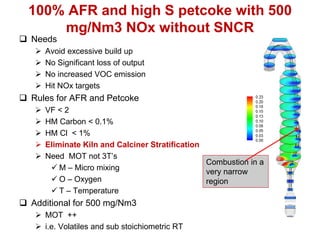
      Eliminate Kiln and Calciner Stratification
      Need MOT not 3T’s
                                                  Combustion in a
         M – Micro mixing
                                                  very narrow
         O – Oxygen                              region
         T – Temperature
 Additional for 500 mg/Nm3
    MOT ++
    i.e. Volatiles and sub stoichiometric RT
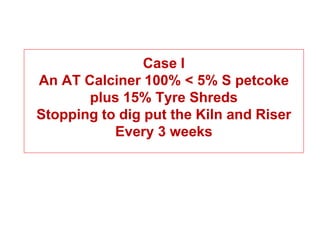
Case I
An AT Calciner 100% < 5% S petcoke
       plus 15% Tyre Shreds
Stopping to dig put the Kiln and Riser
           Every 3 weeks
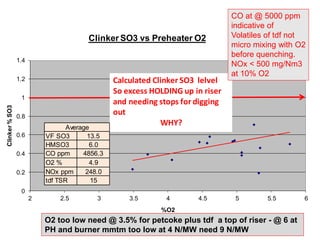
CO at @ 5000 ppm
                                                                               indicative of
                                       Clinker SO3 vs Preheater O2             Volatiles of tdf not
                                                                               micro mixing with O2
                                                                               before quenching.
                1.4
                                                                               NOx < 500 mg/Nm3
                                                                               at 10% O2
                1.2                            Calculated Clinker SO3 lelvel
                                               So excess HOLDING up in riser
                 1
                                               and needing stops for digging
Clinker % SO3


                0.8
                                               out
                                 Average
                                                            WHY?
                0.6       VF SO3       13.5
                          HMSO3         6.0
                0.4       CO ppm      4856.3
                          O2 %          4.9
                0.2       NOx ppm      248.0
                          tdf TSR        15
                 0
                      2       2.5         3        3.5       4       4.5        5       5.5       6
                                                           %O2
                          O2 too low need @ 3.5% for petcoke plus tdf a top of riser - @ 6 at
                          PH and burner mmtm too low at 4 N/MW need 9 N/MW
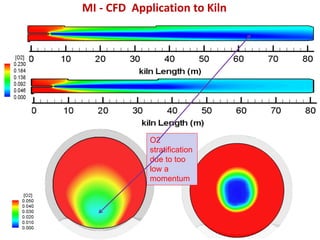
MI - CFD Application to Kiln


             O2
             stratification
             due to too
             low a
             momentum
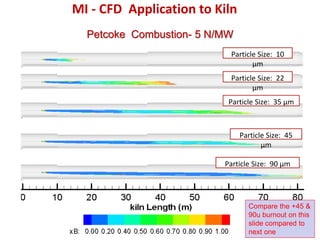
MI - CFD Application to Kiln
  Petcoke Combustion- 5 N/MW
                           Particle Size: 10
                                  µm
                           Particle Size: 22
                                  µm
                           Particle Size: 35 µm


                               Particle Size: 45
                                      µm

                          Particle Size: 90 µm


                                 Compare the +45 &
                                 90u burnout on this
                                 slide compared to
                                 next one
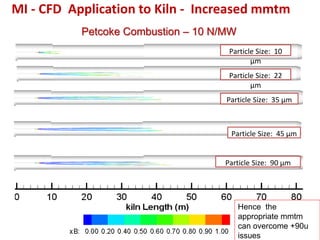
MI - CFD Application to Kiln - Increased mmtm
           Petcoke Combustion – 10 N/MW
                                      Particle Size: 10
                                             µm
                                      Particle Size: 22
                                             µm
                                     Particle Size: 35 µm


                                      Particle Size: 45 µm


                                     Particle Size: 90 µm


                                          Hence the
                                          appropriate mmtm
                                          can overcome +90u
                                          issues
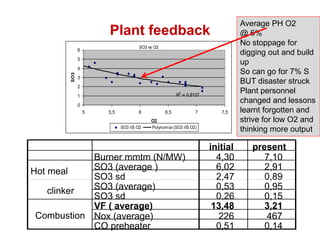
Average PH O2
                     Plant feedback                                          @ 6%
                                   SO3 vs O2
                                                                             No stoppage for
             6
                                                                             digging out and build
             5
                                                                             up
             4
       SO3                                                                   So can go for 7% S
             3
                                                                             BUT disaster struck
             2
                                                     R2 = 0,8157
                                                                             Plant personnel
             1
             0
                                                                             changed and lessons
                 5   5,5           6           6,5            7       7,5    learnt forgotten and
                                        O2                                   strive for low O2 and
                           SO3 VS O2     Polynomial (SO3 VS O2)
                                                                             thinking more output

                                                                   initial      present
            Burner mmtm (N/MW)                                       4,30          7,10
Hot meal    SO3 (average )                                           6,02          2,91
            SO3 sd                                                   2,47          0,89
    clinker SO3 (average)                                            0,53          0,95
            SO3 sd                                                   0,26          0,15
            VF ( average)                                           13,48          3,21
 Combustion Nox (average)                                            226           467
            CO preheater                                             0,51          0,14
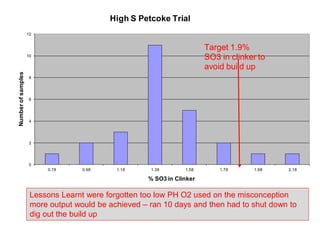
High S Petcoke Trial
                    12


                                                                       Target 1.9%
                    10
                                                                       SO3 in clinker to
                                                                       avoid build up
Number of samples


                     8


                     6


                     4


                     2


                     0
                         0.78      0.98     1.18     1.38       1.58       1.78     1.98   2.18

                                                    % SO3 in Clinker

                     Lessons Learnt were forgotten too low PH O2 used on the misconception
                     more output would be achieved – ran 10 days and then had to shut down to
                     dig out the build up
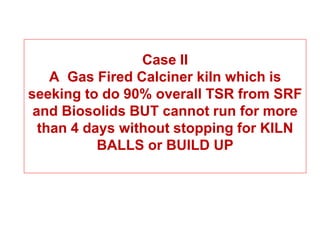
Case II
    A Gas Fired Calciner kiln which is
seeking to do 90% overall TSR from SRF
 and Biosolids BUT cannot run for more
  than 4 days without stopping for KILN
           BALLS or BUILD UP
Kiln Balls and Build Up
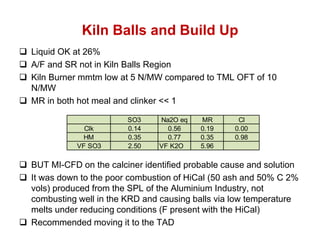
 Liquid OK at 26%
 A/F and SR not in Kiln Balls Region
 Kiln Burner mmtm low at 5 N/MW compared to TML OFT of 10
  N/MW
 MR in both hot meal and clinker << 1

                         SO3     Na2O eq   MR       Cl
               Clk       0.14      0.56    0.19    0.00
              HM         0.35      0.77    0.35    0.98
             VF SO3      2.50    VF K2O    5.96

 BUT MI-CFD on the calciner identified probable cause and solution
 It was down to the poor combustion of HiCal (50 ash and 50% C 2%
  vols) produced from the SPL of the Aluminium Industry, not
  combusting well in the KRD and causing balls via low temperature
  melts under reducing conditions (F present with the HiCal)
 Recommended moving it to the TAD
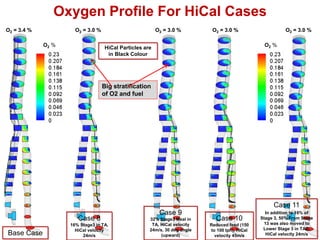
Oxygen Profile For HiCal Cases
O2 = 3.4 %            O2 = 3.0 %                         O2 = 3.0 %         O2 = 3.0 %                     O2 = 3.0 %

             O2 %                                                                                O2 %
                                   HiCal Particles are
                                    in Black Colour


                                   Big stratification
                                   of O2 and fuel


                                                                                                     Case 11
                                                          Case 9                                  In addition to 16% of
                       Case 8                        32% Stage3 Meal in      Case 10            Stage 3, 50% From Stage
                    16% Stage3 in TA,                 TA, HiCal velocity   Reduced feed (150     13 was also moved to
                      HiCal velocity                 24m/s, 30 deg angle   to 100 tph), HiCal    Lower Stage 3 in TAD,
Base Case                24m/s                            (upward)           velocity 45m/s       HiCal velocity 24m/s
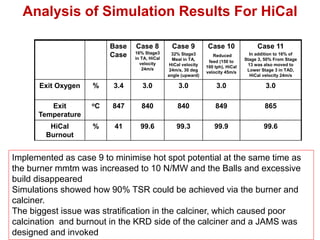
Analysis of Simulation Results For HiCal

                         Base   Case 8           Case 9          Case 10                Case 11
                                16% Stage3
                         Case   in TA, HiCal
                                                 32% Stage3         Reduced          In addition to 16% of
                                                 Meal in TA,      feed (150 to     Stage 3, 50% From Stage
                                  velocity      HiCal velocity                      13 was also moved to
                                   24m/s                         100 tph), HiCal
                                                24m/s, 30 deg    velocity 45m/s     Lower Stage 3 in TAD,
                                               angle (upward)                        HiCal velocity 24m/s

      Exit Oxygen   %    3.4       3.0              3.0               3.0                   3.0

         Exit       oC   847       840             840               849                   865
      Temperature
         HiCal      %     41      99.6             99.3              99.9                  99.6
        Burnout


Implemented as case 9 to minimise hot spot potential at the same time as
the burner mmtm was increased to 10 N/MW and the Balls and excessive
build disappeared
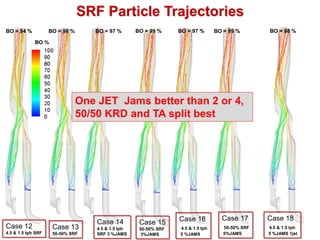
Simulations showed how 90% TSR could be achieved via the burner and
calciner.
The biggest issue was stratification in the calciner, which caused poor
calcination and burnout in the KRD side of the calciner and a JAMS was
designed and invoked
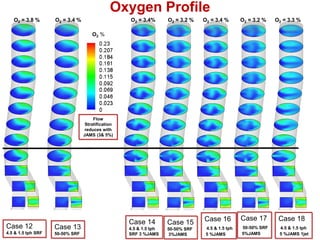
Oxygen Profile
   O2 = 3.8 %       O2 = 3.4 %                     O2 = 3.4%       O2 = 3.2 %   O2 = 3.4 %       O2 = 3.2 %   O2 = 3.3 %

                                     O2 %


                                      Flow
                                  Stratification
                                  reduces with
                                 JAMS (3& 5%)


                                                                                Case 16          Case 17       Case 18
                                                   Case 14         Case 15
Case 12             Case 13                        4.5 & 1.5 tph   50-50% SRF    4.5 & 1.5 tph   50-50% SRF    4.5 & 1.5 tph
4.5 & 1.5 tph SRF   50-50% SRF                     SRF 3 %JAMS      3%JAMS       5 %JAMS         5%JAMS        5 %JAMS 1jet
SRF Particle Trajectories
BO = 94 %           BO = 98 %      BO = 97 %        BO = 99 %     BO = 97 %       BO = 99 %       BO = 98 %

             BO %


                                One JET Jams better than 2 or 4,
                                50/50 KRD and TA split best


                                                                  Case 16           Case 17       Case 18
                                    Case 14          Case 15
Case 12              Case 13        4.5 & 1.5 tph    50-50% SRF   4.5 & 1.5 tph      50-50% SRF   4.5 & 1.5 tph
4.5 & 1.5 tph SRF    50-50% SRF     SRF 3 %JAMS       3%JAMS      5 %JAMS            5%JAMS       5 %JAMS 1jet
Case III
 A coal fired calciner at 70% TSR
wishes to go to 100% Calciner TSR
       with only 2 secs RT
  Current Issues CO and @ 75C
increase in PH outlet temperature
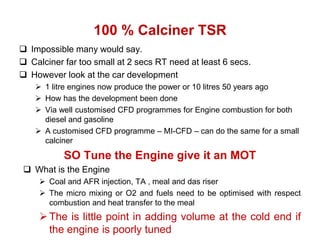
100 % Calciner TSR
 Impossible many would say.
 Calciner far too small at 2 secs RT need at least 6 secs.
 However look at the car development
     1 litre engines now produce the power or 10 litres 50 years ago
     How has the development been done
     Via well customised CFD programmes for Engine combustion for both
      diesel and gasoline
     A customised CFD programme – MI-CFD – can do the same for a small
      calciner
           SO Tune the Engine give it an MOT
  What is the Engine
      Coal and AFR injection, TA , meal and das riser
      The micro mixing or O2 and fuels need to be optimised with respect
       combustion and heat transfer to the meal
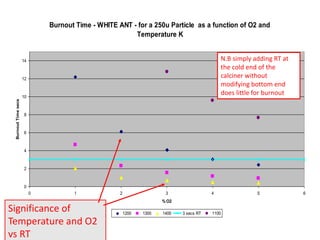
      The is little point in adding volume at the cold end if
       the engine is poorly tuned
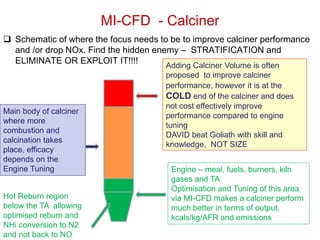
MI-CFD - Calciner
 Schematic of where the focus needs to be to improve calciner performance
  and /or drop NOx. Find the hidden enemy – STRATIFICATION and
  ELIMINATE OR EXPLOIT IT!!!!
                                       Adding Calciner Volume is often
                                       proposed to improve calciner
                                       performance, however it is at the
                                       COLD end of the calciner and does
                                       not cost effectively improve
Main body of calciner
                                       performance compared to engine
where more
                                       tuning
combustion and
                                       DAVID beat Goliath with skill and
calcination takes
                                       knowledge, NOT SIZE
place, efficacy
depends on the
Engine Tuning                           Engine – meal, fuels, burners, kiln
                                        gases and TA
                                        Optimisation and Tuning of this area
Hot Reburn region                       via MI-CFD makes a calciner perform
below the TA allowing                   much better in terms of output,
optimised reburn and                    kcals/kg/AFR and emissions
NHi conversion to N2
and not back to NO
Burnout Time - WHITE ANT - for a 250u Particle as a function of O2 and
                                                        Temperature K


                     14                                                                      N.B simply adding RT at
                                                                                             the cold end of the
                     12
                                                                                             calciner without
                                                                                             modifying bottom end
                     10
                                                                                             does little for burnout
 Burnout Time secs


                     8


                     6


                     4


                     2


                     0
                          0          1              2                  3                 4               5             6
                                                                      % O2
Significance of                                         1200   1300   1400   3 secs RT   1100

Temperature and O2
vs RT
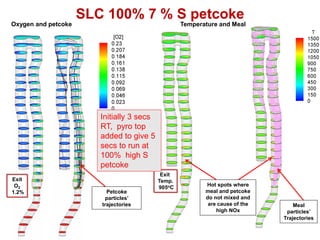
SLC 100% 7 % S petcoke
Oxygen and petcoke                                 Temperature and Meal


                        Initially 3 secs
                        RT, pyro top
                        added to give 5
                        secs to run at
                        100% high S
                        petcoke
                                            Exit
Exit                                       Temp.
 O2                                        905oC          Hot spots where
1.2%                      Petcoke                         meal and petcoke
                         particles’                       do not mixed and
                        trajectories                       are cause of the       Meal
                                                              high NOx         particles’
                                                                              Trajectories
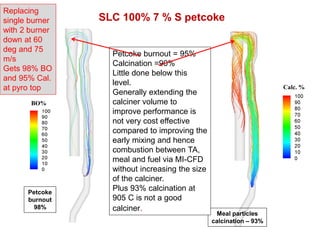
Replacing
single burner   SLC 100% 7 % S petcoke
with 2 burner
down at 60
deg and 75
                  Petcoke burnout = 95%
m/s
                  Calcination =90%
Gets 98% BO
                  Little done below this
and 95% Cal.
                  level.
at pyro top                                                         Calc. %
                  Generally extending the
       BO%        calciner volume to
                  improve performance is
                  not very cost effective
                  compared to improving the
                  early mixing and hence
                  combustion between TA,
                  meal and fuel via MI-CFD
                  without increasing the size
                  of the calciner.
      Petcoke
                  Plus 93% calcination at
      burnout     905 C is not a good
       98%        calciner.
                                                 Meal particles
                                                calcination – 93%
100% Calciner TSR
 CINAR did initially work for this calciner plant to overcome problems of
  poor coal burnout and calcination and very bad build up
 This is shown on the next 3 slides, how a low cost modification to the
  TA inlets enabled them to overcome the problem and get to @ 70%
  calciner TSR with an Engineered Fuel (EF), however the Plant Manager
  wanted to get to 100%
 .As the calciner has only 2 secs RT this proved to be difficult for them,
  due to CO, less of output and elevated PH outlet temperature and we
  were asked again to help
 From simulations of the current operations it was identified that:-
     The EF was being quenched too fast to get a good burnout and its path was
      going to the lower O2 regions in the calciner and only burning out to 73%
     Simulations of the EF and coal injection points, plus meal splits and a
      venturi a series of recommendations were made to get potential to 100%
      TSR
Oxygen Mass Fraction [-]


    Original

                                   Modified

              Original Modified
 Burnout %       70      93
Calcination %    70      90
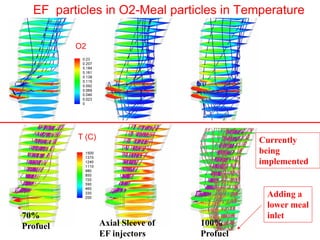
The EF releases
 Oxygen Profiles / Fuel Trajectories       if volatiles fast,
                                              but is then
                                            quenched too
                                           fast by the meal
                                           and then travels
                                              in a low O2
         Case         Base Case              region which
   Coal Burnout (%)      99                    makes the
    EF Burnout %         73                  burnout poor
   Total Burnout %       81
     Calcination         95               Near the walls of
                                          there are oxygen

 Coal / O2                        EF / O2 rich areas where
                                          available oxygen
                                           would enhance
                                             the burnout
O2 [m/m]
EF particles in O2-Meal particles in Temperature

          O2


          T (C)                               Currently
                                              being
                                              implemented


                                               Adding a
                                               lower meal
70%                                            inlet
Profuel           Axial Sleeve of   100%
                  EF injectors      Profuel
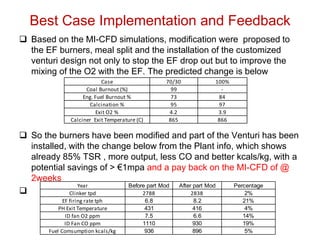
Best Case Implementation and Feedback
 Based on the MI-CFD simulations, modification were proposed to
  the EF burners, meal split and the installation of the customized
  venturi design not only to stop the EF drop out but to improve the
  mixing of the O2 with the EF. The predicted change is below
                            Case                  70/30         100%
                     Coal Burnout (%)               99            -
                    Eng. Fuel Burnout %             73           84
                       Calcination %                95           97
                          Exit O2 %                4.2           3.9
               Calciner Exit Temperature (C)       865           866

 So the burners have been modified and part of the Venturi has been
  installed, with the change below from the Plant info, which shows
  already 85% TSR , more output, less CO and better kcals/kg, with a
  potential savings of > €1mpa and a pay back on the MI-CFD of @
  2weeks
                Year       Before part Mod After part Mod Percentage
            Clinker tpd        2788            2838          2%
             EF firing rate tph             6.8           8.2          21%
           PH Exit Temperature              431           416           4%
              ID fan O2 ppm                 7.5           6.6          14%
              ID Fan CO ppm                1110           930          19%
       Fuel Comsumption kcals/kg            936           896           5%
Case IV
 A Plant is 100% petcoke, but cannot
get above 2.5% S, without running into
 build up issues, even though it has a
clinker MR of 0.6 and wishes to go for
  100% high S petcoke plus AFR and
           meet 600 mg/Nm3
Current issues apart from build up is a
               hot spot
        Calciner RT @ 2.5 sec
Meal and Fuel Particles Tracking – current operation
                                                                         Meal Particles
    Av. Burnout: 83%          Av. Calc: 75%           Fuel Particles &   & Temperature
                                                      O2


                                                                                     T [oC]


Burnout /
Calcination                                      O2 [kg/kg]


              Poor burnout/ calcination plus a hot spot
              Engine need TUNING
Splitting Meal, Modifying Petcoke Burner and Injecting Alternative Fuels

   T [oC]
                                                       Pink: SRF
                                       O2 [kg/kg]


                                                       Black:
                                                       Petcoke


                                                        Purple:
                                                        BF 1
   Hotspots at
   cone and                             60% Meal
   cylinder                             mass
                                        injected       Yellow:
   body
                                        below TA       BF 2
   reduced by
   better meal
   calcination.                                             AF´s falling to kiln hearth
                                                            should be avoided by
                     Av. Calcination: 88%                   insert installation in order
 High temperatures                                          to prevent build up
                     Petcoke Av. Burnout: 98%
 caused by AF´s ,                                           formation .
 dropping through    SRF Av. Burnout: 95%
 need a customised   Bio Fuel 1 Av. Burnout: 86%
 venturi             Biofuel 2 Av. Burnout:90%
Case V
A newly built coal fired calciner running
at 800 to 1000 mg/Nm3 needs to hit < 500
          mg/Nm3 without SNCR

Needed CINAR Hot Reburn Technology
Essentials of Hot Reburn Retrofit
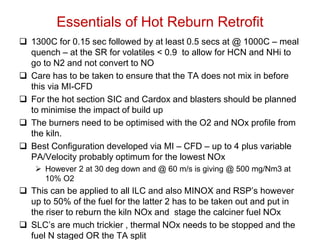
 1300C for 0.15 sec followed by at least 0.5 secs at @ 1000C – meal
  quench – at the SR for volatiles < 0.9 to allow for HCN and NHi to
  go to N2 and not convert to NO
 Care has to be taken to ensure that the TA does not mix in before
  this via MI-CFD
 For the hot section SIC and Cardox and blasters should be planned
  to minimise the impact of build up
 The burners need to be optimised with the O2 and NOx profile from
  the kiln.
 Best Configuration developed via MI – CFD – up to 4 plus variable
  PA/Velocity probably optimum for the lowest NOx
     However 2 at 30 deg down and @ 60 m/s is giving @ 500 mg/Nm3 at
      10% O2
 This can be applied to all ILC and also MINOX and RSP’s however
  up to 50% of the fuel for the latter 2 has to be taken out and put in
  the riser to reburn the kiln NOx and stage the calciner fuel NOx
 SLC’s are much trickier , thermal NOx needs to be stopped and the
  fuel N staged OR the TA split
NOx to 500 mg/Nm3
 The simulation below shows a prediction for normal
operation that show the calciner NO generation to give a
calciner exit NOx of 850 ppm , with a reburn temperature max
< 1200oC;
  NOx                                     T [oC]
  [ppm]

                       Coal injection
                       /Meal injection
                       @ 12 m (@ 0.5
                       secs) to TA
                       mixing

 The reason it is not meeting 500 mg/Nm3 is that the reburn
  temperature is too low for the 0.5 secs RT between the coal
  injection and the TA mixing into the reburn zone
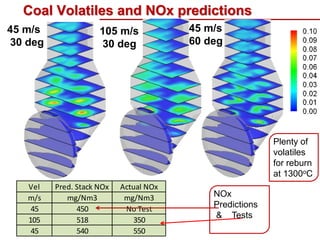
 Dropping the burners by 3.5 m and optimizing them gets
1300C for 0.15 sec before meal and plus 0.5 before TA mixing
Coal Volatiles and NOx predictions
45 m/s               105 m/s            45 m/s
30 deg               30 deg             60 deg


                                                          Plenty of
                                                          volatiles
                                                          for reburn
                                                          at 1300oC
   Vel   Pred. Stack NOx   Actual NOx
   m/s      mg/Nm3          mg/Nm3          NOx
    45         450          No Test         Predictions
                                            & Tests
   105         518            350
    45         540            550
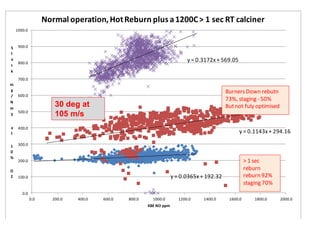
Normal operation, Hot Reburn plus a 1200C > 1 sec RT calciner
    1000.0


S    900.0
t
a
     800.0
                                                                         y = 0.3172x + 569.05
c
k
     700.0
m
g                                                                                        Burners Down rebutn
/    600.0
N
                                                                                         73%, staging - 50%
m
                      30 deg at                                                          But not fuly optimised
     500.0
3                     105 m/s
a    400.0
t                                                                                               y = 0.1143x + 294.16

1    300.0
0
%
     200.0                                                                                         > 1 sec
O
                                                                                                   reburn
2    100.0                                                        y = 0.0365x + 192.32             reburn 92%
                                                                                                   staging 70%
       0.0
             0.0     200.0   400.0   600.0   800.0     1000.0        1200.0    1400.0     1600.0       1800.0     2000.0
                                                     KBE NO ppm
NOx Summary
 Hot reburn can and is being applied to ILC, RSP’s and AT calciners,
  via MI-CFD to reach < 500 mg/Nm3 without SNCR
 Petcoke can be trickier due to its low volatiles
 Which results in a higher NOx for the same fuel N
 This is due to the char N contributing potentially @ 50% of the NOx
  emission, due to the fact that while the NO from the char N is
  normally reduced to < 100 ppm by the NOx form the volatiles in the
  boundary layer, the low SSA of low volatile petcoke does not allow
  this to happen
 However the hot reburn 0.15 sec section drives off more volatiles
  than the proximate analysis test gives and is working well for ILC
 SLC’s of the long vertical type are giving an problem, the key need
  is a not reburn after most of the volatile and char NOx has been
  formed
    This is under development and Plant tests currently being carried out
     12000 kms East of here
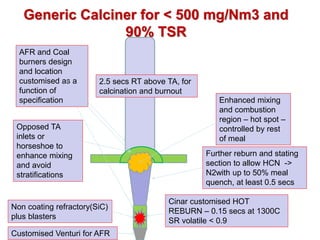
Generic Calciner for < 500 mg/Nm3 and
                 90% TSR
  AFR and Coal
  burners design
  and location
  customised as a       2.5 secs RT above TA, for
  function of           calcination and burnout
  specification                                        Enhanced mixing
                                                       and combustion
                                                       region – hot spot –
 Opposed TA                                            controlled by rest
 inlets or                                             of meal
 horseshoe to
 enhance mixing                                     Further reburn and stating
 and avoid                                          section to allow HCN ->
 stratifications                                    N2with up to 50% meal
                                                    quench, at least 0.5 secs

                                          Cinar customised HOT
Non coating refractory(SiC)
                                          REBURN – 0.15 secs at 1300C
plus blasters
                                          SR volatile < 0.9
Customised Venturi for AFR
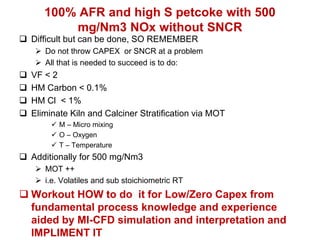
100% AFR and high S petcoke with 500
           mg/Nm3 NOx without SNCR
 Difficult but can be done, SO REMEMBER
      Do not throw CAPEX or SNCR at a problem
      All that is needed to succeed is to do:
   VF < 2
   HM Carbon < 0.1%
   HM Cl < 1%
   Eliminate Kiln and Calciner Stratification via MOT
          M – Micro mixing
          O – Oxygen
          T – Temperature
 Additionally for 500 mg/Nm3
      MOT ++
      i.e. Volatiles and sub stoichiometric RT
 Workout HOW to do it for Low/Zero Capex from
  fundamental process knowledge and experience
  aided by MI-CFD simulation and interpretation and
  IMPLIMENT IT
Cinar’s Clients- Producers and Manufacturers
CINAR delivers solutions to AFR, Process and Emission
Issues in 3 months from Kick Off.
Over 130 projects for cement and lime.
Have Corporate Contracts for all aspects of Process, AFR,
Output and Emissions


                                                        CHERAT


                                                        CEMENT
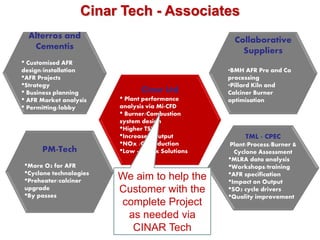
Cinar Tech - Associates
  Alterros and                                    Collaborative
   Cementis                                         Suppliers
• Customised AFR
design/installation                             •BMH AFR Pre and Co
•AFR Projects                                   processing
•Strategy                                       •Pillard Kiln and
• Business planning           Cinar Ltd         Calciner Burner
• AFR Market analysis   • Plant performance     optimisation
• Permitting/lobby      analysis via Mi-CFD
                        • Burner/Combustion
                        system design
                        •Higher TSR
                        •Increased Output            TML - CPEC
                        •NOx /CO reduction      Plant/Process/Burner &
      PM-Tech           •Low –CapEx Solutions     Cyclone Assessment
                                                •MLRA data analysis
•More O2 for AFR                                •Workshops/training
•Cyclone technologies                           •AFR specification
•Preheater/calciner     We aim to help the      •Impact on Output
upgrade                 Customer with the       •SO3 cycle drivers
•By passes                                      •Quality improvement
                        complete Project
                         as needed via
                          CINAR Tech

100% High S petcoke and AFR with &lt; 500 mg/Nm3 NOx

  • 2.
    100% AFR andhigh S petcoke with 500 mg/Nm3 NOx without SNCR by The CINAR TEAM Presented by Tom Lowes at Cemtech Conference Marrakech 12th Feb 2013 Summary Experience based fundamental practical rules to achieve 100% AFR with a high S petcoke are outlined; together Plant Cases where it has been done, with the use of Process Knowledge and experience aided as needed by MI- CFD, together with the basics of low CAPEX hot reburn retrofits to drop the contribution of kiln NOx and calciner fuels N to NOx emissions with Plants cases where it has been done to meet < 500 mg/Nm3 without SNCR
  • 3.
    100% AFR andhigh S petcoke with 500 mg/Nm3 NOx without SNCR  Not easy to achieve  Outside experience of most process people  Need to Understand ( 3W’s):  Why there is a the Problem?  Where is it occurring ?  WHTBD?  Have the ability to go in side the kiln and calciner and see WHERE the problem is happening and WHY.  Then Identify WHTBD via Process Knowledge, MI-CFD simulations and interpretation of a range of potential solutions  This paper will give the rules and show how it can be done for little or no additional CAPEX on 5 of the 130 + Plants Projects that have been done by the CINAR TEAM as a means of guiding Plants to their own specific solutions
  • 4.
    100% AFR andhigh S petcoke with 500 mg/Nm3 NOx without SNCR  Needs  Avoid excessive build up  No Significant loss of output  No increased VOC emission  Hit NOx targets  Rules for AFR and Petcoke  VF < 2  HM Carbon < 0.1%  HM Cl < 1%  Eliminate Kiln and Calciner Stratification  Need MOT not 3T’s Combustion in a  M – Micro mixing very narrow  O – Oxygen region  T – Temperature  Additional for 500 mg/Nm3  MOT ++  i.e. Volatiles and sub stoichiometric RT
  • 5.
    Case I An ATCalciner 100% < 5% S petcoke plus 15% Tyre Shreds Stopping to dig put the Kiln and Riser Every 3 weeks
  • 6.
    CO at @5000 ppm indicative of Clinker SO3 vs Preheater O2 Volatiles of tdf not micro mixing with O2 before quenching. 1.4 NOx < 500 mg/Nm3 at 10% O2 1.2 Calculated Clinker SO3 lelvel So excess HOLDING up in riser 1 and needing stops for digging Clinker % SO3 0.8 out Average WHY? 0.6 VF SO3 13.5 HMSO3 6.0 0.4 CO ppm 4856.3 O2 % 4.9 0.2 NOx ppm 248.0 tdf TSR 15 0 2 2.5 3 3.5 4 4.5 5 5.5 6 %O2 O2 too low need @ 3.5% for petcoke plus tdf a top of riser - @ 6 at PH and burner mmtm too low at 4 N/MW need 9 N/MW
  • 7.
    MI - CFDApplication to Kiln O2 stratification due to too low a momentum
  • 8.
    MI - CFDApplication to Kiln Petcoke Combustion- 5 N/MW Particle Size: 10 µm Particle Size: 22 µm Particle Size: 35 µm Particle Size: 45 µm Particle Size: 90 µm Compare the +45 & 90u burnout on this slide compared to next one
  • 9.
    MI - CFDApplication to Kiln - Increased mmtm Petcoke Combustion – 10 N/MW Particle Size: 10 µm Particle Size: 22 µm Particle Size: 35 µm Particle Size: 45 µm Particle Size: 90 µm Hence the appropriate mmtm can overcome +90u issues
  • 10.
    Average PH O2 Plant feedback @ 6% SO3 vs O2 No stoppage for 6 digging out and build 5 up 4 SO3 So can go for 7% S 3 BUT disaster struck 2 R2 = 0,8157 Plant personnel 1 0 changed and lessons 5 5,5 6 6,5 7 7,5 learnt forgotten and O2 strive for low O2 and SO3 VS O2 Polynomial (SO3 VS O2) thinking more output initial present Burner mmtm (N/MW) 4,30 7,10 Hot meal SO3 (average ) 6,02 2,91 SO3 sd 2,47 0,89 clinker SO3 (average) 0,53 0,95 SO3 sd 0,26 0,15 VF ( average) 13,48 3,21 Combustion Nox (average) 226 467 CO preheater 0,51 0,14
  • 11.
    High S PetcokeTrial 12 Target 1.9% 10 SO3 in clinker to avoid build up Number of samples 8 6 4 2 0 0.78 0.98 1.18 1.38 1.58 1.78 1.98 2.18 % SO3 in Clinker Lessons Learnt were forgotten too low PH O2 used on the misconception more output would be achieved – ran 10 days and then had to shut down to dig out the build up
  • 12.
    Case II A Gas Fired Calciner kiln which is seeking to do 90% overall TSR from SRF and Biosolids BUT cannot run for more than 4 days without stopping for KILN BALLS or BUILD UP
  • 13.
    Kiln Balls andBuild Up  Liquid OK at 26%  A/F and SR not in Kiln Balls Region  Kiln Burner mmtm low at 5 N/MW compared to TML OFT of 10 N/MW  MR in both hot meal and clinker << 1 SO3 Na2O eq MR Cl Clk 0.14 0.56 0.19 0.00 HM 0.35 0.77 0.35 0.98 VF SO3 2.50 VF K2O 5.96  BUT MI-CFD on the calciner identified probable cause and solution  It was down to the poor combustion of HiCal (50 ash and 50% C 2% vols) produced from the SPL of the Aluminium Industry, not combusting well in the KRD and causing balls via low temperature melts under reducing conditions (F present with the HiCal)  Recommended moving it to the TAD
  • 14.
    Oxygen Profile ForHiCal Cases O2 = 3.4 % O2 = 3.0 % O2 = 3.0 % O2 = 3.0 % O2 = 3.0 % O2 % O2 % HiCal Particles are in Black Colour Big stratification of O2 and fuel Case 11 Case 9 In addition to 16% of Case 8 32% Stage3 Meal in Case 10 Stage 3, 50% From Stage 16% Stage3 in TA, TA, HiCal velocity Reduced feed (150 13 was also moved to HiCal velocity 24m/s, 30 deg angle to 100 tph), HiCal Lower Stage 3 in TAD, Base Case 24m/s (upward) velocity 45m/s HiCal velocity 24m/s
  • 15.
    Analysis of SimulationResults For HiCal Base Case 8 Case 9 Case 10 Case 11 16% Stage3 Case in TA, HiCal 32% Stage3 Reduced In addition to 16% of Meal in TA, feed (150 to Stage 3, 50% From Stage velocity HiCal velocity 13 was also moved to 24m/s 100 tph), HiCal 24m/s, 30 deg velocity 45m/s Lower Stage 3 in TAD, angle (upward) HiCal velocity 24m/s Exit Oxygen % 3.4 3.0 3.0 3.0 3.0 Exit oC 847 840 840 849 865 Temperature HiCal % 41 99.6 99.3 99.9 99.6 Burnout Implemented as case 9 to minimise hot spot potential at the same time as the burner mmtm was increased to 10 N/MW and the Balls and excessive build disappeared Simulations showed how 90% TSR could be achieved via the burner and calciner. The biggest issue was stratification in the calciner, which caused poor calcination and burnout in the KRD side of the calciner and a JAMS was designed and invoked
  • 16.
    Oxygen Profile O2 = 3.8 % O2 = 3.4 % O2 = 3.4% O2 = 3.2 % O2 = 3.4 % O2 = 3.2 % O2 = 3.3 % O2 % Flow Stratification reduces with JAMS (3& 5%) Case 16 Case 17 Case 18 Case 14 Case 15 Case 12 Case 13 4.5 & 1.5 tph 50-50% SRF 4.5 & 1.5 tph 50-50% SRF 4.5 & 1.5 tph 4.5 & 1.5 tph SRF 50-50% SRF SRF 3 %JAMS 3%JAMS 5 %JAMS 5%JAMS 5 %JAMS 1jet
  • 17.
    SRF Particle Trajectories BO= 94 % BO = 98 % BO = 97 % BO = 99 % BO = 97 % BO = 99 % BO = 98 % BO % One JET Jams better than 2 or 4, 50/50 KRD and TA split best Case 16 Case 17 Case 18 Case 14 Case 15 Case 12 Case 13 4.5 & 1.5 tph 50-50% SRF 4.5 & 1.5 tph 50-50% SRF 4.5 & 1.5 tph 4.5 & 1.5 tph SRF 50-50% SRF SRF 3 %JAMS 3%JAMS 5 %JAMS 5%JAMS 5 %JAMS 1jet
  • 18.
    Case III Acoal fired calciner at 70% TSR wishes to go to 100% Calciner TSR with only 2 secs RT Current Issues CO and @ 75C increase in PH outlet temperature
  • 19.
    100 % CalcinerTSR  Impossible many would say.  Calciner far too small at 2 secs RT need at least 6 secs.  However look at the car development  1 litre engines now produce the power or 10 litres 50 years ago  How has the development been done  Via well customised CFD programmes for Engine combustion for both diesel and gasoline  A customised CFD programme – MI-CFD – can do the same for a small calciner SO Tune the Engine give it an MOT  What is the Engine  Coal and AFR injection, TA , meal and das riser  The micro mixing or O2 and fuels need to be optimised with respect combustion and heat transfer to the meal  The is little point in adding volume at the cold end if the engine is poorly tuned
  • 20.
    MI-CFD - Calciner Schematic of where the focus needs to be to improve calciner performance and /or drop NOx. Find the hidden enemy – STRATIFICATION and ELIMINATE OR EXPLOIT IT!!!! Adding Calciner Volume is often proposed to improve calciner performance, however it is at the COLD end of the calciner and does not cost effectively improve Main body of calciner performance compared to engine where more tuning combustion and DAVID beat Goliath with skill and calcination takes knowledge, NOT SIZE place, efficacy depends on the Engine Tuning Engine – meal, fuels, burners, kiln gases and TA Optimisation and Tuning of this area Hot Reburn region via MI-CFD makes a calciner perform below the TA allowing much better in terms of output, optimised reburn and kcals/kg/AFR and emissions NHi conversion to N2 and not back to NO
  • 21.
    Burnout Time -WHITE ANT - for a 250u Particle as a function of O2 and Temperature K 14 N.B simply adding RT at the cold end of the 12 calciner without modifying bottom end 10 does little for burnout Burnout Time secs 8 6 4 2 0 0 1 2 3 4 5 6 % O2 Significance of 1200 1300 1400 3 secs RT 1100 Temperature and O2 vs RT
  • 22.
    SLC 100% 7% S petcoke Oxygen and petcoke Temperature and Meal Initially 3 secs RT, pyro top added to give 5 secs to run at 100% high S petcoke Exit Exit Temp. O2 905oC Hot spots where 1.2% Petcoke meal and petcoke particles’ do not mixed and trajectories are cause of the Meal high NOx particles’ Trajectories
  • 23.
    Replacing single burner SLC 100% 7 % S petcoke with 2 burner down at 60 deg and 75 Petcoke burnout = 95% m/s Calcination =90% Gets 98% BO Little done below this and 95% Cal. level. at pyro top Calc. % Generally extending the BO% calciner volume to improve performance is not very cost effective compared to improving the early mixing and hence combustion between TA, meal and fuel via MI-CFD without increasing the size of the calciner. Petcoke Plus 93% calcination at burnout 905 C is not a good 98% calciner. Meal particles calcination – 93%
  • 24.
    100% Calciner TSR CINAR did initially work for this calciner plant to overcome problems of poor coal burnout and calcination and very bad build up  This is shown on the next 3 slides, how a low cost modification to the TA inlets enabled them to overcome the problem and get to @ 70% calciner TSR with an Engineered Fuel (EF), however the Plant Manager wanted to get to 100%  .As the calciner has only 2 secs RT this proved to be difficult for them, due to CO, less of output and elevated PH outlet temperature and we were asked again to help  From simulations of the current operations it was identified that:-  The EF was being quenched too fast to get a good burnout and its path was going to the lower O2 regions in the calciner and only burning out to 73%  Simulations of the EF and coal injection points, plus meal splits and a venturi a series of recommendations were made to get potential to 100% TSR
  • 25.
    Oxygen Mass Fraction[-] Original Modified Original Modified Burnout % 70 93 Calcination % 70 90
  • 26.
    The EF releases Oxygen Profiles / Fuel Trajectories if volatiles fast, but is then quenched too fast by the meal and then travels in a low O2 Case Base Case region which Coal Burnout (%) 99 makes the EF Burnout % 73 burnout poor Total Burnout % 81 Calcination 95 Near the walls of there are oxygen Coal / O2 EF / O2 rich areas where available oxygen would enhance the burnout O2 [m/m]
  • 27.
    EF particles inO2-Meal particles in Temperature O2 T (C) Currently being implemented Adding a lower meal 70% inlet Profuel Axial Sleeve of 100% EF injectors Profuel
  • 28.
    Best Case Implementationand Feedback  Based on the MI-CFD simulations, modification were proposed to the EF burners, meal split and the installation of the customized venturi design not only to stop the EF drop out but to improve the mixing of the O2 with the EF. The predicted change is below Case 70/30 100% Coal Burnout (%) 99 - Eng. Fuel Burnout % 73 84 Calcination % 95 97 Exit O2 % 4.2 3.9 Calciner Exit Temperature (C) 865 866  So the burners have been modified and part of the Venturi has been installed, with the change below from the Plant info, which shows already 85% TSR , more output, less CO and better kcals/kg, with a potential savings of > €1mpa and a pay back on the MI-CFD of @ 2weeks Year Before part Mod After part Mod Percentage  Clinker tpd 2788 2838 2% EF firing rate tph 6.8 8.2 21% PH Exit Temperature 431 416 4% ID fan O2 ppm 7.5 6.6 14% ID Fan CO ppm 1110 930 19% Fuel Comsumption kcals/kg 936 896 5%
  • 29.
    Case IV APlant is 100% petcoke, but cannot get above 2.5% S, without running into build up issues, even though it has a clinker MR of 0.6 and wishes to go for 100% high S petcoke plus AFR and meet 600 mg/Nm3 Current issues apart from build up is a hot spot Calciner RT @ 2.5 sec
  • 30.
    Meal and FuelParticles Tracking – current operation Meal Particles Av. Burnout: 83% Av. Calc: 75% Fuel Particles & & Temperature O2 T [oC] Burnout / Calcination O2 [kg/kg] Poor burnout/ calcination plus a hot spot Engine need TUNING
  • 31.
    Splitting Meal, ModifyingPetcoke Burner and Injecting Alternative Fuels T [oC] Pink: SRF O2 [kg/kg] Black: Petcoke Purple: BF 1 Hotspots at cone and 60% Meal cylinder mass injected Yellow: body below TA BF 2 reduced by better meal calcination. AF´s falling to kiln hearth should be avoided by Av. Calcination: 88% insert installation in order High temperatures to prevent build up Petcoke Av. Burnout: 98% caused by AF´s , formation . dropping through SRF Av. Burnout: 95% need a customised Bio Fuel 1 Av. Burnout: 86% venturi Biofuel 2 Av. Burnout:90%
  • 32.
    Case V A newlybuilt coal fired calciner running at 800 to 1000 mg/Nm3 needs to hit < 500 mg/Nm3 without SNCR Needed CINAR Hot Reburn Technology
  • 33.
    Essentials of HotReburn Retrofit  1300C for 0.15 sec followed by at least 0.5 secs at @ 1000C – meal quench – at the SR for volatiles < 0.9 to allow for HCN and NHi to go to N2 and not convert to NO  Care has to be taken to ensure that the TA does not mix in before this via MI-CFD  For the hot section SIC and Cardox and blasters should be planned to minimise the impact of build up  The burners need to be optimised with the O2 and NOx profile from the kiln.  Best Configuration developed via MI – CFD – up to 4 plus variable PA/Velocity probably optimum for the lowest NOx  However 2 at 30 deg down and @ 60 m/s is giving @ 500 mg/Nm3 at 10% O2  This can be applied to all ILC and also MINOX and RSP’s however up to 50% of the fuel for the latter 2 has to be taken out and put in the riser to reburn the kiln NOx and stage the calciner fuel NOx  SLC’s are much trickier , thermal NOx needs to be stopped and the fuel N staged OR the TA split
  • 34.
    NOx to 500mg/Nm3  The simulation below shows a prediction for normal operation that show the calciner NO generation to give a calciner exit NOx of 850 ppm , with a reburn temperature max < 1200oC; NOx T [oC] [ppm] Coal injection /Meal injection @ 12 m (@ 0.5 secs) to TA mixing  The reason it is not meeting 500 mg/Nm3 is that the reburn temperature is too low for the 0.5 secs RT between the coal injection and the TA mixing into the reburn zone  Dropping the burners by 3.5 m and optimizing them gets 1300C for 0.15 sec before meal and plus 0.5 before TA mixing
  • 35.
    Coal Volatiles andNOx predictions 45 m/s 105 m/s 45 m/s 30 deg 30 deg 60 deg Plenty of volatiles for reburn at 1300oC Vel Pred. Stack NOx Actual NOx m/s mg/Nm3 mg/Nm3 NOx 45 450 No Test Predictions & Tests 105 518 350 45 540 550
  • 36.
    Normal operation, HotReburn plus a 1200C > 1 sec RT calciner 1000.0 S 900.0 t a 800.0 y = 0.3172x + 569.05 c k 700.0 m g Burners Down rebutn / 600.0 N 73%, staging - 50% m 30 deg at But not fuly optimised 500.0 3 105 m/s a 400.0 t y = 0.1143x + 294.16 1 300.0 0 % 200.0 > 1 sec O reburn 2 100.0 y = 0.0365x + 192.32 reburn 92% staging 70% 0.0 0.0 200.0 400.0 600.0 800.0 1000.0 1200.0 1400.0 1600.0 1800.0 2000.0 KBE NO ppm
  • 37.
    NOx Summary  Hotreburn can and is being applied to ILC, RSP’s and AT calciners, via MI-CFD to reach < 500 mg/Nm3 without SNCR  Petcoke can be trickier due to its low volatiles  Which results in a higher NOx for the same fuel N  This is due to the char N contributing potentially @ 50% of the NOx emission, due to the fact that while the NO from the char N is normally reduced to < 100 ppm by the NOx form the volatiles in the boundary layer, the low SSA of low volatile petcoke does not allow this to happen  However the hot reburn 0.15 sec section drives off more volatiles than the proximate analysis test gives and is working well for ILC  SLC’s of the long vertical type are giving an problem, the key need is a not reburn after most of the volatile and char NOx has been formed  This is under development and Plant tests currently being carried out 12000 kms East of here
  • 38.
    Generic Calciner for< 500 mg/Nm3 and 90% TSR AFR and Coal burners design and location customised as a 2.5 secs RT above TA, for function of calcination and burnout specification Enhanced mixing and combustion region – hot spot – Opposed TA controlled by rest inlets or of meal horseshoe to enhance mixing Further reburn and stating and avoid section to allow HCN -> stratifications N2with up to 50% meal quench, at least 0.5 secs Cinar customised HOT Non coating refractory(SiC) REBURN – 0.15 secs at 1300C plus blasters SR volatile < 0.9 Customised Venturi for AFR
  • 39.
    100% AFR andhigh S petcoke with 500 mg/Nm3 NOx without SNCR  Difficult but can be done, SO REMEMBER  Do not throw CAPEX or SNCR at a problem  All that is needed to succeed is to do:  VF < 2  HM Carbon < 0.1%  HM Cl < 1%  Eliminate Kiln and Calciner Stratification via MOT  M – Micro mixing  O – Oxygen  T – Temperature  Additionally for 500 mg/Nm3  MOT ++  i.e. Volatiles and sub stoichiometric RT  Workout HOW to do it for Low/Zero Capex from fundamental process knowledge and experience aided by MI-CFD simulation and interpretation and IMPLIMENT IT
  • 40.
    Cinar’s Clients- Producersand Manufacturers CINAR delivers solutions to AFR, Process and Emission Issues in 3 months from Kick Off. Over 130 projects for cement and lime. Have Corporate Contracts for all aspects of Process, AFR, Output and Emissions CHERAT CEMENT
  • 41.
    Cinar Tech -Associates Alterros and Collaborative Cementis Suppliers • Customised AFR design/installation •BMH AFR Pre and Co •AFR Projects processing •Strategy •Pillard Kiln and • Business planning Cinar Ltd Calciner Burner • AFR Market analysis • Plant performance optimisation • Permitting/lobby analysis via Mi-CFD • Burner/Combustion system design •Higher TSR •Increased Output TML - CPEC •NOx /CO reduction Plant/Process/Burner & PM-Tech •Low –CapEx Solutions Cyclone Assessment •MLRA data analysis •More O2 for AFR •Workshops/training •Cyclone technologies •AFR specification •Preheater/calciner We aim to help the •Impact on Output upgrade Customer with the •SO3 cycle drivers •By passes •Quality improvement complete Project as needed via CINAR Tech