S T E E L
Module
Steel:Properties and
uses of Reinforced Steel
2
2
Table of Content
3
1. History of Steel
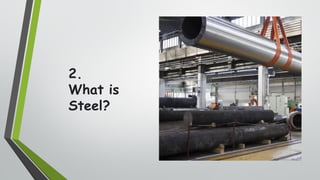
2. What is Steel?
3. What is Reinforced Steel?
4. Need for Reinforced Steel
5. Types of Reinforced Steel
6. Why Steel?
7. Properties of Reinforced Steel
8. Uses of Reinforced Steel
9. Whats New?
10. Conclusion
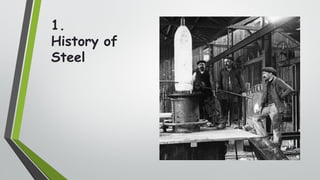
1.
History of
Steel
4
5
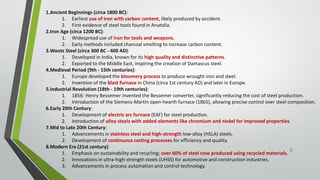
1.Ancient Beginnings (circa 1800 BC):
1. Earliest use of iron with carbon content, likely produced by accident.
2. First evidence of steel tools found in Anatolia.
2.Iron Age (circa 1200 BC):
1. Widespread use of iron for tools and weapons.
2. Early methods included charcoal smelting to increase carbon content.
3.Wootz Steel (circa 300 BC - 400 AD):
1. Developed in India, known for its high quality and distinctive patterns.
2. Exported to the Middle East, inspiring the creation of Damascus steel.
4.Medieval Period (9th - 15th centuries):
1. Europe developed the bloomery process to produce wrought iron and steel.
2. Invention of the blast furnace in China (circa 1st century AD) and later in Europe.
5.Industrial Revolution (18th - 19th centuries):
1. 1856: Henry Bessemer invented the Bessemer converter, significantly reducing the cost of steel production.
2. Introduction of the Siemens-Martin open-hearth furnace (1865), allowing precise control over steel composition.
6.Early 20th Century:
1. Development of electric arc furnace (EAF) for steel production.
2. Introduction of alloy steels with added elements like chromium and nickel for improved properties.
7.Mid to Late 20th Century:
1. Advancements in stainless steel and high-strength low-alloy (HSLA) steels.
2. Development of continuous casting processes for efficiency and quality.
8.Modern Era (21st century):
1. Emphasis on sustainability and recycling; over 60% of steel now produced using recycled materials.
2. Innovations in ultra-high-strength steels (UHSS) for automotive and construction industries.
3. Advancements in process automation and control technology.
6
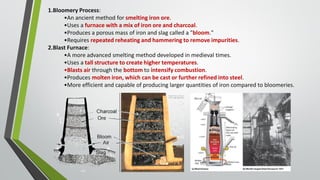
1.Bloomery Process:
•An ancient method for smelting iron ore.
•Uses a furnace with a mix of iron ore and charcoal.
•Produces a porous mass of iron and slag called a "bloom."
•Requires repeated reheating and hammering to remove impurities.
2.Blast Furnace:
•A more advanced smelting method developed in medieval times.
•Uses a tall structure to create higher temperatures.
•Blasts air through the bottom to intensify combustion.
•Produces molten iron, which can be cast or further refined into steel.
•More efficient and capable of producing larger quantities of iron compared to bloomeries.
7
2.
What is
Steel?
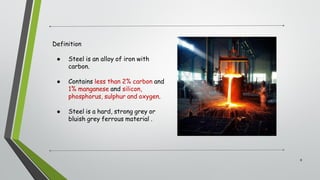
Definition
● Steel is an alloy of iron with
carbon.
● Contains less than 2% carbon and
1% manganese and silicon,
phosphorus, sulphur and oxygen.
● Steel is a hard, strong grey or
bluish grey ferrous material .
8
3.
Reinforced
Steel
9
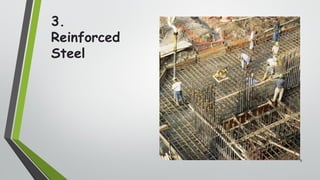
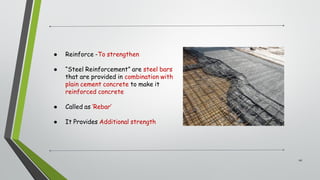
● Reinforce -To strengthen
● “Steel Reinforcement” are steel bars
that are provided in combination with
plain cement concrete to make it
reinforced concrete
● Called as ‘Rebar’
● It Provides Additional strength
10
11
4.
Need for
Reinforced
Steel
12
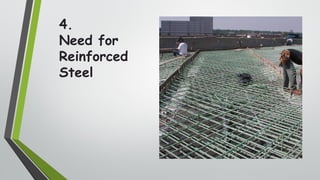
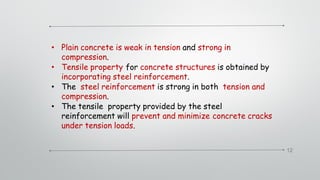
• Plain concrete is weak in tension and strong in
compression.
• Tensile property for concrete structures is obtained by
incorporating steel reinforcement.
• The steel reinforcement is strong in both tension and
compression.
• The tensile property provided by the steel
reinforcement will prevent and minimize concrete cracks
under tension loads.
13
5.
Types and
properties of
Reinforced
Steel
1. Hot Rolled Deformed Bars
14
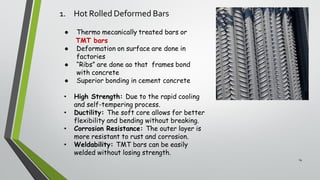
● Thermo mecanically treated bars or
TMT bars
● Deformation on surface are done in
factories
● “Ribs” are done ao that frames bond
with concrete
● Superior bonding in cement concrete
• High Strength: Due to the rapid cooling
and self-tempering process.
• Ductility: The soft core allows for better
flexibility and bending without breaking.
• Corrosion Resistance: The outer layer is
more resistant to rust and corrosion.
• Weldability: TMT bars can be easily
welded without losing strength.
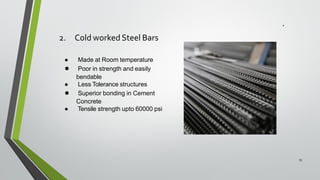
2. Cold workedSteel Bars
15
● Made at Room temperature
● Poor in strength and easily
bendable
● Less Tolerance structures
● Superior bonding in Cement
Concrete
● Tensile strength upto 60000 psi
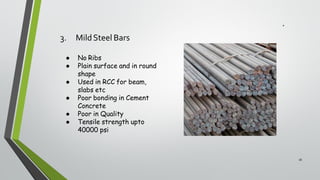
3. MildSteel Bars
16
● No Ribs
● Plain surface and in round
shape
● Used in RCC for beam,
slabs etc
● Poor bonding in Cement
Concrete
● Poor in Quality
● Tensile strength upto
40000 psi
4. TwistedSteel Bars
17
● Also known as Prestressing
Tendons
● These are made of different
wires spun together into a
strand
● It can carry high Tensile
strength upto 270000 psi
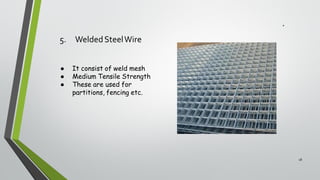
5. WeldedSteelWire
18
● It consist of weld mesh
● Medium Tensile Strength
● These are used for
partitions, fencing etc.
19
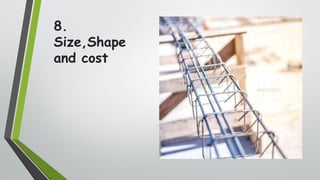
8.
Size,Shape
and cost
20
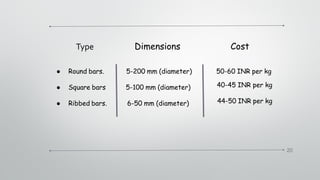
● Round bars.
● Square bars
● Ribbed bars.
5-200 mm (diameter)
5-100 mm (diameter)
6-50 mm (diameter)
50-60 INR per kg
40-45 INR per kg
44-50 INR per kg
Type Dimensions Cost
21
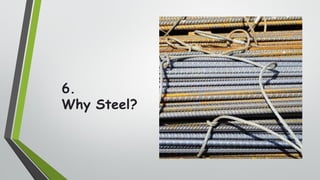
6.
Why Steel?
22
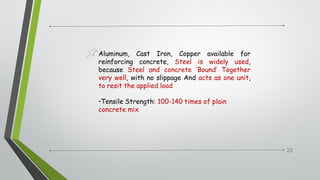
Aluminum, Cast Iron, Copper available for
reinforcing concrete, Steel is widely used,
because Steel and concrete ‘Bound’ Together
very well, with no slippage And acts as one unit,
to resit the applied load
•Tensile Strength: 100-140 times of plain
concrete mix
23
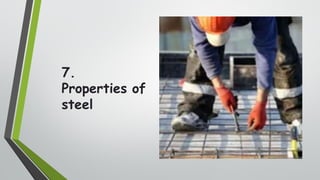
7.
Properties of
steel
● High ductile
● It is eco-friendly
● Recyclable
● Long lasting Material
● Extreme Strength and Durable
● Can resist Bad-weather
● Fire resistant
● Does not rot
● Quality of Construction
● Expand existing structure
● Surfaces are easy to clean
● Weld easily
● less expensive
● Design Freedom
24
25
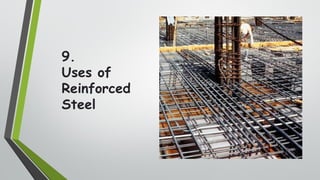
9.
Uses of
Reinforced
Steel
It is used in
● Bridges
● Buildings
● Skyscrapers
● Homes
● Warehouses
● Foundations to increase the
strength of a concrete
structure.
26
Conclusion
27
“
28
Strength, Durability and longer life span“
Thank You

MMBC MODULE II - STEEL presentation 2222

  • 1.
    S T EE L
  • 2.
  • 3.
    Table of Content 3 1.History of Steel 2. What is Steel? 3. What is Reinforced Steel? 4. Need for Reinforced Steel 5. Types of Reinforced Steel 6. Why Steel? 7. Properties of Reinforced Steel 8. Uses of Reinforced Steel 9. Whats New? 10. Conclusion
  • 4.
  • 5.
    5 1.Ancient Beginnings (circa1800 BC): 1. Earliest use of iron with carbon content, likely produced by accident. 2. First evidence of steel tools found in Anatolia. 2.Iron Age (circa 1200 BC): 1. Widespread use of iron for tools and weapons. 2. Early methods included charcoal smelting to increase carbon content. 3.Wootz Steel (circa 300 BC - 400 AD): 1. Developed in India, known for its high quality and distinctive patterns. 2. Exported to the Middle East, inspiring the creation of Damascus steel. 4.Medieval Period (9th - 15th centuries): 1. Europe developed the bloomery process to produce wrought iron and steel. 2. Invention of the blast furnace in China (circa 1st century AD) and later in Europe. 5.Industrial Revolution (18th - 19th centuries): 1. 1856: Henry Bessemer invented the Bessemer converter, significantly reducing the cost of steel production. 2. Introduction of the Siemens-Martin open-hearth furnace (1865), allowing precise control over steel composition. 6.Early 20th Century: 1. Development of electric arc furnace (EAF) for steel production. 2. Introduction of alloy steels with added elements like chromium and nickel for improved properties. 7.Mid to Late 20th Century: 1. Advancements in stainless steel and high-strength low-alloy (HSLA) steels. 2. Development of continuous casting processes for efficiency and quality. 8.Modern Era (21st century): 1. Emphasis on sustainability and recycling; over 60% of steel now produced using recycled materials. 2. Innovations in ultra-high-strength steels (UHSS) for automotive and construction industries. 3. Advancements in process automation and control technology.
  • 6.
    6 1.Bloomery Process: •An ancientmethod for smelting iron ore. •Uses a furnace with a mix of iron ore and charcoal. •Produces a porous mass of iron and slag called a "bloom." •Requires repeated reheating and hammering to remove impurities. 2.Blast Furnace: •A more advanced smelting method developed in medieval times. •Uses a tall structure to create higher temperatures. •Blasts air through the bottom to intensify combustion. •Produces molten iron, which can be cast or further refined into steel. •More efficient and capable of producing larger quantities of iron compared to bloomeries.
  • 7.
  • 8.
    Definition ● Steel isan alloy of iron with carbon. ● Contains less than 2% carbon and 1% manganese and silicon, phosphorus, sulphur and oxygen. ● Steel is a hard, strong grey or bluish grey ferrous material . 8
  • 9.
  • 10.
    ● Reinforce -Tostrengthen ● “Steel Reinforcement” are steel bars that are provided in combination with plain cement concrete to make it reinforced concrete ● Called as ‘Rebar’ ● It Provides Additional strength 10
  • 11.
  • 12.
    12 • Plain concreteis weak in tension and strong in compression. • Tensile property for concrete structures is obtained by incorporating steel reinforcement. • The steel reinforcement is strong in both tension and compression. • The tensile property provided by the steel reinforcement will prevent and minimize concrete cracks under tension loads.
  • 13.
  • 14.
    1. Hot RolledDeformed Bars 14 ● Thermo mecanically treated bars or TMT bars ● Deformation on surface are done in factories ● “Ribs” are done ao that frames bond with concrete ● Superior bonding in cement concrete • High Strength: Due to the rapid cooling and self-tempering process. • Ductility: The soft core allows for better flexibility and bending without breaking. • Corrosion Resistance: The outer layer is more resistant to rust and corrosion. • Weldability: TMT bars can be easily welded without losing strength.
  • 15.
    2. Cold workedSteelBars 15 ● Made at Room temperature ● Poor in strength and easily bendable ● Less Tolerance structures ● Superior bonding in Cement Concrete ● Tensile strength upto 60000 psi
  • 16.
    3. MildSteel Bars 16 ●No Ribs ● Plain surface and in round shape ● Used in RCC for beam, slabs etc ● Poor bonding in Cement Concrete ● Poor in Quality ● Tensile strength upto 40000 psi
  • 17.
    4. TwistedSteel Bars 17 ●Also known as Prestressing Tendons ● These are made of different wires spun together into a strand ● It can carry high Tensile strength upto 270000 psi
  • 18.
    5. WeldedSteelWire 18 ● Itconsist of weld mesh ● Medium Tensile Strength ● These are used for partitions, fencing etc.
  • 19.
  • 20.
    20 ● Round bars. ●Square bars ● Ribbed bars. 5-200 mm (diameter) 5-100 mm (diameter) 6-50 mm (diameter) 50-60 INR per kg 40-45 INR per kg 44-50 INR per kg Type Dimensions Cost
  • 21.
  • 22.
    22 Aluminum, Cast Iron,Copper available for reinforcing concrete, Steel is widely used, because Steel and concrete ‘Bound’ Together very well, with no slippage And acts as one unit, to resit the applied load •Tensile Strength: 100-140 times of plain concrete mix
  • 23.
  • 24.
    ● High ductile ●It is eco-friendly ● Recyclable ● Long lasting Material ● Extreme Strength and Durable ● Can resist Bad-weather ● Fire resistant ● Does not rot ● Quality of Construction ● Expand existing structure ● Surfaces are easy to clean ● Weld easily ● less expensive ● Design Freedom 24
  • 25.
  • 26.
    It is usedin ● Bridges ● Buildings ● Skyscrapers ● Homes ● Warehouses ● Foundations to increase the strength of a concrete structure. 26
  • 27.
  • 28.
  • 29.