www.westbaseuk.com
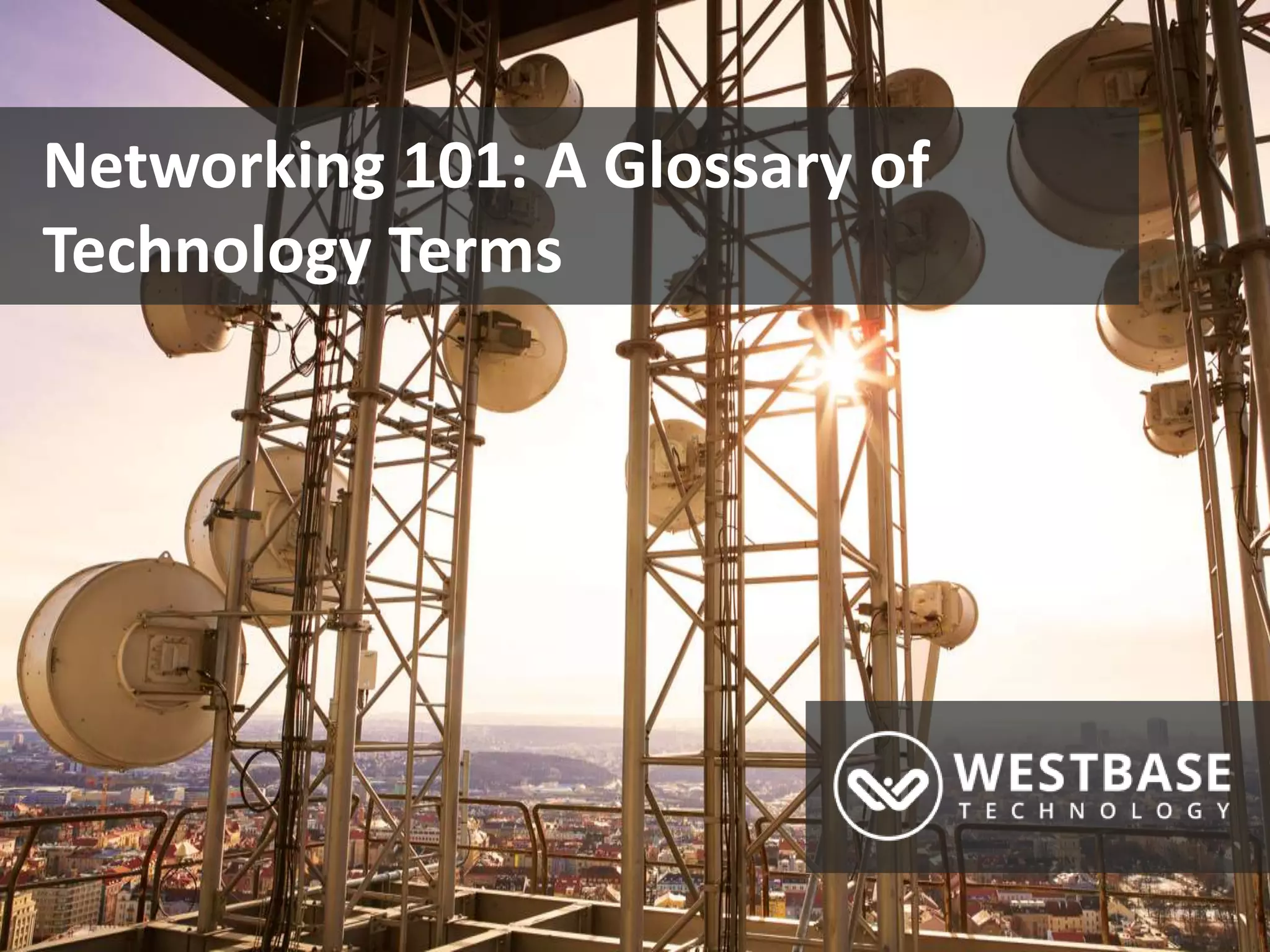
Networking 101: A Glossary of
Technology Terms
www.westbaseuk.com
3G
3G, short form of third generation, is the third generation of UMTS (universal mobile
telecommunications technology). Also known as HSPA or HSPA+, it delivers connectivity speeds and
bandwidth suitable for powering a wide range of applications.
4G
4G is the fourth generation of mobile technology and brings increased speed and bandwidth to
mobile networks. Also known as “LTE” (Long Term Evolution), 4G is unlocking the true potential of
cellular networking and enabling new applications not previously available on 3G.
5G
5G is the fifth generation of mobile technology, not yet available but undergoing development and
testing today. 5G will offer greater capacity, be faster, more energy-efficient and more cost-effective
than any earlier network in order to meet the expanding network demands of technologies such as
the Internet of Things.
Networking 101
Glossary of Terms
www.westbaseuk.com
Business Continuity
Business continuity describes the activities undertaken by an organisation to ensure that any
functions that are critical to the continued running of the business are able to continue in the event
of a serious incident or disaster. This is normally done by assessing the risk to the business of a
range of scenarios, and putting in place plans and systems to mitigate or negate the risk. In terms of
connectivity, we call this “failover”; making sure that a business has back-up connectivity if their
primary connectivity fails.
Distributed Enterprise
A distributed enterprise is an organisation which has a dispersed network of branch locations, as
well as a central head office location which typically manages centralised processes across different
functions. For example retail and restaurant chains or banks. When we talk about the distributed
enterprise in networking specifically, we are referring to geographically-dispersed branches which
are all connected to centralised, back-office systems hosted at a head office location or Network
Operations Centre, which deliver their in-branch applications and services via this connection. This
connection could be fixed line, satellite or cellular.
Networking 101
Glossary of Terms
www.westbaseuk.com
DSL
Digital Subscriber Line is a family of technologies that is used to provide internet access by
transmitting digital data over telephone lines.
Ethernet
Ethernet is the most common type of connection used for a local area network where data is
transferred via cable connections.
Internet of Things (IoT)
The Internet of Things (IoT) is a scenario in which objects including machines, people and animals
are connected via a network. Data can be passed between the objects, each of which is uniquely
identifiable. A real-world example could be a patient wearing a monitor that transmits health data
for doctors to remotely view on their tablet or PC, rather than having to be at the bedside.
Networking 101
Glossary of Terms
www.westbaseuk.com
LAN
Local Area Network (LAN) refers to a computer network that spans a relatively small area such as a
home or business premise.
LTE
LTE stands for "Long Term Evolution" and is another term used to describe 4G mobile technology.
"4G" was originally used to follow on from 3G, but the industry later felt that it didn't appropriately
convey the progress of the technology, so they created "LTE" which has since become a more
recognised term.
Primary Connectivity
Primary connectivity normally refers to the first choice of connectivity a business uses to provide
communication access. In most cases this is the wired public telephone network, although with
connection speeds and reliability improving some businesses are switching to mobile networks.
Networking 101
Glossary of Terms
www.westbaseuk.com
TO VIEW THE FULL
Networking 101: A GLOSSARY
OF Technology TERMS
GUIDE, CLICK HERE TO
DOWNLOAD YOUR COPY
NOW.

Networking Technology 101: A Glossary of Terms

  • 1.
    www.westbaseuk.com Networking 101: AGlossary of Technology Terms
  • 2.
    www.westbaseuk.com 3G 3G, short formof third generation, is the third generation of UMTS (universal mobile telecommunications technology). Also known as HSPA or HSPA+, it delivers connectivity speeds and bandwidth suitable for powering a wide range of applications. 4G 4G is the fourth generation of mobile technology and brings increased speed and bandwidth to mobile networks. Also known as “LTE” (Long Term Evolution), 4G is unlocking the true potential of cellular networking and enabling new applications not previously available on 3G. 5G 5G is the fifth generation of mobile technology, not yet available but undergoing development and testing today. 5G will offer greater capacity, be faster, more energy-efficient and more cost-effective than any earlier network in order to meet the expanding network demands of technologies such as the Internet of Things. Networking 101 Glossary of Terms
  • 3.
    www.westbaseuk.com Business Continuity Business continuitydescribes the activities undertaken by an organisation to ensure that any functions that are critical to the continued running of the business are able to continue in the event of a serious incident or disaster. This is normally done by assessing the risk to the business of a range of scenarios, and putting in place plans and systems to mitigate or negate the risk. In terms of connectivity, we call this “failover”; making sure that a business has back-up connectivity if their primary connectivity fails. Distributed Enterprise A distributed enterprise is an organisation which has a dispersed network of branch locations, as well as a central head office location which typically manages centralised processes across different functions. For example retail and restaurant chains or banks. When we talk about the distributed enterprise in networking specifically, we are referring to geographically-dispersed branches which are all connected to centralised, back-office systems hosted at a head office location or Network Operations Centre, which deliver their in-branch applications and services via this connection. This connection could be fixed line, satellite or cellular. Networking 101 Glossary of Terms
  • 4.
    www.westbaseuk.com DSL Digital Subscriber Lineis a family of technologies that is used to provide internet access by transmitting digital data over telephone lines. Ethernet Ethernet is the most common type of connection used for a local area network where data is transferred via cable connections. Internet of Things (IoT) The Internet of Things (IoT) is a scenario in which objects including machines, people and animals are connected via a network. Data can be passed between the objects, each of which is uniquely identifiable. A real-world example could be a patient wearing a monitor that transmits health data for doctors to remotely view on their tablet or PC, rather than having to be at the bedside. Networking 101 Glossary of Terms
  • 5.
    www.westbaseuk.com LAN Local Area Network(LAN) refers to a computer network that spans a relatively small area such as a home or business premise. LTE LTE stands for "Long Term Evolution" and is another term used to describe 4G mobile technology. "4G" was originally used to follow on from 3G, but the industry later felt that it didn't appropriately convey the progress of the technology, so they created "LTE" which has since become a more recognised term. Primary Connectivity Primary connectivity normally refers to the first choice of connectivity a business uses to provide communication access. In most cases this is the wired public telephone network, although with connection speeds and reliability improving some businesses are switching to mobile networks. Networking 101 Glossary of Terms
  • 6.
    www.westbaseuk.com TO VIEW THEFULL Networking 101: A GLOSSARY OF Technology TERMS GUIDE, CLICK HERE TO DOWNLOAD YOUR COPY NOW.