CELLULAR COMMUNICATION
Prepared by :
Prashant Kumar Gajendra
Regd no.-1305106016
College of Engineering & Technology
Department of C.S.A
Guided by :
Mr. Manjit Kumar Nayak
Contents
 History
 Network Cells
 Frequency Reuse
 Cellular Network components
 Setting and making a call
 Receiving a call
 Cellular concepts & Channels
 GSM & features
 Cellular Services
 Conclusion
History
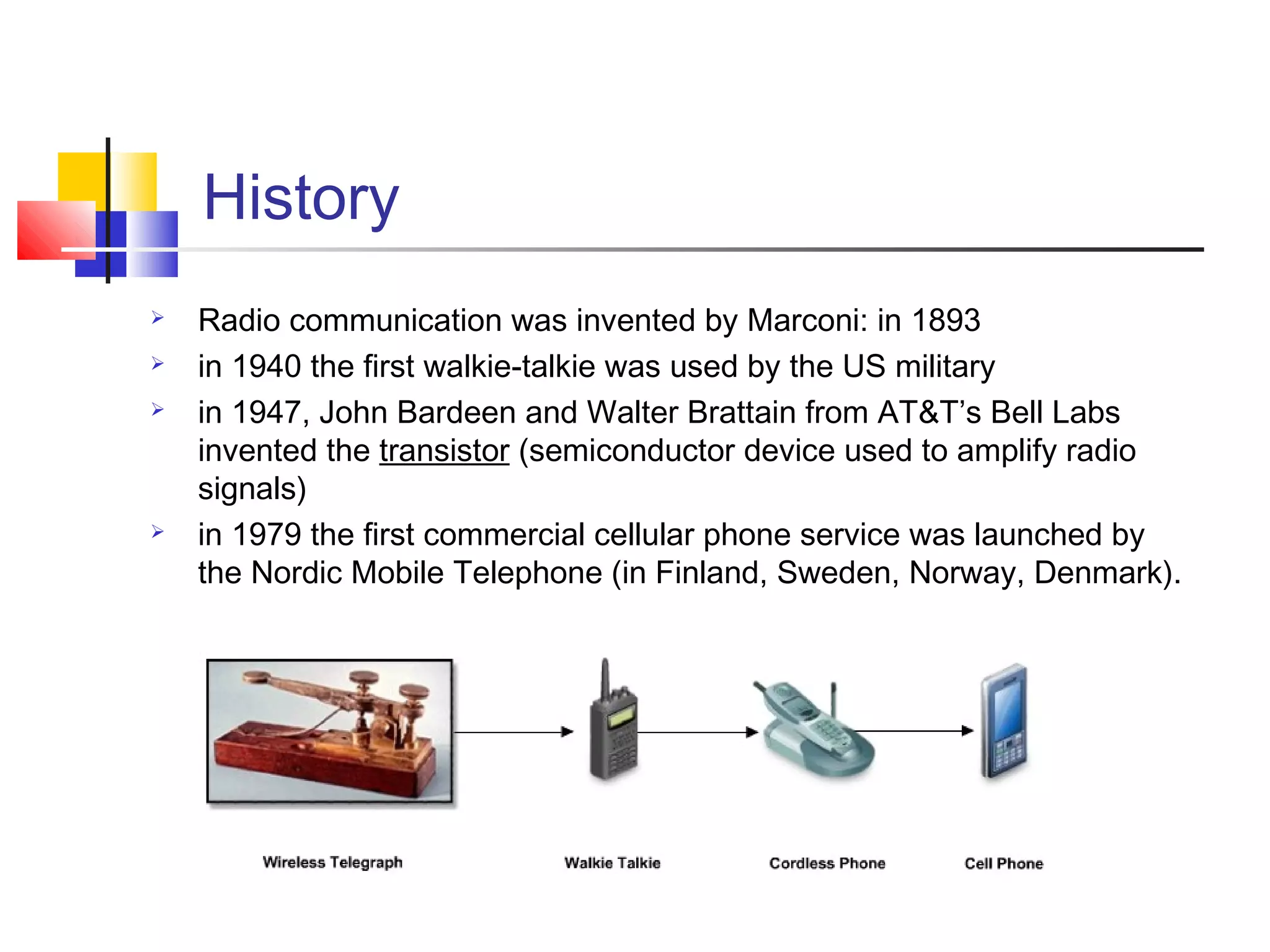
 Radio communication was invented by Marconi: in 1893
 in 1940 the first walkie-talkie was used by the US military
 in 1947, John Bardeen and Walter Brattain from AT&T’s Bell Labs
invented the transistor (semiconductor device used to amplify radio
signals)
 in 1979 the first commercial cellular phone service was launched by
the Nordic Mobile Telephone (in Finland, Sweden, Norway, Denmark).
Cellular systems generations
 1G (first generation) – voice-oriented systems based on analog technology;
ex.: Advanced Mobile Phone Systems (AMPS)
 2G (second generation) - voice-oriented systems based on digital
technology; more efficient and used less spectrum than 1G; ex.: Global
System for Mobile (GSM) and US Time Division Multiple Access (US-
TDMA)
 3G (third generation) – high-speed voice-oriented systems integrated with
data services; ex.: General Packet Radio Service (GPRS), Code Division
Multiple Access (CDMA)
 4G (fourth generation) – mobile ultra-broadband Internet access, for
example to laptops with USB wireless modems to smart phones, and to
other mobile devices
Network Cells
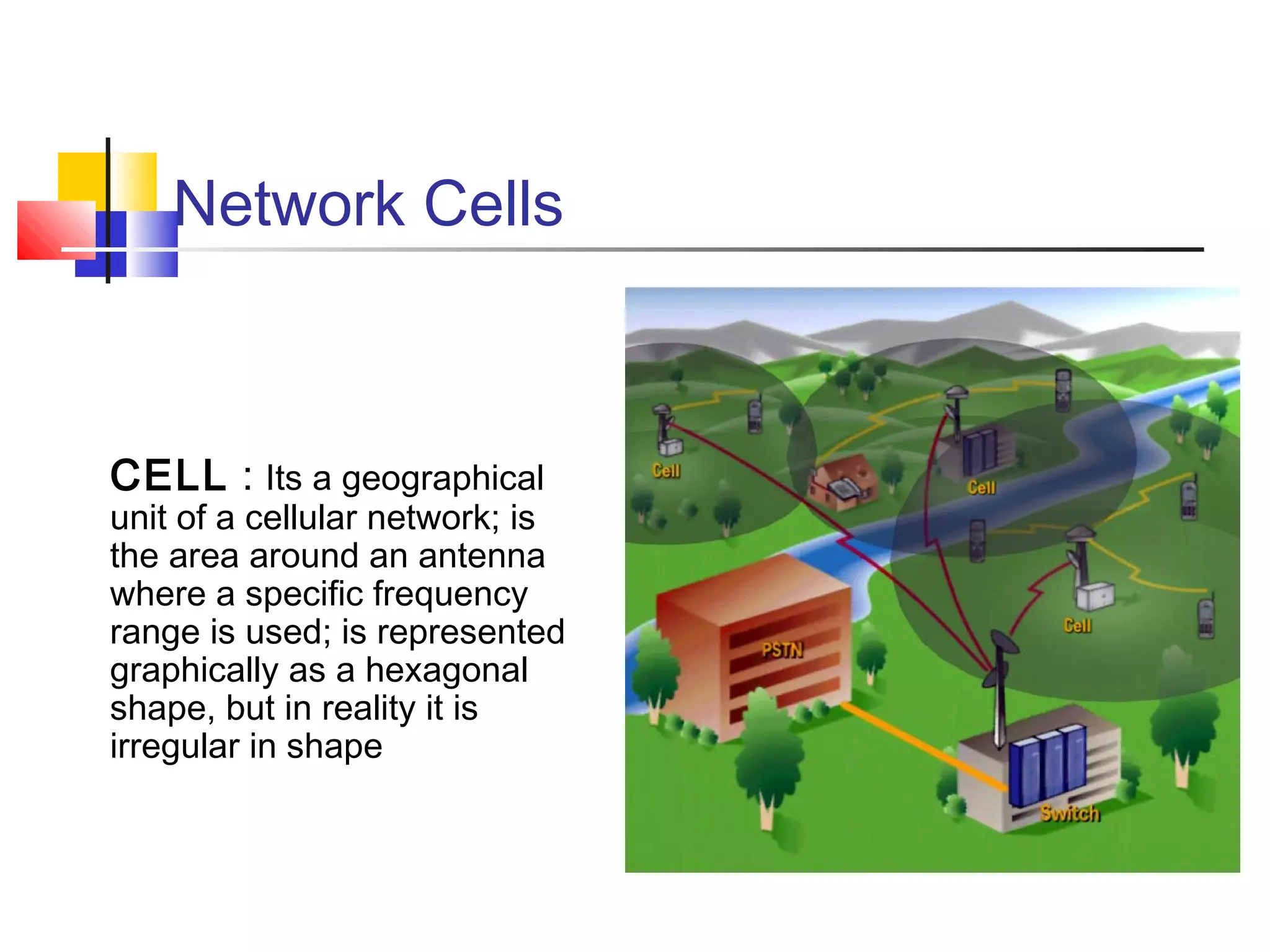
CELL : Its a geographical
unit of a cellular network; is
the area around an antenna
where a specific frequency
range is used; is represented
graphically as a hexagonal
shape, but in reality it is
irregular in shape
Network Cells
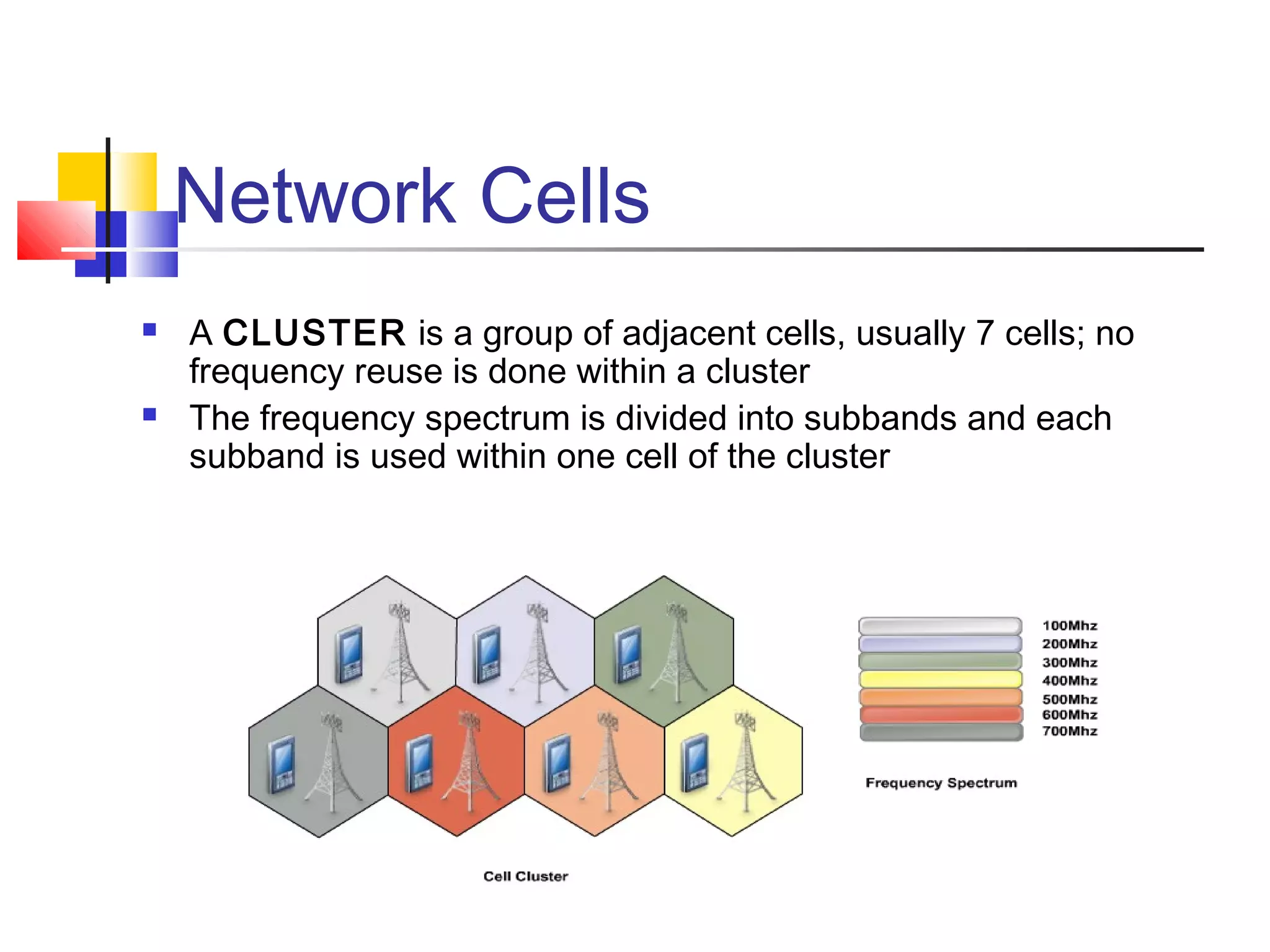
 A CLUSTER is a group of adjacent cells, usually 7 cells; no
frequency reuse is done within a cluster
 The frequency spectrum is divided into subbands and each
subband is used within one cell of the cluster
Frequency reuse
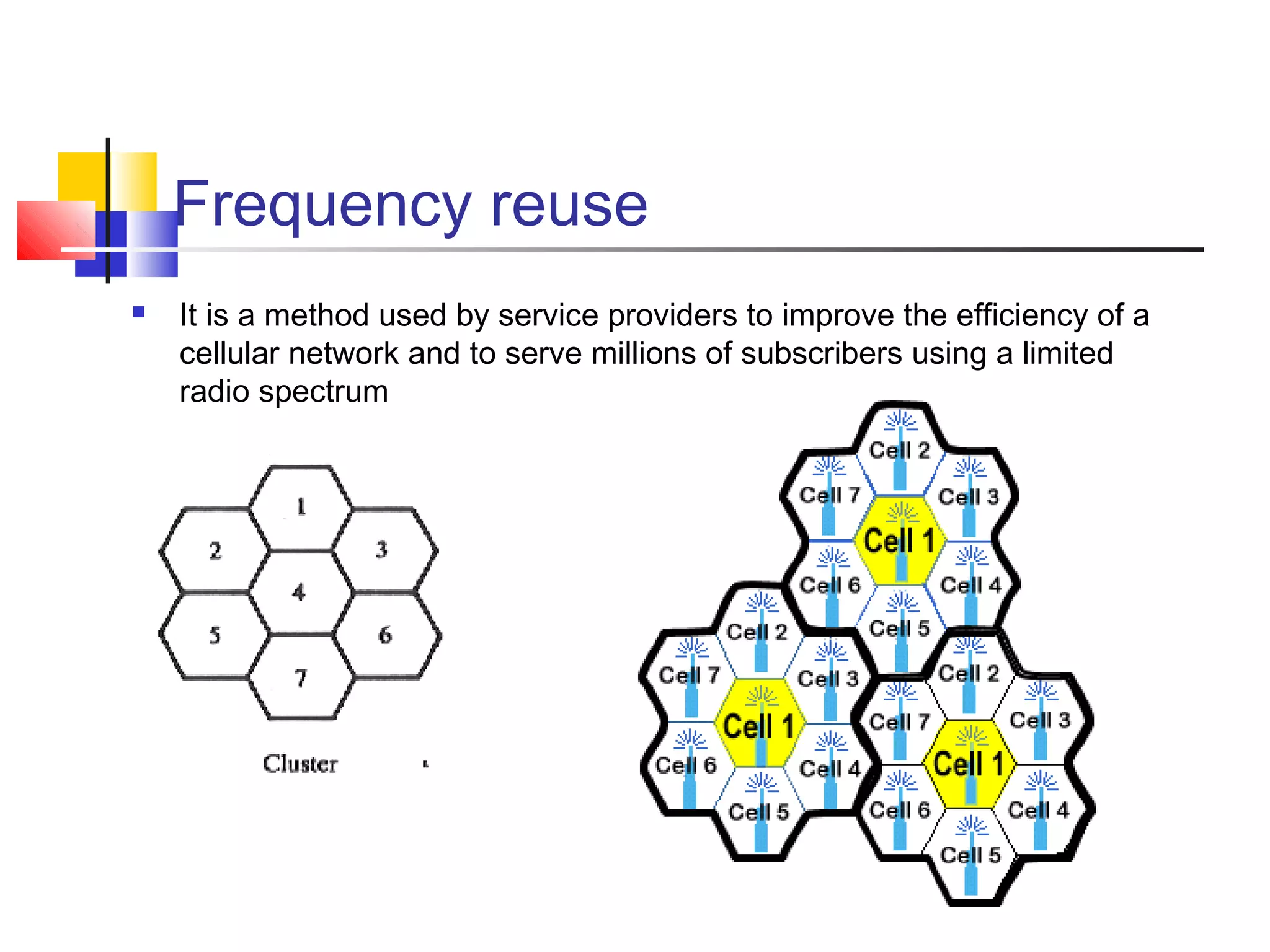
 It is a method used by service providers to improve the efficiency of a
cellular network and to serve millions of subscribers using a limited
radio spectrum
Types of cells
 Macrocell – their coverage is large (aprox. 6 miles in
diameter); used in remote areas, high-power
transmitters and receivers are used
 Microcell – their coverage is small (half a mile in
diameter) and are used in urban zones; low-powered
transmitters and receivers are used to avoid
interference with cells in another clusters
 Picocell – covers areas such as building or a tunnel
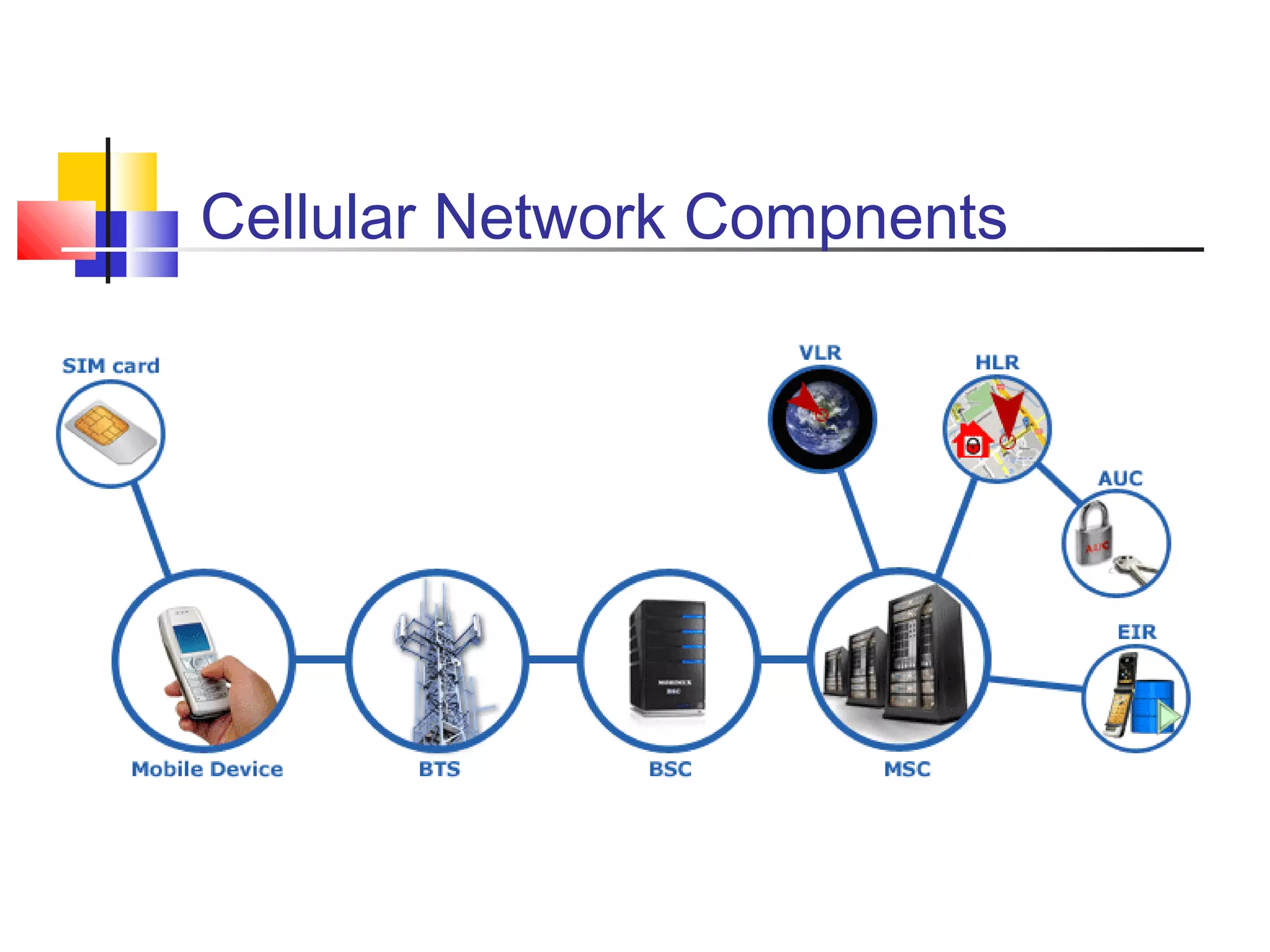
Cellular Network Compnents
Cellular network components
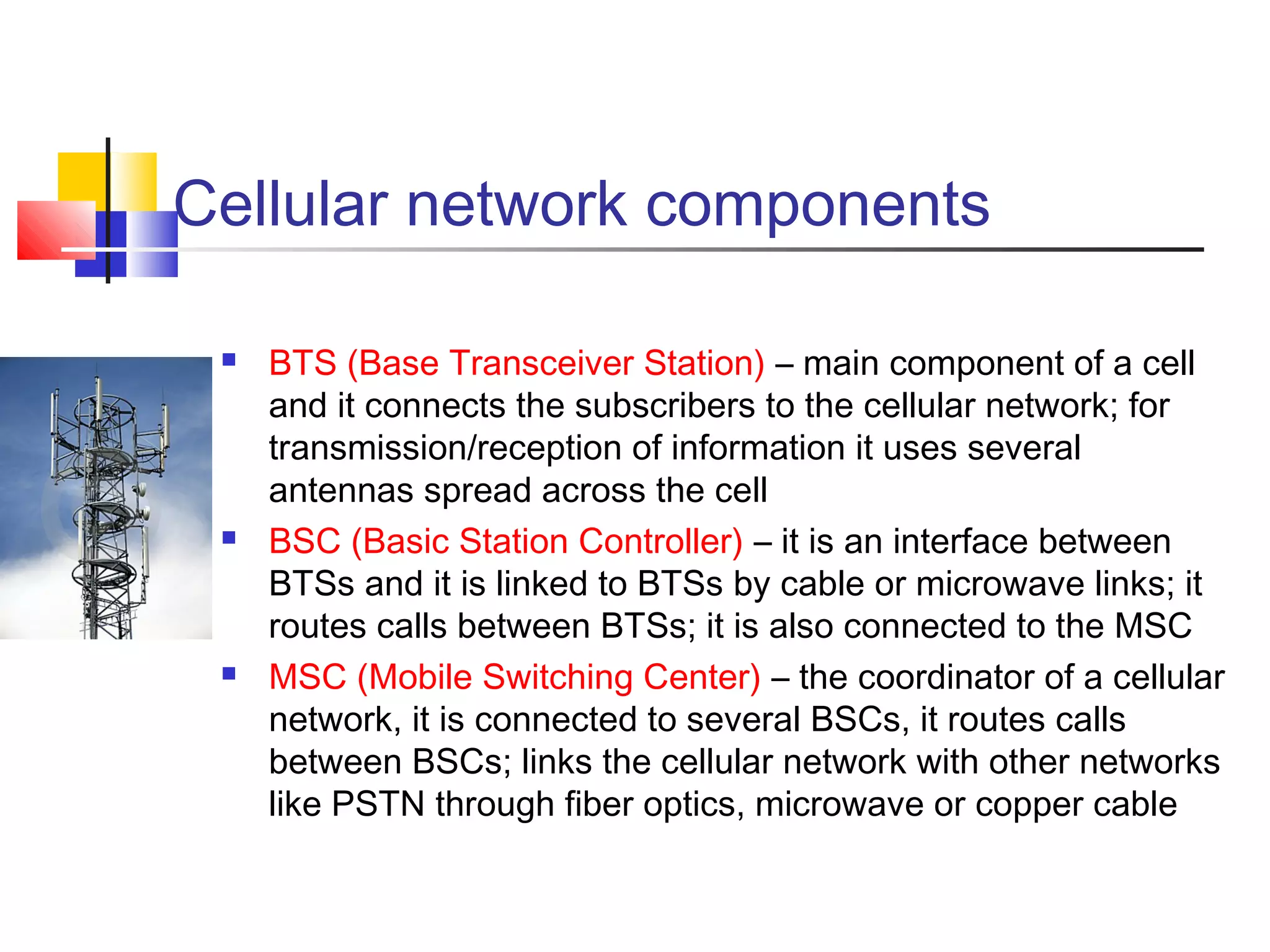
 BTS (Base Transceiver Station) – main component of a cell
and it connects the subscribers to the cellular network; for
transmission/reception of information it uses several
antennas spread across the cell
 BSC (Basic Station Controller) – it is an interface between
BTSs and it is linked to BTSs by cable or microwave links; it
routes calls between BTSs; it is also connected to the MSC
 MSC (Mobile Switching Center) – the coordinator of a cellular
network, it is connected to several BSCs, it routes calls
between BSCs; links the cellular network with other networks
like PSTN through fiber optics, microwave or copper cable
HLR, VLR and EIR registers
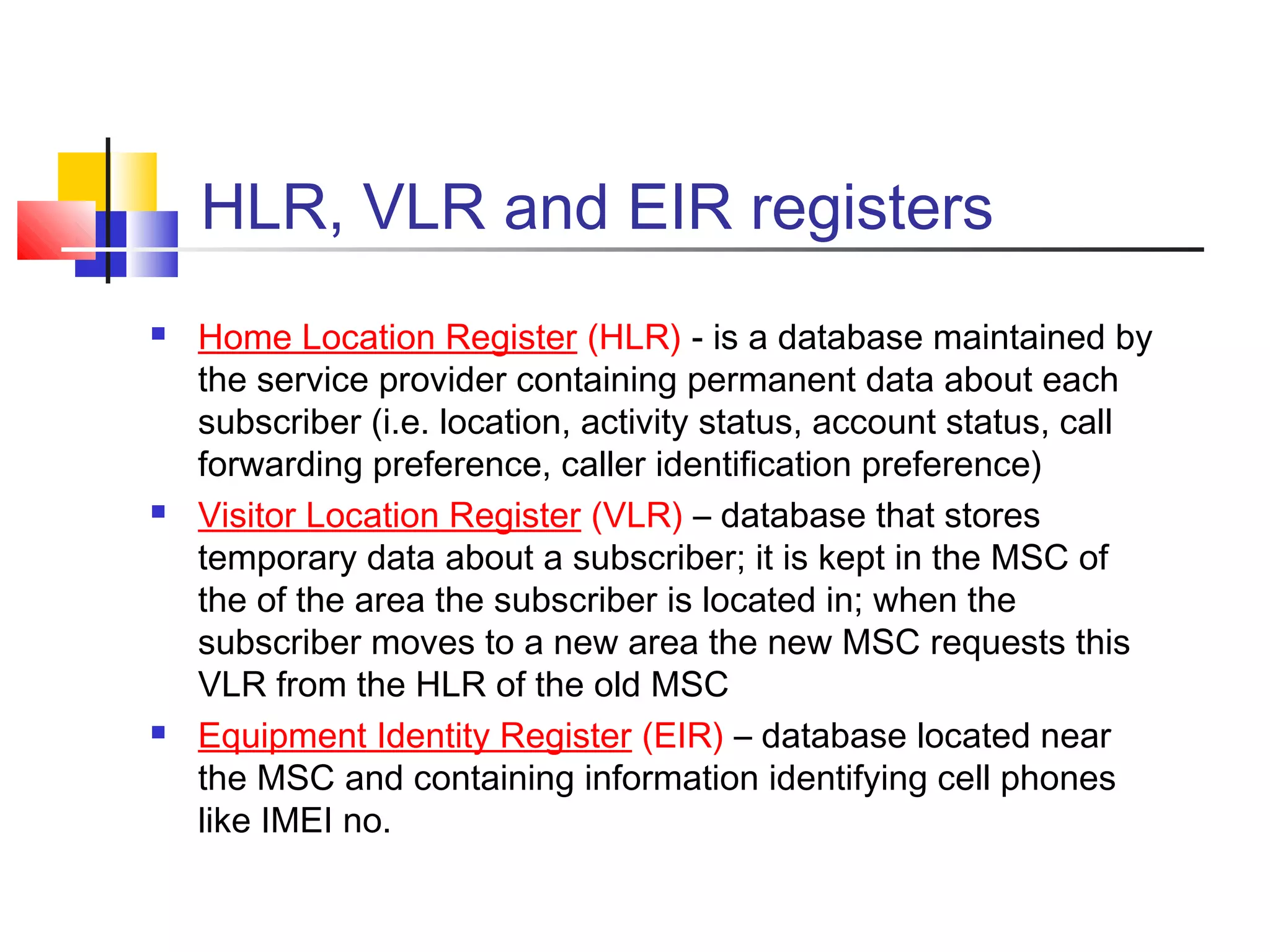
 Home Location Register (HLR) - is a database maintained by
the service provider containing permanent data about each
subscriber (i.e. location, activity status, account status, call
forwarding preference, caller identification preference)
 Visitor Location Register (VLR) – database that stores
temporary data about a subscriber; it is kept in the MSC of
the of the area the subscriber is located in; when the
subscriber moves to a new area the new MSC requests this
VLR from the HLR of the old MSC
 Equipment Identity Register (EIR) – database located near
the MSC and containing information identifying cell phones
like IMEI no.
Components of a cellular phone
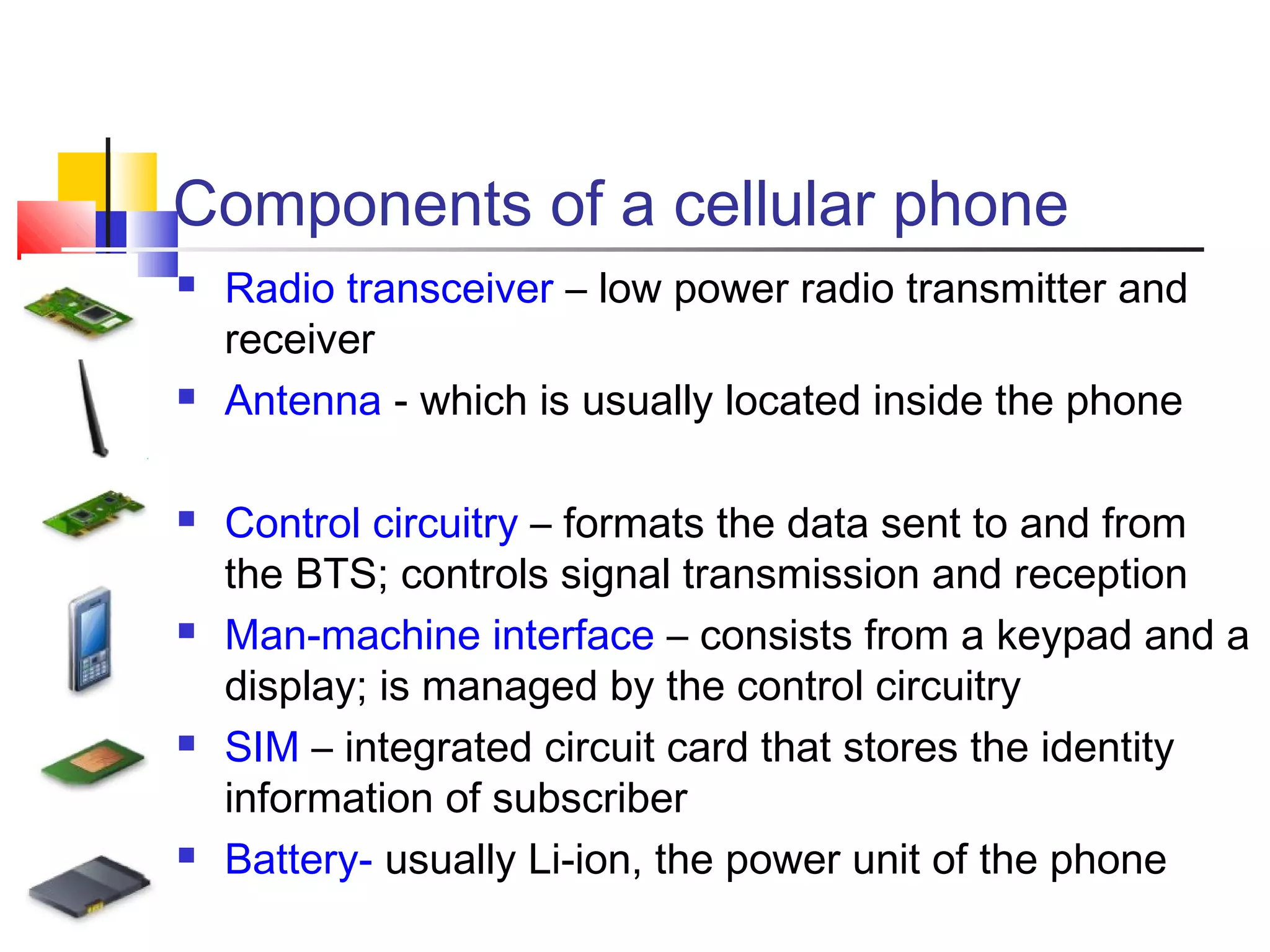
 Radio transceiver – low power radio transmitter and
receiver
 Antenna - which is usually located inside the phone
 Control circuitry – formats the data sent to and from
the BTS; controls signal transmission and reception
 Man-machine interface – consists from a keypad and a
display; is managed by the control circuitry
 SIM – integrated circuit card that stores the identity
information of subscriber
 Battery- usually Li-ion, the power unit of the phone
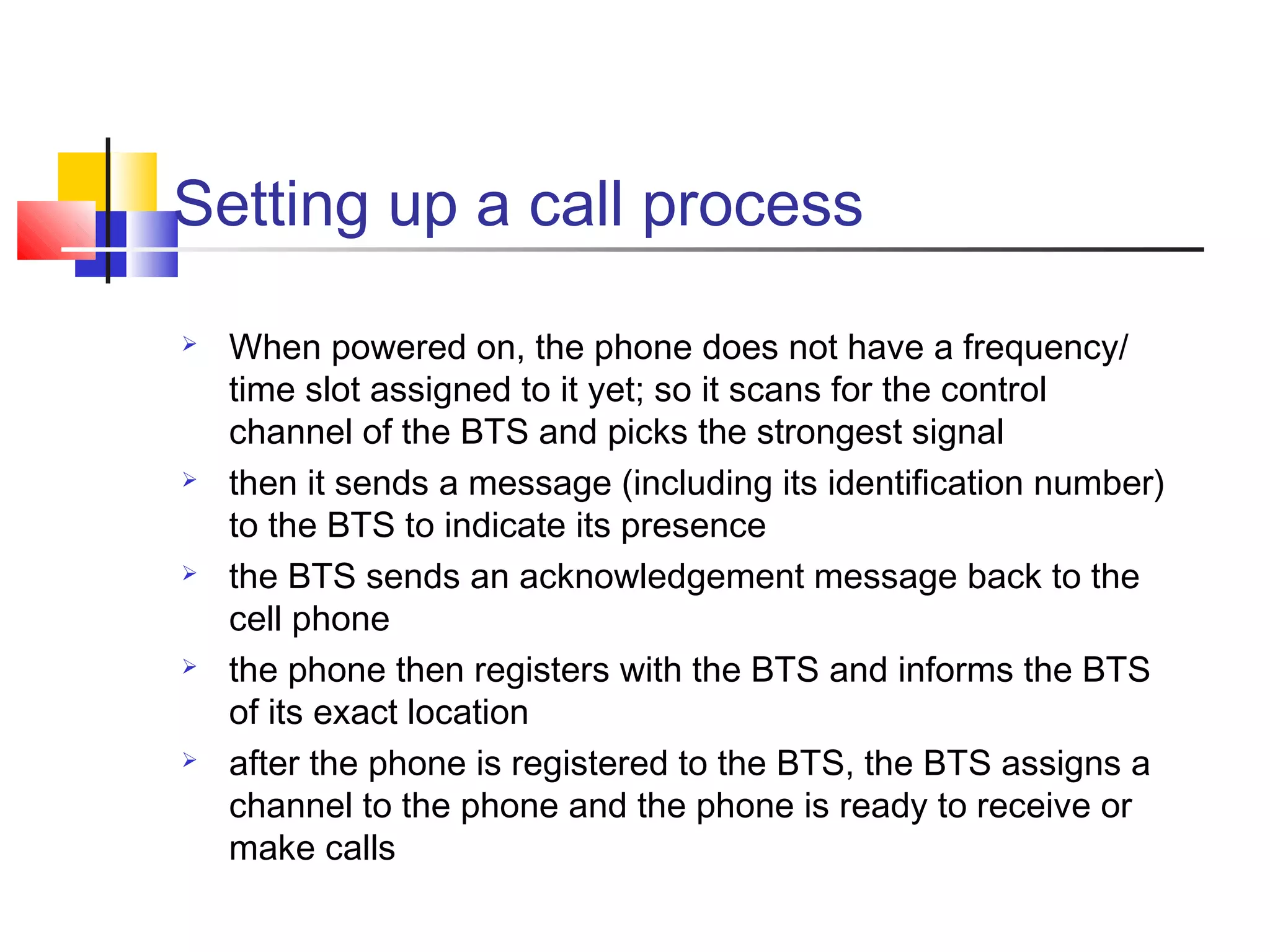
Setting up a call process
 When powered on, the phone does not have a frequency/
time slot assigned to it yet; so it scans for the control
channel of the BTS and picks the strongest signal
 then it sends a message (including its identification number)
to the BTS to indicate its presence
 the BTS sends an acknowledgement message back to the
cell phone
 the phone then registers with the BTS and informs the BTS
of its exact location
 after the phone is registered to the BTS, the BTS assigns a
channel to the phone and the phone is ready to receive or
make calls
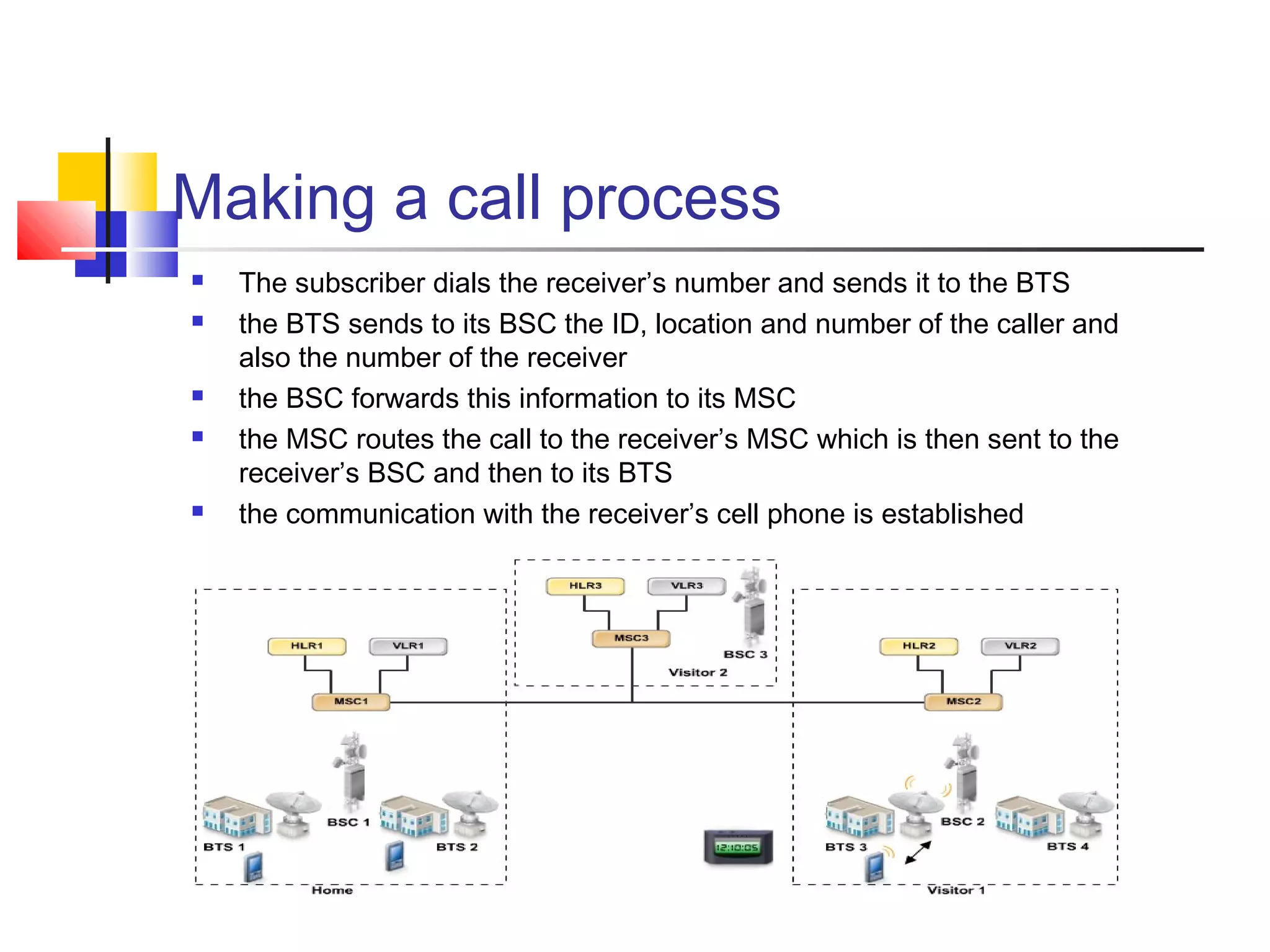
Making a call process
 The subscriber dials the receiver’s number and sends it to the BTS
 the BTS sends to its BSC the ID, location and number of the caller and
also the number of the receiver
 the BSC forwards this information to its MSC
 the MSC routes the call to the receiver’s MSC which is then sent to the
receiver’s BSC and then to its BTS
 the communication with the receiver’s cell phone is established
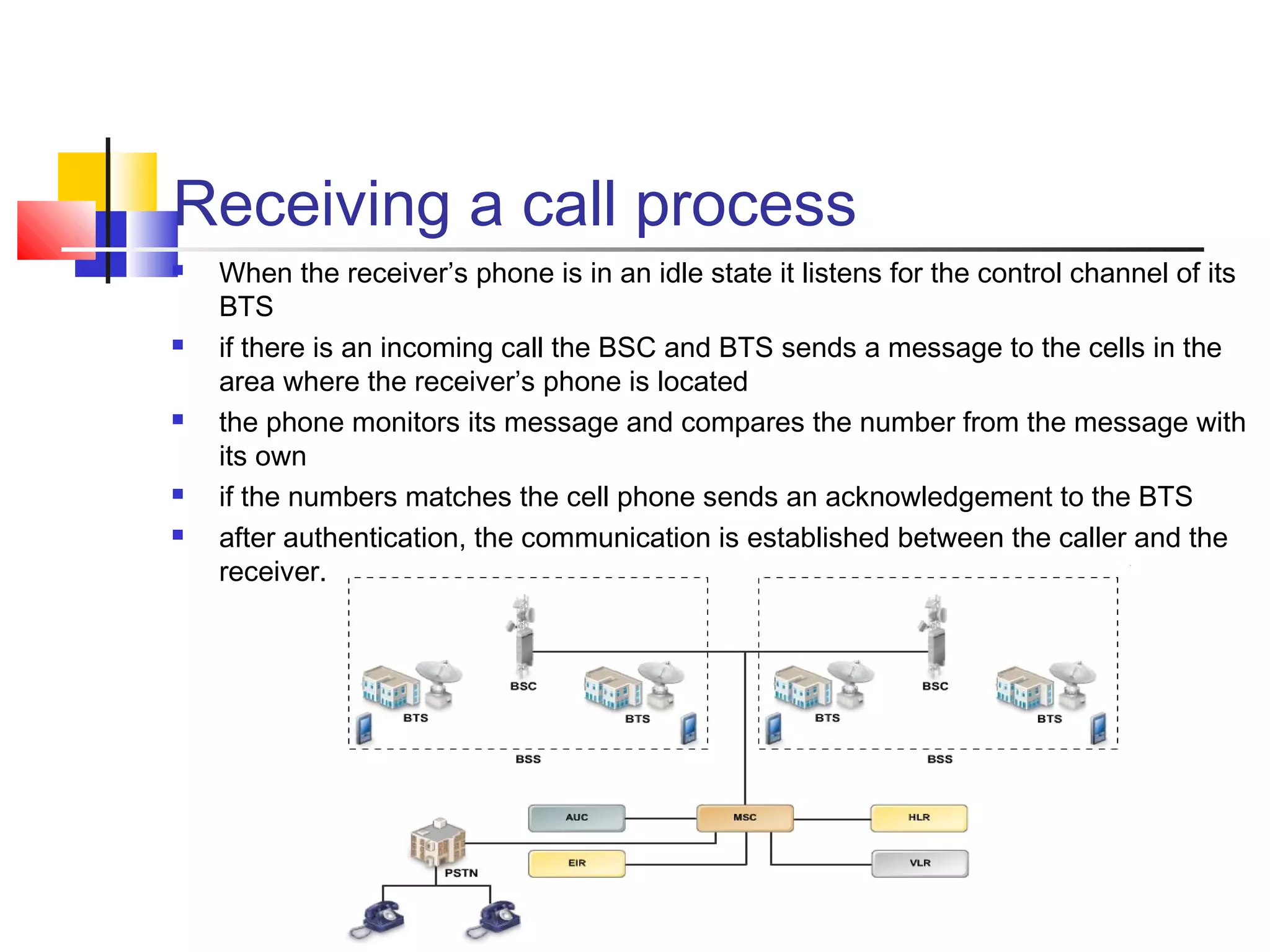
Receiving a call process
 When the receiver’s phone is in an idle state it listens for the control channel of its
BTS
 if there is an incoming call the BSC and BTS sends a message to the cells in the
area where the receiver’s phone is located
 the phone monitors its message and compares the number from the message with
its own
 if the numbers matches the cell phone sends an acknowledgement to the BTS
 after authentication, the communication is established between the caller and the
receiver.
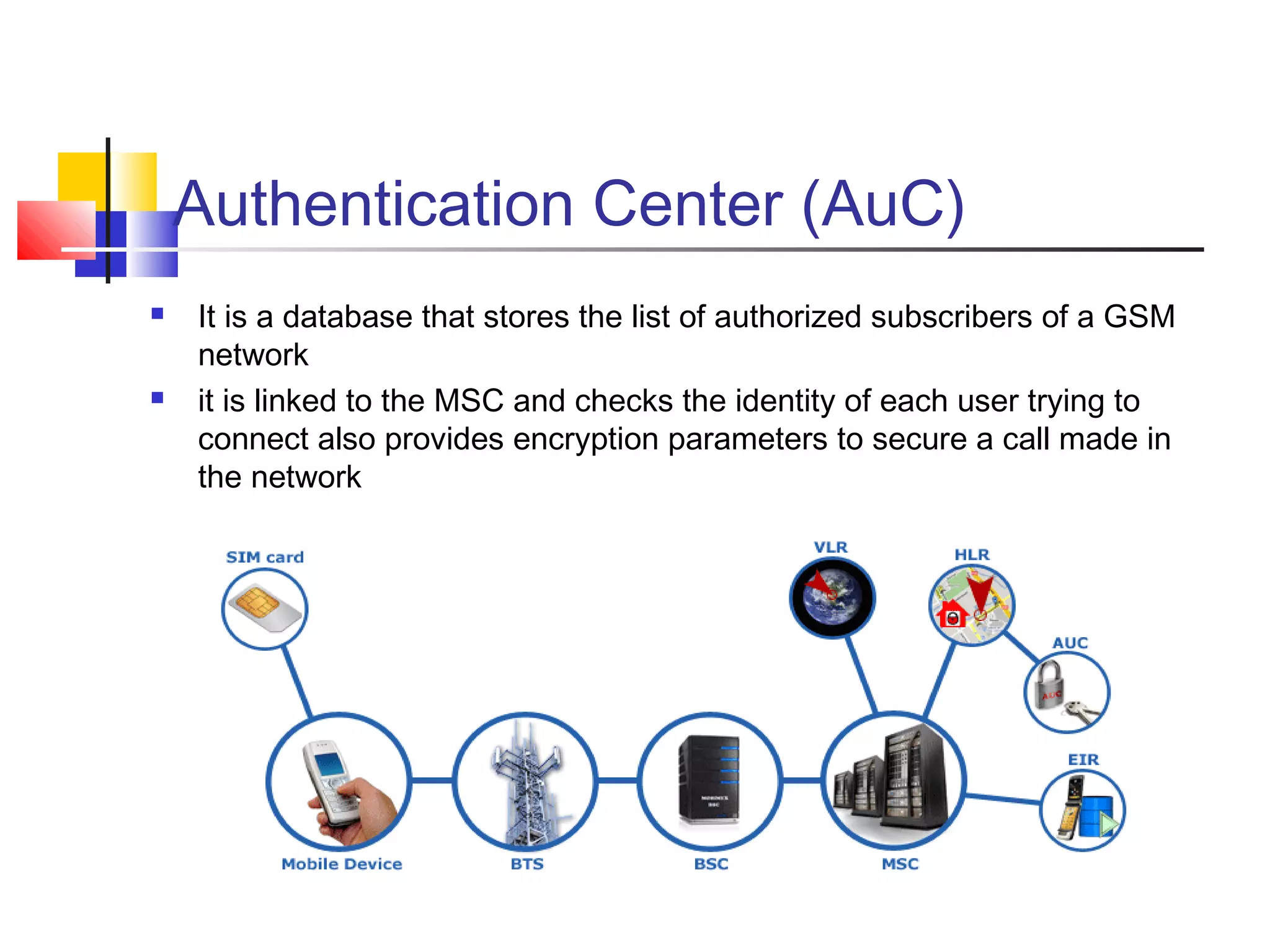
Authentication Center (AuC)
 It is a database that stores the list of authorized subscribers of a GSM
network
 it is linked to the MSC and checks the identity of each user trying to
connect also provides encryption parameters to secure a call made in
the network
Other cellular concepts
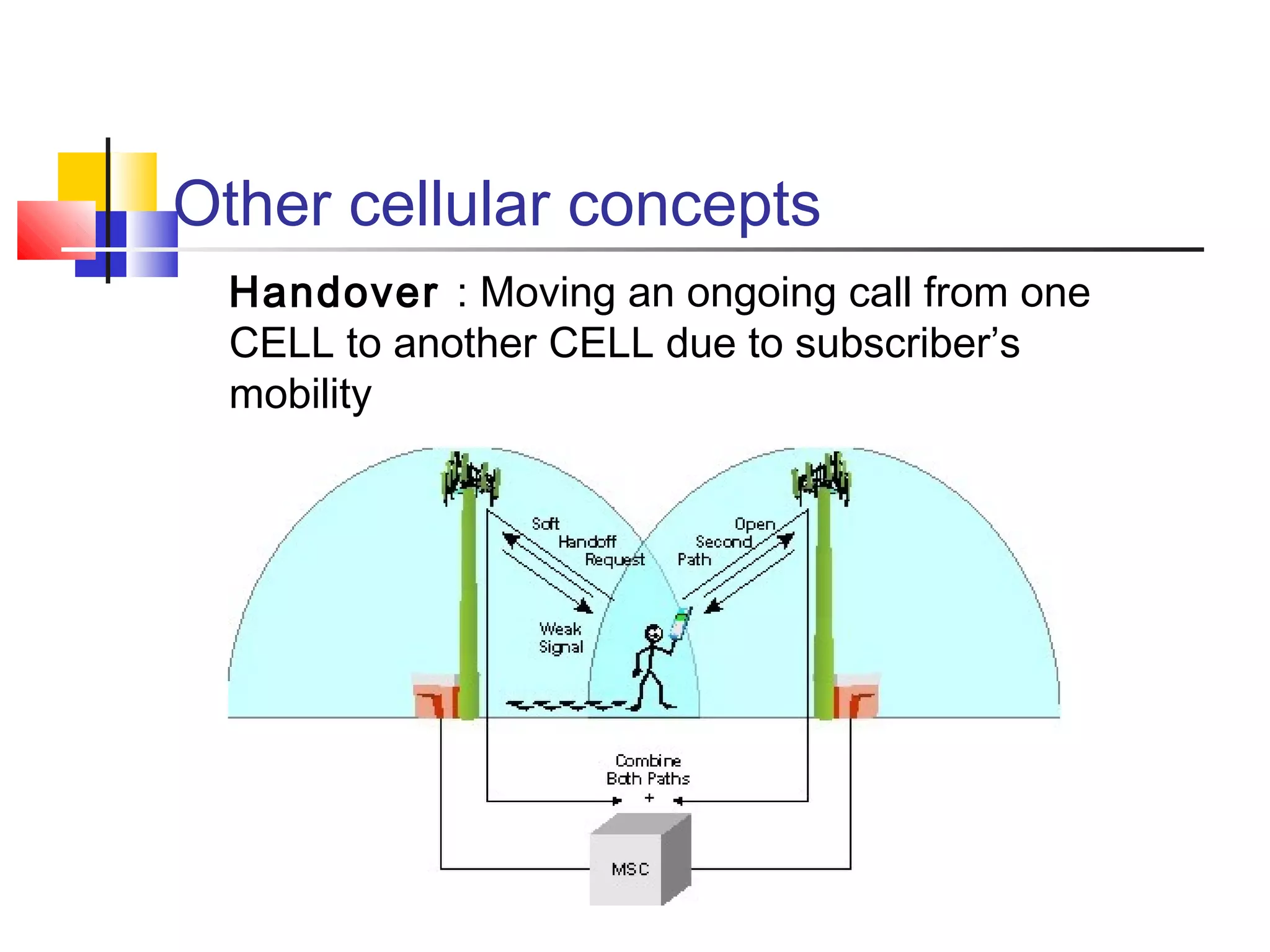
Handover : Moving an ongoing call from one
CELL to another CELL due to subscriber’s
mobility
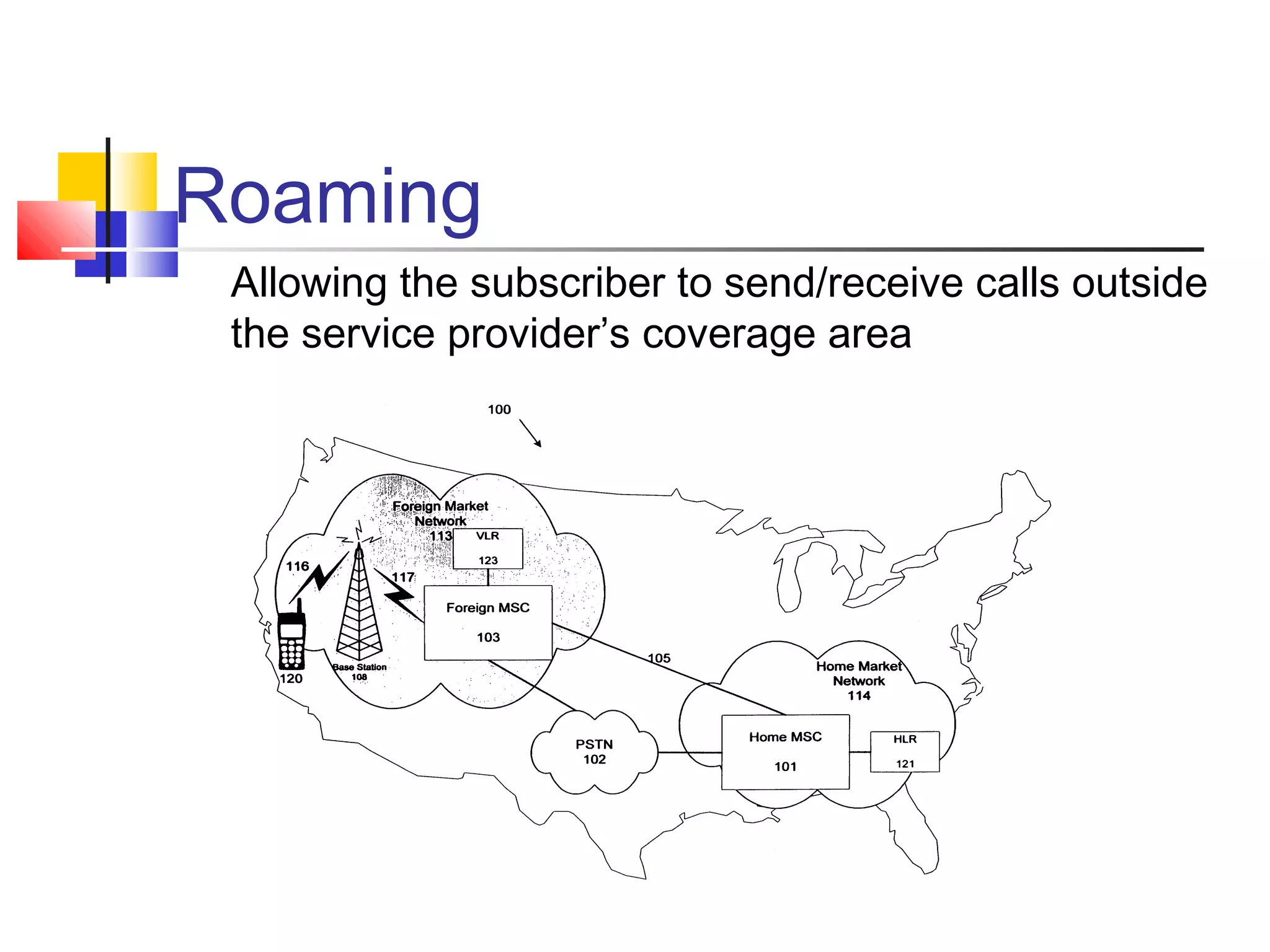
Roaming
Allowing the subscriber to send/receive calls outside
the service provider’s coverage area
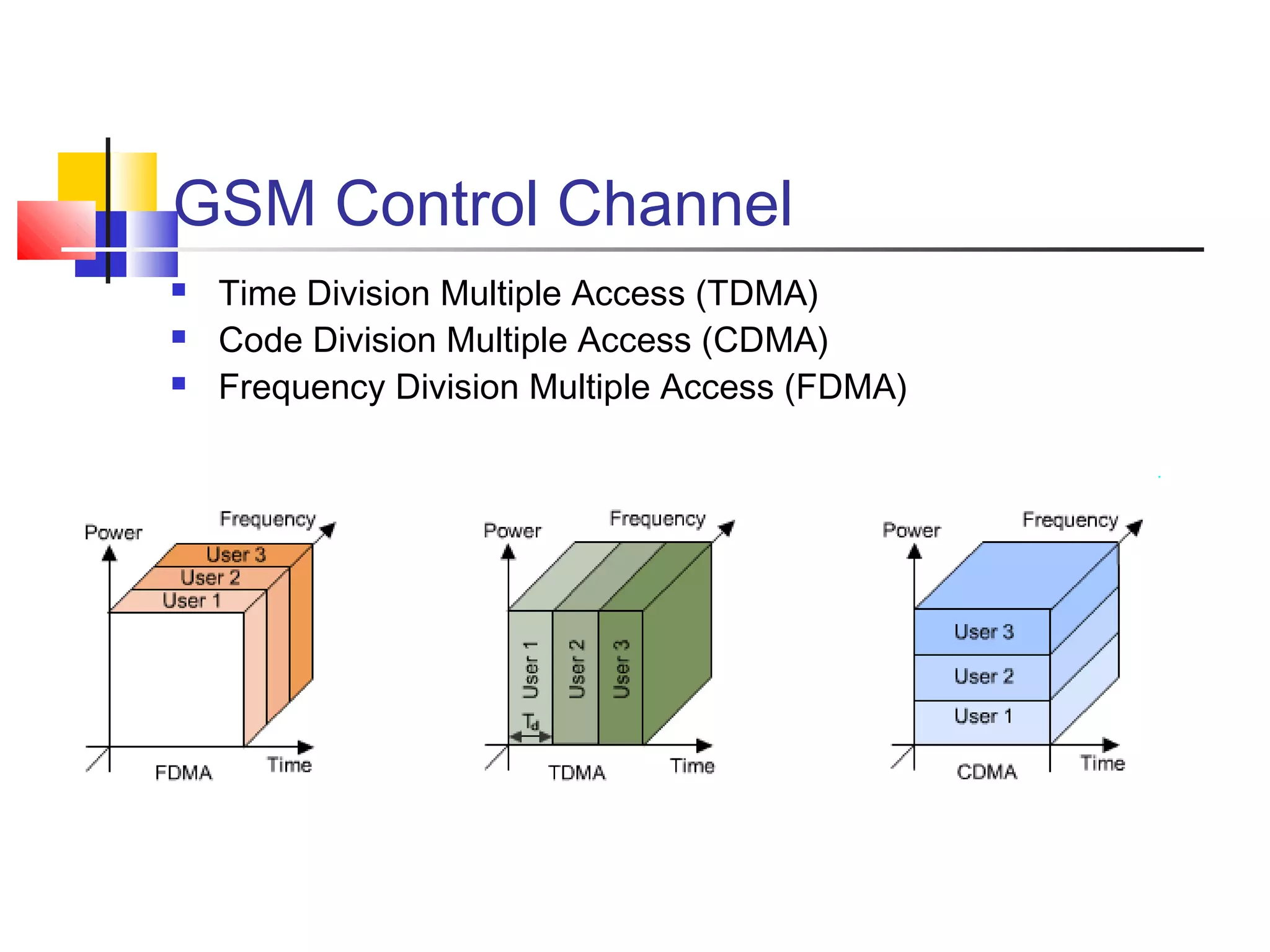
GSM Control Channel
 Time Division Multiple Access (TDMA)
 Code Division Multiple Access (CDMA)
 Frequency Division Multiple Access (FDMA)
TDMA
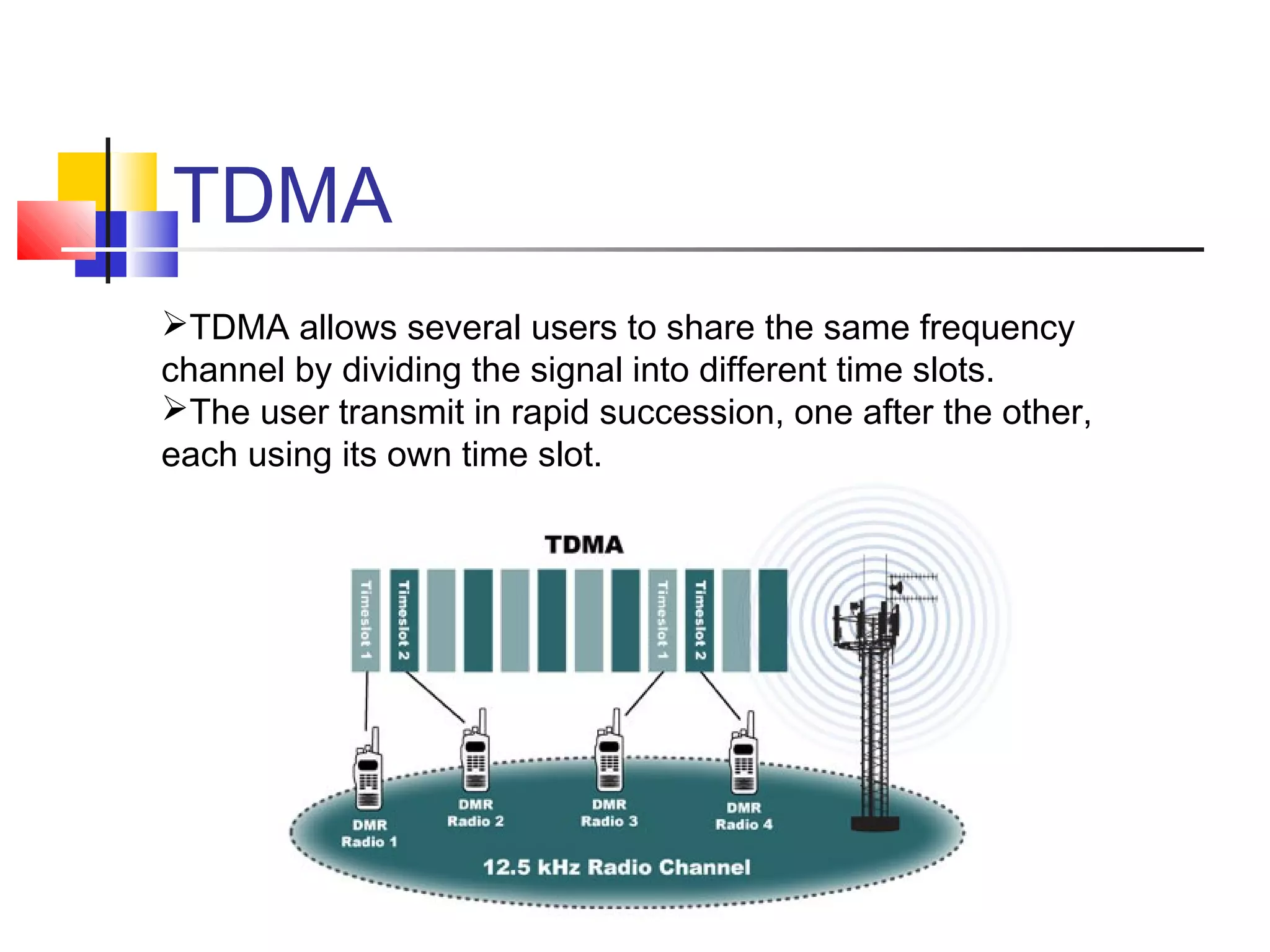
TDMA allows several users to share the same frequency
channel by dividing the signal into different time slots.
The user transmit in rapid succession, one after the other,
each using its own time slot.
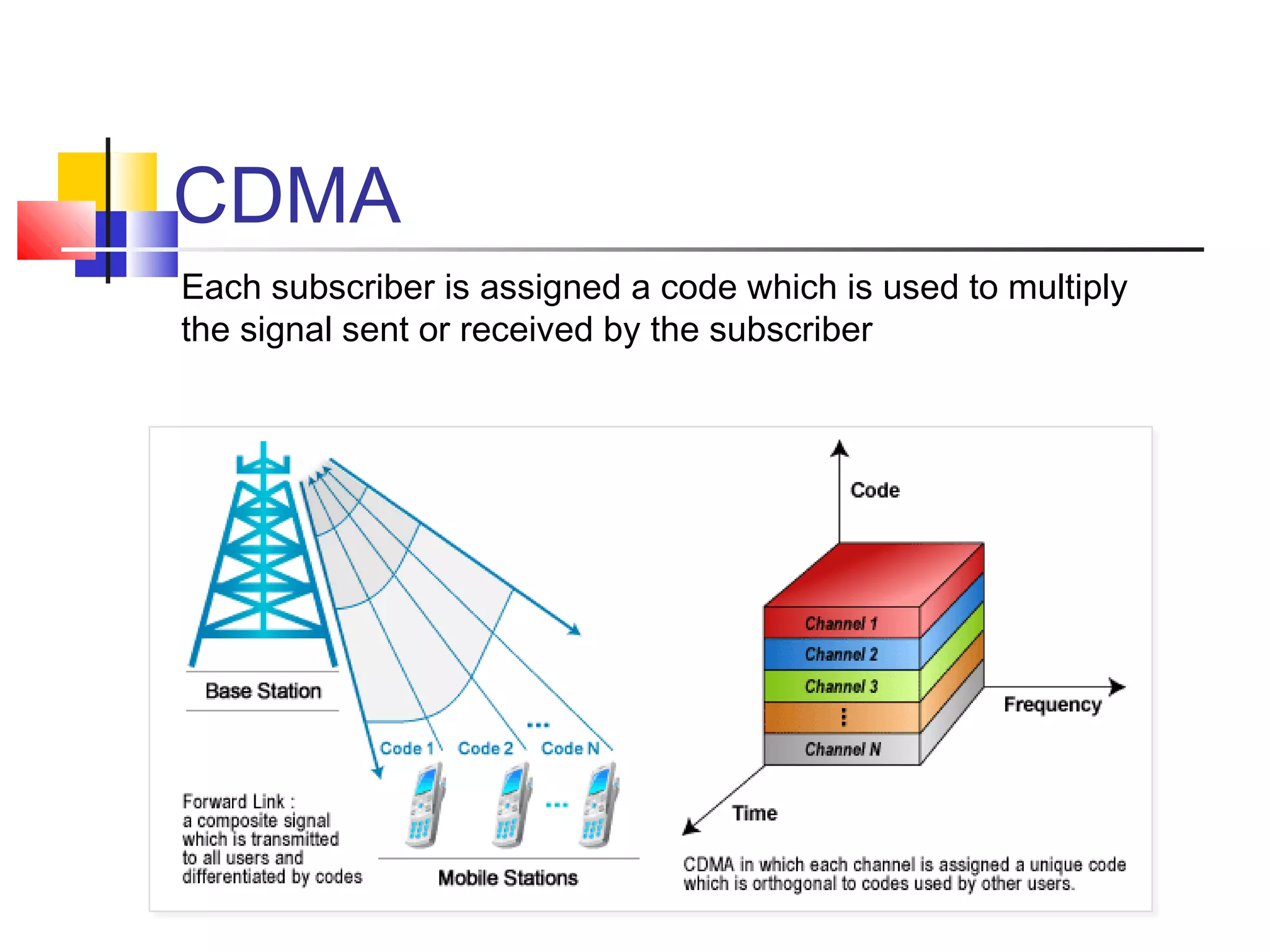
CDMA
Each subscriber is assigned a code which is used to multiply
the signal sent or received by the subscriber
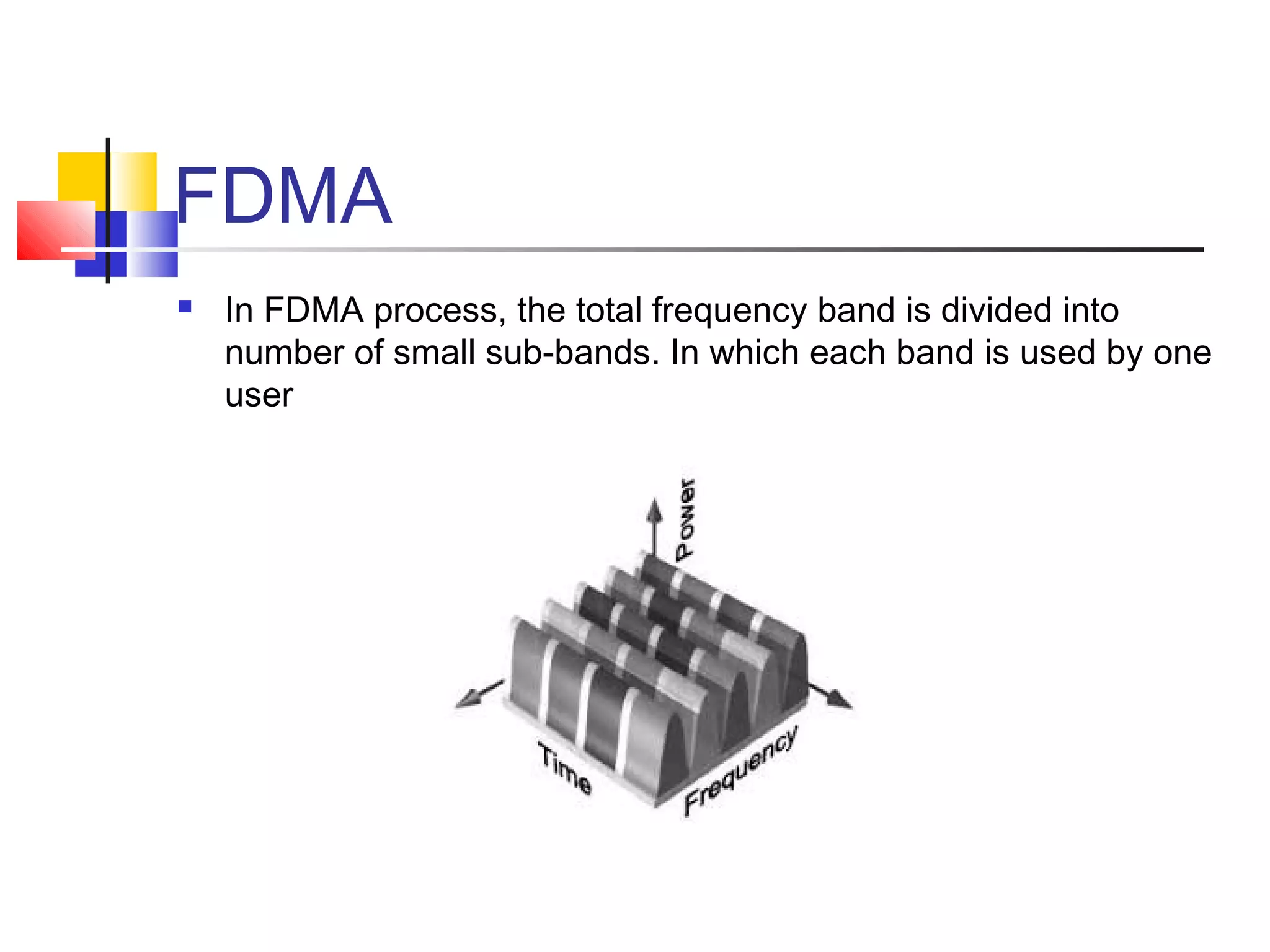
FDMA
 In FDMA process, the total frequency band is divided into
number of small sub-bands. In which each band is used by one
user
GSM
 Global System for Mobile Communication
 GSM operate in frequency bands: 900MHz, 1800 MHz,
1900 MHz
 GSM provides voice and data services
SIM
 a memory card (integrated circuit) holding identity
information, phone book etc.
 GSM system support SIM cards
 other systems, like CDMA do not support SIM cards, but
have something similar called Re-Usable Identification
Module (RUIM)
Cellular services
 Voice communication
 Short Messaging Service (SMS)
 Multimedia Messaging Service (MMS)
 Global Positioning System (GPS)
 Wireless Application Protocol (WAP) – to access the
Internet
 Security (PIN)
Conclusion
 The development of Cellular Communication is the
first step towards a true personal communication
system that will allow communication anywhere,
anytime, and with anyone.
Reference
 M. Mouly and M.-B.
Pautet, The Cellular
Communications, 1992.
 M. Mouly and M.-B.
Pautet, GSM Protocol
Architecture: Radio Sub-system
Signalling, IEEE 41st
Vehicular Technology
Conference, 1991.
THANK YOU
Any Queries ??

cellular communications .pdf

  • 1.
    CELLULAR COMMUNICATION Prepared by: Prashant Kumar Gajendra Regd no.-1305106016 College of Engineering & Technology Department of C.S.A Guided by : Mr. Manjit Kumar Nayak
  • 2.
    Contents  History  NetworkCells  Frequency Reuse  Cellular Network components  Setting and making a call  Receiving a call  Cellular concepts & Channels  GSM & features  Cellular Services  Conclusion
  • 3.
    History  Radio communicationwas invented by Marconi: in 1893  in 1940 the first walkie-talkie was used by the US military  in 1947, John Bardeen and Walter Brattain from AT&T’s Bell Labs invented the transistor (semiconductor device used to amplify radio signals)  in 1979 the first commercial cellular phone service was launched by the Nordic Mobile Telephone (in Finland, Sweden, Norway, Denmark).
  • 4.
    Cellular systems generations 1G (first generation) – voice-oriented systems based on analog technology; ex.: Advanced Mobile Phone Systems (AMPS)  2G (second generation) - voice-oriented systems based on digital technology; more efficient and used less spectrum than 1G; ex.: Global System for Mobile (GSM) and US Time Division Multiple Access (US- TDMA)  3G (third generation) – high-speed voice-oriented systems integrated with data services; ex.: General Packet Radio Service (GPRS), Code Division Multiple Access (CDMA)  4G (fourth generation) – mobile ultra-broadband Internet access, for example to laptops with USB wireless modems to smart phones, and to other mobile devices
  • 5.
    Network Cells CELL :Its a geographical unit of a cellular network; is the area around an antenna where a specific frequency range is used; is represented graphically as a hexagonal shape, but in reality it is irregular in shape
  • 6.
    Network Cells  ACLUSTER is a group of adjacent cells, usually 7 cells; no frequency reuse is done within a cluster  The frequency spectrum is divided into subbands and each subband is used within one cell of the cluster
  • 7.
    Frequency reuse  Itis a method used by service providers to improve the efficiency of a cellular network and to serve millions of subscribers using a limited radio spectrum
  • 8.
    Types of cells Macrocell – their coverage is large (aprox. 6 miles in diameter); used in remote areas, high-power transmitters and receivers are used  Microcell – their coverage is small (half a mile in diameter) and are used in urban zones; low-powered transmitters and receivers are used to avoid interference with cells in another clusters  Picocell – covers areas such as building or a tunnel
  • 9.
  • 10.
    Cellular network components BTS (Base Transceiver Station) – main component of a cell and it connects the subscribers to the cellular network; for transmission/reception of information it uses several antennas spread across the cell  BSC (Basic Station Controller) – it is an interface between BTSs and it is linked to BTSs by cable or microwave links; it routes calls between BTSs; it is also connected to the MSC  MSC (Mobile Switching Center) – the coordinator of a cellular network, it is connected to several BSCs, it routes calls between BSCs; links the cellular network with other networks like PSTN through fiber optics, microwave or copper cable
  • 11.
    HLR, VLR andEIR registers  Home Location Register (HLR) - is a database maintained by the service provider containing permanent data about each subscriber (i.e. location, activity status, account status, call forwarding preference, caller identification preference)  Visitor Location Register (VLR) – database that stores temporary data about a subscriber; it is kept in the MSC of the of the area the subscriber is located in; when the subscriber moves to a new area the new MSC requests this VLR from the HLR of the old MSC  Equipment Identity Register (EIR) – database located near the MSC and containing information identifying cell phones like IMEI no.
  • 12.
    Components of acellular phone  Radio transceiver – low power radio transmitter and receiver  Antenna - which is usually located inside the phone  Control circuitry – formats the data sent to and from the BTS; controls signal transmission and reception  Man-machine interface – consists from a keypad and a display; is managed by the control circuitry  SIM – integrated circuit card that stores the identity information of subscriber  Battery- usually Li-ion, the power unit of the phone
  • 13.
    Setting up acall process  When powered on, the phone does not have a frequency/ time slot assigned to it yet; so it scans for the control channel of the BTS and picks the strongest signal  then it sends a message (including its identification number) to the BTS to indicate its presence  the BTS sends an acknowledgement message back to the cell phone  the phone then registers with the BTS and informs the BTS of its exact location  after the phone is registered to the BTS, the BTS assigns a channel to the phone and the phone is ready to receive or make calls
  • 14.
    Making a callprocess  The subscriber dials the receiver’s number and sends it to the BTS  the BTS sends to its BSC the ID, location and number of the caller and also the number of the receiver  the BSC forwards this information to its MSC  the MSC routes the call to the receiver’s MSC which is then sent to the receiver’s BSC and then to its BTS  the communication with the receiver’s cell phone is established
  • 15.
    Receiving a callprocess  When the receiver’s phone is in an idle state it listens for the control channel of its BTS  if there is an incoming call the BSC and BTS sends a message to the cells in the area where the receiver’s phone is located  the phone monitors its message and compares the number from the message with its own  if the numbers matches the cell phone sends an acknowledgement to the BTS  after authentication, the communication is established between the caller and the receiver.
  • 16.
    Authentication Center (AuC) It is a database that stores the list of authorized subscribers of a GSM network  it is linked to the MSC and checks the identity of each user trying to connect also provides encryption parameters to secure a call made in the network
  • 17.
    Other cellular concepts Handover: Moving an ongoing call from one CELL to another CELL due to subscriber’s mobility
  • 18.
    Roaming Allowing the subscriberto send/receive calls outside the service provider’s coverage area
  • 19.
    GSM Control Channel Time Division Multiple Access (TDMA)  Code Division Multiple Access (CDMA)  Frequency Division Multiple Access (FDMA)
  • 20.
    TDMA TDMA allows severalusers to share the same frequency channel by dividing the signal into different time slots. The user transmit in rapid succession, one after the other, each using its own time slot.
  • 21.
    CDMA Each subscriber isassigned a code which is used to multiply the signal sent or received by the subscriber
  • 22.
    FDMA  In FDMAprocess, the total frequency band is divided into number of small sub-bands. In which each band is used by one user
  • 23.
    GSM  Global Systemfor Mobile Communication  GSM operate in frequency bands: 900MHz, 1800 MHz, 1900 MHz  GSM provides voice and data services SIM  a memory card (integrated circuit) holding identity information, phone book etc.  GSM system support SIM cards  other systems, like CDMA do not support SIM cards, but have something similar called Re-Usable Identification Module (RUIM)
  • 24.
    Cellular services  Voicecommunication  Short Messaging Service (SMS)  Multimedia Messaging Service (MMS)  Global Positioning System (GPS)  Wireless Application Protocol (WAP) – to access the Internet  Security (PIN)
  • 25.
    Conclusion  The developmentof Cellular Communication is the first step towards a true personal communication system that will allow communication anywhere, anytime, and with anyone.
  • 26.
    Reference  M. Moulyand M.-B. Pautet, The Cellular Communications, 1992.  M. Mouly and M.-B. Pautet, GSM Protocol Architecture: Radio Sub-system Signalling, IEEE 41st Vehicular Technology Conference, 1991.
  • 27.