CELL THEORY
Scientific Theory 
• A Scientific theory Is a well sustained explanation of some 
aspects of the natural world that is acquired through the 
scientific method and reputedly tested and confirmed 
through observation and experimentation.
How A Theory Becomes Accepted 
• First of all the scientist that is testing a theory would come up with a hypothesis which is something 
you try to prove through testing. They would then conduct a scientific test that is non bias and also 
reliable (should be a repeatable test) When you have repeated the test you compare with your other 
results. Your work will then be peer reviewed to see if the work is credible. 
• It originally starts with on observation that leads to a hypothesis being made. 
• There are factors that can effect the test. By stopping them from happening you should try and 
control the variable. Don’t be bias in your test, you can stop this by doing blind test or double blind 
test. When your works gets peer reviewed they try to find flaws in the research that can come from 
the different factors 
• Try to get a good size of you study to try and make it as credible as you can. 
• Peer review- is the evaluation of work by one or more people of similar competence to the 
producers of the work (peers). It constitutes a form of self-regulation by qualified members of a 
profession within the relevant field. 
• A blind or blinded experiment is an experiment in which information about the test that might lead to 
bias in the results is concealed from the tester, the subject, or both until after the test. Bias may be 
intentional or unconscious. If both tester and subject are blinded, the trial is a double-blind trial 
• Double blind- Individuals in both groups don't know whether they are getting the real treatment or 
placebo (they are "blind"). Furthermore, the researchers administering placebo and real treatment 
are also kept in the dark about which group is receiving which treatment (making it a "double-blind" 
experiment).
History About Cell Theory 
• The cell was discovered by Robert Hooke in 1665. Hooke first examined 
slices of cork under a compound microscope and noticed that it had small 
pours that he named cells. But this observation did not give any indication 
about the nucleus or an other organelles that you would fine in a cell. The first 
man to witness a live cell under a microscope was Antony Van Leeuwenhoek. 
The idea that cells were separable into individual units was proposed by 
Ludolph Christian Treviranus and Johann Jacob Paul Moldenhawer.. All of 
this finally led to Henri Dutrochet formulating one of the fundamental tenets of 
modern cell theory by declaring that "The cell is the fundamental element of 
organization“. Cell theory is a widely accepted explination of the relationship 
between cells and living things. Cell theory states: All living things or 
organisms are made of cells and their products. New cells are created by old 
cells dividing into two Cells are the basic building units of life.
How The Theory Went Through The Stages 
• When Robert Hooke first found out about the small pours a scientist 
named Antony Van Leeuwenhoek made a microscope that he was 
able to see into a living cell. How this theory got peer reviewed was 
by other scientist went further with the experiment to find out more 
information about all different cells. For example in 1858, Rudolf 
Virchow extended the work of Schleiden and Schwann by proposing 
that all living cells must rise from pre-existing cells. This was 
considered a crazy idea because everyone believe that nonliving 
matter could spontaneously generate living tissue. Research like this 
was made possible because better microscopes were being 
developed so they were able to get I higher magnification. The cell 
theory never had a true hypothesis at the start of the experiments it 
developed at they found out more about cells. 
• Not all parts of this theory people agreed on, some scientist believed 
in cells coming from pre existing cells where as others believed in free 
cell formation, this is where cells form on there own.
• If you still don’t really understand this theory watch this youtube clip 
that helps summerise the whole theory. 
• https://www.youtube.com/watch?v=4OpBylwH9DU 
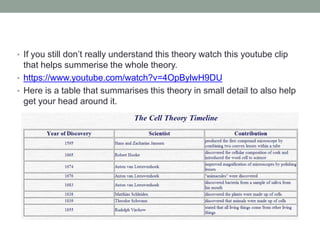
• Here is a table that summarises this theory in small detail to also help 
get your head around it.
References 
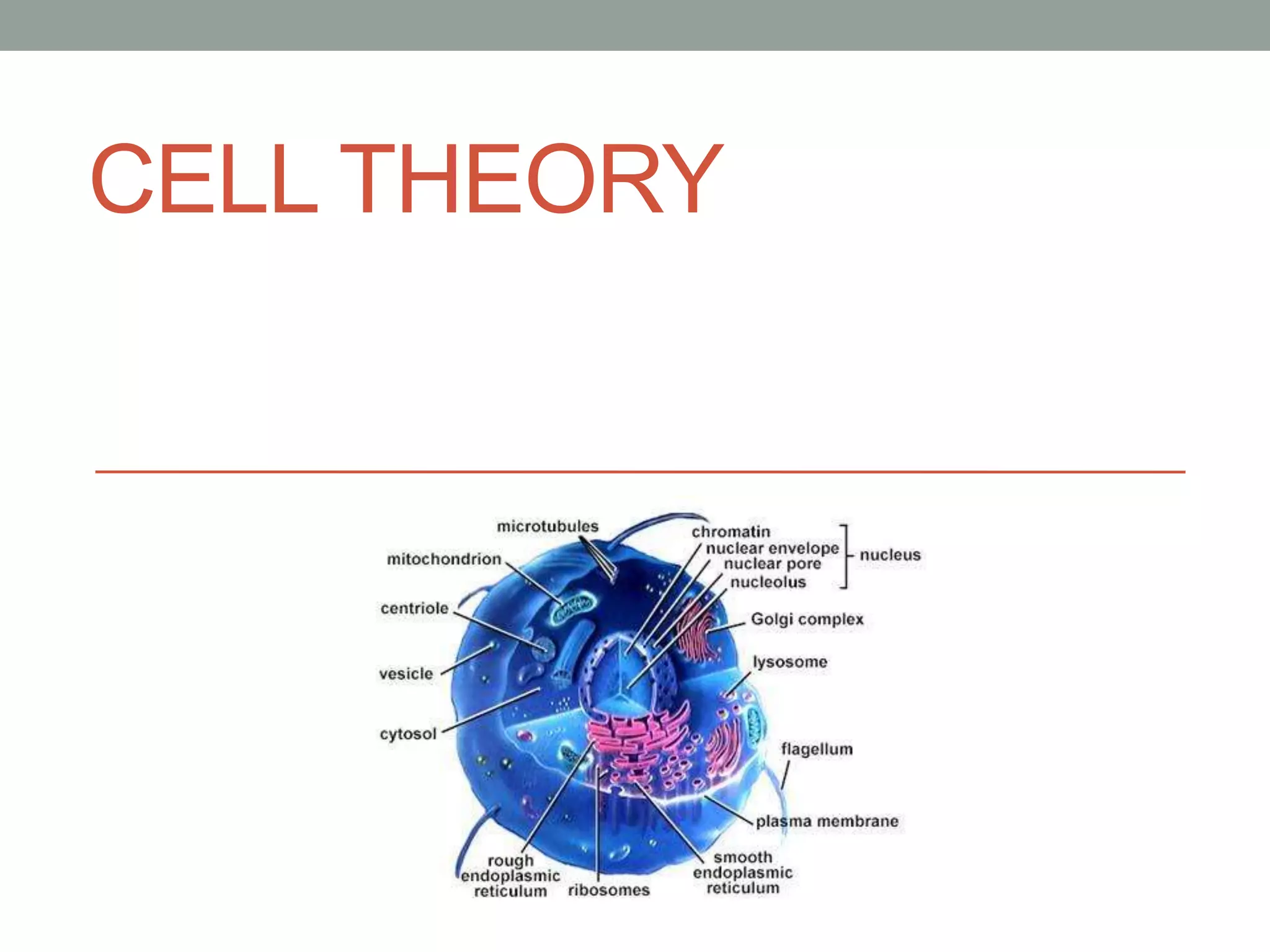
http://www.studyblue.com/notes/note/n/cells/deck/987557 2nd October 2014. Picture one 
http://www.princeton.edu/~achaney/tmve/wiki100k/docs/Cell_theory.html 2nd October 2014. Picture two 
http://science.howstuffworks.com/innovation/scientific-experiments/scientific-method4.htm 2nd October 2014 
http://www.cpschools.com/Schools/OSM/theory.htm 2nd October 2014. The cell theory table 
http://www.med.nyu.edu/content?ChunkIID=21849 2nd October 2014. Double blind test definition 
http://en.wikipedia.org/wiki/Peer_review 2nd October 2014. Peer reviewed 
http://en.wikipedia.org/wiki/Blind_experiment 2nd October 2014. Blind Test

Cell Theory

  • 1.
  • 2.
    Scientific Theory •A Scientific theory Is a well sustained explanation of some aspects of the natural world that is acquired through the scientific method and reputedly tested and confirmed through observation and experimentation.
  • 3.
    How A TheoryBecomes Accepted • First of all the scientist that is testing a theory would come up with a hypothesis which is something you try to prove through testing. They would then conduct a scientific test that is non bias and also reliable (should be a repeatable test) When you have repeated the test you compare with your other results. Your work will then be peer reviewed to see if the work is credible. • It originally starts with on observation that leads to a hypothesis being made. • There are factors that can effect the test. By stopping them from happening you should try and control the variable. Don’t be bias in your test, you can stop this by doing blind test or double blind test. When your works gets peer reviewed they try to find flaws in the research that can come from the different factors • Try to get a good size of you study to try and make it as credible as you can. • Peer review- is the evaluation of work by one or more people of similar competence to the producers of the work (peers). It constitutes a form of self-regulation by qualified members of a profession within the relevant field. • A blind or blinded experiment is an experiment in which information about the test that might lead to bias in the results is concealed from the tester, the subject, or both until after the test. Bias may be intentional or unconscious. If both tester and subject are blinded, the trial is a double-blind trial • Double blind- Individuals in both groups don't know whether they are getting the real treatment or placebo (they are "blind"). Furthermore, the researchers administering placebo and real treatment are also kept in the dark about which group is receiving which treatment (making it a "double-blind" experiment).
  • 4.
    History About CellTheory • The cell was discovered by Robert Hooke in 1665. Hooke first examined slices of cork under a compound microscope and noticed that it had small pours that he named cells. But this observation did not give any indication about the nucleus or an other organelles that you would fine in a cell. The first man to witness a live cell under a microscope was Antony Van Leeuwenhoek. The idea that cells were separable into individual units was proposed by Ludolph Christian Treviranus and Johann Jacob Paul Moldenhawer.. All of this finally led to Henri Dutrochet formulating one of the fundamental tenets of modern cell theory by declaring that "The cell is the fundamental element of organization“. Cell theory is a widely accepted explination of the relationship between cells and living things. Cell theory states: All living things or organisms are made of cells and their products. New cells are created by old cells dividing into two Cells are the basic building units of life.
  • 5.
    How The TheoryWent Through The Stages • When Robert Hooke first found out about the small pours a scientist named Antony Van Leeuwenhoek made a microscope that he was able to see into a living cell. How this theory got peer reviewed was by other scientist went further with the experiment to find out more information about all different cells. For example in 1858, Rudolf Virchow extended the work of Schleiden and Schwann by proposing that all living cells must rise from pre-existing cells. This was considered a crazy idea because everyone believe that nonliving matter could spontaneously generate living tissue. Research like this was made possible because better microscopes were being developed so they were able to get I higher magnification. The cell theory never had a true hypothesis at the start of the experiments it developed at they found out more about cells. • Not all parts of this theory people agreed on, some scientist believed in cells coming from pre existing cells where as others believed in free cell formation, this is where cells form on there own.
  • 6.
    • If youstill don’t really understand this theory watch this youtube clip that helps summerise the whole theory. • https://www.youtube.com/watch?v=4OpBylwH9DU • Here is a table that summarises this theory in small detail to also help get your head around it.
  • 7.
    References http://www.studyblue.com/notes/note/n/cells/deck/987557 2ndOctober 2014. Picture one http://www.princeton.edu/~achaney/tmve/wiki100k/docs/Cell_theory.html 2nd October 2014. Picture two http://science.howstuffworks.com/innovation/scientific-experiments/scientific-method4.htm 2nd October 2014 http://www.cpschools.com/Schools/OSM/theory.htm 2nd October 2014. The cell theory table http://www.med.nyu.edu/content?ChunkIID=21849 2nd October 2014. Double blind test definition http://en.wikipedia.org/wiki/Peer_review 2nd October 2014. Peer reviewed http://en.wikipedia.org/wiki/Blind_experiment 2nd October 2014. Blind Test