Cell City
Ch. 8.2
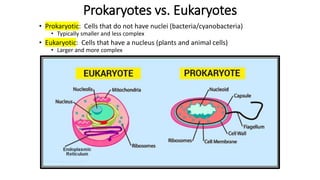
Prokaryotes vs. Eukaryotes
• Prokaryotic: Cells that do not have nuclei (bacteria/cyanobacteria)
• Typically smaller and less complex
• Eukaryotic: Cells that have a nucleus (plants and animal cells)
• Larger and more complex
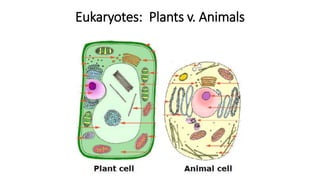
Eukaryotes: Plants v. Animals
Cell Components: Cytoplasm
• “The inner city” the fluid in the cell which contains all the organelles.
• Organelles are like the “businesses” of the cell
• Cytoplasm fills the space from the nucleus to the cell membrane
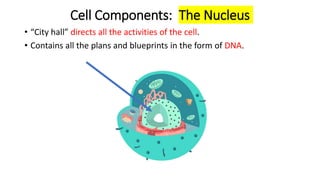
Cell Components: The Nucleus
• “City hall” directs all the activities of the cell.
• Contains all the plans and blueprints in the form of DNA.
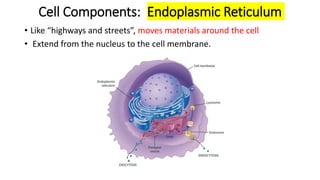
Cell Components: Endoplasmic Reticulum
• Like “highways and streets”, moves materials around the cell
• Extend from the nucleus to the cell membrane.
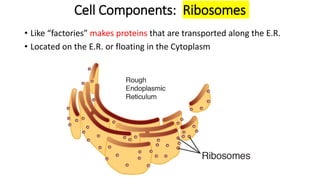
Cell Components: Ribosomes
• Like “factories” makes proteins that are transported along the E.R.
• Located on the E.R. or floating in the Cytoplasm
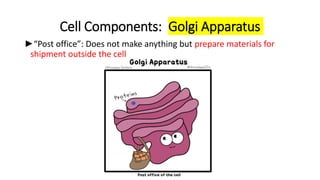
Cell Components: Golgi Apparatus
►“Post office”: Does not make anything but prepare materials for
shipment outside the cell
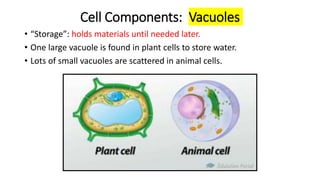
Cell Components: Vacuoles
• “Storage”: holds materials until needed later.
• One large vacuole is found in plant cells to store water.
• Lots of small vacuoles are scattered in animal cells.
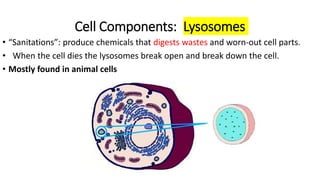
Cell Components: Lysosomes
• “Sanitations”: produce chemicals that digests wastes and worn-out cell parts.
• When the cell dies the lysosomes break open and break down the cell.
• Mostly found in animal cells
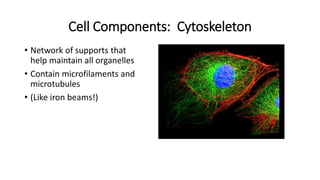
Cell Components: Cytoskeleton
• Network of supports that
help maintain all organelles
• Contain microfilaments and
microtubules
• (Like iron beams!)
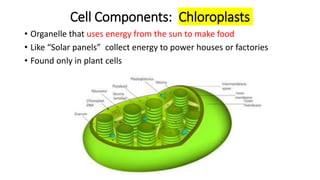
Cell Components: Chloroplasts
• Organelle that uses energy from the sun to make food
• Like “Solar panels” collect energy to power houses or factories
• Found only in plant cells
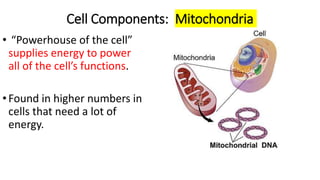
Cell Components: Mitochondria
• “Powerhouse of the cell”
supplies energy to power
all of the cell’s functions.
•Found in higher numbers in
cells that need a lot of
energy.
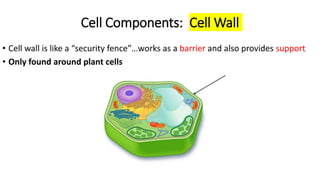
Cell Components: Cell Wall
• Cell wall is like a “security fence”…works as a barrier and also provides support
• Only found around plant cells
Cell Components: Cell Membrane
• “City limits” maintains the cell’s limits or boundaries.
• Controls what goes in and out of the cell.
• food and water move in, waste moves out.
• Made up of phospholipids

Cell City

  • 1.
  • 2.
    Prokaryotes vs. Eukaryotes •Prokaryotic: Cells that do not have nuclei (bacteria/cyanobacteria) • Typically smaller and less complex • Eukaryotic: Cells that have a nucleus (plants and animal cells) • Larger and more complex
  • 3.
  • 4.
    Cell Components: Cytoplasm •“The inner city” the fluid in the cell which contains all the organelles. • Organelles are like the “businesses” of the cell • Cytoplasm fills the space from the nucleus to the cell membrane
  • 5.
    Cell Components: TheNucleus • “City hall” directs all the activities of the cell. • Contains all the plans and blueprints in the form of DNA.
  • 6.
    Cell Components: EndoplasmicReticulum • Like “highways and streets”, moves materials around the cell • Extend from the nucleus to the cell membrane.
  • 7.
    Cell Components: Ribosomes •Like “factories” makes proteins that are transported along the E.R. • Located on the E.R. or floating in the Cytoplasm
  • 8.
    Cell Components: GolgiApparatus ►“Post office”: Does not make anything but prepare materials for shipment outside the cell
  • 9.
    Cell Components: Vacuoles •“Storage”: holds materials until needed later. • One large vacuole is found in plant cells to store water. • Lots of small vacuoles are scattered in animal cells.
  • 10.
    Cell Components: Lysosomes •“Sanitations”: produce chemicals that digests wastes and worn-out cell parts. • When the cell dies the lysosomes break open and break down the cell. • Mostly found in animal cells
  • 11.
    Cell Components: Cytoskeleton •Network of supports that help maintain all organelles • Contain microfilaments and microtubules • (Like iron beams!)
  • 12.
    Cell Components: Chloroplasts •Organelle that uses energy from the sun to make food • Like “Solar panels” collect energy to power houses or factories • Found only in plant cells
  • 13.
    Cell Components: Mitochondria •“Powerhouse of the cell” supplies energy to power all of the cell’s functions. •Found in higher numbers in cells that need a lot of energy.
  • 14.
    Cell Components: CellWall • Cell wall is like a “security fence”…works as a barrier and also provides support • Only found around plant cells
  • 15.
    Cell Components: CellMembrane • “City limits” maintains the cell’s limits or boundaries. • Controls what goes in and out of the cell. • food and water move in, waste moves out. • Made up of phospholipids