THE CELL
PROF.MS.SASIKALAVATHI ARUNACHALAM MSc N OBG
PRINCIPAL
HARYANA COLLEGE OF NURSING, ELLENABAD
The cell is the structural and functional unit of life. ft may be also regarded as the
basic unit of biological activity.
The concept of cell originated from the contributions of Schleiden and Schwann
(1838). However, it was only after 1940, the complexities of cell structure were
exposed.
Prokaryotic and eukaryotic cells
The cells of the living kingdom may be divided into two categories
1. Prokaryotes (Creek : pro - before; karyon nucleus) lack a well defined nucleus
and possess relatively simple structure. These include the various bacteria.
2. Eukaryotes (Greek: eu-true; karyonnucleus) possess a well defined nucleus and
are more complex in their structure and function. The higher organisms (animals
and plants) are composed of eukaryotic cells.
The cell consists of well defined subcellular organelles, enveloped by a plasma
membrane.
By differential centrifugation of tissue homogenate, it is possible to isolate each
cellular organelle in a relatively pure form.
The distribution of major enzymes and metabolic pathways in different cellular
organelles is given in the chapter on enzymes.
The subcellular organelles are briefly described in the following pages.
Eukaryotic Cell Prokaryotic Cell
PLASMA MEMBRANE
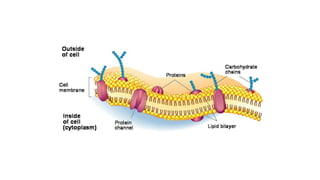
• All membranes including the plasma membrane are made up of lipids, proteins
and the their attached molecules collectively known as calyx.
• Lipids are amphipathic molecules each consisting of a polar or hydrophilic head
and two non polar or hydrophobic tails.
• There are 3 principal types of lipids
• A) Phospholipids- consisting of a head attached to two hydrophobic fatty acids
tails (one saturated and the other unsaturated)
• B)Glycolipids – that posses 1-15 residues of oligosaccharides attached to two fat
consisting of sphingosine or glycerol and two fatty acids tail.
• C) Sterols – that have a planar steroid ring which provides rigidity to the
membrane and a polar hydroxyl group at the terminus for e.g cholesterol
• Membrane consists of a lipid bilayer in which the polar heads of the lipids face out towards the aqueous
environment on either side while the hydrophobic tails face inside to create a hydrophobic environment.
• Different membranes vary considerably with regard to both the ratio of proteins to lipids and the types of
lipids. This provides different biophysical properties to different membrane.
• The lipid molecules frequently moves laterally within their mono layers. Thus providing fluidity to the
membranes.
• Plasma membrane contains about equal masses of lipids and proteins but there are 10-100 times more
lipid molecules than protein molecules in different membranes.
• Proteins can also move laterally within the membrane but slowly as compared to lipids. A protein may
reside in the membrane with cytoplasmic and extracellular domains localized to the outer surface or to
the surface of the membrane.
• There is an asymmetry in the plasma membrane created by biochemical differences between the two
faces of the membrane as follows
• A) lipids in two layers have different concentration of different types. Lipids on the cytoplasmic face are
more highly charged and tend to be unsaturated.
• B) distribution of proteins or their sequences is different on both surfaces.
• C) CHO groups are found exclusively on the extracellular face forming a glycocalyx
• D) in some cases additional glycoproteins on outer surface form the cell coat which may further be
extended into an extracellular matrix rich in glycoproteins
Functions
Barrier between
outer and inner
environment
Regulates
inward and
outward flow of
large and small
molecules
including water
Pumps ions in
and out
Bulk intake of
materials
Recognize
signals from
outside
Membrane
enzymes
catylyze
various
biochemical
reactions
Helps in
formation of
cell junction
between
adjacent cell
Nucleus
Nucleus is the largest cellular organelle, surrounded by a double membrane nuclear envelope. The
outer membrane is continuous with the membranes of endoplasmic reticulum.
At certain intervals, the two nuclear membranes have nuclear pores with a diameter of about 90
nm. These pores permit the free passage of the products synthesized in the nucleus into the
surrounding cytoplasm.
Nucleus contains DNA, the repository of genetic information. Eukaryotic DNA is associated with
basic protein (histones) in the ratio of 1 : 1, to form nucleosomes.
An assembly of nucleosomes constitutes chromatin fibres of chromosomes (Creek'. chroma -
colour; soma body). Thus, a single human chromosome is composed of about a million
nucleosomes.
The number of chromosomes is a characteristic feature of the species. Humans have 46
chromosomes, compactly packed in the nucleus.
The nucleus of the eukaryotic cell contains a dense body known as nucleolus. It is
rich in RNA, particularly the ribosomal RNA which enters the cytosol through
nuclear pores.
The ground material of the nucleus is often referred to as nucleoplasm. It is rich in
enzymes such as DNA polymerases and RNA polymerases.
To the surprise of biochemists, the enzymes of glycolysis, citric acid cycle and
hexose monophosphate shunt have also been detected in the nucleoplasm
Mitochondria
The mitochondria (Creek'. mitos - thread; chondros - granule) are the centres for the
cellular respiration and energy metabolism. They are regarded as the power houses
of the cell with variable size and shape.
Mitochondria are rod-like or filamentous bodies, usually with dimensions of 1.0 x 3
μm. About 2,000 mitochondria, occupying about 1/5th of the total cell volume, are
present in a typical cell.
The mitochondria are composed of a double membrane system. The outer
membrane is smooth and completely envelops the organelle. The inner membrane is
folded to form cristae (Latin - crests) which occupy a larger surface area. The
internal chamber of mitochondria is referred to as matrix or mitosol.
The components of electron transport chain and oxidative phosphorylation
(flavoprotein, cytochromes b, c1, c, a and a3 and coupling factors) are buried in the
The matrix contains several enzymes concerned with the energy metabolism of carbohydrates,
lipids and amino acids (e.g., citric acid cycle, β-oxidation).
The matrix enzymes also participate in the synthesis of heme and urea.
Mitochondria are the principal producers of ATP in the aerobic cells. ATP, the energy currency,
generated in mitochondria is exported to all parts of the cell to provide energy for the cellular
work.
The mitochondrial matrix contains a circular double stranded DNA (mtDNA), RNA and
ribosomes. Thus, the mitochondria are equipped with an independent protein synthesizing
machinery. It is estimated that about 10% of the mitochondrial proteins are produced in the
mitochondria.
The structure and functions of mitochondria closely resemble prokaryotic cells. lt is hypothesized
that mitochondria have evolved from aerobic bacteria. Further, it is believed that during evolution,
the aerobic bacteria developed a symbiotic relationship with primordial anaerobic eukaryotic cells
that ultimately led to the arrival of aerobic eukaryotes.
Endoplasmic reticulum
The network of membrane enclosed spaces that extends throughout the cytoplasm
constitutes endoplasmic reticulum (ER). Some of these thread-like structures extend
from the nuclear pores to the plasma membrane.
A large portion of the ER is studded with ribosomes to give a granular appearance
which is referred to as rough endoplasmic reticulum. Ribosomes are the factories of
protein biosynthesis.
During the process of cell fractionation, rough ER is disrupted to form small
vesicles known as microsomes. It may be noted that microsomes as such do not
occur in the cell.
The smooth endoplasmic reticulum does not contain ribosomes. lt is involved in the
synthesis of lipids (triacylglycerols, phospholipids, sterols) and metabolism of
drugs, besides supplying Ca2+ for the cellular functions.
Golgi apparatus
Eukaryotic cells contain a unique cluster of membrane vesicles known as
dictyosomes which, in turn, constitute Golgi apparatus (or Golgi complex). The
newly synthesized proteins are handed over to the Golgi apparatus which catalyse
the addition of carbohydrates, lipids or sulfate moieties to the proteins. These
chemical modifications are necessary for the transport of proteins across the plasma
membrane.
Certain proteins and enzymes are enclosed in membrane vesicles of Golgi apparatus
and secreted from the cell after the appropriate signals. The digestive enzymes of
pancreas are produced in this fashion.
Golgi apparatus are also involved in the membrane synthesis, particularly for the
formation of intracellular organelles (e.g. peroxisomes, lysosomes)
Lysosomes
Lysosomes are spherical vesicles enveloped by a single membrane. Lysosomes are
regarded as the digestive tract of the cell, since they are actively involved in
digestion of cellular substances-namely proteins, lipids, carbohydrates and nucleic
acids.
Lysosomal enzymes are categorized as hydrolases. These include the following
enzymes (with substrate in brackets)
α-glucosidase (glycogen)
Cathepsins (proteins)
Lipases (lipids)
Ribonucleases (RNA)
The pH of the lysosomal matrix is more acidic (pH < 5) than the cytosol (pH-7) and
this facilitates the degradation of different compounds. The lysosomal enzymes are
responsible for maintaining the cellular compounds in a dynamic state, by their
degradation and recycling. The degraded products leave the lysosomes, usually by
diffusion, for reutilization by the cell.
Sometimes, however, certain residual products, rich in lipids and proteins,
collectively known as Iipofuscin accumulate in the cell. Lipofuscin is the age
pigment or wear and tear pigment which has been implicated in ageing process.
The digestive enzymes of cellular compounds are confined to the lysosomes in the
best interest of the cell. Escape of these enzymes into cytosol will destroy the
functional macromolecules of the cell and result in many complications. The
occurrence of several diseases (e.g. arthritis, muscle diseases, allergic disorders) has
been partly attributed to the release of lysosomal enzymes.
Peroxisomes
Peroxisomes, also known as microbodies, are single membrane cellular organelles.
They are spherical or oval in shape and contain the enzyme catalase. Catalase
protects the cell from the toxic effects of H2O2, by converting it to H2O and O2.
Peroxisomes are also involved in the oxidation of long chain fatty acids (> C18),
and synthesis of plasmalogens and glycolipids.
Plants contain glyoxysomes, a specialized type of peroxisomes, which are involved
in the glyoxylate pathway.
Peroxisome biogenesis disorders (PBDs), are a group of rare diseases involving the
enzyme activities of peroxisomes.
The biochemical abnormalities associated with PBDs include increased levels of
very long chain fatty acids (C24 and C26) and decreased concentrations of
plasmalogens.
The most severe form of PBDs is Zellweger syndrome, a condition characterized by
the absence of functional peroxisomes. The victims of this disease may die within
one year after birth.
Cytosol and cytoskeleton
The cellular matrix is collectively referred to as cytosol. Cytosol is basically a
compartment containing several enzymes/ metabolites and salts in an aqueous gel
like medium.
More recent studies however, indicate that the cytoplasm actually contains a
complex network of protein filaments, spread throughout, that constitutes
cytoskeleton.
The cytoplasmic filaments are of three types - microtubules, actin filaments and
intermediate filaments. The filaments which are polymers of proteins are
responsible for the structure, shape and organization of the cell.
INTEGRATION OF CELLULAR FUNCTIONS
The eukaryotic cells perform a wide range of complex reactions functions to
maintain tissues, and for the ultimate well-being of the whole organism.
For this purpose, the various intracellular processes and biochemical reactions are
tightly controlled and integrated.
Division of a cell into two daughter cells is good example of the orderly occurrence
of an integrated series of cellular reactions.
Apoptosis is the programmed cell death or cell suicide. This occurs when the cell
has fulfilled its biological functions.
Apoptosis may be regarded as a natural cell death and it differs from the cell death
caused by injury due to radiation, anoxia etc. Programmed cell death is a highly
Cell bio

Cell bio

  • 1.
    THE CELL PROF.MS.SASIKALAVATHI ARUNACHALAMMSc N OBG PRINCIPAL HARYANA COLLEGE OF NURSING, ELLENABAD
  • 2.
    The cell isthe structural and functional unit of life. ft may be also regarded as the basic unit of biological activity. The concept of cell originated from the contributions of Schleiden and Schwann (1838). However, it was only after 1940, the complexities of cell structure were exposed. Prokaryotic and eukaryotic cells The cells of the living kingdom may be divided into two categories 1. Prokaryotes (Creek : pro - before; karyon nucleus) lack a well defined nucleus and possess relatively simple structure. These include the various bacteria. 2. Eukaryotes (Greek: eu-true; karyonnucleus) possess a well defined nucleus and are more complex in their structure and function. The higher organisms (animals and plants) are composed of eukaryotic cells.
  • 4.
    The cell consistsof well defined subcellular organelles, enveloped by a plasma membrane. By differential centrifugation of tissue homogenate, it is possible to isolate each cellular organelle in a relatively pure form. The distribution of major enzymes and metabolic pathways in different cellular organelles is given in the chapter on enzymes. The subcellular organelles are briefly described in the following pages.
  • 5.
  • 6.
    PLASMA MEMBRANE • Allmembranes including the plasma membrane are made up of lipids, proteins and the their attached molecules collectively known as calyx. • Lipids are amphipathic molecules each consisting of a polar or hydrophilic head and two non polar or hydrophobic tails. • There are 3 principal types of lipids • A) Phospholipids- consisting of a head attached to two hydrophobic fatty acids tails (one saturated and the other unsaturated) • B)Glycolipids – that posses 1-15 residues of oligosaccharides attached to two fat consisting of sphingosine or glycerol and two fatty acids tail. • C) Sterols – that have a planar steroid ring which provides rigidity to the membrane and a polar hydroxyl group at the terminus for e.g cholesterol
  • 7.
    • Membrane consistsof a lipid bilayer in which the polar heads of the lipids face out towards the aqueous environment on either side while the hydrophobic tails face inside to create a hydrophobic environment. • Different membranes vary considerably with regard to both the ratio of proteins to lipids and the types of lipids. This provides different biophysical properties to different membrane. • The lipid molecules frequently moves laterally within their mono layers. Thus providing fluidity to the membranes. • Plasma membrane contains about equal masses of lipids and proteins but there are 10-100 times more lipid molecules than protein molecules in different membranes. • Proteins can also move laterally within the membrane but slowly as compared to lipids. A protein may reside in the membrane with cytoplasmic and extracellular domains localized to the outer surface or to the surface of the membrane. • There is an asymmetry in the plasma membrane created by biochemical differences between the two faces of the membrane as follows • A) lipids in two layers have different concentration of different types. Lipids on the cytoplasmic face are more highly charged and tend to be unsaturated. • B) distribution of proteins or their sequences is different on both surfaces. • C) CHO groups are found exclusively on the extracellular face forming a glycocalyx • D) in some cases additional glycoproteins on outer surface form the cell coat which may further be extended into an extracellular matrix rich in glycoproteins
  • 9.
    Functions Barrier between outer andinner environment Regulates inward and outward flow of large and small molecules including water Pumps ions in and out Bulk intake of materials Recognize signals from outside Membrane enzymes catylyze various biochemical reactions Helps in formation of cell junction between adjacent cell
  • 10.
    Nucleus Nucleus is thelargest cellular organelle, surrounded by a double membrane nuclear envelope. The outer membrane is continuous with the membranes of endoplasmic reticulum. At certain intervals, the two nuclear membranes have nuclear pores with a diameter of about 90 nm. These pores permit the free passage of the products synthesized in the nucleus into the surrounding cytoplasm. Nucleus contains DNA, the repository of genetic information. Eukaryotic DNA is associated with basic protein (histones) in the ratio of 1 : 1, to form nucleosomes. An assembly of nucleosomes constitutes chromatin fibres of chromosomes (Creek'. chroma - colour; soma body). Thus, a single human chromosome is composed of about a million nucleosomes. The number of chromosomes is a characteristic feature of the species. Humans have 46 chromosomes, compactly packed in the nucleus.
  • 11.
    The nucleus ofthe eukaryotic cell contains a dense body known as nucleolus. It is rich in RNA, particularly the ribosomal RNA which enters the cytosol through nuclear pores. The ground material of the nucleus is often referred to as nucleoplasm. It is rich in enzymes such as DNA polymerases and RNA polymerases. To the surprise of biochemists, the enzymes of glycolysis, citric acid cycle and hexose monophosphate shunt have also been detected in the nucleoplasm
  • 13.
    Mitochondria The mitochondria (Creek'.mitos - thread; chondros - granule) are the centres for the cellular respiration and energy metabolism. They are regarded as the power houses of the cell with variable size and shape. Mitochondria are rod-like or filamentous bodies, usually with dimensions of 1.0 x 3 μm. About 2,000 mitochondria, occupying about 1/5th of the total cell volume, are present in a typical cell. The mitochondria are composed of a double membrane system. The outer membrane is smooth and completely envelops the organelle. The inner membrane is folded to form cristae (Latin - crests) which occupy a larger surface area. The internal chamber of mitochondria is referred to as matrix or mitosol. The components of electron transport chain and oxidative phosphorylation (flavoprotein, cytochromes b, c1, c, a and a3 and coupling factors) are buried in the
  • 14.
    The matrix containsseveral enzymes concerned with the energy metabolism of carbohydrates, lipids and amino acids (e.g., citric acid cycle, β-oxidation). The matrix enzymes also participate in the synthesis of heme and urea. Mitochondria are the principal producers of ATP in the aerobic cells. ATP, the energy currency, generated in mitochondria is exported to all parts of the cell to provide energy for the cellular work. The mitochondrial matrix contains a circular double stranded DNA (mtDNA), RNA and ribosomes. Thus, the mitochondria are equipped with an independent protein synthesizing machinery. It is estimated that about 10% of the mitochondrial proteins are produced in the mitochondria. The structure and functions of mitochondria closely resemble prokaryotic cells. lt is hypothesized that mitochondria have evolved from aerobic bacteria. Further, it is believed that during evolution, the aerobic bacteria developed a symbiotic relationship with primordial anaerobic eukaryotic cells that ultimately led to the arrival of aerobic eukaryotes.
  • 16.
    Endoplasmic reticulum The networkof membrane enclosed spaces that extends throughout the cytoplasm constitutes endoplasmic reticulum (ER). Some of these thread-like structures extend from the nuclear pores to the plasma membrane. A large portion of the ER is studded with ribosomes to give a granular appearance which is referred to as rough endoplasmic reticulum. Ribosomes are the factories of protein biosynthesis. During the process of cell fractionation, rough ER is disrupted to form small vesicles known as microsomes. It may be noted that microsomes as such do not occur in the cell. The smooth endoplasmic reticulum does not contain ribosomes. lt is involved in the synthesis of lipids (triacylglycerols, phospholipids, sterols) and metabolism of drugs, besides supplying Ca2+ for the cellular functions.
  • 18.
    Golgi apparatus Eukaryotic cellscontain a unique cluster of membrane vesicles known as dictyosomes which, in turn, constitute Golgi apparatus (or Golgi complex). The newly synthesized proteins are handed over to the Golgi apparatus which catalyse the addition of carbohydrates, lipids or sulfate moieties to the proteins. These chemical modifications are necessary for the transport of proteins across the plasma membrane. Certain proteins and enzymes are enclosed in membrane vesicles of Golgi apparatus and secreted from the cell after the appropriate signals. The digestive enzymes of pancreas are produced in this fashion. Golgi apparatus are also involved in the membrane synthesis, particularly for the formation of intracellular organelles (e.g. peroxisomes, lysosomes)
  • 20.
    Lysosomes Lysosomes are sphericalvesicles enveloped by a single membrane. Lysosomes are regarded as the digestive tract of the cell, since they are actively involved in digestion of cellular substances-namely proteins, lipids, carbohydrates and nucleic acids. Lysosomal enzymes are categorized as hydrolases. These include the following enzymes (with substrate in brackets) α-glucosidase (glycogen) Cathepsins (proteins) Lipases (lipids) Ribonucleases (RNA)
  • 21.
    The pH ofthe lysosomal matrix is more acidic (pH < 5) than the cytosol (pH-7) and this facilitates the degradation of different compounds. The lysosomal enzymes are responsible for maintaining the cellular compounds in a dynamic state, by their degradation and recycling. The degraded products leave the lysosomes, usually by diffusion, for reutilization by the cell. Sometimes, however, certain residual products, rich in lipids and proteins, collectively known as Iipofuscin accumulate in the cell. Lipofuscin is the age pigment or wear and tear pigment which has been implicated in ageing process. The digestive enzymes of cellular compounds are confined to the lysosomes in the best interest of the cell. Escape of these enzymes into cytosol will destroy the functional macromolecules of the cell and result in many complications. The occurrence of several diseases (e.g. arthritis, muscle diseases, allergic disorders) has been partly attributed to the release of lysosomal enzymes.
  • 23.
    Peroxisomes Peroxisomes, also knownas microbodies, are single membrane cellular organelles. They are spherical or oval in shape and contain the enzyme catalase. Catalase protects the cell from the toxic effects of H2O2, by converting it to H2O and O2. Peroxisomes are also involved in the oxidation of long chain fatty acids (> C18), and synthesis of plasmalogens and glycolipids. Plants contain glyoxysomes, a specialized type of peroxisomes, which are involved in the glyoxylate pathway. Peroxisome biogenesis disorders (PBDs), are a group of rare diseases involving the enzyme activities of peroxisomes.
  • 25.
    The biochemical abnormalitiesassociated with PBDs include increased levels of very long chain fatty acids (C24 and C26) and decreased concentrations of plasmalogens. The most severe form of PBDs is Zellweger syndrome, a condition characterized by the absence of functional peroxisomes. The victims of this disease may die within one year after birth.
  • 26.
    Cytosol and cytoskeleton Thecellular matrix is collectively referred to as cytosol. Cytosol is basically a compartment containing several enzymes/ metabolites and salts in an aqueous gel like medium. More recent studies however, indicate that the cytoplasm actually contains a complex network of protein filaments, spread throughout, that constitutes cytoskeleton. The cytoplasmic filaments are of three types - microtubules, actin filaments and intermediate filaments. The filaments which are polymers of proteins are responsible for the structure, shape and organization of the cell.
  • 28.
    INTEGRATION OF CELLULARFUNCTIONS The eukaryotic cells perform a wide range of complex reactions functions to maintain tissues, and for the ultimate well-being of the whole organism. For this purpose, the various intracellular processes and biochemical reactions are tightly controlled and integrated. Division of a cell into two daughter cells is good example of the orderly occurrence of an integrated series of cellular reactions. Apoptosis is the programmed cell death or cell suicide. This occurs when the cell has fulfilled its biological functions. Apoptosis may be regarded as a natural cell death and it differs from the cell death caused by injury due to radiation, anoxia etc. Programmed cell death is a highly