Made  By- Abhinav  Arya [email_address] Products Vs Brands
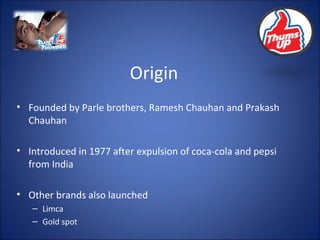
Origin Founded by Parle brothers, Ramesh Chauhan and Prakash Chauhan Introduced in 1977 after expulsion of coca-cola and pepsi from India Other brands also launched Limca Gold spot
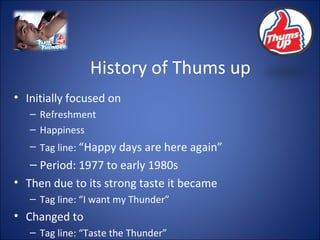
History of Thums up Initially focused on  Refreshment Happiness Tag line:  “Happy days are here again”  Period: 1977 to early 1980s Then due to its strong taste it became Tag line: “I want my Thunder” Changed to Tag line: “Taste the Thunder”
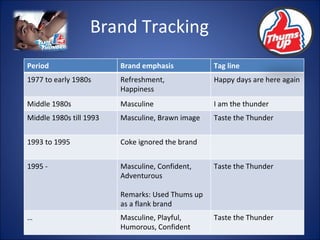
Brand Tracking Period Brand emphasis Tag line 1977 to early 1980s Refreshment,  Happiness Happy days are here again Middle 1980s Masculine I am the thunder Middle 1980s till 1993 Masculine, Brawn image Taste the Thunder 1993 to 1995 Coke ignored the brand 1995 -  Masculine, Confident, Adventurous  Remarks: Used Thums up as a flank brand Taste the Thunder … Masculine, Playful, Humorous, Confident Taste the Thunder
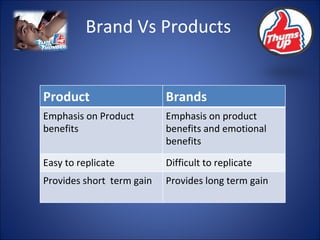
Brand Vs Products Product Brands Emphasis on Product  benefits Emphasis on product benefits and emotional benefits Easy to replicate Difficult to replicate Provides short  term gain Provides long term gain
Target Market Thums Up has been positioned as the "strong tasting cola for today's young adult males, from SEC A, B and C households, between 20-29 years of age''.
Brand Platform Two components Brand personality and brand values Masculine Macho Adventurous Confident Achievement Brand positioning
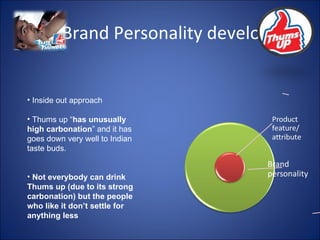
Brand Personality development Inside out approach Thums up “ has unusually high carbonation ” and it has goes down very well to Indian taste buds.  Not everybody can drink Thums up (due to its strong carbonation) but the people who like it don’t settle for anything less
Brand Positioning Positioning needs to be distinct Positioning is a long term strategy Positioning is for Product features/ benefits Emotional benefits Perceptual mapping as a tool  to develop brand positioning strategy Brand positioning success Various ads to reinforce such a strategy
Brand Message Brand understood his insecurities and his anxiety, his determination to survive , and his desire to succeed. This was probably the strongest concept in Indian advertising that connected to the young Indian male. -  Economic Times
Thank You

Thums up brand management in India strategic brand managem"

  • 1.
    Made By-Abhinav Arya [email_address] Products Vs Brands
  • 2.
    Origin Founded byParle brothers, Ramesh Chauhan and Prakash Chauhan Introduced in 1977 after expulsion of coca-cola and pepsi from India Other brands also launched Limca Gold spot
  • 3.
    History of Thumsup Initially focused on Refreshment Happiness Tag line: “Happy days are here again” Period: 1977 to early 1980s Then due to its strong taste it became Tag line: “I want my Thunder” Changed to Tag line: “Taste the Thunder”
  • 4.
    Brand Tracking PeriodBrand emphasis Tag line 1977 to early 1980s Refreshment, Happiness Happy days are here again Middle 1980s Masculine I am the thunder Middle 1980s till 1993 Masculine, Brawn image Taste the Thunder 1993 to 1995 Coke ignored the brand 1995 - Masculine, Confident, Adventurous Remarks: Used Thums up as a flank brand Taste the Thunder … Masculine, Playful, Humorous, Confident Taste the Thunder
  • 5.
    Brand Vs ProductsProduct Brands Emphasis on Product benefits Emphasis on product benefits and emotional benefits Easy to replicate Difficult to replicate Provides short term gain Provides long term gain
  • 6.
    Target Market ThumsUp has been positioned as the "strong tasting cola for today's young adult males, from SEC A, B and C households, between 20-29 years of age''.
  • 7.
    Brand Platform Twocomponents Brand personality and brand values Masculine Macho Adventurous Confident Achievement Brand positioning
  • 8.
    Brand Personality developmentInside out approach Thums up “ has unusually high carbonation ” and it has goes down very well to Indian taste buds. Not everybody can drink Thums up (due to its strong carbonation) but the people who like it don’t settle for anything less
  • 9.
    Brand Positioning Positioningneeds to be distinct Positioning is a long term strategy Positioning is for Product features/ benefits Emotional benefits Perceptual mapping as a tool to develop brand positioning strategy Brand positioning success Various ads to reinforce such a strategy
  • 10.
    Brand Message Brandunderstood his insecurities and his anxiety, his determination to survive , and his desire to succeed. This was probably the strongest concept in Indian advertising that connected to the young Indian male. - Economic Times
  • 11.

Editor's Notes

  • #3 Historically how the brand has been used to convey a particular message
  • #4 Historically how the brand has been used to convey a particular message
  • #5 Historically how the brand has been used to convey a particular message
  • #6 Historically how the brand has been used to convey a particular message
  • #7 Your brand positioning is the “space” that your services and solutions occupy in the minds of your target audience. The right positioning incorporates strong values and differentiators that are important to your customers. Brand positioning is important in deciding where you want to position your brand within its category and relative to the competition. Brand Positioning permeates virtually everything we do. It is the foundation to all communications and brand strategy . It is the disciplined thinking that guides the basis for building relationships between brands and customers. Once you determine the way in which you can reach your market, the next thing to look at is how you are going to lure your customer to try your brand.
  • #8 Your brand positioning is the “space” that your services and solutions occupy in the minds of your target audience. The right positioning incorporates strong values and differentiators that are important to your customers. Brand positioning is important in deciding where you want to position your brand within its category and relative to the competition. Brand Positioning permeates virtually everything we do. It is the foundation to all communications and brand strategy . It is the disciplined thinking that guides the basis for building relationships between brands and customers. Once you determine the way in which you can reach your market, the next thing to look at is how you are going to lure your customer to try your brand.