Evolution of Mittal Group The extraordinary story of Mittal Steel The Growth Approach The Growth Process Mittal Steel International Growth Process: The M&A Process
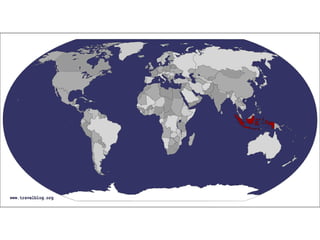
Steel: Global Scenario (1989) Profits were secondary; production was primary Highly fragmented Extreme volatility in steel prices and low growth  Uniform belief that Steel would always be regional 1989: Mittal Group in had less than .05% of the global steel industry (Indonesia Operations)
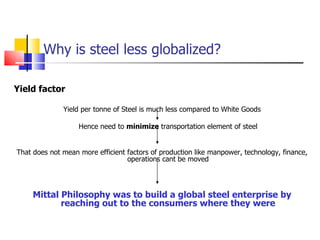
Why is steel less globalized? Yield factor Yield per tonne of Steel is much less compared to White Goods Hence need to  minimize  transportation element of steel That does not mean more efficient factors of production like manpower, technology, finance, operations cant be moved Mittal Philosophy was to build a global steel enterprise by reaching out to the consumers where they were
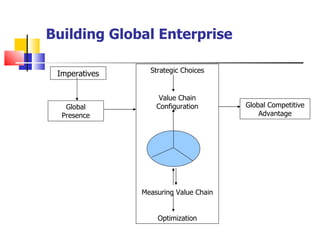
Building Global Enterprise Strategic Choices Value Chain Configuration Measuring Value Chain Optimization Imperatives Global Presence Global Competitive Advantage
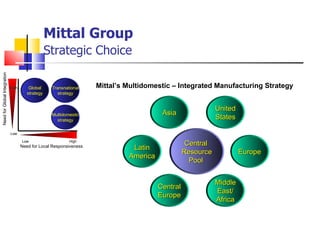
Mittal Group   Strategic Choice Need for Local Responsiveness Need for Global Integration Low High Low High Global strategy Transnational strategy Multidomestic strategy Central  Resource Pool  Europe United States Middle East/ Africa Asia Central Europe Latin America Mittal’s Multidomestic – Integrated Manufacturing Strategy
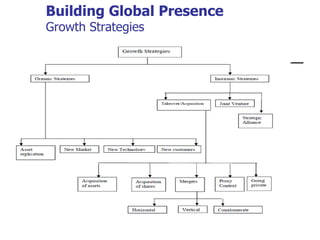
Building Global Presence Growth Strategies
Mittal Steel The Growth Roadmap
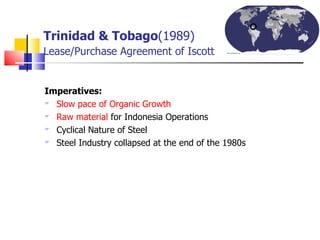
Trinidad & Tobago (1989)   Lease/Purchase Agreement of Iscott Imperatives: Slow pace of Organic Growth Raw material  for Indonesia Operations Cyclical Nature of Steel Steel Industry collapsed at the end of the 1980s
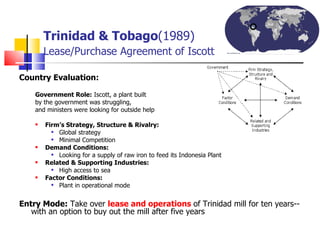
Trinidad & Tobago (1989)   Lease/Purchase Agreement of Iscott Country Evaluation: Government Role:  Iscott, a plant built  by the government was struggling,  and ministers were looking for outside help Firm’s Strategy, Structure & Rivalry: Global strategy Minimal Competition Demand Conditions: Looking for a supply of raw iron to feed its Indonesia Plant Related & Supporting Industries: High access to sea  Factor Conditions: Plant in operational mode Entry Mode:  Take over  lease and operations  of Trinidad mill for ten years--with an option to buy out the mill after five years
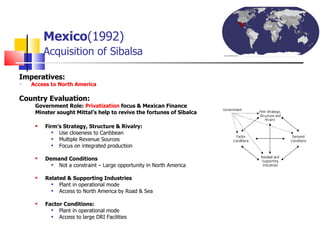
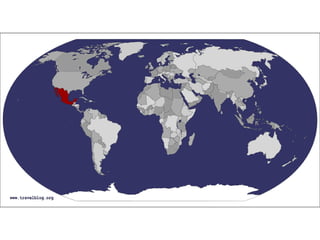
Mexico (1992)   Acquisition of Sibalsa Imperatives: Access to North America Country Evaluation: Government Role:   Privatization  focus & Mexican Finance Minster sought Mittal’s help to revive the fortunes of Sibalca Firm’s Strategy, Structure & Rivalry: Use closeness to Caribbean Multiple Revenue Sources Focus on integrated production Demand Conditions Not a constraint – Large opportunity in North America Related & Supporting Industries Plant in operational mode Access to North America by Road & Sea Factor Conditions: Plant in operational mode Access to large DRI Facilities
Mexico (1992)   Acquisition of Sibalsa CAGE Analysis:   Cultural Distances:   Company seen as outsider Caribbean operations minimized cultural difference Administrative or Political Distances:   Initiative from Mexico Govt.   Geographic Distances:   Closeness to Caribbean Closeness to US Market  Extensive access to waterways Economic Distances: Free trade agreement with US Entry Mode :  Sicarsta steel mills purchased for  $220 million  (mill built in the 1980s for some $2 billion.) Speed:  Purchase of backend DRI facility -Ispat world's largest DRI producer
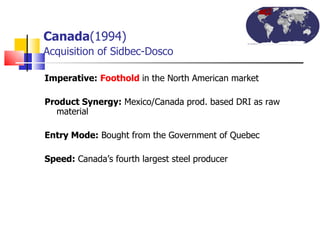
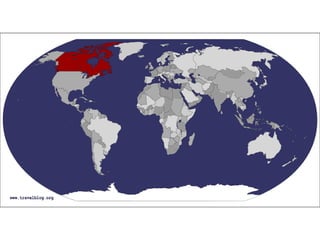
Canada (1994)   Acquisition of Sidbec-Dosco Imperative:   Foothold   in the North American market  Product Synergy:  Mexico/Canada prod. based DRI as raw material  Entry Mode:  Bought from the Government of Quebec  Speed:  Canada’s fourth largest steel producer
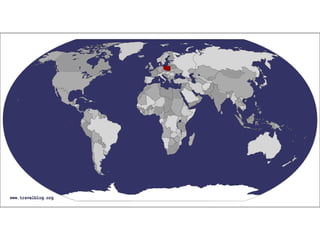
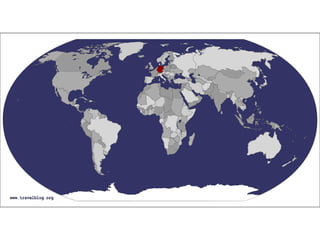
Germany (1995)   Acquisition of Hamburger Stahlwerke Imperatives: Limited access Western European Limited understanding of European market Product Synergy: Expanding scope of business:  Wire rod Building Value Chain Configuration: Renowned for mini-mill expertise   Entry Mode:  Hamburger Stahlwerke in Germany acquired Speed:  Germany's fourth largest producer of  wire rod
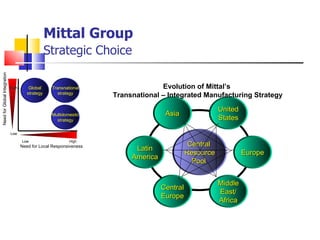
Mittal Group   Strategic Choice Need for Local Responsiveness Need for Global Integration Low High Low High Global strategy Transnational strategy Multidomestic strategy Central  Resource Pool  Europe United States Middle East/ Africa Asia Central Europe Latin America Evolution of Mittal’s  Transnational – Integrated Manufacturing Strategy
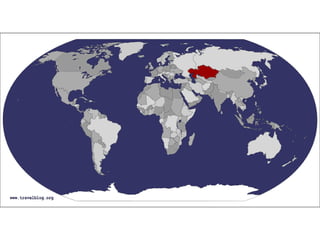
Kazakhstan  (1995)   Acquisition of Karmet Imperatives: Location Advantage Access to huge coal & iron reserves Proximity to China Country Evaluation: Government Role:   Proactive Government Involvement Firm’s Strategy, Structure & Rivalry: Integrated Manufacturing Develop Multiple Revenue Options  Demand Conditions: Huge demand in China Related & Supporting Industries Minimal Infrastructure Factor Conditions: Abundant Manpower Abundant Iron/Coal Mines eg. Shatinskaya Limited access to modern manufacturing equipment
Kazakhstan  (1995)   Acquisition of Karmet Risk Analysis   Risk Perspective:   Two rescue attempts by Western companies, US Steel and VAI of Austria, failed.  Banks did not lend money Risk Hedging:   Develop secondary revenue   stream by selling coal from  Shatinskaya directly to China
Kazakhstan  (1995)   Acquisition of Karmet VOIDS: There was no power or water supplies to the town  PESTEL Analysis:   Political factors:  Basic Soviet era township, along with 70,000 employees and Temirtau and its 170,000 inhabitants, all of whom relied on the plant for a living, faced a bleak future.  One of the preconditions of the deal was that  Mittal couldn’t reduce employment  by much as it was the Kazakh president’s pet project. Hence, huge political problems High government involvement as pet project of President  Economic factors: Soviet-style barter trading prevalent  Wages weren’t being paid  Minimal infrastructure Access Chinese market  Social factors:  Socialistic mindset  Technological factors:  Poor access to modern technology & trained manpower  Environmental factors:  Incredibly harsh weather with temperatures reaching +40C in the summer and -40C in the winter
Kazakhstan  (1995)   Acquisition of Karmet Entry Mode:   Bought the plant outright, putting in his  own  cash Development of Value Chain: Brought international management from India  & other plants to instill new management practices  Scrapped Soviet-style barter trading Invested in plant and the town, restoring heat, light and water Speed:  Developed One of world’s largest integrated manufacturing facility
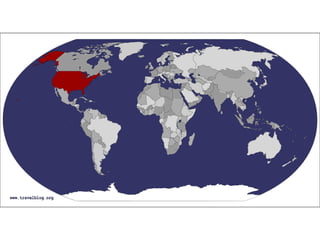
USA (1998)   Acquisition of Inland Steel Imperatives: Entry into US Market Access to technology Product Portfolio: Access to Nippon technology  to manufacture cold roll sheet, strip sheet & special quality bar products Specialized in cold-rolled sheet and strip steel for motor vehicles  Strategic Choice:   Inland was one of the world's largest integrated steel operations Developing the Value Chain:  The steel mill's shoreline location enabled it to take in steelmaking commodities & Inland Steel operated its own fleet of bulk carrier vessels  Entry Approach:   Departing from its low-cost acquisition position, Ispat paid $1.43 billion  for the East Chicago, Indiana-based steelmaker Inland Steel Speed of Market Acquisition:  Inland Steel - fourth largest steel maker in US. Inland acquisition, bolted Ispat International into the world's top ten steel producers
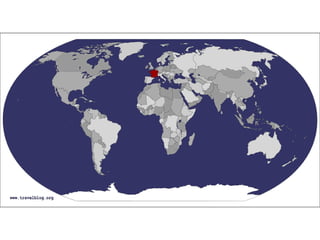
France (1998)   Acquisition of Unimétal Imperatives:  Direct  Access to French Market Product Synergy:   Consolidation of the European long products sector Entry Mode:  Acquisition of Unimétal from Usinor  Speed:   Mittal Steel became the largest producer of high-quality wire rods in Europe
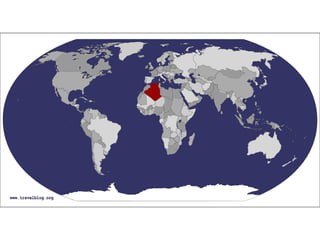
Algeria (2001)   Acquisition of ALFASAID Imperatives: Entry to Africa  Supplies to Europe Country Evaluation:  PESTEL Analysis:   Political factors:   Civil War Underway(1991-2002) Association Treaty in 2001 with  European Union to lower tariffs and increase trade  Economic factors: Reinitiating Economic Reforms Process after previous failure 30% of GDP & and over 95% of export earnings from hydrocarbons  Social factors:  Total Social Disarray Technological factors:  Outdated equipment Legal Factors:   New legislative framework Economic Mode:  Bought 70% of Alfasid from the Algerian government Speed:  Alfasid is the largest producer of steel in North Africa
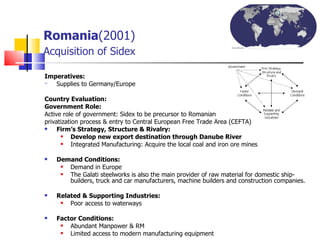
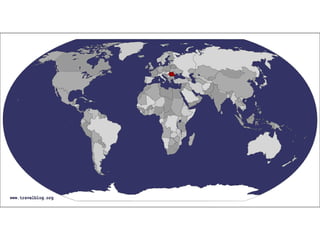
Romania (2001)   Acquisition of Sidex Imperatives: Supplies to Germany/Europe Country Evaluation: Government Role:   Active role of government: Sidex to be precursor to Romanian privatization process & entry to Central European Free Trade Area (CEFTA) Firm’s Strategy, Structure & Rivalry: Develop new export destination through Danube River  Integrated Manufacturing: Acquire the local coal and iron ore mines Demand Conditions: Demand in Europe The Galati steelworks is also the main provider of raw material for domestic ship-builders, truck and car manufacturers, machine builders and construction companies.  Related & Supporting Industries: Poor access to waterways Factor Conditions: Abundant Manpower & RM Limited access to modern manufacturing equipment
Romania (2001)   Acquisition of Sidex PESTEL Analysis:   Political factors:   Political  commitment to economic reforms   Significant role/control of EU  Retrenchment fear: Resistance against privatization Economic factors: 2001: Collapse of Communism Sidex to be precursor to Romanian privatization process &  entry to Central European Free Trade Area (CEFTA). Shortage of Capital Prevalence of Barter Unrealized wages Social factors:  Socialistic mindset & first shot at privatization Hardcore Christian following Technological factors:  Outdated equipment Legal Factors:   Legal framework under development: 1 st  initiative towards economic reforms  Not part of Central European Free Trade Area (CEFTA) or EU
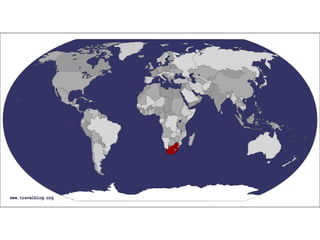
South Africa (2002)   Business Alliance with Iscor Imperative:   Access to Southern Africa Access to Asia/America’s Entry Mode:  Business assistance deal  To provide business assistance over a three-year period in exchange for Iscor shares - provided certain cost-saving thresholds were met PESTEL Analysis: Political:  South African government's growth objectives in the    manufacturing sector,  Legal:  Approval from the country's Competition Commission  Speed:   Mittal Group took control of Iscor in June 2004
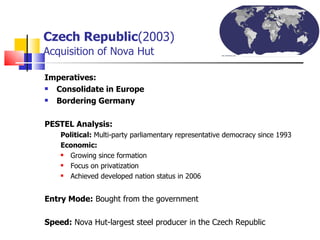
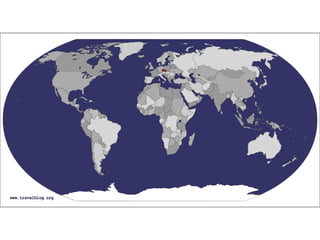
Czech Republic (2003)   Acquisition of Nova Hut Imperatives:  Consolidate in Europe Bordering Germany PESTEL Analysis: Political:  Multi-party parliamentary representative democracy since 1993 Economic:   Growing since formation Focus on privatization  Achieved developed nation status in 2006 Entry Mode:  Bought from the government Speed:  Nova Hut-largest steel producer in the Czech Republic
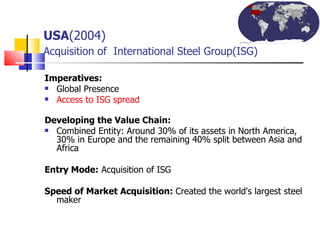
USA (2004)   Acquisition of  International Steel Group(ISG) Imperatives: Global Presence Access to ISG spread   Developing the Value Chain:  Combined Entity: Around 30% of its assets in North America, 30% in Europe and the remaining 40% split between Asia and Africa  Entry Mode:  Acquisition of ISG  Speed of Market Acquisition:  Created the world's largest steel maker
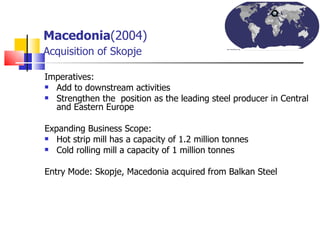
Macedonia (2004)   Acquisition of Skopje Imperatives: Add to downstream activities Strengthen the  position as the leading steel producer in Central and Eastern Europe Expanding Business Scope: Hot strip mill has a capacity of 1.2 million tonnes  Cold rolling mill a capacity of 1 million tonnes  Entry Mode: Skopje, Macedonia acquired from Balkan Steel
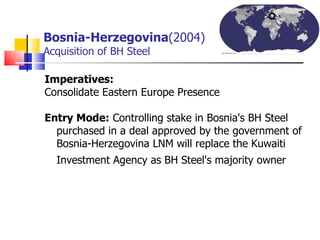
Bosnia-Herzegovina (2004)   Acquisition of BH Steel Imperatives: Consolidate Eastern Europe Presence Entry Mode:  Controlling stake in Bosnia's BH Steel purchased in a deal approved by the government of Bosnia-Herzegovina LNM will replace the Kuwaiti Investment Agency as BH Steel's majority owner
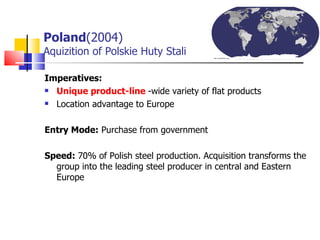
Poland (2004) Aquizition of Polskie Huty Stali Imperatives: Unique product-line  -wide variety of flat products  Location advantage to Europe  Entry Mode:  Purchase from government Speed:  70% of Polish steel production. Acquisition transforms the group into the leading steel producer in central and Eastern Europe
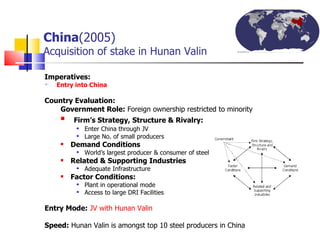
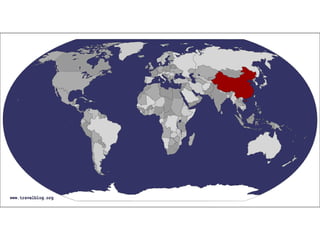
China (2005) Acquisition of stake in Hunan Valin Imperatives: Entry into China Country Evaluation: Government Role:  Foreign ownership restricted to minority Firm’s Strategy, Structure & Rivalry: Enter China through JV Large No. of small producers Demand Conditions World’s largest producer & consumer of steel Related & Supporting Industries Adequate Infrastructure Factor Conditions: Plant in operational mode Access to large DRI Facilities Entry Mode:   JV with Hunan Valin Speed:  Hunan Valin is amongst top 10 steel producers in China
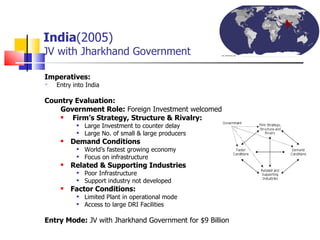
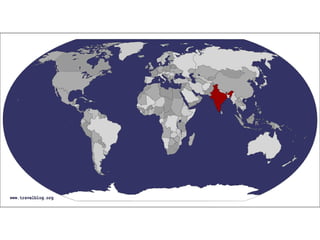
India (2005) JV with Jharkhand Government Imperatives: Entry into India Country Evaluation: Government Role:  Foreign Investment welcomed Firm’s Strategy, Structure & Rivalry: Large Investment to counter delay Large No. of small & large producers Demand Conditions World’s fastest growing economy Focus on infrastructure Related & Supporting Industries Poor Infrastructure Support industry not developed Factor Conditions: Limited Plant in operational mode Access to large DRI Facilities Entry Mode:  JV with Jharkhand Government for $9 Billion
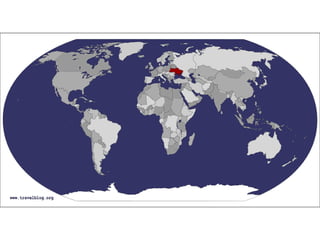
Ukraine (2005) Acquisition of Kryvorizhstal Imperative: Enter Ukraine Market Tap more than one billion tonnes of iron ore resources Entry Mode:   Bought from Public auction  in from Ukraine Govt. Speed:  Kryvorizhstal is Ukraine's leading steelmaker
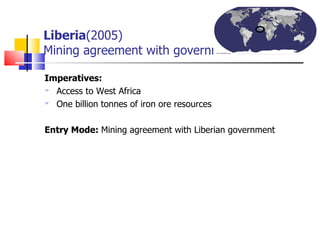
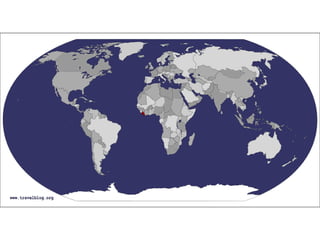
Liberia (2005) Mining agreement with government Imperatives: Access to West Africa One billion tonnes of iron ore resources  Entry Mode:  Mining agreement with Liberian government


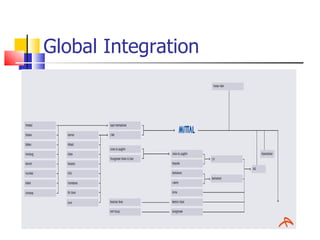
Global Integration
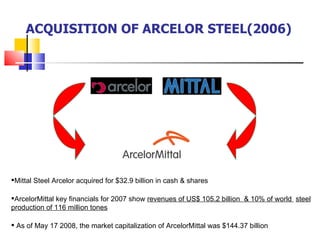
ACQUISITION OF ARCELOR STEEL(2006) Mittal Steel Arcelor acquired for $32.9 billion in cash & shares ArcelorMittal key financials for 2007 show  revenues of US$ 105.2 billion  & 10% of world  steel production of 116 million tones As of May 17 2008, the market capitalization of ArcelorMittal was $144.37 billion
LNM Group’s Approach Highlights Buy  distressed steelmakers , with a view to  geographically diversify   the acquisitions Apply basic  modern management principles  and techniques to run them profitable Employ a core team of experts, moving them around from one location to another , to implement cost-cutting measures, marketing changes and market reorientation
LNM Group’s Approach   DNA Transfer In Mittal’s words  ” The   Next step for a business leader is to communicate one’s aspirations to the workforce, especially those who have only known government bosses. The trouble with states owning businesses is that the workers can’t see any direction. When we go in we communicate and show leadership. When people can see which direction the leaders are going in it becomes easier to motivate them .”
Value Chain Optimization Approach Three factors set Mittal Steel’s management approach apart from that of its peers:  its knowledge sharing programme Knowledge Management Programme(KMP)  This kind of expertise is now being exported around Mittal’s far-flung plants through a process of forced and shared learning. Incorporates: Monday Meeting : At strategic Level Tuesday Meeting : At Operational Level  ‘ e-room’:  If a plant is having a particularly tricky problem, it will post details in an ‘e-room’ — an internal online noticeboard. Managers all over the world are then expected to come up with solutions  its commitment to technology leadership  its encouragement of talent at every level.
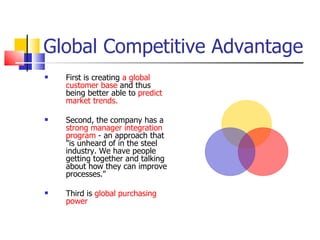
Global Competitive Advantage First is creating  a global customer base  and thus being better able to  predict market trends.  Second, the company has a  strong manager integration program  - an approach that "is unheard of in the steel industry. We have people getting together and talking about how they can improve processes."  Third is  global purchasing power
Learnings Capability: Ability to be flexible  Maintaining a global employee Mixture of nationalities and the cultural mix
Learnings Focus entirely on integrated production Enhance speed of entry by buying leading player in domestic market Buy from government to minimize opposition Build political affiliation & support Build investor support Remove backend & front end voids Enter & consolidate Multiple sources of revenue to hedge risks

Evolution of mittal steel

  • 1.
  • 2.
    Evolution of MittalGroup The extraordinary story of Mittal Steel The Growth Approach The Growth Process Mittal Steel International Growth Process: The M&A Process
  • 3.
    Steel: Global Scenario(1989) Profits were secondary; production was primary Highly fragmented Extreme volatility in steel prices and low growth Uniform belief that Steel would always be regional 1989: Mittal Group in had less than .05% of the global steel industry (Indonesia Operations)
  • 4.
    Why is steelless globalized? Yield factor Yield per tonne of Steel is much less compared to White Goods Hence need to minimize transportation element of steel That does not mean more efficient factors of production like manpower, technology, finance, operations cant be moved Mittal Philosophy was to build a global steel enterprise by reaching out to the consumers where they were
  • 5.
    Building Global EnterpriseStrategic Choices Value Chain Configuration Measuring Value Chain Optimization Imperatives Global Presence Global Competitive Advantage
  • 6.
    Mittal Group Strategic Choice Need for Local Responsiveness Need for Global Integration Low High Low High Global strategy Transnational strategy Multidomestic strategy Central Resource Pool Europe United States Middle East/ Africa Asia Central Europe Latin America Mittal’s Multidomestic – Integrated Manufacturing Strategy
  • 7.
    Building Global PresenceGrowth Strategies
  • 8.
    Mittal Steel TheGrowth Roadmap
  • 9.
    Trinidad & Tobago(1989) Lease/Purchase Agreement of Iscott Imperatives: Slow pace of Organic Growth Raw material for Indonesia Operations Cyclical Nature of Steel Steel Industry collapsed at the end of the 1980s
  • 10.
    Trinidad & Tobago(1989) Lease/Purchase Agreement of Iscott Country Evaluation: Government Role: Iscott, a plant built by the government was struggling, and ministers were looking for outside help Firm’s Strategy, Structure & Rivalry: Global strategy Minimal Competition Demand Conditions: Looking for a supply of raw iron to feed its Indonesia Plant Related & Supporting Industries: High access to sea Factor Conditions: Plant in operational mode Entry Mode: Take over lease and operations of Trinidad mill for ten years--with an option to buy out the mill after five years
  • 11.
    Mexico (1992) Acquisition of Sibalsa Imperatives: Access to North America Country Evaluation: Government Role: Privatization focus & Mexican Finance Minster sought Mittal’s help to revive the fortunes of Sibalca Firm’s Strategy, Structure & Rivalry: Use closeness to Caribbean Multiple Revenue Sources Focus on integrated production Demand Conditions Not a constraint – Large opportunity in North America Related & Supporting Industries Plant in operational mode Access to North America by Road & Sea Factor Conditions: Plant in operational mode Access to large DRI Facilities
  • 12.
    Mexico (1992) Acquisition of Sibalsa CAGE Analysis: Cultural Distances: Company seen as outsider Caribbean operations minimized cultural difference Administrative or Political Distances: Initiative from Mexico Govt. Geographic Distances: Closeness to Caribbean Closeness to US Market Extensive access to waterways Economic Distances: Free trade agreement with US Entry Mode : Sicarsta steel mills purchased for $220 million (mill built in the 1980s for some $2 billion.) Speed: Purchase of backend DRI facility -Ispat world's largest DRI producer
  • 13.
    Canada (1994) Acquisition of Sidbec-Dosco Imperative: Foothold in the North American market Product Synergy: Mexico/Canada prod. based DRI as raw material Entry Mode: Bought from the Government of Quebec Speed: Canada’s fourth largest steel producer
  • 14.
    Germany (1995) Acquisition of Hamburger Stahlwerke Imperatives: Limited access Western European Limited understanding of European market Product Synergy: Expanding scope of business: Wire rod Building Value Chain Configuration: Renowned for mini-mill expertise Entry Mode: Hamburger Stahlwerke in Germany acquired Speed: Germany's fourth largest producer of wire rod
  • 15.
    Mittal Group Strategic Choice Need for Local Responsiveness Need for Global Integration Low High Low High Global strategy Transnational strategy Multidomestic strategy Central Resource Pool Europe United States Middle East/ Africa Asia Central Europe Latin America Evolution of Mittal’s Transnational – Integrated Manufacturing Strategy
  • 16.
    Kazakhstan (1995) Acquisition of Karmet Imperatives: Location Advantage Access to huge coal & iron reserves Proximity to China Country Evaluation: Government Role: Proactive Government Involvement Firm’s Strategy, Structure & Rivalry: Integrated Manufacturing Develop Multiple Revenue Options Demand Conditions: Huge demand in China Related & Supporting Industries Minimal Infrastructure Factor Conditions: Abundant Manpower Abundant Iron/Coal Mines eg. Shatinskaya Limited access to modern manufacturing equipment
  • 17.
    Kazakhstan (1995) Acquisition of Karmet Risk Analysis Risk Perspective: Two rescue attempts by Western companies, US Steel and VAI of Austria, failed. Banks did not lend money Risk Hedging: Develop secondary revenue stream by selling coal from Shatinskaya directly to China
  • 18.
    Kazakhstan (1995) Acquisition of Karmet VOIDS: There was no power or water supplies to the town PESTEL Analysis: Political factors: Basic Soviet era township, along with 70,000 employees and Temirtau and its 170,000 inhabitants, all of whom relied on the plant for a living, faced a bleak future. One of the preconditions of the deal was that Mittal couldn’t reduce employment by much as it was the Kazakh president’s pet project. Hence, huge political problems High government involvement as pet project of President Economic factors: Soviet-style barter trading prevalent Wages weren’t being paid Minimal infrastructure Access Chinese market Social factors: Socialistic mindset Technological factors: Poor access to modern technology & trained manpower Environmental factors: Incredibly harsh weather with temperatures reaching +40C in the summer and -40C in the winter
  • 19.
    Kazakhstan (1995) Acquisition of Karmet Entry Mode: Bought the plant outright, putting in his own cash Development of Value Chain: Brought international management from India & other plants to instill new management practices Scrapped Soviet-style barter trading Invested in plant and the town, restoring heat, light and water Speed: Developed One of world’s largest integrated manufacturing facility
  • 20.
    USA (1998) Acquisition of Inland Steel Imperatives: Entry into US Market Access to technology Product Portfolio: Access to Nippon technology to manufacture cold roll sheet, strip sheet & special quality bar products Specialized in cold-rolled sheet and strip steel for motor vehicles Strategic Choice: Inland was one of the world's largest integrated steel operations Developing the Value Chain: The steel mill's shoreline location enabled it to take in steelmaking commodities & Inland Steel operated its own fleet of bulk carrier vessels Entry Approach: Departing from its low-cost acquisition position, Ispat paid $1.43 billion for the East Chicago, Indiana-based steelmaker Inland Steel Speed of Market Acquisition: Inland Steel - fourth largest steel maker in US. Inland acquisition, bolted Ispat International into the world's top ten steel producers
  • 21.
    France (1998) Acquisition of Unimétal Imperatives: Direct Access to French Market Product Synergy: Consolidation of the European long products sector Entry Mode: Acquisition of Unimétal from Usinor Speed: Mittal Steel became the largest producer of high-quality wire rods in Europe
  • 22.
    Algeria (2001) Acquisition of ALFASAID Imperatives: Entry to Africa Supplies to Europe Country Evaluation: PESTEL Analysis: Political factors: Civil War Underway(1991-2002) Association Treaty in 2001 with European Union to lower tariffs and increase trade Economic factors: Reinitiating Economic Reforms Process after previous failure 30% of GDP & and over 95% of export earnings from hydrocarbons Social factors: Total Social Disarray Technological factors: Outdated equipment Legal Factors: New legislative framework Economic Mode: Bought 70% of Alfasid from the Algerian government Speed: Alfasid is the largest producer of steel in North Africa
  • 23.
    Romania (2001) Acquisition of Sidex Imperatives: Supplies to Germany/Europe Country Evaluation: Government Role: Active role of government: Sidex to be precursor to Romanian privatization process & entry to Central European Free Trade Area (CEFTA) Firm’s Strategy, Structure & Rivalry: Develop new export destination through Danube River Integrated Manufacturing: Acquire the local coal and iron ore mines Demand Conditions: Demand in Europe The Galati steelworks is also the main provider of raw material for domestic ship-builders, truck and car manufacturers, machine builders and construction companies. Related & Supporting Industries: Poor access to waterways Factor Conditions: Abundant Manpower & RM Limited access to modern manufacturing equipment
  • 24.
    Romania (2001) Acquisition of Sidex PESTEL Analysis: Political factors: Political commitment to economic reforms Significant role/control of EU Retrenchment fear: Resistance against privatization Economic factors: 2001: Collapse of Communism Sidex to be precursor to Romanian privatization process & entry to Central European Free Trade Area (CEFTA). Shortage of Capital Prevalence of Barter Unrealized wages Social factors: Socialistic mindset & first shot at privatization Hardcore Christian following Technological factors: Outdated equipment Legal Factors: Legal framework under development: 1 st initiative towards economic reforms Not part of Central European Free Trade Area (CEFTA) or EU
  • 25.
    South Africa (2002) Business Alliance with Iscor Imperative: Access to Southern Africa Access to Asia/America’s Entry Mode: Business assistance deal To provide business assistance over a three-year period in exchange for Iscor shares - provided certain cost-saving thresholds were met PESTEL Analysis: Political: South African government's growth objectives in the manufacturing sector, Legal: Approval from the country's Competition Commission Speed: Mittal Group took control of Iscor in June 2004
  • 26.
    Czech Republic (2003) Acquisition of Nova Hut Imperatives: Consolidate in Europe Bordering Germany PESTEL Analysis: Political: Multi-party parliamentary representative democracy since 1993 Economic: Growing since formation Focus on privatization Achieved developed nation status in 2006 Entry Mode: Bought from the government Speed: Nova Hut-largest steel producer in the Czech Republic
  • 27.
    USA (2004) Acquisition of International Steel Group(ISG) Imperatives: Global Presence Access to ISG spread Developing the Value Chain: Combined Entity: Around 30% of its assets in North America, 30% in Europe and the remaining 40% split between Asia and Africa Entry Mode: Acquisition of ISG Speed of Market Acquisition: Created the world's largest steel maker
  • 28.
    Macedonia (2004) Acquisition of Skopje Imperatives: Add to downstream activities Strengthen the position as the leading steel producer in Central and Eastern Europe Expanding Business Scope: Hot strip mill has a capacity of 1.2 million tonnes Cold rolling mill a capacity of 1 million tonnes Entry Mode: Skopje, Macedonia acquired from Balkan Steel
  • 29.
    Bosnia-Herzegovina (2004) Acquisition of BH Steel Imperatives: Consolidate Eastern Europe Presence Entry Mode: Controlling stake in Bosnia's BH Steel purchased in a deal approved by the government of Bosnia-Herzegovina LNM will replace the Kuwaiti Investment Agency as BH Steel's majority owner
  • 30.
    Poland (2004) Aquizitionof Polskie Huty Stali Imperatives: Unique product-line -wide variety of flat products Location advantage to Europe Entry Mode: Purchase from government Speed: 70% of Polish steel production. Acquisition transforms the group into the leading steel producer in central and Eastern Europe
  • 31.
    China (2005) Acquisitionof stake in Hunan Valin Imperatives: Entry into China Country Evaluation: Government Role: Foreign ownership restricted to minority Firm’s Strategy, Structure & Rivalry: Enter China through JV Large No. of small producers Demand Conditions World’s largest producer & consumer of steel Related & Supporting Industries Adequate Infrastructure Factor Conditions: Plant in operational mode Access to large DRI Facilities Entry Mode: JV with Hunan Valin Speed: Hunan Valin is amongst top 10 steel producers in China
  • 32.
    India (2005) JVwith Jharkhand Government Imperatives: Entry into India Country Evaluation: Government Role: Foreign Investment welcomed Firm’s Strategy, Structure & Rivalry: Large Investment to counter delay Large No. of small & large producers Demand Conditions World’s fastest growing economy Focus on infrastructure Related & Supporting Industries Poor Infrastructure Support industry not developed Factor Conditions: Limited Plant in operational mode Access to large DRI Facilities Entry Mode: JV with Jharkhand Government for $9 Billion
  • 33.
    Ukraine (2005) Acquisitionof Kryvorizhstal Imperative: Enter Ukraine Market Tap more than one billion tonnes of iron ore resources Entry Mode: Bought from Public auction in from Ukraine Govt. Speed: Kryvorizhstal is Ukraine's leading steelmaker
  • 34.
    Liberia (2005) Miningagreement with government Imperatives: Access to West Africa One billion tonnes of iron ore resources Entry Mode: Mining agreement with Liberian government
  • 35.
  • 36.
  • 37.
  • 38.
  • 39.
  • 40.
  • 41.
  • 42.
  • 43.
  • 44.
  • 45.
  • 46.
  • 47.
  • 48.
  • 49.
  • 50.
  • 51.
  • 52.
  • 53.
  • 54.
  • 55.
  • 56.
    ACQUISITION OF ARCELORSTEEL(2006) Mittal Steel Arcelor acquired for $32.9 billion in cash & shares ArcelorMittal key financials for 2007 show revenues of US$ 105.2 billion & 10% of world steel production of 116 million tones As of May 17 2008, the market capitalization of ArcelorMittal was $144.37 billion
  • 57.
    LNM Group’s ApproachHighlights Buy distressed steelmakers , with a view to geographically diversify the acquisitions Apply basic modern management principles and techniques to run them profitable Employ a core team of experts, moving them around from one location to another , to implement cost-cutting measures, marketing changes and market reorientation
  • 58.
    LNM Group’s Approach DNA Transfer In Mittal’s words ” The Next step for a business leader is to communicate one’s aspirations to the workforce, especially those who have only known government bosses. The trouble with states owning businesses is that the workers can’t see any direction. When we go in we communicate and show leadership. When people can see which direction the leaders are going in it becomes easier to motivate them .”
  • 59.
    Value Chain OptimizationApproach Three factors set Mittal Steel’s management approach apart from that of its peers: its knowledge sharing programme Knowledge Management Programme(KMP) This kind of expertise is now being exported around Mittal’s far-flung plants through a process of forced and shared learning. Incorporates: Monday Meeting : At strategic Level Tuesday Meeting : At Operational Level ‘ e-room’: If a plant is having a particularly tricky problem, it will post details in an ‘e-room’ — an internal online noticeboard. Managers all over the world are then expected to come up with solutions its commitment to technology leadership its encouragement of talent at every level.
  • 60.
    Global Competitive AdvantageFirst is creating a global customer base and thus being better able to predict market trends. Second, the company has a strong manager integration program - an approach that "is unheard of in the steel industry. We have people getting together and talking about how they can improve processes." Third is global purchasing power
  • 61.
    Learnings Capability: Abilityto be flexible Maintaining a global employee Mixture of nationalities and the cultural mix
  • 62.
    Learnings Focus entirelyon integrated production Enhance speed of entry by buying leading player in domestic market Buy from government to minimize opposition Build political affiliation & support Build investor support Remove backend & front end voids Enter & consolidate Multiple sources of revenue to hedge risks