Marketing
Management
Abheri Das
Roll -01
Content
• Products and Marketing
• Product success
• Product failure
• Successful product
• Unsuccessful product
 PRODUCT
A product is a good ,service or idea consisting of a bundle of
tangible and intangible attributes that satisfies consumers and is received in
exchange for money or some other unit of value .
 MARKETING
Marketing is not about providing products or services, it is essentially about
providing benefits to the changing needs and demands of the customer
 Goals of marketing
o Increase sales
o Build brand awarness
o Grow market share
o Creating new customer
o Enhance customer relationships
PRODUCT
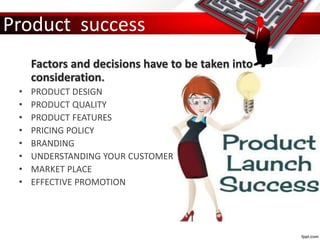
Factors and decisions have to be taken into
consideration.
• PRODUCT DESIGN
• PRODUCT QUALITY
• PRODUCT FEATURES
• PRICING POLICY
• BRANDING
• UNDERSTANDING YOUR CUSTOMER
• MARKET PLACE
• EFFECTIVE PROMOTION
Product success
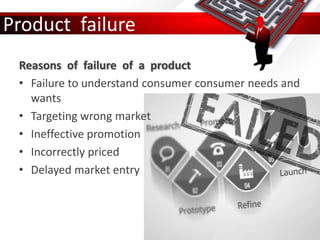
Reasons of failure of a product
• Failure to understand consumer consumer needs and
wants
• Targeting wrong market
• Ineffective promotion
• Incorrectly priced
• Delayed market entry
Product failure
Example
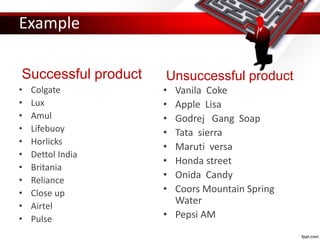
Successful product
• Colgate
• Lux
• Amul
• Lifebuoy
• Horlicks
• Dettol India
• Britania
• Reliance
• Close up
• Airtel
• Pulse
Unsuccessful product
• Vanila Coke
• Apple Lisa
• Godrej Gang Soap
• Tata sierra
• Maruti versa
• Honda street
• Onida Candy
• Coors Mountain Spring
Water
• Pepsi AM
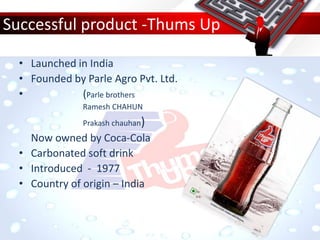
Successful product -Thums Up
• Launched in India
• Founded by Parle Agro Pvt. Ltd.
• (Parle brothers
Ramesh CHAHUN
Prakash chauhan)
Now owned by Coca-Cola
• Carbonated soft drink
• Introduced - 1977
• Country of origin – India
Stage at Product Life Cycle:
• except decline stage
• introduction - When the Brand was doing well
was taken away from the market because it was giving stiff competition
to Coca-cola
• but Coke had to bring out the brand again to attack all the promotional
policy of Pepsi and it was introduced once again.
• Current scenario - Maturity stage.
It has grown like anything,
Successful in attracting more and more number of customers
has a huge market share.
successful in capturing the minds of the consumers.
communication policies -informing consumers that the brand is in the
market and doing well.
The objective -is to remind people about the strength and status of the
brand
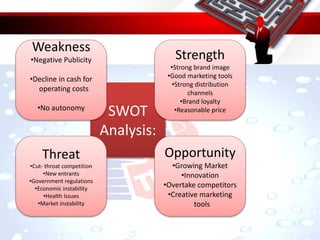
SWOT
Analysis:
Weakness
•Negative Publicity
•Decline in cash for
operating costs
•No autonomy
Strength
•Strong brand image
•Good marketing tools
•Strong distribution
channels
•Brand loyalty
•Reasonable price
Threat
•Cut- throat competition
•New entrants
•Government regulations
•Economic instability
•Health Issues
•Market instability
Opportunity
•Growing Market
•Innovation
•Overtake competitors
•Creative marketing
tools
Market Scenario:
• enjoyed a near monopoly with a much stronger market
share
• beating its other rivals - Camp cola, Double seven and
Dukes.
• major advertisers throughout the 1980s
• Sponsorship - Pepsi had starred with famous bollywood
actress like Juhi Chawla, to frustrate the Indian brand,
Thums Up focussed on cricket sponsorship.
• Coca-cola re-entered Things became even more
complicated when Coca-cola re-entered India after its
absence from 1977 to 1993. Now the fight became a
three-way battle.
• Parle Agro, finally sold Thums Up to Coca-Cola
• Relaunch of the product:
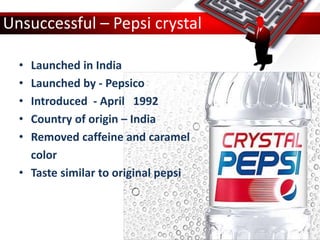
• Launched in India
• Launched by - Pepsico
• Introduced - April 1992
• Country of origin – India
• Removed caffeine and caramel
color
• Taste similar to original pepsi
Unsuccessful – Pepsi crystal
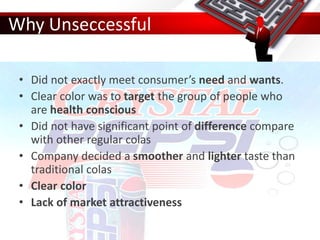
Why Unseccessful
• Did not exactly meet consumer’s need and wants.
• Clear color was to target the group of people who
are health conscious
• Did not have significant point of difference compare
with other regular colas
• Company decided a smoother and lighter taste than
traditional colas
• Clear color
• Lack of market attractiveness
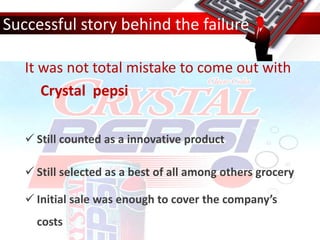
Successful story behind the failure
It was not total mistake to come out with
Crystal pepsi
 Still counted as a innovative product
 Still selected as a best of all among others grocery
 Initial sale was enough to cover the company’s
costs
Abheri das

Abheri das

  • 1.
  • 2.
    Content • Products andMarketing • Product success • Product failure • Successful product • Unsuccessful product
  • 3.
     PRODUCT A productis a good ,service or idea consisting of a bundle of tangible and intangible attributes that satisfies consumers and is received in exchange for money or some other unit of value .  MARKETING Marketing is not about providing products or services, it is essentially about providing benefits to the changing needs and demands of the customer  Goals of marketing o Increase sales o Build brand awarness o Grow market share o Creating new customer o Enhance customer relationships PRODUCT
  • 4.
    Factors and decisionshave to be taken into consideration. • PRODUCT DESIGN • PRODUCT QUALITY • PRODUCT FEATURES • PRICING POLICY • BRANDING • UNDERSTANDING YOUR CUSTOMER • MARKET PLACE • EFFECTIVE PROMOTION Product success
  • 5.
    Reasons of failureof a product • Failure to understand consumer consumer needs and wants • Targeting wrong market • Ineffective promotion • Incorrectly priced • Delayed market entry Product failure
  • 6.
    Example Successful product • Colgate •Lux • Amul • Lifebuoy • Horlicks • Dettol India • Britania • Reliance • Close up • Airtel • Pulse Unsuccessful product • Vanila Coke • Apple Lisa • Godrej Gang Soap • Tata sierra • Maruti versa • Honda street • Onida Candy • Coors Mountain Spring Water • Pepsi AM
  • 7.
    Successful product -ThumsUp • Launched in India • Founded by Parle Agro Pvt. Ltd. • (Parle brothers Ramesh CHAHUN Prakash chauhan) Now owned by Coca-Cola • Carbonated soft drink • Introduced - 1977 • Country of origin – India
  • 8.
    Stage at ProductLife Cycle: • except decline stage • introduction - When the Brand was doing well was taken away from the market because it was giving stiff competition to Coca-cola • but Coke had to bring out the brand again to attack all the promotional policy of Pepsi and it was introduced once again. • Current scenario - Maturity stage. It has grown like anything, Successful in attracting more and more number of customers has a huge market share. successful in capturing the minds of the consumers. communication policies -informing consumers that the brand is in the market and doing well. The objective -is to remind people about the strength and status of the brand
  • 9.
    SWOT Analysis: Weakness •Negative Publicity •Decline incash for operating costs •No autonomy Strength •Strong brand image •Good marketing tools •Strong distribution channels •Brand loyalty •Reasonable price Threat •Cut- throat competition •New entrants •Government regulations •Economic instability •Health Issues •Market instability Opportunity •Growing Market •Innovation •Overtake competitors •Creative marketing tools
  • 10.
    Market Scenario: • enjoyeda near monopoly with a much stronger market share • beating its other rivals - Camp cola, Double seven and Dukes. • major advertisers throughout the 1980s • Sponsorship - Pepsi had starred with famous bollywood actress like Juhi Chawla, to frustrate the Indian brand, Thums Up focussed on cricket sponsorship. • Coca-cola re-entered Things became even more complicated when Coca-cola re-entered India after its absence from 1977 to 1993. Now the fight became a three-way battle. • Parle Agro, finally sold Thums Up to Coca-Cola • Relaunch of the product:
  • 12.
    • Launched inIndia • Launched by - Pepsico • Introduced - April 1992 • Country of origin – India • Removed caffeine and caramel color • Taste similar to original pepsi Unsuccessful – Pepsi crystal
  • 13.
    Why Unseccessful • Didnot exactly meet consumer’s need and wants. • Clear color was to target the group of people who are health conscious • Did not have significant point of difference compare with other regular colas • Company decided a smoother and lighter taste than traditional colas • Clear color • Lack of market attractiveness
  • 14.
    Successful story behindthe failure It was not total mistake to come out with Crystal pepsi  Still counted as a innovative product  Still selected as a best of all among others grocery  Initial sale was enough to cover the company’s costs