Process Analysis II
Types of Processes  Kristin Benihana Operations  --  Prof. Juran Outline
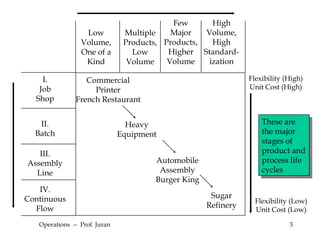
Operations  --  Prof. Juran These are the major stages of  product and process life cycles IV. Continuous Flow III. Assembly Line II. Batch I. Job Shop Low Volume, One of a Kind Multiple Products, Low Volume Few Major Products, Higher Volume High Volume, High Standard- ization Commercial Printer French Restaurant Heavy Equipment Automobile Assembly Burger King Sugar Refinery Flexibility (High) Unit Cost (High) Flexibility (Low) Unit Cost (Low)
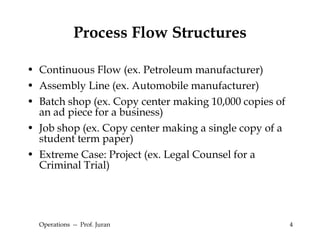
Process Flow Structures Continuous Flow (ex. Petroleum manufacturer)  Assembly Line (ex. Automobile manufacturer) Batch shop (ex. Copy center making 10,000 copies of an ad piece for a business) Job shop (ex. Copy center making a single copy of a student term paper) Extreme Case: Project (ex. Legal Counsel for a Criminal Trial) Operations  --  Prof. Juran
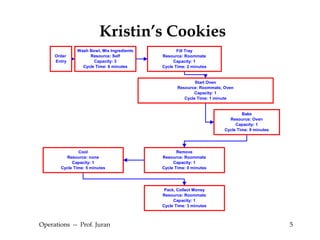
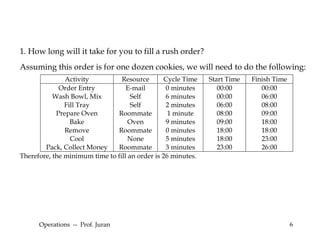
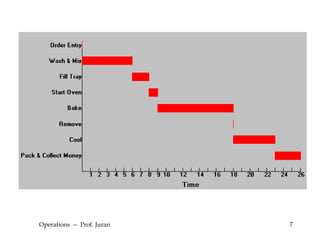
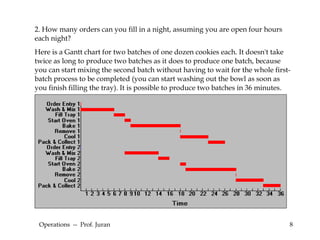
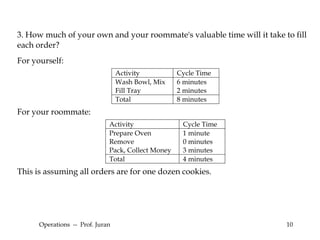
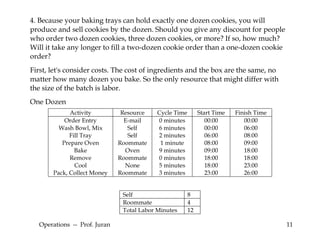
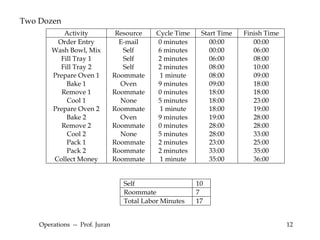
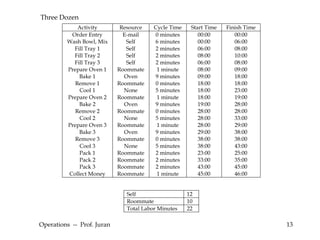
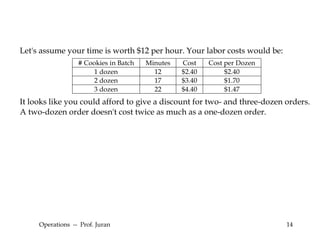
Operations  --  Prof. Juran Kristin’s Cookies
Operations  --  Prof. Juran
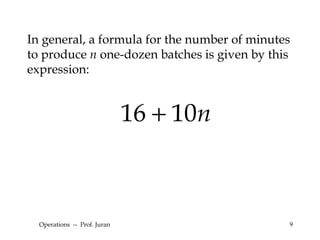
Operations  --  Prof. Juran In general, a formula for the number of minutes to produce  n  one-dozen batches is given by this expression:
Operations  --  Prof. Juran
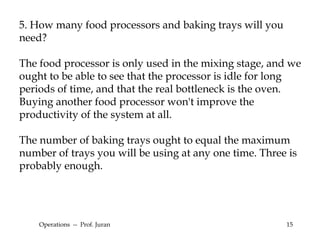
Operations  --  Prof. Juran 5. How many food processors and baking trays will you need? The food processor is only used in the mixing stage, and we ought to be able to see that the processor is idle for long periods of time, and that the real bottleneck is the oven. Buying another food processor won't improve the productivity of the system at all. The number of baking trays ought to equal the maximum number of trays you will be using at any one time. Three is probably enough.
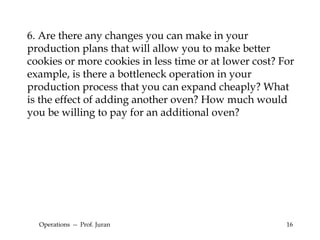
Operations  --  Prof. Juran 6. Are there any changes you can make in your production plans that will allow you to make better cookies or more cookies in less time or at lower cost? For example, is there a bottleneck operation in your production process that you can expand cheaply? What is the effect of adding another oven? How much would you be willing to pay for an additional oven?
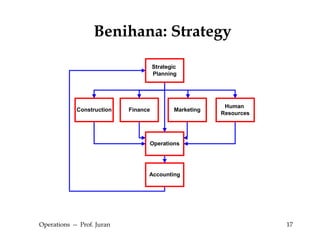
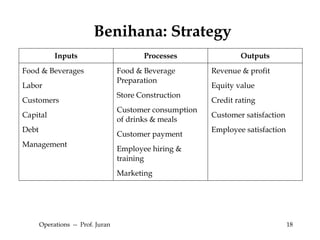
Operations  --  Prof. Juran Benihana: Strategy
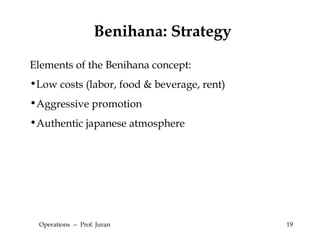
Operations  --  Prof. Juran Elements of the Benihana concept: Low costs (labor, food & beverage, rent) Aggressive promotion Authentic japanese atmosphere Benihana: Strategy
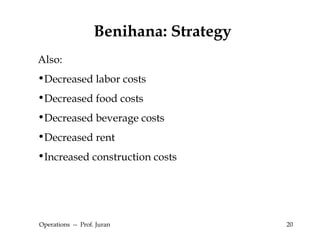
Operations  --  Prof. Juran Also: Decreased labor costs Decreased food costs Decreased beverage costs Decreased rent Increased construction costs Benihana: Strategy
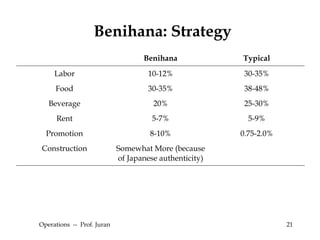
Operations  --  Prof. Juran Benihana: Strategy
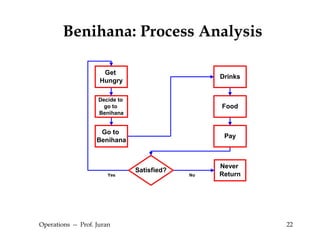
Operations  --  Prof. Juran Benihana: Process Analysis
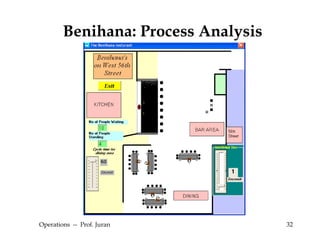
Operations  --  Prof. Juran Important parameters: How many chefs and waitresses there are How frequently customers arrive at the restaurant How quickly customers are seated, either in the bar or in the dining area How frequently the customers order and consume drinks How quickly drinks are served How long it takes to prepare the meal at the grill How long it takes for the customers to eat their meal How long it takes for customers to pay and leave the dining area. Benihana: Process Analysis
Operations  --  Prof. Juran Assume that the dining process takes 60 minutes, and that we want customers in the bar for 24 minutes.  Consider three scenarios: Bar - 8 seats; Dining area - 40 seats Bar - 16 seats; Dining Area - 80 seats Bar - 48 seats; Dining Area - 120 seats Benihana: Process Analysis
Operations  --  Prof. Juran Bar - 8 seats; Dining area - 40 seats It takes 60 minutes for one customer to eat dinner, and there are 40 seats in the dining area. Therefore 40 people eat every 60 minutes (throughput).  On the average a dinner cycle is completed every 60 minutes/40 people = 1.5 minutes per person (cycle time).  We know that dinners are processed in batches of 8, so on the average a table of 8 finishes every 12 minutes. Benihana: Process Analysis
Operations  --  Prof. Juran Bar - 8 seats; Dining area - 40 seats This means that the 8-seat bar must empty every 12 minutes.  The "ideal" time for someone to remain in the bar is about double that time (because this will be just after the second drink has reached the table).  Therefore, it would appear that the ratio of 0.2 (8 bar seats to 40 dining seats) is too small. Benihana: Process Analysis
Operations  --  Prof. Juran Bar - 16 seats; Dining Area - 80 seats It takes 60 minutes for one customer to eat dinner, and there are 80 seats in the dining area. Therefore 80 people eat every 60 minutes (throughput).  On the average a dinner cycle is completed every 60 minutes/80 people = 0.75 minutes per person (cycle time).  We know that dinners are processed in batches of 8, so on the average a table of 8 finishes every 6 minutes. Benihana: Process Analysis
Operations  --  Prof. Juran Bar - 16 seats; Dining Area - 80 seats This means that the 16-seat bar must empty every 12 minutes.  Therefore, it would appear that the ratio of 0.2 (16 bar seats to 80 dining seats) is too small. In fact, all this does is double the restaurant’s capacity, and the bar time remains at 12 minutes.  The only benefit is that 16 seats might allow the host or hostess to do a better job of assembling groups of eight. Benihana: Process Analysis
Operations  --  Prof. Juran Bar - 48 seats; Dining Area - 120 seats It takes 60 minutes for one customer to eat dinner, and there are 120 seats in the dining area. Therefore 120 people eat every 60 minutes (throughput).  On the average a dinner cycle is completed every 60 minutes/120 people = 0.5 minutes per person (cycle time).  We know that dinners are processed in batches of 8, so on the average a table of 8 finishes every 4 minutes. Benihana: Process Analysis
Operations  --  Prof. Juran Bar - 48 seats; Dining Area - 120 seats To send 8 people into the dining area every 4 minutes means that the 48-seat bar must empty every 24 minutes.  Perfect!  Given our assumptions regarding the cycle times of the bar and the dining area, it would appear that a ratio of bar seats to grill seats of 0.4 is about right. (In our case 120:48, but the ratio is more important than the specific numbers.) Benihana: Process Analysis
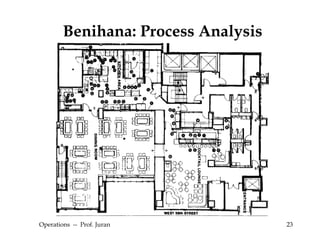
Operations  --  Prof. Juran Benihana: Process Analysis
Historical Development of OM Craft System Industrial Revolution Scientific Management Organizational Science Operations Research JIT and TQM Supply Chain Management Internet Commerce Operations  --  Prof. Juran
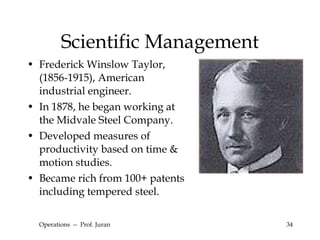
Scientific Management Frederick Winslow Taylor, (1856-1915), American industrial engineer. In 1878, he began working at the Midvale Steel Company. Developed measures of  productivity based on time & motion studies.  Became rich from 100+ patents including tempered steel. Operations  --  Prof. Juran
Taylor’s Industrial Environment Large numbers of unskilled workers Many immigrants who often didn’t speak English Homogeneous markets meant great returns to scale (e.g, Model T dropped in price from $1000 to $360) Management not viewed as a general or learnable skill Operations  --  Prof. Juran
Scientific Management Defined by Frederick Taylor, late 1800s. The systematic study of the relationships between people and tasks to redesign the work for higher efficiency. Taylor sought to reduce the time a worker spent on each task by optimizing the way the task was done. Significant improvements in productivity Operations  --  Prof. Juran
Taylor’s 4 Principles Develop a science for each element of work Select, train, and develop workers Cooperate with workers (share the savings – more $$$ for better performance) Divide work and responsibility equally Operations  --  Prof. Juran 2-6
Resistance to Taylor Separation of work from planning destroyed the traditional craft system – ‘money substituted for pride’ Unions mistrusted – Taylor reduced work force from 450 to 150 on first job Some firms cut rates after changes Legislation to prevent time studies in government jobs. Operations  --  Prof. Juran
Operations  --  Prof. Juran Frank & Lillian Gilbreth Time and Motion Studies Film Therbligs Cheaper by the Dozen Henry L. Gantt Engineer; worked with Taylor Gantt Chart
The Gilbreths Frank and Lillian Gilbreth refined Taylor’s methods. Made many improvements to time and motion studies. Time and motion studies: 1.  Break down each action  into components. 2.  Find better ways  to perform it. 3.  Reorganize each action  to be more efficient. Gilbreths also studied fatigue problems, lighting, heating and other worker issues. Operations  --  Prof. Juran
Types of Processes  Kristin Benihana Operations  --  Prof. Juran Summary

C:\Documents And Settings\Ruchi 11\Desktop\Benihana

  • 1.
  • 2.
    Types of Processes Kristin Benihana Operations -- Prof. Juran Outline
  • 3.
    Operations -- Prof. Juran These are the major stages of product and process life cycles IV. Continuous Flow III. Assembly Line II. Batch I. Job Shop Low Volume, One of a Kind Multiple Products, Low Volume Few Major Products, Higher Volume High Volume, High Standard- ization Commercial Printer French Restaurant Heavy Equipment Automobile Assembly Burger King Sugar Refinery Flexibility (High) Unit Cost (High) Flexibility (Low) Unit Cost (Low)
  • 4.
    Process Flow StructuresContinuous Flow (ex. Petroleum manufacturer) Assembly Line (ex. Automobile manufacturer) Batch shop (ex. Copy center making 10,000 copies of an ad piece for a business) Job shop (ex. Copy center making a single copy of a student term paper) Extreme Case: Project (ex. Legal Counsel for a Criminal Trial) Operations -- Prof. Juran
  • 5.
    Operations -- Prof. Juran Kristin’s Cookies
  • 6.
    Operations -- Prof. Juran
  • 7.
    Operations -- Prof. Juran
  • 8.
    Operations -- Prof. Juran
  • 9.
    Operations -- Prof. Juran In general, a formula for the number of minutes to produce n one-dozen batches is given by this expression:
  • 10.
    Operations -- Prof. Juran
  • 11.
    Operations -- Prof. Juran
  • 12.
    Operations -- Prof. Juran
  • 13.
    Operations -- Prof. Juran
  • 14.
    Operations -- Prof. Juran
  • 15.
    Operations -- Prof. Juran 5. How many food processors and baking trays will you need? The food processor is only used in the mixing stage, and we ought to be able to see that the processor is idle for long periods of time, and that the real bottleneck is the oven. Buying another food processor won't improve the productivity of the system at all. The number of baking trays ought to equal the maximum number of trays you will be using at any one time. Three is probably enough.
  • 16.
    Operations -- Prof. Juran 6. Are there any changes you can make in your production plans that will allow you to make better cookies or more cookies in less time or at lower cost? For example, is there a bottleneck operation in your production process that you can expand cheaply? What is the effect of adding another oven? How much would you be willing to pay for an additional oven?
  • 17.
    Operations -- Prof. Juran Benihana: Strategy
  • 18.
    Operations -- Prof. Juran Benihana: Strategy
  • 19.
    Operations -- Prof. Juran Elements of the Benihana concept: Low costs (labor, food & beverage, rent) Aggressive promotion Authentic japanese atmosphere Benihana: Strategy
  • 20.
    Operations -- Prof. Juran Also: Decreased labor costs Decreased food costs Decreased beverage costs Decreased rent Increased construction costs Benihana: Strategy
  • 21.
    Operations -- Prof. Juran Benihana: Strategy
  • 22.
    Operations -- Prof. Juran Benihana: Process Analysis
  • 23.
    Operations -- Prof. Juran Benihana: Process Analysis
  • 24.
    Operations -- Prof. Juran Important parameters: How many chefs and waitresses there are How frequently customers arrive at the restaurant How quickly customers are seated, either in the bar or in the dining area How frequently the customers order and consume drinks How quickly drinks are served How long it takes to prepare the meal at the grill How long it takes for the customers to eat their meal How long it takes for customers to pay and leave the dining area. Benihana: Process Analysis
  • 25.
    Operations -- Prof. Juran Assume that the dining process takes 60 minutes, and that we want customers in the bar for 24 minutes. Consider three scenarios: Bar - 8 seats; Dining area - 40 seats Bar - 16 seats; Dining Area - 80 seats Bar - 48 seats; Dining Area - 120 seats Benihana: Process Analysis
  • 26.
    Operations -- Prof. Juran Bar - 8 seats; Dining area - 40 seats It takes 60 minutes for one customer to eat dinner, and there are 40 seats in the dining area. Therefore 40 people eat every 60 minutes (throughput). On the average a dinner cycle is completed every 60 minutes/40 people = 1.5 minutes per person (cycle time). We know that dinners are processed in batches of 8, so on the average a table of 8 finishes every 12 minutes. Benihana: Process Analysis
  • 27.
    Operations -- Prof. Juran Bar - 8 seats; Dining area - 40 seats This means that the 8-seat bar must empty every 12 minutes. The "ideal" time for someone to remain in the bar is about double that time (because this will be just after the second drink has reached the table). Therefore, it would appear that the ratio of 0.2 (8 bar seats to 40 dining seats) is too small. Benihana: Process Analysis
  • 28.
    Operations -- Prof. Juran Bar - 16 seats; Dining Area - 80 seats It takes 60 minutes for one customer to eat dinner, and there are 80 seats in the dining area. Therefore 80 people eat every 60 minutes (throughput). On the average a dinner cycle is completed every 60 minutes/80 people = 0.75 minutes per person (cycle time). We know that dinners are processed in batches of 8, so on the average a table of 8 finishes every 6 minutes. Benihana: Process Analysis
  • 29.
    Operations -- Prof. Juran Bar - 16 seats; Dining Area - 80 seats This means that the 16-seat bar must empty every 12 minutes. Therefore, it would appear that the ratio of 0.2 (16 bar seats to 80 dining seats) is too small. In fact, all this does is double the restaurant’s capacity, and the bar time remains at 12 minutes. The only benefit is that 16 seats might allow the host or hostess to do a better job of assembling groups of eight. Benihana: Process Analysis
  • 30.
    Operations -- Prof. Juran Bar - 48 seats; Dining Area - 120 seats It takes 60 minutes for one customer to eat dinner, and there are 120 seats in the dining area. Therefore 120 people eat every 60 minutes (throughput). On the average a dinner cycle is completed every 60 minutes/120 people = 0.5 minutes per person (cycle time). We know that dinners are processed in batches of 8, so on the average a table of 8 finishes every 4 minutes. Benihana: Process Analysis
  • 31.
    Operations -- Prof. Juran Bar - 48 seats; Dining Area - 120 seats To send 8 people into the dining area every 4 minutes means that the 48-seat bar must empty every 24 minutes. Perfect! Given our assumptions regarding the cycle times of the bar and the dining area, it would appear that a ratio of bar seats to grill seats of 0.4 is about right. (In our case 120:48, but the ratio is more important than the specific numbers.) Benihana: Process Analysis
  • 32.
    Operations -- Prof. Juran Benihana: Process Analysis
  • 33.
    Historical Development ofOM Craft System Industrial Revolution Scientific Management Organizational Science Operations Research JIT and TQM Supply Chain Management Internet Commerce Operations -- Prof. Juran
  • 34.
    Scientific Management FrederickWinslow Taylor, (1856-1915), American industrial engineer. In 1878, he began working at the Midvale Steel Company. Developed measures of productivity based on time & motion studies. Became rich from 100+ patents including tempered steel. Operations -- Prof. Juran
  • 35.
    Taylor’s Industrial EnvironmentLarge numbers of unskilled workers Many immigrants who often didn’t speak English Homogeneous markets meant great returns to scale (e.g, Model T dropped in price from $1000 to $360) Management not viewed as a general or learnable skill Operations -- Prof. Juran
  • 36.
    Scientific Management Definedby Frederick Taylor, late 1800s. The systematic study of the relationships between people and tasks to redesign the work for higher efficiency. Taylor sought to reduce the time a worker spent on each task by optimizing the way the task was done. Significant improvements in productivity Operations -- Prof. Juran
  • 37.
    Taylor’s 4 PrinciplesDevelop a science for each element of work Select, train, and develop workers Cooperate with workers (share the savings – more $$$ for better performance) Divide work and responsibility equally Operations -- Prof. Juran 2-6
  • 38.
    Resistance to TaylorSeparation of work from planning destroyed the traditional craft system – ‘money substituted for pride’ Unions mistrusted – Taylor reduced work force from 450 to 150 on first job Some firms cut rates after changes Legislation to prevent time studies in government jobs. Operations -- Prof. Juran
  • 39.
    Operations -- Prof. Juran Frank & Lillian Gilbreth Time and Motion Studies Film Therbligs Cheaper by the Dozen Henry L. Gantt Engineer; worked with Taylor Gantt Chart
  • 40.
    The Gilbreths Frankand Lillian Gilbreth refined Taylor’s methods. Made many improvements to time and motion studies. Time and motion studies: 1. Break down each action into components. 2. Find better ways to perform it. 3. Reorganize each action to be more efficient. Gilbreths also studied fatigue problems, lighting, heating and other worker issues. Operations -- Prof. Juran
  • 41.
    Types of Processes Kristin Benihana Operations -- Prof. Juran Summary

Editor's Notes

  • #3 2
  • #4 13
  • #5 12
  • #6 2
  • #18 2
  • #23 2
  • #24 2
  • #34 14
  • #37  Defined by Frederick Taylor, during the late 1800’s.  Many students seem to feel that the drive for higher efficiency is a recent concept in business. Not true!  Taylor sought efficiency gains over a century ago. He studied the relationships between people and tasks and then redesigned the task for higher efficiency.  For example, Taylor would try to reduce the time a worker spent on each task by optimizing the way the task was done. Perhaps he would change the position of the tools used or the way the parts were arranged during assembly.
  • #38 6
  • #41  The Gilbreths made many improvements to time and motion studies that were implied by Taylor.  Exactly what are Time and motion studies? › Break down each action into components. › Find better ways to perform it. › Reorganize each action to be more efficient. › Example: Ask a student to take out a piece of paper from a notebook, enter four numbers in columns, and then replace the paper. Have another time the student during each element.  The Gilbreths were also early leaders in the study of fatigue problems, lighting, heating and other worker issues.
  • #42 2