Benihana Simulation
       Assignment


           7/4/2011
           SPJIMR
      Jaikishan Gianani
Effect of batching strategy on throughput

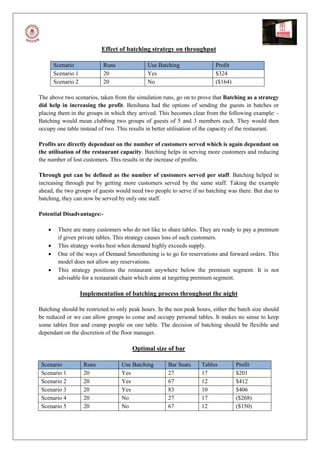
        Scenario             Runs             Use Batching                 Profit
        Scenario 1           20               Yes                          $324
        Scenario 2           20               No                           ($164)

The above two scenarios, taken from the simulation runs, go on to prove that Batching as a strategy
did help in increasing the profit. Benihana had the options of sending the guests in batches or
placing them in the groups in which they arrived. This becomes clear from the following example: -
Batching would mean clubbing two groups of guests of 5 and 3 members each. They would then
occupy one table instead of two. This results in better utilisation of the capacity of the restaurant.

Profits are directly dependant on the number of customers served which is again dependant on
the utilisation of the restaurant capacity. Batching helps in serving more customers and reducing
the number of lost customers. This results in the increase of profits.

Through put can be defined as the number of customers served per staff. Batching helped in
increasing through put by getting more customers served by the same staff. Taking the example
ahead, the two groups of guests would need two people to serve if no batching was there. But due to
batching, they can now be served by only one staff.

Potential Disadvantages:-

        There are many customers who do not like to share tables. They are ready to pay a premium
         if given private tables. This strategy causes loss of such customers.
        This strategy works best when demand highly exceeds supply.
        One of the ways of Demand Smoothening is to go for reservations and forward orders. This
         model does not allow any reservations.
        This strategy positions the restaurant anywhere below the premium segment. It is not
         advisable for a restaurant chain which aims at targeting premium segment.

                     Implementation of batching process throughout the night

Batching should be restricted to only peak hours. In the non peak hours, either the batch size should
be reduced or we can allow groups to come and occupy personal tables. It makes no sense to keep
some tables free and cramp people on one table. The decision of batching should be flexible and
dependant on the discretion of the floor manager.

                                        Optimal size of bar

 Scenario             Runs          Use Batching      Bar Seats      Tables         Profit
 Scenario 1           20            Yes               27             17             $201
 Scenario 2           20            Yes               67             12             $412
 Scenario 3           20            Yes               83             10             $406
 Scenario 4           20            No                27             17             ($268)
 Scenario 5           20            No                67             12             ($150)
The bar in Benihana is used for the dual purposes of: -

    1. Keeping the customer engaged so that the customer does not mind the waiting time.
    2. Generating revenue by selling drinks to the customer. This helps in increasing the overall
       spend of the customer.

From the simulation results the optimal size of the bar is around 65-85 seats and 10-12 dining tables.
The restaurant uses the bar as a place where customers can be made to wait. The bar does not have
the luxury of a waiting area. It should be big enough to accommodate all the people who are waiting.
Having said that, the toughest task is to define ‘big enough’.

The optimal size of the bar can be found out by analysing the data gathered over a time horizon. Also
the capacity of the bar can be changed in the following ways so as to accommodate the fluctuations:-

    1. Changing the layout. The layout determines the utilisation of the floor area. Tantra in
       Kolkata does this. The weekend waiting area is differently laid out compared to the week
       day layout. They have purchased furniture to suit such strategy.
    2. Decreasing the dinning time. This helps in serving the customers faster and hence
       decreasing the requirement of a bigger bar as the time which a customer spends in the bar
       goes down.

                                Impact of changing dining time

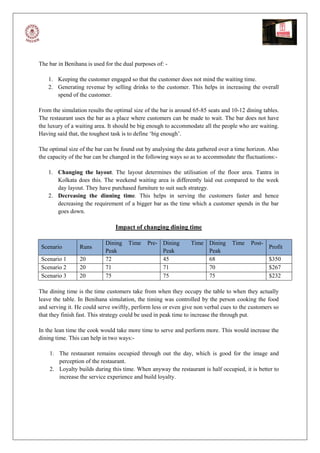
                            Dining    Time    Pre- Dining       Time Dining       Time    Post-
 Scenario        Runs                                                                             Profit
                            Peak                   Peak              Peak
 Scenario 1      20         72                     45                68                           $350
 Scenario 2      20         71                     71                70                           $267
 Scenario 3      20         75                     75                75                           $232

The dining time is the time customers take from when they occupy the table to when they actually
leave the table. In Benihana simulation, the timing was controlled by the person cooking the food
and serving it. He could serve swiftly, perform less or even give non verbal cues to the customers so
that they finish fast. This strategy could be used in peak time to increase the through put.

In the lean time the cook would take more time to serve and perform more. This would increase the
dining time. This can help in two ways:-

    1. The restaurant remains occupied through out the day, which is good for the image and
       perception of the restaurant.
    2. Loyalty builds during this time. When anyway the restaurant is half occupied, it is better to
       increase the service experience and build loyalty.
Ways to reduce demand variability

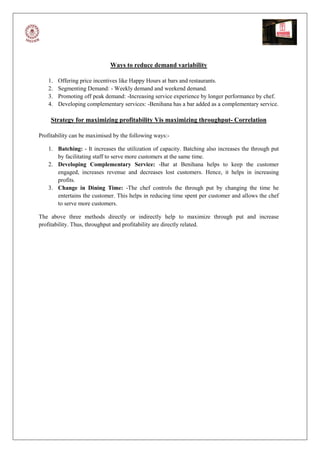
   1.   Offering price incentives like Happy Hours at bars and restaurants.
   2.   Segmenting Demand: - Weekly demand and weekend demand.
   3.   Promoting off peak demand: -Increasing service experience by longer performance by chef.
   4.   Developing complementary services: -Benihana has a bar added as a complementary service.

     Strategy for maximizing profitability Vis maximizing throughput- Correlation

Profitability can be maximised by the following ways:-

   1. Batching: - It increases the utilization of capacity. Batching also increases the through put
      by facilitating staff to serve more customers at the same time.
   2. Developing Complementary Service: -Bar at Benihana helps to keep the customer
      engaged, increases revenue and decreases lost customers. Hence, it helps in increasing
      profits.
   3. Change in Dining Time: -The chef controls the through put by changing the time he
      entertains the customer. This helps in reducing time spent per customer and allows the chef
      to serve more customers.

The above three methods directly or indirectly help to maximize through put and increase
profitability. Thus, throughput and profitability are directly related.

Benihana Simulation

  • 1.
    Benihana Simulation Assignment 7/4/2011 SPJIMR Jaikishan Gianani
  • 2.
    Effect of batchingstrategy on throughput Scenario Runs Use Batching Profit Scenario 1 20 Yes $324 Scenario 2 20 No ($164) The above two scenarios, taken from the simulation runs, go on to prove that Batching as a strategy did help in increasing the profit. Benihana had the options of sending the guests in batches or placing them in the groups in which they arrived. This becomes clear from the following example: - Batching would mean clubbing two groups of guests of 5 and 3 members each. They would then occupy one table instead of two. This results in better utilisation of the capacity of the restaurant. Profits are directly dependant on the number of customers served which is again dependant on the utilisation of the restaurant capacity. Batching helps in serving more customers and reducing the number of lost customers. This results in the increase of profits. Through put can be defined as the number of customers served per staff. Batching helped in increasing through put by getting more customers served by the same staff. Taking the example ahead, the two groups of guests would need two people to serve if no batching was there. But due to batching, they can now be served by only one staff. Potential Disadvantages:-  There are many customers who do not like to share tables. They are ready to pay a premium if given private tables. This strategy causes loss of such customers.  This strategy works best when demand highly exceeds supply.  One of the ways of Demand Smoothening is to go for reservations and forward orders. This model does not allow any reservations.  This strategy positions the restaurant anywhere below the premium segment. It is not advisable for a restaurant chain which aims at targeting premium segment. Implementation of batching process throughout the night Batching should be restricted to only peak hours. In the non peak hours, either the batch size should be reduced or we can allow groups to come and occupy personal tables. It makes no sense to keep some tables free and cramp people on one table. The decision of batching should be flexible and dependant on the discretion of the floor manager. Optimal size of bar Scenario Runs Use Batching Bar Seats Tables Profit Scenario 1 20 Yes 27 17 $201 Scenario 2 20 Yes 67 12 $412 Scenario 3 20 Yes 83 10 $406 Scenario 4 20 No 27 17 ($268) Scenario 5 20 No 67 12 ($150)
  • 3.
    The bar inBenihana is used for the dual purposes of: - 1. Keeping the customer engaged so that the customer does not mind the waiting time. 2. Generating revenue by selling drinks to the customer. This helps in increasing the overall spend of the customer. From the simulation results the optimal size of the bar is around 65-85 seats and 10-12 dining tables. The restaurant uses the bar as a place where customers can be made to wait. The bar does not have the luxury of a waiting area. It should be big enough to accommodate all the people who are waiting. Having said that, the toughest task is to define ‘big enough’. The optimal size of the bar can be found out by analysing the data gathered over a time horizon. Also the capacity of the bar can be changed in the following ways so as to accommodate the fluctuations:- 1. Changing the layout. The layout determines the utilisation of the floor area. Tantra in Kolkata does this. The weekend waiting area is differently laid out compared to the week day layout. They have purchased furniture to suit such strategy. 2. Decreasing the dinning time. This helps in serving the customers faster and hence decreasing the requirement of a bigger bar as the time which a customer spends in the bar goes down. Impact of changing dining time Dining Time Pre- Dining Time Dining Time Post- Scenario Runs Profit Peak Peak Peak Scenario 1 20 72 45 68 $350 Scenario 2 20 71 71 70 $267 Scenario 3 20 75 75 75 $232 The dining time is the time customers take from when they occupy the table to when they actually leave the table. In Benihana simulation, the timing was controlled by the person cooking the food and serving it. He could serve swiftly, perform less or even give non verbal cues to the customers so that they finish fast. This strategy could be used in peak time to increase the through put. In the lean time the cook would take more time to serve and perform more. This would increase the dining time. This can help in two ways:- 1. The restaurant remains occupied through out the day, which is good for the image and perception of the restaurant. 2. Loyalty builds during this time. When anyway the restaurant is half occupied, it is better to increase the service experience and build loyalty.
  • 4.
    Ways to reducedemand variability 1. Offering price incentives like Happy Hours at bars and restaurants. 2. Segmenting Demand: - Weekly demand and weekend demand. 3. Promoting off peak demand: -Increasing service experience by longer performance by chef. 4. Developing complementary services: -Benihana has a bar added as a complementary service. Strategy for maximizing profitability Vis maximizing throughput- Correlation Profitability can be maximised by the following ways:- 1. Batching: - It increases the utilization of capacity. Batching also increases the through put by facilitating staff to serve more customers at the same time. 2. Developing Complementary Service: -Bar at Benihana helps to keep the customer engaged, increases revenue and decreases lost customers. Hence, it helps in increasing profits. 3. Change in Dining Time: -The chef controls the through put by changing the time he entertains the customer. This helps in reducing time spent per customer and allows the chef to serve more customers. The above three methods directly or indirectly help to maximize through put and increase profitability. Thus, throughput and profitability are directly related.