KG’s Chinese Fast Food
Restaurant
Layout of the restaurant
Cold Storage Dry Storage
Interface
Food preparation
A.C Dining area Non A.C Dining area
A.C Dining area
entrance
Non A.C Dining area
entrance
Utensils cleaning
Restroom
Play Area for
children
Importance of Layout
Lesser availability of land and costly rent, force
restaurant owners to have maximum place for
dining, to accomodate more customers and
lesser space to carry out the operations.
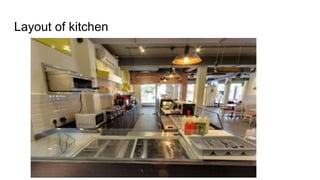
Layout of kitchen
Observations from the Layout
Color scheme is very inviting, which creates a pleasant atmosphere.
Having dominant white color creates a psychological feeling that space is hygiene.
Placement of restroom could have been little far from dining area, to mitigate
disturbance to diners.
Utensils cleaning area is closer to kitchen so that minimum time is utilized to
transfer them to kitchen for preparing food and also serving the orders.
Location of the restaurant
Within 3 km radius of: -
1. Wonder’s park
2. Football stadium
3. Nilgiri gardens
4. Residential societies
5. Coaching centers
6. Colleges
7. Rock garden
Sufficient car parking space.
Easily accessible via Google map
Importance of Location
Location plays an important role in determining success of a restaurant.
It is important that restaurant’s location fulfills following: -
1. Densely populated area: It will help the restaurant to get more customers.
2. Accessibility: The restaurant must allow easy access for customers. For
example, having car parking plays an important role to choose the restaurant.
3. Noticeable: A restaurant on main street stands a higher chance of attracting
customers compared to others.
4. Surrounding neighbourhood: If the restaurant has competition offering
same goods and services, it will distribute the customers; however, if the
competitors offer different services, then it gets easier to run the business.
Time and Motion Study
Time and Motion study helps to look at the activities from different angles and
utilize the resources optimally. Thus, we drill down the activities and time taken
from top level to shop floor level.
It helps to redesign the processes to yield best results with limited time and
resources.
It helps to understand the components of high productivity and causes of low
productivity.
It also helps to determine the ineffective time and work which gets added and how
it can be pruned to improve economic well being of the workplace.
What is Motion study?
Motion study helps to find out the best methods for doing the work and eliminate
the steps which consume time.
It helps to do a detailed study of work being done, prepare operation chart and
find ways to improve.
Motion study also helps to determine the steps causing fatigue to workers and
thus, contributing towards decline in productivity. Thus, we can derive economized
sequence of actions to ensure work is enjoyable for the workers.
Micro motion study helps to record the motion of limbs, number of operations
performed sequentially and parallely; analyze the movement and basic motions, it
will aid to reduce the effort taken to do same job.
Motion study in the restaurant
Washing: - Up and down motion, circular motion for cleaning utensils.
Cooking: - Repeated hand movement in chopping, cutting, adding salt and
pepper, pouring oil and water
Delivering: - Waiters often deliver by carrying tray full of meals in each hand.
Billing: - Punching of orders received from customers, generating bill, carrying bill
and refreshments to customers, carrying money to cash counter, returning amount
to customers, greeting customers.
Cleaning: - Mobbing floor, cleaning tables, replacing cloths, re-filling tissues on all
tables.
Types of work
Repetitive work: - Operations that repeat continuously during time spent at job.
Cleaning of utensils
Cleaning of floor and tables
Cutting and chopping vegetables
Non-repetitive work: - Work cycle is hardly ever identically repeated.
Greeting to customers
Preparing the meal
Taking customer orders
Delivering the orders
What is Time study?
Time study helps to find the idle time and working time, and reduce the former for
increasing productivity.
It helps to derive the overall planning of operations and determine the timeline for
carrying out the same.
Time study is usually carried out and recorded with stopwatch.
It helps to determine time taken for short cycle repetitive jobs and time taken for
direct work.
Unit of measurement for time study: centi-minute (0.01 minutes)
Time study in the restaurant
Washing and cleaning
It is often observed that time taken to wash the utensils and send them to kitchen
leads to delay in services.
1. 2 minutes to wash a pan.
2. 30 seconds to wash a plate.
3. 30 seconds to wash spoon and fork.
4. 2 minutes respectively to wash and wipe slab and floor of kitchen.
Time study in the restaurant
Cooking
Time taken to prepare Veg Noodles: 20 minutes.
Time taken to prepare Veg Toast Sandwich: 4 minutes.
Time taken to prepare Chilli Paneer: 5 minutes 40 seconds
Delivering order
Time taken to deliver cooked meal from kitchen interface to customers: 15
seconds
Time study in the restaurant
Taking orders
It is observed that total time taken to take order differs from customer to customer
which are covered under Allowances in Time Study.
Time taken to take order from customers: 40 seconds to 10 minutes
Time taken to punch order: 20 seconds
Waiting time to punch order: Depends on number of waiters in the queue
Time taken for punched order to reflect in kitchen monitor: 2 seconds
What is Work measurement?
Work measurement is defined as the application of techniques designed to
establish the work content of a specified task by determining the time required for
carrying out the task of a defined standard of a performance by a qualified worker.
It helps to: -
1. Compare alternate methods and build the most suited one.
2. Prepare realistic work schedules by accurate assessment of human work.
3. Set standard of performances for labour utilization and setting labour
standards.
4. To compare actual time taken with standard time and improve the same.
5. It helps to maximize the utilization of equipments available with us.
Work Measurement in the restaurant
Defining wages
The restaurant owner calculates the number of dishes prepared by chef each day.
This helps to determine the labour input invested and productivity of chefs.
It enables the owner to decide the wages for chefs individually. Similarly, the
owner decides wages for other staff: waiters, cleaners.
Assess capabilities
The restaurant owner determines the maximum output of current capability of the
restaurant based on the number of equipments, capacity of equipments, staff
efficiency. It also helps to forecast the expectations and take actions to achieve
What is Bill of Materials?
Bill of Materials (BOM) is a list indicating the quantities of all raw materials, parts,
components, sub-assemblies and major assemblies that go into an end product.
It gives details of the goods needed for building a product.
In our example, it helps restaurant owner to keep track of inventory of materials
used for preparing the food items offered to the customers.
It helps to manage costs and standardize recipe and consumption of goods for
longer run.
Bill of material in the restaurant
Following are bill of materials for products offered by the restaurant: -
Veg noodles: 2 units of capscium, 1 carrot, ½ cabbage, 1 liter boiling water, pinch
of salt, 1 tablespoon oil, 1 pack noodles, ¼ chopped onion, 1 tablespoon sugar,
1/4 tablespoon black pepper, 1 tablespoon soya sauce
Veg toast sandwich: 2 breads, 1 slice cheese, 10 gm lettuce, 10 gm onion, 20
gm tomato, 10 ml sauce
Chilli Paneer: 2 tablespoon flour, 1 tablespoon cornstarch, pinch of salt, ¼ cup
water, 250 grams paneer cubes, 10 gm chopped spring onions, 2 tablespoon dry
chillies, 1 tablespoon oil, 1 tablespoon chopped ginger, tablespoon soya sauce
What is Workflow planning?
Workflow planning is the process of drawing a scheme of action or execution, in
advance, forseeing the likely future development.
Here, we divide each activity in jobs and determine resources such has
equipments, raw materials, human resources, technology requirements.
It is important to estimate duration for each individual job for effective planning.
We also need to identify interdependencies and interaction among entities to do
effective workflow planning.
We also need to coordinate plans of each stakeholder while performing workflow
planning.
Workflow planning at the restaurant
1. Inventory management of goods and raw materials.
2. Cleaning of tables, seats, floor, refilling tissues.
3. Attending incoming customers.
4. Taking accurate orders.
5. Labelling the order against the customer.
6. Preparing meals.
7. Delivering orders to customers.
8. Preparing bills and collecting payment from customers.
9. Greeting outgoing customers.
10.Cleaning of utensils, plates and cutlery.

Lean and Flexible Manufacturing System

  • 1.
    KG’s Chinese FastFood Restaurant
  • 3.
    Layout of therestaurant Cold Storage Dry Storage Interface Food preparation A.C Dining area Non A.C Dining area A.C Dining area entrance Non A.C Dining area entrance Utensils cleaning Restroom Play Area for children
  • 4.
    Importance of Layout Lesseravailability of land and costly rent, force restaurant owners to have maximum place for dining, to accomodate more customers and lesser space to carry out the operations.
  • 5.
  • 6.
    Observations from theLayout Color scheme is very inviting, which creates a pleasant atmosphere. Having dominant white color creates a psychological feeling that space is hygiene. Placement of restroom could have been little far from dining area, to mitigate disturbance to diners. Utensils cleaning area is closer to kitchen so that minimum time is utilized to transfer them to kitchen for preparing food and also serving the orders.
  • 7.
    Location of therestaurant Within 3 km radius of: - 1. Wonder’s park 2. Football stadium 3. Nilgiri gardens 4. Residential societies 5. Coaching centers 6. Colleges 7. Rock garden Sufficient car parking space. Easily accessible via Google map
  • 8.
    Importance of Location Locationplays an important role in determining success of a restaurant. It is important that restaurant’s location fulfills following: - 1. Densely populated area: It will help the restaurant to get more customers. 2. Accessibility: The restaurant must allow easy access for customers. For example, having car parking plays an important role to choose the restaurant. 3. Noticeable: A restaurant on main street stands a higher chance of attracting customers compared to others. 4. Surrounding neighbourhood: If the restaurant has competition offering same goods and services, it will distribute the customers; however, if the competitors offer different services, then it gets easier to run the business.
  • 9.
    Time and MotionStudy Time and Motion study helps to look at the activities from different angles and utilize the resources optimally. Thus, we drill down the activities and time taken from top level to shop floor level. It helps to redesign the processes to yield best results with limited time and resources. It helps to understand the components of high productivity and causes of low productivity. It also helps to determine the ineffective time and work which gets added and how it can be pruned to improve economic well being of the workplace.
  • 10.
    What is Motionstudy? Motion study helps to find out the best methods for doing the work and eliminate the steps which consume time. It helps to do a detailed study of work being done, prepare operation chart and find ways to improve. Motion study also helps to determine the steps causing fatigue to workers and thus, contributing towards decline in productivity. Thus, we can derive economized sequence of actions to ensure work is enjoyable for the workers. Micro motion study helps to record the motion of limbs, number of operations performed sequentially and parallely; analyze the movement and basic motions, it will aid to reduce the effort taken to do same job.
  • 11.
    Motion study inthe restaurant Washing: - Up and down motion, circular motion for cleaning utensils. Cooking: - Repeated hand movement in chopping, cutting, adding salt and pepper, pouring oil and water Delivering: - Waiters often deliver by carrying tray full of meals in each hand. Billing: - Punching of orders received from customers, generating bill, carrying bill and refreshments to customers, carrying money to cash counter, returning amount to customers, greeting customers. Cleaning: - Mobbing floor, cleaning tables, replacing cloths, re-filling tissues on all tables.
  • 12.
    Types of work Repetitivework: - Operations that repeat continuously during time spent at job. Cleaning of utensils Cleaning of floor and tables Cutting and chopping vegetables Non-repetitive work: - Work cycle is hardly ever identically repeated. Greeting to customers Preparing the meal Taking customer orders Delivering the orders
  • 13.
    What is Timestudy? Time study helps to find the idle time and working time, and reduce the former for increasing productivity. It helps to derive the overall planning of operations and determine the timeline for carrying out the same. Time study is usually carried out and recorded with stopwatch. It helps to determine time taken for short cycle repetitive jobs and time taken for direct work. Unit of measurement for time study: centi-minute (0.01 minutes)
  • 14.
    Time study inthe restaurant Washing and cleaning It is often observed that time taken to wash the utensils and send them to kitchen leads to delay in services. 1. 2 minutes to wash a pan. 2. 30 seconds to wash a plate. 3. 30 seconds to wash spoon and fork. 4. 2 minutes respectively to wash and wipe slab and floor of kitchen.
  • 15.
    Time study inthe restaurant Cooking Time taken to prepare Veg Noodles: 20 minutes. Time taken to prepare Veg Toast Sandwich: 4 minutes. Time taken to prepare Chilli Paneer: 5 minutes 40 seconds Delivering order Time taken to deliver cooked meal from kitchen interface to customers: 15 seconds
  • 16.
    Time study inthe restaurant Taking orders It is observed that total time taken to take order differs from customer to customer which are covered under Allowances in Time Study. Time taken to take order from customers: 40 seconds to 10 minutes Time taken to punch order: 20 seconds Waiting time to punch order: Depends on number of waiters in the queue Time taken for punched order to reflect in kitchen monitor: 2 seconds
  • 17.
    What is Workmeasurement? Work measurement is defined as the application of techniques designed to establish the work content of a specified task by determining the time required for carrying out the task of a defined standard of a performance by a qualified worker. It helps to: - 1. Compare alternate methods and build the most suited one. 2. Prepare realistic work schedules by accurate assessment of human work. 3. Set standard of performances for labour utilization and setting labour standards. 4. To compare actual time taken with standard time and improve the same. 5. It helps to maximize the utilization of equipments available with us.
  • 18.
    Work Measurement inthe restaurant Defining wages The restaurant owner calculates the number of dishes prepared by chef each day. This helps to determine the labour input invested and productivity of chefs. It enables the owner to decide the wages for chefs individually. Similarly, the owner decides wages for other staff: waiters, cleaners. Assess capabilities The restaurant owner determines the maximum output of current capability of the restaurant based on the number of equipments, capacity of equipments, staff efficiency. It also helps to forecast the expectations and take actions to achieve
  • 19.
    What is Billof Materials? Bill of Materials (BOM) is a list indicating the quantities of all raw materials, parts, components, sub-assemblies and major assemblies that go into an end product. It gives details of the goods needed for building a product. In our example, it helps restaurant owner to keep track of inventory of materials used for preparing the food items offered to the customers. It helps to manage costs and standardize recipe and consumption of goods for longer run.
  • 20.
    Bill of materialin the restaurant Following are bill of materials for products offered by the restaurant: - Veg noodles: 2 units of capscium, 1 carrot, ½ cabbage, 1 liter boiling water, pinch of salt, 1 tablespoon oil, 1 pack noodles, ¼ chopped onion, 1 tablespoon sugar, 1/4 tablespoon black pepper, 1 tablespoon soya sauce Veg toast sandwich: 2 breads, 1 slice cheese, 10 gm lettuce, 10 gm onion, 20 gm tomato, 10 ml sauce Chilli Paneer: 2 tablespoon flour, 1 tablespoon cornstarch, pinch of salt, ¼ cup water, 250 grams paneer cubes, 10 gm chopped spring onions, 2 tablespoon dry chillies, 1 tablespoon oil, 1 tablespoon chopped ginger, tablespoon soya sauce
  • 21.
    What is Workflowplanning? Workflow planning is the process of drawing a scheme of action or execution, in advance, forseeing the likely future development. Here, we divide each activity in jobs and determine resources such has equipments, raw materials, human resources, technology requirements. It is important to estimate duration for each individual job for effective planning. We also need to identify interdependencies and interaction among entities to do effective workflow planning. We also need to coordinate plans of each stakeholder while performing workflow planning.
  • 22.
    Workflow planning atthe restaurant 1. Inventory management of goods and raw materials. 2. Cleaning of tables, seats, floor, refilling tissues. 3. Attending incoming customers. 4. Taking accurate orders. 5. Labelling the order against the customer. 6. Preparing meals. 7. Delivering orders to customers. 8. Preparing bills and collecting payment from customers. 9. Greeting outgoing customers. 10.Cleaning of utensils, plates and cutlery.