1
UNIT 1
INTODUCTION TO COMPILERS
2
TOPICS
 Language Processors
 Structure of a Compiler
 Evolution of Programming Languages
 Science of Building a Compiler
 Applications of Compiler Technology
 Programming Language Basics
3
LANGUAGE PROCESSORS
 COMPILER
 Read a program in source language and translate into the
target language
 Source language – High-level language like C, C++
 Target language – object code of the target machine
 Report any errors detected in the source program during
translation
4
LANGUAGE PROCESSORS
 INTERPRETER
 Directly executes the operations specified in the source
program on inputs supplied by the user
 Target program is not produced as output of translation
 Gives better error-diagnostics than a compiler
 Executes source program statement by statement
 Target program produced by compiler is much faster at
mapping inputs to outputs
5
LANGUAGE PROCESSORS
 EXAMPLE
 Java language processors combine compilation and
interpretation
 Source program is first compiled into bytecodes
 Bytecodes are then interpreted by a virtual machine
 Just-in-time compilers
 Translate bytecodes into machine language before they run the
intermediate program to process input
6
LANGUAGE PROCESSORS
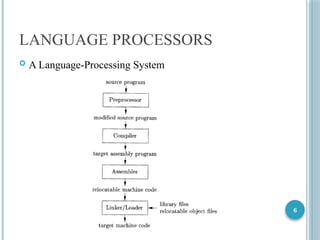
 A Language-Processing System
7
LANGUAGE PROCESSORS
 Preprocessor
 Source program may be divided into modules in separate files
 Accomplishes the task of collecting the source program
 Can delete comments, include other files, expand macros
 Assembler
 Compiler produces an assembly-language program
 Symbolic form of the machine language
 Produces relocatable machine code as output
8
LANGUAGE PROCESSORS
 Linker/Loader
 Relocatable Code
 Not ready to execute
 Memory references are made relative to an undetermined starting
address in memory
 Relocatable machine code may have to be linked with other
object files
 Linker
 Resolves external memory addresses
 Code in file referring to a location in another file
 Loader
 Resolve all relocatable addresses relative to a given starting address
 Puts together all the executable object files into memory for
execution
9
THE STRUCTURE OF A COMPILER
 Analysis Phase
 Break up source program into token or constituent pieces
 Impose a grammatical structure
 Create an intermediate representation of the source program
 If source program is syntactically incorrect or semantically
wrong
 Provide informative messages to the user
 Symbol Table
 Stores the information collected about the source program
 Given to the synthesis phase along with the intermediate
representation
10
THE STRUCTURE OF A COMPILER
 Synthesis Phase
 Constructs the desired target program from
 Intermediate representation
 Information in symbol table
 Back end of the compiler
 Analysis phase is called front end of the compiler
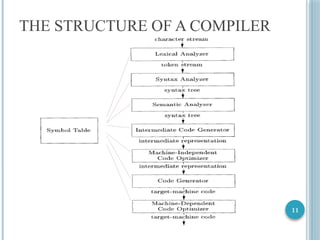
 Compilation process is a sequence of phases
 Each phase transforms one representation of source program
into another
 Several phases may be grouped together
 Symbol table is used by all the phases of the compiler
11
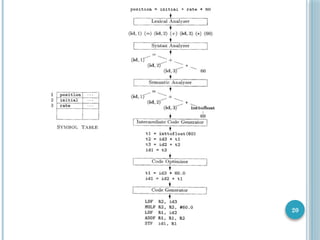
THE STRUCTURE OF A COMPILER
12
LEXICAL ANALYSIS
 Lexical Analyzer
 Reads stream of characters in the source program
 Groups the characters into meaningful sequences – lexemes
 For each lexeme, a token is produced as output
<token-name , attribute-value>
 Token-name : symbol used during syntax analysis
 Attribute-value : an entry in the symbol table for this token
 Information from symbol table is needed for syntax analysis
and code generation
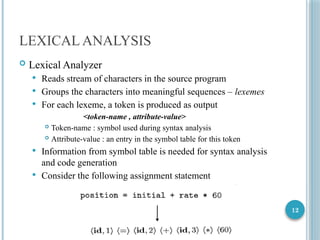
 Consider the following assignment statement
13
SYNTAX ANALYSIS
 Parsing
 Parser uses the tokens to create a tree-like intermediate
representation
 Depicts the grammatical structure of the token stream
 Syntax tree is one such representation
 Interior node – operation
 Children - arguments of the operation
 Other phases use this syntax tree to help analyze source
program and generate target program
14
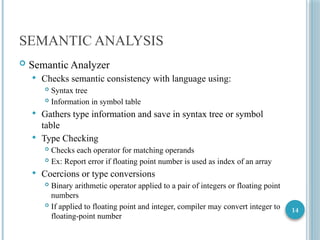
SEMANTIC ANALYSIS
 Semantic Analyzer
 Checks semantic consistency with language using:
 Syntax tree
 Information in symbol table
 Gathers type information and save in syntax tree or symbol
table
 Type Checking
 Checks each operator for matching operands
 Ex: Report error if floating point number is used as index of an array
 Coercions or type conversions
 Binary arithmetic operator applied to a pair of integers or floating point
numbers
 If applied to floating point and integer, compiler may convert integer to
floating-point number
15
SEMANTIC ANALYSIS
 Semantic Analyzer
 For our assignment statement
 Position, rate and initial are floating-point numbers
 Lexeme 60 is an integer
 Type checker finds that * is applied to floating-point ‘rate’ and
integer ‘60’
 Integer is converted to floating-point
16
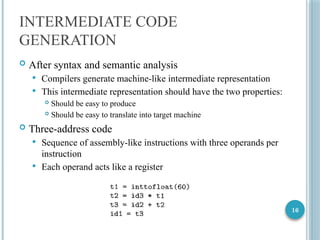
INTERMEDIATE CODE
GENERATION
 After syntax and semantic analysis
 Compilers generate machine-like intermediate representation
 This intermediate representation should have the two properties:
 Should be easy to produce
 Should be easy to translate into target machine
 Three-address code
 Sequence of assembly-like instructions with three operands per
instruction
 Each operand acts like a register
17
INTERMEDIATE CODE
GENERATION
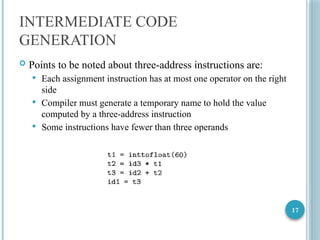
 Points to be noted about three-address instructions are:
 Each assignment instruction has at most one operator on the right
side
 Compiler must generate a temporary name to hold the value
computed by a three-address instruction
 Some instructions have fewer than three operands
18
CODE OPTIMIZATION
 Attempt to improve the target code
 Faster code, shorter code or target code that consumes less power
 Optimizer can deduce that
 Conversion of 60 from int to float can be done once at compile
time
 So, the inttofloat can be eliminated by replacing 60 with 60.0
 t3 is used only once to transmit its value to id1
19
CODE GENERATION
 Code Generator
 Takes intermediate representation as input
 Maps it into target language
 If target language is machine code
 Registers or memory locations are selected for each of the variables used
 Intermediate instructions are translated into sequences of machine
instructions performing the same task
 Assignment of registers to hold variables is a crucial aspect
 First operand of each instruction specifies a destination
20
21
SYMBOL-TABLE MANAGEMENT
 Essential function of Compiler
 Record variable names used in source program
 Collect information about storage allocated for a name
 Type
 Scope – where in the program the value may be used
 In case of procedure names,
 Number and type of its argument
 Method of passing each argument
 Type returned
 Symbol Table
 Data structure containing a record for each variable name with
fields for attributes
22
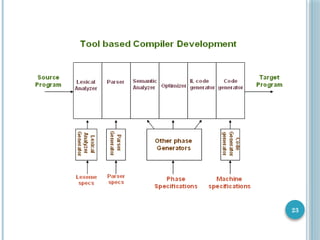
COMPILER-CONSTRUCTION TOOLS
 Commonly used compiler-construction tools
 Parser Generators
 Scanner Generators
 Syntax-directed translation engines
 Code-generator Generators
 Data-flow analysis engines
 Compiler-construction Toolkits
23
24
EVOLUTION OF PROGRAMMING
LANGUAGES
 Move to Higher-Level Languages
 Development of mnemonic assembly languages in 1950’s
 Classification of Languages
 Generation
 First-generation : machine languages
 Second-generation : assembly languages
 Third-generation : C, C++, C#, Java
 Fourth-generation : SQL, Postscript
 Fifth-generation : Prolog
 Imperative and Declarative
 Imperative : how a computation is to be done
 Declarative : what computation is to be done
 Object-oriented Language
 Scripting Languages
25
EVOLUTION OF PROGRAMMING
LANGUAGES
 Impact on Compilers
 Advances in PL’s placed new demands on compiler writers
 Devise algorithms and representations to support new features
 Performance of a computer is dependent on compiler technology
 Good software-engineering techniques are essential for creating
and evolving modern language processors
 Compiler writers must evaluate tradeoffs about
 What problems to deal with
 What heuristics to use to approach the problem of generating efficient
code
26
SCIENCE OF BUILDING A COMPILER
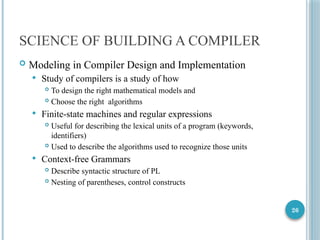
 Modeling in Compiler Design and Implementation
 Study of compilers is a study of how
 To design the right mathematical models and
 Choose the right algorithms
 Finite-state machines and regular expressions
 Useful for describing the lexical units of a program (keywords,
identifiers)
 Used to describe the algorithms used to recognize those units
 Context-free Grammars
 Describe syntactic structure of PL
 Nesting of parentheses, control constructs
27
SCIENCE OF BUILDING A COMPILER
 Science of Code Optimization
 “Optimization” – an attempt to produce code that is more efficient
 Processor architectures have become more complex
 Important to formulate the right problem to solve
 Need a good understanding of the programs
 Compiler design must meet the following design objectives
 Optimization must be correct, i.e., preserve the meaning of compiled
program
 Optimization must improve the performance of many programs
 Compilation time must be kept reasonable
 Engineering effort required must be manageable
28
APPLICATIONS OF COMPILER
TECHNOLOGY
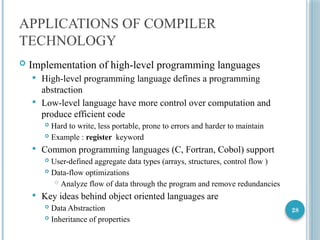
 Implementation of high-level programming languages
 High-level programming language defines a programming
abstraction
 Low-level language have more control over computation and
produce efficient code
 Hard to write, less portable, prone to errors and harder to maintain
 Example : register keyword
 Common programming languages (C, Fortran, Cobol) support
 User-defined aggregate data types (arrays, structures, control flow )
 Data-flow optimizations
 Analyze flow of data through the program and remove redundancies
 Key ideas behind object oriented languages are
 Data Abstraction
 Inheritance of properties
29
APPLICATIONS OF COMPILER
TECHNOLOGY
 Implementation of high-level programming languages
 Java has features that make programming easier
 Type-safe – an object cannot be used as an object of an unrelated type
 Array accesses are checked to ensure that they lie within the bounds
 Built in garbage-collection facility
 Optimizations developed to overcome the overhead by eliminating
unnecessary range checks
30
APPLICATIONS OF COMPILER
TECHNOLOGY
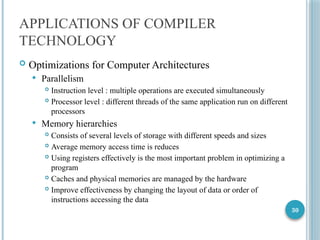
 Optimizations for Computer Architectures
 Parallelism
 Instruction level : multiple operations are executed simultaneously
 Processor level : different threads of the same application run on different
processors
 Memory hierarchies
 Consists of several levels of storage with different speeds and sizes
 Average memory access time is reduces
 Using registers effectively is the most important problem in optimizing a
program
 Caches and physical memories are managed by the hardware
 Improve effectiveness by changing the layout of data or order of
instructions accessing the data
31
APPLICATIONS OF COMPILER
TECHNOLOGY
 Design of new Computer Architectures
 RISC (Reduced Instruction-Set Computer)
 CISC (Complex Instruction-Set Computer) –
 Make assembly programming easier
 Include complex memory addressing modes
 Optimizations reduce these instructions to a small number of simpler
operations
 PowerPC, SPARC, MIPS, Alpha and PA-RISC
 Specialized Architectures
 Data flow machines, vector machines, VLIW, SIMD, systolic arrays
 Made way into the designs of embedded machines
 Entire systems can fit on a single chip
 Compiler technology helps to evaluate architectural designs
32
APPLICATIONS OF COMPILER
TECHNOLOGY
 Program Translations
 Binary Translation
 Translate binary code of one machine to that of another
 Allow machine to run programs compiled for another instruction set
 Used to increase the availability of software for their machines
 Can provide backward compatibility
 Hardware synthesis
 Hardware designs are described in high-level hardware description
languages like Verilog and VHDL
 Described at register transfer level (RTL)
 Variables represent registers
 Expressions represent combinational logic
 Tools translate RTL descriptions into gates, which are then mapped to
transistors and eventually to physical layout
33
APPLICATIONS OF COMPILER
TECHNOLOGY
 Program Translations
 Database Query Interpreters
 Languages are useful in other applications
 Query languages like SQL are used to search databases
 Queries consist of predicates containing relational and boolean operators
 Can be interpreted or compiled into commands to search a database
 Compiled Simulation
 Simulation
 Technique used in scientific and engg disciplines
 Understand a phenomenon or validate a design
 Inputs include description of the design and specific input parameters for
that run
34
APPLICATIONS OF COMPILER
TECHNOLOGY
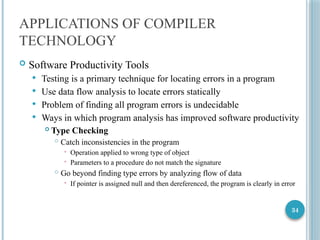
 Software Productivity Tools
 Testing is a primary technique for locating errors in a program
 Use data flow analysis to locate errors statically
 Problem of finding all program errors is undecidable
 Ways in which program analysis has improved software productivity
 Type Checking
 Catch inconsistencies in the program
 Operation applied to wrong type of object
 Parameters to a procedure do not match the signature
 Go beyond finding type errors by analyzing flow of data
 If pointer is assigned null and then dereferenced, the program is clearly in error
35
APPLICATIONS OF COMPILER
TECHNOLOGY
 Software Productivity Tools
 Bounds Checking
 Security breaches are caused by buffer overflows in programs written in C
 Data-flow analysis can be used to locate buffer overflows
 Failing to identify a buffer overflow may compromise the security of the
system
 Memory-management tools
 Automatic memory management removes all memory-management errors
like memory leaks
 Tools developed to help programmers find memory management errors
 Purify - dynamically catches memory management errors as they occur
36
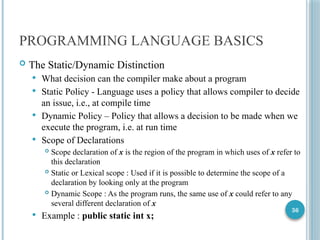
PROGRAMMING LANGUAGE BASICS
 The Static/Dynamic Distinction
 What decision can the compiler make about a program
 Static Policy - Language uses a policy that allows compiler to decide
an issue, i.e., at compile time
 Dynamic Policy – Policy that allows a decision to be made when we
execute the program, i.e. at run time
 Scope of Declarations
 Scope declaration of x is the region of the program in which uses of x refer to
this declaration
 Static or Lexical scope : Used if it is possible to determine the scope of a
declaration by looking only at the program
 Dynamic Scope : As the program runs, the same use of x could refer to any
several different declaration of x
 Example : public static int x;
37
PROGRAMMING LANGUAGE BASICS
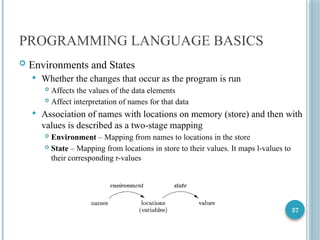
 Environments and States
 Whether the changes that occur as the program is run
 Affects the values of the data elements
 Affect interpretation of names for that data
 Association of names with locations on memory (store) and then with
values is described as a two-stage mapping
 Environment – Mapping from names to locations in the store
 State – Mapping from locations in store to their values. It maps l-values to
their corresponding r-values
38
PROGRAMMING LANGUAGE BASICS
 Environments and States
 Example
 Exceptions to environment and state mappings
 Static versus dynamic binding of names to locations
 Static versus dynamic binding of locations to values
39
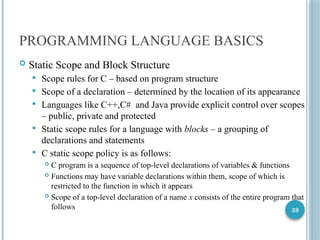
PROGRAMMING LANGUAGE BASICS
 Static Scope and Block Structure
 Scope rules for C – based on program structure
 Scope of a declaration – determined by the location of its appearance
 Languages like C++,C# and Java provide explicit control over scopes
– public, private and protected
 Static scope rules for a language with blocks – a grouping of
declarations and statements
 C static scope policy is as follows:
 C program is a sequence of top-level declarations of variables & functions
 Functions may have variable declarations within them, scope of which is
restricted to the function in which it appears
 Scope of a top-level declaration of a name x consists of the entire program that
follows
40
PROGRAMMING LANGUAGE BASICS
 Static Scope and Block Structure
 The syntax of blocks in C is given by
 It is a type of statement and can appear anywhere that other statements can
appear
 Is a sequence of declarations followed by a sequence of statements, all
surrounded by braces
 Block structure – nesting property of blocks
 Static scope rule for variable declaration is as follows:
 If declaration D of name x belongs to block B,
 Then scope of D is all of B, except for any blocks B’ nested to any depth
within B in which x is redeclared
41
PROGRAMMING LANGUAGE BASICS
 Static Scope and Block Structure
 Blocks in a C++ program
42
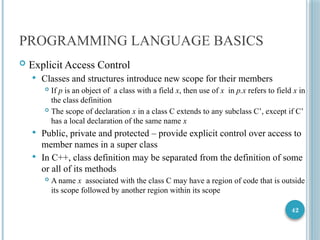
PROGRAMMING LANGUAGE BASICS
 Explicit Access Control
 Classes and structures introduce new scope for their members
 If p is an object of a class with a field x, then use of x in p.x refers to field x in
the class definition
 The scope of declaration x in a class C extends to any subclass C’, except if C’
has a local declaration of the same name x
 Public, private and protected – provide explicit control over access to
member names in a super class
 In C++, class definition may be separated from the definition of some
or all of its methods
 A name x associated with the class C may have a region of code that is outside
its scope followed by another region within its scope
43
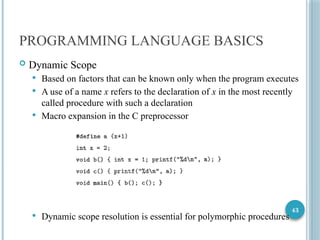
PROGRAMMING LANGUAGE BASICS
 Dynamic Scope
 Based on factors that can be known only when the program executes
 A use of a name x refers to the declaration of x in the most recently
called procedure with such a declaration
 Macro expansion in the C preprocessor
 Dynamic scope resolution is essential for polymorphic procedures
44
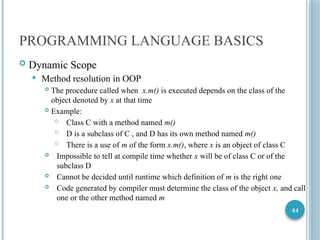
PROGRAMMING LANGUAGE BASICS
 Dynamic Scope
 Method resolution in OOP
 The procedure called when x.m() is executed depends on the class of the
object denoted by x at that time
 Example:
 Class C with a method named m()
 D is a subclass of C , and D has its own method named m()
 There is a use of m of the form x.m(), where x is an object of class C
 Impossible to tell at compile time whether x will be of class C or of the
subclass D
 Cannot be decided until runtime which definition of m is the right one
 Code generated by compiler must determine the class of the object x, and call
one or the other method named m
45
PROGRAMMING LANGUAGE BASICS
 Parameter Passing Mechanisms
 How actual parameters are associated with formal parameters
 Actual parameters – used in the call of a procedure
 Formal parameters – used in the procedure definition
 Call-by-Value
 The actual parameter is evaluated or copied
 Value is placed in the location belonging to the corresponding formal
parameter of the called procedure
 Computation involving formal parameters done by the called procedure is
local to that procedure and actual parameters cannot be changed
 In C, we can pass a pointer to a variable to allow that variable to be changed
by the callee
 Array names passed as parameters in C,C++ or Java give the called procedure
what is in effect a pointer or reference to the array itself
46
PROGRAMMING LANGUAGE BASICS
 Parameter Passing Mechanisms
 Call-by-Reference
 Address of actual parameter is passed to the callee as the value of the
corresponding formal parameter
 Changes to formal parameter appear as changes to the actual parameter
 Essential when the formal parameter is a large object, array or a structure
 Strict call-by-value requires that the caller copy the entire actual parameter
into the space of the corresponding formal parameter
 Copying is expensive when the parameter is large
 Call-by-Name
 The callee executes as if the actual parameter were substituted literally for the
formal parameter in the code of the callee
47
PROGRAMMING LANGUAGE BASICS
 Aliasing
 Consequence of call-by-reference parameter passing
 Possible that two formal parameters can refer to the same location
 Such variables are said to be aliases of one another
 Example:
 a is an array belonging to procedure p, and p calls another procedure q(x,y)
with a call q(a,a)
 Parameters are passed by value but the array names are references to the
location where the array is stored
 So, x and y become aliases of each other
 Understanding aliasing is essential for a compiler that optimizes a program
48
LEXICAL ANALYSIS
49
OBJECTIVES
 Role of Lexical analyzer
 Lexical analysis using formal language definitions with
Finite Automata
 Specification of Tokens
 Recognition of Tokens
50
PROGRAMMING LANGUAGE
STRUCTURE
 A Programming Language is defined by:
 SYNTAX
 Decides whether a sentence in a language is well-formed
 SEMANTICS
 Determines the meaning , if any, of a syntactically well-formed sentence
 GRAMMAR
 Provides a generative finite description of the language
 Well developed tools (regular, context-free and attribute
grammars) are available for the description of syntax
 Lexical analyzer and the Parser handle the syntax of the
programming language
51
THE ROLE OF THE LEXICAL
ANALYZER
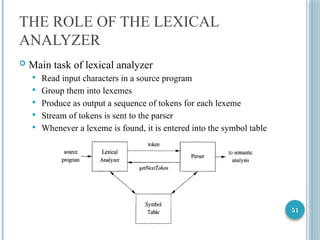
 Main task of lexical analyzer
 Read input characters in a source program
 Group them into lexemes
 Produce as output a sequence of tokens for each lexeme
 Stream of tokens is sent to the parser
 Whenever a lexeme is found, it is entered into the symbol table
52
THE ROLE OF THE LEXICAL
ANALYZER
 Other tasks performed by the lexical analyzer
 Removing comments and whitespace
 Correlating error messages generated by compiler with source program
 Associates a line number with each error message
 Makes a copy of the source program with error messages
 Cascade of two processes
 Scanning
 Processes that do not require the tokenization of input, like, deletion of
comments and compaction of whitespaces
 Lexical analysis
 Scanner produces the sequence of tokens as output
53
THE ROLE OF THE LEXICAL
ANALYZER
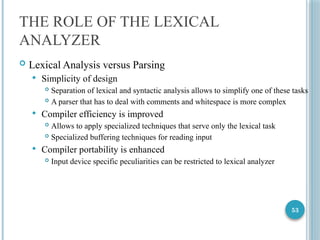
 Lexical Analysis versus Parsing
 Simplicity of design
 Separation of lexical and syntactic analysis allows to simplify one of these tasks
 A parser that has to deal with comments and whitespace is more complex
 Compiler efficiency is improved
 Allows to apply specialized techniques that serve only the lexical task
 Specialized buffering techniques for reading input
 Compiler portability is enhanced
 Input device specific peculiarities can be restricted to lexical analyzer
54
TOKENS, PATTERNS, AND LEXEMES
 Token
 Pair consisting of a token name and an optional attribute value
 Token name – abstract symbol for a lexical unit, like keyword
 Pattern
 Description of the form that the lexemes of a token may take
 If keyword is a token, pattern is a sequence of characters that form the
keyword
 Lexeme
 Sequence of characters in the source program that matches the pattern for a
token
 Identified by the lexical analyzer as an instance of that token
55
TOKENS, PATTERNS, AND LEXEMES
 Typical tokens in a Programming Language
 One token for each keyword
 Tokens for the operators
 Token representing all identifiers
 One or more tokens representing constants, such as numbers and literal
strings
 Tokens for each punctuation symbol, such as comma, semicolon, left and
right parentheses
56
ATTRIBUTES FOR TOKENS
 When more than one lexeme matches a pattern, additional
information about the lexeme must be passed
 Example : Pattern for token number matches both 0 and 1
 So, lexical analyzer returns to the parser both the token name and attribute
value describing the lexeme
 Token name influences parsing decisions
 Attribute value influences translation of tokens after the parse
 Appropriate attribute value for an identifier is a pointer to the symbol-table
entry for that entry
57
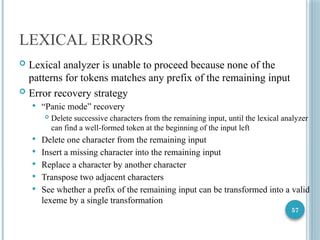
LEXICAL ERRORS
 Lexical analyzer is unable to proceed because none of the
patterns for tokens matches any prefix of the remaining input
 Error recovery strategy
 “Panic mode” recovery
 Delete successive characters from the remaining input, until the lexical analyzer
can find a well-formed token at the beginning of the input left
 Delete one character from the remaining input
 Insert a missing character into the remaining input
 Replace a character by another character
 Transpose two adjacent characters
 See whether a prefix of the remaining input can be transformed into a valid
lexeme by a single transformation
58
INPUT BUFFERING
 Buffer Pairs
 Specialized buffering techniques to reduce the amount of overhead to
process a single input character
 Scheme involving two buffers that are alternately reloaded
 eof – marks the end of the source file
 Two pointers to the input
 lexemeBegin – marks beginning of the current lexeme
 forward – scans ahead until a pattern match is found
59
INPUT BUFFERING
 Buffer Pairs
 Once the next lexeme is determined, forward is set to the character at
its right end
 After lexeme is recorded as an attribute value, lexemeBegin is set to
the character immediately after the lexeme just found
 To advance forward pointer,
 Test whether the end of one of the buffers has been reached
 If so, then reload the other buffer from the input
 Move forward to the beginning of the newly loaded buffer
60
INPUT BUFFERING
 Sentinels
 In previous scheme, each time the forward pointer is advanced,
 Must check that we have not moved off one of the buffers
 If we do, then reload the other buffer
 For each character read, make two tests
 End of buffer
 Determine what character is read
 Combine the buffer-end test with the test for current character, if we
extend each buffer to hold a sentinel character at the end
 Sentinel is a special character that is not a part of the source program
61
SPECIFICATION OF TOKENS
 Strings and Languages
 Alphabet
 Finite set of symbols, e.g., letters, digits and punctuation
 Binary alphabet – {0,1}
 String over an alphabet
 Finite sequence of symbols drawn from that alphabet
 Length of string s (|s|) – number of occurrences of symbols in s
 Empty string (ε) –string of length zero
 Language
 Set of strings over some fixed alphabet
 Ex :
 {ε}, set containing only the empty string
 Set of all syntactically well-formed C programs
62
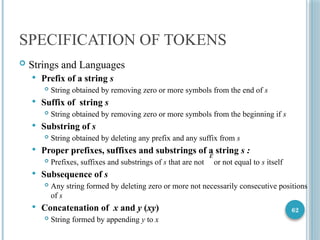
SPECIFICATION OF TOKENS
 Strings and Languages
 Prefix of a string s
 String obtained by removing zero or more symbols from the end of s
 Suffix of string s
 String obtained by removing zero or more symbols from the beginning if s
 Substring of s
 String obtained by deleting any prefix and any suffix from s
 Proper prefixes, suffixes and substrings of a string s :
 Prefixes, suffixes and substrings of s that are not or not equal to s itself
 Subsequence of s
 Any string formed by deleting zero or more not necessarily consecutive positions
of s
 Concatenation of x and y (xy)
 String formed by appending y to x

63
SPECIFICATION OF TOKENS
 Operations on Languages
 Kleene Closure (L*
)
 Set of strings obtained by concatenating L zero or more times
 L0
- concatenation of L zero times, that is ,{ }
 Positive Closure (L+
)
 Same as Kleene closure but without the term L0
ε
64
SPECIFICATION OF TOKENS
 Regular Expressions
 Notation used for describing all languages that can be built from these
operators applied to the symbols of some alphabet
 Ex: Language of C identifiers  letter (letter | digit)*
 Each regular expression r denotes a language L(r), defined recursively
from the languages denoted by r’s sub expressions
 Rules that define the RE’s over some alphabet
 ε is a regular expression and L(ε ) is {ε }
 If a is a symbol in alphabet, then a is a regular expression and L(a) = {a}
 r and s are RE’s denoting languages L(r) and L(s), then
 (r)|(s) is a RE denoting the language L(r) U L(s)
 (r)(s) is a RE denoting the language L(r)L(s)
 (r)*
is a RE denoting (L(r))*
 (r) is a RE denoting L(r)
65
SPECIFICATION OF TOKENS
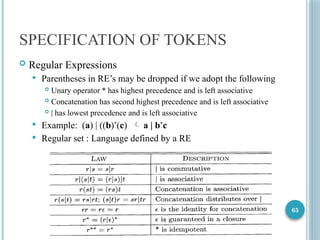
 Regular Expressions
 Parentheses in RE’s may be dropped if we adopt the following
 Unary operator * has highest precedence and is left associative
 Concatenation has second highest precedence and is left associative
 | has lowest precedence and is left associative
 Example: (a) | ((b)*
(c)  a | b*
c
 Regular set : Language defined by a RE
 Two RE’s are equivalent if they denote the same regular set
 Ex: (a|b) = (b|a)
66
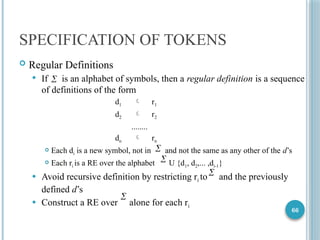
SPECIFICATION OF TOKENS
 Regular Definitions
 If is an alphabet of symbols, then a regular definition is a sequence
of definitions of the form
d1  r1
d2  r2
........
dn  rn
 Each di is a new symbol, not in and not the same as any other of the d’s
 Each ri is a RE over the alphabet U {d1, d2,... ,di-1}
 Avoid recursive definition by restricting ri to and the previously
defined d’s
 Construct a RE over alone for each ri





67
SPECIFICATION OF TOKENS
 Extensions of Regular Expressions
 One or more instances
 Unary operator +
, represents positive closure of a RE and its language
 r*
= r+
| ε and r+
= rr*
= r*
r
 Zero or one instance
 Unary operator ? Means “zero or one occurence”
 r? = r|ε or L(r?) = L(r) U {ε}
 Character classes
 Regular expression, a1| a2|....| an can be replaced by [a1 a2... an ]
 [abc] is short form for a|b|c
68
RECOGNITION OF TOKENS
 Study how to take patterns for all the needed tokens
 Build a piece of code that examines the input string
 Find a prefix that is a lexeme matching one of the patterns
 Simple form of branching statements and conditional expressions
 Terminals of the grammar : if, then, else, relop, id, number
69
RECOGNITION OF TOKENS
 Patterns for the tokens are described using regular definitions
 Recognize the token ws, to remove whitespaces
70
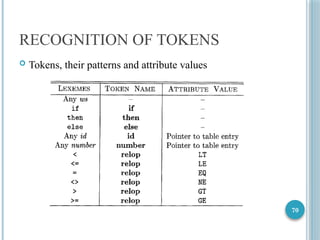
RECOGNITION OF TOKENS
 Tokens, their patterns and attribute values
71
TRANSITION DIAGRAMS
 Convert patterns into flowcharts called transition diagrams
 States
 Represents a condition that could occur during the scanning of input
that matches a pattern
 Edges
 Directed from one state to another
 Labelled by a symbol or set of symbols
 If in some state s, and next input symbol is a,
 Look for an edge out of state s labelled by a
 If such an edge is found, advance the forward pointer and enter the
state to which that edge leads
72
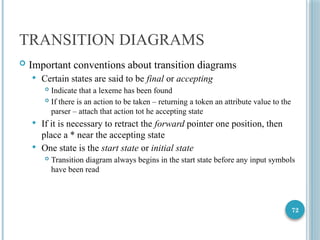
TRANSITION DIAGRAMS
 Important conventions about transition diagrams
 Certain states are said to be final or accepting
 Indicate that a lexeme has been found
 If there is an action to be taken – returning a token an attribute value to the
parser – attach that action tot he accepting state
 If it is necessary to retract the forward pointer one position, then
place a * near the accepting state
 One state is the start state or initial state
 Transition diagram always begins in the start state before any input symbols
have been read
73
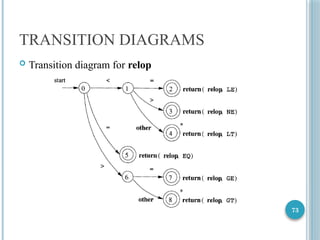
TRANSITION DIAGRAMS
 Transition diagram for relop
74
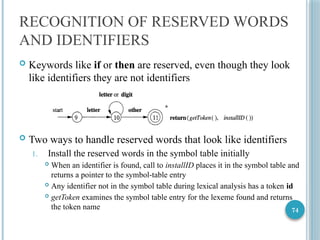
RECOGNITION OF RESERVED WORDS
AND IDENTIFIERS
 Keywords like if or then are reserved, even though they look
like identifiers they are not identifiers
 Two ways to handle reserved words that look like identifiers
1. Install the reserved words in the symbol table initially
 When an identifier is found, call to installID places it in the symbol table and
returns a pointer to the symbol-table entry
 Any identifier not in the symbol table during lexical analysis has a token id
 getToken examines the symbol table entry for the lexeme found and returns
the token name
75
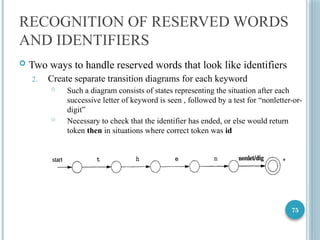
RECOGNITION OF RESERVED WORDS
AND IDENTIFIERS
 Two ways to handle reserved words that look like identifiers
2. Create separate transition diagrams for each keyword
 Such a diagram consists of states representing the situation after each
successive letter of keyword is seen , followed by a test for “nonletter-or-
digit”
 Necessary to check that the identifier has ended, or else would return
token then in situations where correct token was id
76
ARCHITECTURE OF A TRANSITION-
DIAGRAM-BASED LEXICAL ANALYZER
 Collection of transition diagrams can be used to build a lexical
analyzer
 Each state is represented by a piece of code
 Variable state holding the number of the current state
 A switch based on the value of state takes us to the code for each of
the possible states, where action of that state is found
 Code for a state is itself a switch statement or multiway branch that
determines the next state
77
ARCHITECTURE OF A TRANSITION-
DIAGRAM-BASED LEXICAL ANALYZER
Fig : Implementation of relop transition diagram
78
ARCHITECTURE OF A TRANSITION-
DIAGRAM-BASED LEXICAL ANALYZER
 Ways in which the code could fit into the entire lexical analyzer
 Arrange the transition diagrams for each token to be tried sequentially
 Function fail() resets the forward pointer and starts next transition diagram
 Allows to use transition diagrams for the individual keywords
 Run various transition diagrams “in parallel”
 Feed the next input character to all of them an allow each one to make the
transitions required
 Must be careful to resolve the case where
 One diagram finds a lexeme that matches the pattern
 While one or more other diagrams are still able to process the input
 Combine all transition diagrams into one
 Allow to read input until there is no possible next state
 Take the longest lexeme that matched any pattern

unit1_cd unit1_cd unit1_cd unit1_cd unit1_cd (1).pptx

  • 1.
  • 2.
    2 TOPICS  Language Processors Structure of a Compiler  Evolution of Programming Languages  Science of Building a Compiler  Applications of Compiler Technology  Programming Language Basics
  • 3.
    3 LANGUAGE PROCESSORS  COMPILER Read a program in source language and translate into the target language  Source language – High-level language like C, C++  Target language – object code of the target machine  Report any errors detected in the source program during translation
  • 4.
    4 LANGUAGE PROCESSORS  INTERPRETER Directly executes the operations specified in the source program on inputs supplied by the user  Target program is not produced as output of translation  Gives better error-diagnostics than a compiler  Executes source program statement by statement  Target program produced by compiler is much faster at mapping inputs to outputs
  • 5.
    5 LANGUAGE PROCESSORS  EXAMPLE Java language processors combine compilation and interpretation  Source program is first compiled into bytecodes  Bytecodes are then interpreted by a virtual machine  Just-in-time compilers  Translate bytecodes into machine language before they run the intermediate program to process input
  • 6.
    6 LANGUAGE PROCESSORS  ALanguage-Processing System
  • 7.
    7 LANGUAGE PROCESSORS  Preprocessor Source program may be divided into modules in separate files  Accomplishes the task of collecting the source program  Can delete comments, include other files, expand macros  Assembler  Compiler produces an assembly-language program  Symbolic form of the machine language  Produces relocatable machine code as output
  • 8.
    8 LANGUAGE PROCESSORS  Linker/Loader Relocatable Code  Not ready to execute  Memory references are made relative to an undetermined starting address in memory  Relocatable machine code may have to be linked with other object files  Linker  Resolves external memory addresses  Code in file referring to a location in another file  Loader  Resolve all relocatable addresses relative to a given starting address  Puts together all the executable object files into memory for execution
  • 9.
    9 THE STRUCTURE OFA COMPILER  Analysis Phase  Break up source program into token or constituent pieces  Impose a grammatical structure  Create an intermediate representation of the source program  If source program is syntactically incorrect or semantically wrong  Provide informative messages to the user  Symbol Table  Stores the information collected about the source program  Given to the synthesis phase along with the intermediate representation
  • 10.
    10 THE STRUCTURE OFA COMPILER  Synthesis Phase  Constructs the desired target program from  Intermediate representation  Information in symbol table  Back end of the compiler  Analysis phase is called front end of the compiler  Compilation process is a sequence of phases  Each phase transforms one representation of source program into another  Several phases may be grouped together  Symbol table is used by all the phases of the compiler
  • 11.
  • 12.
    12 LEXICAL ANALYSIS  LexicalAnalyzer  Reads stream of characters in the source program  Groups the characters into meaningful sequences – lexemes  For each lexeme, a token is produced as output <token-name , attribute-value>  Token-name : symbol used during syntax analysis  Attribute-value : an entry in the symbol table for this token  Information from symbol table is needed for syntax analysis and code generation  Consider the following assignment statement
  • 13.
    13 SYNTAX ANALYSIS  Parsing Parser uses the tokens to create a tree-like intermediate representation  Depicts the grammatical structure of the token stream  Syntax tree is one such representation  Interior node – operation  Children - arguments of the operation  Other phases use this syntax tree to help analyze source program and generate target program
  • 14.
    14 SEMANTIC ANALYSIS  SemanticAnalyzer  Checks semantic consistency with language using:  Syntax tree  Information in symbol table  Gathers type information and save in syntax tree or symbol table  Type Checking  Checks each operator for matching operands  Ex: Report error if floating point number is used as index of an array  Coercions or type conversions  Binary arithmetic operator applied to a pair of integers or floating point numbers  If applied to floating point and integer, compiler may convert integer to floating-point number
  • 15.
    15 SEMANTIC ANALYSIS  SemanticAnalyzer  For our assignment statement  Position, rate and initial are floating-point numbers  Lexeme 60 is an integer  Type checker finds that * is applied to floating-point ‘rate’ and integer ‘60’  Integer is converted to floating-point
  • 16.
    16 INTERMEDIATE CODE GENERATION  Aftersyntax and semantic analysis  Compilers generate machine-like intermediate representation  This intermediate representation should have the two properties:  Should be easy to produce  Should be easy to translate into target machine  Three-address code  Sequence of assembly-like instructions with three operands per instruction  Each operand acts like a register
  • 17.
    17 INTERMEDIATE CODE GENERATION  Pointsto be noted about three-address instructions are:  Each assignment instruction has at most one operator on the right side  Compiler must generate a temporary name to hold the value computed by a three-address instruction  Some instructions have fewer than three operands
  • 18.
    18 CODE OPTIMIZATION  Attemptto improve the target code  Faster code, shorter code or target code that consumes less power  Optimizer can deduce that  Conversion of 60 from int to float can be done once at compile time  So, the inttofloat can be eliminated by replacing 60 with 60.0  t3 is used only once to transmit its value to id1
  • 19.
    19 CODE GENERATION  CodeGenerator  Takes intermediate representation as input  Maps it into target language  If target language is machine code  Registers or memory locations are selected for each of the variables used  Intermediate instructions are translated into sequences of machine instructions performing the same task  Assignment of registers to hold variables is a crucial aspect  First operand of each instruction specifies a destination
  • 20.
  • 21.
    21 SYMBOL-TABLE MANAGEMENT  Essentialfunction of Compiler  Record variable names used in source program  Collect information about storage allocated for a name  Type  Scope – where in the program the value may be used  In case of procedure names,  Number and type of its argument  Method of passing each argument  Type returned  Symbol Table  Data structure containing a record for each variable name with fields for attributes
  • 22.
    22 COMPILER-CONSTRUCTION TOOLS  Commonlyused compiler-construction tools  Parser Generators  Scanner Generators  Syntax-directed translation engines  Code-generator Generators  Data-flow analysis engines  Compiler-construction Toolkits
  • 23.
  • 24.
    24 EVOLUTION OF PROGRAMMING LANGUAGES Move to Higher-Level Languages  Development of mnemonic assembly languages in 1950’s  Classification of Languages  Generation  First-generation : machine languages  Second-generation : assembly languages  Third-generation : C, C++, C#, Java  Fourth-generation : SQL, Postscript  Fifth-generation : Prolog  Imperative and Declarative  Imperative : how a computation is to be done  Declarative : what computation is to be done  Object-oriented Language  Scripting Languages
  • 25.
    25 EVOLUTION OF PROGRAMMING LANGUAGES Impact on Compilers  Advances in PL’s placed new demands on compiler writers  Devise algorithms and representations to support new features  Performance of a computer is dependent on compiler technology  Good software-engineering techniques are essential for creating and evolving modern language processors  Compiler writers must evaluate tradeoffs about  What problems to deal with  What heuristics to use to approach the problem of generating efficient code
  • 26.
    26 SCIENCE OF BUILDINGA COMPILER  Modeling in Compiler Design and Implementation  Study of compilers is a study of how  To design the right mathematical models and  Choose the right algorithms  Finite-state machines and regular expressions  Useful for describing the lexical units of a program (keywords, identifiers)  Used to describe the algorithms used to recognize those units  Context-free Grammars  Describe syntactic structure of PL  Nesting of parentheses, control constructs
  • 27.
    27 SCIENCE OF BUILDINGA COMPILER  Science of Code Optimization  “Optimization” – an attempt to produce code that is more efficient  Processor architectures have become more complex  Important to formulate the right problem to solve  Need a good understanding of the programs  Compiler design must meet the following design objectives  Optimization must be correct, i.e., preserve the meaning of compiled program  Optimization must improve the performance of many programs  Compilation time must be kept reasonable  Engineering effort required must be manageable
  • 28.
    28 APPLICATIONS OF COMPILER TECHNOLOGY Implementation of high-level programming languages  High-level programming language defines a programming abstraction  Low-level language have more control over computation and produce efficient code  Hard to write, less portable, prone to errors and harder to maintain  Example : register keyword  Common programming languages (C, Fortran, Cobol) support  User-defined aggregate data types (arrays, structures, control flow )  Data-flow optimizations  Analyze flow of data through the program and remove redundancies  Key ideas behind object oriented languages are  Data Abstraction  Inheritance of properties
  • 29.
    29 APPLICATIONS OF COMPILER TECHNOLOGY Implementation of high-level programming languages  Java has features that make programming easier  Type-safe – an object cannot be used as an object of an unrelated type  Array accesses are checked to ensure that they lie within the bounds  Built in garbage-collection facility  Optimizations developed to overcome the overhead by eliminating unnecessary range checks
  • 30.
    30 APPLICATIONS OF COMPILER TECHNOLOGY Optimizations for Computer Architectures  Parallelism  Instruction level : multiple operations are executed simultaneously  Processor level : different threads of the same application run on different processors  Memory hierarchies  Consists of several levels of storage with different speeds and sizes  Average memory access time is reduces  Using registers effectively is the most important problem in optimizing a program  Caches and physical memories are managed by the hardware  Improve effectiveness by changing the layout of data or order of instructions accessing the data
  • 31.
    31 APPLICATIONS OF COMPILER TECHNOLOGY Design of new Computer Architectures  RISC (Reduced Instruction-Set Computer)  CISC (Complex Instruction-Set Computer) –  Make assembly programming easier  Include complex memory addressing modes  Optimizations reduce these instructions to a small number of simpler operations  PowerPC, SPARC, MIPS, Alpha and PA-RISC  Specialized Architectures  Data flow machines, vector machines, VLIW, SIMD, systolic arrays  Made way into the designs of embedded machines  Entire systems can fit on a single chip  Compiler technology helps to evaluate architectural designs
  • 32.
    32 APPLICATIONS OF COMPILER TECHNOLOGY Program Translations  Binary Translation  Translate binary code of one machine to that of another  Allow machine to run programs compiled for another instruction set  Used to increase the availability of software for their machines  Can provide backward compatibility  Hardware synthesis  Hardware designs are described in high-level hardware description languages like Verilog and VHDL  Described at register transfer level (RTL)  Variables represent registers  Expressions represent combinational logic  Tools translate RTL descriptions into gates, which are then mapped to transistors and eventually to physical layout
  • 33.
    33 APPLICATIONS OF COMPILER TECHNOLOGY Program Translations  Database Query Interpreters  Languages are useful in other applications  Query languages like SQL are used to search databases  Queries consist of predicates containing relational and boolean operators  Can be interpreted or compiled into commands to search a database  Compiled Simulation  Simulation  Technique used in scientific and engg disciplines  Understand a phenomenon or validate a design  Inputs include description of the design and specific input parameters for that run
  • 34.
    34 APPLICATIONS OF COMPILER TECHNOLOGY Software Productivity Tools  Testing is a primary technique for locating errors in a program  Use data flow analysis to locate errors statically  Problem of finding all program errors is undecidable  Ways in which program analysis has improved software productivity  Type Checking  Catch inconsistencies in the program  Operation applied to wrong type of object  Parameters to a procedure do not match the signature  Go beyond finding type errors by analyzing flow of data  If pointer is assigned null and then dereferenced, the program is clearly in error
  • 35.
    35 APPLICATIONS OF COMPILER TECHNOLOGY Software Productivity Tools  Bounds Checking  Security breaches are caused by buffer overflows in programs written in C  Data-flow analysis can be used to locate buffer overflows  Failing to identify a buffer overflow may compromise the security of the system  Memory-management tools  Automatic memory management removes all memory-management errors like memory leaks  Tools developed to help programmers find memory management errors  Purify - dynamically catches memory management errors as they occur
  • 36.
    36 PROGRAMMING LANGUAGE BASICS The Static/Dynamic Distinction  What decision can the compiler make about a program  Static Policy - Language uses a policy that allows compiler to decide an issue, i.e., at compile time  Dynamic Policy – Policy that allows a decision to be made when we execute the program, i.e. at run time  Scope of Declarations  Scope declaration of x is the region of the program in which uses of x refer to this declaration  Static or Lexical scope : Used if it is possible to determine the scope of a declaration by looking only at the program  Dynamic Scope : As the program runs, the same use of x could refer to any several different declaration of x  Example : public static int x;
  • 37.
    37 PROGRAMMING LANGUAGE BASICS Environments and States  Whether the changes that occur as the program is run  Affects the values of the data elements  Affect interpretation of names for that data  Association of names with locations on memory (store) and then with values is described as a two-stage mapping  Environment – Mapping from names to locations in the store  State – Mapping from locations in store to their values. It maps l-values to their corresponding r-values
  • 38.
    38 PROGRAMMING LANGUAGE BASICS Environments and States  Example  Exceptions to environment and state mappings  Static versus dynamic binding of names to locations  Static versus dynamic binding of locations to values
  • 39.
    39 PROGRAMMING LANGUAGE BASICS Static Scope and Block Structure  Scope rules for C – based on program structure  Scope of a declaration – determined by the location of its appearance  Languages like C++,C# and Java provide explicit control over scopes – public, private and protected  Static scope rules for a language with blocks – a grouping of declarations and statements  C static scope policy is as follows:  C program is a sequence of top-level declarations of variables & functions  Functions may have variable declarations within them, scope of which is restricted to the function in which it appears  Scope of a top-level declaration of a name x consists of the entire program that follows
  • 40.
    40 PROGRAMMING LANGUAGE BASICS Static Scope and Block Structure  The syntax of blocks in C is given by  It is a type of statement and can appear anywhere that other statements can appear  Is a sequence of declarations followed by a sequence of statements, all surrounded by braces  Block structure – nesting property of blocks  Static scope rule for variable declaration is as follows:  If declaration D of name x belongs to block B,  Then scope of D is all of B, except for any blocks B’ nested to any depth within B in which x is redeclared
  • 41.
    41 PROGRAMMING LANGUAGE BASICS Static Scope and Block Structure  Blocks in a C++ program
  • 42.
    42 PROGRAMMING LANGUAGE BASICS Explicit Access Control  Classes and structures introduce new scope for their members  If p is an object of a class with a field x, then use of x in p.x refers to field x in the class definition  The scope of declaration x in a class C extends to any subclass C’, except if C’ has a local declaration of the same name x  Public, private and protected – provide explicit control over access to member names in a super class  In C++, class definition may be separated from the definition of some or all of its methods  A name x associated with the class C may have a region of code that is outside its scope followed by another region within its scope
  • 43.
    43 PROGRAMMING LANGUAGE BASICS Dynamic Scope  Based on factors that can be known only when the program executes  A use of a name x refers to the declaration of x in the most recently called procedure with such a declaration  Macro expansion in the C preprocessor  Dynamic scope resolution is essential for polymorphic procedures
  • 44.
    44 PROGRAMMING LANGUAGE BASICS Dynamic Scope  Method resolution in OOP  The procedure called when x.m() is executed depends on the class of the object denoted by x at that time  Example:  Class C with a method named m()  D is a subclass of C , and D has its own method named m()  There is a use of m of the form x.m(), where x is an object of class C  Impossible to tell at compile time whether x will be of class C or of the subclass D  Cannot be decided until runtime which definition of m is the right one  Code generated by compiler must determine the class of the object x, and call one or the other method named m
  • 45.
    45 PROGRAMMING LANGUAGE BASICS Parameter Passing Mechanisms  How actual parameters are associated with formal parameters  Actual parameters – used in the call of a procedure  Formal parameters – used in the procedure definition  Call-by-Value  The actual parameter is evaluated or copied  Value is placed in the location belonging to the corresponding formal parameter of the called procedure  Computation involving formal parameters done by the called procedure is local to that procedure and actual parameters cannot be changed  In C, we can pass a pointer to a variable to allow that variable to be changed by the callee  Array names passed as parameters in C,C++ or Java give the called procedure what is in effect a pointer or reference to the array itself
  • 46.
    46 PROGRAMMING LANGUAGE BASICS Parameter Passing Mechanisms  Call-by-Reference  Address of actual parameter is passed to the callee as the value of the corresponding formal parameter  Changes to formal parameter appear as changes to the actual parameter  Essential when the formal parameter is a large object, array or a structure  Strict call-by-value requires that the caller copy the entire actual parameter into the space of the corresponding formal parameter  Copying is expensive when the parameter is large  Call-by-Name  The callee executes as if the actual parameter were substituted literally for the formal parameter in the code of the callee
  • 47.
    47 PROGRAMMING LANGUAGE BASICS Aliasing  Consequence of call-by-reference parameter passing  Possible that two formal parameters can refer to the same location  Such variables are said to be aliases of one another  Example:  a is an array belonging to procedure p, and p calls another procedure q(x,y) with a call q(a,a)  Parameters are passed by value but the array names are references to the location where the array is stored  So, x and y become aliases of each other  Understanding aliasing is essential for a compiler that optimizes a program
  • 48.
  • 49.
    49 OBJECTIVES  Role ofLexical analyzer  Lexical analysis using formal language definitions with Finite Automata  Specification of Tokens  Recognition of Tokens
  • 50.
    50 PROGRAMMING LANGUAGE STRUCTURE  AProgramming Language is defined by:  SYNTAX  Decides whether a sentence in a language is well-formed  SEMANTICS  Determines the meaning , if any, of a syntactically well-formed sentence  GRAMMAR  Provides a generative finite description of the language  Well developed tools (regular, context-free and attribute grammars) are available for the description of syntax  Lexical analyzer and the Parser handle the syntax of the programming language
  • 51.
    51 THE ROLE OFTHE LEXICAL ANALYZER  Main task of lexical analyzer  Read input characters in a source program  Group them into lexemes  Produce as output a sequence of tokens for each lexeme  Stream of tokens is sent to the parser  Whenever a lexeme is found, it is entered into the symbol table
  • 52.
    52 THE ROLE OFTHE LEXICAL ANALYZER  Other tasks performed by the lexical analyzer  Removing comments and whitespace  Correlating error messages generated by compiler with source program  Associates a line number with each error message  Makes a copy of the source program with error messages  Cascade of two processes  Scanning  Processes that do not require the tokenization of input, like, deletion of comments and compaction of whitespaces  Lexical analysis  Scanner produces the sequence of tokens as output
  • 53.
    53 THE ROLE OFTHE LEXICAL ANALYZER  Lexical Analysis versus Parsing  Simplicity of design  Separation of lexical and syntactic analysis allows to simplify one of these tasks  A parser that has to deal with comments and whitespace is more complex  Compiler efficiency is improved  Allows to apply specialized techniques that serve only the lexical task  Specialized buffering techniques for reading input  Compiler portability is enhanced  Input device specific peculiarities can be restricted to lexical analyzer
  • 54.
    54 TOKENS, PATTERNS, ANDLEXEMES  Token  Pair consisting of a token name and an optional attribute value  Token name – abstract symbol for a lexical unit, like keyword  Pattern  Description of the form that the lexemes of a token may take  If keyword is a token, pattern is a sequence of characters that form the keyword  Lexeme  Sequence of characters in the source program that matches the pattern for a token  Identified by the lexical analyzer as an instance of that token
  • 55.
    55 TOKENS, PATTERNS, ANDLEXEMES  Typical tokens in a Programming Language  One token for each keyword  Tokens for the operators  Token representing all identifiers  One or more tokens representing constants, such as numbers and literal strings  Tokens for each punctuation symbol, such as comma, semicolon, left and right parentheses
  • 56.
    56 ATTRIBUTES FOR TOKENS When more than one lexeme matches a pattern, additional information about the lexeme must be passed  Example : Pattern for token number matches both 0 and 1  So, lexical analyzer returns to the parser both the token name and attribute value describing the lexeme  Token name influences parsing decisions  Attribute value influences translation of tokens after the parse  Appropriate attribute value for an identifier is a pointer to the symbol-table entry for that entry
  • 57.
    57 LEXICAL ERRORS  Lexicalanalyzer is unable to proceed because none of the patterns for tokens matches any prefix of the remaining input  Error recovery strategy  “Panic mode” recovery  Delete successive characters from the remaining input, until the lexical analyzer can find a well-formed token at the beginning of the input left  Delete one character from the remaining input  Insert a missing character into the remaining input  Replace a character by another character  Transpose two adjacent characters  See whether a prefix of the remaining input can be transformed into a valid lexeme by a single transformation
  • 58.
    58 INPUT BUFFERING  BufferPairs  Specialized buffering techniques to reduce the amount of overhead to process a single input character  Scheme involving two buffers that are alternately reloaded  eof – marks the end of the source file  Two pointers to the input  lexemeBegin – marks beginning of the current lexeme  forward – scans ahead until a pattern match is found
  • 59.
    59 INPUT BUFFERING  BufferPairs  Once the next lexeme is determined, forward is set to the character at its right end  After lexeme is recorded as an attribute value, lexemeBegin is set to the character immediately after the lexeme just found  To advance forward pointer,  Test whether the end of one of the buffers has been reached  If so, then reload the other buffer from the input  Move forward to the beginning of the newly loaded buffer
  • 60.
    60 INPUT BUFFERING  Sentinels In previous scheme, each time the forward pointer is advanced,  Must check that we have not moved off one of the buffers  If we do, then reload the other buffer  For each character read, make two tests  End of buffer  Determine what character is read  Combine the buffer-end test with the test for current character, if we extend each buffer to hold a sentinel character at the end  Sentinel is a special character that is not a part of the source program
  • 61.
    61 SPECIFICATION OF TOKENS Strings and Languages  Alphabet  Finite set of symbols, e.g., letters, digits and punctuation  Binary alphabet – {0,1}  String over an alphabet  Finite sequence of symbols drawn from that alphabet  Length of string s (|s|) – number of occurrences of symbols in s  Empty string (ε) –string of length zero  Language  Set of strings over some fixed alphabet  Ex :  {ε}, set containing only the empty string  Set of all syntactically well-formed C programs
  • 62.
    62 SPECIFICATION OF TOKENS Strings and Languages  Prefix of a string s  String obtained by removing zero or more symbols from the end of s  Suffix of string s  String obtained by removing zero or more symbols from the beginning if s  Substring of s  String obtained by deleting any prefix and any suffix from s  Proper prefixes, suffixes and substrings of a string s :  Prefixes, suffixes and substrings of s that are not or not equal to s itself  Subsequence of s  Any string formed by deleting zero or more not necessarily consecutive positions of s  Concatenation of x and y (xy)  String formed by appending y to x 
  • 63.
    63 SPECIFICATION OF TOKENS Operations on Languages  Kleene Closure (L* )  Set of strings obtained by concatenating L zero or more times  L0 - concatenation of L zero times, that is ,{ }  Positive Closure (L+ )  Same as Kleene closure but without the term L0 ε
  • 64.
    64 SPECIFICATION OF TOKENS Regular Expressions  Notation used for describing all languages that can be built from these operators applied to the symbols of some alphabet  Ex: Language of C identifiers  letter (letter | digit)*  Each regular expression r denotes a language L(r), defined recursively from the languages denoted by r’s sub expressions  Rules that define the RE’s over some alphabet  ε is a regular expression and L(ε ) is {ε }  If a is a symbol in alphabet, then a is a regular expression and L(a) = {a}  r and s are RE’s denoting languages L(r) and L(s), then  (r)|(s) is a RE denoting the language L(r) U L(s)  (r)(s) is a RE denoting the language L(r)L(s)  (r)* is a RE denoting (L(r))*  (r) is a RE denoting L(r)
  • 65.
    65 SPECIFICATION OF TOKENS Regular Expressions  Parentheses in RE’s may be dropped if we adopt the following  Unary operator * has highest precedence and is left associative  Concatenation has second highest precedence and is left associative  | has lowest precedence and is left associative  Example: (a) | ((b)* (c)  a | b* c  Regular set : Language defined by a RE  Two RE’s are equivalent if they denote the same regular set  Ex: (a|b) = (b|a)
  • 66.
    66 SPECIFICATION OF TOKENS Regular Definitions  If is an alphabet of symbols, then a regular definition is a sequence of definitions of the form d1  r1 d2  r2 ........ dn  rn  Each di is a new symbol, not in and not the same as any other of the d’s  Each ri is a RE over the alphabet U {d1, d2,... ,di-1}  Avoid recursive definition by restricting ri to and the previously defined d’s  Construct a RE over alone for each ri     
  • 67.
    67 SPECIFICATION OF TOKENS Extensions of Regular Expressions  One or more instances  Unary operator + , represents positive closure of a RE and its language  r* = r+ | ε and r+ = rr* = r* r  Zero or one instance  Unary operator ? Means “zero or one occurence”  r? = r|ε or L(r?) = L(r) U {ε}  Character classes  Regular expression, a1| a2|....| an can be replaced by [a1 a2... an ]  [abc] is short form for a|b|c
  • 68.
    68 RECOGNITION OF TOKENS Study how to take patterns for all the needed tokens  Build a piece of code that examines the input string  Find a prefix that is a lexeme matching one of the patterns  Simple form of branching statements and conditional expressions  Terminals of the grammar : if, then, else, relop, id, number
  • 69.
    69 RECOGNITION OF TOKENS Patterns for the tokens are described using regular definitions  Recognize the token ws, to remove whitespaces
  • 70.
    70 RECOGNITION OF TOKENS Tokens, their patterns and attribute values
  • 71.
    71 TRANSITION DIAGRAMS  Convertpatterns into flowcharts called transition diagrams  States  Represents a condition that could occur during the scanning of input that matches a pattern  Edges  Directed from one state to another  Labelled by a symbol or set of symbols  If in some state s, and next input symbol is a,  Look for an edge out of state s labelled by a  If such an edge is found, advance the forward pointer and enter the state to which that edge leads
  • 72.
    72 TRANSITION DIAGRAMS  Importantconventions about transition diagrams  Certain states are said to be final or accepting  Indicate that a lexeme has been found  If there is an action to be taken – returning a token an attribute value to the parser – attach that action tot he accepting state  If it is necessary to retract the forward pointer one position, then place a * near the accepting state  One state is the start state or initial state  Transition diagram always begins in the start state before any input symbols have been read
  • 73.
  • 74.
    74 RECOGNITION OF RESERVEDWORDS AND IDENTIFIERS  Keywords like if or then are reserved, even though they look like identifiers they are not identifiers  Two ways to handle reserved words that look like identifiers 1. Install the reserved words in the symbol table initially  When an identifier is found, call to installID places it in the symbol table and returns a pointer to the symbol-table entry  Any identifier not in the symbol table during lexical analysis has a token id  getToken examines the symbol table entry for the lexeme found and returns the token name
  • 75.
    75 RECOGNITION OF RESERVEDWORDS AND IDENTIFIERS  Two ways to handle reserved words that look like identifiers 2. Create separate transition diagrams for each keyword  Such a diagram consists of states representing the situation after each successive letter of keyword is seen , followed by a test for “nonletter-or- digit”  Necessary to check that the identifier has ended, or else would return token then in situations where correct token was id
  • 76.
    76 ARCHITECTURE OF ATRANSITION- DIAGRAM-BASED LEXICAL ANALYZER  Collection of transition diagrams can be used to build a lexical analyzer  Each state is represented by a piece of code  Variable state holding the number of the current state  A switch based on the value of state takes us to the code for each of the possible states, where action of that state is found  Code for a state is itself a switch statement or multiway branch that determines the next state
  • 77.
    77 ARCHITECTURE OF ATRANSITION- DIAGRAM-BASED LEXICAL ANALYZER Fig : Implementation of relop transition diagram
  • 78.
    78 ARCHITECTURE OF ATRANSITION- DIAGRAM-BASED LEXICAL ANALYZER  Ways in which the code could fit into the entire lexical analyzer  Arrange the transition diagrams for each token to be tried sequentially  Function fail() resets the forward pointer and starts next transition diagram  Allows to use transition diagrams for the individual keywords  Run various transition diagrams “in parallel”  Feed the next input character to all of them an allow each one to make the transitions required  Must be careful to resolve the case where  One diagram finds a lexeme that matches the pattern  While one or more other diagrams are still able to process the input  Combine all transition diagrams into one  Allow to read input until there is no possible next state  Take the longest lexeme that matched any pattern