
Key payment processing system
running on MariaDB Galera Cluster
Introduction
March 7, 2019 2
Harry Dijkstra
Senior Database Specialist
• 18 years experience in Oracle databases
• 2 years experience in DB2 and SQL Server
databases
• 3 years MariaDB experience
Ernst Wernicke
Senior Database and Storage Specialist
• Over 15 years experience in DB2, SQL Server and
Oracle databases
• Over 15 years experience in payment processing
systems
• 3 years MariaDB experience
CCV Processing
• Arnhem based
• Family owned
• 60 years old
• Payment processor
– Retail
– Parking
– Petrol
– Travel & Entertainment
• Loyalty provider
March 7, 2019 3
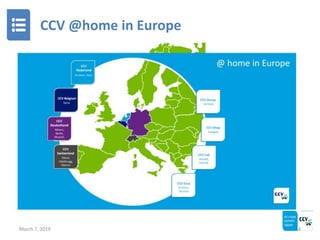
CCV @home in Europe
March 7, 2019 4
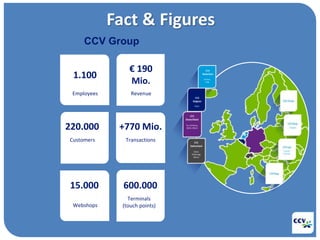
Fact & Figures
1.100
Employees
€ 190
Mio.
Revenue
220.000
Customers
+770 Mio.
Transactions
15.000
Webshops
600.000
Terminals
(touch points)
CCV Group
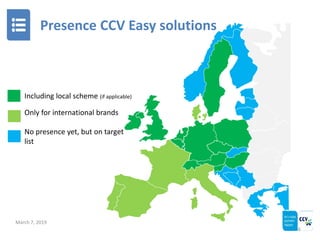
Presence CCV Easy solutions
6
Including local scheme (if applicable)
Only for international brands
No presence yet, but on target
list
March 7, 2019
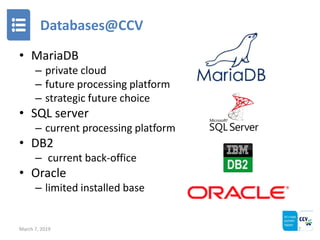
Databases@CCV
March 7, 2019 7
• MariaDB
– private cloud
– future processing platform
– strategic future choice
• SQL server
– current processing platform
• DB2
– current back-office
• Oracle
– limited installed base
MariaDB@CCV
March 7, 2019 8
• CCV360
– Development of a new, omni-channel portfolio
– Terminal, cash-register app, webshop, loyalty,
merchant boarding and MyCCV
• jSwitch
– Operational 2021
– Future processing system
jSwitch@CCV
• Requirements
• Database architectures
• PoC
• Issues, considerations and discussions
• Next steps
• Realization
March 7, 2019 9
jSwitch Requirements summary
March 7, 2019 10
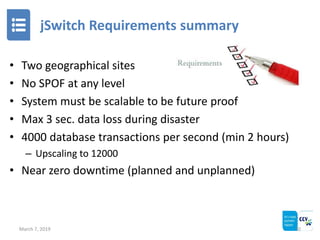
• Two geographical sites
• No SPOF at any level
• System must be scalable to be future proof
• Max 3 sec. data loss during disaster
• 4000 database transactions per second (min 2 hours)
– Upscaling to 12000
• Near zero downtime (planned and unplanned)
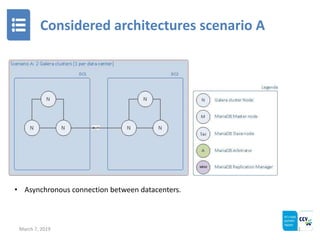
Considered architectures scenario A
March 7, 2019 11
• Asynchronous connection between datacenters.
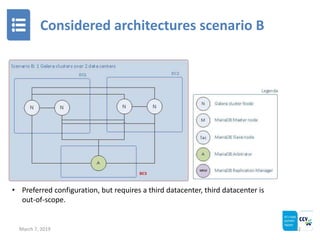
Considered architectures scenario B
March 7, 2019 12
• Preferred configuration, but requires a third datacenter, third datacenter is
out-of-scope.
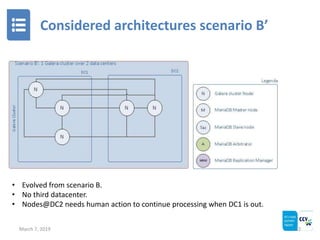
Considered architectures scenario B’
March 7, 2019 13
• Evolved from scenario B.
• No third datacenter.
• Nodes@DC2 needs human action to continue processing when DC1 is out.
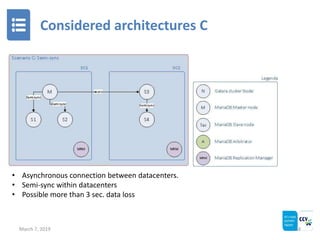
Considered architectures C
March 7, 2019 14
• Asynchronous connection between datacenters.
• Semi-sync within datacenters
• Possible more than 3 sec. data loss
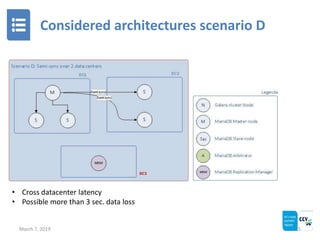
Considered architectures scenario D
March 7, 2019 15
• Cross datacenter latency
• Possible more than 3 sec. data loss
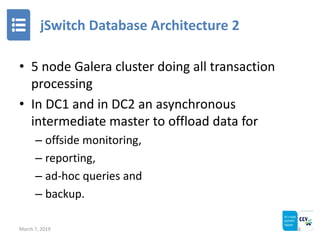
jSwitch Database Architecture 2
March 7, 2019 16
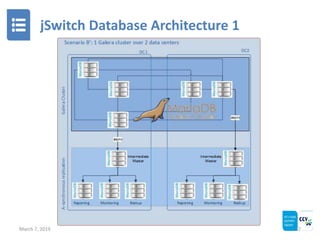
• 5 node Galera cluster doing all transaction
processing
• In DC1 and in DC2 an asynchronous
intermediate master to offload data for
– offside monitoring,
– reporting,
– ad-hoc queries and
– backup.
jSwitch Database Architecture 1
March 7, 2019 17
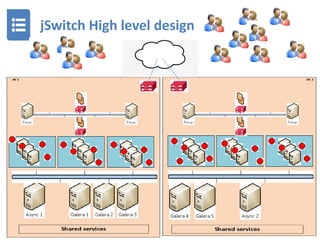
jSwitch High level design
March 7, 2019
18
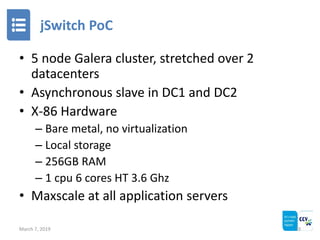
jSwitch PoC
March 7, 2019 19
• 5 node Galera cluster, stretched over 2
datacenters
• Asynchronous slave in DC1 and DC2
• X-86 Hardware
– Bare metal, no virtualization
– Local storage
– 256GB RAM
– 1 cpu 6 cores HT 3.6 Ghz
• Maxscale at all application servers
Issues, considerations and discussions
March 7, 2019 20
• Issues & discussions:
– Periodical performance drops
– 5 node Galera performance problems
– Open source
– Support or no support
– Enterprise vs non-enterprise
– Small installed base (especially in The Netherlands)
– External support/consultancy hard to find
• Pros:
– Solid database solution
– Full support from MariaDB
– Short lines to MariaDB support and developers
– Fast and adequate support from account manager
• PoC Outcome: Go
Next steps
March 7, 2019 21
• Building test environment
• Building acceptance and production environment
• Automation
• Fault tolerant
• Monitoring using Monyog
• Sharding
– Logical
– Spyder
Realization Test
March 7, 2019 22
• 3 Teams
• 9 environments
• Automation – Ansible
• Discussion technical concepts
• Discussion responsibilities
• First real world transaction
Realization Acceptance and Production
March 7, 2019 23
• Migration path
• Building Accp environment
• Connection to other CCV systems
– Fraud detection
– Front - Back office
– MQ Services
– Ewacs alerting
– Other shared services
Questions?
March 7, 2019 24
h.dijkstra@nl.ccv.eu
e.wernicke@nl.ccv.eu

CCV: migrating our payment processing system to MariaDB

  • 1.
    Key payment processingsystem running on MariaDB Galera Cluster
  • 2.
    Introduction March 7, 20192 Harry Dijkstra Senior Database Specialist • 18 years experience in Oracle databases • 2 years experience in DB2 and SQL Server databases • 3 years MariaDB experience Ernst Wernicke Senior Database and Storage Specialist • Over 15 years experience in DB2, SQL Server and Oracle databases • Over 15 years experience in payment processing systems • 3 years MariaDB experience
  • 3.
    CCV Processing • Arnhembased • Family owned • 60 years old • Payment processor – Retail – Parking – Petrol – Travel & Entertainment • Loyalty provider March 7, 2019 3
  • 4.
    CCV @home inEurope March 7, 2019 4
  • 5.
    Fact & Figures 1.100 Employees €190 Mio. Revenue 220.000 Customers +770 Mio. Transactions 15.000 Webshops 600.000 Terminals (touch points) CCV Group
  • 6.
    Presence CCV Easysolutions 6 Including local scheme (if applicable) Only for international brands No presence yet, but on target list March 7, 2019
  • 7.
    Databases@CCV March 7, 20197 • MariaDB – private cloud – future processing platform – strategic future choice • SQL server – current processing platform • DB2 – current back-office • Oracle – limited installed base
  • 8.
    MariaDB@CCV March 7, 20198 • CCV360 – Development of a new, omni-channel portfolio – Terminal, cash-register app, webshop, loyalty, merchant boarding and MyCCV • jSwitch – Operational 2021 – Future processing system
  • 9.
    jSwitch@CCV • Requirements • Databasearchitectures • PoC • Issues, considerations and discussions • Next steps • Realization March 7, 2019 9
  • 10.
    jSwitch Requirements summary March7, 2019 10 • Two geographical sites • No SPOF at any level • System must be scalable to be future proof • Max 3 sec. data loss during disaster • 4000 database transactions per second (min 2 hours) – Upscaling to 12000 • Near zero downtime (planned and unplanned)
  • 11.
    Considered architectures scenarioA March 7, 2019 11 • Asynchronous connection between datacenters.
  • 12.
    Considered architectures scenarioB March 7, 2019 12 • Preferred configuration, but requires a third datacenter, third datacenter is out-of-scope.
  • 13.
    Considered architectures scenarioB’ March 7, 2019 13 • Evolved from scenario B. • No third datacenter. • Nodes@DC2 needs human action to continue processing when DC1 is out.
  • 14.
    Considered architectures C March7, 2019 14 • Asynchronous connection between datacenters. • Semi-sync within datacenters • Possible more than 3 sec. data loss
  • 15.
    Considered architectures scenarioD March 7, 2019 15 • Cross datacenter latency • Possible more than 3 sec. data loss
  • 16.
    jSwitch Database Architecture2 March 7, 2019 16 • 5 node Galera cluster doing all transaction processing • In DC1 and in DC2 an asynchronous intermediate master to offload data for – offside monitoring, – reporting, – ad-hoc queries and – backup.
  • 17.
  • 18.
    jSwitch High leveldesign March 7, 2019 18
  • 19.
    jSwitch PoC March 7,2019 19 • 5 node Galera cluster, stretched over 2 datacenters • Asynchronous slave in DC1 and DC2 • X-86 Hardware – Bare metal, no virtualization – Local storage – 256GB RAM – 1 cpu 6 cores HT 3.6 Ghz • Maxscale at all application servers
  • 20.
    Issues, considerations anddiscussions March 7, 2019 20 • Issues & discussions: – Periodical performance drops – 5 node Galera performance problems – Open source – Support or no support – Enterprise vs non-enterprise – Small installed base (especially in The Netherlands) – External support/consultancy hard to find • Pros: – Solid database solution – Full support from MariaDB – Short lines to MariaDB support and developers – Fast and adequate support from account manager • PoC Outcome: Go
  • 21.
    Next steps March 7,2019 21 • Building test environment • Building acceptance and production environment • Automation • Fault tolerant • Monitoring using Monyog • Sharding – Logical – Spyder
  • 22.
    Realization Test March 7,2019 22 • 3 Teams • 9 environments • Automation – Ansible • Discussion technical concepts • Discussion responsibilities • First real world transaction
  • 23.
    Realization Acceptance andProduction March 7, 2019 23 • Migration path • Building Accp environment • Connection to other CCV systems – Fraud detection – Front - Back office – MQ Services – Ewacs alerting – Other shared services
  • 24.
    Questions? March 7, 201924 h.dijkstra@nl.ccv.eu e.wernicke@nl.ccv.eu