VoltDB and Erlang


         TechPlanet 2012
           H. Diedrich

   http://www.eonblast.com – twitter @hdiedrich
Your Host


Henning Diedrich

• Founder, CEO Eonblast
• Maintainer of Emysql, Erlvolt
This Presentation


 Review With Leasure
• Video & Slides will be online at SK planet
• Slides will be online at slideshare.net
Eonblast
VoltDB and Erlang


  Open Source Tech for Scale
1. What makes Them Special?
2. How do They Look?
3. Are They For Me?

    Made for a Concrete Need

    Made for Distribution

    Made for Multi-Core

    Truly Different Approaches

    Based on Parallelism

    Improving on Previous Solutions

    Corporate-Created

    Open Source

    Professional Support

    Known by Those in the Know
The free, scaling, SQL DB


Redis + SQL + Scale = VoltDB
Why VoltDB?

Business Perspective

• Reduce Costs
• Scale Seamlessly
• Maintain Strategic Flexibility
Why VoltDB?

Production Perspective

• Keep The Good of SQL
• Use the Speed of In-Memory
• Take Pain out of Scaling
In-Memory


The Redis of clusters
•   Today good for 100s of GB of data
•   Sheds 75% of DBM system activity
•   Made from scratch for distribution
•   Full disk persistence
SQL

The MySQL of NewSQLs
•   SQL Has Flaws
•   Essentially Math, Not Syntax
•   You'd be missing Queries
•   VoltDB is even 'more SQL than SQL'
CAP

                •    Distributed
                •    Consistent
                •    Highly-Available
                •    Partition-Tolerant

                    … have it all!
Brewer on CAP 2012: http://www.infoq.com/articles/cap-twelve-years-later-how-the-rules-have-changed
ACID

•   Atomicity
•   Consistency
•   Isolation
•   Durability

… for granted?
Double Bookkeeping

•   Not Every App needs It
•   Requires ACID Transactions
•   Neigh Impossible to emulate
•   Impossible With BASE
    (Eventual Consistency)
The Magic


• Compiled-In Queries
• Single-Thread Execution
• Snowflakes & Clones
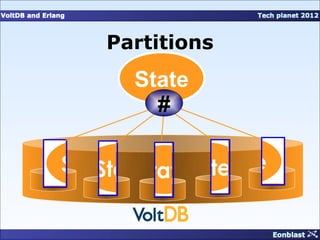
Partitions
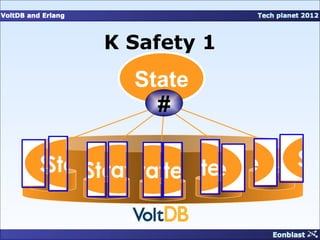
  State
    #
K Safety 1
  State
    #
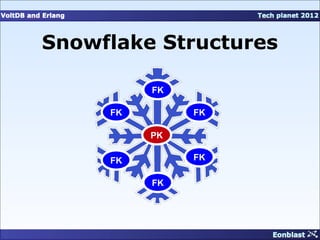
Snowflake Structures

          FK

     FK        FK

          PK
          PK

     FK        FK

          FK
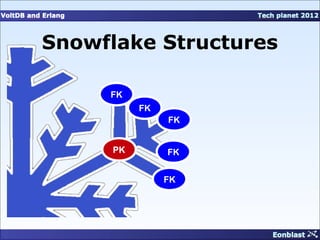
Snowflake Structures

     FK
           FK
                FK


      PK        FK


                FK
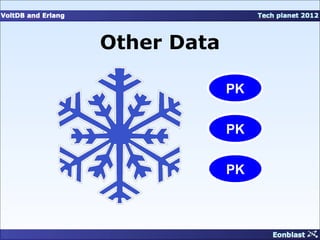
Other Data

             PK


             PK


             PK
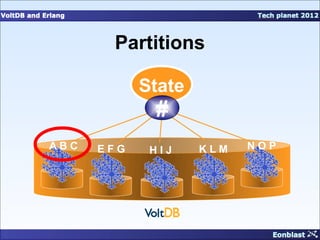
Partitions

            State
             #
ABC   EFG    HIJ    KLM   NOP
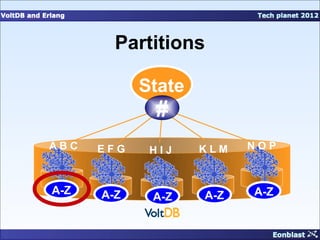
Partitions

            State
             #
ABC   EFG    HIJ    KLM   NOP


A-Z   A-Z           A-Z   A-Z
             A-Z
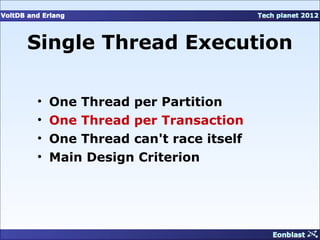
Single Thread Execution

•   One Thread per Partition
•   One Thread per Transaction
•   One Thread can't race itself
•   Main Design Criterion
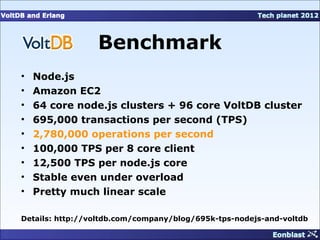
Benchmark
•   Node.js
•   Amazon EC2
•   64 core node.js clusters + 96 core VoltDB cluster
•   695,000 transactions per second (TPS)
•   2,780,000 operations per second
•   100,000 TPS per 8 core client
•   12,500 TPS per node.js core
•   Stable even under overload
•   Pretty much linear scale

Details: http://voltdb.com/company/blog/695k-tps-nodejs-and-voltdb
Benchmark
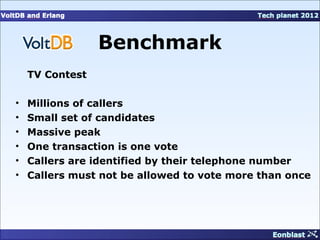
    TV Contest

•   Millions of callers
•   Small set of candidates
•   Massive peak
•   One transaction is one vote
•   Callers are identified by their telephone number
•   Callers must not be allowed to vote more than once
Benchmark
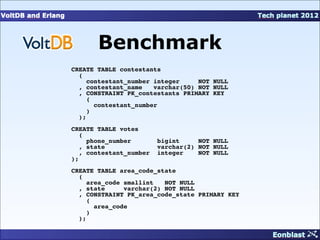
CREATE TABLE contestants
  (
     contestant_number integer     NOT NULL
  , contestant_name    varchar(50) NOT NULL
  , CONSTRAINT PK_contestants PRIMARY KEY
     (
       contestant_number
     )
  );
CREATE TABLE votes
  (
    phone_number        bigint     NOT NULL
  , state               varchar(2) NOT NULL
  , contestant_number   integer    NOT NULL
);
CREATE TABLE area_code_state
  (
     area_code smallint   NOT NULL
  , state      varchar(2) NOT NULL
  , CONSTRAINT PK_area_code_state PRIMARY KEY
     (
       area_code
     )
  );
Benchmark
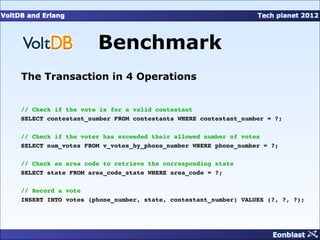
The Transaction in 4 Operations


// Check if the vote is for a valid contestant
SELECT contestant_number FROM contestants WHERE contestant_number = ?;

// Check if the voter has exceeded their allowed number of votes
SELECT num_votes FROM v_votes_by_phone_number WHERE phone_number = ?;

// Check an area code to retrieve the corresponding state
SELECT state FROM area_code_state WHERE area_code = ?;

// Record a vote
INSERT INTO votes (phone_number, state, contestant_number) VALUES (?, ?, ?);
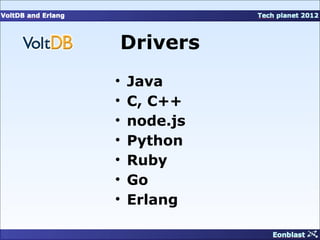
Drivers
•   Java
•   C, C++
•   node.js
•   Python
•   Ruby
•   Go
•   Erlang
•   VoltDB, Inc. 2009 – commercial developer, support
•   Open Source – 100% dictatorial by VoltDB, Inc
•   Made for OLTP – fast cheap writes, high throughput
•   CA of CAP – 100% consistent & highly available
•   Simple SQL – real queries
•   In-memory – 100x faster than MySQL
•   ACID transactions – double bookkeeping
•   Distributed – for painless growth
•   Linear scale – predictable, low cost
•   Replication, Snapshots – disk persistence, hot backup
•   More SQL than SQL – clean separation of data
Getting Started
• Download and Install from voltdb.com
• Open Getting Started inside the installation
• Run Hello World locally
• Read M.I.T. Paper A New Architecture
• Watch webinars at voltdb.com
• Free Help also from VoltDB staff
  http://community.voltdb.com/forum
• Use EC2 to benchmark your ideas
Upcoming Blog Post

• Looking at 14 databases
•   Riak, Cassandra, Membase, H-Base, Voldemort, MySQL, MySQL Cluster, Redis, Redis
    Cluster, Tokyo Cabinet, Memcached, CouchDB, Couchbase, VoltDB, MongoDB, Postgres


• In the light of what games need
• Unbiased comparison
• Twitter @hdiedrich
Erlang may be to Java
 what Java was to C++


  C++ – pointers = Java
Java – deadlocks = Erlang
Why Erlang?

Business Perspective

• Reduce Costs
• Reduce Downtimes
• Shorten Time To Market
Why Erlang?

Production Perspective

• High Productivity
• Low Hardware Requirements
• Fewer Errors
Who Is using It?


  “You probably use systems
based on Erlang/OTP every day
     without knowing it.“

         Mike Williams
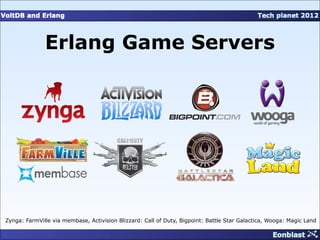
Erlang Game Servers


Zynga: FarmVille via membase, Activision Blizzard: Call of Duty, Bigpoint: Battle Star Galactica, Wooga: Magic Land
Erlang Poster Childs
Klarna AB


• Financial Services for E-Commerce
• 30 seconds downtime in 3 years

Distributed Databases
•       Membase


•       Riak


•       BigCouch
Sweet Spots
• Stateful Servers with High Throughput
• Cluster Distribution Layers
• Chats
Origins


PLEX
• Ericsson makes billions with telecom switches
• They used PLEX, an all proprietary software
• PLEX delivers, but has bad productivity
Origins
• The 80's: Ericsson Computer Science Lab
 Joe Armstrong, Robert Virding, Mike
 Williams

 „What aspects of computer languages
 make it easier to program telecom
 systems?“
Erlang was Built For

•   Reliability
•   Maintenance
•   Distribution
•   Productivity
Concurrency Built In


•   In the Language, not OS
•   Easier Testing
•   Massively Battle-Tested
•   Closer To Real Problems
The Magic

• Microprocesses
• Pattern Matching                          *


• Immutable Variables

* Not your familiar Regex string matching
Thinking Erlang
•   The Actor Model
•   Thinking Parallel
•   Thinking Functional
•   Thinking Processes
•   Pattern Matching
•   Let It Crash!
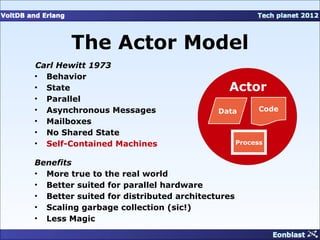
The Actor Model
Carl Hewitt 1973
• Behavior
• State                                    Actor
• Parallel
• Asynchronous Messages                   Data
                                         Data
                                                 Code
                                                  Code
• Mailboxes
• No Shared State
• Self-Contained Machines
                                            Object
                                            Process


Benefits
• More true to the real world
• Better suited for parallel hardware
• Better suited for distributed architectures
• Scaling garbage collection (sic!)
• Less Magic
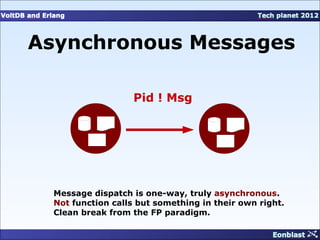
Asynchronous Messages

                    Pid ! Msg


  Message dispatch is one-way, truly asynchronous.
  Not function calls but something in their own right.
  Clean break from the FP paradigm.
Thinking Processes
What should be a Process?

Processes                        “It's easy!”
                                 Joe Armstrong
• Don’t share State
• Communicate Asynchronously
• Are Very Cheap to create And keep
• Monitor Each Other
• Provide Contention Handling
• Constitute the Error Handling Atom
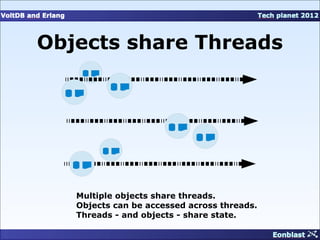
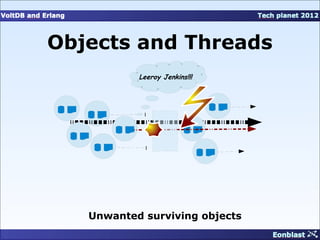
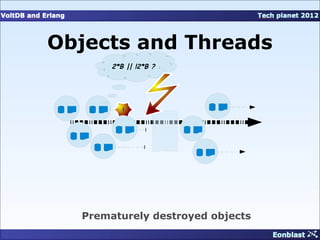
Objects share Threads


   Multiple objects share threads.
   Objects can be accessed across threads.
   Threads - and objects - share state.
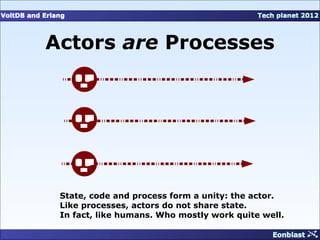
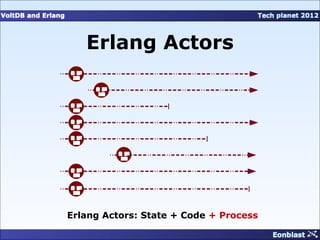
Actors are Processes


 State, code and process form a unity: the actor.
 Like processes, actors do not share state.
 In fact, like humans. Who mostly work quite well.
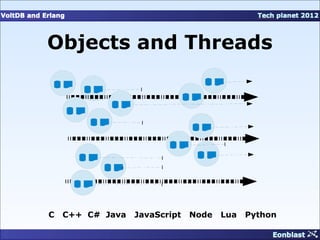
Objects and Threads


C   C++ C# Java   JavaScript   Node   Lua   Python
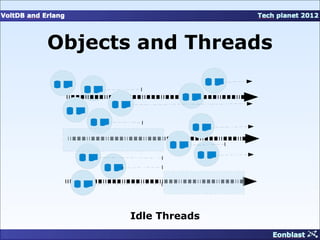
Objects and Threads


       Idle Threads
Objects and Threads
           Leeroy Jenkins!!!


   Unwanted surviving objects
Objects and Threads
       2*B || !2*B ?


  Prematurely destroyed objects
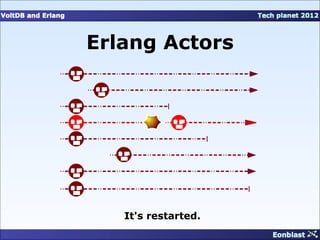
Erlang Actors


Erlang Actors: State + Code + Process
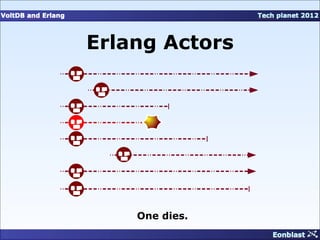
Erlang Actors


    One dies.
Erlang Actors


   It's restarted.
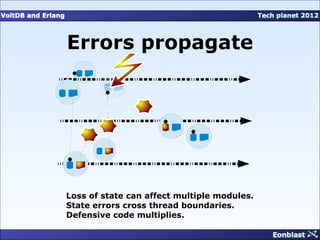
Errors propagate


Loss of state can affect multiple modules.
State errors cross thread boundaries.
Defensive code multiplies.
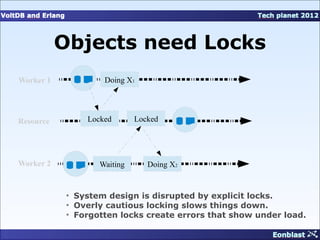
Objects need Locks
Worker 1               Doing X1


Resource           Locked       Locked


Worker 2              Waiting      Doing X2


            ●
                System design is disrupted by explicit locks.
            ●
                Overly cautious locking slows things down.
            ●
                Forgotten locks create errors that show under load.
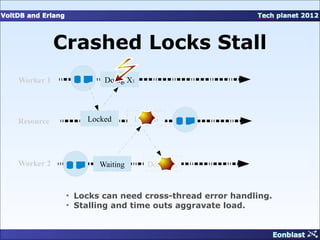
Crashed Locks Stall
Worker 1               Doing X1


Resource           Locked       Locked


Worker 2              Waiting      Doing X2


            ●
                Locks can need cross-thread error handling.
            ●
                Stalling and time outs aggravate load.
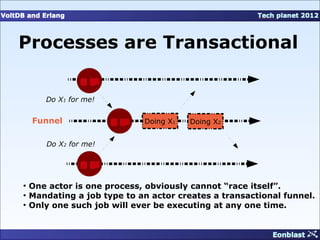
Processes are Transactional


       Do X1 for me!


    Funnel                   Doing X1   Doing X2


       Do X2 for me!


●
    One actor is one process, obviously cannot “race itself”.
●
    Mandating a job type to an actor creates a transactional funnel.
●
    Only one such job will ever be executing at any one time.
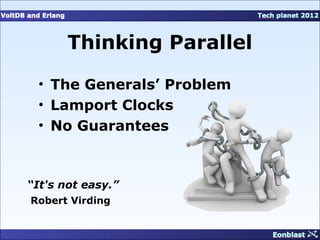
Thinking Parallel

 • The Generals’ Problem
 • Lamport Clocks
 • No Guarantees


“It's not easy.”
Robert Virding
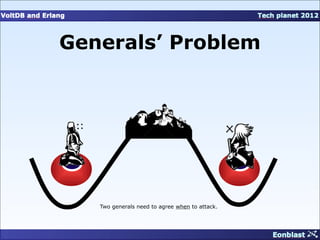
Generals’ Problem


                                                State


   Two generals need to agree when to attack.
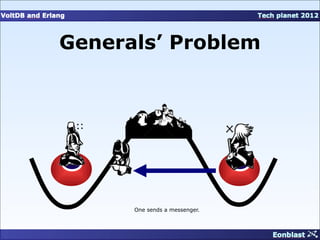
Generals’ Problem


                               State


      One sends a messenger.
Generals’ Problem


                     State


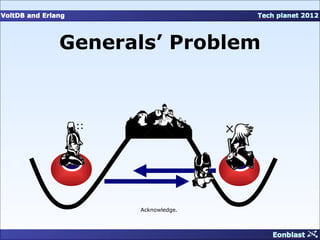
      Acknowledge.
Generals’ Problem


                          State


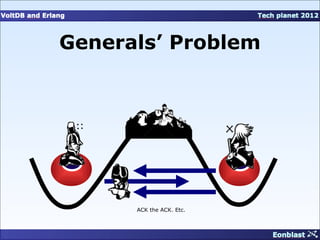
      ACK the ACK. Etc.
Generals’ Problem


                                   State


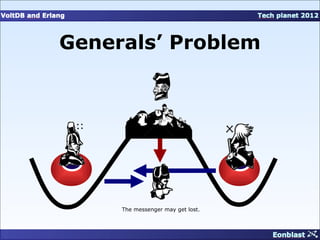
     The messenger may get lost.
Byzantine Generals


                                     State


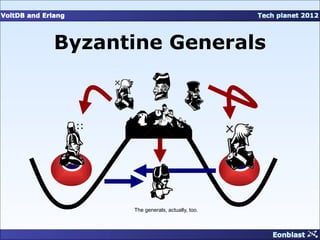
      The generals, actually, too.
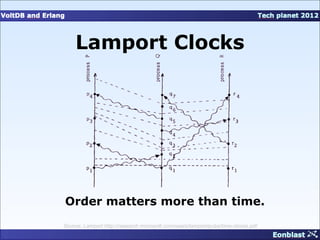
Lamport Clocks


Order matters more than time.
Source: Lamport http://research.microsoft.com/users/lamport/pubs/time-clocks.pdf
Thinking Functional
  Small Functions
+ Immutable Variables
→ Don’t assign variables: return results!


Complete State in Plain Sight
→ Awful for updates in place.
→ Awsome for debugging & maintenance.


Erlang is not side-effect free at all.
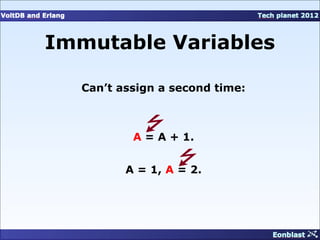
Immutable Variables

   Can’t assign a second time:


           A = A + 1.


          A = 1, A = 2.
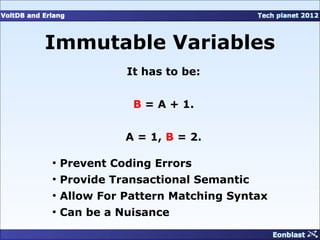
Immutable Variables
              It has to be:


               B = A + 1.


              A = 1, B = 2.

●
    Prevent Coding Errors
●
    Provide Transactional Semantic
●
    Allow For Pattern Matching Syntax
●
    Can be a Nuisance
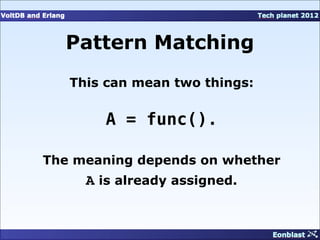
Pattern Matching
   This can mean two things:


       A = func().

The meaning depends on whether
     A is already assigned.
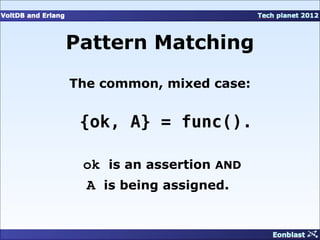
Pattern Matching
The common, mixed case:


 {ok, A} = func().

 ok is an assertion AND
 A is being assigned.
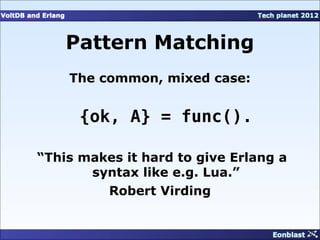
Pattern Matching
    The common, mixed case:


      {ok, A} = func().

“This makes it hard to give Erlang a
       syntax like e.g. Lua.”
         Robert Virding
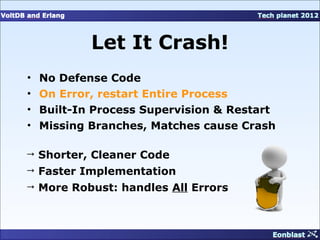
Let It Crash!
•   No Defense Code
•   On Error, restart Entire Process
•   Built-In Process Supervision & Restart
•   Missing Branches, Matches cause Crash

→ Shorter, Cleaner Code
→ Faster Implementation
→ More Robust: handles All Errors
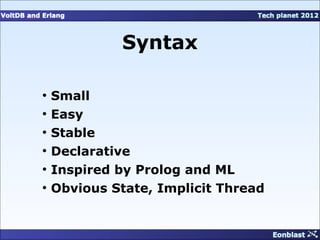
Syntax

●
    Small
●
    Easy
●
    Stable
●
    Declarative
●
    Inspired by Prolog and ML
●
    Obvious State, Implicit Thread
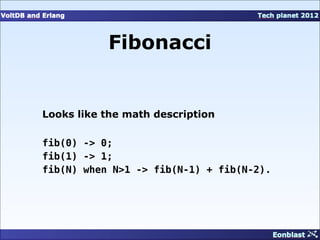
Fibonacci


Looks like the math description

fib(0) -> 0;
fib(1) -> 1;
fib(N) when N>1 -> fib(N-1) + fib(N-2).
Hello, World!

-module(hello).
-export([start/0]).

start() ->
   io:format("Hello, World!~n").
Hello, World!
            -module(hello).
            -export([start/0, loop/0]).


            start() ->
              Pid = spawn(hello, loop, []),
              Pid ! hello.


            loop() ->
               receive
                  hello ->
                      io:format("Hello, World!~n"),
                      loop()
               end.

From Edward Garson's Blog at http://egarson.blogspot.de/2008/03/real-erlang-hello-world.html
Start
-module(hello).
-export([start/0, loop/0]).


start() ->
  Pid = spawn(hello, loop, []),
  Pid ! hello.


loop() ->
   receive
      hello ->
          io:format("Hello, World!~n"),
          loop()
   end.

  From Edward Garson's Blog at http://egarson.blogspot.de/2008/03/real-erlang-hello-world.html
Output
-module(hello).
-export([start/0, loop/0]).


start() ->
  Pid = spawn(hello, loop, []),
  Pid ! hello.


loop() ->
   receive
      hello ->
          io:format("Hello, World!~n"),
          loop()
   end.

  From Edward Garson's Blog at http://egarson.blogspot.de/2008/03/real-erlang-hello-world.html
Process Spawning
-module(hello).
-export([start/0, loop/0]).


start() ->
  Pid = spawn(hello, loop, []),
  Pid ! hello.


loop() ->                                                                    New Process
   receive
      hello ->
          io:format("Hello, World!~n"),
          loop()
   end.

  From Edward Garson's Blog at http://egarson.blogspot.de/2008/03/real-erlang-hello-world.html
Blocking Receive
-module(hello).
-export([start/0, loop/0]).


start() ->
  Pid = spawn(hello, loop, []),
  Pid ! hello.


loop() ->
   receive
      hello ->
          io:format("Hello, World!~n"),
          loop()
   end.

  From Edward Garson's Blog at http://egarson.blogspot.de/2008/03/real-erlang-hello-world.html
Message Passing
-module(hello).
-export([start/0, loop/0]).


start() ->
  Pid = spawn(hello, loop, []),
  Pid ! hello.


loop() ->
   receive
      hello ->
          io:format("Hello, World!~n"),
          loop()
   end.

  From Edward Garson's Blog at http://egarson.blogspot.de/2008/03/real-erlang-hello-world.html
Pattern Matching
-module(hello).
-export([start/0, loop/0]).


start() ->
  Pid = spawn(hello, loop, []),
  Pid ! hello.


loop() ->
   receive
      hello ->
          io:format("Hello, World!~n"),
          loop()
   end.

  From Edward Garson's Blog at http://egarson.blogspot.de/2008/03/real-erlang-hello-world.html
Tail Recursion
-module(hello).
-export([start/0, loop/0]).


start() ->
  Pid = spawn(hello, loop, []),
  Pid ! hello.


loop() ->
   receive
      hello ->
          io:format("Hello, World!~n"),
          loop()
   end.

  From Edward Garson's Blog at http://egarson.blogspot.de/2008/03/real-erlang-hello-world.html
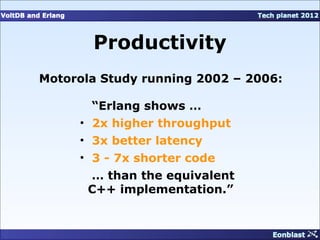
Productivity
Motorola Study running 2002 – 2006:

       “Erlang shows …
     • 2x higher throughput
     • 3x better latency
     • 3 - 7x shorter code
       … than the equivalent
       C++ implementation.”
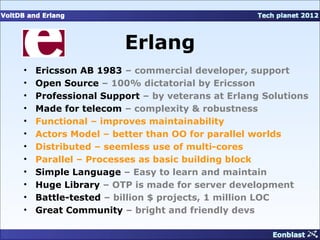
Erlang
•   Ericsson AB 1983 – commercial developer, support
•   Open Source – 100% dictatorial by Ericsson
•   Professional Support – by veterans at Erlang Solutions
•   Made for telecom – complexity & robustness
•   Functional – improves maintainability
•   Actors Model – better than OO for parallel worlds
•   Distributed – seemless use of multi-cores
•   Parallel – Processes as basic building block
•   Simple Language – Easy to learn and maintain
•   Huge Library – OTP is made for server development
•   Battle-tested – billion $ projects, 1 million LOC
•   Great Community – bright and friendly devs
Learning Erlang

• Scour Post-Mortems
• Download and Install from erlang.org
• Fred’s site Learn You Some Erlang!
• Joe’s book Programming Erlang
• IRC #erlounge
• Erlang Mailing List
• Local Erlounge Meetings
• Erlang Factories & User Conferences
Erlvolt
Erlvolt


• The Erlang VoltDB Driver
• Stable Synchronous Version
• Upcoming Asynchronous Version


    https://github.com/Eonblast/Erlvolt
Erlvolt

Insert
erlvolt:callProcedure(Connection, "Insert", ["안녕하세요", "세계", "Korean"]),


Select
Response = erlvolt:callProcedure(Connection, "Select", ["Korean"]),
Row = erlvolt:fetchRow(Table, 1),
io:format("~n~n~s, ~s!~n",
[ erlvolt:getString(Row, Table, "HELLO"),
  erlvolt:getString(Row, Table, "WORLD") ]);
Resources
Erlang                                                           VoltDB
Web                                                              Download
http://www.erlang.org/                                           http://voltdb.com/products-services/downloads
http://learnyousomeerlang.com/
http://www.erlang.org/static/getting_started_quickly.html        Webinars
                                                                 http://community.voltdb.com/weninars
List
                                                                 Forum
http://erlang.org/mailman/listinfo/erlang-questions
                                                                 http://community.voltdb.com/forum
http://groups.google.com/group/erlang-programming
                                                                 Voter Example
Books                                                            https://github.com/VoltDB/voltdb/tree/master/examples/voter
http://pragprog.com/book/jaerlang/programming-erlang
http://shop.oreilly.com/product/9780596518189.do                 Benchmark Blog Post
                                                                 http://voltdb.com/company/blog/695k-tps-nodejs-and-voltdb
References
http://erldocs.com/                                              Volt’s Magic Sauce
http://www.erlang.org/doc/                                       http://nms.csail.mit.edu/~stavros/pubs/hstore.pdf

Post Mortems
http://www.facebook.com/note.php?note_id=14218138919
http://www.slideshare.net/wooga/erlang-the-big-switch-in-social-games


Erlvolt
https://github.com/Eonblast/Erlvolt


Eonblast
https://www.eonblast.com
Upcoming

• Erlvolt 2 – asynchronous Erlang VoltDB driver
• 14 New Databases for Games – Blog Post


 TBA on Twitter @hdiedrich
Questions


• Email: hdiedrich*eonblast.com
• Twitter: @hdiedrich
• VoltDB: http://community.voltdb.com/forum
• Erlang: erlang-questions@erlang.org
• Eonblast: http://www.eonblast.com
• Game News: @eonblast

VoltDB and Erlang - Tech planet 2012

  • 1.
    VoltDB and Erlang TechPlanet 2012 H. Diedrich http://www.eonblast.com – twitter @hdiedrich
  • 2.
    Your Host Henning Diedrich •Founder, CEO Eonblast • Maintainer of Emysql, Erlvolt
  • 3.
    This Presentation ReviewWith Leasure • Video & Slides will be online at SK planet • Slides will be online at slideshare.net
  • 4.
  • 5.
    VoltDB and Erlang Open Source Tech for Scale 1. What makes Them Special? 2. How do They Look? 3. Are They For Me?
  • 6.
    Made for a Concrete Need  Made for Distribution  Made for Multi-Core  Truly Different Approaches  Based on Parallelism  Improving on Previous Solutions  Corporate-Created  Open Source  Professional Support  Known by Those in the Know
  • 7.
    The free, scaling,SQL DB Redis + SQL + Scale = VoltDB
  • 8.
    Why VoltDB? Business Perspective •Reduce Costs • Scale Seamlessly • Maintain Strategic Flexibility
  • 9.
    Why VoltDB? Production Perspective •Keep The Good of SQL • Use the Speed of In-Memory • Take Pain out of Scaling
  • 10.
    In-Memory The Redis ofclusters • Today good for 100s of GB of data • Sheds 75% of DBM system activity • Made from scratch for distribution • Full disk persistence
  • 11.
    SQL The MySQL ofNewSQLs • SQL Has Flaws • Essentially Math, Not Syntax • You'd be missing Queries • VoltDB is even 'more SQL than SQL'
  • 12.
    CAP • Distributed • Consistent • Highly-Available • Partition-Tolerant … have it all! Brewer on CAP 2012: http://www.infoq.com/articles/cap-twelve-years-later-how-the-rules-have-changed
  • 13.
    ACID • Atomicity • Consistency • Isolation • Durability … for granted?
  • 14.
    Double Bookkeeping • Not Every App needs It • Requires ACID Transactions • Neigh Impossible to emulate • Impossible With BASE (Eventual Consistency)
  • 15.
    The Magic • Compiled-InQueries • Single-Thread Execution • Snowflakes & Clones
  • 16.
  • 17.
    K Safety 1 State #
  • 18.
    Snowflake Structures FK FK FK PK PK FK FK FK
  • 19.
    Snowflake Structures FK FK FK PK FK FK
  • 20.
    Other Data PK PK PK
  • 21.
    Partitions State # ABC EFG HIJ KLM NOP
  • 22.
    Partitions State # ABC EFG HIJ KLM NOP A-Z A-Z A-Z A-Z A-Z
  • 23.
    Single Thread Execution • One Thread per Partition • One Thread per Transaction • One Thread can't race itself • Main Design Criterion
  • 24.
    Benchmark • Node.js • Amazon EC2 • 64 core node.js clusters + 96 core VoltDB cluster • 695,000 transactions per second (TPS) • 2,780,000 operations per second • 100,000 TPS per 8 core client • 12,500 TPS per node.js core • Stable even under overload • Pretty much linear scale Details: http://voltdb.com/company/blog/695k-tps-nodejs-and-voltdb
  • 25.
    Benchmark TV Contest • Millions of callers • Small set of candidates • Massive peak • One transaction is one vote • Callers are identified by their telephone number • Callers must not be allowed to vote more than once
  • 26.
    Benchmark CREATE TABLE contestants ( contestant_number integer NOT NULL , contestant_name varchar(50) NOT NULL , CONSTRAINT PK_contestants PRIMARY KEY ( contestant_number ) ); CREATE TABLE votes ( phone_number bigint NOT NULL , state varchar(2) NOT NULL , contestant_number integer NOT NULL ); CREATE TABLE area_code_state ( area_code smallint NOT NULL , state varchar(2) NOT NULL , CONSTRAINT PK_area_code_state PRIMARY KEY ( area_code ) );
  • 27.
    Benchmark The Transaction in4 Operations // Check if the vote is for a valid contestant SELECT contestant_number FROM contestants WHERE contestant_number = ?; // Check if the voter has exceeded their allowed number of votes SELECT num_votes FROM v_votes_by_phone_number WHERE phone_number = ?; // Check an area code to retrieve the corresponding state SELECT state FROM area_code_state WHERE area_code = ?; // Record a vote INSERT INTO votes (phone_number, state, contestant_number) VALUES (?, ?, ?);
  • 28.
    Drivers • Java • C, C++ • node.js • Python • Ruby • Go • Erlang
  • 29.
    VoltDB, Inc. 2009 – commercial developer, support • Open Source – 100% dictatorial by VoltDB, Inc • Made for OLTP – fast cheap writes, high throughput • CA of CAP – 100% consistent & highly available • Simple SQL – real queries • In-memory – 100x faster than MySQL • ACID transactions – double bookkeeping • Distributed – for painless growth • Linear scale – predictable, low cost • Replication, Snapshots – disk persistence, hot backup • More SQL than SQL – clean separation of data
  • 30.
    Getting Started • Downloadand Install from voltdb.com • Open Getting Started inside the installation • Run Hello World locally • Read M.I.T. Paper A New Architecture • Watch webinars at voltdb.com • Free Help also from VoltDB staff http://community.voltdb.com/forum • Use EC2 to benchmark your ideas
  • 31.
    Upcoming Blog Post •Looking at 14 databases • Riak, Cassandra, Membase, H-Base, Voldemort, MySQL, MySQL Cluster, Redis, Redis Cluster, Tokyo Cabinet, Memcached, CouchDB, Couchbase, VoltDB, MongoDB, Postgres • In the light of what games need • Unbiased comparison • Twitter @hdiedrich
  • 33.
    Erlang may beto Java what Java was to C++ C++ – pointers = Java Java – deadlocks = Erlang
  • 34.
    Why Erlang? Business Perspective •Reduce Costs • Reduce Downtimes • Shorten Time To Market
  • 35.
    Why Erlang? Production Perspective •High Productivity • Low Hardware Requirements • Fewer Errors
  • 36.
    Who Is usingIt? “You probably use systems based on Erlang/OTP every day without knowing it.“ Mike Williams
  • 37.
    Erlang Game Servers Zynga:FarmVille via membase, Activision Blizzard: Call of Duty, Bigpoint: Battle Star Galactica, Wooga: Magic Land
  • 38.
    Erlang Poster Childs KlarnaAB • Financial Services for E-Commerce • 30 seconds downtime in 3 years Distributed Databases • Membase • Riak • BigCouch
  • 39.
    Sweet Spots • StatefulServers with High Throughput • Cluster Distribution Layers • Chats
  • 40.
    Origins PLEX • Ericsson makesbillions with telecom switches • They used PLEX, an all proprietary software • PLEX delivers, but has bad productivity
  • 41.
    Origins • The 80's:Ericsson Computer Science Lab Joe Armstrong, Robert Virding, Mike Williams „What aspects of computer languages make it easier to program telecom systems?“
  • 42.
    Erlang was BuiltFor • Reliability • Maintenance • Distribution • Productivity
  • 43.
    Concurrency Built In • In the Language, not OS • Easier Testing • Massively Battle-Tested • Closer To Real Problems
  • 44.
    The Magic • Microprocesses •Pattern Matching * • Immutable Variables * Not your familiar Regex string matching
  • 45.
    Thinking Erlang • The Actor Model • Thinking Parallel • Thinking Functional • Thinking Processes • Pattern Matching • Let It Crash!
  • 46.
    The Actor Model CarlHewitt 1973 • Behavior • State Actor • Parallel • Asynchronous Messages Data Data Code Code • Mailboxes • No Shared State • Self-Contained Machines Object Process Benefits • More true to the real world • Better suited for parallel hardware • Better suited for distributed architectures • Scaling garbage collection (sic!) • Less Magic
  • 47.
    Asynchronous Messages Pid ! Msg Message dispatch is one-way, truly asynchronous. Not function calls but something in their own right. Clean break from the FP paradigm.
  • 48.
    Thinking Processes What shouldbe a Process? Processes “It's easy!” Joe Armstrong • Don’t share State • Communicate Asynchronously • Are Very Cheap to create And keep • Monitor Each Other • Provide Contention Handling • Constitute the Error Handling Atom
  • 49.
    Objects share Threads Multiple objects share threads. Objects can be accessed across threads. Threads - and objects - share state.
  • 50.
    Actors are Processes State, code and process form a unity: the actor. Like processes, actors do not share state. In fact, like humans. Who mostly work quite well.
  • 51.
    Objects and Threads C C++ C# Java JavaScript Node Lua Python
  • 52.
  • 53.
    Objects and Threads Leeroy Jenkins!!! Unwanted surviving objects
  • 54.
    Objects and Threads 2*B || !2*B ? Prematurely destroyed objects
  • 55.
    Erlang Actors Erlang Actors:State + Code + Process
  • 56.
    Erlang Actors One dies.
  • 57.
    Erlang Actors It's restarted.
  • 58.
    Errors propagate Loss ofstate can affect multiple modules. State errors cross thread boundaries. Defensive code multiplies.
  • 59.
    Objects need Locks Worker1 Doing X1 Resource Locked Locked Worker 2 Waiting Doing X2 ● System design is disrupted by explicit locks. ● Overly cautious locking slows things down. ● Forgotten locks create errors that show under load.
  • 60.
    Crashed Locks Stall Worker1 Doing X1 Resource Locked Locked Worker 2 Waiting Doing X2 ● Locks can need cross-thread error handling. ● Stalling and time outs aggravate load.
  • 61.
    Processes are Transactional Do X1 for me! Funnel Doing X1 Doing X2 Do X2 for me! ● One actor is one process, obviously cannot “race itself”. ● Mandating a job type to an actor creates a transactional funnel. ● Only one such job will ever be executing at any one time.
  • 62.
    Thinking Parallel •The Generals’ Problem • Lamport Clocks • No Guarantees “It's not easy.” Robert Virding
  • 63.
    Generals’ Problem State Two generals need to agree when to attack.
  • 64.
    Generals’ Problem State One sends a messenger.
  • 65.
    Generals’ Problem State Acknowledge.
  • 66.
    Generals’ Problem State ACK the ACK. Etc.
  • 67.
    Generals’ Problem State The messenger may get lost.
  • 68.
    Byzantine Generals State The generals, actually, too.
  • 69.
    Lamport Clocks Order mattersmore than time. Source: Lamport http://research.microsoft.com/users/lamport/pubs/time-clocks.pdf
  • 70.
    Thinking Functional Small Functions + Immutable Variables → Don’t assign variables: return results! Complete State in Plain Sight → Awful for updates in place. → Awsome for debugging & maintenance. Erlang is not side-effect free at all.
  • 71.
    Immutable Variables Can’t assign a second time: A = A + 1. A = 1, A = 2.
  • 72.
    Immutable Variables It has to be: B = A + 1. A = 1, B = 2. ● Prevent Coding Errors ● Provide Transactional Semantic ● Allow For Pattern Matching Syntax ● Can be a Nuisance
  • 73.
    Pattern Matching This can mean two things: A = func(). The meaning depends on whether A is already assigned.
  • 74.
    Pattern Matching The common,mixed case: {ok, A} = func(). ok is an assertion AND A is being assigned.
  • 75.
    Pattern Matching The common, mixed case: {ok, A} = func(). “This makes it hard to give Erlang a syntax like e.g. Lua.” Robert Virding
  • 76.
    Let It Crash! • No Defense Code • On Error, restart Entire Process • Built-In Process Supervision & Restart • Missing Branches, Matches cause Crash → Shorter, Cleaner Code → Faster Implementation → More Robust: handles All Errors
  • 77.
    Syntax ● Small ● Easy ● Stable ● Declarative ● Inspired by Prolog and ML ● Obvious State, Implicit Thread
  • 78.
    Fibonacci Looks like themath description fib(0) -> 0; fib(1) -> 1; fib(N) when N>1 -> fib(N-1) + fib(N-2).
  • 79.
  • 80.
    Hello, World! -module(hello). -export([start/0, loop/0]). start() -> Pid = spawn(hello, loop, []), Pid ! hello. loop() -> receive hello -> io:format("Hello, World!~n"), loop() end. From Edward Garson's Blog at http://egarson.blogspot.de/2008/03/real-erlang-hello-world.html
  • 81.
    Start -module(hello). -export([start/0, loop/0]). start() -> Pid = spawn(hello, loop, []), Pid ! hello. loop() -> receive hello -> io:format("Hello, World!~n"), loop() end. From Edward Garson's Blog at http://egarson.blogspot.de/2008/03/real-erlang-hello-world.html
  • 82.
    Output -module(hello). -export([start/0, loop/0]). start() -> Pid = spawn(hello, loop, []), Pid ! hello. loop() -> receive hello -> io:format("Hello, World!~n"), loop() end. From Edward Garson's Blog at http://egarson.blogspot.de/2008/03/real-erlang-hello-world.html
  • 83.
    Process Spawning -module(hello). -export([start/0, loop/0]). start()-> Pid = spawn(hello, loop, []), Pid ! hello. loop() -> New Process receive hello -> io:format("Hello, World!~n"), loop() end. From Edward Garson's Blog at http://egarson.blogspot.de/2008/03/real-erlang-hello-world.html
  • 84.
    Blocking Receive -module(hello). -export([start/0, loop/0]). start()-> Pid = spawn(hello, loop, []), Pid ! hello. loop() -> receive hello -> io:format("Hello, World!~n"), loop() end. From Edward Garson's Blog at http://egarson.blogspot.de/2008/03/real-erlang-hello-world.html
  • 85.
    Message Passing -module(hello). -export([start/0, loop/0]). start()-> Pid = spawn(hello, loop, []), Pid ! hello. loop() -> receive hello -> io:format("Hello, World!~n"), loop() end. From Edward Garson's Blog at http://egarson.blogspot.de/2008/03/real-erlang-hello-world.html
  • 86.
    Pattern Matching -module(hello). -export([start/0, loop/0]). start()-> Pid = spawn(hello, loop, []), Pid ! hello. loop() -> receive hello -> io:format("Hello, World!~n"), loop() end. From Edward Garson's Blog at http://egarson.blogspot.de/2008/03/real-erlang-hello-world.html
  • 87.
    Tail Recursion -module(hello). -export([start/0, loop/0]). start()-> Pid = spawn(hello, loop, []), Pid ! hello. loop() -> receive hello -> io:format("Hello, World!~n"), loop() end. From Edward Garson's Blog at http://egarson.blogspot.de/2008/03/real-erlang-hello-world.html
  • 88.
    Productivity Motorola Study running2002 – 2006: “Erlang shows … • 2x higher throughput • 3x better latency • 3 - 7x shorter code … than the equivalent C++ implementation.”
  • 89.
    Erlang • Ericsson AB 1983 – commercial developer, support • Open Source – 100% dictatorial by Ericsson • Professional Support – by veterans at Erlang Solutions • Made for telecom – complexity & robustness • Functional – improves maintainability • Actors Model – better than OO for parallel worlds • Distributed – seemless use of multi-cores • Parallel – Processes as basic building block • Simple Language – Easy to learn and maintain • Huge Library – OTP is made for server development • Battle-tested – billion $ projects, 1 million LOC • Great Community – bright and friendly devs
  • 90.
    Learning Erlang • ScourPost-Mortems • Download and Install from erlang.org • Fred’s site Learn You Some Erlang! • Joe’s book Programming Erlang • IRC #erlounge • Erlang Mailing List • Local Erlounge Meetings • Erlang Factories & User Conferences
  • 91.
  • 92.
    Erlvolt • The ErlangVoltDB Driver • Stable Synchronous Version • Upcoming Asynchronous Version https://github.com/Eonblast/Erlvolt
  • 93.
    Erlvolt Insert erlvolt:callProcedure(Connection, "Insert", ["안녕하세요","세계", "Korean"]), Select Response = erlvolt:callProcedure(Connection, "Select", ["Korean"]), Row = erlvolt:fetchRow(Table, 1), io:format("~n~n~s, ~s!~n", [ erlvolt:getString(Row, Table, "HELLO"), erlvolt:getString(Row, Table, "WORLD") ]);
  • 94.
    Resources Erlang VoltDB Web Download http://www.erlang.org/ http://voltdb.com/products-services/downloads http://learnyousomeerlang.com/ http://www.erlang.org/static/getting_started_quickly.html Webinars http://community.voltdb.com/weninars List Forum http://erlang.org/mailman/listinfo/erlang-questions http://community.voltdb.com/forum http://groups.google.com/group/erlang-programming Voter Example Books https://github.com/VoltDB/voltdb/tree/master/examples/voter http://pragprog.com/book/jaerlang/programming-erlang http://shop.oreilly.com/product/9780596518189.do Benchmark Blog Post http://voltdb.com/company/blog/695k-tps-nodejs-and-voltdb References http://erldocs.com/ Volt’s Magic Sauce http://www.erlang.org/doc/ http://nms.csail.mit.edu/~stavros/pubs/hstore.pdf Post Mortems http://www.facebook.com/note.php?note_id=14218138919 http://www.slideshare.net/wooga/erlang-the-big-switch-in-social-games Erlvolt https://github.com/Eonblast/Erlvolt Eonblast https://www.eonblast.com
  • 95.
    Upcoming • Erlvolt 2– asynchronous Erlang VoltDB driver • 14 New Databases for Games – Blog Post TBA on Twitter @hdiedrich
  • 96.
    Questions • Email: hdiedrich*eonblast.com •Twitter: @hdiedrich • VoltDB: http://community.voltdb.com/forum • Erlang: erlang-questions@erlang.org • Eonblast: http://www.eonblast.com • Game News: @eonblast