









Introducing the R2DBC
connector
Reactive Programming with MariaDB
Who is this guy?
Rob Hedgpeth
Developer Evangelist
robh@mariadb.com
@probablyrealrob
rhedgpeth
Agenda
● Reactive Programming
○ What is it?
○ Why is it important?
● R2DBC
○ What is it?
○ How can you use it?
● Demo
Non-blocking
Database Euphoria
Reactive Programming
What is it?
@mariadb
reactive programming
/rēˈaktiv/ /ˈprōˌgramiNG/
A declarative programming paradigm concerned with data streams and the
propagation of change.
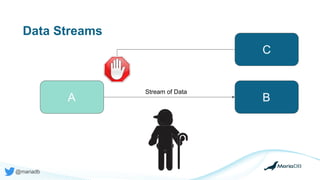
Data Streams
A B
Stream of Data
C
@mariadb
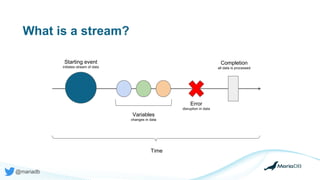
What is a stream?
@mariadb
Variables
changes in data
Starting event
initiates stream of data
Error
disruption in data
Completion
all data is processed
Time
Reactive Streams
@mariadb
● An initiative started in 2013 by several companies (e.g. Netflix, Pivotal,
Lightbend and many others)
● A specification
○ API types
○ Technology Compatibility Kit (TCK)
● The goal was to provide a standard for asynchronous stream processing with
non-blocking back pressure.
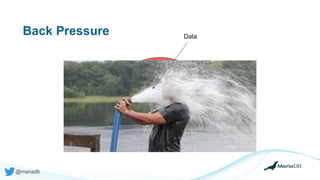
Back Pressure
@mariadb
Data
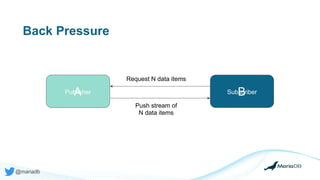
Back Pressure
@mariadb
A B
Push stream of
N data items
Request N data items
Publisher Subscriber
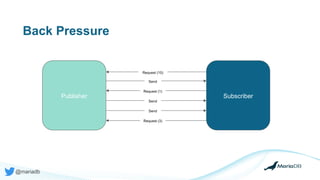
Back Pressure
@mariadb
Publisher Subscriber
Request (10)
Send
Request (1)
Send
Send
Request (3)
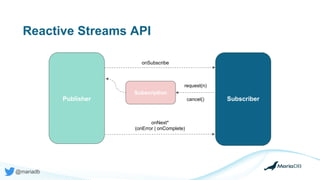
Reactive Streams API
@mariadb
Publisher Subscriber
Subscription
onSubscribe
request(n)
cancel()
onNext*
(onError | onComplete)
Reactive Streams API
@mariadb
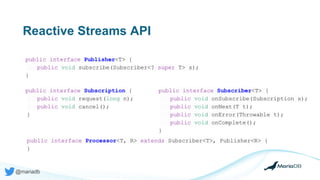
public interface Publisher<T> {
public void subscribe(Subscriber<? super T> s);
}
public interface Subscriber<T> {
public void onSubscribe(Subscription s);
public void onNext(T t);
public void onError(Throwable t);
public void onComplete();
}
public interface Subscription {
public void request(long n);
public void cancel();
}
public interface Processor<T, R> extends Subscriber<T>, Publisher<R> {
}
Why is it important?
Reactive Programming
@mariadb
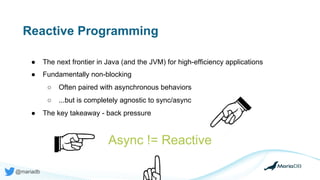
● The next frontier in Java (and the JVM) for high-efficiency applications
● Fundamentally non-blocking
○ Often paired with asynchronous behaviors
○ ...but is completely agnostic to sync/async
● The key takeaway - back pressure
Async != Reactive
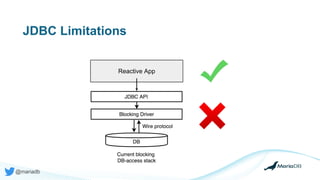
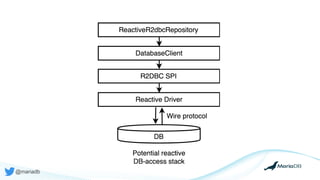
JDBC Limitations
@mariadb
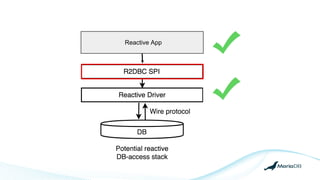
Reactive App
R2DBC
What is it?
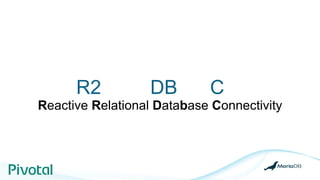
Reactive Relational Database Connectivity
R2 DB C
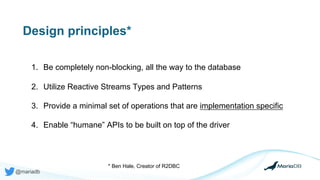
Design principles*
@mariadb
1. Be completely non-blocking, all the way to the database
2. Utilize Reactive Streams Types and Patterns
3. Provide a minimal set of operations that are implementation specific
4. Enable “humane” APIs to be built on top of the driver
* Ben Hale, Creator of R2DBC
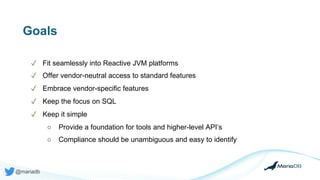
Goals
@mariadb
✓ Fit seamlessly into Reactive JVM platforms
✓ Offer vendor-neutral access to standard features
✓ Embrace vendor-specific features
✓ Keep the focus on SQL
✓ Keep it simple
○ Provide a foundation for tools and higher-level API’s
○ Compliance should be unambiguous and easy to identify
Reactive App
Why a service-provider interface (SPI)?
@mariadb
● One of JDBC’s biggest failings was that the same API had to serve as both
humane API for users as well as an inhumane API for alternative clients like JPA,
Jdbi, etc.
○ API that users didn’t like using
○ Driver authors didn’t like implementing
● It also lead to drivers duplicating effort
○ ? binding
○ URL parsing
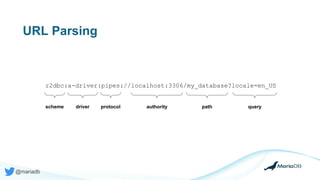
URL Parsing
@mariadb
r2dbc:a-driver:pipes://localhost:3306/my_database?locale=en_US
scheme driver protocol authority path query
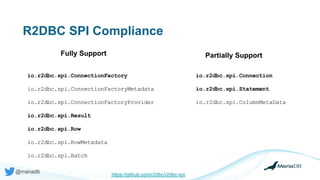
R2DBC SPI Compliance
@mariadb
io.r2dbc.spi.ConnectionFactory
io.r2dbc.spi.ConnectionFactoryMetadata
io.r2dbc.spi.ConnectionFactoryProvider
io.r2dbc.spi.Result
io.r2dbc.spi.Row
io.r2dbc.spi.RowMetadata
io.r2dbc.spi.Batch
Fully Support Partially Support
io.r2dbc.spi.Connection
io.r2dbc.spi.Statement
io.r2dbc.spi.ColumnMetaData
https://github.com/r2dbc/r2dbc-spi
io.r2dbc.spi.ConnectionFactory
io.r2dbc.spi.ConnectionFactoryMetadata
io.r2dbc.spi.ConnectionFactoryProvider
io.r2dbc.spi.Result
io.r2dbc.spi.Row
io.r2dbc.spi.RowMetadata
io.r2dbc.spi.Batch
io.r2dbc.spi.Connection
io.r2dbc.spi.Statement
io.r2dbc.spi.ColumnMetaData
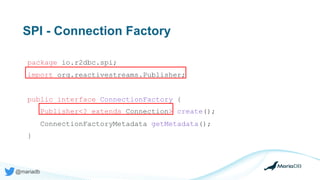
SPI - Connection Factory
@mariadb
package io.r2dbc.spi;
import org.reactivestreams.Publisher;
public interface ConnectionFactory {
Publisher<? extends Connection> create();
ConnectionFactoryMetadata getMetadata();
}
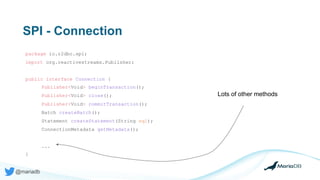
SPI - Connection
@mariadb
package io.r2dbc.spi;
import org.reactivestreams.Publisher;
public interface Connection {
Publisher<Void> beginTransaction();
Publisher<Void> close();
Publisher<Void> commitTransaction();
Batch createBatch();
Statement createStatement(String sql);
ConnectionMetadata getMetadata();
...
}
Lots of other methods
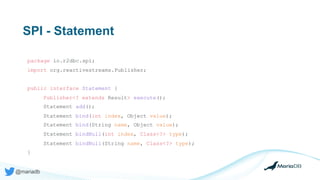
SPI - Statement
@mariadb
package io.r2dbc.spi;
import org.reactivestreams.Publisher;
public interface Statement {
Publisher<? extends Result> execute();
Statement add();
Statement bind(int index, Object value);
Statement bind(String name, Object value);
Statement bindNull(int index, Class<?> type);
Statement bindNull(String name, Class<?> type);
}
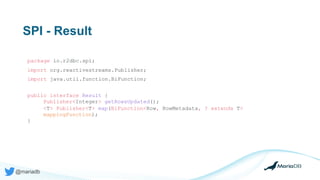
SPI - Result
@mariadb
package io.r2dbc.spi;
import org.reactivestreams.Publisher;
import java.util.function.BiFunction;
public interface Result {
Publisher<Integer> getRowsUpdated();
<T> Publisher<T> map(BiFunction<Row, RowMetadata, ? extends T>
mappingFunction);
}
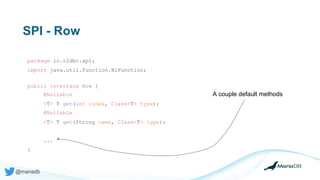
SPI - Row
@mariadb
package io.r2dbc.spi;
import java.util.function.BiFunction;
public interface Row {
@Nullable
<T> T get(int index, Class<T> type);
@Nullable
<T> T get(String name, Class<T> type);
...
}
A couple default methods
How can you use it?
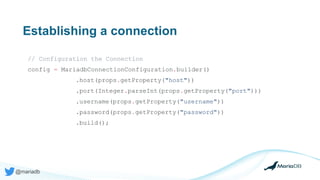
Establishing a connection
@mariadb
// Configuration the Connection
config = MariadbConnectionConfiguration.builder()
.host(props.getProperty("host"))
.port(Integer.parseInt(props.getProperty("port")))
.username(props.getProperty("username"))
.password(props.getProperty("password"))
.build();
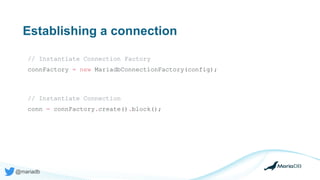
Establishing a connection
@mariadb
// Instantiate Connection Factory
connFactory = new MariadbConnectionFactory(config);
// Instantiate Connection
conn = connFactory.create().block();
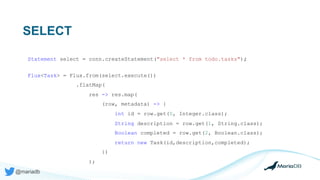
SELECT
@mariadb
Statement select = conn.createStatement("select * from todo.tasks");
Flux<Task> = Flux.from(select.execute())
.flatMap(
res -> res.map(
(row, metadata) -> {
int id = row.get(0, Integer.class);
String description = row.get(1, String.class);
Boolean completed = row.get(2, Boolean.class);
return new Task(id,description,completed);
})
);
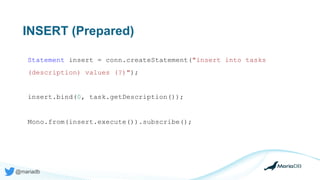
INSERT (Prepared)
@mariadb
Statement insert = conn.createStatement("insert into tasks
(description) values (?)");
insert.bind(0, task.getDescription());
Mono.from(insert.execute()).subscribe();
But...
@mariadb
Demo
A hands on look at the new MariaDB R2DBC Connector
@mariadb
Roadmap
@mariadb
● Performance
● Fast batch using MariaDB bulk (processing)
● GeoJSON data type
● Pluggable types for MariaDB 10.5 (JSON, INET4, INET6, BOOLEAN, ...)
https://mariadb.com/products/skysql/get-started/
$500 credit to get started
@mariadb
developers@mariadb.com @mariadb mariadb-corporation
Thank you!
https://github.com/mariadb-corporation/mariadb-connector-r2dbc
https://github.com/mariadb-corporation/developer-examples
Open Source Developer Examples
Introducing the R2DBC async Java connector

Introducing the R2DBC async Java connector