1
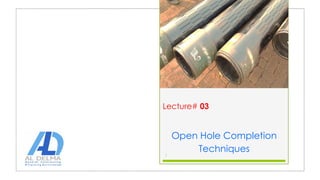
Lecture# 03
Open Hole Completion
Techniques
2
Open Hole
Completion Techniques
1. Barefoot Completions
2. Pre-drilled and Pre-slotted Liners
3. Zonal Isolation Techniques
4. Formation Damage Tendency and Mitigation
3
Barefoot Completion
Advantages
o Low cost
o Easier interventions (sidetracking, deepening,…)
o Easier water and/or gas shut off
4
Disadvantages
o Borehole Collapse
o Inability to deploy upfront zonal isolation equipment
(e.g. swellable elastomer packer)
5
Open Hole
Completion Techniques
1. Barefoot Completions
2. Pre-drilled and Pre-slotted Liners
3. Zonal Isolation Techniques
4. Formation Damage Tendency and Mitigation
6
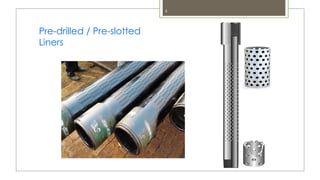
Pre-drilled / Pre-slotted
Liners
7
Purposes
o Stop gross hole collapse
o Allow to deploy zonal isolation packers
o Allow to deploy intervention tool strings such as
production logs (PLTs)
8
Open Hole
Completion Techniques
1. Barefoot Completions
2. Pre-drilled and Pre-slotted Liners
3. Zonal Isolation Techniques
4. Formation Damage Tendency and Mitigation
9
Zonal Isolation
Techniques
I. External Casing Packers (ECPs)
II. Swellable Elastomer Packers
10
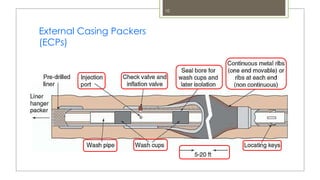
External Casing Packers
(ECPs)
11
ECPs
Considerations
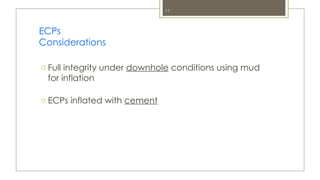
o Full integrity under downhole conditions using mud
for inflation
o ECPs inflated with cement
12
Zonal Isolation
Techniques
I. External Casing Packers (ECPs)
II. Swellable Elastomer Packers
13
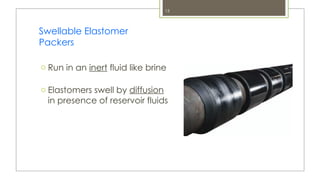
Swellable Elastomer
Packers
o Run in an inert fluid like brine
o Elastomers swell by diffusion
in presence of reservoir fluids
14
Swellable Elastomer
Packers
o Full expansion up to 40 days
o Used in series for additional assurance of a seal
o Trading-off between running clearance and sealing
pressure
o Sealing pressure up to 4,000 psi
15
Advantages
(over ECPs)
o Greater simplicity and lower costs
o Not need a washpipe
o More effective in high temperature
o Tight clearances when running in hole (about 0.15
inch radial clearance)
16
Open Hole
Completion Techniques
1. Barefoot Completions
2. Pre-drilled and Pre-slotted Liners
3. Zonal Isolation Techniques
4. Formation Damage Tendency and Mitigation
17
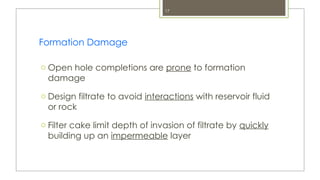
Formation Damage
o Open hole completions are prone to formation
damage
o Design filtrate to avoid interactions with reservoir fluid
or rock
o Filter cake limit depth of invasion of filtrate by quickly
building up an impermeable layer
18
In General
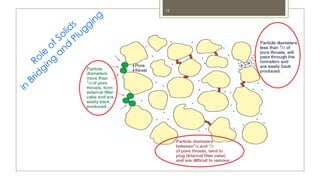
Any Fluid that is likely to Contact Reservoir Rock should
have Solids that either Bridge or Invade without
Plugging
19
Role
of Solids
in
Bridging
and
Plugging
20
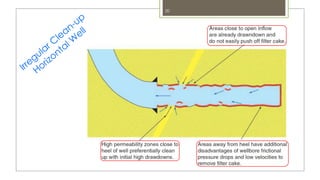
Irregular C
lean-up
Horizontal W
ell
21
Thank You
Any Question
?

Open Hole Completion and zonal isolation