CNS Blood Flow, Blood-Brain
         Barriers and CSF
Objectives
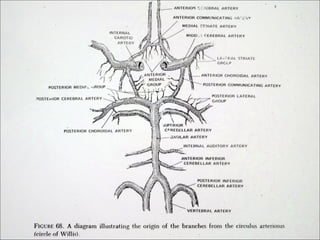
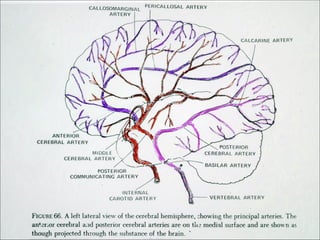
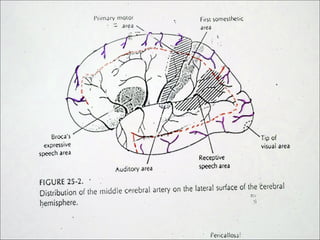
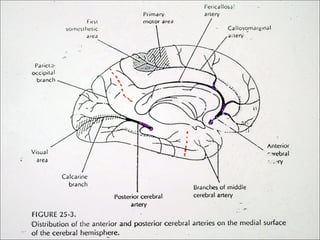
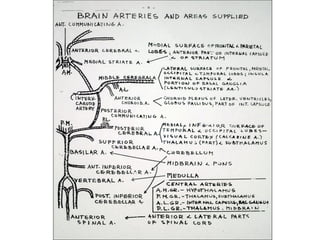
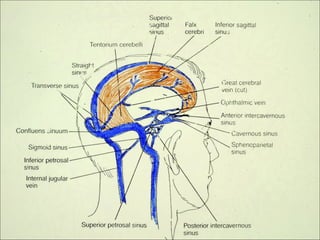
1.   Describe main arteries and veins supplying the brain
2.   Correlate regional function with arterial blood supply
3.   Explain principles of cerebral blood flow regulation
4.   Distinguish main components of BBB and their function
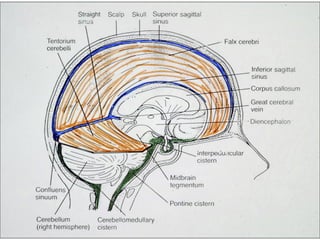
5.   Describe formation, flow and absorption of CSF
6.   Explain functions of CSF
Physiology of cerebral circulation
Normal rate of CBF : 50ml/100g/min ---750ml/brain/min
Normal oxygen consumption: 3.5 ml O2/100g/min
Regulation of cerebral blood flow
1.    Regulation by CO2 and pH/H+ ion concentration
      PaCO2 increases CBF via H+ from H2CO3…vasodilatation
      Importance: H+ depresses neuronal activity…↑CBF removes H+
2.    Regulation by hypoxia (oxygen deficiency)
      PaO2 decrease results in brain vasodilatation, which…↑CBF
3.    Regulation by activity of nervous tissue
      Neural activity increases regional CBF within seconds (reading
      loudly, clasping hands, looking in light, listening noisy music…)
Physiology of cerebral circulation
                    (2)
4.    Autoregulation of CBF when BP changes
      CBF does not change if BP increases from 60 to 140 mmHg
      In hypertension: autoregulation is extended to 200 mmHg
      Below 60 or above 200 mmHg: danger of brain hypoxia/bleeding

      REMEMBER: Autoregulation keeps CBF constant

5.    Role of autonomic nervous system
      Only sympathetic nerves are present on large brain vessels but
      they constrict vessels only when BP is very high (>200 mmHg)
      No parasympathetic innervation of brain vessels
Blood-brain barrier
Specific permeability barriers exist between blood and brain
    (blood-brain barrier) and blood and CSF (blood-CSF
    barrier). Brain and CSF are selectively excluded by
    above barriers and are thus normally protected against
    fluctuations of blood constituents or drugs.
Three different mechanisms underlie Blood-Brain Barrier:
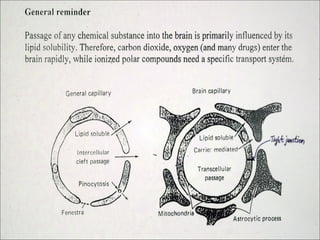
1.   Tight junctions between capillary endothelial cells in the brain
     which generally decrease passage of substances (in contrast to
     fenestrated capillaries in other organs). In case of Blood-CSF
     Barrier, tight junctions are located between epithelial cells of
     choroid plexus, while its capillaries resemble those of systemic
     circulation.
BBB - 2
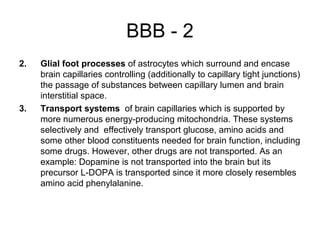
2.   Glial foot processes of astrocytes which surround and encase
     brain capillaries controlling (additionally to capillary tight junctions)
     the passage of substances between capillary lumen and brain
     interstitial space.
3.   Transport systems of brain capillaries which is supported by
     more numerous energy-producing mitochondria. These systems
     selectively and effectively transport glucose, amino acids and
     some other blood constituents needed for brain function, including
     some drugs. However, other drugs are not transported. As an
     example: Dopamine is not transported into the brain but its
     precursor L-DOPA is transported since it more closely resembles
     amino acid phenylalanine.
Cbf, bbb and csf
Cbf, bbb and csf
Cbf, bbb and csf

Cbf, bbb and csf

  • 1.
    CNS Blood Flow,Blood-Brain Barriers and CSF Objectives 1. Describe main arteries and veins supplying the brain 2. Correlate regional function with arterial blood supply 3. Explain principles of cerebral blood flow regulation 4. Distinguish main components of BBB and their function 5. Describe formation, flow and absorption of CSF 6. Explain functions of CSF
  • 9.
    Physiology of cerebralcirculation Normal rate of CBF : 50ml/100g/min ---750ml/brain/min Normal oxygen consumption: 3.5 ml O2/100g/min Regulation of cerebral blood flow 1. Regulation by CO2 and pH/H+ ion concentration PaCO2 increases CBF via H+ from H2CO3…vasodilatation Importance: H+ depresses neuronal activity…↑CBF removes H+ 2. Regulation by hypoxia (oxygen deficiency) PaO2 decrease results in brain vasodilatation, which…↑CBF 3. Regulation by activity of nervous tissue Neural activity increases regional CBF within seconds (reading loudly, clasping hands, looking in light, listening noisy music…)
  • 10.
    Physiology of cerebralcirculation (2) 4. Autoregulation of CBF when BP changes CBF does not change if BP increases from 60 to 140 mmHg In hypertension: autoregulation is extended to 200 mmHg Below 60 or above 200 mmHg: danger of brain hypoxia/bleeding REMEMBER: Autoregulation keeps CBF constant 5. Role of autonomic nervous system Only sympathetic nerves are present on large brain vessels but they constrict vessels only when BP is very high (>200 mmHg) No parasympathetic innervation of brain vessels
  • 11.
    Blood-brain barrier Specific permeabilitybarriers exist between blood and brain (blood-brain barrier) and blood and CSF (blood-CSF barrier). Brain and CSF are selectively excluded by above barriers and are thus normally protected against fluctuations of blood constituents or drugs. Three different mechanisms underlie Blood-Brain Barrier: 1. Tight junctions between capillary endothelial cells in the brain which generally decrease passage of substances (in contrast to fenestrated capillaries in other organs). In case of Blood-CSF Barrier, tight junctions are located between epithelial cells of choroid plexus, while its capillaries resemble those of systemic circulation.
  • 12.
    BBB - 2 2. Glial foot processes of astrocytes which surround and encase brain capillaries controlling (additionally to capillary tight junctions) the passage of substances between capillary lumen and brain interstitial space. 3. Transport systems of brain capillaries which is supported by more numerous energy-producing mitochondria. These systems selectively and effectively transport glucose, amino acids and some other blood constituents needed for brain function, including some drugs. However, other drugs are not transported. As an example: Dopamine is not transported into the brain but its precursor L-DOPA is transported since it more closely resembles amino acid phenylalanine.