Visit ebookfinal.com to download the full version and
explore more ebooks or textbooks
Leading Managing Continuing Professional
Development Developing People Developing Schools
2nd Edition Sara Bubb
_____ Click the link below to download _____
https://ebookfinal.com/download/leading-managing-continuing-
professional-development-developing-people-developing-
schools-2nd-edition-sara-bubb/
Explore and download more ebooks or textbook at ebookfinal.com
Here are some recommended products that we believe you will be
interested in. You can click the link to download.
Developing and managing electronic collections the
essentials Johnson
https://ebookfinal.com/download/developing-and-managing-electronic-
collections-the-essentials-johnson/
Xenotransplantation and risk regulating a developing
biotechnology 1st Edition Sara Fovargue
https://ebookfinal.com/download/xenotransplantation-and-risk-
regulating-a-developing-biotechnology-1st-edition-sara-fovargue/
Developing Performance Indicators for Managing Maintenance
Second Edition Wireman
https://ebookfinal.com/download/developing-performance-indicators-for-
managing-maintenance-second-edition-wireman/
The Real Warren Buffett Managing Capital Leading People
James O'Loughlin
https://ebookfinal.com/download/the-real-warren-buffett-managing-
capital-leading-people-james-oloughlin/
Children Families and Schools Developing Partnerships for
Inclusive Education 1st Edition Sally Beveridge
https://ebookfinal.com/download/children-families-and-schools-
developing-partnerships-for-inclusive-education-1st-edition-sally-
beveridge/
Continuing Professional Development in Health and Social
Care Second Edition Auldeen Alsop(Auth.)
https://ebookfinal.com/download/continuing-professional-development-
in-health-and-social-care-second-edition-auldeen-alsopauth/
Living and Leading through Uncertainty Developing leaders
capability for uncertainty 1st Edition Kathy Bennett
https://ebookfinal.com/download/living-and-leading-through-
uncertainty-developing-leaders-capability-for-uncertainty-1st-edition-
kathy-bennett/
Prioritizing Urban Children Teachers and Schools Through
Professional Development Schools 1st Edition Pia Lindquist
Wong
https://ebookfinal.com/download/prioritizing-urban-children-teachers-
and-schools-through-professional-development-schools-1st-edition-pia-
lindquist-wong/
Developing Knowledge Based Client Relationships Second
Edition Leadership in Professional Services Ross Dawson
https://ebookfinal.com/download/developing-knowledge-based-client-
relationships-second-edition-leadership-in-professional-services-ross-
dawson/
Leading Managing Continuing Professional Development
Developing People Developing Schools 2nd Edition Sara
Bubb Digital Instant Download
Author(s): Sara Bubb, Peter Earley
ISBN(s): 9781412948289, 1412948282
Edition: 2nd
File Details: PDF, 3.01 MB
Year: 2007
Language: english
Leading and Managing Continuing
Professional Development
Second Edition
A01.qxd 23/8/07 12:51 pm Page i
A01.qxd 23/8/07 12:51 pm Page ii
Leading and
Managing Continuing
Professional Development
Second Edition
Sara Bubb and Peter Earley
Paul Chapman Publishing
A01.qxd 23/8/07 12:51 pm Page iii
© Sara Bubb and Peter Earley 2007
Chapter 7 © Graham Handscomb
First published 2004
This edition published in 2007
Apart from any fair dealing for the purposes of research or private study, or criticism or review,
as permitted under the Copyright, Designs and Patents Act, 1988, this publication may be
reproduced, stored or transmitted in any form, or by any means, only with the prior
permission in writing of the publishers, or in the case of reprographic reproduction, in
accordance with the terms of licences issued by the Copyright Licensing Agency. Enquiries
concerning reproduction outside those terms should be sent to the publishers.
Paul Chapman Publishing
A SAGE Publications Company
1 Oliver’s Yard
55 City Road
London EC1Y 1SP
SAGE Publications Inc
2455 Teller Road
Thousand Oaks, California 91320
SAGE Publications India Pvt Ltd
B 1/I1 Mohan Cooperative Industrial Area
Mathura Road, Post Bag 7
New Delhi 110 044
SAGE Publications Asia – Pacific Pte Ltd
33 Pekin Street #02-01
Far East Square
Singapore 048763
Library of Congress Control Number: 2007924114
British Library Cataloguing in Publication Data
A catalogue record for this book is available from the British Library
ISBN-978-1-4129-4827-2
ISBN 978-1-4129-4828-9 (pbk)
Typeset by Pantek Arts Ltd, Maidstone, Kent
Printed in Great Britain by the Cromwell Press, Trowbridge, Wiltshire
Printed on paper from sustainable resources
A01.qxd 29/8/07 1:10 pm Page iv
We would like to dedicate this book
to the late Ray Bolam whose work in this
field has been inspirational.
A01.qxd 23/8/07 12:51 pm Page v
A01.qxd 23/8/07 12:51 pm Page vi
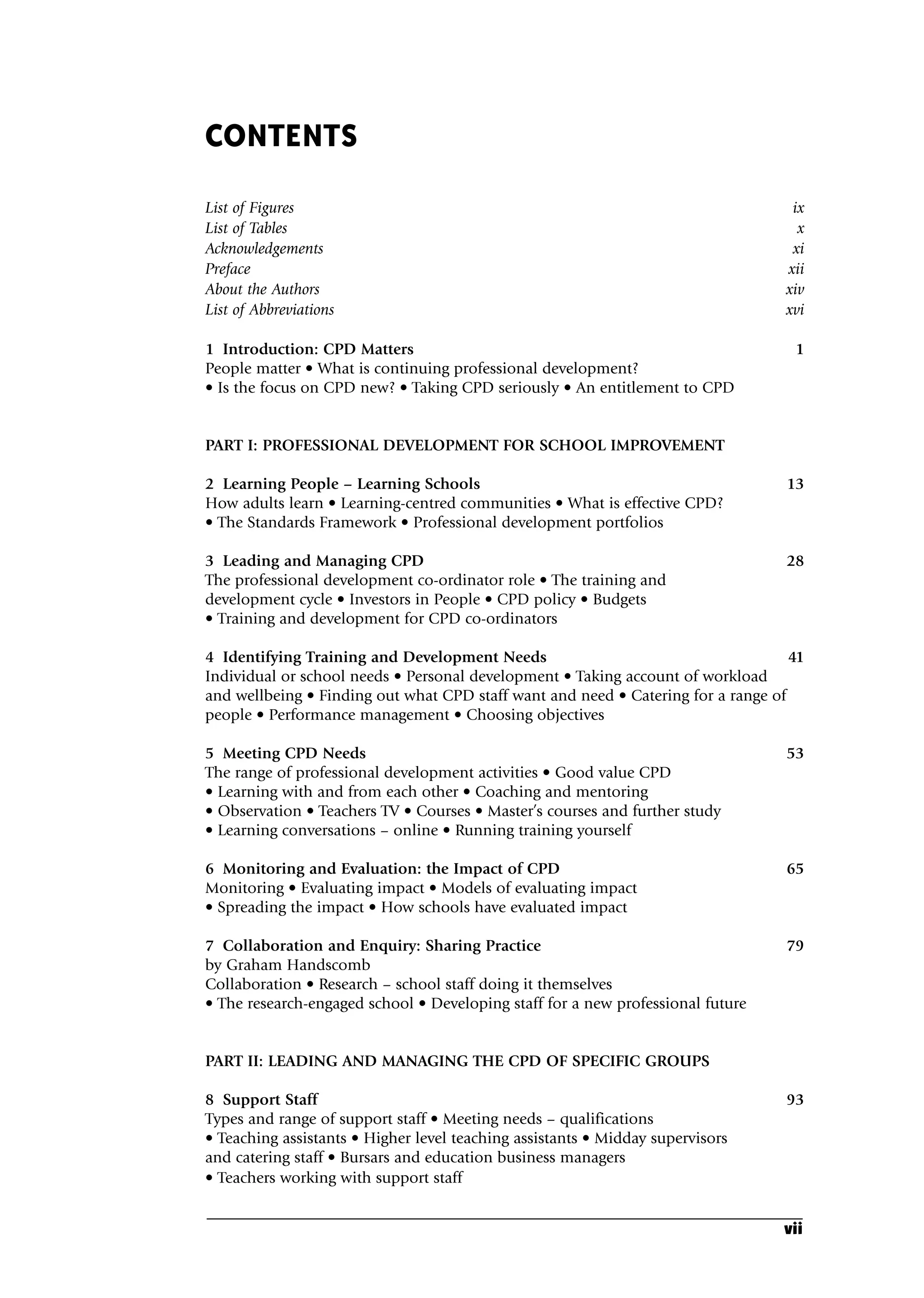
CONTENTS
List of Figures ix
List of Tables x
Acknowledgements xi
Preface xii
About the Authors xiv
List of Abbreviations xvi
1 Introduction: CPD Matters 1
People matter • What is continuing professional development?
• Is the focus on CPD new? • Taking CPD seriously • An entitlement to CPD
PART I: PROFESSIONAL DEVELOPMENT FOR SCHOOL IMPROVEMENT
2 Learning People – Learning Schools 13
How adults learn • Learning-centred communities • What is effective CPD?
• The Standards Framework • Professional development portfolios
3 Leading and Managing CPD 28
The professional development co-ordinator role • The training and
development cycle • Investors in People • CPD policy • Budgets
• Training and development for CPD co-ordinators
4 Identifying Training and Development Needs 41
Individual or school needs • Personal development • Taking account of workload
and wellbeing • Finding out what CPD staff want and need • Catering for a range of
people • Performance management • Choosing objectives
5 Meeting CPD Needs 53
The range of professional development activities • Good value CPD
• Learning with and from each other • Coaching and mentoring
• Observation • Teachers TV • Courses • Master’s courses and further study
• Learning conversations – online • Running training yourself
6 Monitoring and Evaluation: the Impact of CPD 65
Monitoring • Evaluating impact • Models of evaluating impact
• Spreading the impact • How schools have evaluated impact
7 Collaboration and Enquiry: Sharing Practice 79
by Graham Handscomb
Collaboration • Research – school staff doing it themselves
• The research-engaged school • Developing staff for a new professional future
PART II: LEADING AND MANAGING THE CPD OF SPECIFIC GROUPS
8 Support Staff 93
Types and range of support staff • Meeting needs – qualifications
• Teaching assistants • Higher level teaching assistants • Midday supervisors
and catering staff • Bursars and education business managers
• Teachers working with support staff
vii
A01.qxd 23/8/07 12:51 pm Page vii
viii
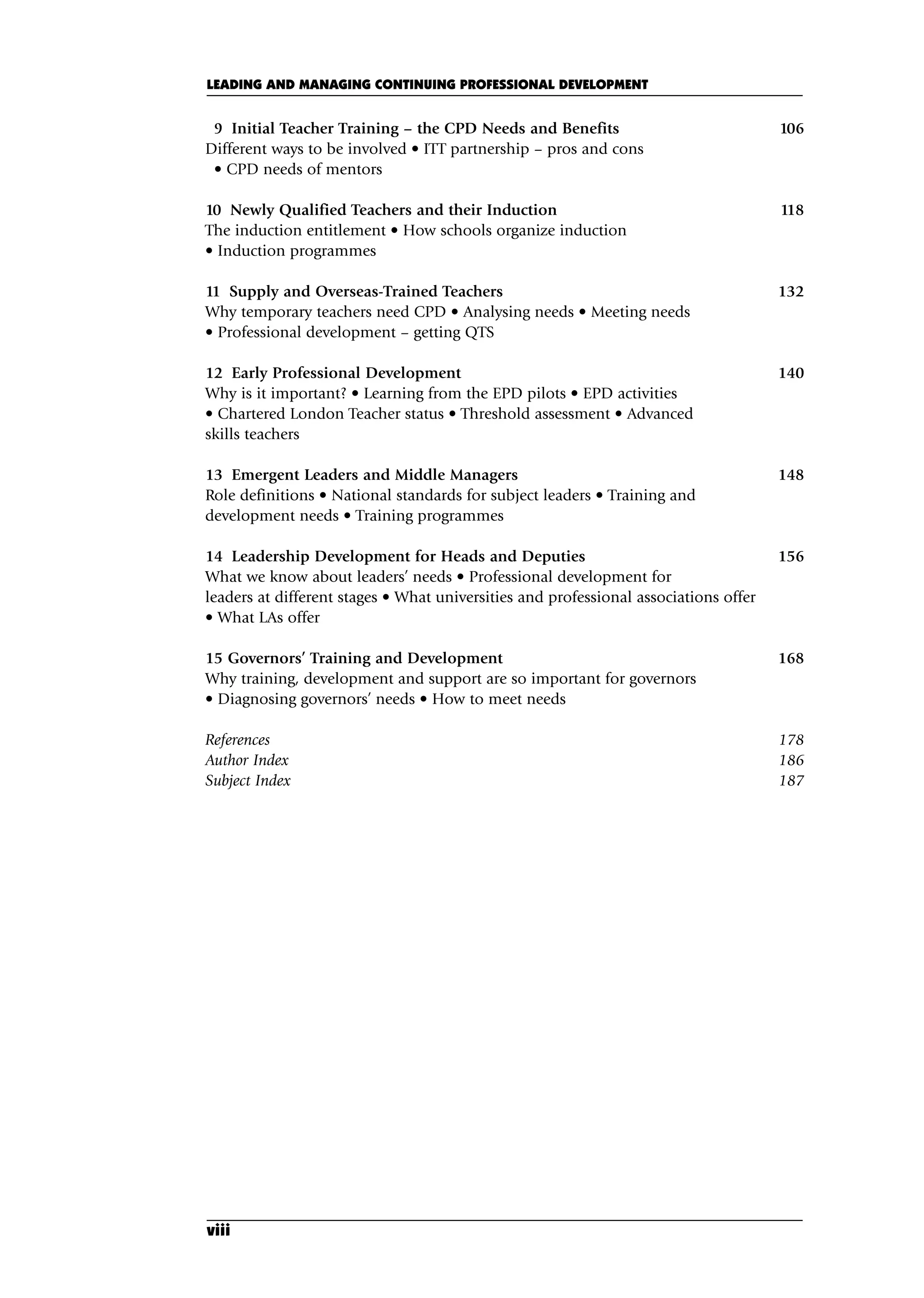
9 Initial Teacher Training – the CPD Needs and Benefits 106
Different ways to be involved • ITT partnership – pros and cons
• CPD needs of mentors
10 Newly Qualified Teachers and their Induction 118
The induction entitlement • How schools organize induction
• Induction programmes
11 Supply and Overseas-Trained Teachers 132
Why temporary teachers need CPD • Analysing needs • Meeting needs
• Professional development – getting QTS
12 Early Professional Development 140
Why is it important? • Learning from the EPD pilots • EPD activities
• Chartered London Teacher status • Threshold assessment • Advanced
skills teachers
13 Emergent Leaders and Middle Managers 148
Role definitions • National standards for subject leaders • Training and
development needs • Training programmes
14 Leadership Development for Heads and Deputies 156
What we know about leaders’ needs • Professional development for
leaders at different stages • What universities and professional associations offer
• What LAs offer
15 Governors’ Training and Development 168
Why training, development and support are so important for governors
• Diagnosing governors’ needs • How to meet needs
References 178
Author Index 186
Subject Index 187
LEADING AND MANAGING CONTINUING PROFESSIONAL DEVELOPMENT
A01.qxd 23/8/07 12:51 pm Page viii
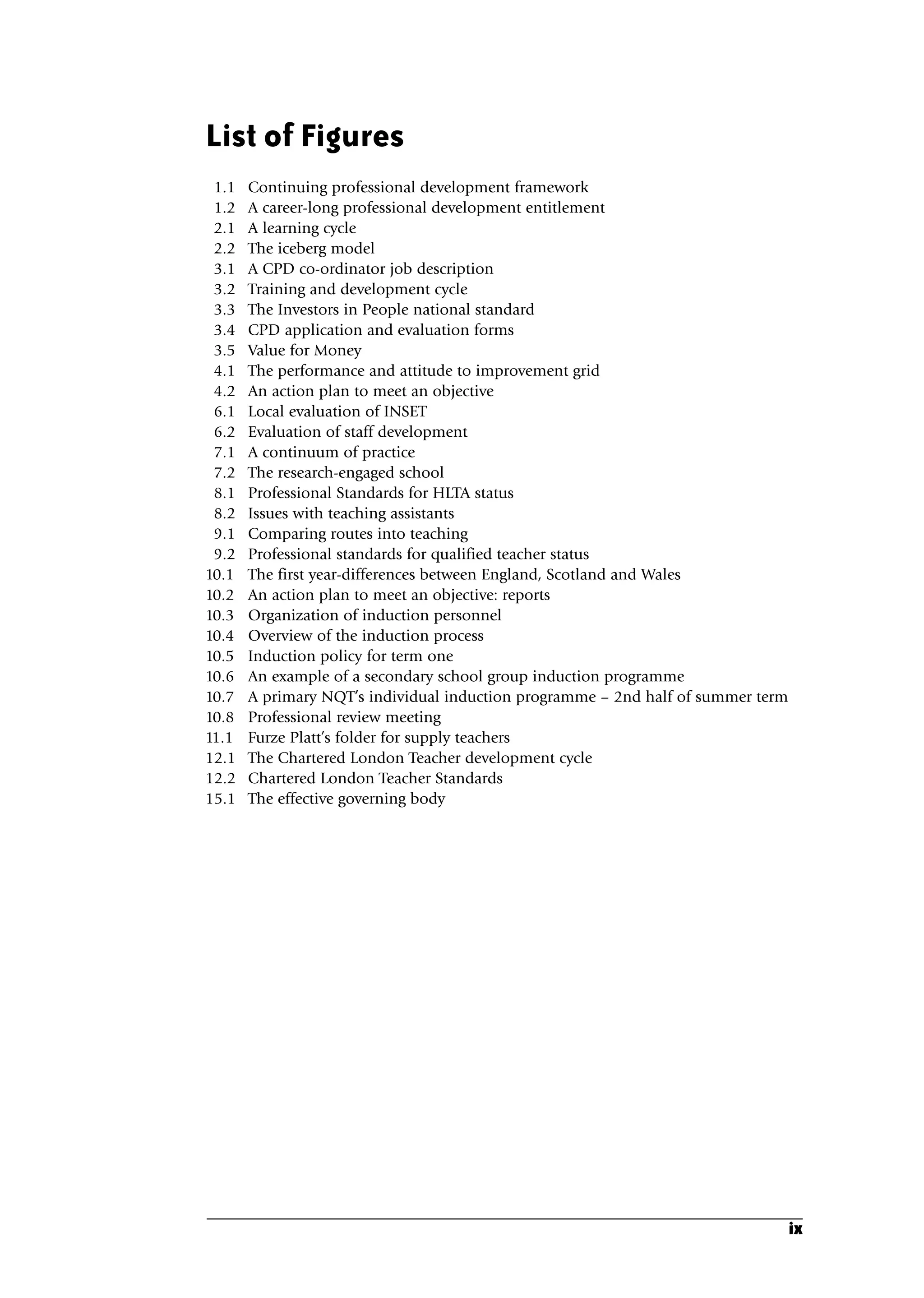
List of Figures
1.1 Continuing professional development framework
1.2 A career-long professional development entitlement
2.1 A learning cycle
2.2 The iceberg model
3.1 A CPD co-ordinator job description
3.2 Training and development cycle
3.3 The Investors in People national standard
3.4 CPD application and evaluation forms
3.5 Value for Money
4.1 The performance and attitude to improvement grid
4.2 An action plan to meet an objective
6.1 Local evaluation of INSET
6.2 Evaluation of staff development
7.1 A continuum of practice
7.2 The research-engaged school
8.1 Professional Standards for HLTA status
8.2 Issues with teaching assistants
9.1 Comparing routes into teaching
9.2 Professional standards for qualified teacher status
10.1 The first year-differences between England, Scotland and Wales
10.2 An action plan to meet an objective: reports
10.3 Organization of induction personnel
10.4 Overview of the induction process
10.5 Induction policy for term one
10.6 An example of a secondary school group induction programme
10.7 A primary NQT’s individual induction programme – 2nd half of summer term
10.8 Professional review meeting
11.1 Furze Platt’s folder for supply teachers
12.1 The Chartered London Teacher development cycle
12.2 Chartered London Teacher Standards
15.1 The effective governing body
ix
A01.qxd 23/8/07 12:51 pm Page ix
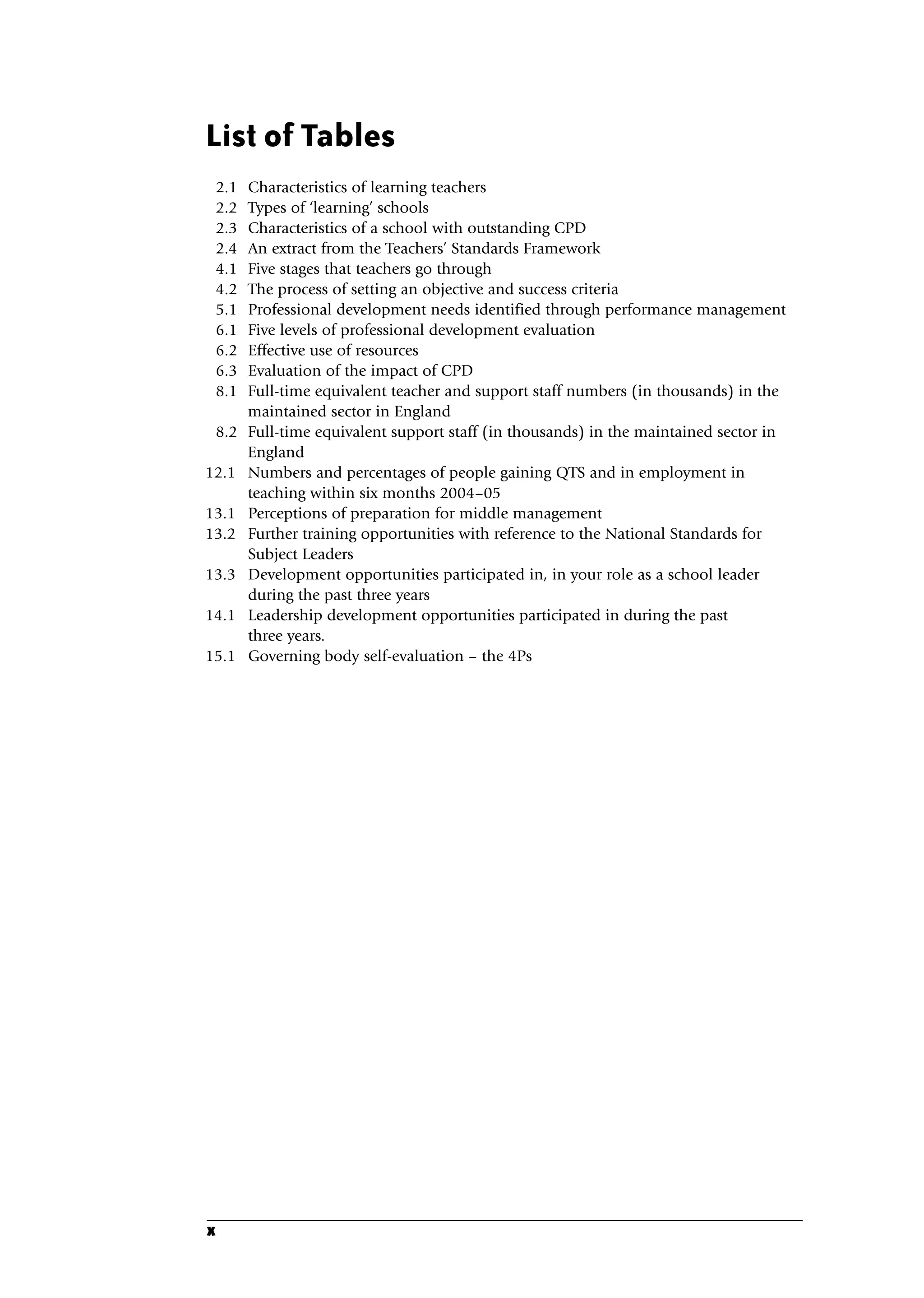
List of Tables
2.1 Characteristics of learning teachers
2.2 Types of ‘learning’ schools
2.3 Characteristics of a school with outstanding CPD
2.4 An extract from the Teachers’ Standards Framework
4.1 Five stages that teachers go through
4.2 The process of setting an objective and success criteria
5.1 Professional development needs identified through performance management
6.1 Five levels of professional development evaluation
6.2 Effective use of resources
6.3 Evaluation of the impact of CPD
8.1 Full-time equivalent teacher and support staff numbers (in thousands) in the
maintained sector in England
8.2 Full-time equivalent support staff (in thousands) in the maintained sector in
England
12.1 Numbers and percentages of people gaining QTS and in employment in
teaching within six months 2004–05
13.1 Perceptions of preparation for middle management
13.2 Further training opportunities with reference to the National Standards for
Subject Leaders
13.3 Development opportunities participated in, in your role as a school leader
during the past three years
14.1 Leadership development opportunities participated in during the past
three years.
15.1 Governing body self-evaluation – the 4Ps
x
A01.qxd 23/8/07 12:51 pm Page x
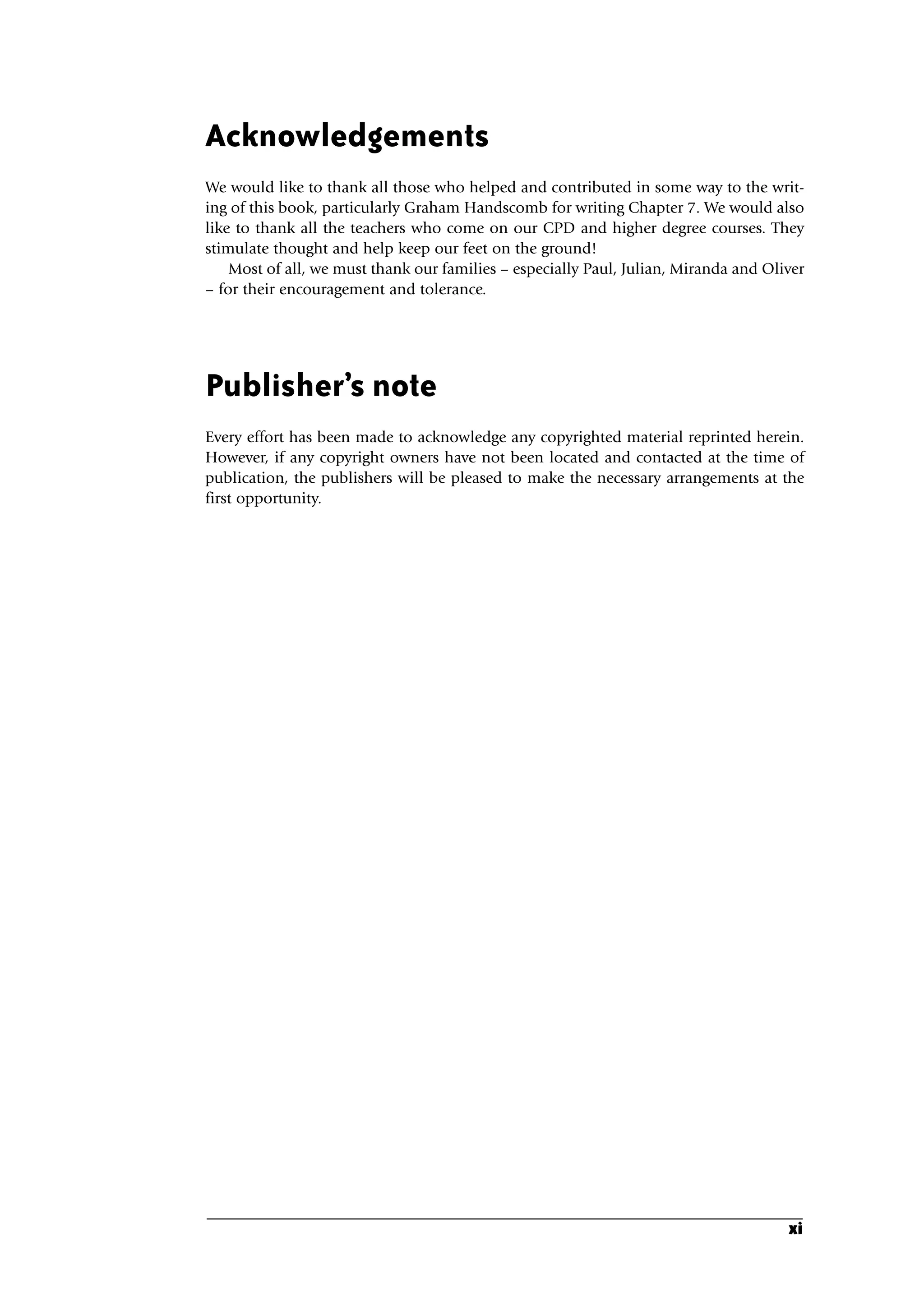
Acknowledgements
We would like to thank all those who helped and contributed in some way to the writ-
ing of this book, particularly Graham Handscomb for writing Chapter 7. We would also
like to thank all the teachers who come on our CPD and higher degree courses. They
stimulate thought and help keep our feet on the ground!
Most of all, we must thank our families – especially Paul, Julian, Miranda and Oliver
– for their encouragement and tolerance.
Publisher’s note
Every effort has been made to acknowledge any copyrighted material reprinted herein.
However, if any copyright owners have not been located and contacted at the time of
publication, the publishers will be pleased to make the necessary arrangements at the
first opportunity.
xi
A01.qxd 23/8/07 12:51 pm Page xi
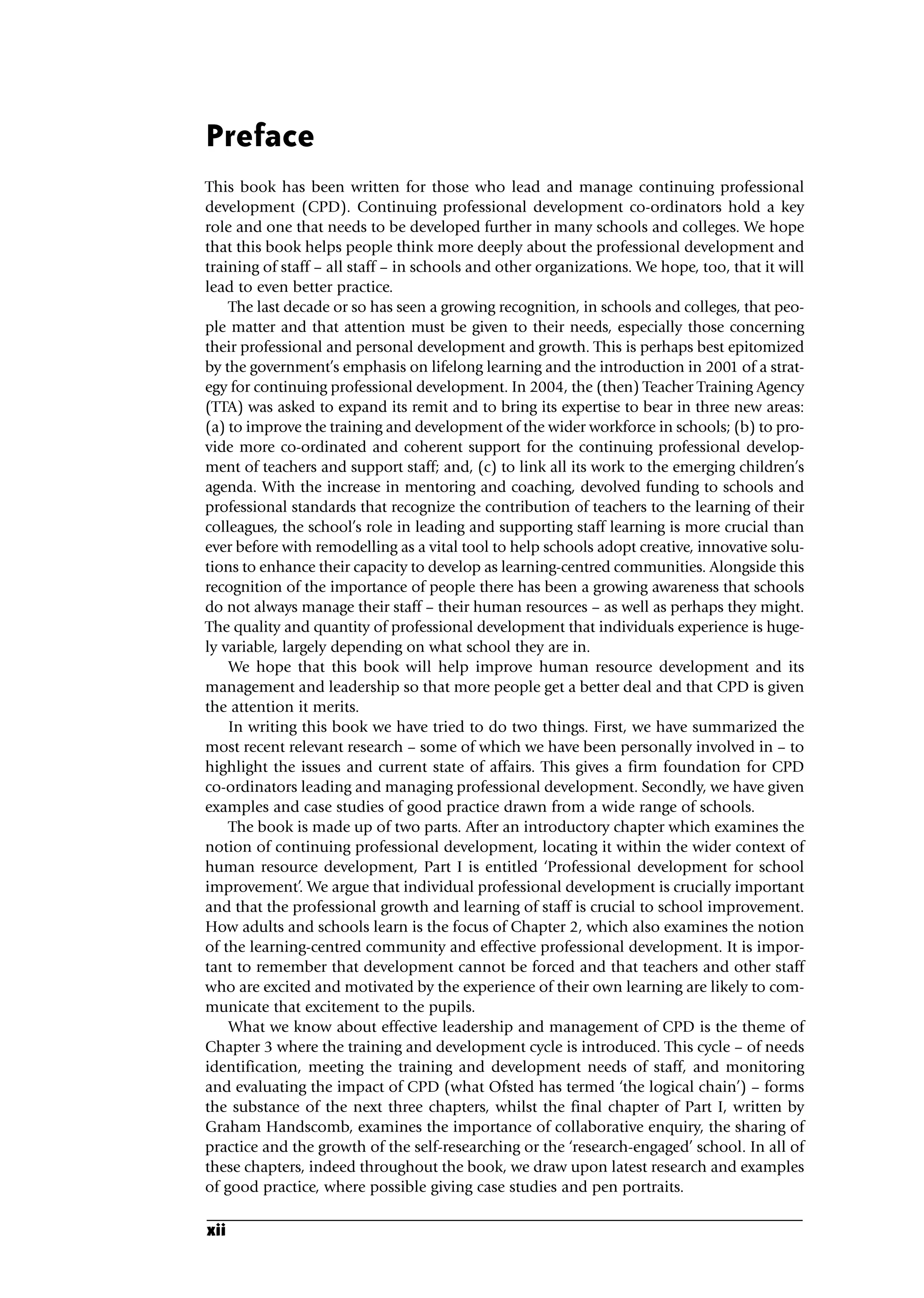
Preface
This book has been written for those who lead and manage continuing professional
development (CPD). Continuing professional development co-ordinators hold a key
role and one that needs to be developed further in many schools and colleges. We hope
that this book helps people think more deeply about the professional development and
training of staff – all staff – in schools and other organizations. We hope, too, that it will
lead to even better practice.
The last decade or so has seen a growing recognition, in schools and colleges, that peo-
ple matter and that attention must be given to their needs, especially those concerning
their professional and personal development and growth. This is perhaps best epitomized
by the government’s emphasis on lifelong learning and the introduction in 2001 of a strat-
egy for continuing professional development. In 2004, the (then) Teacher Training Agency
(TTA) was asked to expand its remit and to bring its expertise to bear in three new areas:
(a) to improve the training and development of the wider workforce in schools; (b) to pro-
vide more co-ordinated and coherent support for the continuing professional develop-
ment of teachers and support staff; and, (c) to link all its work to the emerging children’s
agenda. With the increase in mentoring and coaching, devolved funding to schools and
professional standards that recognize the contribution of teachers to the learning of their
colleagues, the school’s role in leading and supporting staff learning is more crucial than
ever before with remodelling as a vital tool to help schools adopt creative, innovative solu-
tions to enhance their capacity to develop as learning-centred communities. Alongside this
recognition of the importance of people there has been a growing awareness that schools
do not always manage their staff – their human resources – as well as perhaps they might.
The quality and quantity of professional development that individuals experience is huge-
ly variable, largely depending on what school they are in.
We hope that this book will help improve human resource development and its
management and leadership so that more people get a better deal and that CPD is given
the attention it merits.
In writing this book we have tried to do two things. First, we have summarized the
most recent relevant research – some of which we have been personally involved in – to
highlight the issues and current state of affairs. This gives a firm foundation for CPD
co-ordinators leading and managing professional development. Secondly, we have given
examples and case studies of good practice drawn from a wide range of schools.
The book is made up of two parts. After an introductory chapter which examines the
notion of continuing professional development, locating it within the wider context of
human resource development, Part I is entitled ‘Professional development for school
improvement’. We argue that individual professional development is crucially important
and that the professional growth and learning of staff is crucial to school improvement.
How adults and schools learn is the focus of Chapter 2, which also examines the notion
of the learning-centred community and effective professional development. It is impor-
tant to remember that development cannot be forced and that teachers and other staff
who are excited and motivated by the experience of their own learning are likely to com-
municate that excitement to the pupils.
What we know about effective leadership and management of CPD is the theme of
Chapter 3 where the training and development cycle is introduced. This cycle – of needs
identification, meeting the training and development needs of staff, and monitoring
and evaluating the impact of CPD (what Ofsted has termed ‘the logical chain’) – forms
the substance of the next three chapters, whilst the final chapter of Part I, written by
Graham Handscomb, examines the importance of collaborative enquiry, the sharing of
practice and the growth of the self-researching or the ‘research-engaged’ school. In all of
these chapters, indeed throughout the book, we draw upon latest research and examples
of good practice, where possible giving case studies and pen portraits.
xii
A01.qxd 23/8/07 12:51 pm Page xii
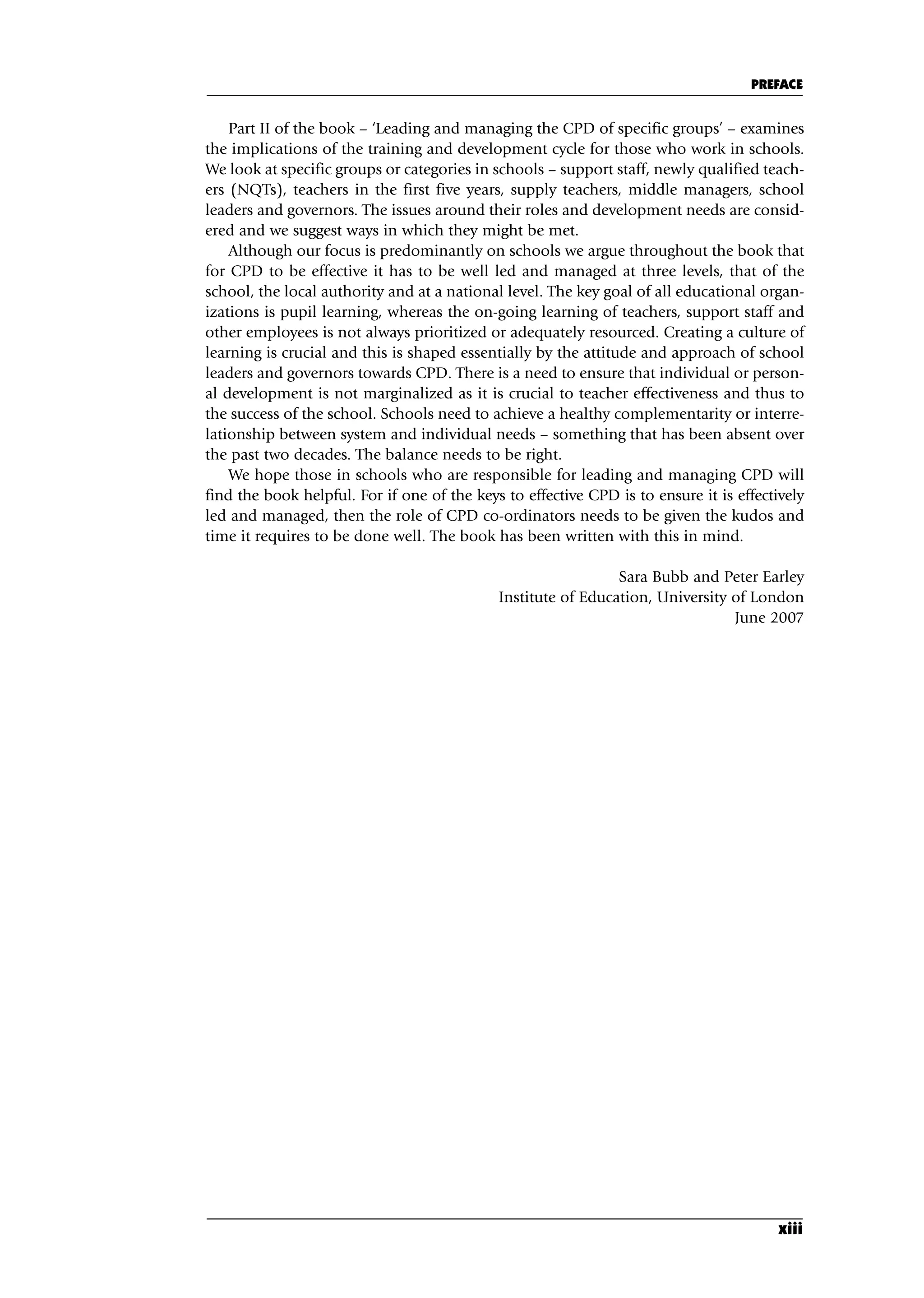
Part II of the book – ‘Leading and managing the CPD of specific groups’ – examines
the implications of the training and development cycle for those who work in schools.
We look at specific groups or categories in schools – support staff, newly qualified teach-
ers (NQTs), teachers in the first five years, supply teachers, middle managers, school
leaders and governors. The issues around their roles and development needs are consid-
ered and we suggest ways in which they might be met.
Although our focus is predominantly on schools we argue throughout the book that
for CPD to be effective it has to be well led and managed at three levels, that of the
school, the local authority and at a national level. The key goal of all educational organ-
izations is pupil learning, whereas the on-going learning of teachers, support staff and
other employees is not always prioritized or adequately resourced. Creating a culture of
learning is crucial and this is shaped essentially by the attitude and approach of school
leaders and governors towards CPD. There is a need to ensure that individual or person-
al development is not marginalized as it is crucial to teacher effectiveness and thus to
the success of the school. Schools need to achieve a healthy complementarity or interre-
lationship between system and individual needs – something that has been absent over
the past two decades. The balance needs to be right.
We hope those in schools who are responsible for leading and managing CPD will
find the book helpful. For if one of the keys to effective CPD is to ensure it is effectively
led and managed, then the role of CPD co-ordinators needs to be given the kudos and
time it requires to be done well. The book has been written with this in mind.
Sara Bubb and Peter Earley
Institute of Education, University of London
June 2007
PREFACE
xiii
A01.qxd 23/8/07 12:51 pm Page xiii
About the Authors
Sara Bubb is an experienced London teacher who helps staff in schools develop. She
does this in many ways: through leading professional development, assessing, develop-
ing schemes, researching and writing.
With a national and international reputation in the induction of new teachers and
professional development, Sara speaks at conferences and runs courses throughout the
country and abroad (e.g. Norway, Taiwan) on topics such as helping staff develop, obser-
vation skills, induction, developing pedagogical skills, leading CPD, subject leadership,
monitoring teaching and implementing performance management. She has featured on
and been a consultant for eight Teachers TV programmes. She trains a broad range of
people, including inspectors, assessors, advisers, consultants, Fasttrack, TeachFirst and
advanced skills teachers.
Sara assesses advanced skills, excellent, overseas trained and graduate teachers and
higher level teaching assistants and was an external assessor for Threshold. She has
inspected over 25 primary schools.
As a senior lecturer at the Institue of Education (0.2) she works on PGCE and Masters
programmes and set up the employment based routes (OTT and GTP) to QTS. She is
lead director of the CfBT Educational Trust-funded Sef2Si – ‘From Self Evaluation to
School Improvement: the role of effective professional development’ project. She co-
directed the DfES-funded national research Project on the Effectiveness of the Induction
Year, was deputy director of the TTA systematic review of induction research and helped
the Northern Ireland GTC revise their teacher competences.
On a 0.2 secondment to the (then) DfES London Challenge team, Sara is the con-
sultant for Chartered London Teacher status – a scheme involving over 38,600 teachers.
She is the London Gifted and Talented Early Years network leader, working with staff in
reception and nursery classes to enhance their provision for all children, especially the
most able.
She has written books and numerous articles on induction, professional develop-
ment, workload, and performance management. She is the new teacher expert at the
Times Educational Supplement, and writes articles, a weekly advice column and answers
questions on its website.
Professor Peter Earley is Head of Education Leadership and Management Programmes
at the London Centre for Leadership in Learning at the Institute of Education, University
of London. A central research interest is leadership and he has recently completed a series
of studies of school leaders. Other research interests include school governing bodies,
school inspection, self-evaluation and professional development. He is currently co-ordi-
nating projects entitled ‘From Self Evaluation to School Improvement: the role of effec-
tive professional development’ and ‘Future Leaders: an evaluation of a pilot project’.
In addition he co-edits the practitioner journal Professional Development Today. He was
the course leader for the Institute’s Educational Leadership and Management MA and
currently is co-ordinating the EdD specialist module on ‘Leadership and Learning in
Educational Organisations’. He was until recently a school governor and a member of
the executive of the National Association of School Governors.
He has published widely and his previous books for PCP/Sage include,
Understanding School Leadership (2004) (with Dick Weindling), Managing Teacher
Workload: Work-life balance and wellbeing (2004) (with Sara Bubb), and Improving Schools
and Inspection: The Self-inspecting School (2000) (with Neil Ferguson). He has also writ-
ten, Improving Schools and Governing Bodies (1999) (with Michael Creese), Routledge and
Leadership and Management in Education: Cultures, Change and Context (2005) (with
Marianne Coleman), Oxford University Press.
xiv
A01.qxd 23/8/07 12:51 pm Page xiv
Graham Handscomb is Principal Adviser in Essex Schools, Children and Families
Directorate and has held a number of Local Authority senior management roles. He pre-
viously taught for eighteen years and was a secondary deputy headteacher. He leads
Essex’s policy and practice on initial teacher training and the continuing professional
development of teachers. He is an associate tutor with the University of Cambridge, and
Senior Member of Hughes Hall College, Cambridge. He founded the Essex Forum for
Learning and Research Enquiry (FLARE) which pioneered work on the concept of the
Research-Engaged School.
Graham is editor of Professional Development Today, and a member of the editorial
board of Teaching Thinking magazine; he has written extensively on professional devel-
opment. He is a member of numerous national bodies including the DfES Steering
Group on a three-year research project looking at the impact of school leadership on
learning; the national Thinking Skills Strategy Group, and Professional Development
Board. Graham also does work with the General Teaching Council and the Training and
Development Agency.
ABOUT THE AUTHORS
xv
A01.qxd 23/8/07 12:51 pm Page xv
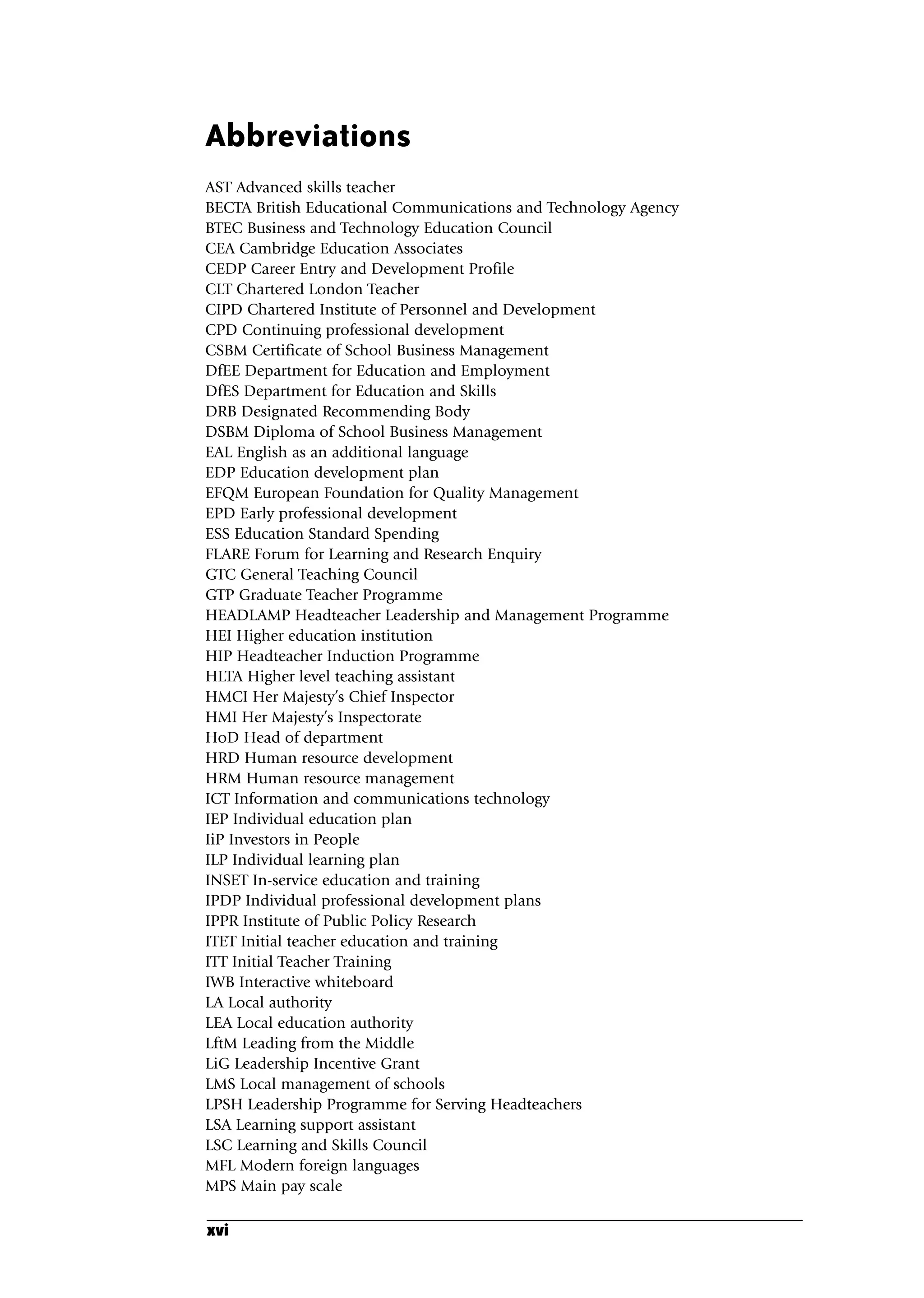
Abbreviations
AST Advanced skills teacher
BECTA British Educational Communications and Technology Agency
BTEC Business and Technology Education Council
CEA Cambridge Education Associates
CEDP Career Entry and Development Profile
CLT Chartered London Teacher
CIPD Chartered Institute of Personnel and Development
CPD Continuing professional development
CSBM Certificate of School Business Management
DfEE Department for Education and Employment
DfES Department for Education and Skills
DRB Designated Recommending Body
DSBM Diploma of School Business Management
EAL English as an additional language
EDP Education development plan
EFQM European Foundation for Quality Management
EPD Early professional development
ESS Education Standard Spending
FLARE Forum for Learning and Research Enquiry
GTC General Teaching Council
GTP Graduate Teacher Programme
HEADLAMP Headteacher Leadership and Management Programme
HEI Higher education institution
HIP Headteacher Induction Programme
HLTA Higher level teaching assistant
HMCI Her Majesty’s Chief Inspector
HMI Her Majesty’s Inspectorate
HoD Head of department
HRD Human resource development
HRM Human resource management
ICT Information and communications technology
IEP Individual education plan
IiP Investors in People
ILP Individual learning plan
INSET In-service education and training
IPDP Individual professional development plans
IPPR Institute of Public Policy Research
ITET Initial teacher education and training
ITT Initial Teacher Training
IWB Interactive whiteboard
LA Local authority
LEA Local education authority
LftM Leading from the Middle
LiG Leadership Incentive Grant
LMS Local management of schools
LPSH Leadership Programme for Serving Headteachers
LSA Learning support assistant
LSC Learning and Skills Council
MFL Modern foreign languages
MPS Main pay scale
xvi
A01.qxd 23/8/07 12:51 pm Page xvi
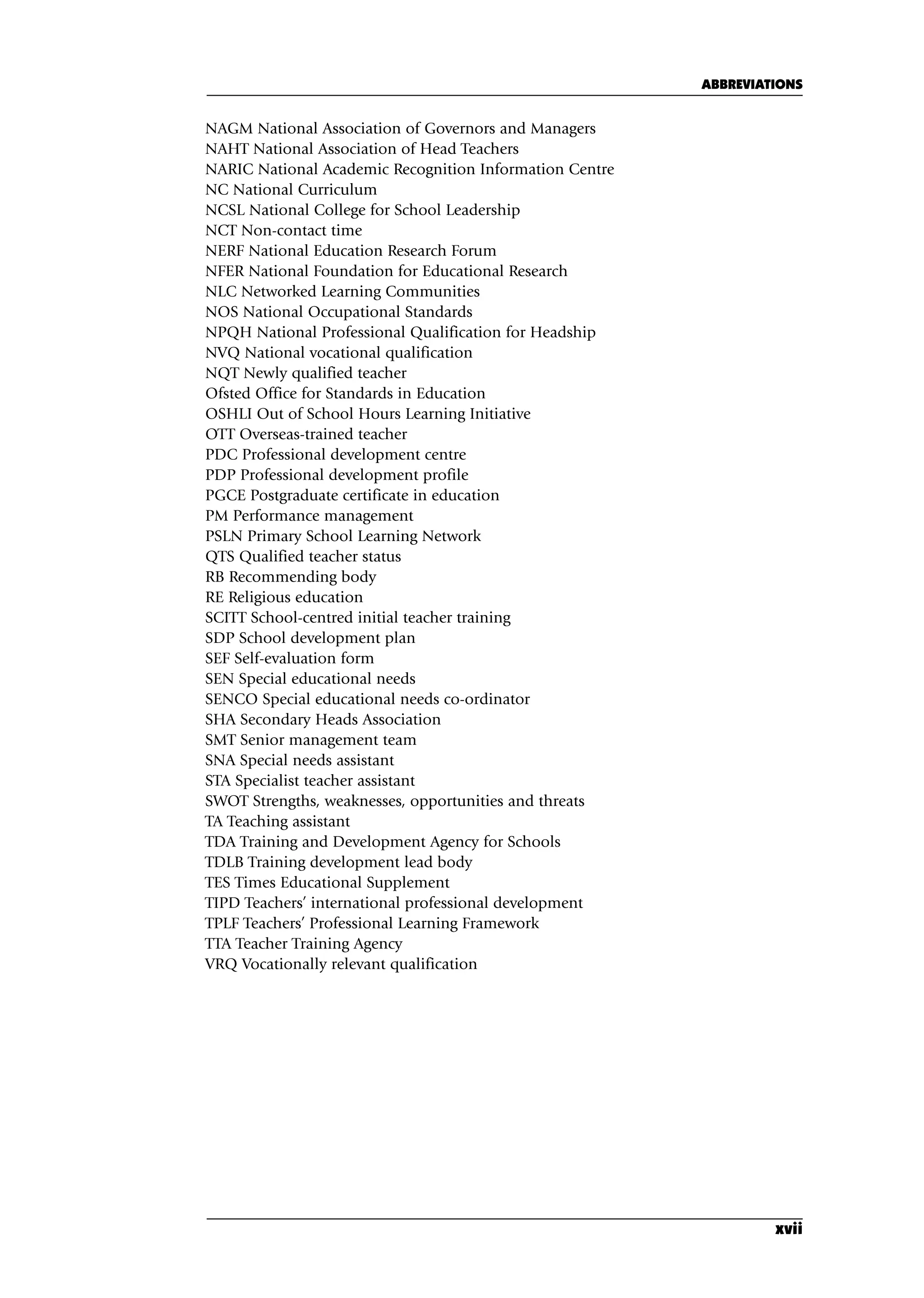
NAGM National Association of Governors and Managers
NAHT National Association of Head Teachers
NARIC National Academic Recognition Information Centre
NC National Curriculum
NCSL National College for School Leadership
NCT Non-contact time
NERF National Education Research Forum
NFER National Foundation for Educational Research
NLC Networked Learning Communities
NOS National Occupational Standards
NPQH National Professional Qualification for Headship
NVQ National vocational qualification
NQT Newly qualified teacher
Ofsted Office for Standards in Education
OSHLI Out of School Hours Learning Initiative
OTT Overseas-trained teacher
PDC Professional development centre
PDP Professional development profile
PGCE Postgraduate certificate in education
PM Performance management
PSLN Primary School Learning Network
QTS Qualified teacher status
RB Recommending body
RE Religious education
SCITT School-centred initial teacher training
SDP School development plan
SEF Self-evaluation form
SEN Special educational needs
SENCO Special educational needs co-ordinator
SHA Secondary Heads Association
SMT Senior management team
SNA Special needs assistant
STA Specialist teacher assistant
SWOT Strengths, weaknesses, opportunities and threats
TA Teaching assistant
TDA Training and Development Agency for Schools
TDLB Training development lead body
TES Times Educational Supplement
TIPD Teachers’ international professional development
TPLF Teachers’ Professional Learning Framework
TTA Teacher Training Agency
VRQ Vocationally relevant qualification
ABBREVIATIONS
xvii
A01.qxd 23/8/07 12:51 pm Page xvii
A01.qxd 23/8/07 12:51 pm Page xviii
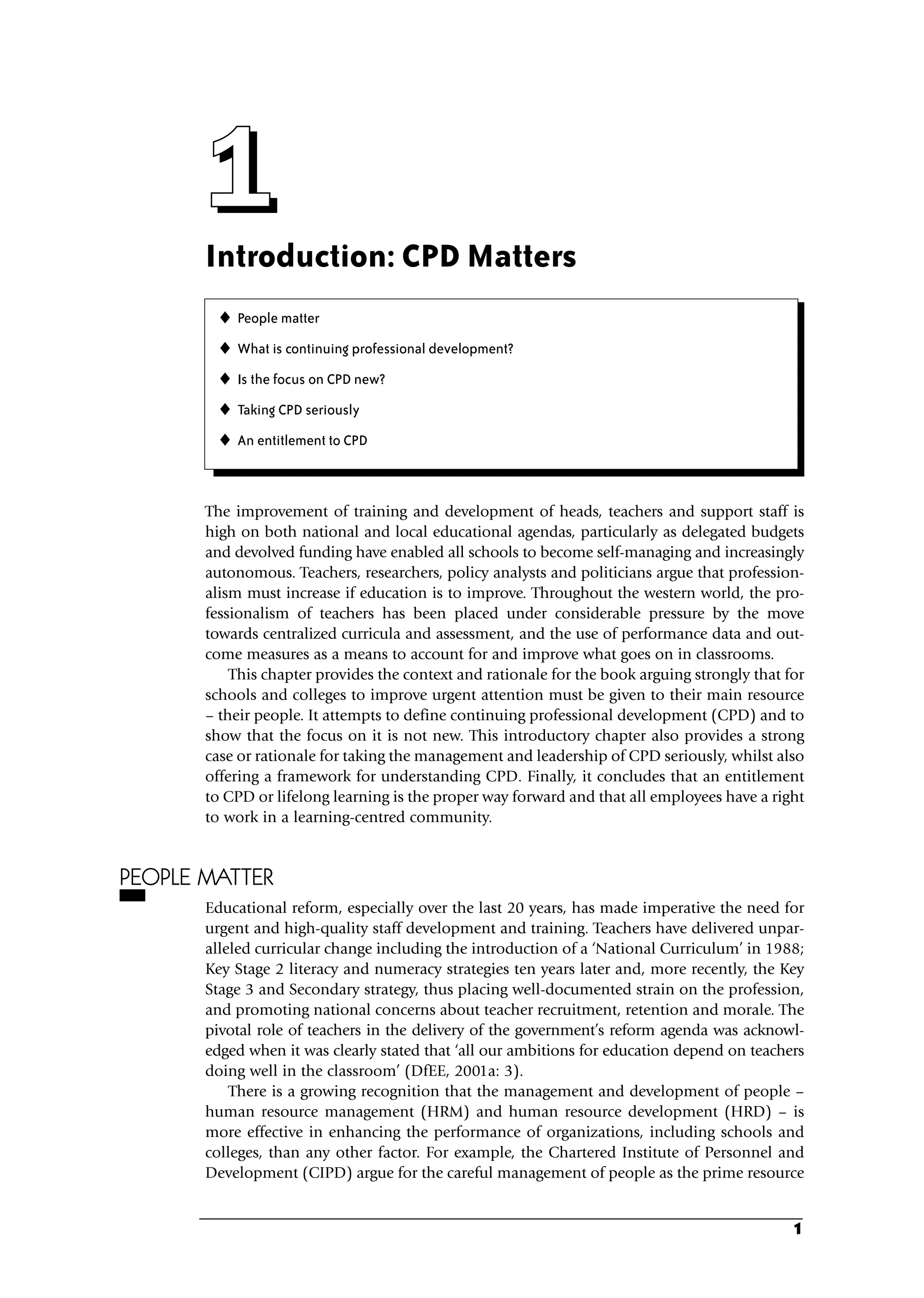
Introduction: CPD Matters
The improvement of training and development of heads, teachers and support staff is
high on both national and local educational agendas, particularly as delegated budgets
and devolved funding have enabled all schools to become self-managing and increasingly
autonomous. Teachers, researchers, policy analysts and politicians argue that profession-
alism must increase if education is to improve. Throughout the western world, the pro-
fessionalism of teachers has been placed under considerable pressure by the move
towards centralized curricula and assessment, and the use of performance data and out-
come measures as a means to account for and improve what goes on in classrooms.
This chapter provides the context and rationale for the book arguing strongly that for
schools and colleges to improve urgent attention must be given to their main resource
– their people. It attempts to define continuing professional development (CPD) and to
show that the focus on it is not new. This introductory chapter also provides a strong
case or rationale for taking the management and leadership of CPD seriously, whilst also
offering a framework for understanding CPD. Finally, it concludes that an entitlement
to CPD or lifelong learning is the proper way forward and that all employees have a right
to work in a learning-centred community.
PEOPLE MATTER
Educational reform, especially over the last 20 years, has made imperative the need for
urgent and high-quality staff development and training. Teachers have delivered unpar-
alleled curricular change including the introduction of a ‘National Curriculum’ in 1988;
Key Stage 2 literacy and numeracy strategies ten years later and, more recently, the Key
Stage 3 and Secondary strategy, thus placing well-documented strain on the profession,
and promoting national concerns about teacher recruitment, retention and morale. The
pivotal role of teachers in the delivery of the government’s reform agenda was acknowl-
edged when it was clearly stated that ‘all our ambitions for education depend on teachers
doing well in the classroom’ (DfEE, 2001a: 3).
There is a growing recognition that the management and development of people –
human resource management (HRM) and human resource development (HRD) – is
more effective in enhancing the performance of organizations, including schools and
colleges, than any other factor. For example, the Chartered Institute of Personnel and
Development (CIPD) argue for the careful management of people as the prime resource
1
1
1
1
1
 People matter
 What is continuing professional development?
 Is the focus on CPD new?
 Taking CPD seriously
 An entitlement to CPD
C01.qxd 23/8/07 12:52 pm Page 1
Discovering Diverse Content Through
Random Scribd Documents
“To think that Anderton should die of heart failure,” exclaimed Bentham.
“Why, I can hardly believe it. Think of the altitudes to which he climbed in
the Himalayas, Carter. No man with a weak heart could stand such a cold
and rare atmosphere as you get up there. Well, I’m glad I have probably the
last words he ever wrote.”
“Yes, there is no doubt of that, I think. The fact was, I had that letter
mailed for certain reasons.”
Matthew Bentham looked puzzled. Then he shook his head, as if he did
not care to pursue the subject.
“Those reasons are sufficiently weighty,” went on Nick, “for me to desire
to know what he wrote. I realize that my request is distinctly out of the
ordinary. But I think you know me well enough to be sure that I must have a
very strong motive.”
The professor was silent for a few moments. The detective knew he was
turning the request over in his mind, and that it had not struck him at all
favorably. Then he seemed to decide the other way, for he broke out
impulsively:
“Well, it is rather irregular, but I don’t know why you shouldn’t see the
letter. Of course, I have your promise that you will not let it go any further.”
“Of course,” replied Nick. “I think it is hardly necessary for me to say
that, but I do promise.”
Professor Bentham handed the letter to Nick Carter, who read as follows:
“My Dear Bentham: Am seizing the first opportunity since my return
from China to tell you I have succeeded in getting hold of the secret records
of the organization known as the ‘Yellow Tong.’ That the tong means
mischief you will see by the papers that I am sending you by safe hands. You
will not get them for a day or two, perhaps, because I am fairly certain there
are agents of the Yellow Tong in New York now who are ready to go to any
extreme to get those records. In fact, I have been told that Sang Tu himself is
in the city—doubtless in disguise. As you know, he is the head of the tong,
and as unscrupulous as he is able. When these records come to you, keep
them safely until you see me. No one knows that I intend to transfer them to
your custody, and because of that I feel they will be safe with you until it
shall come time to transfer them to Washington. Until I see you, for a long
talk, I remain, as ever, your faithful friend,
Andrew Anderton.”
That was all. It was evident to Nick Carter that the writer feared to trust
too much to paper and ink, and that he had a great deal more to tell which he
meant to communicate by word of mouth.
“The records have not come, I suppose?” asked Nick.
“Not yet. Moreover, I don’t know how he is sending them. I shall be glad
to get them, for he has told me just enough in this letter to assure me that the
records will be full of important information, both to the government and to
science. As for Sang Tu, I never saw that individual. I am told he belongs to
a powerful Manchu family, and that, before China became a republic, he
exercised great influence at Peking. Now that my friend Anderton is dead, I
suppose I shall have to take the responsibility of handling these records.”
“And the danger,” said Nick gravely.
“You mean from the Yellow Tong?”
“Yes, and particularly from Sang Tu. By the way, do you happen to know
a certain Professor Tolo, a Japanese?”
“I never met him, but I have heard of him. He has not been in New York
long. I hear that he is a very able man, and that his knowledge of the whole
Orient is regarded as wonderful. Do you know anything about him?”
“I have seen him,” replied Nick carelessly. “Well, I won’t stay any longer,
professor. I knew that these records were not to be found in Mr. Anderton’s
library, and I also had heard that he brought them with him.”
“Oh, did you?” asked the professor, rather surprised. “I don’t see how it
was that you——”
“My dear Mr. Bentham,” responded Nick, with a smile. “You know that I
am employed to make many secret investigations. It came in my way to find
out about these records, and when I heard that Mr. Anderton was dead, I
looked through his study for these valuable papers. I was worried because
they were not there. Now that I know you have them, I feel safer. Would you
permit me to use your telephone? Then I won’t trouble you any longer.”
“Trouble me?” protested Bentham. “That’s a nice thing for you to say,
Carter. I haven’t ever had you in my house before, and now you are
apologizing for being here. I’ll get even with you by never coming to your
place,” he added, smiling. “There’s the phone. Go ahead!”
Nick took up the instrument, and soon had Patsy Garvan on the wire. He
had listened not more than a few seconds, when he suddenly shouted back
into the transmitter, in an agitated tone:
“All right, Patsy! I’ll come over there at once. Keep quiet till I come.”
He put the receiver on the hook, and, with a hasty “Good-by, professor.
I’ll see you later,” dashed for the door.
“Wait a moment,” cried Bentham. “What’s the trouble?”
“No trouble at all!” shouted back Nick. “But I believe I’m going to find
out something about the Yellow Tong.”
Half an hour later he was flying up the stairs to the study of Andrew
Anderton. He found Patsy Garvan striding up and down the room in a state
of intense excitement.
“Where is he?” asked Nick, as he ran into the room.
“In that tool house, or whatever the place is, in the back yard,” was Patsy
Garvan’s answer, as he ran to one of the windows and flung it wide open.
CHAPTER XII.
AVENGED.
The rope ladder that Chick had used the night before, and which was
again coiled up in its place on the fire-escape balcony, was brought into use.
Nick Carter did not hesitate now, nor did he care who saw his movements.
He was first over the high fence into the next yard, but he had hardly
alighted on the soft earth of the flower bed when Patsy Garvan was by his
side.
“Shoot—to kill!” was Nick Carter’s brief order, as he ran to a brick
structure at the end of the yard. “We’ve got to make sure of those rascals this
time.”
The brick building looked like a garage, but as there was no way for a
motor car to be got into this yard, Nick knew it could not be used for that
purpose. One glance showed him that it was old, and that the brickwork was
shaky. There was a door and one window. The window was barred.
Nick decided, after a brief survey, that the bars could be torn loose with
some exertion, and he seized one of them with both hands and pulled with
all his might. If the detective had not been a man of extraordinary muscular
power, perhaps he could not have made the bar yield. As it was, he pulled it
out of one end after a few minutes’ labor. Then it was comparatively easy to
get the other end out.
This left him room to crawl through. As he dropped to the floor, he saw
somebody lying on the floor, bound hand and foot, and with a cloth fastened
over his mouth, so that he could not utter a sound.
Two or three slashes with his knife, and off came the ropes. At the same
time he loosened the suffocating cloth. Then he lifted Chick to his feet. To
his joy, he saw that his assistant was not hurt. He was standing up without
aid, although obviously he felt very stiff.
“Where are they, Chick? In the house?”
“Yes. There are three of them. Sun Jin, the man with the scars, and
another chink.”
“And who is the third?” asked Nick Carter.
“Professor Tolo, of course. I tell you, chief, that Jap is one of the worst
citizens I ever saw out of jail. He’s going to get us all if we don’t watch out.”
“Is he?” came grimly from the great detective. “I think not. The electric
chair will get him.”
“It ought to, I believe. But he’s smart enough not to do his own job. He
never has anything to do with the actual use of the crossed needles, and he is
smart enough to make it hard to bring anything definite against him.”
While Chick was speaking, he was digging at the lock with his
pocketknife, and it was not long before he shot back the lock and pulled the
door open.
Patsy Garvan met them as they went out, and, with his usual recklessness
where his emotions were concerned, threw his arms around Chick’s
shoulders, and shouted, in a powerful voice:
“Good old scout! They didn’t get you! I saw them, and I would have
come over the fence right then if the chief hadn’t phoned me to wait. Come
on, everybody! This is where we get the Yellow Tong and hang it on the
fence to dry, inside out! Wow! Bring on your chinks!”
It was impossible to keep Patsy quiet, as both Nick Carter and Chick well
knew. Now that his blood was up, he must be allowed to have his fling,
regardless of who might hear him.
“Don’t try the door,” warned Chick. “They have it locked and barred. But
you can get through the kitchen window by just breaking the glass and
reaching in to the catch.”
“We’ll cut a hole. That will be better than making a crash by breaking it,”
said Nick.
He took from his portable kit of tools a glazier’s diamond, and cut a
square hole in the glass as neatly as if it were his regular business. He
pinched the piece of glass with his nimble fingers before it could fall to the
floor inside, and had the catch pushed back almost in the same movement.
The next moment he was in the kitchen, pistol in hand, while his two
assistants also came through.
So far they had not heard a sound in the house. Yet there could be no
question that somebody was there, for only just before Patsy Garvan had
seen the three men carrying Chick’s bound figure down the yard, to deposit
it in the brick tool house.
These three men might have gone out by the front door. But, according to
Patsy, the caretaker was still there, because he had come out only a minute
before Nick opened the study door. Patsy had watched him from the window,
and had seen him go down the yard to look at the outside of the tool house.
Then he had sauntered back, lighted a pipe, and gone into the house,
smoking, as if he had no intention of moving away—for a while, at all
events.
“We’ve got to get that caretaker, first of all,” whispered Nick.
He opened the door of the kitchen that led to the other part of the house,
closely followed by his two assistants.
There was a dark hall which seemed to run through to the front door, and
the three explorers crept along till they got to another door. When they
opened this, they were startled by a rush of sunlight. It gave out upon the
little, paved yard in front of the house, with the avenue beyond.
Standing in the yard and leaning over the iron railings, as he puffed at a
pipe so strong that it polluted the whole block, was the caretaker. He was
enjoying the leisurely panorama of the early morning, apparently with
nothing on his mind.
Nick pulled his assistants back to the dark hall, and locked and bolted the
door in silence.
“He didn’t see us, and we don’t want him to come in,” he whispered. “We
will look through the house. I don’t believe those fellows have gone out. It is
my opinion they intended to go out to the tool house later and dispose of
you, Chick.”
“Very likely,” assented Chick coolly. “I don’t care what they intended,
now that I know they won’t be able to do it. I’m going upstairs.”
“Not without me,” grunted Patsy.
Cautiously they crept up to the main floor, and went into the dining room,
the door of which was a little way open. The curtains were drawn at the
window, but there was enough light for them to see that the furniture was all
shrouded in denim, and that the pictures on the walls had been covered with
sheets.
The effect was ghostly, but it was natural enough. The owners of the
house wanted their belongings to be kept as fresh as possible while they
were away.
The other rooms on this floor were also wrapped in cloths, and all were
so silent that it was difficult to imagine them full of life and brightness, as
probably they were when the family was at home.
To the next floor went the three investigators, and there they found a
handsome drawing-room in front and two smaller rooms behind, that
probably were used as a cardroom and my lady’s special sitting room.
“That’s a fine grand piano over there,” observed Patsy, in a whisper.
“Gee! I’d like to hear some ragtime on that.”
Patsy Garvan had a way of being incongruous without knowing it. When
an idea came into his head, he was liable to give it utterance, regardless of
where he might be.
The piano, covered all over with an immense sheet that hung down on all
sides, had attracted his attention to such a degree that it seemed to fascinate
him. He tiptoed over the luxurious rugs on the polished floor of the drawing-
room until he was close to the piano, and he put his hands on it.
“Say, chief!” he whispered. “I’m just going to open this music box and
see how it looks inside.”
“Come away!” hissed Chick. “Are you crazy?”
But Patsy either did not hear, or he would not heed. Throwing up the
sheet, as well as the rich, brocaded cover underneath, he opened the front of
the piano, exposing the keyboard, and the magnificent, pearl-inlaid music
desk. Then he spread his fingers over the keys, as if about to play.
Patsy was a fair performer on the piano, as well as on several other
instruments. He could hardly resist trying this valuable piano. Only the fear
that there might be others in the house besides his two companions, who
would perhaps catch them unawares if he were to make a sound on the
instrument, held him back.
With a sigh, he put down the lid, and was turning away, when he
happened to glance around the side of the piano. It stood across a corner of
the room, leaving a space behind, besides diagonal corners on either side.
Without a word, Patsy flung himself into the three-cornered space at the
back of the piano, and instantly there was an uproar that made it quite
superfluous for Nick and Chick to keep silence any longer.
Patsy struggled out to the middle of the drawing-room. In either hand he
held a Chinaman!
“Come on, Chick! Take one of these!” he shouted. “I’ve got the guy with
the white ear. You take the other one! Look out! Behind you!” he added, in a
shriek.
It was well that he had uttered this warning. Two other Chinamen had
come from the shadows of the other rooms, and each held a knife uplifted.
Before they could bring the knives down, Nick Carter had shot out his
left fist and felled one, while Chick floored the other.
But this was not the end of the battle. The two men Patsy had seized at
the back of the piano took advantage of the diversion to break away from
him, and the next moment he was dashing down the stairs, after them.
The front door was their objective, but it had been locked and bolted just
as had the one in the basement that Nick Carter had secured. It was against
this door that the fight came to an issue.
Patsy Garvan did not hesitate to rush in. He slammed one of the
Chinamen on the chin and crumpled him up. It made him smile with
satisfaction as he noted that it was the one with the scarred ear.
Before he could give attention to the other man, that snarling individual
had drawn something from the folds of his blue blouse that glistened evilly
in the half light of the hall.
Whatever it was, Patsy determined not to wait for it. Letting fly with his
right fist—and missing, as the Chinaman ducked, he seized him by the throat
with the other hand. There was a gurgling hiss, and then the fellow went
down on top of his fellow rascal.
A scream—loud, long drawn out, and unearthly—came from the man
with the scarred ear, who was underneath, and the awful cry was echoed by
the Chinaman on top. Then both were still.
Patsy Garvan stood looking at them in astonishment, when Nick Carter
came down with a rush and ran to the help of his petrified assistant.
“Got ’em, Patsy?”
“I think so. But they seemed to give out all at once, without me touching
them. That is, after I’d slung this one on top of the other.”
Nick Carter did not answer, but a look of understanding came into his
keen eyes, as he pulled the top Chinaman off of his comrade and laid him on
his back. Then he took out his pocket flash and turned it first on one
senseless figure, and then the other.
Deeply embedded in the chest of the underneath man—the Chinaman
with the scarred ear and the burned finger, from which the rag had been
removed—were the poisoned crossed needles with which the detective had
become so strangely familiar in the last two days.
He hastily tore open the front of the blouse and shirt away from the chest
of the other. There were the two little marks which showed that he, too, had
died from the same horrible death as his companion.
“It’s clear enough,” said Nick quietly. “When you flung this man on top
of the other, the needles were driven into both of them. It was poetic justice.
The murder of Andrew Anderton has been avenged.”
“This one with the scarred ear is the fellow who actually killed Mr.
Anderton, wasn’t he?” asked Patsy.
“Yes, I have ample proof of that. This other man was concerned in it, too.
The only thing I want now is to get the archconspirator—the man who
arranged the murder—Sang Tu.”
“You mean Professor Tolo, don’t you?” asked Patsy.
“It may turn out to be the same thing,” returned Nick Carter. “We shall
have to find that out later. Hello, Chick!” he called up the stairs. “Have you
got those two fellows, all right?”
“Yes,” replied Chick. “I have handcuffs on both of them. What am I to do
with them now?”
“I’ll go out and grab that caretaker. Then I’ll bring him in and make him
telephone to the police station for a patrol wagon. I don’t know how deep he
is in this thing. He can explain that to the police.”
“Why don’t you telephone, yourself, chief?” asked Chick. “They’d
probably pay more attention to you than to the old man.”
“Yes, and they’d question me more than I care for, too,” replied Nick. “I
don’t want to answer questions until I am face to face with the man who asks
them. This case isn’t wound up yet, you know.”
THE END.
“The Forced Crime; or, Nick Carter’s Brazen Clew,” will be the title of
the long, complete story which you will read in the next issue, No. 152, of
the Nick Carter Stories, out August 7th. In the forthcoming story you will
find more of the adventures of the famous detective in running down the
members of the Yellow Tong. Then, too, you will also find several articles of
interest, together with an installment of the serial now appearing.
Sheridan of the U. S. Mail.
By RALPH BOSTON.
(This interesting story was commenced in No. 148 of Nick Carter Stories. Back numbers can
always be obtained from your news dealer or the publishers.)
CHAPTER XVIII.
THE WOMAN IN THE CASE.
“I’m a fine sort of lover,” Owen muttered to himself, with a mirthless
laugh, as he left the post office, and proceeded to the residence of the
Reverend Doctor Moore. “A man ought to believe in the girl he loves, no
matter who else he has to doubt in order to do so; yet here I am giving the
preference to Pop Andrews, refusing to believe that there’s any possibility of
his being a liar and a thief, when I know very well that either that must be
the case, or else Dallas must be guilty.”
But although he argued this with himself, Owen realized that it was not a
matter of sentiment, but of cold logic, which had caused him to decide in
favor of the veteran letter carrier.
In a very despondent frame of mind, Owen rang the doorbell of the
clergyman’s house, hoping that the reverend gentleman might be able to tell
him something—some little detail which he had not thought to mention to
Superintendent Henderson—which might put an entirely new complexion on
the case, and enable him to solve the mystery without accusing either Dallas
or the letter carrier.
He found that Doctor Moore was a pleasant little man, several years past
middle age, with a kindly smile and an air of unworldliness which the
inspector was not surprised to find in a man who would send a hundred-
dollar note in an unregistered letter.
Owen explained the object of his call, and the clergyman readily agreed
to give him all the assistance he could in solving the mystery.
“In the first place,” said Owen, “did anybody know, doctor, that you were
sending this money through the mail? I mean to say, was anybody aware of
the fact before you dropped the letter in the box? Some dishonest person
might have followed you, and fished the letter out of the box as soon as you
stepped away?”
“No,” answered Doctor Moore. “I don’t think that’s possible. I didn’t
mention the fact that I was sending that money to anybody—not even to
Mrs. Moore.”
“And you are quite sure that it went into the box all right? Some people
are very careless, you know, when they mail letters. Sometimes, instead of
going into the box, the letter slips to the sidewalk unnoticed.”
“No, I am quite sure that wasn’t the case with me,” the clergyman replied
smilingly. “I remember that I was particularly careful to see that the letter
went to the bottom of the box. I even took the precaution of peering into the
slot after I had deposited it, to make sure that it had gone all the way down. I
know letters sometimes stick in the slot cover, and, as this one contained
money, I was especially careful in that respect.”
“And you are equally positive that it was a pink envelope, are you,
doctor? It couldn’t possibly have been any other color?”
“I am quite certain that it was pink. To prove to you that I couldn’t
possibly be mistaken on that point, I might repeat to you a little pun I made
to the young lady who gave me the envelope. I said to her: ‘I guess the
person who receives this will consider it the pink of perfection.’ Now, it
stands to reason I couldn’t have made that pun if the envelope had been of
any other color, doesn’t it?”
“The young lady who gave you the envelope?” repeated Owen, seizing
quickly upon these words. “May I ask you to explain what you mean by that,
sir? Who was this young lady?”
The clergyman smiled. “Why, yes, to be sure! How stupid of me! I am
afraid that when I answered you a little while ago that nobody knew of my
intention to mail the hundred-dollar bill, I was not quite accurate. On second
thought, there was one person who saw me put the money into the
envelope.”
“And who was that person?” demanded Owen eagerly.
“The young lady who gave me the envelope; she is employed as a
typewriter in my friend Mr. Sammis’ office. It would be quite out of the
question, of course, to suspect her of fishing the letter out of the box.”
The clergyman laughed lightly.
Owen did not echo his laugh. He stared at him in astonishment. “You
mean to tell me, doctor, that you got that envelope from her?”
“Yes; let me explain how that happened: You see, originally the letter and
money were in a white envelope—one of my own. I had it in my pocket
when I reached Mr. Sammis’ office. I was going there to see him about
church affairs, you know. The sight of the street letter box outside his office
suddenly reminded me that I hadn’t mailed that letter. I took it out of my
pocket, with the intention of doing so immediately, when it slipped from my
hand and fell to the sidewalk. It had been raining quite heavily, and the
sidewalks were very muddy. Of course, the letter fell address side downward
—letters always do seem to fall that way, especially when it’s muddy—and
when I picked it up I saw that it was not in a condition to send through the
mails; the writing on the envelope was all blurred. So I stepped into the real-
estate office, and requested the young lady seated at the typewriter to let me
have a plain envelope. She had a box of square pink envelopes on the desk—
her own private stationery, I presume—and she handed me one of those,
explaining that it was the only kind she had which didn’t bear Mr. Sammis’
business card. I told her that would do very nicely. It was then I made that
little joking remark that the color was most appropriate, as the person who
received it would think it the pink of perfection.”
“And you put the money in the envelope in her presence?” exclaimed
Owen gloomily.
“Yes, of course! Why shouldn’t I have done so? Bless my soul! You don’t
think for a minute that a nice young woman like that wasn’t to be trusted, do
you?”
A happy thought suddenly occurred to Owen. A plausible explanation of
the mystery flashed through his mind. He believed he understood now why
Dallas had afterward sought to get possession of that letter.
“You say that she took the envelope from a box of private stationery
which she had on her desk, Doctor Moore?” he inquired breathlessly.
“Yes; but really I cannot understand why you should lay such stress upon
this unimportant incident.” The clergyman had not yet heard Pop Andrews’
story about handing the missing letter to Dallas, and consequently had no
idea what Owen was getting at.
It had occurred to the inspector that it was quite possible that Dallas,
intending to give Doctor Moore an empty envelope, had unwittingly handed
him one which contained something of great value to her. She had not
discovered her mistake until after the clergyman had dropped the letter into
the box. Then, determined to get her property back, she had waited for the
postman, and told him that little fib about the letter being hers, realizing that
Pop Andrews would have refused to hand it to her if she had told him the
truth.
That must be the solution to the mystery, thought Owen, and he drew a
deep breath of relief. Dallas had acted unlawfully, of course, in claiming and
opening a letter which was not hers; but, if this theory was correct, the
circumstances were extenuating, and the thing wasn’t nearly as serious as it
had looked.
“Don’t you think it possible,” asked Sheridan, turning eagerly to Doctor
Moore “that there was something in that pink envelope which she handed to
you—a slip of paper or something of that sort? You wouldn’t have noticed
that, of course.”
“On the contrary,” replied the clergyman, with a smile, “I surely would
have noticed it. I can’t imagine what you are driving at, my friend; but I am
quite positive that the envelope she handed to me was empty.”
“What makes you so sure of that?” demanded Owen incredulously.
“Because,” came the slowly delivered answer, “I recall distinctly that I
held the envelope up against the electric light. You see, it looked to me as if
the paper it was made of was exceedingly thin, and I thought there might be
a possibility of that hundred-dollar bill showing through and attracting
attention, so I held the empty envelope against the electric globe to ascertain
just how transparent it really was. I could see right through it, and if there
had been any object inside, I should surely have noticed it and called the
young lady’s attention to it.”
Owen’s heart sank into his boots as this hope was dispelled. He walked
out of the clergyman’s house more dejected than when he had entered it.
Gloomily he wended his way to the real-estate office of Walter K. Sammis.
“Any word of Miss Worthington?” he inquired of the girl’s employer.
“No,” replied Mr. Sammis, with a frown; “and I can’t understand what’s
happened to her. I sent around to her boarding house, just now, and they say
that she isn’t there—hasn’t been there since yesterday evening. It’s really
very strange that she should be absent like this, without leaving me any
word.
“Surely,” he muttered, speaking more to himself than to Owen, “the little
row we had yesterday afternoon can’t have anything to do with it?”
“The little row?” repeated Sheridan quickly.
Mr. Sammis frowned. “Yes; Miss Worthington and I had a little
difference; but I scarcely think that was enough to make her go off and leave
me in the lurch like this. It was over a financial matter. She requested me to
advance her fifty dollars—said she was badly in need of the money, and
offered to pay it off in weekly installments, out of her wages. I told her that I
regretted that I could not consent to such an unbusinesslike arrangement.”
Owen glared at the real-estate man. He knew that Sammis was close-
fisted, but he could not imagine any man refusing such a slight favor to an
employee as faithful and industrious as Dallas had always been.
“And you wouldn’t let her have the money?” he exclaimed scornfully.
“No; I told her that I couldn’t see my way clear to do so. You see, I’ve
had heavy expenses lately, and, anyway, I have——”
“You ought to be ashamed of yourself, Mr. Sammis,” Sheridan
interrupted hotly. “Whatever that poor little girl has done, in her desperation,
you’re responsible for.”
He strode indignantly out of the place, more discouraged than ever.
Matters were getting worse and worse. Everything seemed to point to
Dallas’ guilt.
He went once more to the girl’s boarding house, hoping against hope that
he might find her there, although he knew very well that his errand would be
in vain.
“Heard anything from Miss Worthington?” he inquired of the landlady.
“Nothing at all, Mr. Sheridan. There was somebody from her place of
employment inquiring about her half an hour ago. Ain’t it queer that she
should have disappeared like this?”
“I’d like to go upstairs to her room,” said Owen, an idea suddenly striking
him.
“Well, I don’t know about that, Mr. Sheridan,” said the landlady. “It
seems to me it would scarcely be proper——”
She stopped short as her astonished gaze fell upon the shining badge
which Owen suddenly displayed.
“I’m not here in a personal capacity, Mrs. O’Brien,” he said. “I’m here as
a representative of the United States government, and I demand the privilege
of inspecting Miss Worthington’s room.”
“Well, I never!” exclaimed the woman. “The United States government!
Dear me, what can it all mean? Why, certainly, Mr. Sheridan. Under those
circumstances, will you please step this way?”
Owen followed her upstairs, feeling almost ashamed of himself that he
was offering this indignity to the girl he was going to make his wife. But it
had occurred to him that perhaps in Dallas’ room he might find some clew to
her present whereabouts, and he was determined to find her.
And the very first thing his gaze fell upon as he entered the room was a
waste-paper basket, in which were the pieces of a torn pink envelope.
There were only four pieces, and it was an easy matter for Owen to put
them together and to read the address.
He uttered a groan of anguish and despair as he did so. The pink
envelope, the stamp of which had not been canceled, was addressed in a
man’s handwriting to the person in Pennsylvania to whom the Reverend
Doctor Moore had mailed the hundred-dollar note.
It was no longer possible to doubt that Dallas was guilty of robbing the
United States mails.
CHAPTER XIX.
AN UNEXPECTED MEETING.
Convinced now of the girl’s guilt, Owen Sheridan was walking dejectedly
out of the room, when suddenly he remembered that he had not carried out
his intention of searching for some clew as to Dallas’ whereabouts.
He returned to the waste-paper basket, which was half full of litter, and
emptied its contents on the floor. Some fragments of paper with blue printing
on them caught his eye. He recognized them as being parts of the top of a
telegraph blank.
There was a pad of Postal Telegraph sending blanks on a small writing
desk in a corner of the room. It occurred to Owen that Dallas might have
written out a message with the intention of sending it over the wire, then
changed her mind and torn up what she had written. He began eagerly to
pick the rest of the pieces from the heap of rubbish, and soon had the
complete telegram.
It consisted of two lines in the girl’s handwriting, which he recognized
immediately. The torn-up message was addressed to Chester Worthington,
89 Dulwich Street, Chicago, and read:
“Disregard my letter. Am coming to you immediately. Don’t do anything
rash. Will do my utmost to help you.
“Dallas.”
“Ah,” exclaimed Sheridan, “I guess this explains where she has gone—
and why. That scapegrace brother of hers has got into trouble again, and she
has gone out there to help him. And I suppose she used that hundred-dollar
bill to pay her fare. Yes, that must be it. She tried to borrow the price of the
train ticket from her employer, and when he refused, the poor girl, in her
desperation, yielded to the temptation to steal that letter.”
For several minutes he sat staring miserably at the telegram which he
had pieced together on the writing desk; then he rose abruptly, and,
thrusting the fragments of paper into his pocket, moved toward the door, a
look of determination in his eyes.
By the time he reached the street his mind was fully made up as to the
course he would pursue. He intended to go back to the chief inspector, and
report that he had failed to solve the mystery of the missing pink envelope;
and, moreover, he would say nothing about the telegram he had found in
Dallas’ room, so that if others were put on the case they would be unable to
get on the track of the girl.
The chief would sneer at him, no doubt, for falling down on his very first
case; but he wouldn’t mind that as long as Dallas escaped punishment for
an offense which he could not believe her guilty of, in spite of the evidence
he had obtained.
“And, of course, I’m going to hand in my resignation from the postal
service, to take effect at once,” he told himself. “I couldn’t very well
continue in the employ of the United States government after helping to
defeat the ends of justice.”
“Hello!” exclaimed a cheery voice, as Owen turned the street corner, so
wrapped up in his gloomy meditations that he almost collided with the
speaker. “And how’s our young post-office inspector to-day? Not on the
trail of malefactors already, I’ll wager. From your pre-occupied air and the
frown upon your countenance, Owen, it must be a perplexing problem
you’re wrestling with.”
Owen looked into the smiling countenance of ex-Judge Sugden
Lawrence, the kind friend whose influence had enabled him to land the
government job which he now contemplated resigning.
Acting on an impulse, Sheridan decided to take the lawyer into his
confidence. He knew that the latter could be trusted not to betray Dallas’
secret.
“It is a perplexing problem I’m wrestling with, judge,” he said; “one of
the most unpleasant a fellow was ever up against.”
“Official or personal?” inquired the lawyer.
“Both,” answered Owen grimly. “And that’s where the trouble comes in.
It’s the personal element in this case which makes it impossible for me to
do my duty.”
The judge frowned, and looked at him disapprovingly. “Impossible to do
your duty, Owen? I’m sorry to hear you talk like that. If I thought that you
really meant it, I should regret very much that I had assisted you to become
a post-office inspector. No personal considerations should ever cause an
officer of the law to shirk his duty.”
“That’s all very well to say,” returned the inspector; “but an officer of the
law is human, just like everybody else, and it isn’t reasonable to ask him to
arrest the girl he loves.”
“What!” exclaimed Judge Lawrence, in astonishment. “Arrest Miss
Worthington? What on earth for?”
In a few words Owen sadly explained to him the nature of his first
assignment as a post-office inspector. The lawyer listened with growing
amazement.
“This is really most extraordinary! I cannot bring myself to believe that
that young woman could be a thief. Come on downtown with me to my
office, Owen, and let us talk this case over. Perhaps by putting our heads
together we shall be able to convince ourselves of your fiancée’s
innocence.”
Half an hour later they sat in the lawyer’s private office, and Owen
narrated every detail of the case, and displayed the incriminating envelope
and the telegram, which he pieced together on Judge Lawrence’s desk.
“It is really very strange,” declared the judge. “Looking at all the
evidence from the standpoint of a lawyer, I should have no hesitancy in
declaring that the young woman must be guilty. And yet——” He stopped
short, and, leaning back in his chair, gazed dreamily toward the ceiling.
Welcome to our website – the ideal destination for book lovers and
knowledge seekers. With a mission to inspire endlessly, we offer a
vast collection of books, ranging from classic literary works to
specialized publications, self-development books, and children's
literature. Each book is a new journey of discovery, expanding
knowledge and enriching the soul of the reade
Our website is not just a platform for buying books, but a bridge
connecting readers to the timeless values of culture and wisdom. With
an elegant, user-friendly interface and an intelligent search system,
we are committed to providing a quick and convenient shopping
experience. Additionally, our special promotions and home delivery
services ensure that you save time and fully enjoy the joy of reading.
Let us accompany you on the journey of exploring knowledge and
personal growth!
ebookfinal.com

Leading Managing Continuing Professional Development Developing People Developing Schools 2nd Edition Sara Bubb


  • 1.
    Visit ebookfinal.com todownload the full version and explore more ebooks or textbooks Leading Managing Continuing Professional Development Developing People Developing Schools 2nd Edition Sara Bubb _____ Click the link below to download _____ https://ebookfinal.com/download/leading-managing-continuing- professional-development-developing-people-developing- schools-2nd-edition-sara-bubb/ Explore and download more ebooks or textbook at ebookfinal.com
  • 2.
    Here are somerecommended products that we believe you will be interested in. You can click the link to download. Developing and managing electronic collections the essentials Johnson https://ebookfinal.com/download/developing-and-managing-electronic- collections-the-essentials-johnson/ Xenotransplantation and risk regulating a developing biotechnology 1st Edition Sara Fovargue https://ebookfinal.com/download/xenotransplantation-and-risk- regulating-a-developing-biotechnology-1st-edition-sara-fovargue/ Developing Performance Indicators for Managing Maintenance Second Edition Wireman https://ebookfinal.com/download/developing-performance-indicators-for- managing-maintenance-second-edition-wireman/ The Real Warren Buffett Managing Capital Leading People James O'Loughlin https://ebookfinal.com/download/the-real-warren-buffett-managing- capital-leading-people-james-oloughlin/
  • 3.
    Children Families andSchools Developing Partnerships for Inclusive Education 1st Edition Sally Beveridge https://ebookfinal.com/download/children-families-and-schools- developing-partnerships-for-inclusive-education-1st-edition-sally- beveridge/ Continuing Professional Development in Health and Social Care Second Edition Auldeen Alsop(Auth.) https://ebookfinal.com/download/continuing-professional-development- in-health-and-social-care-second-edition-auldeen-alsopauth/ Living and Leading through Uncertainty Developing leaders capability for uncertainty 1st Edition Kathy Bennett https://ebookfinal.com/download/living-and-leading-through- uncertainty-developing-leaders-capability-for-uncertainty-1st-edition- kathy-bennett/ Prioritizing Urban Children Teachers and Schools Through Professional Development Schools 1st Edition Pia Lindquist Wong https://ebookfinal.com/download/prioritizing-urban-children-teachers- and-schools-through-professional-development-schools-1st-edition-pia- lindquist-wong/ Developing Knowledge Based Client Relationships Second Edition Leadership in Professional Services Ross Dawson https://ebookfinal.com/download/developing-knowledge-based-client- relationships-second-edition-leadership-in-professional-services-ross- dawson/
  • 5.
    Leading Managing ContinuingProfessional Development Developing People Developing Schools 2nd Edition Sara Bubb Digital Instant Download Author(s): Sara Bubb, Peter Earley ISBN(s): 9781412948289, 1412948282 Edition: 2nd File Details: PDF, 3.01 MB Year: 2007 Language: english

  • 7.
    Leading and ManagingContinuing Professional Development Second Edition A01.qxd 23/8/07 12:51 pm Page i
  • 8.
  • 9.
    Leading and Managing Continuing ProfessionalDevelopment Second Edition Sara Bubb and Peter Earley Paul Chapman Publishing A01.qxd 23/8/07 12:51 pm Page iii
  • 10.
    © Sara Bubband Peter Earley 2007 Chapter 7 © Graham Handscomb First published 2004 This edition published in 2007 Apart from any fair dealing for the purposes of research or private study, or criticism or review, as permitted under the Copyright, Designs and Patents Act, 1988, this publication may be reproduced, stored or transmitted in any form, or by any means, only with the prior permission in writing of the publishers, or in the case of reprographic reproduction, in accordance with the terms of licences issued by the Copyright Licensing Agency. Enquiries concerning reproduction outside those terms should be sent to the publishers. Paul Chapman Publishing A SAGE Publications Company 1 Oliver’s Yard 55 City Road London EC1Y 1SP SAGE Publications Inc 2455 Teller Road Thousand Oaks, California 91320 SAGE Publications India Pvt Ltd B 1/I1 Mohan Cooperative Industrial Area Mathura Road, Post Bag 7 New Delhi 110 044 SAGE Publications Asia – Pacific Pte Ltd 33 Pekin Street #02-01 Far East Square Singapore 048763 Library of Congress Control Number: 2007924114 British Library Cataloguing in Publication Data A catalogue record for this book is available from the British Library ISBN-978-1-4129-4827-2 ISBN 978-1-4129-4828-9 (pbk) Typeset by Pantek Arts Ltd, Maidstone, Kent Printed in Great Britain by the Cromwell Press, Trowbridge, Wiltshire Printed on paper from sustainable resources A01.qxd 29/8/07 1:10 pm Page iv
  • 11.
    We would liketo dedicate this book to the late Ray Bolam whose work in this field has been inspirational. A01.qxd 23/8/07 12:51 pm Page v
  • 12.
  • 13.
    CONTENTS List of Figuresix List of Tables x Acknowledgements xi Preface xii About the Authors xiv List of Abbreviations xvi 1 Introduction: CPD Matters 1 People matter • What is continuing professional development? • Is the focus on CPD new? • Taking CPD seriously • An entitlement to CPD PART I: PROFESSIONAL DEVELOPMENT FOR SCHOOL IMPROVEMENT 2 Learning People – Learning Schools 13 How adults learn • Learning-centred communities • What is effective CPD? • The Standards Framework • Professional development portfolios 3 Leading and Managing CPD 28 The professional development co-ordinator role • The training and development cycle • Investors in People • CPD policy • Budgets • Training and development for CPD co-ordinators 4 Identifying Training and Development Needs 41 Individual or school needs • Personal development • Taking account of workload and wellbeing • Finding out what CPD staff want and need • Catering for a range of people • Performance management • Choosing objectives 5 Meeting CPD Needs 53 The range of professional development activities • Good value CPD • Learning with and from each other • Coaching and mentoring • Observation • Teachers TV • Courses • Master’s courses and further study • Learning conversations – online • Running training yourself 6 Monitoring and Evaluation: the Impact of CPD 65 Monitoring • Evaluating impact • Models of evaluating impact • Spreading the impact • How schools have evaluated impact 7 Collaboration and Enquiry: Sharing Practice 79 by Graham Handscomb Collaboration • Research – school staff doing it themselves • The research-engaged school • Developing staff for a new professional future PART II: LEADING AND MANAGING THE CPD OF SPECIFIC GROUPS 8 Support Staff 93 Types and range of support staff • Meeting needs – qualifications • Teaching assistants • Higher level teaching assistants • Midday supervisors and catering staff • Bursars and education business managers • Teachers working with support staff vii A01.qxd 23/8/07 12:51 pm Page vii
  • 14.
    viii 9 Initial TeacherTraining – the CPD Needs and Benefits 106 Different ways to be involved • ITT partnership – pros and cons • CPD needs of mentors 10 Newly Qualified Teachers and their Induction 118 The induction entitlement • How schools organize induction • Induction programmes 11 Supply and Overseas-Trained Teachers 132 Why temporary teachers need CPD • Analysing needs • Meeting needs • Professional development – getting QTS 12 Early Professional Development 140 Why is it important? • Learning from the EPD pilots • EPD activities • Chartered London Teacher status • Threshold assessment • Advanced skills teachers 13 Emergent Leaders and Middle Managers 148 Role definitions • National standards for subject leaders • Training and development needs • Training programmes 14 Leadership Development for Heads and Deputies 156 What we know about leaders’ needs • Professional development for leaders at different stages • What universities and professional associations offer • What LAs offer 15 Governors’ Training and Development 168 Why training, development and support are so important for governors • Diagnosing governors’ needs • How to meet needs References 178 Author Index 186 Subject Index 187 LEADING AND MANAGING CONTINUING PROFESSIONAL DEVELOPMENT A01.qxd 23/8/07 12:51 pm Page viii
  • 15.
    List of Figures 1.1Continuing professional development framework 1.2 A career-long professional development entitlement 2.1 A learning cycle 2.2 The iceberg model 3.1 A CPD co-ordinator job description 3.2 Training and development cycle 3.3 The Investors in People national standard 3.4 CPD application and evaluation forms 3.5 Value for Money 4.1 The performance and attitude to improvement grid 4.2 An action plan to meet an objective 6.1 Local evaluation of INSET 6.2 Evaluation of staff development 7.1 A continuum of practice 7.2 The research-engaged school 8.1 Professional Standards for HLTA status 8.2 Issues with teaching assistants 9.1 Comparing routes into teaching 9.2 Professional standards for qualified teacher status 10.1 The first year-differences between England, Scotland and Wales 10.2 An action plan to meet an objective: reports 10.3 Organization of induction personnel 10.4 Overview of the induction process 10.5 Induction policy for term one 10.6 An example of a secondary school group induction programme 10.7 A primary NQT’s individual induction programme – 2nd half of summer term 10.8 Professional review meeting 11.1 Furze Platt’s folder for supply teachers 12.1 The Chartered London Teacher development cycle 12.2 Chartered London Teacher Standards 15.1 The effective governing body ix A01.qxd 23/8/07 12:51 pm Page ix
  • 16.
    List of Tables 2.1Characteristics of learning teachers 2.2 Types of ‘learning’ schools 2.3 Characteristics of a school with outstanding CPD 2.4 An extract from the Teachers’ Standards Framework 4.1 Five stages that teachers go through 4.2 The process of setting an objective and success criteria 5.1 Professional development needs identified through performance management 6.1 Five levels of professional development evaluation 6.2 Effective use of resources 6.3 Evaluation of the impact of CPD 8.1 Full-time equivalent teacher and support staff numbers (in thousands) in the maintained sector in England 8.2 Full-time equivalent support staff (in thousands) in the maintained sector in England 12.1 Numbers and percentages of people gaining QTS and in employment in teaching within six months 2004–05 13.1 Perceptions of preparation for middle management 13.2 Further training opportunities with reference to the National Standards for Subject Leaders 13.3 Development opportunities participated in, in your role as a school leader during the past three years 14.1 Leadership development opportunities participated in during the past three years. 15.1 Governing body self-evaluation – the 4Ps x A01.qxd 23/8/07 12:51 pm Page x
  • 17.
    Acknowledgements We would liketo thank all those who helped and contributed in some way to the writ- ing of this book, particularly Graham Handscomb for writing Chapter 7. We would also like to thank all the teachers who come on our CPD and higher degree courses. They stimulate thought and help keep our feet on the ground! Most of all, we must thank our families – especially Paul, Julian, Miranda and Oliver – for their encouragement and tolerance. Publisher’s note Every effort has been made to acknowledge any copyrighted material reprinted herein. However, if any copyright owners have not been located and contacted at the time of publication, the publishers will be pleased to make the necessary arrangements at the first opportunity. xi A01.qxd 23/8/07 12:51 pm Page xi
  • 18.
    Preface This book hasbeen written for those who lead and manage continuing professional development (CPD). Continuing professional development co-ordinators hold a key role and one that needs to be developed further in many schools and colleges. We hope that this book helps people think more deeply about the professional development and training of staff – all staff – in schools and other organizations. We hope, too, that it will lead to even better practice. The last decade or so has seen a growing recognition, in schools and colleges, that peo- ple matter and that attention must be given to their needs, especially those concerning their professional and personal development and growth. This is perhaps best epitomized by the government’s emphasis on lifelong learning and the introduction in 2001 of a strat- egy for continuing professional development. In 2004, the (then) Teacher Training Agency (TTA) was asked to expand its remit and to bring its expertise to bear in three new areas: (a) to improve the training and development of the wider workforce in schools; (b) to pro- vide more co-ordinated and coherent support for the continuing professional develop- ment of teachers and support staff; and, (c) to link all its work to the emerging children’s agenda. With the increase in mentoring and coaching, devolved funding to schools and professional standards that recognize the contribution of teachers to the learning of their colleagues, the school’s role in leading and supporting staff learning is more crucial than ever before with remodelling as a vital tool to help schools adopt creative, innovative solu- tions to enhance their capacity to develop as learning-centred communities. Alongside this recognition of the importance of people there has been a growing awareness that schools do not always manage their staff – their human resources – as well as perhaps they might. The quality and quantity of professional development that individuals experience is huge- ly variable, largely depending on what school they are in. We hope that this book will help improve human resource development and its management and leadership so that more people get a better deal and that CPD is given the attention it merits. In writing this book we have tried to do two things. First, we have summarized the most recent relevant research – some of which we have been personally involved in – to highlight the issues and current state of affairs. This gives a firm foundation for CPD co-ordinators leading and managing professional development. Secondly, we have given examples and case studies of good practice drawn from a wide range of schools. The book is made up of two parts. After an introductory chapter which examines the notion of continuing professional development, locating it within the wider context of human resource development, Part I is entitled ‘Professional development for school improvement’. We argue that individual professional development is crucially important and that the professional growth and learning of staff is crucial to school improvement. How adults and schools learn is the focus of Chapter 2, which also examines the notion of the learning-centred community and effective professional development. It is impor- tant to remember that development cannot be forced and that teachers and other staff who are excited and motivated by the experience of their own learning are likely to com- municate that excitement to the pupils. What we know about effective leadership and management of CPD is the theme of Chapter 3 where the training and development cycle is introduced. This cycle – of needs identification, meeting the training and development needs of staff, and monitoring and evaluating the impact of CPD (what Ofsted has termed ‘the logical chain’) – forms the substance of the next three chapters, whilst the final chapter of Part I, written by Graham Handscomb, examines the importance of collaborative enquiry, the sharing of practice and the growth of the self-researching or the ‘research-engaged’ school. In all of these chapters, indeed throughout the book, we draw upon latest research and examples of good practice, where possible giving case studies and pen portraits. xii A01.qxd 23/8/07 12:51 pm Page xii
  • 19.
    Part II ofthe book – ‘Leading and managing the CPD of specific groups’ – examines the implications of the training and development cycle for those who work in schools. We look at specific groups or categories in schools – support staff, newly qualified teach- ers (NQTs), teachers in the first five years, supply teachers, middle managers, school leaders and governors. The issues around their roles and development needs are consid- ered and we suggest ways in which they might be met. Although our focus is predominantly on schools we argue throughout the book that for CPD to be effective it has to be well led and managed at three levels, that of the school, the local authority and at a national level. The key goal of all educational organ- izations is pupil learning, whereas the on-going learning of teachers, support staff and other employees is not always prioritized or adequately resourced. Creating a culture of learning is crucial and this is shaped essentially by the attitude and approach of school leaders and governors towards CPD. There is a need to ensure that individual or person- al development is not marginalized as it is crucial to teacher effectiveness and thus to the success of the school. Schools need to achieve a healthy complementarity or interre- lationship between system and individual needs – something that has been absent over the past two decades. The balance needs to be right. We hope those in schools who are responsible for leading and managing CPD will find the book helpful. For if one of the keys to effective CPD is to ensure it is effectively led and managed, then the role of CPD co-ordinators needs to be given the kudos and time it requires to be done well. The book has been written with this in mind. Sara Bubb and Peter Earley Institute of Education, University of London June 2007 PREFACE xiii A01.qxd 23/8/07 12:51 pm Page xiii
  • 20.
    About the Authors SaraBubb is an experienced London teacher who helps staff in schools develop. She does this in many ways: through leading professional development, assessing, develop- ing schemes, researching and writing. With a national and international reputation in the induction of new teachers and professional development, Sara speaks at conferences and runs courses throughout the country and abroad (e.g. Norway, Taiwan) on topics such as helping staff develop, obser- vation skills, induction, developing pedagogical skills, leading CPD, subject leadership, monitoring teaching and implementing performance management. She has featured on and been a consultant for eight Teachers TV programmes. She trains a broad range of people, including inspectors, assessors, advisers, consultants, Fasttrack, TeachFirst and advanced skills teachers. Sara assesses advanced skills, excellent, overseas trained and graduate teachers and higher level teaching assistants and was an external assessor for Threshold. She has inspected over 25 primary schools. As a senior lecturer at the Institue of Education (0.2) she works on PGCE and Masters programmes and set up the employment based routes (OTT and GTP) to QTS. She is lead director of the CfBT Educational Trust-funded Sef2Si – ‘From Self Evaluation to School Improvement: the role of effective professional development’ project. She co- directed the DfES-funded national research Project on the Effectiveness of the Induction Year, was deputy director of the TTA systematic review of induction research and helped the Northern Ireland GTC revise their teacher competences. On a 0.2 secondment to the (then) DfES London Challenge team, Sara is the con- sultant for Chartered London Teacher status – a scheme involving over 38,600 teachers. She is the London Gifted and Talented Early Years network leader, working with staff in reception and nursery classes to enhance their provision for all children, especially the most able. She has written books and numerous articles on induction, professional develop- ment, workload, and performance management. She is the new teacher expert at the Times Educational Supplement, and writes articles, a weekly advice column and answers questions on its website. Professor Peter Earley is Head of Education Leadership and Management Programmes at the London Centre for Leadership in Learning at the Institute of Education, University of London. A central research interest is leadership and he has recently completed a series of studies of school leaders. Other research interests include school governing bodies, school inspection, self-evaluation and professional development. He is currently co-ordi- nating projects entitled ‘From Self Evaluation to School Improvement: the role of effec- tive professional development’ and ‘Future Leaders: an evaluation of a pilot project’. In addition he co-edits the practitioner journal Professional Development Today. He was the course leader for the Institute’s Educational Leadership and Management MA and currently is co-ordinating the EdD specialist module on ‘Leadership and Learning in Educational Organisations’. He was until recently a school governor and a member of the executive of the National Association of School Governors. He has published widely and his previous books for PCP/Sage include, Understanding School Leadership (2004) (with Dick Weindling), Managing Teacher Workload: Work-life balance and wellbeing (2004) (with Sara Bubb), and Improving Schools and Inspection: The Self-inspecting School (2000) (with Neil Ferguson). He has also writ- ten, Improving Schools and Governing Bodies (1999) (with Michael Creese), Routledge and Leadership and Management in Education: Cultures, Change and Context (2005) (with Marianne Coleman), Oxford University Press. xiv A01.qxd 23/8/07 12:51 pm Page xiv

  • 21.
    Graham Handscomb isPrincipal Adviser in Essex Schools, Children and Families Directorate and has held a number of Local Authority senior management roles. He pre- viously taught for eighteen years and was a secondary deputy headteacher. He leads Essex’s policy and practice on initial teacher training and the continuing professional development of teachers. He is an associate tutor with the University of Cambridge, and Senior Member of Hughes Hall College, Cambridge. He founded the Essex Forum for Learning and Research Enquiry (FLARE) which pioneered work on the concept of the Research-Engaged School. Graham is editor of Professional Development Today, and a member of the editorial board of Teaching Thinking magazine; he has written extensively on professional devel- opment. He is a member of numerous national bodies including the DfES Steering Group on a three-year research project looking at the impact of school leadership on learning; the national Thinking Skills Strategy Group, and Professional Development Board. Graham also does work with the General Teaching Council and the Training and Development Agency. ABOUT THE AUTHORS xv A01.qxd 23/8/07 12:51 pm Page xv
  • 22.
    Abbreviations AST Advanced skillsteacher BECTA British Educational Communications and Technology Agency BTEC Business and Technology Education Council CEA Cambridge Education Associates CEDP Career Entry and Development Profile CLT Chartered London Teacher CIPD Chartered Institute of Personnel and Development CPD Continuing professional development CSBM Certificate of School Business Management DfEE Department for Education and Employment DfES Department for Education and Skills DRB Designated Recommending Body DSBM Diploma of School Business Management EAL English as an additional language EDP Education development plan EFQM European Foundation for Quality Management EPD Early professional development ESS Education Standard Spending FLARE Forum for Learning and Research Enquiry GTC General Teaching Council GTP Graduate Teacher Programme HEADLAMP Headteacher Leadership and Management Programme HEI Higher education institution HIP Headteacher Induction Programme HLTA Higher level teaching assistant HMCI Her Majesty’s Chief Inspector HMI Her Majesty’s Inspectorate HoD Head of department HRD Human resource development HRM Human resource management ICT Information and communications technology IEP Individual education plan IiP Investors in People ILP Individual learning plan INSET In-service education and training IPDP Individual professional development plans IPPR Institute of Public Policy Research ITET Initial teacher education and training ITT Initial Teacher Training IWB Interactive whiteboard LA Local authority LEA Local education authority LftM Leading from the Middle LiG Leadership Incentive Grant LMS Local management of schools LPSH Leadership Programme for Serving Headteachers LSA Learning support assistant LSC Learning and Skills Council MFL Modern foreign languages MPS Main pay scale xvi A01.qxd 23/8/07 12:51 pm Page xvi
  • 23.
    NAGM National Associationof Governors and Managers NAHT National Association of Head Teachers NARIC National Academic Recognition Information Centre NC National Curriculum NCSL National College for School Leadership NCT Non-contact time NERF National Education Research Forum NFER National Foundation for Educational Research NLC Networked Learning Communities NOS National Occupational Standards NPQH National Professional Qualification for Headship NVQ National vocational qualification NQT Newly qualified teacher Ofsted Office for Standards in Education OSHLI Out of School Hours Learning Initiative OTT Overseas-trained teacher PDC Professional development centre PDP Professional development profile PGCE Postgraduate certificate in education PM Performance management PSLN Primary School Learning Network QTS Qualified teacher status RB Recommending body RE Religious education SCITT School-centred initial teacher training SDP School development plan SEF Self-evaluation form SEN Special educational needs SENCO Special educational needs co-ordinator SHA Secondary Heads Association SMT Senior management team SNA Special needs assistant STA Specialist teacher assistant SWOT Strengths, weaknesses, opportunities and threats TA Teaching assistant TDA Training and Development Agency for Schools TDLB Training development lead body TES Times Educational Supplement TIPD Teachers’ international professional development TPLF Teachers’ Professional Learning Framework TTA Teacher Training Agency VRQ Vocationally relevant qualification ABBREVIATIONS xvii A01.qxd 23/8/07 12:51 pm Page xvii
  • 24.
    A01.qxd 23/8/07 12:51pm Page xviii
  • 25.
    Introduction: CPD Matters Theimprovement of training and development of heads, teachers and support staff is high on both national and local educational agendas, particularly as delegated budgets and devolved funding have enabled all schools to become self-managing and increasingly autonomous. Teachers, researchers, policy analysts and politicians argue that profession- alism must increase if education is to improve. Throughout the western world, the pro- fessionalism of teachers has been placed under considerable pressure by the move towards centralized curricula and assessment, and the use of performance data and out- come measures as a means to account for and improve what goes on in classrooms. This chapter provides the context and rationale for the book arguing strongly that for schools and colleges to improve urgent attention must be given to their main resource – their people. It attempts to define continuing professional development (CPD) and to show that the focus on it is not new. This introductory chapter also provides a strong case or rationale for taking the management and leadership of CPD seriously, whilst also offering a framework for understanding CPD. Finally, it concludes that an entitlement to CPD or lifelong learning is the proper way forward and that all employees have a right to work in a learning-centred community. PEOPLE MATTER Educational reform, especially over the last 20 years, has made imperative the need for urgent and high-quality staff development and training. Teachers have delivered unpar- alleled curricular change including the introduction of a ‘National Curriculum’ in 1988; Key Stage 2 literacy and numeracy strategies ten years later and, more recently, the Key Stage 3 and Secondary strategy, thus placing well-documented strain on the profession, and promoting national concerns about teacher recruitment, retention and morale. The pivotal role of teachers in the delivery of the government’s reform agenda was acknowl- edged when it was clearly stated that ‘all our ambitions for education depend on teachers doing well in the classroom’ (DfEE, 2001a: 3). There is a growing recognition that the management and development of people – human resource management (HRM) and human resource development (HRD) – is more effective in enhancing the performance of organizations, including schools and colleges, than any other factor. For example, the Chartered Institute of Personnel and Development (CIPD) argue for the careful management of people as the prime resource 1 1 1 1 1 People matter What is continuing professional development? Is the focus on CPD new? Taking CPD seriously An entitlement to CPD C01.qxd 23/8/07 12:52 pm Page 1
  • 26.
    Discovering Diverse ContentThrough Random Scribd Documents
  • 27.
    “To think thatAnderton should die of heart failure,” exclaimed Bentham. “Why, I can hardly believe it. Think of the altitudes to which he climbed in the Himalayas, Carter. No man with a weak heart could stand such a cold and rare atmosphere as you get up there. Well, I’m glad I have probably the last words he ever wrote.” “Yes, there is no doubt of that, I think. The fact was, I had that letter mailed for certain reasons.” Matthew Bentham looked puzzled. Then he shook his head, as if he did not care to pursue the subject. “Those reasons are sufficiently weighty,” went on Nick, “for me to desire to know what he wrote. I realize that my request is distinctly out of the ordinary. But I think you know me well enough to be sure that I must have a very strong motive.” The professor was silent for a few moments. The detective knew he was turning the request over in his mind, and that it had not struck him at all favorably. Then he seemed to decide the other way, for he broke out impulsively: “Well, it is rather irregular, but I don’t know why you shouldn’t see the letter. Of course, I have your promise that you will not let it go any further.” “Of course,” replied Nick. “I think it is hardly necessary for me to say that, but I do promise.” Professor Bentham handed the letter to Nick Carter, who read as follows: “My Dear Bentham: Am seizing the first opportunity since my return from China to tell you I have succeeded in getting hold of the secret records of the organization known as the ‘Yellow Tong.’ That the tong means mischief you will see by the papers that I am sending you by safe hands. You will not get them for a day or two, perhaps, because I am fairly certain there are agents of the Yellow Tong in New York now who are ready to go to any extreme to get those records. In fact, I have been told that Sang Tu himself is in the city—doubtless in disguise. As you know, he is the head of the tong, and as unscrupulous as he is able. When these records come to you, keep them safely until you see me. No one knows that I intend to transfer them to your custody, and because of that I feel they will be safe with you until it shall come time to transfer them to Washington. Until I see you, for a long talk, I remain, as ever, your faithful friend, Andrew Anderton.”
  • 28.
    That was all.It was evident to Nick Carter that the writer feared to trust too much to paper and ink, and that he had a great deal more to tell which he meant to communicate by word of mouth. “The records have not come, I suppose?” asked Nick. “Not yet. Moreover, I don’t know how he is sending them. I shall be glad to get them, for he has told me just enough in this letter to assure me that the records will be full of important information, both to the government and to science. As for Sang Tu, I never saw that individual. I am told he belongs to a powerful Manchu family, and that, before China became a republic, he exercised great influence at Peking. Now that my friend Anderton is dead, I suppose I shall have to take the responsibility of handling these records.” “And the danger,” said Nick gravely. “You mean from the Yellow Tong?” “Yes, and particularly from Sang Tu. By the way, do you happen to know a certain Professor Tolo, a Japanese?” “I never met him, but I have heard of him. He has not been in New York long. I hear that he is a very able man, and that his knowledge of the whole Orient is regarded as wonderful. Do you know anything about him?” “I have seen him,” replied Nick carelessly. “Well, I won’t stay any longer, professor. I knew that these records were not to be found in Mr. Anderton’s library, and I also had heard that he brought them with him.” “Oh, did you?” asked the professor, rather surprised. “I don’t see how it was that you——” “My dear Mr. Bentham,” responded Nick, with a smile. “You know that I am employed to make many secret investigations. It came in my way to find out about these records, and when I heard that Mr. Anderton was dead, I looked through his study for these valuable papers. I was worried because they were not there. Now that I know you have them, I feel safer. Would you permit me to use your telephone? Then I won’t trouble you any longer.” “Trouble me?” protested Bentham. “That’s a nice thing for you to say, Carter. I haven’t ever had you in my house before, and now you are apologizing for being here. I’ll get even with you by never coming to your place,” he added, smiling. “There’s the phone. Go ahead!” Nick took up the instrument, and soon had Patsy Garvan on the wire. He had listened not more than a few seconds, when he suddenly shouted back into the transmitter, in an agitated tone:
  • 29.
    “All right, Patsy!I’ll come over there at once. Keep quiet till I come.” He put the receiver on the hook, and, with a hasty “Good-by, professor. I’ll see you later,” dashed for the door. “Wait a moment,” cried Bentham. “What’s the trouble?” “No trouble at all!” shouted back Nick. “But I believe I’m going to find out something about the Yellow Tong.” Half an hour later he was flying up the stairs to the study of Andrew Anderton. He found Patsy Garvan striding up and down the room in a state of intense excitement. “Where is he?” asked Nick, as he ran into the room. “In that tool house, or whatever the place is, in the back yard,” was Patsy Garvan’s answer, as he ran to one of the windows and flung it wide open.
  • 30.
    CHAPTER XII. AVENGED. The ropeladder that Chick had used the night before, and which was again coiled up in its place on the fire-escape balcony, was brought into use. Nick Carter did not hesitate now, nor did he care who saw his movements. He was first over the high fence into the next yard, but he had hardly alighted on the soft earth of the flower bed when Patsy Garvan was by his side. “Shoot—to kill!” was Nick Carter’s brief order, as he ran to a brick structure at the end of the yard. “We’ve got to make sure of those rascals this time.” The brick building looked like a garage, but as there was no way for a motor car to be got into this yard, Nick knew it could not be used for that purpose. One glance showed him that it was old, and that the brickwork was shaky. There was a door and one window. The window was barred. Nick decided, after a brief survey, that the bars could be torn loose with some exertion, and he seized one of them with both hands and pulled with all his might. If the detective had not been a man of extraordinary muscular power, perhaps he could not have made the bar yield. As it was, he pulled it out of one end after a few minutes’ labor. Then it was comparatively easy to get the other end out. This left him room to crawl through. As he dropped to the floor, he saw somebody lying on the floor, bound hand and foot, and with a cloth fastened over his mouth, so that he could not utter a sound. Two or three slashes with his knife, and off came the ropes. At the same time he loosened the suffocating cloth. Then he lifted Chick to his feet. To his joy, he saw that his assistant was not hurt. He was standing up without aid, although obviously he felt very stiff. “Where are they, Chick? In the house?” “Yes. There are three of them. Sun Jin, the man with the scars, and another chink.” “And who is the third?” asked Nick Carter.
  • 31.
    “Professor Tolo, ofcourse. I tell you, chief, that Jap is one of the worst citizens I ever saw out of jail. He’s going to get us all if we don’t watch out.” “Is he?” came grimly from the great detective. “I think not. The electric chair will get him.” “It ought to, I believe. But he’s smart enough not to do his own job. He never has anything to do with the actual use of the crossed needles, and he is smart enough to make it hard to bring anything definite against him.” While Chick was speaking, he was digging at the lock with his pocketknife, and it was not long before he shot back the lock and pulled the door open. Patsy Garvan met them as they went out, and, with his usual recklessness where his emotions were concerned, threw his arms around Chick’s shoulders, and shouted, in a powerful voice: “Good old scout! They didn’t get you! I saw them, and I would have come over the fence right then if the chief hadn’t phoned me to wait. Come on, everybody! This is where we get the Yellow Tong and hang it on the fence to dry, inside out! Wow! Bring on your chinks!” It was impossible to keep Patsy quiet, as both Nick Carter and Chick well knew. Now that his blood was up, he must be allowed to have his fling, regardless of who might hear him. “Don’t try the door,” warned Chick. “They have it locked and barred. But you can get through the kitchen window by just breaking the glass and reaching in to the catch.” “We’ll cut a hole. That will be better than making a crash by breaking it,” said Nick. He took from his portable kit of tools a glazier’s diamond, and cut a square hole in the glass as neatly as if it were his regular business. He pinched the piece of glass with his nimble fingers before it could fall to the floor inside, and had the catch pushed back almost in the same movement. The next moment he was in the kitchen, pistol in hand, while his two assistants also came through. So far they had not heard a sound in the house. Yet there could be no question that somebody was there, for only just before Patsy Garvan had seen the three men carrying Chick’s bound figure down the yard, to deposit it in the brick tool house.
  • 32.
    These three menmight have gone out by the front door. But, according to Patsy, the caretaker was still there, because he had come out only a minute before Nick opened the study door. Patsy had watched him from the window, and had seen him go down the yard to look at the outside of the tool house. Then he had sauntered back, lighted a pipe, and gone into the house, smoking, as if he had no intention of moving away—for a while, at all events. “We’ve got to get that caretaker, first of all,” whispered Nick. He opened the door of the kitchen that led to the other part of the house, closely followed by his two assistants. There was a dark hall which seemed to run through to the front door, and the three explorers crept along till they got to another door. When they opened this, they were startled by a rush of sunlight. It gave out upon the little, paved yard in front of the house, with the avenue beyond. Standing in the yard and leaning over the iron railings, as he puffed at a pipe so strong that it polluted the whole block, was the caretaker. He was enjoying the leisurely panorama of the early morning, apparently with nothing on his mind. Nick pulled his assistants back to the dark hall, and locked and bolted the door in silence. “He didn’t see us, and we don’t want him to come in,” he whispered. “We will look through the house. I don’t believe those fellows have gone out. It is my opinion they intended to go out to the tool house later and dispose of you, Chick.” “Very likely,” assented Chick coolly. “I don’t care what they intended, now that I know they won’t be able to do it. I’m going upstairs.” “Not without me,” grunted Patsy. Cautiously they crept up to the main floor, and went into the dining room, the door of which was a little way open. The curtains were drawn at the window, but there was enough light for them to see that the furniture was all shrouded in denim, and that the pictures on the walls had been covered with sheets. The effect was ghostly, but it was natural enough. The owners of the house wanted their belongings to be kept as fresh as possible while they were away.
  • 33.
    The other roomson this floor were also wrapped in cloths, and all were so silent that it was difficult to imagine them full of life and brightness, as probably they were when the family was at home. To the next floor went the three investigators, and there they found a handsome drawing-room in front and two smaller rooms behind, that probably were used as a cardroom and my lady’s special sitting room. “That’s a fine grand piano over there,” observed Patsy, in a whisper. “Gee! I’d like to hear some ragtime on that.” Patsy Garvan had a way of being incongruous without knowing it. When an idea came into his head, he was liable to give it utterance, regardless of where he might be. The piano, covered all over with an immense sheet that hung down on all sides, had attracted his attention to such a degree that it seemed to fascinate him. He tiptoed over the luxurious rugs on the polished floor of the drawing- room until he was close to the piano, and he put his hands on it. “Say, chief!” he whispered. “I’m just going to open this music box and see how it looks inside.” “Come away!” hissed Chick. “Are you crazy?” But Patsy either did not hear, or he would not heed. Throwing up the sheet, as well as the rich, brocaded cover underneath, he opened the front of the piano, exposing the keyboard, and the magnificent, pearl-inlaid music desk. Then he spread his fingers over the keys, as if about to play. Patsy was a fair performer on the piano, as well as on several other instruments. He could hardly resist trying this valuable piano. Only the fear that there might be others in the house besides his two companions, who would perhaps catch them unawares if he were to make a sound on the instrument, held him back. With a sigh, he put down the lid, and was turning away, when he happened to glance around the side of the piano. It stood across a corner of the room, leaving a space behind, besides diagonal corners on either side. Without a word, Patsy flung himself into the three-cornered space at the back of the piano, and instantly there was an uproar that made it quite superfluous for Nick and Chick to keep silence any longer. Patsy struggled out to the middle of the drawing-room. In either hand he held a Chinaman!
  • 34.
    “Come on, Chick!Take one of these!” he shouted. “I’ve got the guy with the white ear. You take the other one! Look out! Behind you!” he added, in a shriek. It was well that he had uttered this warning. Two other Chinamen had come from the shadows of the other rooms, and each held a knife uplifted. Before they could bring the knives down, Nick Carter had shot out his left fist and felled one, while Chick floored the other. But this was not the end of the battle. The two men Patsy had seized at the back of the piano took advantage of the diversion to break away from him, and the next moment he was dashing down the stairs, after them. The front door was their objective, but it had been locked and bolted just as had the one in the basement that Nick Carter had secured. It was against this door that the fight came to an issue. Patsy Garvan did not hesitate to rush in. He slammed one of the Chinamen on the chin and crumpled him up. It made him smile with satisfaction as he noted that it was the one with the scarred ear. Before he could give attention to the other man, that snarling individual had drawn something from the folds of his blue blouse that glistened evilly in the half light of the hall. Whatever it was, Patsy determined not to wait for it. Letting fly with his right fist—and missing, as the Chinaman ducked, he seized him by the throat with the other hand. There was a gurgling hiss, and then the fellow went down on top of his fellow rascal. A scream—loud, long drawn out, and unearthly—came from the man with the scarred ear, who was underneath, and the awful cry was echoed by the Chinaman on top. Then both were still. Patsy Garvan stood looking at them in astonishment, when Nick Carter came down with a rush and ran to the help of his petrified assistant. “Got ’em, Patsy?” “I think so. But they seemed to give out all at once, without me touching them. That is, after I’d slung this one on top of the other.” Nick Carter did not answer, but a look of understanding came into his keen eyes, as he pulled the top Chinaman off of his comrade and laid him on his back. Then he took out his pocket flash and turned it first on one senseless figure, and then the other.
  • 35.
    Deeply embedded inthe chest of the underneath man—the Chinaman with the scarred ear and the burned finger, from which the rag had been removed—were the poisoned crossed needles with which the detective had become so strangely familiar in the last two days. He hastily tore open the front of the blouse and shirt away from the chest of the other. There were the two little marks which showed that he, too, had died from the same horrible death as his companion. “It’s clear enough,” said Nick quietly. “When you flung this man on top of the other, the needles were driven into both of them. It was poetic justice. The murder of Andrew Anderton has been avenged.” “This one with the scarred ear is the fellow who actually killed Mr. Anderton, wasn’t he?” asked Patsy. “Yes, I have ample proof of that. This other man was concerned in it, too. The only thing I want now is to get the archconspirator—the man who arranged the murder—Sang Tu.” “You mean Professor Tolo, don’t you?” asked Patsy. “It may turn out to be the same thing,” returned Nick Carter. “We shall have to find that out later. Hello, Chick!” he called up the stairs. “Have you got those two fellows, all right?” “Yes,” replied Chick. “I have handcuffs on both of them. What am I to do with them now?” “I’ll go out and grab that caretaker. Then I’ll bring him in and make him telephone to the police station for a patrol wagon. I don’t know how deep he is in this thing. He can explain that to the police.” “Why don’t you telephone, yourself, chief?” asked Chick. “They’d probably pay more attention to you than to the old man.” “Yes, and they’d question me more than I care for, too,” replied Nick. “I don’t want to answer questions until I am face to face with the man who asks them. This case isn’t wound up yet, you know.” THE END.
  • 36.
    “The Forced Crime;or, Nick Carter’s Brazen Clew,” will be the title of the long, complete story which you will read in the next issue, No. 152, of the Nick Carter Stories, out August 7th. In the forthcoming story you will find more of the adventures of the famous detective in running down the members of the Yellow Tong. Then, too, you will also find several articles of interest, together with an installment of the serial now appearing.
  • 37.
    Sheridan of theU. S. Mail. By RALPH BOSTON. (This interesting story was commenced in No. 148 of Nick Carter Stories. Back numbers can always be obtained from your news dealer or the publishers.)
  • 38.
    CHAPTER XVIII. THE WOMANIN THE CASE. “I’m a fine sort of lover,” Owen muttered to himself, with a mirthless laugh, as he left the post office, and proceeded to the residence of the Reverend Doctor Moore. “A man ought to believe in the girl he loves, no matter who else he has to doubt in order to do so; yet here I am giving the preference to Pop Andrews, refusing to believe that there’s any possibility of his being a liar and a thief, when I know very well that either that must be the case, or else Dallas must be guilty.” But although he argued this with himself, Owen realized that it was not a matter of sentiment, but of cold logic, which had caused him to decide in favor of the veteran letter carrier. In a very despondent frame of mind, Owen rang the doorbell of the clergyman’s house, hoping that the reverend gentleman might be able to tell him something—some little detail which he had not thought to mention to Superintendent Henderson—which might put an entirely new complexion on the case, and enable him to solve the mystery without accusing either Dallas or the letter carrier. He found that Doctor Moore was a pleasant little man, several years past middle age, with a kindly smile and an air of unworldliness which the inspector was not surprised to find in a man who would send a hundred- dollar note in an unregistered letter. Owen explained the object of his call, and the clergyman readily agreed to give him all the assistance he could in solving the mystery. “In the first place,” said Owen, “did anybody know, doctor, that you were sending this money through the mail? I mean to say, was anybody aware of the fact before you dropped the letter in the box? Some dishonest person might have followed you, and fished the letter out of the box as soon as you stepped away?” “No,” answered Doctor Moore. “I don’t think that’s possible. I didn’t mention the fact that I was sending that money to anybody—not even to Mrs. Moore.”
  • 39.
    “And you arequite sure that it went into the box all right? Some people are very careless, you know, when they mail letters. Sometimes, instead of going into the box, the letter slips to the sidewalk unnoticed.” “No, I am quite sure that wasn’t the case with me,” the clergyman replied smilingly. “I remember that I was particularly careful to see that the letter went to the bottom of the box. I even took the precaution of peering into the slot after I had deposited it, to make sure that it had gone all the way down. I know letters sometimes stick in the slot cover, and, as this one contained money, I was especially careful in that respect.” “And you are equally positive that it was a pink envelope, are you, doctor? It couldn’t possibly have been any other color?” “I am quite certain that it was pink. To prove to you that I couldn’t possibly be mistaken on that point, I might repeat to you a little pun I made to the young lady who gave me the envelope. I said to her: ‘I guess the person who receives this will consider it the pink of perfection.’ Now, it stands to reason I couldn’t have made that pun if the envelope had been of any other color, doesn’t it?” “The young lady who gave you the envelope?” repeated Owen, seizing quickly upon these words. “May I ask you to explain what you mean by that, sir? Who was this young lady?” The clergyman smiled. “Why, yes, to be sure! How stupid of me! I am afraid that when I answered you a little while ago that nobody knew of my intention to mail the hundred-dollar bill, I was not quite accurate. On second thought, there was one person who saw me put the money into the envelope.” “And who was that person?” demanded Owen eagerly. “The young lady who gave me the envelope; she is employed as a typewriter in my friend Mr. Sammis’ office. It would be quite out of the question, of course, to suspect her of fishing the letter out of the box.” The clergyman laughed lightly. Owen did not echo his laugh. He stared at him in astonishment. “You mean to tell me, doctor, that you got that envelope from her?” “Yes; let me explain how that happened: You see, originally the letter and money were in a white envelope—one of my own. I had it in my pocket when I reached Mr. Sammis’ office. I was going there to see him about church affairs, you know. The sight of the street letter box outside his office
  • 40.
    suddenly reminded methat I hadn’t mailed that letter. I took it out of my pocket, with the intention of doing so immediately, when it slipped from my hand and fell to the sidewalk. It had been raining quite heavily, and the sidewalks were very muddy. Of course, the letter fell address side downward —letters always do seem to fall that way, especially when it’s muddy—and when I picked it up I saw that it was not in a condition to send through the mails; the writing on the envelope was all blurred. So I stepped into the real- estate office, and requested the young lady seated at the typewriter to let me have a plain envelope. She had a box of square pink envelopes on the desk— her own private stationery, I presume—and she handed me one of those, explaining that it was the only kind she had which didn’t bear Mr. Sammis’ business card. I told her that would do very nicely. It was then I made that little joking remark that the color was most appropriate, as the person who received it would think it the pink of perfection.” “And you put the money in the envelope in her presence?” exclaimed Owen gloomily. “Yes, of course! Why shouldn’t I have done so? Bless my soul! You don’t think for a minute that a nice young woman like that wasn’t to be trusted, do you?” A happy thought suddenly occurred to Owen. A plausible explanation of the mystery flashed through his mind. He believed he understood now why Dallas had afterward sought to get possession of that letter. “You say that she took the envelope from a box of private stationery which she had on her desk, Doctor Moore?” he inquired breathlessly. “Yes; but really I cannot understand why you should lay such stress upon this unimportant incident.” The clergyman had not yet heard Pop Andrews’ story about handing the missing letter to Dallas, and consequently had no idea what Owen was getting at. It had occurred to the inspector that it was quite possible that Dallas, intending to give Doctor Moore an empty envelope, had unwittingly handed him one which contained something of great value to her. She had not discovered her mistake until after the clergyman had dropped the letter into the box. Then, determined to get her property back, she had waited for the postman, and told him that little fib about the letter being hers, realizing that Pop Andrews would have refused to hand it to her if she had told him the truth.
  • 41.
    That must bethe solution to the mystery, thought Owen, and he drew a deep breath of relief. Dallas had acted unlawfully, of course, in claiming and opening a letter which was not hers; but, if this theory was correct, the circumstances were extenuating, and the thing wasn’t nearly as serious as it had looked. “Don’t you think it possible,” asked Sheridan, turning eagerly to Doctor Moore “that there was something in that pink envelope which she handed to you—a slip of paper or something of that sort? You wouldn’t have noticed that, of course.” “On the contrary,” replied the clergyman, with a smile, “I surely would have noticed it. I can’t imagine what you are driving at, my friend; but I am quite positive that the envelope she handed to me was empty.” “What makes you so sure of that?” demanded Owen incredulously. “Because,” came the slowly delivered answer, “I recall distinctly that I held the envelope up against the electric light. You see, it looked to me as if the paper it was made of was exceedingly thin, and I thought there might be a possibility of that hundred-dollar bill showing through and attracting attention, so I held the empty envelope against the electric globe to ascertain just how transparent it really was. I could see right through it, and if there had been any object inside, I should surely have noticed it and called the young lady’s attention to it.” Owen’s heart sank into his boots as this hope was dispelled. He walked out of the clergyman’s house more dejected than when he had entered it. Gloomily he wended his way to the real-estate office of Walter K. Sammis. “Any word of Miss Worthington?” he inquired of the girl’s employer. “No,” replied Mr. Sammis, with a frown; “and I can’t understand what’s happened to her. I sent around to her boarding house, just now, and they say that she isn’t there—hasn’t been there since yesterday evening. It’s really very strange that she should be absent like this, without leaving me any word. “Surely,” he muttered, speaking more to himself than to Owen, “the little row we had yesterday afternoon can’t have anything to do with it?” “The little row?” repeated Sheridan quickly. Mr. Sammis frowned. “Yes; Miss Worthington and I had a little difference; but I scarcely think that was enough to make her go off and leave me in the lurch like this. It was over a financial matter. She requested me to
  • 42.
    advance her fiftydollars—said she was badly in need of the money, and offered to pay it off in weekly installments, out of her wages. I told her that I regretted that I could not consent to such an unbusinesslike arrangement.” Owen glared at the real-estate man. He knew that Sammis was close- fisted, but he could not imagine any man refusing such a slight favor to an employee as faithful and industrious as Dallas had always been. “And you wouldn’t let her have the money?” he exclaimed scornfully. “No; I told her that I couldn’t see my way clear to do so. You see, I’ve had heavy expenses lately, and, anyway, I have——” “You ought to be ashamed of yourself, Mr. Sammis,” Sheridan interrupted hotly. “Whatever that poor little girl has done, in her desperation, you’re responsible for.” He strode indignantly out of the place, more discouraged than ever. Matters were getting worse and worse. Everything seemed to point to Dallas’ guilt. He went once more to the girl’s boarding house, hoping against hope that he might find her there, although he knew very well that his errand would be in vain. “Heard anything from Miss Worthington?” he inquired of the landlady. “Nothing at all, Mr. Sheridan. There was somebody from her place of employment inquiring about her half an hour ago. Ain’t it queer that she should have disappeared like this?” “I’d like to go upstairs to her room,” said Owen, an idea suddenly striking him. “Well, I don’t know about that, Mr. Sheridan,” said the landlady. “It seems to me it would scarcely be proper——” She stopped short as her astonished gaze fell upon the shining badge which Owen suddenly displayed. “I’m not here in a personal capacity, Mrs. O’Brien,” he said. “I’m here as a representative of the United States government, and I demand the privilege of inspecting Miss Worthington’s room.” “Well, I never!” exclaimed the woman. “The United States government! Dear me, what can it all mean? Why, certainly, Mr. Sheridan. Under those circumstances, will you please step this way?”
  • 43.
    Owen followed herupstairs, feeling almost ashamed of himself that he was offering this indignity to the girl he was going to make his wife. But it had occurred to him that perhaps in Dallas’ room he might find some clew to her present whereabouts, and he was determined to find her. And the very first thing his gaze fell upon as he entered the room was a waste-paper basket, in which were the pieces of a torn pink envelope. There were only four pieces, and it was an easy matter for Owen to put them together and to read the address. He uttered a groan of anguish and despair as he did so. The pink envelope, the stamp of which had not been canceled, was addressed in a man’s handwriting to the person in Pennsylvania to whom the Reverend Doctor Moore had mailed the hundred-dollar note. It was no longer possible to doubt that Dallas was guilty of robbing the United States mails.
  • 44.
    CHAPTER XIX. AN UNEXPECTEDMEETING. Convinced now of the girl’s guilt, Owen Sheridan was walking dejectedly out of the room, when suddenly he remembered that he had not carried out his intention of searching for some clew as to Dallas’ whereabouts. He returned to the waste-paper basket, which was half full of litter, and emptied its contents on the floor. Some fragments of paper with blue printing on them caught his eye. He recognized them as being parts of the top of a telegraph blank. There was a pad of Postal Telegraph sending blanks on a small writing desk in a corner of the room. It occurred to Owen that Dallas might have written out a message with the intention of sending it over the wire, then changed her mind and torn up what she had written. He began eagerly to pick the rest of the pieces from the heap of rubbish, and soon had the complete telegram. It consisted of two lines in the girl’s handwriting, which he recognized immediately. The torn-up message was addressed to Chester Worthington, 89 Dulwich Street, Chicago, and read:
  • 45.
    “Disregard my letter.Am coming to you immediately. Don’t do anything rash. Will do my utmost to help you. “Dallas.” “Ah,” exclaimed Sheridan, “I guess this explains where she has gone— and why. That scapegrace brother of hers has got into trouble again, and she has gone out there to help him. And I suppose she used that hundred-dollar bill to pay her fare. Yes, that must be it. She tried to borrow the price of the train ticket from her employer, and when he refused, the poor girl, in her desperation, yielded to the temptation to steal that letter.” For several minutes he sat staring miserably at the telegram which he had pieced together on the writing desk; then he rose abruptly, and, thrusting the fragments of paper into his pocket, moved toward the door, a look of determination in his eyes. By the time he reached the street his mind was fully made up as to the course he would pursue. He intended to go back to the chief inspector, and report that he had failed to solve the mystery of the missing pink envelope; and, moreover, he would say nothing about the telegram he had found in Dallas’ room, so that if others were put on the case they would be unable to get on the track of the girl. The chief would sneer at him, no doubt, for falling down on his very first case; but he wouldn’t mind that as long as Dallas escaped punishment for an offense which he could not believe her guilty of, in spite of the evidence he had obtained. “And, of course, I’m going to hand in my resignation from the postal service, to take effect at once,” he told himself. “I couldn’t very well continue in the employ of the United States government after helping to defeat the ends of justice.” “Hello!” exclaimed a cheery voice, as Owen turned the street corner, so wrapped up in his gloomy meditations that he almost collided with the speaker. “And how’s our young post-office inspector to-day? Not on the trail of malefactors already, I’ll wager. From your pre-occupied air and the frown upon your countenance, Owen, it must be a perplexing problem you’re wrestling with.” Owen looked into the smiling countenance of ex-Judge Sugden Lawrence, the kind friend whose influence had enabled him to land the
  • 46.
    government job whichhe now contemplated resigning. Acting on an impulse, Sheridan decided to take the lawyer into his confidence. He knew that the latter could be trusted not to betray Dallas’ secret. “It is a perplexing problem I’m wrestling with, judge,” he said; “one of the most unpleasant a fellow was ever up against.” “Official or personal?” inquired the lawyer. “Both,” answered Owen grimly. “And that’s where the trouble comes in. It’s the personal element in this case which makes it impossible for me to do my duty.” The judge frowned, and looked at him disapprovingly. “Impossible to do your duty, Owen? I’m sorry to hear you talk like that. If I thought that you really meant it, I should regret very much that I had assisted you to become a post-office inspector. No personal considerations should ever cause an officer of the law to shirk his duty.” “That’s all very well to say,” returned the inspector; “but an officer of the law is human, just like everybody else, and it isn’t reasonable to ask him to arrest the girl he loves.” “What!” exclaimed Judge Lawrence, in astonishment. “Arrest Miss Worthington? What on earth for?” In a few words Owen sadly explained to him the nature of his first assignment as a post-office inspector. The lawyer listened with growing amazement. “This is really most extraordinary! I cannot bring myself to believe that that young woman could be a thief. Come on downtown with me to my office, Owen, and let us talk this case over. Perhaps by putting our heads together we shall be able to convince ourselves of your fiancée’s innocence.” Half an hour later they sat in the lawyer’s private office, and Owen narrated every detail of the case, and displayed the incriminating envelope and the telegram, which he pieced together on Judge Lawrence’s desk. “It is really very strange,” declared the judge. “Looking at all the evidence from the standpoint of a lawyer, I should have no hesitancy in declaring that the young woman must be guilty. And yet——” He stopped short, and, leaning back in his chair, gazed dreamily toward the ceiling.
  • 47.
    Welcome to ourwebsite – the ideal destination for book lovers and knowledge seekers. With a mission to inspire endlessly, we offer a vast collection of books, ranging from classic literary works to specialized publications, self-development books, and children's literature. Each book is a new journey of discovery, expanding knowledge and enriching the soul of the reade Our website is not just a platform for buying books, but a bridge connecting readers to the timeless values of culture and wisdom. With an elegant, user-friendly interface and an intelligent search system, we are committed to providing a quick and convenient shopping experience. Additionally, our special promotions and home delivery services ensure that you save time and fully enjoy the joy of reading. Let us accompany you on the journey of exploring knowledge and personal growth! ebookfinal.com