Leading Managing Continuing Professional
Development Developing People Developing Schools
2nd Sara Bubb download
https://ebookbell.com/product/leading-managing-continuing-
professional-development-developing-people-developing-
schools-2nd-sara-bubb-4643012
Explore and download more ebooks at ebookbell.com
Here are some recommended products that we believe you will be
interested in. You can click the link to download.
Leading And Managing Continuing Professional Development Developing
People Developing Schools Peter Earley Sara Bubb
https://ebookbell.com/product/leading-and-managing-continuing-
professional-development-developing-people-developing-schools-peter-
earley-sara-bubb-4138608
Leading And Managing Continuing Professional Development Developing
People Developing Schools Sara Bubb Peter Earley
https://ebookbell.com/product/leading-and-managing-continuing-
professional-development-developing-people-developing-schools-sara-
bubb-peter-earley-4138670
Leading And Managing Teaching Assistants A Practical Guide For School
Leaders Managers Teachers And Higherlevel Teaching Assistants 1st
Edition Anne Watkinson
https://ebookbell.com/product/leading-and-managing-teaching-
assistants-a-practical-guide-for-school-leaders-managers-teachers-and-
higherlevel-teaching-assistants-1st-edition-anne-watkinson-2140616
Leading And Managing In Canadian Nursing First Canadian Patricia S
Yoderwise Sandra Regan
https://ebookbell.com/product/leading-and-managing-in-canadian-
nursing-first-canadian-patricia-s-yoderwise-sandra-regan-33168198
Leading And Managing Strategic Suppliers Richard Moxham Author
https://ebookbell.com/product/leading-and-managing-strategic-
suppliers-richard-moxham-author-33356690
Leading And Managing Indigenous Education In The Postcolonial World
1st Edition Zane Ma Rhea
https://ebookbell.com/product/leading-and-managing-indigenous-
education-in-the-postcolonial-world-1st-edition-zane-ma-rhea-42601598
Leading And Managing Innovation Second Edition Russell D Archibald
https://ebookbell.com/product/leading-and-managing-innovation-second-
edition-russell-d-archibald-5273356
Leading And Managing In The Social Sector Strategies For Advancing
Human Dignity And Social Justice 1st Edition S Aqeel Tirmizi
https://ebookbell.com/product/leading-and-managing-in-the-social-
sector-strategies-for-advancing-human-dignity-and-social-justice-1st-
edition-s-aqeel-tirmizi-5838930
Leading And Managing Elearning What The Elearning Leader Needs To Know
1st Edition Anthony A Pia
https://ebookbell.com/product/leading-and-managing-elearning-what-the-
elearning-leader-needs-to-know-1st-edition-anthony-a-pia-6789250
Leading and Managing Continuing
Professional Development
Second Edition
A01.qxd 23/8/07 12:51 pm Page i
A01.qxd 23/8/07 12:51 pm Page ii
Leading and
Managing Continuing
Professional Development
Second Edition
Sara Bubb and Peter Earley
Paul Chapman Publishing
A01.qxd 23/8/07 12:51 pm Page iii
© Sara Bubb and Peter Earley 2007
Chapter 7 © Graham Handscomb
First published 2004
This edition published in 2007
Apart from any fair dealing for the purposes of research or private study, or criticism or review,
as permitted under the Copyright, Designs and Patents Act, 1988, this publication may be
reproduced, stored or transmitted in any form, or by any means, only with the prior
permission in writing of the publishers, or in the case of reprographic reproduction, in
accordance with the terms of licences issued by the Copyright Licensing Agency. Enquiries
concerning reproduction outside those terms should be sent to the publishers.
Paul Chapman Publishing
A SAGE Publications Company
1 Oliver’s Yard
55 City Road
London EC1Y 1SP
SAGE Publications Inc
2455 Teller Road
Thousand Oaks, California 91320
SAGE Publications India Pvt Ltd
B 1/I1 Mohan Cooperative Industrial Area
Mathura Road, Post Bag 7
New Delhi 110 044
SAGE Publications Asia – Pacific Pte Ltd
33 Pekin Street #02-01
Far East Square
Singapore 048763
Library of Congress Control Number: 2007924114
British Library Cataloguing in Publication Data
A catalogue record for this book is available from the British Library
ISBN-978-1-4129-4827-2
ISBN 978-1-4129-4828-9 (pbk)
Typeset by Pantek Arts Ltd, Maidstone, Kent
Printed in Great Britain by the Cromwell Press, Trowbridge, Wiltshire
Printed on paper from sustainable resources
A01.qxd 29/8/07 1:10 pm Page iv
We would like to dedicate this book
to the late Ray Bolam whose work in this
field has been inspirational.
A01.qxd 23/8/07 12:51 pm Page v
A01.qxd 23/8/07 12:51 pm Page vi
CONTENTS
List of Figures ix
List of Tables x
Acknowledgements xi
Preface xii
About the Authors xiv
List of Abbreviations xvi
1 Introduction: CPD Matters 1
People matter • What is continuing professional development?
• Is the focus on CPD new? • Taking CPD seriously • An entitlement to CPD
PART I: PROFESSIONAL DEVELOPMENT FOR SCHOOL IMPROVEMENT
2 Learning People – Learning Schools 13
How adults learn • Learning-centred communities • What is effective CPD?
• The Standards Framework • Professional development portfolios
3 Leading and Managing CPD 28
The professional development co-ordinator role • The training and
development cycle • Investors in People • CPD policy • Budgets
• Training and development for CPD co-ordinators
4 Identifying Training and Development Needs 41
Individual or school needs • Personal development • Taking account of workload
and wellbeing • Finding out what CPD staff want and need • Catering for a range of
people • Performance management • Choosing objectives
5 Meeting CPD Needs 53
The range of professional development activities • Good value CPD
• Learning with and from each other • Coaching and mentoring
• Observation • Teachers TV • Courses • Master’s courses and further study
• Learning conversations – online • Running training yourself
6 Monitoring and Evaluation: the Impact of CPD 65
Monitoring • Evaluating impact • Models of evaluating impact
• Spreading the impact • How schools have evaluated impact
7 Collaboration and Enquiry: Sharing Practice 79
by Graham Handscomb
Collaboration • Research – school staff doing it themselves
• The research-engaged school • Developing staff for a new professional future
PART II: LEADING AND MANAGING THE CPD OF SPECIFIC GROUPS
8 Support Staff 93
Types and range of support staff • Meeting needs – qualifications
• Teaching assistants • Higher level teaching assistants • Midday supervisors
and catering staff • Bursars and education business managers
• Teachers working with support staff
vii
A01.qxd 23/8/07 12:51 pm Page vii
viii
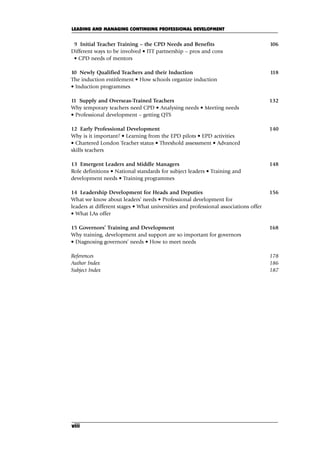
9 Initial Teacher Training – the CPD Needs and Benefits 106
Different ways to be involved • ITT partnership – pros and cons
• CPD needs of mentors
10 Newly Qualified Teachers and their Induction 118
The induction entitlement • How schools organize induction
• Induction programmes
11 Supply and Overseas-Trained Teachers 132
Why temporary teachers need CPD • Analysing needs • Meeting needs
• Professional development – getting QTS
12 Early Professional Development 140
Why is it important? • Learning from the EPD pilots • EPD activities
• Chartered London Teacher status • Threshold assessment • Advanced
skills teachers
13 Emergent Leaders and Middle Managers 148
Role definitions • National standards for subject leaders • Training and
development needs • Training programmes
14 Leadership Development for Heads and Deputies 156
What we know about leaders’ needs • Professional development for
leaders at different stages • What universities and professional associations offer
• What LAs offer
15 Governors’ Training and Development 168
Why training, development and support are so important for governors
• Diagnosing governors’ needs • How to meet needs
References 178
Author Index 186
Subject Index 187
LEADING AND MANAGING CONTINUING PROFESSIONAL DEVELOPMENT
A01.qxd 23/8/07 12:51 pm Page viii
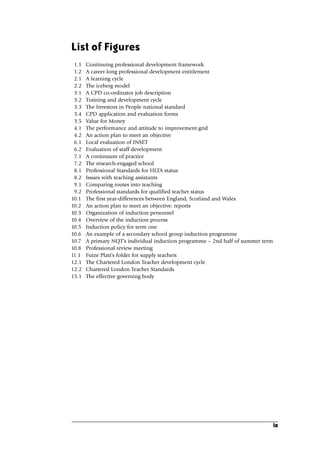
List of Figures
1.1 Continuing professional development framework
1.2 A career-long professional development entitlement
2.1 A learning cycle
2.2 The iceberg model
3.1 A CPD co-ordinator job description
3.2 Training and development cycle
3.3 The Investors in People national standard
3.4 CPD application and evaluation forms
3.5 Value for Money
4.1 The performance and attitude to improvement grid
4.2 An action plan to meet an objective
6.1 Local evaluation of INSET
6.2 Evaluation of staff development
7.1 A continuum of practice
7.2 The research-engaged school
8.1 Professional Standards for HLTA status
8.2 Issues with teaching assistants
9.1 Comparing routes into teaching
9.2 Professional standards for qualified teacher status
10.1 The first year-differences between England, Scotland and Wales
10.2 An action plan to meet an objective: reports
10.3 Organization of induction personnel
10.4 Overview of the induction process
10.5 Induction policy for term one
10.6 An example of a secondary school group induction programme
10.7 A primary NQT’s individual induction programme – 2nd half of summer term
10.8 Professional review meeting
11.1 Furze Platt’s folder for supply teachers
12.1 The Chartered London Teacher development cycle
12.2 Chartered London Teacher Standards
15.1 The effective governing body
ix
A01.qxd 23/8/07 12:51 pm Page ix
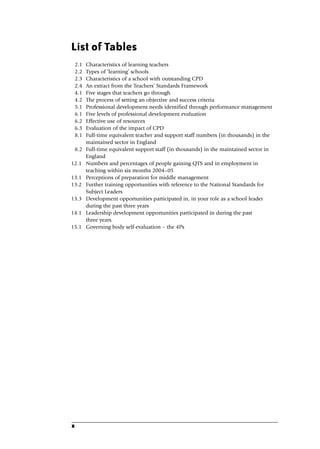
List of Tables
2.1 Characteristics of learning teachers
2.2 Types of ‘learning’ schools
2.3 Characteristics of a school with outstanding CPD
2.4 An extract from the Teachers’ Standards Framework
4.1 Five stages that teachers go through
4.2 The process of setting an objective and success criteria
5.1 Professional development needs identified through performance management
6.1 Five levels of professional development evaluation
6.2 Effective use of resources
6.3 Evaluation of the impact of CPD
8.1 Full-time equivalent teacher and support staff numbers (in thousands) in the
maintained sector in England
8.2 Full-time equivalent support staff (in thousands) in the maintained sector in
England
12.1 Numbers and percentages of people gaining QTS and in employment in
teaching within six months 2004–05
13.1 Perceptions of preparation for middle management
13.2 Further training opportunities with reference to the National Standards for
Subject Leaders
13.3 Development opportunities participated in, in your role as a school leader
during the past three years
14.1 Leadership development opportunities participated in during the past
three years.
15.1 Governing body self-evaluation – the 4Ps
x
A01.qxd 23/8/07 12:51 pm Page x
Acknowledgements
We would like to thank all those who helped and contributed in some way to the writ-
ing of this book, particularly Graham Handscomb for writing Chapter 7. We would also
like to thank all the teachers who come on our CPD and higher degree courses. They
stimulate thought and help keep our feet on the ground!
Most of all, we must thank our families – especially Paul, Julian, Miranda and Oliver
– for their encouragement and tolerance.
Publisher’s note
Every effort has been made to acknowledge any copyrighted material reprinted herein.
However, if any copyright owners have not been located and contacted at the time of
publication, the publishers will be pleased to make the necessary arrangements at the
first opportunity.
xi
A01.qxd 23/8/07 12:51 pm Page xi
Preface
This book has been written for those who lead and manage continuing professional
development (CPD). Continuing professional development co-ordinators hold a key
role and one that needs to be developed further in many schools and colleges. We hope
that this book helps people think more deeply about the professional development and
training of staff – all staff – in schools and other organizations. We hope, too, that it will
lead to even better practice.
The last decade or so has seen a growing recognition, in schools and colleges, that peo-
ple matter and that attention must be given to their needs, especially those concerning
their professional and personal development and growth. This is perhaps best epitomized
by the government’s emphasis on lifelong learning and the introduction in 2001 of a strat-
egy for continuing professional development. In 2004, the (then) Teacher Training Agency
(TTA) was asked to expand its remit and to bring its expertise to bear in three new areas:
(a) to improve the training and development of the wider workforce in schools; (b) to pro-
vide more co-ordinated and coherent support for the continuing professional develop-
ment of teachers and support staff; and, (c) to link all its work to the emerging children’s
agenda. With the increase in mentoring and coaching, devolved funding to schools and
professional standards that recognize the contribution of teachers to the learning of their
colleagues, the school’s role in leading and supporting staff learning is more crucial than
ever before with remodelling as a vital tool to help schools adopt creative, innovative solu-
tions to enhance their capacity to develop as learning-centred communities. Alongside this
recognition of the importance of people there has been a growing awareness that schools
do not always manage their staff – their human resources – as well as perhaps they might.
The quality and quantity of professional development that individuals experience is huge-
ly variable, largely depending on what school they are in.
We hope that this book will help improve human resource development and its
management and leadership so that more people get a better deal and that CPD is given
the attention it merits.
In writing this book we have tried to do two things. First, we have summarized the
most recent relevant research – some of which we have been personally involved in – to
highlight the issues and current state of affairs. This gives a firm foundation for CPD
co-ordinators leading and managing professional development. Secondly, we have given
examples and case studies of good practice drawn from a wide range of schools.
The book is made up of two parts. After an introductory chapter which examines the
notion of continuing professional development, locating it within the wider context of
human resource development, Part I is entitled ‘Professional development for school
improvement’. We argue that individual professional development is crucially important
and that the professional growth and learning of staff is crucial to school improvement.
How adults and schools learn is the focus of Chapter 2, which also examines the notion
of the learning-centred community and effective professional development. It is impor-
tant to remember that development cannot be forced and that teachers and other staff
who are excited and motivated by the experience of their own learning are likely to com-
municate that excitement to the pupils.
What we know about effective leadership and management of CPD is the theme of
Chapter 3 where the training and development cycle is introduced. This cycle – of needs
identification, meeting the training and development needs of staff, and monitoring
and evaluating the impact of CPD (what Ofsted has termed ‘the logical chain’) – forms
the substance of the next three chapters, whilst the final chapter of Part I, written by
Graham Handscomb, examines the importance of collaborative enquiry, the sharing of
practice and the growth of the self-researching or the ‘research-engaged’ school. In all of
these chapters, indeed throughout the book, we draw upon latest research and examples
of good practice, where possible giving case studies and pen portraits.
xii
A01.qxd 23/8/07 12:51 pm Page xii
Part II of the book – ‘Leading and managing the CPD of specific groups’ – examines
the implications of the training and development cycle for those who work in schools.
We look at specific groups or categories in schools – support staff, newly qualified teach-
ers (NQTs), teachers in the first five years, supply teachers, middle managers, school
leaders and governors. The issues around their roles and development needs are consid-
ered and we suggest ways in which they might be met.
Although our focus is predominantly on schools we argue throughout the book that
for CPD to be effective it has to be well led and managed at three levels, that of the
school, the local authority and at a national level. The key goal of all educational organ-
izations is pupil learning, whereas the on-going learning of teachers, support staff and
other employees is not always prioritized or adequately resourced. Creating a culture of
learning is crucial and this is shaped essentially by the attitude and approach of school
leaders and governors towards CPD. There is a need to ensure that individual or person-
al development is not marginalized as it is crucial to teacher effectiveness and thus to
the success of the school. Schools need to achieve a healthy complementarity or interre-
lationship between system and individual needs – something that has been absent over
the past two decades. The balance needs to be right.
We hope those in schools who are responsible for leading and managing CPD will
find the book helpful. For if one of the keys to effective CPD is to ensure it is effectively
led and managed, then the role of CPD co-ordinators needs to be given the kudos and
time it requires to be done well. The book has been written with this in mind.
Sara Bubb and Peter Earley
Institute of Education, University of London
June 2007
PREFACE
xiii
A01.qxd 23/8/07 12:51 pm Page xiii
About the Authors
Sara Bubb is an experienced London teacher who helps staff in schools develop. She
does this in many ways: through leading professional development, assessing, develop-
ing schemes, researching and writing.
With a national and international reputation in the induction of new teachers and
professional development, Sara speaks at conferences and runs courses throughout the
country and abroad (e.g. Norway, Taiwan) on topics such as helping staff develop, obser-
vation skills, induction, developing pedagogical skills, leading CPD, subject leadership,
monitoring teaching and implementing performance management. She has featured on
and been a consultant for eight Teachers TV programmes. She trains a broad range of
people, including inspectors, assessors, advisers, consultants, Fasttrack, TeachFirst and
advanced skills teachers.
Sara assesses advanced skills, excellent, overseas trained and graduate teachers and
higher level teaching assistants and was an external assessor for Threshold. She has
inspected over 25 primary schools.
As a senior lecturer at the Institue of Education (0.2) she works on PGCE and Masters
programmes and set up the employment based routes (OTT and GTP) to QTS. She is
lead director of the CfBT Educational Trust-funded Sef2Si – ‘From Self Evaluation to
School Improvement: the role of effective professional development’ project. She co-
directed the DfES-funded national research Project on the Effectiveness of the Induction
Year, was deputy director of the TTA systematic review of induction research and helped
the Northern Ireland GTC revise their teacher competences.
On a 0.2 secondment to the (then) DfES London Challenge team, Sara is the con-
sultant for Chartered London Teacher status – a scheme involving over 38,600 teachers.
She is the London Gifted and Talented Early Years network leader, working with staff in
reception and nursery classes to enhance their provision for all children, especially the
most able.
She has written books and numerous articles on induction, professional develop-
ment, workload, and performance management. She is the new teacher expert at the
Times Educational Supplement, and writes articles, a weekly advice column and answers
questions on its website.
Professor Peter Earley is Head of Education Leadership and Management Programmes
at the London Centre for Leadership in Learning at the Institute of Education, University
of London. A central research interest is leadership and he has recently completed a series
of studies of school leaders. Other research interests include school governing bodies,
school inspection, self-evaluation and professional development. He is currently co-ordi-
nating projects entitled ‘From Self Evaluation to School Improvement: the role of effec-
tive professional development’ and ‘Future Leaders: an evaluation of a pilot project’.
In addition he co-edits the practitioner journal Professional Development Today. He was
the course leader for the Institute’s Educational Leadership and Management MA and
currently is co-ordinating the EdD specialist module on ‘Leadership and Learning in
Educational Organisations’. He was until recently a school governor and a member of
the executive of the National Association of School Governors.
He has published widely and his previous books for PCP/Sage include,
Understanding School Leadership (2004) (with Dick Weindling), Managing Teacher
Workload: Work-life balance and wellbeing (2004) (with Sara Bubb), and Improving Schools
and Inspection: The Self-inspecting School (2000) (with Neil Ferguson). He has also writ-
ten, Improving Schools and Governing Bodies (1999) (with Michael Creese), Routledge and
Leadership and Management in Education: Cultures, Change and Context (2005) (with
Marianne Coleman), Oxford University Press.
xiv
A01.qxd 23/8/07 12:51 pm Page xiv
Graham Handscomb is Principal Adviser in Essex Schools, Children and Families
Directorate and has held a number of Local Authority senior management roles. He pre-
viously taught for eighteen years and was a secondary deputy headteacher. He leads
Essex’s policy and practice on initial teacher training and the continuing professional
development of teachers. He is an associate tutor with the University of Cambridge, and
Senior Member of Hughes Hall College, Cambridge. He founded the Essex Forum for
Learning and Research Enquiry (FLARE) which pioneered work on the concept of the
Research-Engaged School.
Graham is editor of Professional Development Today, and a member of the editorial
board of Teaching Thinking magazine; he has written extensively on professional devel-
opment. He is a member of numerous national bodies including the DfES Steering
Group on a three-year research project looking at the impact of school leadership on
learning; the national Thinking Skills Strategy Group, and Professional Development
Board. Graham also does work with the General Teaching Council and the Training and
Development Agency.
ABOUT THE AUTHORS
xv
A01.qxd 23/8/07 12:51 pm Page xv
Abbreviations
AST Advanced skills teacher
BECTA British Educational Communications and Technology Agency
BTEC Business and Technology Education Council
CEA Cambridge Education Associates
CEDP Career Entry and Development Profile
CLT Chartered London Teacher
CIPD Chartered Institute of Personnel and Development
CPD Continuing professional development
CSBM Certificate of School Business Management
DfEE Department for Education and Employment
DfES Department for Education and Skills
DRB Designated Recommending Body
DSBM Diploma of School Business Management
EAL English as an additional language
EDP Education development plan
EFQM European Foundation for Quality Management
EPD Early professional development
ESS Education Standard Spending
FLARE Forum for Learning and Research Enquiry
GTC General Teaching Council
GTP Graduate Teacher Programme
HEADLAMP Headteacher Leadership and Management Programme
HEI Higher education institution
HIP Headteacher Induction Programme
HLTA Higher level teaching assistant
HMCI Her Majesty’s Chief Inspector
HMI Her Majesty’s Inspectorate
HoD Head of department
HRD Human resource development
HRM Human resource management
ICT Information and communications technology
IEP Individual education plan
IiP Investors in People
ILP Individual learning plan
INSET In-service education and training
IPDP Individual professional development plans
IPPR Institute of Public Policy Research
ITET Initial teacher education and training
ITT Initial Teacher Training
IWB Interactive whiteboard
LA Local authority
LEA Local education authority
LftM Leading from the Middle
LiG Leadership Incentive Grant
LMS Local management of schools
LPSH Leadership Programme for Serving Headteachers
LSA Learning support assistant
LSC Learning and Skills Council
MFL Modern foreign languages
MPS Main pay scale
xvi
A01.qxd 23/8/07 12:51 pm Page xvi
NAGM National Association of Governors and Managers
NAHT National Association of Head Teachers
NARIC National Academic Recognition Information Centre
NC National Curriculum
NCSL National College for School Leadership
NCT Non-contact time
NERF National Education Research Forum
NFER National Foundation for Educational Research
NLC Networked Learning Communities
NOS National Occupational Standards
NPQH National Professional Qualification for Headship
NVQ National vocational qualification
NQT Newly qualified teacher
Ofsted Office for Standards in Education
OSHLI Out of School Hours Learning Initiative
OTT Overseas-trained teacher
PDC Professional development centre
PDP Professional development profile
PGCE Postgraduate certificate in education
PM Performance management
PSLN Primary School Learning Network
QTS Qualified teacher status
RB Recommending body
RE Religious education
SCITT School-centred initial teacher training
SDP School development plan
SEF Self-evaluation form
SEN Special educational needs
SENCO Special educational needs co-ordinator
SHA Secondary Heads Association
SMT Senior management team
SNA Special needs assistant
STA Specialist teacher assistant
SWOT Strengths, weaknesses, opportunities and threats
TA Teaching assistant
TDA Training and Development Agency for Schools
TDLB Training development lead body
TES Times Educational Supplement
TIPD Teachers’ international professional development
TPLF Teachers’ Professional Learning Framework
TTA Teacher Training Agency
VRQ Vocationally relevant qualification
ABBREVIATIONS
xvii
A01.qxd 23/8/07 12:51 pm Page xvii
A01.qxd 23/8/07 12:51 pm Page xviii
Introduction: CPD Matters
The improvement of training and development of heads, teachers and support staff is
high on both national and local educational agendas, particularly as delegated budgets
and devolved funding have enabled all schools to become self-managing and increasingly
autonomous. Teachers, researchers, policy analysts and politicians argue that profession-
alism must increase if education is to improve. Throughout the western world, the pro-
fessionalism of teachers has been placed under considerable pressure by the move
towards centralized curricula and assessment, and the use of performance data and out-
come measures as a means to account for and improve what goes on in classrooms.
This chapter provides the context and rationale for the book arguing strongly that for
schools and colleges to improve urgent attention must be given to their main resource
– their people. It attempts to define continuing professional development (CPD) and to
show that the focus on it is not new. This introductory chapter also provides a strong
case or rationale for taking the management and leadership of CPD seriously, whilst also
offering a framework for understanding CPD. Finally, it concludes that an entitlement
to CPD or lifelong learning is the proper way forward and that all employees have a right
to work in a learning-centred community.
PEOPLE MATTER
Educational reform, especially over the last 20 years, has made imperative the need for
urgent and high-quality staff development and training. Teachers have delivered unpar-
alleled curricular change including the introduction of a ‘National Curriculum’ in 1988;
Key Stage 2 literacy and numeracy strategies ten years later and, more recently, the Key
Stage 3 and Secondary strategy, thus placing well-documented strain on the profession,
and promoting national concerns about teacher recruitment, retention and morale. The
pivotal role of teachers in the delivery of the government’s reform agenda was acknowl-
edged when it was clearly stated that ‘all our ambitions for education depend on teachers
doing well in the classroom’ (DfEE, 2001a: 3).
There is a growing recognition that the management and development of people –
human resource management (HRM) and human resource development (HRD) – is
more effective in enhancing the performance of organizations, including schools and
colleges, than any other factor. For example, the Chartered Institute of Personnel and
Development (CIPD) argue for the careful management of people as the prime resource
1
1
1
1
1
 People matter
 What is continuing professional development?
 Is the focus on CPD new?
 Taking CPD seriously
 An entitlement to CPD
C01.qxd 23/8/07 12:52 pm Page 1
of the organization, claiming that managers get better results (in terms of productivity,
customer satisfaction, profitability and employee retention) by managing and develop-
ing people better. Within the sphere of education, Riches and Morgan were probably the
first to recognize that the truly key and scarce organizational resource was not finance or
money but excellent people when they stated:
Of all the resources at the disposal of a person or an organisation it is only people who can grow
and develop and be motivated to achieve certain desired ends. The attaining of targets for the
organization is in their hands and it is the way people are managed so that maximum perform-
ance is matched as closely as possible with satisfaction for the individuals doing the performing,
which is at the heart of HRM and optimum management. (1989: 1 original emphases)
People and their training and development – their continuing professional development
– must be seen as an investment and it is therefore essential that each school establish-
es not only a CPD or HRD policy but also the means of its implementation through
effective management and leadership. As funds and responsibilities are progressively
transferred to schools they can be deployed in more varied and creative ways, leading to
more responsive and effective systems of CPD. Schools and their governing bodies take
the main responsibility for developing the quality, motivation and performance of their
people – for managing and developing the human resources. The approach to CPD and
its management presented in this book is to regard the training and development of staff
as both a collective and individual responsibility – institutional and individual needs
have to be regarded in a complementary and holistic way. Schools operating in this
manner are likely to have a better motivated and higher-performing workforce.
Schools that do not look after their staff’s professional development usually lose the
best people. The arguments for professional development are clear. We believe that it:
 helps everyone be more effective in their jobs, so pupils learn and
behave better and achieve higher standards;
 improves retention and recruitment – word gets around about the
places where you are looked after, and where you are not;
 contributes to a positive ethos where people feel valued and motivated;
 makes for a learning-centred community – the pupils are learning and
so are the staff;
 is a professional responsibility and entitlement;
 saves money – the costs of recruiting and inducting a new teacher are high.
If the expertise and experience of staff are increasingly seen as a school’s most precious
resource then the management and leadership of CPD must be seen as an integral part
of managing the total resources available to the school. Some have linked CPD to objec-
tives as identified in both school development and personal development plans. In this
way it is likely that an appropriate balance will be retained between school (and group)
needs and the personal and professional needs of the individual. Staff will always feel the
need to be valued, and this should not be forgotten when considering the balance between
identifying and meeting individual and institutional needs. The effective management of
CPD should ensure that support is available and conditions created which enable staff
to work together and to develop and improve their workplace performance. By head-
teachers, CPD co-ordinators and other staff helping to create a climate or culture which
is conducive to learning – of both staff and pupils – schools are well on the road to
becoming learning-centred communities where investment in people is given the
priority it deserves. Student or pupil learning is a key goal of all schools, whereas often
the on-going learning of staff is not always prioritized or adequately resourced.
LEADING AND MANAGING CONTINUING PROFESSIONAL DEVELOPMENT
2
C01.qxd 23/8/07 12:52 pm Page 2
WHAT IS CONTINUING PROFESSIONAL DEVELOPMENT?
One of the hallmarks of being identified as a professional is to continue to learn
throughout a career. The professions, broadly defined, now cover over 20 per cent of the
workforce – more if managers are included – and most are employed in large compa-
nies or the public sector. They range from the well established and powerful to those
who are still trying to establish their professional status. The strongest are those of over
80 professions regulated by law, public authority and royal charter, where membership
or registration is necessary to practise. Continuing professional development has
become the phrase widely used for on-going education and training for the professions,
whilst ‘workforce development’ is the more general term. If teaching is seen as a profes-
sion – and a case for this has long been argued – an important characteristic or hallmark
of a member of a profession is the commitment shown towards self-improvement or
development. This is not, however, for its own sake but to ensure that the beneficiaries
or clients – in our case pupils and parents – are provided with the best possible service.
The prime responsibility for securing individual professional development of staff is
not, however, the exclusive concern of the employer – staff themselves must expect to
play a key role – and professional development opportunities must be available for indi-
viduals to help them become better practitioners.
But what do we mean by the term CPD and is it different from personal development
or staff development or in-service education and training (INSET)? Broadly speaking, con-
tinuing professional development encompasses all formal and informal learning that
enables individuals to improve their own practice. Professional development is an
aspect of personal development and, wherever possible, the two should interact and
complement each other. The former is mainly about occupational role development,
whereas personal development is about the development of the person, often the
‘whole’ person, and it almost always involves changes in self-awareness. As Waters
explains: ‘It is the development that can occur when teachers are construed first and
foremost as people, and is predicated on the premise that people are always much more
than the roles they play’ (1998: 30).
A definition of CPD might refer to: ‘any professional development activities engaged
in by teachers which enhance their knowledge and skills and enable them to consider
their attitudes and approaches to the education of children, with a view to improve the
quality of the teaching and learning process’ (Bolam, 1993: 3). In this sense it is perhaps
little different to how some have defined in-service training or staff development. The
seminal James Report (DES, 1972) defined INSET as: ‘the whole range of activities by
which teachers can extend their personal education, develop their professional compe-
tence and improve their understanding of education principles and techniques’.
An analysis of the literature does, however, reveal a number of nuances and slight dif-
ferences for the different concepts used. A simple but most useful conceptual breakdown
is offered by Bolam in his publication for the General Teaching Council where he makes
use of a threefold distinction among:
 professional training, for example, short courses, workshops and
conferences emphasizing practical information and skills;
 professional education, for example, long courses and secondments
emphasizing theory and research-based knowledge;
 professional support, for example, activities that aim to develop on the
job experience and performance. (Bolam, 1993)
Continuing professional development is an on-going process building upon initial
teacher training (ITT) and induction, including development and training opportunities
throughout a career and concluding with preparation for retirement. At different times
INTRODUCTION: CPD MATTERS
3
C01.qxd 23/8/07 12:52 pm Page 3
and at different stages one or other may be given priority, but the totality can be referred
to as continuing professional development. Development – as noted earlier – is about
improvement, both individual and school improvement.
Continuing professional development embraces those education, training and sup-
port activities engaged in by teachers following their initial certification which aim to
add to their professional knowledge; improve their professional skills; help clarify their
professional values; and enable pupils to be educated more effectively (Bolam, 1993).
In their survey of continuing education for the professions, Madden and Mitchell
(1993) state that CPD can fulfil three functions:
 updating and extending the professional’s knowledge and skills on
new developments and new areas of practice – to ensure continuing
competence in the current job;
 training for new responsibilities and for a changing role (for example,
management, budgeting, teaching) – developing new areas of
competence in preparation for a more senior post;
 developing personal and professional effectiveness and increasing job
satisfaction – increasing competence in a wider context with benefits
to both professional and personal roles.
Our definition of CPD is also wide-ranging and goes well beyond the mere acquisition
of knowledge or skills. For us staff development is:
an on-going process encompassing all formal and informal learning experiences that enable
all staff in schools, individually and with others, to think about what they are doing, enhance
their knowledge and skills and improve ways of working so that pupil learning and wellbe-
ing are enhanced as a result. It should achieve a balance between individual, group, school
and national needs; encourage a commitment to professional and personal growth; and
increase resilience, self-confidence, job satisfaction and enthusiasm for working with
children and colleagues. (Based on Bubb and Earley, 2005)
Or, put more simply, it is about creating opportunities for adult learning, ultimately for
the purpose of enhancing the quality of education in the classroom. To summarize, CPD
is an on-going process of education, training, learning and support activities which is:
 taking place in either external or work-based settings;
 engaged in by qualified, educational professionals;
 aimed mainly at promoting learning and development of their
professional knowledge, skills and values;
 to help decide and implement valued changes in their teaching and
learning behaviour so that they can educate their students more
effectively thus achieving an agreed balance between individual,
school and national needs (based on Bolam, 2003).
It is clear that long gone are the days when initial training and induction were seen as a
total or final preparation for a career in teaching; nowadays they have to be seen as mere-
ly providing a platform on which further or continuing professional development will
be built. Nevertheless, the initial period in teaching is crucial as the experience of the
first year is most formative. There is therefore a need to set high expectations and stan-
dards when there is the greatest receptiveness and willingness to learn and develop. It is
during the induction period, for example, that the support of others is crucial if new
entrants to the profession are to develop the competences, the confidence and the atti-
tudes that will serve as the basis for on-going professional development.
LEADING AND MANAGING CONTINUING PROFESSIONAL DEVELOPMENT
4
C01.qxd 23/8/07 12:52 pm Page 4
Perhaps the single most important feature of CPD is to encourage and promote a
commitment on the part of the individual to professional growth. Leading and manag-
ing people development – making CPD work – therefore means providing structures
and procedures to coordinate developmental opportunities so as to promote such
growth and to help staff develop and improve their workplace performance.
IS THE FOCUS ON CPD NEW?
Ideas about the central importance of CPD to education are not new, although they are
of fairly recent origin:
The first national enquiry into in-service education training was not mounted until 1970,
which seems to suggest that it had broadly been assumed that initial education and training
would suffice for a professional lifetime. It is an assumption rooted in a view, perhaps held
subconsciously rather than formalized as ‘policy’, that the task of the teacher remained con-
stant. (H. Tomlinson, 1993)
The James Report, published as long ago as 1972, was aware of the need to change such out-
moded views and recognize the social and cultural changes that were affecting the educa-
tion system. As a result, the further professional development of staff became a national
issue. The report, which is perhaps best known for its suggestion that teachers should be
entitled to the equivalent of one term’s release for training and development every seven
years, stressed the importance of in-service education and training, and stated that each
school should regard the continued training of its teachers as an essential part of its task
for which all members of staff share responsibility. Every school was seen as needing a
‘professional tutor’ to coordinate training and development, and to compile and maintain
‘a training programme for the staff of the school, which would take account of the curric-
ular needs of the school and of the professional needs of the teachers’ (DES, 1972). As
Williams (1993) notes in his overview of changing policies and practices, the strength of
these proposals was their focus on teachers and schools, seeing responsibility for CPD to
be that of individual staff and the schools in which they worked.
The James Report also made reference to the now widely used and accepted continu-
um of professional development – the so-called ‘three Is’ of initial teacher training,
induction and INSET. Continuing professional development should ensure that individ-
uals progress from ‘novice’ or ‘advanced beginner’ status to that of an ‘expert’. However,
expert status is not a once and for all achievement. It is on-going – new demands, a
changing curriculum and various other changes mean that learning and development
are never ending.
At the time of the James Report, training and development were seen very much as the
individual’s concern and they were not perceived as important by all staff or their
employers, the local (education) authorities (LAs). The report was followed by a num-
ber of policy and discussion documents, culminating in what has been termed ‘the
INSET revolution’ so that now CPD has ‘gradually become a priority within the educa-
tion system paralleling the rise of “human resource development” in other large organ-
isations in the public and private sectors’ (Oldroyd and Hall, 1991). The point has been
made, however, that the predominant view of INSET over the recent past is that it is cen-
trally funded and used largely to ‘retool’ and ‘retrain’ teachers so they can ‘deliver’ the
government’s reforms, particularly those associated with the 1988 Education Reform Act
and the national strategies for primary and secondary schools. John Tomlinson, for
example, identifies the early 1980s as a turning point: ‘between a time when INSET was
almost entirely left to be pursued by the individual teacher and the present view that it
must also, indeed predominantly, serve the needs of the schools and the system as well
as the personal or professional development of the individual’ (1993). We shall return
INTRODUCTION: CPD MATTERS
5
C01.qxd 23/8/07 12:52 pm Page 5
in a later chapter to this shifting emphasis of CPD provision and consider how the needs
of the ‘system’, the ‘institution’ and the ‘individual’ might be catered for.
TAKING CPD SERIOUSLY
The 2006 GTC(E) survey of teachers found clear differences in experiences of CPD that
related to professional role:
There was a gradient in response with headteachers being the most satisfied that their needs
were met; having engaged in the most different types of CPD activity; and being the most con-
fident that CPD was valued in their school and taken into account in decision-making, while
class teachers were less satisfied that their needs had been met, had experienced less variety
in CPD activity; and were less confident that CPD was valued and taken into account in their
schools. (Hutchings et al., 2006: vii)
Continuing professional development has to be seen as a collective responsibility – the
responsibility of both individual staff and the schools and colleges in which they work.
Individuals and their places of employment should take joint responsibility for profes-
sional development and training, which should be for the benefit of both. Growing atten-
tion has been given to organizational ‘cultures’ and the emphasis that may or may not be
given to the training and development or the ‘learning’ of its members. The experience and
expertise of staff – both teaching and support – are generally recognized to be the school’s
most important and most expensive resource (Earley, 1995). The term ‘learning organiza-
tion’ or ‘learning community’ is becoming more commonly known and attempts are being
made – through such initiatives as Investors in People and the school inspection frame-
work (Ofsted, 2003a; 2005) – to ensure that more schools are aware of what this means
for themselves. Leading and managing people and their development have to be seen as a
central part of the responsibility of managing the school’s total resources.
A learning community – or what we prefer to call a ‘learning-centred community’
(see next chapter) – is sensitive to its environment and constantly evolving, making use
of the skills and talents of all of its people to greatest benefit. It develops a learning cul-
ture where learning and development are valued and seen as an integral part of effective
performance, and where people are regarded as assets rather than costs to be reduced.
The term is particularly appropriate to education. In a school, for instance, the question
has to be asked how can the idea of learning be central to it if its own staff are not
engaged in that process themselves? There are two groups of learners within schools –
young people and adults – and we neglect either at our peril. If teachers and other staff
are not seen as continuous learners by the school itself, how can adults engage young-
sters in any meaningful pursuit of learning?
As any teacher who has worked in more than one school will attest, the training and
development culture may be quite different from one establishment to another. In some
schools staff’s on-going professional development is seen as integral, given great signif-
icance and very closely linked to the school improvement plan (SIP). In such places
there is an expectation that individuals and their managers will take a collective respon-
sibility for both individual and institutional development. In this sense ‘good schools’
are said to make ‘good teachers’ as much as the other way around. A school wishing to
become a learning-centred community would therefore take its CPD responsibilities
most seriously and strive to secure effective learning for both its pupils and staff. It
would subscribe heavily to a development culture and give training and development –
and its effective leadership and management – a high priority.
Investors in People – a national standard for training and development – is at the fore-
front in helping schools and colleges to embrace a development culture and become ‘learn-
ing-centred’ or ‘thinking’ schools. The learning-centred community is capable of developing
LEADING AND MANAGING CONTINUING PROFESSIONAL DEVELOPMENT
6
C01.qxd 23/8/07 12:52 pm Page 6
itself and its workforce, and a culture of training and development – of CPD – will imbue
the organization and be embedded in both its structures and processes. The fact that a sig-
nificant number of schools and colleges have been awarded Investors in People status is a
formal recognition of this. Chapter 3 considers Investors in People in more detail.
AN ENTITLEMENT TO CPD
The notion of an entitlement to CPD is something that has been promoted in England
and Wales by the General Teaching Councils. It sees an entitlement to professional
development as ‘career long and sustained so that on entry to the profession a teacher
has a clear expectation of continuing, relevant and planned professional development’.
England’s General Teaching Council (GTC) has drawn up an entitlement to profession-
al learning within its Teachers’ Professional Learning Framework (TPLF) that was published
in March 2003 (GTC[E], 2003). The GTC(E) believes that there should be a personal
entitlement to professional development throughout a teacher’s career and one that is
not linked solely to school targets.
Teachers need the opportunity to:
 Have structured time to engage in sustained reflection and structured
learning;
 Create learning opportunities from everyday practice such as planning
and assessing for learning;
 Develop their ability to identify their own learning and development
needs and those of others;
 Develop an individual learning plan;
 Have school-based learning as well as course participation, recognized
for accreditation;
 Develop self-evaluation, observation and peer review skills;
 Develop mentoring and coaching skills and their ability to offer
professional dialogue and feedback;
 Plan their longer-term career aspirations. (GTC[E], 2003: 6)
So, there is a great lever for professional development in the Teachers’ Professional Learning
Framework but, as noted earlier, anyone who has worked in more than one school will
know that the training and development culture may vary from one place to another. Carol
Adams, the (then) chief executive of the GTC (England), was clear about the need for a high
quality CPD entitlement, seeing the necessity to transform the meaning of CPD so that:
teachers and providers come to see it as lifelong access to high quality experiences that
enhance teaching for teachers and learning for learners; opportunities for teachers’ needs to
be met as and when they arise. This model stands in stark contrast with one of being ‘sent’
on a course. Activities like observing teaching and learning in a range of colleagues’ classes is
valued by teachers and those who lead them and is an important component in the GTC’s
vision. (Cordingley, 2001: 80)
In Wales the GTC considers that teachers and employers have different but complementary
responsibilities in relation to CPD (see Jones, 2003):
 employers – to provide professional development opportunities for
teachers to support a broad range of priorities which occur during the
normal work cycle and an entitlement to professional development
which focuses on the individual professional and personal needs and
objectives of the teacher is emphasized;
INTRODUCTION: CPD MATTERS
7
C01.qxd 23/8/07 12:52 pm Page 7
teachers – to develop themselves as ‘reflective professionals’ by
reflecting on their work and by identifying new ways of working.
These activities should be undertaken as part of a teacher’s work.
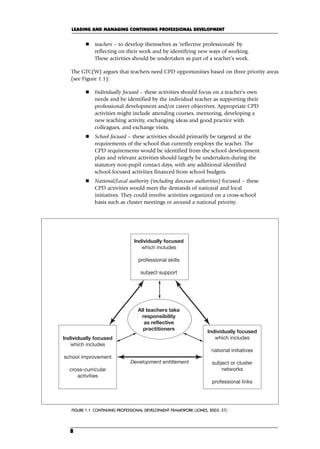
The GTC(W) argues that teachers need CPD opportunities based on three priority areas
(see Figure 1.1):
 Individually focused – these activities should focus on a teacher’s own
needs and be identified by the individual teacher as supporting their
professional development and/or career objectives. Appropriate CPD
activities might include attending courses, mentoring, developing a
new teaching activity, exchanging ideas and good practice with
colleagues, and exchange visits.
 School focused – these activities should primarily be targeted at the
requirements of the school that currently employs the teacher. The
CPD requirements would be identified from the school development
plan and relevant activities should largely be undertaken during the
statutory non-pupil contact days, with any additional identified
school-focused activities financed from school budgets.
 National/Local authority (including diocesan authorities) focused – these
CPD activities would meet the demands of national and local
initiatives. They could involve activities organized on a cross-school
basis such as cluster meetings or around a national priority.
LEADING AND MANAGING CONTINUING PROFESSIONAL DEVELOPMENT
8
All teachers take
responsibility
as reflective
practitioners
Individually focused
which includes
professional skills
subject support
Development entitlement
Individually focused
which includes
school improvement
cross-curricular
activities
Individually focused
which includes
national initiatives
subject or cluster
networks
professional links
FIGURE 1.1 CONTINUING PROFESSIONAL DEVELOPMENT FRAMEWORK (JONES, 2003: 37)
C01.qxd 23/8/07 12:52 pm Page 8
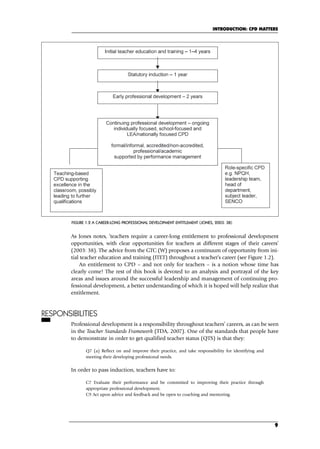
As Jones notes, ‘teachers require a career-long entitlement to professional development
opportunities, with clear opportunities for teachers at different stages of their careers’
(2003: 38). The advice from the GTC (W) proposes a continuum of opportunity from ini-
tial teacher education and training (ITET) throughout a teacher’s career (see Figure 1.2).
An entitlement to CPD – and not only for teachers – is a notion whose time has
clearly come! The rest of this book is devoted to an analysis and portrayal of the key
areas and issues around the successful leadership and management of continuing pro-
fessional development, a better understanding of which it is hoped will help realize that
entitlement.
RESPONSIBILITIES
Professional development is a responsibility throughout teachers’ careers, as can be seen
in the Teacher Standards Framework (TDA, 2007). One of the standards that people have
to demonstrate in order to get qualified teacher status (QTS) is that they:
Q7 (a) Reflect on and improve their practice, and take responsibility for identifying and
meeting their developing professional needs.
In order to pass induction, teachers have to:
C7 Evaluate their performance and be committed to improving their practice through
appropriate professional development.
C9 Act upon advice and feedback and be open to coaching and mentoring.
INTRODUCTION: CPD MATTERS
9
FIGURE 1.2 A CAREER-LONG PROFESSIONAL DEVELOPMENT ENTITLEMENT (JONES, 2003: 38)
C01.qxd 23/8/07 12:52 pm Page 9
The post-threshold standards require people to:
P10 Contribute to the professional development of colleagues through coaching and mentoring,
demonstrating effective practice, and providing advice and feedback.
Higher Level Teaching Assistants (HLTAs) are required to demonstrate that,
7. Improve their own knowledge and practice including responding to advice and feedback.
(TDA, 2007b: 2)
With the change of emphasis on the importance of training and development and
greater control from the centre, there has been a corresponding move towards a higher
degree of prescription and statutory requirements regarding CPD. The late 1980s, for
example, saw the introduction of the Teachers Pay and Conditions of Service Act (1987),
which for the first time specified teachers’ professional duties. These included, amongst
many other things, ‘participating in arrangements for his [sic] further training and pro-
fessional development as a teacher’. It did not, however, make it a statutory requirement
for teachers ‘to show any official evidence of developing, updating or even maintaining
their professional knowledge and competence’ (H. Tomlinson, 1993). The legislation
also introduced the notion of ‘directed’ time (1,265 hours) and ‘non-contact’ days. The
latter – consisting of five days when teachers met without pupils being on site – were for
the purpose of preparation, planning, assessment (PPA), review and in-service training.
Research into the use of these five days – of which at least three are recommended to be
used for CPD – suggests that they have not always been used productively by schools
(Harland et al., 1999). There is still much variation in how effectively these training days
are being used for development purposes and the introduction, through workforce
remodelling, has meant PPA should be done at other times.
In some other professions there is specified mandatory CPD for all its members. The
Royal Institute of British Architects, for example, has an obligatory requirement that mem-
bers undertake certain amounts of CPD each year. A survey of 20 professional bodies
found that 13 specified a certain number of hours – a median of 30 hours a year (Madden
and Mitchell, 1993). Professional bodies can be located on a continuum from full manda-
tory CPD requirements to individuals taking responsibility voluntarily for their own on-
going development. Teachers are perhaps found somewhere in the middle of the continu-
um. Within the teaching profession there has been no shortage of calls for CPD to be taken
more seriously, whether as a reward (the benefits model), or as compliance (the sanctions
model), and for certain ‘entitlements’ to be enshrined in legislation. However, the prob-
lem with any voluntary scheme is that those with most to gain from CPD are often the
least likely to do so, whilst mandatory policies may lead to a lack of individuality,
although the latter do ensure all members have the opportunity to develop.
CONCLUSION
Continuing professional development is about on-going or lifelong learning which will
help us respond to ever-changing situations and exercise judgement in informed and cre-
ative ways but, as Pachler and Field remind us, it should also be seen as a means for us ‘to
rejuvenate practice, to expand our professional repertoire, increase our self-esteem, self-
confidence and enthusiasm for teaching or, for example, our level of criticality and, there-
by, achieve enhanced job satisfaction’ (2004: 2). This book is about all of these and more!
LEADING AND MANAGING CONTINUING PROFESSIONAL DEVELOPMENT
10
C01.qxd 23/8/07 12:52 pm Page 10
PART I:
PROFESSIONAL DEVELOPMENT FOR
SCHOOL IMPROVEMENT
C02.qxd 23/8/07 12:53 pm Page 11
C02.qxd 23/8/07 12:53 pm Page 12
Learning People – Learning Schools
Professional development is crucial for organizational growth and school improvement.
The professional growth of teachers and other staff is a key component of developing
children’s learning. Roland Barthes, a former US principal and well-known writer on
school improvement, remarked: ‘Probably nothing within a school has more impact on
students in terms of skills development, self-confidence, or classroom behaviour than
the personal and professional development of their teachers’ (1990: 49). This is quite an
assertion, but the fundamental point he was making has been supported by research and
inspection evidence. But how does adult development and learning occur and is there
anything different about how adults learn compared to children? What do we know
about how adults best learn? Also what sort of organizational settings and cultures are
most conducive to adult or teacher development and growth? What do we know about
learning organizations or communities of learners? How do staff and schools learn?
These questions form the main themes of this chapter.
HOW ADULTS LEARN
Thinking about how adults learn is crucial for anyone involved in CPD. The way that we
understand learning will affect the provision of activities we make for people to learn,
and the accuracy of our understanding will affect the effectiveness of the learning that
takes place. Those who work in schools and other educational organizations come from
a variety of backgrounds and experiences. This needs to be recognized and built upon.
Adults have a wide variety of previous experiences, knowledge, skills, interests and com-
petences. Some prefer informal learning situations, others more formal ones. The
American writer Knowles (1984) used the term ‘andragogy’ (as opposed to pedagogy)
and noted the following characteristics of adult learners:
 They are largely self-directed and require a climate of trust, openness,
respect and collaboration to learn effectively.
 The previous experience of the learner has to be implicit in the
learning process (it is too significant to ignore).
 The adult learner needs to accept the need to learn.
 They are biased towards problem-solving as a learning activity.
13
2
2
2
2
 How adults learn
 Learning-centred communities
 What is effective CPD?
 The Standards Framework
 Professional development portfolios
C02.qxd 23/8/07 12:53 pm Page 13
Practical relevance is a significant factor in gaining commitment.
 They only internalize learning if motivated by intrinsic factors.
It is interesting to reflect on how many of these characteristics are found in most educa-
tional organizations.
Eileen Carnell, as part of research conducted over six years, found that teachers said that
effective learning experiences:
 are linked inextricably with day to day work contexts, for example, in
the classroom or working with groups of colleagues in their school;
 are challenging, developmental and take place over an extended
period of time;
 arise when people feel in control, have ownership, develop shared
aims and reciprocity – supporting and being supported by respected
colleagues;
 are participatory; the more people are engaged in activities and the more
interaction with colleagues, the more effective the activities are seen;
 are practical and relevant with opportunities for reflection, learning
and change;
 happen in a trusting, non-hierarchical environment;
 include pupil and peer learning dialogue;
 occur when staff work together in social exchange, reflecting, planning
and developing actions for change;
 focus explicitly on their own learning. (2001: 44)
The most appropriate model for thinking about professional development is one based
on experiential learning. This stresses the importance of workplace learning and learn-
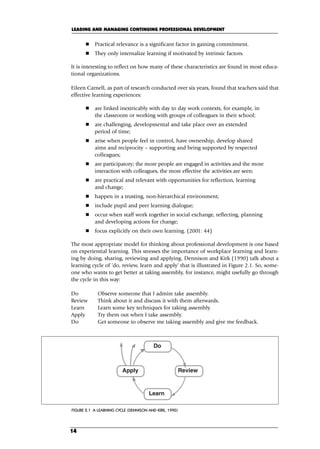
ing by doing, sharing, reviewing and applying. Dennison and Kirk (1990) talk about a
learning cycle of ‘do, review, learn and apply’ that is illustrated in Figure 2.1. So, some-
one who wants to get better at taking assembly, for instance, might usefully go through
the cycle in this way:
Do Observe someone that I admire take assembly.
Review Think about it and discuss it with them afterwards.
Learn Learn some key techniques for taking assembly.
Apply Try them out when I take assembly.
Do Get someone to observe me taking assembly and give me feedback.
LEADING AND MANAGING CONTINUING PROFESSIONAL DEVELOPMENT
14
FIGURE 2.1 A LEARNING CYCLE (DENNISON AND KIRK, 1990)
C02.qxd 23/8/07 12:53 pm Page 14
LEARNING STYLES
Howard Gardner’s theory of multiple intelligences and our awareness of visual, auditory
or kinaesthetic learning styles are useful in teaching children. Similarly, different adults
learn in different ways and have preferred learning styles. Probably the best known
analysis of this is that of Honey and Mumford (2006a). They identify four types of learn-
ers: theorists, pragmatists, activists and reflectors.
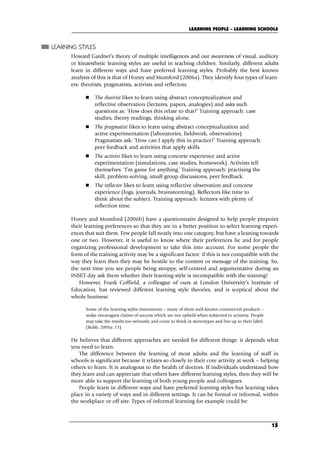
 The theorist likes to learn using abstract conceptualization and
reflective observation (lectures, papers, analogies) and asks such
questions as: ‘How does this relate to that?’ Training approach: case
studies, theory readings, thinking alone.
 The pragmatist likes to learn using abstract conceptualization and
active experimentation (laboratories, fieldwork, observations).
Pragmatists ask: ‘How can I apply this in practice?’ Training approach:
peer feedback and activities that apply skills.
 The activist likes to learn using concrete experience and active
experimentation (simulations, case studies, homework). Activists tell
themselves: ‘I’m game for anything.’ Training approach: practising the
skill, problem-solving, small group discussions, peer feedback.
 The reflector likes to learn using reflective observation and concrete
experience (logs, journals, brainstorming). Reflectors like time to
think about the subject. Training approach: lectures with plenty of
reflection time.
Honey and Mumford (2006b) have a questionnaire designed to help people pinpoint
their learning preferences so that they are in a better position to select learning experi-
ences that suit them. Few people fall neatly into one category, but have a leaning towards
one or two. However, it is useful to know where their preferences lie and for people
organizing professional development to take this into account. For some people the
form of the training activity may be a significant factor: if this is not compatible with the
way they learn then they may be hostile to the content or message of the training. So,
the next time you see people being stroppy, self-centred and argumentative during an
INSET day ask them whether their learning style is incompatible with the training!
However, Frank Coffield, a colleague of ours at London University’s Institute of
Education, has reviewed different learning style theories, and is sceptical about the
whole business:
Some of the learning styles instruments – many of them well-known commercial products –
make extravagant claims of success which are not upheld when subjected to scrutiny. People
may take the results too seriously and come to think in stereotypes and live up to their label.
(Bubb, 2005a: 15)
He believes that different approaches are needed for different things: it depends what
you need to learn.
The difference between the learning of most adults and the learning of staff in
schools is significant because it relates so closely to their core activity at work – helping
others to learn. It is analogous to the health of doctors. If individuals understand how
they learn and can appreciate that others have different learning styles, then they will be
more able to support the learning of both young people and colleagues.
People learn in different ways and have preferred learning styles but learning takes
place in a variety of ways and in different settings. It can be formal or informal, within
the workplace or off site. Types of informal learning for example could be:
LEARNING PEOPLE – LEARNING SCHOOLS
15
C02.qxd 23/8/07 12:53 pm Page 15
planned – but other things may be learned too;
 reactive and unplanned – the day to day learning from doing;
 implicit – learning that the individual is unaware of, but which has
taken place and which others may notice (Williams, 2002).
One can also think of learning in vertical and horizontal dimensions:
 vertical – knowing more, new learning and experiences;
 horizontal – the same knowledge applied in different contexts, deeper
understanding.
So people do not always have to learn new things to be developing professionally.
There is no easy answer to the question ‘what needs to be done to help adults
become better learners?’ but the following are worth asking:
 How open are individuals to new experiences?
 Are they seen as opportunities for learning?
 Do individuals learn from mistakes that may have been made?
 Is becoming a better learner largely a state of mind?
 Does the school help or hinder learning?
For change to occur in practices then priority must be given to the personal resources
and capacity for learning of individuals. Responding to new demands requires a range
of skills and qualities (for example, problem-solving, stress management, interpersonal
skills) and effective CPD is about empowering staff so they can prepare for change. It is
as much concerned with the affective as the cognitive; process skills as with outcomes;
and personal growth as much as technical competence (West-Burnham and O’Sullivan,
1998). The VITAE project (Day et al., 2006) recommended that any CPD should target
both instrumental needs and those designed to support individuals’ commitment and
resilience. It needs to support rather than erode staff’s sense of positive identity and con-
tribute to their wellbeing, job satisfaction, sense of achievement and capacities to main-
tain upward trajectories of commitment.
LEARNING STAFF
The role of CPD in the development of learning-centred communities has focused dis-
cussion on the ways in which staff learn most successfully. Eileen Carnell has drawn up
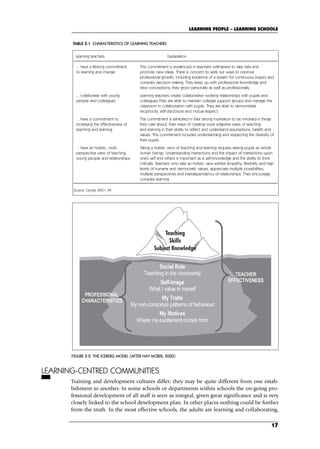
features of teachers who make good progress in their learning (see Table 2.1).
People need time after any development activity to consolidate thoughts into new
and novel contexts. Small-scale action research or teacher practitioner projects undertak-
en after the development activity are likely to have a powerful impact on staff, as is
shown in Chapter 7. An Ofsted report on CPD (Ofsted, 2002a) also draws attention to
the importance of preparation time before professional development, and consolida-
tion time afterwards.
The Hay Group’s ‘iceberg’ model (see Figure 2.2) is useful in illustrating the impor-
tance of looking at the whole person. Personalized learning shouldn’t just be for pupils
but for staff too, so we need to look below the surface at people’s motives, personality,
self-esteem and roles outside school. Professional development that takes these into
account will be very powerful.
A key task of managers of CPD is to encourage and develop ‘learning adults’ and to facil-
itate planned learning and development opportunities. This can be done in a variety of ways
but especially by offering a structured programme of on-the-job, close-to-the-job and off-the-
job opportunities, and a culture of development within which staff feel valued in the job they
do. All of the above are likely to be found within learning-centred communities.
LEADING AND MANAGING CONTINUING PROFESSIONAL DEVELOPMENT
16
C02.qxd 23/8/07 12:53 pm Page 16
LEARNING-CENTRED COMMUNITIES
Training and development cultures differ; they may be quite different from one estab-
lishment to another. In some schools or departments within schools the on-going pro-
fessional development of all staff is seen as integral, given great significance and is very
closely linked to the school development plan. In other places nothing could be further
from the truth. In the most effective schools, the adults are learning and collaborating,
LEARNING PEOPLE – LEARNING SCHOOLS
17
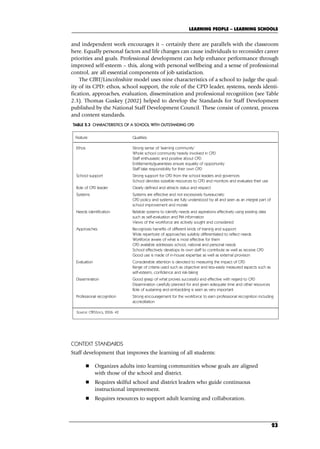
Learning teachers Explanation
... have a lifelong commitment This commitment is evidenced in teachers' willingness to take risks and
to learning and change promote new ideas. There is concern to seek out ways to improve
professional growth, including evidence of a system for continuous inquiry and
complex decision-making. They keep up with professional knowledge and
new conceptions; they grow personally as well as professionally.
... collaborate with young Learning teachers create collaborative working relationships with pupils and
people and colleagues colleagues.They are able to maintain collegial support groups and manage the
classroom in collaboration with pupils. They are able to demonstrate
reciprocity, self-disclosure and mutual respect.
... have a commitment to This commitment is exhibited in their strong motivation to be involved in things
increasing the effectiveness of they care about, their ways of creating more adaptive ways of teaching
teaching and learning and learning in their ability to reflect and understand assumptions, beliefs and
values. This commitment includes understanding and respecting the diversity of
their pupils.
... have an holistic, multi- Taking a holistic view of teaching and learning requires seeing pupils as whole
perspective view of teaching, human beings. Understanding interactions and the impact of interactions upon
young people and relationships one's self and others is important as is self-knowledge and the ability to think
critically. Teachers who take an holistic view exhibit empathy, flexibility and high
levels of humane and democratic values, appreciate multiple possibilities,
multiple perspectives and interdependency of relationships. They encourage
complex learning.
Source: Carnell, 2001: 49
TABLE 2.1 CHARACTERISTICS OF LEARNING TEACHERS
FIGURE 2.2 THE ICEBERG MODEL (AFTER HAY MCBER, 2000)
C02.qxd 23/8/07 12:53 pm Page 17
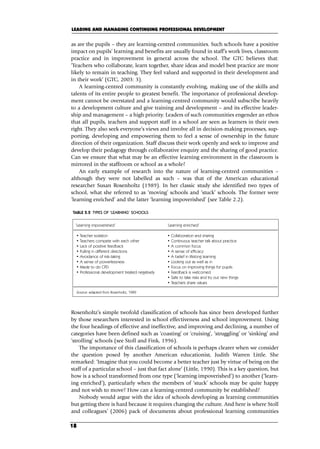
as are the pupils – they are learning-centred communities. Such schools have a positive
impact on pupils’ learning and benefits are usually found in staff’s work lives, classroom
practice and in improvement in general across the school. The GTC believes that:
‘Teachers who collaborate, learn together, share ideas and model best practice are more
likely to remain in teaching. They feel valued and supported in their development and
in their work’ (GTC, 2003: 3).
A learning-centred community is constantly evolving, making use of the skills and
talents of its entire people to greatest benefit. The importance of professional develop-
ment cannot be overstated and a learning-centred community would subscribe heavily
to a development culture and give training and development – and its effective leader-
ship and management – a high priority. Leaders of such communities engender an ethos
that all pupils, teachers and support staff in a school are seen as learners in their own
right. They also seek everyone’s views and involve all in decision-making processes, sup-
porting, developing and empowering them to feel a sense of ownership in the future
direction of their organization. Staff discuss their work openly and seek to improve and
develop their pedagogy through collaborative enquiry and the sharing of good practice.
Can we ensure that what may be an effective learning environment in the classroom is
mirrored in the staffroom or school as a whole?
An early example of research into the nature of learning-centred communities –
although they were not labelled as such – was that of the American educational
researcher Susan Rosenholtz (1989). In her classic study she identified two types of
school, what she referred to as ‘moving’ schools and ‘stuck’ schools. The former were
‘learning enriched’ and the latter ‘learning impoverished’ (see Table 2.2).
Rosenholtz’s simple twofold classification of schools has since been developed further
by those researchers interested in school effectiveness and school improvement. Using
the four headings of effective and ineffective, and improving and declining, a number of
categories have been defined such as ‘coasting’ or ‘cruising’, ‘struggling’ or ‘sinking’ and
‘strolling’ schools (see Stoll and Fink, 1996).
The importance of this classification of schools is perhaps clearer when we consider
the question posed by another American educationist, Judith Warren Little. She
remarked: ‘Imagine that you could become a better teacher just by virtue of being on the
staff of a particular school – just that fact alone’ (Little, 1990). This is a key question, but
how is a school transformed from one type (‘learning impoverished’) to another (‘learn-
ing enriched’), particularly when the members of ‘stuck’ schools may be quite happy
and not wish to move? How can a learning-centred community be established?
Nobody would argue with the idea of schools developing as learning communities
but getting there is hard because it requires changing the culture. And here is where Stoll
and colleagues’ (2006) pack of documents about professional learning communities
LEADING AND MANAGING CONTINUING PROFESSIONAL DEVELOPMENT
18
‘Learning impoverished’ ‘Learning enriched’
• Teacher isolation • Collaboration and sharing
• Teachers compete with each other • Continuous teacher talk about practice
• Lack of positive feedback • A common focus
• Pulling in different directions • A sense of efficacy
• Avoidance of risk-taking • A belief in lifelong learning
• A sense of powerlessness • Looking out as well as in
• Made to do CPD • Focus on improving things for pupils
• Professional development treated negatively • Feedback is welcomed
• Safe to take risks and try out new things
• Teachers share values
Source: adapted from Rosenholtz, 1989
TABLE 2.2 TYPES OF ‘LEARNING’ SCHOOLS
C02.qxd 23/8/07 12:53 pm Page 18
(PLCs) is a godsend to busy professional development co-ordinators. The pack contains
a sheet explaining what PLCs are, a user guide, and a route map to assist in planning
your journey through the 13 booklets. After some activities that help deepen under-
standing about PLCs, these materials give step by step suggestions of how to audit an
organization, plan its development, ideas for action, and lastly how to monitor and
evaluate its impact.
Across the pack there are a range of different activities such as reading short articles,
auditing current practice and sorting quotations into different characteristics of PLCs.
Identifying your present school culture is a sensible place to start and these materials
suggest fun ways to do so, such as looking at what messages the entrance area conveys,
asking pupils to take photos, and getting staff to think of metaphors for what their learn-
ing community is like.
The isolation that most teachers experience needs to be replaced with a climate that
encourages observation, sharing teaching strategies, trying out new ways of teaching, get-
ting feedback, and redesigning curriculum and methods of instruction (Bezzina, 2002).
People in such groups become a ‘community of practice’ (Wenger, 1998).
Research tells us there are eight key characteristics of effective professional learning
communities:
1. shared values and vision;
2. collective responsibility for pupils’ learning;
3. collaboration focused on learning;
4. individual and collective professional learning;
5. reflective professional enquiry;
6. openness, networks and partnerships;
7. inclusive membership;
8. mutual trust, respect and support (Bolam et al., 2005).
PLCs are created, managed and sustained through four processes: optimizing resources
and structures; promoting individual and collective learning; explicitly promoting,
monitoring and sustaining the learning community; and leading and managing CPD
well. The following play an important role:
 school-based formal professional development opportunities – a solid
basis of expert knowledge and skills and practical tools for implementing
CPD (for example, professional development profiles, coaching and
mentoring);
 work-based and incidental learning opportunities, based on theories
of adult learning (for example, experimenting with and reflecting on
pedagogical practices, experiential learning, problem-based learning
and meta-learning);
 teamwork at both group and whole-school level (for example,
problem-solving and creative activities within departments, key stage
and pastoral groups, strategic leadership groups, teams developing
whole-school policies or leading school improvement activities);
 self-evaluation and inquiry, action research, and using evidence to
inform practice (for example, Ofsted reports, pupil and teacher
surveys, assessment of pupils’ progress, eliciting feedback from
parents);
LEARNING PEOPLE – LEARNING SCHOOLS
19
C02.qxd 23/8/07 12:53 pm Page 19
partnerships with people from LAs, higher education, local businesses,
and so on, involving a rethinking of the way each institution operates
as well as how staff might work as part of this partnership;
 external professional development opportunities, including courses,
higher degrees, membership of local working parties;
 networking through teachers and other members of school
communities linking up with each other to share ideas, disseminate
good practice, discuss and resolve problems, challenge each other’s
thinking and create new knowledge;
 critical friendships involving external agents who play a role in
promoting inquiry-mindedness in school communities by helping
those in schools to interpret and use data, bringing an outsider’s eye
to school activities and supportively challenging assumptions;
 leadership, management and co-ordination of professional activities
(Stoll et al., 2003: 5–6. See also Stoll et al., 2006).
Effective leaders help shape the culture of a school by their behaviour. They lead the
learning. This might be by constantly questioning the status quo to find better ways of
achieving goals, creating environments where positive results and credits are celebrated;
evaluating and affirming people; or by thinking positively and realizing that every prob-
lem presents a learning opportunity. Groups of staff who correspond outside of school,
either electronically or in face-to-face groups or meetings or networks, show great poten-
tial as sites for focused, on-going and self-directed inquiry.
NETWORKED LEARNING COMMUNITIES
In England, the National College for School Leadership (NCSL) has encouraged net-
worked learning communities to promote change through learning at multiple levels of
the education system. The networks are made up of at least six schools and a higher edu-
cation institution, and the underpinning notion is that the learning is from each other,
with each other and on behalf of each other. An example of a networked learning com-
munity is offered by Kellow (2003) who describes the origins of the Primary Schools
Learning Network (PSLN) in Milton Keynes.
Networks provide:
 opportunities for staff to both gain and generate knowledge;
 a variety of collaborative structures;
 flexibility and informality;
 discussion of problems that have no agreed-upon solutions;
 ideas that challenge staff rather than merely prescribing generic solutions;
 an organizational structure that can be independent of, yet attached
to, schools or universities;
 a chance to work across schools and district/local authority lines;
 a vision of reform that excites and encourages risk-taking in a
supportive environment;
 a community that respects teachers’ knowledge as well as knowledge
from research and reform (Lieberman, 1999).
The NCSL website (www.ncsl.org.uk) has many useful resources related to networked
learning communities. There are six interconnected levels of learning, which are the
foundations for each network:
LEADING AND MANAGING CONTINUING PROFESSIONAL DEVELOPMENT
20
C02.qxd 23/8/07 12:53 pm Page 20
pupil learning – pupils tell us about themselves as learners;
 adult learning – through joint work, adults teach each other the art and
craft of teaching;
 leadership for learning and leadership development – leaders coach and
facilitate others to lead;
 school-wide learning – adults become better every year at supporting
pupil learning, just because they work in this school and network;
 school-to-school learning – our schools learn more because they are
learning together;
 network-to-network learning – we feel part of a learning profession.
WHAT IS EFFECTIVE CPD?
Any discussion of what constitutes effective professional development needs to begin by
asking effective for whom – the individual, the school and its pupils, or the education
system as a whole? And for what? The beneficiaries of CPD may not always over-lap,
although in many cases they will; what is helpful for an individual is also likely to be of
benefit both for pupils and the school. On the other hand, training to meet the latest
government initiative may be effective for implementing a particular strategy but not
necessarily for the overall long-term development of staff. Effective CPD is likely to con-
sist of that which first and foremost enhances pupil outcomes, but which also helps to
bring about changes in practice and improves teaching, management and leadership
skills and qualities. It should be ‘fit for purpose’ and add something to the school’s over-
all capacity to develop; the school should be able to build upon the collective learning
of its people. Exposure to and participation in a wide range of professional development
opportunities are likely to bring about change to individuals’ beliefs, values, attitudes
and behaviours, and these may well lead to changes in classroom and school practices.
Any change should, however, lead to improvement; we are not talking about change for
change’s sake!
Ultimately, effective CPD should lead to improvements in the five outcomes of the
Every Child Matters agenda through supporting all children to:
1 Be healthy.
2 Stay safe.
3 Enjoy and achieve.
4 Make a positive contribution.
5 Achieve economic wellbeing.
Much has been written about what constitutes effective CPD (e.g. a series of EPPI
reviews conducted by Cordingley et al., 2004, 2005, 2006) but it should be remembered
that the characteristics influencing effectiveness are multiple and highly complex. We
should therefore begin with an important caveat: the technical and methodological
problems of measuring the direct effects or impact of CPD especially on classroom per-
formance – of both staff and pupils – are considerable. This is, amongst other reasons,
because the term embraces a wide variety of modes and methods, and includes profes-
sional training, education and support. The number of variables to be taken into
account is considerable. In Chapter 6, for example, we show how the ‘impact’ of a course
or a piece of training may be mediated through a number of factors.
Continuing professional development can only have an indirect impact on pupil
learning and outcomes. Very few research studies have considered the relationship
LEARNING PEOPLE – LEARNING SCHOOLS
21
C02.qxd 23/8/07 12:53 pm Page 21
between the characteristics of professional development and any change in classroom
teaching practice or the gains in pupil achievement or learning outcomes more broadly.
Despite this, there is a growing body of research evidence and informed professional
judgement that gives a broad indication of the essential characteristics of effective CPD.
An early National Foundation for Educational Research (NFER) study found effective
CPD could take a variety of forms but had a number of key characteristics. These includ-
ed the clear identification of aims and objectives, along with an analysis of training
needs to ensure training and development activities matched existing levels of expertise.
Training needs were identified at school level following appraisal (performance manage-
ment) and/or the drawing up of the school development plan. Opportunities for reflec-
tion were also important, as were action research, on-going evaluation and follow-up
work. Effective training was seen to form part of a coherent programme and was not a
‘one-off’ activity. The optimum use of existing resources and facilities was most likely
when CPD activities were well planned, helping to promote targeted and tailor-made
training, avoiding overload and minimizing disruption (Brown and Earley, 1990).
In 2002, Her Majesty’s Inspectors found that:
Teachers, line managers and CPD co-ordinators rarely assembled an array of CPD activities to
form a coherent individual training plan, designed to bring about specific improvement in a
teacher’s knowledge and skills. More often teachers worked on a range of loosely related activities
that did not always provide good value or achieve the intended outcome. (Ofsted, 2002a: 3)
The report concluded that schools ‘failed to allow enough time to support effective pro-
fessional development and to ensure that acquired knowledge and skills were consoli-
dated, implemented and shared with other teachers’ (Ofsted, 2002a: 3).
More recently, Ofsted describes the management of professional development as a
logical chain of procedures, which entails ‘identifying school and staff needs, planning
to meet those needs, providing varied and relevant activities, involving support staff
alongside teachers, monitoring progress and evaluating the impact of the professional
development’. They note that schools which had designed their CPD effectively and inte-
grated it with their improvement plans found that teaching and learning improved and
standards rose (Ofsted, 2006: 2).
Fragmented ‘one-shot’ workshops and conferences at which staff listen passively to
‘experts’ rarely make a difference. As Boyle and colleagues point out, these traditional
approaches to professional development appear insufficient to foster learning which fun-
damentally alters what teachers teach or how they teach. The following types of profes-
sional development activities are more likely to offer sustained learning opportunities:
 study groups in which staff are engaged on regular, structured and
collaborative interactions around topics identified by the group;
 observation – observing others and being observed;
 coaching or mentoring arrangements, where staff work one-on-one
with an equally or more experienced teacher;
 networks, which link people either in person or electronically, to
explore and discuss topics of interest, pursue common goals, share
information and address common concerns;
 immersion in inquiry, in which people engage in the kinds of learning
that they are expected to practise with their students (Boyle et al.,
2003: 3).
Involvement in development activities by staff is, to a large extent, voluntary but there
are a number of factors that will encourage participation. Boring, repetitive and dependent
work discourages professional development and growth, whereas challenging, variable
LEADING AND MANAGING CONTINUING PROFESSIONAL DEVELOPMENT
22
C02.qxd 23/8/07 12:53 pm Page 22
and independent work encourages it – certainly there are parallels with the classroom
here. Equally personal factors and life changes can cause individuals to reconsider career
priorities and goals. Professional development can help enhance performance through
improved self-esteem – this, along with personal wellbeing and a sense of professional
control, are all essential components of job satisfaction.
The CfBT/Lincolnshire model uses nine characteristics of a school to judge the qual-
ity of its CPD: ethos, school support, the role of the CPD leader, systems, needs identi-
fication, approaches, evaluation, dissemination and professional recognition (see Table
2.3). Thomas Guskey (2002) helped to develop the Standards for Staff Development
published by the National Staff Development Council. These consist of context, process
and content standards.
CONTEXT STANDARDS
Staff development that improves the learning of all students:
 Organizes adults into learning communities whose goals are aligned
with those of the school and district.
 Requires skilful school and district leaders who guide continuous
instructional improvement.
 Requires resources to support adult learning and collaboration.
LEARNING PEOPLE – LEARNING SCHOOLS
23
Feature Qualities
Ethos Strong sense of ‘learning community’
Whole school community heavily involved in CPD
Staff enthusiastic and positive about CPD
Entitlements/guarantees ensure equality of opportunity
Staff take responsibility for their own CPD
School support Strong support for CPD from the school leaders and governors
School devotes sizeable resources to CPD and monitors and evaluates their use
Role of CPD leader Clearly defined and attracts status and respect
Systems Systems are effective and not excessively bureaucratic
CPD policy and systems are fully understood by all and seen as an integral part of
school improvement and morale
Needs identification Reliable systems to identify needs and aspirations effectively using existing data
such as self-evaluation and PM information
Views of the workforce are actively sought and considered
Approaches Recognizes benefits of different kinds of training and support
Wide repertoire of approaches suitably differentiated to reflect needs
Workforce aware of what is most effective for them
CPD available addresses school, national and personal needs
School effectively develops its own staff to contribute as well as receive CPD
Good use is made of in-house expertise as well as external provision
Evaluation Considerable attention is devoted to measuring the impact of CPD
Range of criteria used such as objective and less-easily measured aspects such as
self-esteem, confidence and risk-taking
Dissemination Good grasp of what proves successful and effective with regard to CPD
Dissemination carefully planned for and given adequate time and other resources
Role of sustaining and embedding is seen as very important
Professional recognition Strong encouragement for the workforce to earn professional recognition including
accreditation
Source: CfBT/Lincs, 2006: 42
TABLE 2.3 CHARACTERISTICS OF A SCHOOL WITH OUTSTANDING CPD
C02.qxd 23/8/07 12:53 pm Page 23
LEADING AND MANAGING CONTINUING PROFESSIONAL DEVELOPMENT
24
PROCESS STANDARDS
Staff development that improves the learning of all students:
 Uses disaggregated student data to determine adult learning priorities,
monitor progress, and help sustain continuous improvement.
 Uses multiple sources of information to guide improvement and
demonstrate its impact.
 Prepares educators to apply research to decision-making.
 Uses learning strategies appropriate to the intended goal.
 Applies knowledge about human learning and change.
 Provides educators with the knowledge and skills to collaborate.
CONTENT STANDARDS
Staff development that improves the learning of all students:
 Prepares educators to understand and appreciate all students, create
safe, orderly and supportive learning environments, and hold high
expectations for their academic achievement.
 Deepens educators' content knowledge, provides them with research-
based instructional strategies to assist students in meeting rigorous
academic standards, and prepares them to use various types of
classroom assessments appropriately.
 Provides educators with knowledge and skills to involve families and
other stakeholders appropriately (NSDC, 2001).
THE STANDARDS FRAMEWORK
In 2007, the Training and Development Agency for Schools (TDA) brought coherence to
the framework of professional and occupational standards for classroom teachers in
England and introduced new standards for qualified teacher status (Q), induction (the
core, C), post-threshold (P), excellent teacher (E) and advanced skills teacher (A). All the
standards are underpinned by the five key outcomes for children and young people iden-
tified in Every Child Matters and the six areas of the Common core of skills and knowledge for
the children’s workforce (see Figure 8.1). They are arranged in three interrelated sections:
a) Professional attributes
b) Professional knowledge and understanding
c) Professional skills.
They are organized like a tree with the QTS and core standards being the trunk off which
the other standards grow (see Table 2.4). Each set of standards builds on the previous
set, so that a teacher being considered for the threshold would need to satisfy the thresh-
old standards (P) and continue to meet the core standards (C); a teacher aspiring to
become an Excellent Teacher would need to satisfy the standards that are specific to that
status (E) and continue to meet the preceding relevant standards (C and P); and a
teacher aspiring to become an AST would need to satisfy the standards that are specific
to that status (A) as well as meeting the preceding relevant standards (C, P and E),
although they can apply for an AST post before going through the threshold.
C02.qxd 23/8/07 12:53 pm Page 24
The framework of standards is progressive, reflecting the development of teachers’ profes-
sional attributes, knowledge and understanding and skills. Post-threshold teachers are
expected to act as role models for teaching and learning, make a distinctive contribution
to raising standards across the school and provide regular coaching and mentoring to less
experienced teachers. Excellent Teachers provide an exemplary model to others through
their professional expertise, have a leading role in raising standards by supporting
improvements in teaching practice and support and help their colleagues to improve their
effectiveness and to address their development needs through highly effective coaching
and mentoring. Advanced Skills Teachers provide models of excellent and innovative
teaching and use their skills to enhance teaching and learning by undertaking and leading
school improvement activities and continuing professional development (CPD) for other
teachers. They support staff in other schools one day a week and draw on the experience
they gain elsewhere to improve practice in their own and other schools.
The framework may also help to develop a clearer and more relevant job description
or career path. Teachers’ careers can and do follow a huge variety of different routes.
Some teachers never want to take on management responsibilities but make extremely
valuable contributions to their pupils and their schools by the quality of their teaching
in the classroom. Some move through different leadership roles and eventually become
headteachers. In between there are many different combinations and sequences of roles
– including moves into and out of other areas of education, or other areas of employ-
ment more generally. Effective CPD needs to meet all these needs.
PROFESSIONAL DEVELOPMENT PORTFOLIOS
Staff need a receptacle for all professional development and performance management
related paperwork. A professional development portfolio is useful in chronicling where
LEARNING PEOPLE – LEARNING SCHOOLS
25
1. Professional attributes
Those All teachers (C) Post-threshold Excellent teachers Advanced skills
recommended should: teachers (P) (E) should: teachers (A)
for the award should: should:
of QTS (Q)
should:
Q3
(a) Be aware of
the professional
duties of teachers
and the statutory
framework within
which they work.
(b) Be aware of
the policies and
practices of the
workplace and
share in
collective
responsibility for
their implementation.
Source: TDA, 2007a
TABLE 2.4 AN EXTRACT FROM THE TEACHERS’ STANDARDS FRAMEWORK
C3 Maintain an up-to-date knowledge and understanding of the professional duties of
teachers and the statutory framework within which they work, and contribute to the
development, implementation and evaluation of the policies and practice of their
workplace, including those designed to promote equality of opportunity.
P1 Contribute significantly, where appropriate, to
implementing workplace policies and practice and to
promoting collective responsibility for their implementation.
E1 Be prepared to
take a leading role in
developing
workplace policies
and practice and in
promoting collective
responsibility for
their implementation.
A1 Be prepared to
take on a strategic
leadership role in
developing
workplace policies
and practice and in
promoting
collective
responsibility for
their
implementation in
their own and
other workplaces.
C02.qxd 23/8/07 12:53 pm Page 25
one has been and planning where one wants to go. It is not a requirement but many
people are now keeping such a folder. Many new teachers start them in training. There
are many models around but all embody the wider idea of the responsible and reflec-
tive professional who keeps an on-going record of professional development. It is a
receptacle for all objectives, action plans, reflections and assessments that can stay with
the teacher for their whole career and be used for induction, performance management,
threshold and job applications.
People who keep professional development portfolios say how useful they are. Here
are some soundbites from teachers:
The portfolio does make you think differently about yourself. You recognise the things that
you do and it makes you feel good about the things that you do. It’s very easy to become
frustrated by what you are not achieving rather than by what you are achieving. And, it’s so
easy to forget. The portfolio is one of those ways to look at what you have achieved. I think
parents should see the teacher’s portfolio. It would blow their mind.
I love doing my portfolio! I find it really satisfying, especially to look back at. (Berrill and
Whalen, 2003: 5)
Some portfolios are kept electronically. Keeping Track (www.teachernet.gov.uk/develop-
ment) has been the professional and career development section of the Teachernet web-
site since 2004. The great thing about Keeping Track is that it is free but it has disadvan-
tages: it is only designed to be used by individual staff so it would involve a lot of cut-
ting and pasting to enable a CPD manager to collate people’s professional development.
However, Keeping Track provides individuals with the opportunity to build and main-
tain an electronic professional portfolio (an e-portfolio) by:
 showing individuals how to keep track of their own professional
development;
 enabling individuals to record milestones and achievements as a basis
for reflecting on progress and further development needs;
 making it easier for individuals to maintain and update CPD records,
and their CV.
Once individuals have logged in, using a password, all of the information they record
on the site is confidential and saved in their ‘filing cabinet’. However, they can print off
a copy; copy the document from the on-line filing cabinet and attach it to an e-mail; or
ask a colleague to read individual entries on screen. Alternatively, staff may just use some
features such as the CPD log or CV. These come in either a template or a free form.
There is much on this website for CPD co-ordinators to dip into and use selectively
to augment their work. The templates section has questionnaires, self-audits, and a
learning journal, that CPD co-ordinators might wish to use or modify. Some of these
could be used as part of the basic CPD structures within a school and others as optional
extras. Different people record experiences in different ways – some love learning journals
and others think they’re a waste of time.
The case studies are structured to show different career routes and how these were
chosen. They describe the experiences of a range of teachers in all phases, from NQTs,
career changers, middle and senior managers, right up to Her Majesty's Chief Inspector.
This might inspire staff in schools to discuss their career routes and why they made cer-
tain choices. ‘Starting Points’ identifies the characteristics of effective teachers in the con-
text of the Threshold Standards, and invites individuals to use questionnaires to com-
pare their progress and performance against these.
Companies such as Blue and Ascon have produced software systems that unify both
the individual and school level professional development with performance manage-
ment, and so could be very useful for CPD managers. Both cater for all staff, not just the
LEADING AND MANAGING CONTINUING PROFESSIONAL DEVELOPMENT
26
C02.qxd 23/8/07 12:53 pm Page 26
teachers, and have testimonials from schools that have used them. The downside is the
cost but if the system works well this would easily be recompensed for by the time saved.
Schools would need to ensure that:
 the system worked alongside existing software;
 it was easy to use by people with a range of ICT skills;
 time was given to training people in the system;
 the running costs (for getting updates and troubleshooting) were
reasonable.
CONCLUSION
How can we disseminate good practice within school? Recognizing its existence and its
importance is a good start. We also need to remind ourselves of the finding from school
effectiveness research that individual teachers in their classrooms matter three or four
times more than headteachers or other school ‘effects’. So focusing on best practice at
classroom level is essential. David Reynolds (2003) states that we need to rid ourselves
of the notion that the way to improve the system is through school-to-school transfer of
good practice – the belief which underlies training and specialist schools, for example.
It is, he argues, much more sensible for schools not to be dependent on others helping
them out but from learning from their own best practice. He claims that ‘every school,
no matter how well it is doing overall, has practitioners relatively better than others,
many schools will have excellent teachers defined in national terms, and a significant
proportion of schools will have world-class people’ (ibid.: 23).
Helping people learn from others in their schools is so much easier (and cheaper)
than learning from someone 20 miles away. ‘When you are “buddied’’ with a colleague
who is doing better than you with the same children in the same school, that is when
the alibis stop’ (ibid: 23).
We need to get people from the same department or school working closely togeth-
er, talking and sharing experiences. But we also need to be aware of the limitations of
such an approach if it is taken up to the exclusion of all else. Good schools welcome the
contribution of outsiders – critical friends from the local university and the local author-
ity, for example – and there is a real danger of schools ‘recycling their own inadequacies’
without it. Pachler and Field state that:
CPD is dependent upon debate, discussion, sharing and joint learning and therefore we must
be prepared to use our work context and the people therein as a resource for our learning, but
also be prepared to assist in the ‘generation’ of sharable examples to enable the transferral
and adaptation of good ideas to others. (2004: 6)
Nevertheless, Reynolds’ plea for a new emphasis on internal good practice is a valid one.
It is also a central feature of a learning-centred community. More recently, Michael
Fielding and colleagues (2005) in a study of factors influencing the transfer of ‘good
practice’ prefer to use the term ‘joint practice development’ as a more accurate and
appropriate description of how staff learn.
The role of CPD managers and school leaders in all this is crucial as they encourage
staff to think about their own learning. Professional development managers and school
leaders themselves need to be up to date and demonstrate a commitment to CPD, to be
‘lead learners’ promoting a learning climate or culture and monitoring and evaluating
the progress of staff professional development and training. It is difficult not to be a
learning adult in a learning-centred school! But such schools have to be managed and it
is to the management and leadership of CPD that we turn to in the next chapter.
LEARNING PEOPLE – LEARNING SCHOOLS
27
C02.qxd 23/8/07 12:53 pm Page 27
28
Leading and Managing CPD
Professional development does not just happen – it has to be managed and led, and
done so effectively ensuring it has a positive impact and represents good value for
money. Research (Hustler et al., 2003) on teachers’ attitudes to CPD found that the sta-
tus, knowledge and approach of the CPD co-ordinator (and the leadership team or sen-
ior management team more generally) could radically affect, positively or negatively,
staff attitudes towards and understandings of professional development. The Office for
Standards in Education found that:
Teachers, line managers and CPD co-ordinators rarely assembled an array of CPD activities to
form a coherent individual training plan, designed to bring about specific improvement in a
teacher’s knowledge and skills. More often teachers worked on a range of loosely related activities
that did not always provide good value or achieve the intended outcome. (Ofsted, 2002a: 3)
The CPD co-ordinator role is both crucial and often underdeveloped – many could
benefit from professional development in order to do their job better. If one of the keys
to effective CPD is to ensure it is well led and managed, then the role of CPD co-
ordinator needs to be given the kudos and time it requires to be done well. We need to
move from an administrative role to that of facilitator and staff supporter.
The Training and Development Agency for schools (TDA) wants to build stronger
infrastructures in schools. The GTC(E) have formed an online network of CPD co-ordi-
nators called ‘Connect’. This has rightly raised their status because they have the power
to make a significant difference to their colleagues and thereby raise pupil achievement,
but they also risk wasting a great deal of time and money. How many people have had
training in how to lead and manage professional development? It has to be done effec-
tively so that CPD gives good value for money and has a positive impact.
Schools often link CPD to objectives or targets as identified in both school improve-
ment and personal development plans, and these in turn are related to a system of per-
formance management or staff appraisal. In this way it is likely that an appropriate bal-
ance will be retained between school (and group) needs and the personal and profes-
sional needs of the individual – between what has been referred to, more generally, as
‘hard’ and ‘soft’ aspects of human resource management. Staff will always feel the need
to be valued and this should not be forgotten when considering the balance between
identifying and meeting individual and school needs.
The effective management of CPD should ensure that support is available and conditions
created which enable staff to work together and to develop and improve their workplace
3
3
3
3
 The professional development co-ordinator role
 The training and development cycle
 Investors in People
 CPD policy
 Budgets
 Training and development for CPD co-ordinators
C03.qxd 23/8/07 12:54 pm Page 28
performance. Through headteachers, CPD co-ordinators and other staff helping to create a
climate or culture which is conducive to learning – of both staff and pupils – schools and
colleges are well on the road to becoming learning-centred communities where investment
in people is given the priority it deserves. Student learning is a key goal of all educational
organizations, whereas the on-going learning of teachers, support staff and other paid
employees is not always prioritized or adequately resourced.
Creating a culture of learning is crucial and this is going to be shaped by the attitude
and approach of educational leaders towards CPD. What messages are headteachers and
other educational leaders giving about the importance of professional development? Are
they themselves participating in training, particularly in school-based events, are they
‘leading the learning’? If it is true that ‘children learn more from adults’ deeds than their
words’ and that ‘in order to develop a love of learning in students, teachers must first be
learners themselves’ (Jallongo, 1991: 48), then this is equally true of teachers and others
working in the organization.
This chapter considers how schools and educational systems are approaching the
leadership and management of CPD. It draws upon existing research and inspection
findings to illuminate some of the key issues that need to be given consideration by edu-
cational leaders. It commences with an examination of the role of the professional
development co-ordinator.
THE PROFESSIONAL DEVELOPMENT CO-ORDINATOR ROLE
It could be argued that leading and managing professional development to help bring
about a learning-centred community, for all that work or study within it, is everybody’s
responsibility. However, formally the responsibility is most likely to belong to the pro-
fessional development or CPD co-ordinator or leader. The person undertaking this
responsibility is usually a senior member of staff, often a deputy or assistant head, or in
primary schools (especially small ones) the headteacher. The responsibility for manag-
ing CPD may be part of the post holder’s wider ‘human resources’ or personnel func-
tion, but it will always be one of several management responsibilities held.
No longer is CPD co-ordination about collating all the thousands of fliers and book-
ing courses: the role is expanding to cover many of the core functions within a school
(see an example of a CPD co-ordinator job description in Figure 3.1). Capacity building
and change management processes to enable schools to become learning-centred com-
munities are central to the role, as are auditing and organizing opportunities to meet the
learning needs of staff as they are identified through performance management (and
other processes) and linked to individual and school improvement plans.
At the moment job titles have a combination of these words:
 CPD/professional development/staff development/INSET/human
resources
 Co-ordinator/leader/manager/officer/administrator.
More often the role is subsumed under the title ‘head,’ ‘deputy’ or ‘assistant head’. This
is indicative of the confusion around the role – and how much is expected from it. For
instance, contributors (LA and school CPD co-ordinators) to London’s Learning (DfES,
2005a) consider that a school has a good basis to be a learning-centred community
when the CPD leader:
 is a member of the school’s leadership team;
 empowers individual staff to be responsible for their own professional
development;
LEADING AND MANAGING CPD
29
C03.qxd 23/8/07 12:54 pm Page 29
empowers team leaders to be responsible for their team’s learning
programmes;
 has an overview of the learning of all staff in the school and its impact
on standards and school improvement;
 ensures that CPD and performance management are integral to the
improvement cycle of the school;
 ensures the characteristics of high quality professional learning are
applied to development opportunities available to all staff;
 promotes the link between effective professional learning and the
standards of teaching and learning;
 integrates local, regional and national opportunities into staff learning
plans and relates these to school priorities;
 uses CPD resources strategically to bring about school improvement;
 ensures all staff contribute to effective school evaluation and
improvement processes (DfES, 2005a).
As national standards are being developed across the teaching profession from teaching
assistants, to NQTs to headteachers, should there be a set for CPD co-ordinators? It is
difficult because while we agree with Goodall et al.’s (2005) recommendation that the
CPD leader role should be undertaken by a senior member of staff, we believe that such
a statement is misleading because one person cannot do the job alone. It would be more
accurate to say that overall responsibility should lie with a senior member of staff because
the job needs more than one person – unless they don’t do anything else! Clear job
descriptions are needed to define exactly who does what and where priorities lie. Many
of the tasks – the budget, booking cover and courses – are administrative and don’t need
a teacher to undertake them. Below is a list of tasks that needs to be broken down and
parts allocated to appropriate people:
 to identify school training and development needs in the context of
the school development plan;
 to assure the identification of individual development needs in
accordance with the staff development policy and procedures;
 to compile the school's training and development plan;
 to determine resource needs and allocate resources in accordance with
the staff development policy;
 to design training programmes in accordance with effective learning
principles and to assist others in this task;
 to co-ordinate the provision of training in accordance with the
school's training plan;
 to monitor resource expenditure on staff development and to ensure
expenditure stays within budget;
 to support and advise other managers in their staff development role;
 to promote the monitoring and assessment of staff learning and
performance, ensuring that such activities are used to steer
development and enhance performance;
 to collect information on performance and to assist other managers in
this task, so as to contribute to evaluation;
 to evaluate and improve the school's training and development
programmes and processes (based on Baxter and Chambers, 1998).
LEADING AND MANAGING CONTINUING PROFESSIONAL DEVELOPMENT
30
C03.qxd 23/8/07 12:54 pm Page 30
We suggest that new terms would raise the profile of and give clarity to the role, perhaps
in a similar way to the changes that occurred when the term ‘SENco’ started to be used.
The STADco would be the Staff Training and Development Co-ordinator; the STADle,
the leader; STADman, the manager; and STADadmin, the administrator. The word ‘staff’
is used rather than ‘professional’ to emphasize that we’re looking at the whole school
workforce not just the teachers (the professionals). The phrase ‘training and develop-
ment’ can be used both as a catch-all and to distinguish between formal training and
more holistic development.
LEADING AND MANAGING CPD
31
FIGURE 3.1 A CPD CO-ORDINATOR JOB DESCRIPTION (FROM CfBT/LINCS, 2006: 120)
1 The school will have a named CPD co-ordinator who shall be deemed to be fulfilling a leadership and
management responsibility in relation to this post. The CPD co-ordinator will receive training as appropri-
ate in order to fulfil this role effectively and attend useful providers sessions;
2 The CPD co-ordinator shall be responsible for identifying the school’s CPD needs and those of the staff
working within it. CPD will be an integral part of the school’s development plan and be based on a range
of information:
 the needs of the school as identified through its self-evaluation;
 issues identified through other monitoring, e.g. Ofsted, quality standards such as Investors in People;
 national and local priorities, e.g. national strategies, the LA’s EDP, local community priorities;
 Performance Management;
 feedback from staff and others including governors, pupils and parents;
3 The CPD co-ordinator will be responsible annually for discussing with the headteacher and governing
body the main CPD priorities and the likely budgetary implications of addressing these needs. They will
advise on issues such as the benefits of service agreements with appropriate providers;
4 CPD issues will be addressed at governing body meetings and be included as part of the headteacher
report. The CPD co-ordinator shall attend governing body meetings and those of the curriculum committee
as appropriate including the presentation annually of a report on the provision and impact of CPD;
5 Requests for accessing CPD should be addressed to the CPD co-ordinator who will decide on the most
effective means, e.g. deciding whether to offer to a single member of the school community or whether
there would be benefits in more having direct access;
6 The CPD co-ordinator should provide and update details of the range of CPD opportunities available and
be responsible for communicating relevant opportunities to appropriate staff, e.g. relevant courses, part-
nership groups, distance learning materials. The information will be kept updated and made accessible
and available to staff;
7 The CPD co-ordinator shall be responsible for ensuring that appropriate opportunities are provided for all
groups in the school community;
8 The CPD co-ordinator will maintain a list of accredited providers and will use only those who have accred-
ited status;
9 There will be annual discussion between staff and the CPD co-ordinator to discuss within the context of
school priorities:
 needs and aspirations;
 methods of accessing CPD provision including appropriate bursaries;
 accreditation opportunities;
 ways of disseminating the training.
Where appropriate, this will be combined with the Performance Management process.
10 The CPD co-ordinator will be responsible for ensuring the efficient organizing of opportunities, e.g. book-
ing, replacement cover arrangements, circulating relevant materials;
11 The CPD co-ordinator will be responsible for providing appropriate support to CPD, e.g. training videos,
organizing membership and subscriptions of appropriate bodies such as subject associations, school
improvement organizations;
12 Where the school is either offered an opportunity or where a member of the school community recom-
mends participating in a school improvement project or initiative, the CPD co-ordinator will be responsi-
ble for investigating the benefits and for reporting to the headteacher and governing body.
C03.qxd 23/8/07 12:54 pm Page 31
Another Random Document on
Scribd Without Any Related Topics
what they used to be. The modern lions consume the Christians
without the slightest discrimination. All this modern hurry and hustle
is very distressing.
April 10.—Stayed at Tivoli with V.... and A.... from Saturday to
Monday. Even in a country house a day may be well spent. Much
interesting talk on the Fiscal question. V.... deprecates Tariff Reform
in all its shapes. A.... while remaining, as he ever was, a staunch
Free Trader, considers that in some cases—and given certain
conditions —retaliation is admissible—possibly in the matter of the
fringes of litters and the axles of chariot-wheels—-objects which
exclusively concern the very rich.
April 20.—An exhilarating day. Walked to the Tiber and back. Read
the preface of the new Persian grammar. Faustina interrupted me
three times over purely trivial matters of domestic detail.
April 20.—Commodus is impossible. He grows more and more
extravagant every day. He persists in spending his pocket money in
buying absurd pets—and the gods know that Faustina has enough
pets in the house already. But I am thankful to say I have drawn the
line at badgers. I put my foot down. I was dignified, but firm. I
endure Faustina's peacocks, because I think it is good for my better
nature. Besides which they are ornamental and—if properly dressed
—not unpleasant to the palate, but badgers—!
April 20.—A painful episode occurred. When I returned from my
morning stroll I was aware that an altercation was taking place in
the atrium. I entered and found myself face to face with two Persian
merchants—of the lowest type—who were exhibiting to Faustina
several ropes of pearls. Faustina, of course, had had no hand in the
matter. The merchants had forced themselves on her presence on
some ridiculous pretext. Faustina, in spite of her faults, values jewels
at their true price. She has a soul above such things. She abhors
trinkets. She sees their futility.
April 23.—Re-read the Iliad. Find it too long. The character of Helen
shows defective psychology. Homer did not understand women.
April 27.—Games again. Very tame. Lions lethargic as usual. How
dissatisfied Nero would have been! Nero, although a bad poet, was
an excellent organiser. He understood the psychology of the crowd.
He was essentially an altruist. Faustina insisted on making a foolish
bet. Women's bets are the last word of silliness. They bet because
the name of a gladiator reminds them of a pet dog, or for some such
reason. They have no inkling of logic: no power of deduction. I
found no difficulty in anticipating the victories of the successful
candidates, but I refrained from making a wager.
May 1.—Absurd processions in the streets. Faustina painted her face
black and walked round the garden in a movable bower of greenery.
I could see no kind of point or sense in the episode. Under cross-
examination, she confessed that the idea had been suggested to her
by her nurse. All this is very trying. It sets Commodus the worst
possible example. But I suppose I must endure this. The ways of
Fate are inscrutable, and after all, things might have been worse.
Faustina might have been a loose woman! A profligate!
May 6.—Read out the first canto of my epic on the origins of species
to Faustina and Commodus. Commodus, I regret to say, yawned and
finally dozed. Faustina enjoyed it immensely. She said she always
thought that I was a real poet, and that now she knew it. She says
she thinks it is far better than Homer or Virgil; that there is so much
more in it. Faustina is a very good judge of literature. There is no
one whose opinion on matters of art and literature I value more. For
instance she thinks Sappho's lyrics are not only trivial, but coarse.
She also thinks Æschylus much overrated, which, of course, he is.
How far we have got beyond all that! Some day I mean to write a
play on the subject of love. It has never yet been properly treated—
on the stage. Sophocles and Seneca knew nothing of women; and
Euripides' women are far too complicated.
May 12.—Meditated on religion, but was again interrupted by
Faustina just as I was making a really illuminating note on the
subject of Isis. Much distressed by modern free thought. Commodus
pays much too much attention to the minor goddesses, but this, at
his age, is excusable. He is, thank goodness, entirely untainted by
the detestable Jewish or so-called Christian superstition, which I
fear is spreading.
May 13.—V.... and A.... dined. Also a Greek philosopher whose name
escapes me. The Greek was most indiscreet. He discussed the
Christian question before everybody. He must have been aware by
my expression that the topic is one which I consider unfit for public
discussion. He not only discussed, but he actually defended this
hysterical, obstinate, unpatriotic, and fundamentally criminal sect. I
do not, of course, entirely credit the stories current with regard to
their orgies and their human sacrifices. The evidence is not—so far—
sufficiently sound; but, whatever their practices and their rites may
be, the Christians are a pernicious and dangerous sect. They will
prove, unless they are extirpated, the ruin of the Empire. They have
no notion of civic duty; no reverence, no respect for custom or
tradition. They are unfilial, and they are the enemies of the human
race. They are a cancer in the State. Faustina agrees with me, I am
glad to say.
May 14.—Commodus is suspected of having made friends with a
Christian slave. The rumour is no doubt a calumny. I cannot bring
myself to believe that a son of mine, with the education which he
has enjoyed, and the example which has ever been before his eyes,
of his father's unswerving and unremitting devotion to duty and the
State, can have degraded himself by dabbling in this degrading and
wicked superstition. Nevertheless it is as well to be on the safe side,
and, after prolonged reflection, I have decided to make a great
sacrifice. I am going to allow him to take part professionally in the
games: under another name of course. I think it may distract him.
The games are a Roman institution. They are the expression of the
Empire. They breathe the spirit of Romulus, of Brutus, of Regulus, of
Fabius Cunctator, of Cincinnatus, of the Gracchi. Faustina said only
yesterday that she felt she was the mother of at least one Gracchus!
That was well said. I was much touched.
May 20.—Commodus has appeared with great success, but the Lions
still show apathy.
VII
FROM THE DIARY OF MRS JAMES LEE'S
HUSBAND
October 1.—At last the heat wave is over. It's the first day we have
been able to breathe for months.
Just as I was coming back from my morning walk, Hilda leant out of
the window, and suggested I could climb up into her room like
Romeo. I said I preferred the door. Hilda shut the window with a
bang and was cross all through luncheon.
Rissoles again, I said to Hilda, you know I hate hashed meat.
She said: I know I can't give you the food you get at the Grand
Hotel. That's because I went to Deauville last week.
October 5.—We lit a fire for the first time last night. Hilda said she
felt cold. I thought it was rather stuffy. She said: Do light the fire,
and went out of the room. I lit it, and it smoked. This chimney
always does smoke at first. When she came back she said: What
have you done? I said: I've lit the fire; you asked me to. She said:
But not all that wood at once, and you ought to have pushed the
wood back. For the rest of the evening she complained of the heat
and the smoke, although we had the window open in the dining
room and the smoke had all disappeared after a few moments.
October 7.—It's very windy. Went for a walk on the cliffs. Back
through the fields. Saw a rabbit and a magpie. Wish I had had a
gun.
I said to Hilda that the sea was striped to leeward like a snake, and
olive-coloured, but on the weather side it was spotted with wind.
Hilda said: You are very observant about the weather. This was a
hit at me and the fire. Little things rankle in her mind.
Afterwards she was sorry she had said this and she said: What fun
we shall have here in winter. I don't think it's a winter place myself,
but I want to stay here till I've finished my poem. I'm getting on
with it.
October 8.—I read out to Hilda a lyric I had just finished. It's to
come in the Second Canto when Lancelot says good-bye to Princess
Asra. The situation is roughly that the Princess bullies him and he
gets sick of it and goes—and then, of course, she's sorry, when it's
too late. He sings the song as he's going. She overhears it. I was
rather pleased with it. Hilda said: Oh! of course I know I worry you
with my attentions. What this had got to do with the poem I can't
think. It was all because last night, when I was working, Hilda came
into my room and said: Are you warm enough? and I said Yes,
rather absent-mindedly, as I was in the middle of my work. Ten
minutes later she looked in again and asked me if I wanted some
beer, and I said No, without looking up. Then very soon afterwards
she came in a third time, and asked me if I was sure I wasn't cold,
and whether I wouldn't have the fire lit. Rather snappishly—because
it is a bore to be interrupted just when one's on the verge of getting
an idea fixed—I said No.
I'm afraid this hurt her feelings.
October 9.—Since Hilda has given up her sketching she has nothing
to do. I was very busy this afternoon finishing my weekly article in
time for the post. She rushed into the room and said didn't I think a
butterfly settling on a jock was the ultimate symbol of love and the
mind of man? I said I thought she was very probably right. Heavens
knows what she meant. Women's minds move by jerks, one never
knows what they'll say next. They're so irrelevant.
October 10.—It's blowing a gale. Stuck in the poem. Hilda says it's
cynical. I don't know what she means. She says she didn't know I
was so bitter. I said: It's only a kind of fairy tale. She said: Yes;
but that makes it worse. But it's only an ordinary love story, I
said. She said: Of course I know nothing can go on being the same.
It can no doubt be better, but not the same as it was before. But
Princess Asra is only an incident in my poem, I said. Hilda said
nothing, but after a time she asked me whether I thought that was
the meaning of the moan of the wind. I have no idea what she
meant by that. She is very cryptic sometimes.
October 11.—Lovely day. The sun came out and I suggested that I
should take a holiday, and that we should go and have a picnic on
the rocks. I was afraid Hilda might have something against the plan
—one never knows. But she didn't. On the contrary she seemed
delighted. She made a hamper and I carried it down to the rocks.
We caught shrimps and threw stones into the sea just like children. I
think Hilda enjoyed herself. On the way home, I asked her why she
didn't go on with her drawing. I really think it's a great pity she has
given it up. She has real talent. She said: I will if you wish it. I
said: Of course I don't want you to do it, if you don't like; but I do
think it's a pity to waste such a very real talent. She said: I quite
understand, and sighed. I wonder what she was thinking of. Hilda is
absurdly modest. She draws extremely well, especially figures.
October 12.—Hilda has begun drawing again. I am delighted. She
began copying the cast of a hand; but I suggested to her that it
would be far more interesting for her to draw a real hand from
nature. So she got a little girl from the village to sit for her. I am
delighted. It gives her an occupation, and I really am very busy just
now. After all, we came here so as not to be disturbed—to be away
from people and interruptions; and I find that in the last two months
I have got through less work than I did in London in June. I must
make up for lost time. I can't get on with the poem. I think I shall
leave it for a time. I should immensely like Hilda's opinion on what
ought to happen next. She can be of the greatest help and use when
she chooses. Unfortunately she has taken one of those unreasonable
and entirely unaccountable dislikes to this poem, and no argument is
of the slightest use. It's no good even mentioning it. I shall leave it
for a time and go on with my other work. It is most unfortunate that
Hilda should look upon it in this light, especially as she doesn't even
know what the subject is; but she has taken an episode—in fact, one
little song—as symbolic of the whole. But then logic never was
Hilda's strong point.
October 13.—Hilda is getting on very well with the hand. She seems
to enjoy it, which is the great thing.
October 24.—Have been too busy all these last days thinking, even
to write my diary. Believe I have at last really got an idea for the
poem. Shall begin to-morrow. Have not dared mention it to Hilda.
Fortunately she is still utterly absorbed in her drawing.
October 27.—Great disappointment. Last night Hilda said it was no
good concealing things any longer, and that one must look facts in
the face. I had no idea what she meant. Then she said she had
noticed for some time past how bored I was here, and how I was
longing to get rid of her. Nothing I could say would persuade her of
the contrary. I tried to explain that I had been searching for a new
idea and that this had no doubt made me appear more absent-
minded than usual. She said: I am not going to worry you any
longer. I am going to set you free. And to my intense surprise she
announced that she had booked a berth on the steamer for the day
after to-morrow. I knew that argument wouldn't be of any use, so I
gave in at once. It is most disappointing just as I had got an idea I
wanted to consult her about.
October 29.—On board the steamer Queen Marguerite. Saw Hilda
off. She insisted on going and refused to argue. Deeply regret she is
leaving. Hilda is the only woman I ever met who remains tidy even
on a steamer. The sea-air suits her. It has done her a world of good,
and it's a great pity she is leaving so soon—she says it's for good;
but that, of course, is ridiculous.
VIII
FROM THE DIARY OF SHERLOCK HOLMES
Baker Street, January 1.—Starting a diary in order to jot down a few
useful incidents which will be of no use to Watson. Watson very
often fails to see that an unsuccessful case is more interesting from
a professional point of view than a successful case. He means well.
January 6.—Watson has gone to Brighton for a few days, for change
of air. This morning quite an interesting little incident happened
which I note as a useful example of how sometimes people who
have no powers of deduction nevertheless stumble on the truth for
the wrong reason. (This never happens to Watson, fortunately.)
Lestrade called from Scotland Yard with reference to the theft of a
diamond and ruby ring from Lady Dorothy Smith's wedding presents.
The facts of the case were briefly these: On Thursday evening such
of the presents as were jewels had been brought down from Lady
Dorothy's bedroom to the drawing-room to be shown to an admiring
group of friends. The ring was amongst them. After they had been
shown, the jewels were taken upstairs once more and locked in the
safe. The next morning the ring was missing. Lestrade, after
investigating the matter, came to the conclusion that the ring had
not been stolen, but had either been dropped in the drawing-room,
or replaced in one of the other cases; but since he had searched the
room and the remaining cases, his theory so far received no support.
I accompanied him to Eaton Square to the residence of Lady
Middlesex, Lady Dorothy's mother.
While we were engaged in searching the drawing-room, Lestrade
uttered a cry of triumph and produced the ring from the lining of the
arm-chair. I told him he might enjoy the triumph, but that the matter
was not quite so simple as he seemed to think. A glance at the ring
had shown me not only that the stones were false, but that the false
ring had been made in a hurry. To deduce the name of its maker
was of course child's play. Lestrade or any pupil of Scotland Yard
would have taken for granted it was the same jeweller who had
made the real ring. I asked for the bridegroom's present, and in a
short time I was interviewing the jeweller who had provided it. As I
thought, he had made a ring, with imitation stones (made of the
dust of real stones), a week ago, for a young lady. She had given no
name and had fetched and paid for it herself. I deduced the obvious
fact that Lady Dorothy had lost the real ring, her uncle's gift, and,
not daring to say so, had had an imitation ring made. I returned to
the house, where I found Lestrade, who had called to make
arrangements for watching the presents during their exhibition.
I asked for Lady Dorothy, who at once said to me:
The ring was found yesterday by Mr Lestrade.
I know, I answered, but which ring?
She could not repress a slight twitch of the eyelids as she said:
There was only one ring.
I told her of my discovery and of my investigations.
This is a very odd coincidence, Mr Holmes, she said. Some one
else must have ordered an imitation. But you shall examine my ring
for yourself. Where-upon she fetched the ring, and I saw it was no
imitation. She had of course in the meantime found the real ring.
But to my intense annoyance she took it to Lestrade and said to
him:
Isn't this the ring you found yesterday, Mr Lestrade?
Lestrade examined it and said, Of course it is absolutely identical in
every respect.
And do you think it is an imitation? asked this most provoking
young lady.
Certainly not, said Lestrade, and turning to me he added: Ah!
Holmes, that is where theory leads one. At the Yard we go in for
facts.
I could say nothing; but as I said good-bye to Lady Dorothy, I
congratulated her on having found the real ring. The incident,
although it proved the correctness of my reasoning, was vexing as it
gave that ignorant blunderer an opportunity of crowing over me.
January 10.—A man called just as Watson and I were having
breakfast. He didn't give his name. He asked me if I knew who he
was. I said, Beyond seeing that you are unmarried, that you have
travelled up this morning from Sussex, that you have served in the
French Army, that you write for reviews, and are especially
interested in the battles of the Middle Ages, that you give lectures,
that you are a Roman Catholic, and that you have once been to
Japan, I don't know who you are.
The man replied that he was unmarried, but that he lived in
Manchester, that he had never been to Sussex or Japan, that he had
never written a line in his life, that he had never served in any army
save the English Territorial force, that so far from being a Roman
Catholic he was a Freemason, and that he was by trade an electrical
engineer—I suspected him of lying; and I asked him why his boots
were covered with the clayey and chalk mixture peculiar to
Horsham; why his boots were French Army service boots, elastic-
sided, and bought probably at Valmy; why the second half of a
return ticket from Southwater was emerging from his ticket-pocket;
why he wore the medal of St Anthony on his watch-chain; why he
smoked Caporal cigarettes; why the proofs of an article on the Battle
of Eylau were protruding from his breast-pocket, together with a
copy of the Tablet; why he carried in his hand a parcel which, owing
to the untidy way in which it had been made (an untidiness which, in
harmony with the rest of his clothes, showed that he could not be
married) revealed the fact that it contained photographic magic
lantern slides; and why he was tattooed on the left wrist with a
Japanese fish.
The reason I have come to consult you will explain some of these
things, he answered.
I was staying last night at the Windsor Hotel, and this morning
when I woke up I found an entirely different set of clothes from my
own. I called the waiter and pointed this out, but neither the waiter
nor any of the other servants, after making full enquiries, were able
to account for the change. None of the other occupants of the hotel
had complained of anything being wrong with their own clothes.
Two gentlemen had gone out early from the hotel at 7.30. One of
them had left for good, the other was expected to return.
All the belongings I am wearing, including this parcel, which
contains slides, belong to someone else.
My own things contained nothing valuable, and consisted of clothes
and boots very similar to these; my coat was also stuffed with
papers. As to the tattoo, it was done at a Turkish bath by a
shampooer, who learnt the trick in the Navy.
The case did not present any features of the slightest interest. I
merely advised the man to return to the hotel and await the real
owner of the clothes, who was evidently the man who had gone out
at 7.30.
This is a case of my reasoning being, with one partial exception,
perfectly correct. Everything I had deduced would no doubt have
fitted the real owner of the clothes.
Watson asked rather irrelevantly why I had not noticed that the
clothes were not the man's own clothes.
A stupid question, as the clothes were reach-me-downs which fitted
him as well as such clothes ever do fit, and he was probably of the
same build as their rightful owner.
January 12.—Found a carbuncle of unusual size in the plum-pudding.
Suspected the makings of an interesting case. But luckily, before I
had stated any hypothesis to Watson—who was greatly excited—Mrs
Turner came in and noticed it and said her naughty nephew Bill had
been at his tricks again, and that the red stone had come from a
Christmas tree. Of course, I had not examined the stone with my
lens.
IX
FROM THE DIARY OF THE EMPEROR TITUS
Titus reginam Berenicem ... cui etiam nuptias pollicitus ferebatur
... statim ab urbe demisit invitus invitam.—TACITUS.
Rome, Monday.—The eruption at Vesuvius does not after all appear
to have been greatly exaggerated, as I at first had thought on
receiving Pliny's graphic letter. One never can quite trust literary men
when facts are in question. It is clear that I missed a very fine and
interesting spectacle. In fact I have lost a day. Good phrase, that.
Must try and bring it in some time or other.
Tuesday.—I fear there is no doubt of Berenice's growing
unpopularity. It is tiresome, as I was hoping that the marriage might
take place soon—quietly. She insists on wearing a diadem—which is
unnecessary; and her earrings—made of emeralds and gold cupids—
are too large. She asked me, to-day, if I didn't think she resembled
the Rose of Sharon. I said I supposed she meant the rose of
Paestum. She said, Ah! You've never read the Song of Songs. I
said I had read all Sappho. She said, It's not by Sappho, it's by
Solomon. I had no idea King Solomon wrote.
Wednesday.—Berenice has asked some of her relations to stay with
her. They arrived this morning. Her mother, her sister, her younger
brother, and her cousin. They are very conversational. They chatter
together like parrots or cockatoos. They are also insatiably
inquisitive. Talked finance with Paulinus. He says that the Treasury is
practically empty. Nobody in the palace appears to have any ready
money. When the usual crowd of beggars came to the palace this
evening for their daily allowance I had to send them away. It was
the first time, Paulinus remarked, that I had let a day go by without
making a gift. Yes, I answered, I have lost a day. The phrase, I
am glad to say, was heard by everybody. I afterwards borrowed a
little money from Berenice's brother, who made no difficulties. He is
a nice, generous lad, if a little talkative, but then we all of us have
our faults. Berenice's mother loses no opportunity of asking when
the wedding day is to be. Most awkward. I temporised.
Thursday.—Berenice's relations have spread the news in the Court,
by telling it to one of the matrons in strict confidence, that I am
about to marry Berenice almost immediately. This is most
unfortunate. The news has created a sensation, and they all say that
such a match would be more than unpopular amongst the people.
Berenice has not mentioned it herself. Lost heavily at dice yesterday.
Accepted the offer of Berenice's brother to lend me a lump sum,
instead of constantly borrowing small coins. I have no doubt that is
the wiser course.
Thursday, a week later.—The strain on my purse is terrible. Had, of
course, to subscribe largely to the Pompeii and Herculaneum fund,
also to the pestilence relief, also to the Flavian Amphitheatre fund.
Borrowed another lump sum from Berenice's brother. He is certainly
very good-natured. Berenice's mother again referred to the marriage
question. I said this was an unlucky month for marriages. Not if you
are born in December, she answered. Unfortunately I was born in
December.
Friday.—Do not know where to turn for money. Do not always want
to be borrowing from Berenice's brother. Somehow or other it makes
them all so familiar. Given the circumstances, and the extreme
unpopularity of their presence here, it is awkward. Besides, it is a
shame to trade on the good-nature of a youth. Have sold all the
decorations of the Imperial residence and devoted a portion of the
proceeds to the Relief Fund. Some one spread the rumour among
the dear people that I had devoted the whole of the money to the
Relief Fund. I cannot think how these rumours get about.
Saturday, a week later.—This has been a most expensive fortnight.
Have had to do a lot of entertaining, and I regret to say I have been
once more obliged to borrow a lump sum from Berenice's brother.
How I shall ever be able to pay him back the gods alone know! Had
the news of my marriage unofficially announced, followed
immediately by a semi-official and ambiguous denial, made to see
what effect the news would have among the public. Paulinus says
the impression produced was deplorable. The Romans cannot, he
says, forget that Berenice is a queen. Of course they can't, if she will
wear a crown. People say, he says, that even Nero and Caligula
avoided offending public opinion on this point. They refer also to
Julius Cæsar's action on the Lupercal. There is no doubt that such a
course will ensure me a lasting unpopularity. But what is to be done?
Berenice's relations talk of the marriage as a matter of course. I
have practically promised marriage. Berenice herself says nothing,
but her silence is eloquent. Her brother becomes more and more
familiar, and presses me to accept further loans. I do my best to
refuse, and I have made a vow that the lump sum which he lent me
to-day shall be positively the last one.
Monday.—Paulinus tells me that the Senate have decided to present
me with a monster petition against my marriage. Since it is obviously
impossible—owing to the strong feeling raised and the present
excited state of popular opinion—I have resolved to anticipate
events, and I have given leave to Paulinus to contradict officially the
rumours of my impending marriage. He is to add (unofficially) that
Berenice is shortly leaving Rome for change of air; and that she will
probably spend the summer months in her charming villa on the
Dead Sea. In the meantime I have got to break the news to
Berenice before to-morrow morning. Antiochus, the king of
Commagene, arrived here this morning. More expense!
Monday night, later.—The crisis is partially over. It has been
extremely painful. Berenice at first was incredulous. Then she was
upset, and left me, threatening to kill herself. I sent Paulinus to try
and calm her. She then said she would leave Rome without setting
eyes on me again, and state her reasons in an open letter which she
would issue for private circulation only. This, of course, would have
been most undesirable. Her mother and sister backed her up, and
threw up at me the example of Antony, taunting me with cowardice,
of being afraid of the Senate, and of outraging the dignity of a
family, royal in rank, and of immemorial lineage. (Berenice is directly
descended from King Solomon on her mother's side.) Finally,
Berenice's brother came to me and said that as he would shortly be
leaving Rome he would be obliged if I could pay him back the trifling
loans he had favoured me with. He brought a list of them. He
charges interest. It is a tradition, he says, in his family, to charge 90
per cent, interest on Royal loans. He said that he was quite willing to
apply to the Senate, if the reimbursement in any way incommoded
me. This was a great shock to me. Immediate repayment was and is
impossible. The marriage is equally impossible. I told Berenice
frankly that I could not remain in Rome as Emperor and the husband
of a foreign Queen. She said, But why shouldn't I be Empress?
Woman-like, she missed the point. I said I was willing to follow her
to her villa and renounce all claim to the Empire. Having offered her
this alternative, I summoned Antiochus, who is an old friend of hers,
to be the arbiter. As soon as the facts were put before him I left
them and Antiochus had a lengthy interview with Berenice in private.
I was convinced this was the best course. At the end of it, Berenice
generously refused to accept my sacrifice, and while renouncing all
idea of self-slaughter or retaliation announced her intention of
leaving Rome. But those loans! and their terrible interest! that
matter is still unsettled!
Tuesday.—All has been settled. Antiochus has lent me the whole sum
due to Berenice's brother, and a handsome margin for my personal
use. I restored the interest and capital of the loan to Berenice's
brother. Said farewell to the family before the whole Court, and
handed Berenice's brother a fine gold chain as a slight token of my
esteem. This, he said, is too much. No man, I answered,
should leave his prince's presence dissatisfied. Hereupon the whole
Court murmured applause, and by a slight gesture I indicated that
the audience was at an end. Berenice, alas! left Rome at noon,
escorted by Antiochus, who is to spend the summer with her in
Palestine. To-day I can say in all conscientiousness that I have not
lost a day; but it seems to me that I have lost everything else that
there is to lose in this life.
X
FROM THE DIARY OF HARRIET SHELLEY
George Street, Edinburgh, September 6, 1811.—Mr Hogg arrived this
morning. He seemed at first to be quite oblivious of the fact that he
was in the city of the unfortunate Queen Mary. Bysshe and I
conducted him to the palace of Holyrood immediately, where we
inspected the instructive and elegant series of portraits of the
Scottish kings. I was much affected by the sight of the unfortunate
Queen's bedroom.
Mr Hogg has not been well grounded in history; and he was on more
than one occasion inaccurate. He had never heard of Fergus the
Just. Bysshe was much moved, and enchanted by the objects of
interest. He ran through the rooms at a great pace, now and then
pointing back at an object of interest and exclaiming: That is good.
I regretted the absence of Eliza, but perhaps it is as well that she
was not with us on this occasion. She would not have permitted me
to contemplate the tragic stain of Rizzio's wound, for fear of the
effect the sight might have on my nerves. Mr Hogg was strangely
insensible to the sorrowful associations of the spot.
After we had inspected the rooms and the relics, Bysshe with intent,
I, with renewed awe, and Mr Hogg with a somewhat inopportune
levity, Bysshe was obliged to go home and write letters, and so I
suggested that Mr Hogg should conduct me to Arthur's Seat, in
order to enjoy the sublime prospect which that eminence
commands.
So sublime, so grand, so inspiring was the view that even Mr Hogg
was impressed. As for myself, words fail to express the manifold and
conflicting emotions which were stirred in my breast. The weather
was fine, clear and tranquil; but alas! no sooner had we started on
our descent than the wind began to blow with great violence. It was
of course impossible for me in such circumstances to risk the
impropriety which might be occasioned, had the wind, as was only
too probable, so disturbed my dress as to reveal to my companion
the indelicate spectacle of my decently concealed ankles, so I seated
myself on a rock resolving to wait until the violence of the wind
should subside. Mr Hogg, who laid unnecessary stress on the fact
that he had not dined on either of the preceding days, and being
deficient in a proper sense of delicacy and seemliness, vowed he
would desert me and proceed home by himself. To my dismay he
began to carry his threat into execution, and it was with the utmost
difficulty that I succeeded in accomplishing the descent without
affording him any unseemly exhibition.
Sunday.—The manner in which the Sabbath is observed in this city is
repellent to my principles. Bysshe and Mr Hogg have gone to the
Kirk. I pleaded the wearisome performance would be certain in my
case to bring on a headache and so I remained at home. They
returned much exhausted by the wrestlings of an eminent divine
with Satan. I am engaged in translating Madame Cottin's immortal
Claire D'Albe into English prose. This occupies my morning. Bysshe
is translating a treatise of Buffon, with which we were both of us
charmed. In the evenings I read out Telemachus.
I regret to say that Bysshe fell asleep while I was but half way
through an instructive discourse of Idomeneius relating to the wise
laws of Crete. Mr Hogg is an attentive listener and it is a pleasure to
read to him.
York, October 10, 1811.—Travelled by post-chaise from Darlington.
Read Anna St Ives by Holcroft in the chaise throughout the
journey. Bysshe was restless and suggested my skipping certain
portions of the narrative. I, of course, declined, knowing that it was
the intention of the authoress that her work should be read without
omissions. Bysshe is obliged to go to London. In the evenings I read
out Dr Robertson's historical works to Mr Hogg. We are on the eve of
a great event. My dear sister Eliza has consented to visit us and is
about to arrive. What a privilege for Mr Hogg, what a source of
pleasure for Bysshe. I ardently regret that he should not be present
to welcome her.
October 25.—Eliza has arrived. I am deeply touched by her kindness
in coming and overcome when I think what a joyful surprise her
presence will be for Bysshe, and how it will illuminate our household.
October 26.—Bysshe arrived from London. Eliza spent the day
brushing her hair. In the evening I suggested reading aloud from
Holcroft; but Eliza, such is her kind-heartedness, feared that it might
upset my nerves. She felt certain too, that her esteemed friend, Miss
Warne, whom she regards as a pattern and model in all things,
would not approve of Holcroft.
October 26.—Eliza is certain that Miss Warne would find nothing to
admire in York Minster. Changed our lodgings. Eliza thinks that the
pure mountain air of the Lakes would be salutary to my nerves.
Bysshe and Mr Hogg miss our evening readings. I sometimes,
however, continue to read to them in an undertone when Eliza is
brushing her hair. But the pleasure is marred by the trepidation I am
in lest I should disturb her. Eliza objects to the name Bysshe. She is
certain Miss Warne could not endure such a name, so in future my
husband shall be called Percy. It is certainly prettier and more
romantic.
Keswick, November 16.—We have made the acquaintance of the
Southeys. Mr Southey is a great reader and devotes two hours daily
to the study of the Portuguese and Spanish languages. Mrs Southey
is an adept at book-binding and binds her husband's books with
elegance and neatness. Bysshe, I mean Percy, has alas three times
narrowly risked offending the poet. The first time by inadvertently
taking a book down from one of his book-shelves, the second time
by falling asleep when Mr Southey after having locked him into his
study was reading aloud to him his epic, The Curse of Kehama,
and the third time by sharply criticising his action in eating tea-
cakes, and by subsequently devouring a whole plate of them,
himself.
Bysshe, I mean Percy, has implored me to beg Mrs Southey to
instruct me in the art of making tea-cakes. I wish Eliza could begin
to realise the existence of Bysshe, I mean Percy. She seems
altogether unaware of his presence in the house; but then Eliza is so
much occupied in considering what will be best for me that she has
no time to bestow any attention to anything else. Percy is
contemplating the composition of a poem which is to be called
Queen Mab. Eliza said that Miss Warne had a horror of Queen
Mab; Bysshe explained to her that his poem was to be didactic and
philosophical and had nothing to do with fairies. That, said Eliza,
makes it worse. Bysshe ran out of the room with shrill exclamation
of impatience. Hush, hush! said Eliza, think of poor Harriet's
nerves.
November 20.—Bysshe confessed to me that he could see neither
beauty nor charm in Eliza. This is curious since her black hair has
always been an object of universal admiration. I am afraid that Eliza
does not understand him. I need hardly say what a disappointment
this is to me.
Bysshe and I were thinking of writing a novel in collaboration. But
Eliza said that Miss Warne considered that it was not seemly for a
woman to dabble in fiction. Bysshe, I mean Percy—(In writing I find
it difficult to accustom myself to the new name, but I am fortunately
successful in the presence of Eliza in always saying Percy)—Percy
and I are thinking of studying Hebrew. I have not yet told Eliza of
this project. She is opposed to my reading Latin authors in their
original tongue.
November 30.—We were walking this afternoon in the
neighbourhood of the lake. Percy, Eliza and myself. Percy was talking
of Plato's republic when Eliza interrupted him by recalling to his mind
something which she had indeed often mentioned before, namely,
Miss Warne's positive dislike of all the Greek authors and especially
Plato. Scarcely had she uttered these words, when we looked round
and found that Bysshe had vanished in silence like a ghost in the
trees. We called and searched for him in vain.
But when we returned to the house we found him awaiting us buried
in a book.
The incident greatly displeased Eliza and she insisted upon my
taking to my bed as soon as we got home, although I confess I felt
no suspicion of any ailment, nor would she hear of my reading either
aloud or to myself. She sat by my bed-side, brushing her hair. She
grieved me by saying that she could not conceive what Miss Warne
would think of Bysshe. I mean Percy.
XI
FROM THE JOURNAL INTIME OF THE
EMPEROR TIBERIUS
February 1.—Disquieting news from Parthia. Artabanus is giving
trouble again. Shall probably have to send an expedition. The
military party in Rome say that there will probably be unrest in
Thrace in the spring. I remember they said the same thing last year.
Slept wretchedly last night. Claricles' medicine is worse than useless.
Wrote three despatches and one private letter. Fed Hannibal, the
tortoise. Went for a stroll in the afternoon. Picked the first wind-
flower, and put it in water. The gardener says we shall have some
rain shortly. Please the Gods this may be true, as the country needs
it badly! Dined alone. Played spilikins after dinner with Fufius, but
found it a strain.
February 2.—Woke at four and remained awake until seven, then
went asleep again, and overslept myself. Scolded Balbus for not
calling me. He said he did not dare call me more emphatically. Told
him it must not occur again.
February 3.—Nothing particular.
February 4.—Letter from my mother begging me to come and see
her. Says she is suffering from lung trouble. Women are so
unreasonable. She must realise that it is impossible for me to get
away just at present. Hannibal would not touch his lettuce to-day.
This is the third day running it has happened. Claricles has given him
some medicine. Strolled along to cliffs in the morning. Much vexed
by a fisherman who pushed a lobster under my very nose. I have a
horror of shellfish. Varus and Aufidius dined. Found their
conversation a strain. So retired early. Read the Seventh Book of the
Æneid, but found it insipid. Virgil will certainly not live. He was a
sycophant.
February 10.—Anniversary of poor Julia's death. Began to write short
poem on the subject, but was interrupted by the arrival of the
courier from Rome. Much vexed, as it altogether interrupted my train
of thought and spoilt what would have been a fine elegy. News from
Rome unsatisfactory. It rained in the afternoon, so I did not go out.
Sorted my specimens of dried herbs, which are in a sad state of
confusion. Dined alone. Dictated a despatch to Sejanus. Read some
of the Alcestis (Euripides) before going to bed. Alcestis reminds me
of Julia in many ways. She had the same fervid altruism and the
same knack of saying really disagreeable things. But they both
meant well....
March 1.—A lovely spring day. Went for a stroll, and jotted down a
few ideas for a poem on Spring. The birds were singing. Listened for
some time to the babbling of the brook. Think of alluding to this in
the poem. Desilientis aquae would make a good ending to a
pentameter. Mentioned it to Fufius when I came in, casually. He said
he did not think it was very original. Fufius is hyper-critical. He does
not feel poetry. Finished the memorial lines on Julia ending Ave
atque Vale. Shall not show them to Fufius. He would be certain to
say something disparaging. Positively haunted by the sight of the
wild tulips in the hills, fluttering in the breeze. Sights like this live in
the memory. Disturbed early in the morning by a noise of
hammering. It is strange that where-ever I go this happens. Made
inquiries, and ascertained that the stable roof is being repaired. If it
is not the stable roof it is sure to be something else. Last week it
was a strayed cow which woke me at five. Find it very difficult to get
sleep in the early morning, whatever precautions I take. In a
month's time the nightingales will begin, and then sleep will be out
of the question. Thinking of writing a poem called To Sleep.
March 10.—Claricles says I am overworked and need a change. Have
decided to go for a short walking tour, quite by myself. Thought of
taking Fufius, but knowing how self-willed he is, decided not to.
Packed my knapsack. Took an extra pair of sandals, a worsted scarf,
an ivory comb, two gold toothpicks, and a volume of Sappho's
Songs. Find this light, feminine verse suitable for outdoor life. Shall
start early to-morrow. Had my hair cut. The slave was clumsy when
cutting round the ears. They still smart. Find this fault to be
universal among haircutters. Shall take tablets with me in order to
jot down any ideas for future poems, although Claricles advises me
to give up writing for two or three weeks.
March 13.—Returned earlier than I expected. Walking tour successful
on the whole. Visited Sorrentum, an idyllic spot. Not sure I don't
prefer it to Capreæ. It is a curious thing that man is always
discontented with what he has, and hankers after what he has not
got. Walked leisurely the first day, stopping every now and then for
light refreshment. Found the country people very civil and anxious to
please. Nobody knew who I was, and I was intensely gratified by
many spontaneous and frank experiences of loyalty and devotion to
the Emperor. This is refreshing in this sceptical age. It is a comfort to
think that although I may not go down to posterity as a great
military genius like Julius Cæsar, I shall at least leave a blameless
name, as far as my domestic life is concerned, and an untarnished
reputation for benevolence, kindness, and unswerving devotion to
duty. Without being conceited, I think that some of my verse will
live. I think I shall be among the Roman poets when I die; but this is
not saying much, when one considers the absurd praise given to
poetasters such as Virgil and Ponticus. Strolling along the seashore
near Sorrentum a very pretty little episode occurred. A woman, one
of the fishermen's wives, was sitting by her cottage door, spinning.
Her child, a little girl about six years old, was playing with a doll hard
by.
I said Good day to the fisherman's wife, and she offered me a
glass of wine. I declined, as Claricles has forbidden me red wine, but
I said I would gladly accept a bowl of milk. She immediately went to
fetch it, and the child went with her. When they returned the child
offered me the bowl, lisping in a charming manner. I drank the milk,
and the mother then said to the child:
Tell the kind gentleman whom you love best in the world.
Papa and mamma, lisped the child.
And after that? asked the mother.
After that the divine Emperor Tiberius, who is the father and the
mother of us all, she said.
I gave the mother a gold piece. Fufius says it is a mistake to give
money to the poor, and that it pauperises them. He says one does
more harm than good by indiscriminate charity. But I think it cannot
be a bad thing to follow the impulses of the heart. I should like this
to be said of me: Although he had many faults, such as discontent
and want of boldness, his heart was in the right place. It is little
incidents like the one I noted above which make up for the many
disappointments and trials of a monarch's life. The second day of my
tour was marred by a thunder-shower, but I found a thrush's nest
and three eggs in it. There are few things which move me so
inexpressibly as the sight of a thrush's nest with the eggs lying in it.
It is curious that the nightingale's egg should be so ugly. Owing to
the bad weather, and the rheumatism in my joints which it brought
on, I was obliged to cut short my tour.
(This extract probably belongs to a later period)
June.—Asinius Gallus has again sent in a petition about the prison
fare. It appears he has a conscientious objection to eating veal. The
officials say they can do nothing. If they make an exception in his
favour they will be obliged to do so in many less deserving cases. I
confess these little things worry me. Our prison system seems to me
lacking in elasticity; but it is dreadfully difficult to bring into effect
any sweeping reform; because if the prison disciplinary system is
modified to meet the requirements of the more cultivated prisoners,
the prisons would be crowded with ruffians who would get
themselves arrested on purpose. At least this is the official view, and
it is shared by Sejanus, who has gone into the matter thoroughly. I
confess it leaves me unconvinced. I am glad to say we are ahead of
the Persians in the matter. In Persia they think nothing of shutting
up a prisoner—of whatever rank—in a cell and keeping him isolated
from the world sometimes for as long as three months at a time.
This seems to me barbarous.
July 6.—The heat is overpowering. Agrippina threatens to come
home and to bring her daughter. I wrote saying I thought it is very
unwise to bring children here at this time of year, owing to the
prevalence of fever. She answered that her daughter was looking
forward to the sea-bathing. If they come it will mean that my
summer will be ruined.
July 7.—I went to the home farm this afternoon. The farmer's wife is
very ill. There is little or no hope of her recovery. Spent two hours
there reading out passages of the Odyssey. She does not
understand Greek; but it seemed to soothe her. Her husband told
her that he felt confident that she could not get worse after this. The
faith of these simple folk is most touching. How unlike Fufius and all
his friends.
August 1.—There is no news except that, as always occurs at this
time of year, the Phœnix is reported to have been seen in Egypt.
August 3.—One of those distressing little incidents happened to-day
which entirely spoil one's comfort and peace of mind for the
moment: just like a piece of dust getting into one's eye. My old
friend Lucius Anuseius came all the way from Rhodes to see me. By
some mistake he was shown into the Chamber, where prisoners are
examined, and before the error was rectified he was rather rudely
interrogated. It turned out afterwards that Balbus mistook him for
Titus Anuseius, the informer. Balbus is growing more and more
stupid; he forgets everything. I ought to send him away; on the
other hand, he knows my habits, and I should feel lost without him.
As it is, Claricles says that Lucius is likely to feel it for several days.
He is so sensitive and the slightest thing upsets his nerves. All his
family are touchy, and I am afraid he will look upon the matter as a
deliberate slight. If it had happened to anyone else it would not have
mattered. They would have understood at once. This has quite put
me out. But, as Fufius says, how little I shall think of this in a year's
time.
August 7.—Lucius Anuseius left the island in a huff. It is most
regrettable.
August 12.—Agrippina arrives to-morrow. There is nothing to be
done. How pleasant life would be were it not for one's relations.
XII
FROM THE DIARY OF ŒDIPUS REX
Corinth. The Feast of the Minotaur.—My birthday and coming-of-age.
All went oft very successfully. Papa gave me a chariot and mamma a
pocket tooth-pick, set in gold, with an Egyptian inscription on it (two
flamingoes and a water-rat, which means in Egyptian Be merry and
wise). Nausicaa, my nurse, gave me a stylus-wiper with A Present
from Corinth beautifully worked into it in silk. Polyphemus, our
faithful old messenger (who has only one eye), gave me a pair of
sandal strings. Very useful, as I'm always losing mine.
In the morning, after I had received all the family congratulations
and tokens, at the first meal, there was a public presentation of gifts
in the palace.
The town of Corinth sent a deputation, headed by the Priest of the
Temple of Castor and Pollux, which presented me, on behalf of the
city, with a silver vase, symbolic of the freedom of the city,
beautifully embossed, and engraved with a suitable inscription.
The priest made a long speech, and papa, who never cared for
oratory, kept on muttering, By Demeter, be brief, but the priest
wasn't brief. He spoke for nearly an hour.
Then I had to respond. I said I would earnestly endeavour to follow
in my father's footsteps and to deserve the good-will and esteem of
my future subjects, which was being manifested in so touching and
patriotic a fashion. My speech had all been written out for me
beforehand by Zoroaster, my Persian tutor; but I flatter myself I
added a few unexpected and telling touches.
For instance, I began by saying: Unaccustomed as I am to speaking
in public—. They cheered this to the echo.
I also managed to bring in rather an amusing anecdote about how a
foreign merchant called Abraham tried to get the better of a
Corinthian merchant in a bargain, and how the Corinthian got the
best of him by guile. This provoked loud laughter.
My peroration, ending with the words:
What do they know of Corinth who only Corinth know?
(a quotation from Tyrtæus) was loudly cheered. But my cousin
Thersites almost spoilt the effect by adding audibly, Quite enough.
In the afternoon there were games, and an ox was roasted whole
for the ὁι πολλὸι. Papa says, now I am of age, I must go and pay my
respects to the oracle at Delphi. It is a family tradition.
Delphi.—(What is the date?)—Arrived at last after a tedious journey.
The inn is very uncomfortable. This is too bad, as in the guide book
(Odysseus') it is marked with a constellation of the Pleiades, which
means very good. The wine tastes of tar. And the salt is a chemical
compound called Σερεβος. I made a scene and asked for ordinary
slaves' salt, and they hadn't got any.
Shall not stay at this inn again, and I shall warn others not to. It is
called ΞΕΝΩΛΟΧΕΙΟΝ ΒΑΓΟΝΛΗ. Disappointed in the Temple (very
late architecture) and still more in the Oracle. I suppose it thought I
didn't pay enough. But because one happens to be a prince, I don't
see why one should be robbed. Besides which. I am travelling
incognito as Kyrios Ralli. But the priests bowed, and they all called
me, your Shiningness. The Oracle was quite absurd, and evidently
in a very bad temper. It said I would kill my father and marry my
mother. It only shows how absurd the whole thing is. I hate
superstition, and oracles ought to be stopped by law. Gypsies on the
roadside are put in gaol. Why should oracles be supported by the
State? I shall write to the False Witness about it.
In the afternoon went to the theatre. Saw the tragedy of Adam and
Eve, a historical drama, translated from the Hebrew. Very long. The
part of the Archangel, danced by Thepsis, was very bad, and the
man who danced Eve was too old; but the snake was good. Scenery
fine, especially the tree (which had real leaves).
Daulis, Tuesday.—Arrived this morning. Very disappointing; the
famous Daulian nightingale is not singing this spring. Just my luck.
Rather an amazing incident happened yesterday on the way. My
chariot was run into by a stranger. He was on the wrong side of the
road, and, of course, entirely in the wrong. Also, his charioteer was
not sober. We shouted, and we gave them ample room, and time,
but he ran straight into us and his chariot was upset. The owner and
charioteer were both taken to the Æsculapian Home, which is under
Welcome to our website – the perfect destination for book lovers and
knowledge seekers. We believe that every book holds a new world,
offering opportunities for learning, discovery, and personal growth.
That’s why we are dedicated to bringing you a diverse collection of
books, ranging from classic literature and specialized publications to
self-development guides and children's books.
More than just a book-buying platform, we strive to be a bridge
connecting you with timeless cultural and intellectual values. With an
elegant, user-friendly interface and a smart search system, you can
quickly find the books that best suit your interests. Additionally,
our special promotions and home delivery services help you save time
and fully enjoy the joy of reading.
Join us on a journey of knowledge exploration, passion nurturing, and
personal growth every day!
ebookbell.com

Leading Managing Continuing Professional Development Developing People Developing Schools 2nd Sara Bubb

  • 1.
    Leading Managing ContinuingProfessional Development Developing People Developing Schools 2nd Sara Bubb download https://ebookbell.com/product/leading-managing-continuing- professional-development-developing-people-developing- schools-2nd-sara-bubb-4643012 Explore and download more ebooks at ebookbell.com
  • 2.
    Here are somerecommended products that we believe you will be interested in. You can click the link to download. Leading And Managing Continuing Professional Development Developing People Developing Schools Peter Earley Sara Bubb https://ebookbell.com/product/leading-and-managing-continuing- professional-development-developing-people-developing-schools-peter- earley-sara-bubb-4138608 Leading And Managing Continuing Professional Development Developing People Developing Schools Sara Bubb Peter Earley https://ebookbell.com/product/leading-and-managing-continuing- professional-development-developing-people-developing-schools-sara- bubb-peter-earley-4138670 Leading And Managing Teaching Assistants A Practical Guide For School Leaders Managers Teachers And Higherlevel Teaching Assistants 1st Edition Anne Watkinson https://ebookbell.com/product/leading-and-managing-teaching- assistants-a-practical-guide-for-school-leaders-managers-teachers-and- higherlevel-teaching-assistants-1st-edition-anne-watkinson-2140616 Leading And Managing In Canadian Nursing First Canadian Patricia S Yoderwise Sandra Regan https://ebookbell.com/product/leading-and-managing-in-canadian- nursing-first-canadian-patricia-s-yoderwise-sandra-regan-33168198
  • 3.
    Leading And ManagingStrategic Suppliers Richard Moxham Author https://ebookbell.com/product/leading-and-managing-strategic- suppliers-richard-moxham-author-33356690 Leading And Managing Indigenous Education In The Postcolonial World 1st Edition Zane Ma Rhea https://ebookbell.com/product/leading-and-managing-indigenous- education-in-the-postcolonial-world-1st-edition-zane-ma-rhea-42601598 Leading And Managing Innovation Second Edition Russell D Archibald https://ebookbell.com/product/leading-and-managing-innovation-second- edition-russell-d-archibald-5273356 Leading And Managing In The Social Sector Strategies For Advancing Human Dignity And Social Justice 1st Edition S Aqeel Tirmizi https://ebookbell.com/product/leading-and-managing-in-the-social- sector-strategies-for-advancing-human-dignity-and-social-justice-1st- edition-s-aqeel-tirmizi-5838930 Leading And Managing Elearning What The Elearning Leader Needs To Know 1st Edition Anthony A Pia https://ebookbell.com/product/leading-and-managing-elearning-what-the- elearning-leader-needs-to-know-1st-edition-anthony-a-pia-6789250
  • 6.
    Leading and ManagingContinuing Professional Development Second Edition A01.qxd 23/8/07 12:51 pm Page i
  • 7.
  • 8.
    Leading and Managing Continuing ProfessionalDevelopment Second Edition Sara Bubb and Peter Earley Paul Chapman Publishing A01.qxd 23/8/07 12:51 pm Page iii
  • 9.
    © Sara Bubband Peter Earley 2007 Chapter 7 © Graham Handscomb First published 2004 This edition published in 2007 Apart from any fair dealing for the purposes of research or private study, or criticism or review, as permitted under the Copyright, Designs and Patents Act, 1988, this publication may be reproduced, stored or transmitted in any form, or by any means, only with the prior permission in writing of the publishers, or in the case of reprographic reproduction, in accordance with the terms of licences issued by the Copyright Licensing Agency. Enquiries concerning reproduction outside those terms should be sent to the publishers. Paul Chapman Publishing A SAGE Publications Company 1 Oliver’s Yard 55 City Road London EC1Y 1SP SAGE Publications Inc 2455 Teller Road Thousand Oaks, California 91320 SAGE Publications India Pvt Ltd B 1/I1 Mohan Cooperative Industrial Area Mathura Road, Post Bag 7 New Delhi 110 044 SAGE Publications Asia – Pacific Pte Ltd 33 Pekin Street #02-01 Far East Square Singapore 048763 Library of Congress Control Number: 2007924114 British Library Cataloguing in Publication Data A catalogue record for this book is available from the British Library ISBN-978-1-4129-4827-2 ISBN 978-1-4129-4828-9 (pbk) Typeset by Pantek Arts Ltd, Maidstone, Kent Printed in Great Britain by the Cromwell Press, Trowbridge, Wiltshire Printed on paper from sustainable resources A01.qxd 29/8/07 1:10 pm Page iv
  • 10.
    We would liketo dedicate this book to the late Ray Bolam whose work in this field has been inspirational. A01.qxd 23/8/07 12:51 pm Page v
  • 11.
  • 12.
    CONTENTS List of Figuresix List of Tables x Acknowledgements xi Preface xii About the Authors xiv List of Abbreviations xvi 1 Introduction: CPD Matters 1 People matter • What is continuing professional development? • Is the focus on CPD new? • Taking CPD seriously • An entitlement to CPD PART I: PROFESSIONAL DEVELOPMENT FOR SCHOOL IMPROVEMENT 2 Learning People – Learning Schools 13 How adults learn • Learning-centred communities • What is effective CPD? • The Standards Framework • Professional development portfolios 3 Leading and Managing CPD 28 The professional development co-ordinator role • The training and development cycle • Investors in People • CPD policy • Budgets • Training and development for CPD co-ordinators 4 Identifying Training and Development Needs 41 Individual or school needs • Personal development • Taking account of workload and wellbeing • Finding out what CPD staff want and need • Catering for a range of people • Performance management • Choosing objectives 5 Meeting CPD Needs 53 The range of professional development activities • Good value CPD • Learning with and from each other • Coaching and mentoring • Observation • Teachers TV • Courses • Master’s courses and further study • Learning conversations – online • Running training yourself 6 Monitoring and Evaluation: the Impact of CPD 65 Monitoring • Evaluating impact • Models of evaluating impact • Spreading the impact • How schools have evaluated impact 7 Collaboration and Enquiry: Sharing Practice 79 by Graham Handscomb Collaboration • Research – school staff doing it themselves • The research-engaged school • Developing staff for a new professional future PART II: LEADING AND MANAGING THE CPD OF SPECIFIC GROUPS 8 Support Staff 93 Types and range of support staff • Meeting needs – qualifications • Teaching assistants • Higher level teaching assistants • Midday supervisors and catering staff • Bursars and education business managers • Teachers working with support staff vii A01.qxd 23/8/07 12:51 pm Page vii
  • 13.
    viii 9 Initial TeacherTraining – the CPD Needs and Benefits 106 Different ways to be involved • ITT partnership – pros and cons • CPD needs of mentors 10 Newly Qualified Teachers and their Induction 118 The induction entitlement • How schools organize induction • Induction programmes 11 Supply and Overseas-Trained Teachers 132 Why temporary teachers need CPD • Analysing needs • Meeting needs • Professional development – getting QTS 12 Early Professional Development 140 Why is it important? • Learning from the EPD pilots • EPD activities • Chartered London Teacher status • Threshold assessment • Advanced skills teachers 13 Emergent Leaders and Middle Managers 148 Role definitions • National standards for subject leaders • Training and development needs • Training programmes 14 Leadership Development for Heads and Deputies 156 What we know about leaders’ needs • Professional development for leaders at different stages • What universities and professional associations offer • What LAs offer 15 Governors’ Training and Development 168 Why training, development and support are so important for governors • Diagnosing governors’ needs • How to meet needs References 178 Author Index 186 Subject Index 187 LEADING AND MANAGING CONTINUING PROFESSIONAL DEVELOPMENT A01.qxd 23/8/07 12:51 pm Page viii
  • 14.
    List of Figures 1.1Continuing professional development framework 1.2 A career-long professional development entitlement 2.1 A learning cycle 2.2 The iceberg model 3.1 A CPD co-ordinator job description 3.2 Training and development cycle 3.3 The Investors in People national standard 3.4 CPD application and evaluation forms 3.5 Value for Money 4.1 The performance and attitude to improvement grid 4.2 An action plan to meet an objective 6.1 Local evaluation of INSET 6.2 Evaluation of staff development 7.1 A continuum of practice 7.2 The research-engaged school 8.1 Professional Standards for HLTA status 8.2 Issues with teaching assistants 9.1 Comparing routes into teaching 9.2 Professional standards for qualified teacher status 10.1 The first year-differences between England, Scotland and Wales 10.2 An action plan to meet an objective: reports 10.3 Organization of induction personnel 10.4 Overview of the induction process 10.5 Induction policy for term one 10.6 An example of a secondary school group induction programme 10.7 A primary NQT’s individual induction programme – 2nd half of summer term 10.8 Professional review meeting 11.1 Furze Platt’s folder for supply teachers 12.1 The Chartered London Teacher development cycle 12.2 Chartered London Teacher Standards 15.1 The effective governing body ix A01.qxd 23/8/07 12:51 pm Page ix
  • 15.
    List of Tables 2.1Characteristics of learning teachers 2.2 Types of ‘learning’ schools 2.3 Characteristics of a school with outstanding CPD 2.4 An extract from the Teachers’ Standards Framework 4.1 Five stages that teachers go through 4.2 The process of setting an objective and success criteria 5.1 Professional development needs identified through performance management 6.1 Five levels of professional development evaluation 6.2 Effective use of resources 6.3 Evaluation of the impact of CPD 8.1 Full-time equivalent teacher and support staff numbers (in thousands) in the maintained sector in England 8.2 Full-time equivalent support staff (in thousands) in the maintained sector in England 12.1 Numbers and percentages of people gaining QTS and in employment in teaching within six months 2004–05 13.1 Perceptions of preparation for middle management 13.2 Further training opportunities with reference to the National Standards for Subject Leaders 13.3 Development opportunities participated in, in your role as a school leader during the past three years 14.1 Leadership development opportunities participated in during the past three years. 15.1 Governing body self-evaluation – the 4Ps x A01.qxd 23/8/07 12:51 pm Page x
  • 16.
    Acknowledgements We would liketo thank all those who helped and contributed in some way to the writ- ing of this book, particularly Graham Handscomb for writing Chapter 7. We would also like to thank all the teachers who come on our CPD and higher degree courses. They stimulate thought and help keep our feet on the ground! Most of all, we must thank our families – especially Paul, Julian, Miranda and Oliver – for their encouragement and tolerance. Publisher’s note Every effort has been made to acknowledge any copyrighted material reprinted herein. However, if any copyright owners have not been located and contacted at the time of publication, the publishers will be pleased to make the necessary arrangements at the first opportunity. xi A01.qxd 23/8/07 12:51 pm Page xi
  • 17.
    Preface This book hasbeen written for those who lead and manage continuing professional development (CPD). Continuing professional development co-ordinators hold a key role and one that needs to be developed further in many schools and colleges. We hope that this book helps people think more deeply about the professional development and training of staff – all staff – in schools and other organizations. We hope, too, that it will lead to even better practice. The last decade or so has seen a growing recognition, in schools and colleges, that peo- ple matter and that attention must be given to their needs, especially those concerning their professional and personal development and growth. This is perhaps best epitomized by the government’s emphasis on lifelong learning and the introduction in 2001 of a strat- egy for continuing professional development. In 2004, the (then) Teacher Training Agency (TTA) was asked to expand its remit and to bring its expertise to bear in three new areas: (a) to improve the training and development of the wider workforce in schools; (b) to pro- vide more co-ordinated and coherent support for the continuing professional develop- ment of teachers and support staff; and, (c) to link all its work to the emerging children’s agenda. With the increase in mentoring and coaching, devolved funding to schools and professional standards that recognize the contribution of teachers to the learning of their colleagues, the school’s role in leading and supporting staff learning is more crucial than ever before with remodelling as a vital tool to help schools adopt creative, innovative solu- tions to enhance their capacity to develop as learning-centred communities. Alongside this recognition of the importance of people there has been a growing awareness that schools do not always manage their staff – their human resources – as well as perhaps they might. The quality and quantity of professional development that individuals experience is huge- ly variable, largely depending on what school they are in. We hope that this book will help improve human resource development and its management and leadership so that more people get a better deal and that CPD is given the attention it merits. In writing this book we have tried to do two things. First, we have summarized the most recent relevant research – some of which we have been personally involved in – to highlight the issues and current state of affairs. This gives a firm foundation for CPD co-ordinators leading and managing professional development. Secondly, we have given examples and case studies of good practice drawn from a wide range of schools. The book is made up of two parts. After an introductory chapter which examines the notion of continuing professional development, locating it within the wider context of human resource development, Part I is entitled ‘Professional development for school improvement’. We argue that individual professional development is crucially important and that the professional growth and learning of staff is crucial to school improvement. How adults and schools learn is the focus of Chapter 2, which also examines the notion of the learning-centred community and effective professional development. It is impor- tant to remember that development cannot be forced and that teachers and other staff who are excited and motivated by the experience of their own learning are likely to com- municate that excitement to the pupils. What we know about effective leadership and management of CPD is the theme of Chapter 3 where the training and development cycle is introduced. This cycle – of needs identification, meeting the training and development needs of staff, and monitoring and evaluating the impact of CPD (what Ofsted has termed ‘the logical chain’) – forms the substance of the next three chapters, whilst the final chapter of Part I, written by Graham Handscomb, examines the importance of collaborative enquiry, the sharing of practice and the growth of the self-researching or the ‘research-engaged’ school. In all of these chapters, indeed throughout the book, we draw upon latest research and examples of good practice, where possible giving case studies and pen portraits. xii A01.qxd 23/8/07 12:51 pm Page xii
  • 18.
    Part II ofthe book – ‘Leading and managing the CPD of specific groups’ – examines the implications of the training and development cycle for those who work in schools. We look at specific groups or categories in schools – support staff, newly qualified teach- ers (NQTs), teachers in the first five years, supply teachers, middle managers, school leaders and governors. The issues around their roles and development needs are consid- ered and we suggest ways in which they might be met. Although our focus is predominantly on schools we argue throughout the book that for CPD to be effective it has to be well led and managed at three levels, that of the school, the local authority and at a national level. The key goal of all educational organ- izations is pupil learning, whereas the on-going learning of teachers, support staff and other employees is not always prioritized or adequately resourced. Creating a culture of learning is crucial and this is shaped essentially by the attitude and approach of school leaders and governors towards CPD. There is a need to ensure that individual or person- al development is not marginalized as it is crucial to teacher effectiveness and thus to the success of the school. Schools need to achieve a healthy complementarity or interre- lationship between system and individual needs – something that has been absent over the past two decades. The balance needs to be right. We hope those in schools who are responsible for leading and managing CPD will find the book helpful. For if one of the keys to effective CPD is to ensure it is effectively led and managed, then the role of CPD co-ordinators needs to be given the kudos and time it requires to be done well. The book has been written with this in mind. Sara Bubb and Peter Earley Institute of Education, University of London June 2007 PREFACE xiii A01.qxd 23/8/07 12:51 pm Page xiii
  • 19.
    About the Authors SaraBubb is an experienced London teacher who helps staff in schools develop. She does this in many ways: through leading professional development, assessing, develop- ing schemes, researching and writing. With a national and international reputation in the induction of new teachers and professional development, Sara speaks at conferences and runs courses throughout the country and abroad (e.g. Norway, Taiwan) on topics such as helping staff develop, obser- vation skills, induction, developing pedagogical skills, leading CPD, subject leadership, monitoring teaching and implementing performance management. She has featured on and been a consultant for eight Teachers TV programmes. She trains a broad range of people, including inspectors, assessors, advisers, consultants, Fasttrack, TeachFirst and advanced skills teachers. Sara assesses advanced skills, excellent, overseas trained and graduate teachers and higher level teaching assistants and was an external assessor for Threshold. She has inspected over 25 primary schools. As a senior lecturer at the Institue of Education (0.2) she works on PGCE and Masters programmes and set up the employment based routes (OTT and GTP) to QTS. She is lead director of the CfBT Educational Trust-funded Sef2Si – ‘From Self Evaluation to School Improvement: the role of effective professional development’ project. She co- directed the DfES-funded national research Project on the Effectiveness of the Induction Year, was deputy director of the TTA systematic review of induction research and helped the Northern Ireland GTC revise their teacher competences. On a 0.2 secondment to the (then) DfES London Challenge team, Sara is the con- sultant for Chartered London Teacher status – a scheme involving over 38,600 teachers. She is the London Gifted and Talented Early Years network leader, working with staff in reception and nursery classes to enhance their provision for all children, especially the most able. She has written books and numerous articles on induction, professional develop- ment, workload, and performance management. She is the new teacher expert at the Times Educational Supplement, and writes articles, a weekly advice column and answers questions on its website. Professor Peter Earley is Head of Education Leadership and Management Programmes at the London Centre for Leadership in Learning at the Institute of Education, University of London. A central research interest is leadership and he has recently completed a series of studies of school leaders. Other research interests include school governing bodies, school inspection, self-evaluation and professional development. He is currently co-ordi- nating projects entitled ‘From Self Evaluation to School Improvement: the role of effec- tive professional development’ and ‘Future Leaders: an evaluation of a pilot project’. In addition he co-edits the practitioner journal Professional Development Today. He was the course leader for the Institute’s Educational Leadership and Management MA and currently is co-ordinating the EdD specialist module on ‘Leadership and Learning in Educational Organisations’. He was until recently a school governor and a member of the executive of the National Association of School Governors. He has published widely and his previous books for PCP/Sage include, Understanding School Leadership (2004) (with Dick Weindling), Managing Teacher Workload: Work-life balance and wellbeing (2004) (with Sara Bubb), and Improving Schools and Inspection: The Self-inspecting School (2000) (with Neil Ferguson). He has also writ- ten, Improving Schools and Governing Bodies (1999) (with Michael Creese), Routledge and Leadership and Management in Education: Cultures, Change and Context (2005) (with Marianne Coleman), Oxford University Press. xiv A01.qxd 23/8/07 12:51 pm Page xiv
  • 20.
    Graham Handscomb isPrincipal Adviser in Essex Schools, Children and Families Directorate and has held a number of Local Authority senior management roles. He pre- viously taught for eighteen years and was a secondary deputy headteacher. He leads Essex’s policy and practice on initial teacher training and the continuing professional development of teachers. He is an associate tutor with the University of Cambridge, and Senior Member of Hughes Hall College, Cambridge. He founded the Essex Forum for Learning and Research Enquiry (FLARE) which pioneered work on the concept of the Research-Engaged School. Graham is editor of Professional Development Today, and a member of the editorial board of Teaching Thinking magazine; he has written extensively on professional devel- opment. He is a member of numerous national bodies including the DfES Steering Group on a three-year research project looking at the impact of school leadership on learning; the national Thinking Skills Strategy Group, and Professional Development Board. Graham also does work with the General Teaching Council and the Training and Development Agency. ABOUT THE AUTHORS xv A01.qxd 23/8/07 12:51 pm Page xv
  • 21.
    Abbreviations AST Advanced skillsteacher BECTA British Educational Communications and Technology Agency BTEC Business and Technology Education Council CEA Cambridge Education Associates CEDP Career Entry and Development Profile CLT Chartered London Teacher CIPD Chartered Institute of Personnel and Development CPD Continuing professional development CSBM Certificate of School Business Management DfEE Department for Education and Employment DfES Department for Education and Skills DRB Designated Recommending Body DSBM Diploma of School Business Management EAL English as an additional language EDP Education development plan EFQM European Foundation for Quality Management EPD Early professional development ESS Education Standard Spending FLARE Forum for Learning and Research Enquiry GTC General Teaching Council GTP Graduate Teacher Programme HEADLAMP Headteacher Leadership and Management Programme HEI Higher education institution HIP Headteacher Induction Programme HLTA Higher level teaching assistant HMCI Her Majesty’s Chief Inspector HMI Her Majesty’s Inspectorate HoD Head of department HRD Human resource development HRM Human resource management ICT Information and communications technology IEP Individual education plan IiP Investors in People ILP Individual learning plan INSET In-service education and training IPDP Individual professional development plans IPPR Institute of Public Policy Research ITET Initial teacher education and training ITT Initial Teacher Training IWB Interactive whiteboard LA Local authority LEA Local education authority LftM Leading from the Middle LiG Leadership Incentive Grant LMS Local management of schools LPSH Leadership Programme for Serving Headteachers LSA Learning support assistant LSC Learning and Skills Council MFL Modern foreign languages MPS Main pay scale xvi A01.qxd 23/8/07 12:51 pm Page xvi
  • 22.
    NAGM National Associationof Governors and Managers NAHT National Association of Head Teachers NARIC National Academic Recognition Information Centre NC National Curriculum NCSL National College for School Leadership NCT Non-contact time NERF National Education Research Forum NFER National Foundation for Educational Research NLC Networked Learning Communities NOS National Occupational Standards NPQH National Professional Qualification for Headship NVQ National vocational qualification NQT Newly qualified teacher Ofsted Office for Standards in Education OSHLI Out of School Hours Learning Initiative OTT Overseas-trained teacher PDC Professional development centre PDP Professional development profile PGCE Postgraduate certificate in education PM Performance management PSLN Primary School Learning Network QTS Qualified teacher status RB Recommending body RE Religious education SCITT School-centred initial teacher training SDP School development plan SEF Self-evaluation form SEN Special educational needs SENCO Special educational needs co-ordinator SHA Secondary Heads Association SMT Senior management team SNA Special needs assistant STA Specialist teacher assistant SWOT Strengths, weaknesses, opportunities and threats TA Teaching assistant TDA Training and Development Agency for Schools TDLB Training development lead body TES Times Educational Supplement TIPD Teachers’ international professional development TPLF Teachers’ Professional Learning Framework TTA Teacher Training Agency VRQ Vocationally relevant qualification ABBREVIATIONS xvii A01.qxd 23/8/07 12:51 pm Page xvii
  • 23.
    A01.qxd 23/8/07 12:51pm Page xviii
  • 24.
    Introduction: CPD Matters Theimprovement of training and development of heads, teachers and support staff is high on both national and local educational agendas, particularly as delegated budgets and devolved funding have enabled all schools to become self-managing and increasingly autonomous. Teachers, researchers, policy analysts and politicians argue that profession- alism must increase if education is to improve. Throughout the western world, the pro- fessionalism of teachers has been placed under considerable pressure by the move towards centralized curricula and assessment, and the use of performance data and out- come measures as a means to account for and improve what goes on in classrooms. This chapter provides the context and rationale for the book arguing strongly that for schools and colleges to improve urgent attention must be given to their main resource – their people. It attempts to define continuing professional development (CPD) and to show that the focus on it is not new. This introductory chapter also provides a strong case or rationale for taking the management and leadership of CPD seriously, whilst also offering a framework for understanding CPD. Finally, it concludes that an entitlement to CPD or lifelong learning is the proper way forward and that all employees have a right to work in a learning-centred community. PEOPLE MATTER Educational reform, especially over the last 20 years, has made imperative the need for urgent and high-quality staff development and training. Teachers have delivered unpar- alleled curricular change including the introduction of a ‘National Curriculum’ in 1988; Key Stage 2 literacy and numeracy strategies ten years later and, more recently, the Key Stage 3 and Secondary strategy, thus placing well-documented strain on the profession, and promoting national concerns about teacher recruitment, retention and morale. The pivotal role of teachers in the delivery of the government’s reform agenda was acknowl- edged when it was clearly stated that ‘all our ambitions for education depend on teachers doing well in the classroom’ (DfEE, 2001a: 3). There is a growing recognition that the management and development of people – human resource management (HRM) and human resource development (HRD) – is more effective in enhancing the performance of organizations, including schools and colleges, than any other factor. For example, the Chartered Institute of Personnel and Development (CIPD) argue for the careful management of people as the prime resource 1 1 1 1 1 People matter What is continuing professional development? Is the focus on CPD new? Taking CPD seriously An entitlement to CPD C01.qxd 23/8/07 12:52 pm Page 1
  • 25.
    of the organization,claiming that managers get better results (in terms of productivity, customer satisfaction, profitability and employee retention) by managing and develop- ing people better. Within the sphere of education, Riches and Morgan were probably the first to recognize that the truly key and scarce organizational resource was not finance or money but excellent people when they stated: Of all the resources at the disposal of a person or an organisation it is only people who can grow and develop and be motivated to achieve certain desired ends. The attaining of targets for the organization is in their hands and it is the way people are managed so that maximum perform- ance is matched as closely as possible with satisfaction for the individuals doing the performing, which is at the heart of HRM and optimum management. (1989: 1 original emphases) People and their training and development – their continuing professional development – must be seen as an investment and it is therefore essential that each school establish- es not only a CPD or HRD policy but also the means of its implementation through effective management and leadership. As funds and responsibilities are progressively transferred to schools they can be deployed in more varied and creative ways, leading to more responsive and effective systems of CPD. Schools and their governing bodies take the main responsibility for developing the quality, motivation and performance of their people – for managing and developing the human resources. The approach to CPD and its management presented in this book is to regard the training and development of staff as both a collective and individual responsibility – institutional and individual needs have to be regarded in a complementary and holistic way. Schools operating in this manner are likely to have a better motivated and higher-performing workforce. Schools that do not look after their staff’s professional development usually lose the best people. The arguments for professional development are clear. We believe that it: helps everyone be more effective in their jobs, so pupils learn and behave better and achieve higher standards; improves retention and recruitment – word gets around about the places where you are looked after, and where you are not; contributes to a positive ethos where people feel valued and motivated; makes for a learning-centred community – the pupils are learning and so are the staff; is a professional responsibility and entitlement; saves money – the costs of recruiting and inducting a new teacher are high. If the expertise and experience of staff are increasingly seen as a school’s most precious resource then the management and leadership of CPD must be seen as an integral part of managing the total resources available to the school. Some have linked CPD to objec- tives as identified in both school development and personal development plans. In this way it is likely that an appropriate balance will be retained between school (and group) needs and the personal and professional needs of the individual. Staff will always feel the need to be valued, and this should not be forgotten when considering the balance between identifying and meeting individual and institutional needs. The effective management of CPD should ensure that support is available and conditions created which enable staff to work together and to develop and improve their workplace performance. By head- teachers, CPD co-ordinators and other staff helping to create a climate or culture which is conducive to learning – of both staff and pupils – schools are well on the road to becoming learning-centred communities where investment in people is given the priority it deserves. Student or pupil learning is a key goal of all schools, whereas often the on-going learning of staff is not always prioritized or adequately resourced. LEADING AND MANAGING CONTINUING PROFESSIONAL DEVELOPMENT 2 C01.qxd 23/8/07 12:52 pm Page 2
  • 26.
    WHAT IS CONTINUINGPROFESSIONAL DEVELOPMENT? One of the hallmarks of being identified as a professional is to continue to learn throughout a career. The professions, broadly defined, now cover over 20 per cent of the workforce – more if managers are included – and most are employed in large compa- nies or the public sector. They range from the well established and powerful to those who are still trying to establish their professional status. The strongest are those of over 80 professions regulated by law, public authority and royal charter, where membership or registration is necessary to practise. Continuing professional development has become the phrase widely used for on-going education and training for the professions, whilst ‘workforce development’ is the more general term. If teaching is seen as a profes- sion – and a case for this has long been argued – an important characteristic or hallmark of a member of a profession is the commitment shown towards self-improvement or development. This is not, however, for its own sake but to ensure that the beneficiaries or clients – in our case pupils and parents – are provided with the best possible service. The prime responsibility for securing individual professional development of staff is not, however, the exclusive concern of the employer – staff themselves must expect to play a key role – and professional development opportunities must be available for indi- viduals to help them become better practitioners. But what do we mean by the term CPD and is it different from personal development or staff development or in-service education and training (INSET)? Broadly speaking, con- tinuing professional development encompasses all formal and informal learning that enables individuals to improve their own practice. Professional development is an aspect of personal development and, wherever possible, the two should interact and complement each other. The former is mainly about occupational role development, whereas personal development is about the development of the person, often the ‘whole’ person, and it almost always involves changes in self-awareness. As Waters explains: ‘It is the development that can occur when teachers are construed first and foremost as people, and is predicated on the premise that people are always much more than the roles they play’ (1998: 30). A definition of CPD might refer to: ‘any professional development activities engaged in by teachers which enhance their knowledge and skills and enable them to consider their attitudes and approaches to the education of children, with a view to improve the quality of the teaching and learning process’ (Bolam, 1993: 3). In this sense it is perhaps little different to how some have defined in-service training or staff development. The seminal James Report (DES, 1972) defined INSET as: ‘the whole range of activities by which teachers can extend their personal education, develop their professional compe- tence and improve their understanding of education principles and techniques’. An analysis of the literature does, however, reveal a number of nuances and slight dif- ferences for the different concepts used. A simple but most useful conceptual breakdown is offered by Bolam in his publication for the General Teaching Council where he makes use of a threefold distinction among: professional training, for example, short courses, workshops and conferences emphasizing practical information and skills; professional education, for example, long courses and secondments emphasizing theory and research-based knowledge; professional support, for example, activities that aim to develop on the job experience and performance. (Bolam, 1993) Continuing professional development is an on-going process building upon initial teacher training (ITT) and induction, including development and training opportunities throughout a career and concluding with preparation for retirement. At different times INTRODUCTION: CPD MATTERS 3 C01.qxd 23/8/07 12:52 pm Page 3
  • 27.
    and at differentstages one or other may be given priority, but the totality can be referred to as continuing professional development. Development – as noted earlier – is about improvement, both individual and school improvement. Continuing professional development embraces those education, training and sup- port activities engaged in by teachers following their initial certification which aim to add to their professional knowledge; improve their professional skills; help clarify their professional values; and enable pupils to be educated more effectively (Bolam, 1993). In their survey of continuing education for the professions, Madden and Mitchell (1993) state that CPD can fulfil three functions: updating and extending the professional’s knowledge and skills on new developments and new areas of practice – to ensure continuing competence in the current job; training for new responsibilities and for a changing role (for example, management, budgeting, teaching) – developing new areas of competence in preparation for a more senior post; developing personal and professional effectiveness and increasing job satisfaction – increasing competence in a wider context with benefits to both professional and personal roles. Our definition of CPD is also wide-ranging and goes well beyond the mere acquisition of knowledge or skills. For us staff development is: an on-going process encompassing all formal and informal learning experiences that enable all staff in schools, individually and with others, to think about what they are doing, enhance their knowledge and skills and improve ways of working so that pupil learning and wellbe- ing are enhanced as a result. It should achieve a balance between individual, group, school and national needs; encourage a commitment to professional and personal growth; and increase resilience, self-confidence, job satisfaction and enthusiasm for working with children and colleagues. (Based on Bubb and Earley, 2005) Or, put more simply, it is about creating opportunities for adult learning, ultimately for the purpose of enhancing the quality of education in the classroom. To summarize, CPD is an on-going process of education, training, learning and support activities which is: taking place in either external or work-based settings; engaged in by qualified, educational professionals; aimed mainly at promoting learning and development of their professional knowledge, skills and values; to help decide and implement valued changes in their teaching and learning behaviour so that they can educate their students more effectively thus achieving an agreed balance between individual, school and national needs (based on Bolam, 2003). It is clear that long gone are the days when initial training and induction were seen as a total or final preparation for a career in teaching; nowadays they have to be seen as mere- ly providing a platform on which further or continuing professional development will be built. Nevertheless, the initial period in teaching is crucial as the experience of the first year is most formative. There is therefore a need to set high expectations and stan- dards when there is the greatest receptiveness and willingness to learn and develop. It is during the induction period, for example, that the support of others is crucial if new entrants to the profession are to develop the competences, the confidence and the atti- tudes that will serve as the basis for on-going professional development. LEADING AND MANAGING CONTINUING PROFESSIONAL DEVELOPMENT 4 C01.qxd 23/8/07 12:52 pm Page 4
  • 28.
    Perhaps the singlemost important feature of CPD is to encourage and promote a commitment on the part of the individual to professional growth. Leading and manag- ing people development – making CPD work – therefore means providing structures and procedures to coordinate developmental opportunities so as to promote such growth and to help staff develop and improve their workplace performance. IS THE FOCUS ON CPD NEW? Ideas about the central importance of CPD to education are not new, although they are of fairly recent origin: The first national enquiry into in-service education training was not mounted until 1970, which seems to suggest that it had broadly been assumed that initial education and training would suffice for a professional lifetime. It is an assumption rooted in a view, perhaps held subconsciously rather than formalized as ‘policy’, that the task of the teacher remained con- stant. (H. Tomlinson, 1993) The James Report, published as long ago as 1972, was aware of the need to change such out- moded views and recognize the social and cultural changes that were affecting the educa- tion system. As a result, the further professional development of staff became a national issue. The report, which is perhaps best known for its suggestion that teachers should be entitled to the equivalent of one term’s release for training and development every seven years, stressed the importance of in-service education and training, and stated that each school should regard the continued training of its teachers as an essential part of its task for which all members of staff share responsibility. Every school was seen as needing a ‘professional tutor’ to coordinate training and development, and to compile and maintain ‘a training programme for the staff of the school, which would take account of the curric- ular needs of the school and of the professional needs of the teachers’ (DES, 1972). As Williams (1993) notes in his overview of changing policies and practices, the strength of these proposals was their focus on teachers and schools, seeing responsibility for CPD to be that of individual staff and the schools in which they worked. The James Report also made reference to the now widely used and accepted continu- um of professional development – the so-called ‘three Is’ of initial teacher training, induction and INSET. Continuing professional development should ensure that individ- uals progress from ‘novice’ or ‘advanced beginner’ status to that of an ‘expert’. However, expert status is not a once and for all achievement. It is on-going – new demands, a changing curriculum and various other changes mean that learning and development are never ending. At the time of the James Report, training and development were seen very much as the individual’s concern and they were not perceived as important by all staff or their employers, the local (education) authorities (LAs). The report was followed by a num- ber of policy and discussion documents, culminating in what has been termed ‘the INSET revolution’ so that now CPD has ‘gradually become a priority within the educa- tion system paralleling the rise of “human resource development” in other large organ- isations in the public and private sectors’ (Oldroyd and Hall, 1991). The point has been made, however, that the predominant view of INSET over the recent past is that it is cen- trally funded and used largely to ‘retool’ and ‘retrain’ teachers so they can ‘deliver’ the government’s reforms, particularly those associated with the 1988 Education Reform Act and the national strategies for primary and secondary schools. John Tomlinson, for example, identifies the early 1980s as a turning point: ‘between a time when INSET was almost entirely left to be pursued by the individual teacher and the present view that it must also, indeed predominantly, serve the needs of the schools and the system as well as the personal or professional development of the individual’ (1993). We shall return INTRODUCTION: CPD MATTERS 5 C01.qxd 23/8/07 12:52 pm Page 5
  • 29.
    in a laterchapter to this shifting emphasis of CPD provision and consider how the needs of the ‘system’, the ‘institution’ and the ‘individual’ might be catered for. TAKING CPD SERIOUSLY The 2006 GTC(E) survey of teachers found clear differences in experiences of CPD that related to professional role: There was a gradient in response with headteachers being the most satisfied that their needs were met; having engaged in the most different types of CPD activity; and being the most con- fident that CPD was valued in their school and taken into account in decision-making, while class teachers were less satisfied that their needs had been met, had experienced less variety in CPD activity; and were less confident that CPD was valued and taken into account in their schools. (Hutchings et al., 2006: vii) Continuing professional development has to be seen as a collective responsibility – the responsibility of both individual staff and the schools and colleges in which they work. Individuals and their places of employment should take joint responsibility for profes- sional development and training, which should be for the benefit of both. Growing atten- tion has been given to organizational ‘cultures’ and the emphasis that may or may not be given to the training and development or the ‘learning’ of its members. The experience and expertise of staff – both teaching and support – are generally recognized to be the school’s most important and most expensive resource (Earley, 1995). The term ‘learning organiza- tion’ or ‘learning community’ is becoming more commonly known and attempts are being made – through such initiatives as Investors in People and the school inspection frame- work (Ofsted, 2003a; 2005) – to ensure that more schools are aware of what this means for themselves. Leading and managing people and their development have to be seen as a central part of the responsibility of managing the school’s total resources. A learning community – or what we prefer to call a ‘learning-centred community’ (see next chapter) – is sensitive to its environment and constantly evolving, making use of the skills and talents of all of its people to greatest benefit. It develops a learning cul- ture where learning and development are valued and seen as an integral part of effective performance, and where people are regarded as assets rather than costs to be reduced. The term is particularly appropriate to education. In a school, for instance, the question has to be asked how can the idea of learning be central to it if its own staff are not engaged in that process themselves? There are two groups of learners within schools – young people and adults – and we neglect either at our peril. If teachers and other staff are not seen as continuous learners by the school itself, how can adults engage young- sters in any meaningful pursuit of learning? As any teacher who has worked in more than one school will attest, the training and development culture may be quite different from one establishment to another. In some schools staff’s on-going professional development is seen as integral, given great signif- icance and very closely linked to the school improvement plan (SIP). In such places there is an expectation that individuals and their managers will take a collective respon- sibility for both individual and institutional development. In this sense ‘good schools’ are said to make ‘good teachers’ as much as the other way around. A school wishing to become a learning-centred community would therefore take its CPD responsibilities most seriously and strive to secure effective learning for both its pupils and staff. It would subscribe heavily to a development culture and give training and development – and its effective leadership and management – a high priority. Investors in People – a national standard for training and development – is at the fore- front in helping schools and colleges to embrace a development culture and become ‘learn- ing-centred’ or ‘thinking’ schools. The learning-centred community is capable of developing LEADING AND MANAGING CONTINUING PROFESSIONAL DEVELOPMENT 6 C01.qxd 23/8/07 12:52 pm Page 6
  • 30.
    itself and itsworkforce, and a culture of training and development – of CPD – will imbue the organization and be embedded in both its structures and processes. The fact that a sig- nificant number of schools and colleges have been awarded Investors in People status is a formal recognition of this. Chapter 3 considers Investors in People in more detail. AN ENTITLEMENT TO CPD The notion of an entitlement to CPD is something that has been promoted in England and Wales by the General Teaching Councils. It sees an entitlement to professional development as ‘career long and sustained so that on entry to the profession a teacher has a clear expectation of continuing, relevant and planned professional development’. England’s General Teaching Council (GTC) has drawn up an entitlement to profession- al learning within its Teachers’ Professional Learning Framework (TPLF) that was published in March 2003 (GTC[E], 2003). The GTC(E) believes that there should be a personal entitlement to professional development throughout a teacher’s career and one that is not linked solely to school targets. Teachers need the opportunity to: Have structured time to engage in sustained reflection and structured learning; Create learning opportunities from everyday practice such as planning and assessing for learning; Develop their ability to identify their own learning and development needs and those of others; Develop an individual learning plan; Have school-based learning as well as course participation, recognized for accreditation; Develop self-evaluation, observation and peer review skills; Develop mentoring and coaching skills and their ability to offer professional dialogue and feedback; Plan their longer-term career aspirations. (GTC[E], 2003: 6) So, there is a great lever for professional development in the Teachers’ Professional Learning Framework but, as noted earlier, anyone who has worked in more than one school will know that the training and development culture may vary from one place to another. Carol Adams, the (then) chief executive of the GTC (England), was clear about the need for a high quality CPD entitlement, seeing the necessity to transform the meaning of CPD so that: teachers and providers come to see it as lifelong access to high quality experiences that enhance teaching for teachers and learning for learners; opportunities for teachers’ needs to be met as and when they arise. This model stands in stark contrast with one of being ‘sent’ on a course. Activities like observing teaching and learning in a range of colleagues’ classes is valued by teachers and those who lead them and is an important component in the GTC’s vision. (Cordingley, 2001: 80) In Wales the GTC considers that teachers and employers have different but complementary responsibilities in relation to CPD (see Jones, 2003): employers – to provide professional development opportunities for teachers to support a broad range of priorities which occur during the normal work cycle and an entitlement to professional development which focuses on the individual professional and personal needs and objectives of the teacher is emphasized; INTRODUCTION: CPD MATTERS 7 C01.qxd 23/8/07 12:52 pm Page 7
  • 31.
    teachers – todevelop themselves as ‘reflective professionals’ by reflecting on their work and by identifying new ways of working. These activities should be undertaken as part of a teacher’s work. The GTC(W) argues that teachers need CPD opportunities based on three priority areas (see Figure 1.1): Individually focused – these activities should focus on a teacher’s own needs and be identified by the individual teacher as supporting their professional development and/or career objectives. Appropriate CPD activities might include attending courses, mentoring, developing a new teaching activity, exchanging ideas and good practice with colleagues, and exchange visits. School focused – these activities should primarily be targeted at the requirements of the school that currently employs the teacher. The CPD requirements would be identified from the school development plan and relevant activities should largely be undertaken during the statutory non-pupil contact days, with any additional identified school-focused activities financed from school budgets. National/Local authority (including diocesan authorities) focused – these CPD activities would meet the demands of national and local initiatives. They could involve activities organized on a cross-school basis such as cluster meetings or around a national priority. LEADING AND MANAGING CONTINUING PROFESSIONAL DEVELOPMENT 8 All teachers take responsibility as reflective practitioners Individually focused which includes professional skills subject support Development entitlement Individually focused which includes school improvement cross-curricular activities Individually focused which includes national initiatives subject or cluster networks professional links FIGURE 1.1 CONTINUING PROFESSIONAL DEVELOPMENT FRAMEWORK (JONES, 2003: 37) C01.qxd 23/8/07 12:52 pm Page 8
  • 32.
    As Jones notes,‘teachers require a career-long entitlement to professional development opportunities, with clear opportunities for teachers at different stages of their careers’ (2003: 38). The advice from the GTC (W) proposes a continuum of opportunity from ini- tial teacher education and training (ITET) throughout a teacher’s career (see Figure 1.2). An entitlement to CPD – and not only for teachers – is a notion whose time has clearly come! The rest of this book is devoted to an analysis and portrayal of the key areas and issues around the successful leadership and management of continuing pro- fessional development, a better understanding of which it is hoped will help realize that entitlement. RESPONSIBILITIES Professional development is a responsibility throughout teachers’ careers, as can be seen in the Teacher Standards Framework (TDA, 2007). One of the standards that people have to demonstrate in order to get qualified teacher status (QTS) is that they: Q7 (a) Reflect on and improve their practice, and take responsibility for identifying and meeting their developing professional needs. In order to pass induction, teachers have to: C7 Evaluate their performance and be committed to improving their practice through appropriate professional development. C9 Act upon advice and feedback and be open to coaching and mentoring. INTRODUCTION: CPD MATTERS 9 FIGURE 1.2 A CAREER-LONG PROFESSIONAL DEVELOPMENT ENTITLEMENT (JONES, 2003: 38) C01.qxd 23/8/07 12:52 pm Page 9
  • 33.
    The post-threshold standardsrequire people to: P10 Contribute to the professional development of colleagues through coaching and mentoring, demonstrating effective practice, and providing advice and feedback. Higher Level Teaching Assistants (HLTAs) are required to demonstrate that, 7. Improve their own knowledge and practice including responding to advice and feedback. (TDA, 2007b: 2) With the change of emphasis on the importance of training and development and greater control from the centre, there has been a corresponding move towards a higher degree of prescription and statutory requirements regarding CPD. The late 1980s, for example, saw the introduction of the Teachers Pay and Conditions of Service Act (1987), which for the first time specified teachers’ professional duties. These included, amongst many other things, ‘participating in arrangements for his [sic] further training and pro- fessional development as a teacher’. It did not, however, make it a statutory requirement for teachers ‘to show any official evidence of developing, updating or even maintaining their professional knowledge and competence’ (H. Tomlinson, 1993). The legislation also introduced the notion of ‘directed’ time (1,265 hours) and ‘non-contact’ days. The latter – consisting of five days when teachers met without pupils being on site – were for the purpose of preparation, planning, assessment (PPA), review and in-service training. Research into the use of these five days – of which at least three are recommended to be used for CPD – suggests that they have not always been used productively by schools (Harland et al., 1999). There is still much variation in how effectively these training days are being used for development purposes and the introduction, through workforce remodelling, has meant PPA should be done at other times. In some other professions there is specified mandatory CPD for all its members. The Royal Institute of British Architects, for example, has an obligatory requirement that mem- bers undertake certain amounts of CPD each year. A survey of 20 professional bodies found that 13 specified a certain number of hours – a median of 30 hours a year (Madden and Mitchell, 1993). Professional bodies can be located on a continuum from full manda- tory CPD requirements to individuals taking responsibility voluntarily for their own on- going development. Teachers are perhaps found somewhere in the middle of the continu- um. Within the teaching profession there has been no shortage of calls for CPD to be taken more seriously, whether as a reward (the benefits model), or as compliance (the sanctions model), and for certain ‘entitlements’ to be enshrined in legislation. However, the prob- lem with any voluntary scheme is that those with most to gain from CPD are often the least likely to do so, whilst mandatory policies may lead to a lack of individuality, although the latter do ensure all members have the opportunity to develop. CONCLUSION Continuing professional development is about on-going or lifelong learning which will help us respond to ever-changing situations and exercise judgement in informed and cre- ative ways but, as Pachler and Field remind us, it should also be seen as a means for us ‘to rejuvenate practice, to expand our professional repertoire, increase our self-esteem, self- confidence and enthusiasm for teaching or, for example, our level of criticality and, there- by, achieve enhanced job satisfaction’ (2004: 2). This book is about all of these and more! LEADING AND MANAGING CONTINUING PROFESSIONAL DEVELOPMENT 10 C01.qxd 23/8/07 12:52 pm Page 10
  • 34.
    PART I: PROFESSIONAL DEVELOPMENTFOR SCHOOL IMPROVEMENT C02.qxd 23/8/07 12:53 pm Page 11
  • 35.
  • 36.
    Learning People –Learning Schools Professional development is crucial for organizational growth and school improvement. The professional growth of teachers and other staff is a key component of developing children’s learning. Roland Barthes, a former US principal and well-known writer on school improvement, remarked: ‘Probably nothing within a school has more impact on students in terms of skills development, self-confidence, or classroom behaviour than the personal and professional development of their teachers’ (1990: 49). This is quite an assertion, but the fundamental point he was making has been supported by research and inspection evidence. But how does adult development and learning occur and is there anything different about how adults learn compared to children? What do we know about how adults best learn? Also what sort of organizational settings and cultures are most conducive to adult or teacher development and growth? What do we know about learning organizations or communities of learners? How do staff and schools learn? These questions form the main themes of this chapter. HOW ADULTS LEARN Thinking about how adults learn is crucial for anyone involved in CPD. The way that we understand learning will affect the provision of activities we make for people to learn, and the accuracy of our understanding will affect the effectiveness of the learning that takes place. Those who work in schools and other educational organizations come from a variety of backgrounds and experiences. This needs to be recognized and built upon. Adults have a wide variety of previous experiences, knowledge, skills, interests and com- petences. Some prefer informal learning situations, others more formal ones. The American writer Knowles (1984) used the term ‘andragogy’ (as opposed to pedagogy) and noted the following characteristics of adult learners: They are largely self-directed and require a climate of trust, openness, respect and collaboration to learn effectively. The previous experience of the learner has to be implicit in the learning process (it is too significant to ignore). The adult learner needs to accept the need to learn. They are biased towards problem-solving as a learning activity. 13 2 2 2 2 How adults learn Learning-centred communities What is effective CPD? The Standards Framework Professional development portfolios C02.qxd 23/8/07 12:53 pm Page 13
  • 37.
    Practical relevance isa significant factor in gaining commitment. They only internalize learning if motivated by intrinsic factors. It is interesting to reflect on how many of these characteristics are found in most educa- tional organizations. Eileen Carnell, as part of research conducted over six years, found that teachers said that effective learning experiences: are linked inextricably with day to day work contexts, for example, in the classroom or working with groups of colleagues in their school; are challenging, developmental and take place over an extended period of time; arise when people feel in control, have ownership, develop shared aims and reciprocity – supporting and being supported by respected colleagues; are participatory; the more people are engaged in activities and the more interaction with colleagues, the more effective the activities are seen; are practical and relevant with opportunities for reflection, learning and change; happen in a trusting, non-hierarchical environment; include pupil and peer learning dialogue; occur when staff work together in social exchange, reflecting, planning and developing actions for change; focus explicitly on their own learning. (2001: 44) The most appropriate model for thinking about professional development is one based on experiential learning. This stresses the importance of workplace learning and learn- ing by doing, sharing, reviewing and applying. Dennison and Kirk (1990) talk about a learning cycle of ‘do, review, learn and apply’ that is illustrated in Figure 2.1. So, some- one who wants to get better at taking assembly, for instance, might usefully go through the cycle in this way: Do Observe someone that I admire take assembly. Review Think about it and discuss it with them afterwards. Learn Learn some key techniques for taking assembly. Apply Try them out when I take assembly. Do Get someone to observe me taking assembly and give me feedback. LEADING AND MANAGING CONTINUING PROFESSIONAL DEVELOPMENT 14 FIGURE 2.1 A LEARNING CYCLE (DENNISON AND KIRK, 1990) C02.qxd 23/8/07 12:53 pm Page 14
  • 38.
    LEARNING STYLES Howard Gardner’stheory of multiple intelligences and our awareness of visual, auditory or kinaesthetic learning styles are useful in teaching children. Similarly, different adults learn in different ways and have preferred learning styles. Probably the best known analysis of this is that of Honey and Mumford (2006a). They identify four types of learn- ers: theorists, pragmatists, activists and reflectors. The theorist likes to learn using abstract conceptualization and reflective observation (lectures, papers, analogies) and asks such questions as: ‘How does this relate to that?’ Training approach: case studies, theory readings, thinking alone. The pragmatist likes to learn using abstract conceptualization and active experimentation (laboratories, fieldwork, observations). Pragmatists ask: ‘How can I apply this in practice?’ Training approach: peer feedback and activities that apply skills. The activist likes to learn using concrete experience and active experimentation (simulations, case studies, homework). Activists tell themselves: ‘I’m game for anything.’ Training approach: practising the skill, problem-solving, small group discussions, peer feedback. The reflector likes to learn using reflective observation and concrete experience (logs, journals, brainstorming). Reflectors like time to think about the subject. Training approach: lectures with plenty of reflection time. Honey and Mumford (2006b) have a questionnaire designed to help people pinpoint their learning preferences so that they are in a better position to select learning experi- ences that suit them. Few people fall neatly into one category, but have a leaning towards one or two. However, it is useful to know where their preferences lie and for people organizing professional development to take this into account. For some people the form of the training activity may be a significant factor: if this is not compatible with the way they learn then they may be hostile to the content or message of the training. So, the next time you see people being stroppy, self-centred and argumentative during an INSET day ask them whether their learning style is incompatible with the training! However, Frank Coffield, a colleague of ours at London University’s Institute of Education, has reviewed different learning style theories, and is sceptical about the whole business: Some of the learning styles instruments – many of them well-known commercial products – make extravagant claims of success which are not upheld when subjected to scrutiny. People may take the results too seriously and come to think in stereotypes and live up to their label. (Bubb, 2005a: 15) He believes that different approaches are needed for different things: it depends what you need to learn. The difference between the learning of most adults and the learning of staff in schools is significant because it relates so closely to their core activity at work – helping others to learn. It is analogous to the health of doctors. If individuals understand how they learn and can appreciate that others have different learning styles, then they will be more able to support the learning of both young people and colleagues. People learn in different ways and have preferred learning styles but learning takes place in a variety of ways and in different settings. It can be formal or informal, within the workplace or off site. Types of informal learning for example could be: LEARNING PEOPLE – LEARNING SCHOOLS 15 C02.qxd 23/8/07 12:53 pm Page 15
  • 39.
    planned – butother things may be learned too; reactive and unplanned – the day to day learning from doing; implicit – learning that the individual is unaware of, but which has taken place and which others may notice (Williams, 2002). One can also think of learning in vertical and horizontal dimensions: vertical – knowing more, new learning and experiences; horizontal – the same knowledge applied in different contexts, deeper understanding. So people do not always have to learn new things to be developing professionally. There is no easy answer to the question ‘what needs to be done to help adults become better learners?’ but the following are worth asking: How open are individuals to new experiences? Are they seen as opportunities for learning? Do individuals learn from mistakes that may have been made? Is becoming a better learner largely a state of mind? Does the school help or hinder learning? For change to occur in practices then priority must be given to the personal resources and capacity for learning of individuals. Responding to new demands requires a range of skills and qualities (for example, problem-solving, stress management, interpersonal skills) and effective CPD is about empowering staff so they can prepare for change. It is as much concerned with the affective as the cognitive; process skills as with outcomes; and personal growth as much as technical competence (West-Burnham and O’Sullivan, 1998). The VITAE project (Day et al., 2006) recommended that any CPD should target both instrumental needs and those designed to support individuals’ commitment and resilience. It needs to support rather than erode staff’s sense of positive identity and con- tribute to their wellbeing, job satisfaction, sense of achievement and capacities to main- tain upward trajectories of commitment. LEARNING STAFF The role of CPD in the development of learning-centred communities has focused dis- cussion on the ways in which staff learn most successfully. Eileen Carnell has drawn up features of teachers who make good progress in their learning (see Table 2.1). People need time after any development activity to consolidate thoughts into new and novel contexts. Small-scale action research or teacher practitioner projects undertak- en after the development activity are likely to have a powerful impact on staff, as is shown in Chapter 7. An Ofsted report on CPD (Ofsted, 2002a) also draws attention to the importance of preparation time before professional development, and consolida- tion time afterwards. The Hay Group’s ‘iceberg’ model (see Figure 2.2) is useful in illustrating the impor- tance of looking at the whole person. Personalized learning shouldn’t just be for pupils but for staff too, so we need to look below the surface at people’s motives, personality, self-esteem and roles outside school. Professional development that takes these into account will be very powerful. A key task of managers of CPD is to encourage and develop ‘learning adults’ and to facil- itate planned learning and development opportunities. This can be done in a variety of ways but especially by offering a structured programme of on-the-job, close-to-the-job and off-the- job opportunities, and a culture of development within which staff feel valued in the job they do. All of the above are likely to be found within learning-centred communities. LEADING AND MANAGING CONTINUING PROFESSIONAL DEVELOPMENT 16 C02.qxd 23/8/07 12:53 pm Page 16
  • 40.
    LEARNING-CENTRED COMMUNITIES Training anddevelopment cultures differ; they may be quite different from one estab- lishment to another. In some schools or departments within schools the on-going pro- fessional development of all staff is seen as integral, given great significance and is very closely linked to the school development plan. In other places nothing could be further from the truth. In the most effective schools, the adults are learning and collaborating, LEARNING PEOPLE – LEARNING SCHOOLS 17 Learning teachers Explanation ... have a lifelong commitment This commitment is evidenced in teachers' willingness to take risks and to learning and change promote new ideas. There is concern to seek out ways to improve professional growth, including evidence of a system for continuous inquiry and complex decision-making. They keep up with professional knowledge and new conceptions; they grow personally as well as professionally. ... collaborate with young Learning teachers create collaborative working relationships with pupils and people and colleagues colleagues.They are able to maintain collegial support groups and manage the classroom in collaboration with pupils. They are able to demonstrate reciprocity, self-disclosure and mutual respect. ... have a commitment to This commitment is exhibited in their strong motivation to be involved in things increasing the effectiveness of they care about, their ways of creating more adaptive ways of teaching teaching and learning and learning in their ability to reflect and understand assumptions, beliefs and values. This commitment includes understanding and respecting the diversity of their pupils. ... have an holistic, multi- Taking a holistic view of teaching and learning requires seeing pupils as whole perspective view of teaching, human beings. Understanding interactions and the impact of interactions upon young people and relationships one's self and others is important as is self-knowledge and the ability to think critically. Teachers who take an holistic view exhibit empathy, flexibility and high levels of humane and democratic values, appreciate multiple possibilities, multiple perspectives and interdependency of relationships. They encourage complex learning. Source: Carnell, 2001: 49 TABLE 2.1 CHARACTERISTICS OF LEARNING TEACHERS FIGURE 2.2 THE ICEBERG MODEL (AFTER HAY MCBER, 2000) C02.qxd 23/8/07 12:53 pm Page 17
  • 41.
    as are thepupils – they are learning-centred communities. Such schools have a positive impact on pupils’ learning and benefits are usually found in staff’s work lives, classroom practice and in improvement in general across the school. The GTC believes that: ‘Teachers who collaborate, learn together, share ideas and model best practice are more likely to remain in teaching. They feel valued and supported in their development and in their work’ (GTC, 2003: 3). A learning-centred community is constantly evolving, making use of the skills and talents of its entire people to greatest benefit. The importance of professional develop- ment cannot be overstated and a learning-centred community would subscribe heavily to a development culture and give training and development – and its effective leader- ship and management – a high priority. Leaders of such communities engender an ethos that all pupils, teachers and support staff in a school are seen as learners in their own right. They also seek everyone’s views and involve all in decision-making processes, sup- porting, developing and empowering them to feel a sense of ownership in the future direction of their organization. Staff discuss their work openly and seek to improve and develop their pedagogy through collaborative enquiry and the sharing of good practice. Can we ensure that what may be an effective learning environment in the classroom is mirrored in the staffroom or school as a whole? An early example of research into the nature of learning-centred communities – although they were not labelled as such – was that of the American educational researcher Susan Rosenholtz (1989). In her classic study she identified two types of school, what she referred to as ‘moving’ schools and ‘stuck’ schools. The former were ‘learning enriched’ and the latter ‘learning impoverished’ (see Table 2.2). Rosenholtz’s simple twofold classification of schools has since been developed further by those researchers interested in school effectiveness and school improvement. Using the four headings of effective and ineffective, and improving and declining, a number of categories have been defined such as ‘coasting’ or ‘cruising’, ‘struggling’ or ‘sinking’ and ‘strolling’ schools (see Stoll and Fink, 1996). The importance of this classification of schools is perhaps clearer when we consider the question posed by another American educationist, Judith Warren Little. She remarked: ‘Imagine that you could become a better teacher just by virtue of being on the staff of a particular school – just that fact alone’ (Little, 1990). This is a key question, but how is a school transformed from one type (‘learning impoverished’) to another (‘learn- ing enriched’), particularly when the members of ‘stuck’ schools may be quite happy and not wish to move? How can a learning-centred community be established? Nobody would argue with the idea of schools developing as learning communities but getting there is hard because it requires changing the culture. And here is where Stoll and colleagues’ (2006) pack of documents about professional learning communities LEADING AND MANAGING CONTINUING PROFESSIONAL DEVELOPMENT 18 ‘Learning impoverished’ ‘Learning enriched’ • Teacher isolation • Collaboration and sharing • Teachers compete with each other • Continuous teacher talk about practice • Lack of positive feedback • A common focus • Pulling in different directions • A sense of efficacy • Avoidance of risk-taking • A belief in lifelong learning • A sense of powerlessness • Looking out as well as in • Made to do CPD • Focus on improving things for pupils • Professional development treated negatively • Feedback is welcomed • Safe to take risks and try out new things • Teachers share values Source: adapted from Rosenholtz, 1989 TABLE 2.2 TYPES OF ‘LEARNING’ SCHOOLS C02.qxd 23/8/07 12:53 pm Page 18
  • 42.
    (PLCs) is agodsend to busy professional development co-ordinators. The pack contains a sheet explaining what PLCs are, a user guide, and a route map to assist in planning your journey through the 13 booklets. After some activities that help deepen under- standing about PLCs, these materials give step by step suggestions of how to audit an organization, plan its development, ideas for action, and lastly how to monitor and evaluate its impact. Across the pack there are a range of different activities such as reading short articles, auditing current practice and sorting quotations into different characteristics of PLCs. Identifying your present school culture is a sensible place to start and these materials suggest fun ways to do so, such as looking at what messages the entrance area conveys, asking pupils to take photos, and getting staff to think of metaphors for what their learn- ing community is like. The isolation that most teachers experience needs to be replaced with a climate that encourages observation, sharing teaching strategies, trying out new ways of teaching, get- ting feedback, and redesigning curriculum and methods of instruction (Bezzina, 2002). People in such groups become a ‘community of practice’ (Wenger, 1998). Research tells us there are eight key characteristics of effective professional learning communities: 1. shared values and vision; 2. collective responsibility for pupils’ learning; 3. collaboration focused on learning; 4. individual and collective professional learning; 5. reflective professional enquiry; 6. openness, networks and partnerships; 7. inclusive membership; 8. mutual trust, respect and support (Bolam et al., 2005). PLCs are created, managed and sustained through four processes: optimizing resources and structures; promoting individual and collective learning; explicitly promoting, monitoring and sustaining the learning community; and leading and managing CPD well. The following play an important role: school-based formal professional development opportunities – a solid basis of expert knowledge and skills and practical tools for implementing CPD (for example, professional development profiles, coaching and mentoring); work-based and incidental learning opportunities, based on theories of adult learning (for example, experimenting with and reflecting on pedagogical practices, experiential learning, problem-based learning and meta-learning); teamwork at both group and whole-school level (for example, problem-solving and creative activities within departments, key stage and pastoral groups, strategic leadership groups, teams developing whole-school policies or leading school improvement activities); self-evaluation and inquiry, action research, and using evidence to inform practice (for example, Ofsted reports, pupil and teacher surveys, assessment of pupils’ progress, eliciting feedback from parents); LEARNING PEOPLE – LEARNING SCHOOLS 19 C02.qxd 23/8/07 12:53 pm Page 19
  • 43.
    partnerships with peoplefrom LAs, higher education, local businesses, and so on, involving a rethinking of the way each institution operates as well as how staff might work as part of this partnership; external professional development opportunities, including courses, higher degrees, membership of local working parties; networking through teachers and other members of school communities linking up with each other to share ideas, disseminate good practice, discuss and resolve problems, challenge each other’s thinking and create new knowledge; critical friendships involving external agents who play a role in promoting inquiry-mindedness in school communities by helping those in schools to interpret and use data, bringing an outsider’s eye to school activities and supportively challenging assumptions; leadership, management and co-ordination of professional activities (Stoll et al., 2003: 5–6. See also Stoll et al., 2006). Effective leaders help shape the culture of a school by their behaviour. They lead the learning. This might be by constantly questioning the status quo to find better ways of achieving goals, creating environments where positive results and credits are celebrated; evaluating and affirming people; or by thinking positively and realizing that every prob- lem presents a learning opportunity. Groups of staff who correspond outside of school, either electronically or in face-to-face groups or meetings or networks, show great poten- tial as sites for focused, on-going and self-directed inquiry. NETWORKED LEARNING COMMUNITIES In England, the National College for School Leadership (NCSL) has encouraged net- worked learning communities to promote change through learning at multiple levels of the education system. The networks are made up of at least six schools and a higher edu- cation institution, and the underpinning notion is that the learning is from each other, with each other and on behalf of each other. An example of a networked learning com- munity is offered by Kellow (2003) who describes the origins of the Primary Schools Learning Network (PSLN) in Milton Keynes. Networks provide: opportunities for staff to both gain and generate knowledge; a variety of collaborative structures; flexibility and informality; discussion of problems that have no agreed-upon solutions; ideas that challenge staff rather than merely prescribing generic solutions; an organizational structure that can be independent of, yet attached to, schools or universities; a chance to work across schools and district/local authority lines; a vision of reform that excites and encourages risk-taking in a supportive environment; a community that respects teachers’ knowledge as well as knowledge from research and reform (Lieberman, 1999). The NCSL website (www.ncsl.org.uk) has many useful resources related to networked learning communities. There are six interconnected levels of learning, which are the foundations for each network: LEADING AND MANAGING CONTINUING PROFESSIONAL DEVELOPMENT 20 C02.qxd 23/8/07 12:53 pm Page 20
  • 44.
    pupil learning –pupils tell us about themselves as learners; adult learning – through joint work, adults teach each other the art and craft of teaching; leadership for learning and leadership development – leaders coach and facilitate others to lead; school-wide learning – adults become better every year at supporting pupil learning, just because they work in this school and network; school-to-school learning – our schools learn more because they are learning together; network-to-network learning – we feel part of a learning profession. WHAT IS EFFECTIVE CPD? Any discussion of what constitutes effective professional development needs to begin by asking effective for whom – the individual, the school and its pupils, or the education system as a whole? And for what? The beneficiaries of CPD may not always over-lap, although in many cases they will; what is helpful for an individual is also likely to be of benefit both for pupils and the school. On the other hand, training to meet the latest government initiative may be effective for implementing a particular strategy but not necessarily for the overall long-term development of staff. Effective CPD is likely to con- sist of that which first and foremost enhances pupil outcomes, but which also helps to bring about changes in practice and improves teaching, management and leadership skills and qualities. It should be ‘fit for purpose’ and add something to the school’s over- all capacity to develop; the school should be able to build upon the collective learning of its people. Exposure to and participation in a wide range of professional development opportunities are likely to bring about change to individuals’ beliefs, values, attitudes and behaviours, and these may well lead to changes in classroom and school practices. Any change should, however, lead to improvement; we are not talking about change for change’s sake! Ultimately, effective CPD should lead to improvements in the five outcomes of the Every Child Matters agenda through supporting all children to: 1 Be healthy. 2 Stay safe. 3 Enjoy and achieve. 4 Make a positive contribution. 5 Achieve economic wellbeing. Much has been written about what constitutes effective CPD (e.g. a series of EPPI reviews conducted by Cordingley et al., 2004, 2005, 2006) but it should be remembered that the characteristics influencing effectiveness are multiple and highly complex. We should therefore begin with an important caveat: the technical and methodological problems of measuring the direct effects or impact of CPD especially on classroom per- formance – of both staff and pupils – are considerable. This is, amongst other reasons, because the term embraces a wide variety of modes and methods, and includes profes- sional training, education and support. The number of variables to be taken into account is considerable. In Chapter 6, for example, we show how the ‘impact’ of a course or a piece of training may be mediated through a number of factors. Continuing professional development can only have an indirect impact on pupil learning and outcomes. Very few research studies have considered the relationship LEARNING PEOPLE – LEARNING SCHOOLS 21 C02.qxd 23/8/07 12:53 pm Page 21
  • 45.
    between the characteristicsof professional development and any change in classroom teaching practice or the gains in pupil achievement or learning outcomes more broadly. Despite this, there is a growing body of research evidence and informed professional judgement that gives a broad indication of the essential characteristics of effective CPD. An early National Foundation for Educational Research (NFER) study found effective CPD could take a variety of forms but had a number of key characteristics. These includ- ed the clear identification of aims and objectives, along with an analysis of training needs to ensure training and development activities matched existing levels of expertise. Training needs were identified at school level following appraisal (performance manage- ment) and/or the drawing up of the school development plan. Opportunities for reflec- tion were also important, as were action research, on-going evaluation and follow-up work. Effective training was seen to form part of a coherent programme and was not a ‘one-off’ activity. The optimum use of existing resources and facilities was most likely when CPD activities were well planned, helping to promote targeted and tailor-made training, avoiding overload and minimizing disruption (Brown and Earley, 1990). In 2002, Her Majesty’s Inspectors found that: Teachers, line managers and CPD co-ordinators rarely assembled an array of CPD activities to form a coherent individual training plan, designed to bring about specific improvement in a teacher’s knowledge and skills. More often teachers worked on a range of loosely related activities that did not always provide good value or achieve the intended outcome. (Ofsted, 2002a: 3) The report concluded that schools ‘failed to allow enough time to support effective pro- fessional development and to ensure that acquired knowledge and skills were consoli- dated, implemented and shared with other teachers’ (Ofsted, 2002a: 3). More recently, Ofsted describes the management of professional development as a logical chain of procedures, which entails ‘identifying school and staff needs, planning to meet those needs, providing varied and relevant activities, involving support staff alongside teachers, monitoring progress and evaluating the impact of the professional development’. They note that schools which had designed their CPD effectively and inte- grated it with their improvement plans found that teaching and learning improved and standards rose (Ofsted, 2006: 2). Fragmented ‘one-shot’ workshops and conferences at which staff listen passively to ‘experts’ rarely make a difference. As Boyle and colleagues point out, these traditional approaches to professional development appear insufficient to foster learning which fun- damentally alters what teachers teach or how they teach. The following types of profes- sional development activities are more likely to offer sustained learning opportunities: study groups in which staff are engaged on regular, structured and collaborative interactions around topics identified by the group; observation – observing others and being observed; coaching or mentoring arrangements, where staff work one-on-one with an equally or more experienced teacher; networks, which link people either in person or electronically, to explore and discuss topics of interest, pursue common goals, share information and address common concerns; immersion in inquiry, in which people engage in the kinds of learning that they are expected to practise with their students (Boyle et al., 2003: 3). Involvement in development activities by staff is, to a large extent, voluntary but there are a number of factors that will encourage participation. Boring, repetitive and dependent work discourages professional development and growth, whereas challenging, variable LEADING AND MANAGING CONTINUING PROFESSIONAL DEVELOPMENT 22 C02.qxd 23/8/07 12:53 pm Page 22
  • 46.
    and independent workencourages it – certainly there are parallels with the classroom here. Equally personal factors and life changes can cause individuals to reconsider career priorities and goals. Professional development can help enhance performance through improved self-esteem – this, along with personal wellbeing and a sense of professional control, are all essential components of job satisfaction. The CfBT/Lincolnshire model uses nine characteristics of a school to judge the qual- ity of its CPD: ethos, school support, the role of the CPD leader, systems, needs identi- fication, approaches, evaluation, dissemination and professional recognition (see Table 2.3). Thomas Guskey (2002) helped to develop the Standards for Staff Development published by the National Staff Development Council. These consist of context, process and content standards. CONTEXT STANDARDS Staff development that improves the learning of all students: Organizes adults into learning communities whose goals are aligned with those of the school and district. Requires skilful school and district leaders who guide continuous instructional improvement. Requires resources to support adult learning and collaboration. LEARNING PEOPLE – LEARNING SCHOOLS 23 Feature Qualities Ethos Strong sense of ‘learning community’ Whole school community heavily involved in CPD Staff enthusiastic and positive about CPD Entitlements/guarantees ensure equality of opportunity Staff take responsibility for their own CPD School support Strong support for CPD from the school leaders and governors School devotes sizeable resources to CPD and monitors and evaluates their use Role of CPD leader Clearly defined and attracts status and respect Systems Systems are effective and not excessively bureaucratic CPD policy and systems are fully understood by all and seen as an integral part of school improvement and morale Needs identification Reliable systems to identify needs and aspirations effectively using existing data such as self-evaluation and PM information Views of the workforce are actively sought and considered Approaches Recognizes benefits of different kinds of training and support Wide repertoire of approaches suitably differentiated to reflect needs Workforce aware of what is most effective for them CPD available addresses school, national and personal needs School effectively develops its own staff to contribute as well as receive CPD Good use is made of in-house expertise as well as external provision Evaluation Considerable attention is devoted to measuring the impact of CPD Range of criteria used such as objective and less-easily measured aspects such as self-esteem, confidence and risk-taking Dissemination Good grasp of what proves successful and effective with regard to CPD Dissemination carefully planned for and given adequate time and other resources Role of sustaining and embedding is seen as very important Professional recognition Strong encouragement for the workforce to earn professional recognition including accreditation Source: CfBT/Lincs, 2006: 42 TABLE 2.3 CHARACTERISTICS OF A SCHOOL WITH OUTSTANDING CPD C02.qxd 23/8/07 12:53 pm Page 23
  • 47.
    LEADING AND MANAGINGCONTINUING PROFESSIONAL DEVELOPMENT 24 PROCESS STANDARDS Staff development that improves the learning of all students: Uses disaggregated student data to determine adult learning priorities, monitor progress, and help sustain continuous improvement. Uses multiple sources of information to guide improvement and demonstrate its impact. Prepares educators to apply research to decision-making. Uses learning strategies appropriate to the intended goal. Applies knowledge about human learning and change. Provides educators with the knowledge and skills to collaborate. CONTENT STANDARDS Staff development that improves the learning of all students: Prepares educators to understand and appreciate all students, create safe, orderly and supportive learning environments, and hold high expectations for their academic achievement. Deepens educators' content knowledge, provides them with research- based instructional strategies to assist students in meeting rigorous academic standards, and prepares them to use various types of classroom assessments appropriately. Provides educators with knowledge and skills to involve families and other stakeholders appropriately (NSDC, 2001). THE STANDARDS FRAMEWORK In 2007, the Training and Development Agency for Schools (TDA) brought coherence to the framework of professional and occupational standards for classroom teachers in England and introduced new standards for qualified teacher status (Q), induction (the core, C), post-threshold (P), excellent teacher (E) and advanced skills teacher (A). All the standards are underpinned by the five key outcomes for children and young people iden- tified in Every Child Matters and the six areas of the Common core of skills and knowledge for the children’s workforce (see Figure 8.1). They are arranged in three interrelated sections: a) Professional attributes b) Professional knowledge and understanding c) Professional skills. They are organized like a tree with the QTS and core standards being the trunk off which the other standards grow (see Table 2.4). Each set of standards builds on the previous set, so that a teacher being considered for the threshold would need to satisfy the thresh- old standards (P) and continue to meet the core standards (C); a teacher aspiring to become an Excellent Teacher would need to satisfy the standards that are specific to that status (E) and continue to meet the preceding relevant standards (C and P); and a teacher aspiring to become an AST would need to satisfy the standards that are specific to that status (A) as well as meeting the preceding relevant standards (C, P and E), although they can apply for an AST post before going through the threshold. C02.qxd 23/8/07 12:53 pm Page 24
  • 48.
    The framework ofstandards is progressive, reflecting the development of teachers’ profes- sional attributes, knowledge and understanding and skills. Post-threshold teachers are expected to act as role models for teaching and learning, make a distinctive contribution to raising standards across the school and provide regular coaching and mentoring to less experienced teachers. Excellent Teachers provide an exemplary model to others through their professional expertise, have a leading role in raising standards by supporting improvements in teaching practice and support and help their colleagues to improve their effectiveness and to address their development needs through highly effective coaching and mentoring. Advanced Skills Teachers provide models of excellent and innovative teaching and use their skills to enhance teaching and learning by undertaking and leading school improvement activities and continuing professional development (CPD) for other teachers. They support staff in other schools one day a week and draw on the experience they gain elsewhere to improve practice in their own and other schools. The framework may also help to develop a clearer and more relevant job description or career path. Teachers’ careers can and do follow a huge variety of different routes. Some teachers never want to take on management responsibilities but make extremely valuable contributions to their pupils and their schools by the quality of their teaching in the classroom. Some move through different leadership roles and eventually become headteachers. In between there are many different combinations and sequences of roles – including moves into and out of other areas of education, or other areas of employ- ment more generally. Effective CPD needs to meet all these needs. PROFESSIONAL DEVELOPMENT PORTFOLIOS Staff need a receptacle for all professional development and performance management related paperwork. A professional development portfolio is useful in chronicling where LEARNING PEOPLE – LEARNING SCHOOLS 25 1. Professional attributes Those All teachers (C) Post-threshold Excellent teachers Advanced skills recommended should: teachers (P) (E) should: teachers (A) for the award should: should: of QTS (Q) should: Q3 (a) Be aware of the professional duties of teachers and the statutory framework within which they work. (b) Be aware of the policies and practices of the workplace and share in collective responsibility for their implementation. Source: TDA, 2007a TABLE 2.4 AN EXTRACT FROM THE TEACHERS’ STANDARDS FRAMEWORK C3 Maintain an up-to-date knowledge and understanding of the professional duties of teachers and the statutory framework within which they work, and contribute to the development, implementation and evaluation of the policies and practice of their workplace, including those designed to promote equality of opportunity. P1 Contribute significantly, where appropriate, to implementing workplace policies and practice and to promoting collective responsibility for their implementation. E1 Be prepared to take a leading role in developing workplace policies and practice and in promoting collective responsibility for their implementation. A1 Be prepared to take on a strategic leadership role in developing workplace policies and practice and in promoting collective responsibility for their implementation in their own and other workplaces. C02.qxd 23/8/07 12:53 pm Page 25
  • 49.
    one has beenand planning where one wants to go. It is not a requirement but many people are now keeping such a folder. Many new teachers start them in training. There are many models around but all embody the wider idea of the responsible and reflec- tive professional who keeps an on-going record of professional development. It is a receptacle for all objectives, action plans, reflections and assessments that can stay with the teacher for their whole career and be used for induction, performance management, threshold and job applications. People who keep professional development portfolios say how useful they are. Here are some soundbites from teachers: The portfolio does make you think differently about yourself. You recognise the things that you do and it makes you feel good about the things that you do. It’s very easy to become frustrated by what you are not achieving rather than by what you are achieving. And, it’s so easy to forget. The portfolio is one of those ways to look at what you have achieved. I think parents should see the teacher’s portfolio. It would blow their mind. I love doing my portfolio! I find it really satisfying, especially to look back at. (Berrill and Whalen, 2003: 5) Some portfolios are kept electronically. Keeping Track (www.teachernet.gov.uk/develop- ment) has been the professional and career development section of the Teachernet web- site since 2004. The great thing about Keeping Track is that it is free but it has disadvan- tages: it is only designed to be used by individual staff so it would involve a lot of cut- ting and pasting to enable a CPD manager to collate people’s professional development. However, Keeping Track provides individuals with the opportunity to build and main- tain an electronic professional portfolio (an e-portfolio) by: showing individuals how to keep track of their own professional development; enabling individuals to record milestones and achievements as a basis for reflecting on progress and further development needs; making it easier for individuals to maintain and update CPD records, and their CV. Once individuals have logged in, using a password, all of the information they record on the site is confidential and saved in their ‘filing cabinet’. However, they can print off a copy; copy the document from the on-line filing cabinet and attach it to an e-mail; or ask a colleague to read individual entries on screen. Alternatively, staff may just use some features such as the CPD log or CV. These come in either a template or a free form. There is much on this website for CPD co-ordinators to dip into and use selectively to augment their work. The templates section has questionnaires, self-audits, and a learning journal, that CPD co-ordinators might wish to use or modify. Some of these could be used as part of the basic CPD structures within a school and others as optional extras. Different people record experiences in different ways – some love learning journals and others think they’re a waste of time. The case studies are structured to show different career routes and how these were chosen. They describe the experiences of a range of teachers in all phases, from NQTs, career changers, middle and senior managers, right up to Her Majesty's Chief Inspector. This might inspire staff in schools to discuss their career routes and why they made cer- tain choices. ‘Starting Points’ identifies the characteristics of effective teachers in the con- text of the Threshold Standards, and invites individuals to use questionnaires to com- pare their progress and performance against these. Companies such as Blue and Ascon have produced software systems that unify both the individual and school level professional development with performance manage- ment, and so could be very useful for CPD managers. Both cater for all staff, not just the LEADING AND MANAGING CONTINUING PROFESSIONAL DEVELOPMENT 26 C02.qxd 23/8/07 12:53 pm Page 26
  • 50.
    teachers, and havetestimonials from schools that have used them. The downside is the cost but if the system works well this would easily be recompensed for by the time saved. Schools would need to ensure that: the system worked alongside existing software; it was easy to use by people with a range of ICT skills; time was given to training people in the system; the running costs (for getting updates and troubleshooting) were reasonable. CONCLUSION How can we disseminate good practice within school? Recognizing its existence and its importance is a good start. We also need to remind ourselves of the finding from school effectiveness research that individual teachers in their classrooms matter three or four times more than headteachers or other school ‘effects’. So focusing on best practice at classroom level is essential. David Reynolds (2003) states that we need to rid ourselves of the notion that the way to improve the system is through school-to-school transfer of good practice – the belief which underlies training and specialist schools, for example. It is, he argues, much more sensible for schools not to be dependent on others helping them out but from learning from their own best practice. He claims that ‘every school, no matter how well it is doing overall, has practitioners relatively better than others, many schools will have excellent teachers defined in national terms, and a significant proportion of schools will have world-class people’ (ibid.: 23). Helping people learn from others in their schools is so much easier (and cheaper) than learning from someone 20 miles away. ‘When you are “buddied’’ with a colleague who is doing better than you with the same children in the same school, that is when the alibis stop’ (ibid: 23). We need to get people from the same department or school working closely togeth- er, talking and sharing experiences. But we also need to be aware of the limitations of such an approach if it is taken up to the exclusion of all else. Good schools welcome the contribution of outsiders – critical friends from the local university and the local author- ity, for example – and there is a real danger of schools ‘recycling their own inadequacies’ without it. Pachler and Field state that: CPD is dependent upon debate, discussion, sharing and joint learning and therefore we must be prepared to use our work context and the people therein as a resource for our learning, but also be prepared to assist in the ‘generation’ of sharable examples to enable the transferral and adaptation of good ideas to others. (2004: 6) Nevertheless, Reynolds’ plea for a new emphasis on internal good practice is a valid one. It is also a central feature of a learning-centred community. More recently, Michael Fielding and colleagues (2005) in a study of factors influencing the transfer of ‘good practice’ prefer to use the term ‘joint practice development’ as a more accurate and appropriate description of how staff learn. The role of CPD managers and school leaders in all this is crucial as they encourage staff to think about their own learning. Professional development managers and school leaders themselves need to be up to date and demonstrate a commitment to CPD, to be ‘lead learners’ promoting a learning climate or culture and monitoring and evaluating the progress of staff professional development and training. It is difficult not to be a learning adult in a learning-centred school! But such schools have to be managed and it is to the management and leadership of CPD that we turn to in the next chapter. LEARNING PEOPLE – LEARNING SCHOOLS 27 C02.qxd 23/8/07 12:53 pm Page 27
  • 51.
    28 Leading and ManagingCPD Professional development does not just happen – it has to be managed and led, and done so effectively ensuring it has a positive impact and represents good value for money. Research (Hustler et al., 2003) on teachers’ attitudes to CPD found that the sta- tus, knowledge and approach of the CPD co-ordinator (and the leadership team or sen- ior management team more generally) could radically affect, positively or negatively, staff attitudes towards and understandings of professional development. The Office for Standards in Education found that: Teachers, line managers and CPD co-ordinators rarely assembled an array of CPD activities to form a coherent individual training plan, designed to bring about specific improvement in a teacher’s knowledge and skills. More often teachers worked on a range of loosely related activities that did not always provide good value or achieve the intended outcome. (Ofsted, 2002a: 3) The CPD co-ordinator role is both crucial and often underdeveloped – many could benefit from professional development in order to do their job better. If one of the keys to effective CPD is to ensure it is well led and managed, then the role of CPD co- ordinator needs to be given the kudos and time it requires to be done well. We need to move from an administrative role to that of facilitator and staff supporter. The Training and Development Agency for schools (TDA) wants to build stronger infrastructures in schools. The GTC(E) have formed an online network of CPD co-ordi- nators called ‘Connect’. This has rightly raised their status because they have the power to make a significant difference to their colleagues and thereby raise pupil achievement, but they also risk wasting a great deal of time and money. How many people have had training in how to lead and manage professional development? It has to be done effec- tively so that CPD gives good value for money and has a positive impact. Schools often link CPD to objectives or targets as identified in both school improve- ment and personal development plans, and these in turn are related to a system of per- formance management or staff appraisal. In this way it is likely that an appropriate bal- ance will be retained between school (and group) needs and the personal and profes- sional needs of the individual – between what has been referred to, more generally, as ‘hard’ and ‘soft’ aspects of human resource management. Staff will always feel the need to be valued and this should not be forgotten when considering the balance between identifying and meeting individual and school needs. The effective management of CPD should ensure that support is available and conditions created which enable staff to work together and to develop and improve their workplace 3 3 3 3 The professional development co-ordinator role The training and development cycle Investors in People CPD policy Budgets Training and development for CPD co-ordinators C03.qxd 23/8/07 12:54 pm Page 28
  • 52.
    performance. Through headteachers,CPD co-ordinators and other staff helping to create a climate or culture which is conducive to learning – of both staff and pupils – schools and colleges are well on the road to becoming learning-centred communities where investment in people is given the priority it deserves. Student learning is a key goal of all educational organizations, whereas the on-going learning of teachers, support staff and other paid employees is not always prioritized or adequately resourced. Creating a culture of learning is crucial and this is going to be shaped by the attitude and approach of educational leaders towards CPD. What messages are headteachers and other educational leaders giving about the importance of professional development? Are they themselves participating in training, particularly in school-based events, are they ‘leading the learning’? If it is true that ‘children learn more from adults’ deeds than their words’ and that ‘in order to develop a love of learning in students, teachers must first be learners themselves’ (Jallongo, 1991: 48), then this is equally true of teachers and others working in the organization. This chapter considers how schools and educational systems are approaching the leadership and management of CPD. It draws upon existing research and inspection findings to illuminate some of the key issues that need to be given consideration by edu- cational leaders. It commences with an examination of the role of the professional development co-ordinator. THE PROFESSIONAL DEVELOPMENT CO-ORDINATOR ROLE It could be argued that leading and managing professional development to help bring about a learning-centred community, for all that work or study within it, is everybody’s responsibility. However, formally the responsibility is most likely to belong to the pro- fessional development or CPD co-ordinator or leader. The person undertaking this responsibility is usually a senior member of staff, often a deputy or assistant head, or in primary schools (especially small ones) the headteacher. The responsibility for manag- ing CPD may be part of the post holder’s wider ‘human resources’ or personnel func- tion, but it will always be one of several management responsibilities held. No longer is CPD co-ordination about collating all the thousands of fliers and book- ing courses: the role is expanding to cover many of the core functions within a school (see an example of a CPD co-ordinator job description in Figure 3.1). Capacity building and change management processes to enable schools to become learning-centred com- munities are central to the role, as are auditing and organizing opportunities to meet the learning needs of staff as they are identified through performance management (and other processes) and linked to individual and school improvement plans. At the moment job titles have a combination of these words: CPD/professional development/staff development/INSET/human resources Co-ordinator/leader/manager/officer/administrator. More often the role is subsumed under the title ‘head,’ ‘deputy’ or ‘assistant head’. This is indicative of the confusion around the role – and how much is expected from it. For instance, contributors (LA and school CPD co-ordinators) to London’s Learning (DfES, 2005a) consider that a school has a good basis to be a learning-centred community when the CPD leader: is a member of the school’s leadership team; empowers individual staff to be responsible for their own professional development; LEADING AND MANAGING CPD 29 C03.qxd 23/8/07 12:54 pm Page 29
  • 53.
    empowers team leadersto be responsible for their team’s learning programmes; has an overview of the learning of all staff in the school and its impact on standards and school improvement; ensures that CPD and performance management are integral to the improvement cycle of the school; ensures the characteristics of high quality professional learning are applied to development opportunities available to all staff; promotes the link between effective professional learning and the standards of teaching and learning; integrates local, regional and national opportunities into staff learning plans and relates these to school priorities; uses CPD resources strategically to bring about school improvement; ensures all staff contribute to effective school evaluation and improvement processes (DfES, 2005a). As national standards are being developed across the teaching profession from teaching assistants, to NQTs to headteachers, should there be a set for CPD co-ordinators? It is difficult because while we agree with Goodall et al.’s (2005) recommendation that the CPD leader role should be undertaken by a senior member of staff, we believe that such a statement is misleading because one person cannot do the job alone. It would be more accurate to say that overall responsibility should lie with a senior member of staff because the job needs more than one person – unless they don’t do anything else! Clear job descriptions are needed to define exactly who does what and where priorities lie. Many of the tasks – the budget, booking cover and courses – are administrative and don’t need a teacher to undertake them. Below is a list of tasks that needs to be broken down and parts allocated to appropriate people: to identify school training and development needs in the context of the school development plan; to assure the identification of individual development needs in accordance with the staff development policy and procedures; to compile the school's training and development plan; to determine resource needs and allocate resources in accordance with the staff development policy; to design training programmes in accordance with effective learning principles and to assist others in this task; to co-ordinate the provision of training in accordance with the school's training plan; to monitor resource expenditure on staff development and to ensure expenditure stays within budget; to support and advise other managers in their staff development role; to promote the monitoring and assessment of staff learning and performance, ensuring that such activities are used to steer development and enhance performance; to collect information on performance and to assist other managers in this task, so as to contribute to evaluation; to evaluate and improve the school's training and development programmes and processes (based on Baxter and Chambers, 1998). LEADING AND MANAGING CONTINUING PROFESSIONAL DEVELOPMENT 30 C03.qxd 23/8/07 12:54 pm Page 30
  • 54.
    We suggest thatnew terms would raise the profile of and give clarity to the role, perhaps in a similar way to the changes that occurred when the term ‘SENco’ started to be used. The STADco would be the Staff Training and Development Co-ordinator; the STADle, the leader; STADman, the manager; and STADadmin, the administrator. The word ‘staff’ is used rather than ‘professional’ to emphasize that we’re looking at the whole school workforce not just the teachers (the professionals). The phrase ‘training and develop- ment’ can be used both as a catch-all and to distinguish between formal training and more holistic development. LEADING AND MANAGING CPD 31 FIGURE 3.1 A CPD CO-ORDINATOR JOB DESCRIPTION (FROM CfBT/LINCS, 2006: 120) 1 The school will have a named CPD co-ordinator who shall be deemed to be fulfilling a leadership and management responsibility in relation to this post. The CPD co-ordinator will receive training as appropri- ate in order to fulfil this role effectively and attend useful providers sessions; 2 The CPD co-ordinator shall be responsible for identifying the school’s CPD needs and those of the staff working within it. CPD will be an integral part of the school’s development plan and be based on a range of information: the needs of the school as identified through its self-evaluation; issues identified through other monitoring, e.g. Ofsted, quality standards such as Investors in People; national and local priorities, e.g. national strategies, the LA’s EDP, local community priorities; Performance Management; feedback from staff and others including governors, pupils and parents; 3 The CPD co-ordinator will be responsible annually for discussing with the headteacher and governing body the main CPD priorities and the likely budgetary implications of addressing these needs. They will advise on issues such as the benefits of service agreements with appropriate providers; 4 CPD issues will be addressed at governing body meetings and be included as part of the headteacher report. The CPD co-ordinator shall attend governing body meetings and those of the curriculum committee as appropriate including the presentation annually of a report on the provision and impact of CPD; 5 Requests for accessing CPD should be addressed to the CPD co-ordinator who will decide on the most effective means, e.g. deciding whether to offer to a single member of the school community or whether there would be benefits in more having direct access; 6 The CPD co-ordinator should provide and update details of the range of CPD opportunities available and be responsible for communicating relevant opportunities to appropriate staff, e.g. relevant courses, part- nership groups, distance learning materials. The information will be kept updated and made accessible and available to staff; 7 The CPD co-ordinator shall be responsible for ensuring that appropriate opportunities are provided for all groups in the school community; 8 The CPD co-ordinator will maintain a list of accredited providers and will use only those who have accred- ited status; 9 There will be annual discussion between staff and the CPD co-ordinator to discuss within the context of school priorities: needs and aspirations; methods of accessing CPD provision including appropriate bursaries; accreditation opportunities; ways of disseminating the training. Where appropriate, this will be combined with the Performance Management process. 10 The CPD co-ordinator will be responsible for ensuring the efficient organizing of opportunities, e.g. book- ing, replacement cover arrangements, circulating relevant materials; 11 The CPD co-ordinator will be responsible for providing appropriate support to CPD, e.g. training videos, organizing membership and subscriptions of appropriate bodies such as subject associations, school improvement organizations; 12 Where the school is either offered an opportunity or where a member of the school community recom- mends participating in a school improvement project or initiative, the CPD co-ordinator will be responsi- ble for investigating the benefits and for reporting to the headteacher and governing body. C03.qxd 23/8/07 12:54 pm Page 31
  • 55.
    Another Random Documenton Scribd Without Any Related Topics
  • 56.
    what they usedto be. The modern lions consume the Christians without the slightest discrimination. All this modern hurry and hustle is very distressing. April 10.—Stayed at Tivoli with V.... and A.... from Saturday to Monday. Even in a country house a day may be well spent. Much interesting talk on the Fiscal question. V.... deprecates Tariff Reform in all its shapes. A.... while remaining, as he ever was, a staunch Free Trader, considers that in some cases—and given certain conditions —retaliation is admissible—possibly in the matter of the fringes of litters and the axles of chariot-wheels—-objects which exclusively concern the very rich. April 20.—An exhilarating day. Walked to the Tiber and back. Read the preface of the new Persian grammar. Faustina interrupted me three times over purely trivial matters of domestic detail. April 20.—Commodus is impossible. He grows more and more extravagant every day. He persists in spending his pocket money in buying absurd pets—and the gods know that Faustina has enough pets in the house already. But I am thankful to say I have drawn the line at badgers. I put my foot down. I was dignified, but firm. I endure Faustina's peacocks, because I think it is good for my better nature. Besides which they are ornamental and—if properly dressed —not unpleasant to the palate, but badgers—! April 20.—A painful episode occurred. When I returned from my morning stroll I was aware that an altercation was taking place in the atrium. I entered and found myself face to face with two Persian merchants—of the lowest type—who were exhibiting to Faustina several ropes of pearls. Faustina, of course, had had no hand in the matter. The merchants had forced themselves on her presence on some ridiculous pretext. Faustina, in spite of her faults, values jewels at their true price. She has a soul above such things. She abhors trinkets. She sees their futility. April 23.—Re-read the Iliad. Find it too long. The character of Helen shows defective psychology. Homer did not understand women.
  • 57.
    April 27.—Games again.Very tame. Lions lethargic as usual. How dissatisfied Nero would have been! Nero, although a bad poet, was an excellent organiser. He understood the psychology of the crowd. He was essentially an altruist. Faustina insisted on making a foolish bet. Women's bets are the last word of silliness. They bet because the name of a gladiator reminds them of a pet dog, or for some such reason. They have no inkling of logic: no power of deduction. I found no difficulty in anticipating the victories of the successful candidates, but I refrained from making a wager. May 1.—Absurd processions in the streets. Faustina painted her face black and walked round the garden in a movable bower of greenery. I could see no kind of point or sense in the episode. Under cross- examination, she confessed that the idea had been suggested to her by her nurse. All this is very trying. It sets Commodus the worst possible example. But I suppose I must endure this. The ways of Fate are inscrutable, and after all, things might have been worse. Faustina might have been a loose woman! A profligate! May 6.—Read out the first canto of my epic on the origins of species to Faustina and Commodus. Commodus, I regret to say, yawned and finally dozed. Faustina enjoyed it immensely. She said she always thought that I was a real poet, and that now she knew it. She says she thinks it is far better than Homer or Virgil; that there is so much more in it. Faustina is a very good judge of literature. There is no one whose opinion on matters of art and literature I value more. For instance she thinks Sappho's lyrics are not only trivial, but coarse. She also thinks Æschylus much overrated, which, of course, he is. How far we have got beyond all that! Some day I mean to write a play on the subject of love. It has never yet been properly treated— on the stage. Sophocles and Seneca knew nothing of women; and Euripides' women are far too complicated. May 12.—Meditated on religion, but was again interrupted by Faustina just as I was making a really illuminating note on the subject of Isis. Much distressed by modern free thought. Commodus pays much too much attention to the minor goddesses, but this, at
  • 58.
    his age, isexcusable. He is, thank goodness, entirely untainted by the detestable Jewish or so-called Christian superstition, which I fear is spreading. May 13.—V.... and A.... dined. Also a Greek philosopher whose name escapes me. The Greek was most indiscreet. He discussed the Christian question before everybody. He must have been aware by my expression that the topic is one which I consider unfit for public discussion. He not only discussed, but he actually defended this hysterical, obstinate, unpatriotic, and fundamentally criminal sect. I do not, of course, entirely credit the stories current with regard to their orgies and their human sacrifices. The evidence is not—so far— sufficiently sound; but, whatever their practices and their rites may be, the Christians are a pernicious and dangerous sect. They will prove, unless they are extirpated, the ruin of the Empire. They have no notion of civic duty; no reverence, no respect for custom or tradition. They are unfilial, and they are the enemies of the human race. They are a cancer in the State. Faustina agrees with me, I am glad to say. May 14.—Commodus is suspected of having made friends with a Christian slave. The rumour is no doubt a calumny. I cannot bring myself to believe that a son of mine, with the education which he has enjoyed, and the example which has ever been before his eyes, of his father's unswerving and unremitting devotion to duty and the State, can have degraded himself by dabbling in this degrading and wicked superstition. Nevertheless it is as well to be on the safe side, and, after prolonged reflection, I have decided to make a great sacrifice. I am going to allow him to take part professionally in the games: under another name of course. I think it may distract him. The games are a Roman institution. They are the expression of the Empire. They breathe the spirit of Romulus, of Brutus, of Regulus, of Fabius Cunctator, of Cincinnatus, of the Gracchi. Faustina said only yesterday that she felt she was the mother of at least one Gracchus! That was well said. I was much touched.
  • 59.
    May 20.—Commodus hasappeared with great success, but the Lions still show apathy. VII FROM THE DIARY OF MRS JAMES LEE'S HUSBAND October 1.—At last the heat wave is over. It's the first day we have been able to breathe for months. Just as I was coming back from my morning walk, Hilda leant out of the window, and suggested I could climb up into her room like Romeo. I said I preferred the door. Hilda shut the window with a bang and was cross all through luncheon. Rissoles again, I said to Hilda, you know I hate hashed meat. She said: I know I can't give you the food you get at the Grand Hotel. That's because I went to Deauville last week. October 5.—We lit a fire for the first time last night. Hilda said she felt cold. I thought it was rather stuffy. She said: Do light the fire, and went out of the room. I lit it, and it smoked. This chimney always does smoke at first. When she came back she said: What have you done? I said: I've lit the fire; you asked me to. She said: But not all that wood at once, and you ought to have pushed the wood back. For the rest of the evening she complained of the heat and the smoke, although we had the window open in the dining room and the smoke had all disappeared after a few moments. October 7.—It's very windy. Went for a walk on the cliffs. Back through the fields. Saw a rabbit and a magpie. Wish I had had a gun.
  • 60.
    I said toHilda that the sea was striped to leeward like a snake, and olive-coloured, but on the weather side it was spotted with wind. Hilda said: You are very observant about the weather. This was a hit at me and the fire. Little things rankle in her mind. Afterwards she was sorry she had said this and she said: What fun we shall have here in winter. I don't think it's a winter place myself, but I want to stay here till I've finished my poem. I'm getting on with it. October 8.—I read out to Hilda a lyric I had just finished. It's to come in the Second Canto when Lancelot says good-bye to Princess Asra. The situation is roughly that the Princess bullies him and he gets sick of it and goes—and then, of course, she's sorry, when it's too late. He sings the song as he's going. She overhears it. I was rather pleased with it. Hilda said: Oh! of course I know I worry you with my attentions. What this had got to do with the poem I can't think. It was all because last night, when I was working, Hilda came into my room and said: Are you warm enough? and I said Yes, rather absent-mindedly, as I was in the middle of my work. Ten minutes later she looked in again and asked me if I wanted some beer, and I said No, without looking up. Then very soon afterwards she came in a third time, and asked me if I was sure I wasn't cold, and whether I wouldn't have the fire lit. Rather snappishly—because it is a bore to be interrupted just when one's on the verge of getting an idea fixed—I said No. I'm afraid this hurt her feelings. October 9.—Since Hilda has given up her sketching she has nothing to do. I was very busy this afternoon finishing my weekly article in time for the post. She rushed into the room and said didn't I think a butterfly settling on a jock was the ultimate symbol of love and the mind of man? I said I thought she was very probably right. Heavens knows what she meant. Women's minds move by jerks, one never knows what they'll say next. They're so irrelevant.
  • 61.
    October 10.—It's blowinga gale. Stuck in the poem. Hilda says it's cynical. I don't know what she means. She says she didn't know I was so bitter. I said: It's only a kind of fairy tale. She said: Yes; but that makes it worse. But it's only an ordinary love story, I said. She said: Of course I know nothing can go on being the same. It can no doubt be better, but not the same as it was before. But Princess Asra is only an incident in my poem, I said. Hilda said nothing, but after a time she asked me whether I thought that was the meaning of the moan of the wind. I have no idea what she meant by that. She is very cryptic sometimes. October 11.—Lovely day. The sun came out and I suggested that I should take a holiday, and that we should go and have a picnic on the rocks. I was afraid Hilda might have something against the plan —one never knows. But she didn't. On the contrary she seemed delighted. She made a hamper and I carried it down to the rocks. We caught shrimps and threw stones into the sea just like children. I think Hilda enjoyed herself. On the way home, I asked her why she didn't go on with her drawing. I really think it's a great pity she has given it up. She has real talent. She said: I will if you wish it. I said: Of course I don't want you to do it, if you don't like; but I do think it's a pity to waste such a very real talent. She said: I quite understand, and sighed. I wonder what she was thinking of. Hilda is absurdly modest. She draws extremely well, especially figures. October 12.—Hilda has begun drawing again. I am delighted. She began copying the cast of a hand; but I suggested to her that it would be far more interesting for her to draw a real hand from nature. So she got a little girl from the village to sit for her. I am delighted. It gives her an occupation, and I really am very busy just now. After all, we came here so as not to be disturbed—to be away from people and interruptions; and I find that in the last two months I have got through less work than I did in London in June. I must make up for lost time. I can't get on with the poem. I think I shall leave it for a time. I should immensely like Hilda's opinion on what ought to happen next. She can be of the greatest help and use when she chooses. Unfortunately she has taken one of those unreasonable
  • 62.
    and entirely unaccountabledislikes to this poem, and no argument is of the slightest use. It's no good even mentioning it. I shall leave it for a time and go on with my other work. It is most unfortunate that Hilda should look upon it in this light, especially as she doesn't even know what the subject is; but she has taken an episode—in fact, one little song—as symbolic of the whole. But then logic never was Hilda's strong point. October 13.—Hilda is getting on very well with the hand. She seems to enjoy it, which is the great thing. October 24.—Have been too busy all these last days thinking, even to write my diary. Believe I have at last really got an idea for the poem. Shall begin to-morrow. Have not dared mention it to Hilda. Fortunately she is still utterly absorbed in her drawing. October 27.—Great disappointment. Last night Hilda said it was no good concealing things any longer, and that one must look facts in the face. I had no idea what she meant. Then she said she had noticed for some time past how bored I was here, and how I was longing to get rid of her. Nothing I could say would persuade her of the contrary. I tried to explain that I had been searching for a new idea and that this had no doubt made me appear more absent- minded than usual. She said: I am not going to worry you any longer. I am going to set you free. And to my intense surprise she announced that she had booked a berth on the steamer for the day after to-morrow. I knew that argument wouldn't be of any use, so I gave in at once. It is most disappointing just as I had got an idea I wanted to consult her about. October 29.—On board the steamer Queen Marguerite. Saw Hilda off. She insisted on going and refused to argue. Deeply regret she is leaving. Hilda is the only woman I ever met who remains tidy even on a steamer. The sea-air suits her. It has done her a world of good, and it's a great pity she is leaving so soon—she says it's for good; but that, of course, is ridiculous.
  • 63.
    VIII FROM THE DIARYOF SHERLOCK HOLMES Baker Street, January 1.—Starting a diary in order to jot down a few useful incidents which will be of no use to Watson. Watson very often fails to see that an unsuccessful case is more interesting from a professional point of view than a successful case. He means well. January 6.—Watson has gone to Brighton for a few days, for change of air. This morning quite an interesting little incident happened which I note as a useful example of how sometimes people who have no powers of deduction nevertheless stumble on the truth for the wrong reason. (This never happens to Watson, fortunately.) Lestrade called from Scotland Yard with reference to the theft of a diamond and ruby ring from Lady Dorothy Smith's wedding presents. The facts of the case were briefly these: On Thursday evening such of the presents as were jewels had been brought down from Lady Dorothy's bedroom to the drawing-room to be shown to an admiring group of friends. The ring was amongst them. After they had been shown, the jewels were taken upstairs once more and locked in the safe. The next morning the ring was missing. Lestrade, after investigating the matter, came to the conclusion that the ring had not been stolen, but had either been dropped in the drawing-room, or replaced in one of the other cases; but since he had searched the room and the remaining cases, his theory so far received no support. I accompanied him to Eaton Square to the residence of Lady Middlesex, Lady Dorothy's mother. While we were engaged in searching the drawing-room, Lestrade uttered a cry of triumph and produced the ring from the lining of the arm-chair. I told him he might enjoy the triumph, but that the matter was not quite so simple as he seemed to think. A glance at the ring had shown me not only that the stones were false, but that the false ring had been made in a hurry. To deduce the name of its maker
  • 64.
    was of coursechild's play. Lestrade or any pupil of Scotland Yard would have taken for granted it was the same jeweller who had made the real ring. I asked for the bridegroom's present, and in a short time I was interviewing the jeweller who had provided it. As I thought, he had made a ring, with imitation stones (made of the dust of real stones), a week ago, for a young lady. She had given no name and had fetched and paid for it herself. I deduced the obvious fact that Lady Dorothy had lost the real ring, her uncle's gift, and, not daring to say so, had had an imitation ring made. I returned to the house, where I found Lestrade, who had called to make arrangements for watching the presents during their exhibition. I asked for Lady Dorothy, who at once said to me: The ring was found yesterday by Mr Lestrade. I know, I answered, but which ring? She could not repress a slight twitch of the eyelids as she said: There was only one ring. I told her of my discovery and of my investigations. This is a very odd coincidence, Mr Holmes, she said. Some one else must have ordered an imitation. But you shall examine my ring for yourself. Where-upon she fetched the ring, and I saw it was no imitation. She had of course in the meantime found the real ring. But to my intense annoyance she took it to Lestrade and said to him: Isn't this the ring you found yesterday, Mr Lestrade? Lestrade examined it and said, Of course it is absolutely identical in every respect. And do you think it is an imitation? asked this most provoking young lady. Certainly not, said Lestrade, and turning to me he added: Ah! Holmes, that is where theory leads one. At the Yard we go in for facts.
  • 65.
    I could saynothing; but as I said good-bye to Lady Dorothy, I congratulated her on having found the real ring. The incident, although it proved the correctness of my reasoning, was vexing as it gave that ignorant blunderer an opportunity of crowing over me. January 10.—A man called just as Watson and I were having breakfast. He didn't give his name. He asked me if I knew who he was. I said, Beyond seeing that you are unmarried, that you have travelled up this morning from Sussex, that you have served in the French Army, that you write for reviews, and are especially interested in the battles of the Middle Ages, that you give lectures, that you are a Roman Catholic, and that you have once been to Japan, I don't know who you are. The man replied that he was unmarried, but that he lived in Manchester, that he had never been to Sussex or Japan, that he had never written a line in his life, that he had never served in any army save the English Territorial force, that so far from being a Roman Catholic he was a Freemason, and that he was by trade an electrical engineer—I suspected him of lying; and I asked him why his boots were covered with the clayey and chalk mixture peculiar to Horsham; why his boots were French Army service boots, elastic- sided, and bought probably at Valmy; why the second half of a return ticket from Southwater was emerging from his ticket-pocket; why he wore the medal of St Anthony on his watch-chain; why he smoked Caporal cigarettes; why the proofs of an article on the Battle of Eylau were protruding from his breast-pocket, together with a copy of the Tablet; why he carried in his hand a parcel which, owing to the untidy way in which it had been made (an untidiness which, in harmony with the rest of his clothes, showed that he could not be married) revealed the fact that it contained photographic magic lantern slides; and why he was tattooed on the left wrist with a Japanese fish. The reason I have come to consult you will explain some of these things, he answered.
  • 66.
    I was stayinglast night at the Windsor Hotel, and this morning when I woke up I found an entirely different set of clothes from my own. I called the waiter and pointed this out, but neither the waiter nor any of the other servants, after making full enquiries, were able to account for the change. None of the other occupants of the hotel had complained of anything being wrong with their own clothes. Two gentlemen had gone out early from the hotel at 7.30. One of them had left for good, the other was expected to return. All the belongings I am wearing, including this parcel, which contains slides, belong to someone else. My own things contained nothing valuable, and consisted of clothes and boots very similar to these; my coat was also stuffed with papers. As to the tattoo, it was done at a Turkish bath by a shampooer, who learnt the trick in the Navy. The case did not present any features of the slightest interest. I merely advised the man to return to the hotel and await the real owner of the clothes, who was evidently the man who had gone out at 7.30. This is a case of my reasoning being, with one partial exception, perfectly correct. Everything I had deduced would no doubt have fitted the real owner of the clothes. Watson asked rather irrelevantly why I had not noticed that the clothes were not the man's own clothes. A stupid question, as the clothes were reach-me-downs which fitted him as well as such clothes ever do fit, and he was probably of the same build as their rightful owner. January 12.—Found a carbuncle of unusual size in the plum-pudding. Suspected the makings of an interesting case. But luckily, before I had stated any hypothesis to Watson—who was greatly excited—Mrs Turner came in and noticed it and said her naughty nephew Bill had been at his tricks again, and that the red stone had come from a
  • 67.
    Christmas tree. Ofcourse, I had not examined the stone with my lens. IX FROM THE DIARY OF THE EMPEROR TITUS Titus reginam Berenicem ... cui etiam nuptias pollicitus ferebatur ... statim ab urbe demisit invitus invitam.—TACITUS. Rome, Monday.—The eruption at Vesuvius does not after all appear to have been greatly exaggerated, as I at first had thought on receiving Pliny's graphic letter. One never can quite trust literary men when facts are in question. It is clear that I missed a very fine and interesting spectacle. In fact I have lost a day. Good phrase, that. Must try and bring it in some time or other. Tuesday.—I fear there is no doubt of Berenice's growing unpopularity. It is tiresome, as I was hoping that the marriage might take place soon—quietly. She insists on wearing a diadem—which is unnecessary; and her earrings—made of emeralds and gold cupids— are too large. She asked me, to-day, if I didn't think she resembled the Rose of Sharon. I said I supposed she meant the rose of Paestum. She said, Ah! You've never read the Song of Songs. I said I had read all Sappho. She said, It's not by Sappho, it's by Solomon. I had no idea King Solomon wrote. Wednesday.—Berenice has asked some of her relations to stay with her. They arrived this morning. Her mother, her sister, her younger brother, and her cousin. They are very conversational. They chatter together like parrots or cockatoos. They are also insatiably inquisitive. Talked finance with Paulinus. He says that the Treasury is practically empty. Nobody in the palace appears to have any ready
  • 68.
    money. When theusual crowd of beggars came to the palace this evening for their daily allowance I had to send them away. It was the first time, Paulinus remarked, that I had let a day go by without making a gift. Yes, I answered, I have lost a day. The phrase, I am glad to say, was heard by everybody. I afterwards borrowed a little money from Berenice's brother, who made no difficulties. He is a nice, generous lad, if a little talkative, but then we all of us have our faults. Berenice's mother loses no opportunity of asking when the wedding day is to be. Most awkward. I temporised. Thursday.—Berenice's relations have spread the news in the Court, by telling it to one of the matrons in strict confidence, that I am about to marry Berenice almost immediately. This is most unfortunate. The news has created a sensation, and they all say that such a match would be more than unpopular amongst the people. Berenice has not mentioned it herself. Lost heavily at dice yesterday. Accepted the offer of Berenice's brother to lend me a lump sum, instead of constantly borrowing small coins. I have no doubt that is the wiser course. Thursday, a week later.—The strain on my purse is terrible. Had, of course, to subscribe largely to the Pompeii and Herculaneum fund, also to the pestilence relief, also to the Flavian Amphitheatre fund. Borrowed another lump sum from Berenice's brother. He is certainly very good-natured. Berenice's mother again referred to the marriage question. I said this was an unlucky month for marriages. Not if you are born in December, she answered. Unfortunately I was born in December. Friday.—Do not know where to turn for money. Do not always want to be borrowing from Berenice's brother. Somehow or other it makes them all so familiar. Given the circumstances, and the extreme unpopularity of their presence here, it is awkward. Besides, it is a shame to trade on the good-nature of a youth. Have sold all the decorations of the Imperial residence and devoted a portion of the proceeds to the Relief Fund. Some one spread the rumour among
  • 69.
    the dear peoplethat I had devoted the whole of the money to the Relief Fund. I cannot think how these rumours get about. Saturday, a week later.—This has been a most expensive fortnight. Have had to do a lot of entertaining, and I regret to say I have been once more obliged to borrow a lump sum from Berenice's brother. How I shall ever be able to pay him back the gods alone know! Had the news of my marriage unofficially announced, followed immediately by a semi-official and ambiguous denial, made to see what effect the news would have among the public. Paulinus says the impression produced was deplorable. The Romans cannot, he says, forget that Berenice is a queen. Of course they can't, if she will wear a crown. People say, he says, that even Nero and Caligula avoided offending public opinion on this point. They refer also to Julius Cæsar's action on the Lupercal. There is no doubt that such a course will ensure me a lasting unpopularity. But what is to be done? Berenice's relations talk of the marriage as a matter of course. I have practically promised marriage. Berenice herself says nothing, but her silence is eloquent. Her brother becomes more and more familiar, and presses me to accept further loans. I do my best to refuse, and I have made a vow that the lump sum which he lent me to-day shall be positively the last one. Monday.—Paulinus tells me that the Senate have decided to present me with a monster petition against my marriage. Since it is obviously impossible—owing to the strong feeling raised and the present excited state of popular opinion—I have resolved to anticipate events, and I have given leave to Paulinus to contradict officially the rumours of my impending marriage. He is to add (unofficially) that Berenice is shortly leaving Rome for change of air; and that she will probably spend the summer months in her charming villa on the Dead Sea. In the meantime I have got to break the news to Berenice before to-morrow morning. Antiochus, the king of Commagene, arrived here this morning. More expense! Monday night, later.—The crisis is partially over. It has been extremely painful. Berenice at first was incredulous. Then she was
  • 70.
    upset, and leftme, threatening to kill herself. I sent Paulinus to try and calm her. She then said she would leave Rome without setting eyes on me again, and state her reasons in an open letter which she would issue for private circulation only. This, of course, would have been most undesirable. Her mother and sister backed her up, and threw up at me the example of Antony, taunting me with cowardice, of being afraid of the Senate, and of outraging the dignity of a family, royal in rank, and of immemorial lineage. (Berenice is directly descended from King Solomon on her mother's side.) Finally, Berenice's brother came to me and said that as he would shortly be leaving Rome he would be obliged if I could pay him back the trifling loans he had favoured me with. He brought a list of them. He charges interest. It is a tradition, he says, in his family, to charge 90 per cent, interest on Royal loans. He said that he was quite willing to apply to the Senate, if the reimbursement in any way incommoded me. This was a great shock to me. Immediate repayment was and is impossible. The marriage is equally impossible. I told Berenice frankly that I could not remain in Rome as Emperor and the husband of a foreign Queen. She said, But why shouldn't I be Empress? Woman-like, she missed the point. I said I was willing to follow her to her villa and renounce all claim to the Empire. Having offered her this alternative, I summoned Antiochus, who is an old friend of hers, to be the arbiter. As soon as the facts were put before him I left them and Antiochus had a lengthy interview with Berenice in private. I was convinced this was the best course. At the end of it, Berenice generously refused to accept my sacrifice, and while renouncing all idea of self-slaughter or retaliation announced her intention of leaving Rome. But those loans! and their terrible interest! that matter is still unsettled! Tuesday.—All has been settled. Antiochus has lent me the whole sum due to Berenice's brother, and a handsome margin for my personal use. I restored the interest and capital of the loan to Berenice's brother. Said farewell to the family before the whole Court, and handed Berenice's brother a fine gold chain as a slight token of my esteem. This, he said, is too much. No man, I answered,
  • 71.
    should leave hisprince's presence dissatisfied. Hereupon the whole Court murmured applause, and by a slight gesture I indicated that the audience was at an end. Berenice, alas! left Rome at noon, escorted by Antiochus, who is to spend the summer with her in Palestine. To-day I can say in all conscientiousness that I have not lost a day; but it seems to me that I have lost everything else that there is to lose in this life. X FROM THE DIARY OF HARRIET SHELLEY George Street, Edinburgh, September 6, 1811.—Mr Hogg arrived this morning. He seemed at first to be quite oblivious of the fact that he was in the city of the unfortunate Queen Mary. Bysshe and I conducted him to the palace of Holyrood immediately, where we inspected the instructive and elegant series of portraits of the Scottish kings. I was much affected by the sight of the unfortunate Queen's bedroom. Mr Hogg has not been well grounded in history; and he was on more than one occasion inaccurate. He had never heard of Fergus the Just. Bysshe was much moved, and enchanted by the objects of interest. He ran through the rooms at a great pace, now and then pointing back at an object of interest and exclaiming: That is good. I regretted the absence of Eliza, but perhaps it is as well that she was not with us on this occasion. She would not have permitted me to contemplate the tragic stain of Rizzio's wound, for fear of the effect the sight might have on my nerves. Mr Hogg was strangely insensible to the sorrowful associations of the spot. After we had inspected the rooms and the relics, Bysshe with intent, I, with renewed awe, and Mr Hogg with a somewhat inopportune
  • 72.
    levity, Bysshe wasobliged to go home and write letters, and so I suggested that Mr Hogg should conduct me to Arthur's Seat, in order to enjoy the sublime prospect which that eminence commands. So sublime, so grand, so inspiring was the view that even Mr Hogg was impressed. As for myself, words fail to express the manifold and conflicting emotions which were stirred in my breast. The weather was fine, clear and tranquil; but alas! no sooner had we started on our descent than the wind began to blow with great violence. It was of course impossible for me in such circumstances to risk the impropriety which might be occasioned, had the wind, as was only too probable, so disturbed my dress as to reveal to my companion the indelicate spectacle of my decently concealed ankles, so I seated myself on a rock resolving to wait until the violence of the wind should subside. Mr Hogg, who laid unnecessary stress on the fact that he had not dined on either of the preceding days, and being deficient in a proper sense of delicacy and seemliness, vowed he would desert me and proceed home by himself. To my dismay he began to carry his threat into execution, and it was with the utmost difficulty that I succeeded in accomplishing the descent without affording him any unseemly exhibition. Sunday.—The manner in which the Sabbath is observed in this city is repellent to my principles. Bysshe and Mr Hogg have gone to the Kirk. I pleaded the wearisome performance would be certain in my case to bring on a headache and so I remained at home. They returned much exhausted by the wrestlings of an eminent divine with Satan. I am engaged in translating Madame Cottin's immortal Claire D'Albe into English prose. This occupies my morning. Bysshe is translating a treatise of Buffon, with which we were both of us charmed. In the evenings I read out Telemachus. I regret to say that Bysshe fell asleep while I was but half way through an instructive discourse of Idomeneius relating to the wise laws of Crete. Mr Hogg is an attentive listener and it is a pleasure to read to him.
  • 73.
    York, October 10,1811.—Travelled by post-chaise from Darlington. Read Anna St Ives by Holcroft in the chaise throughout the journey. Bysshe was restless and suggested my skipping certain portions of the narrative. I, of course, declined, knowing that it was the intention of the authoress that her work should be read without omissions. Bysshe is obliged to go to London. In the evenings I read out Dr Robertson's historical works to Mr Hogg. We are on the eve of a great event. My dear sister Eliza has consented to visit us and is about to arrive. What a privilege for Mr Hogg, what a source of pleasure for Bysshe. I ardently regret that he should not be present to welcome her. October 25.—Eliza has arrived. I am deeply touched by her kindness in coming and overcome when I think what a joyful surprise her presence will be for Bysshe, and how it will illuminate our household. October 26.—Bysshe arrived from London. Eliza spent the day brushing her hair. In the evening I suggested reading aloud from Holcroft; but Eliza, such is her kind-heartedness, feared that it might upset my nerves. She felt certain too, that her esteemed friend, Miss Warne, whom she regards as a pattern and model in all things, would not approve of Holcroft. October 26.—Eliza is certain that Miss Warne would find nothing to admire in York Minster. Changed our lodgings. Eliza thinks that the pure mountain air of the Lakes would be salutary to my nerves. Bysshe and Mr Hogg miss our evening readings. I sometimes, however, continue to read to them in an undertone when Eliza is brushing her hair. But the pleasure is marred by the trepidation I am in lest I should disturb her. Eliza objects to the name Bysshe. She is certain Miss Warne could not endure such a name, so in future my husband shall be called Percy. It is certainly prettier and more romantic. Keswick, November 16.—We have made the acquaintance of the Southeys. Mr Southey is a great reader and devotes two hours daily to the study of the Portuguese and Spanish languages. Mrs Southey is an adept at book-binding and binds her husband's books with
  • 74.
    elegance and neatness.Bysshe, I mean Percy, has alas three times narrowly risked offending the poet. The first time by inadvertently taking a book down from one of his book-shelves, the second time by falling asleep when Mr Southey after having locked him into his study was reading aloud to him his epic, The Curse of Kehama, and the third time by sharply criticising his action in eating tea- cakes, and by subsequently devouring a whole plate of them, himself. Bysshe, I mean Percy, has implored me to beg Mrs Southey to instruct me in the art of making tea-cakes. I wish Eliza could begin to realise the existence of Bysshe, I mean Percy. She seems altogether unaware of his presence in the house; but then Eliza is so much occupied in considering what will be best for me that she has no time to bestow any attention to anything else. Percy is contemplating the composition of a poem which is to be called Queen Mab. Eliza said that Miss Warne had a horror of Queen Mab; Bysshe explained to her that his poem was to be didactic and philosophical and had nothing to do with fairies. That, said Eliza, makes it worse. Bysshe ran out of the room with shrill exclamation of impatience. Hush, hush! said Eliza, think of poor Harriet's nerves. November 20.—Bysshe confessed to me that he could see neither beauty nor charm in Eliza. This is curious since her black hair has always been an object of universal admiration. I am afraid that Eliza does not understand him. I need hardly say what a disappointment this is to me. Bysshe and I were thinking of writing a novel in collaboration. But Eliza said that Miss Warne considered that it was not seemly for a woman to dabble in fiction. Bysshe, I mean Percy—(In writing I find it difficult to accustom myself to the new name, but I am fortunately successful in the presence of Eliza in always saying Percy)—Percy and I are thinking of studying Hebrew. I have not yet told Eliza of this project. She is opposed to my reading Latin authors in their original tongue.
  • 75.
    November 30.—We werewalking this afternoon in the neighbourhood of the lake. Percy, Eliza and myself. Percy was talking of Plato's republic when Eliza interrupted him by recalling to his mind something which she had indeed often mentioned before, namely, Miss Warne's positive dislike of all the Greek authors and especially Plato. Scarcely had she uttered these words, when we looked round and found that Bysshe had vanished in silence like a ghost in the trees. We called and searched for him in vain. But when we returned to the house we found him awaiting us buried in a book. The incident greatly displeased Eliza and she insisted upon my taking to my bed as soon as we got home, although I confess I felt no suspicion of any ailment, nor would she hear of my reading either aloud or to myself. She sat by my bed-side, brushing her hair. She grieved me by saying that she could not conceive what Miss Warne would think of Bysshe. I mean Percy. XI FROM THE JOURNAL INTIME OF THE EMPEROR TIBERIUS February 1.—Disquieting news from Parthia. Artabanus is giving trouble again. Shall probably have to send an expedition. The military party in Rome say that there will probably be unrest in Thrace in the spring. I remember they said the same thing last year. Slept wretchedly last night. Claricles' medicine is worse than useless. Wrote three despatches and one private letter. Fed Hannibal, the tortoise. Went for a stroll in the afternoon. Picked the first wind- flower, and put it in water. The gardener says we shall have some
  • 76.
    rain shortly. Pleasethe Gods this may be true, as the country needs it badly! Dined alone. Played spilikins after dinner with Fufius, but found it a strain. February 2.—Woke at four and remained awake until seven, then went asleep again, and overslept myself. Scolded Balbus for not calling me. He said he did not dare call me more emphatically. Told him it must not occur again. February 3.—Nothing particular. February 4.—Letter from my mother begging me to come and see her. Says she is suffering from lung trouble. Women are so unreasonable. She must realise that it is impossible for me to get away just at present. Hannibal would not touch his lettuce to-day. This is the third day running it has happened. Claricles has given him some medicine. Strolled along to cliffs in the morning. Much vexed by a fisherman who pushed a lobster under my very nose. I have a horror of shellfish. Varus and Aufidius dined. Found their conversation a strain. So retired early. Read the Seventh Book of the Æneid, but found it insipid. Virgil will certainly not live. He was a sycophant. February 10.—Anniversary of poor Julia's death. Began to write short poem on the subject, but was interrupted by the arrival of the courier from Rome. Much vexed, as it altogether interrupted my train of thought and spoilt what would have been a fine elegy. News from Rome unsatisfactory. It rained in the afternoon, so I did not go out. Sorted my specimens of dried herbs, which are in a sad state of confusion. Dined alone. Dictated a despatch to Sejanus. Read some of the Alcestis (Euripides) before going to bed. Alcestis reminds me of Julia in many ways. She had the same fervid altruism and the same knack of saying really disagreeable things. But they both meant well.... March 1.—A lovely spring day. Went for a stroll, and jotted down a few ideas for a poem on Spring. The birds were singing. Listened for some time to the babbling of the brook. Think of alluding to this in
  • 77.
    the poem. Desilientisaquae would make a good ending to a pentameter. Mentioned it to Fufius when I came in, casually. He said he did not think it was very original. Fufius is hyper-critical. He does not feel poetry. Finished the memorial lines on Julia ending Ave atque Vale. Shall not show them to Fufius. He would be certain to say something disparaging. Positively haunted by the sight of the wild tulips in the hills, fluttering in the breeze. Sights like this live in the memory. Disturbed early in the morning by a noise of hammering. It is strange that where-ever I go this happens. Made inquiries, and ascertained that the stable roof is being repaired. If it is not the stable roof it is sure to be something else. Last week it was a strayed cow which woke me at five. Find it very difficult to get sleep in the early morning, whatever precautions I take. In a month's time the nightingales will begin, and then sleep will be out of the question. Thinking of writing a poem called To Sleep. March 10.—Claricles says I am overworked and need a change. Have decided to go for a short walking tour, quite by myself. Thought of taking Fufius, but knowing how self-willed he is, decided not to. Packed my knapsack. Took an extra pair of sandals, a worsted scarf, an ivory comb, two gold toothpicks, and a volume of Sappho's Songs. Find this light, feminine verse suitable for outdoor life. Shall start early to-morrow. Had my hair cut. The slave was clumsy when cutting round the ears. They still smart. Find this fault to be universal among haircutters. Shall take tablets with me in order to jot down any ideas for future poems, although Claricles advises me to give up writing for two or three weeks. March 13.—Returned earlier than I expected. Walking tour successful on the whole. Visited Sorrentum, an idyllic spot. Not sure I don't prefer it to Capreæ. It is a curious thing that man is always discontented with what he has, and hankers after what he has not got. Walked leisurely the first day, stopping every now and then for light refreshment. Found the country people very civil and anxious to please. Nobody knew who I was, and I was intensely gratified by many spontaneous and frank experiences of loyalty and devotion to the Emperor. This is refreshing in this sceptical age. It is a comfort to
  • 78.
    think that althoughI may not go down to posterity as a great military genius like Julius Cæsar, I shall at least leave a blameless name, as far as my domestic life is concerned, and an untarnished reputation for benevolence, kindness, and unswerving devotion to duty. Without being conceited, I think that some of my verse will live. I think I shall be among the Roman poets when I die; but this is not saying much, when one considers the absurd praise given to poetasters such as Virgil and Ponticus. Strolling along the seashore near Sorrentum a very pretty little episode occurred. A woman, one of the fishermen's wives, was sitting by her cottage door, spinning. Her child, a little girl about six years old, was playing with a doll hard by. I said Good day to the fisherman's wife, and she offered me a glass of wine. I declined, as Claricles has forbidden me red wine, but I said I would gladly accept a bowl of milk. She immediately went to fetch it, and the child went with her. When they returned the child offered me the bowl, lisping in a charming manner. I drank the milk, and the mother then said to the child: Tell the kind gentleman whom you love best in the world. Papa and mamma, lisped the child. And after that? asked the mother. After that the divine Emperor Tiberius, who is the father and the mother of us all, she said. I gave the mother a gold piece. Fufius says it is a mistake to give money to the poor, and that it pauperises them. He says one does more harm than good by indiscriminate charity. But I think it cannot be a bad thing to follow the impulses of the heart. I should like this to be said of me: Although he had many faults, such as discontent and want of boldness, his heart was in the right place. It is little incidents like the one I noted above which make up for the many disappointments and trials of a monarch's life. The second day of my tour was marred by a thunder-shower, but I found a thrush's nest and three eggs in it. There are few things which move me so
  • 79.
    inexpressibly as thesight of a thrush's nest with the eggs lying in it. It is curious that the nightingale's egg should be so ugly. Owing to the bad weather, and the rheumatism in my joints which it brought on, I was obliged to cut short my tour. (This extract probably belongs to a later period) June.—Asinius Gallus has again sent in a petition about the prison fare. It appears he has a conscientious objection to eating veal. The officials say they can do nothing. If they make an exception in his favour they will be obliged to do so in many less deserving cases. I confess these little things worry me. Our prison system seems to me lacking in elasticity; but it is dreadfully difficult to bring into effect any sweeping reform; because if the prison disciplinary system is modified to meet the requirements of the more cultivated prisoners, the prisons would be crowded with ruffians who would get themselves arrested on purpose. At least this is the official view, and it is shared by Sejanus, who has gone into the matter thoroughly. I confess it leaves me unconvinced. I am glad to say we are ahead of the Persians in the matter. In Persia they think nothing of shutting up a prisoner—of whatever rank—in a cell and keeping him isolated from the world sometimes for as long as three months at a time. This seems to me barbarous. July 6.—The heat is overpowering. Agrippina threatens to come home and to bring her daughter. I wrote saying I thought it is very unwise to bring children here at this time of year, owing to the prevalence of fever. She answered that her daughter was looking forward to the sea-bathing. If they come it will mean that my summer will be ruined. July 7.—I went to the home farm this afternoon. The farmer's wife is very ill. There is little or no hope of her recovery. Spent two hours there reading out passages of the Odyssey. She does not understand Greek; but it seemed to soothe her. Her husband told her that he felt confident that she could not get worse after this. The faith of these simple folk is most touching. How unlike Fufius and all his friends.
  • 80.
    August 1.—There isno news except that, as always occurs at this time of year, the Phœnix is reported to have been seen in Egypt. August 3.—One of those distressing little incidents happened to-day which entirely spoil one's comfort and peace of mind for the moment: just like a piece of dust getting into one's eye. My old friend Lucius Anuseius came all the way from Rhodes to see me. By some mistake he was shown into the Chamber, where prisoners are examined, and before the error was rectified he was rather rudely interrogated. It turned out afterwards that Balbus mistook him for Titus Anuseius, the informer. Balbus is growing more and more stupid; he forgets everything. I ought to send him away; on the other hand, he knows my habits, and I should feel lost without him. As it is, Claricles says that Lucius is likely to feel it for several days. He is so sensitive and the slightest thing upsets his nerves. All his family are touchy, and I am afraid he will look upon the matter as a deliberate slight. If it had happened to anyone else it would not have mattered. They would have understood at once. This has quite put me out. But, as Fufius says, how little I shall think of this in a year's time. August 7.—Lucius Anuseius left the island in a huff. It is most regrettable. August 12.—Agrippina arrives to-morrow. There is nothing to be done. How pleasant life would be were it not for one's relations. XII FROM THE DIARY OF ŒDIPUS REX Corinth. The Feast of the Minotaur.—My birthday and coming-of-age. All went oft very successfully. Papa gave me a chariot and mamma a
  • 81.
    pocket tooth-pick, setin gold, with an Egyptian inscription on it (two flamingoes and a water-rat, which means in Egyptian Be merry and wise). Nausicaa, my nurse, gave me a stylus-wiper with A Present from Corinth beautifully worked into it in silk. Polyphemus, our faithful old messenger (who has only one eye), gave me a pair of sandal strings. Very useful, as I'm always losing mine. In the morning, after I had received all the family congratulations and tokens, at the first meal, there was a public presentation of gifts in the palace. The town of Corinth sent a deputation, headed by the Priest of the Temple of Castor and Pollux, which presented me, on behalf of the city, with a silver vase, symbolic of the freedom of the city, beautifully embossed, and engraved with a suitable inscription. The priest made a long speech, and papa, who never cared for oratory, kept on muttering, By Demeter, be brief, but the priest wasn't brief. He spoke for nearly an hour. Then I had to respond. I said I would earnestly endeavour to follow in my father's footsteps and to deserve the good-will and esteem of my future subjects, which was being manifested in so touching and patriotic a fashion. My speech had all been written out for me beforehand by Zoroaster, my Persian tutor; but I flatter myself I added a few unexpected and telling touches. For instance, I began by saying: Unaccustomed as I am to speaking in public—. They cheered this to the echo. I also managed to bring in rather an amusing anecdote about how a foreign merchant called Abraham tried to get the better of a Corinthian merchant in a bargain, and how the Corinthian got the best of him by guile. This provoked loud laughter. My peroration, ending with the words: What do they know of Corinth who only Corinth know? (a quotation from Tyrtæus) was loudly cheered. But my cousin Thersites almost spoilt the effect by adding audibly, Quite enough.
  • 82.
    In the afternoonthere were games, and an ox was roasted whole for the ὁι πολλὸι. Papa says, now I am of age, I must go and pay my respects to the oracle at Delphi. It is a family tradition. Delphi.—(What is the date?)—Arrived at last after a tedious journey. The inn is very uncomfortable. This is too bad, as in the guide book (Odysseus') it is marked with a constellation of the Pleiades, which means very good. The wine tastes of tar. And the salt is a chemical compound called Σερεβος. I made a scene and asked for ordinary slaves' salt, and they hadn't got any. Shall not stay at this inn again, and I shall warn others not to. It is called ΞΕΝΩΛΟΧΕΙΟΝ ΒΑΓΟΝΛΗ. Disappointed in the Temple (very late architecture) and still more in the Oracle. I suppose it thought I didn't pay enough. But because one happens to be a prince, I don't see why one should be robbed. Besides which. I am travelling incognito as Kyrios Ralli. But the priests bowed, and they all called me, your Shiningness. The Oracle was quite absurd, and evidently in a very bad temper. It said I would kill my father and marry my mother. It only shows how absurd the whole thing is. I hate superstition, and oracles ought to be stopped by law. Gypsies on the roadside are put in gaol. Why should oracles be supported by the State? I shall write to the False Witness about it. In the afternoon went to the theatre. Saw the tragedy of Adam and Eve, a historical drama, translated from the Hebrew. Very long. The part of the Archangel, danced by Thepsis, was very bad, and the man who danced Eve was too old; but the snake was good. Scenery fine, especially the tree (which had real leaves). Daulis, Tuesday.—Arrived this morning. Very disappointing; the famous Daulian nightingale is not singing this spring. Just my luck. Rather an amazing incident happened yesterday on the way. My chariot was run into by a stranger. He was on the wrong side of the road, and, of course, entirely in the wrong. Also, his charioteer was not sober. We shouted, and we gave them ample room, and time, but he ran straight into us and his chariot was upset. The owner and charioteer were both taken to the Æsculapian Home, which is under
  • 83.
    Welcome to ourwebsite – the perfect destination for book lovers and knowledge seekers. We believe that every book holds a new world, offering opportunities for learning, discovery, and personal growth. That’s why we are dedicated to bringing you a diverse collection of books, ranging from classic literature and specialized publications to self-development guides and children's books. More than just a book-buying platform, we strive to be a bridge connecting you with timeless cultural and intellectual values. With an elegant, user-friendly interface and a smart search system, you can quickly find the books that best suit your interests. Additionally, our special promotions and home delivery services help you save time and fully enjoy the joy of reading. Join us on a journey of knowledge exploration, passion nurturing, and personal growth every day! ebookbell.com