CONSUMER BEHAVIOR
"The study of individuals, groups, or organizations and
all the activities associated with the purchase, use and
disposal of goods and services."
-Wikipedia
The preferences of the consumer directly influence their
buying behavior and decision process.
CONSUMER BEHAVIOR
BEHAVIOR INFLUENCES
Some of the factors that can influence what a consumer buys
and how the consumer decides to make a purchase are
Social- family, culture, social media
Marketing Mix- product, place, promotion, and price
Psychological- attitudes, motives, perceptions, lifestyle,
intelligence
Situational- specific purchase situation, sensory situation
or time of day
CONSUMER INVOLVEMENT
Effort used and level of consumer engagement in the
decision process is impacted by the 3 levels of
consumer involvement.
ROUTINE (low): relying on habit and/or impulse, not
commonly using alternative evaluation
LIMITED (medium): mediocre effort and less reliant on
habitual purchasing
EXTENSIVE (high): major effort and problem-solving skills
used, common in high-risk purchase decisions
Step 1
• Need Recognition
Step 2
• Search for information
Step 3
• Evaluation of Alternatives
Step 4
• Purchase
and Consumption
Step 5
• Post-purchase
CONSUMER BUYING BEHAVIOR
The Decision Process
Maslow's hierarchy of needs is a popular
model depicting the different needs for an
individual.
 He believed that you should satisfy needs
on the lower level before satisfying the
higher levels.
STEP 1: NEED RECOGNITION
Identifying a need and desire to satisfy this need
STEP 2:
INFORMATION SEARCH
Search of options available to buy in hopes to satisfy need
Internal search: using personal memory and
knowledge about the product or service gathered
through past experiences.
External search: gathering information outside of
personal knowledge by talking to friends, family, or
salesperson, reading commercial media, like Consumer
Reports or utilizing an online search engine like
Google or Bing.
 Perception of risk involved with the purchase directly impacts the level of effort a
consumer will use to search and evaluate options.
 Lack of control, for example an immediate need or lack of search options
available also impacts effort given.
STEP 3:
ALTERNATIVE EVALUTATION
Evaluating the available options and alternatives to satisfy need
Attribute sets are the evaluative criteria the consumer uses
to decide what purchase option is best.
Universal- all possible choices
Retrieval- memory of previous choices
Evoked- influenced or considered choices
 Effective marketing will position a product into the evoked set
STEP 4:
PURCHASE AND CONSUMPTION
Note: The consumer may purchase online or in-store
Customers make the best purchase and use/consume the product
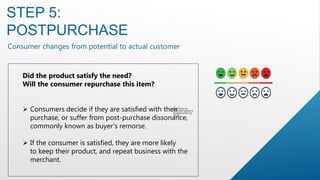
STEP 5:
POSTPURCHASE
Consumer changes from potential to actual customer
Did the product satisfy the need?
Will the consumer repurchase this item?
 Consumers decide if they are satisfied with their
purchase, or suffer from post-purchase dissonance,
commonly known as buyer's remorse.
 If the consumer is satisfied, they are more likely
to keep their product, and repeat business with the
merchant.
This Photo by
Unknown author is
licensed under CC
BY-NC
Grewal, D. and Levy, M., n.d. Marketing. 8th ed.
https://en.wikipedia.org/wiki/Consumer_behaviour
https://elearn.sinclair.edu/d2l/le/content/245985/viewContent/8067670/View
https://elearn.sinclair.edu/d2l/le/content/245985/viewContent/8067671/View
https://elearn.sinclair.edu/d2l/le/content/245985/viewContent/8067674/View
https://elearn.sinclair.edu/d2l/le/content/245985/viewContent/8067673/View
SOURCES

Consumer Behavior

  • 1.
  • 2.
    "The study ofindividuals, groups, or organizations and all the activities associated with the purchase, use and disposal of goods and services." -Wikipedia The preferences of the consumer directly influence their buying behavior and decision process. CONSUMER BEHAVIOR
  • 3.
    BEHAVIOR INFLUENCES Some ofthe factors that can influence what a consumer buys and how the consumer decides to make a purchase are Social- family, culture, social media Marketing Mix- product, place, promotion, and price Psychological- attitudes, motives, perceptions, lifestyle, intelligence Situational- specific purchase situation, sensory situation or time of day
  • 4.
    CONSUMER INVOLVEMENT Effort usedand level of consumer engagement in the decision process is impacted by the 3 levels of consumer involvement. ROUTINE (low): relying on habit and/or impulse, not commonly using alternative evaluation LIMITED (medium): mediocre effort and less reliant on habitual purchasing EXTENSIVE (high): major effort and problem-solving skills used, common in high-risk purchase decisions
  • 5.
    Step 1 • NeedRecognition Step 2 • Search for information Step 3 • Evaluation of Alternatives Step 4 • Purchase and Consumption Step 5 • Post-purchase CONSUMER BUYING BEHAVIOR The Decision Process
  • 6.
    Maslow's hierarchy ofneeds is a popular model depicting the different needs for an individual.  He believed that you should satisfy needs on the lower level before satisfying the higher levels. STEP 1: NEED RECOGNITION Identifying a need and desire to satisfy this need
  • 7.
    STEP 2: INFORMATION SEARCH Searchof options available to buy in hopes to satisfy need Internal search: using personal memory and knowledge about the product or service gathered through past experiences. External search: gathering information outside of personal knowledge by talking to friends, family, or salesperson, reading commercial media, like Consumer Reports or utilizing an online search engine like Google or Bing.  Perception of risk involved with the purchase directly impacts the level of effort a consumer will use to search and evaluate options.  Lack of control, for example an immediate need or lack of search options available also impacts effort given.
  • 8.
    STEP 3: ALTERNATIVE EVALUTATION Evaluatingthe available options and alternatives to satisfy need Attribute sets are the evaluative criteria the consumer uses to decide what purchase option is best. Universal- all possible choices Retrieval- memory of previous choices Evoked- influenced or considered choices  Effective marketing will position a product into the evoked set
  • 9.
    STEP 4: PURCHASE ANDCONSUMPTION Note: The consumer may purchase online or in-store Customers make the best purchase and use/consume the product
  • 10.
    STEP 5: POSTPURCHASE Consumer changesfrom potential to actual customer Did the product satisfy the need? Will the consumer repurchase this item?  Consumers decide if they are satisfied with their purchase, or suffer from post-purchase dissonance, commonly known as buyer's remorse.  If the consumer is satisfied, they are more likely to keep their product, and repeat business with the merchant. This Photo by Unknown author is licensed under CC BY-NC
  • 11.
    Grewal, D. andLevy, M., n.d. Marketing. 8th ed. https://en.wikipedia.org/wiki/Consumer_behaviour https://elearn.sinclair.edu/d2l/le/content/245985/viewContent/8067670/View https://elearn.sinclair.edu/d2l/le/content/245985/viewContent/8067671/View https://elearn.sinclair.edu/d2l/le/content/245985/viewContent/8067674/View https://elearn.sinclair.edu/d2l/le/content/245985/viewContent/8067673/View SOURCES