CATION EXCHANGE
CAPACITY (CEC)
Dr. Kiran Karthik Raj
Assistant Professor
COA,Vellayani
2
Definition
 Cations are positively charged ions such as calcium (Ca2+
), magnesium
(Mg2+
), and potassium (K+
), sodium (Na+
) hydrogen (H+
), aluminum (Al3+), iron
(Fe2+
), manganese (Mn2+
), zinc (Zn2+
) and copper (Cu2+
).
 Cation exchange capacity (CEC) is the capacity of a soil to hold exchangeable
cations (hold positively charged ions) on its surface.
 Cations are held by the negatively charged clay and organic matter
particles in the soil through electrostatic forces (negative soil particles attract
the positive cations).
Units
 CEC is conventionally expressed in meq/100 g which is numerically equal to
centimoles of positive charge per kilogram of exchanger (cmol(+)/kg).
 The CEC of soils varies according the clay %, the type of clay, soil pH and
amount of organic matter.
3
Why clay particles are negatively
charged ?
 pH Independent Charge / Isomorphous substitution: Net negative
charge because of the substitution of silica (Si4+
) by aluminum (Al3+)
in the silicon tetrahedral sheet of mineral structure of the clay.
 The negative charges associated with isomorphous substitution are
considered permanent, that is, the charges do not change with pH
changes.
 the negative charge of the clay particles is balanced by the
positive charge of the cations in the soil.
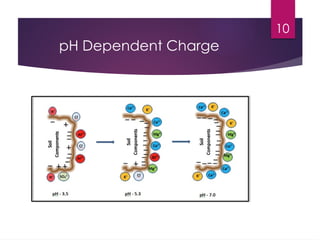
 pH Dependent Charge: Depends on the soil pH, de-protonation of
surface hydroxyl groups. CEC associated with soil organic matter is
called pH-dependent CEC. This means that the actual CEC of the
soil will depend on the pH of the soil.
4
Cation exchange capacity (CEC)
• It influences the soil’s ability to hold onto essential
nutrients and provides a buffer against soil acidification.
• Soils with a higher clay fraction tend to have a higher CEC.
• Organic matter has a very high CEC.
• Sandy soils rely heavily on the high CEC of organic matter
for the retention of nutrients in the topsoil.
• It influences the soil’s ability to hold onto essential
nutrients and provides a buffer against soil acidification.
• Soils with a higher clay fraction tend to have a higher CEC.
• Organic matter has a very high CEC.
• Sandy soils rely heavily on the high CEC of organic matter
for the retention of nutrients in the topsoil.
• It influences the soil’s ability to hold onto essential
nutrients and provides a buffer against soil acidification.
• Soils with a higher clay fraction tend to have a higher CEC.
• Organic matter has a very high CEC.
• Sandy soils rely heavily on the high CEC of organic matter
for the retention of nutrients in the topsoil.
5
Importance
 The higher the CEC the more clay or organic matter present in the soil.
 The clay mineral and organic matter components of soil have negatively
charged sites on their surfaces which adsorb and hold positively charged
ions (cations) by electrostatic force.
 This electrical charge is critical to the supply of nutrients to plants because
many nutrients exist as cations (e.g. magnesium, potassium and calcium).
 In general terms, soils with large quantities of negative charge are more
fertile because they retain more cations
 Acid soil: Exchange acidity due to exchangeable H+
, Al3+
and Mn2+
 The lower the CEC of a soil, the faster the soil pH will decrease with time.
Liming soils to higher than pH 6 will maintain exchangeable basic cations.
6
Importance
 Soils with a low CEC are more likely to develop deficiencies of calcium,
magnesium and potassium.
 The higher the CEC, the larger the quantity of lime that must be
added to increase the soil pH; sandy soils need less lime than clay
soils to increase the pH to desired levels.
ANION EXCHANGE
CAPACITY (AEC)
8
Definition
 Sum total of exchangeable anions that a soil can adsorb.
 In addition to predominantly negative charge sites which attract soil
cations, all soil clays and organic matter simultaneously have a relatively
small number of positive charge sites which retain anions in dynamic
equilibrium with the soil solution.
 Unit: milliequivalents per 100 grams of soil (meq /100 g soil) or
centimoles of negative charge per kilogram soil (cmol(-)/kg).
 Anion exchange capacity (AEC) represents the positive charge
available to attract anions in solution.
 In most soils CEC > AEC.
9
Reason
 Soils that have an anion exchange capacity typically contain weathered
kaolin minerals, iron and aluminum oxides, and amorphous materials.
 Anion exchange capacity is dependent upon the pH of the soil and
increases as the pH of the soil decreases.
 Phosphorus, Sulphate and borate are held on anion exchange site.
 Govern fixation of phosphorus in soil.
10
pH Dependent Charge

Cation and anion exchange capacity notes soil

  • 1.
    CATION EXCHANGE CAPACITY (CEC) Dr.Kiran Karthik Raj Assistant Professor COA,Vellayani
  • 2.
    2 Definition  Cations arepositively charged ions such as calcium (Ca2+ ), magnesium (Mg2+ ), and potassium (K+ ), sodium (Na+ ) hydrogen (H+ ), aluminum (Al3+), iron (Fe2+ ), manganese (Mn2+ ), zinc (Zn2+ ) and copper (Cu2+ ).  Cation exchange capacity (CEC) is the capacity of a soil to hold exchangeable cations (hold positively charged ions) on its surface.  Cations are held by the negatively charged clay and organic matter particles in the soil through electrostatic forces (negative soil particles attract the positive cations). Units  CEC is conventionally expressed in meq/100 g which is numerically equal to centimoles of positive charge per kilogram of exchanger (cmol(+)/kg).  The CEC of soils varies according the clay %, the type of clay, soil pH and amount of organic matter.
  • 3.
    3 Why clay particlesare negatively charged ?  pH Independent Charge / Isomorphous substitution: Net negative charge because of the substitution of silica (Si4+ ) by aluminum (Al3+) in the silicon tetrahedral sheet of mineral structure of the clay.  The negative charges associated with isomorphous substitution are considered permanent, that is, the charges do not change with pH changes.  the negative charge of the clay particles is balanced by the positive charge of the cations in the soil.  pH Dependent Charge: Depends on the soil pH, de-protonation of surface hydroxyl groups. CEC associated with soil organic matter is called pH-dependent CEC. This means that the actual CEC of the soil will depend on the pH of the soil.
  • 4.
    4 Cation exchange capacity(CEC) • It influences the soil’s ability to hold onto essential nutrients and provides a buffer against soil acidification. • Soils with a higher clay fraction tend to have a higher CEC. • Organic matter has a very high CEC. • Sandy soils rely heavily on the high CEC of organic matter for the retention of nutrients in the topsoil. • It influences the soil’s ability to hold onto essential nutrients and provides a buffer against soil acidification. • Soils with a higher clay fraction tend to have a higher CEC. • Organic matter has a very high CEC. • Sandy soils rely heavily on the high CEC of organic matter for the retention of nutrients in the topsoil. • It influences the soil’s ability to hold onto essential nutrients and provides a buffer against soil acidification. • Soils with a higher clay fraction tend to have a higher CEC. • Organic matter has a very high CEC. • Sandy soils rely heavily on the high CEC of organic matter for the retention of nutrients in the topsoil.
  • 5.
    5 Importance  The higherthe CEC the more clay or organic matter present in the soil.  The clay mineral and organic matter components of soil have negatively charged sites on their surfaces which adsorb and hold positively charged ions (cations) by electrostatic force.  This electrical charge is critical to the supply of nutrients to plants because many nutrients exist as cations (e.g. magnesium, potassium and calcium).  In general terms, soils with large quantities of negative charge are more fertile because they retain more cations  Acid soil: Exchange acidity due to exchangeable H+ , Al3+ and Mn2+  The lower the CEC of a soil, the faster the soil pH will decrease with time. Liming soils to higher than pH 6 will maintain exchangeable basic cations.
  • 6.
    6 Importance  Soils witha low CEC are more likely to develop deficiencies of calcium, magnesium and potassium.  The higher the CEC, the larger the quantity of lime that must be added to increase the soil pH; sandy soils need less lime than clay soils to increase the pH to desired levels.
  • 7.
  • 8.
    8 Definition  Sum totalof exchangeable anions that a soil can adsorb.  In addition to predominantly negative charge sites which attract soil cations, all soil clays and organic matter simultaneously have a relatively small number of positive charge sites which retain anions in dynamic equilibrium with the soil solution.  Unit: milliequivalents per 100 grams of soil (meq /100 g soil) or centimoles of negative charge per kilogram soil (cmol(-)/kg).  Anion exchange capacity (AEC) represents the positive charge available to attract anions in solution.  In most soils CEC > AEC.
  • 9.
    9 Reason  Soils thathave an anion exchange capacity typically contain weathered kaolin minerals, iron and aluminum oxides, and amorphous materials.  Anion exchange capacity is dependent upon the pH of the soil and increases as the pH of the soil decreases.  Phosphorus, Sulphate and borate are held on anion exchange site.  Govern fixation of phosphorus in soil.
  • 10.