CATARACT SURGERY
COMPLICATIONS
surjeet acharya
VMC
PRE-OPERATIVE
ANXIETY
Rx: DIAZEPAM 2-5mg at bed time
NAUSEA AND GASTRITIS
ACETAZOLAMIDE
Rx: ORAL ANTACIDS
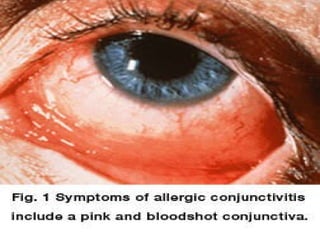
ALLERGIC CONJUCTIVITIS
CORNEAL ABRASION
ANESTHESIA
COMPLICATIONS
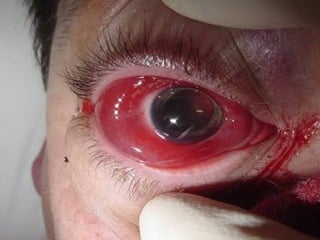
RETROBULBAR
HEMORRHAGE
Rx: 1 drop PILOCARPINE (2%) with
pressure bandage
OCULOCARDIAC REFLEX
Bradycardia +/- Cardiac arrhythmia
Rx; ATROPINE (iv)
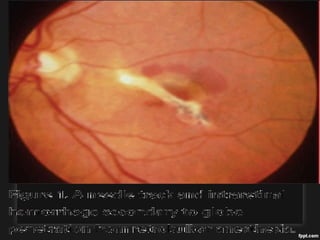
PERFORATION OF GLOBE
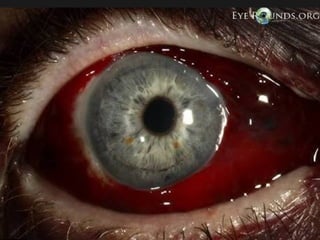
SUBCONJUCTIVAL HEMORRHAGE
DISLOCATION OF LENS
OPERATIVE
POOR PRE-OP
HYPOGLYCEMIA
COUGH/SNEEZE, move head towards
sides
Excess Bleed if patient is on anticoagulants
POOR SURGICAL SKILL
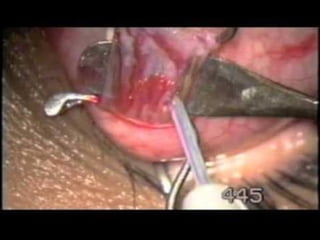
Superior Rectus
laceration/haematoma
seen in ECCE/SICS
no treatment required
Excess bleed
Incision related
Irregular incision- in ECCE
Button holing of anterior wall of tunnel
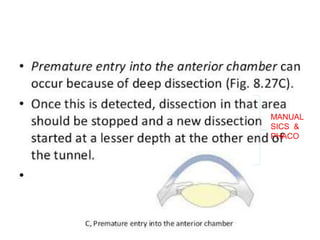
Premature entry into anterior chamber
Scleral disinsertion
MANUAL
SICS &
PHACO
Corneal Injury
when A.C is entered with sharp
instruments
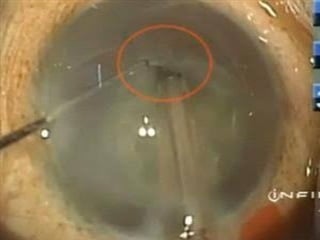
CAPSULORRHEXIS
COMPLICATIONS
Escaping capsulorrhexis
Small capsulorrhexis
Eccentric capsulorrhexis
Very large capsulorrhexis
POSTERIOR CAPSULAR
RUPTURE
Feared complication in all Cataract
surgeries
Occurs due to-
forceful hydrodissection
direct injury by instruments
cortex aspiration (ACCIDENTAL PCR)
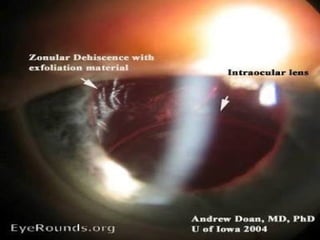
ZONULAR DEHISCENCE
In all ECCE and SICS
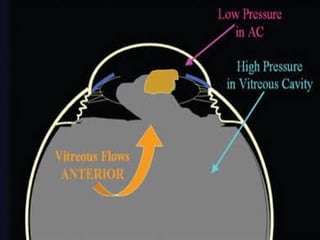
VITREOUS LOSS
• To decrease vitreous volume- pre op
mannitol
• To decrease aqueous volume- pre op
acetazolamide
• To decrease orbital volume- ocular
massage and compression
• Better ocular akinesia and anesthesia
• Minimising external pressure- carefull
handling, minimum pull on bridle suture
• Posteriorsclerotomy + vitreous drain from
pars plana- in case of high IOP and
surgery cannot be postponed
if vitreous loss has occured
anterior vitrectomy
clear vitreous from AC and Incision site
This prevents post-op complication due to
vitreous loss
NUCLEUS DROP
mostly seen in PHACO
Rx- refer case to
VITRORETINAl surgeon
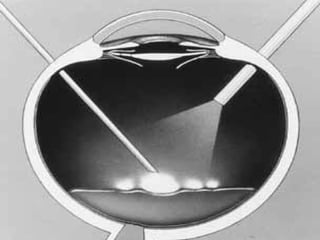
POSTERIOR LOSS OF LENS FRAGMENTS
Due to PCR or ZD during PHACO
Can lead to glaucoma, uveitis, RD
Rx- refer to vitreoretinal surgeon (pars plana
vitrectomy)
EXPULSIVE CHOROIDAL HEMORRHAGE
seen in HT and arteriosclerosis changes patients
MOSTLY in ICCE, ECCE
LEAST in SICS and PHACO
Ch: WOUND GAPING; LOSS OF LENS,
VITREOUS, IRIS, RETINA, UVEA & finally gush
of blood
Rx- unsatisfactory
EYE IS LOST so EVISCERATION IS DONE
POST-OP
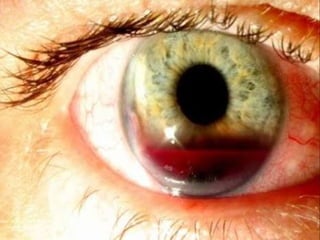
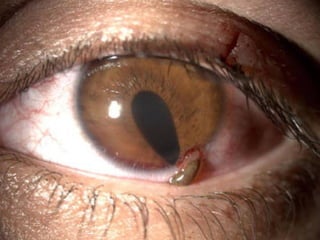
Hyphaema
Rx: usually gets absorbs by
itself
Drain out blood (if not resolved
in 1 week)
Treat for raised IOP
(acetazolamide)
IRIS PROLAPSE
Common in ICCE and ECCE
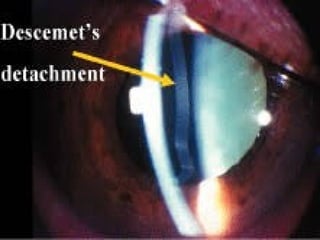
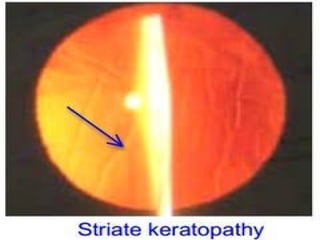
STRIATE KERATOPATHY
Due to endothelium damage (cornea)
corneal edema with descement folds
Rx: hypertonic saline drops + steroids
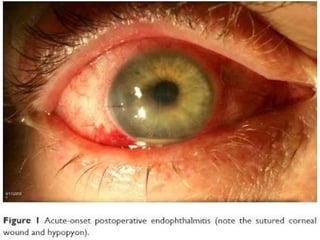
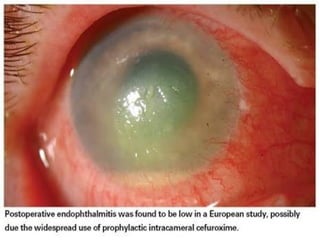
ENDOPTHALMITIS
Causes- instruments, solutions, surgeon hand,
patient own flora
ocular pain, conjuctival congestion, corneal
edema, exudates, diminished vision, hypopyon
Rx: IntraVitreal Antibiotics
steroids
supportive
vitrectomy
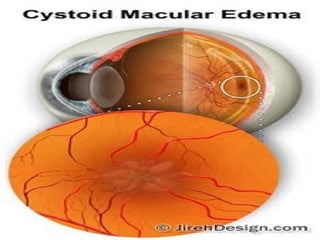
CME
Common in all cataract surgery but insignificant
develops 1-3 months later
EP: vitreous incarceration and iritis
Rx: anterior vitrectomy+steroids+anti-PGs
Prevention: preop and postop anti-PGs
CHRONIC POSTOP
ENDOTHALMITIS
Agents
Rx: pars plana vitrectomy + Ab/Af therapy
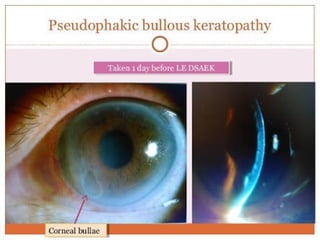
PSEUDOBULLOUS
KERATOPATHY
Continued corneal edema
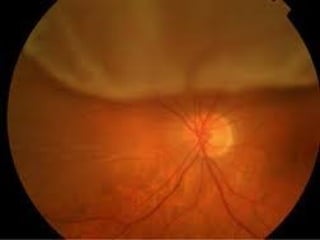
RD
Aphakic>>>>phakic
ICCE >>> ECCE
R/F- vitreous loss, myopics
EPITHELIAL INGROWTH
Conjuctival epithelium enters AC and can
block TM causing Glaucoma
In late stages, it can extend upto iris and
anterior part of vitreous
FIBROUS DOWNGROWTH
Due to abnormal apposition of cataract
wound
Can lead to secondary glaucoma, anterior
segment disorganisation and finally,
phthisis bulbi
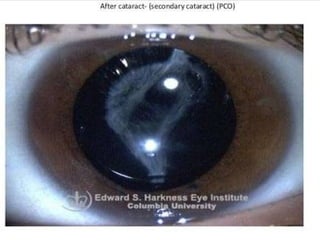
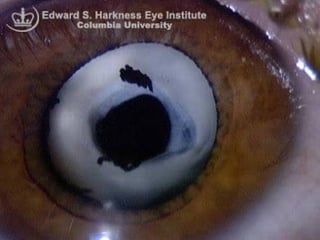
AFTER CATARACT
a.k.a SECONDARY CATARACT
Generally after ECCE
Causes: - residual lens matter
- proliferative cataract may develop
from remains of anterior cells in
capsular bag
Clinical Types
Dense membranous: thickened PCO
Rx: membranectomy
Soemmering’s ring: thick ring behind iris
enclosed between
2 layers of capsule
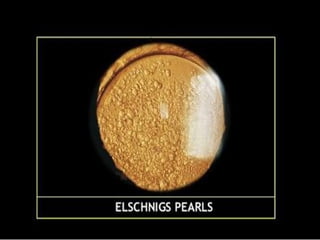
Elschnig’s pearls: vacuolated subcapsular
epithelial cells are
clustered in posterior
capsule
Rx: YAG-laser capsulotomy
IOL RELATED
COMPLICATIONS
Anterior chamber and Iris supported lens
CME, uveitis, secondary glaucoma, UGH
syndrome (uveitis, glaucoma, hyphema)
IOL malpossition
Sunset syndrome- inferior subluxation of iol
Sunrise syndrome- superior subluxation of
iol
Loss lens syndrome- dislocation into vitreous
Windsheild-wiper syndrome
Pupillary capture
Postop iritis or proliferation of lens fibre
remnants
Toxic Anterior Segment
Syndrome
Violent inflammation of uveal tissue
Causes: - ethylene gas (for sterlising IOL)
- lens material
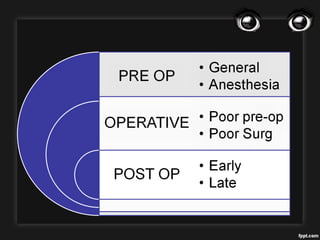
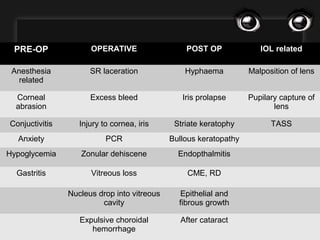
PRE-OP OPERATIVE POST OP IOL related
Anesthesia
related
SR laceration Hyphaema Malposition of lens
Corneal
abrasion
Excess bleed Iris prolapse Pupilary capture of
lens
Conjuctivitis Injury to cornea, iris Striate keratophy TASS
Anxiety PCR Bullous keratopathy
Hypoglycemia Zonular dehiscene Endopthalmitis
Gastritis Vitreous loss CME, RD
Nucleus drop into vitreous
cavity
Epithelial and
fibrous growth
Expulsive choroidal
hemorrhage
After cataract
THANK YOU

cataract complication