Catalysis of Substitution Reactions
on Heterocycles Bound
to a
Solid Phase
wolfgang.brill@am.pnu.com
Catalysis of Substitution Reactions
on Heterocycles Bound
to a
Solid Phase
O
Nuc
N
N N
H
N
X
X
H,X
Nuc
Nuc
Radical, Nuc
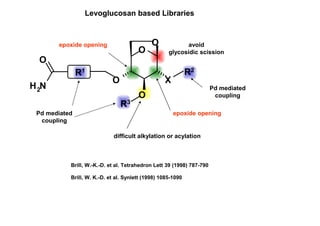
Levoglucosan based Libraries
epoxide opening
epoxide opening
difficult alkylation or acylation
avoid
glycosidic scissionO
O
XO
O
O
NH2
R1 R2
R3
Pd mediated
coupling
Pd mediated
coupling
Brill, W.-K.-D. et al. Tetrahedron Lett 39 (1998) 787-790
Brill, W. K.-D. et al. Synlett (1998) 1085-1090
O
O
OHOH
OH
O
O
OTsTsO
OH
O
O
OTs
O
O
O
OTs
OH
O
TsCl NaOMe
OH
BF3
. OEt2
LiOH
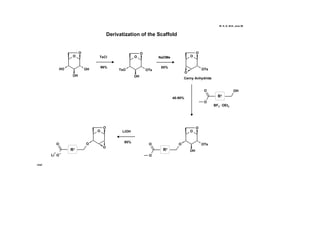
Derivatization of the Scaffold
cha2
96% 85%
40-90%
95%
O
O
R1
O
O
R1
O
O
O
O
O
O
R1
Li
+
W. K.-D. Brill, June 96
Cerny Anhydride
O
O
O
OH
OTsO
O
R1
I
(CH2)10
R1:
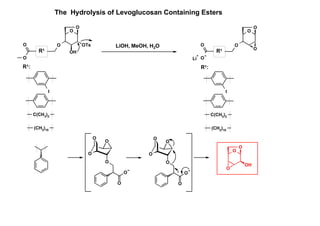
The Hydrolysis of Levoglucosan Containing Esters
C(CH3
)2
Li
+
O
O
O
O
O
O
R1
I
(CH2)10
R1:
C(CH3)2
O
O
O
O
O
O
O
O
O
O
O
O
O
O
OH
O
LiOH, MeOH, H2O
Schematic Representation of Resins
crosslink
shrunken resin
(poorly solvated)
compound bound
to the polymer
Reactions can only be performed, if reagents can diffuse
through the gelphase of the beads. The polymer has to be
solvated with the appropriate solvent to form such a phase.
swollen resin
(solvated)
O
O
N
H
O
O
O
ORink
R2R2'NH
Li+ Ph4B-
2,6-lutidine
100°C
R1
> 90%
R2OH
P4-t-Bu
dioxan, 60°C
> 90%
R2SH
LiHMDS
dioxane
80°C
> 90%
O
O
N
H
O
O
O OR
OHRink R1
O
O
N
H
O
O
O SR
OHRink R1
O
O
N
H
O
O
O N
OH R
R
Rink R1 2'
2
2
2
O
NH2
O
O
O
O
O
O
O
OR1
Li
+
DIC, HOBT, DMF
levunbas16
Brill 1999Opening of Levoglucosan-2.3-epoxides with various Nucleophiles
N
N P
N
N
P
NMe2
NMe2
Me2N
P NMe2
NMe2
NMe2
PMe2N
NMe2
NMe2
P4-t-Bu:
Rink-linker:
O
O
O
O
O
N
H OH
OTs
O
O
O
O
O
N
H O
O
O
O
O
O
N
OH
O
O
O
O
O
N
H
S
OH
O
O
H2N
OH
O
O
NH3
+
OH
S
NH
O
O
O
R
TFA
-TFA
-
S
NH
R
O
OO
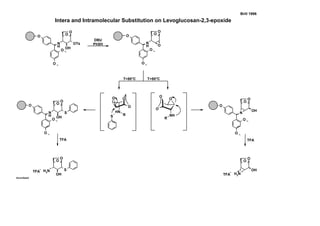
T>80°C
+
TFA
DBU
PhSH
T<80°C
TFA
Intera and Intramolecular Substitution on Levoglucosan-2,3-epoxide
levunibas4
Brill 1996
O
O
O
O
OH
O
N
H
I
N
ORink
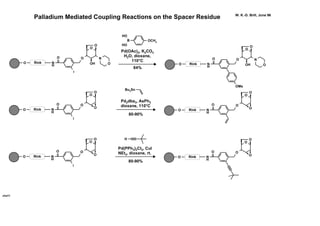
Palladium Mediated Coupling Reactions on the Spacer Residue
Pd(OAc)2, K2CO3
H2O, dioxane,
110°C
84%
O
O
O
O
OH
O
N
H
N
O
OMe
Rink
HO
HO
B OCH3
Bu3Sn
cha11
O
O
O
OO
N
H
I
O
Rink
Pd2dba3, AsPh3
dioxane, 110°C
80-90%
O
O
O
OO
N
H
O
Rink
H
W. K.-D. Brill, June 96
O
O
O
OO
N
H
I
O
Rink
Pd(PPh3)2Cl2, CuI
NEt3, dioxane, rt.
80-90%
O
O
O
OO
N
H
O
Rink
O
O
O
OO
N
H
ORink
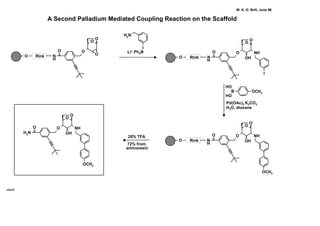
A Second Palladium Mediated Coupling Reaction on the Scaffold
HO
HO
B OCH3
O
O
O
OO
N
H
OH
NH
I
Rink
O
O
O
OO
N
H
OH
NH
OCH3
Rink
O
O
OO
NH2 OH
NH
OCH3
20% TFA
72% from
aminoresin
I
H2
N
Li+ Ph4B-
cha12
W. K.-D. Brill, June 96
Pd(OAc)2 K2CO3
H2O, dioxane
O
O
N
H
O
O
O OR
OHRink R1
2
O
O
N
H
O
O
O OR
OHRink R1
2
R3
O
NH2
O
O
O OR
OHR1
2
R3
How to avoid glycolysis:
1) conc. of TFA < 20%
2) solvent of TFA must have higher boiling point than TFA
3) resin must swell in solvent
a) 20% TFA in ClCH2CH2Cl
b) toluene before evaporation
R3-X
Schwesinger
base or
KOtBu
Final Derivatizations and Cleavage
The Synthesis of Purine Derivatives
on Polymeric Supports
•Potential Targets
•Development of the Chemistry
•Designing the Synthesis
•Selection of Building Blocks
•The Sort & Combine Method
•Performing the Synthesis with IRORI-MiniKansTM
•Workup, Purification and Archiving
N
H N
N
N
N
H
R
R
R
N
H
N N
N
N
N
R
NH
H H
R
R N
H N
N
N
N
R
N
R
H
H
R
N N
N
N
N
H
R
R
R
N
H
H
N N
N
H
N
N
R
NH
H
R
R
Purines may bind to Proteins in different ways
They address nucleoside binding pockets
Nucleoside Cofactors Lead us to Drug TargetsNucleoside Cofactors Lead us to Drug Targets
11. Many cofactors contain nucleoside motifs. Many cofactors contain nucleoside motifs
2. Nucleosides or nucleoside cofactors are involved in all important2. Nucleosides or nucleoside cofactors are involved in all important
cellularcellular
processes.processes.
DNADNA synthesissynthesis
RNARNA synthesissynthesis
proteinprotein synthesissynthesis
carbohydratecarbohydrate synthesis and oligomerizationsynthesis and oligomerization
lipidlipid synthesis and processingsynthesis and processing
synthesis ofsynthesis of homohomo andand heterocyclicheterocyclic aromaticsaromatics
signalingsignaling via phosphoylation and sulfatationvia phosphoylation and sulfatation
signaling assignaling as second messengersecond messenger oror hormonehormone
alkylationalkylation andand dealkylationdealkylation of DNA and other substrates.of DNA and other substrates.
3. Nucleoside binding sites are not optimized toward very tight binding!3. Nucleoside binding sites are not optimized toward very tight binding!
i, ii: Attachment to the polymer
iii: 6-Substitution
iv: 2-Substitution
v: Bromination
vi: Stille coupling
vii: Cleavage
Reaction Scheme
OH
N
N
N
N
Cl
Cl
N
N
N
N N
N
N
N Cl
O CF3
O
N
N
N
N
H
Cl
Cl
N
N
N
N
Br
N
N
N
N N
N
N
N
H
Rink resin
R1
R2
R1
i ii
iii
iv
1 2
3
4
R1-H:
R2-E
6 5
1
2
3
4
5
6
7
8
9
7
R1
R2
v
R1
vi R3-SnBu3
8
R3
R2
R1
R3
R2
vii
9
OH
N
N
N
N
Cl
Cl
O CF3
O
N
N
N
N
H
Cl
Cl
Rink resin
1 2
3
4
1
2
3
4
5
6
7
8
9
TFAA, 2,6-lutidine
4 eq.NMP
crystallization of
excess
recycling
Immobilization of 2,6-dichloropurine
Yield[%]Entry: Solvent Catalyst T [°C] Reaction
Time [h] Start.mat. Product
1 dioxane DIPEA 80 24 100 -
2 2,6-lutidine/dioxane - 60 24 79.3 24.3
3 2,6-lutidine/NMP - 60 24 31.7 68.3
4 “ HNEt3
+
F3CCO2
-
60 24 11.7 88.3
N
H
F
Cl
N
N
N
H
N
Cl
N
F
Cl
N
H N
N
N
Cl
Cl
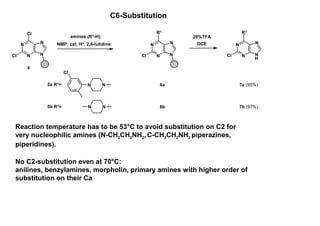
C6-Substitution
N
N N
NCl
Cl
N
N N
H
N
Cl
N N
N N
Cl
N
N N
N
Cl
6a
6b
R1
amines (R1-H):
4
R1
7a (95%)
7b (97%)
5a R1=
5b R1=
NMP, cat. H+, 2,6-lutidine
20%TFA
DCE
C6-Substitution
Reaction temperature has to be 53°C to avoid substitution on C2 for
very nucleophilic amines (N-CH2CH2NH2, C-CH2CH2NH2 piperazines,
piperidines).
No C2-substitution even at 70°C:
anilines, benzylamines, morpholin, primary amines with higher order of
substitution on their Ca
N
N N
N
Cl
N
N
Cl
N N
N
N
N
O
N
N
Cl
N
H
O
Pd-catalyst
N
N N
N
Cl
N
N
N N
N
N
N
N
B
OH
OH
Pd-catalyst
Solvent Base
Cat. or
Promotor
Co-ligand
Reaction
T [°C]
Time
[h]
Yield
[%]
NMP DIPEA - - 100 48 -
NMP Cs2CO3 Pd(PCy3)2Cl2 - 100 “ 48.7
“ K3PO4 “ - “ “ 45.7
“ Cs2CO3 Pd2dba3 P(tBu)3 “ “ 65.6
“ K3PO4 “ “ “ “ 66.3*
Solvent Base
Cat. or
Promotor
Co-ligand
Reaction
T [°C]
Time
[h]
Yield
[%]
NMP K3PO4 Pd2dba3 P(tBu)3 100 48 84.5*
Sustitution on C2
* rest is starting mat.
X'
L
L
PdAr
X"
L
L
PdAr
X"
B(OH)2
Ar
R
Pd
Ar-X'Ar-R
X"-B(OH)2
PdLn
MX"
MX'R-B(OH)2
X'
L
L
PdAr
X"
L
L
PdAr
X"
NRR'
Ar
L
Pd
Ar-X'Ar-NRR'
PdLn
MX"
MX'R-NHR'
X''-
H
+
•The mechanism for aminations and Suzuki-couplings is
similar.
•Amines and boronates couple under the same conditions
•A wide selection of building blocks possible
•Reaction temperatures compatible with Kans.
Sustitution on C2
Br2
NN
N
Br2
N
+
Br N
+
Br
solv. polar solvent
N N
N
N
N
N
R
R1 R1'
R2
R2'
N N
N
N
N
N
R
Br
N N
N
N
N
N
R
R1 R1'
R2
R2'
N N
N
N
N
N
R
Br
EtOEt
yelloworange
soluble in benzene insoluble in benzene
solv.
Br2
solv.
Br+solv.
+ Br-solv.
solv.
2,6-lutidine
rapid equilibration
with solvent
5 h, rt., DMF
R1 R1'
R2
R2'
R1 R1'
R2
R2'
pentane
Two Types of Bromine Complexes Were Investigated
Synthesis:
Reactivity:
Entry Resin Conditions Time [h] Bromine content
1 Merrifield Br-complex, NMP, 2,6 lutidine 3x 24
1
<0.3 %
2 Merrifield Br-complex benzene,
2,6-lutidine
24 1.1% 0.14mmol/g
3 product of
entry 2
sat. KOtBu, dioxane 88°C 72 <0.3%
1
) Three consecutive treatments
.
Modification of the Polymeric Support by the Brominating agent
N
Br2
Bromine-complex
Br-content of resin, treated with the Bromine Complex (EA)
N
Br2
Br
no reaction:
Rink
N N
N
N
Cl
Cl
Rink
N N
N
N
N
Cl
R1 R1'
Rink
N N
N
N
N
NHAc
R1 R1'
Rink
N N
N
N
N
N
R1 R1'
R2
R2'
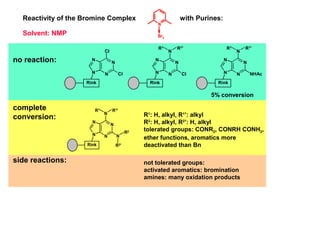
complete
conversion:
side reactions: not tolerated groups:
activated aromatics: bromination
amines: many oxidation products
N
Br2
Reactivity of the Bromine Complex with Purines:
Solvent: NMP
R1
: H, alkyl, R1
’: alkyl
R2
: H, alkyl, R2
’: H, alkyl
tolerated groups: CONR2, CONRH CONH2,
ether functions, aromatics more
deactivated than Bn
5% conversion
The Reactivity of the Bromine Complex in dry Benzene:
N
Br2
• disproportionation is very slow
• little electrophilic substitution
• oxidizing power is enhanced relative to reactions in NMP
Selective side reactions:
Rink
N N
N
N
N
N
H
H
R
R
N N
N
N
N
N
H
H
R
RO
Br
Rink'
N
Br2
benzene
Rink
N N
N
N
N
N
N
O
N
O
N N
N
N
N
N
O
N
O
N
H
O
HO
Br
Rink'
N
Br2
benzene
The Reactivity of the Bromine Complex in wet Benzene:
N
Br2
Rink
N N
N
N
N
N
H
H
R
R
N N
N
N
N
NH2
H
R
BrN
Br2
Rink'
benzene
H2O
Side chain oxidations are not mediaded by the solid phase.
They work are observed also in solution phase.
N N
N
N
N
N
Br
Br
N N
N
N
N
N
H
O
Br
N N
N
N
N
NH2
Br
Br
N N
N
N
N
+
N
Br
H
R1"R1'
R2'
N N
N
N
N
N
Br
R1 R1"
R2'
N N
N
N
N
N
H
Br
Br
Br
R1"R1'
¨
R2' N N
N
N
N
N
Br
H
Br
R1' R1"
R2'
R1' R1"
R2'
R1' R1"
R2'
R1 R1"
i
ii
ii
Proposed Mechanism for the Modification at C2
i: Br2-complex; ii: H2O
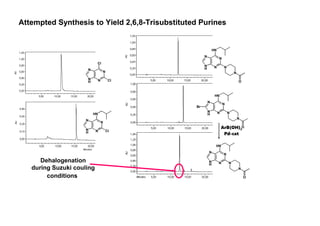
Attempted Synthesis to Yield 2,6,8-Trisubstituted Purines
N
H N
N
N
NH
Cl
N
H N
N
N
Cl
Cl
N
H N
N
N
NH
N
N
O
N
H N
N
N
NH
N
N
O
Br
N
H N
N
N
NH
N
N
O
Dehalogenation
during Suzuki couling
conditions
ArB(OH)2
Pd-cat
Entry Solvent Cu cat. Pd cat. Co-ligand
Product
yield
[%]
dehalog.
[%]
1 dioxane - Pd2dba3 As(Ph)3 - >5
2 NMP CuO Pd2dba3 dpppf
no reaction
3 NMP Cu(OAc)2 Pd2dba3 dppp - 91.6
4 NMP
O
Bu
Et
O
2
Cu
2+
Pd2dba3 dppp 51.5 48.5
5 NMP CuI Pd2dba3 dppp 20 -
6 NMP S
CuO
O
Pd2dba3 dppp 35.7 64.1
7 NMP Cu2O - - no reaction
8 NMP Cu2O Pd(OAc)2 dppp >98 -
SnBu3
N
NN
N
Br
NH
NH N
NN
N
NH
NH N
N
N
N
NH
NH
cat.
+
Substitution on C8
P P
dppp:
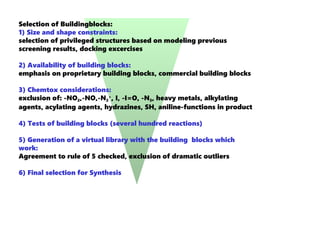
Selection of Buildingblocks:
1) Size and shape constraints:
selection of privileged structures based on modeling previous
screening results, docking excercises
2) Availability of building blocks:
emphasis on proprietary building blocks, commercial building blocks
3) Chemtox considerations:
exclusion of: -NO2,-NO,-N2
+
, I, -I=O, -N3, heavy metals, alkylating
agents, acylating agents, hydrazines, SH, aniline-functions in product
4) Tests of building blocks (several hundred reactions)
5) Generation of a virtual library with the building blocks which
work:
Agreement to rule of 5 checked, exclusion of dramatic outliers
6) Final selection for Synthesis
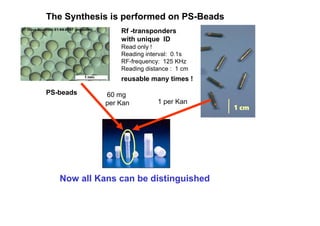
The Synthesis is performed on PS-Beads
PS-beads 60 mg
per Kan
Rf -transponders
with unique ID
Read only !
Reading interval: 0.1s
RF-frequency: 125 KHz
Reading distance : 1 cm
reusable many times !
1 cm
1 per Kan
Now all Kans can be distinguished
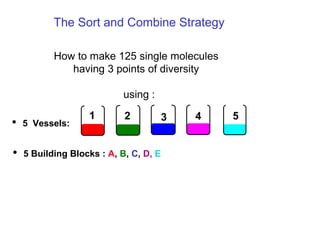
The Sort and Combine Strategy
• 5 Building Blocks : A, B, C, D, E
• 5 Vessels:
1 2 3 4 5
How to make 125 single molecules
having 3 points of diversity
using :
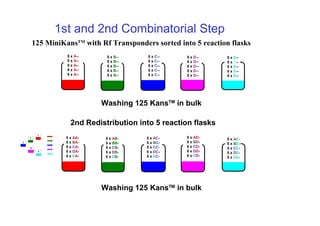
1st and 2nd Combinatorial Step
125 MiniKansTM
with Rf Transponders sorted into 5 reaction flasks
5 x A--
5 x A--
5 x A--
5 x A--
5 x A--
5 x B--
5 x B--
5 x B--
5 x B--
5 x B--
5 x C--
5 x C--
5 x C--
5 x C--
5 x C--
5 x D--
5 x D--
5 x D--
5 x D--
5 x D--
5 x E--
5 x E--
5 x E--
5 x E--
5 x E--
Washing 125 KansTM
in bulk
2nd Redistribution into 5 reaction flasks
5 x AA-
5 x BA-
5 x CA-
5 x DA-
5 x EA-
5 x AB-
5 x BB-
5 x CB-
5 x DB-
5 x EB-
5 x AC-
5 x BC-
5 x CC-
5 x DC-
5 x EC-
5 x AD-
5 x BD-
5 x CD-
5 x DD-
5 x ED-
5 x AE-
5 x BE-
5 x CE-
5 x DE-
5 x EE-
Washing 125 KansTM
in bulk
3
2
1
4
5
Flasks 3rd: Redistribution into 5 Reaction
1 x AEB
1 x BEB
1 x CEB
1 x DEB
1 x EEB
1 x AEC
1 x BEC
1 x CEC
1 x DEC
1 x EEC
1 x AED
1 x BED
1 x CED
1 x DED
1 x EED
1 x AEE
1 x BEE
1 x CEE
1 x DEE
1 x EEE
Washing 125 KansTM
in bulk then order into Racks : one Kan in one tube
1 x AEA
1 x BEA
1 x CEA
1 x DEA
1 x EEA
1 x ADA
1 x BDA
1 x CDA
1 x DDA
1 x EDA
1 x ACA
1 x BCA
1 x CCA
1 x DCA
1 x ECA
1 x ABA
1 x BBA
1 x CBA
1 x DBA
1 x EBA
1 x AAA
1 x BAA
1 x CAA
1 x DAA
1 x EAA
1 x ADB
1 x BDB
1 x CDB
1 x DDB
1 x EDB
1 x ACB
1 x BCB
1 x CCB
1 x DCB
1 x ECB
1 x ABB
1 x BBB
1 x CBB
1 x DBB
1 x EBB
1 x AAB
1 x BAB
1 x CAB
1 x DAB
1 x EAB
1 x ADC
1 x BDC
1 x CDC
1 x DDC
1 x EDC
1 x ACC
1 x BCC
1 x CCC
1 x DCC
1 x ECC
1 x ABC
1 x BBC
1 x CBC
1 x DBC
1 x EBC
1 x AAC
1 x BAC
1 x CAC
1 x DAC
1 x EAC
1 x ADD
1 x BDD
1 x CDD
1 x DDD
1 x EDD
1 x ACD
1 x BCD
1 x CCD
1 x DCD
1 x ECD
1 x ABD
1 x BBD
1 x CBD
1 x DBD
1 x EBD
1 x AAD
1 x BAD
1 x CAD
1 x DAD
1 x EAD
1 x ADE
1 x BDE
1 x CDE
1 x DDE
1 x EDE
1 x ACE
1 x BCE
1 x CCE
1 x DCE
1 x ECE
1 x ABE
1 x BBE
1 x CBE
1 x DBE
1 x EBE
1 x AAE
1 x BAE
1 x CAE
1 x DAE
1 x EAE
1
2
3
4
5
Automatic
Sampler
(Hamilton)
SynthManPlan
synthesis
Plan
synthesis
Perform
synthesis
Perform
synthesis
Purify &
Analyze
compounds
Purify &
Analyze
compounds
Archive
data &
stock
Archive
data &
stock
HPLC
Weighing
full
Dilution
Import
BB
MS
Import
Compounds
Family data
Reagent data
Method data
Salt data
Barcodes
Workin
g Sheet
Preparerea
gents
Preparerea
gents
Compone
nt
Database
Family
Database
2.
1.
9
16.
8.
7.
15.
6.
5.
3.
4.
14.
13.12.
10.
Archive
Databases
Archive
Databases
HPLC
(Millennium
)
Structural
Analysis
Automatic
weighing
(MicroWeight)
Automated
Sorting
(Kan Sort)
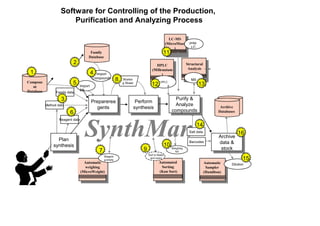
Software for Controlling of the Production,
Purification and Analyzing Process
Weighin
g empty
Sort to flasks
and racks
LC-MS
(MicroMass
)
11.
prep.
LC
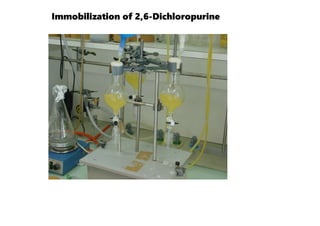
Immobilization of 2,6-Dichloropurine
Addition of Resin slurry to IRORI MiniKans
Sort & Combinetransponder
Sort Kans
redistribute
Washing of KansTM
in Bulk
By R. Gallarini, S. Vinzenz,W. Brill
Sorting of Kans Into Racks prior to Cleavage: Last
step of Sort-and-Combine Method
TFA
Transponder
TFA-Cleavage
Preparative HPLC-MS Purification
• LC-MS, MicroMass “platform LC”
• Gilson-Autosampler adapted to hold 2 Novartis
Mega Racks = 192 samples
• Capacity: 2 units with up to 384 samples
• HPLC columns: 5 cm length, 2 cm diameter, 5
µm C18
• Gradient: optimized for each library
• Expected MS-Peak is delivered into 10 mL
glass tube
Micromass, UK http://www.micromass.co.uk
MicroMass LC-MS
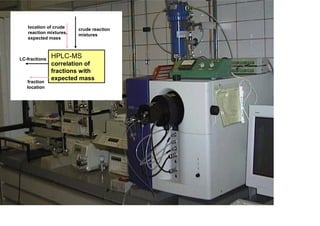
HPLC-MS
correlation of
fractions with
expected mass
fraction
location
LC-fractions
crude reaction
mixtures
location of crude
reaction mixtures,
expected mass
High-throughput purification
Crude sample
Fraction collection by LC/MS
Result of purification
Confirmation of identity
HPLC/UV purity : 20% HPLC/UV purity : >95%
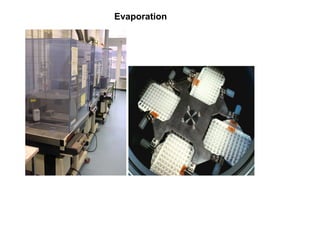
Evaporation
Automated weighing system
Throughput: 1 rack / hr
Recycling of used Kans
By S. Vinzenz,W.Brill
Batch-Registration of Compounds by Synthman
Achnowledgement
Modeling: E. Jacoby
Synthman: R. Fäh, H.-P. Moessner
Synthesis: S. Müller, J. Schaub, C. Riva-Toniolo*, D. Tirefort**
Purification & Registration: F. Gombert, G. Lerch, H. Wettstein
Hardware: S. Vinzenz, R. Gallarini
General: A. DeMesmaeker, J. Zimmermann, S. Wendeborn

catalysis_of_substitution_reactions_on_heterocycles_on_sp

  • 1.
    Catalysis of SubstitutionReactions on Heterocycles Bound to a Solid Phase wolfgang.brill@am.pnu.com
  • 2.
    Catalysis of SubstitutionReactions on Heterocycles Bound to a Solid Phase O Nuc N N N H N X X H,X Nuc Nuc Radical, Nuc
  • 3.
    Levoglucosan based Libraries epoxideopening epoxide opening difficult alkylation or acylation avoid glycosidic scissionO O XO O O NH2 R1 R2 R3 Pd mediated coupling Pd mediated coupling Brill, W.-K.-D. et al. Tetrahedron Lett 39 (1998) 787-790 Brill, W. K.-D. et al. Synlett (1998) 1085-1090
  • 4.
    O O OHOH OH O O OTsTsO OH O O OTs O O O OTs OH O TsCl NaOMe OH BF3 . OEt2 LiOH Derivatizationof the Scaffold cha2 96% 85% 40-90% 95% O O R1 O O R1 O O O O O O R1 Li + W. K.-D. Brill, June 96 Cerny Anhydride
  • 5.
    O O O OH OTsO O R1 I (CH2)10 R1: The Hydrolysis ofLevoglucosan Containing Esters C(CH3 )2 Li + O O O O O O R1 I (CH2)10 R1: C(CH3)2 O O O O O O O O O O O O O O OH O LiOH, MeOH, H2O
  • 6.
    Schematic Representation ofResins crosslink shrunken resin (poorly solvated) compound bound to the polymer Reactions can only be performed, if reagents can diffuse through the gelphase of the beads. The polymer has to be solvated with the appropriate solvent to form such a phase. swollen resin (solvated)
  • 7.
    O O N H O O O ORink R2R2'NH Li+ Ph4B- 2,6-lutidine 100°C R1 > 90% R2OH P4-t-Bu dioxan,60°C > 90% R2SH LiHMDS dioxane 80°C > 90% O O N H O O O OR OHRink R1 O O N H O O O SR OHRink R1 O O N H O O O N OH R R Rink R1 2' 2 2 2 O NH2 O O O O O O O OR1 Li + DIC, HOBT, DMF levunbas16 Brill 1999Opening of Levoglucosan-2.3-epoxides with various Nucleophiles N N P N N P NMe2 NMe2 Me2N P NMe2 NMe2 NMe2 PMe2N NMe2 NMe2 P4-t-Bu: Rink-linker:
  • 8.
  • 9.
    O O O O OH O N H I N ORink Palladium Mediated CouplingReactions on the Spacer Residue Pd(OAc)2, K2CO3 H2O, dioxane, 110°C 84% O O O O OH O N H N O OMe Rink HO HO B OCH3 Bu3Sn cha11 O O O OO N H I O Rink Pd2dba3, AsPh3 dioxane, 110°C 80-90% O O O OO N H O Rink H W. K.-D. Brill, June 96 O O O OO N H I O Rink Pd(PPh3)2Cl2, CuI NEt3, dioxane, rt. 80-90% O O O OO N H O Rink
  • 10.
    O O O OO N H ORink A Second PalladiumMediated Coupling Reaction on the Scaffold HO HO B OCH3 O O O OO N H OH NH I Rink O O O OO N H OH NH OCH3 Rink O O OO NH2 OH NH OCH3 20% TFA 72% from aminoresin I H2 N Li+ Ph4B- cha12 W. K.-D. Brill, June 96 Pd(OAc)2 K2CO3 H2O, dioxane
  • 11.
    O O N H O O O OR OHRink R1 2 O O N H O O OOR OHRink R1 2 R3 O NH2 O O O OR OHR1 2 R3 How to avoid glycolysis: 1) conc. of TFA < 20% 2) solvent of TFA must have higher boiling point than TFA 3) resin must swell in solvent a) 20% TFA in ClCH2CH2Cl b) toluene before evaporation R3-X Schwesinger base or KOtBu Final Derivatizations and Cleavage
  • 12.
    The Synthesis ofPurine Derivatives on Polymeric Supports •Potential Targets •Development of the Chemistry •Designing the Synthesis •Selection of Building Blocks •The Sort & Combine Method •Performing the Synthesis with IRORI-MiniKansTM •Workup, Purification and Archiving
  • 13.
    N H N N N N H R R R N H N N N N N R NH HH R R N H N N N N R N R H H R N N N N N H R R R N H H N N N H N N R NH H R R Purines may bind to Proteins in different ways They address nucleoside binding pockets
  • 14.
    Nucleoside Cofactors Leadus to Drug TargetsNucleoside Cofactors Lead us to Drug Targets 11. Many cofactors contain nucleoside motifs. Many cofactors contain nucleoside motifs 2. Nucleosides or nucleoside cofactors are involved in all important2. Nucleosides or nucleoside cofactors are involved in all important cellularcellular processes.processes. DNADNA synthesissynthesis RNARNA synthesissynthesis proteinprotein synthesissynthesis carbohydratecarbohydrate synthesis and oligomerizationsynthesis and oligomerization lipidlipid synthesis and processingsynthesis and processing synthesis ofsynthesis of homohomo andand heterocyclicheterocyclic aromaticsaromatics signalingsignaling via phosphoylation and sulfatationvia phosphoylation and sulfatation signaling assignaling as second messengersecond messenger oror hormonehormone alkylationalkylation andand dealkylationdealkylation of DNA and other substrates.of DNA and other substrates. 3. Nucleoside binding sites are not optimized toward very tight binding!3. Nucleoside binding sites are not optimized toward very tight binding!
  • 15.
    i, ii: Attachmentto the polymer iii: 6-Substitution iv: 2-Substitution v: Bromination vi: Stille coupling vii: Cleavage Reaction Scheme OH N N N N Cl Cl N N N N N N N N Cl O CF3 O N N N N H Cl Cl N N N N Br N N N N N N N N H Rink resin R1 R2 R1 i ii iii iv 1 2 3 4 R1-H: R2-E 6 5 1 2 3 4 5 6 7 8 9 7 R1 R2 v R1 vi R3-SnBu3 8 R3 R2 R1 R3 R2 vii 9
  • 16.
    OH N N N N Cl Cl O CF3 O N N N N H Cl Cl Rink resin 12 3 4 1 2 3 4 5 6 7 8 9 TFAA, 2,6-lutidine 4 eq.NMP crystallization of excess recycling Immobilization of 2,6-dichloropurine
  • 17.
    Yield[%]Entry: Solvent CatalystT [°C] Reaction Time [h] Start.mat. Product 1 dioxane DIPEA 80 24 100 - 2 2,6-lutidine/dioxane - 60 24 79.3 24.3 3 2,6-lutidine/NMP - 60 24 31.7 68.3 4 “ HNEt3 + F3CCO2 - 60 24 11.7 88.3 N H F Cl N N N H N Cl N F Cl N H N N N Cl Cl C6-Substitution
  • 18.
    N N N NCl Cl N N N H N Cl NN N N Cl N N N N Cl 6a 6b R1 amines (R1-H): 4 R1 7a (95%) 7b (97%) 5a R1= 5b R1= NMP, cat. H+, 2,6-lutidine 20%TFA DCE C6-Substitution Reaction temperature has to be 53°C to avoid substitution on C2 for very nucleophilic amines (N-CH2CH2NH2, C-CH2CH2NH2 piperazines, piperidines). No C2-substitution even at 70°C: anilines, benzylamines, morpholin, primary amines with higher order of substitution on their Ca
  • 19.
    N N N N Cl N N Cl N N N N N O N N Cl N H O Pd-catalyst N NN N Cl N N N N N N N N B OH OH Pd-catalyst Solvent Base Cat. or Promotor Co-ligand Reaction T [°C] Time [h] Yield [%] NMP DIPEA - - 100 48 - NMP Cs2CO3 Pd(PCy3)2Cl2 - 100 “ 48.7 “ K3PO4 “ - “ “ 45.7 “ Cs2CO3 Pd2dba3 P(tBu)3 “ “ 65.6 “ K3PO4 “ “ “ “ 66.3* Solvent Base Cat. or Promotor Co-ligand Reaction T [°C] Time [h] Yield [%] NMP K3PO4 Pd2dba3 P(tBu)3 100 48 84.5* Sustitution on C2 * rest is starting mat.
  • 20.
    X' L L PdAr X" L L PdAr X" B(OH)2 Ar R Pd Ar-X'Ar-R X"-B(OH)2 PdLn MX" MX'R-B(OH)2 X' L L PdAr X" L L PdAr X" NRR' Ar L Pd Ar-X'Ar-NRR' PdLn MX" MX'R-NHR' X''- H + •The mechanism foraminations and Suzuki-couplings is similar. •Amines and boronates couple under the same conditions •A wide selection of building blocks possible •Reaction temperatures compatible with Kans. Sustitution on C2
  • 21.
    Br2 NN N Br2 N + Br N + Br solv. polarsolvent N N N N N N R R1 R1' R2 R2' N N N N N N R Br N N N N N N R R1 R1' R2 R2' N N N N N N R Br EtOEt yelloworange soluble in benzene insoluble in benzene solv. Br2 solv. Br+solv. + Br-solv. solv. 2,6-lutidine rapid equilibration with solvent 5 h, rt., DMF R1 R1' R2 R2' R1 R1' R2 R2' pentane Two Types of Bromine Complexes Were Investigated Synthesis: Reactivity:
  • 22.
    Entry Resin ConditionsTime [h] Bromine content 1 Merrifield Br-complex, NMP, 2,6 lutidine 3x 24 1 <0.3 % 2 Merrifield Br-complex benzene, 2,6-lutidine 24 1.1% 0.14mmol/g 3 product of entry 2 sat. KOtBu, dioxane 88°C 72 <0.3% 1 ) Three consecutive treatments . Modification of the Polymeric Support by the Brominating agent N Br2 Bromine-complex Br-content of resin, treated with the Bromine Complex (EA) N Br2 Br
  • 23.
    no reaction: Rink N N N N Cl Cl Rink NN N N N Cl R1 R1' Rink N N N N N NHAc R1 R1' Rink N N N N N N R1 R1' R2 R2' complete conversion: side reactions: not tolerated groups: activated aromatics: bromination amines: many oxidation products N Br2 Reactivity of the Bromine Complex with Purines: Solvent: NMP R1 : H, alkyl, R1 ’: alkyl R2 : H, alkyl, R2 ’: H, alkyl tolerated groups: CONR2, CONRH CONH2, ether functions, aromatics more deactivated than Bn 5% conversion
  • 24.
    The Reactivity ofthe Bromine Complex in dry Benzene: N Br2 • disproportionation is very slow • little electrophilic substitution • oxidizing power is enhanced relative to reactions in NMP Selective side reactions: Rink N N N N N N H H R R N N N N N N H H R RO Br Rink' N Br2 benzene Rink N N N N N N N O N O N N N N N N O N O N H O HO Br Rink' N Br2 benzene
  • 25.
    The Reactivity ofthe Bromine Complex in wet Benzene: N Br2 Rink N N N N N N H H R R N N N N N NH2 H R BrN Br2 Rink' benzene H2O Side chain oxidations are not mediaded by the solid phase. They work are observed also in solution phase.
  • 26.
    N N N N N N Br Br N N N N N N H O Br NN N N N NH2 Br Br N N N N N + N Br H R1"R1' R2' N N N N N N Br R1 R1" R2' N N N N N N H Br Br Br R1"R1' ¨ R2' N N N N N N Br H Br R1' R1" R2' R1' R1" R2' R1' R1" R2' R1 R1" i ii ii Proposed Mechanism for the Modification at C2 i: Br2-complex; ii: H2O
  • 27.
    Attempted Synthesis toYield 2,6,8-Trisubstituted Purines N H N N N NH Cl N H N N N Cl Cl N H N N N NH N N O N H N N N NH N N O Br N H N N N NH N N O Dehalogenation during Suzuki couling conditions ArB(OH)2 Pd-cat
  • 28.
    Entry Solvent Cucat. Pd cat. Co-ligand Product yield [%] dehalog. [%] 1 dioxane - Pd2dba3 As(Ph)3 - >5 2 NMP CuO Pd2dba3 dpppf no reaction 3 NMP Cu(OAc)2 Pd2dba3 dppp - 91.6 4 NMP O Bu Et O 2 Cu 2+ Pd2dba3 dppp 51.5 48.5 5 NMP CuI Pd2dba3 dppp 20 - 6 NMP S CuO O Pd2dba3 dppp 35.7 64.1 7 NMP Cu2O - - no reaction 8 NMP Cu2O Pd(OAc)2 dppp >98 - SnBu3 N NN N Br NH NH N NN N NH NH N N N N NH NH cat. + Substitution on C8 P P dppp:
  • 29.
    Selection of Buildingblocks: 1)Size and shape constraints: selection of privileged structures based on modeling previous screening results, docking excercises 2) Availability of building blocks: emphasis on proprietary building blocks, commercial building blocks 3) Chemtox considerations: exclusion of: -NO2,-NO,-N2 + , I, -I=O, -N3, heavy metals, alkylating agents, acylating agents, hydrazines, SH, aniline-functions in product 4) Tests of building blocks (several hundred reactions) 5) Generation of a virtual library with the building blocks which work: Agreement to rule of 5 checked, exclusion of dramatic outliers 6) Final selection for Synthesis
  • 30.
    The Synthesis isperformed on PS-Beads PS-beads 60 mg per Kan Rf -transponders with unique ID Read only ! Reading interval: 0.1s RF-frequency: 125 KHz Reading distance : 1 cm reusable many times ! 1 cm 1 per Kan Now all Kans can be distinguished
  • 31.
    The Sort andCombine Strategy • 5 Building Blocks : A, B, C, D, E • 5 Vessels: 1 2 3 4 5 How to make 125 single molecules having 3 points of diversity using :
  • 32.
    1st and 2ndCombinatorial Step 125 MiniKansTM with Rf Transponders sorted into 5 reaction flasks 5 x A-- 5 x A-- 5 x A-- 5 x A-- 5 x A-- 5 x B-- 5 x B-- 5 x B-- 5 x B-- 5 x B-- 5 x C-- 5 x C-- 5 x C-- 5 x C-- 5 x C-- 5 x D-- 5 x D-- 5 x D-- 5 x D-- 5 x D-- 5 x E-- 5 x E-- 5 x E-- 5 x E-- 5 x E-- Washing 125 KansTM in bulk 2nd Redistribution into 5 reaction flasks 5 x AA- 5 x BA- 5 x CA- 5 x DA- 5 x EA- 5 x AB- 5 x BB- 5 x CB- 5 x DB- 5 x EB- 5 x AC- 5 x BC- 5 x CC- 5 x DC- 5 x EC- 5 x AD- 5 x BD- 5 x CD- 5 x DD- 5 x ED- 5 x AE- 5 x BE- 5 x CE- 5 x DE- 5 x EE- Washing 125 KansTM in bulk 3 2 1 4 5
  • 33.
    Flasks 3rd: Redistributioninto 5 Reaction 1 x AEB 1 x BEB 1 x CEB 1 x DEB 1 x EEB 1 x AEC 1 x BEC 1 x CEC 1 x DEC 1 x EEC 1 x AED 1 x BED 1 x CED 1 x DED 1 x EED 1 x AEE 1 x BEE 1 x CEE 1 x DEE 1 x EEE Washing 125 KansTM in bulk then order into Racks : one Kan in one tube 1 x AEA 1 x BEA 1 x CEA 1 x DEA 1 x EEA 1 x ADA 1 x BDA 1 x CDA 1 x DDA 1 x EDA 1 x ACA 1 x BCA 1 x CCA 1 x DCA 1 x ECA 1 x ABA 1 x BBA 1 x CBA 1 x DBA 1 x EBA 1 x AAA 1 x BAA 1 x CAA 1 x DAA 1 x EAA 1 x ADB 1 x BDB 1 x CDB 1 x DDB 1 x EDB 1 x ACB 1 x BCB 1 x CCB 1 x DCB 1 x ECB 1 x ABB 1 x BBB 1 x CBB 1 x DBB 1 x EBB 1 x AAB 1 x BAB 1 x CAB 1 x DAB 1 x EAB 1 x ADC 1 x BDC 1 x CDC 1 x DDC 1 x EDC 1 x ACC 1 x BCC 1 x CCC 1 x DCC 1 x ECC 1 x ABC 1 x BBC 1 x CBC 1 x DBC 1 x EBC 1 x AAC 1 x BAC 1 x CAC 1 x DAC 1 x EAC 1 x ADD 1 x BDD 1 x CDD 1 x DDD 1 x EDD 1 x ACD 1 x BCD 1 x CCD 1 x DCD 1 x ECD 1 x ABD 1 x BBD 1 x CBD 1 x DBD 1 x EBD 1 x AAD 1 x BAD 1 x CAD 1 x DAD 1 x EAD 1 x ADE 1 x BDE 1 x CDE 1 x DDE 1 x EDE 1 x ACE 1 x BCE 1 x CCE 1 x DCE 1 x ECE 1 x ABE 1 x BBE 1 x CBE 1 x DBE 1 x EBE 1 x AAE 1 x BAE 1 x CAE 1 x DAE 1 x EAE 1 2 3 4 5
  • 34.
    Automatic Sampler (Hamilton) SynthManPlan synthesis Plan synthesis Perform synthesis Perform synthesis Purify & Analyze compounds Purify & Analyze compounds Archive data& stock Archive data & stock HPLC Weighing full Dilution Import BB MS Import Compounds Family data Reagent data Method data Salt data Barcodes Workin g Sheet Preparerea gents Preparerea gents Compone nt Database Family Database 2. 1. 9 16. 8. 7. 15. 6. 5. 3. 4. 14. 13.12. 10. Archive Databases Archive Databases HPLC (Millennium ) Structural Analysis Automatic weighing (MicroWeight) Automated Sorting (Kan Sort) Software for Controlling of the Production, Purification and Analyzing Process Weighin g empty Sort to flasks and racks LC-MS (MicroMass ) 11. prep. LC
  • 35.
  • 36.
    Addition of Resinslurry to IRORI MiniKans
  • 37.
  • 38.
    Washing of KansTM inBulk By R. Gallarini, S. Vinzenz,W. Brill
  • 39.
    Sorting of KansInto Racks prior to Cleavage: Last step of Sort-and-Combine Method
  • 40.
  • 41.
    Preparative HPLC-MS Purification •LC-MS, MicroMass “platform LC” • Gilson-Autosampler adapted to hold 2 Novartis Mega Racks = 192 samples • Capacity: 2 units with up to 384 samples • HPLC columns: 5 cm length, 2 cm diameter, 5 µm C18 • Gradient: optimized for each library • Expected MS-Peak is delivered into 10 mL glass tube Micromass, UK http://www.micromass.co.uk
  • 42.
    MicroMass LC-MS HPLC-MS correlation of fractionswith expected mass fraction location LC-fractions crude reaction mixtures location of crude reaction mixtures, expected mass
  • 43.
    High-throughput purification Crude sample Fractioncollection by LC/MS Result of purification Confirmation of identity HPLC/UV purity : 20% HPLC/UV purity : >95%
  • 44.
  • 45.
  • 46.
    Recycling of usedKans By S. Vinzenz,W.Brill
  • 47.
  • 48.
    Achnowledgement Modeling: E. Jacoby Synthman:R. Fäh, H.-P. Moessner Synthesis: S. Müller, J. Schaub, C. Riva-Toniolo*, D. Tirefort** Purification & Registration: F. Gombert, G. Lerch, H. Wettstein Hardware: S. Vinzenz, R. Gallarini General: A. DeMesmaeker, J. Zimmermann, S. Wendeborn