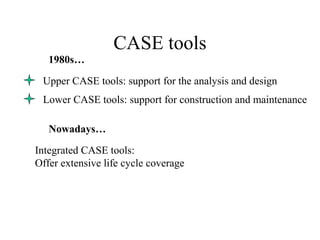
CASE tools
Upper CASE tools: support for the analysis and design
Lower CASE tools: support for construction and maintenance
1980s…
Nowadays…
Integrated CASE tools:
Offer extensive life cycle coverage
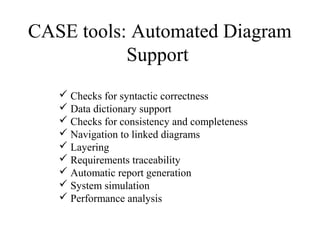
CASE tools: Automated Diagram
Support
 Checks for syntactic correctness
 Data dictionary support
 Checks for consistency and completeness
 Navigation to linked diagrams
 Layering
 Requirements traceability
 Automatic report generation
 System simulation
 Performance analysis
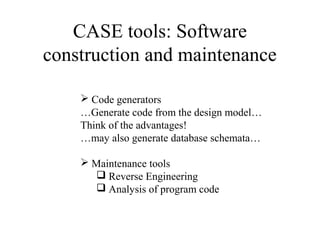
CASE tools: Software
construction and maintenance
 Code generators
…Generate code from the design model…
Think of the advantages!
…may also generate database schemata…
 Maintenance tools
 Reverse Engineering
 Analysis of program code
CASE tools: Advantages
 Help standardization of notations and diagrams
 Help communication between development team members
 Automatically check the quality of the A&D models
 Reduction of time and effort
 Enhance reuse of models or models’ components
CASE tools: Disadvantages
• Limitations in flexibility of documentation
• May lead to restriction to the tool’s capabilities
• Major danger: completeness and syntactic correctness
does NOT mean compliance with requirements
• Costs associated with the use of the tool: purchase +
training
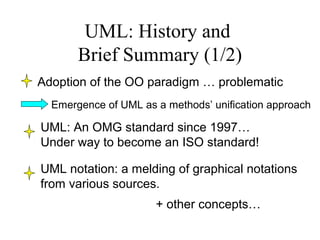
UML: History and
Brief Summary (1/2)
Adoption of the OO paradigm … problematic
Emergence of UML as a methods’ unification approach
UML notation: a melding of graphical notations
from various sources.
+ other concepts…
UML: An OMG standard since 1997…
Under way to become an ISO standard!
UML: History and
Brief Summary (2/2)
UML: A method or a notation?
Primarily a notation
Modeling method: techniques + guidelines + notations 
roadmap for the development of a model
However, there are attempts to describe OO methods
or methodological frameworks that would be able to employ UML.
1. The Rational Unified Process
2. The Object-oriented Process, Environment and Notation (OPEN)

Case tools

  • 1.
    CASE tools Upper CASEtools: support for the analysis and design Lower CASE tools: support for construction and maintenance 1980s… Nowadays… Integrated CASE tools: Offer extensive life cycle coverage
  • 2.
    CASE tools: AutomatedDiagram Support  Checks for syntactic correctness  Data dictionary support  Checks for consistency and completeness  Navigation to linked diagrams  Layering  Requirements traceability  Automatic report generation  System simulation  Performance analysis
  • 3.
    CASE tools: Software constructionand maintenance  Code generators …Generate code from the design model… Think of the advantages! …may also generate database schemata…  Maintenance tools  Reverse Engineering  Analysis of program code
  • 4.
    CASE tools: Advantages Help standardization of notations and diagrams  Help communication between development team members  Automatically check the quality of the A&D models  Reduction of time and effort  Enhance reuse of models or models’ components
  • 5.
    CASE tools: Disadvantages •Limitations in flexibility of documentation • May lead to restriction to the tool’s capabilities • Major danger: completeness and syntactic correctness does NOT mean compliance with requirements • Costs associated with the use of the tool: purchase + training
  • 6.
    UML: History and BriefSummary (1/2) Adoption of the OO paradigm … problematic Emergence of UML as a methods’ unification approach UML notation: a melding of graphical notations from various sources. + other concepts… UML: An OMG standard since 1997… Under way to become an ISO standard!
  • 7.
    UML: History and BriefSummary (2/2) UML: A method or a notation? Primarily a notation Modeling method: techniques + guidelines + notations  roadmap for the development of a model However, there are attempts to describe OO methods or methodological frameworks that would be able to employ UML. 1. The Rational Unified Process 2. The Object-oriented Process, Environment and Notation (OPEN)