Computer
Aided
Software
Engineering
Hazırlayan : Hüseynov Nicat
What is
CASE
tools?
CASE tools are set of software application programs, which
are used to automate SDLC activities. CASE tools are used
by software project managers, analysts and engineers to
develop software system.There are number of CASE tools
available to simplify various stages of Software
Development Life Cycle such as Analysis tools, Design
tools, Project management tools, Database Management
tools, Documentation tools are to name a few.
Components of CASE Tools
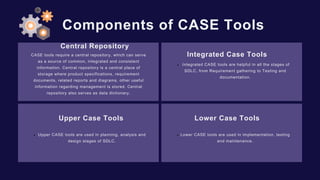
CASE tools require a central repository, which can serve
as a source of common, integrated and consistent
information. Central repository is a central place of
storage where product specifications, requirement
documents, related reports and diagrams, other useful
information regarding management is stored. Central
repository also serves as data dictionary.
Integrated CASE tools are helpful in all the stages of
SDLC, from Requirement gathering to Testing and
documentation.
Lower Case Tools
Upper CASE tools are used in planning, analysis and
design stages of SDLC.
Lower CASE tools are used in implementation, testing
and maintenance.
Integrated Case Tools
Upper Case Tools
Central Repository
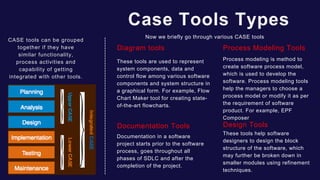
CASE tools can be grouped
together if they have
similar functionality,
process activities and
capability of getting
integrated with other tools.
Case Tools Types
Now we briefly go through various CASE tools
Diagram tools
These tools are used to represent
system components, data and
control flow among various software
components and system structure in
a graphical form. For example, Flow
Chart Maker tool for creating state-
of-the-art flowcharts.
Process Modeling Tools
Process modeling is method to
create software process model,
which is used to develop the
software. Process modeling tools
help the managers to choose a
process model or modify it as per
the requirement of software
product. For example, EPF
Composer
Documentation Tools
Documentation in a software
project starts prior to the software
process, goes throughout all
phases of SDLC and after the
completion of the project.
These tools help software
designers to design the block
structure of the software, which
may further be broken down in
smaller modules using refinement
techniques.
Design Tools
Case Tools Types
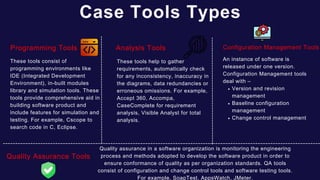
Analysis Tools
These tools help to gather
requirements, automatically check
for any inconsistency, inaccuracy in
the diagrams, data redundancies or
erroneous omissions. For example,
Accept 360, Accompa,
CaseComplete for requirement
analysis, Visible Analyst for total
analysis.
Configuration Management Tools
An instance of software is
released under one version.
Configuration Management tools
deal with –
Version and revision
management
Baseline configuration
management
Change control management
Programming Tools
These tools consist of
programming environments like
IDE (Integrated Development
Environment), in-built modules
library and simulation tools. These
tools provide comprehensive aid in
building software product and
include features for simulation and
testing. For example, Cscope to
search code in C, Eclipse.
Quality Assurance Tools
Quality assurance in a software organization is monitoring the engineering
process and methods adopted to develop the software product in order to
ensure conformance of quality as per organization standards. QA tools
consist of configuration and change control tools and software testing tools.
For example, SoapTest, AppsWatch, JMeter.
Advantages of the
CASE approach:
Comprehensive documentation
creation and maintenance is
made easier by CASE tools.
Improved
Documentation
Development cycles take less
time when certain jobs, such
testing and code generation,
are automated.
Quicker Cycles of
Development
Reusable component creation
and maintenance are frequently
facilitated by CASE tools.
Reusing
Components
Disadvantages of
the CASE approach:
In most cases, programmers’
productivity may fall in the
initial phase of implementation,
Many consultants offer training
and on-site services that can
be important to accelerate the
learning curve and to the
development and use of the
CASE tools.
Learning Curve:
Using a case tool is very
costly. Most firms engaged
in software development on
a small scale do not invest
in CASE tools because they
think that the benefit of
CASE is justifiable only in
the development of large
systems.
Cost:
It is important to build an
appropriate selection tool mix
to urge cost advantage CASE
integration and data integration
across all platforms is
extremely important.
Tool Mix:
The open-source community plays a
vital role in the development of CASE
tools, making them more accessible to
a broader audience and fostering
innovation. Open-source CASE tools
offer transparency, flexibility, and cost
savings:
Open Source
CASE Tools:
Predictive Modeling: Machine learning
can assist in predicting software
development project outcomes,
including estimates for project
completion and identifying potential
bottlenecks.
AI and machine learning are making
their mark in the world of CASE tools.
These technologies offer several
advantages, such as:
Code Analysis: AI-powered CASE tools
can analyze code, identify patterns, and
detect potential issues, helping
developers write cleaner and more
efficient code.
Artificial
Intelligence (AI)
and Machine
Learning
Integration:
Conclusion
In today’s software development
world, computer-aided software
engineering is a vital tool that
enables teams to produce high-
quality software quickly and
cooperatively. CASE tools will
probably become more and more
essential as technology develops
in order to satisfy the demands of
complicated software
development projects.

Thanks for
listening
Teacher:Dr.Taleh Esgerov, Ph.D
Student:Huseynov Nicat
Group ID:E6213

Computer Aided Software Engineering Slide

  • 1.
  • 2.
    What is CASE tools? CASE toolsare set of software application programs, which are used to automate SDLC activities. CASE tools are used by software project managers, analysts and engineers to develop software system.There are number of CASE tools available to simplify various stages of Software Development Life Cycle such as Analysis tools, Design tools, Project management tools, Database Management tools, Documentation tools are to name a few.
  • 3.
    Components of CASETools CASE tools require a central repository, which can serve as a source of common, integrated and consistent information. Central repository is a central place of storage where product specifications, requirement documents, related reports and diagrams, other useful information regarding management is stored. Central repository also serves as data dictionary. Integrated CASE tools are helpful in all the stages of SDLC, from Requirement gathering to Testing and documentation. Lower Case Tools Upper CASE tools are used in planning, analysis and design stages of SDLC. Lower CASE tools are used in implementation, testing and maintenance. Integrated Case Tools Upper Case Tools Central Repository
  • 4.
    CASE tools canbe grouped together if they have similar functionality, process activities and capability of getting integrated with other tools. Case Tools Types Now we briefly go through various CASE tools Diagram tools These tools are used to represent system components, data and control flow among various software components and system structure in a graphical form. For example, Flow Chart Maker tool for creating state- of-the-art flowcharts. Process Modeling Tools Process modeling is method to create software process model, which is used to develop the software. Process modeling tools help the managers to choose a process model or modify it as per the requirement of software product. For example, EPF Composer Documentation Tools Documentation in a software project starts prior to the software process, goes throughout all phases of SDLC and after the completion of the project. These tools help software designers to design the block structure of the software, which may further be broken down in smaller modules using refinement techniques. Design Tools
  • 5.
    Case Tools Types AnalysisTools These tools help to gather requirements, automatically check for any inconsistency, inaccuracy in the diagrams, data redundancies or erroneous omissions. For example, Accept 360, Accompa, CaseComplete for requirement analysis, Visible Analyst for total analysis. Configuration Management Tools An instance of software is released under one version. Configuration Management tools deal with – Version and revision management Baseline configuration management Change control management Programming Tools These tools consist of programming environments like IDE (Integrated Development Environment), in-built modules library and simulation tools. These tools provide comprehensive aid in building software product and include features for simulation and testing. For example, Cscope to search code in C, Eclipse. Quality Assurance Tools Quality assurance in a software organization is monitoring the engineering process and methods adopted to develop the software product in order to ensure conformance of quality as per organization standards. QA tools consist of configuration and change control tools and software testing tools. For example, SoapTest, AppsWatch, JMeter.
  • 6.
    Advantages of the CASEapproach: Comprehensive documentation creation and maintenance is made easier by CASE tools. Improved Documentation Development cycles take less time when certain jobs, such testing and code generation, are automated. Quicker Cycles of Development Reusable component creation and maintenance are frequently facilitated by CASE tools. Reusing Components
  • 7.
    Disadvantages of the CASEapproach: In most cases, programmers’ productivity may fall in the initial phase of implementation, Many consultants offer training and on-site services that can be important to accelerate the learning curve and to the development and use of the CASE tools. Learning Curve: Using a case tool is very costly. Most firms engaged in software development on a small scale do not invest in CASE tools because they think that the benefit of CASE is justifiable only in the development of large systems. Cost: It is important to build an appropriate selection tool mix to urge cost advantage CASE integration and data integration across all platforms is extremely important. Tool Mix:
  • 8.
    The open-source communityplays a vital role in the development of CASE tools, making them more accessible to a broader audience and fostering innovation. Open-source CASE tools offer transparency, flexibility, and cost savings: Open Source CASE Tools: Predictive Modeling: Machine learning can assist in predicting software development project outcomes, including estimates for project completion and identifying potential bottlenecks. AI and machine learning are making their mark in the world of CASE tools. These technologies offer several advantages, such as: Code Analysis: AI-powered CASE tools can analyze code, identify patterns, and detect potential issues, helping developers write cleaner and more efficient code. Artificial Intelligence (AI) and Machine Learning Integration:
  • 9.
    Conclusion In today’s softwaredevelopment world, computer-aided software engineering is a vital tool that enables teams to produce high- quality software quickly and cooperatively. CASE tools will probably become more and more essential as technology develops in order to satisfy the demands of complicated software development projects.

  • 10.
    Thanks for listening Teacher:Dr.Taleh Esgerov,Ph.D Student:Huseynov Nicat Group ID:E6213