SURVEY TEACHING METHOD
&
CASE STUDY TEACHING METHODS
Survey methodology studies the sampling of individual units from a population and the
associated survey data collection techniques, such as questionnaire construction and methods
for improving the number and accuracy of responses to surveys.
https://en.wikipedia.org/wiki/Survey_methodology
Survey method based on following steps:
• Planning
• Sampling
• Constructing the instrument
• Constructing the survey
• Processing the data
SURVEY TEACHING METHOD
https://en.wikipedia.org/wiki/Survey_methodology
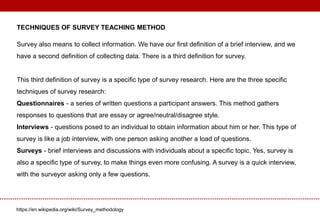
Survey also means to collect information. We have our first definition of a brief interview, and we
have a second definition of collecting data. There is a third definition for survey.
This third definition of survey is a specific type of survey research. Here are the three specific
techniques of survey research:
Questionnaires - a series of written questions a participant answers. This method gathers
responses to questions that are essay or agree/neutral/disagree style.
Interviews - questions posed to an individual to obtain information about him or her. This type of
survey is like a job interview, with one person asking another a load of questions.
Surveys - brief interviews and discussions with individuals about a specific topic. Yes, survey is
also a specific type of survey, to make things even more confusing. A survey is a quick interview,
with the surveyor asking only a few questions.
TECHNIQUES OF SURVEY TEACHING METHOD
ELEMENTS OF SURVEY RESEARCH
S.No. ELEMENT PURPOSE
01. Research questions What questions will the study address?
02. Background & significance Why are these questions important?
03. Design
Time frame
Approach
04. Subjects Who are the subjects and how will they be
selected?
Selection criteria
Sampling design
05. Variables What measurements will be made?
Predictor variables
Outcome variables
06. Statistical issues How large is the study and how will it be
analyzed?
Hypotheses
Sample size
Analytical approach
(Hulley et al., 2007)
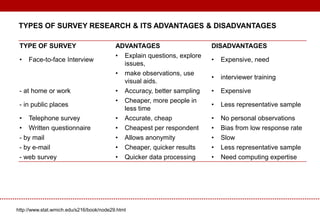
TYPE OF SURVEY ADVANTAGES DISADVANTAGES
• Face-to-face Interview
• Explain questions, explore
issues,
• Expensive, need
• make observations, use
visual aids.
• interviewer training
- at home or work • Accuracy, better sampling • Expensive
- in public places
• Cheaper, more people in
less time
• Less representative sample
• Telephone survey • Accurate, cheap • No personal observations
• Written questionnaire • Cheapest per respondent • Bias from low response rate
- by mail • Allows anonymity • Slow
- by e-mail • Cheaper, quicker results • Less representative sample
- web survey • Quicker data processing • Need computing expertise
http://www.stat.wmich.edu/s216/book/node29.html
TYPES OF SURVEY RESEARCH & ITS ADVANTAGES & DISADVANTAGES
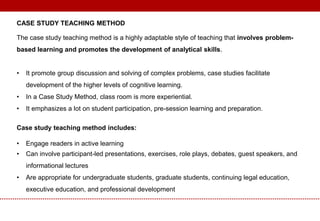
The case study teaching method is a highly adaptable style of teaching that involves problem-
based learning and promotes the development of analytical skills.
• It promote group discussion and solving of complex problems, case studies facilitate
development of the higher levels of cognitive learning.
• In a Case Study Method, class room is more experiential.
• It emphasizes a lot on student participation, pre-session learning and preparation.
CASE STUDY TEACHING METHOD
Case study teaching method includes:
• Engage readers in active learning
• Can involve participant-led presentations, exercises, role plays, debates, guest speakers, and
informational lectures
• Are appropriate for undergraduate students, graduate students, continuing legal education,
executive education, and professional development
• Typically require at least one class session to fully implement, with some multi-part or multi-
player role plays requiring more time
• May incorporate additional readings or multimedia
Teaching manuals for teaching include:
• the basic premise of the case study
• how a case study can be used within a course
• learning objectives
• assignment questions
• a typical class discussion flow
• key takeaways
• additional information such as board plans, informational slides, exercises, volunteer
instructions, and updates or epilogues to the case study
CASE STUDY METHODS
A brief taxonomy of case study methods based on the way the instructor presents the story in the
classroom (Herreid, 1994, 1998, 2005b) follows:
1- Lecture Method. In the lecture method, the instructor takes on the role of storyteller. An
advantage of the method is that the information is presented in context.
Disadvantages of the lecture method: Students are passive recipients of information.
2- Discussion Methods. Whole classroom discussion is the classical case teaching method. In its
original form, it was conducted by a professor in the front of the class. Other classroom variants of
the entire classroom discussion format include debates, symposia, trials, and public hearing.
3- Small-Group Methods. The advantages of small-group discussion has been promoted as
collaborative or cooperative learning. It is especially effective in promoting diversity of opinion and
respect for divergent views and for improving the expression of ideas.
4- Individual Cases.
Not all cases need be given to groups. Students hand in their responses after hearing the lectures
on the topic and doing literature research. The instructor then runs a class discussion on their
responses.
5- Computer Simulation Cases.
Bergland and others (2006) developed computer-based interactive cases that may last as long as
a month, with time for independent student research, communication, and writing. It is mostly used
in medical field.
6- Clicker Cases. Introductory classes, running a classroom discussion or forming small-group
conversations requires heroic effort. With the use of this technology, case studies can be
presented to huge classes. Professors can ask students to respond to the questions as the case,
presented in a PowerPoint presentation, unfolds. Clicker cases have opened up the mega
classrooms to truly interactive experiences
Advantages of case study teaching methods:
• Students get an opportunity to learn by doing
• Encourage them to ask right questions
• Instructor can take students to non-classroom situations at very low cost
• Give students flexibility and confidence
• Help students to take informed decisions
• Enhances their employability in a global context
PREPARATION OF STUDENTS & THE EDUCATIONAL PROCESS
The educational process of the case studies method has four components:
• Individual analysis & preparation,
• Optional informal small-group discussion,
• Classroom discussions, and
• End-of-class generalization about the learning.
RESULTS OF CASE STUDY METHODS:
• The results of case study discussion as a learning method include:
• Enhances students’ grasp of the theory
• Exposes students to actual working of the Organizations
• Reflect the ambiguity and uneven decisions required in Organizations even in an
information age
• Understand divergent perspective and resolve misunderstanding
• Better communication and interpersonal skills
• Provide options for middle ground in conflict situations
• Provides a piece of real world learning
THANK YOU!

Case study & survey method.pptx

  • 1.
    SURVEY TEACHING METHOD & CASESTUDY TEACHING METHODS
  • 2.
    Survey methodology studiesthe sampling of individual units from a population and the associated survey data collection techniques, such as questionnaire construction and methods for improving the number and accuracy of responses to surveys. https://en.wikipedia.org/wiki/Survey_methodology Survey method based on following steps: • Planning • Sampling • Constructing the instrument • Constructing the survey • Processing the data SURVEY TEACHING METHOD
  • 3.
    https://en.wikipedia.org/wiki/Survey_methodology Survey also meansto collect information. We have our first definition of a brief interview, and we have a second definition of collecting data. There is a third definition for survey. This third definition of survey is a specific type of survey research. Here are the three specific techniques of survey research: Questionnaires - a series of written questions a participant answers. This method gathers responses to questions that are essay or agree/neutral/disagree style. Interviews - questions posed to an individual to obtain information about him or her. This type of survey is like a job interview, with one person asking another a load of questions. Surveys - brief interviews and discussions with individuals about a specific topic. Yes, survey is also a specific type of survey, to make things even more confusing. A survey is a quick interview, with the surveyor asking only a few questions. TECHNIQUES OF SURVEY TEACHING METHOD
  • 4.
    ELEMENTS OF SURVEYRESEARCH S.No. ELEMENT PURPOSE 01. Research questions What questions will the study address? 02. Background & significance Why are these questions important? 03. Design Time frame Approach 04. Subjects Who are the subjects and how will they be selected? Selection criteria Sampling design 05. Variables What measurements will be made? Predictor variables Outcome variables 06. Statistical issues How large is the study and how will it be analyzed? Hypotheses Sample size Analytical approach (Hulley et al., 2007)
  • 5.
    TYPE OF SURVEYADVANTAGES DISADVANTAGES • Face-to-face Interview • Explain questions, explore issues, • Expensive, need • make observations, use visual aids. • interviewer training - at home or work • Accuracy, better sampling • Expensive - in public places • Cheaper, more people in less time • Less representative sample • Telephone survey • Accurate, cheap • No personal observations • Written questionnaire • Cheapest per respondent • Bias from low response rate - by mail • Allows anonymity • Slow - by e-mail • Cheaper, quicker results • Less representative sample - web survey • Quicker data processing • Need computing expertise http://www.stat.wmich.edu/s216/book/node29.html TYPES OF SURVEY RESEARCH & ITS ADVANTAGES & DISADVANTAGES
  • 6.
    The case studyteaching method is a highly adaptable style of teaching that involves problem- based learning and promotes the development of analytical skills. • It promote group discussion and solving of complex problems, case studies facilitate development of the higher levels of cognitive learning. • In a Case Study Method, class room is more experiential. • It emphasizes a lot on student participation, pre-session learning and preparation. CASE STUDY TEACHING METHOD Case study teaching method includes: • Engage readers in active learning • Can involve participant-led presentations, exercises, role plays, debates, guest speakers, and informational lectures • Are appropriate for undergraduate students, graduate students, continuing legal education, executive education, and professional development
  • 7.
    • Typically requireat least one class session to fully implement, with some multi-part or multi- player role plays requiring more time • May incorporate additional readings or multimedia Teaching manuals for teaching include: • the basic premise of the case study • how a case study can be used within a course • learning objectives • assignment questions • a typical class discussion flow • key takeaways • additional information such as board plans, informational slides, exercises, volunteer instructions, and updates or epilogues to the case study
  • 8.
    CASE STUDY METHODS Abrief taxonomy of case study methods based on the way the instructor presents the story in the classroom (Herreid, 1994, 1998, 2005b) follows: 1- Lecture Method. In the lecture method, the instructor takes on the role of storyteller. An advantage of the method is that the information is presented in context. Disadvantages of the lecture method: Students are passive recipients of information. 2- Discussion Methods. Whole classroom discussion is the classical case teaching method. In its original form, it was conducted by a professor in the front of the class. Other classroom variants of the entire classroom discussion format include debates, symposia, trials, and public hearing. 3- Small-Group Methods. The advantages of small-group discussion has been promoted as collaborative or cooperative learning. It is especially effective in promoting diversity of opinion and respect for divergent views and for improving the expression of ideas.
  • 9.
    4- Individual Cases. Notall cases need be given to groups. Students hand in their responses after hearing the lectures on the topic and doing literature research. The instructor then runs a class discussion on their responses. 5- Computer Simulation Cases. Bergland and others (2006) developed computer-based interactive cases that may last as long as a month, with time for independent student research, communication, and writing. It is mostly used in medical field. 6- Clicker Cases. Introductory classes, running a classroom discussion or forming small-group conversations requires heroic effort. With the use of this technology, case studies can be presented to huge classes. Professors can ask students to respond to the questions as the case, presented in a PowerPoint presentation, unfolds. Clicker cases have opened up the mega classrooms to truly interactive experiences
  • 11.
    Advantages of casestudy teaching methods: • Students get an opportunity to learn by doing • Encourage them to ask right questions • Instructor can take students to non-classroom situations at very low cost • Give students flexibility and confidence • Help students to take informed decisions • Enhances their employability in a global context PREPARATION OF STUDENTS & THE EDUCATIONAL PROCESS The educational process of the case studies method has four components: • Individual analysis & preparation, • Optional informal small-group discussion, • Classroom discussions, and • End-of-class generalization about the learning.
  • 12.
    RESULTS OF CASESTUDY METHODS: • The results of case study discussion as a learning method include: • Enhances students’ grasp of the theory • Exposes students to actual working of the Organizations • Reflect the ambiguity and uneven decisions required in Organizations even in an information age • Understand divergent perspective and resolve misunderstanding • Better communication and interpersonal skills • Provide options for middle ground in conflict situations • Provides a piece of real world learning
  • 13.