Presented by:
Sundeep Bhatti, Poonam Kaur Billing, Jason Macwan,
Arjun Pisharody, Neha Randhawa, Charlene Tcheong
About Chipotle
About Chipotle
About Chipotle
About Chipotle
• Business concept (business-level strategy)
• Vision/Mission:
• “… change the way people think about and eat fast food”
• High quality ingredients, classic cooking methods, affordable prices, distinctive interior design,
friendly employees
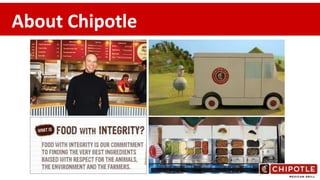
• Food with integrity
• 1595+ store locations across US, Canada, France,
UK and Germany
• 2013 Revenues of $3.21B
• 17.7% increase over 2012
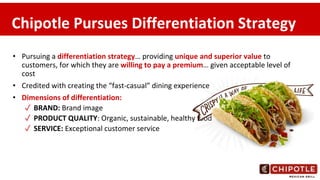
• Pursuing a differentiation strategy… providing unique and superior value to
customers, for which they are willing to pay a premium… given acceptable level of
cost
• Credited with creating the “fast-casual” dining experience
• Dimensions of differentiation:
✓ BRAND: Brand image
✓ PRODUCT QUALITY: Organic, sustainable, healthy food
✓ SERVICE: Exceptional customer service
Chipotle Pursues Differentiation Strategy
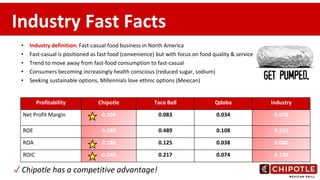
✓ Chipotle has a competitive advantage!
Industry Fast Facts
• Industry definition: Fast-casual food business in North America
• Fast-casual is positioned as fast food (convenience) but with focus on food quality & service
• Trend to move away from fast-food consumption to fast-casual
• Consumers becoming increasingly health conscious (reduced sugar, sodium)
• Seeking sustainable options, Millennials love ethnic options (Mexican)
Profitability Chipotle Taco Bell Qdoba Industry
Net Profit Margin 0.104 0.083 0.034 0.078
ROE 0.240 0.489 0.108 0.255
ROA 0.186 0.125 0.038 0.086
ROIC 0.240 0.217 0.074 0.130
General/Macro Environment
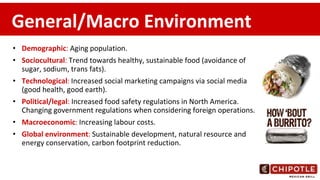
• Demographic: Aging population.
• Sociocultural: Trend towards healthy, sustainable food (avoidance of
sugar, sodium, trans fats).
• Technological: Increased social marketing campaigns via social media
(good health, good earth).
• Political/legal: Increased food safety regulations in North America.
Changing government regulations when considering foreign operations.
• Macroeconomic: Increasing labour costs.
• Global environment: Sustainable development, natural resource and
energy conservation, carbon footprint reduction.
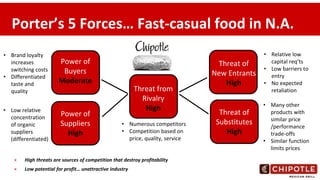
× High threats are sources of competition that destroy profitability
× Low potential for profit… unattractive industry
Porter’s 5 Forces… Fast-casual food in N.A.
Power of
Buyers
Moderate
Threat of
New Entrants
High
Threat from
Rivalry
High
• Brand loyalty
increases
switching costs
• Differentiated
taste and
quality
• Low relative
concentration
of organic
suppliers
(differentiated)
• Relative low
capital req’ts
• Low barriers to
entry
• No expected
retaliation
• Many other
products with
similar price
/performance
trade-offs
• Similar function
limits prices
• Numerous competitors
• Competition based on
price, quality, service
Power of
Suppliers
High
Threat of
Substitutes
High
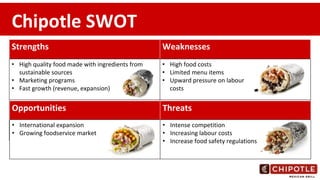
Strengths Weaknesses
• High quality food made with ingredients from
sustainable sources
• Marketing programs
• Fast growth (revenue, expansion)
• High food costs
• Limited menu items
• Upward pressure on labour
costs
Chipotle SWOT
Opportunities Threats
• International expansion
• Growing foodservice market
• Intense competition
• Increasing labour costs
• Increase food safety regulations
Value Chain
SUPERIOR
SUPERIOR SUPERIOR
Sustainable Competitive Advantage - VRIO
Value
Chain
Activity
Core Competence
/ Activity
Superior value
(premium) or low
cost?
Valuable? Rare? Costly to
imitate?
Organized to
be exploited?
Primary Inbound logistics YES YES YES YES
Primary Operations YES YES YES YES
Primary Sales & Marketing YES YES YES YES
Secondary Procurement YES YES YES YES
Secondary Human Resource
Management
YES YES YES YES
premium
cost
Effective Leadership
● Steve Ells, Chairman and co-CEO
○ Ells is founder of Chipotle
○ Classically trained chef who once held aspirations of
opening a fine-dining restaurant
○ Well-known face among Chipotle employees due to
store visits conducted
● Montgomery F. Moran, co-CEO
○ High school friend of Ells
○ Previously worked as a lawyer before joining Chipotle as
COO and then co-CEO
○ Instrumental in establishing the Restaurateur program
● Montgomery F. Moran established the 13
characteristics essential to Chipotle’s career
advancement:
○ conscientious
○ respectful
○ hospitable
○ high energy
○ infectiously enthusiastic
○ happy
● The career path can seem like many steps, but
qualified candidates can excel through in a rapid
manner
○ presentable
○ smart
○ polite
○ motivated
○ ambitious
○ curious
○ honest
Common Career Path
Behavioural Control Mechanisms
• RULES
o Chipotle’s only steadfast rule is to work hard to try to change the
way people think about and eat fast food
• REWARDS
o Employees are encouraged with financial incentives in the form of
cash bonuses and stock options to progress through the ranks to
reach the significant goal of Restaurateur, with 98% of new roles
being filled with internal promotions
• CULTURE
o Employees wholeheartedly embrace the concept of “Food with
Integrity”, internalizing the values associated with the company and
operating to the high standards set forth by management
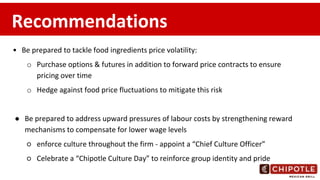
Recommendations
• Be prepared to tackle food ingredients price volatility:
o Purchase options & futures in addition to forward price contracts to ensure
pricing over time
o Hedge against food price fluctuations to mitigate this risk
● Be prepared to address upward pressures of labour costs by strengthening reward
mechanisms to compensate for lower wage levels
○ enforce culture throughout the firm - appoint a “Chief Culture Officer”
○ Celebrate a “Chipotle Culture Day” to reinforce group identity and pride
Thank you!
Any questions?

Case study - Strategy Review at Chipotle

  • 1.
    Presented by: Sundeep Bhatti,Poonam Kaur Billing, Jason Macwan, Arjun Pisharody, Neha Randhawa, Charlene Tcheong
  • 2.
  • 3.
  • 4.
  • 5.
    About Chipotle • Businessconcept (business-level strategy) • Vision/Mission: • “… change the way people think about and eat fast food” • High quality ingredients, classic cooking methods, affordable prices, distinctive interior design, friendly employees • Food with integrity • 1595+ store locations across US, Canada, France, UK and Germany • 2013 Revenues of $3.21B • 17.7% increase over 2012
  • 6.
    • Pursuing adifferentiation strategy… providing unique and superior value to customers, for which they are willing to pay a premium… given acceptable level of cost • Credited with creating the “fast-casual” dining experience • Dimensions of differentiation: ✓ BRAND: Brand image ✓ PRODUCT QUALITY: Organic, sustainable, healthy food ✓ SERVICE: Exceptional customer service Chipotle Pursues Differentiation Strategy
  • 7.
    ✓ Chipotle hasa competitive advantage! Industry Fast Facts • Industry definition: Fast-casual food business in North America • Fast-casual is positioned as fast food (convenience) but with focus on food quality & service • Trend to move away from fast-food consumption to fast-casual • Consumers becoming increasingly health conscious (reduced sugar, sodium) • Seeking sustainable options, Millennials love ethnic options (Mexican) Profitability Chipotle Taco Bell Qdoba Industry Net Profit Margin 0.104 0.083 0.034 0.078 ROE 0.240 0.489 0.108 0.255 ROA 0.186 0.125 0.038 0.086 ROIC 0.240 0.217 0.074 0.130
  • 8.
    General/Macro Environment • Demographic:Aging population. • Sociocultural: Trend towards healthy, sustainable food (avoidance of sugar, sodium, trans fats). • Technological: Increased social marketing campaigns via social media (good health, good earth). • Political/legal: Increased food safety regulations in North America. Changing government regulations when considering foreign operations. • Macroeconomic: Increasing labour costs. • Global environment: Sustainable development, natural resource and energy conservation, carbon footprint reduction.
  • 9.
    × High threatsare sources of competition that destroy profitability × Low potential for profit… unattractive industry Porter’s 5 Forces… Fast-casual food in N.A. Power of Buyers Moderate Threat of New Entrants High Threat from Rivalry High • Brand loyalty increases switching costs • Differentiated taste and quality • Low relative concentration of organic suppliers (differentiated) • Relative low capital req’ts • Low barriers to entry • No expected retaliation • Many other products with similar price /performance trade-offs • Similar function limits prices • Numerous competitors • Competition based on price, quality, service Power of Suppliers High Threat of Substitutes High
  • 10.
    Strengths Weaknesses • Highquality food made with ingredients from sustainable sources • Marketing programs • Fast growth (revenue, expansion) • High food costs • Limited menu items • Upward pressure on labour costs Chipotle SWOT Opportunities Threats • International expansion • Growing foodservice market • Intense competition • Increasing labour costs • Increase food safety regulations
  • 11.
  • 12.
    Sustainable Competitive Advantage- VRIO Value Chain Activity Core Competence / Activity Superior value (premium) or low cost? Valuable? Rare? Costly to imitate? Organized to be exploited? Primary Inbound logistics YES YES YES YES Primary Operations YES YES YES YES Primary Sales & Marketing YES YES YES YES Secondary Procurement YES YES YES YES Secondary Human Resource Management YES YES YES YES premium cost
  • 13.
    Effective Leadership ● SteveElls, Chairman and co-CEO ○ Ells is founder of Chipotle ○ Classically trained chef who once held aspirations of opening a fine-dining restaurant ○ Well-known face among Chipotle employees due to store visits conducted ● Montgomery F. Moran, co-CEO ○ High school friend of Ells ○ Previously worked as a lawyer before joining Chipotle as COO and then co-CEO ○ Instrumental in establishing the Restaurateur program
  • 14.
    ● Montgomery F.Moran established the 13 characteristics essential to Chipotle’s career advancement: ○ conscientious ○ respectful ○ hospitable ○ high energy ○ infectiously enthusiastic ○ happy ● The career path can seem like many steps, but qualified candidates can excel through in a rapid manner ○ presentable ○ smart ○ polite ○ motivated ○ ambitious ○ curious ○ honest Common Career Path
  • 15.
    Behavioural Control Mechanisms •RULES o Chipotle’s only steadfast rule is to work hard to try to change the way people think about and eat fast food • REWARDS o Employees are encouraged with financial incentives in the form of cash bonuses and stock options to progress through the ranks to reach the significant goal of Restaurateur, with 98% of new roles being filled with internal promotions • CULTURE o Employees wholeheartedly embrace the concept of “Food with Integrity”, internalizing the values associated with the company and operating to the high standards set forth by management
  • 16.
    Recommendations • Be preparedto tackle food ingredients price volatility: o Purchase options & futures in addition to forward price contracts to ensure pricing over time o Hedge against food price fluctuations to mitigate this risk ● Be prepared to address upward pressures of labour costs by strengthening reward mechanisms to compensate for lower wage levels ○ enforce culture throughout the firm - appoint a “Chief Culture Officer” ○ Celebrate a “Chipotle Culture Day” to reinforce group identity and pride
  • 17.