!
Chipotle Mexican Grill
Equity Research Report
Jessie Huang
Wayne Lin
Jiangchao Lu
Alex Osterhage
Ty Shen
Garrett Trebilcock
!
!
!
!
!
!
!
!
!
!
The	
  Ohio	
  State	
  University	
  -­‐	
  Fisher	
  College	
  of	
  Business	
  
2	
  |	
  P a g e 	


Chipotle Mexican Grill, Inc.
Executive Summary
Company Description:
Chipotle Mexican Grill is a fast casual chain of restaurants that specialize in burritos,
tacos, burrito bowls, and salads. As of the second quarter of 2015, they operated 1,835 locations
and ranked #1 in revenue and market capitalization of all fast casual restaurants. Each location
employs a team of “top performers” that focus on sourcing the highest quality and sustainable
raw ingredients while utilizing classic cooking techniques with a distinctive interior design.
Rationale
●   Through comparable store sales growth and new store sales, Chipotle has consistently
been able to increase overall revenue year after year. We believe that they will continue
to increase revenue at an average rate of 11% over the next ten years.
●   Chipotle is trying to change the way people think about and eat fast food by sustainably
sourcing all ingredients and limiting the use of GMO’s. The “Food with Integrity”
initiative represents a motivation to cultivate a better world that we believe customers
will continue to support and competitors will find difficult to replicate.
●   Led by founder, CEO, and Chairman Steve Ells, Chipotle management is incentivized to
focus on long term growth and demonstrate the ability to strategically add value for
shareholders.
●   As a restaurant chain that seeks to provide high quality food at a fast pace, Chipotle will
look toward creating a faster and more optimal restaurant design to accommodate
quicker throughput times, increasing their volume in ticket sales.
●   One main ingredient that differentiates Chipotle from other fast casual restaurants is
their employees. Management seeks only the top performing personnel that create and
impart a special environment for each customer.
Key Assumptions:
●   Ten Year Average Revenue Growth: 11% (7% New Store Sales, 4% Comparable Store
Sales)
●   Terminal Growth Rate: 4% at a WACC of 11%
Risks:
●   Comparable store sales growth will be limited by the “trade-down” effect, service speed
decreases, and consumer discretionary income changes. The rate at which new stores are
opened will be susceptible to many risk factors and may cause a large decrease in
revenue growth.
●   Customers who visit Chipotle restaurants are generally affected by macroeconomic
trends. Rising inflationary expectations, changes in eating habits and stock market
fluctuations all have impacts on the firm’s intrinsic value.
●   Large risks of continued growth are challenges in staffing top managers and employees
plus the potential rise in minimum wage requirements. The Affordable Care Act will
also push down returns.
The	
  Ohio	
  State	
  University	
  -­‐	
  Fisher	
  College	
  of	
  Business	
  
3	
  |	
  P a g e 	


Company Overview:
Chipotle Mexican Grill, Inc. is a famous chain of restaurants in the United States that
serves a limited menu consisting of burritos, tacos, burrito bowls and salads. As of the second
quarter of 2015, they had 1,835 restaurants throughout 45 different states and few international
locations including Canada, England, France and Germany. In addition, they operate a minimal
number of ShopHouse Southeast Asian Kitchen and Pizzeria Locale restaurants both fast casual
concepts that do not have a significant impact on sales growth.
Chipotle focuses on providing customers with the best food using high-quality raw
ingredients that are grown in a sustainable manner. These ingredients are sourced in such a way
that respect for animals, farmers and the environment is held in the highest regards. Similarly,
Chipotle seeks to attract top performers who believe in company values and have the ability to
grow into team leaders. Inspired by fine dining establishments and using non-traditional
cooking methods, we believe they have built a unique experience within each restaurant that
will keep customers coming back for more.
Based on our analysis of the trailing ten-year free cash flow model, Chipotle has
implemented an aggressive growth strategy, increasing revenue at an average of 24%. This
historical revenue growth coupled with decreased costs as a percentage of revenue led to an
almost doubling of ROE and ROA in the past ten years. In addition, ROIC grew from 10.66 to
25.69 which drove a stock price appreciation of 1600% since their IPO on January 26th, 2006.
Since then, Chipotle management has not elected for a stock split, meaning the current trading
price of one share is $730 with a P/E ratio of about 44.
Business Model (Drivers and Costs of Growth):
Chipotle is considered a growth company where share price is extremely susceptible to
changes in estimated revenue growth and actual revenue reports. Similar to competitors like
McDonald's, Chipotle relies on the ability to grow revenue through comparable store sales
growth and new store sales. This growth is partially driven through the concept of “Food with
Integrity” which is limited by increases in costs of food, beverage, packaging, and labor. In
addition, the Chipotle management, industry trends and peer competition could hinder the
growth strategy that has made them so successful in years past.
Revenue Growth:
As discussed previously, Chipotle was able to successfully leverage investments by
McDonald’s to grow from 16 to 500 restaurants between 1998 and 2005. After the divestment,
Chipotle continued to grow revenue at an average rate of 23% per year. This growth was and
continues to be driven by comparable store sales growth and new store sales. Comparable store
sales (in operations for 13 months) have two primary drivers: traffic and ticket price. The
increase in the number of customers generating transactions within each store is affected by
strategic marketing and branding, increased service speed, and increases in consumer
discretionary income. In 2014, comparable store sales growth was 16.8% of revenue driven
primarily by an increase in customer visits and a price increase of 3.8%. Going forward,
Chipotle is expected to have comparable stores sales increases in the low-to-mid single digits
and we forecast an average of 4.6% over the next 5 years. New store sales include both
domestic and international openings but is the net of reopenings. As of Q2 2015, Chipotle has
1,835 locations on an increase of 48 in the quarter. This puts new store growth on pace to hit
estimates of 190-205 for the year 2015. Chipotle’s international expansion strategy is minimal
The	
  Ohio	
  State	
  University	
  -­‐	
  Fisher	
  College	
  of	
  Business	
  
4	
  |	
  P a g e 	


compared to domestic expansion. In 2014, new store sales accounted for 11% of revenue and
we estimate Chipotle to continue to open new stores at a similar rate to their estimates for 2015.
As Chipotle continues to grow, new store sales represent a smaller portion of revenue which
drives our estimate for average new store sales over the next ten years to be 7% of revenue.
Even as new store sales represent a smaller portion, they still are the larger driver of total
revenue growth. It is worth mentioning that the operations and new openings of ShopHouse and
Pizzeria Locale restaurants are not contributors to growth and may be discontinued.
Food with Integrity
Food with Integrity is Chipotle’s commitment toward delivering high quality ingredients
raised with respect for the environment, animals and farmers. In selecting suppliers, Chipotle
sources food from farmers rather than factories. They look to partner with local farmers,
believing this food supply will provide the freshest ingredients for their customers. The select
farmers who share values with Chipotle, commit to use vegetables grown in healthy soil and
allow livestock to roam freely. This initiative also flows into the food preparation process, as
Chipotle seeks to go the extra mile to insure freshness. With quality remaining the key focus, all
food is prepared on site within each Chipotle kitchen and served with no artificial flavors or
filters.
Instead of cutting costs and increasing the price to generate a high gross margin.
Chipotle focuses mainly on spending more for ingredients, while trying to maintain a relatively
affordable price point. In 2013, Chipotle made headlines for becoming the first national
restaurant chain to voluntarily disclose the presence of GMOs in their food. In 2015, Chipotle
succeeded in the quest of switching to serve food made only with non-GMO ingredients.
Therefore, in the mind of those who wait in the long line, a burrito is not just a burrito—it
represents a motivation to cultivate a better world.
In the long term it is believed that customer’s recognition of the importance of “Food
with Integrity” will increase demand for responsibly sourced meats and agriculture. Chipotle is
on the forefront of this revolution and expects customer support to create a competitive
advantage that competitors will have difficulty replicating. This competitive advantage will
continue to drive revenue growth until replication is achieved or customers no longer feel a
connection between eating at Chipotle restaurants and cultivating a better world through
sustainably sourced ingredients.
The	
  Ohio	
  State	
  University	
  -­‐	
  Fisher	
  College	
  of	
  Business	
  
5	
  |	
  P a g e 	


The Chipotle Restaurant Design and Workforce:
What makes Chipotle a unique restaurant concept stems from their overall brick-and-
mortar design and the unique employees the business attempts to hire. Their labor force
emerges from management’s business model that seeks to provide the highest quality of food at
the fastest rate possible. To accomplish this, Chipotle retrofits custom floor plans for each of
their respective establishments with the goal of maximizing the natural customer flow of every
Chipotle eatery. The customized respective floor plans, design of serving lines, as well as
improved ordering lines look to create the highest throughput of customer orders. Essentially,
Chipotle pushes the curve of restaurant design by creating the most efficient ways to process
consumer requests. This ultimately will have a positive impact on comparable sales, as Chipotle
continues to make changes in their store layouts. Each additional adjustment should assist in
generating additional traffic and ticket purchases. With a focus on store layouts and efficiencies,
comparable sales can be projected into the future at the low to mid-single digit range.
Unlike most other fast casual food providers, Chipotle employs a strong focus on hiring
and empowering top performing employees. They look to uncover personnel that have a passion
for food, who will operate their restaurants to the highest standards, and who will allow for the
variety of personalities at Chipotle to contribute toward their success. Differing from many
other fast casual restaurants, Chipotle looks to install crew members at every stage of the food
making cycle to reinforce the focus on individual service. This also allows them to specifically
interact with customers during the process cycle and impart the unique Chipotle experience
during each order. Management views this interaction as a building block toward creating
loyalty and awareness for the Chipotle brand among employees and customers. The unique
relational experience for customers is a key driver for repeat customer loyalty, adding to both
comparable and new store sales growth. Recently, Chipotle completed their quota of hiring
4,000 new workers on September 9, 2015. This a confident signal from management that they
are committed to their overall future growth as a company. Due to these specific hiring and
management strategies, we believe that Chipotle will continue to increase its workforce in a
way that will support continued revenue and store growth.
Competition and Market Share:
Chipotle dominates the fast-casual segment of the restaurant industry. When
determining comparable restaurants, we decided to pull some from the fast-casual segment and
a few others based on different factors. In the end, we chose Panera, Chuy’s Tex-Mex and
McDonalds due to comparable ROA, D/E, current and P/E ratios. We then looked at betas and
geographic location of all restaurant firms to further screen potential peer firms. These choices
in peer firms represent what we think Chipotle could become, a strategically and operationally
identical restaurant, and a restaurant with similar size, market share and customer base. Chipotle
currently has a decent portion of this market share but McDonalds, due to their maturity, has the
largest share.
The	
  Ohio	
  State	
  University	
  -­‐	
  Fisher	
  College	
  of	
  Business	
  
6	
  |	
  P a g e 	


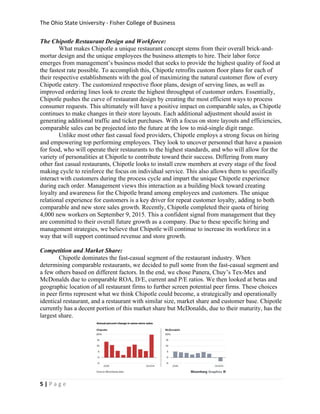
When analyzing the limited service restaurant segment, we determined that Chipotle has
a 2% market share compared to Panera’s 1.2%, Chuy’s .12% and McDonald’s 8.8%. They have
grown this 2% market share in 2014 from their 1% market share in 2010 while McDonald’s has
decreased by 2% in the same time frame. Panera’s market share has seen a low level of growth
but remains a major competitor for Chipotle in the fast-casual segment. In the future, we believe
Chipotle will continue to enjoy a large share of the market and the benefits associated with that
dominance.
Chipotle recognizes a different list of peer firms when determining compensation for
management. Due to the importance of Chipotles performance compared to this list, we felt it
was important to mention Chipotle’s average annual revenue but impressive market cap
compared to these peers. The list includes the likes of Yum! Brands, Bob Evans, Cheesecake
Factory and Starbucks (public companies with revenue over $500 million).
Industry Trends:
Aside from the internal drivers, the performance of Chipotle is also affected by the
industry trends in the macro-environment. In our opinion, we believe there are several key
factors that should be analyzed when considering Chipotle’s future performance. A few ideal
considerations that we have identified which could impact the business comprise of inflationary
expectations, general industry growth, and changes in eating habits
Beginning with inflationary expenses, according to the International Monetary Fund
(IMF), inflation through 2020 is projected to settle around 2.21%. With Chipotle also operating
in the food industry, we must also take into account the possibility of rising food costs. Through
the outside resource of “Trading Economics,” we project that food inflation in the United States
should be approximately 2% during the same period. Keeping these relative estimates in mind,
we believe that Chipotle’s ticket price can be projected to rise up into the range of 2-2.5% over
the coming years.
Next, Chipotle as a restaurant can also be impacted by the overall general industry
growth. According to a report from the National Restaurant Association, restaurant service sales
in the United States are projected to grow 20% reaching a sales level of $710 billion. It is our
belief, based on these projections that a similar trend of this magnitude will persist into the
future. With such a rising tide in growing sales, we believe that this could only positively
impact Chipotle’s store sales.
The	
  Ohio	
  State	
  University	
  -­‐	
  Fisher	
  College	
  of	
  Business	
  
7	
  |	
  P a g e 	


Third, analyzing the data we acquired from the United States Department of Agriculture
(USDA). The estimated monthly sales away from home in the United States will grow at an
annual rate of 6.7%. Overlooking this data, we can infer that American eating habits are shifting
in their complexity. Individuals are now seeking to dine out more often than they are to stay in
and cook at home. We believe this change in eating habits will have a positive impact on
Chipotle’s sales and traffic numbers, moving into the future.
View of Management:
After review of the proxy statement and analysis of executive compensation, we have
determined that management is incentivized in such a way that they should keep the interests of
the business and those of shareholders in mind when making decisions. The compensation
committee believes it is necessary to deploy programs that emphasize entrepreneurial and
innovative thought processes and that reward management when their team’s efforts creates
shareholder value. Executive compensation is made up of a base salary tied to individual
contribution and experience, an annual cash bonus taking average daily sales and sales increases
into account, and an equity allotment. Even though the base salary is individualistic, we believe
management is still very team-focused. Shareholder returns were 1,456% since Chipotle’s IPO
in 2006 and a portion of returns can be attributed to management's drive to add value. The cash
bonus is determined by a committee who looks at performance and individuals ability to create
shareholder value when comparing company performance to benchmarks in the restaurant
industry (sales growth, income growth and shareholder return over a one, three and five year
period). This, paired with an equity compensation directly tied to share price appreciation
(Stock Only Stock Appreciation Rights) gives management the incentive to continue the
efficient and strategic growth of the Chipotle brand. Vesting lasts three years meaning
management cannot sell their awarded shares for that period of time and is subject to
performance compared to a restaurant industry peer group. If Chipotle were to ever experience a
depreciation in stock price, decreased market share or lower sales, management would be
punished through a depreciation in value of shares previously awarded and a lower number of
shares awarded in that period.
Share Repurchases:
Starting in 2008, Chipotle started a share repurchase program of $100 million dollars
each year to buy back its class B common stock opportunistically in the market. This can be
viewed in a few different ways. First of all, repurchases are usually a signal from management
that shares are undervalued. We do not believe that management could possibly think a P/E of
44x earnings warrants an undervaluation of share price. Repurchases are also used as a metric
for management to return cash to shareholders without reducing the value of shares. $100
million a year is not a significant enough amount of cash for us to think that management's
purpose in repurchasing shares is to return cash to holders. It is more likely that the repurchases
are a way for management to keep the total amount of shares outstanding in balance and less
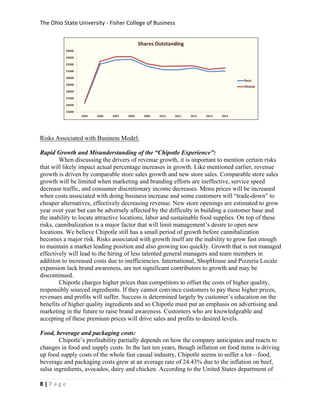
diluted. The graph on the next page highlights this trend.
The	
  Ohio	
  State	
  University	
  -­‐	
  Fisher	
  College	
  of	
  Business	
  
8	
  |	
  P a g e 	


Risks Associated with Business Model:
Rapid Growth and Misunderstanding of the “Chipotle Experience”:
When discussing the drivers of revenue growth, it is important to mention certain risks
that will likely impact actual percentage increases in growth. Like mentioned earlier, revenue
growth is driven by comparable store sales growth and new store sales. Comparable store sales
growth will be limited when marketing and branding efforts are ineffective, service speed
decrease traffic, and consumer discretionary income decreases. Menu prices will be increased
when costs associated with doing business increase and some customers will “trade-down” to
cheaper alternatives, effectively decreasing revenue. New store openings are estimated to grow
year over year but can be adversely affected by the difficulty in building a customer base and
the inability to locate attractive locations, labor and sustainable food supplies. On top of these
risks, cannibalization is a major factor that will limit management’s desire to open new
locations. We believe Chipotle still has a small period of growth before cannibalization
becomes a major risk. Risks associated with growth itself are the inability to grow fast enough
to maintain a market leading position and also growing too quickly. Growth that is not managed
effectively will lead to the hiring of less talented general managers and team members in
addition to increased costs due to inefficiencies. International, ShopHouse and Pizzeria Locale
expansion lack brand awareness, are not significant contributors to growth and may be
discontinued.
Chipotle charges higher prices than competitors to offset the costs of higher quality,
responsibly sourced ingredients. If they cannot convince customers to pay these higher prices,
revenues and profits will suffer. Success is determined largely by customer’s education on the
benefits of higher quality ingredients and so Chipotle must put an emphasis on advertising and
marketing in the future to raise brand awareness. Customers who are knowledgeable and
accepting of these premium prices will drive sales and profits to desired levels.
Food, beverage and packaging costs:
Chipotle’s profitability partially depends on how the company anticipates and reacts to
changes in food and supply costs. In the last ten years, though inflation on food items is driving
up food supply costs of the whole fast casual industry, Chipotle seems to suffer a lot—food,
beverage and packaging costs grew at an average rate of 24.43% due to the inflation on beef,
salsa ingredients, avocados, dairy and chicken. According to the United States department of
The	
  Ohio	
  State	
  University	
  -­‐	
  Fisher	
  College	
  of	
  Business	
  
9	
  |	
  P a g e 	


agriculture, the forecasted price change of beef in 2016 will be 2-3%, and the historical price
change in the past 20 years was 4.1 percent. For fruit and vegetables, the predicted change will
be 2-3% next year compared to 3% for the past 20 years; for dairy products it is 2-3% predicted
next year and 2.8% for the past 20 years. The predicted average inflation rate for the next five
years is 2.21%, which is quite similar to the number above. We believe that a reasonable price
change of approximately 2.25%-2.5% will combat rising costs.
It is unlikely for Chipotle to cut food supply costs in order to achieve a higher
profitability, especially since the increase is a result of factors beyond its control, such as
seasonal fluctuations, weather conditions, government regulations and generalized infectious
diseases. We expect that food, beverage and packaging costs would continue to increase at the
rate that is consistent with inflation. Since Chipotle is committed to provide customers with an
exceptional experience in addition to high quality, responsibly sourced food, customers are most
likely willing to swallow a price increase. This would just be a way for Chipotle to pass on the
food supply costs.
Labor Costs:
One of the biggest challenges facing Chipotle is their open market staffing and wage
constraints. Like mentioned before, Chipotle’s competitive advantage as a fast casual eatery
begins with their employee culture. To sustain the customer centered Chipotle business model,
management has indicated that a significant factor impacting company growth may be due to
Chipotle’s inability to properly staff each restaurant with a proper team. This inefficiency in
hiring may require an increase in training costs, delayed profits for Chipotle’s new restaurant
sales, and overall slowing of growth projections for new openings. Chipotle also faces stringent
new immigration laws that could increase management’s compliance and supervision during
hiring process of new employees. The additional supplies and personnel needed for such
functions can only increase their labor and operational costs. Another factor that could majorly
increase labor costs is the employer mandated U.S. healthcare reform law, the Affordable Care
Act. For 2015, Chipotle adopted their own qualifying plan under the Affordable Care Act which
could provide additional costs as employees may switch to their plan over time. As a projection
for 2015 labor costs, Chipotle expects costs to increase due majorly to the Affordable Care Act
and the minimum wage increase felt on the federal or state level. Specifically, California has the
greatest number of Chipotle restaurants out of any state with 325 stores. The state has enacted a
The	
  Ohio	
  State	
  University	
  -­‐	
  Fisher	
  College	
  of	
  Business	
  
10	
  |	
  P a g e 	


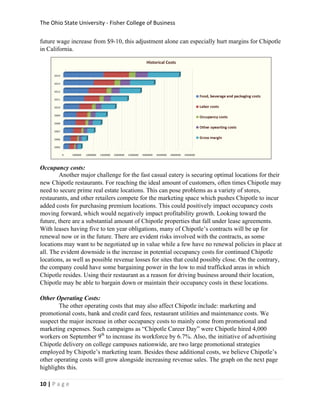
future wage increase from $9-10, this adjustment alone can especially hurt margins for Chipotle
in California.
Occupancy costs:
Another major challenge for the fast casual eatery is securing optimal locations for their
new Chipotle restaurants. For reaching the ideal amount of customers, often times Chipotle may
need to secure prime real estate locations. This can pose problems as a variety of stores,
restaurants, and other retailers compete for the marketing space which pushes Chipotle to incur
added costs for purchasing premium locations. This could positively impact occupancy costs
moving forward, which would negatively impact profitability growth. Looking toward the
future, there are a substantial amount of Chipotle properties that fall under lease agreements.
With leases having five to ten year obligations, many of Chipotle’s contracts will be up for
renewal now or in the future. There are evident risks involved with the contracts, as some
locations may want to be negotiated up in value while a few have no renewal policies in place at
all. The evident downside is the increase in potential occupancy costs for continued Chipotle
locations, as well as possible revenue losses for sites that could possibly close. On the contrary,
the company could have some bargaining power in the low to mid trafficked areas in which
Chipotle resides. Using their restaurant as a reason for driving business around their location,
Chipotle may be able to bargain down or maintain their occupancy costs in these locations.
Other Operating Costs:
The other operating costs that may also affect Chipotle include: marketing and
promotional costs, bank and credit card fees, restaurant utilities and maintenance costs. We
suspect the major increase in other occupancy costs to mainly come from promotional and
marketing expenses. Such campaigns as “Chipotle Career Day” were Chipotle hired 4,000
workers on September 9th
to increase its workforce by 6.7%. Also, the initiative of advertising
Chipotle delivery on college campuses nationwide, are two large promotional strategies
employed by Chipotle’s marketing team. Besides these additional costs, we believe Chipotle’s
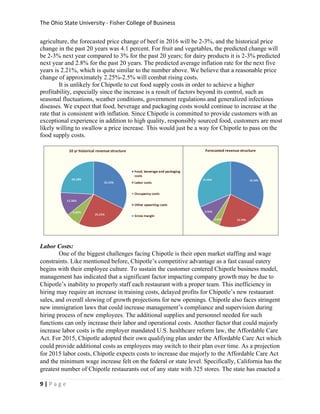
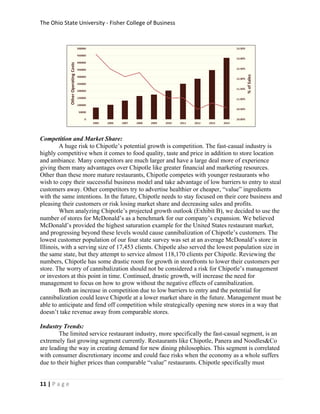
other operating costs will grow alongside increasing revenue sales. The graph on the next page
highlights this.
The	
  Ohio	
  State	
  University	
  -­‐	
  Fisher	
  College	
  of	
  Business	
  
11	
  |	
  P a g e 	


Competition and Market Share:
A huge risk to Chipotle’s potential growth is competition. The fast-casual industry is
highly competitive when it comes to food quality, taste and price in addition to store location
and ambiance. Many competitors are much larger and have a large deal more of experience
giving them many advantages over Chipotle like greater financial and marketing resources.
Other than these more mature restaurants, Chipotle competes with younger restaurants who
wish to copy their successful business model and take advantage of low barriers to entry to steal
customers away. Other competitors try to advertise healthier or cheaper, “value” ingredients
with the same intentions. In the future, Chipotle needs to stay focused on their core business and
pleasing their customers or risk losing market share and decreasing sales and profits.
When analyzing Chipotle’s projected growth outlook (Exhibit B), we decided to use the
number of stores for McDonald’s as a benchmark for our company’s expansion. We believed
McDonald’s provided the highest saturation example for the United States restaurant market,
and progressing beyond these levels would cause cannibalization of Chipotle’s customers. The
lowest customer population of our four state survey was set at an average McDonald’s store in
Illinois, with a serving size of 17,453 clients. Chipotle also served the lowest population size in
the same state, but they attempt to service almost 118,170 clients per Chipotle. Reviewing the
numbers, Chipotle has some drastic room for growth in storefronts to lower their customers per
store. The worry of cannibalization should not be considered a risk for Chipotle’s management
or investors at this point in time. Continued, drastic growth, will increase the need for
management to focus on how to grow without the negative effects of cannibalization.
Both an increase in competition due to low barriers to entry and the potential for
cannibalization could leave Chipotle at a lower market share in the future. Management must be
able to anticipate and fend off competition while strategically opening new stores in a way that
doesn’t take revenue away from comparable stores.
Industry Trends:
The limited service restaurant industry, more specifically the fast-casual segment, is an
extremely fast growing segment currently. Restaurants like Chipotle, Panera and Noodles&Co
are leading the way in creating demand for new dining philosophies. This segment is correlated
with consumer discretionary income and could face risks when the economy as a whole suffers
due to their higher prices than comparable “value” restaurants. Chipotle specifically must
The	
  Ohio	
  State	
  University	
  -­‐	
  Fisher	
  College	
  of	
  Business	
  
12	
  |	
  P a g e 	


differentiate itself through better service, ingredients and atmosphere to ensure continued
growth.
View of Management:
Chipotle’s proxy statement provides a fair amount of insight into the compensation
practices of key employees. Currently, CEO Steve Ells owns approximately .6% of shares
outstanding which brings total insider ownership to just over 1%. We believe that shareholders
should require Ells and management to own more shares which would incentivize them further
to bring value to shareholders. On the other hand, during the last shareholder meeting, it was
decided that SOSARs (Stock Only Stock Appreciation Rights) would be increased for leading
management. This increase makes a majority of key employee’s total compensation highly
weighted in the favor of stock options. This weighting is a positive sign for investors that
management has shareholders best interests at heart.
Final Thoughts on Risk:
At the end of the day, Chipotle will have its hands full with the mitigation of risks
associated with growing too fast or too slow, a misunderstanding of company values, increases
in the costs of food, beverage, packaging, labor and occupancy in addition to the threat of new
competition and a smaller market share. Management has a huge role to play in the strategic
leadership of the company but without the proper incentive programs in place, they will not be
inclined to make the best decisions for shareholders. We believe they are headed in the right
direction but must remain unbiased and value focused.
Conclusion:
Taking everything previously discussed into account, from the strength of Chipotle’s
value and revenue drivers to the potential risks of their current growth, we stand by our
recommendation of a SELL on Chipotle Mexican Grill. We believe in Chipotle as a responsible
and strategic company but think the market has inflated the stock price to a dangerous level.
While they continue to show strong signs of growth, that growth will slow and investors will
punish the firm by decreasing demand and forcing the stock price lower. Chipotle is currently
trading at a costly price of 45x earnings and we believe this price is just too high for new
investors to pay. The company will remain extremely successful with a large market share of
the fast-casual segment of the restaurant industry due in large part to the brilliant management
of key employees. These key employees have started a new dining philosophy with their “Food
with Integrity” incentive that will continue to change the way people think about and eat fast
food.
The	
  Ohio	
  State	
  University	
  -­‐	
  Fisher	
  College	
  of	
  Business	
  
13	
  |	
  P a g e 	


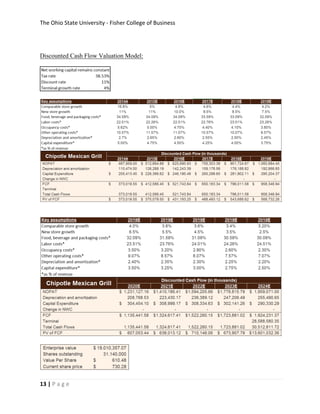
Discounted Cash Flow Valuation Model:
The	
  Ohio	
  State	
  University	
  -­‐	
  Fisher	
  College	
  of	
  Business	
  
14	
  |	
  P a g e 	


Exhibit A:
ROA D/E Current Ratio P/E beta
Chipotle 18.00% 0.09 3.28 44.73 0.94
Panera Bread 14.00% 0.05 1.29 31.41 0.64
Chuy's 6.00% 0.05 0.75 32.58 0.146
McDonald’s 15.00% 1.15 1.52 22.71 0.718
For return on Asset, D/E ratio and Current ratio, a three year average is used. For P/E ratio
and Beta, current value is used.
Exhibit B:
McDonald’s:
California number of stores= 1,492
State population = 38,802,500
McDonald’s Customer Population Per Store = 26,007
New York number of stores= 767
State population = 19,746,227
McDonald’s Customer Population Per Store = 25,744
Texas number of stores= 1,225
State population = 26,656,958
McDonald’s Customer Population Per Store = 21,760
Illinois number of stores= 738
State population = 12,880,580
McDonald’s Customer Population Per Store = 17,453
Chipotle’s:
California number of stores= 325
State population = 38,802,500
Chipotle’s Customer Population Per Store = 119,392
New York number of stores= 97
State population= 19,746,227
Chipotle’s Customer Population Per Store = 203,569
Texas number of stores= 134
State population = 26,656,958
Chipotle’s Customer Population Per Store = 198,932
Illinois number of stores= 109
State population = 12,880,580
Chipotle’s Customer Population Per Store = 118,170
The	
  Ohio	
  State	
  University	
  -­‐	
  Fisher	
  College	
  of	
  Business	
  
15	
  |	
  P a g e 	


Exhibit C:
Exhibit D: Chipotle Restaurants as of 12/31/14
The	
  Ohio	
  State	
  University	
  -­‐	
  Fisher	
  College	
  of	
  Business	
  
16	
  |	
  P a g e 	


Sources:
•   Bloomberg Terminal – The Ohio State University, Fisher College of Business
•   Capital IQ – The Ohio State University, Fisher College of Business
•   Chipotle Annual Reports 2008-2014
•   Chipotle Proxy Report 2014
•   Chipotle Investor Relations Website
o   http://ir.chipotle.com/phoenix.zhtml?c=194775&p=irol-irhome
•   Yahoo.com
•   Sec.gov
•   Seekingalpha.com
•   MarketRealist.com

Final CMG Report

  • 1.
    ! Chipotle Mexican Grill EquityResearch Report Jessie Huang Wayne Lin Jiangchao Lu Alex Osterhage Ty Shen Garrett Trebilcock ! ! ! ! ! ! ! ! ! !
  • 2.
    The  Ohio  State  University  -­‐  Fisher  College  of  Business   2  |  P a g e     Chipotle Mexican Grill, Inc. Executive Summary Company Description: Chipotle Mexican Grill is a fast casual chain of restaurants that specialize in burritos, tacos, burrito bowls, and salads. As of the second quarter of 2015, they operated 1,835 locations and ranked #1 in revenue and market capitalization of all fast casual restaurants. Each location employs a team of “top performers” that focus on sourcing the highest quality and sustainable raw ingredients while utilizing classic cooking techniques with a distinctive interior design. Rationale ●   Through comparable store sales growth and new store sales, Chipotle has consistently been able to increase overall revenue year after year. We believe that they will continue to increase revenue at an average rate of 11% over the next ten years. ●   Chipotle is trying to change the way people think about and eat fast food by sustainably sourcing all ingredients and limiting the use of GMO’s. The “Food with Integrity” initiative represents a motivation to cultivate a better world that we believe customers will continue to support and competitors will find difficult to replicate. ●   Led by founder, CEO, and Chairman Steve Ells, Chipotle management is incentivized to focus on long term growth and demonstrate the ability to strategically add value for shareholders. ●   As a restaurant chain that seeks to provide high quality food at a fast pace, Chipotle will look toward creating a faster and more optimal restaurant design to accommodate quicker throughput times, increasing their volume in ticket sales. ●   One main ingredient that differentiates Chipotle from other fast casual restaurants is their employees. Management seeks only the top performing personnel that create and impart a special environment for each customer. Key Assumptions: ●   Ten Year Average Revenue Growth: 11% (7% New Store Sales, 4% Comparable Store Sales) ●   Terminal Growth Rate: 4% at a WACC of 11% Risks: ●   Comparable store sales growth will be limited by the “trade-down” effect, service speed decreases, and consumer discretionary income changes. The rate at which new stores are opened will be susceptible to many risk factors and may cause a large decrease in revenue growth. ●   Customers who visit Chipotle restaurants are generally affected by macroeconomic trends. Rising inflationary expectations, changes in eating habits and stock market fluctuations all have impacts on the firm’s intrinsic value. ●   Large risks of continued growth are challenges in staffing top managers and employees plus the potential rise in minimum wage requirements. The Affordable Care Act will also push down returns.
  • 3.
    The  Ohio  State  University  -­‐  Fisher  College  of  Business   3  |  P a g e     Company Overview: Chipotle Mexican Grill, Inc. is a famous chain of restaurants in the United States that serves a limited menu consisting of burritos, tacos, burrito bowls and salads. As of the second quarter of 2015, they had 1,835 restaurants throughout 45 different states and few international locations including Canada, England, France and Germany. In addition, they operate a minimal number of ShopHouse Southeast Asian Kitchen and Pizzeria Locale restaurants both fast casual concepts that do not have a significant impact on sales growth. Chipotle focuses on providing customers with the best food using high-quality raw ingredients that are grown in a sustainable manner. These ingredients are sourced in such a way that respect for animals, farmers and the environment is held in the highest regards. Similarly, Chipotle seeks to attract top performers who believe in company values and have the ability to grow into team leaders. Inspired by fine dining establishments and using non-traditional cooking methods, we believe they have built a unique experience within each restaurant that will keep customers coming back for more. Based on our analysis of the trailing ten-year free cash flow model, Chipotle has implemented an aggressive growth strategy, increasing revenue at an average of 24%. This historical revenue growth coupled with decreased costs as a percentage of revenue led to an almost doubling of ROE and ROA in the past ten years. In addition, ROIC grew from 10.66 to 25.69 which drove a stock price appreciation of 1600% since their IPO on January 26th, 2006. Since then, Chipotle management has not elected for a stock split, meaning the current trading price of one share is $730 with a P/E ratio of about 44. Business Model (Drivers and Costs of Growth): Chipotle is considered a growth company where share price is extremely susceptible to changes in estimated revenue growth and actual revenue reports. Similar to competitors like McDonald's, Chipotle relies on the ability to grow revenue through comparable store sales growth and new store sales. This growth is partially driven through the concept of “Food with Integrity” which is limited by increases in costs of food, beverage, packaging, and labor. In addition, the Chipotle management, industry trends and peer competition could hinder the growth strategy that has made them so successful in years past. Revenue Growth: As discussed previously, Chipotle was able to successfully leverage investments by McDonald’s to grow from 16 to 500 restaurants between 1998 and 2005. After the divestment, Chipotle continued to grow revenue at an average rate of 23% per year. This growth was and continues to be driven by comparable store sales growth and new store sales. Comparable store sales (in operations for 13 months) have two primary drivers: traffic and ticket price. The increase in the number of customers generating transactions within each store is affected by strategic marketing and branding, increased service speed, and increases in consumer discretionary income. In 2014, comparable store sales growth was 16.8% of revenue driven primarily by an increase in customer visits and a price increase of 3.8%. Going forward, Chipotle is expected to have comparable stores sales increases in the low-to-mid single digits and we forecast an average of 4.6% over the next 5 years. New store sales include both domestic and international openings but is the net of reopenings. As of Q2 2015, Chipotle has 1,835 locations on an increase of 48 in the quarter. This puts new store growth on pace to hit estimates of 190-205 for the year 2015. Chipotle’s international expansion strategy is minimal
  • 4.
    The  Ohio  State  University  -­‐  Fisher  College  of  Business   4  |  P a g e     compared to domestic expansion. In 2014, new store sales accounted for 11% of revenue and we estimate Chipotle to continue to open new stores at a similar rate to their estimates for 2015. As Chipotle continues to grow, new store sales represent a smaller portion of revenue which drives our estimate for average new store sales over the next ten years to be 7% of revenue. Even as new store sales represent a smaller portion, they still are the larger driver of total revenue growth. It is worth mentioning that the operations and new openings of ShopHouse and Pizzeria Locale restaurants are not contributors to growth and may be discontinued. Food with Integrity Food with Integrity is Chipotle’s commitment toward delivering high quality ingredients raised with respect for the environment, animals and farmers. In selecting suppliers, Chipotle sources food from farmers rather than factories. They look to partner with local farmers, believing this food supply will provide the freshest ingredients for their customers. The select farmers who share values with Chipotle, commit to use vegetables grown in healthy soil and allow livestock to roam freely. This initiative also flows into the food preparation process, as Chipotle seeks to go the extra mile to insure freshness. With quality remaining the key focus, all food is prepared on site within each Chipotle kitchen and served with no artificial flavors or filters. Instead of cutting costs and increasing the price to generate a high gross margin. Chipotle focuses mainly on spending more for ingredients, while trying to maintain a relatively affordable price point. In 2013, Chipotle made headlines for becoming the first national restaurant chain to voluntarily disclose the presence of GMOs in their food. In 2015, Chipotle succeeded in the quest of switching to serve food made only with non-GMO ingredients. Therefore, in the mind of those who wait in the long line, a burrito is not just a burrito—it represents a motivation to cultivate a better world. In the long term it is believed that customer’s recognition of the importance of “Food with Integrity” will increase demand for responsibly sourced meats and agriculture. Chipotle is on the forefront of this revolution and expects customer support to create a competitive advantage that competitors will have difficulty replicating. This competitive advantage will continue to drive revenue growth until replication is achieved or customers no longer feel a connection between eating at Chipotle restaurants and cultivating a better world through sustainably sourced ingredients.
  • 5.
    The  Ohio  State  University  -­‐  Fisher  College  of  Business   5  |  P a g e     The Chipotle Restaurant Design and Workforce: What makes Chipotle a unique restaurant concept stems from their overall brick-and- mortar design and the unique employees the business attempts to hire. Their labor force emerges from management’s business model that seeks to provide the highest quality of food at the fastest rate possible. To accomplish this, Chipotle retrofits custom floor plans for each of their respective establishments with the goal of maximizing the natural customer flow of every Chipotle eatery. The customized respective floor plans, design of serving lines, as well as improved ordering lines look to create the highest throughput of customer orders. Essentially, Chipotle pushes the curve of restaurant design by creating the most efficient ways to process consumer requests. This ultimately will have a positive impact on comparable sales, as Chipotle continues to make changes in their store layouts. Each additional adjustment should assist in generating additional traffic and ticket purchases. With a focus on store layouts and efficiencies, comparable sales can be projected into the future at the low to mid-single digit range. Unlike most other fast casual food providers, Chipotle employs a strong focus on hiring and empowering top performing employees. They look to uncover personnel that have a passion for food, who will operate their restaurants to the highest standards, and who will allow for the variety of personalities at Chipotle to contribute toward their success. Differing from many other fast casual restaurants, Chipotle looks to install crew members at every stage of the food making cycle to reinforce the focus on individual service. This also allows them to specifically interact with customers during the process cycle and impart the unique Chipotle experience during each order. Management views this interaction as a building block toward creating loyalty and awareness for the Chipotle brand among employees and customers. The unique relational experience for customers is a key driver for repeat customer loyalty, adding to both comparable and new store sales growth. Recently, Chipotle completed their quota of hiring 4,000 new workers on September 9, 2015. This a confident signal from management that they are committed to their overall future growth as a company. Due to these specific hiring and management strategies, we believe that Chipotle will continue to increase its workforce in a way that will support continued revenue and store growth. Competition and Market Share: Chipotle dominates the fast-casual segment of the restaurant industry. When determining comparable restaurants, we decided to pull some from the fast-casual segment and a few others based on different factors. In the end, we chose Panera, Chuy’s Tex-Mex and McDonalds due to comparable ROA, D/E, current and P/E ratios. We then looked at betas and geographic location of all restaurant firms to further screen potential peer firms. These choices in peer firms represent what we think Chipotle could become, a strategically and operationally identical restaurant, and a restaurant with similar size, market share and customer base. Chipotle currently has a decent portion of this market share but McDonalds, due to their maturity, has the largest share.
  • 6.
    The  Ohio  State  University  -­‐  Fisher  College  of  Business   6  |  P a g e     When analyzing the limited service restaurant segment, we determined that Chipotle has a 2% market share compared to Panera’s 1.2%, Chuy’s .12% and McDonald’s 8.8%. They have grown this 2% market share in 2014 from their 1% market share in 2010 while McDonald’s has decreased by 2% in the same time frame. Panera’s market share has seen a low level of growth but remains a major competitor for Chipotle in the fast-casual segment. In the future, we believe Chipotle will continue to enjoy a large share of the market and the benefits associated with that dominance. Chipotle recognizes a different list of peer firms when determining compensation for management. Due to the importance of Chipotles performance compared to this list, we felt it was important to mention Chipotle’s average annual revenue but impressive market cap compared to these peers. The list includes the likes of Yum! Brands, Bob Evans, Cheesecake Factory and Starbucks (public companies with revenue over $500 million). Industry Trends: Aside from the internal drivers, the performance of Chipotle is also affected by the industry trends in the macro-environment. In our opinion, we believe there are several key factors that should be analyzed when considering Chipotle’s future performance. A few ideal considerations that we have identified which could impact the business comprise of inflationary expectations, general industry growth, and changes in eating habits Beginning with inflationary expenses, according to the International Monetary Fund (IMF), inflation through 2020 is projected to settle around 2.21%. With Chipotle also operating in the food industry, we must also take into account the possibility of rising food costs. Through the outside resource of “Trading Economics,” we project that food inflation in the United States should be approximately 2% during the same period. Keeping these relative estimates in mind, we believe that Chipotle’s ticket price can be projected to rise up into the range of 2-2.5% over the coming years. Next, Chipotle as a restaurant can also be impacted by the overall general industry growth. According to a report from the National Restaurant Association, restaurant service sales in the United States are projected to grow 20% reaching a sales level of $710 billion. It is our belief, based on these projections that a similar trend of this magnitude will persist into the future. With such a rising tide in growing sales, we believe that this could only positively impact Chipotle’s store sales.
  • 7.
    The  Ohio  State  University  -­‐  Fisher  College  of  Business   7  |  P a g e     Third, analyzing the data we acquired from the United States Department of Agriculture (USDA). The estimated monthly sales away from home in the United States will grow at an annual rate of 6.7%. Overlooking this data, we can infer that American eating habits are shifting in their complexity. Individuals are now seeking to dine out more often than they are to stay in and cook at home. We believe this change in eating habits will have a positive impact on Chipotle’s sales and traffic numbers, moving into the future. View of Management: After review of the proxy statement and analysis of executive compensation, we have determined that management is incentivized in such a way that they should keep the interests of the business and those of shareholders in mind when making decisions. The compensation committee believes it is necessary to deploy programs that emphasize entrepreneurial and innovative thought processes and that reward management when their team’s efforts creates shareholder value. Executive compensation is made up of a base salary tied to individual contribution and experience, an annual cash bonus taking average daily sales and sales increases into account, and an equity allotment. Even though the base salary is individualistic, we believe management is still very team-focused. Shareholder returns were 1,456% since Chipotle’s IPO in 2006 and a portion of returns can be attributed to management's drive to add value. The cash bonus is determined by a committee who looks at performance and individuals ability to create shareholder value when comparing company performance to benchmarks in the restaurant industry (sales growth, income growth and shareholder return over a one, three and five year period). This, paired with an equity compensation directly tied to share price appreciation (Stock Only Stock Appreciation Rights) gives management the incentive to continue the efficient and strategic growth of the Chipotle brand. Vesting lasts three years meaning management cannot sell their awarded shares for that period of time and is subject to performance compared to a restaurant industry peer group. If Chipotle were to ever experience a depreciation in stock price, decreased market share or lower sales, management would be punished through a depreciation in value of shares previously awarded and a lower number of shares awarded in that period. Share Repurchases: Starting in 2008, Chipotle started a share repurchase program of $100 million dollars each year to buy back its class B common stock opportunistically in the market. This can be viewed in a few different ways. First of all, repurchases are usually a signal from management that shares are undervalued. We do not believe that management could possibly think a P/E of 44x earnings warrants an undervaluation of share price. Repurchases are also used as a metric for management to return cash to shareholders without reducing the value of shares. $100 million a year is not a significant enough amount of cash for us to think that management's purpose in repurchasing shares is to return cash to holders. It is more likely that the repurchases are a way for management to keep the total amount of shares outstanding in balance and less diluted. The graph on the next page highlights this trend.
  • 8.
    The  Ohio  State  University  -­‐  Fisher  College  of  Business   8  |  P a g e     Risks Associated with Business Model: Rapid Growth and Misunderstanding of the “Chipotle Experience”: When discussing the drivers of revenue growth, it is important to mention certain risks that will likely impact actual percentage increases in growth. Like mentioned earlier, revenue growth is driven by comparable store sales growth and new store sales. Comparable store sales growth will be limited when marketing and branding efforts are ineffective, service speed decrease traffic, and consumer discretionary income decreases. Menu prices will be increased when costs associated with doing business increase and some customers will “trade-down” to cheaper alternatives, effectively decreasing revenue. New store openings are estimated to grow year over year but can be adversely affected by the difficulty in building a customer base and the inability to locate attractive locations, labor and sustainable food supplies. On top of these risks, cannibalization is a major factor that will limit management’s desire to open new locations. We believe Chipotle still has a small period of growth before cannibalization becomes a major risk. Risks associated with growth itself are the inability to grow fast enough to maintain a market leading position and also growing too quickly. Growth that is not managed effectively will lead to the hiring of less talented general managers and team members in addition to increased costs due to inefficiencies. International, ShopHouse and Pizzeria Locale expansion lack brand awareness, are not significant contributors to growth and may be discontinued. Chipotle charges higher prices than competitors to offset the costs of higher quality, responsibly sourced ingredients. If they cannot convince customers to pay these higher prices, revenues and profits will suffer. Success is determined largely by customer’s education on the benefits of higher quality ingredients and so Chipotle must put an emphasis on advertising and marketing in the future to raise brand awareness. Customers who are knowledgeable and accepting of these premium prices will drive sales and profits to desired levels. Food, beverage and packaging costs: Chipotle’s profitability partially depends on how the company anticipates and reacts to changes in food and supply costs. In the last ten years, though inflation on food items is driving up food supply costs of the whole fast casual industry, Chipotle seems to suffer a lot—food, beverage and packaging costs grew at an average rate of 24.43% due to the inflation on beef, salsa ingredients, avocados, dairy and chicken. According to the United States department of
  • 9.
    The  Ohio  State  University  -­‐  Fisher  College  of  Business   9  |  P a g e     agriculture, the forecasted price change of beef in 2016 will be 2-3%, and the historical price change in the past 20 years was 4.1 percent. For fruit and vegetables, the predicted change will be 2-3% next year compared to 3% for the past 20 years; for dairy products it is 2-3% predicted next year and 2.8% for the past 20 years. The predicted average inflation rate for the next five years is 2.21%, which is quite similar to the number above. We believe that a reasonable price change of approximately 2.25%-2.5% will combat rising costs. It is unlikely for Chipotle to cut food supply costs in order to achieve a higher profitability, especially since the increase is a result of factors beyond its control, such as seasonal fluctuations, weather conditions, government regulations and generalized infectious diseases. We expect that food, beverage and packaging costs would continue to increase at the rate that is consistent with inflation. Since Chipotle is committed to provide customers with an exceptional experience in addition to high quality, responsibly sourced food, customers are most likely willing to swallow a price increase. This would just be a way for Chipotle to pass on the food supply costs. Labor Costs: One of the biggest challenges facing Chipotle is their open market staffing and wage constraints. Like mentioned before, Chipotle’s competitive advantage as a fast casual eatery begins with their employee culture. To sustain the customer centered Chipotle business model, management has indicated that a significant factor impacting company growth may be due to Chipotle’s inability to properly staff each restaurant with a proper team. This inefficiency in hiring may require an increase in training costs, delayed profits for Chipotle’s new restaurant sales, and overall slowing of growth projections for new openings. Chipotle also faces stringent new immigration laws that could increase management’s compliance and supervision during hiring process of new employees. The additional supplies and personnel needed for such functions can only increase their labor and operational costs. Another factor that could majorly increase labor costs is the employer mandated U.S. healthcare reform law, the Affordable Care Act. For 2015, Chipotle adopted their own qualifying plan under the Affordable Care Act which could provide additional costs as employees may switch to their plan over time. As a projection for 2015 labor costs, Chipotle expects costs to increase due majorly to the Affordable Care Act and the minimum wage increase felt on the federal or state level. Specifically, California has the greatest number of Chipotle restaurants out of any state with 325 stores. The state has enacted a
  • 10.
    The  Ohio  State  University  -­‐  Fisher  College  of  Business   10  |  P a g e     future wage increase from $9-10, this adjustment alone can especially hurt margins for Chipotle in California. Occupancy costs: Another major challenge for the fast casual eatery is securing optimal locations for their new Chipotle restaurants. For reaching the ideal amount of customers, often times Chipotle may need to secure prime real estate locations. This can pose problems as a variety of stores, restaurants, and other retailers compete for the marketing space which pushes Chipotle to incur added costs for purchasing premium locations. This could positively impact occupancy costs moving forward, which would negatively impact profitability growth. Looking toward the future, there are a substantial amount of Chipotle properties that fall under lease agreements. With leases having five to ten year obligations, many of Chipotle’s contracts will be up for renewal now or in the future. There are evident risks involved with the contracts, as some locations may want to be negotiated up in value while a few have no renewal policies in place at all. The evident downside is the increase in potential occupancy costs for continued Chipotle locations, as well as possible revenue losses for sites that could possibly close. On the contrary, the company could have some bargaining power in the low to mid trafficked areas in which Chipotle resides. Using their restaurant as a reason for driving business around their location, Chipotle may be able to bargain down or maintain their occupancy costs in these locations. Other Operating Costs: The other operating costs that may also affect Chipotle include: marketing and promotional costs, bank and credit card fees, restaurant utilities and maintenance costs. We suspect the major increase in other occupancy costs to mainly come from promotional and marketing expenses. Such campaigns as “Chipotle Career Day” were Chipotle hired 4,000 workers on September 9th to increase its workforce by 6.7%. Also, the initiative of advertising Chipotle delivery on college campuses nationwide, are two large promotional strategies employed by Chipotle’s marketing team. Besides these additional costs, we believe Chipotle’s other operating costs will grow alongside increasing revenue sales. The graph on the next page highlights this.
  • 11.
    The  Ohio  State  University  -­‐  Fisher  College  of  Business   11  |  P a g e     Competition and Market Share: A huge risk to Chipotle’s potential growth is competition. The fast-casual industry is highly competitive when it comes to food quality, taste and price in addition to store location and ambiance. Many competitors are much larger and have a large deal more of experience giving them many advantages over Chipotle like greater financial and marketing resources. Other than these more mature restaurants, Chipotle competes with younger restaurants who wish to copy their successful business model and take advantage of low barriers to entry to steal customers away. Other competitors try to advertise healthier or cheaper, “value” ingredients with the same intentions. In the future, Chipotle needs to stay focused on their core business and pleasing their customers or risk losing market share and decreasing sales and profits. When analyzing Chipotle’s projected growth outlook (Exhibit B), we decided to use the number of stores for McDonald’s as a benchmark for our company’s expansion. We believed McDonald’s provided the highest saturation example for the United States restaurant market, and progressing beyond these levels would cause cannibalization of Chipotle’s customers. The lowest customer population of our four state survey was set at an average McDonald’s store in Illinois, with a serving size of 17,453 clients. Chipotle also served the lowest population size in the same state, but they attempt to service almost 118,170 clients per Chipotle. Reviewing the numbers, Chipotle has some drastic room for growth in storefronts to lower their customers per store. The worry of cannibalization should not be considered a risk for Chipotle’s management or investors at this point in time. Continued, drastic growth, will increase the need for management to focus on how to grow without the negative effects of cannibalization. Both an increase in competition due to low barriers to entry and the potential for cannibalization could leave Chipotle at a lower market share in the future. Management must be able to anticipate and fend off competition while strategically opening new stores in a way that doesn’t take revenue away from comparable stores. Industry Trends: The limited service restaurant industry, more specifically the fast-casual segment, is an extremely fast growing segment currently. Restaurants like Chipotle, Panera and Noodles&Co are leading the way in creating demand for new dining philosophies. This segment is correlated with consumer discretionary income and could face risks when the economy as a whole suffers due to their higher prices than comparable “value” restaurants. Chipotle specifically must
  • 12.
    The  Ohio  State  University  -­‐  Fisher  College  of  Business   12  |  P a g e     differentiate itself through better service, ingredients and atmosphere to ensure continued growth. View of Management: Chipotle’s proxy statement provides a fair amount of insight into the compensation practices of key employees. Currently, CEO Steve Ells owns approximately .6% of shares outstanding which brings total insider ownership to just over 1%. We believe that shareholders should require Ells and management to own more shares which would incentivize them further to bring value to shareholders. On the other hand, during the last shareholder meeting, it was decided that SOSARs (Stock Only Stock Appreciation Rights) would be increased for leading management. This increase makes a majority of key employee’s total compensation highly weighted in the favor of stock options. This weighting is a positive sign for investors that management has shareholders best interests at heart. Final Thoughts on Risk: At the end of the day, Chipotle will have its hands full with the mitigation of risks associated with growing too fast or too slow, a misunderstanding of company values, increases in the costs of food, beverage, packaging, labor and occupancy in addition to the threat of new competition and a smaller market share. Management has a huge role to play in the strategic leadership of the company but without the proper incentive programs in place, they will not be inclined to make the best decisions for shareholders. We believe they are headed in the right direction but must remain unbiased and value focused. Conclusion: Taking everything previously discussed into account, from the strength of Chipotle’s value and revenue drivers to the potential risks of their current growth, we stand by our recommendation of a SELL on Chipotle Mexican Grill. We believe in Chipotle as a responsible and strategic company but think the market has inflated the stock price to a dangerous level. While they continue to show strong signs of growth, that growth will slow and investors will punish the firm by decreasing demand and forcing the stock price lower. Chipotle is currently trading at a costly price of 45x earnings and we believe this price is just too high for new investors to pay. The company will remain extremely successful with a large market share of the fast-casual segment of the restaurant industry due in large part to the brilliant management of key employees. These key employees have started a new dining philosophy with their “Food with Integrity” incentive that will continue to change the way people think about and eat fast food.
  • 13.
    The  Ohio  State  University  -­‐  Fisher  College  of  Business   13  |  P a g e     Discounted Cash Flow Valuation Model:
  • 14.
    The  Ohio  State  University  -­‐  Fisher  College  of  Business   14  |  P a g e     Exhibit A: ROA D/E Current Ratio P/E beta Chipotle 18.00% 0.09 3.28 44.73 0.94 Panera Bread 14.00% 0.05 1.29 31.41 0.64 Chuy's 6.00% 0.05 0.75 32.58 0.146 McDonald’s 15.00% 1.15 1.52 22.71 0.718 For return on Asset, D/E ratio and Current ratio, a three year average is used. For P/E ratio and Beta, current value is used. Exhibit B: McDonald’s: California number of stores= 1,492 State population = 38,802,500 McDonald’s Customer Population Per Store = 26,007 New York number of stores= 767 State population = 19,746,227 McDonald’s Customer Population Per Store = 25,744 Texas number of stores= 1,225 State population = 26,656,958 McDonald’s Customer Population Per Store = 21,760 Illinois number of stores= 738 State population = 12,880,580 McDonald’s Customer Population Per Store = 17,453 Chipotle’s: California number of stores= 325 State population = 38,802,500 Chipotle’s Customer Population Per Store = 119,392 New York number of stores= 97 State population= 19,746,227 Chipotle’s Customer Population Per Store = 203,569 Texas number of stores= 134 State population = 26,656,958 Chipotle’s Customer Population Per Store = 198,932 Illinois number of stores= 109 State population = 12,880,580 Chipotle’s Customer Population Per Store = 118,170
  • 15.
    The  Ohio  State  University  -­‐  Fisher  College  of  Business   15  |  P a g e     Exhibit C: Exhibit D: Chipotle Restaurants as of 12/31/14
  • 16.
    The  Ohio  State  University  -­‐  Fisher  College  of  Business   16  |  P a g e     Sources: •   Bloomberg Terminal – The Ohio State University, Fisher College of Business •   Capital IQ – The Ohio State University, Fisher College of Business •   Chipotle Annual Reports 2008-2014 •   Chipotle Proxy Report 2014 •   Chipotle Investor Relations Website o   http://ir.chipotle.com/phoenix.zhtml?c=194775&p=irol-irhome •   Yahoo.com •   Sec.gov •   Seekingalpha.com •   MarketRealist.com