By: Divya Vashisht
DCGC TRAINEE
ROLL NO. 08
Case Presentation
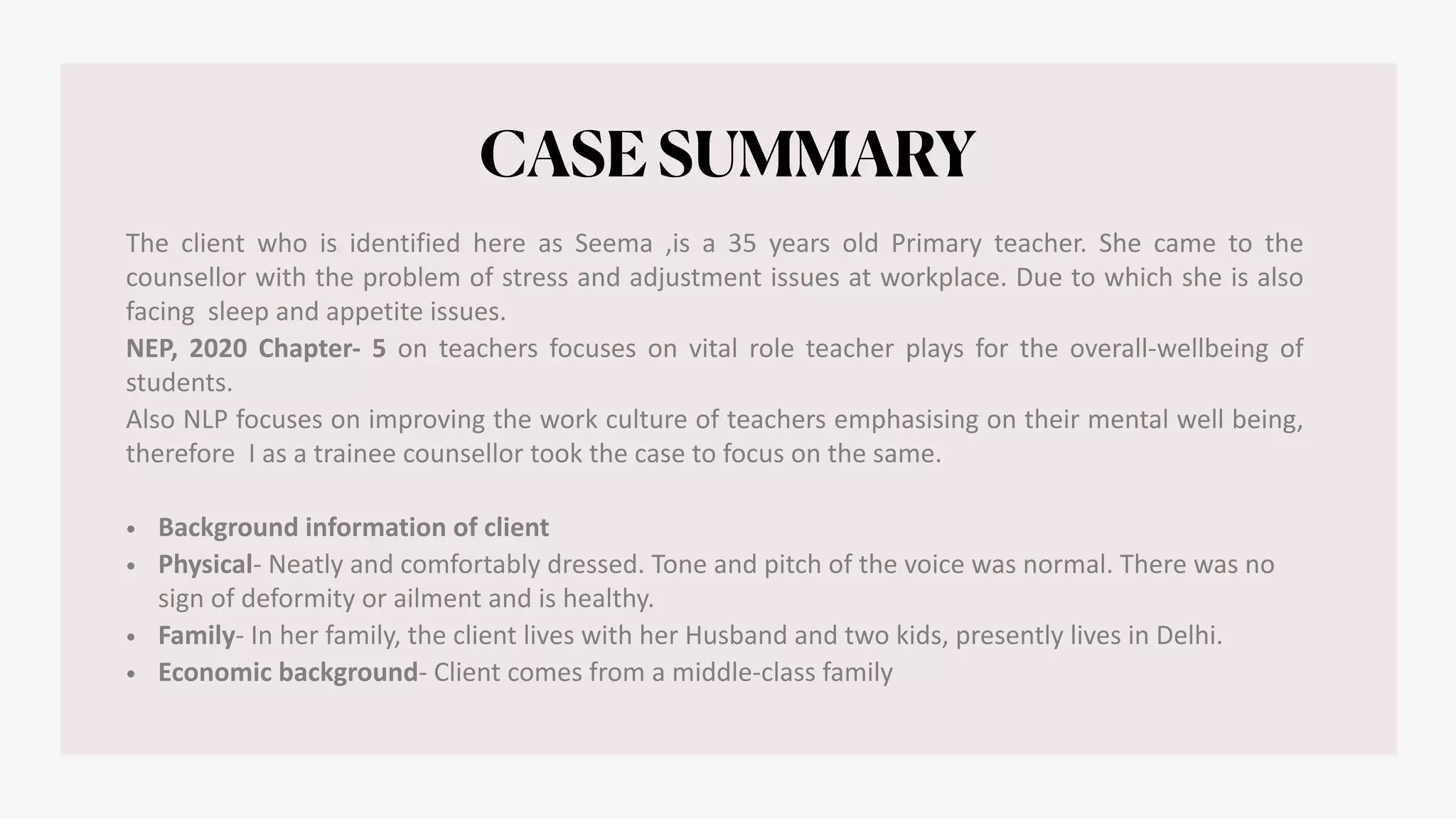
CASE SUMMARY
The client who is identified here as Seema ,is a 35 years old Primary teacher. She came to the
counsellor with the problem of stress and adjustment issues at workplace. Due to which she is also
facing sleep and appetite issues.
NEP, 2020 Chapter- 5 on teachers focuses on vital role teacher plays for the overall-wellbeing of
students.
Also NLP focuses on improving the work culture of teachers emphasising on their mental well being,
therefore I as a trainee counsellor took the case to focus on the same.
• Background information of client
• Physical- Neatly and comfortably dressed. Tone and pitch of the voice was normal. There was no
sign of deformity or ailment and is healthy.
• Family- In her family, the client lives with her Husband and two kids, presently lives in Delhi.
• Economic background- Client comes from a middle-class family
PRESENTING ISSUES
• Automatic irrational thoughts.
• Sleep issues.
• Loss of appetite.
35 year old Seema was facing issues at workplace- stress and adjustment
SESSION- 1
Objectives:
(i) To collect the background information of the client
(ii) To build rapport with the client
(iii) To understand the issues faced by the client.
Outcomes:
• rapport building with the client.
• Confidentiality assurance to the client.
• Getting insight about the feelings of alienation, transition and adjustment issues with new
staff.
• Significant information about school environment and family situations was also collected.
Skills:
• SOLER (Attentive listening skills).
• Responding skills: Questioning (Open ended and close ended). For probing and exploring.
• Supportive responses.
• Paraphrase and Reflection.
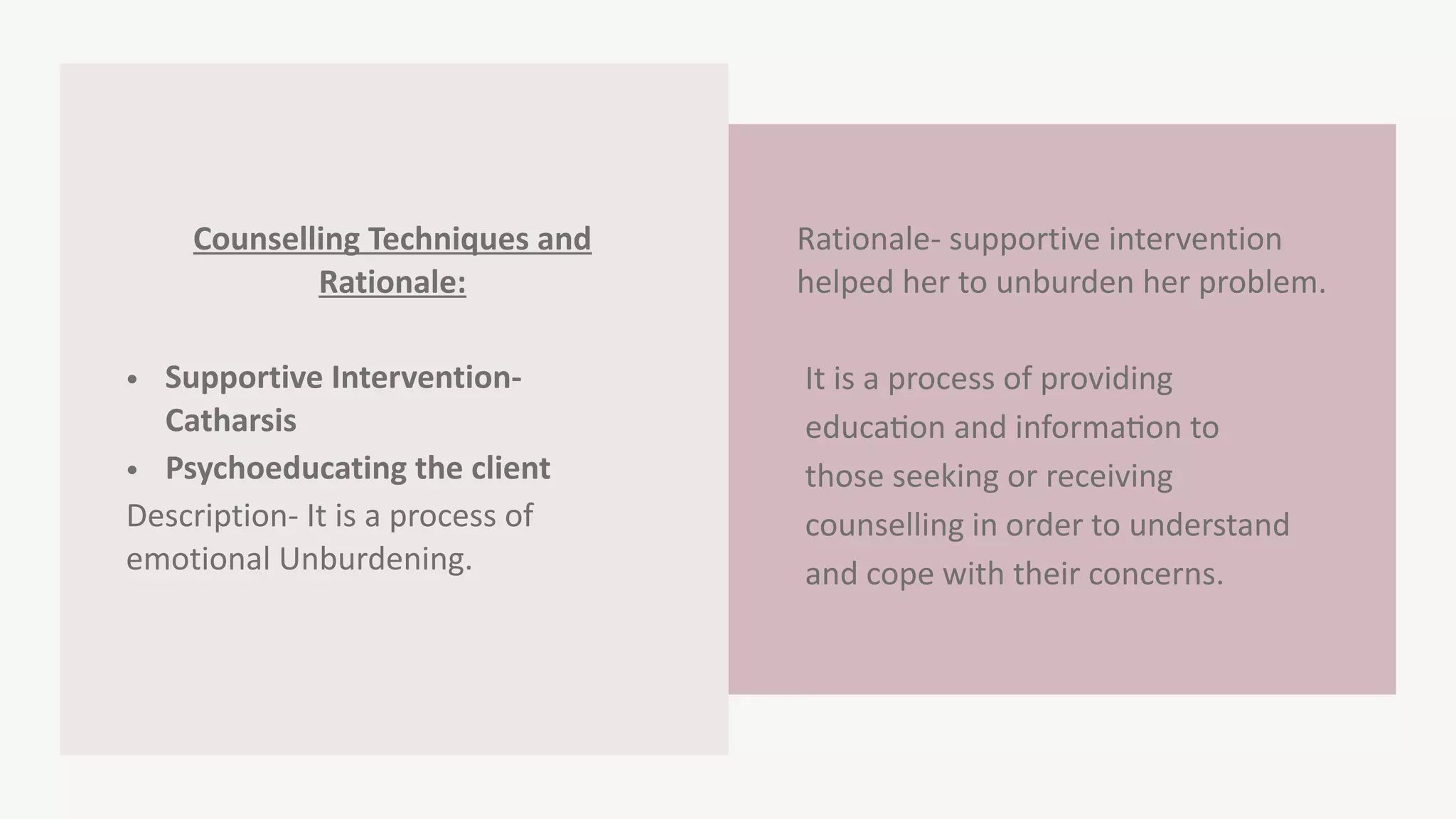
Counselling Techniques and
Rationale:
• Supportive Intervention-
Catharsis
• Psychoeducating the client
Description- It is a process of
emotional Unburdening.
Rationale- supportive intervention
helped her to unburden her problem.
It is a process of providing
educa
ti
on and informa
ti
on to
those seeking or receiving
counselling in order to understand
and cope with their concerns.
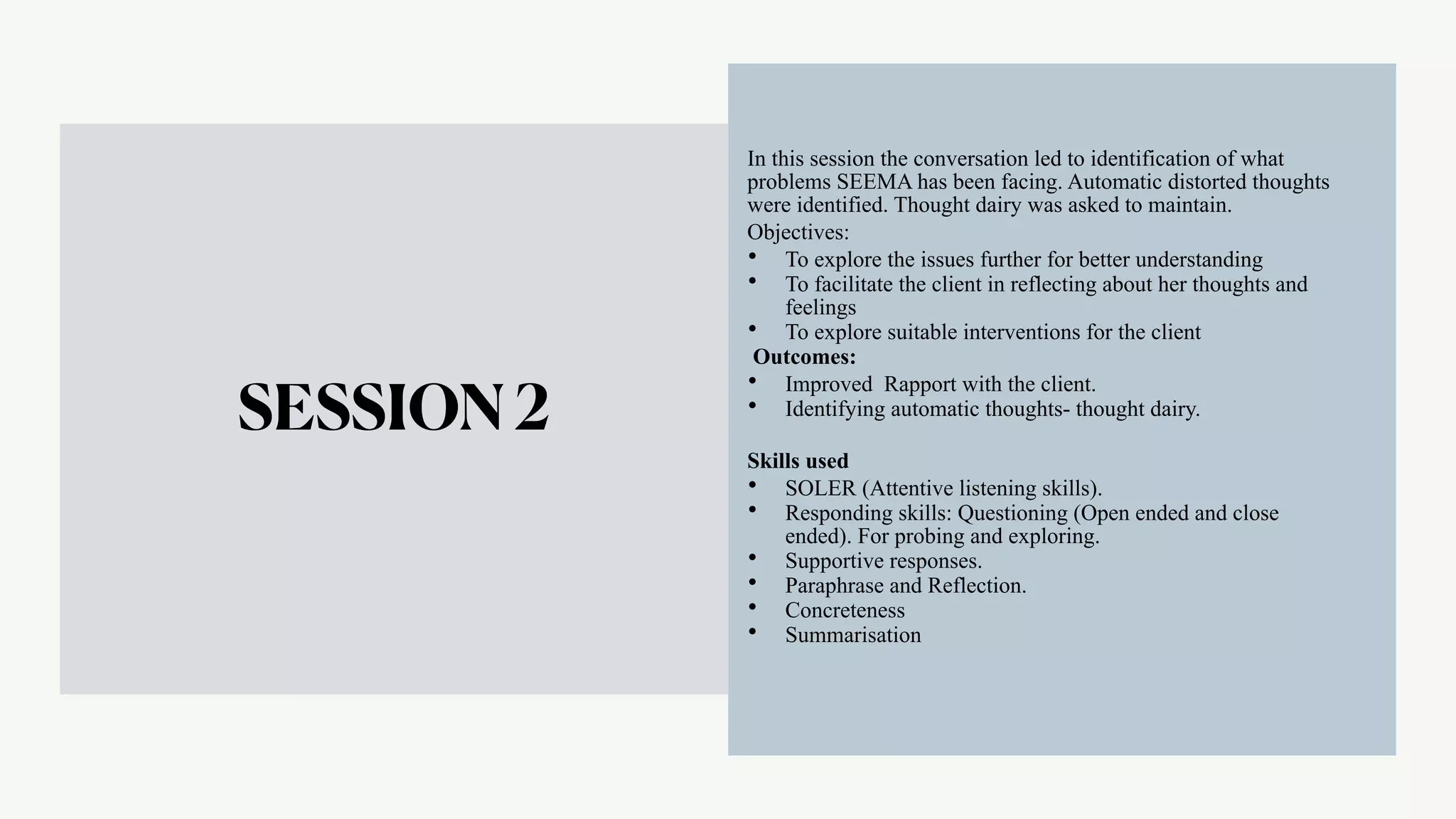
In this session the conversation led to identification of what
problems SEEMA has been facing. Automatic distorted thoughts
were identified. Thought dairy was asked to maintain.
Objectives:
• To explore the issues further for better understanding
• To facilitate the client in reflecting about her thoughts and
feelings
• To explore suitable interventions for the client
Outcomes:
• Improved Rapport with the client.
• Identifying automatic thoughts- thought dairy.
Skills used
• SOLER (Attentive listening skills).
• Responding skills: Questioning (Open ended and close
ended). For probing and exploring.
• Supportive responses.
• Paraphrase and Reflection.
• Concreteness
• Summarisation
SESSION 2
this session Seema was motivated to understand her automatic
thoughts, she was facilitated by the counsellor she was asked to identify
the thought as helpful or unhelpful. She was asked to provide the
evidence of unhelpful thoughts being right, associated feeling its
intensity was explored, physiological responses attached to it were
explored.Further it was discussed there are ways in which we can
replace them with alternative thoughts. She was also asked to share her
thoughts on the same.
• Objectives:
(i) To facilitate the client in re
fl
ecting on her thoughts
(ii) To discuss and explore ways for the client to keep up on planned
intervention.
Outcomes:
• Identifying more strategies to deal with the situation.
• Alternate thoughts identi
fi
cation.
Skills used :
• SOLER (Attentive listening skills).
• Responding skills: Questioning (Leading questions, Open ended and
close ended). For probing and exploring.
• Supportive responses.
• Paraphrase and Re
fl
ection.
SESSION 3
Cognitive behaviour
therapy
CBT treatment usually involves efforts to change thinking
patterns. These strategies might include:
• Learning to recognise one’s distortions in thinking that are
creating problems, and then to reevaluate them in light of
reality.
• Gaining a better understanding of the behaviour and
motivation of others.
• Using problem-solving skills to cope with difficult situations.
• Learning to develop a greater sense of confidence in one’s
own abilities.
Counselling Technique used:
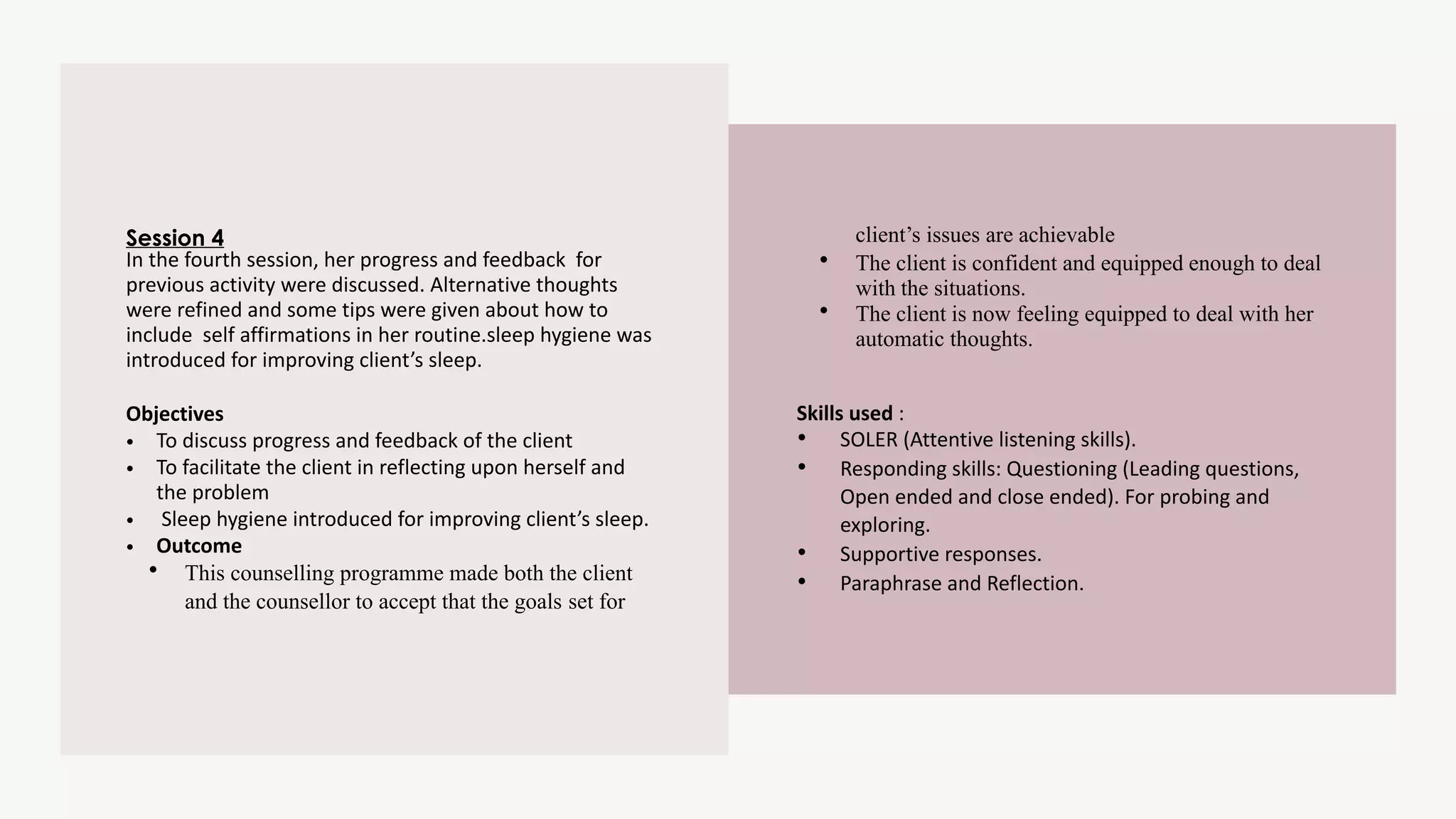
Session 4
In the fourth session, her progress and feedback for
previous activity were discussed. Alternative thoughts
were refined and some tips were given about how to
include self affirmations in her routine.sleep hygiene was
introduced for improving client’s sleep.
Objectives
• To discuss progress and feedback of the client
• To facilitate the client in reflecting upon herself and
the problem
• Sleep hygiene introduced for improving client’s sleep.
• Outcome
• This counselling programme made both the client
and the counsellor to accept that the goals set for
client’s issues are achievable
• The client is confident and equipped enough to deal
with the situations.
• The client is now feeling equipped to deal with her
automatic thoughts.
Skills used :
• SOLER (Attentive listening skills).
• Responding skills: Questioning (Leading questions,
Open ended and close ended). For probing and
exploring.
• Supportive responses.
• Paraphrase and Reflection.
Sleep hygiene
introduced.
Techniques used
Feedback was taken about her progress and about the counselling sessions. It
was observed that her stress levels were lower than earlier. Further, ways in
which she can manage similar kind of stress in future were also discussed.
Importance of learning to cope with the stressors were also discussed. The
session was terminated and the client was told that she can approach the
counsellor in future, if she feels the need.
Objectives
1. To take feedback on the counselling sessions.
2. To discuss about possible ways to deal with relapses.
3. To terminate the session.
Outcome
After discussing all the mentioned areas the session was terminated
successfully and the client showed confidence to resolve similar situations in
future on his own. Follow ups were said to be open to discuss in future. The
purpose of the termination is to provide closure.
Session: 5
Skills learned :
• SOLER (Attentive listening skills).
• Responding skills: Questioning (Leading questions, Open ended and close
ended). For probing and exploring.
• Supportive responses.
• Paraphrase and Reflection.
Difficulties faced :
There was a time limitation and connectivity issue at times due to virtual counselling. Due to poor
network quality the client’s camera could not be switched on which made it impossible to observe the
facial expression and body language of the client. There was also situation of connection lost due to which
at times the sessions ended in between which disturbed the flow of the conversation and caused
interruptions. It was also difficult to address all the concerns of the client.
Through these counselling sessions, I have
recognised some of my counselling strengths and
areas that needs improvement. As per the time given
to us , I did my best much to facilitate my clientfor
her well being, automatic thoughts and sleep issues.
I plan on enhancing my counselling strengths once I
will start working in a formal setting. And I’am also
planning to attend to my areas of improvement with
increased practice and self reflection.
OVERALL ACHIEVEMENT
Thank you!!

case study - Psychology

  • 1.
    By: Divya Vashisht DCGCTRAINEE ROLL NO. 08 Case Presentation
  • 2.
    CASE SUMMARY The clientwho is identified here as Seema ,is a 35 years old Primary teacher. She came to the counsellor with the problem of stress and adjustment issues at workplace. Due to which she is also facing sleep and appetite issues. NEP, 2020 Chapter- 5 on teachers focuses on vital role teacher plays for the overall-wellbeing of students. Also NLP focuses on improving the work culture of teachers emphasising on their mental well being, therefore I as a trainee counsellor took the case to focus on the same. • Background information of client • Physical- Neatly and comfortably dressed. Tone and pitch of the voice was normal. There was no sign of deformity or ailment and is healthy. • Family- In her family, the client lives with her Husband and two kids, presently lives in Delhi. • Economic background- Client comes from a middle-class family
  • 3.
    PRESENTING ISSUES • Automaticirrational thoughts. • Sleep issues. • Loss of appetite.
  • 4.
    35 year oldSeema was facing issues at workplace- stress and adjustment SESSION- 1 Objectives: (i) To collect the background information of the client (ii) To build rapport with the client (iii) To understand the issues faced by the client. Outcomes: • rapport building with the client. • Confidentiality assurance to the client. • Getting insight about the feelings of alienation, transition and adjustment issues with new staff. • Significant information about school environment and family situations was also collected. Skills: • SOLER (Attentive listening skills). • Responding skills: Questioning (Open ended and close ended). For probing and exploring. • Supportive responses. • Paraphrase and Reflection.
  • 5.
    Counselling Techniques and Rationale: •Supportive Intervention- Catharsis • Psychoeducating the client Description- It is a process of emotional Unburdening. Rationale- supportive intervention helped her to unburden her problem. It is a process of providing educa ti on and informa ti on to those seeking or receiving counselling in order to understand and cope with their concerns.
  • 6.
    In this sessionthe conversation led to identification of what problems SEEMA has been facing. Automatic distorted thoughts were identified. Thought dairy was asked to maintain. Objectives: • To explore the issues further for better understanding • To facilitate the client in reflecting about her thoughts and feelings • To explore suitable interventions for the client Outcomes: • Improved Rapport with the client. • Identifying automatic thoughts- thought dairy. Skills used • SOLER (Attentive listening skills). • Responding skills: Questioning (Open ended and close ended). For probing and exploring. • Supportive responses. • Paraphrase and Reflection. • Concreteness • Summarisation SESSION 2
  • 7.
    this session Seemawas motivated to understand her automatic thoughts, she was facilitated by the counsellor she was asked to identify the thought as helpful or unhelpful. She was asked to provide the evidence of unhelpful thoughts being right, associated feeling its intensity was explored, physiological responses attached to it were explored.Further it was discussed there are ways in which we can replace them with alternative thoughts. She was also asked to share her thoughts on the same. • Objectives: (i) To facilitate the client in re fl ecting on her thoughts (ii) To discuss and explore ways for the client to keep up on planned intervention. Outcomes: • Identifying more strategies to deal with the situation. • Alternate thoughts identi fi cation. Skills used : • SOLER (Attentive listening skills). • Responding skills: Questioning (Leading questions, Open ended and close ended). For probing and exploring. • Supportive responses. • Paraphrase and Re fl ection. SESSION 3
  • 8.
    Cognitive behaviour therapy CBT treatmentusually involves efforts to change thinking patterns. These strategies might include: • Learning to recognise one’s distortions in thinking that are creating problems, and then to reevaluate them in light of reality. • Gaining a better understanding of the behaviour and motivation of others. • Using problem-solving skills to cope with difficult situations. • Learning to develop a greater sense of confidence in one’s own abilities. Counselling Technique used:
  • 9.
    Session 4 In thefourth session, her progress and feedback for previous activity were discussed. Alternative thoughts were refined and some tips were given about how to include self affirmations in her routine.sleep hygiene was introduced for improving client’s sleep. Objectives • To discuss progress and feedback of the client • To facilitate the client in reflecting upon herself and the problem • Sleep hygiene introduced for improving client’s sleep. • Outcome • This counselling programme made both the client and the counsellor to accept that the goals set for client’s issues are achievable • The client is confident and equipped enough to deal with the situations. • The client is now feeling equipped to deal with her automatic thoughts. Skills used : • SOLER (Attentive listening skills). • Responding skills: Questioning (Leading questions, Open ended and close ended). For probing and exploring. • Supportive responses. • Paraphrase and Reflection.
  • 10.
  • 11.
    Feedback was takenabout her progress and about the counselling sessions. It was observed that her stress levels were lower than earlier. Further, ways in which she can manage similar kind of stress in future were also discussed. Importance of learning to cope with the stressors were also discussed. The session was terminated and the client was told that she can approach the counsellor in future, if she feels the need. Objectives 1. To take feedback on the counselling sessions. 2. To discuss about possible ways to deal with relapses. 3. To terminate the session. Outcome After discussing all the mentioned areas the session was terminated successfully and the client showed confidence to resolve similar situations in future on his own. Follow ups were said to be open to discuss in future. The purpose of the termination is to provide closure. Session: 5
  • 12.
    Skills learned : •SOLER (Attentive listening skills). • Responding skills: Questioning (Leading questions, Open ended and close ended). For probing and exploring. • Supportive responses. • Paraphrase and Reflection. Difficulties faced : There was a time limitation and connectivity issue at times due to virtual counselling. Due to poor network quality the client’s camera could not be switched on which made it impossible to observe the facial expression and body language of the client. There was also situation of connection lost due to which at times the sessions ended in between which disturbed the flow of the conversation and caused interruptions. It was also difficult to address all the concerns of the client.
  • 13.
    Through these counsellingsessions, I have recognised some of my counselling strengths and areas that needs improvement. As per the time given to us , I did my best much to facilitate my clientfor her well being, automatic thoughts and sleep issues. I plan on enhancing my counselling strengths once I will start working in a formal setting. And I’am also planning to attend to my areas of improvement with increased practice and self reflection. OVERALL ACHIEVEMENT
  • 14.