DR Awadhesh kr sharma,SR DEPTT OF MEDICINE MLB MEDICAL COLLEGE JHANSI(UP) Two Case studies
TWO CASE STUDIES
CASE - I
Mr. Durga Prasad 70 years ,Male, farmer by occupation presented with chief complaints of –  Productive cough for 8 months. Loss of appetite for 8 months. Loss of weight upto 25% for 8 months.
Negative History –   No history of….. High grade fever  Haemoptysis Foul smelling sputum  Exertional dyspnoea Chest pain Orthopnoea  PND Pedal edema Engorgement of neck veins Ascitis Rt hypochondriac tenderness Oligurea  Burning micturation
Past history –  no h/o DM, HTN & TB. Personnel history –   Patient is chronic bidi smoker for 48 years, he used to smoke 30 bidi per day. Smoking index  = 48 x 30 = 1440 i.e. > 300
General examination  – Built – Average PR – 82/min  BP- 110/80 mm of Hg  RR – 16 / min  Temp – afebrile  Pallar--- ++  Cyanosis – absent Clubbing – absent Icterus – absent Lymph node enlargement – absent  JVP – not raised
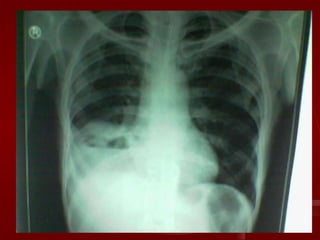
On respiratory system examination ----- Trachea is central. In right inframammary, lower axillary, inter and infra scapular region – diminished chest movement increased tactile vocal fremitus, vocal rasonace impaired percussion note bronchial breath sound Examination of other systems is with in normal limit.
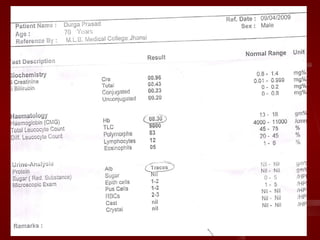
INVESTIGATIONS


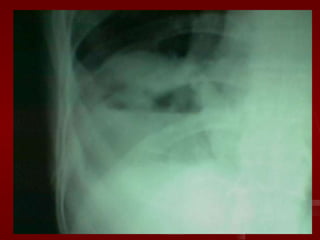
On the basis of above history, examination and investigations the presumptive diagnosis is------ Right middle and lower lobe consolidation with cavitation
Cause?  Pulmonary Kochs  Lung carcinoma Lung abbcess
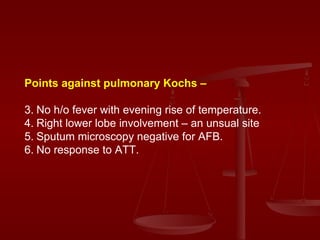
Points against pulmonary Kochs – No h/o fever with evening rise of temperature. Right lower lobe involvement – an unsual site Sputum microscopy negative for AFB. No response to ATT.
Points against lung abcess – No h/o high grade fever. No h/o copious amount of foul smelling sputum. No tachycardia & tachypnea. Total leucocytes count are normal.
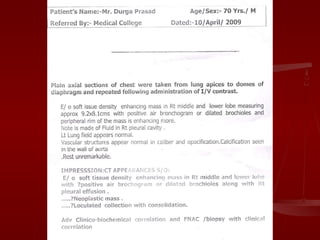
So we think in terms of lung malignancy, & go for HRCT which shows –
 
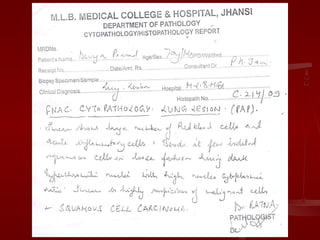
Then we done USG guided FNAC of the lesion which confirms it to be squamous cell carcinoma involving rt middle & lower lobe of lung.
 
Discussion Primary carcinoma of the lung is the leading cause of death in both men and women, accounting for 1.18 million deaths from lung cancer worldwide in  2007. The relative risk of developing lung cancer is increased about thirteen fold by active smoking and about 1.5 fold by long term passive exposure to cigarette smoke. About 15% of lung cancers occur in individuals who have never smoked. The majority of these are found in women. Radiation is another enviromental cause of lung cancer. Four major cell types make up 80% of all primary lung neoplasms according to WHO there are –  Squamous or epidermoid CA Small cell (oat cell) CA Adenocarcinoma (including bronchioloalveolar) Large cell CA
Most frequent histologic subtype is adenocarcinoma. Major treatment discussion are made on the basis of wheather they are classified as a small cell lung CA or non small cell lung cencer. At presentation, SCLCs usually have already spread such that surgery is unlikely to be curative and are managed primarily by chemotherapy with or without radiotherapy. NSCLC that are clinically localized at the time of presentation may be cured with either surgery or radiotherapy.
Squamous and small cell cancers usually present as central masses with endobronchial growth, while adenocarcinomas present as peripheral masses. Squamous cell CA cavitate in 10-20% of cases. Although 5-15% of patients with lung cancer are identified while they are asymptomatic usually as a result of routine CXR or through the use of screening CT scan, most patients presents with some sign or symptom.
Central/endobronchial growth-  causes cough, hemoptysis, wheeze, stridor, dyspnoea and post obstructive pneumonitis. Peripheral growth-  Pancoast or superior sulcus syndromes SVC syndrome Extrathoraccic metastatic disease Paraneoplastic syndromes Skeletal connective tissue syndrome The role of screening high risk patients (for example current or former smokers >50yrs of age) for early stage lung cancers is debated. Low dose, non-contrast, thin slice, helical or spiral CT has emerged as a possible new tool for lung cancer screening.

Once sign, symptoms or screening studies suggest lung cancer, a tissue diagnosis must be established . Tumour tissue can be obtained by a bronchial or trans bronchial biopsy during fiberoptic bronchoscopy, by fine- needle aspiration of thoracic or extrathoracic  tumour masses using CT guidance or by percutanecus biopsy of enlarged lymph node, soft tissue mass. According to TNM staging, our patient belongs to T3 NoMo i.e. stage IB.  Stage IB, IIA and IIB who can tolerate operation, the treatment of choice is pulmonary resection. The role of adjuvant chemotherapy for stage IB disease is undefined, subset analysis of all the randomized studies showed no benefit in patient with stage IB.
CASE – II
 
Mrs. Leelawati 75 years, Female, Housewife, resident of Oraiya, admitted with chief complaints of – Cough with progressively increasing breathlessness for 5 months. Acute exaggravation of breathlessness with bilateral pedal edema for 10 days. Negative history – No history of –  chest pain, perspiration  PND Fever Drugs intake Intermittent claudication  DVT
Past history –  no h/o DM, HTN, TB Personnel history –  Non bidi smoker Family history –  not significant On Examination PR – 100/min, regular, normovolumic, normal in character without any radiofemoral and radioradial delay. BP – 90/60 mmHg in right arm in supine position. RR – 22/min, regular, thoracoabdominal  Temp – N SpO2 – 86% without O2 Pallar-absent Cyanosis-absent Clubbing-absent Icterus-absent Lymphadenopathy-absent JVP – raised, cv wave present  Pedal edema--- +
Cardiovascular system examination apical impulse is in 5th ICS at MCL  palpable & loud second sound (P2) Left PSH of grade II/III Pansystolic murmur of grade III/VI in tricuspid area which increases in intensity on inspiration. Respiratory system ---- Bilateral coarse basal crepts present on auscultation. Abdominal system examination---- Tender hepatomegaly 2 cm below costal margin.
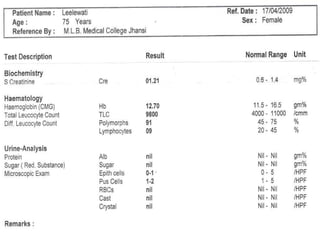
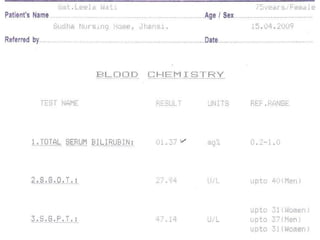
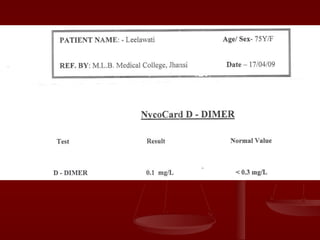
So,  Clinical diagnosis – Severe pulmonary artery hypertension with severe TR with congestive heart failure stage C  cause ? Cor pulmonale Pulmonary thromboembolism Primary pulmonary artery HTN
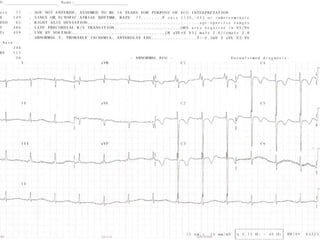
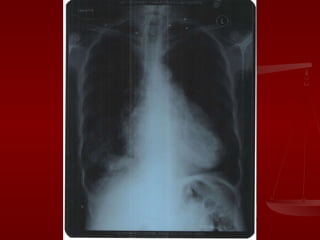
On investigation Routine investigations ECG CXR PA view USG abdomen D- dimmer assay PFT


So, final diagnosis is pulmonary hypertension associated with lung disease and or hypoxemia cause COAD.
 

CASE STUDIES

  • 1.
    DR Awadhesh krsharma,SR DEPTT OF MEDICINE MLB MEDICAL COLLEGE JHANSI(UP) Two Case studies
  • 2.
  • 3.
  • 4.
    Mr. Durga Prasad70 years ,Male, farmer by occupation presented with chief complaints of – Productive cough for 8 months. Loss of appetite for 8 months. Loss of weight upto 25% for 8 months.
  • 5.
    Negative History – No history of….. High grade fever Haemoptysis Foul smelling sputum Exertional dyspnoea Chest pain Orthopnoea PND Pedal edema Engorgement of neck veins Ascitis Rt hypochondriac tenderness Oligurea Burning micturation
  • 6.
    Past history – no h/o DM, HTN & TB. Personnel history – Patient is chronic bidi smoker for 48 years, he used to smoke 30 bidi per day. Smoking index = 48 x 30 = 1440 i.e. > 300
  • 7.
    General examination – Built – Average PR – 82/min BP- 110/80 mm of Hg RR – 16 / min Temp – afebrile Pallar--- ++ Cyanosis – absent Clubbing – absent Icterus – absent Lymph node enlargement – absent JVP – not raised
  • 8.
    On respiratory systemexamination ----- Trachea is central. In right inframammary, lower axillary, inter and infra scapular region – diminished chest movement increased tactile vocal fremitus, vocal rasonace impaired percussion note bronchial breath sound Examination of other systems is with in normal limit.
  • 9.
  • 10.
  • 11.
  • 12.
  • 13.
    On the basisof above history, examination and investigations the presumptive diagnosis is------ Right middle and lower lobe consolidation with cavitation
  • 14.
    Cause? PulmonaryKochs Lung carcinoma Lung abbcess
  • 15.
    Points against pulmonaryKochs – No h/o fever with evening rise of temperature. Right lower lobe involvement – an unsual site Sputum microscopy negative for AFB. No response to ATT.
  • 16.
    Points against lungabcess – No h/o high grade fever. No h/o copious amount of foul smelling sputum. No tachycardia & tachypnea. Total leucocytes count are normal.
  • 17.
    So we thinkin terms of lung malignancy, & go for HRCT which shows –
  • 18.
  • 19.
    Then we doneUSG guided FNAC of the lesion which confirms it to be squamous cell carcinoma involving rt middle & lower lobe of lung.
  • 20.
  • 21.
    Discussion Primary carcinomaof the lung is the leading cause of death in both men and women, accounting for 1.18 million deaths from lung cancer worldwide in 2007. The relative risk of developing lung cancer is increased about thirteen fold by active smoking and about 1.5 fold by long term passive exposure to cigarette smoke. About 15% of lung cancers occur in individuals who have never smoked. The majority of these are found in women. Radiation is another enviromental cause of lung cancer. Four major cell types make up 80% of all primary lung neoplasms according to WHO there are – Squamous or epidermoid CA Small cell (oat cell) CA Adenocarcinoma (including bronchioloalveolar) Large cell CA
  • 22.
    Most frequent histologicsubtype is adenocarcinoma. Major treatment discussion are made on the basis of wheather they are classified as a small cell lung CA or non small cell lung cencer. At presentation, SCLCs usually have already spread such that surgery is unlikely to be curative and are managed primarily by chemotherapy with or without radiotherapy. NSCLC that are clinically localized at the time of presentation may be cured with either surgery or radiotherapy.
  • 23.
    Squamous and smallcell cancers usually present as central masses with endobronchial growth, while adenocarcinomas present as peripheral masses. Squamous cell CA cavitate in 10-20% of cases. Although 5-15% of patients with lung cancer are identified while they are asymptomatic usually as a result of routine CXR or through the use of screening CT scan, most patients presents with some sign or symptom.
  • 24.
    Central/endobronchial growth- causes cough, hemoptysis, wheeze, stridor, dyspnoea and post obstructive pneumonitis. Peripheral growth- Pancoast or superior sulcus syndromes SVC syndrome Extrathoraccic metastatic disease Paraneoplastic syndromes Skeletal connective tissue syndrome The role of screening high risk patients (for example current or former smokers >50yrs of age) for early stage lung cancers is debated. Low dose, non-contrast, thin slice, helical or spiral CT has emerged as a possible new tool for lung cancer screening.
  • 25.
    Once sign, symptomsor screening studies suggest lung cancer, a tissue diagnosis must be established . Tumour tissue can be obtained by a bronchial or trans bronchial biopsy during fiberoptic bronchoscopy, by fine- needle aspiration of thoracic or extrathoracic tumour masses using CT guidance or by percutanecus biopsy of enlarged lymph node, soft tissue mass. According to TNM staging, our patient belongs to T3 NoMo i.e. stage IB. Stage IB, IIA and IIB who can tolerate operation, the treatment of choice is pulmonary resection. The role of adjuvant chemotherapy for stage IB disease is undefined, subset analysis of all the randomized studies showed no benefit in patient with stage IB.
  • 26.
  • 27.
  • 28.
    Mrs. Leelawati 75years, Female, Housewife, resident of Oraiya, admitted with chief complaints of – Cough with progressively increasing breathlessness for 5 months. Acute exaggravation of breathlessness with bilateral pedal edema for 10 days. Negative history – No history of – chest pain, perspiration PND Fever Drugs intake Intermittent claudication DVT
  • 29.
    Past history – no h/o DM, HTN, TB Personnel history – Non bidi smoker Family history – not significant On Examination PR – 100/min, regular, normovolumic, normal in character without any radiofemoral and radioradial delay. BP – 90/60 mmHg in right arm in supine position. RR – 22/min, regular, thoracoabdominal Temp – N SpO2 – 86% without O2 Pallar-absent Cyanosis-absent Clubbing-absent Icterus-absent Lymphadenopathy-absent JVP – raised, cv wave present Pedal edema--- +
  • 30.
    Cardiovascular system examinationapical impulse is in 5th ICS at MCL palpable & loud second sound (P2) Left PSH of grade II/III Pansystolic murmur of grade III/VI in tricuspid area which increases in intensity on inspiration. Respiratory system ---- Bilateral coarse basal crepts present on auscultation. Abdominal system examination---- Tender hepatomegaly 2 cm below costal margin.
  • 31.
    So, Clinicaldiagnosis – Severe pulmonary artery hypertension with severe TR with congestive heart failure stage C cause ? Cor pulmonale Pulmonary thromboembolism Primary pulmonary artery HTN
  • 32.
    On investigation Routineinvestigations ECG CXR PA view USG abdomen D- dimmer assay PFT
  • 33.
  • 34.
  • 35.
  • 36.
  • 37.
  • 38.
    So, final diagnosisis pulmonary hypertension associated with lung disease and or hypoxemia cause COAD.
  • 39.