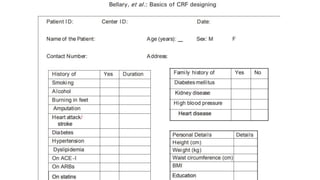
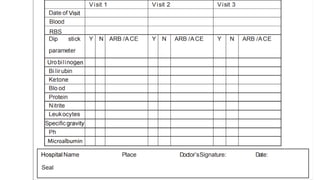
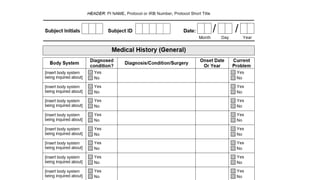
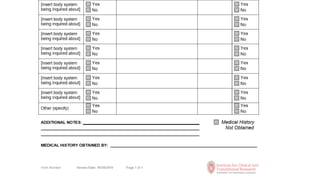
DES FERGUSSON
COLLEGE, PUNE
CASE
REPORT
FORM
BTH554 CLINICAL RESEARCH
SAMRUDDHI GOSAVI
SANJYOT DHARURKAR
SANKET KADAM
SHAMI GURAV
PRESENTED BY:
“IF IT IS NOT DOCUMENTED, IT
DOESN'T EXIST. AS LONG AS
INFORMATION IS RETAINED IN
SOMEONE'S HEAD, IT IS
VULNERABLE TO LOSS.”
~LOUIS FRIED, 1992
. Bellary S. et al. Perspectives in Clinical Research. 2014; 5(4):159- 166
• A case report form (CRF) is an instrument to structure and facilitate collection of
data for clinical research.
• The International Council for Harmonization (ICH) Guidelines for Good Clinical
Practice (GCP) define the CRF as:
INTRODUCTION
TO CRF
“A PRINTED, OPTICAL OR ELECTRONIC DOCUMENT DESIGNED TO
RECORD ALL OF THE PROTOCOL - REQUIRED INFORMATION TO BE
REPORTED TO THE SPONSOR ON EACH TRIAL SUBJECT.”
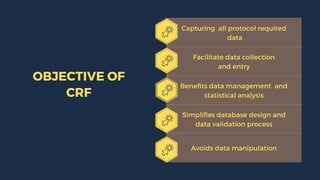
Capturing all protocol required
data
Facilitate data collection
and entry
Benefits data management and
statistical analysis
Simplifies database design and
data validation process
Avoids data manipulation
OBJECTIVE OF
CRF
BACKGROUND
OF THE STUDY
The ICH E3 guideline,
"Structure and Content of
Clinical Study Reports," was
first published in 1995 and has
been revised several times since
then. The guideline provides
recommendations for the
content and format of clinical
study reports, including the use
of CRFs.
CRF DESIGN &
DEVELOPMENT
A
CRF should be designed for optimal collection of data
in accordance with the study protocol compliance and
regulatory requirements
B
Be clear and concise with data questions &
avoid duplication
C
Provide units to ensure comparable values &
instructions to reduce misinterpretations
D
Using consistent formats, fonts, style and
font sizes, also selection of the layouts ie.
Portrait or landscape.
E
Collect data in a fashion that allows for the most
efficient computerization F
CRFs designed should be implemented
keeping the end-user in mind.
G
Using the standard formats. E.g dd/mm/yyyy
throughout CRF. H
Instructions to be mentioned in bold and
italicized, separate columns with thick lines
so that the information in the form is
segregated.
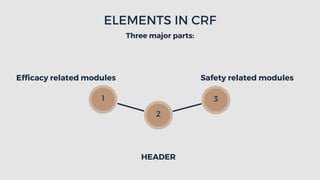
1
2
3
Safety related modules
Efficacy related modules
ELEMENTS IN CRF
Three major parts:
HEADER
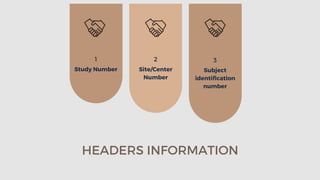
HEADERS INFORMATION
1
Study Number
2
Site/Center
Number
3
Subject
identification
number
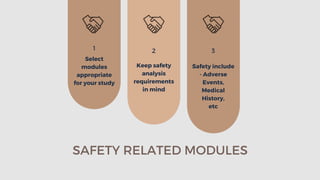
SAFETY RELATED MODULES
1
Select
modules
appropriate
for your study
2
Keep safety
analysis
requirements
in mind
3
Safety include
- Adverse
Events,
Medical
History,
etc
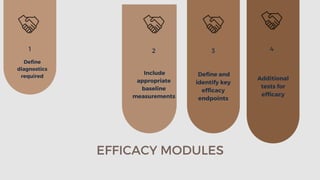
EFFICACY MODULES
2
Include
appropriate
baseline
measurements
3
Define and
identify key
efficacy
endpoints
4
Additional
tests for
efficacy
1
Define
diagnostics
required
TYPES OF CRF :
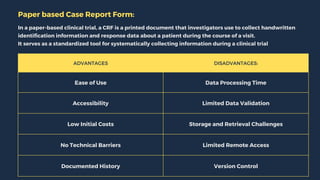
ADVANTAGES DISADVANTAGES:
Ease of Use Data Processing Time
Accessibility Limited Data Validation
Low Initial Costs Storage and Retrieval Challenges
No Technical Barriers Limited Remote Access
Documented History Version Control
Paper based Case Report Form:
In a paper-based clinical trial, a CRF is a printed document that investigators use to collect handwritten
identification information and response data about a patient during the course of a visit.
It serves as a standardized tool for systematically collecting information during a clinical trial
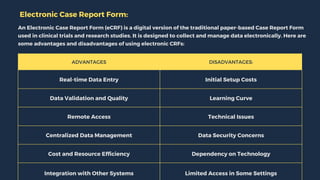
ADVANTAGES DISADVANTAGES:
Real-time Data Entry Initial Setup Costs
Data Validation and Quality Learning Curve
Remote Access Technical Issues
Centralized Data Management Data Security Concerns
Cost and Resource Efficiency Dependency on Technology
Integration with Other Systems Limited Access in Some Settings
Electronic Case Report Form:
An Electronic Case Report Form (eCRF) is a digital version of the traditional paper-based Case Report Form
used in clinical trials and research studies. It is designed to collect and manage data electronically. Here are
some advantages and disadvantages of using electronic CRFs:
CRF
COMPLETION
GUIDELINES
(CCG) :
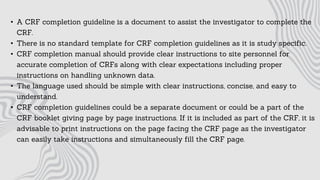
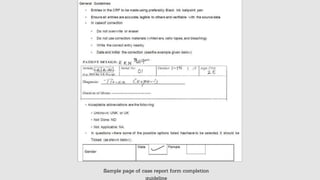
• A CRF completion guideline is a document to assist the investigator to complete the
CRF.
• There is no standard template for CRF completion guidelines as it is study specific.
• CRF completion manual should provide clear instructions to site personnel for
accurate completion of CRFs along with clear expectations including proper
instructions on handling unknown data.
• The language used should be simple with clear instructions, concise, and easy to
understand.
• CRF completion guidelines could be a separate document or could be a part of the
CRF booklet giving page by page instructions. If it is included as part of the CRF, it is
advisable to print instructions on the page facing the CRF page as the investigator
can easily take instructions and simultaneously fill the CRF page.
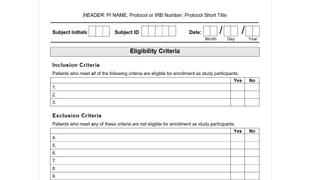
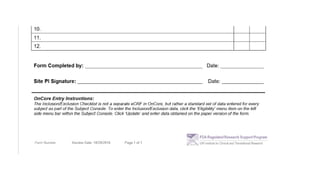
Sample page of case report form completion
guideline
The ICH E6(R2) (International Conference for Harmonisation) Good Clinical Practice:
Integrated Addendum contains several passages particularly relevant to CCGs
• Section 4.9.0 states that the investigator should maintain, “adequate and accurate
source documents and trial records” and goes on to specify, “Source data should be
attributable, legible, contemporaneous, original, accurate, and complete” and that
“changes to source data should be traceable, should not obscure the original entry,
and should be explained if necessary”
• Section 4.9.1 places responsibility on the investigator for ensuring the “accuracy,
completeness, legibility, and timeliness of the data reported to the sponsor in the
CRFs and in all required reports.”
• Section 4.9.2 states that data, “reported on the CRF, that are derived from source
documents, should be consistent with the source documents or the discrepancies
should be explained.”
• Section 4.9.3 further emphasizes good documentation practices, stating, “any
change or correction to a CRF should be dated, initialed, and explained (if
necessary) and should not obscure the original entry (i.e., an audit trail should
be maintained).”
• Section 4.9.3 goes on to state, “Sponsors should provide guidance to
investigators and/or the investigators’ designated representatives on making
such corrections.” and that “Sponsors should have written procedures to assure
that changes or corrections in CRFs made by sponsor’s designated
representatives are documented, are necessary, and are endorsed by the
investigator. The investigator should retain records of the changes and
corrections.
• Section 5.5.1 states, “The sponsor should utilize appropriately qualified
individuals to supervise the overall conduct of the trial, to handle the data, to
verify the data, to conduct the statistical analyses, and to prepare the trial
reports.”
• Section 5.5.3 (e) states that the sponsor should “Maintain a list of the
individuals who are authorized to make data changes.”
• Section 5.5.4 under Trial Management, Data Handling and Recordkeeping,
states, “If data are transformed during processing, it should always be possible
to compare the original data and observations with the processed data.”
• Section 6.4 states, “Data integrity is the degree to which data are complete,
consistent, accurate, trustworthy, and reliable and that these characteristics of
the data are maintained throughout the data life cycle. The data should be
collected and maintained in a secure manner, so that they are attributable,
legible, contemporaneously recorded, original (or a true copy) and accurate”
Creation & Maintenance of CCGs:
• Develop guidelines in collaboration with the same roles that designed the CRF.
These include protocol authors, form designers, investigators, practicing
physicians, statisticians, site and medical monitors, site-based study
coordinators, those familiar with the study database system, data entry, and
data processing.
• Allow sufficient time for development and testing of forms and instructions.
• CRF and CCGs cannot be finalized prior to finalization of protocol.
• Design CRFs and associated CCGs simultaneously with protocol development.
• Hold dedicated meetings for timelier review and finalization of the CCGs
Implementation of the CCGs:
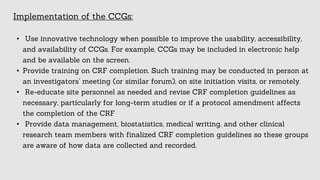
• Use innovative technology when possible to improve the usability, accessibility,
and availability of CCGs. For example, CCGs may be included in electronic help
and be available on the screen.
• Provide training on CRF completion. Such training may be conducted in person at
an investigators’ meeting (or similar forum), on site initiation visits, or remotely.
• Re-educate site personnel as needed and revise CRF completion guidelines as
necessary, particularly for long-term studies or if a protocol amendment affects
the completion of the CRF
• Provide data management, biostatistics, medical writing, and other clinical
research team members with finalized CRF completion guidelines so these groups
are aware of how data are collected and recorded.
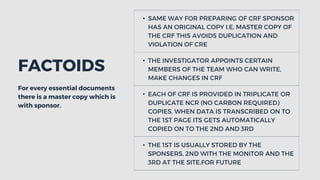
For every essential documents
there is a master copy which is
with sponsor.
FACTOIDS
• SAME WAY FOR PREPARING OF CRF SPONSOR
HAS AN ORIGINAL COPY I.E. MASTER COPY OF
THE CRF THIS AVOIDS DUPLICATION AND
VIOLATION OF CRE
• THE INVESTIGATOR APPOINTS CERTAIN
MEMBERS OF THE TEAM WHO CAN WRITE,
MAKE CHANGES IN CRF
• EACH OF CRF IS PROVIDED IN TRIPLICATE OR
DUPLICATE NCR (NO CARBON REQUIRED)
COPIES, WHEN DATA IS TRANSCRIBED ON TO
THE 1ST PAGE ITS GETS AUTOMATICALLY
COPIED ON TO THE 2ND AND 3RD
• THE 1ST IS USUALLY STORED BY THE
SPONSERS, 2ND WITH THE MONITOR AND THE
3RD AT THE SITE,FOR FUTURE
RETENTION OF
CRF AS AN
ESSENTIAL
DOCUMENT
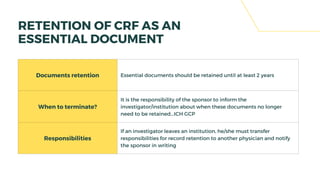
Documents retention Essential documents should be retained until at least 2 years
When to terminate?
It is the responsibility of the sponsor to inform the
investigator/institution about when these documents no longer
need to be retained...ICH GCP
Responsibilities
If an investigator leaves an institution, he/she must transfer
responsibilities for record retention to another physician and notify
the sponsor in writing
RETENTION OF CRF AS AN
ESSENTIAL DOCUMENT
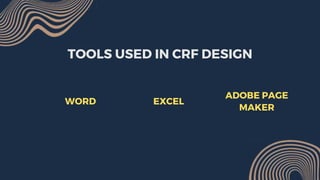
TOOLS USED IN CRF DESIGN
WORD EXCEL
ADOBE PAGE
MAKER
• IJLRP | ISSN (O) – 2582-8010 December 2020 | Vol. 1 Issue. 4 www.ijlrp.com.
• Bellary S, Krishnankutty B, Latha MS. Basics of case report form designing in clinical research. Perspect Clin Res. 2014 Oct;5(4):159-
66. doi: 10.4103/2229-3485.140555. PMID: 25276625; PMCID: PMC4170533.
REFERENCES
• CRF Completion Guidelines, Kelly Hills, Tara Bartlett, Isabelle Leconte and Meredith N. Zozus, Hills K, et al. CRF Completion
Guidelines. Journal of the Society for Clinical Data Management. 2021; 1(1): X, pp. 1–12. DOI: https://doi.org/10.47912/jscdm.X
• Food and Drug Administration. US Department of Health and Human Services. Guidance for industry: Use of Electronic Heal
Record Data in Clinical Investigations. July 2018. Accessed August 8, 2018. Available from
https://www.fda.gov/downloads/Drugs/GuidanceComplianceRegulatoryInformation/Guidances/UCM501068.
• Shantala Bellary, Binny Krishnankutty, and M. S. Latha, Basics of case report form designing in clinical research, Global
Medical Affairs, Dr. Reddy’s Laboratories Ltd., Hyderabad, Clinical Research, USV Limited, Mumbai, India, Perspectives in
Clinical Research, October-December 2014, Vol 5, Issue 4.
1. https://clinzenclinicaltrial.blogspot.com/
2.https://pubmed.ncbi.nlm.nih.gov/36845316/
Louis Fried (1992) THE RULES OF PROJECT MANAGEMENT, Information Systems Management, 9:3, 71-74,
Bellary S. et al. Perspectives in Clinical Research. 2014; 5(4):159- 166

clinical research essential document Case report form

  • 1.
    DES FERGUSSON COLLEGE, PUNE CASE REPORT FORM BTH554CLINICAL RESEARCH SAMRUDDHI GOSAVI SANJYOT DHARURKAR SANKET KADAM SHAMI GURAV PRESENTED BY:
  • 2.
    “IF IT ISNOT DOCUMENTED, IT DOESN'T EXIST. AS LONG AS INFORMATION IS RETAINED IN SOMEONE'S HEAD, IT IS VULNERABLE TO LOSS.” ~LOUIS FRIED, 1992
  • 3.
    . Bellary S.et al. Perspectives in Clinical Research. 2014; 5(4):159- 166 • A case report form (CRF) is an instrument to structure and facilitate collection of data for clinical research. • The International Council for Harmonization (ICH) Guidelines for Good Clinical Practice (GCP) define the CRF as: INTRODUCTION TO CRF “A PRINTED, OPTICAL OR ELECTRONIC DOCUMENT DESIGNED TO RECORD ALL OF THE PROTOCOL - REQUIRED INFORMATION TO BE REPORTED TO THE SPONSOR ON EACH TRIAL SUBJECT.”
  • 4.
    Capturing all protocolrequired data Facilitate data collection and entry Benefits data management and statistical analysis Simplifies database design and data validation process Avoids data manipulation OBJECTIVE OF CRF
  • 5.
    BACKGROUND OF THE STUDY TheICH E3 guideline, "Structure and Content of Clinical Study Reports," was first published in 1995 and has been revised several times since then. The guideline provides recommendations for the content and format of clinical study reports, including the use of CRFs.
  • 6.
  • 7.
    A CRF should bedesigned for optimal collection of data in accordance with the study protocol compliance and regulatory requirements B Be clear and concise with data questions & avoid duplication C Provide units to ensure comparable values & instructions to reduce misinterpretations D Using consistent formats, fonts, style and font sizes, also selection of the layouts ie. Portrait or landscape. E Collect data in a fashion that allows for the most efficient computerization F CRFs designed should be implemented keeping the end-user in mind. G Using the standard formats. E.g dd/mm/yyyy throughout CRF. H Instructions to be mentioned in bold and italicized, separate columns with thick lines so that the information in the form is segregated.
  • 8.
    1 2 3 Safety related modules Efficacyrelated modules ELEMENTS IN CRF Three major parts: HEADER
  • 9.
  • 10.
    SAFETY RELATED MODULES 1 Select modules appropriate foryour study 2 Keep safety analysis requirements in mind 3 Safety include - Adverse Events, Medical History, etc
  • 11.
    EFFICACY MODULES 2 Include appropriate baseline measurements 3 Define and identifykey efficacy endpoints 4 Additional tests for efficacy 1 Define diagnostics required
  • 13.
  • 14.
    ADVANTAGES DISADVANTAGES: Ease ofUse Data Processing Time Accessibility Limited Data Validation Low Initial Costs Storage and Retrieval Challenges No Technical Barriers Limited Remote Access Documented History Version Control Paper based Case Report Form: In a paper-based clinical trial, a CRF is a printed document that investigators use to collect handwritten identification information and response data about a patient during the course of a visit. It serves as a standardized tool for systematically collecting information during a clinical trial
  • 15.
    ADVANTAGES DISADVANTAGES: Real-time DataEntry Initial Setup Costs Data Validation and Quality Learning Curve Remote Access Technical Issues Centralized Data Management Data Security Concerns Cost and Resource Efficiency Dependency on Technology Integration with Other Systems Limited Access in Some Settings Electronic Case Report Form: An Electronic Case Report Form (eCRF) is a digital version of the traditional paper-based Case Report Form used in clinical trials and research studies. It is designed to collect and manage data electronically. Here are some advantages and disadvantages of using electronic CRFs:
  • 16.
  • 17.
    • A CRFcompletion guideline is a document to assist the investigator to complete the CRF. • There is no standard template for CRF completion guidelines as it is study specific. • CRF completion manual should provide clear instructions to site personnel for accurate completion of CRFs along with clear expectations including proper instructions on handling unknown data. • The language used should be simple with clear instructions, concise, and easy to understand. • CRF completion guidelines could be a separate document or could be a part of the CRF booklet giving page by page instructions. If it is included as part of the CRF, it is advisable to print instructions on the page facing the CRF page as the investigator can easily take instructions and simultaneously fill the CRF page.
  • 18.
    Sample page ofcase report form completion guideline
  • 19.
    The ICH E6(R2)(International Conference for Harmonisation) Good Clinical Practice: Integrated Addendum contains several passages particularly relevant to CCGs • Section 4.9.0 states that the investigator should maintain, “adequate and accurate source documents and trial records” and goes on to specify, “Source data should be attributable, legible, contemporaneous, original, accurate, and complete” and that “changes to source data should be traceable, should not obscure the original entry, and should be explained if necessary” • Section 4.9.1 places responsibility on the investigator for ensuring the “accuracy, completeness, legibility, and timeliness of the data reported to the sponsor in the CRFs and in all required reports.” • Section 4.9.2 states that data, “reported on the CRF, that are derived from source documents, should be consistent with the source documents or the discrepancies should be explained.”
  • 20.
    • Section 4.9.3further emphasizes good documentation practices, stating, “any change or correction to a CRF should be dated, initialed, and explained (if necessary) and should not obscure the original entry (i.e., an audit trail should be maintained).” • Section 4.9.3 goes on to state, “Sponsors should provide guidance to investigators and/or the investigators’ designated representatives on making such corrections.” and that “Sponsors should have written procedures to assure that changes or corrections in CRFs made by sponsor’s designated representatives are documented, are necessary, and are endorsed by the investigator. The investigator should retain records of the changes and corrections.
  • 21.
    • Section 5.5.1states, “The sponsor should utilize appropriately qualified individuals to supervise the overall conduct of the trial, to handle the data, to verify the data, to conduct the statistical analyses, and to prepare the trial reports.” • Section 5.5.3 (e) states that the sponsor should “Maintain a list of the individuals who are authorized to make data changes.” • Section 5.5.4 under Trial Management, Data Handling and Recordkeeping, states, “If data are transformed during processing, it should always be possible to compare the original data and observations with the processed data.” • Section 6.4 states, “Data integrity is the degree to which data are complete, consistent, accurate, trustworthy, and reliable and that these characteristics of the data are maintained throughout the data life cycle. The data should be collected and maintained in a secure manner, so that they are attributable, legible, contemporaneously recorded, original (or a true copy) and accurate”
  • 22.
    Creation & Maintenanceof CCGs: • Develop guidelines in collaboration with the same roles that designed the CRF. These include protocol authors, form designers, investigators, practicing physicians, statisticians, site and medical monitors, site-based study coordinators, those familiar with the study database system, data entry, and data processing. • Allow sufficient time for development and testing of forms and instructions. • CRF and CCGs cannot be finalized prior to finalization of protocol. • Design CRFs and associated CCGs simultaneously with protocol development. • Hold dedicated meetings for timelier review and finalization of the CCGs
  • 23.
    Implementation of theCCGs: • Use innovative technology when possible to improve the usability, accessibility, and availability of CCGs. For example, CCGs may be included in electronic help and be available on the screen. • Provide training on CRF completion. Such training may be conducted in person at an investigators’ meeting (or similar forum), on site initiation visits, or remotely. • Re-educate site personnel as needed and revise CRF completion guidelines as necessary, particularly for long-term studies or if a protocol amendment affects the completion of the CRF • Provide data management, biostatistics, medical writing, and other clinical research team members with finalized CRF completion guidelines so these groups are aware of how data are collected and recorded.
  • 24.
    For every essentialdocuments there is a master copy which is with sponsor. FACTOIDS • SAME WAY FOR PREPARING OF CRF SPONSOR HAS AN ORIGINAL COPY I.E. MASTER COPY OF THE CRF THIS AVOIDS DUPLICATION AND VIOLATION OF CRE • THE INVESTIGATOR APPOINTS CERTAIN MEMBERS OF THE TEAM WHO CAN WRITE, MAKE CHANGES IN CRF • EACH OF CRF IS PROVIDED IN TRIPLICATE OR DUPLICATE NCR (NO CARBON REQUIRED) COPIES, WHEN DATA IS TRANSCRIBED ON TO THE 1ST PAGE ITS GETS AUTOMATICALLY COPIED ON TO THE 2ND AND 3RD • THE 1ST IS USUALLY STORED BY THE SPONSERS, 2ND WITH THE MONITOR AND THE 3RD AT THE SITE,FOR FUTURE
  • 25.
    RETENTION OF CRF ASAN ESSENTIAL DOCUMENT
  • 26.
    Documents retention Essentialdocuments should be retained until at least 2 years When to terminate? It is the responsibility of the sponsor to inform the investigator/institution about when these documents no longer need to be retained...ICH GCP Responsibilities If an investigator leaves an institution, he/she must transfer responsibilities for record retention to another physician and notify the sponsor in writing RETENTION OF CRF AS AN ESSENTIAL DOCUMENT
  • 27.
    TOOLS USED INCRF DESIGN WORD EXCEL ADOBE PAGE MAKER
  • 34.
    • IJLRP |ISSN (O) – 2582-8010 December 2020 | Vol. 1 Issue. 4 www.ijlrp.com. • Bellary S, Krishnankutty B, Latha MS. Basics of case report form designing in clinical research. Perspect Clin Res. 2014 Oct;5(4):159- 66. doi: 10.4103/2229-3485.140555. PMID: 25276625; PMCID: PMC4170533. REFERENCES • CRF Completion Guidelines, Kelly Hills, Tara Bartlett, Isabelle Leconte and Meredith N. Zozus, Hills K, et al. CRF Completion Guidelines. Journal of the Society for Clinical Data Management. 2021; 1(1): X, pp. 1–12. DOI: https://doi.org/10.47912/jscdm.X • Food and Drug Administration. US Department of Health and Human Services. Guidance for industry: Use of Electronic Heal Record Data in Clinical Investigations. July 2018. Accessed August 8, 2018. Available from https://www.fda.gov/downloads/Drugs/GuidanceComplianceRegulatoryInformation/Guidances/UCM501068. • Shantala Bellary, Binny Krishnankutty, and M. S. Latha, Basics of case report form designing in clinical research, Global Medical Affairs, Dr. Reddy’s Laboratories Ltd., Hyderabad, Clinical Research, USV Limited, Mumbai, India, Perspectives in Clinical Research, October-December 2014, Vol 5, Issue 4. 1. https://clinzenclinicaltrial.blogspot.com/ 2.https://pubmed.ncbi.nlm.nih.gov/36845316/ Louis Fried (1992) THE RULES OF PROJECT MANAGEMENT, Information Systems Management, 9:3, 71-74, Bellary S. et al. Perspectives in Clinical Research. 2014; 5(4):159- 166

Editor's Notes