Case Presentation:
A case of chronic mouth ulcers…
Mazin Eragat
GPST1
Case
Presenting complaint
History of presenting complaint
Case
Past medical history
Drug history
Allergies
Case
Social history
Family history
Travel history
Case
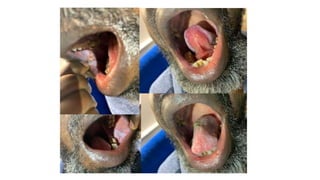
Examination
Investigations
Case
Differential diagnoses
Management plan
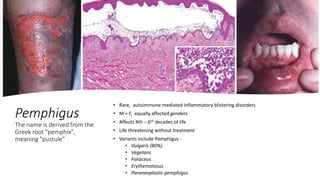
Pemphigus
The name is derived from the
Greek root "pemphix",
meaning "pustule”
• Rare, autoimmune mediated inflammatory blistering disorders
• M = F, equally affected genders
• Affects 4th – 6th decades of life
• Life threatening without treatment
• Variants include Pemphigus -
• Vulgaris (80%)
• Vegetans
• Foliaceus
• Erythematosus
• Paraneoplastic pemphigus
Diagnosis
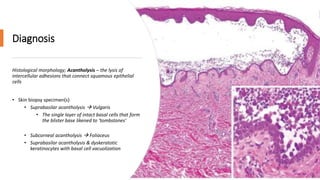
Histological morphology; Acantholysis – the lysis of
intercellular adhesions that connect squamous epithelial
cells
• Skin biopsy specimen(s)
• Suprabasilar acantholysis  Vulgaris
• The single layer of intact basal cells that form
the blister base likened to ‘tombstones’
• Subcorneal acantholysis  Foliaceus
• Suprabasilar acantholysis & dyskeratotic
keratinocytes with basal cell vacuolization
Pathophysiology
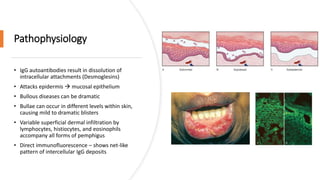
• IgG autoantibodies result in dissolution of
intracellular attachments (Desmoglesins)
• Attacks epidermis  mucosal epithelium
• Bullous diseases can be dramatic
• Bullae can occur in different levels within skin,
causing mild to dramatic blisters
• Variable superficial dermal infiltration by
lymphocytes, histiocytes, and eosinophils
accompany all forms of pemphigus
• Direct immunofluorescence – shows net-like
pattern of intercellular IgG deposits
History (Vulgaris)
• Pemphigus is the commonest type
• Can involve scalp, face, axilla, groin, trunk, points of pressure
• May present as oral ulcers, classically persisting for months before
skin involvement appears
• Primary lesions are superficial vesicles / bullae that rupture easily
• This leaves shallow erosions which are crusted
Treatment
• Regimens depend on patient’s age, degree of involvement, rate of progression,
and subtype of pemphigus.
• Systemic corticosteroids (eg. 1mg/kg Prednisolone oral OD) required for P.
Vulgaris, whereas topical corticosteroids (0.05% fluocinonide ointment topical
BD) can occasionally control P. foliaceus.
• One course of IV immunoglobulin (400 mg/kg 5/7 days) is safe for steroid
resistant disease.
• Other agents include; Dapsone, Hydroxychloroquine, Mycophenolate mofetil,
Azathioprine, Cyclophosphamide & Rituximab.
• Although steroid sparing agents are clinically effective, few controlled studies
demonstrate benefit.
• Tumour removal in paraneoplastic pemphigus is often curative, but in
malignancies can be resistant and require pulse methylpred, immuno-apheresis,
immunoablative cyclophosphamide & rituximab.
Prognosis
• Mainstay of treatment is immunosuppressive agents, which reduce
titre of pathogenic antibodies.
• Before use of corticosteroids, 60-90% of patients with vulgaris died
• Since introduction of steroids, dropped to 5-10% mortality rate
• Paraneoplastic relates to the type of cancer
• Benign tumours – usually lesions clear after tumour resection
• Malignant tumours (most commonly non-Hodgkin lymphoma) – have a
poorer prognosis and treatment does not entirely prevent mortality
Questions?
• Many thanks

Case presentation: Pemphigus

  • 1.
    Case Presentation: A caseof chronic mouth ulcers… Mazin Eragat GPST1
  • 2.
  • 3.
  • 4.
  • 5.
  • 6.
  • 8.
    Pemphigus The name isderived from the Greek root "pemphix", meaning "pustule” • Rare, autoimmune mediated inflammatory blistering disorders • M = F, equally affected genders • Affects 4th – 6th decades of life • Life threatening without treatment • Variants include Pemphigus - • Vulgaris (80%) • Vegetans • Foliaceus • Erythematosus • Paraneoplastic pemphigus
  • 9.
    Diagnosis Histological morphology; Acantholysis– the lysis of intercellular adhesions that connect squamous epithelial cells • Skin biopsy specimen(s) • Suprabasilar acantholysis  Vulgaris • The single layer of intact basal cells that form the blister base likened to ‘tombstones’ • Subcorneal acantholysis  Foliaceus • Suprabasilar acantholysis & dyskeratotic keratinocytes with basal cell vacuolization
  • 10.
    Pathophysiology • IgG autoantibodiesresult in dissolution of intracellular attachments (Desmoglesins) • Attacks epidermis  mucosal epithelium • Bullous diseases can be dramatic • Bullae can occur in different levels within skin, causing mild to dramatic blisters • Variable superficial dermal infiltration by lymphocytes, histiocytes, and eosinophils accompany all forms of pemphigus • Direct immunofluorescence – shows net-like pattern of intercellular IgG deposits
  • 11.
    History (Vulgaris) • Pemphigusis the commonest type • Can involve scalp, face, axilla, groin, trunk, points of pressure • May present as oral ulcers, classically persisting for months before skin involvement appears • Primary lesions are superficial vesicles / bullae that rupture easily • This leaves shallow erosions which are crusted
  • 12.
    Treatment • Regimens dependon patient’s age, degree of involvement, rate of progression, and subtype of pemphigus. • Systemic corticosteroids (eg. 1mg/kg Prednisolone oral OD) required for P. Vulgaris, whereas topical corticosteroids (0.05% fluocinonide ointment topical BD) can occasionally control P. foliaceus. • One course of IV immunoglobulin (400 mg/kg 5/7 days) is safe for steroid resistant disease. • Other agents include; Dapsone, Hydroxychloroquine, Mycophenolate mofetil, Azathioprine, Cyclophosphamide & Rituximab. • Although steroid sparing agents are clinically effective, few controlled studies demonstrate benefit. • Tumour removal in paraneoplastic pemphigus is often curative, but in malignancies can be resistant and require pulse methylpred, immuno-apheresis, immunoablative cyclophosphamide & rituximab.
  • 13.
    Prognosis • Mainstay oftreatment is immunosuppressive agents, which reduce titre of pathogenic antibodies. • Before use of corticosteroids, 60-90% of patients with vulgaris died • Since introduction of steroids, dropped to 5-10% mortality rate • Paraneoplastic relates to the type of cancer • Benign tumours – usually lesions clear after tumour resection • Malignant tumours (most commonly non-Hodgkin lymphoma) – have a poorer prognosis and treatment does not entirely prevent mortality
  • 14.