1
Clinical conference
on
Pelvic Inflammatory Disease
(PID)
Presented by
Rabeya sultana Reta
MSN (WHMN)
2nd
semester
BSMMU
2
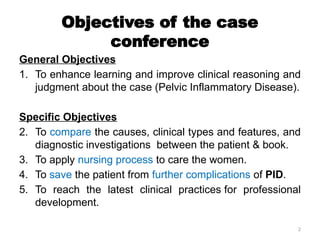
Objectives of the case
conference
General Objectives
1. To enhance learning and improve clinical reasoning and
judgment about the case (Pelvic Inflammatory Disease).
Specific Objectives
2. To compare the causes, clinical types and features, and
diagnostic investigations between the patient & book.
3. To apply nursing process to care the women.
4. To save the patient from further complications of PID.
5. To reach the latest clinical practices for professional
development.
3
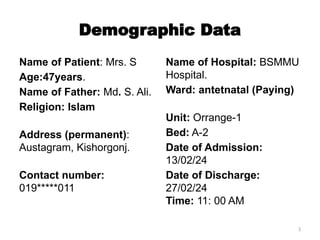
Demographic Data
Name of Patient: Mrs. S
Age:47years.
Name of Father: Md. S. Ali.
Religion: Islam
Address (permanent):
Austagram, Kishorgonj.
Contact number:
019*****011
Name of Hospital: BSMMU
Hospital.
Ward: antetnatal (Paying)
Unit: Orrange-1
Bed: A-2
Date of Admission:
13/02/24
Date of Discharge:
27/02/24
Time: 11: 00 AM
4
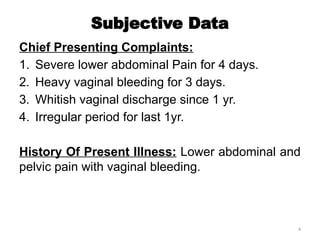
Subjective Data
Chief Presenting Complaints:
1. Severe lower abdominal Pain for 4 days.
2. Heavy vaginal bleeding for 3 days.
3. Whitish vaginal discharge since 1 yr.
4. Irregular period for last 1yr.
History Of Present Illness: Lower abdominal and
pelvic pain with vaginal bleeding.
5
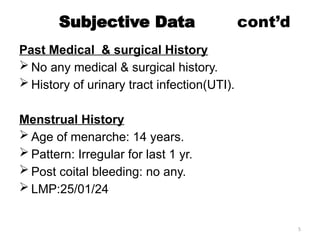
Subjective Data cont’d
Past Medical & surgical History
 No any medical & surgical history.
 History of urinary tract infection(UTI).
Menstrual History
 Age of menarche: 14 years.
 Pattern: Irregular for last 1 yr.
 Post coital bleeding: no any.
 LMP:25/01/24
6
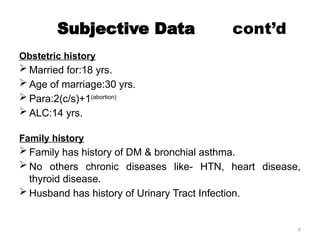
Subjective Data cont’d
Obstetric history
 Married for:18 yrs.
 Age of marriage:30 yrs.
 Para:2(c/s)+1(abortion)
 ALC:14 yrs.
Family history
 Family has history of DM & bronchial asthma.
 No others chronic diseases like- HTN, heart disease,
thyroid disease.
 Husband has history of Urinary Tract Infection.
7
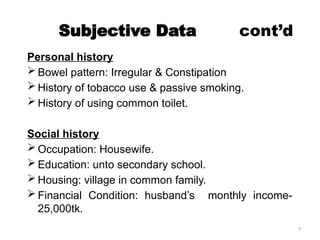
Subjective Data cont’d
Personal history
 Bowel pattern: Irregular & Constipation
 History of tobacco use & passive smoking.
 History of using common toilet.
Social history
 Occupation: Housewife.
 Education: unto secondary school.
 Housing: village in common family.
 Financial Condition: husband’s monthly income-
25,000tk.
8
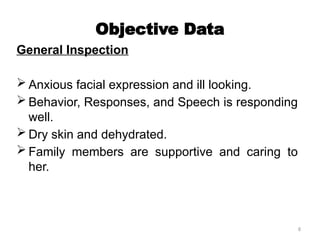
Objective Data
General Inspection
 Anxious facial expression and ill looking.
 Behavior, Responses, and Speech is responding
well.
 Dry skin and dehydrated.
 Family members are supportive and caring to
her.
9
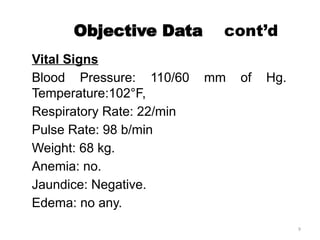
Objective Data cont’d
Vital Signs
Blood Pressure: 110/60 mm of Hg.
Temperature:102°F,
Respiratory Rate: 22/min
Pulse Rate: 98 b/min
Weight: 68 kg.
Anemia: no.
Jaundice: Negative.
Edema: no any.
10
Obstetric examinations
Abdominal examination
 No any scar mark on inspection.
 Tender abdomen on palpation.
 Cervical/adnexal motion tenderness also be
observed.
Pelvic examination:
 heavy vaginal bleeding present.
 Whitish plug in vaginal area present.
11
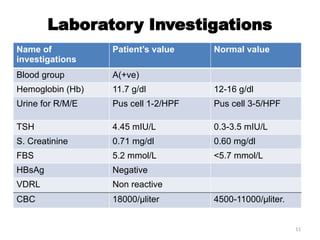
Laboratory Investigations
Name of
investigations
Patient’s value Normal value
Blood group A(+ve)
Hemoglobin (Hb) 11.7 g/dl 12-16 g/dl
Urine for R/M/E Pus cell 1-2/HPF Pus cell 3-5/HPF
TSH 4.45 mIU/L 0.3-3.5 mIU/L
S. Creatinine 0.71 mg/dl 0.60 mg/dl
FBS 5.2 mmol/L <5.7 mmol/L
HBsAg Negative
VDRL Non reactive
CBC 18000/µliter 4500-11000/µliter.
12
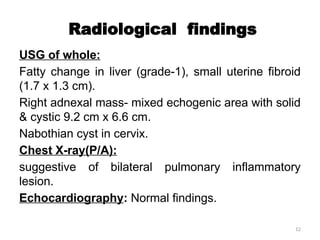
Radiological findings
USG of whole:
Fatty change in liver (grade-1), small uterine fibroid
(1.7 x 1.3 cm).
Right adnexal mass- mixed echogenic area with solid
& cystic 9.2 cm x 6.6 cm.
Nabothian cyst in cervix.
Chest X-ray(P/A):
suggestive of bilateral pulmonary inflammatory
lesion.
Echocardiography: Normal findings.
13
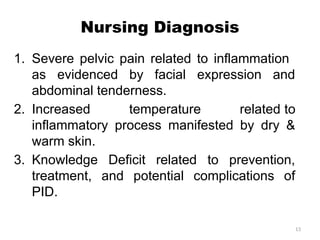
Nursing Diagnosis
1. Severe pelvic pain related to inflammation
as evidenced by facial expression and
abdominal tenderness.
2. Increased temperature related to
inflammatory process manifested by dry &
warm skin.
3. Knowledge Deficit related to prevention,
treatment, and potential complications of
PID.
14
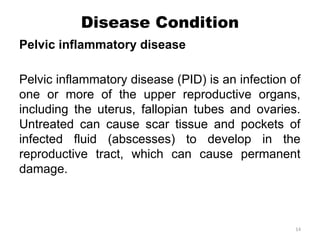
Disease Condition
Pelvic inflammatory disease
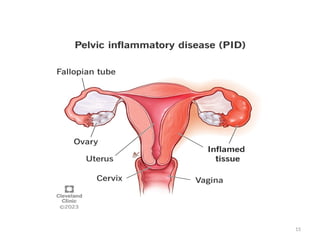
Pelvic inflammatory disease (PID) is an infection of
one or more of the upper reproductive organs,
including the uterus, fallopian tubes and ovaries.
Untreated can cause scar tissue and pockets of
infected fluid (abscesses) to develop in the
reproductive tract, which can cause permanent
damage.
15
16
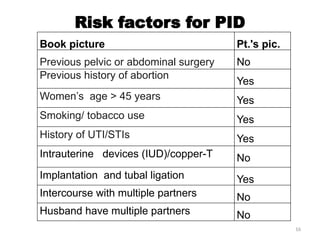
Risk factors for PID
Book picture Pt.'s pic.
Previous pelvic or abdominal surgery No
Previous history of abortion
Yes
Women’s age > 45 years Yes
Smoking/ tobacco use Yes
History of UTI/STIs Yes
Intrauterine devices (IUD)/copper-T No
Implantation and tubal ligation Yes
Intercourse with multiple partners No
Husband have multiple partners No
17
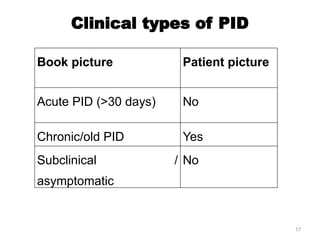
Clinical types of PID
Book picture Patient picture
Acute PID (>30 days) No
Chronic/old PID Yes
Subclinical /
asymptomatic
No
18
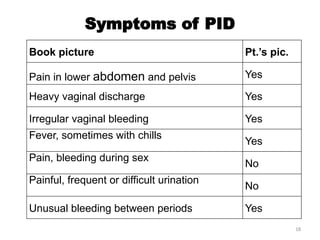
Symptoms of PID
Book picture Pt.’s pic.
Pain in lower abdomen and pelvis Yes
Heavy vaginal discharge Yes
Irregular vaginal bleeding Yes
Fever, sometimes with chills
Yes
Pain, bleeding during sex
No
Painful, frequent or difficult urination
No
Unusual bleeding between periods Yes
19
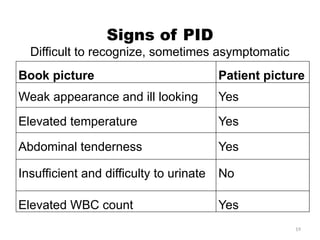
Signs of PID
Difficult to recognize, sometimes asymptomatic
Book picture Patient picture
Weak appearance and ill looking Yes
Elevated temperature Yes
Abdominal tenderness Yes
Insufficient and difficulty to urinate No
Elevated WBC count Yes
20
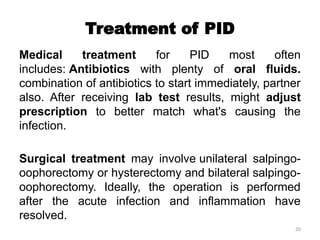
Treatment of PID
Medical treatment for PID most often
includes: Antibiotics with plenty of oral fluids.
combination of antibiotics to start immediately, partner
also. After receiving lab test results, might adjust
prescription to better match what's causing the
infection.
Surgical treatment may involve unilateral salpingo-
oophorectomy or hysterectomy and bilateral salpingo-
oophorectomy. Ideally, the operation is performed
after the acute infection and inflammation have
resolved.
21
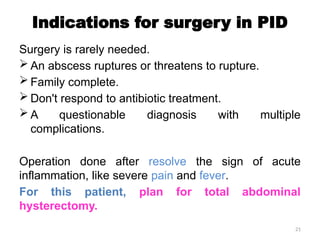
Indications for surgery in PID
Surgery is rarely needed.
 An abscess ruptures or threatens to rupture.
 Family complete.
 Don't respond to antibiotic treatment.
 A questionable diagnosis with multiple
complications.
Operation done after resolve the sign of acute
inflammation, like severe pain and fever.
For this patient, plan for total abdominal
hysterectomy.
22
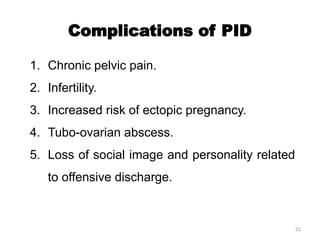
Complications of PID
1. Chronic pelvic pain.
2. Infertility.
3. Increased risk of ectopic pregnancy.
4. Tubo-ovarian abscess.
5. Loss of social image and personality related
to offensive discharge.
23
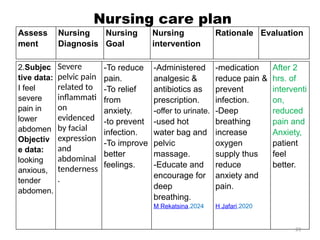
Nursing care plan
2.Subjec
tive data:
I feel
severe
pain in
lower
abdomen
Objectiv
e data:
looking
anxious,
tender
abdomen.
Severe
pelvic pain
related to
inflammati
on
evidenced
by facial
expression
and
abdominal
tenderness
.
-To reduce
pain.
-To relief
from
anxiety.
-to prevent
infection.
-To improve
better
feelings.
-Administered
analgesic &
antibiotics as
prescription.
-offer to urinate.
-used hot
water bag and
pelvic
massage.
-Educate and
encourage for
deep
breathing.
M Rekatsina,2024
-medication
reduce pain &
prevent
infection.
-Deep
breathing
increase
oxygen
supply thus
reduce
anxiety and
pain.
H Jafari,2020
After 2
hrs. of
interventi
on,
reduced
pain and
Anxiety,
patient
feel
better.
Assess
ment
Nursing
Diagnosis
Nursing
Goal
Nursing
intervention
Rationale Evaluation
24
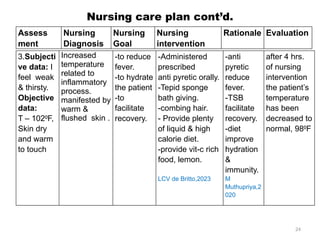
Nursing care plan cont’d.
Assess
ment
Nursing
Diagnosis
Nursing
Goal
Nursing
intervention
Rationale Evaluation
3.Subjecti
ve data: I
feel weak
& thirsty.
Objective
data:
T – 102 F,
⁰
Skin dry
and warm
to touch
Increased
temperature
related to
inflammatory
process.
manifested by
warm &
flushed skin .
-to reduce
fever.
-to hydrate
the patient
-to
facilitate
recovery.
-Administered
prescribed
anti pyretic orally.
-Tepid sponge
bath giving.
-combing hair.
- Provide plenty
of liquid & high
calorie diet.
-provide vit-c rich
food, lemon.
LCV de Britto,2023
-anti
pyretic
reduce
fever.
-TSB
facilitate
recovery.
-diet
improve
hydration
&
immunity.
M
Muthupriya,2
020
after 4 hrs.
of nursing
intervention
the patient’s
temperature
has been
decreased to
normal, 98 F
⁰
25
Nursing care plan cont’d.
Assess
ment
Nursing
Diagnosis
Nursing
Goal
Nursing
intervention
Rationale Evaluatio
n
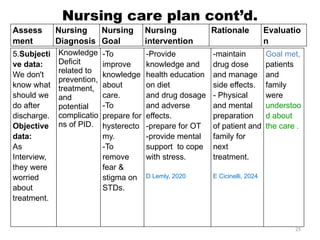
5.Subjecti
ve data:
We don't
know what
should we
do after
discharge.
Objective
data:
As
Interview,
they were
worried
about
treatment.
Knowledge
Deficit
related to
prevention,
treatment,
and
potential
complicatio
ns of PID.
-To
improve
knowledge
about
care.
-To
prepare for
hysterecto
my.
-To
remove
fear &
stigma on
STDs.
-Provide
knowledge and
health education
on diet
and drug dosage
and adverse
effects.
-prepare for OT
-provide mental
support to cope
with stress.
D Lemly, 2020
-maintain
drug dose
and manage
side effects.
- Physical
and mental
preparation
of patient and
family for
next
treatment.
E Cicinelli, 2024
Goal met,
patients
and
family
were
understoo
d about
the care .
26
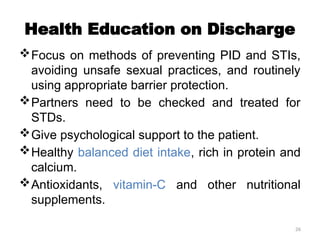
Health Education on Discharge
Focus on methods of preventing PID and STIs,
avoiding unsafe sexual practices, and routinely
using appropriate barrier protection.
Partners need to be checked and treated for
STDs.
Give psychological support to the patient.
Healthy balanced diet intake, rich in protein and
calcium.
Antioxidants, vitamin-C and other nutritional
supplements.
27
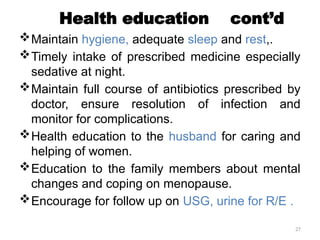
Health education cont’d
Maintain hygiene, adequate sleep and rest,.
Timely intake of prescribed medicine especially
sedative at night.
Maintain full course of antibiotics prescribed by
doctor, ensure resolution of infection and
monitor for complications.
Health education to the husband for caring and
helping of women.
Education to the family members about mental
changes and coping on menopause.
Encourage for follow up on USG, urine for R/E .
28
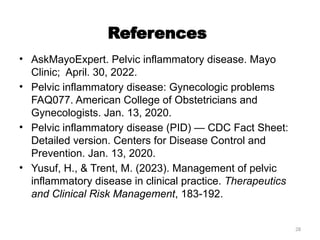
References
• AskMayoExpert. Pelvic inflammatory disease. Mayo
Clinic; April. 30, 2022.
• Pelvic inflammatory disease: Gynecologic problems
FAQ077. American College of Obstetricians and
Gynecologists. Jan. 13, 2020.
• Pelvic inflammatory disease (PID) — CDC Fact Sheet:
Detailed version. Centers for Disease Control and
Prevention. Jan. 13, 2020.
• Yusuf, H., & Trent, M. (2023). Management of pelvic
inflammatory disease in clinical practice. Therapeutics
and Clinical Risk Management, 183-192.
29

Case Presentation on pelvic inflammatory disease (PID).pptx

  • 1.
    1 Clinical conference on Pelvic InflammatoryDisease (PID) Presented by Rabeya sultana Reta MSN (WHMN) 2nd semester BSMMU
  • 2.
    2 Objectives of thecase conference General Objectives 1. To enhance learning and improve clinical reasoning and judgment about the case (Pelvic Inflammatory Disease). Specific Objectives 2. To compare the causes, clinical types and features, and diagnostic investigations between the patient & book. 3. To apply nursing process to care the women. 4. To save the patient from further complications of PID. 5. To reach the latest clinical practices for professional development.
  • 3.
    3 Demographic Data Name ofPatient: Mrs. S Age:47years. Name of Father: Md. S. Ali. Religion: Islam Address (permanent): Austagram, Kishorgonj. Contact number: 019*****011 Name of Hospital: BSMMU Hospital. Ward: antetnatal (Paying) Unit: Orrange-1 Bed: A-2 Date of Admission: 13/02/24 Date of Discharge: 27/02/24 Time: 11: 00 AM
  • 4.
    4 Subjective Data Chief PresentingComplaints: 1. Severe lower abdominal Pain for 4 days. 2. Heavy vaginal bleeding for 3 days. 3. Whitish vaginal discharge since 1 yr. 4. Irregular period for last 1yr. History Of Present Illness: Lower abdominal and pelvic pain with vaginal bleeding.
  • 5.
    5 Subjective Data cont’d PastMedical & surgical History  No any medical & surgical history.  History of urinary tract infection(UTI). Menstrual History  Age of menarche: 14 years.  Pattern: Irregular for last 1 yr.  Post coital bleeding: no any.  LMP:25/01/24
  • 6.
    6 Subjective Data cont’d Obstetrichistory  Married for:18 yrs.  Age of marriage:30 yrs.  Para:2(c/s)+1(abortion)  ALC:14 yrs. Family history  Family has history of DM & bronchial asthma.  No others chronic diseases like- HTN, heart disease, thyroid disease.  Husband has history of Urinary Tract Infection.
  • 7.
    7 Subjective Data cont’d Personalhistory  Bowel pattern: Irregular & Constipation  History of tobacco use & passive smoking.  History of using common toilet. Social history  Occupation: Housewife.  Education: unto secondary school.  Housing: village in common family.  Financial Condition: husband’s monthly income- 25,000tk.
  • 8.
    8 Objective Data General Inspection Anxious facial expression and ill looking.  Behavior, Responses, and Speech is responding well.  Dry skin and dehydrated.  Family members are supportive and caring to her.
  • 9.
    9 Objective Data cont’d VitalSigns Blood Pressure: 110/60 mm of Hg. Temperature:102°F, Respiratory Rate: 22/min Pulse Rate: 98 b/min Weight: 68 kg. Anemia: no. Jaundice: Negative. Edema: no any.
  • 10.
    10 Obstetric examinations Abdominal examination No any scar mark on inspection.  Tender abdomen on palpation.  Cervical/adnexal motion tenderness also be observed. Pelvic examination:  heavy vaginal bleeding present.  Whitish plug in vaginal area present.
  • 11.
    11 Laboratory Investigations Name of investigations Patient’svalue Normal value Blood group A(+ve) Hemoglobin (Hb) 11.7 g/dl 12-16 g/dl Urine for R/M/E Pus cell 1-2/HPF Pus cell 3-5/HPF TSH 4.45 mIU/L 0.3-3.5 mIU/L S. Creatinine 0.71 mg/dl 0.60 mg/dl FBS 5.2 mmol/L <5.7 mmol/L HBsAg Negative VDRL Non reactive CBC 18000/µliter 4500-11000/µliter.
  • 12.
    12 Radiological findings USG ofwhole: Fatty change in liver (grade-1), small uterine fibroid (1.7 x 1.3 cm). Right adnexal mass- mixed echogenic area with solid & cystic 9.2 cm x 6.6 cm. Nabothian cyst in cervix. Chest X-ray(P/A): suggestive of bilateral pulmonary inflammatory lesion. Echocardiography: Normal findings.
  • 13.
    13 Nursing Diagnosis 1. Severepelvic pain related to inflammation as evidenced by facial expression and abdominal tenderness. 2. Increased temperature related to inflammatory process manifested by dry & warm skin. 3. Knowledge Deficit related to prevention, treatment, and potential complications of PID.
  • 14.
    14 Disease Condition Pelvic inflammatorydisease Pelvic inflammatory disease (PID) is an infection of one or more of the upper reproductive organs, including the uterus, fallopian tubes and ovaries. Untreated can cause scar tissue and pockets of infected fluid (abscesses) to develop in the reproductive tract, which can cause permanent damage.
  • 15.
  • 16.
    16 Risk factors forPID Book picture Pt.'s pic. Previous pelvic or abdominal surgery No Previous history of abortion Yes Women’s age > 45 years Yes Smoking/ tobacco use Yes History of UTI/STIs Yes Intrauterine devices (IUD)/copper-T No Implantation and tubal ligation Yes Intercourse with multiple partners No Husband have multiple partners No
  • 17.
    17 Clinical types ofPID Book picture Patient picture Acute PID (>30 days) No Chronic/old PID Yes Subclinical / asymptomatic No
  • 18.
    18 Symptoms of PID Bookpicture Pt.’s pic. Pain in lower abdomen and pelvis Yes Heavy vaginal discharge Yes Irregular vaginal bleeding Yes Fever, sometimes with chills Yes Pain, bleeding during sex No Painful, frequent or difficult urination No Unusual bleeding between periods Yes
  • 19.
    19 Signs of PID Difficultto recognize, sometimes asymptomatic Book picture Patient picture Weak appearance and ill looking Yes Elevated temperature Yes Abdominal tenderness Yes Insufficient and difficulty to urinate No Elevated WBC count Yes
  • 20.
    20 Treatment of PID Medicaltreatment for PID most often includes: Antibiotics with plenty of oral fluids. combination of antibiotics to start immediately, partner also. After receiving lab test results, might adjust prescription to better match what's causing the infection. Surgical treatment may involve unilateral salpingo- oophorectomy or hysterectomy and bilateral salpingo- oophorectomy. Ideally, the operation is performed after the acute infection and inflammation have resolved.
  • 21.
    21 Indications for surgeryin PID Surgery is rarely needed.  An abscess ruptures or threatens to rupture.  Family complete.  Don't respond to antibiotic treatment.  A questionable diagnosis with multiple complications. Operation done after resolve the sign of acute inflammation, like severe pain and fever. For this patient, plan for total abdominal hysterectomy.
  • 22.
    22 Complications of PID 1.Chronic pelvic pain. 2. Infertility. 3. Increased risk of ectopic pregnancy. 4. Tubo-ovarian abscess. 5. Loss of social image and personality related to offensive discharge.
  • 23.
    23 Nursing care plan 2.Subjec tivedata: I feel severe pain in lower abdomen Objectiv e data: looking anxious, tender abdomen. Severe pelvic pain related to inflammati on evidenced by facial expression and abdominal tenderness . -To reduce pain. -To relief from anxiety. -to prevent infection. -To improve better feelings. -Administered analgesic & antibiotics as prescription. -offer to urinate. -used hot water bag and pelvic massage. -Educate and encourage for deep breathing. M Rekatsina,2024 -medication reduce pain & prevent infection. -Deep breathing increase oxygen supply thus reduce anxiety and pain. H Jafari,2020 After 2 hrs. of interventi on, reduced pain and Anxiety, patient feel better. Assess ment Nursing Diagnosis Nursing Goal Nursing intervention Rationale Evaluation
  • 24.
    24 Nursing care plancont’d. Assess ment Nursing Diagnosis Nursing Goal Nursing intervention Rationale Evaluation 3.Subjecti ve data: I feel weak & thirsty. Objective data: T – 102 F, ⁰ Skin dry and warm to touch Increased temperature related to inflammatory process. manifested by warm & flushed skin . -to reduce fever. -to hydrate the patient -to facilitate recovery. -Administered prescribed anti pyretic orally. -Tepid sponge bath giving. -combing hair. - Provide plenty of liquid & high calorie diet. -provide vit-c rich food, lemon. LCV de Britto,2023 -anti pyretic reduce fever. -TSB facilitate recovery. -diet improve hydration & immunity. M Muthupriya,2 020 after 4 hrs. of nursing intervention the patient’s temperature has been decreased to normal, 98 F ⁰
  • 25.
    25 Nursing care plancont’d. Assess ment Nursing Diagnosis Nursing Goal Nursing intervention Rationale Evaluatio n 5.Subjecti ve data: We don't know what should we do after discharge. Objective data: As Interview, they were worried about treatment. Knowledge Deficit related to prevention, treatment, and potential complicatio ns of PID. -To improve knowledge about care. -To prepare for hysterecto my. -To remove fear & stigma on STDs. -Provide knowledge and health education on diet and drug dosage and adverse effects. -prepare for OT -provide mental support to cope with stress. D Lemly, 2020 -maintain drug dose and manage side effects. - Physical and mental preparation of patient and family for next treatment. E Cicinelli, 2024 Goal met, patients and family were understoo d about the care .
  • 26.
    26 Health Education onDischarge Focus on methods of preventing PID and STIs, avoiding unsafe sexual practices, and routinely using appropriate barrier protection. Partners need to be checked and treated for STDs. Give psychological support to the patient. Healthy balanced diet intake, rich in protein and calcium. Antioxidants, vitamin-C and other nutritional supplements.
  • 27.
    27 Health education cont’d Maintainhygiene, adequate sleep and rest,. Timely intake of prescribed medicine especially sedative at night. Maintain full course of antibiotics prescribed by doctor, ensure resolution of infection and monitor for complications. Health education to the husband for caring and helping of women. Education to the family members about mental changes and coping on menopause. Encourage for follow up on USG, urine for R/E .
  • 28.
    28 References • AskMayoExpert. Pelvicinflammatory disease. Mayo Clinic; April. 30, 2022. • Pelvic inflammatory disease: Gynecologic problems FAQ077. American College of Obstetricians and Gynecologists. Jan. 13, 2020. • Pelvic inflammatory disease (PID) — CDC Fact Sheet: Detailed version. Centers for Disease Control and Prevention. Jan. 13, 2020. • Yusuf, H., & Trent, M. (2023). Management of pelvic inflammatory disease in clinical practice. Therapeutics and Clinical Risk Management, 183-192.
  • 29.