O B G Y N E
CASE PRESENTATION
Done by :
Afrah Dhaifallah
Elaf Ibrahim
Norah Abdurrahman
PERSONAL HX
Mona, 29 years old Saudi housewife, married for 5 years
G2P2+0 , 2 previous CS , She is breast-feeding
Originlly from Al-madina and living in Tabuk
With no special habits of medical importance
Her husband 35 years old , Teacher , non smoker
CHIEF COMPLAIN
She came to the ER
complaining of fever
since 2 days
HPI
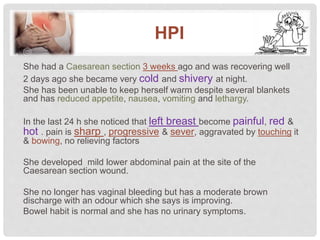
She had a Caesarean section 3 weeks ago and was recovering well
2 days ago she became very cold and shivery at night.
She has been unable to keep herself warm despite several blankets
and has reduced appetite, nausea, vomiting and lethargy.
In the last 24 h she noticed that left breast become painful, red &
hot . pain is sharp , progressive & sever, aggravated by touching it
& bowing, no relieving factors
She developed mild lower abdominal pain at the site of the
Caesarean section wound.
She no longer has vaginal bleeding but has a moderate brown
discharge with an odour which she says is improving.
Bowel habit is normal and she has no urinary symptoms.
GYNECOLOGIC HX :
No history of :
1- breast disease and breast self exam .
2- previous gynecologic surgery .
3- infertility .
4- using contraceptive .
No method of treatment used before and this is the first
time to present her self to the hospital with the same
condition .
MENSTRUAL HX :
Her menarche has occurred at
the age of 14 years since that time
she has regular cycle occurring every
30 days it lasts about 6 days ,
dark red in color , she changes her
pads 4 times per day .
associated with dysmenorrhea
in first 1 days , No intermenstrual pain
or discharge ,
No Bleeding after sexual intercourse
or in between the period .
-First day of LMP: 5 / 1/ 2016 .
OBSTETRIC HX
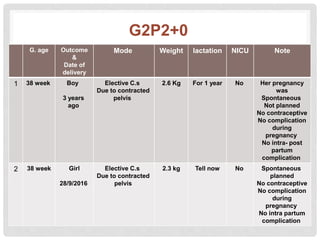
G2P2+0
NoteNICUlactationWeightModeOutcome
&
Date of
delivery
G. age
Her pregnancy
was
Spontaneous
Not planned
No contraceptive
No complication
during
pregnancy
No intra- post
partum
complication
NoFor 1 year2.6 KgElective C.s
Due to contracted
pelvis
Boy
3 years
ago
38 week1
Spontaneous
planned
No contraceptive
No complication
during
pregnancy
No intra partum
complication
NoTell now2.3 kgElective C.s
Due to contracted
pelvis
Girl
28/9/2016
38 week2
PAST & FAMILY HISTORY
Past Hx :
No history of any medical disease (Hypertension, DM,
epilepsy , thyroid )
No history of previous surgical operation.
No history of blood transfusion .
No history of drug , food allergies .
Family Hx :
No family history of DM , HTN and breast / ovarian cancer
.
No family history of Congenital anomaly .
No hx of twins
SOCIAL HX
- She doesn’t drink alcohol or smoke
- She lives in a well ventilated house
- Good socioeconomic status
- No animal contact
- No exercise
- No HX of traveling
SUMMARY
- Mona, 29 years old
-She had a Caesarean section 3 weeks ago
-Until 2 days ago she started to have :
* fever
* reduced appetite
* nausea, vomiting and lethargy.
* In the last 24 h she has noticed the left breast has become
painful and red & hot
* She has mild lower abdominal pain at the site of the
Caesarean section wound.
* Bowel habit is normal and she has no urinary symptoms.
What is your
Differential diagnosis ?
EXAMINATION
- temperature is 38.6°C.
- Blood pressure is 120/64 mmHg
- heart rate 106 b/min.
- The chest is clear and heart sounds are normal.
- redness , hotness & Tenderness over the superiolateral aspect of the
left breast & No dicharge
- The right breast is normal
- Normal lymph node examination
- Abdomen soft & lax
- Mild tenderness over caesarean section incision
no redness, hotness, swelling or discharge
- The uterus is firm and is non-tender
- No leg swelling.
INVESTIGATION
- CBS :
Hb : 10.1 g/dl
WBC : increased * mainly neutrophils *
Platelet : slightly increase
- C-reactive protein : 203 * < 5 mg/L
- Na & K :
within normal
- Urinalysis :
+++ blood
Leukocyte negative
Nitrate negative
Protein trace
what is the diagnosis ?
Other investigation ?
How would you manage ?
DIAGNOSIS
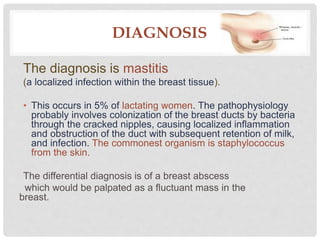
The diagnosis is mastitis
(a localized infection within the breast tissue).
• This occurs in 5% of lactating women. The pathophysiology
probably involves colonization of the breast ducts by bacteria
through the cracked nipples, causing localized inflammation
and obstruction of the duct with subsequent retention of milk,
and infection. The commonest organism is staphylococcus
from the skin.
The differential diagnosis is of a breast abscess
which would be palpated as a fluctuant mass in the
breast.
INVESTIGATION
• Blood cultures and a swab from the breast milk or nipple
are necessary.
• In cases of diagnostic doubt, an ultrasound scan can
differentiate mastitis from an abscess.
MANAGEMENT
1- Antibiotics * table *
2- Analgesia ( Acetaminophen , ibuprofen )
3- anti-emetic
4- continue breast-feeding. if this is too painful she should
express milk in order to try to unblock the duct.
ANTIBIOTICS
Inpatient treatmentOutpatient options
Nafcillin 2 g IV q4h or
Oxacillin 2 g IV q4h
If beta-lactam allergy or MRSA
suspicion:
Clindamycin 600 mg IV q8h or
Vancomycin 15 mg/kg IV q12h
Dicloxacillin
500 mg for 10-14 days or
Cephalexin
500 mg for 10-14 days
If beta-lactam allergy:
Clarithromycin
500 mg for 10-14 days
If suspected (CA-MRSA) infection:
Clindamycin
300 mg for 10-14 days
Case presentation mastitis

Case presentation mastitis

  • 1.
    O B GY N E CASE PRESENTATION Done by : Afrah Dhaifallah Elaf Ibrahim Norah Abdurrahman
  • 2.
    PERSONAL HX Mona, 29years old Saudi housewife, married for 5 years G2P2+0 , 2 previous CS , She is breast-feeding Originlly from Al-madina and living in Tabuk With no special habits of medical importance Her husband 35 years old , Teacher , non smoker
  • 3.
    CHIEF COMPLAIN She cameto the ER complaining of fever since 2 days
  • 4.
    HPI She had aCaesarean section 3 weeks ago and was recovering well 2 days ago she became very cold and shivery at night. She has been unable to keep herself warm despite several blankets and has reduced appetite, nausea, vomiting and lethargy. In the last 24 h she noticed that left breast become painful, red & hot . pain is sharp , progressive & sever, aggravated by touching it & bowing, no relieving factors She developed mild lower abdominal pain at the site of the Caesarean section wound. She no longer has vaginal bleeding but has a moderate brown discharge with an odour which she says is improving. Bowel habit is normal and she has no urinary symptoms.
  • 5.
    GYNECOLOGIC HX : Nohistory of : 1- breast disease and breast self exam . 2- previous gynecologic surgery . 3- infertility . 4- using contraceptive . No method of treatment used before and this is the first time to present her self to the hospital with the same condition .
  • 6.
    MENSTRUAL HX : Hermenarche has occurred at the age of 14 years since that time she has regular cycle occurring every 30 days it lasts about 6 days , dark red in color , she changes her pads 4 times per day . associated with dysmenorrhea in first 1 days , No intermenstrual pain or discharge , No Bleeding after sexual intercourse or in between the period . -First day of LMP: 5 / 1/ 2016 .
  • 7.
  • 8.
    G2P2+0 NoteNICUlactationWeightModeOutcome & Date of delivery G. age Herpregnancy was Spontaneous Not planned No contraceptive No complication during pregnancy No intra- post partum complication NoFor 1 year2.6 KgElective C.s Due to contracted pelvis Boy 3 years ago 38 week1 Spontaneous planned No contraceptive No complication during pregnancy No intra partum complication NoTell now2.3 kgElective C.s Due to contracted pelvis Girl 28/9/2016 38 week2
  • 9.
    PAST & FAMILYHISTORY Past Hx : No history of any medical disease (Hypertension, DM, epilepsy , thyroid ) No history of previous surgical operation. No history of blood transfusion . No history of drug , food allergies . Family Hx : No family history of DM , HTN and breast / ovarian cancer . No family history of Congenital anomaly . No hx of twins
  • 10.
    SOCIAL HX - Shedoesn’t drink alcohol or smoke - She lives in a well ventilated house - Good socioeconomic status - No animal contact - No exercise - No HX of traveling
  • 11.
    SUMMARY - Mona, 29years old -She had a Caesarean section 3 weeks ago -Until 2 days ago she started to have : * fever * reduced appetite * nausea, vomiting and lethargy. * In the last 24 h she has noticed the left breast has become painful and red & hot * She has mild lower abdominal pain at the site of the Caesarean section wound. * Bowel habit is normal and she has no urinary symptoms.
  • 12.
  • 13.
    EXAMINATION - temperature is38.6°C. - Blood pressure is 120/64 mmHg - heart rate 106 b/min. - The chest is clear and heart sounds are normal. - redness , hotness & Tenderness over the superiolateral aspect of the left breast & No dicharge - The right breast is normal - Normal lymph node examination - Abdomen soft & lax - Mild tenderness over caesarean section incision no redness, hotness, swelling or discharge - The uterus is firm and is non-tender - No leg swelling.
  • 14.
    INVESTIGATION - CBS : Hb: 10.1 g/dl WBC : increased * mainly neutrophils * Platelet : slightly increase - C-reactive protein : 203 * < 5 mg/L - Na & K : within normal - Urinalysis : +++ blood Leukocyte negative Nitrate negative Protein trace
  • 15.
    what is thediagnosis ? Other investigation ? How would you manage ?
  • 16.
    DIAGNOSIS The diagnosis ismastitis (a localized infection within the breast tissue). • This occurs in 5% of lactating women. The pathophysiology probably involves colonization of the breast ducts by bacteria through the cracked nipples, causing localized inflammation and obstruction of the duct with subsequent retention of milk, and infection. The commonest organism is staphylococcus from the skin. The differential diagnosis is of a breast abscess which would be palpated as a fluctuant mass in the breast.
  • 17.
    INVESTIGATION • Blood culturesand a swab from the breast milk or nipple are necessary. • In cases of diagnostic doubt, an ultrasound scan can differentiate mastitis from an abscess.
  • 18.
    MANAGEMENT 1- Antibiotics *table * 2- Analgesia ( Acetaminophen , ibuprofen ) 3- anti-emetic 4- continue breast-feeding. if this is too painful she should express milk in order to try to unblock the duct.
  • 19.
    ANTIBIOTICS Inpatient treatmentOutpatient options Nafcillin2 g IV q4h or Oxacillin 2 g IV q4h If beta-lactam allergy or MRSA suspicion: Clindamycin 600 mg IV q8h or Vancomycin 15 mg/kg IV q12h Dicloxacillin 500 mg for 10-14 days or Cephalexin 500 mg for 10-14 days If beta-lactam allergy: Clarithromycin 500 mg for 10-14 days If suspected (CA-MRSA) infection: Clindamycin 300 mg for 10-14 days