CASE PRESENTATION ON EAGLE SYNDROME
Presented by :-
Keerthi.Neelufor ,
5th Pharm.D ,
Y17PHD0411 ,
HINDU COLLEGE OF PHARMACY
Presented on :- 01/11/2021
Day :- Monday
EAGLE SYNDROME
• It is named after the Watt Weems Eagle in 1937
• It is also called as Elongated Styloid Process Syndrome or Styloid –
Stylohyoid syndrome
• It is a rare disease
• It is a pain that is caused in the throat and the face
• It is estimated that 1 in 62,500 people will get this disease
• Women are 3 times more prone in getting this disease
CAUSES
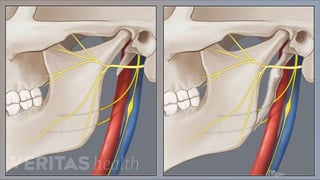
• It is usually caused by the elongated styloid bone or by the calcified stylohyoid ligament
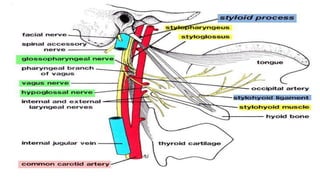
• The styloid process is a short pointy bone just below your ear and the stylohyoid ligament
connects to the hyoid bone in the neck
• According to GARD [ Genetic And Rare Diseases Information Center ] about 4 percent of
population will have this long styloid process
• Other causes may be like tonsillectomy
• It is mostly bilateral [ Both Sides ]
PATHOPHYSIOLOGY
• Eagle Sir has considered tonsillectomy responsible for the formation of scar tissue around the styloid apex,
with consequent compression or stretching of the vascular and nervous structures contained in the
retrostyloid compartment (in particular, the glossopharyngeal nerve and perivascular carotid sympathetic
fibers).
• Eagle syndrome is also discovered in patients who have never been subjected to tonsillectomy.
The other factors may be like
1. The ossification of the stylohyoid ligament complex, causing contraction of the
stylopharyngeal muscle and stretching of the XII cranial nerve
2. The fracture and medialization of the ossified stylohyoid ligament, with incomplete repair due
to continuous hyoid bone movements and formation of excessive granulation tissue
3. The ossification of muscular tendons leading to irritation of the structures nearby
4. The abnormal length associated with abnormal angulation of the styloid process
SYMPTOMS
• Pain usually on 1 side of neck or face [ Especially at Jaw ]
• Pain when swallowing or turning the head to 1 side
• Globus hystericus
• Tinnitus
• Sore throat
• Ear ache
• Headache etc.,
COMPLICATIONS
• Headache
• Loss of balance
• Changes in vision
• Confusion
• Weakness
• Due to Pressure it can even lead to Stroke
DIAGNOSIS
• Physical injuries to jaw
• Ear infections
• Physical examination
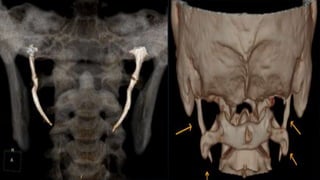
• Radiology tests like x-ray
• Imaging tests like CT etc.,
TREATMENT
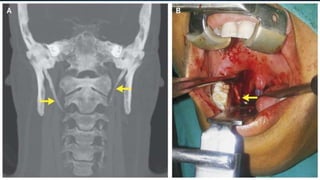
• Primary approach is through surgical i.e., styloidectomy
• It can be done either intraoral or extraorally
• If surgery is a risky option then the symptoms can be managed by
• OTC or NSAID'S like Naproxen , Ibuprofen etc.,
1. Steroids
2. Anti depressants like TCA's
3. Anticonvulsants & anaesthetics etc.,
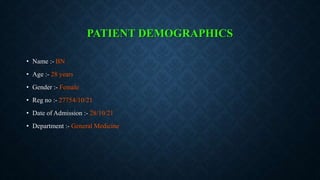
PATIENT DEMOGRAPHICS
• Name :- BN
• Age :- 28 years
• Gender :- Female
• Reg no :- 27754/10/21
• Date of Admission :- 28/10/21
• Department :- General Medicine
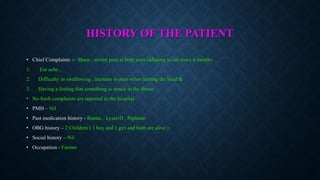
HISTORY OF THE PATIENT
• Chief Complaints :- Sharp , severe pain at both jaws radiating to ear since 4 months
1. Ear ache ,
2. Difficulty in swallowing , increase in pain when turning the head &
3. Having a feeling that something is struck in the throat
• No fresh complaints are reported in the hospital
• PMH – Nil
• Past medication history - Rantac , Lyser-D , Pephene
• OBG history – 2 Children ( 1 boy and 1 girl and both are alive )
• Social history – Nil
• Occupation - Farmer
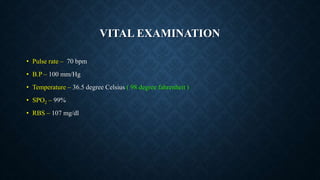
VITAL EXAMINATION
• Pulse rate – 70 bpm
• B.P – 100 mm/Hg
• Temperature – 36.5 degree Celsius ( 98 degree fahrenheit )
• SPO2 – 99%
• RBS – 107 mg/dl
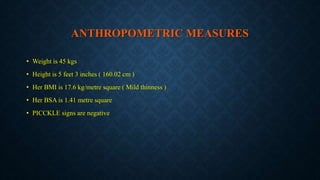
ANTHROPOMETRIC MEASURES
• Weight is 45 kgs
• Height is 5 feet 3 inches ( 160.02 cm )
• Her BMI is 17.6 kg/metre square ( Mild thinness )
• Her BSA is 1.41 metre square
• PICCKLE signs are negative
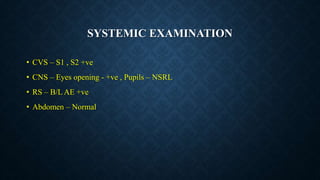
SYSTEMIC EXAMINATION
• CVS – S1 , S2 +ve
• CNS – Eyes opening - +ve , Pupils – NSRL
• RS – B/L AE +ve
• Abdomen – Normal
ASSESSMENT
• Provisional diagnosis :- Globus hystericus
• Final diagnosis :- Based on subjective data & objective data [ CT scan of neck ]
obtained from the patient is assessed to have " Eagle's Syndrome "
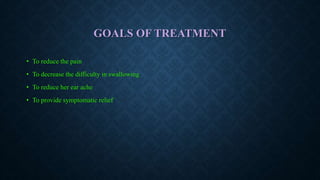
GOALS OF TREATMENT
• To reduce the pain
• To decrease the difficulty in swallowing
• To reduce her ear ache
• To provide symptomatic relief
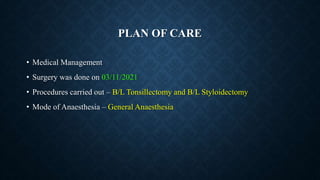
PLAN OF CARE
• Medical Management
• Surgery was done on 03/11/2021
• Procedures carried out – B/L Tonsillectomy and B/L Styloidectomy
• Mode of Anaesthesia – General Anaesthesia
S.NO VITALS DAY 1 DAY 2 DAY 3 DAY 4
1. Temperature [ in
degree fahrenheit ]
98.6 98.6 98.6 98.6
2. BP [ mm/Hg ] 100/70 110/70 110/80 120/80 , 100/60
3. PR [ bpm ] 70 72 67 84 , 86 , 66 , 65
4. SPO2 [ % ] 99 99 99 99 , 98 ( RR – 22
cpm , 18 )
5. RBS , FBS [ mg/dL
]
107 91 91 108 , 100 , 101 ,
111 , 91 , 105 , 77 ,
75
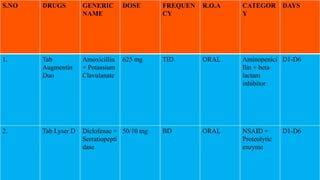
S.NO DRUGS GENERIC
NAME
DOSE FREQUEN
CY
R.O.A CATEGOR
Y
DAYS
1. Tab
Augmentin
Duo
Amoxicillin
+ Potassium
Clavulanate
625 mg TID ORAL Aminopenici
llin + beta
lactam
inhibitor
D1-D6
2. Tab Lyser D Diclofenac +
Serratiopepti
dase
50/10 mg BD ORAL NSAID +
Proteolytic
enzyme
D1-D6
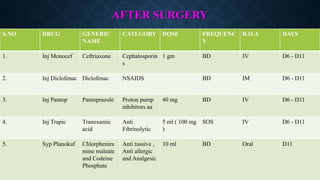
AFTER SURGERY
S.NO DRUG GENERIC
NAME
CATEGORY DOSE FREQUENC
Y
R.O.A DAYS
1. Inj Monocef Ceftriaxone Cephalosporin
s
1 gm BD IV D6 - D11
2. Inj Diclofenac Diclofenac NSAIDS BD IM D6 - D11
3. Inj Pantop Pantoprazole Proton pump
inhibitors aa
40 mg BD IV D6 - D11
4. Inj Trapic Tranexamic
acid
Anti
Fibrinolytic
5 ml ( 100 mg
)
SOS IV D6 - D11
5. Syp Planokuf Chlorphenira
mine maleate
and Codeine
Phosphate
Anti tussive ,
Anti allergic
and Analgesic
10 ml BD Oral D11
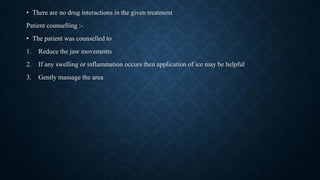
• There are no drug interactions in the given treatment
Patient counselling :-
• The patient was counselled to
1. Reduce the jaw movements
2. If any swelling or inflammation occurs then application of ice may be helpful
3. Gently massage the area
• Ct scan of neck :-
1. Mucosal thickening of b/l maxillary sinus with obliterated right osteomeatal
complex
2. Elongated styloid process b/l [ Right – 4.48 cm , Left – 4.41 cm ]
• Hb – 11.4 , 10.8 gm % [ 12-16 ]
• TRBC – 3.72 , 3.22 millions [ 4 – 6.2 ]
• PCV – 31.6 % ( 34 – 52 )
• CRP – 28.4 , 41.8 mg/l ( Upto 6 )
• X-ray etc.,
Case presentation on eagle syndrome.pptx

Case presentation on eagle syndrome.pptx

  • 1.
    CASE PRESENTATION ONEAGLE SYNDROME Presented by :- Keerthi.Neelufor , 5th Pharm.D , Y17PHD0411 , HINDU COLLEGE OF PHARMACY Presented on :- 01/11/2021 Day :- Monday
  • 3.
    EAGLE SYNDROME • Itis named after the Watt Weems Eagle in 1937 • It is also called as Elongated Styloid Process Syndrome or Styloid – Stylohyoid syndrome • It is a rare disease • It is a pain that is caused in the throat and the face • It is estimated that 1 in 62,500 people will get this disease • Women are 3 times more prone in getting this disease
  • 4.
    CAUSES • It isusually caused by the elongated styloid bone or by the calcified stylohyoid ligament • The styloid process is a short pointy bone just below your ear and the stylohyoid ligament connects to the hyoid bone in the neck • According to GARD [ Genetic And Rare Diseases Information Center ] about 4 percent of population will have this long styloid process • Other causes may be like tonsillectomy • It is mostly bilateral [ Both Sides ]
  • 6.
    PATHOPHYSIOLOGY • Eagle Sirhas considered tonsillectomy responsible for the formation of scar tissue around the styloid apex, with consequent compression or stretching of the vascular and nervous structures contained in the retrostyloid compartment (in particular, the glossopharyngeal nerve and perivascular carotid sympathetic fibers). • Eagle syndrome is also discovered in patients who have never been subjected to tonsillectomy.
  • 7.
    The other factorsmay be like 1. The ossification of the stylohyoid ligament complex, causing contraction of the stylopharyngeal muscle and stretching of the XII cranial nerve 2. The fracture and medialization of the ossified stylohyoid ligament, with incomplete repair due to continuous hyoid bone movements and formation of excessive granulation tissue 3. The ossification of muscular tendons leading to irritation of the structures nearby 4. The abnormal length associated with abnormal angulation of the styloid process
  • 8.
    SYMPTOMS • Pain usuallyon 1 side of neck or face [ Especially at Jaw ] • Pain when swallowing or turning the head to 1 side • Globus hystericus • Tinnitus • Sore throat • Ear ache • Headache etc.,
  • 9.
    COMPLICATIONS • Headache • Lossof balance • Changes in vision • Confusion • Weakness • Due to Pressure it can even lead to Stroke
  • 10.
    DIAGNOSIS • Physical injuriesto jaw • Ear infections • Physical examination • Radiology tests like x-ray • Imaging tests like CT etc.,
  • 12.
    TREATMENT • Primary approachis through surgical i.e., styloidectomy • It can be done either intraoral or extraorally • If surgery is a risky option then the symptoms can be managed by • OTC or NSAID'S like Naproxen , Ibuprofen etc., 1. Steroids 2. Anti depressants like TCA's 3. Anticonvulsants & anaesthetics etc.,
  • 14.
    PATIENT DEMOGRAPHICS • Name:- BN • Age :- 28 years • Gender :- Female • Reg no :- 27754/10/21 • Date of Admission :- 28/10/21 • Department :- General Medicine
  • 15.
    HISTORY OF THEPATIENT • Chief Complaints :- Sharp , severe pain at both jaws radiating to ear since 4 months 1. Ear ache , 2. Difficulty in swallowing , increase in pain when turning the head & 3. Having a feeling that something is struck in the throat • No fresh complaints are reported in the hospital • PMH – Nil • Past medication history - Rantac , Lyser-D , Pephene • OBG history – 2 Children ( 1 boy and 1 girl and both are alive ) • Social history – Nil • Occupation - Farmer
  • 16.
    VITAL EXAMINATION • Pulserate – 70 bpm • B.P – 100 mm/Hg • Temperature – 36.5 degree Celsius ( 98 degree fahrenheit ) • SPO2 – 99% • RBS – 107 mg/dl
  • 17.
    ANTHROPOMETRIC MEASURES • Weightis 45 kgs • Height is 5 feet 3 inches ( 160.02 cm ) • Her BMI is 17.6 kg/metre square ( Mild thinness ) • Her BSA is 1.41 metre square • PICCKLE signs are negative
  • 18.
    SYSTEMIC EXAMINATION • CVS– S1 , S2 +ve • CNS – Eyes opening - +ve , Pupils – NSRL • RS – B/L AE +ve • Abdomen – Normal
  • 19.
    ASSESSMENT • Provisional diagnosis:- Globus hystericus • Final diagnosis :- Based on subjective data & objective data [ CT scan of neck ] obtained from the patient is assessed to have " Eagle's Syndrome "
  • 20.
    GOALS OF TREATMENT •To reduce the pain • To decrease the difficulty in swallowing • To reduce her ear ache • To provide symptomatic relief
  • 21.
    PLAN OF CARE •Medical Management • Surgery was done on 03/11/2021 • Procedures carried out – B/L Tonsillectomy and B/L Styloidectomy • Mode of Anaesthesia – General Anaesthesia
  • 22.
    S.NO VITALS DAY1 DAY 2 DAY 3 DAY 4 1. Temperature [ in degree fahrenheit ] 98.6 98.6 98.6 98.6 2. BP [ mm/Hg ] 100/70 110/70 110/80 120/80 , 100/60 3. PR [ bpm ] 70 72 67 84 , 86 , 66 , 65 4. SPO2 [ % ] 99 99 99 99 , 98 ( RR – 22 cpm , 18 ) 5. RBS , FBS [ mg/dL ] 107 91 91 108 , 100 , 101 , 111 , 91 , 105 , 77 , 75
  • 23.
    S.NO DRUGS GENERIC NAME DOSEFREQUEN CY R.O.A CATEGOR Y DAYS 1. Tab Augmentin Duo Amoxicillin + Potassium Clavulanate 625 mg TID ORAL Aminopenici llin + beta lactam inhibitor D1-D6 2. Tab Lyser D Diclofenac + Serratiopepti dase 50/10 mg BD ORAL NSAID + Proteolytic enzyme D1-D6
  • 24.
    AFTER SURGERY S.NO DRUGGENERIC NAME CATEGORY DOSE FREQUENC Y R.O.A DAYS 1. Inj Monocef Ceftriaxone Cephalosporin s 1 gm BD IV D6 - D11 2. Inj Diclofenac Diclofenac NSAIDS BD IM D6 - D11 3. Inj Pantop Pantoprazole Proton pump inhibitors aa 40 mg BD IV D6 - D11 4. Inj Trapic Tranexamic acid Anti Fibrinolytic 5 ml ( 100 mg ) SOS IV D6 - D11 5. Syp Planokuf Chlorphenira mine maleate and Codeine Phosphate Anti tussive , Anti allergic and Analgesic 10 ml BD Oral D11
  • 25.
    • There areno drug interactions in the given treatment Patient counselling :- • The patient was counselled to 1. Reduce the jaw movements 2. If any swelling or inflammation occurs then application of ice may be helpful 3. Gently massage the area
  • 26.
    • Ct scanof neck :- 1. Mucosal thickening of b/l maxillary sinus with obliterated right osteomeatal complex 2. Elongated styloid process b/l [ Right – 4.48 cm , Left – 4.41 cm ] • Hb – 11.4 , 10.8 gm % [ 12-16 ] • TRBC – 3.72 , 3.22 millions [ 4 – 6.2 ] • PCV – 31.6 % ( 34 – 52 ) • CRP – 28.4 , 41.8 mg/l ( Upto 6 ) • X-ray etc.,