
Case Presentation Using
Progressive Disclosure
Example slides
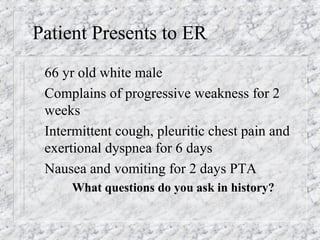
Patient Presents to ER
66 yr old white male
Complains of progressive weakness for 2
weeks
Intermittent cough, pleuritic chest pain and
exertional dyspnea for 6 days
Nausea and vomiting for 2 days PTA
What questions do you ask in history?
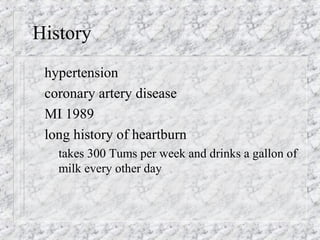
History
hypertension
coronary artery disease
MI 1989
long history of heartburn
– takes 300 Tums per week and drinks a gallon of
milk every other day
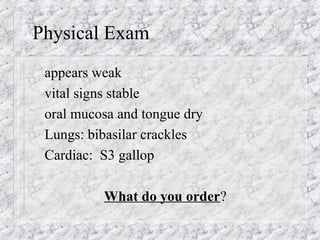
Physical Exam
appears weak
vital signs stable
oral mucosa and tongue dry
Lungs: bibasilar crackles
Cardiac: S3 gallop
What do you order?
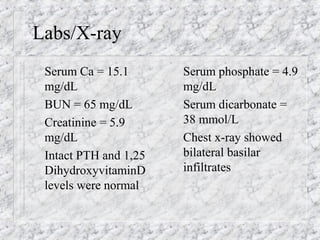
Labs/X-ray
Serum Ca = 15.1
mg/dL
BUN = 65 mg/dL
Creatinine = 5.9
mg/dL
Intact PTH and 1,25
DihydroxyvitaminD
levels were normal
Serum phosphate = 4.9
mg/dL
Serum dicarbonate =
38 mmol/L
Chest x-ray showed
bilateral basilar
infiltrates
What is your differiential
diagnosis?
Hypercalcemia of malignancy?
Primary hyperparathyroidis?
Milk-alkali syndrome?
Immobilization?
Multiple Myeloma?
Milk-alkali Syndrome
Presents with the triad of
hypercalcemia,
alkalosis and
renal failure
Occurs in acute, subacute, and chronic
forms
Milk-alkali Syndrome
Related to excessive ingestion of calcium
and absorbable antacids such as calcium
carbonate and milk
First reported in 1923
– thought to be a toxic reaction to the then
popular Sippy treatment of peptic ulcer disease.
The Sippy regimen: hourly administration of milk or
cream with a mixture of bicarbonate containing salts
that included calcium carbonate.
Milk-alkali Syndrome
Became rare with the advent of modern
ulcer therapy with nonabsorbable antacids,
H2 blockers and sucralfate.
May be an increased frequency of this
syndrome because of the growing
popularity of over-the-counter calcium
carbonate marketed either as antacids or as
calcium supplements for the prevention of
osteoporosis
What is your treatment plan?
Treatment Plan
Hospitalization, hydration, and diuresis
Discontinue injestion of calcium
IV Lasix and fluids
If life threatening: short course high dose
calcitonin (Calcimar) (8 IU per kg IM Q 6-
8)
Consult?
Consult?
Consult if renal failure might require
dialyses.
Prevention
Milk-alkali syndrome might easily be
prevented by restricting calcium intake to
1.2 to 1.5 g/day or by using a supplement
that does not contain absorbable alkali.
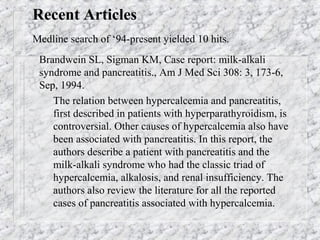
Recent Articles
Medline search of ‘94-present yielded 10 hits.
Brandwein SL, Sigman KM, Case report: milk-alkali
syndrome and pancreatitis., Am J Med Sci 308: 3, 173-6,
Sep, 1994.
– The relation between hypercalcemia and pancreatitis,
first described in patients with hyperparathyroidism, is
controversial. Other causes of hypercalcemia also have
been associated with pancreatitis. In this report, the
authors describe a patient with pancreatitis and the
milk-alkali syndrome who had the classic triad of
hypercalcemia, alkalosis, and renal insufficiency. The
authors also review the literature for all the reported
cases of pancreatitis associated with hypercalcemia.
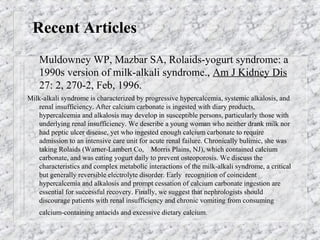
Recent Articles
Muldowney WP, Mazbar SA, Rolaids-yogurt syndrome: a
1990s version of milk-alkali syndrome., Am J Kidney Dis
27: 2, 270-2, Feb, 1996.
Milk-alkali syndrome is characterized by progressive hypercalcemia, systemic alkalosis, and
renal insufficiency. After calcium carbonate is ingested with diary products,
hypercalcemia and alkalosis may develop in susceptible persons, particularly those with
underlying renal insufficiency. We describe a young woman who neither drank milk nor
had peptic ulcer disease, yet who ingested enough calcium carbonate to require
admission to an intensive care unit for acute renal failure. Chronically bulimic, she was
taking Rolaids (Warner-Lambert Co, Morris Plains, NJ), which contained calcium
carbonate, and was eating yogurt daily to prevent osteoporosis. We discuss the
characteristics and complex metabolic interactions of the milk-alkali syndrome, a critical
but generally reversible electrolyte disorder. Early recognition of coincident
hypercalcemia and alkalosis and prompt cessation of calcium carbonate ingestion are
essential for successful recovery. Finally, we suggest that nephrologists should
discourage patients with renal insufficiency and chronic vomiting from consuming
calcium-containing antacids and excessive dietary calcium.
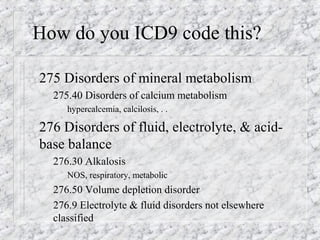
How do you ICD9 code this?
275 Disorders of mineral metabolism
– 275.40 Disorders of calcium metabolism
hypercalcemia, calcilosis, . .
276 Disorders of fluid, electrolyte, & acid-
base balance
– 276.30 Alkalosis
NOS, respiratory, metabolic
– 276.50 Volume depletion disorder
– 276.9 Electrolyte & fluid disorders not elsewhere
classified

Case presentation guide

  • 1.
    Case Presentation Using ProgressiveDisclosure Example slides
  • 2.
    Patient Presents toER 66 yr old white male Complains of progressive weakness for 2 weeks Intermittent cough, pleuritic chest pain and exertional dyspnea for 6 days Nausea and vomiting for 2 days PTA What questions do you ask in history?
  • 3.
    History hypertension coronary artery disease MI1989 long history of heartburn – takes 300 Tums per week and drinks a gallon of milk every other day
  • 4.
    Physical Exam appears weak vitalsigns stable oral mucosa and tongue dry Lungs: bibasilar crackles Cardiac: S3 gallop What do you order?
  • 5.
    Labs/X-ray Serum Ca =15.1 mg/dL BUN = 65 mg/dL Creatinine = 5.9 mg/dL Intact PTH and 1,25 DihydroxyvitaminD levels were normal Serum phosphate = 4.9 mg/dL Serum dicarbonate = 38 mmol/L Chest x-ray showed bilateral basilar infiltrates
  • 6.
    What is yourdifferiential diagnosis? Hypercalcemia of malignancy? Primary hyperparathyroidis? Milk-alkali syndrome? Immobilization? Multiple Myeloma?
  • 7.
    Milk-alkali Syndrome Presents withthe triad of hypercalcemia, alkalosis and renal failure Occurs in acute, subacute, and chronic forms
  • 8.
    Milk-alkali Syndrome Related toexcessive ingestion of calcium and absorbable antacids such as calcium carbonate and milk First reported in 1923 – thought to be a toxic reaction to the then popular Sippy treatment of peptic ulcer disease. The Sippy regimen: hourly administration of milk or cream with a mixture of bicarbonate containing salts that included calcium carbonate.
  • 9.
    Milk-alkali Syndrome Became rarewith the advent of modern ulcer therapy with nonabsorbable antacids, H2 blockers and sucralfate. May be an increased frequency of this syndrome because of the growing popularity of over-the-counter calcium carbonate marketed either as antacids or as calcium supplements for the prevention of osteoporosis
  • 10.
    What is yourtreatment plan?
  • 11.
    Treatment Plan Hospitalization, hydration,and diuresis Discontinue injestion of calcium IV Lasix and fluids If life threatening: short course high dose calcitonin (Calcimar) (8 IU per kg IM Q 6- 8) Consult?
  • 12.
    Consult? Consult if renalfailure might require dialyses.
  • 13.
    Prevention Milk-alkali syndrome mighteasily be prevented by restricting calcium intake to 1.2 to 1.5 g/day or by using a supplement that does not contain absorbable alkali.
  • 14.
    Recent Articles Medline searchof ‘94-present yielded 10 hits. Brandwein SL, Sigman KM, Case report: milk-alkali syndrome and pancreatitis., Am J Med Sci 308: 3, 173-6, Sep, 1994. – The relation between hypercalcemia and pancreatitis, first described in patients with hyperparathyroidism, is controversial. Other causes of hypercalcemia also have been associated with pancreatitis. In this report, the authors describe a patient with pancreatitis and the milk-alkali syndrome who had the classic triad of hypercalcemia, alkalosis, and renal insufficiency. The authors also review the literature for all the reported cases of pancreatitis associated with hypercalcemia.
  • 15.
    Recent Articles Muldowney WP,Mazbar SA, Rolaids-yogurt syndrome: a 1990s version of milk-alkali syndrome., Am J Kidney Dis 27: 2, 270-2, Feb, 1996. Milk-alkali syndrome is characterized by progressive hypercalcemia, systemic alkalosis, and renal insufficiency. After calcium carbonate is ingested with diary products, hypercalcemia and alkalosis may develop in susceptible persons, particularly those with underlying renal insufficiency. We describe a young woman who neither drank milk nor had peptic ulcer disease, yet who ingested enough calcium carbonate to require admission to an intensive care unit for acute renal failure. Chronically bulimic, she was taking Rolaids (Warner-Lambert Co, Morris Plains, NJ), which contained calcium carbonate, and was eating yogurt daily to prevent osteoporosis. We discuss the characteristics and complex metabolic interactions of the milk-alkali syndrome, a critical but generally reversible electrolyte disorder. Early recognition of coincident hypercalcemia and alkalosis and prompt cessation of calcium carbonate ingestion are essential for successful recovery. Finally, we suggest that nephrologists should discourage patients with renal insufficiency and chronic vomiting from consuming calcium-containing antacids and excessive dietary calcium.
  • 16.
    How do youICD9 code this? 275 Disorders of mineral metabolism – 275.40 Disorders of calcium metabolism hypercalcemia, calcilosis, . . 276 Disorders of fluid, electrolyte, & acid- base balance – 276.30 Alkalosis NOS, respiratory, metabolic – 276.50 Volume depletion disorder – 276.9 Electrolyte & fluid disorders not elsewhere classified

Editor's Notes

  • #12 The milk-alkali syndrome, first reported as an adverse reaction to peptic ulcer therapy in the 1920s, may be increasing due to the growing use of calcium carbonate supplements to prevent osteoporosis. In recent case reports of the syndrome, most patients had been taking only calcium carbonate, which provides both calcium and absorbable alkali. The pathophysiology of the syndrome remains unclear. Until the recent introduction of the immunoradiometric assay (IRMA), it was not possible to reliably distinguish the milk-alkali syndrome from hyperparathyroidism with noninvasive studies. Investigators reviewed the records of the 100 patients hospitalized for hypercalcemia between 1985 and 1993. Milk-alkali syndrome was diagnosed in seven of the 100 patients, based on a history of increased consumption of calcium and alkali, the presence of both hypercalcemia and metabolic acidosis, and the absence of any other explanations for these findings. Six of the seven patients were women. All seven had been taking OTC antacids containing calcium carbonate in dosages of 4 to 12 g/day. Serum bicarbonate levels were elevated in three patients and high-normal in the rest. Serum parathyroid hormone levels, measured by IRMA in six patients at the time of admission, were low in all six.
  • #14 Conservative treatment (generally saline plus loop diuretics) was associated with temporary hypocalcemia and rebound hyperparathyroidism in two patients. Renal function was significantly impaired in two patients and mildly impaired in two others. Only one patient was admitted between 1985 and 1989; the other six were hospitalized between 1990 and 1993. Milk-alkali syndrome accounted for 2% of all hospitalizations for hypercalcemia from 1985 to 1990 and 12% of such admissions between 1990 and 1993, a statistically significant increase. Use of OTC medications and dairy products should be carefully investigated in all hypercalcemic patients. Determination of serum parathyroid levels with IRMA can reliably distinguish milk-alkali syndrome from hyperparathyroidism. However, the assay should be performed shortly after admission because treatment often leads to a rapid rebound of parathyroid hormone levels. Milk-alkali syndrome might easily be prevented by restricting calcium intake to 1.2 to 1.5 g/day or by using a supplement that does not contain absorbable alkali. SOURCE: Beall, D., and Scofield, R. Milk-alkali syndrome associated with calcium carbonate consumption. Medicine 74:89-96, Mar. 1995. From the University of Oklahoma Health Science Center, Oklahoma City; and other institutions. Source of funding not stated.
  • #15 Medline search of milk-alkali syndrome in 1994-present yielded 10 articles.