Download to read offline
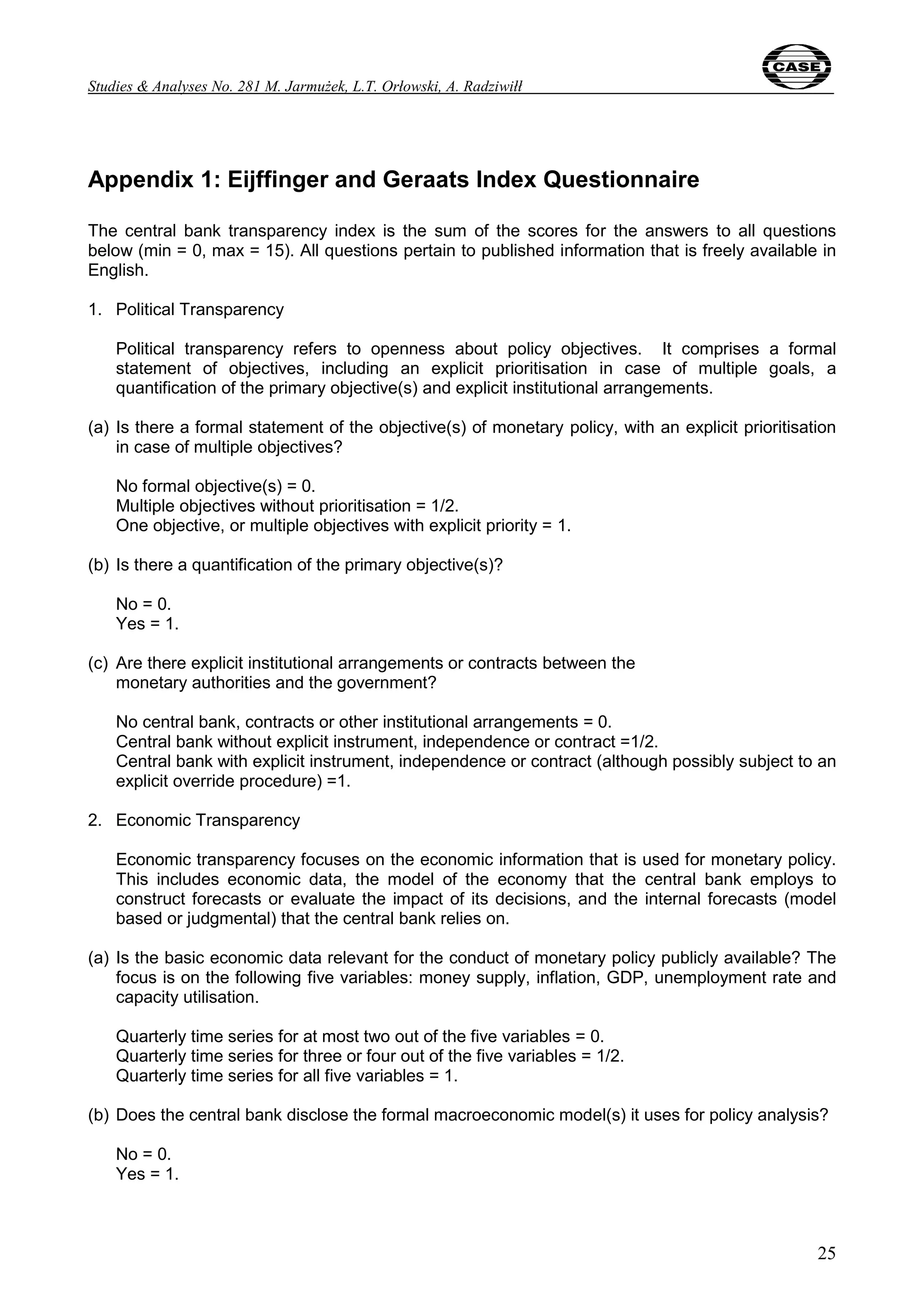



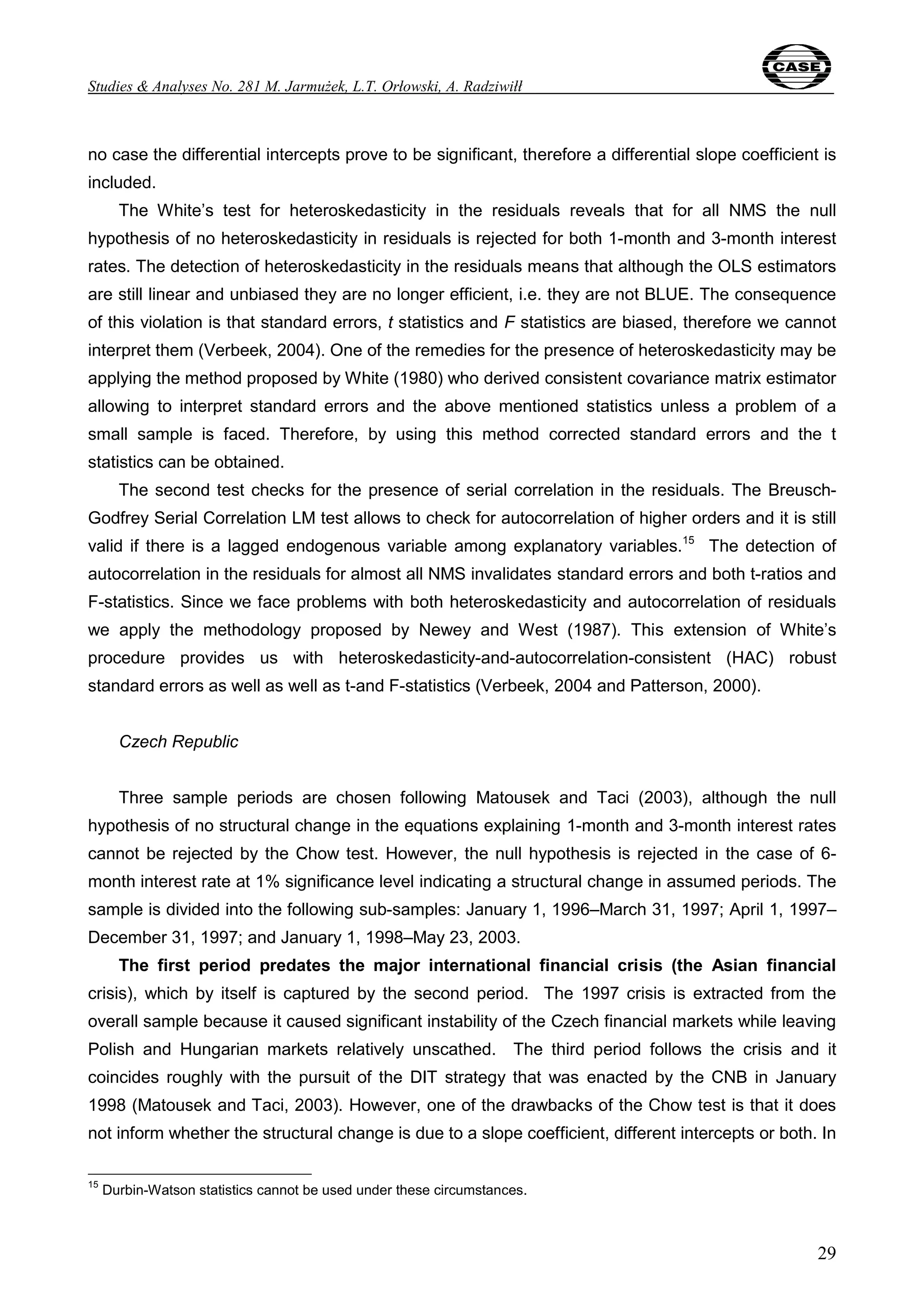
![Studies & Analyses No. 281 – Monetary Policy Transparency in the Inflation ...
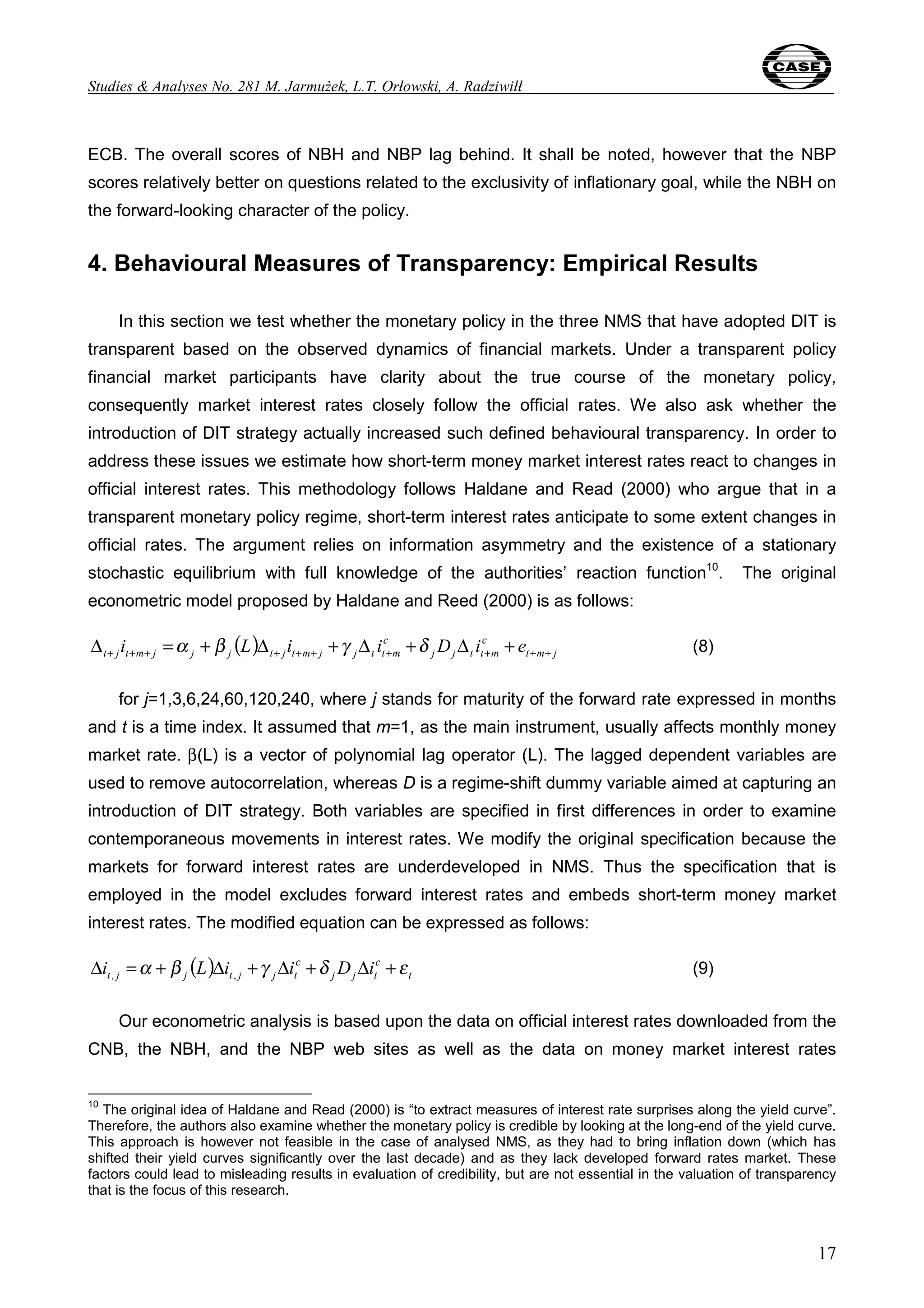
order to address this issue and assess structural characteristics of the three sample periods, the
tested form of the model for the Czech Republic (estimated at different maturities) is prescribed as
a slightly modified Equation (9):
30
( ) c
c
c
t
t
t
t j j t j j t Δi =α + β L Δi +γ Δi +δ D Δi +δ D Δi +ε , , 1 1 2 2 (10)
where D1 and D2 represent dummy variables capturing the first and second sample periods
respectively, thus the remaining observations correspond with the third period. The estimation
results of Equation (10) for two maturities are presented in Table A.3.1.
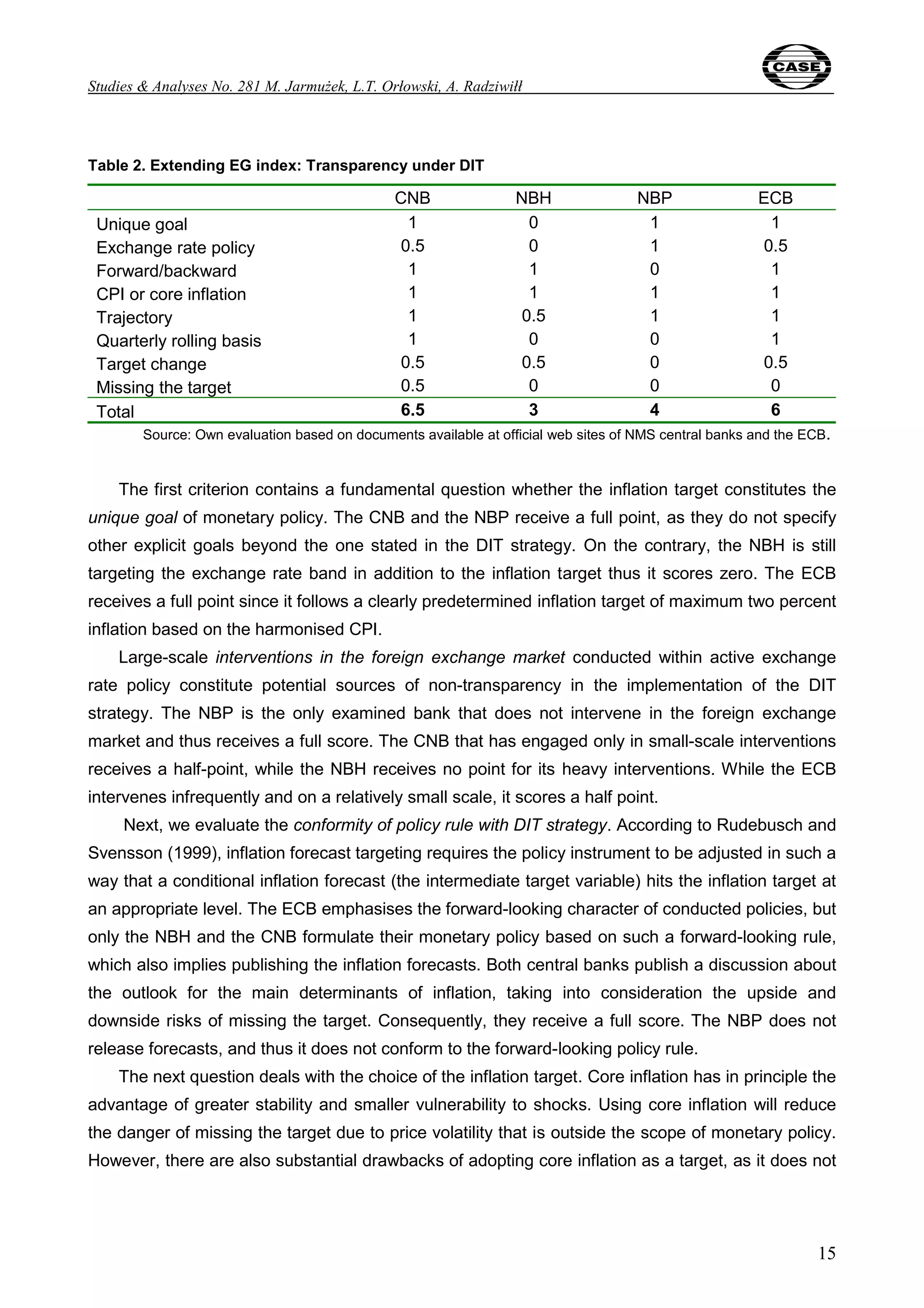
Table A.3.1. Estimation representations of Equation (10) for the Czech Republic
Coefficients
α β1 γ δ1 δ2 adj. R2 F-test
PRIBOR 1m -0.0013 0.1194 0.4740** 0.5311** -0.5493** 11.6661
[0.0193] [0.1480] [0.0789] [0.1123] [0.1722]
0.0211
0.0000
PRIBOR 3m -0.0024 0.1572** 0.3136** 0.8336** -0.2116* 27.5505
[0.0092] [0.0780] [0.0753] [0.0969] [0.1095]
0.0509
0.0000
HAC standard errors are reported in parentheses; * indicates significance at 5%; ** indicates significance at 1%, second
rows for F-statistics represent p-values
Source: Own estimations
The results show that both parameters γ and δ are statistically significant, which means that
the null hypothesis of zero coefficient is rejected. The interactive dummy variables are also
statistically significant. Since estimated δ2 coefficients are negative, it can be argued that
transparency of the monetary policy has increased after the introduction of DIT.
Hungary
The empirical test of responses of market interest rates to the official rates in Hungary is based
on two sample periods: December 19, 1996–May 3, 2001; and May 4, 2001–May 23, 2003. The
point of division reflects the day of the inception of DIT by the NBH. Therefore, the structural
analysis reflecting differences in interest rate reactions during these two periods enables to assess
contribution of the new policy regime to financial stability relative to the stability under the previous
system that was based on exchange rate targeting. Due to the identification of two periods only,
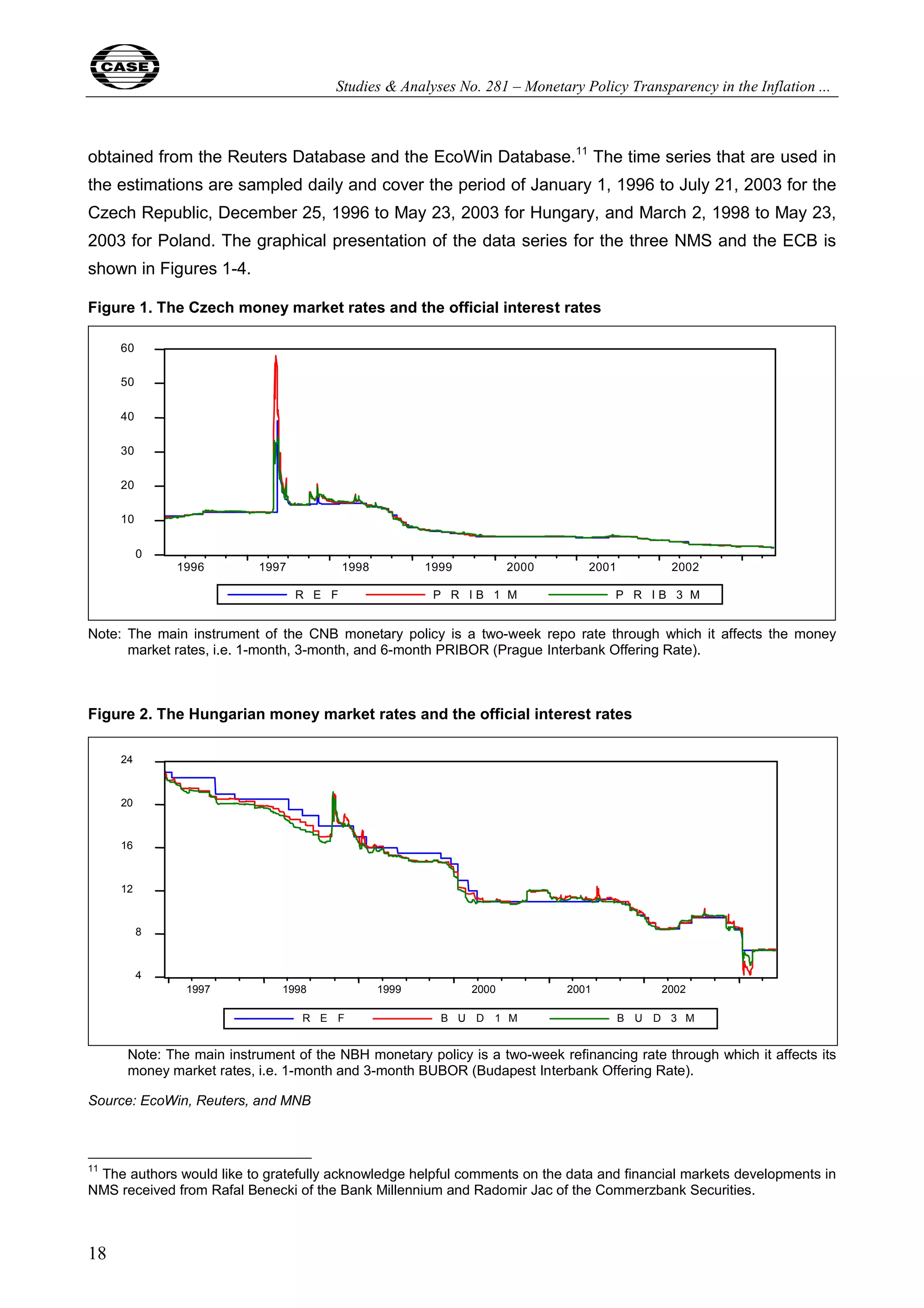
the tested function for Hungary is based on Equation (9) to allow for D to capture the pre-DIT
period. The results of the Equation (9) for two maturities are presented in Table A.3.2
The empirical evidence suggests that the NBH is not transparent and there is a marked decline
in transparency following the introduction of the DIT, as a parameter γ is significantly different from
zero and δ is negative.](https://image.slidesharecdn.com/sa281-141105045200-conversion-gate02/75/CASE-Network-Studies-and-Analyses-281-Monetary-Policy-Transparency-in-Inflation-Targeting-Countries-the-Czech-Republic-Hungary-and-Poland-30-2048.jpg)
![Studies & Analyses No. 281 M. Jarmużek, L.T. Orłowski, A. Radziwiłł
31
Table A.3.2. Estimation representations of Equation (9) for Hungary
Coefficients
α β1 γ δ1 adj. R2 F-test
BUDBOR 1m -0.0071* 0.1091 0.5667** -0.5478** 26.2798
[0.0031] [0.0836] [0.1866] [0.1993]
0.0434
0.0000
BUDBOR 3m -0.0053* 0.2805** 0.5500** -0.5346** 91.6862
[0.0024] [0.0676] [0.1807] [0.1816]
0.1400
0.0000
HAC standard errors are reported in parentheses; * indicates significance at 5%; ** indicates significance at 1%; second
rows for F-statistics represent p-values
Source: Own estimations
Poland
The empirical analysis of the model for Poland is based on the extraction of two sample
periods: January 1, 1996–June 3, 1998; and June 4, 1998–May 23, 2003. The first sample period
predates the announcement of the DIT strategy, while the second period follows it. Thus the tested
function for Poland includes one dummy capturing the pre-DIT period. There is also a dummy for
the period of the end of 1999 to adjust for a dynamic increase in the market interest rates related to
the year 2000.16
( ) c
c
c
t
t
t
t j j t j j t Δi =α + β L Δi +γ Δi +δ D Δi +δ D Δi +ε , , 1 1 2 2 (11)
where D1 and D2 represent dummy variables capturing the regime shift in monetary policy and
Y2K problem, respectively. The results of the Equation (11) for two maturities are presented in
Table A.3.3.
Table A.3.3. Estimation representations of Equation (11) for Poland
Coefficients
α β1 γ δ1 δ2 adj. R2 F-test
WIBOR 1m -0.0038 0.2504*** 0.3199*** 0.2471* -0.3831** 87.8142
[0.0042] [0.0648] [0.1282] [0.1323] [0.1274]
0.2029
0.0000
WIBOR 3m -0.0072** 0.2041*** 0.1848** 0.2054* -0.1528** 73.1434
[0.0033] [0.0480] [0.0779] [0.1105] [0.0775]
0.1746
0.0000
HAC standard errors are reported in parentheses, * indicates significance at 10%, ** indicates significance at 5%, ***
indicates significance at 1%, second rows for F-statistics represent p-values
Source: Own estimations
16 Market participants and general public were afraid of problems with liquidity that could occur as a consequence of
obsolete software possessed by some banks.](https://image.slidesharecdn.com/sa281-141105045200-conversion-gate02/75/CASE-Network-Studies-and-Analyses-281-Monetary-Policy-Transparency-in-Inflation-Targeting-Countries-the-Czech-Republic-Hungary-and-Poland-31-2048.jpg)
![Studies & Analyses No. 281 – Monetary Policy Transparency in the Inflation ...
32
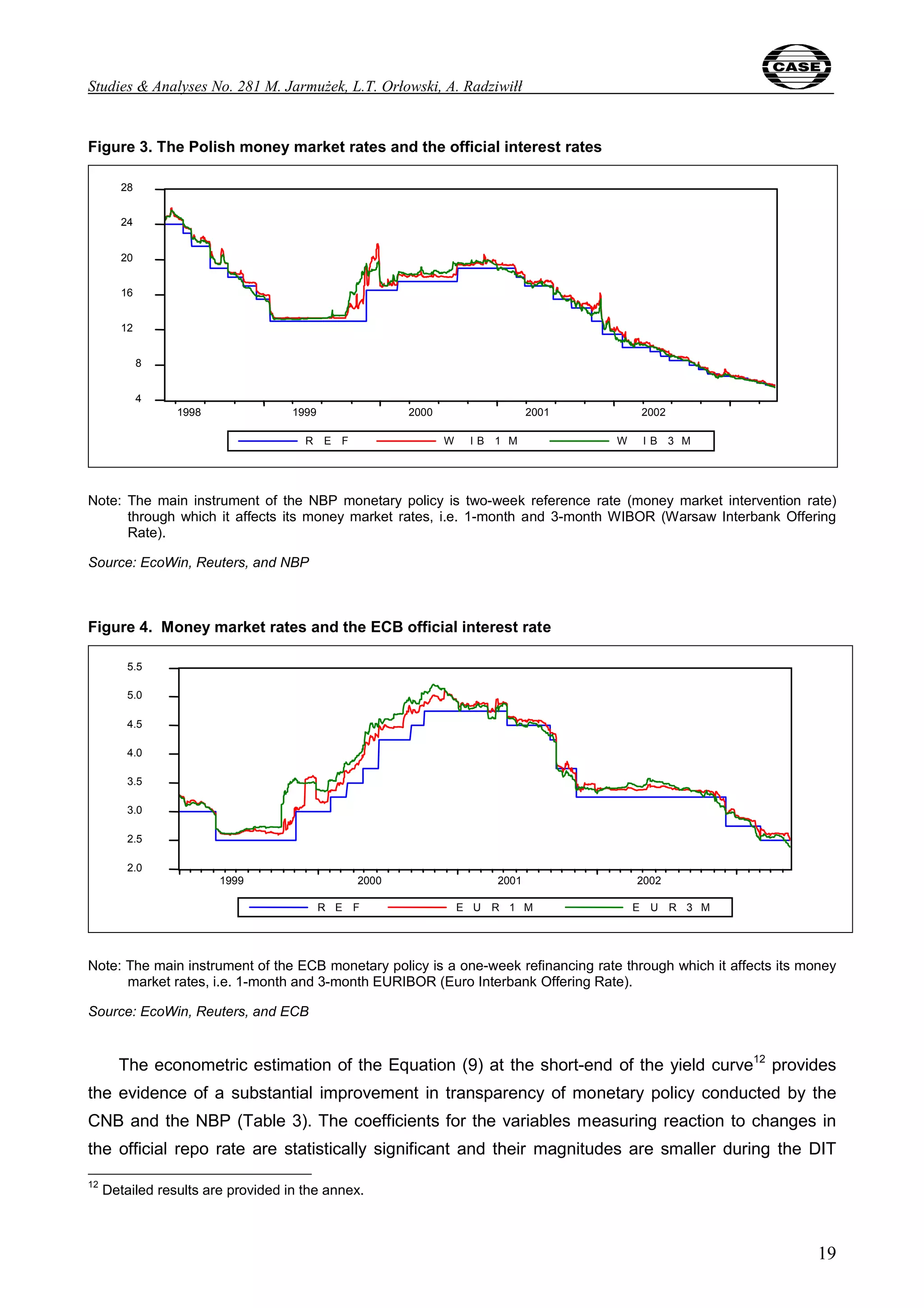
The empirical evidence suggests that the NBP is not transparent because a parameter γ is
significantly greater than zero. However, there is a statistically significant increase in transparency
in the monetary policy conduct following the introduction of DIT, as δ1 is significant at 10% level
and has a positive sign.
ECB
The empirical analysis covers the period of January 1, 1999 – May 23, 2003. The empirical
test for the Eurozone does not include a regime shift dummy variable, as there has been no
change in the monetary policy strategy of the ECB in the analysed period.
( ) c
t
t j j t j j t Δi =α + β L Δi +γ Δi +ε , , (12)
Table A.3.4 Estimation representations of Equation (12) for the ECB
Coefficients
α β1 γ adj. R2 F-test
EURIBOR 1m -0.0005 0.1094** 0.2718** 88.6911
[0.0009] [0.0315] [0.0975]
0.1331
0.0000
EURIBOR 3m -0.0006 0.1526** 0.2064* 0.1300 86.3236
[0.0008] [0.0407] [0.0914] 0.0000
HAC standard errors are reported in parentheses; * indicates significance at 5%, ** indicates significance at 1%; second
rows for F-statistics represent p-values
Source: Own estimations
The empirical evidence suggests that the ECB is not transparent because a parameter γ is
significantly greater than zero, although its magnitude is slightly lower than for Poland.](https://image.slidesharecdn.com/sa281-141105045200-conversion-gate02/75/CASE-Network-Studies-and-Analyses-281-Monetary-Policy-Transparency-in-Inflation-Targeting-Countries-the-Czech-Republic-Hungary-and-Poland-32-2048.jpg)

This paper analyzes monetary policy transparency in the Czech Republic, Hungary, and Poland, which have adopted direct inflation targeting (DIT) strategies. It evaluates both institutional and behavioral transparency using the Eijffinger-Geraats index and an econometric model, revealing an ambiguous relationship between the two measures. The findings suggest that transparency is crucial for achieving compatibility with the European Central Bank's standards as the countries prepare for European Monetary Union membership.


