S t u d i a i A n a l i z y 
S t u d i e s & A n a l y s e s 
C e n t r um A n a l i z 
S p o l e c z n o – E k o n omi c z n y c h 
C e n t e r f o r S o c i a l 
a n d E c o n omi c R e s e a r c h 
3 2 7 
Rafal Benecki, Jens Hölscher, Mariusz Jarmuzek 
Fiscal Transparency and Policy Rules in Poland 
W a r s a w , M a y 2 0 0 6
Studies & Analyses CASE No. 327 - Fiscal Transparency and Policy Rules in Poland 
Materials published here have a working paper character. They can be subject to further 
publication. The views and opinions expressed here reflect the author(s) point of view and not 
necessarily those of CASE. 
This research was supported by a grant from the CERGE-EI Foundation under a program of the 
Global Development Network. Additional funds for grantees in the Balkan countries have been 
provided by the Austrian Government through WIIW, Vienna. All opinions expressed are those of 
the author(s) and have not been endorsed by CERGE-EI, WIIW, or the GDN. 
The authors would like to thank Artur Bubilo, Marek Dabrowski, Brigitte Granville, Paul De 
Grauwe, Dennis Leech and participants of the conference organised by the University College 
London for helpful comments, suggestions and discussions. 
Keywords: Fiscal Transparency, Fiscal Rules, Fiscal Discipline, Institutions. 
© CASE – Center for Social and Economic Research, Warsaw 2006 
2 
Graphic Design: Agnieszka Natalia Bury 
ISSN 1506-1701 
ISBN 978-83-7178-410-1 EAN 97883717884101 
Publisher: 
CASE – Center for Social and Economic Research 
12 Sienkiewicza, 00-944 Warsaw, Poland 
tel.: (48 22) 622 66 27, 828 61 33, fax: (48 22) 828 60 69 
e-mail: case@case.com.pl 
http://www.case.com.pl/
Studies & Analyses CASE No. 327 - Fiscal Transparency and Policy Rules in Poland 
3 
Contents 
Abstract .....................................................................................................................................5 
Introduction ...............................................................................................................................6 
1. Theoretical and empirical background ...............................................................................7 
1.1. Transparency in fiscal policy.....................................................................................7 
1.1.1. Theoretical background ..........................................................................................8 
1.1.2. Empirical research...................................................................................................9 
1.2. Fiscal policy rules.....................................................................................................10 
1.2.1. Deficit rules ............................................................................................................10 
1.2.2. Debt rules...............................................................................................................11 
1.2.3. Expenditure rules...................................................................................................12 
1.3. Empirical research....................................................................................................13 
1.4. Discussion ................................................................................................................14 
2. Analytical framework ..........................................................................................................15 
2.1. Rudimentary fiscal arithmetic..................................................................................15 
2.2. Basic fiscal rules ......................................................................................................17 
2.3. Discussion ................................................................................................................18 
3. Fiscal transparency and rules in Poland ...........................................................................18 
3.1. Fiscal policy in Poland over the transition period..................................................18 
3.2. Transparency ............................................................................................................21 
3.3. Fiscal policy rules................................................................................................23 
3.3.1. Public debt rules ..............................................................................................24 
3.3.2. Deficit rules.......................................................................................................24 
3.3.3. Expenditure rules.............................................................................................25 
3.4. Discussion ................................................................................................................25 
4. A proposal ...........................................................................................................................26 
5. Concluding remarks............................................................................................................27 
Bibliography: ...........................................................................................................................31
Studies & Analyses CASE No. 327 - Fiscal Transparency and Policy Rules in Poland 
Rafal Benecki is Senior Economist at ING Bank, where he is running macroeconomic analysis, 
forecasts and strategy. His research interests cover also banking sector developments with 
special emphasis on housing financing and mortgage banking. In the years 2001-2005 he 
worked in the Macroeconomic Analysis Bureau of the Bank Millennium. In 1999 he was a 
summer intern at the Research Department of the National Bank of Poland. Rafal Benecki is the 
Laureate of National High School Olympiad in Economics. He graduated from the Wroclaw 
University of Economics and is currently finishing postgraduate studies in Financial Economics 
at Queen Mary College, University of London as the British Chevening scholar. 
Dr. Jens Hölscher is Head of the Research Group "Economic and Social Transition" and Reader 
in Economics at the University of Brighton. Previously he taught at the Universities of Berlin, 
Swansea, Birmingham and Chemnitz. He held Visiting Professorships at the Universities of Halle 
(IWH), Bonn (ZEI), Bolzano-Bozen, New Brunswick in Cairo and Almaty (KIMEP) as well as a 
research scholarship by the Deutsche Bundesbank. He is interested in monetary and transition 
economics, both areas in which he published widely. He is the co-editor of Palgrave's 
(Macmillan's Global Publishing) book series "Studies in Economic Transition". 
Mariusz Jarmuzek has been associated with the CASE Foundation since 1997. His research 
interests cover development and transition economics, monetary and fiscal policy, exchange 
rate economics, and political economy of transformation. Between 2000-2002 he worked as a 
member of the USAID advisory mission to the President of Georgia, and was also involved in 
consultancy projects to the Ministry of Finance, the Warsaw Stock Exchange, and the Polish 
Bank for Development. He then worked as an economist at the National Bank of Poland and for 
the University College London. He was an intern in the European Department of the 
International Monetary Fund, World Bank, National Bank of Poland, and ING Barings. As a 
laureate of the IMF/GDN competition he was Visiting Scholar in the Research Department of the 
International Monetary Fund. Mariusz Jarmuzek holds Masters degree from the University of 
Lodz and the University of Warwick. He is currently a PhD student at Queen Mary College of the 
University of London. 
4
Studies & Analyses CASE No. 327 - Fiscal Transparency and Policy Rules in Poland 
5 
Abstract 
This paper discusses the link between the deficit bias in public finance and institutional settings. 
The Polish experience is put in a wider context and provides an extensive discussion of possible 
institutional reforms that may be implemented to stabilise the path of fiscal policy and reduce the 
deficit bias. Although substantial improvements have been made in Poland with respect to fiscal 
transparency standards set by the IMF and EU there is still much scope for enhancement. The 
recommended change in fiscal policy would involve the implementation of medium-term 
budgetary framework that would ensure consistency between the budgetary process and 
medium-term fiscal goals. This should be accompanied by the introduction of binding constraints 
on fiscal policy. The expenditure rule could be reintroduced to strengthen fiscal discipline, as it 
could force policymakers to tighten fiscal policy. It seems to be indispensable to maintain fiscal 
rules at the local government level. The issue of still limited fiscal transparency and 
unsatisfactory performance of fiscal rules requires the undertaking of various appropriate 
measures to strengthen the policy framework in Poland. This can be done in our view by 
involving external institution entitled to examine fiscal transparency and the performance of fiscal 
rules in the budgetary process. We think that the institution that is fully capable to take the lead 
in this respect is the NIK, which was granted full independence in 1994 and has since proved to 
be successful in overseeing public finances. This should, however, be accompanied by 
simultaneous enhancement of the internal audit.
Studies & Analyses CASE No. 327 - Fiscal Transparency and Policy Rules in Poland 
6 
Introduction 
Transparency and fiscal rules can be of great help in reducing the deficit bias. The 
importance of fiscal transparency is highly appreciated by such international organisations as 
the IMF, which has published Codes of Good Practices on Fiscal Transparency (1998) and the 
OECD, with its Best Practices for Budget Transparency (2000). They have also been explicitly 
formulated by the European Union in the acquis communautaire. All these organisations 
emphasise the role of fiscal transparency as a precondition for fiscal sustainability and good 
governance. Transparency is commonly supplemented by fiscal rules that are implemented to 
inject or restore credibility. They have been introduced as binding constraints by the EU in the 
form of the Maastricht criteria and the Stability and Growth Pact. However, in order to fully 
benefit from such rules fiscal policy has to be transparent, as this obliges policymakers to 
become more accountable. 
Poland has made some efforts to make its fiscal policy more transparent over the last 
few years mainly in order to comply with EU and IMF regulations. This has been accompanied 
by the introduction of some binding constraints on fiscal policy that are required by the EU. 
However, there still seems to be a long way to go in both respects. The main purpose of this 
study is to assess the current stance and desirable progress in the implementation of fiscal 
transparency and rules in Poland. An index of transparency based on Report on the Observance 
of Standards and Codes (ROSC), with some modifications, is also constructed in this paper, 
followed by proposals for making transparency and fiscal rules more efficient within Poland’s 
fiscal policy. This study attempts to answer the following questions: Firstly, to what extent is 
fiscal policy transparent in the context of the standards set by the EU’s regulations and the IMF’s 
ROSC? Secondly, have the fiscal rules adopted by Poland proved to be successful in 
establishing fiscal policy discipline? Finally, what still needs to be changed to make both 
transparency and fiscal rules more efficient for the conduct of fiscal policy? To set the work in 
context we also provide an overview of recent advances in both the theoretical and empirical 
literature on fiscal transparency and rules.
Studies & Analyses CASE No. 327 - Fiscal Transparency and Policy Rules in Poland 
1. Theoretical and empirical background 
The literature on fiscal rules has been widely addressed in recent years in particular with 
regards to transparency. Langenus (2001) argues, for example, that apart from rules specifying 
quantitative targets for fiscal policy it is also equally important to set qualitative targets, to make 
more precise the procedural issues affecting fiscal policy. Transparency as such clearly plays a 
special role in terms of monitoring both numerical and procedural targets. 
7 
1.1. Transparency in fiscal policy 
Fiscal transparency can be defined as the government and financial authorities more 
widely being open about the structure and functions of their operations, fiscal policy intentions, 
public sector accounts and fiscal projections (Kopits and Craig, 1998). Such openness is 
essential if discipline is to be imposed on governments and policymakers made accountable for 
the design and implementation of fiscal policy. Transparency should lead to better, more 
credible policies, to a less uncertain policy environment, to earlier and smoother fiscal policy 
responses to emerging economic problems and ultimately to improved economic performance. 
According to Kopits and Szekely (2002) and Feldman and Watson (2002), the key 
transparency objective is an open multi-year budget framework. They claim that the adoption of 
a medium-term budget framework, alongside structural reforms, is very important in the context 
of EU accession. The second transparency objective is consolidation of the budget across all 
areas of fiscal activity, such as off-budget operations. This may include extra-budgetary funds, 
contingent liabilities and the balances of state owned financial and non-financial enterprises. The 
third important transparency objective is to achieve a sound accounting system consistent with 
the European System of Accounts (ESA 95) and the IMF Government Finance Statistics Manual 
(GFSM 2001). An integral part of the issues here is having an external audit that can enhance 
and strengthen internal controls. The fourth objective is to clearly define relations among 
different levels of government, including reporting practices at the sub-national level.
Studies & Analyses CASE No. 327 - Fiscal Transparency and Policy Rules in Poland 
A high degree of fiscal transparency is most commonly associated with benefits in the 
form of greater fiscal discipline (Alesina et al., 1999) and more accountable fiscal policy 
(Hemming and Kell, 2001). Other benefits are related to the reduction of uncertainty over fiscal 
policy as well as faster and smoother fiscal policy response to any shocks that may hit an 
economy. 
8 
1.1.1. Theoretical background 
There is an extensive literature outlining theoretical models on the political and 
institutional aspects of fiscal policy. This framework encompasses the interaction between the 
political and economic dimensions of fiscal policy and in large part also attempts to reconcile 
them (Alesina and Perotti, 1995). Apart from economic variables, such as average growth or 
initial level of debt, affecting fiscal performance independent political variables such as political 
polarisation, government structure and electoral systems (Persson and Tabellini, 1995) are also 
key. 
The theoretical literature on the implications of fiscal transparency is not large, however. 
Several strong sources stand out: the asymmetric information models of fiscal policy developed 
by Rogoff (1990) and the contributions of Easterly (1999), who adapt the Ramsey-Cass- 
Koopmans model to analyse the consequences of creative accounting practices related to the 
Maastricht Treaty. In a similar spirit to Easterly’s approach, Milesi-Ferretti (2004) propose a 
model in which the impact of fiscal transparency on government debt is considered, allowing for 
creative accounting practices under a fiscal policy rules regime. The author concludes that 
transparency determines the scope for creative accounting, as opposed to real fiscal 
adjustment, and emphasises the role of fiscal rules in this context. Shi and Svensson (2002) 
present a political agency model in which politicians attempt to appear competent by issuing 
debt and thus providing more public goods. This of course only postpones payment to future 
periods. In their model, the degree of fiscal or budgetary transparency determines when and 
how far voters can observe debt, and thus the extent to which an incumbent can use debt to 
appear competent. Alt and Lassem (2003) extend this model to political parties with preferences 
over public spending. The first outcome suggests that transparency diminishes debt 
accumulation partly due to the electoral cycle, which is consistent with Shi and Svensson’s 
model. Alt and Lassem also find that increasing political polarisation increases debt 
accumulation (Alesina and Tabellini, 1990) and confirm the model proposed by Persson and 
Svensson (1989), which suggests that right-wing governments tend to have higher deficits than
Studies & Analyses CASE No. 327 - Fiscal Transparency and Policy Rules in Poland 
left-wing governments. An interesting approach is developed by Ferejohn (1999), who examines 
an agency model in which transparency affects voter trust in government and thus the size of 
government. The common feature of all approaches is that transparency is associated with 
higher probability or accuracy of observations of incumbents’ performance. 
9 
1.1.2. Empirical research 
The empirical research on fiscal transparency is also limited. Alesina and Perotti (1996) 
note that the “results on transparency probably say more about the difficulty of measuring it than 
about its effect on fiscal discipline”. This is reiterated by Alesina and Perotti (1999) and 
subsequently by Tanzi and Schuknecht (2000). 
One strand of the empirical literature constructs an index that measures different 
dimensions of fiscal transparency. Von Hagen (1992) compiles a transparency index for eight 
European countries that measures whether they have special funds, if their budgets are 
submitted in a single document, assesses transparency by respondents, whether there is a link 
to national accounts and whether loans to non-governmental entities are included. This index 
has been partially updated by de Haan et al. (1999). Guerrero et al. (2001) provide an index of 
budget transparency for five Latin American countries: Argentina, Brazil, Chile, Mexico and Peru. 
The index measures in a comparable form the degree of accessibility and utility of the 
information provided by national governments with respect to finances, revenues and 
expenditures. The authors find that all the analysed countries lacked budget transparency and 
the index takes values between 3.7 and 5.9, on a scale with the maximum score of 10. This is 
complemented by a detailed analysis by a group of experts of the legal frameworks within which 
budgetary processes take place in each country. A more descriptive approach is employed by 
Allan and Perry (2003), who analyse fiscal transparency in EU accession countries. They use 
the IMF’s ROSC to assess the current stance of fiscal transparency in the economies of the new 
member states. The paper highlights four areas that should be enhanced in terms of budgetary 
practices. Principally, it suggests that medium-term budget frameworks to help increase fiscal 
policy credibility need to be established. The others include comprehensive coverage of off-budget 
activities in conjunction with strengthening and modernising governments’ accounting 
and reporting systems. There is also a need to develop uniform reporting standards for the 
broadly defined general government as well as improve the management capacity at the sub-national 
governmental level.
Studies & Analyses CASE No. 327 - Fiscal Transparency and Policy Rules in Poland 
Another strand of empirical research has been initiated by Alt, Lassen, and Skilling (2002). They 
compile an index of fiscal transparency for the US and test empirically the influence of 
transparency on the scale of government and gubernatorial popularity. This methodology is 
followed by Alt and Lassen (2003), who provide an index of transparency for OECD countries 
examining the relationship between fiscal transparency and public debt and deficits. The basis 
for compiling the index is the OECD’s Best Practices for Budget Transparency (OECD, 2001). Its 
results confirm the hypothesis that transparency impacts positively on fiscal performance in 19 
OECD countries, even after factoring into the equation issues such as partisanship and 
polarisation. The authors also check for endogeneity problems, as anecdotal accounts of fiscal 
performance suggest that improvements in fiscal transparency are often part of a fiscal 
consolidation package. Thus, governments that are keen on fiscal discipline may be more willing 
to establish transparent fiscal procedure. 
10 
1.2. Fiscal policy rules 
Fiscal policy rules can be defined as constraints, expressed in terms of an indicator of 
fiscal performance, imposed on fiscal policy (Kopits and Symansky, 1998). A broader definition 
of fiscal policy rules is applied by Hemming and Kell (2001), who also include, apart from certain 
targets for fiscal variables, various procedural rules that ensure the execution of fiscal policy. 
The main objective in designing an economic policy based on such rules is to gain trust 
by ensuring that fundamentals are predictable and robust. This should apply to any government 
in office (Kopits, 2001). Hemming and Kell (2001) claim that there are essentially two principal 
arguments in favour of introducing fiscal policy rules. Firstly, rules can reduce deficit bias by 
strengthening the credibility of the fiscal authorities. Secondly, rules can also impose restrictions 
on deficits at the intra-national level, helping to avoid transmitting negative effects of fiscal policy 
loosening to the higher level or other jurisdictions. 
1.2.1. Deficit rules 
A deficit rule can be defined as a constraint imposed on a budget deficit to be fulfilled 
over a predefined period of time. The measure of the fiscal position is commonly specified as the 
general government deficit, and the period of time to which the rule is binding can be annual 
targets and/or the medium-term perspective.
Studies & Analyses CASE No. 327 - Fiscal Transparency and Policy Rules in Poland 
There is a problem related to the inflexibility of rules, however (Alesina and Perotti, 
1999). More specifically, the rules are of a pro-cyclical character, as they are inconsistent with 
the stabilising role of fiscal policy. A solution to this dilemma is to set the time framework for the 
operation of deficit rules over the cycle, as opposed to setting annual targets. This allows 
automatic stabilisers to work and leaves some space for discretionary policy, which should, 
however, be offset over the cycle. In this context, the issue of a trade-off between credibility and 
flexibility arises (Hemming and Kell, 2001). This stems from the fact that allowing for 
discretionary fiscal policy results in increased flexibility, but at the same time makes the target 
less precise, this lowering credibility. 
Setting a rule over the cycle necessitates, therefore, first defining the cycle. This is 
because fiscal policy should be designed on the basis of the cyclical character of the economy. 
Hemming and Kell (2001) argue that there is a risk related to the end of the cycle because it is 
very difficult to estimate a clear ending point. This may result in an inadequate policy action 
being undertaken to meet a rule, as the desirable policy response ensuring macroeconomic 
consistency would require a different policy. A potential remedy to this problem would be to 
target a cyclically-adjusted budget deficit on an annual basis because it would allow automatic 
stabilisers to come into effect. However, as mentioned above, the concept of cyclical adjustment 
would play a crucial role in setting fiscal policy, and given the limited precision of cyclical 
estimations the role for such a solution is rather limited. 
Deficit rules are sometimes criticised for “encouraging creative accounting and other 
detrimental practices to transparency” (Hemming and Kell, 2001). Remedies may be to apply 
internationally recognised and comparable accounting standards and classifications as well as 
independent scrutiny of their execution. 
11 
1.2.2. Debt rules 
A debt rule is a constraint usually imposed on the debt-to-GDP ratio that should be met 
within a predefined period of time. Appropriate measurement of the public debt is a crucial issue 
in practical terms for setting and executing fiscal targets. There is a question mark over whether 
net or gross debt should be applied. The former includes assets owned by the government that 
can be sold, but the issue of proper valuation arises. The latter is a widely used and 
internationally comparable measure, although it is not entirely efficient when assessing fiscal 
sustainability. Another element is to choose between face values and market prices of debts and 
assets. Face values are more commonly used by governments, as market prices are volatile and
Studies & Analyses CASE No. 327 - Fiscal Transparency and Policy Rules in Poland 
may reflect a temporarily unfavourable situation in the financial markets. However, market 
participants tend to prefer employing market values in their analysis. 
A very important concept in the context of debt rules and targets is maximum sustainable 
government debt. Theory has yet to come up with a widely accepted and operationally useful 
approach, however. An influential paper by Barro (1979) claims that the debt ratio should be 
constant. Judd (1985) and Chamley (1986) conclude, based on dynamic optimal tax models with 
exogenous growth, that debt should decrease over time to levels set by initial conditions. The 
model with endogenous growth by Milesi-Ferretti and Roubini (1998) suggests that debt should 
be negative over the long term. Rankin and Roffia (2003) employ the two-period overlapping 
generational model proposed by Diamond (1965). The authors show under which conditions 
maximum sustainable government debt can be achieved in both a closed and an open 
economy. They also provide a thorough analysis of stability conditions. Rankin and Roffia show 
that a steady state maximum sustainable interest-inclusive debt leads to the occurrence of 
greater crowding out effects in comparison with the steady state related to interest-exclusive 
debt.1 
The determination of optimal debt remains a challenging question for theory, which in 
conjunction with the welfare-enhancing effects of fluctuations in debt allows one to conclude that 
a debt ceiling may be superior to a point-target (Hemming and Kell, 2001). The authors are in 
favour of a combination of both path and ceiling, as this offers an adequate mixture of flexibility 
and credibility. 
12 
1.2.3. Expenditure rules 
This is a constraint imposed on expenditures in a form of a ceiling or spending limits. 
They may vary substantially from one country to another in form.2 
Hemming and Kell (2001) analyse the advantages and disadvantages of expenditure 
rules. There are three main advantages, they suggest. Firstly, they impose pressure on 
politicians to consider budgetary constraint when setting fiscal parameters. This also makes 
government more accountable because expenditures can be controlled as opposed to deficits 
depending to a large extent on economic performance. Secondly, they are very simple to 
understand by the participants of the budgetary process and more widely in society. It is also 
much easier to monitor them than cyclically-adjusted deficits. Finally, the expenditure rules 
1 Interest-exclusive debt is the outstanding value of government liabilities at the beginning of any period, 
whereas interest-inclusive debt includes current interest payments (Rankin and Roffia, 2003). 
2 A detailed discussion can be found in Hemming and Kell (2001)
Studies & Analyses CASE No. 327 - Fiscal Transparency and Policy Rules in Poland 
enhance robust fiscal policy and allow automatic stabilisers to work. There are also drawbacks 
corresponding to expenditure rules. Firstly, politicians tend to spend as much as is allowed by 
the ceilings even in the context of favourable economic conditions. Secondly, they may not be 
sufficient to ensure surpluses during prosperity periods. 
13 
1.3. Empirical research 
Following Kennedy et al. (2001), empirical research on fiscal rules can be broadly divided 
into four areas. Firstly, there is the question as to whether fiscal policy rules are effective. 
Secondly, the effectiveness of the rules can be analysed with respect to different types of rules 
i.e. deficit rules, debt limits and expenditure rules. Thirdly, it is important to investigate the extent 
to which fiscal rules are constraints for any government’s counter-cyclical policy. Finally, the role 
of political and budgetary institutions, along with fiscal consolidation, is discussed. 
Poterba (1996, 1997) addresses the crucial question of the effectiveness of the rules. He 
analyses the importance of balanced budget constraints in the US and concludes that budget 
rules and related fiscal institutions have an impact on fiscal performance. From a different angle 
Eichengreen and Bayoumi (1994) investigate the effectiveness of rules, examining how fiscal 
rules affect interest costs. They conclude that by imposing expenditure and tax limits the interest 
costs are diminished. Poterba and Rueben (1999) confirm this with respect to expenditure limits, 
but provide different results for tax limits. They claim that the introduction of tax limits may 
reduce the government’s ability to service its debt in the form of bonds. 
Empirical research also investigates how different type of fiscal rules affects overall 
effectiveness. Poterba (1994) concludes that the more restrictive expenditure and tax rules are 
the faster fiscal adjustments to unexpected deficits occur. The results obtained by von Hagen 
(1991) suggest that the application of both debt rules and balanced budgets have distributional 
effects on per capita state debt, the share of debt to GDP and the ratio of non-guaranteed to 
guaranteed debt in those states that have adopted restrictive measures. Another of von Hagen’s 
conclusions is that balanced budget rules may be associated with creative accounting. This is 
not, however, confirmed by a study undertaken by Bohn and Inman (1996). Their results show 
that the adoption of more stringent rules tends to lead to better fiscal performance of states. The 
study also indicates that constitutional rules are preferable to statutory rules. 
Another line of research is concerned with the impact of rules on the ability of fiscal policy 
to reduce the fluctuations that are part of the business cycle. Results obtained by Bayoumi and 
Eichengreen (1995) show that states that apply restrictive fiscal rules tend to be characterised
Studies & Analyses CASE No. 327 - Fiscal Transparency and Policy Rules in Poland 
by lower cyclical variability. However, the study by Alesina and Bayoumi (1996) indicates that 
this tends not to be accompanied by increased variability of output at the state level. Levinson 
(1998) criticises Alesina and Bayoumi’s analysis on the grounds that they do not take into 
account those features of states that may not be fully observable. He points out that the size of a 
state is a variable linked to business cycle fluctuations and also discovers that stringent 
balanced budget rules tend to increase business cycle fluctuations. 
Another strand of the empirical literature is devoted to the role of political systems, 
budgetary institutions and fiscal consolidation. An important contribution has been made by 
Hallerberg and von Hagen (1999), who argue, based on the dataset for EU countries, that a 
principal issue is either delegation of power to a strong finance minister or setting negotiated 
expenditure targets. Arreaza et al. (1999) extend this further, showing that in countries which 
adopt either a delegation of power approach or negotiated expenditure targets the government 
can smooth consumption easier than otherwise would be possible. The question of the level of 
government involvement in the context of fiscal rules is raised by Corsetti and Roubini (1996). 
They argue that fiscal rules should be applied at the intra-national level rather than at national 
level. A similar view is presented by Bayoumi and Eichengreen (1995). 
14 
1.4. Discussion 
The issue of fiscal transparency has been examined theoretically in the literature. The 
central conclusion appears to be that the higher the degree of transparency the higher the 
potential benefits in terms of greater fiscal discipline and more accountable fiscal policy. Other 
benefits are related to reduction of uncertainty in fiscal policy and faster and smoother fiscal 
policy responses to shocks hitting the economy. Empirical research confirms the positive impact 
of transparency on fiscal performance. 
Transparency can be a powerful supplementary tool when setting and subsequently 
executing fiscal rules that are primarily introduced to gain credibility. This is particularly important 
for countries that seek to inject or restore credibility when initialising a reform package or 
following a crisis. An optimal solution to adopting fiscal rules seems to be a cyclically-adjusted 
deficit alongside a debt ceiling and path that would be accompanied by a ceiling for 
expenditures. Empirical results tend to favour fiscal rules. However, in order to fully benefit from 
such rules fiscal policy has to be transparent, as this imposes pressure on policymakers to be 
accountable. The issue of accountability can act as an important tool for politicians in pursuing a 
disciplined fiscal policy.
Studies & Analyses CASE No. 327 - Fiscal Transparency and Policy Rules in Poland 
15 
2. Analytical framework 
The main objective of this section is to set out a basic framework for the analysis of fiscal 
rules in the context of transparency, which is presented in the subsequent sections. The section 
starts with a review of basic fiscal accounting and analyses the stability of debt. This is followed 
by an exposition of the basic fiscal policy rules. Finally, the key points for fiscal policy conduct 
are broached within the framework outlined above. 
2.1. Rudimentary fiscal arithmetic 
The analytical framework we employ in our study is based upon a partial equilibrium 
setup. The generic formula involves the government budget constraint that can be expressed as 
an unstable non-homogenous difference equation 
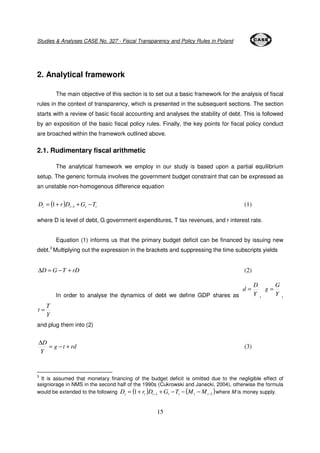
t ( ) t t t D = + r D +G −T −1 1 (1) 
where D is level of debt, G government expenditures, T tax revenues, and r interest rate. 
Equation (1) informs us that the primary budget deficit can be financed by issuing new 
debt.3 Multiplying out the expression in the brackets and suppressing the time subscripts yields 
DD = G −T + rD (2) 
D 
d = 
In order to analyse the dynamics of debt we define GDP shares as Y 
G 
g = 
, Y 
, 
T 
Y 
t = 
and plug them into (2) 
g t rd 
D 
Y 
= − + 
D 
(3) 
3 It is assumed that monetary financing of the budget deficit is omitted due to the negligible effect of 
seigniorage in NMS in the second half of the 1990s (Cukrowski and Janecki, 2004), otherwise the formula 
would be extended to the following ( ) ( ) 1 1 1 − − = + + − − − t t t t t t t D r D G T M M where M is money supply.
Studies & Analyses CASE No. 327 - Fiscal Transparency and Policy Rules in Poland 
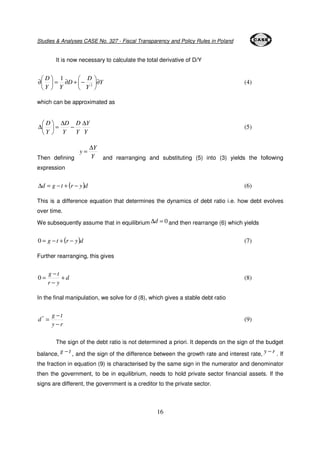
It is now necessary to calculate the total derivative of D/Y 
 
D (5) 
0 = (8) 
= * (9) 
16 
Y 
D 
Y 
 
 
= ¶ D 
+ − D 
Y Y 
 
¶  
 
 
 
¶ 
 
2 
1 
(4) 
which can be approximated as 
 
D D 
Y 
Y 
D 
Y 
D 
Y 
Y 
− 
D 
=  
 
D 
= 
Y 
y 
Then defining Y 
and rearranging and substituting (5) into (3) yields the following 
expression 
Dd = g −t + (r − y)d (6) 
This is a difference equation that determines the dynamics of debt ratio i.e. how debt evolves 
over time. 
We subsequently assume that in equilibriumDd = 0 and then rearrange (6) which yields 
0 = g − t + (r − y)d (7) 
Further rearranging, this gives 
d 
− 
g t 
r y 
+ 
− 
In the final manipulation, we solve for d (8), which gives a stable debt ratio 
− 
g t 
y r 
d 
− 
The sign of the debt ratio is not determined a priori. It depends on the sign of the budget 
balance, g t − 
, and the sign of the difference between the growth rate and interest rate, y − r . If 
the fraction in equation (9) is characterised by the same sign in the numerator and denominator 
then the government, to be in equilibrium, needs to hold private sector financial assets. If the 
signs are different, the government is a creditor to the private sector.
Studies & Analyses CASE No. 327 - Fiscal Transparency and Policy Rules in Poland 
£ (11) 
17 
2.2. Basic fiscal rules 
The previous subsection presents government budget constraints and derives a debt 
ratio ensuring stability. It is important to discuss the conditions that have to be satisfied in order 
to keep debt stable. We follow Carlin and Soskice (2005) in formulating a setting for fiscal rules 
based on a partial equilibrium framework.4 
The government budget constraints in terms of ratios to GDP can be recalled from 
equation (6). 
Dd = g −t + (r − y)d (10) 
This expression shows that the accumulation of debt is shaped by a primary deficit and 
the difference between interest rates and economic growth. Under these conditions the stability 
of debt can be achieved at any ratio, therefore we stick to the Maastricht criterion requiring the 
debt ratio not to exceed 60 percent of GDP.5 If we want to prevent the debt ratio from increasing, 
the solvency condition has to be met i.e. d £ 0 . This allows us to formulate the following 
expression 
− 
t g 
r y 
d 
− 
where bars denote long-term values. Assuming a certain path of expenditures the question of 
financing arises. Recalling the equation (10) and the solvency condition gives 
t ³ g + (r − y)d (12) 
Subsequently, setting government revenues from taxes at the long-term level 
* t and equating 
this to equation (12) yields a fiscal rule. 
Dd £ (g − g )+ [(r − r )− (y − y)]d (13) 
We can interpret as follows: that a government wanting to increase its expenditures over 
long-term values can temporarily do so by borrowing. The rule implies, however, that if the 
4 Analysis based on the general equilibrium framework can be found, inter alia, in studies by Buiter (2001), 
Buiter and Grafe (2003), and Annicchiarico and Giammarioli (2004). 
5 It is to a large extent an arbitrary number, but since we want to analyse the case of Poland this is a 
binding constraint.
Studies & Analyses CASE No. 327 - Fiscal Transparency and Policy Rules in Poland 
interest rate is higher than its long-term values over the temporary horizon or if economic growth 
is lower than its long-term values then the debt is allowed to increase. This is because the rule 
allows for an increase in the budget deficit, which in turn leads to debt accumulation. On the 
other hand, if the government increases expenditures permanently then this should be 
accompanied by an increase in taxes. 
18 
2.3. Discussion 
In order to work appropriately the fiscal rule presented above has to be supplemented by 
a high degree of transparency in fiscal policy with respect to predictions for interest rates and 
economic growth. The importance of transparency is also emphasised by Carlin and Soskice 
(2004). In addition, the medium-term macroeconomic framework to be pursued by the 
government and unveiled to the general public is another precondition because variables such 
as inflation and exchange rates can also be included as government budget constraints. This 
would allow one to assess the consistency of assumed fiscal policy in the broader context of 
macroeconomic policy. 
3. Fiscal transparency and rules in Poland 
3.1. Fiscal policy in Poland over the transition period 
Robust economic growth in the first years of Poland’s post-communist transition made it 
possible to maintain a balanced budget at a relatively safe level. During the 1990’s the central 
government deficit was reduced from 6.5% of GDP (1991-1992) to about 3% of GDP 
between1993-1996 and to 2% of GDP subsequently. Public debt was also reduced, from about 
90% of GDP in 1990.6 In the first years of the transition the Paris and London Clubs agreed to 
write off a significant part of Poland’s foreign debt. This operation also resulted in Poland 
regaining the credit capacity it had lost at the end of the 1970’s, when the communist 
government refused to servicing its excessive debt. 
Poland’s fiscal policy stance started to deteriorate in 1999. The general government 
deficit increased to 3% of GDP, despite a decrease in the central government deficit, due to 
growing lending by off-budget institutions. This took place after the implementation of four key 
6 Foreign debt was incurred in the 1970’s when successive communist governments borrowed to finance 
unsuccessful manufacturing sector reforms.
Studies & Analyses CASE No. 327 - Fiscal Transparency and Policy Rules in Poland 
reforms of public sector institutions (i.e. the pension system, health service, local administration 
and education). Low economic growth between 2001 and 2002 resulted in a further deterioration 
in the fiscal position. In the pre-accession period Poland was also one of the central and eastern 
European countries to relax its fiscal policy. Consequently, between 2000 and 2004 the general 
government deficit increased from 3.0% to 6.3% of GDP. This was accompanied by a drop in 
privatisation revenues, which tend to be used as an alternative to Treasury securities as a 
means of covering public sector borrowing requirements. This caused a significant acceleration 
of public debt from 2002 onwards. In 2003 public debt exceed the first threshold laid out in the 
Act on Public Finance (a ratio of 50% debt-to-GDP), and in 2004 stabilised slightly below the 
second threshold (55% debt-to-GDP). 
There is a wide range of factors explaining such considerable fiscal deterioration 
between 1999 and 2004. The unfavourable fiscal performance may in large part be attributable 
to delayed costs of the reforms undertaken earlier in the 1990’s. Other factors were also the 
electoral cycle and economic slowdown. Additionally, a cross-European country comparison 
shows that fiscal policy was relaxed across the Central European new member states, whereas 
the Baltic countries improved their fiscal stance. The fiscal performance of central European 
countries can be treated as the outcome in many ways of deliberate political-economic 
decisions, which are in turn largely dependent on the expected benefits to be derived from a 
tighter or looser fiscal stance.7 
At the beginning of the 1990’s Poland underwent significant structural reforms with the 
implementation of market economic rules. This was manifested in acceleration of economic 
restructuring and a significant decrease in employment, amongst other things. The social costs 
of these reforms were partially offset by easy access to a wide range of social transfers. This, 
combined with widening indexation of budget spending, resulted in a significant increase in the 
structural deficit of the Polish budget. Consequently, economic slowdown, which started in 2000, 
revealed the structural problems inherent in Poland’s public finances. It should also be noted 
that the reforms of the Polish public sector were significantly delayed compared to the wider 
economic restructuring process. Thus, the poor condition of public institutions in fact reinforced 
the underlying problems of the Polish budget in the years of economic slowdown. In 1999 the 
Polish government implemented key public sector reforms, but this added to the deteriorating 
condition of the country’s public finance due to the high initial costs of the changes. Its positive 
aspects will only be visible in the longer term (for example reforms of the pension system). 
19 
7 see Berger et al. (2004)
Studies & Analyses CASE No. 327 - Fiscal Transparency and Policy Rules in Poland 
Another key factor explaining the significant deterioration in public finances since the 
1990’s is Poland’s electoral cycle. The 2001 elections and the political competition that preceded 
it in effect forced the government to prepare a budget that significantly increased spending, 
including in certain legally statutory areas and based on rather unrealistically favourable 
macroeconomic assumptions. Since 2001 the budget structure has changed and the earlier 
balance between current spending and revenues abandoned. In 2001 the net lending of the 
general government exceeded capital spending, which meant that government had to start 
borrowing to cover its current spending. 
Political constrains also reduced the possibility of implementing radical spending reforms 
in the subsequent annual budgets. In 2004, the government came up with the so-called 
‘Hausner (austerity) plan’8, but parliament watered down many of its expenditure cutting 
legislation, thus reducing any of the positive financial results that might have arisen from it. 
The macroeconomic environment has also had a strong impact on fiscal performance, 
with the pace of economic growth and level of inflation determining the tax base and thus, in 
turn, general government revenues. Due to the cyclical character of revenues the flexibility of 
expenditures is obliged to maintain the budget deficit at a sustainable level even in years of 
economic slowdown. The significant share of fixed expenditures in Poland’s central budget 
further reinforced the deterioration in the fiscal stance between 2001-2002. 
In both pre- and post accession periods Poland failed to significantly tighten its fiscal 
policy. In 2004, Poland was one of six new member countries exceeding the SGP pact limit for 
the general government deficit. The first year of EU membership, which imposed an external 
anchor on the fiscal policies of the new member countries, appears not to have been effective 
stimuli to fiscal tightening, yet at least. The lack of fiscal consolidation can partially be attributed 
to the high cost of accession. Kopits and Szekely (2004) estimate that unless the new accession 
countries undertake major fiscal reforms the average direct budgetary cost of EU entry will widen 
the budget deficit by 3-4.75% of GDP. Furthermore, the stronger bargaining position of the new 
member countries may be seen as an incentive to deviate from convergence towards the 
Maastricht criteria. As an additional factor explaining Poland’s low propensity to tighten its fiscal 
stance after accession one can also note the dilution of sanctions for failures to converge to the 
deficit reference values. This is combined with a decrease in the role played by the SGP after 
8 The Hausner plan proposed spending cuts in the area of social appraisal and administrative costs. It also sought to 
increase public sector revenues by widening the tax base. The financial results of program were initially estimated at 
PLN 50 bn, but the majority of them would not be visible until after the 2005 election. 
20
Studies & Analyses CASE No. 327 - Fiscal Transparency and Policy Rules in Poland 
unsuccessful attempts to impose economic sanctions on those EU member countries whose 
general government deficits are above the SGP threshold.9 
21 
3.2. Transparency 
In the 1990’s Poland experienced considerable improvement in its fiscal transparency. 
Two important developments bringing the conduct of policy closer to international standards of 
transparency were: the implementation of a modern budgeting process and clarifying the 
boundaries of the public sector. Since 1998 fiscal management has been based on the Act on 
Public Finances, which comprehensively defines the responsibilities and activities of the 
government. Implementation of the act enforces codified budgets and a far more stringent 
reporting process. It defines the use of budgetary reserves and provides for the imposition of 
sanctions for non-compliance10. Finally, the act classifies all public sector units and outlines 
financial management standards, as well as clarification of borrowing authority. 
The reforms undertaken in the 1990’s by other transition countries in the region were 
more advanced. This placed the conduct of Poland’s fiscal policy far behind the transparent 
practices of most of the other new EU members. Considerable improvement in terms of 
transparency practices were made in the pre-accession period due to the obligation to 
implement accountability standards as a condition for obtaining EU funds, as well as the 
implementation of more effective management to meet fiscal goals. 
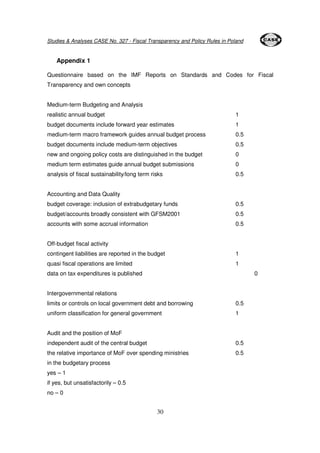
The following assessment of fiscal transparency is based on the questionnaire proposed 
by Allan and Perry. The questionnaire was constructed by modifying the IMF’s observance 
standards in order to highlight four areas that have particular significance for EU accession 
countries: (i) establishing a medium-term budget framework (MTBF); (ii) comprehensive 
coverage of non-budgetary activities; (iii) effective accounting, reporting and oversight; and (iv) 
strengthening intergovernmental relations. The authors also added point (v), which is concerned 
with audit functions and the MoF’s role and powers in the budgetary process. The index is 
included in the Appendix 1 to this work. 
As for the first of the above mentioned areas, transparency monitoring, one should note 
that Poland still has a deficiency in the budgeting process. This differentiates it significantly from 
the standards of an efficient medium-term budget framework. One of the most important 
weaknesses of the Polish budgeting process is the yearly outlook of its planning. This is contrary 
9 A detailed discussion can be found in Berger et al. (2004) 
10 IMF, Report of Observance of Standards and Codes (2001)
Studies & Analyses CASE No. 327 - Fiscal Transparency and Policy Rules in Poland 
to IMF recommendation, which propose the use of a medium-term framework or fiscal strategy 
to guide annual budget submissions. A yearly outlook does not allow any effectively links to be 
made nor credibly budgeting planning with medium-term fiscal policy goals, connected for 
example with EU obligations. Additionally, budget planning should be strictly based on medium-term 
macroeconomic projections. This makes decision-makers aware of revenue shortages 
connected with the economic cycle and thus allows them to control unrealistic budget bids. 
Poland’s budgeting process is based on macroeconomic projections. But since they cover only a 
single year this makes any proper evaluation of medium term macroeconomic risk connected, 
for example, with cyclical fluctuation of output, difficult. Both the above mentioned problems (lack 
of long term fiscal objectives in the yearly budget and insufficient impact of medium term 
macroeconomic estimates on the budget) would suggest that the budgeting process in Poland is 
still more affected by short-term policy aims than medium term objectives (for example fiscal 
targets connected with accession to the EMU). Consequently, the budget act outlines medium 
term goals only in general terms. The Polish budgeting process does not meet another feature 
of the MTBF, namely failing to make distinctions between new and ongoing policy costs. This 
undermines the establishment of accountability standards. On the positive side, there has been 
an increase in budgetary realism in recent years and periodically performed fiscal sustainability 
and long term risk analysis. 
In the second area of transparency monitoring, i.e. effective accounting, reporting and 
oversight, Poland‘s performance continues to improve. The defragmentation of the Polish public 
sector is still significant, although in recent years considerable attempts to consolidate the sector 
have been undertaken. A few state agencies have been liquidated and other state offices 
consolidated into the government. Moreover, since 2004 a significant share of special funds 
have been included in the central budget. The MoF has started to move from a cash-based 
accounting classification (GFSM-1996) to an accrual-based system (GFSM-2001). The GFSM- 
2001 system is consistent with the ESA-95 format, which became the main fiscal indicator after 
accession. 
In the third area of fiscal transparency, i.e. comprehensive coverage of non-budgetary 
activities, Poland has seen noticeable improvement. The MoF now includes in the yearly budget 
contingent liabilities and aims to limit quasi-fiscal activities (excluding still used government-held 
shares to recapitalize state-owned enterprises). However, on the negative side, to deteriorating 
fiscal transparency should be added difficulties with access to information on tax expenditures, 
which are generally released on a rather ad hoc basis and thus rarely properly or fully 
scrutinised. 
22
Studies & Analyses CASE No. 327 - Fiscal Transparency and Policy Rules in Poland 
In the fourth area, i.e. intergovernmental relations, it should be noted that the MoF has 
implemented a new classification of revenues, expenditures and foreign sources of financing, 
compatible with European regulations. Apart from developing an IT system of reporting for local 
government, this improves transparency standards in the area of intergovernmental relations. 
The last problem point in the fiscal transparency questionnaire covers audit functions and 
the position of the MoF in the budgeting process. In the Polish public sector there exist 
institutions liable to external and internal audit. At the central government level external audits 
are performed by the Supreme Chamber of Control (NIK). NIK inspects the accounts of central 
government and non-budget funds. It examines financial compliance with budgetary legislation. 
It should be noted that the institution is politically independent, which increases its credibility and 
its function. At the local government level external audit functions are performed by both NIK 
and regional clearing chambers. Inspections are effective, although there are some problems 
with execution of irregularities. The internal audit at both central and local government levels is 
provided by a systematically developing service. The internal audit programme was started in 
2001 and the authorities have systematically increased the number of certified auditors and 
consequently control units cover an increasing number of public sector entities. 
The MoF has a dominant position in the central government budgeting process. The 
majority of public entities estimate their budgets based on expenditures limits, which they pass 
on to the MoF. Limits are based on total revenue projection and deficit limits to finance them. 
The impact of deficits on debt dynamics has been analysed especially in recent years when the 
risk of exceeding the constitutionally inscribed debt limit has increased. The impact of the MoF 
on the budgeting process also depends to a certain extent on public sector centralisation. In 
2004, a new law on public entities finance was passed, significantly increasing local government 
contributions to general government spending. However, local government are bound by fiscal 
rules that are more restrictive than for the central government. 
23 
3.3. Fiscal policy rules 
The case of Poland provides impressive examples of fiscal policy rules. The Polish 
constitution and Act on Public Finances impose debt and deficit rules. There are also examples 
of similar boundaries connected with external (European) obligations imposed on Poland. Some 
expenditure rules have also been introduced at hoc by the minister of finance (known as the 
‘Belka rule’).
Studies & Analyses CASE No. 327 - Fiscal Transparency and Policy Rules in Poland 
24 
3.3.1. Public debt rules 
Debt rules are the most rigid and effective. The first of them is the constitutional limit on 
public debt, including warranties and guarantees, stipulating it cannot exceed 60% of GDP. 
However, the constitution does not contain a definition of public debt and refers to the Act on 
Public Finances. This gives plenty of room for interpretation in defining debt and can be seen as 
its main drawback. The second debt rule (in fact a group of rules) is included in the Act on Public 
Finances. This regulation binds the government to stay within three public debt thresholds. 
These are set to halt increases in borrowing restrictions for central and local governments when 
the public debt to GDP ratio exceeds them. The first limit is set at a ratio of 50% debt-to-GDP. 
Exceeding this level obliges central government to maintain a budget deficit-to-revenue ratio in 
the next year at the same level as in the year before. The same applies to local government. If 
public debt exceeds 55% of GDP the government is obliged to prepare the next year’s budget to 
be in balance, which necessarily lowers the government’s debt-to-GDP ratio. Moreover 
government is also obliged to present to parliament its fiscal consolidation program aimed at 
decreasing the public debt-to-GDP ratio. The thresholds for local government deficits have also 
been tightened. The last threshold is equal the constitutional limit for public debt (60% of GDP). 
The third debt limit is also compatible with Maastricht criteria. If public debt reaches or exceeds 
such a level, the next year’s budget for central and local governments must be balanced. 
Additionally, warranties and guarantees granted by public sector units is prohibited. The 
government is also obliged to present to parliament a fiscal consolidation program aimed at 
reducing the public debt-to-GDP ratio. 
If debt exceeds the first threshold it has rather limited consequences for fiscal policy. An 
increase of debt above 55% of GDP, which to some extent would force the government to 
balance central budget, would have a wider impact on central and local budgets. One of the 
main disadvantages of debt rules is the two-year delay between the date of breaching the debt 
limit and the obligation to implement a remedy. This is because official estimates of debt for year 
t are available in the second quarter of t+1 years. 
3.3.2. Deficit rules 
The Polish constitution contains a clause that the central government budget deficit 
cannot be changed without parliamentary approval. Consequently, the government tends to
Studies & Analyses CASE No. 327 - Fiscal Transparency and Policy Rules in Poland 
prepare a rather cautious forecast of revenues and expenditures in its budget projections. The 
government has also sometimes been forced to recourse to creative accounting procedures or 
allow excessive lending by non-budget institutions to reach previously envisaged deficit levels. 
This has usually taken place if the performance of revenues has been worse than assumed and 
stems largely from the high share of fixed expenditure in the budget. 
After its accession to the EU Poland has had to comply with SGP restrictions on its fiscal 
deficit. The pact states that the general government deficit cannot exceed 3% of GDP. If this 
level is breached members are supposed to be subject to excessive deficit procedures. 
Moreover, the threshold of 3% of GDP is also one of the convergence criteria and consequently 
appears as long term fiscal goal, given recent declarations made by the Polish authorities of 
their intention to enter EMU as quickly as possible. 
25 
3.3.3. Expenditure rules 
Fiscal policy in Poland in recent years also provides a good example of expenditure 
rules. In 2002, the then minister of finance Belka announced that the following year’s budgets 
would be prepared based on the assumption that central government expenditures would not 
increase by more than 1% above inflation. This set the path of fiscal policy in the subsequent 
years and was appreciated by the central bank and financial markets. However, the advantages 
of this rule strongly depend on its credibility. The experience of recent years shows that the rule 
has been less obligatory and its enforcement largely abandoned by post-Belka ministers. 
Moreover, the rule only covers the central government deficit, which does not guarantee any 
decrease in the general government deficit due to a possible recourse to increase of excessive 
lending by off-budget units. 
3.4. Discussion 
Over the last few years Poland has made significant progress in putting fiscal 
transparency into practice. However, the most challenging areas for achieving IMF and the EU 
standards remain medium-term budgeting as well as accounting and data quality. 
The most important benefits in terms of transparency of policy in Poland would be 
improvement of the fiscal management process, which would be especially beneficial on the 
convergence path. One of the most widely recommended changes in fiscal policy should be 
implementation of a medium term budgeting framework, which would provide compatibility
Studies & Analyses CASE No. 327 - Fiscal Transparency and Policy Rules in Poland 
between the budgeting process and medium term fiscal goals (for example, included in the 
convergence reports). This would reinforce government attempts to meet fiscal convergence 
criteria and thus also increase credibility. Moreover, budget planning based on medium term 
macroeconomic projections would increase public finance stability if macroeconomic risk was 
included. 
Due to decentralisation of government activities, mainly by increasing the share of local 
budgets in the general government sector, compatible accounting and reporting systems should 
be established in order to effectively monitor fiscal risk and analyse sustainability. Moreover, 
establishing a new law on local government revenues increases local entities’ flexibility and 
responsibility in the spending policy. Essential knowledge in the sphere of budgeting should be 
transferred to local governments in order to avoid fiscal problems similar to those central 
government has experienced, when the first cyclical slowdown took place between 2001 and 
2002. 
The fiscal rules presented in this paper distinguish Poland positively among central 
European countries in terms of protection from fiscal expansion. The most rigid are debt rules, 
which reduce risks of excessive borrowing and uncontrolled increases in debt servicing, which 
would result in constraining public spending or default. Debt rules constitute the ultimate limit for 
government borrowing, which become active when debt reaches a ceiling. Deficit rules should 
be treated as a current constraint for fiscal policy. On the one hand, over-rigid deficit rules in 
transition countries would cause additional turbulence for policy making due to high volatility of 
output. On the other hand, deficit rules, which are valid in Poland, do not guarantee essential 
and effective motivation for the government to maintain a healthy public stance. Regarding rules 
binding local government one should note that they are strictly more rigid than for central 
government. This could also lead to recourse to creative accounting by local government and 
this would suggest that internal and external audits, as well as implementation of comparable 
accounting and reporting methods, should be implemented. 
26 
4. A proposal 
Fiscal policy targets that have to be achieved to fulfil fiscal convergence criteria have not 
yet been met in Poland. Although the implementation of rules has substantially bound fiscal 
policy to operate within the environment supporting necessary fiscal adjustment there seems to 
be much scope for further improvements. According to analysis by Allan and Perry (2003), as 
well as this study, the current stance and progress in fiscal transparency in Poland is not 
adequate to the needs and requirements set by the EU and the IMF. Therefore, we propose the
Studies & Analyses CASE No. 327 - Fiscal Transparency and Policy Rules in Poland 
formulation of an institutional framework to enhance the efficiency of transparency and fiscal 
rules in Poland. This in turn should result in superior fiscal performance over the longer-term. 
The conclusion considering the case of Poland against the background of fiscal 
sustainability poses the question as to whether the introduction of an Independent Fiscal 
Authority (IFA) as proposed by Ball (1997) and Gruen (1997) might be a remedy for fiscal 
prudence. This is of course the most extreme solution to the problem, but would leave the 
responsibility to the experts rather than to politics. On the other hand the sustainability of fiscal 
deficits ultimately depends on the level of debt accepted by voters. These might be in favour of a 
suspension of the fiscal rule, which would lead to the delay in the admission to the EMU, and 
most likely a damaged reputation. 
In our view, an intermediate step would be the full use of the prerogatives held by the 
NIK. This institution is entitled to inspect all central government accounts and non-budgetary 
funds and has the right to examine financial compliance with budgetary legislation. At the local 
government level audit functions are conducted by both the NIK and regional clearing chambers. 
One should note that the institution was granted full independence in 1994 and has since proved 
to be highly successful in examining public finances. The remaining problem in terms of 
operational issues is the execution of irregularities, if and when found. The broad scope for 
NIK’s inspection measures should be supplemented by legislation that would allow examinations 
of public sector institutions also with respect to international transparency standards. The 
institution should have the right to impose financial fines on public sector entities for not 
complying with the approved regulations. This could prevent politicians from employing creative 
accounting strategies in order to satisfy the Maastricht criteria as it was the case in Greece, Italy, 
and France (Easterly, 1999). 
27 
5. Concluding remarks 
The issue of fiscal transparency has been theoretically examined in the literature, 
suggesting that a higher degree of transparency is fundamentally associated with potential 
benefits in terms of greater fiscal discipline and more accountable fiscal policy. Other benefits 
are related to the reduction of uncertainty over the conduct of fiscal policy, as well as to earlier 
and smoother fiscal policy responses to shocks hitting the economy. Empirical results tend to 
confirm a positive impact of transparency on fiscal performance in developed countries. 
Transparency can be a powerful supplementary tool when setting and subsequently 
executing fiscal rules that are primarily introduced to gain credibility. This seems to be 
particularly important for countries that would like to inject or restore credibility when initialising a
Studies & Analyses CASE No. 327 - Fiscal Transparency and Policy Rules in Poland 
reform package or following a crisis. An optimal solution to adopting fiscal rules seems to be 
cyclically-adjusted deficits, along with both a ceiling and path for debt that would be 
accompanied by a ceiling for expenditures. Although the concept of a cyclically-adjusted deficit 
seems to be very relevant (the one allowing automatic stabilisers to work), certain technical 
difficulties with appropriate evaluation do arise. Empirical results are generally in favour of fiscal 
rules. However, in order to fully benefit from rules fiscal policy has to be transparent, as this 
obliges policymakers to become more accountable. The issue of accountability can act as an 
important tool for policymakers to pursue a disciplined fiscal policy. 
Although substantial improvements have been made in Poland with respect to fiscal 
transparency standards set by the EU and other international organisations there is still much 
scope for enhancement. The element of fiscal transparency that should be made significantly 
better is broadly defined improvement in the fiscal management process. The recommended 
change in fiscal policy would involve the implementation of medium-term budgetary framework 
that would ensure consistency between the budgetary process and medium-term fiscal goals. 
This would in turn reinforce the government’s attempt to satisfy fiscal convergence criteria and 
consequently increase its credibility in the financial markets. Furthermore, budgetary planning 
based upon medium-term macroeconomic projections would enhance the stability of public 
finance if macroeconomic risks were included. Another important issue is the compatible 
accounting and reporting system at both national and intra-national level that should be 
established in order to monitor fiscal risk effectively and analyse sustainability. Yet another 
change to implement would be to transfer know-how on budgetary issues from central 
government to local governments. 
The applied fiscal rules distinguish Poland positively from other central European 
countries in terms of protection from fiscal expansion. The most rigid of them is the debt rule, 
although it can be argued that it has prevented Poland from excessive borrowing and an 
uncontrolled increase in debt. The deficit rule could induce some higher volatility of output, 
although fiscal policy with respect to the targeted deficit has not been particularly successful in 
recent years. The rule does not guarantee essential and effective motivation for the government 
to maintain sustainable public finances. The expenditure rule was introduced for just a short 
period of time, therefore it is not possible to assess its efficiency. In our view, however, the rule 
should be reintroduced to strengthen fiscal discipline, as it could force policymakers to tighten 
fiscal policy. It seems to be indispensable to maintain fiscal rules at the local government level. 
Although they are even more rigid than the central government by the issue of creative 
accounting arises in this context. 
28
Studies & Analyses CASE No. 327 - Fiscal Transparency and Policy Rules in Poland 
The issue of still limited fiscal transparency and unsatisfactory performance of fiscal rules 
requires the undertaking of various appropriate measures to strengthen the fiscal policy 
framework in Poland. This can be done in our view by involving external institution entitled to 
examine fiscal transparency and the performance of fiscal rules thoroughly more in the 
budgetary process. We think that the institution that is fully capable to take the lead in this 
respect is the NIK, which was granted full independence in 1994 and has since proved to highly 
successful in overseeing public finances. This should, however, be accompanied by 
simultaneous enhancement of the internal audit. 
29
Studies & Analyses CASE No. 327 - Fiscal Transparency and Policy Rules in Poland 
30 
Appendix 1 
Questionnaire based on the IMF Reports on Standards and Codes for Fiscal 
Transparency and own concepts 
Medium-term Budgeting and Analysis 
realistic annual budget 1 
budget documents include forward year estimates 1 
medium-term macro framework guides annual budget process 0.5 
budget documents include medium-term objectives 0.5 
new and ongoing policy costs are distinguished in the budget 0 
medium term estimates guide annual budget submissions 0 
analysis of fiscal sustainability/long term risks 0.5 
Accounting and Data Quality 
budget coverage: inclusion of extrabudgetary funds 0.5 
budget/accounts broadly consistent with GFSM2001 0.5 
accounts with some accrual information 0.5 
Off-budget fiscal activity 
contingent liabilities are reported in the budget 1 
quasi fiscal operations are limited 1 
data on tax expenditures is published 0 
Intergovernmental relations 
limits or controls on local government debt and borrowing 0.5 
uniform classification for general government 1 
Audit and the position of MoF 
independent audit of the central budget 0.5 
the relative importance of MoF over spending ministries 0.5 
in the budgetary process 
yes – 1 
if yes, but unsatisfactorily – 0.5 
no – 0
Studies & Analyses CASE No. 327 - Fiscal Transparency and Policy Rules in Poland 
31 
Bibliography: 
Alesina, A. and T. Bayoumi (1996) “The Costs and Benefits of Fiscal Rules: Evidence 
from U.S. States”, NBER Working Paper, No. 5614. 
Alesina, A., R. Hausmann, R. Hommes, and E. Stein (1999) “Budget 
Institutions and Fiscal Performance in Latin America.” Journal of Development 
Economics 59, pp. 233-253. 
Alesina, A. and R. Perotti (1999) “Budget Deficits and Budget Institutions,” in J. M. 
Poterba and J. von Hagen (eds.) Fiscal Institutions and Fiscal Performance, University 
of Chicago Press. 
Alesina, A. and R. Perotti (1996) “Fiscal Discipline and the Budget Process.” 
American Economic Review 86, pp. 401-407. 
Alesina, A., and G. Tabellini (1990) “A Positive Theory of Budget Deficits and 
Government Debt.” Review of Economic Studies 57, pp. 403-414. 
Allan W. and T. Perry (2003) “Fiscal Transparency in EU Accession Countries”, IMF 
Working Paper, WP03/163 
Allen, R., Schiavo-Campo, S., Columkill Garrity, T. (2004) “Assessing and Reforming 
Public Management – A new approach”, The World Bank, Washington 
Alt, J., D. Lassen and D. Skilling (2002) “Fiscal Transparency, Gubernatorial 
Popularity, and the Scale of Government: Evidence from the States,” State Politics and 
Policy Quarterly 2, pp. 230-250. 
Alt J. and D. Lassen, (2003) “Fiscal Transparency, Political Parties, and Debt in OECD 
Countries”, mimeo, December 
Annicchiarico, B. and Giammarioli, N. (2004) “Fiscal Rules and Sustainability of 
Public Finances in an Endogenous Growth Model”, ECB Working Paper No. 381, August 
Arreaza, A., B. Sørensen and O. Yosha (1999) “Consumption smoothing through 
Fiscal Policy in OECD and EU Countries”, in J.M. Poterba and J. von Hagen (eds.), 
Fiscal Institutions and Fiscal Performance, Chicago, The University of Chicago Press, 
pp. 59-80. 
Ball, L., (1997) “A Proposal for the Next Macroeconomic Reform” Victoria Economic 
Commentaries, Vol. 14, No. 1, pp.1-7. 
Barro, R. (1979) “On the Determination of the Public Debt”, Journal of Political 
Economy, Vol. 87, No. 5, pp. 940-71. 
Bayoumi, T. and B. Eichengreen (1994) “The Political Economy of Fiscal Restrictions: 
Implications for Europe from the United States”, European Economic Review, Vol. 38, 
No. 3-4, pp. 783-91.
Studies & Analyses CASE No. 327 - Fiscal Transparency and Policy Rules in Poland 
Bayoumi, T. and B. Eichengreen (1995) “Restraining Yourself: The Implications of 
Fiscal Rules for Economic Stabilization”, IMF Staff Papers, Vol. 42, No.1, pp. 32-48. 
Berger, H., G. Kopits, I. Szekely (2004) “Fiscal Indulgence in Central Europe: Loss of 
the External Anchor?”, IMF Working Paper, WP04/62 
Bohn, H. and R. Inman (1996) “Balanced-Budget Rules and Public Deficits: Evidence 
from the U.S. States”, Carnegie-Rochester Conference Series on Public Policy, Vol. 45, 
No. 1-4, pp. 13-76. 
Buiter, W. (2001) ‘Notes on “A Code for Fiscal Stability” ’, Oxford Economic Papers, 
53(1), pp. 1–19. 
Buiter, W., C. Grafe (2004) Patching up the Pact Suggestions for enhancing fiscals 
unsustainability and macroeconomic stability in an enlarged European Union, 
Economics of Transition, Vol. 12 (1) 2004, 67–102 
Carlin, W. and D. Soskice (2005) "Macroeconomics: Rigidities, 
Institutions, and Politics", Oxford University Press 
Chamley, C. (1986) “Optimal Taxation of Capital Income in General Equilibrium with 
Infinite Lives”, Econometrica, Vol. 54, No. 3, pp. 607-22. 
Corsetti, G. and N. Roubini (1996) “European versus American Perspectives on 
Balanced-Budget Rules”, American Economic Review, pp. 408-13. 
Cukrowski, J. and J. Janecki (2005) “Generation of Seigniorage Wealth Before and 
After Euro Area Accession: Case of Poland”, in P. Jaworski and T. Mickiewicz (eds.) 
Public Finance and Foreign Direct Investment in the Wider EU, UCL, London 
Diamond, P. (1965) “National Debt in a Neoclassical Growth Model”, American 
Economic Review, 55(5), pp. 1126-150 
de Haan, J., W. Moessen, and B. Volkerink (1999) “Budgetary Procedures – Aspects 
and Changes: New Evidence for Some European Countries,” in J. Poterba and J. von 
Hagen (eds.) Fiscal Institutions and Fiscal Performance, University of Chicago Press. 
Guerrero J. P. and H. Hofbauer (2001) “Index of Budget Transparency in Five Latin 
American Coutries: Argentina, Brazil, Chile, Mexico, and Peru”, International Budget 
Project. 
Gruen, N., (1997), “Making Fiscal Policy Flexibly Independent from Government”, 
Agenda, Vol. 4, No. 3 pp. 297-307. 
Easterly, W. (1999) “When is Fiscal Adjustment an Illusion?” Economic Policy April, pp. 
57-76. 
Ferejohn, J. (1999) “Accountability and Authority: Towards a Model of Political 
Accountability,” in A. Przeworski, B. Manin and S. C. Stokes (eds.), Democracy, 
Accountability, and Representation, New York: Cambridge University Press. 
32
Studies & Analyses CASE No. 327 - Fiscal Transparency and Policy Rules in Poland 
von Hagen, J. (1992) “Budgeting Procedures and Fiscal Performance in the European 
Community.” EEC Economic Papers 9 
Hall, P., and R. Taylor (1996) “Political Science and the Three New Institutionalisms” 
Political Studies, pp. 936-957. 
Hallerberg, M. and J. von Hagen (1997) “Electoral Institutions, Cabinet Negotiations, 
and Budget Deficits within the European Union.” CEPR Discussion Paper 1555. 
Hallerberg, M. and J. von Hagen (1999) “Electoral Institutions, Cabinet Negotiations, 
and Budget Deficits in the European Union”, in J. Poterba and J. von Hagen (eds.), 
Fiscal Institutions and Fiscal Performance, Chicago, The University of Chicago Press, 
pp. 209-32. 
Hallerberg, M., L. Vinhas de Souza, and W. Clark (2002) “Political Business Cycles in 
EU Accession Countries.” European Union Politics 3(2), pp. 231-50 
Hemming R. and M. Kell (2001)”Promoting Fiscal responsibility: transparency, rules 
and Independent Fiscal Authorities”, in: Fiscal Rules: Papers Presented at the Bank of 
Italy Workshop Held in Perugia, 1-3 February 2001 
IMF (1998) Codes of Good Practices on Fiscal Transparency 
33 
IMF (1998) IMF Survey 
IMF (2001) Republic of Poland: Report on Observance of Standards and Codes – Fiscal 
Transparency module 
IMF (2001) Government Finance Statistics Manual 
IMF (2003) Republic of Poland: Report on Observance of Standards and Codes – Fiscal 
Transparency module – update 
IMF (2004) Republic of Poland: Report on Observance of Standards and Codes – Fiscal 
Transparency module – update 
Judd, K. (1985) “Redistributive Taxation in a Simple Perfect Foresight Model”, Journal 
of Public Economics, Vol. 28, No. 1, pp. 59-83. 
Kennedy, S., J. Robbins, F. Delorme (2001) “The Role of Fiscal Rules in Determining 
Fiscal Performance”, in Balassone, F. and Franco, D., (eds), Fiscal Rules, Research 
Department Public Finance Workshop, Banca d’Italia 
Kopits, G. (2001) “Fiscal Rules: Useful Policy Framework or Unnecessary Ornament?”, 
in Balassone, F. and Franco, D., (eds), Fiscal Rules, Research Department Public 
Finance Workshop, Banca d’Italia 
Kopits, G., and J. Craig (1998) “Transparency in Government Operations,” IMF 
Occasional Paper 158.
Studies & Analyses CASE No. 327 - Fiscal Transparency and Policy Rules in Poland 
Kopits, G. and S. Symansky (1998) “Fiscal Policy Rules”, International Monetary Fund, 
Occasional Paper, No. 162. 
Kopits, G. and I. Szekely (2002) “Fiscal Policy Challenges of EU Accession for Central 
European Economies”, a paper presented at the conference organised by the Austrian 
National Bank, Vienna, November 3-5 
Langenus, G. (2001) “Comment” in Balassone, F. and Franco, D., (eds), Fiscal Rules, 
Research Department Public Finance Workshop, Banca d’Italia 
Laver, M. and W. B. Hunt (1992) Policy and Party Competition. New York: Routledge. 
Levinson, A. (1998) “Balanced Budgets and Business Cycles: Evidence from the 
States”, National Tax Journal, Vol. 51, No. 4, pp. 715-32. 
Ministry of Finance of the Republic of Poland (2002) Pre-accession program 2002 
Ministry of Finance of the Republic of Poland (2003) Budget draft for 2004 
Ministry of Finance of the Republic of Poland (2003) Pre-accession program 2003 
Ministry of Finance of the Republic of Poland (2004) Budget draft for 2005 
Ministry of Finance of the Republic of Poland (2004) Convergence report 
Ministry of Finance of the Republic of Poland (2004) Convergence report – update 
Ministry of Finance of the Republic of Poland (2004) The public finance medium-term 
strategy 
Milesi-Ferretti, G. M. (2003) “Good, Bad or Ugly? On The Effects of Fiscal Rulet with 
Creative Accounting.” Journal of Public Economics 88, pp. 377-394 
Milesi-Ferretti, G. and N. Roubini (1998) “On the Taxation of Human and Physical 
Capital in Models of Endogenous Growth”, Journal of Public Economics, Vol. 70, No. 2, 
pp. 237-54. 
OECD (1995) Budgeting for Results: Perspectives on Public Expenditure Management, 
Paris. 
OECD (1998) Survey of Budgeting Developments – Country Responses, 
PUMA/SBO(98)3/ANN. 
OECD (2001) OECD Best Practices for Budget Transparency. 
PUMA/SBO(2000)6/FINAL, May. 
OECD (2004) Economic Survey – Poland 2004: Towards a sounder macroeconomic 
policy mix, Paris. 
Persson, T., and L. E. O. Svensson (1989) “Why a Stubborn Conservative Would Run 
a Deficit; Policy with Time Inconsistent Preferences.” Quarterly Journal of Economics 
34
Studies & Analyses CASE No. 327 - Fiscal Transparency and Policy Rules in Poland 
35 
104, pp. 325-346. 
Persson, T, and G. Tabellini (2000) Political Economics: Explaining Economic Policy, 
MIT Press. 
Persson, T., and G. Tabellini (2003) The Economic Effect of Constitutions. MIT Press. 
Poterba, J. (1994) “State Responses to Fiscal Crises: The Effects of Budgetary 
Institutions and Politics”, Journal of Political Economy, Vol. 102, No.4, pp. 799-821. 
Poterba, J. (1996) “Budget Institutions and Fiscal Policy in the U.S. States”, American 
Economic Review, Vol. 86, No. 2, pp. 395-400. 
Poterba, J. (1997) “Do Budget Rules Work?” in A. Auerbach (ed.), Fiscal Policy: 
Lessons from Empirical Research, Cambridge, MIT Press, pp. 53-86. 
Poterba, J., and J. von Hagen (1999) “Introduction,” in J. Poterba and J. von Hagen 
(eds.) Fiscal Institutions and Fiscal Performance, University of Chicago Press. 
Poterba, J. and K. Rueben (1999) “State Fiscal Institutions and the U.S. Municipal 
Bond Market”, in J. Poterba and J. von Hagen (eds.), Fiscal Institutions and Fiscal 
Performance, Chicago, The University of Chicago Press, pp. 181-207. 
Petrie M. (2003) “Promoting Fiscal Transparency: The Complementary Rolesof the IMF, 
Financial Markets, and Civil Society”, IMF Working Paper, WP03/199 
Rankin, N. and Roffia, B. (2003) “Maximum Sustainable Government Debt in the 
Overlapping Generations Model”, The Manchester School, 71(3), pp. 217-241. 
Rogoff, K. (1990) “Equilibrium Political Business Cycles.” American Economic Review 
80, pp. 21-36. 
Shi, M. and J. Svensson (2002) “Conditional Political Budget Cycles.” Manuscript, IIES, 
Stockholm, October. 
Stasavage, D. (2003) “Transparency, Democratic Accountability, and the Economic 
Consequences of Monetary Institutions.” American Journal of Political Science 47, 389- 
403. 
Tanzi, V., and L. Schuknecht (2000) Public Spending in the 20th Century: A Global 
Perspective, Cambridge University Press

CASE Network Studies and Analyses 327 - Fiscal Transparency and Policy Rules in Poland

  • 1.
    S t ud i a i A n a l i z y S t u d i e s & A n a l y s e s C e n t r um A n a l i z S p o l e c z n o – E k o n omi c z n y c h C e n t e r f o r S o c i a l a n d E c o n omi c R e s e a r c h 3 2 7 Rafal Benecki, Jens Hölscher, Mariusz Jarmuzek Fiscal Transparency and Policy Rules in Poland W a r s a w , M a y 2 0 0 6
  • 2.
    Studies & AnalysesCASE No. 327 - Fiscal Transparency and Policy Rules in Poland Materials published here have a working paper character. They can be subject to further publication. The views and opinions expressed here reflect the author(s) point of view and not necessarily those of CASE. This research was supported by a grant from the CERGE-EI Foundation under a program of the Global Development Network. Additional funds for grantees in the Balkan countries have been provided by the Austrian Government through WIIW, Vienna. All opinions expressed are those of the author(s) and have not been endorsed by CERGE-EI, WIIW, or the GDN. The authors would like to thank Artur Bubilo, Marek Dabrowski, Brigitte Granville, Paul De Grauwe, Dennis Leech and participants of the conference organised by the University College London for helpful comments, suggestions and discussions. Keywords: Fiscal Transparency, Fiscal Rules, Fiscal Discipline, Institutions. © CASE – Center for Social and Economic Research, Warsaw 2006 2 Graphic Design: Agnieszka Natalia Bury ISSN 1506-1701 ISBN 978-83-7178-410-1 EAN 97883717884101 Publisher: CASE – Center for Social and Economic Research 12 Sienkiewicza, 00-944 Warsaw, Poland tel.: (48 22) 622 66 27, 828 61 33, fax: (48 22) 828 60 69 e-mail: case@case.com.pl http://www.case.com.pl/
  • 3.
    Studies & AnalysesCASE No. 327 - Fiscal Transparency and Policy Rules in Poland 3 Contents Abstract .....................................................................................................................................5 Introduction ...............................................................................................................................6 1. Theoretical and empirical background ...............................................................................7 1.1. Transparency in fiscal policy.....................................................................................7 1.1.1. Theoretical background ..........................................................................................8 1.1.2. Empirical research...................................................................................................9 1.2. Fiscal policy rules.....................................................................................................10 1.2.1. Deficit rules ............................................................................................................10 1.2.2. Debt rules...............................................................................................................11 1.2.3. Expenditure rules...................................................................................................12 1.3. Empirical research....................................................................................................13 1.4. Discussion ................................................................................................................14 2. Analytical framework ..........................................................................................................15 2.1. Rudimentary fiscal arithmetic..................................................................................15 2.2. Basic fiscal rules ......................................................................................................17 2.3. Discussion ................................................................................................................18 3. Fiscal transparency and rules in Poland ...........................................................................18 3.1. Fiscal policy in Poland over the transition period..................................................18 3.2. Transparency ............................................................................................................21 3.3. Fiscal policy rules................................................................................................23 3.3.1. Public debt rules ..............................................................................................24 3.3.2. Deficit rules.......................................................................................................24 3.3.3. Expenditure rules.............................................................................................25 3.4. Discussion ................................................................................................................25 4. A proposal ...........................................................................................................................26 5. Concluding remarks............................................................................................................27 Bibliography: ...........................................................................................................................31
  • 4.
    Studies & AnalysesCASE No. 327 - Fiscal Transparency and Policy Rules in Poland Rafal Benecki is Senior Economist at ING Bank, where he is running macroeconomic analysis, forecasts and strategy. His research interests cover also banking sector developments with special emphasis on housing financing and mortgage banking. In the years 2001-2005 he worked in the Macroeconomic Analysis Bureau of the Bank Millennium. In 1999 he was a summer intern at the Research Department of the National Bank of Poland. Rafal Benecki is the Laureate of National High School Olympiad in Economics. He graduated from the Wroclaw University of Economics and is currently finishing postgraduate studies in Financial Economics at Queen Mary College, University of London as the British Chevening scholar. Dr. Jens Hölscher is Head of the Research Group "Economic and Social Transition" and Reader in Economics at the University of Brighton. Previously he taught at the Universities of Berlin, Swansea, Birmingham and Chemnitz. He held Visiting Professorships at the Universities of Halle (IWH), Bonn (ZEI), Bolzano-Bozen, New Brunswick in Cairo and Almaty (KIMEP) as well as a research scholarship by the Deutsche Bundesbank. He is interested in monetary and transition economics, both areas in which he published widely. He is the co-editor of Palgrave's (Macmillan's Global Publishing) book series "Studies in Economic Transition". Mariusz Jarmuzek has been associated with the CASE Foundation since 1997. His research interests cover development and transition economics, monetary and fiscal policy, exchange rate economics, and political economy of transformation. Between 2000-2002 he worked as a member of the USAID advisory mission to the President of Georgia, and was also involved in consultancy projects to the Ministry of Finance, the Warsaw Stock Exchange, and the Polish Bank for Development. He then worked as an economist at the National Bank of Poland and for the University College London. He was an intern in the European Department of the International Monetary Fund, World Bank, National Bank of Poland, and ING Barings. As a laureate of the IMF/GDN competition he was Visiting Scholar in the Research Department of the International Monetary Fund. Mariusz Jarmuzek holds Masters degree from the University of Lodz and the University of Warwick. He is currently a PhD student at Queen Mary College of the University of London. 4
  • 5.
    Studies & AnalysesCASE No. 327 - Fiscal Transparency and Policy Rules in Poland 5 Abstract This paper discusses the link between the deficit bias in public finance and institutional settings. The Polish experience is put in a wider context and provides an extensive discussion of possible institutional reforms that may be implemented to stabilise the path of fiscal policy and reduce the deficit bias. Although substantial improvements have been made in Poland with respect to fiscal transparency standards set by the IMF and EU there is still much scope for enhancement. The recommended change in fiscal policy would involve the implementation of medium-term budgetary framework that would ensure consistency between the budgetary process and medium-term fiscal goals. This should be accompanied by the introduction of binding constraints on fiscal policy. The expenditure rule could be reintroduced to strengthen fiscal discipline, as it could force policymakers to tighten fiscal policy. It seems to be indispensable to maintain fiscal rules at the local government level. The issue of still limited fiscal transparency and unsatisfactory performance of fiscal rules requires the undertaking of various appropriate measures to strengthen the policy framework in Poland. This can be done in our view by involving external institution entitled to examine fiscal transparency and the performance of fiscal rules in the budgetary process. We think that the institution that is fully capable to take the lead in this respect is the NIK, which was granted full independence in 1994 and has since proved to be successful in overseeing public finances. This should, however, be accompanied by simultaneous enhancement of the internal audit.
  • 6.
    Studies & AnalysesCASE No. 327 - Fiscal Transparency and Policy Rules in Poland 6 Introduction Transparency and fiscal rules can be of great help in reducing the deficit bias. The importance of fiscal transparency is highly appreciated by such international organisations as the IMF, which has published Codes of Good Practices on Fiscal Transparency (1998) and the OECD, with its Best Practices for Budget Transparency (2000). They have also been explicitly formulated by the European Union in the acquis communautaire. All these organisations emphasise the role of fiscal transparency as a precondition for fiscal sustainability and good governance. Transparency is commonly supplemented by fiscal rules that are implemented to inject or restore credibility. They have been introduced as binding constraints by the EU in the form of the Maastricht criteria and the Stability and Growth Pact. However, in order to fully benefit from such rules fiscal policy has to be transparent, as this obliges policymakers to become more accountable. Poland has made some efforts to make its fiscal policy more transparent over the last few years mainly in order to comply with EU and IMF regulations. This has been accompanied by the introduction of some binding constraints on fiscal policy that are required by the EU. However, there still seems to be a long way to go in both respects. The main purpose of this study is to assess the current stance and desirable progress in the implementation of fiscal transparency and rules in Poland. An index of transparency based on Report on the Observance of Standards and Codes (ROSC), with some modifications, is also constructed in this paper, followed by proposals for making transparency and fiscal rules more efficient within Poland’s fiscal policy. This study attempts to answer the following questions: Firstly, to what extent is fiscal policy transparent in the context of the standards set by the EU’s regulations and the IMF’s ROSC? Secondly, have the fiscal rules adopted by Poland proved to be successful in establishing fiscal policy discipline? Finally, what still needs to be changed to make both transparency and fiscal rules more efficient for the conduct of fiscal policy? To set the work in context we also provide an overview of recent advances in both the theoretical and empirical literature on fiscal transparency and rules.
  • 7.
    Studies & AnalysesCASE No. 327 - Fiscal Transparency and Policy Rules in Poland 1. Theoretical and empirical background The literature on fiscal rules has been widely addressed in recent years in particular with regards to transparency. Langenus (2001) argues, for example, that apart from rules specifying quantitative targets for fiscal policy it is also equally important to set qualitative targets, to make more precise the procedural issues affecting fiscal policy. Transparency as such clearly plays a special role in terms of monitoring both numerical and procedural targets. 7 1.1. Transparency in fiscal policy Fiscal transparency can be defined as the government and financial authorities more widely being open about the structure and functions of their operations, fiscal policy intentions, public sector accounts and fiscal projections (Kopits and Craig, 1998). Such openness is essential if discipline is to be imposed on governments and policymakers made accountable for the design and implementation of fiscal policy. Transparency should lead to better, more credible policies, to a less uncertain policy environment, to earlier and smoother fiscal policy responses to emerging economic problems and ultimately to improved economic performance. According to Kopits and Szekely (2002) and Feldman and Watson (2002), the key transparency objective is an open multi-year budget framework. They claim that the adoption of a medium-term budget framework, alongside structural reforms, is very important in the context of EU accession. The second transparency objective is consolidation of the budget across all areas of fiscal activity, such as off-budget operations. This may include extra-budgetary funds, contingent liabilities and the balances of state owned financial and non-financial enterprises. The third important transparency objective is to achieve a sound accounting system consistent with the European System of Accounts (ESA 95) and the IMF Government Finance Statistics Manual (GFSM 2001). An integral part of the issues here is having an external audit that can enhance and strengthen internal controls. The fourth objective is to clearly define relations among different levels of government, including reporting practices at the sub-national level.
  • 8.
    Studies & AnalysesCASE No. 327 - Fiscal Transparency and Policy Rules in Poland A high degree of fiscal transparency is most commonly associated with benefits in the form of greater fiscal discipline (Alesina et al., 1999) and more accountable fiscal policy (Hemming and Kell, 2001). Other benefits are related to the reduction of uncertainty over fiscal policy as well as faster and smoother fiscal policy response to any shocks that may hit an economy. 8 1.1.1. Theoretical background There is an extensive literature outlining theoretical models on the political and institutional aspects of fiscal policy. This framework encompasses the interaction between the political and economic dimensions of fiscal policy and in large part also attempts to reconcile them (Alesina and Perotti, 1995). Apart from economic variables, such as average growth or initial level of debt, affecting fiscal performance independent political variables such as political polarisation, government structure and electoral systems (Persson and Tabellini, 1995) are also key. The theoretical literature on the implications of fiscal transparency is not large, however. Several strong sources stand out: the asymmetric information models of fiscal policy developed by Rogoff (1990) and the contributions of Easterly (1999), who adapt the Ramsey-Cass- Koopmans model to analyse the consequences of creative accounting practices related to the Maastricht Treaty. In a similar spirit to Easterly’s approach, Milesi-Ferretti (2004) propose a model in which the impact of fiscal transparency on government debt is considered, allowing for creative accounting practices under a fiscal policy rules regime. The author concludes that transparency determines the scope for creative accounting, as opposed to real fiscal adjustment, and emphasises the role of fiscal rules in this context. Shi and Svensson (2002) present a political agency model in which politicians attempt to appear competent by issuing debt and thus providing more public goods. This of course only postpones payment to future periods. In their model, the degree of fiscal or budgetary transparency determines when and how far voters can observe debt, and thus the extent to which an incumbent can use debt to appear competent. Alt and Lassem (2003) extend this model to political parties with preferences over public spending. The first outcome suggests that transparency diminishes debt accumulation partly due to the electoral cycle, which is consistent with Shi and Svensson’s model. Alt and Lassem also find that increasing political polarisation increases debt accumulation (Alesina and Tabellini, 1990) and confirm the model proposed by Persson and Svensson (1989), which suggests that right-wing governments tend to have higher deficits than
  • 9.
    Studies & AnalysesCASE No. 327 - Fiscal Transparency and Policy Rules in Poland left-wing governments. An interesting approach is developed by Ferejohn (1999), who examines an agency model in which transparency affects voter trust in government and thus the size of government. The common feature of all approaches is that transparency is associated with higher probability or accuracy of observations of incumbents’ performance. 9 1.1.2. Empirical research The empirical research on fiscal transparency is also limited. Alesina and Perotti (1996) note that the “results on transparency probably say more about the difficulty of measuring it than about its effect on fiscal discipline”. This is reiterated by Alesina and Perotti (1999) and subsequently by Tanzi and Schuknecht (2000). One strand of the empirical literature constructs an index that measures different dimensions of fiscal transparency. Von Hagen (1992) compiles a transparency index for eight European countries that measures whether they have special funds, if their budgets are submitted in a single document, assesses transparency by respondents, whether there is a link to national accounts and whether loans to non-governmental entities are included. This index has been partially updated by de Haan et al. (1999). Guerrero et al. (2001) provide an index of budget transparency for five Latin American countries: Argentina, Brazil, Chile, Mexico and Peru. The index measures in a comparable form the degree of accessibility and utility of the information provided by national governments with respect to finances, revenues and expenditures. The authors find that all the analysed countries lacked budget transparency and the index takes values between 3.7 and 5.9, on a scale with the maximum score of 10. This is complemented by a detailed analysis by a group of experts of the legal frameworks within which budgetary processes take place in each country. A more descriptive approach is employed by Allan and Perry (2003), who analyse fiscal transparency in EU accession countries. They use the IMF’s ROSC to assess the current stance of fiscal transparency in the economies of the new member states. The paper highlights four areas that should be enhanced in terms of budgetary practices. Principally, it suggests that medium-term budget frameworks to help increase fiscal policy credibility need to be established. The others include comprehensive coverage of off-budget activities in conjunction with strengthening and modernising governments’ accounting and reporting systems. There is also a need to develop uniform reporting standards for the broadly defined general government as well as improve the management capacity at the sub-national governmental level.
  • 10.
    Studies & AnalysesCASE No. 327 - Fiscal Transparency and Policy Rules in Poland Another strand of empirical research has been initiated by Alt, Lassen, and Skilling (2002). They compile an index of fiscal transparency for the US and test empirically the influence of transparency on the scale of government and gubernatorial popularity. This methodology is followed by Alt and Lassen (2003), who provide an index of transparency for OECD countries examining the relationship between fiscal transparency and public debt and deficits. The basis for compiling the index is the OECD’s Best Practices for Budget Transparency (OECD, 2001). Its results confirm the hypothesis that transparency impacts positively on fiscal performance in 19 OECD countries, even after factoring into the equation issues such as partisanship and polarisation. The authors also check for endogeneity problems, as anecdotal accounts of fiscal performance suggest that improvements in fiscal transparency are often part of a fiscal consolidation package. Thus, governments that are keen on fiscal discipline may be more willing to establish transparent fiscal procedure. 10 1.2. Fiscal policy rules Fiscal policy rules can be defined as constraints, expressed in terms of an indicator of fiscal performance, imposed on fiscal policy (Kopits and Symansky, 1998). A broader definition of fiscal policy rules is applied by Hemming and Kell (2001), who also include, apart from certain targets for fiscal variables, various procedural rules that ensure the execution of fiscal policy. The main objective in designing an economic policy based on such rules is to gain trust by ensuring that fundamentals are predictable and robust. This should apply to any government in office (Kopits, 2001). Hemming and Kell (2001) claim that there are essentially two principal arguments in favour of introducing fiscal policy rules. Firstly, rules can reduce deficit bias by strengthening the credibility of the fiscal authorities. Secondly, rules can also impose restrictions on deficits at the intra-national level, helping to avoid transmitting negative effects of fiscal policy loosening to the higher level or other jurisdictions. 1.2.1. Deficit rules A deficit rule can be defined as a constraint imposed on a budget deficit to be fulfilled over a predefined period of time. The measure of the fiscal position is commonly specified as the general government deficit, and the period of time to which the rule is binding can be annual targets and/or the medium-term perspective.
  • 11.
    Studies & AnalysesCASE No. 327 - Fiscal Transparency and Policy Rules in Poland There is a problem related to the inflexibility of rules, however (Alesina and Perotti, 1999). More specifically, the rules are of a pro-cyclical character, as they are inconsistent with the stabilising role of fiscal policy. A solution to this dilemma is to set the time framework for the operation of deficit rules over the cycle, as opposed to setting annual targets. This allows automatic stabilisers to work and leaves some space for discretionary policy, which should, however, be offset over the cycle. In this context, the issue of a trade-off between credibility and flexibility arises (Hemming and Kell, 2001). This stems from the fact that allowing for discretionary fiscal policy results in increased flexibility, but at the same time makes the target less precise, this lowering credibility. Setting a rule over the cycle necessitates, therefore, first defining the cycle. This is because fiscal policy should be designed on the basis of the cyclical character of the economy. Hemming and Kell (2001) argue that there is a risk related to the end of the cycle because it is very difficult to estimate a clear ending point. This may result in an inadequate policy action being undertaken to meet a rule, as the desirable policy response ensuring macroeconomic consistency would require a different policy. A potential remedy to this problem would be to target a cyclically-adjusted budget deficit on an annual basis because it would allow automatic stabilisers to come into effect. However, as mentioned above, the concept of cyclical adjustment would play a crucial role in setting fiscal policy, and given the limited precision of cyclical estimations the role for such a solution is rather limited. Deficit rules are sometimes criticised for “encouraging creative accounting and other detrimental practices to transparency” (Hemming and Kell, 2001). Remedies may be to apply internationally recognised and comparable accounting standards and classifications as well as independent scrutiny of their execution. 11 1.2.2. Debt rules A debt rule is a constraint usually imposed on the debt-to-GDP ratio that should be met within a predefined period of time. Appropriate measurement of the public debt is a crucial issue in practical terms for setting and executing fiscal targets. There is a question mark over whether net or gross debt should be applied. The former includes assets owned by the government that can be sold, but the issue of proper valuation arises. The latter is a widely used and internationally comparable measure, although it is not entirely efficient when assessing fiscal sustainability. Another element is to choose between face values and market prices of debts and assets. Face values are more commonly used by governments, as market prices are volatile and
  • 12.
    Studies & AnalysesCASE No. 327 - Fiscal Transparency and Policy Rules in Poland may reflect a temporarily unfavourable situation in the financial markets. However, market participants tend to prefer employing market values in their analysis. A very important concept in the context of debt rules and targets is maximum sustainable government debt. Theory has yet to come up with a widely accepted and operationally useful approach, however. An influential paper by Barro (1979) claims that the debt ratio should be constant. Judd (1985) and Chamley (1986) conclude, based on dynamic optimal tax models with exogenous growth, that debt should decrease over time to levels set by initial conditions. The model with endogenous growth by Milesi-Ferretti and Roubini (1998) suggests that debt should be negative over the long term. Rankin and Roffia (2003) employ the two-period overlapping generational model proposed by Diamond (1965). The authors show under which conditions maximum sustainable government debt can be achieved in both a closed and an open economy. They also provide a thorough analysis of stability conditions. Rankin and Roffia show that a steady state maximum sustainable interest-inclusive debt leads to the occurrence of greater crowding out effects in comparison with the steady state related to interest-exclusive debt.1 The determination of optimal debt remains a challenging question for theory, which in conjunction with the welfare-enhancing effects of fluctuations in debt allows one to conclude that a debt ceiling may be superior to a point-target (Hemming and Kell, 2001). The authors are in favour of a combination of both path and ceiling, as this offers an adequate mixture of flexibility and credibility. 12 1.2.3. Expenditure rules This is a constraint imposed on expenditures in a form of a ceiling or spending limits. They may vary substantially from one country to another in form.2 Hemming and Kell (2001) analyse the advantages and disadvantages of expenditure rules. There are three main advantages, they suggest. Firstly, they impose pressure on politicians to consider budgetary constraint when setting fiscal parameters. This also makes government more accountable because expenditures can be controlled as opposed to deficits depending to a large extent on economic performance. Secondly, they are very simple to understand by the participants of the budgetary process and more widely in society. It is also much easier to monitor them than cyclically-adjusted deficits. Finally, the expenditure rules 1 Interest-exclusive debt is the outstanding value of government liabilities at the beginning of any period, whereas interest-inclusive debt includes current interest payments (Rankin and Roffia, 2003). 2 A detailed discussion can be found in Hemming and Kell (2001)
  • 13.
    Studies & AnalysesCASE No. 327 - Fiscal Transparency and Policy Rules in Poland enhance robust fiscal policy and allow automatic stabilisers to work. There are also drawbacks corresponding to expenditure rules. Firstly, politicians tend to spend as much as is allowed by the ceilings even in the context of favourable economic conditions. Secondly, they may not be sufficient to ensure surpluses during prosperity periods. 13 1.3. Empirical research Following Kennedy et al. (2001), empirical research on fiscal rules can be broadly divided into four areas. Firstly, there is the question as to whether fiscal policy rules are effective. Secondly, the effectiveness of the rules can be analysed with respect to different types of rules i.e. deficit rules, debt limits and expenditure rules. Thirdly, it is important to investigate the extent to which fiscal rules are constraints for any government’s counter-cyclical policy. Finally, the role of political and budgetary institutions, along with fiscal consolidation, is discussed. Poterba (1996, 1997) addresses the crucial question of the effectiveness of the rules. He analyses the importance of balanced budget constraints in the US and concludes that budget rules and related fiscal institutions have an impact on fiscal performance. From a different angle Eichengreen and Bayoumi (1994) investigate the effectiveness of rules, examining how fiscal rules affect interest costs. They conclude that by imposing expenditure and tax limits the interest costs are diminished. Poterba and Rueben (1999) confirm this with respect to expenditure limits, but provide different results for tax limits. They claim that the introduction of tax limits may reduce the government’s ability to service its debt in the form of bonds. Empirical research also investigates how different type of fiscal rules affects overall effectiveness. Poterba (1994) concludes that the more restrictive expenditure and tax rules are the faster fiscal adjustments to unexpected deficits occur. The results obtained by von Hagen (1991) suggest that the application of both debt rules and balanced budgets have distributional effects on per capita state debt, the share of debt to GDP and the ratio of non-guaranteed to guaranteed debt in those states that have adopted restrictive measures. Another of von Hagen’s conclusions is that balanced budget rules may be associated with creative accounting. This is not, however, confirmed by a study undertaken by Bohn and Inman (1996). Their results show that the adoption of more stringent rules tends to lead to better fiscal performance of states. The study also indicates that constitutional rules are preferable to statutory rules. Another line of research is concerned with the impact of rules on the ability of fiscal policy to reduce the fluctuations that are part of the business cycle. Results obtained by Bayoumi and Eichengreen (1995) show that states that apply restrictive fiscal rules tend to be characterised
  • 14.
    Studies & AnalysesCASE No. 327 - Fiscal Transparency and Policy Rules in Poland by lower cyclical variability. However, the study by Alesina and Bayoumi (1996) indicates that this tends not to be accompanied by increased variability of output at the state level. Levinson (1998) criticises Alesina and Bayoumi’s analysis on the grounds that they do not take into account those features of states that may not be fully observable. He points out that the size of a state is a variable linked to business cycle fluctuations and also discovers that stringent balanced budget rules tend to increase business cycle fluctuations. Another strand of the empirical literature is devoted to the role of political systems, budgetary institutions and fiscal consolidation. An important contribution has been made by Hallerberg and von Hagen (1999), who argue, based on the dataset for EU countries, that a principal issue is either delegation of power to a strong finance minister or setting negotiated expenditure targets. Arreaza et al. (1999) extend this further, showing that in countries which adopt either a delegation of power approach or negotiated expenditure targets the government can smooth consumption easier than otherwise would be possible. The question of the level of government involvement in the context of fiscal rules is raised by Corsetti and Roubini (1996). They argue that fiscal rules should be applied at the intra-national level rather than at national level. A similar view is presented by Bayoumi and Eichengreen (1995). 14 1.4. Discussion The issue of fiscal transparency has been examined theoretically in the literature. The central conclusion appears to be that the higher the degree of transparency the higher the potential benefits in terms of greater fiscal discipline and more accountable fiscal policy. Other benefits are related to reduction of uncertainty in fiscal policy and faster and smoother fiscal policy responses to shocks hitting the economy. Empirical research confirms the positive impact of transparency on fiscal performance. Transparency can be a powerful supplementary tool when setting and subsequently executing fiscal rules that are primarily introduced to gain credibility. This is particularly important for countries that seek to inject or restore credibility when initialising a reform package or following a crisis. An optimal solution to adopting fiscal rules seems to be a cyclically-adjusted deficit alongside a debt ceiling and path that would be accompanied by a ceiling for expenditures. Empirical results tend to favour fiscal rules. However, in order to fully benefit from such rules fiscal policy has to be transparent, as this imposes pressure on policymakers to be accountable. The issue of accountability can act as an important tool for politicians in pursuing a disciplined fiscal policy.
  • 15.
    Studies & AnalysesCASE No. 327 - Fiscal Transparency and Policy Rules in Poland 15 2. Analytical framework The main objective of this section is to set out a basic framework for the analysis of fiscal rules in the context of transparency, which is presented in the subsequent sections. The section starts with a review of basic fiscal accounting and analyses the stability of debt. This is followed by an exposition of the basic fiscal policy rules. Finally, the key points for fiscal policy conduct are broached within the framework outlined above. 2.1. Rudimentary fiscal arithmetic The analytical framework we employ in our study is based upon a partial equilibrium setup. The generic formula involves the government budget constraint that can be expressed as an unstable non-homogenous difference equation t ( ) t t t D = + r D +G −T −1 1 (1) where D is level of debt, G government expenditures, T tax revenues, and r interest rate. Equation (1) informs us that the primary budget deficit can be financed by issuing new debt.3 Multiplying out the expression in the brackets and suppressing the time subscripts yields DD = G −T + rD (2) D d = In order to analyse the dynamics of debt we define GDP shares as Y G g = , Y , T Y t = and plug them into (2) g t rd D Y = − + D (3) 3 It is assumed that monetary financing of the budget deficit is omitted due to the negligible effect of seigniorage in NMS in the second half of the 1990s (Cukrowski and Janecki, 2004), otherwise the formula would be extended to the following ( ) ( ) 1 1 1 − − = + + − − − t t t t t t t D r D G T M M where M is money supply.
  • 16.
    Studies & AnalysesCASE No. 327 - Fiscal Transparency and Policy Rules in Poland It is now necessary to calculate the total derivative of D/Y  D (5) 0 = (8) = * (9) 16 Y D Y   = ¶ D + − D Y Y  ¶     ¶  2 1 (4) which can be approximated as  D D Y Y D Y D Y Y − D =   D = Y y Then defining Y and rearranging and substituting (5) into (3) yields the following expression Dd = g −t + (r − y)d (6) This is a difference equation that determines the dynamics of debt ratio i.e. how debt evolves over time. We subsequently assume that in equilibriumDd = 0 and then rearrange (6) which yields 0 = g − t + (r − y)d (7) Further rearranging, this gives d − g t r y + − In the final manipulation, we solve for d (8), which gives a stable debt ratio − g t y r d − The sign of the debt ratio is not determined a priori. It depends on the sign of the budget balance, g t − , and the sign of the difference between the growth rate and interest rate, y − r . If the fraction in equation (9) is characterised by the same sign in the numerator and denominator then the government, to be in equilibrium, needs to hold private sector financial assets. If the signs are different, the government is a creditor to the private sector.
  • 17.
    Studies & AnalysesCASE No. 327 - Fiscal Transparency and Policy Rules in Poland £ (11) 17 2.2. Basic fiscal rules The previous subsection presents government budget constraints and derives a debt ratio ensuring stability. It is important to discuss the conditions that have to be satisfied in order to keep debt stable. We follow Carlin and Soskice (2005) in formulating a setting for fiscal rules based on a partial equilibrium framework.4 The government budget constraints in terms of ratios to GDP can be recalled from equation (6). Dd = g −t + (r − y)d (10) This expression shows that the accumulation of debt is shaped by a primary deficit and the difference between interest rates and economic growth. Under these conditions the stability of debt can be achieved at any ratio, therefore we stick to the Maastricht criterion requiring the debt ratio not to exceed 60 percent of GDP.5 If we want to prevent the debt ratio from increasing, the solvency condition has to be met i.e. d £ 0 . This allows us to formulate the following expression − t g r y d − where bars denote long-term values. Assuming a certain path of expenditures the question of financing arises. Recalling the equation (10) and the solvency condition gives t ³ g + (r − y)d (12) Subsequently, setting government revenues from taxes at the long-term level * t and equating this to equation (12) yields a fiscal rule. Dd £ (g − g )+ [(r − r )− (y − y)]d (13) We can interpret as follows: that a government wanting to increase its expenditures over long-term values can temporarily do so by borrowing. The rule implies, however, that if the 4 Analysis based on the general equilibrium framework can be found, inter alia, in studies by Buiter (2001), Buiter and Grafe (2003), and Annicchiarico and Giammarioli (2004). 5 It is to a large extent an arbitrary number, but since we want to analyse the case of Poland this is a binding constraint.
  • 18.
    Studies & AnalysesCASE No. 327 - Fiscal Transparency and Policy Rules in Poland interest rate is higher than its long-term values over the temporary horizon or if economic growth is lower than its long-term values then the debt is allowed to increase. This is because the rule allows for an increase in the budget deficit, which in turn leads to debt accumulation. On the other hand, if the government increases expenditures permanently then this should be accompanied by an increase in taxes. 18 2.3. Discussion In order to work appropriately the fiscal rule presented above has to be supplemented by a high degree of transparency in fiscal policy with respect to predictions for interest rates and economic growth. The importance of transparency is also emphasised by Carlin and Soskice (2004). In addition, the medium-term macroeconomic framework to be pursued by the government and unveiled to the general public is another precondition because variables such as inflation and exchange rates can also be included as government budget constraints. This would allow one to assess the consistency of assumed fiscal policy in the broader context of macroeconomic policy. 3. Fiscal transparency and rules in Poland 3.1. Fiscal policy in Poland over the transition period Robust economic growth in the first years of Poland’s post-communist transition made it possible to maintain a balanced budget at a relatively safe level. During the 1990’s the central government deficit was reduced from 6.5% of GDP (1991-1992) to about 3% of GDP between1993-1996 and to 2% of GDP subsequently. Public debt was also reduced, from about 90% of GDP in 1990.6 In the first years of the transition the Paris and London Clubs agreed to write off a significant part of Poland’s foreign debt. This operation also resulted in Poland regaining the credit capacity it had lost at the end of the 1970’s, when the communist government refused to servicing its excessive debt. Poland’s fiscal policy stance started to deteriorate in 1999. The general government deficit increased to 3% of GDP, despite a decrease in the central government deficit, due to growing lending by off-budget institutions. This took place after the implementation of four key 6 Foreign debt was incurred in the 1970’s when successive communist governments borrowed to finance unsuccessful manufacturing sector reforms.
  • 19.
    Studies & AnalysesCASE No. 327 - Fiscal Transparency and Policy Rules in Poland reforms of public sector institutions (i.e. the pension system, health service, local administration and education). Low economic growth between 2001 and 2002 resulted in a further deterioration in the fiscal position. In the pre-accession period Poland was also one of the central and eastern European countries to relax its fiscal policy. Consequently, between 2000 and 2004 the general government deficit increased from 3.0% to 6.3% of GDP. This was accompanied by a drop in privatisation revenues, which tend to be used as an alternative to Treasury securities as a means of covering public sector borrowing requirements. This caused a significant acceleration of public debt from 2002 onwards. In 2003 public debt exceed the first threshold laid out in the Act on Public Finance (a ratio of 50% debt-to-GDP), and in 2004 stabilised slightly below the second threshold (55% debt-to-GDP). There is a wide range of factors explaining such considerable fiscal deterioration between 1999 and 2004. The unfavourable fiscal performance may in large part be attributable to delayed costs of the reforms undertaken earlier in the 1990’s. Other factors were also the electoral cycle and economic slowdown. Additionally, a cross-European country comparison shows that fiscal policy was relaxed across the Central European new member states, whereas the Baltic countries improved their fiscal stance. The fiscal performance of central European countries can be treated as the outcome in many ways of deliberate political-economic decisions, which are in turn largely dependent on the expected benefits to be derived from a tighter or looser fiscal stance.7 At the beginning of the 1990’s Poland underwent significant structural reforms with the implementation of market economic rules. This was manifested in acceleration of economic restructuring and a significant decrease in employment, amongst other things. The social costs of these reforms were partially offset by easy access to a wide range of social transfers. This, combined with widening indexation of budget spending, resulted in a significant increase in the structural deficit of the Polish budget. Consequently, economic slowdown, which started in 2000, revealed the structural problems inherent in Poland’s public finances. It should also be noted that the reforms of the Polish public sector were significantly delayed compared to the wider economic restructuring process. Thus, the poor condition of public institutions in fact reinforced the underlying problems of the Polish budget in the years of economic slowdown. In 1999 the Polish government implemented key public sector reforms, but this added to the deteriorating condition of the country’s public finance due to the high initial costs of the changes. Its positive aspects will only be visible in the longer term (for example reforms of the pension system). 19 7 see Berger et al. (2004)
  • 20.
    Studies & AnalysesCASE No. 327 - Fiscal Transparency and Policy Rules in Poland Another key factor explaining the significant deterioration in public finances since the 1990’s is Poland’s electoral cycle. The 2001 elections and the political competition that preceded it in effect forced the government to prepare a budget that significantly increased spending, including in certain legally statutory areas and based on rather unrealistically favourable macroeconomic assumptions. Since 2001 the budget structure has changed and the earlier balance between current spending and revenues abandoned. In 2001 the net lending of the general government exceeded capital spending, which meant that government had to start borrowing to cover its current spending. Political constrains also reduced the possibility of implementing radical spending reforms in the subsequent annual budgets. In 2004, the government came up with the so-called ‘Hausner (austerity) plan’8, but parliament watered down many of its expenditure cutting legislation, thus reducing any of the positive financial results that might have arisen from it. The macroeconomic environment has also had a strong impact on fiscal performance, with the pace of economic growth and level of inflation determining the tax base and thus, in turn, general government revenues. Due to the cyclical character of revenues the flexibility of expenditures is obliged to maintain the budget deficit at a sustainable level even in years of economic slowdown. The significant share of fixed expenditures in Poland’s central budget further reinforced the deterioration in the fiscal stance between 2001-2002. In both pre- and post accession periods Poland failed to significantly tighten its fiscal policy. In 2004, Poland was one of six new member countries exceeding the SGP pact limit for the general government deficit. The first year of EU membership, which imposed an external anchor on the fiscal policies of the new member countries, appears not to have been effective stimuli to fiscal tightening, yet at least. The lack of fiscal consolidation can partially be attributed to the high cost of accession. Kopits and Szekely (2004) estimate that unless the new accession countries undertake major fiscal reforms the average direct budgetary cost of EU entry will widen the budget deficit by 3-4.75% of GDP. Furthermore, the stronger bargaining position of the new member countries may be seen as an incentive to deviate from convergence towards the Maastricht criteria. As an additional factor explaining Poland’s low propensity to tighten its fiscal stance after accession one can also note the dilution of sanctions for failures to converge to the deficit reference values. This is combined with a decrease in the role played by the SGP after 8 The Hausner plan proposed spending cuts in the area of social appraisal and administrative costs. It also sought to increase public sector revenues by widening the tax base. The financial results of program were initially estimated at PLN 50 bn, but the majority of them would not be visible until after the 2005 election. 20
  • 21.
    Studies & AnalysesCASE No. 327 - Fiscal Transparency and Policy Rules in Poland unsuccessful attempts to impose economic sanctions on those EU member countries whose general government deficits are above the SGP threshold.9 21 3.2. Transparency In the 1990’s Poland experienced considerable improvement in its fiscal transparency. Two important developments bringing the conduct of policy closer to international standards of transparency were: the implementation of a modern budgeting process and clarifying the boundaries of the public sector. Since 1998 fiscal management has been based on the Act on Public Finances, which comprehensively defines the responsibilities and activities of the government. Implementation of the act enforces codified budgets and a far more stringent reporting process. It defines the use of budgetary reserves and provides for the imposition of sanctions for non-compliance10. Finally, the act classifies all public sector units and outlines financial management standards, as well as clarification of borrowing authority. The reforms undertaken in the 1990’s by other transition countries in the region were more advanced. This placed the conduct of Poland’s fiscal policy far behind the transparent practices of most of the other new EU members. Considerable improvement in terms of transparency practices were made in the pre-accession period due to the obligation to implement accountability standards as a condition for obtaining EU funds, as well as the implementation of more effective management to meet fiscal goals. The following assessment of fiscal transparency is based on the questionnaire proposed by Allan and Perry. The questionnaire was constructed by modifying the IMF’s observance standards in order to highlight four areas that have particular significance for EU accession countries: (i) establishing a medium-term budget framework (MTBF); (ii) comprehensive coverage of non-budgetary activities; (iii) effective accounting, reporting and oversight; and (iv) strengthening intergovernmental relations. The authors also added point (v), which is concerned with audit functions and the MoF’s role and powers in the budgetary process. The index is included in the Appendix 1 to this work. As for the first of the above mentioned areas, transparency monitoring, one should note that Poland still has a deficiency in the budgeting process. This differentiates it significantly from the standards of an efficient medium-term budget framework. One of the most important weaknesses of the Polish budgeting process is the yearly outlook of its planning. This is contrary 9 A detailed discussion can be found in Berger et al. (2004) 10 IMF, Report of Observance of Standards and Codes (2001)
  • 22.
    Studies & AnalysesCASE No. 327 - Fiscal Transparency and Policy Rules in Poland to IMF recommendation, which propose the use of a medium-term framework or fiscal strategy to guide annual budget submissions. A yearly outlook does not allow any effectively links to be made nor credibly budgeting planning with medium-term fiscal policy goals, connected for example with EU obligations. Additionally, budget planning should be strictly based on medium-term macroeconomic projections. This makes decision-makers aware of revenue shortages connected with the economic cycle and thus allows them to control unrealistic budget bids. Poland’s budgeting process is based on macroeconomic projections. But since they cover only a single year this makes any proper evaluation of medium term macroeconomic risk connected, for example, with cyclical fluctuation of output, difficult. Both the above mentioned problems (lack of long term fiscal objectives in the yearly budget and insufficient impact of medium term macroeconomic estimates on the budget) would suggest that the budgeting process in Poland is still more affected by short-term policy aims than medium term objectives (for example fiscal targets connected with accession to the EMU). Consequently, the budget act outlines medium term goals only in general terms. The Polish budgeting process does not meet another feature of the MTBF, namely failing to make distinctions between new and ongoing policy costs. This undermines the establishment of accountability standards. On the positive side, there has been an increase in budgetary realism in recent years and periodically performed fiscal sustainability and long term risk analysis. In the second area of transparency monitoring, i.e. effective accounting, reporting and oversight, Poland‘s performance continues to improve. The defragmentation of the Polish public sector is still significant, although in recent years considerable attempts to consolidate the sector have been undertaken. A few state agencies have been liquidated and other state offices consolidated into the government. Moreover, since 2004 a significant share of special funds have been included in the central budget. The MoF has started to move from a cash-based accounting classification (GFSM-1996) to an accrual-based system (GFSM-2001). The GFSM- 2001 system is consistent with the ESA-95 format, which became the main fiscal indicator after accession. In the third area of fiscal transparency, i.e. comprehensive coverage of non-budgetary activities, Poland has seen noticeable improvement. The MoF now includes in the yearly budget contingent liabilities and aims to limit quasi-fiscal activities (excluding still used government-held shares to recapitalize state-owned enterprises). However, on the negative side, to deteriorating fiscal transparency should be added difficulties with access to information on tax expenditures, which are generally released on a rather ad hoc basis and thus rarely properly or fully scrutinised. 22
  • 23.
    Studies & AnalysesCASE No. 327 - Fiscal Transparency and Policy Rules in Poland In the fourth area, i.e. intergovernmental relations, it should be noted that the MoF has implemented a new classification of revenues, expenditures and foreign sources of financing, compatible with European regulations. Apart from developing an IT system of reporting for local government, this improves transparency standards in the area of intergovernmental relations. The last problem point in the fiscal transparency questionnaire covers audit functions and the position of the MoF in the budgeting process. In the Polish public sector there exist institutions liable to external and internal audit. At the central government level external audits are performed by the Supreme Chamber of Control (NIK). NIK inspects the accounts of central government and non-budget funds. It examines financial compliance with budgetary legislation. It should be noted that the institution is politically independent, which increases its credibility and its function. At the local government level external audit functions are performed by both NIK and regional clearing chambers. Inspections are effective, although there are some problems with execution of irregularities. The internal audit at both central and local government levels is provided by a systematically developing service. The internal audit programme was started in 2001 and the authorities have systematically increased the number of certified auditors and consequently control units cover an increasing number of public sector entities. The MoF has a dominant position in the central government budgeting process. The majority of public entities estimate their budgets based on expenditures limits, which they pass on to the MoF. Limits are based on total revenue projection and deficit limits to finance them. The impact of deficits on debt dynamics has been analysed especially in recent years when the risk of exceeding the constitutionally inscribed debt limit has increased. The impact of the MoF on the budgeting process also depends to a certain extent on public sector centralisation. In 2004, a new law on public entities finance was passed, significantly increasing local government contributions to general government spending. However, local government are bound by fiscal rules that are more restrictive than for the central government. 23 3.3. Fiscal policy rules The case of Poland provides impressive examples of fiscal policy rules. The Polish constitution and Act on Public Finances impose debt and deficit rules. There are also examples of similar boundaries connected with external (European) obligations imposed on Poland. Some expenditure rules have also been introduced at hoc by the minister of finance (known as the ‘Belka rule’).
  • 24.
    Studies & AnalysesCASE No. 327 - Fiscal Transparency and Policy Rules in Poland 24 3.3.1. Public debt rules Debt rules are the most rigid and effective. The first of them is the constitutional limit on public debt, including warranties and guarantees, stipulating it cannot exceed 60% of GDP. However, the constitution does not contain a definition of public debt and refers to the Act on Public Finances. This gives plenty of room for interpretation in defining debt and can be seen as its main drawback. The second debt rule (in fact a group of rules) is included in the Act on Public Finances. This regulation binds the government to stay within three public debt thresholds. These are set to halt increases in borrowing restrictions for central and local governments when the public debt to GDP ratio exceeds them. The first limit is set at a ratio of 50% debt-to-GDP. Exceeding this level obliges central government to maintain a budget deficit-to-revenue ratio in the next year at the same level as in the year before. The same applies to local government. If public debt exceeds 55% of GDP the government is obliged to prepare the next year’s budget to be in balance, which necessarily lowers the government’s debt-to-GDP ratio. Moreover government is also obliged to present to parliament its fiscal consolidation program aimed at decreasing the public debt-to-GDP ratio. The thresholds for local government deficits have also been tightened. The last threshold is equal the constitutional limit for public debt (60% of GDP). The third debt limit is also compatible with Maastricht criteria. If public debt reaches or exceeds such a level, the next year’s budget for central and local governments must be balanced. Additionally, warranties and guarantees granted by public sector units is prohibited. The government is also obliged to present to parliament a fiscal consolidation program aimed at reducing the public debt-to-GDP ratio. If debt exceeds the first threshold it has rather limited consequences for fiscal policy. An increase of debt above 55% of GDP, which to some extent would force the government to balance central budget, would have a wider impact on central and local budgets. One of the main disadvantages of debt rules is the two-year delay between the date of breaching the debt limit and the obligation to implement a remedy. This is because official estimates of debt for year t are available in the second quarter of t+1 years. 3.3.2. Deficit rules The Polish constitution contains a clause that the central government budget deficit cannot be changed without parliamentary approval. Consequently, the government tends to
  • 25.
    Studies & AnalysesCASE No. 327 - Fiscal Transparency and Policy Rules in Poland prepare a rather cautious forecast of revenues and expenditures in its budget projections. The government has also sometimes been forced to recourse to creative accounting procedures or allow excessive lending by non-budget institutions to reach previously envisaged deficit levels. This has usually taken place if the performance of revenues has been worse than assumed and stems largely from the high share of fixed expenditure in the budget. After its accession to the EU Poland has had to comply with SGP restrictions on its fiscal deficit. The pact states that the general government deficit cannot exceed 3% of GDP. If this level is breached members are supposed to be subject to excessive deficit procedures. Moreover, the threshold of 3% of GDP is also one of the convergence criteria and consequently appears as long term fiscal goal, given recent declarations made by the Polish authorities of their intention to enter EMU as quickly as possible. 25 3.3.3. Expenditure rules Fiscal policy in Poland in recent years also provides a good example of expenditure rules. In 2002, the then minister of finance Belka announced that the following year’s budgets would be prepared based on the assumption that central government expenditures would not increase by more than 1% above inflation. This set the path of fiscal policy in the subsequent years and was appreciated by the central bank and financial markets. However, the advantages of this rule strongly depend on its credibility. The experience of recent years shows that the rule has been less obligatory and its enforcement largely abandoned by post-Belka ministers. Moreover, the rule only covers the central government deficit, which does not guarantee any decrease in the general government deficit due to a possible recourse to increase of excessive lending by off-budget units. 3.4. Discussion Over the last few years Poland has made significant progress in putting fiscal transparency into practice. However, the most challenging areas for achieving IMF and the EU standards remain medium-term budgeting as well as accounting and data quality. The most important benefits in terms of transparency of policy in Poland would be improvement of the fiscal management process, which would be especially beneficial on the convergence path. One of the most widely recommended changes in fiscal policy should be implementation of a medium term budgeting framework, which would provide compatibility
  • 26.
    Studies & AnalysesCASE No. 327 - Fiscal Transparency and Policy Rules in Poland between the budgeting process and medium term fiscal goals (for example, included in the convergence reports). This would reinforce government attempts to meet fiscal convergence criteria and thus also increase credibility. Moreover, budget planning based on medium term macroeconomic projections would increase public finance stability if macroeconomic risk was included. Due to decentralisation of government activities, mainly by increasing the share of local budgets in the general government sector, compatible accounting and reporting systems should be established in order to effectively monitor fiscal risk and analyse sustainability. Moreover, establishing a new law on local government revenues increases local entities’ flexibility and responsibility in the spending policy. Essential knowledge in the sphere of budgeting should be transferred to local governments in order to avoid fiscal problems similar to those central government has experienced, when the first cyclical slowdown took place between 2001 and 2002. The fiscal rules presented in this paper distinguish Poland positively among central European countries in terms of protection from fiscal expansion. The most rigid are debt rules, which reduce risks of excessive borrowing and uncontrolled increases in debt servicing, which would result in constraining public spending or default. Debt rules constitute the ultimate limit for government borrowing, which become active when debt reaches a ceiling. Deficit rules should be treated as a current constraint for fiscal policy. On the one hand, over-rigid deficit rules in transition countries would cause additional turbulence for policy making due to high volatility of output. On the other hand, deficit rules, which are valid in Poland, do not guarantee essential and effective motivation for the government to maintain a healthy public stance. Regarding rules binding local government one should note that they are strictly more rigid than for central government. This could also lead to recourse to creative accounting by local government and this would suggest that internal and external audits, as well as implementation of comparable accounting and reporting methods, should be implemented. 26 4. A proposal Fiscal policy targets that have to be achieved to fulfil fiscal convergence criteria have not yet been met in Poland. Although the implementation of rules has substantially bound fiscal policy to operate within the environment supporting necessary fiscal adjustment there seems to be much scope for further improvements. According to analysis by Allan and Perry (2003), as well as this study, the current stance and progress in fiscal transparency in Poland is not adequate to the needs and requirements set by the EU and the IMF. Therefore, we propose the
  • 27.
    Studies & AnalysesCASE No. 327 - Fiscal Transparency and Policy Rules in Poland formulation of an institutional framework to enhance the efficiency of transparency and fiscal rules in Poland. This in turn should result in superior fiscal performance over the longer-term. The conclusion considering the case of Poland against the background of fiscal sustainability poses the question as to whether the introduction of an Independent Fiscal Authority (IFA) as proposed by Ball (1997) and Gruen (1997) might be a remedy for fiscal prudence. This is of course the most extreme solution to the problem, but would leave the responsibility to the experts rather than to politics. On the other hand the sustainability of fiscal deficits ultimately depends on the level of debt accepted by voters. These might be in favour of a suspension of the fiscal rule, which would lead to the delay in the admission to the EMU, and most likely a damaged reputation. In our view, an intermediate step would be the full use of the prerogatives held by the NIK. This institution is entitled to inspect all central government accounts and non-budgetary funds and has the right to examine financial compliance with budgetary legislation. At the local government level audit functions are conducted by both the NIK and regional clearing chambers. One should note that the institution was granted full independence in 1994 and has since proved to be highly successful in examining public finances. The remaining problem in terms of operational issues is the execution of irregularities, if and when found. The broad scope for NIK’s inspection measures should be supplemented by legislation that would allow examinations of public sector institutions also with respect to international transparency standards. The institution should have the right to impose financial fines on public sector entities for not complying with the approved regulations. This could prevent politicians from employing creative accounting strategies in order to satisfy the Maastricht criteria as it was the case in Greece, Italy, and France (Easterly, 1999). 27 5. Concluding remarks The issue of fiscal transparency has been theoretically examined in the literature, suggesting that a higher degree of transparency is fundamentally associated with potential benefits in terms of greater fiscal discipline and more accountable fiscal policy. Other benefits are related to the reduction of uncertainty over the conduct of fiscal policy, as well as to earlier and smoother fiscal policy responses to shocks hitting the economy. Empirical results tend to confirm a positive impact of transparency on fiscal performance in developed countries. Transparency can be a powerful supplementary tool when setting and subsequently executing fiscal rules that are primarily introduced to gain credibility. This seems to be particularly important for countries that would like to inject or restore credibility when initialising a
  • 28.
    Studies & AnalysesCASE No. 327 - Fiscal Transparency and Policy Rules in Poland reform package or following a crisis. An optimal solution to adopting fiscal rules seems to be cyclically-adjusted deficits, along with both a ceiling and path for debt that would be accompanied by a ceiling for expenditures. Although the concept of a cyclically-adjusted deficit seems to be very relevant (the one allowing automatic stabilisers to work), certain technical difficulties with appropriate evaluation do arise. Empirical results are generally in favour of fiscal rules. However, in order to fully benefit from rules fiscal policy has to be transparent, as this obliges policymakers to become more accountable. The issue of accountability can act as an important tool for policymakers to pursue a disciplined fiscal policy. Although substantial improvements have been made in Poland with respect to fiscal transparency standards set by the EU and other international organisations there is still much scope for enhancement. The element of fiscal transparency that should be made significantly better is broadly defined improvement in the fiscal management process. The recommended change in fiscal policy would involve the implementation of medium-term budgetary framework that would ensure consistency between the budgetary process and medium-term fiscal goals. This would in turn reinforce the government’s attempt to satisfy fiscal convergence criteria and consequently increase its credibility in the financial markets. Furthermore, budgetary planning based upon medium-term macroeconomic projections would enhance the stability of public finance if macroeconomic risks were included. Another important issue is the compatible accounting and reporting system at both national and intra-national level that should be established in order to monitor fiscal risk effectively and analyse sustainability. Yet another change to implement would be to transfer know-how on budgetary issues from central government to local governments. The applied fiscal rules distinguish Poland positively from other central European countries in terms of protection from fiscal expansion. The most rigid of them is the debt rule, although it can be argued that it has prevented Poland from excessive borrowing and an uncontrolled increase in debt. The deficit rule could induce some higher volatility of output, although fiscal policy with respect to the targeted deficit has not been particularly successful in recent years. The rule does not guarantee essential and effective motivation for the government to maintain sustainable public finances. The expenditure rule was introduced for just a short period of time, therefore it is not possible to assess its efficiency. In our view, however, the rule should be reintroduced to strengthen fiscal discipline, as it could force policymakers to tighten fiscal policy. It seems to be indispensable to maintain fiscal rules at the local government level. Although they are even more rigid than the central government by the issue of creative accounting arises in this context. 28
  • 29.
    Studies & AnalysesCASE No. 327 - Fiscal Transparency and Policy Rules in Poland The issue of still limited fiscal transparency and unsatisfactory performance of fiscal rules requires the undertaking of various appropriate measures to strengthen the fiscal policy framework in Poland. This can be done in our view by involving external institution entitled to examine fiscal transparency and the performance of fiscal rules thoroughly more in the budgetary process. We think that the institution that is fully capable to take the lead in this respect is the NIK, which was granted full independence in 1994 and has since proved to highly successful in overseeing public finances. This should, however, be accompanied by simultaneous enhancement of the internal audit. 29
  • 30.
    Studies & AnalysesCASE No. 327 - Fiscal Transparency and Policy Rules in Poland 30 Appendix 1 Questionnaire based on the IMF Reports on Standards and Codes for Fiscal Transparency and own concepts Medium-term Budgeting and Analysis realistic annual budget 1 budget documents include forward year estimates 1 medium-term macro framework guides annual budget process 0.5 budget documents include medium-term objectives 0.5 new and ongoing policy costs are distinguished in the budget 0 medium term estimates guide annual budget submissions 0 analysis of fiscal sustainability/long term risks 0.5 Accounting and Data Quality budget coverage: inclusion of extrabudgetary funds 0.5 budget/accounts broadly consistent with GFSM2001 0.5 accounts with some accrual information 0.5 Off-budget fiscal activity contingent liabilities are reported in the budget 1 quasi fiscal operations are limited 1 data on tax expenditures is published 0 Intergovernmental relations limits or controls on local government debt and borrowing 0.5 uniform classification for general government 1 Audit and the position of MoF independent audit of the central budget 0.5 the relative importance of MoF over spending ministries 0.5 in the budgetary process yes – 1 if yes, but unsatisfactorily – 0.5 no – 0
  • 31.
    Studies & AnalysesCASE No. 327 - Fiscal Transparency and Policy Rules in Poland 31 Bibliography: Alesina, A. and T. Bayoumi (1996) “The Costs and Benefits of Fiscal Rules: Evidence from U.S. States”, NBER Working Paper, No. 5614. Alesina, A., R. Hausmann, R. Hommes, and E. Stein (1999) “Budget Institutions and Fiscal Performance in Latin America.” Journal of Development Economics 59, pp. 233-253. Alesina, A. and R. Perotti (1999) “Budget Deficits and Budget Institutions,” in J. M. Poterba and J. von Hagen (eds.) Fiscal Institutions and Fiscal Performance, University of Chicago Press. Alesina, A. and R. Perotti (1996) “Fiscal Discipline and the Budget Process.” American Economic Review 86, pp. 401-407. Alesina, A., and G. Tabellini (1990) “A Positive Theory of Budget Deficits and Government Debt.” Review of Economic Studies 57, pp. 403-414. Allan W. and T. Perry (2003) “Fiscal Transparency in EU Accession Countries”, IMF Working Paper, WP03/163 Allen, R., Schiavo-Campo, S., Columkill Garrity, T. (2004) “Assessing and Reforming Public Management – A new approach”, The World Bank, Washington Alt, J., D. Lassen and D. Skilling (2002) “Fiscal Transparency, Gubernatorial Popularity, and the Scale of Government: Evidence from the States,” State Politics and Policy Quarterly 2, pp. 230-250. Alt J. and D. Lassen, (2003) “Fiscal Transparency, Political Parties, and Debt in OECD Countries”, mimeo, December Annicchiarico, B. and Giammarioli, N. (2004) “Fiscal Rules and Sustainability of Public Finances in an Endogenous Growth Model”, ECB Working Paper No. 381, August Arreaza, A., B. Sørensen and O. Yosha (1999) “Consumption smoothing through Fiscal Policy in OECD and EU Countries”, in J.M. Poterba and J. von Hagen (eds.), Fiscal Institutions and Fiscal Performance, Chicago, The University of Chicago Press, pp. 59-80. Ball, L., (1997) “A Proposal for the Next Macroeconomic Reform” Victoria Economic Commentaries, Vol. 14, No. 1, pp.1-7. Barro, R. (1979) “On the Determination of the Public Debt”, Journal of Political Economy, Vol. 87, No. 5, pp. 940-71. Bayoumi, T. and B. Eichengreen (1994) “The Political Economy of Fiscal Restrictions: Implications for Europe from the United States”, European Economic Review, Vol. 38, No. 3-4, pp. 783-91.
  • 32.
    Studies & AnalysesCASE No. 327 - Fiscal Transparency and Policy Rules in Poland Bayoumi, T. and B. Eichengreen (1995) “Restraining Yourself: The Implications of Fiscal Rules for Economic Stabilization”, IMF Staff Papers, Vol. 42, No.1, pp. 32-48. Berger, H., G. Kopits, I. Szekely (2004) “Fiscal Indulgence in Central Europe: Loss of the External Anchor?”, IMF Working Paper, WP04/62 Bohn, H. and R. Inman (1996) “Balanced-Budget Rules and Public Deficits: Evidence from the U.S. States”, Carnegie-Rochester Conference Series on Public Policy, Vol. 45, No. 1-4, pp. 13-76. Buiter, W. (2001) ‘Notes on “A Code for Fiscal Stability” ’, Oxford Economic Papers, 53(1), pp. 1–19. Buiter, W., C. Grafe (2004) Patching up the Pact Suggestions for enhancing fiscals unsustainability and macroeconomic stability in an enlarged European Union, Economics of Transition, Vol. 12 (1) 2004, 67–102 Carlin, W. and D. Soskice (2005) "Macroeconomics: Rigidities, Institutions, and Politics", Oxford University Press Chamley, C. (1986) “Optimal Taxation of Capital Income in General Equilibrium with Infinite Lives”, Econometrica, Vol. 54, No. 3, pp. 607-22. Corsetti, G. and N. Roubini (1996) “European versus American Perspectives on Balanced-Budget Rules”, American Economic Review, pp. 408-13. Cukrowski, J. and J. Janecki (2005) “Generation of Seigniorage Wealth Before and After Euro Area Accession: Case of Poland”, in P. Jaworski and T. Mickiewicz (eds.) Public Finance and Foreign Direct Investment in the Wider EU, UCL, London Diamond, P. (1965) “National Debt in a Neoclassical Growth Model”, American Economic Review, 55(5), pp. 1126-150 de Haan, J., W. Moessen, and B. Volkerink (1999) “Budgetary Procedures – Aspects and Changes: New Evidence for Some European Countries,” in J. Poterba and J. von Hagen (eds.) Fiscal Institutions and Fiscal Performance, University of Chicago Press. Guerrero J. P. and H. Hofbauer (2001) “Index of Budget Transparency in Five Latin American Coutries: Argentina, Brazil, Chile, Mexico, and Peru”, International Budget Project. Gruen, N., (1997), “Making Fiscal Policy Flexibly Independent from Government”, Agenda, Vol. 4, No. 3 pp. 297-307. Easterly, W. (1999) “When is Fiscal Adjustment an Illusion?” Economic Policy April, pp. 57-76. Ferejohn, J. (1999) “Accountability and Authority: Towards a Model of Political Accountability,” in A. Przeworski, B. Manin and S. C. Stokes (eds.), Democracy, Accountability, and Representation, New York: Cambridge University Press. 32
  • 33.
    Studies & AnalysesCASE No. 327 - Fiscal Transparency and Policy Rules in Poland von Hagen, J. (1992) “Budgeting Procedures and Fiscal Performance in the European Community.” EEC Economic Papers 9 Hall, P., and R. Taylor (1996) “Political Science and the Three New Institutionalisms” Political Studies, pp. 936-957. Hallerberg, M. and J. von Hagen (1997) “Electoral Institutions, Cabinet Negotiations, and Budget Deficits within the European Union.” CEPR Discussion Paper 1555. Hallerberg, M. and J. von Hagen (1999) “Electoral Institutions, Cabinet Negotiations, and Budget Deficits in the European Union”, in J. Poterba and J. von Hagen (eds.), Fiscal Institutions and Fiscal Performance, Chicago, The University of Chicago Press, pp. 209-32. Hallerberg, M., L. Vinhas de Souza, and W. Clark (2002) “Political Business Cycles in EU Accession Countries.” European Union Politics 3(2), pp. 231-50 Hemming R. and M. Kell (2001)”Promoting Fiscal responsibility: transparency, rules and Independent Fiscal Authorities”, in: Fiscal Rules: Papers Presented at the Bank of Italy Workshop Held in Perugia, 1-3 February 2001 IMF (1998) Codes of Good Practices on Fiscal Transparency 33 IMF (1998) IMF Survey IMF (2001) Republic of Poland: Report on Observance of Standards and Codes – Fiscal Transparency module IMF (2001) Government Finance Statistics Manual IMF (2003) Republic of Poland: Report on Observance of Standards and Codes – Fiscal Transparency module – update IMF (2004) Republic of Poland: Report on Observance of Standards and Codes – Fiscal Transparency module – update Judd, K. (1985) “Redistributive Taxation in a Simple Perfect Foresight Model”, Journal of Public Economics, Vol. 28, No. 1, pp. 59-83. Kennedy, S., J. Robbins, F. Delorme (2001) “The Role of Fiscal Rules in Determining Fiscal Performance”, in Balassone, F. and Franco, D., (eds), Fiscal Rules, Research Department Public Finance Workshop, Banca d’Italia Kopits, G. (2001) “Fiscal Rules: Useful Policy Framework or Unnecessary Ornament?”, in Balassone, F. and Franco, D., (eds), Fiscal Rules, Research Department Public Finance Workshop, Banca d’Italia Kopits, G., and J. Craig (1998) “Transparency in Government Operations,” IMF Occasional Paper 158.
  • 34.
    Studies & AnalysesCASE No. 327 - Fiscal Transparency and Policy Rules in Poland Kopits, G. and S. Symansky (1998) “Fiscal Policy Rules”, International Monetary Fund, Occasional Paper, No. 162. Kopits, G. and I. Szekely (2002) “Fiscal Policy Challenges of EU Accession for Central European Economies”, a paper presented at the conference organised by the Austrian National Bank, Vienna, November 3-5 Langenus, G. (2001) “Comment” in Balassone, F. and Franco, D., (eds), Fiscal Rules, Research Department Public Finance Workshop, Banca d’Italia Laver, M. and W. B. Hunt (1992) Policy and Party Competition. New York: Routledge. Levinson, A. (1998) “Balanced Budgets and Business Cycles: Evidence from the States”, National Tax Journal, Vol. 51, No. 4, pp. 715-32. Ministry of Finance of the Republic of Poland (2002) Pre-accession program 2002 Ministry of Finance of the Republic of Poland (2003) Budget draft for 2004 Ministry of Finance of the Republic of Poland (2003) Pre-accession program 2003 Ministry of Finance of the Republic of Poland (2004) Budget draft for 2005 Ministry of Finance of the Republic of Poland (2004) Convergence report Ministry of Finance of the Republic of Poland (2004) Convergence report – update Ministry of Finance of the Republic of Poland (2004) The public finance medium-term strategy Milesi-Ferretti, G. M. (2003) “Good, Bad or Ugly? On The Effects of Fiscal Rulet with Creative Accounting.” Journal of Public Economics 88, pp. 377-394 Milesi-Ferretti, G. and N. Roubini (1998) “On the Taxation of Human and Physical Capital in Models of Endogenous Growth”, Journal of Public Economics, Vol. 70, No. 2, pp. 237-54. OECD (1995) Budgeting for Results: Perspectives on Public Expenditure Management, Paris. OECD (1998) Survey of Budgeting Developments – Country Responses, PUMA/SBO(98)3/ANN. OECD (2001) OECD Best Practices for Budget Transparency. PUMA/SBO(2000)6/FINAL, May. OECD (2004) Economic Survey – Poland 2004: Towards a sounder macroeconomic policy mix, Paris. Persson, T., and L. E. O. Svensson (1989) “Why a Stubborn Conservative Would Run a Deficit; Policy with Time Inconsistent Preferences.” Quarterly Journal of Economics 34
  • 35.
    Studies & AnalysesCASE No. 327 - Fiscal Transparency and Policy Rules in Poland 35 104, pp. 325-346. Persson, T, and G. Tabellini (2000) Political Economics: Explaining Economic Policy, MIT Press. Persson, T., and G. Tabellini (2003) The Economic Effect of Constitutions. MIT Press. Poterba, J. (1994) “State Responses to Fiscal Crises: The Effects of Budgetary Institutions and Politics”, Journal of Political Economy, Vol. 102, No.4, pp. 799-821. Poterba, J. (1996) “Budget Institutions and Fiscal Policy in the U.S. States”, American Economic Review, Vol. 86, No. 2, pp. 395-400. Poterba, J. (1997) “Do Budget Rules Work?” in A. Auerbach (ed.), Fiscal Policy: Lessons from Empirical Research, Cambridge, MIT Press, pp. 53-86. Poterba, J., and J. von Hagen (1999) “Introduction,” in J. Poterba and J. von Hagen (eds.) Fiscal Institutions and Fiscal Performance, University of Chicago Press. Poterba, J. and K. Rueben (1999) “State Fiscal Institutions and the U.S. Municipal Bond Market”, in J. Poterba and J. von Hagen (eds.), Fiscal Institutions and Fiscal Performance, Chicago, The University of Chicago Press, pp. 181-207. Petrie M. (2003) “Promoting Fiscal Transparency: The Complementary Rolesof the IMF, Financial Markets, and Civil Society”, IMF Working Paper, WP03/199 Rankin, N. and Roffia, B. (2003) “Maximum Sustainable Government Debt in the Overlapping Generations Model”, The Manchester School, 71(3), pp. 217-241. Rogoff, K. (1990) “Equilibrium Political Business Cycles.” American Economic Review 80, pp. 21-36. Shi, M. and J. Svensson (2002) “Conditional Political Budget Cycles.” Manuscript, IIES, Stockholm, October. Stasavage, D. (2003) “Transparency, Democratic Accountability, and the Economic Consequences of Monetary Institutions.” American Journal of Political Science 47, 389- 403. Tanzi, V., and L. Schuknecht (2000) Public Spending in the 20th Century: A Global Perspective, Cambridge University Press