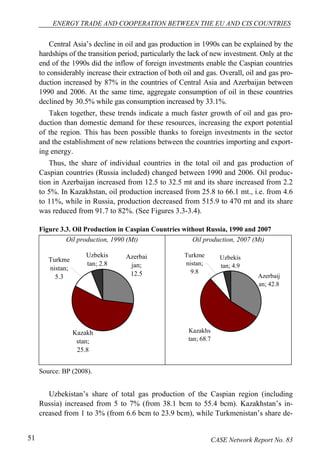
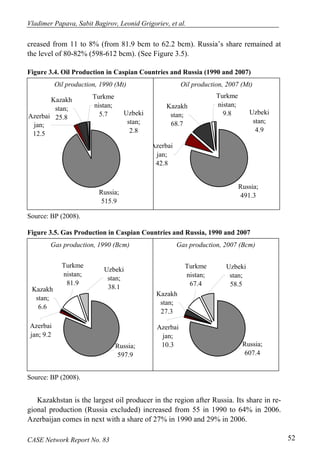
The views and opinions expressed here reflect the authors’ point of view and 
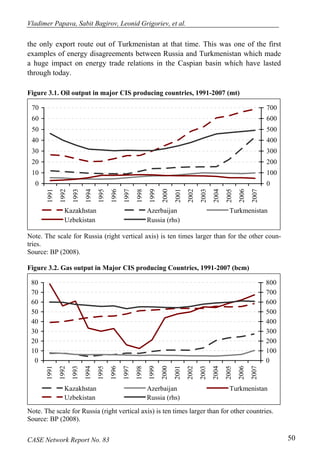
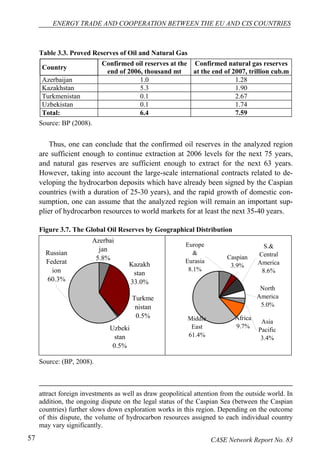
not necessarily those of CASE Network. 
This study has been prepared within the framework of the ENEPO project (EU 
Eastern Neighbourhood: Economic Potential and Future Development) coordinated 
by CASE – Center for Social and Economic Research, financed under the Sixth 
Framework Programme of the European Commission. The study summarizes the 
results of the Workpackage 5 coordinated by CASE - Transcaucasus. The content 
of this publication is the sole responsibility of the authors and can in no way be 
taken to reflect the views of the European Union or other institutions the authors 
may be affiliated to. 
Transcaucasus 
Keywords: energy supply, energy demand, gas and oil resources, Caspian 
countries, EU, Russia, Caucasus. 
JEL codes: Q41, Q48, Q43 
© CASE – Center for Social and Economic Research, Warsaw, 2009 
Graphic Design: Agnieszka Natalia Bury 
EAN 9788371784798 
Publisher: 
CASE-Center for Social and Economic Research on behalf of CASE Network 
12 Sienkiewicza, 00-010 Warsaw, Poland 
tel.: (48 22) 622 66 27, 828 61 33, fax: (48 22) 828 60 69 
e-mail: case@case-research.eu 
http://www.case-research.eu
The CASE Network is a group of economic and social research centers in Po-land, 
Kyrgyzstan, Ukraine, Georgia, Moldova, and Belarus. Organizations in the 
network regularly conduct joint research and advisory projects. The research cov-ers 
a wide spectrum of economic and social issues, including economic effects of 
the European integration process, economic relations between the EU and CIS, 
monetary policy and euro-accession, innovation and competitiveness, and labour 
markets and social policy. The network aims to increase the range and quality of 
economic research and information available to policy-makers and civil society, 
and takes an active role in on-going debates on how to meet the economic chal-lenges 
facing the EU, post-transition countries and the global economy. 
The CASE network consists of: 
• CASE – Center for Social and Economic Research, Warsaw, est. 1991, 
www.case-research.eu 
• CASE – Center for Social and Economic Research – Kyrgyzstan, est. 
1998, www.case.elcat.kg 
• Center for Social and Economic Research - CASE Ukraine, est. 1999, 
www.case-ukraine.kiev.ua 
• CASE –Transcaucasus Center for Social and Economic Research, est. 
2000, www.case-transcaucasus.org.ge 
• Foundation for Social and Economic Research CASE Moldova, est. 2003, 
www.case.com.md 
• CASE Belarus - Center for Social and Economic Research Belarus, est. 
2007.
Vladimer Papava, Sabit Bagirov, Leonid Grigoriev, et al. 
The Authors 
Vladimer Papava is a Senior Fellow at the Georgian Foundation for Strategic 
and International Studies, a Senior Associate Fellow of the Joint Center formed by 
the Central Asia-Caucasus Institute (Johns Hopkins University-SAIS) and the Silk 
Road Studies Program (Uppsala University). He was a Minister of Economy 
(1994-2000) and a Member of the Parliament of the Republic of Georgia (2004-2008); 
in 2005-2006 he was a Fulbright Fellow at the Central Asia-Caucasus Institute at the 
Nitze School at SAIS, Johns Hopkins University (Washington, D.C.). Since 2007 
he has been a member of the CASE (Center for Social and Economic Research) 
Advisory Council. Dr. Papava holds a Diploma of the Candidate of Economic Sci-ences 
from Central Economic and Mathematical Institute of the Academy of Sci-ences 
of the USSR (Moscow, 1982), a Diploma of the Doctor of Economic Sci-ences 
from Tbilisi State University (1989), and Leningrad State University (1990). 
He is the author of more than 200 publications, including works on the theoretical 
and applied studies post-Communist economies and the economic development of 
the Central Caucasus countries. He is a corresponding member of the Georgian 
National Academy of Sciences. 
Sabit Bagirov is president of the Entrepreneurship Development Foundation 
and the Center for Economic and Political Research in Baku, Azerbaijan. From 
1992-1993, he served as the state advisor on strategic programs to the president of 
Azerbaijan, helping establish state committees on antimonopoly policy and support 
for entrepreneurship, privatization of state property, land reform, and foreign in-vestment. 
During that time, he was also president of the State Oil Company of 
Azerbaijan (SOCAR), where he restructured the company for greater efficiency 
and was responsible for contracts with foreign investors for the development of oil 
and gas. 
Leonid Grigoriev is President of the Institute of Energy and Finance, a re-search 
advisory firm based in Moscow. Mr. Grigoriev served as Deputy Minister of 
Finance during the Yeltsin administration and prior to that as Advisor to the execu-tive 
director of the World Bank. He was later Director General, Bureau of Eco-nomic 
Analysis, and served as President of the Association of the Independent 
Center of Economic Analysis which unites more than 50 Russian research institu-tions. 
Dr. Grigoriev holds MS and PhD degrees from Moscow State University; he 
serves as Dean of the Management Department at the International University of 
Moscow and has authored more than 20 books. His academic interests include 
CASE Network Report No. 83 4
ENERGY TRADE AND COOPERATION BETWEEN THE EU AND CIS COUNTRIES 
global energy issues, economic forecasting, economies in transition and the private 
financial sector. 
Wojciech Paczynski is a senior economist at CASE – Center for Social and 
Economic Research. His research interests include applied macroeconomics, inter-national 
economics, international relations, game theory and economics of educa-tion. 
He has managed several research, analytical and advisory projects in Europe 
and Central Asia and has published on EU integration, monetary unions, monetary 
policy, currency crises, and EU relations with neighboring countries. He is a mem-ber 
of a DG ECFIN Euro Team. He worked for the OECD Economics Department, 
University of Dortmund and the Polish Ministry of Economy, and served as con-sultant 
for the World Bank and OSCE. 
Marcel Salikhov is head of economic research at the Institute of Energy and 
Finance, a Moscow-based non-profit research institution. Mr. Salikhov worked 
with several major industrial and financial companies from 2002-2004 and served 
as a strategic planning consultant for the V-Ratio Business Consulting Company. 
He has published in a number of economic journals and recently co-authored with 
Leonid Grigoriev a book on the economic development of the ex-USSR countries 
during last 15 years. Mr. Salikhov holds a degree in Economics from Moscow 
State Institute of Electronic Technology (MIET) and is currently a faculty member 
in the economics department. His academic interests include global energy and 
global financial markets issues. 
Micheil Tokmazishvil – is a Member of the Council of the National Bank of 
Georgia, Senior researcher at Case-Transcaucasus– Center for Social and Eco-nomic 
Research. He was Head of the Department of Macroeconomics of the 
Budget office of the Parliament of Georgia, the country manager of the program of 
the Economic Development Institute of the World Bank in Georgia. Dr. Tok-mazishvili 
holds a Diploma of the Doctor of Economic Sciences from Tbilisi State 
University; he served as professor at the various universities of Georgia. His aca-demic 
interests include economies in transition, international relations and mone-tary 
policy issues. 
5 CASE Network Report No. 83
Vladimer Papava, Sabit Bagirov, Leonid Grigoriev, et al. 
Abstract 
The report reviews key issues in energy trade and cooperation between the EU 
and CIS countries. It describes historical trends of oil and gas demand in the EU, 
other European and CIS countries and offers demand forecasts until 2030. Recent 
developments in oil and gas production and exports from Russia and Caspian coun-tries 
are covered in detail leading to the discussion of the likely export potential of 
these regions. The key factors determining the production outlook, trade-offs and 
competition related to energy resources transportation choices are also discussed. 
The report also covers the interests and role of transit countries in relations be-tween 
producer and consumer regions. The analytical section leads to policy rec-ommendations 
that focus mainly on the EU. 
CASE Network Report No. 83 6
ENERGY TRADE AND COOPERATION BETWEEN THE EU AND CIS COUNTRIES 
Contents 
Introduction ......................................................................................................... 10 
1. Energy Trends in Europe: Oil and Gas Demand ........................................ 13 
1.1. Current Trends in Oil and Gas Demand ................................................... 14 
1.1.1. Oil ....................................................................................................... 14 
1.1.2. Natural gas .......................................................................................... 15 
1.1.3. Oil and Gas in the Energy Mix ........................................................... 17 
1.2. Forecast of Oil and Gas Demand.............................................................. 21 
1.2.1. Oil ....................................................................................................... 21 
1.2.2. Gas ...................................................................................................... 24 
1.3. Non-CIS Sources of EU Energy Supply................................................... 26 
1.3.1. Gas ...................................................................................................... 26 
1.3.2. Oil ....................................................................................................... 28 
2. Oil and gas in Russia...................................................................................... 31 
2.1. Current Trends of Gas and Oil Production and Exports........................... 31 
2.1.1. Oil ....................................................................................................... 32 
2.1.2. Gas ...................................................................................................... 35 
2.1.3. Transit Issues ...................................................................................... 42 
2.2. Forecasts for Oil and Gas Production....................................................... 44 
2.2.1. Oil ....................................................................................................... 45 
2.2.2. Gas ...................................................................................................... 46 
3. Caspian Oil and Gas ...................................................................................... 49 
3.1. Current Trends of Gas and Oil Production and Demand.......................... 49 
3.2. Oil and Gas Forecast................................................................................. 54 
3.2.1. Azerbaijan........................................................................................... 55 
3.2.2. Kazakhstan.......................................................................................... 55 
3.2.3. Turkmenistan ...................................................................................... 55 
3.2.4. Uzbekistan .......................................................................................... 56 
3.2.5. The Consolidated Oil Reserves of Azerbaijan, Kazakhstan, 
Turkmenistan and Uzbekistan ...................................................................... 56 
4. Transportation Choices and Competition of Alternative Pipelines........... 59 
4.1. Oil and Gas Pipelines ............................................................................... 59 
4.2. Competition .............................................................................................. 61 
5. Cooperation between the EU and Caspian countries.................................. 66 
5.1. Cooperation with Central Asia ................................................................. 66 
5.2. Cooperation with the South Caucasus ...................................................... 67 
5.3. A Common Voice to Harmonize Cooperation ......................................... 68 
6. Conclusions and Recommendations ............................................................. 69 
Conclusions....................................................................................................... 69 
Recommendations............................................................................................. 71 
References ............................................................................................................ 73 
7 CASE Network Report No. 83
Vladimer Papava, Sabit Bagirov, Leonid Grigoriev, et al. 
Abbreviations 
BTC – Baku-Tbilisi-Ceyhan pipeline 
BTE – Baku-Tbilisi-Erzurum pipeline 
BTS – Baltic Transport System 
CAC – Central Asia - Centre pipeline 
CIS – Commonwealth of Independent States 
CNPC – China National Petroleum corporation 
CPC – Caspian Pipeline Consortium pipeline 
CPI – Consumer price index 
DOE – US Department of Energy 
EBRD – European Bank for Reconstruction and Development 
EIA – Energy Information Administration (at the US Department of Energy) 
EU – European Union 
FSU – Former Soviet Union 
GUEU – Georgia-Ukraine-European Union pipeline 
IEA – International Energy Agency 
IEF – Institute of Energy and Finance (Russia) 
KMG – KazMunaiGaz 
LNG – Liquefied natural gas 
OECD – Organization for Economic Co-operation and Development 
OPEC – Organization of the Petroleum Exporting Countries 
SCP – South Caucasus pipeline 
TAF – Trans-Afghan route 
TCGP – Transcaspian Gas pipeline 
TGI – Turkey-Greece-Italy pipeline 
CASE Network Report No. 83 8
ENERGY TRADE AND COOPERATION BETWEEN THE EU AND CIS COUNTRIES 
Units of measurement 
bcm – billion cubic meters 
cub.m – cubic meter 
mt – million tonnes 
mtoe – million tonnes of oil equivalent 
toe – tonne of oil equivalent 
Measurement 
1 barrel = 0.1364 tonne (of oil equivalent) 
9 CASE Network Report No. 83
Vladimer Papava, Sabit Bagirov, Leonid Grigoriev, et al. 
Introduction 
The world’s current energy problems originate from the growing global con-sumption 
of energy, which is the result of expanding economies, a growing popula-tion, 
rising living standards as well as a great geographical mismatch between en-ergy 
supply and demand. 
The Presidency Conclusions of the European Council (Brussels, 23/24 March, 
2006) stress the fact that Europe is “facing a number of challenges in the energy 
field: the ongoing difficult situation on the oil and gas markets, the increasing im-port 
dependency and limited diversification achieved so far, high and volatile en-ergy 
prices, growing global energy demand, security risks affecting producing and 
transit countries as well as transport routes, the growing threats of climate change, 
slow progress in energy efficiency and use of renewable power-carriers, the need 
for increased transparency on energy markets and further integration and intercon-nection 
of national energy markets with the energy market liberalization nearing 
completion (July 2007), the limited coordination between energy players while 
large investments are required in energy infrastructure” (Council of the European 
Union, 2006). 
The EU “Green Paper” of March 2006 points to a growing EU’s dependence on 
import (up to 70% of total energy and 80% of gas by 2030) and high gas import 
concentration (most supplies come from only three neighbor countries). 
The stabilization of prices, the development of a long-term forecast, infrastruc-ture 
improvements, the sufficiency of power-carriers supply, and an increase in the 
reliability of suppliers are of great importance for energy security. 
The uneven geographical distribution of power resources as well as differences 
in development levels and characteristics of the energy sector affect the develop-ment 
of countries’ as well as companies’ interests. These challenges, if allowed to 
deteriorate, will inevitably undermine economic growth, standards of living and 
national security. 
It is beyond dispute today that the prosperity and way of life of every nation are 
conditioned by energy use. Therefore it makes sense to strengthen the energy co-operation 
and security of the EU by developing energy markets and diversifying its 
energy resources’ supply. To support its economic development, the EU needs 
consistent, reasonably priced and sustainable energy supplies. 
CASE Network Report No. 83 10
ENERGY TRADE AND COOPERATION BETWEEN THE EU AND CIS COUNTRIES 
Energy security challenges differ between consumer and producer countries. 
This complicates the relations between the two groups. Until now, no common uni-fied 
EU energy policy has been formulated. Additionally, in many producer coun-tries, 
the government plays a very important role, often as an owner of major pro-ducers 
of energy. This further complicates the dialogue, due to the somewhat dif-ferent 
objectives and levels of power of private companies and national govern-ments. 
Differences between the interests of parties are related not so much to the cur-rent 
problems of prices and supplies (although a few such disagreements were re-cently 
observed in the CIS region), but rather to the assurance of future supplies, 
returns on investment and pricing mechanisms. 
Several oil and gas exporting countries are heavily dependent on revenues from 
this single sector due to the low level of diversification of their economies. On the 
other hand, potential problems with securing sufficient energy supplies would risk 
the economic stability and development of energy importing countries. 
There are various approaches to resolving energy problems. The first one at-tempts 
to address the problem of the sustainability of current energy markets, the 
lack of confidence between energy importers and exporters in terms of the reliabil-ity 
of future deliveries, conflicts related to the transit of energy resources and other 
problems. 
For the EU member states, it is more efficient to deal with the countries which 
have achieved political stability and in which oil and gas are produced by private 
companies (Grigoriev, 2006) despite the fact that the highest reserves of hydrocar-bons 
are in the countries where state-controlled companies are main operators in 
the energy field. 
Another solution is to elaborate a long-term forecast and to study prospects of 
energy production and consumption and their influence on economic growth. A 
comprehensive strategy aimed at diversifying energy sources and transit routes is 
needed. This is where we should look for answers. 
When attempting to resolve these issues, we should take into consideration the 
prerequisites for long-term political, economic, social and environmental sustain-ability. 
This, in turn, will influence the energy sector and affect economic growth 
throughout the XXI century. 
The geographical scope of this paper covers the whole European continent and 
the former Soviet Union countries, with the main focus being on current EU mem-ber 
states and large CIS energy producing countries. 
The paper aims to: 
• assess energy consumption and import trends (mostly for oil and gas); 
11 CASE Network Report No. 83
Vladimer Papava, Sabit Bagirov, Leonid Grigoriev, et al. 
• present the future energy needs of the EU; 
• study the production and export potential of major CIS oil and gas pro-ducers; 
• identify proven and likely locations of energy reserves; 
• review existing and planned transportation infrastructure; 
• analyze barriers to trade and challenges to cooperation and trade between 
the CIS and the EU, barriers to increasing the FSU’s production and ex-ports 
to the EU, and barriers to investment in the energy sector; 
• examine the geopolitical characteristics of relations between energy pro-ducing 
countries and “transit countries” in the CIS; 
• assess alternative transportation infrastructure in EU and its political chal-lenges. 
The first section analyses the oil demand trends and forecasts in the EU. The 
second and third sections examine the Russian and Caspian energy supplies and 
potential resources. The last section characterizes transportation options, infrastruc-ture 
capacity trends, cooperation and prospects1. 
In conclusion, we offer recommendations in the field of cooperation in energy 
supply. 
1 The main data source used in this report is BP (2008). All other information not provided 
by BP is taken from IEA, Eurostat, EIA and the statistical agencies of respective countries 
and analytical and forecasting institutes. 
CASE Network Report No. 83 12
ENERGY TRADE AND COOPERATION BETWEEN THE EU AND CIS COUNTRIES 
1. Energy Trends in Europe: Oil 
and Gas Demand 
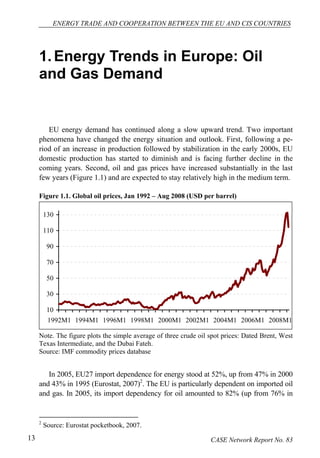
EU energy demand has continued along a slow upward trend. Two important 
phenomena have changed the energy situation and outlook. First, following a pe-riod 
of an increase in production followed by stabilization in the early 2000s, EU 
domestic production has started to diminish and is facing further decline in the 
coming years. Second, oil and gas prices have increased substantially in the last 
few years (Figure 1.1) and are expected to stay relatively high in the medium term. 
Figure 1.1. Global oil prices, Jan 1992 – Aug 2008 (USD per barrel) 
130 
110 
90 
70 
50 
30 
10 
1992M1 1994M1 1996M1 1998M1 2000M1 2002M1 2004M1 2006M1 2008M1 
Note. The figure plots the simple average of three crude oil spot prices: Dated Brent, West 
Texas Intermediate, and the Dubai Fateh. 
Source: IMF commodity prices database 
In 2005, EU27 import dependence for energy stood at 52%, up from 47% in 2000 
and 43% in 1995 (Eurostat, 2007)2. The EU is particularly dependent on imported oil 
and gas. In 2005, its import dependency for oil amounted to 82% (up from 76% in 
2 Source: Eurostat pocketbook, 2007. 
13 CASE Network Report No. 83
Vladimer Papava, Sabit Bagirov, Leonid Grigoriev, et al. 
2000) and for gas 58% (up from 49% in 2000)3. With the falling internal production 
of hydrocarbons, Europe’s import dependency is certain to rise. DG TREN (2008) 
foresees that by 2030, the EU’s import dependence will reach around 95% for oil, 
84% for natural gas, and have an overall import dependence of 67%. 
Large investments will be needed over the next few years to support production, 
transportation and distribution capacity, replace ageing infrastructure, and improve 
energy efficiency in order to address environmental challenges and meet expected 
energy demand increases. 
1.1. Current Trends in Oil and Gas Demand 
1.1.1. Oil 
Between 1991 and 2007, oil demand in the EU expanded at an average annual 
rate of 0.3%, which is much slower than in other parts of the world4. In more recent 
years, demand growth seems to have moderated even further to an annual rate of 
less than 0.1% between 1999 and 20075. The EU27 accounted for approximately 
18% of total global oil consumption in 2007, down from 21% in 1991. 
Oil consumption in the whole European continent and the former Soviet Union 
(FSU) region taken together declined quite substantially between 1991 and 2007, 
by 1% annually on average. This was due to a major decline in oil consumption 
between 1991 and 2000 in the FSU. In Russia, oil consumption roughly halved be-tween 
1990-91 and 2000-01; in Kazakhstan the consumption level in 1999 was one 
third of that in 1990-91. In Ukraine, oil consumption in 2000 was only one fifth of 
the 1990 level. 
The demand trends differ quite substantially among the EU economies and 
other European countries. In Germany, the largest EU consumer, oil demand rose 
somewhat between 1990 and 1996 while the last decade brought a consistent de-cline. 
Between 1999 and 2007, demand was falling by 2% annually on average. In 
3 Source: Eurostat pocketbook, 2007. Dependency is calculated as the ratio of the net im-ports 
to the total consumption of a country or region. The overall energy import dependence 
(for all energy products) is well below the import dependence for oil and gas because of 
lower dependence on imports of other energy resources such as fossil fuels, etc. 
4 1.4% average annual growth in North America, 3.4% growth in Asia and Pacific region 
5 Calculations presented in this section are based on BP (2008) data. 
CASE Network Report No. 83 14
ENERGY TRADE AND COOPERATION BETWEEN THE EU AND CIS COUNTRIES 
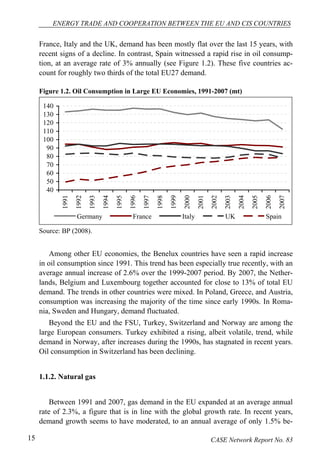
France, Italy and the UK, demand has been mostly flat over the last 15 years, with 
recent signs of a decline. In contrast, Spain witnessed a rapid rise in oil consump-tion, 
at an average rate of 3% annually (see Figure 1.2). These five countries ac-count 
for roughly two thirds of the total EU27 demand. 
Figure 1.2. Oil Consumption in Large EU Economies, 1991-2007 (mt) 
140 
130 
120 
110 
100 
90 
80 
70 
60 
50 
40 
1991 
1992 
1993 
1994 
1995 
1996 
1997 
1998 
1999 
2000 
2001 
2002 
2003 
2004 
2005 
2006 
2007 
Germany France Italy UK Spain 
Source: BP (2008). 
Among other EU economies, the Benelux countries have seen a rapid increase 
in oil consumption since 1991. This trend has been especially true recently, with an 
average annual increase of 2.6% over the 1999-2007 period. By 2007, the Nether-lands, 
Belgium and Luxembourg together accounted for close to 13% of total EU 
demand. The trends in other countries were mixed. In Poland, Greece, and Austria, 
consumption was increasing the majority of the time since early 1990s. In Roma-nia, 
Sweden and Hungary, demand fluctuated. 
Beyond the EU and the FSU, Turkey, Switzerland and Norway are among the 
large European consumers. Turkey exhibited a rising, albeit volatile, trend, while 
demand in Norway, after increases during the 1990s, has stagnated in recent years. 
Oil consumption in Switzerland has been declining. 
1.1.2. Natural gas 
Between 1991 and 2007, gas demand in the EU expanded at an average annual 
rate of 2.3%, a figure that is in line with the global growth rate. In recent years, 
demand growth seems to have moderated, to an annual average of only 1.5% be- 
15 CASE Network Report No. 83
Vladimer Papava, Sabit Bagirov, Leonid Grigoriev, et al. 
tween 1999 and 2007. During this period, global demand accelerated to an average 
annual rate of 2.8%. The EU27 accounted for around 16.5% of global gas con-sumption 
in 20076. 
In 2007, gas consumption in the FSU was 31% above the EU27 level, down 
from double the EU level in 1991. Russia alone consumed only 9% less gas than 
the entire EU in 2007. In the FSU countries, a strong reliance on gas, in compari-son 
with other regions in the world, is explained by abundant gas reserves in Rus-sia 
and several Central Asian countries and (until recently) very low domestic 
prices. In the early 1990s, the FSU saw a slight decline in the consumption of natu-ral 
gas. However since 1997, consumption has risen. From 1999 – 2007, it rose at 
an average rate of 2.1% annually. 
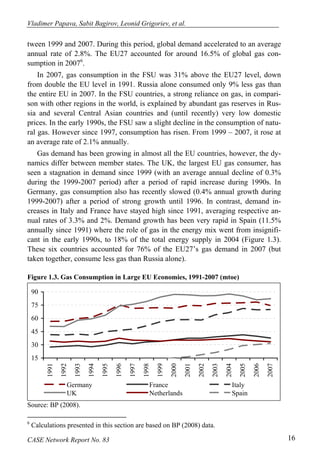
Gas demand has been growing in almost all the EU countries, however, the dy-namics 
differ between member states. The UK, the largest EU gas consumer, has 
seen a stagnation in demand since 1999 (with an average annual decline of 0.3% 
during the 1999-2007 period) after a period of rapid increase during 1990s. In 
Germany, gas consumption also has recently slowed (0.4% annual growth during 
1999-2007) after a period of strong growth until 1996. In contrast, demand in-creases 
in Italy and France have stayed high since 1991, averaging respective an-nual 
rates of 3.3% and 2%. Demand growth has been very rapid in Spain (11.5% 
annually since 1991) where the role of gas in the energy mix went from insignifi-cant 
in the early 1990s, to 18% of the total energy supply in 2004 (Figure 1.3). 
These six countries accounted for 76% of the EU27’s gas demand in 2007 (but 
taken together, consume less gas than Russia alone). 
Figure 1.3. Gas Consumption in Large EU Economies, 1991-2007 (mtoe) 
90 
75 
60 
45 
30 
15 
1991 
1992 
1993 
1994 
1995 
1996 
1997 
1998 
1999 
2000 
2001 
2002 
2003 
2004 
2005 
2006 
2007 
Germany France Italy 
UK Netherlands Spain 
Source: BP (2008). 
6 Calculations presented in this section are based on BP (2008) data. 
CASE Network Report No. 83 16
ENERGY TRADE AND COOPERATION BETWEEN THE EU AND CIS COUNTRIES 
Among other EU economies, Belgium and Poland have seen a continued in-crease 
in consumption, at approximately 2.8-3.3% annually. Denmark, the Nether-lands, 
Romania, Slovakia and the UK are the only EU27 countries in which de-mand 
has been declining since 1999. Apart from the EU and FSU countries, only 
Turkey is a significant European consumer of gas, with new import pipeline infra-structure 
allowing for an annual growth in demand of nearly 14% since 1999. 
1.1.3. Oil and Gas in the Energy Mix 
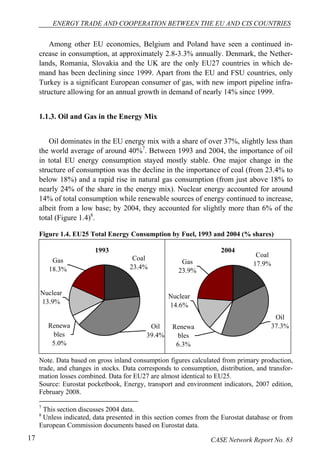
Oil dominates in the EU energy mix with a share of over 37%, slightly less than 
the world average of around 40%7. Between 1993 and 2004, the importance of oil 
in total EU energy consumption stayed mostly stable. One major change in the 
structure of consumption was the decline in the importance of coal (from 23.4% to 
below 18%) and a rapid rise in natural gas consumption (from just above 18% to 
nearly 24% of the share in the energy mix). Nuclear energy accounted for around 
14% of total consumption while renewable sources of energy continued to increase, 
albeit from a low base; by 2004, they accounted for slightly more than 6% of the 
total (Figure 1.4)8. 
Figure 1.4. EU25 Total Energy Consumption by Fuel, 1993 and 2004 (% shares) 
1993 
Coal 
23.4% 
Oil 
39.4% 
Gas 
18.3% 
Nuclear 
13.9% 
Renewa 
bles 
5.0% 
2004 
Coal 
17.9% 
Oil 
37.3% 
Gas 
23.9% 
Nuclear 
14.6% 
Renewa 
bles 
6.3% 
Note. Data based on gross inland consumption figures calculated from primary production, 
trade, and changes in stocks. Data corresponds to consumption, distribution, and transfor-mation 
losses combined. Data for EU27 are almost identical to EU25. 
Source: Eurostat pocketbook, Energy, transport and environment indicators, 2007 edition, 
February 2008. 
7 This section discusses 2004 data. 
8 Unless indicated, data presented in this section comes from the Eurostat database or from 
European Commission documents based on Eurostat data. 
17 CASE Network Report No. 83
Vladimer Papava, Sabit Bagirov, Leonid Grigoriev, et al. 
The energy mix in some FSU countries, notably Russia and Ukraine, differs 
from the EU average in that natural gas plays a larger role. For example, in Russia, 
gas accounted for 54% of the 2004 energy mix. Within the EU, there is also sub-stantial 
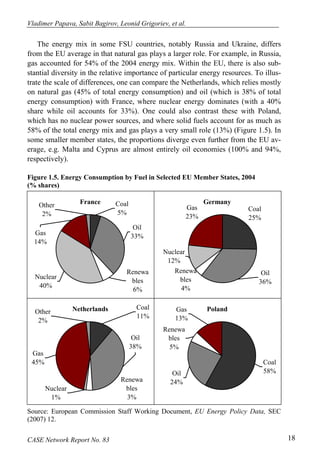
diversity in the relative importance of particular energy resources. To illus-trate 
the scale of differences, one can compare the Netherlands, which relies mostly 
on natural gas (45% of total energy consumption) and oil (which is 38% of total 
energy consumption) with France, where nuclear energy dominates (with a 40% 
share while oil accounts for 33%). One could also contrast these with Poland, 
which has no nuclear power sources, and where solid fuels account for as much as 
58% of the total energy mix and gas plays a very small role (13%) (Figure 1.5). In 
some smaller member states, the proportions diverge even further from the EU av-erage, 
e.g. Malta and Cyprus are almost entirely oil economies (100% and 94%, 
respectively). 
Figure 1.5. Energy Consumption by Fuel in Selected EU Member States, 2004 
(% shares) 
Other France 
2% 
Coal 
5% 
Oil 
Gas 33% 
14% 
Nuclear 
40% 
Renewa 
bles 
6% 
Germany 
Coal 
25% 
Gas 
23% 
Nuclear 
12% 
Renewa 
bles 
4% 
Oil 
36% 
Netherlands Coal 
Other 11% 
2% 
Oil 
38% 
Gas 
45% 
Nuclear 
1% 
Renewa 
bles 
3% 
Poland 
Coal 
Gas 
13% 
Renewa 
bles 
5% 
Oil 58% 
24% 
Source: European Commission Staff Working Document, EU Energy Policy Data, SEC 
(2007) 12. 
CASE Network Report No. 83 18
ENERGY TRADE AND COOPERATION BETWEEN THE EU AND CIS COUNTRIES 
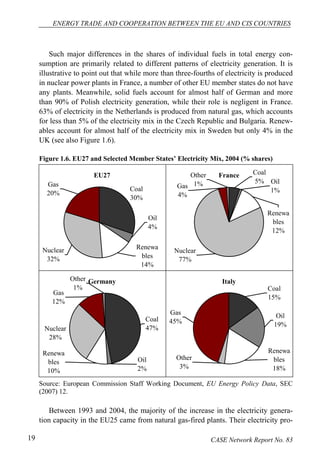
Such major differences in the shares of individual fuels in total energy con-sumption 
are primarily related to different patterns of electricity generation. It is 
illustrative to point out that while more than three-fourths of electricity is produced 
in nuclear power plants in France, a number of other EU member states do not have 
any plants. Meanwhile, solid fuels account for almost half of German and more 
than 90% of Polish electricity generation, while their role is negligent in France. 
63% of electricity in the Netherlands is produced from natural gas, which accounts 
for less than 5% of the electricity mix in the Czech Republic and Bulgaria. Renew-ables 
account for almost half of the electricity mix in Sweden but only 4% in the 
UK (see also Figure 1.6). 
Figure 1.6. EU27 and Selected Member States’ Electricity Mix, 2004 (% shares) 
EU27 
Coal 
30% 
Oil 
4% 
Gas 
20% 
Nuclear 
32% 
Renewa 
bles 
14% 
Other France 
1% 
Coal 
5% Oil 
Gas 1% 
4% 
Nuclear 
77% 
Renewa 
bles 
12% 
Germany 
Coal 
47% 
Other 
1% 
Oil 
2% 
Gas 
12% 
Nuclear 
28% 
Renewa 
bles 
10% 
Italy 
Coal 
15% 
Oil 
19% 
Gas 
45% 
Other 
3% 
Renewa 
bles 
18% 
Source: European Commission Staff Working Document, EU Energy Policy Data, SEC 
(2007) 12. 
Between 1993 and 2004, the majority of the increase in the electricity genera-tion 
capacity in the EU25 came from natural gas-fired plants. Their electricity pro- 
19 CASE Network Report No. 83
Vladimer Papava, Sabit Bagirov, Leonid Grigoriev, et al. 
duction more than tripled between 1993 and 2004, compared to a nearly flat output 
from solid fuels-fired stations and hydropower plants, a minor increase in output 
from nuclear power stations, and a substantial decline in output from oil-fired sta-tions. 
The output of power plants which operate based on renewable resources 
(other than hydro energy), particularly wind and biomass, increased sharply over 
the analyzed period (25 and 3.4 times, respectively), although their shares in total 
electricity production are still relatively small. 
The data presented so far indicates that while patterns of natural gas consump-tion 
differ vastly between countries, the differences in the relative role of oil in the 
total energy mix, while substantial, are of a much smaller magnitude. This is ex-plained 
by the various usage patterns of oil and natural gas. The use of gas is diver-sified, 
with electricity and heat generation accounting for close to 30%, residential 
consumption also close to 30%, industry accounting for close to 25%, and the rest 
spread among other uses9. It is therefore clear that different industrial, electricity 
and heat generation patterns in various European countries lead to major differ-ences 
in the role that gas plays in the total energy mix of each country. 
The situation with oil is different because its main use is in the transport sector, 
absorbing roughly half of total consumption in the EU. Oil is also used in the in-dustrial 
sector, in households, in electricity generation plants and in agriculture; 
however these uses play a relatively small role10. From the perspective of oil de-mand 
trends, it is important to note that thus far, no economically significant alter-natives 
for oil in the transportation sector have emerged. In 2005, bio-fuels ac-counted 
for less than 0.5% of total fuel consumption in most of the EU member 
states with only a few countries with higher shares (around 3.5% in Germany) 
(European Commission Staff, 2007). The share of bio-fuels is expected to increase 
in the EU, possibly reaching around 5% by 2010. In March 2007, the European 
Council re-confirmed a 10% binding minimal target for the share of bio-fuels in 
overall transport fuel consumption by 2020. However, the feasibility of reaching 
this target without causing major troubles for the agricultural sector, negatively 
affecting biodiversity, destabilizing global food prices, etc. has been questioned by 
several stakeholders, sparking heated debates in the EU (e.g., see Turmes, 2008). 
Indeed, it is widely acknowledged that this target is not feasible unless a functional 
and robust sustainability scheme of biofuels production is put in place and second 
generation biofuels become commercially viable (European Commission, 2008). 
This point in particular implies that the EU will need to import biofuels from re- 
9 IEA data pertaining to EU25 2004 consumption patterns. 
10 Oil is a very versatile energy source and can also be used e.g. for electricity generation. 
This explains why some small countries (e.g. islands of Cyprus and Malta) may rely almost 
entirely on oil. This does not contradict the main message of this paragraph, which applies 
to countries with a more diversified economic base. 
CASE Network Report No. 83 20
ENERGY TRADE AND COOPERATION BETWEEN THE EU AND CIS COUNTRIES 
gions where conditions for their production are more favorable. In turn, boosting 
international trade in biofuels is not an easy task due to the lack of internationally 
agreed-upon criteria for sustainable production and the diverse range of govern-ment 
measures aimed at sheltering domestic markets (see e.g. UNCTAD, 2006). 
While the role of oil products in the transport sector is unlikely to change sub-stantially 
in the coming years or even decades, substantial changes in the mix of 
fuels are already taking place in the EU. A key trend is the rising relative demand 
for diesel (which accounted for 50% of final energy consumption in the transport 
sector in 2005, up from 40% in 1995) and the corresponding falling relative de-mand 
for gasoline (which fell from 45% in 1995 to 31% in 2005). This results from 
the rapidly growing popularity of diesel-fueled cars, which currently account for 
around half of new cars registered in Western Europe, up from less than 20% in the 
early 1990s (IEA, 2006a). 
1.2. Forecast of Oil and Gas Demand 
1.2.1. Oil 
This report presents the results of a demand modeling exercise carried out using 
an updated version of the CASE Advisors (2000) oil demand model. Interpreting 
the forecast results requires understanding the methodology and assumptions guid-ing 
the modeling. A description of these is included below followed by the presen-tation 
and discussion of the results. 
The baseline scenario presented in this report assumes the continuation and rela-tive 
stability of the relationships between aggregate economic activity measures, 
prices, and oil demand in European countries. In other words, in the forecast hori-zon, 
no major technological breakthrough is foreseen that could significantly limit 
the role of oil as a major fuel for the transport sector. In addition, no change in the 
patterns of demand for transport services is foreseen. A brief discussion of the im-pact 
of other sets of assumptions is included later in this section. 
The forecast horizon is until 2030, in line with the practice of the International 
Energy Agency and the US Energy Information Administration. The database on 
historical annual oil demand is taken from BP (2008). 
The model comprises three blocks: structural, trend and expert. The structural 
block models the demand for oil at the country level with measures of aggregate 
21 CASE Network Report No. 83
Vladimer Papava, Sabit Bagirov, Leonid Grigoriev, et al. 
economic activity (proxied by GDP), oil intensity, and international price levels. 
Following the typical findings from the literature (see e.g. Krichene, 2005), the 
structural model assumes low price elasticity in the short term and significant in-come 
elasticity of oil demand. Future GDP growth path is based on assumptions 
concerning the speed of convergence within the non-FSU European economies and 
past performance in the case of FSU countries. 
The trend block relies on a simple autoregressive model (estimated using the 
automated procedure of Neumaier and Schneider, 2001) to describe oil demand as 
a function of past trends. The expert module uses the information from several 
large international models used at major institutions, such as International Energy 
Agency, US Energy Information Administration, and European Commission (EIA, 
2007, 2008; European Commission, 2006; DG TREN, 2008; and IEA, 2006b, 
2007, 2008). 
The forecasts are obtained as weighted averages from the results suggested by 
three model blocks with their relative importance differing at various forecast hori-zons 
(e.g. weights on the results from the trend block concentrated on the short-term 
forecast of up to 5 years). 
Figure 1.7. Oil Demand in EU27 and FSU7 – 1990-2030 (mt per annum) 
800 
700 
600 
500 
400 
300 
200 
100 
1990 
1992 
1994 
1996 
1998 
2000 
2002 
2004 
2006 
2008 
2010 
2012 
2014 
2016 
2018 
2020 
2022 
2024 
2026 
2028 
2030 
EU27 FSU7 
Note. EU27 is comprised of 27 EU member states as of 2007. FSU7 is comprised of the 
seven largest oil consumers among CIS countries: Russia, Ukraine, Kazakhstan, Belarus, 
Uzbekistan, Turkmenistan, and Azerbaijan. 
Source: BP (2008) and oil demand model. 
Figure 1.7 and Table 1.1 present the key results of the forecasting exercise. To-tal 
demand in Europe and in the FSU region is expected to increase at an average 
annual rate of 0.4% over the 2005-30 period, with broadly similar dynamics over 
CASE Network Report No. 83 22
ENERGY TRADE AND COOPERATION BETWEEN THE EU AND CIS COUNTRIES 
the whole forecast horizon, apart from the recession-related decline foreseen in the 
2008-2009 period. EU27 demand growth is expected to slow from the levels ob-served 
in 1996-2005 (0.7% annually on average) to 0.2% annually over 2005-2030. 
The FSU countries will see much stronger demand growth, at 1.2% annually during 
2005-2030, although this still represents a significant decline in the oil intensity of 
their economies compared to the period through the late 1990s. 
Table 1.1. Average Annual Growth of Oil Demand – 1996-2030 (% per annum) 
Europe & FSU EU27 FSU7 
1996-2005 0.22 0.71 -1.90 
2006-2010 -0.20 -0.50 1.20 
2011-2020 0.60 0.30 1.30 
2021-2030 0.60 0.40 1.20 
2006-2030 0.40 0.20 1.20 
Note. FSU7 is comprised of the 7 largest oil consumers among CIS countries: Russia, 
Ukraine, Kazakhstan, Belarus, Uzbekistan, Turkmenistan, Azerbaijan. Europe & FSU is 
comprised of EU27, all CIS countries plus Albania, Bosnia-Herzegovina, Croatia, Iceland, 
Former Yugoslav Republic of Macedonia, Montenegro, Norway, Serbia, Switzerland, and 
Turkey. 
Source: BP (2008) and oil demand model. 
In the above scenario (which produces similar results to some other larger fore-casting 
projects carried out, for example, by DG TREN in 2008, or EIA in 2008), 
the EU is characterized by relatively low oil demand growth compared to other 
regions. Europe’s share in global consumption is set to decline. It is worth recalling 
that the oil market is global in nature, i.e. oil price developments will be deter-mined 
by the global demand/supply balance rather than the developments in 
Europe. Still, the global oil (and more generally energy) demand path emerging 
from these models is perceived as unsustainable from the environmental perspec-tive 
(and possibly also due to supply capacity and security constraints). Rising 
global energy consumption and related CO2 emissions are, in all likelihood, the 
primary factors responsible for the climate changes observed in recent decades 
(IPCC, 2007). This acts as a stimulus for governments, and in particular for the 
European Commission, to introduce policy initiatives that could (1) limit the en-ergy 
demand and (2) shift it towards cleaner energy sources. This implies lower 
consumption of oil. 
In 2007-08, the European Commission proposed a set of integrated energy and 
climate change packages proposing actions and targets related to these two issues11. 
This has sparked heated debates between various stakeholders which may lead to 
policy changes, effectively reducing the consumption of oil relative to a reference 
11 See European Commission, 2007b, for details. 
23 CASE Network Report No. 83
Vladimer Papava, Sabit Bagirov, Leonid Grigoriev, et al. 
scenario. To get a sense of the possible energy savings, one could note that the IEA 
(2005) Alternative Policy Scenario assumes 10% lower global oil demand in 2030 
compared to the baseline. The majority of savings come from measures affecting 
the transport sector. Europe is expected to play an important role in fostering im-provements 
in the efficiency of new vehicles, increasing the role of biofuels, and 
initiating changes in patterns of passenger and freight transport. However, given 
the costs involved in upgrading the economy to become less energy-intensive, 
some form of global cooperation is needed to ensure that policies consistent with 
the Alternative Scenario are implemented. Without such cooperation and the in-volvement 
of other major players such as the US, China, India, or the CIS, any sig-nificant 
progress is unlikely. 
1.2.2. Gas 
Predicting future natural gas demand requires an approach different from that 
used in modeling oil demand. This is because the use of gas is diversified across 
sectors and in all these sectors there are substitutes for gas (unlike in the case of oil 
in the transport sector). In addition, gas consumed in Europe mostly comes from 
pipelines (despite the growing role of LNG), indicating the unique character of the 
European gas market. Unlike oil, gas can reach a particular destination only if there 
is a sufficient capacity in pipeline infrastructure. Gas consumption is therefore 
loosely linked to macroeconomic developments that can be forecasted with some 
degree of certainty (such as GDP growth) and depends more on government poli-cies 
and private sector activities, in particular investments in gas-fired power plants 
and gas transit infrastructure. For these reasons, the discussion of expected future 
demand trends below is not based on the modeling exercise. Rather, it draws on 
existing analyses by other sources, which are based on the examination of present 
and likely government policies and other factors which determine the availability 
and cost effectiveness of natural gas12. The sources include IEA (2005, 2006, 
2007), EIA (2007, 2008), Eurogas (2006), DG TREN (2008), European Commis-sion 
(2006) and European Commission Staff (2006). 
According to all these sources, between 2005 and 2030, gas demand in the EU 
is expected to increase significantly faster than oil demand. The most recent predic-tions 
have scaled down the pace of the annual demand increase: from a forecast of 
12 Another possible approach could rely on forecasting the maximum potential supply as-suming 
that demand will adjust to the available supply. However, as evident from the sub-sequent 
sections of this report, forecasting gas supply in any given region is far from an 
easy task. 
CASE Network Report No. 83 24
ENERGY TRADE AND COOPERATION BETWEEN THE EU AND CIS COUNTRIES 
1.4-2% in 2006 to 0.6%-1.4% in 2008. A somewhat faster growth until 2015 will 
be followed by more muted gains between 2015 and 203013. The FSU region is 
also expected to see further increases in domestic demand (from already high cur-rent 
levels), with dynamics that are broadly similar to the EU/OECD economies (to 
the tune of around 1% annually)14. 
Most of the demand increase is expected to come from the power generation 
sector. Therefore, the future path of gas demand will depend, to a large extent, on 
the perceived economic viability of new gas-fired power plants in these and other 
European countries. For obvious reasons, apart from factors such as attitude to nu-clear 
energy, forecasted gas prices are playing an important role in this. Currently, 
gas prices are strongly related to oil prices, despite the fact that the two natural re-sources 
are no longer close substitutes (for discussion see Energy Charter, 2007; 
and Stern, 2007a). In an environment of high global oil prices (and therefore high 
gas prices), the viability of several new investment projects in gas-fired power gen-eration 
may become less clear to investors, leading to delays in project implemen-tation. 
We are inclined to believe that conservative gas growth forecasts for the EU are 
more plausible. Apart from expected high oil and gas prices, supply security may 
be an additional factor increasing the risk of investments in gas-dependent projects 
and thus limiting their attractiveness relative. to, for example, projects based on 
clean coal technologies15. In our view, a scenario with 0.5-1% average annual 
growth between 2006 and 2015, slowing to around 0.5% over 2016-2030, appears 
most likely. This would add up to a 16% increase in gas demand in Europe be-tween 
2005 and 2030, or a 0.6% average annual growth over the period. 
Future gas demand in FSU countries is even more uncertain due to unknown 
changes in domestic gas pricing. The policies of individual FSU countries (espe-cially 
Russia and Ukraine) will have a major impact on gas demand, and thus on 
the relative competitiveness of various modes of electricity production. One may 
expect differences between major gas producers (Russia, some Central Asian and 
Caucasus countries) and countries relying on imported gas. 
13 Different sources present forecasts for somewhat differently defined groupings of coun-tries. 
However, given the high concentration of gas demand in a few large consumers in the 
EU and OECD, the results for the dynamics of demand growth are hardly affected by 
changes in the region boundaries. Consequently, the results presented for the EU27 can also 
be applied to all non-FSU European countries (among which only Turkey, an OECD mem-ber 
country, consumes significant amounts of natural gas). 
14 These forecasts are subject to particularly wide error margins given the uncertain path of 
gas price changes in the region from currently still largely artificially low levels. 
15 Some authors view coal as a promising alternative to oil and gas, providing the imple-mentation 
of technological improvements which significantly limit CO2 emissions. See, e.g. 
Auer (2007). 
25 CASE Network Report No. 83
Vladimer Papava, Sabit Bagirov, Leonid Grigoriev, et al. 
1.3. Non-CIS Sources of EU Energy Supply 
This section briefly presents the outlook for non-CIS sources of natural gas and 
oil supply for Europe, i.e. of domestic production, and import from other major 
suppliers. 
1.3.1. Gas 
Historically, the EU was meeting a large part of its gas demand with domestic 
production, mainly in the Netherlands, UK, Italy, Germany, and Romania (with 
smaller volumes produced in Denmark and Poland). In 1995, the combined produc-tion 
of these countries met about half of EU-27 demand. EU domestic production 
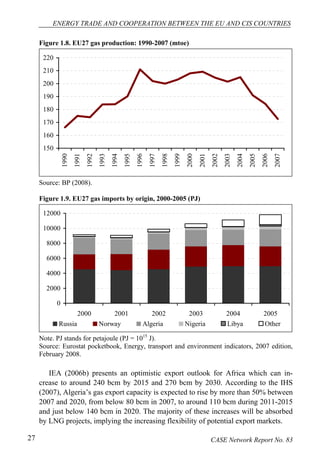
of natural gas has fluctuated since 1995, reaching a peak in 2000-01, before it be-gan 
to decline (Figure 1.8). In 2007, domestic output was below 1995 levels, in-creasing 
the EU’s import dependency (given a strong surge in demand as discussed 
in section 1.1.2). In the mid-1990s, nearly half of EU gas imports were coming 
from Russia, with Norway and Algeria accounting for around 15% each. Since 
then, total EU imports have significantly increased (with a 30% rise between 2000 
and 2005). Volumes imported from all major suppliers have also increased, but 
with varying dynamics. The relative importance of Russia has decreased, and the 
relative importance of Algeria has stayed broadly stable, while Norway, Libya, and 
Nigeria have increased their shares in EU gas imports. In 2007, the EU27 imported 
gas from three main destinations: Russia (around 38%), Norway (25%) and Africa, 
with Algeria, Nigeria, Libya and Egypt accounting for around 26%. 
The currently prevailing view suggests that EU domestic gas output (UK, Neth-erlands 
and other countries) as well as Norwegian production may fluctuate until 
2010 with a continued decline thereafter, possibly accelerating beyond 2015 (see 
e.g. Stern, 2007b; EIA, 2007, IEA, 2006b). This outlook will only change due to 
new gas discoveries. Therefore, the key question relates to the potential of non- 
European gas supply. 
The potential for CIS exports to the EU is analyzed in the subsequent sections 
of this report. Here we present the outlook of other important gas suppliers. 
It is commonly believed that the Middle East and Africa will see large gains in 
gas output until 2030, with a projected average annual growth in the range 3-4.5% 
in the Middle East and 4-4.5% in Africa (IEA, 2006b, EIA, 2007). Much of the 
increased output will be exported although rising domestic demand must also be 
taken into consideration. 
CASE Network Report No. 83 26
ENERGY TRADE AND COOPERATION BETWEEN THE EU AND CIS COUNTRIES 
Figure 1.8. EU27 gas production: 1990-2007 (mtoe) 
220 
210 
200 
190 
180 
170 
160 
150 
1990 
1991 
1992 
1993 
1994 
1995 
1996 
1997 
1998 
1999 
2000 
2001 
2002 
2003 
2004 
2005 
2006 
2007 Source: BP (2008). 
Figure 1.9. EU27 gas imports by origin, 2000-2005 (PJ) 
12000 
10000 
8000 
6000 
4000 
2000 
0 
2000 2001 2002 2003 2004 2005 
Russia Norway Algeria Nigeria Libya Other 
Note. PJ stands for petajoule (PJ = 1015 J). 
Source: Eurostat pocketbook, Energy, transport and environment indicators, 2007 edition, 
February 2008. 
IEA (2006b) presents an optimistic export outlook for Africa which can in-crease 
to around 240 bcm by 2015 and 270 bcm by 2030. According to the IHS 
(2007), Algeria’s gas export capacity is expected to rise by more than 50% between 
2007 and 2020, from below 80 bcm in 2007, to around 110 bcm during 2011-2015 
and just below 140 bcm in 2020. The majority of these increases will be absorbed 
by LNG projects, implying the increasing flexibility of potential export markets. 
27 CASE Network Report No. 83
Vladimer Papava, Sabit Bagirov, Leonid Grigoriev, et al. 
According to the IEA (2006b), the Middle East may see its gas exports expand-ing 
to close to 190 bcm by 2015 and around 230 bcm by 2030. 
From the EU perspective, the key question is how much of the increased ex-ports 
should be directed towards EU markets. The IEA (2006a) presents a scenario 
in which most of increases in gas exports from both Africa and Middle East are 
directed towards Europe, which is expected to receive more than 200 bcm from 
Africa and close to 100 bcm from the Middle East by 2030. However, a substantial 
part of this additional export capacity will be in the form of LNG. Thus, producers 
will have a substantial degree of freedom in choosing buyers. The US may emerge 
as Europe’s key competitor for LNG unless projects involving Arctic gas (from 
Alaska and Canada) exploitation are sped up. 
Gas pipeline projects from North Africa to Southern Europe are at various 
stages of planning/construction and one should expect a gradually increasing role 
of LNG in meeting the EU gas demand. From the perspective of the long-term se-curity 
of gas supplies to the EU, both the Middle East and Africa involve risks, re-lated 
inter alia to political instability. 
Summing up, the following observations can be made: 
• EU domestic output as well as gas imports from Norway are likely to de-cline, 
leading to Europe’s increasing reliance on non-European sources; 
• The role of African (in particular, Algeria) and possibly also of Middle 
Eastern suppliers of gas for the EU is likely to increase; 
• New pipeline projects will increase the diversity of gas sources; 
• Nevertheless, LNG will be playing an increasingly important role in EU 
gas imports, implying the increasing international integration of the LNG 
market and competition, in particular between the EU and US consumers; 
• Political instability in the producing and transit regions and uncertain de-mand 
projections need to be taken into account in formulating supply pro-jections. 
1.3.2. Oil 
EU countries import a large share of oil. Imported crude oil accounted for more 
than 84% of inputs to the EU27 refineries as of 2006, compared to around 75% in 
1994. Among EU countries, only the UK is a major oil producer but its production 
has been steadily declining since 1999. Denmark also extracts significant volumes 
of crude oil; smaller amounts are produced by Italy and Romania. 
CASE Network Report No. 83 28
ENERGY TRADE AND COOPERATION BETWEEN THE EU AND CIS COUNTRIES 
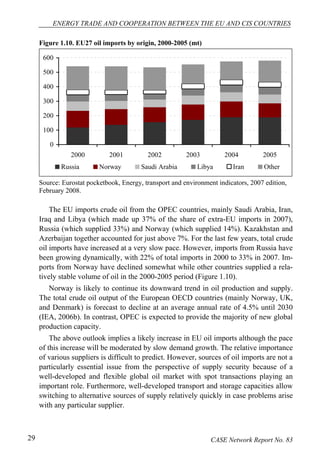
Figure 1.10. EU27 oil imports by origin, 2000-2005 (mt) 
600 
500 
400 
300 
200 
100 
0 
2000 2001 2002 2003 2004 2005 
Russia Norway Saudi Arabia Libya Iran Other 
Source: Eurostat pocketbook, Energy, transport and environment indicators, 2007 edition, 
February 2008. 
The EU imports crude oil from the OPEC countries, mainly Saudi Arabia, Iran, 
Iraq and Libya (which made up 37% of the share of extra-EU imports in 2007), 
Russia (which supplied 33%) and Norway (which supplied 14%). Kazakhstan and 
Azerbaijan together accounted for just above 7%. For the last few years, total crude 
oil imports have increased at a very slow pace. However, imports from Russia have 
been growing dynamically, with 22% of total imports in 2000 to 33% in 2007. Im-ports 
from Norway have declined somewhat while other countries supplied a rela-tively 
stable volume of oil in the 2000-2005 period (Figure 1.10). 
Norway is likely to continue its downward trend in oil production and supply. 
The total crude oil output of the European OECD countries (mainly Norway, UK, 
and Denmark) is forecast to decline at an average annual rate of 4.5% until 2030 
(IEA, 2006b). In contrast, OPEC is expected to provide the majority of new global 
production capacity. 
The above outlook implies a likely increase in EU oil imports although the pace 
of this increase will be moderated by slow demand growth. The relative importance 
of various suppliers is difficult to predict. However, sources of oil imports are not a 
particularly essential issue from the perspective of supply security because of a 
well-developed and flexible global oil market with spot transactions playing an 
important role. Furthermore, well-developed transport and storage capacities allow 
switching to alternative sources of supply relatively quickly in case problems arise 
with any particular supplier. 
29 CASE Network Report No. 83
Vladimer Papava, Sabit Bagirov, Leonid Grigoriev, et al. 
Over the last few years, the EU has also been increasing imports of petroleum 
products, the demand for which has been shifting away from gasoline toward diesel 
(as discussed in Section 1.1.3 above). At the same time, in the US, demand for 
gasoline has risen sharply. The European refining industry was unable to adjust to 
such rapid changes in demand structure. This acted as a driving force for substan-tial 
EU gasoline exports to the US and other markets and large volumes of diesel 
imports, especially from the CIS countries (mainly Russia). According to Eurostat 
data, in 2007, EU gasoline exports reached 43 mt (18 mt to the US), or around 40% 
of total petroleum product exports. In the same year, EU diesel oil imports reached 
30 mt (15 mt from Russia, 2 mt from Belarus), close to 30% of total petroleum 
product imports. Purvin and Gertz (2008) provide an in-depth discussion of this 
phenomenon. 
Summing up the discussion on potential sources of oil supply for Europe, one 
can make the following observations: 
• EU domestic output as well as oil imports from Norway are likely to de-cline, 
thus further increasing EU’s reliance on non-European sources; 
• OPEC is expected to see substantial gains in output and its share in EU 
crude oil imports will increase; 
• From the perspective of supply security, the diversification of oil import 
sources is much less important than in the case of natural gas. 
CASE Network Report No. 83 30
ENERGY TRADE AND COOPERATION BETWEEN THE EU AND CIS COUNTRIES 
2. Oil and gas in Russia 
Russia is a global supplier of energy sources and its exports are essential for en-suring 
global energy balance and stability both currently and in the long run. Rus-sia 
accounts for more than 12% of global oil production, about 22% of global natu-ral 
gas production and more than 5% of global coal production. It produces 10.3% 
of world’s primary energy (about 1.2 billion TOE in 2005, by IEA estimates), of 
which 45% is exported and 55% is consumed domestically (including energy-goods 
for export). Russia is the largest single supplier of energy resources to the 
European Union. 
In 2006, the primary energy supply almost reached 1990 levels, after a dramatic 
decline in 1990s with a slight increase of gas supply comparing to oil and coal. 
Russia needs to find a harmonized way to develop its energy sector to satisfy both 
the external and domestic demand for energy. Future decades will inevitably bring 
massive investments in the energy sector that should allow for maintaining and 
increasing production and transportation capacity. 
2.1. Current Trends of Gas and Oil Production and Exports 
During the 1990s, the domestic demand for energy in Russia declined dramati-cally. 
Between 1990 and 1997, GDP contracted by 43%. This was accompanied by 
an 11% drop in gas output, and a 41% decline in oil production. Since the start of 
the economic recovery in 1999, both internal and external demand for Russia’s en-ergy 
products increased again. 
On the domestic front, the supply of energy resources was determined by 
changes in economic rationality on a corporate level, uncertainty related to gov-ernment 
regulations and changes in taxation. During the 1990s, the transition-related 
output decline, structural changes in the economy and the energy sector, 
and low world energy prices were the main causes of declining production of en-ergy. 
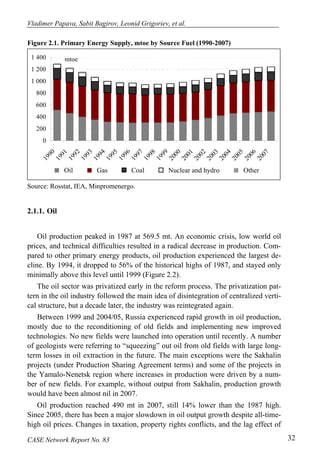
Primary energy supply was constantly decreasing for the first eight years of 
transition (from 1990 to 1997) (See Figure 2.1). 
31 CASE Network Report No. 83
Vladimer Papava, Sabit Bagirov, Leonid Grigoriev, et al. 
Figure 2.1. Primary Energy Supply, mtoe by Source Fuel (1990-2007) 
1 400 
1 200 
1 000 
800 
600 
400 
200 
0 
1990 
1994 
1993 
mtoe 
1991 
1992 
1995 
1997 
1996 
2001 
2000 
1999 
1998 
2004 
2003 
2002 
2005 
2007 
2006 
Oil Gas Coal Nuclear and hydro Other 
Source: Rosstat, IEA, Minpromenergo. 
2.1.1. Oil 
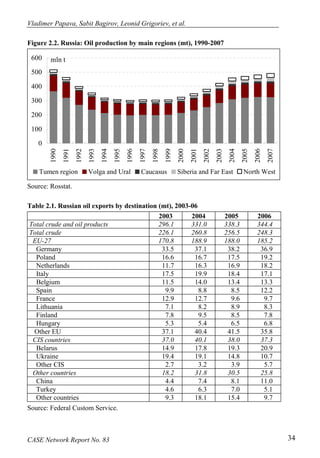
Oil production peaked in 1987 at 569.5 mt. An economic crisis, low world oil 
prices, and technical difficulties resulted in a radical decrease in production. Com-pared 
to other primary energy products, oil production experienced the largest de-cline. 
By 1994, it dropped to 56% of the historical highs of 1987, and stayed only 
minimally above this level until 1999 (Figure 2.2). 
The oil sector was privatized early in the reform process. The privatization pat-tern 
in the oil industry followed the main idea of disintegration of centralized verti-cal 
structure, but a decade later, the industry was reintegrated again. 
Between 1999 and 2004/05, Russia experienced rapid growth in oil production, 
mostly due to the reconditioning of old fields and implementing new improved 
technologies. No new fields were launched into operation until recently. A number 
of geologists were referring to “squeezing” out oil from old fields with large long-term 
losses in oil extraction in the future. The main exceptions were the Sakhalin 
projects (under Production Sharing Agreement terms) and some of the projects in 
the Yamalo-Nenetsk region where increases in production were driven by a num-ber 
of new fields. For example, without output from Sakhalin, production growth 
would have been almost nil in 2007. 
Oil production reached 490 mt in 2007, still 14% lower than the 1987 high. 
Since 2005, there has been a major slowdown in oil output growth despite all-time-high 
oil prices. Changes in taxation, property rights conflicts, and the lag effect of 
CASE Network Report No. 83 32
ENERGY TRADE AND COOPERATION BETWEEN THE EU AND CIS COUNTRIES 
lack of investments in exploring new fields were the main reasons of the decelera-tion 
in growth. 
Changes in production were accompanied by changes in sources of demand. In 
the early 1990s, more than a half of oil produced was domestically consumed. In 
2006, 70% of production (including oil products) was exported. This means that 
the oil sector has become more dependent on external demand and export transport 
infrastructure. 
Another implication is that domestic prices of oil products have become more 
dependent on world market prices especially with the unified natural resource pro-duction 
tax (UNRPT) and export duties linked to world prices. These taxes and 
duties gave a huge boost to government incomes, while limiting resources for in-vestments 
of oil companies. 
Therefore, in the absence of the formal regulation of oil product prices, there is 
a strong motivation to push domestic prices up as most of the export returns end up 
in the state budget. The actual pricing of individual oil products is strongly influ-enced 
by the structure of refining capacities. Most refining facilities are old and 
their productivity is below international levels. No new large refinery has been 
commissioned since 1991. 
There is also excessive distillation capacity and uneven geographical location. 
Thus, there is a fundamental mismatch between domestic demand for oil products 
and production capacities. These lead to higher prices on light products (like gaso-line) 
and lower prices on heavy products (like fuel oil). 
More than 70% of the refining capacity is controlled by vertically integrated 
companies. Therefore, there is strong governmental pressure on oil companies to 
limit price increases for gasoline and fuels. Major companies have developed 
strong retail networks and manage all the stages of the production and distribution 
chain so that they can control costs and pricing inside the chain. Due to public dis-content 
and government pressure, the major companies voluntarily capped prices 
of gasoline in 2005-07. 
Exports of crude oil reached a maximum of 260 mt in 2004 and then gradually 
declined, mainly thanks to tax and tariff policies which stimulated domestic refin-ing. 
Duties on oil product exports have been lower than for crude since 2004. 
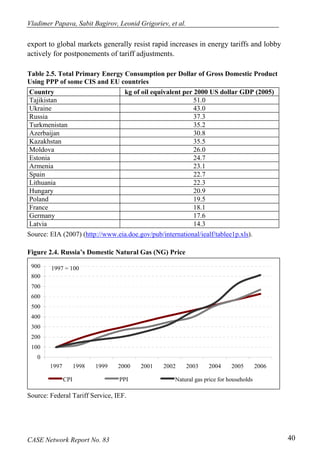
The EU market is the largest foreign market for Russian crude. In 2006, 185 mt 
(almost 75% of all crude oil exports) were supplied to the EU (Table 2.1). Exports 
to the CIS have been relatively stable at around 35-40 mt annually for the last few 
years. More than a half of CIS exports go to Belarus. Ukraine and Kazakhstan are 
also major recipient markets. 
33 CASE Network Report No. 83
Vladimer Papava, Sabit Bagirov, Leonid Grigoriev, et al. 
Figure 2.2. Russia: Oil production by main regions (mt), 1990-2007 
600 
500 
400 
300 
200 
100 
0 
mln t 
1990 
1991 
1992 
1993 
1994 
1995 
1996 
1997 
1998 
1999 
2000 
2001 
2002 
2003 
2004 
2005 
2006 
2007 
Tumen region Volga and Ural Caucasus Siberia and Far East North West 
Source: Rosstat. 
Table 2.1. Russian oil exports by destination (mt), 2003-06 
2003 2004 2005 2006 
Total crude and oil products 296.1 331.0 338.3 344.4 
Total crude 226.1 260.8 256.5 248.3 
EU-27 170.8 188.9 188.0 185.2 
Germany 33.5 37.1 38.2 36.9 
Poland 16.6 16.7 17.5 19.2 
Netherlands 11.7 16.3 16.9 18.2 
Italy 17.5 19.9 18.4 17.1 
Belgium 11.5 14.0 13.4 13.3 
Spain 9.9 8.8 8.5 12.2 
France 12.9 12.7 9.6 9.7 
Lithuania 7.1 8.2 8.9 8.3 
Finland 7.8 9.5 8.5 7.8 
Hungary 5.3 5.4 6.5 6.8 
Other EU 37.1 40.4 41.5 35.8 
CIS countries 37.0 40.1 38.0 37.3 
Belarus 14.9 17.8 19.3 20.9 
Ukraine 19.4 19.1 14.8 10.7 
Other CIS 2.7 3.2 3.9 5.7 
Other countries 18.2 31.8 30.5 25.8 
China 4.4 7.4 8.1 11.0 
Turkey 4.6 6.3 7.0 5.1 
Other countries 9.3 18.1 15.4 9.7 
Source: Federal Custom Service. 
CASE Network Report No. 83 34
ENERGY TRADE AND COOPERATION BETWEEN THE EU AND CIS COUNTRIES 
Exports to China have increased rapidly for the last few years (from 1.3 mt in 
2000 to 11mt in 2006) backed mainly by Rosneft contracts with CNPC16. Oil sup-plies 
to countries east of the CIS (including China) will continue to grow in the 
coming years as these markets are especially targeted by the Transneft state corpo-ration 
in new pipeline projects. 
There are three routes for Russian oil exports: via sea terminals - mainly Pri-morsk 
on the Baltic Sea and the Black Sea terminals (around 55% of exports), via 
the Druzhba pipeline which is connected directly to European consumers (30%), by 
rail and other modes (15%). 
2.1.2. Gas 
Compared to oil, natural gas production has seen much less volatility over the last 
15 years. At its lowest point (1997), gas production was only 10% lower than in 1990. 
In spite of GDP decline, electricity and especially natural gas consumption were 
more stable. The growing shift in the use of gas in the S&M private sector, house-holds, 
and the power sector secured demand in the 1990s. About 70% of produced 
gas is consumed domestically with more than a half being used by power plants, 10% 
by industry, 10% by household consumption and 9% by transport. 
While domestic consumption of oil halved between 1990 and 1998, gas con-sumption 
declined only by 13%. This was mainly determined by the increasing use 
of gas by domestic power plants, which were switching from expensive and “dirty” 
fuel oil to gas. Some support came from exports but this played only a limited role. 
The net gas exports stood at 160-180 bcm for the last 20 years without a significant 
decline or growth during this period. 
During 1997-2002, production was fairly constant at about 580-590 bcm annu-ally. 
Domestic gas consumption plays a more important role in energy balance than 
oil. 
Another major difference is that unlike oil prices, the domestic gas prices are 
still regulated. The remaining cheap gas has become a favorable energy source for 
both consumers and the power sector. However, the low level of domestic gas 
prices makes its sales hardly profitable. The break-even point in domestic gas trade 
was only reached in 2007. Gazprom is trying to raise domestic administrative 
prices as much as possible. 
16 Rosneft’ received a loan from CNPC in 2006 and is obliged to supply oil to China until 
2010. Oil is transported by rail with a discount tariff set by Federal Tariff Service to make 
these deliveries more competitive. There are plans to use the Atasu-Alashankou pipeline 
but there have been no actual supplies yet. 
35 CASE Network Report No. 83
Vladimer Papava, Sabit Bagirov, Leonid Grigoriev, et al. 
Looking at this sector from the supply side, a majority of gas fields were put 
into operation in the 1970-80s and thus in the 1990s they were still relatively new 
(when compared to major oil fields) with relatively modern equipment. Therefore, 
a lack of investments was not as destructive as in the other sectors of the energy 
industry. 
Gazprom (in which the state holds the majority of shares) is by far the largest 
gas producer, accounting for 84% of the national output in 200717. Other market 
players are big oil companies producing mainly associated gas as well as independ-ent 
producers (Novatek, Itera and others)18. Their share in total output has been 
rising slowly, at a rate that is largely determined by access to the Gazprom-owned 
pipeline system. 
Since 2003, gas production has been increasing at around 2% annually with the 
bulk of additional supplies being exported. Domestic output has been declining on 
the Volga and growing in the Caucasus and the East. (See Figure 2.3). In 2006, gas 
production in Russia grew by 2.4% with the help of independent gas suppliers and 
oil companies, while Gazprom did not expand production. In 2007, gas production 
decreased by 0.8% while Gazprom decreased its production by only 0.1%. It is be-lieved 
that the main reason for the decline was the warm weather in Russia and 
Europe which affected demand for gas. 
Figure 2.3. Russian gas production by main regions (bcm), 1990-2007 
660 
640 
620 
600 
580 
560 
540 
520 
500 
bcm 
1990 
1991 
1992 
1993 
1994 
1995 
1996 
1997 
1998 
1999 
2000 
2001 
2002 
2003 
2004 
2005 
2006 
2007 
Tumen region Volga and Ural Caucasus Siberia and Far East North West 
Source: Federal State Statistics Service. 
17 This share declined from over 90% at the end of the1990s. 
18 As Gazprom has an equity stake in Novatek and Itera (through Sibnefetegas) their “inde-pendent” 
status is questionable. However, this could also give them better terms of access 
to the pipeline system. 
CASE Network Report No. 83 36
ENERGY TRADE AND COOPERATION BETWEEN THE EU AND CIS COUNTRIES 
On the European market, the share of Russian gas has been declining steadily. 
For example, in 1990, Russia contributed to more than 66% of the EU-27’s gas 
import, yet in 2007 it was only 48%. 
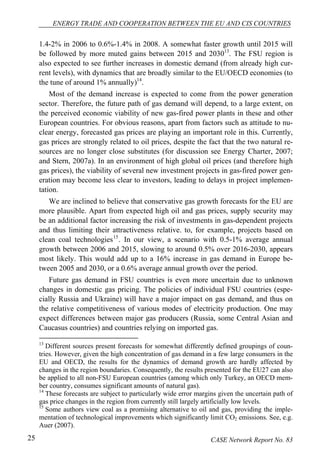
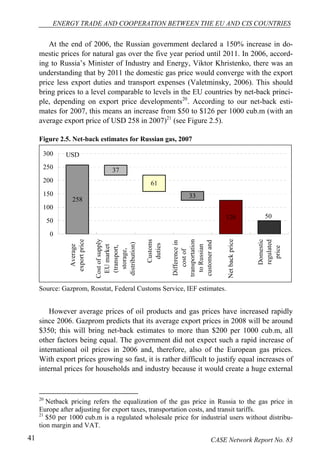
In the last few years, production began to decline in the three main fields of 
Gazprom in the north of the Tyumen region (the so-called Nadym-Pur-Taz area): 
Urengoy, Yamburg, Medvezhye. The growth of gas production is driven mainly by 
the Zapolyarnoe field (also in the Nadym-Pur-Taz area) which has a capacity of 
100 bcm, and the increased activity of independent producers. Gazprom does not 
disclose information on the production of separate fields so it is hard to estimate 
the distribution between “old” and “new” fields but there is strong evidence of a 
considerable Gazprom effort to slow down production decline in Nadymgazprom 
(Medevezhye and Komsomolskoe fields) and Urengoigazprom. Thus meaningful 
production growth can only be brought about by new investments. 
As previously noted, Russia exports some 30% of its gas with the majority 
(65% of exports) going to the EU and the CIS (20%). The rest of the exports are 
mainly directed at Turkey through the Blue Stream pipeline. 
The direction of gas exports has changed in the last few years with the share 
destined for the EU and Turkey growing and the share destined for the CIS declin-ing. 
A decrease of exports to the CIS region can be explained by price increases 
and changes in gas relations between Russia, Ukraine and Turkmenistan. Since 
around 2005-06, a major part of Ukrainian imports have been from Turkmenistan, 
which have been transported through Russian territory, while Russia supplies only 
a minor part of Ukraine’s imports. 
Supplies to traditional consumers of Russian gas in Europe, i.e. Germany and 
Italy, have remained stable for the last few years. Growth has been driven mainly 
by exports to Turkey and Eastern Europe and the beginning of exports to the UK 
(Table 2.2). 
There is an ongoing debate, both domestic and international, as to whether Gaz-prom 
has enough investments in gas production and whether or not Russia can 
keep its production levels in the long run at the current level or growing as its main 
fields progressively mature. For example, the head of the Institute of Energy Policy, 
Vladimir Milov, repeatedly pointed to grim output prospects which, combined with 
growing domestic and external consumption, could lead to serious deficits of gas as 
early as 2010. Other domestic observers are also expressing some concerns while 
they are explicitly sure that foreign long-term contracts will be honored under any 
circumstances. 
37 CASE Network Report No. 83
Vladimer Papava, Sabit Bagirov, Leonid Grigoriev, et al. 
Table 2.2. Export of gas by final consumer countries (bcm), 2000-2006 
2000 2001 2002 2003 2004 2005 2006 
Total 193.9 181.2 185.5 189.4 200.4 207.3 203.0 
EU-27 120.5 117.4 119.0 125.5 125.9 137.5 137.9 
Germany 34.1 32.6 31.0 29.4 31.3 32.6 34.4 
Italy 21.8 20.2 19.3 19.7 21.6 21.9 22.1 
France 12.9 11.2 11.4 11.2 13.2 13.2 10.0 
Hungary 6.6 8.1 9.1 10.4 9.3 9.0 8.8 
UK - - - 1.1 2.9 3.8 8.7 
Poland 7.0 7.5 7.2 7.4 6.3 7.0 7.7 
Czech Republic 7.5 7.5 7.4 7.4 6.8 7.4 7.4 
Slovakia 7.9 7.5 7.7 6.9 4.9 4.6 7.0 
Austria 5.1 4.9 5.2 6.0 6.0 6.8 6.6 
Romania 3.2 2.9 3.5 5.1 4.1 4.5 5.5 
Other EU 14.4 15.1 17.1 20.9 19.4 26.7 19.7 
CIS countries 60.0 49.2 51.3 47.3 55.1 47.5 41.1 
Belarus 17.1 17.3 17.6 18.1 19.6 20.1 20.8 
Ukraine 39.7 28.7 27.5 26.5 32.3 24.4 10.1 
Other CIS 3.1 3.3 6.2 2.7 3.2 3.0 10.2 
Other countries 13.3 14.5 15.2 16.6 19.4 22.3 24.0 
Turkey 10.3 11.1 11.8 12.3 14.5 18.0 19.9 
Other countries 3.1 3.4 3.4 4.3 4.9 4.3 4.1 
Source: Gazprom, Federal Custom Service. 
We also remain optimistic regarding Russian exports. Actual investments in the 
fixed capital of Gazprom have increased six fold since 2003 in nominal USD terms. 
Real growth is obviously lower but still quite impressive. Investments in fixed 
capital will continue to grow based on the company’s investment program. 
Table 2.3. Investments in fixed capital of Gazprom by main sectors (billion USD), 
2003-2007 
2003 2004 2005 2006 2007е 
Total 3.5 5.2 8.4 16.1 23.6 
Gas production 0.1 0.1 0.1 4.9 9.2 
Transportation 2.7 3.8 6.5 9.1 8.9 
Refining 0.2 0.4 0.6 0.8 1.7 
Distribution 0.3 0.3 0.7 0.8 2.3 
Other 0.2 0.5 0.5 0.5 1.4 
Source: Gazprom, IEF estimates. 
It is important to note that since 2006, there has been a strong shift in invest-ments 
from the transportation to the production segment. In 2007, fixed invest-ments 
(see Table 2.3) reached a record level of USD 23.6 billion. It is assumed that 
this level will increase in 2008 as the North Stream project pipeline will begin and 
CASE Network Report No. 83 38
ENERGY TRADE AND COOPERATION BETWEEN THE EU AND CIS COUNTRIES 
active development of Yamal and investments in Yuzhno-Russkoe fields will be 
continued. So investments in production increased from USD 4.9 billion in 2006 to 
USD 9.2 billion in 2007; they were actually almost nil until 2006. 
The estimated gas reserves of the main fields have remained unchanged for the 
last few years, in the range of 16.4-16.6 trillion cub.m. 
Table 2.4. Proven reserves19 by main fields (trillion cub.m), 2001-2006 
2001 2006 
Producing fields 16.7 16.4 
Urengoiskoye 5.6 5.3 
Yamburgskoye 4.2 3.8 
Zapolyarnoye 3.5 3.2 
Astrakhanskyoe 2.5 2.5 
Orenburgskoye 0.8 0.8 
Yuzhno-Russkoye - 0.8 
Fields under development 8.2 8.9 
Bovanenkovskoye 4.4 4.4 
Shtokmanovskoye 2.5 3.2 
Kharasaveiskoye 1.3 1.3 
Source: Gazprom. 
Since Soviet times, energy prices have been heavily subsidized in Russia. In the 
1990s, low energy prices and a tolerance of massive arrears for energy bills implied 
de facto soft budget constraints for households and enterprises. To put it simply, 
low energy prices helped households and companies survive during difficult times. 
But the opportunity costs of such subsidies have been rising with the growth in ex-port 
prices. Low prices also stimulated wasteful consumption and a lack of pro-gress 
in energy efficiency. The relatively low cost of energy resources, heavy in-dustry 
bias in the industrial structure of the economy, harsh economic conditions, 
soft budget constraints and the lack of incentives for improving energy efficiency 
are the main determinants of a relatively high level of energy intensity in Russia 
(Table 2.5). 
The current government policy in this field aims at a rapid increase (signifi-cantly 
above the level of CPI inflation) of energy domestic tariffs, particularly for 
gas where the difference between domestic and export prices is the biggest. Since 
2003, natural gas tariffs have been rising faster than CPI and PPI (See Figure 2.5). 
However, aluminum, chemical, fertilizers and other energy intensive industries that 
19 By national classification – A+B+C1. There is some mismatch between the international 
classification of the reserves of the UN (WPC/SPE/AAPG) and local classification from 
Soviet times. There are still no full estimates of Russian mineral resources in the interna-tional 
classification. 
39 CASE Network Report No. 83
Vladimer Papava, Sabit Bagirov, Leonid Grigoriev, et al. 
export to global markets generally resist rapid increases in energy tariffs and lobby 
actively for postponements of tariff adjustments. 
Table 2.5. Total Primary Energy Consumption per Dollar of Gross Domestic Product 
Using PPP of some CIS and EU countries 
Country kg of oil equivalent per 2000 US dollar GDP (2005) 
Tajikistan 51.0 
Ukraine 43.0 
Russia 37.3 
Turkmenistan 35.2 
Azerbaijan 30.8 
Kazakhstan 35.5 
Moldova 26.0 
Estonia 24.7 
Armenia 23.1 
Spain 22.7 
Lithuania 22.3 
Hungary 20.9 
Poland 19.5 
France 18.1 
Germany 17.6 
Latvia 14.3 
Source: EIA (2007) (http://www.eia.doe.gov/pub/international/iealf/tablee1p.xls). 
Figure 2.4. Russia’s Domestic Natural Gas (NG) Price 
900 
800 
700 
600 
500 
400 
300 
200 
100 
0 
1997 = 100 
1997 1998 1999 2000 2001 2002 2003 2004 2005 2006 
CPI PPI Natural gas price for households 
Source: Federal Tariff Service, IEF. 
CASE Network Report No. 83 40
ENERGY TRADE AND COOPERATION BETWEEN THE EU AND CIS COUNTRIES 
At the end of 2006, the Russian government declared a 150% increase in do-mestic 
prices for natural gas over the five year period until 2011. In 2006, accord-ing 
to Russia’s Minister of Industry and Energy, Viktor Khristenko, there was an 
understanding that by 2011 the domestic gas price would converge with the export 
price less export duties and transport expenses (Valetminsky, 2006). This should 
bring prices to a level comparable to levels in the EU countries by net-back princi-ple, 
depending on export price developments20. According to our net-back esti-mates 
for 2007, this means an increase from $50 to $126 per 1000 cub.m (with an 
average export price of USD 258 in 2007)21 (see Figure 2.5). 
Figure 2.5. Net-back estimates for Russian gas, 2007 
USD 
258 
126 
33 
61 
37 
50 
300 
250 
200 
150 
100 
50 
0 
Average 
export price 
Cost of supply 
EU market 
(transport, 
storage, 
distribution) 
Customs 
duties 
Difference in 
cost of 
transportation 
to Russian 
customer and 
Net back price 
Domestic 
regulated 
price 
Source: Gazprom, Rosstat, Federal Customs Service, IEF estimates. 
However average prices of oil products and gas prices have increased rapidly 
since 2006. Gazprom predicts that its average export prices in 2008 will be around 
$350; this will bring net-back estimates to more than $200 per 1000 cub.m, all 
other factors being equal. The government did not expect such a rapid increase of 
international oil prices in 2006 and, therefore, also of the European gas prices. 
With export prices growing so fast, it is rather difficult to justify equal increases of 
internal prices for households and industry because it would create a huge external 
20 Netback pricing refers the equalization of the gas price in Russia to the gas price in 
Europe after adjusting for export taxes, transportation costs, and transit tariffs. 
21 $50 per 1000 cub.m is a regulated wholesale price for industrial users without distribu-tion 
margin and VAT. 
41 CASE Network Report No. 83
Vladimer Papava, Sabit Bagirov, Leonid Grigoriev, et al. 
shock. We expect domestic gas prices to grow at about 20-25% annually in the 
coming years, but we do not expect them to reach net-back levels. 
If such a price increase did materialize, (even to $125 by 2010) this would im-ply 
that the relative attractiveness of export markets would diminish and become 
similar to the domestic market. Gazprom would be largely indifferent (at least 
theoretically) if faced with the choice of supplying gas domestically or for export. 
Domestic price increases are a factor of major importance which will affect any 
meaningful long-term forecasts of the development of the gas sector. This is be-cause 
energy saving and improving energy efficiency will become more attractive. 
The reaction of households and industry to price increases (price elasticity of gas 
demand) is uncertain and there are no trustworthy estimates. 
2.1.3. Transit Issues 
Russia plays an important role in the transit of Central Asian oil and gas. In par-ticular, 
significant volumes of gas from Turkmenistan are reaching Ukraine 
through the Russian territory. Russian oil reaches the EU and other markets mainly 
via the Baltic Sea and Black Seas. Russian gas reaches the EU markets via pipe-lines, 
mainly via Ukraine, and Belarus (Table 2.7). 
Table 2.6. Russian gas transit volumes and transit fees, 2001-2007 
2001 2002 2003 2004 2005 2006 2007 
Transit volume, bcm 
Ukraine 104 104 104 106 110 106 101 
Belarus 25 28 33 35 41 44 47 
Turkey (Blue Stream) - - 1 3 5 8 10 
Transit fees, $/1000 cub. m per 100 km 
Ukraine n/a n/a n/a n/a 1.1 1.6 1.6 
Belarus (Beltransgas) n/a n/a n/a n/a 0.8 0.8 1.5 
Source: Beltransgas, Ukrtransgas, Naftogas, Gazprom. 
Cooperation between Russia and transit countries has not been without prob-lems. 
The main conflicts regarding energy supplies in the region after 1991 took 
place between the Russian suppliers and Belarusian companies. Politically, the 
most difficult one occurred in 2007 and resulted in a complex deal on gas and oil. 
Gazprom reached the option of buying 50% of Beltransgas for $2.5 billion by 2010 
in equal annual installments of 12.5%22. This is an important step for an operational 
22 Gazprom’s stake in Beltransgas reached 25% in February 2008. 
CASE Network Report No. 83 42
ENERGY TRADE AND COOPERATION BETWEEN THE EU AND CIS COUNTRIES 
beachhead for transit. Belarusian companies retained relatively low prices for gas 
($100 per 1000 cub.m in 2007) and some reduced privileges for oil refineries in the 
form of increased customs duties. 
Russian relations with Ukraine related to gas transit issues have always been 
complicated due to involvement of political issues. Gas has been the only good 
traded between the two countries for which prices have not reflected market condi-tions 
(if the net-back price principle is applied as a benchmark). Before 2006, 
Ukraine received payments for Russian gas transit to the West in kind using gas 
(almost 20 billion cub.m annually). Implied price transit was very high by any 
standards. Essentially the idea of tying up transit and gas prices was in conflict 
with the Energy Charter Treaty23 regarding the separation of transit fees and prices 
of delivered goods (Chapter 7). The ECT was ratified by Ukraine in 1998. Russia, 
after signing in 1994, is making a point of following its main approach. Such a re-gime 
could go on in the early 2000s for reasons of low gas prices and low demand 
in the EU due to economic stagnation. However as soon as demand and prices went 
up, Gazprom began to avoid politically motivated low prices for gas and stop pay-ing 
extraordinarily high transit fees. 
Since 2006, Gazprom has been delivering Central Asian gas to the Ukrainian 
companies for the price of the original supplier plus the transit price through Rus-sia24 
(in the winter of 2008 some Russian gas was also delivered). Central Asian 
gas has been becoming more and more expensive with the price getting closer to 
the net-back (EU border) price. Political tensions can be expected to cease to exist 
once Ukrainian import gas prices are on par with EU import prices (netted back to 
the Ukrainian border), which might happen by 2009. The Russian side has also 
been continually voicing discontent about maintenance issues. There is substantial 
uncertainty regarding the technical conditions of Ukrainian pipelines, which may 
be a factor endangering the security of supply. 
Recently, Russia has been actively trying to diversify its gas export routes to the 
EU, promoting two large pipeline projects: Nord Stream (under the Baltic Sea) and 
South Stream (through the Black Sea). If implemented, these projects would de-crease 
Russia’s reliance on the current main transit countries, Ukraine and Belarus. 
The construction of these new pipelines may add to European energy security the 
same way as the Blue Stream helped to improve Turkey’s supplies in January 2008. 
At the same time, this will not help in the diversification of EU gas import sources. 
23 Energy Charter Treaty (ECT) is an international agreement on energy issues including 
trade, transit and investment. 
24 A lot of attention was given to the RossUkrEnergo, while it was more a buffer for Gaz-prom 
providing some way of rent sharing, and not actually affecting consumers. 
43 CASE Network Report No. 83
Vladimer Papava, Sabit Bagirov, Leonid Grigoriev, et al. 
2.2. Forecasts for Oil and Gas Production 
It is a difficult task to forecast energy trends in Russia as the energy sector faces 
a great deal of price uncertainty, from both the international and domestic point of 
view. If price differences diminish, the competition between export and domestic 
markets will increase. 
Forecasts of energy production are generally based on resource estimates. Com-pared 
to Soviet times, modern Russia witnessed a significant decrease in invest-ment 
in new fields exploration. Besides, the official information on reserves is still 
classified and not available to the public. These factors largely complicate building 
production forecasts as information on output potential varies substantially be-tween 
different sources. 
The latest official long-term forecasts for energy were developed in 2003 within 
the Energy Strategy. They were based on rather conservative assumptions and be-came 
obsolete by 2004. The 2006 actual production figures were closer to forecasts 
for 2010 in the optimistic scenario of the 2003 Strategy (See Table 2.8). 
Table 2.7. Russia’s Energy Output: Actual Data and Energy Strategy 2003 Forecasts 
(Optimistic Scenario) 
Russia Energy 2005 2006 Strategy – Optimistic Scenario 2005 2010 2020 
Oil, mt 470 480 445 490 520 
Gas, billion cub.m 641 656 615 665 730 
Coal, mt 298 309 280 330 430 
Electricity, TWh 952 991 935 1070 1365 
Source: Minpromenergo, Rosstat. 
In the Energy Strategy of Russia for the period through 2020, forecasted vol-umes 
of gas production differ considerably depending on assumptions of different 
socio-economic developments in Russia. In the optimistic scenario, gas production 
may amount to approximately 665 bcm in 2010, and would increase to 730 bcm in 
2020. In the moderate version, gas production is expected to reach 635 bcm in 
2010 and up to 680 bcm by 2020. In the case of the “pessimistic scenario”, Russian 
gas production will start declining in the near future and stabilize later at a level of 
555-560 bcm annually by 2010. 
Russia is experiencing broad (while not always public) domestic debate over its 
future course of development and the reconstruction of the energy sector. After 17 
years of using the fixed assets of the former Soviet Union, it is time for a reinvest-ment 
of its financial resources into infrastructure, exploration, upstream, down-stream 
and the electricity sectors. The next decade will play a crucial role in this 
CASE Network Report No. 83 44
ENERGY TRADE AND COOPERATION BETWEEN THE EU AND CIS COUNTRIES 
respect. Naturally, global oil prices and export proceeds will play a role in the de-velopment 
of the energy sector. The Energy Strategy of 2003 is set for a major re-vision 
(planned for approval at early 2009) and extension until 2030. 
2.2.1. Oil 
Although official forecasts for the Russian energy sector are still to come in the 
form of the updated Energy Strategy there are some estimates of future trends by 
the Institute of Energy Strategy under the Ministry of Industry and Energy. Based 
on their forecasts, oil production in 2010-2030 will grow more slowly (at 2-3% 
annually) than gas and coal. This trend will be caused mainly by production decline 
in the Volga-Ural region. By industry estimates, production in this region will de-crease 
by 30% from current levels by 2030. The production of West Siberia and 
Timano-Pechora provinces will stabilize in 2015-2020 and then will gradually de-cline. 
The main sources for growing output will be concentrated in East Siberia, the 
Lena-Tungus regions and the fields of the Far East. One of the first projects will be 
the Vankor oil field in Eastern Siberia which is developed by Rosneft. It is sched-uled 
to begin production in 2008, and will reach an output of 20 mt annually by 
2015. Domestic consumption of oil will grow by one third by 2030 and will ac-count 
for around 169 mt. 
Table 2.8. Forecast production and consumption of energy in Russia, 2005-2030 
2005 2010f 2015f 2020f 2025f 2030f 
Production 1,207 1,299 1,388 1,524 1,618 1,691 
Oil 470 510 530 550 565 570 
Gas 513 538 563 602 627 643 
Coal 142 156 162 195 222 245 
Other sources 82 94 133 176 203 232 
Net export 534 530 538 594 632 647 
Oil 342 360 375 390 401 400 
Gas 159 136 133 164 183 196 
Coal 30 31 24 23 34 34 
Other sources 3 3 6 17 15 17 
Primary consumption 673 768 850 929 986 1,044 
Oil 128 150 155 160 164 170 
Gas 353 402 429 438 445 448 
Coal 112 125 138 172 188 212 
Other sources 79 92 127 159 189 215 
Source: Institute of Energy Strategy. 
45 CASE Network Report No. 83
Vladimer Papava, Sabit Bagirov, Leonid Grigoriev, et al. 
There will be substantial changes in oil transport infrastructure including a large 
pipeline in the Eastern direction (Eastern Siberia – Pacific). The western direction 
will be influenced by the extension of the Baltic Transport System (BTS-2). Its 
capacity will be 50 mt and the final points will be Primorsk and/or the Ust’-Luga 
ports in Baltic sea. 
By the end of 2009, construction of the first leg of “Eastern Siberia – Pacific” 
oil pipeline is planned to be completed. Its capacity will be 30 mt while the capac-ity 
of the entire pipeline will be 80 mt. 30 mt are planned to be exported to China 
while the remaining volume will be delivered to the Primorye terminal for tanker 
shipping. For export to China, the pipeline branch is to be built from Skovorodino 
to Daqing (the length of 1030 km). 
The main factors driving future trends in oil production and exports are: 
• Changes in production geography. Production in the traditional regions of 
oil production in Europe and the Caucasus will continue decline while the 
production of West Siberia will stabilize. New centers of the oil industry 
will develop in the Eastern parts of the country. The new refining capacity 
will also concentrate more to the east; 
• Domestic consumption of oil products. Domestic consumption will grow 
rather fast especially in the transport sector. A further increase in the 
number of vehicles will boost demand for light products; 
• New transport infrastructure. Future projects include BTS-2 and the re-construction 
of the Primorsk port terminal, the Haryaga-Indiga pipeline, 
the Burgas-Alexandropolis pipeline with a capacity of 35 mt, the mod-ernization 
of the Caspian pipeline consortium (CPC) systems up to 67 mt 
and extension of the Aturau - Samara pipeline for an increase in the transit 
of Kazakh and Turkmen oil. Thus export channels will become more di-versified. 
2.2.2. Gas 
There is a high level of uncertainty and significant differences in the forecasts 
of future trends in the gas industry. For example, there is a major difference in the 
forecasts by world’s most authoritative sources – the International Energy Agency 
(IEA) and the US Department of Energy (DOE). The latter expects a tremendous 
growth in both production and exports by 2030 but it is not clear how these growth 
rates will be achieved on the supply side. The forecasts of the Institute of Energy 
Strategy and the IEA are close to each other and imply a modest growth in produc-tion. 
Thus there is a general consensus that Russia can sustain its current levels of 
CASE Network Report No. 83 46
ENERGY TRADE AND COOPERATION BETWEEN THE EU AND CIS COUNTRIES 
production and support moderate growth as new areas of production develop. Fu-ture 
export trends can be assessed by examining main production projects, domes-tic 
consumption and transport infrastructure projects and their directions. 
Table 2.9. Forecasts for Russian natural gas sector 2015-2030, bcm 
Institute of En-ergy 
Strategy 
(Russia, 2007) 
US Department of 
Energy (2007) 
International En-ergy 
Agency 
(2007) 
2015 2030 2015 2030 2015 2030 
Production 705 800 812 1 036 697 804 
Net export 167 244 280 420 194 222 
Gross inland consumption 538 556 532 616 503 582 
Source: IEA, EIA, Institute of Energy Strategy. 
In the long run, the Yamalo-Nenets region fields will remain the main base of 
gas production in Russia. It currently accounts for more than 90% of production 
but will decline in the future. On the other hand, growth in production will be pro-vided 
by new fields: 
• The Yuzhno-Russkoe fields. Due to the expanded difficulties of the main 
fields in 2007, Gazprom accelerated the development of the Yuzhno- 
Russkoe field to help sustain production levels. It is planned that the pro-duction 
of this field will reach 15 bcm in 2008 and 25 bcm by 2009. This 
field is developed together with BASF, which has a 35% equity stake in 
the project; 
• Yamal. At the end of 2007, Gazprom approved the Yamal peninsula de-velopment 
program. Under the base scenario, production of the 
Bovanenkovo field will start by 2012 with 15 bcm. The project will reach 
its capacity of 115 bcm/year by 2016-2017. The development will require 
massive investments in expanding the transport infrastructure system; 
• The Shtokman offshore field will be developed with the help of Total 
(25% of equity stake in operator company) and Norsk Hydro (24%). The 
first phase of the project assumes the beginning of production of 23.7 bcm 
by 2013 and LNG production by 2014. Gas from Shtokman will supply 
the Nord Stream pipeline; 
• Caspian offshore fields; 
• Sakhalin offshore fields. 
The main planned new transport routes involve: 
• Nord Stream; 
• South Stream; 
47 CASE Network Report No. 83
Vladimer Papava, Sabit Bagirov, Leonid Grigoriev, et al. 
• Blue Stream-2, which is a branch of the existing Blue Stream aimed 
mainly at the Israeli market. 
As we can see, most of the planned projects in gas production and transporta-tion 
are aimed at domestic and EU markets. Gazprom has strategic plans to supply 
China in the foreseeable future, but this all depends on the agreed upon export 
price and Chinese domestic gas infrastructure investments. At present, there is no 
agreement with China on export prices and this is contributing to the delay in the 
development of the Kovykta project. 
Gas from the Sakhalin projects will be processed to LNG and its final consum-ers 
will likely be in Japan and South Korea. Therefore the EU will continue to be 
the main foreign consumer of Russian gas in the long term. All new Gazprom pro-jects 
are being developed in partnership with European companies – Eni, BASF, 
Total, Norsk Hydro, EON Ruhrgas and others. Close ties and mutual financial in-terests 
will ensure European interests in these projects. 
CASE Network Report No. 83 48
ENERGY TRADE AND COOPERATION BETWEEN THE EU AND CIS COUNTRIES 
3. Caspian Oil and Gas 
The Caspian countries (Kazakhstan, Azerbaijan, Turkmenistan and Uzbekistan) 
are substantial energy producers supplying both Europe and Asia with oil, oil 
products and natural gas25. 
The EU and other countries are interested in alternative sources of oil and gas. 
Therefore, from the very beginning, they have been interested in getting access to 
Caspian energy resources and creating alternative pipelines for their transportation. 
This, in turn, has ensured a large inflow of foreign direct investments into countries 
producing oil and gas or transporting these resources through their territories via 
pipelines. 
3.1. Current Trends of Gas and Oil Production and Demand 
The early 1990s witnessed a significant decline in oil output in the Caspian 
countries, but since the second half of the 1990s, this region has witnessed a strong 
rebound, particularly in the cases of Kazakhstan and Azerbaijan (Figure 3.1). 
During the 1990-2006 period, gas extraction increased in Kazakhstan (3.6 times) 
and in Uzbekistan (by 45%). It declined in Azerbaijan (by 32%) and Turkmenistan 
(by 25%). In Russia, gas production remained approximately at previous levels 
(see Chapter 2). Turkmenistan witnessed particularly volatile production patterns 
with a rapid decline in production between 1993 and 1994, and then again between 
1996 and 1997-98, with exports dropping to 1.8 bcm from 70 bcm in 1991. It re-corded 
a sharp increase until 2003 and gradually increased thereafter (in 2005-06). 
However, in 2006, its production remained 20% below the early 1990s level. The 
production crisis of 1998 was caused by a pricing dispute with Russia. As a result, 
Russia denied Turkmenistan access to the Central Asia Centre pipeline, which was 
25 Strictly geographically, the group of Caspian countries covers Azerbaijan, Kazakhstan, 
Iran, Russia Turkmenistan and Uzbekistan. For purpose of this paper, the term “Caspian 
countries” will be used in respect to Azerbaijan, Kazakhstan, Uzbekistan and Turkmeni-stan. 
Data on Russia (see Chapter 2) refer to production of energy on its whole territory. 
49 CASE Network Report No. 83
Vladimer Papava, Sabit Bagirov, Leonid Grigoriev, et al. 
the only export route out of Turkmenistan at that time. This was one of the first 
examples of energy disagreements between Russia and Turkmenistan which made 
a huge impact on energy trade relations in the Caspian basin which have lasted 
through today. 
Figure 3.1. Oil output in major CIS producing countries, 1991-2007 (mt) 
70 
60 
50 
40 
30 
20 
10 
0 
1991 
1992 
1993 
1994 
1995 
1996 
1997 
1998 
1999 
2000 
2001 
2002 
2003 
2004 
2005 
2006 
2007 
700 
600 
500 
400 
300 
200 
100 
0 
Kazakhstan Azerbaijan Turkmenistan 
Uzbekistan Russia (rhs) 
Note. The scale for Russia (right vertical axis) is ten times larger than for the other coun-tries. 
Source: BP (2008). 
Figure 3.2. Gas output in Major CIS producing Countries, 1991-2007 (bcm) 
80 
70 
60 
50 
40 
30 
20 
10 
0 
1991 
1992 
1993 
1994 
1995 
1996 
1997 
1998 
1999 
2000 
2001 
2002 
2003 
2004 
2005 
2006 
2007 
800 
700 
600 
500 
400 
300 
200 
100 
0 
Kazakhstan Azerbaijan Turkmenistan 
Uzbekistan Russia (rhs) 
Note. The scale for Russia (right vertical axis) is ten times larger than for other countries. 
Source: BP (2008). 
CASE Network Report No. 83 50
ENERGY TRADE AND COOPERATION BETWEEN THE EU AND CIS COUNTRIES 
Central Asia’s decline in oil and gas production in 1990s can be explained by the 
hardships of the transition period, particularly the lack of new investment. Only at the 
end of the 1990s did the inflow of foreign investments enable the Caspian countries 
to considerably increase their extraction of both oil and gas. Overall, oil and gas pro-duction 
increased by 87% in the countries of Central Asia and Azerbaijan between 
1990 and 2006. At the same time, aggregate consumption of oil in these countries 
declined by 30.5% while gas consumption increased by 33.1%. 
Taken together, these trends indicate a much faster growth of oil and gas pro-duction 
than domestic demand for these resources, increasing the export potential 
of the region. This has been possible thanks to foreign investments in the sector 
and the establishment of new relations between the countries importing and export-ing 
energy. 
Thus, the share of individual countries in the total oil and gas production of 
Caspian countries (Russia included) changed between 1990 and 2006. Oil produc-tion 
in Azerbaijan increased from 12.5 to 32.5 mt and its share increased from 2.2 
to 5%. In Kazakhstan, oil production increased from 25.8 to 66.1 mt., i.e. from 4.6 
to 11%, while in Russia, production decreased from 515.9 to 470 mt and its share 
was reduced from 91.7 to 82%. (See Figures 3.3-3.4). 
Figure 3.3. Oil Production in Caspian Countries without Russia, 1990 and 2007 
Oil production, 1990 (Mt) 
Uzbekis 
Turkme tan; 2.8 
nistan; 
5.3 
Kazakh 
stan; 
25.8 
Azerbai 
jan; 
12.5 
Oil production, 2007 (Mt) 
Turkme 
nistan; 
9.8 
Kazakhs 
tan; 68.7 
Azerbaij 
an; 42.8 
Uzbekis 
tan; 4.9 
Source: BP (2008). 
Uzbekistan’s share of total gas production of the Caspian region (including 
Russia) increased from 5 to 7% (from 38.1 bcm to 55.4 bcm). Kazakhstan’s in-creased 
from 1 to 3% (from 6.6 bcm to 23.9 bcm), while Turkmenistan’s share de- 
51 CASE Network Report No. 83
Vladimer Papava, Sabit Bagirov, Leonid Grigoriev, et al. 
creased from 11 to 8% (from 81.9 bcm to 62.2 bcm). Russia’s share remained at 
the level of 80-82% (598-612 bcm). (See Figure 3.5). 
Figure 3.4. Oil Production in Caspian Countries and Russia (1990 and 2007) 
Oil production, 1990 (Mt) 
Azerbai 
jan; 
12.5 
Turkme 
nistan; 
5.7 
Kazakh 
stan; 
25.8 Uzbeki 
Russia; 
515.9 
stan; 
2.8 
Oil production, 2007 (Mt) 
Kazakh 
stan; 
68.7 
Azerbai 
jan; 
42.8 
Uzbeki 
stan; 
4.9 
Russia; 
491.3 
Turkme 
nistan; 
9.8 
Source: BP (2008). 
Figure 3.5. Gas Production in Caspian Countries and Russia, 1990 and 2007 
Gas production, 1990 (Bcm) 
Uzbeki 
stan; 
Turkme 
nistan; 
81.9 
Kazakh 38.1 
stan; 
6.6 
Russia; 
597.9 
Azerbai 
jan; 9.2 
Gas production, 2007 (Bcm) 
Uzbeki 
stan; 
58.5 
Kazakh 
stan; 
27.3 
Turkme 
nistan; 
67.4 
Russia; 
607.4 
Azerbai 
jan; 
10.3 
Source: BP (2008). 
Kazakhstan is the largest oil producer in the region after Russia. Its share in re-gional 
production (Russia excluded) increased from 55 in 1990 to 64% in 2006. 
Azerbaijan comes in next with a share of 27% in 1990 and 29% in 2006. 
CASE Network Report No. 83 52
ENERGY TRADE AND COOPERATION BETWEEN THE EU AND CIS COUNTRIES 
As for gas production, Turkmenistan’s share was reduced from 60 to 43% and it 
is expected to keep the leading role thanks to large reserves. Uzbekistan follows as 
the next largest gas producer. However, while Uzbekistan’s internal consumption 
absorbs 78% of gas production, Turkmenistan exports three quarters of its gas pro-duction 
(See Figure 3.6). 
Figure 3.6. Gas Production in Caspian Countries without Russia (1990, 2007) 
Gas production, 1990 (Bcm) 
Kazakh 
stan; 
6.6 
Azerbai 
jan; 9.2 
Uzbeki 
stan; 
38.1 
Turkme 
nistan; 
81.9 
Gas production, 2007 (Bcm) 
Kazakh 
stan; 
27.3 
Azerbai 
jan; 
Uzbeki 10.3 
stan; 
58.5 
Turkme 
nistan; 
67.4 
Source: BP (2008). 
Oil consumption was reduced almost by a half in 1990-2006 in Kazakhstan, 
Azerbaijan and Russia together. It only increased in Turkmenistan by 11.8%. 
Uzbekistan continues to import oil to meet its internal needs, but thanks to the 
growth of its internal output, the share of imported oil was reduced almost two-fold 
and the share of gas export increased. While Uzbekistan was consuming 96.6% of 
internally produced gas, in 2006 this rate was reduced to 79 %. Consumption in-creased 
from 36.6 bcm in 1990 to 43.2 bcm in 2006 due to the growth of gas ex-traction. 
However, Uzbekistan continues to consume most of its gas output domes-tically. 
The rate of domestic consumption was considerably reduced in Kazakhstan – 
from 189.4% of total gas production in 1990 to 84.5% in 2006. In Russia, during 
the same period this rate remained unchanged (about 70-72%). 
At present, the countries of the Caspian do not account for a large share of 
world oil and gas production. However, their confirmed reserves, together with the 
perspective of the development of transport infrastructure in the region may enable 
them to increase this share. In 2006, Azerbaijan’s share was 0.8% of world oil pro-duction. 
Kazakhstan’s share was 1.7%. 
53 CASE Network Report No. 83
Vladimer Papava, Sabit Bagirov, Leonid Grigoriev, et al. 
Table 3.1. Oil production, consumption and export, 2006 (mt) 
Oil production Oil consumption Oil exports 
Azerbaijan 32.5 4.7 23.4 
Kazakhstan 66.1 10.6 54.5 
Turkmenistan 8.1 5.2 n/a 
Uzbekistan 5.4 6.9 n/a 
Total 112.1 27.4 n/a 
Source: BP, countries’ state statistical departments. 
Table 3.2. Gas production, consumption and export, 2006 (bcm) 
Gas production Gas consumption Gas export 
Azerbaijan 6.3 9.6 0.65 
Kazakhstan 24.6 20.2 7.80 
Turkmenistan 62.2 18.9 48.50 
Uzbekistan 55.4 43.2 12.60 
Total 148.5 91.9 69.55 
Source: BP, countries’ state statistical departments. 
Between 1990 and 2006, total oil production in Caspian countries (without Rus-sia) 
increased more than two-fold, reaching 112.1 mt. During the same period, gas 
production increased minimally from 135.8 bcm to 148.5 bcm (BP, 2008). Taking 
into consideration the potential resources and production capacity of energy, we 
may conclude that this tendency will continue in the future. 
Estimates show that the total volume of exports, with the account of confirmed 
reserves and the expected level of domestic consumption, may amount to 4.9 bil-lion 
tones of oil and 5.5 trillion cub.m of natural gas in the next 40 years. The an-nual 
export potential of the Caspian countries may reach levels of 150-170 mt of 
oil and 120-140 bcm of gas by 2015. These volumes may be even higher in 2020. 
However, this will depend on the size of investment into oil and gas projects and 
pipelines, the economic and political situation in the region as well as a number of 
other factors. 
3.2. Oil and Gas Forecast 
Prospective reserves of Caspian oil are concentrated mainly offshore of Azer-baijan 
and Kazakhstan. Potential gas reserves may be located offshore of Turk-menistan. 
26 
26 Russia has limited offshore reserves. 
CASE Network Report No. 83 54
ENERGY TRADE AND COOPERATION BETWEEN THE EU AND CIS COUNTRIES 
3.2.1. Azerbaijan 
It is estimated that in Azerbaijan, the volume of residual extractable reserves 
amounts to 1,130 mt of oil and condensate and to 820 bcm of natural gas. The main 
proven oil reserves are concentrated in the Azeri-Chirag-Guneshli deposit while 
natural gas reserves are in the Shah Deniz deposit. According to BP, the proven 
reserves of gas amount to 1.35 trillion cub.m and 1 billion tonnes of oil (BP, 2007). 
However, some optimistic calculations estimate oil reserves in the Azerbaijani sec-tor 
of the Caspian at 5.3 billion tonnes and natural gas at 1.85 trillion cub.m (Cohen, 
2006). 
3.2.2. Kazakhstan 
Kazakhstan is a country with substantial hydrocarbon reserves. Overall, up to 
3.3% of explored and proven world reserves belong to this country. At the end of 
2007, there were estimated to be roughly 5.3 billion tonnes of oil (BP, 2008). 
Natural gas has been found in less than two dozen deposits. The Amangalgy 
and Shagirli-Shomyshty fields and the Imashevskoye gas-liquids field are the best 
known (Smirnov, 2006). The proven reserves of natural gas in Kazakhstan amount 
to approximately 1.9 trillion cub.m (BP, 2008), while probable reserves, including 
those beneath the Caspian, are in the range of 8 to 8.5 trillion cub.m. Over 70% of 
total gas reserves are accompanying gas, which is extracted out of the hydrocarbon 
deposits known as Tengiz, Kashagan and Karachaganak. Instead of processing the 
accompanying gas into a commercial commodity, it is more profitable to inject the 
extracted accompanying gas back into the wells, thereby increasing the rate of res-ervoir 
recovery. Therefore, the usable reserves of gas are smaller than those offi-cially 
reported (Glumskov, 2006). 
Estimates of total recoverable hydrocarbon reserves, both onshore and offshore, 
vary between 9 and 40 billion barrels (i.e. 1.2-5.5 billion tonnes) of oil and 2.8 tril-lion 
cub.m of natural gas, putting the country on par with Turkmenistan (EIA, 
2008). 
3.2.3. Turkmenistan 
Turkmenistan has a small amount of proven oil reserves estimated at around 82 
mt (BP, 2008; EIA, 2005). Other sources largely agree with these estimates. Turk-menistan 
is the main exporter of natural gas in Central Asia. In terms of the volume 
55 CASE Network Report No. 83
Vladimer Papava, Sabit Bagirov, Leonid Grigoriev, et al. 
of proven reserves, Turkmenistan is 13th place in the world and is second (after 
Russia) among the CIS countries. In 2006, Turkmenistan was 10th in the world in 
terms of volume of extracted gas and ranked 4th in terms of volume of gas exports. 
Its proven reserves of gas are about 2.67 trillion cub.m (BP, 2008). 
More optimistic estimates come from the representatives of Turkmengeology, a 
state-owned geological exploration corporation, who place the combined initial 
hydrocarbon reserves of Turkmenistan at 45 billion tonnes, with the recoverable 
equivalent valued at 30 billion tonnes (Oil and Gas Reserves of Turkmenistan, 
2006). Mr. Nazar Suyunov, the former vice-president of Turkmenistan, stated that 
the economically recoverable gas reserves of the country were in the range of 2.6 
and 2.8 trillion cub.m (Suyunov, 2006), which is similar to the EIA and BP esti-mates. 
3.2.4. Uzbekistan 
The proven natural gas reserves of of Uzbekistan totaled around 1.8 trillion 
cub.m as of the end of 2004 (Ziadullaev, 2006; BP, 2008). The estimated hydro-carbon 
reserves amounted to 5.9 trillion cub.m of natural gas, 81.7 mt of oil, and 36 
mt of gas liquids at the outset of 2006 (Uzbekistan has Calculated its Natural Gas 
Reserves, 2006). 
The corresponding forecast for 2004-2020 looks as follows: an annual increase 
in hydrocarbon reserves will make up 75–112 mt of standard fuel, while the com-mercially 
viable deposits of natural gas is set to grow by 60–85 bcm per year (As-rorov, 
2006). Uzbekistan’s oil reserves are estimated at 82 mt. This amount is con-sistent 
with the BP forecasts (BP, 2008). 
3.2.5. The Consolidated Oil Reserves of Azerbaijan, Kazakhstan, 
Turkmenistan and Uzbekistan 
According to BP’s analysis, the total volume of confirmed oil reserves of Azer-baijan, 
Kazakhstan, Turkmenistan and Uzbekistan was 6.7 billion tonnes and the 
total volume of confirmed reserves of natural gas was 7.6 trillion cub.m as of the 
end of 2007 (BP, 2008), which amount to 3.8% of global oil and 4.3% of global 
gas deposits27. 
27 A review of different government and non-government sources reveals inconsistency in 
the estimates of the Caspian hydrocarbon wealth. Government estimates are generally more 
optimistic than non-government forecasts. This can be explained by governments’ desire to 
CASE Network Report No. 83 56
ENERGY TRADE AND COOPERATION BETWEEN THE EU AND CIS COUNTRIES 
Table 3.3. Proved Reserves of Oil and Natural Gas 
Country Confirmed oil reserves at the 
end of 2006, thousand mt 
Confirmed natural gas reserves 
at the end of 2007, trillion cub.m 
Azerbaijan 1.0 1.28 
Kazakhstan 5.3 1.90 
Turkmenistan 0.1 2.67 
Uzbekistan 0.1 1.74 
Total: 6.4 7.59 
Source: BP (2008). 
Thus, one can conclude that the confirmed oil reserves in the analyzed region 
are sufficient enough to continue extraction at 2006 levels for the next 75 years, 
and natural gas reserves are sufficient enough to extract for the next 63 years. 
However, taking into account the large-scale international contracts related to de-veloping 
the hydrocarbon deposits which have already been signed by the Caspian 
countries (with a duration of 25-30 years), and the rapid growth of domestic con-sumption, 
one can assume that the analyzed region will remain an important sup-plier 
of hydrocarbon resources to world markets for at least the next 35-40 years. 
Figure 3.7. The Global Oil Reserves by Geographical Distribution 
Kazakh 
stan 
33.0% 
Azerbai 
jan 
5.8% 
Uzbeki 
stan 
0.5% 
Turkme 
nistan 
0.5% 
Russian 
Federat 
ion 
60.3% 
Caspian 
3.9% 
Africa 
9.7% 
Europe 
& 
Eurasia 
8.1% 
Middle 
East 
61.4% 
S.& 
Central 
America 
8.6% 
North 
America 
5.0% 
Asia 
Pacific 
3.4% 
Source: (BP, 2008). 
attract foreign investments as well as draw geopolitical attention from the outside world. In 
addition, the ongoing dispute on the legal status of the Caspian Sea (between the Caspian 
countries) further slows down exploration works in this region. Depending on the outcome 
of this dispute, the volume of hydrocarbon resources assigned to each individual country 
may vary significantly. 
57 CASE Network Report No. 83
Vladimer Papava, Sabit Bagirov, Leonid Grigoriev, et al. 
In total, the proven recoverable oil reserves of the region constitute around 4 
billion tonnes, which is equivalent to just 2.6% of the global crude oil stock. On a 
global scale, that is comparable with the consolidated reserves in the Northern Sea, 
but 25-50 times less than the aggregate reserves of the Middle East, which is home 
to two thirds of the proven hydrocarbon wealth in the world (Vatsganov & 
Michailov, 2005). 
Figure 3.8. The Global Gas Reserves by Geographical Distribution 
Azerbai 
jan 
15% 
Uzbeki 
stan 
21% 
Kazakh 
stan 
33% 
Turkme 
nistan 
31% 
Asia 
Pacific 
8.2% 
S.& 
Central 
America 
3.8% 
Africa 5.0% 
7.8% 
Europe 
& 
Eurasia 
30.3% 
Middle 
East 
40.5% 
Caspian 
North 
America 
4.4% 
Source: (BP, 2008). 
CASE Network Report No. 83 58
ENERGY TRADE AND COOPERATION BETWEEN THE EU AND CIS COUNTRIES 
4. Transportation Choices and 
Competition of Alternative 
Pipelines 
While importing countries tend to diversify their supply sources, exporting 
states try to do the same in respect to their hydrocarbons, i.e. crude oil, natural gas 
and petroleum products. In both cases, diversification policies are driven by exist-ing 
geopolitical paradigms. 
There are various ongoing projects related to transporting Caspian oil and gas to 
Europe. One route, the most important in terms of volumes of gas and oil trans-ported 
to the EU, goes via Russia. The other one goes via Azerbaijan, Georgia and 
Turkey, and transports most of Azerbaijan’s oil and, since 2007, has been trans-porting 
a small portion of its gas export as well. 
4.1. Oil and Gas Pipelines 
Main transportation routes in operation are presented in the Table 4.1. 
Since the Caspian Sea is land-locked, oil delivered to the ports of Azerbaijan 
and Russia is then transported to the Black Sea ports of Novorossiysk, Batumi, Poti 
and Kulevi via either the existing oil pipelines (Makhachkala-Novorossiysk, Baku- 
Supsa, Baku-Novorossiysk) or via Azerbaijan and Georgia’s railway systems. Al-ternately, 
it is transported to the Turkish port in Ceyhan via the Baku-Tbilisi- 
Ceyhan (BTC) route. Oil products from Kazakhstan and Turkmenistan are also 
transported to the same ports on the Black Sea by railway. 
On January 24, 2007, Kazmunaygaz and the contractors in charge of the devel-opment 
of the Kashagan and Tengiz oil fields signed a Memorandum of Under-standing 
regarding building the Kazakhstan Caspian Transportation System. It aims 
at ensuring the transport of the growing amounts of oil exports via the Caspian Sea. 
It was decided that oil would be transported via the Eskene – Kurik – Baku – Tbi-lisi 
– Ceyhan route. This implies building the Eskene – Kurik oil pipeline. The 
59 CASE Network Report No. 83
Vladimer Papava, Sabit Bagirov, Leonid Grigoriev, et al. 
Trans-Caspian Transportation System will include oil discharge terminals along the 
Caspian coast of Kazakhstan, a tanker fleet, oil-loading terminals on the Caspian 
coast of Azerbaijan, and integration with the Baku-Ceyhan pipeline infrastructure. 
In this project, the Kazakh system will be able to ship 25 mt of crude oil per year, 
with a possible future expansion of up to 38 mt. The project is expected to be com-pleted 
by 2010-2011. We should mention that, once this plan is implemented, it 
will fully fill the Baku-Ceyhan pipeline which has a total annual capacity of 50 mt. 
In order to secure the transit of Azeri and Kazak surplus oil to the Black Sea ports, 
an upgrade of the South Caucasus railway infrastructure will be required. In 2007, 
the GUEU Consortium moved forward on the so-called Georgia-Ukraine- 
European Union (GUEU) pipeline project, which is to connect Georgia and 
Ukraine under the Black Sea. The plan is to bring Caspian oil to the EU market. 
Table 4.1. Oil Pipelines 
Total capacity, 
thous. barrels per 
day 
Total capacity, 
thous. tonnes per 
day 
Length, 
km 
Baku (Azerbaijan) – Tbilisi (Geor-gia) 
– Ceyhan (Turkey); 1,000 136 1,768 
Baku (Azerbaijan) – Novorossiysk 
(Russia); 115 15.6 1,475 
Baku (Azerbaijan) – Supsa 
(Georgia); 115 15.6 837 
Atyrau (Kazakhstan) – Samara 
(Russia); 300 40.9 697 
Tengiz (Kazakhstan) – 
Novorossiysk (Russia); 560 (1st line) 76.3 (1st line) 1,510 
Shimkent (Kazakhstan) – Chardzhou 
(Turkmenistan through Uzbekistan); 140 19.0 n/a 
Atasu (North-West Kazakhstan) – 
200 (initial), 400 
27.8 (initial), 54.5 
Alashkanou (Xinjiang, China); 
(budgeted) 
(budgeted) 960 
Neka (Iran) – Tehran (Iran). 175 23.8 350 
Turkmenistan – Afghanistan – 
Pakistan (Gvadar) n/a n/a 
Source: EIA, BP, Cohen, 2006. 
On March 15, 2007, Russia, Bulgaria, and Greece signed an intergovernmental 
agreement to build the Trans-Balkan Oil Pipeline, Burgas-Alexandropoulos (B-A), 
which will originate in the Bulgarian Black Sea port of Burgas and end at Alexan-droupolis 
on the Greek Aegean coast. The pipeline will carry 35 mt of oil annually 
in the first phase, and will expand to 50 mt in the second phase. The pipeline will 
carry oil mainly from the Russian Black Sea ports to the Aegean Sea for shipment 
CASE Network Report No. 83 60
ENERGY TRADE AND COOPERATION BETWEEN THE EU AND CIS COUNTRIES 
by tankers. This pipeline will lengthen the Caspian Pipeline Consortium’s (CPC) 
line from Kazakhstan to Russia’s Black Sea port of Novorossiysk. It poses a direct 
challenge to the Trans-Caspian oil transport projects. The Burgas-Alexandroupolis 
line will also divert the Caspian oil volumes necessary to supply the Odessa-Brody 
pipeline in Ukraine and its possible extension into Plock (Poland), which is an EU-supported 
project. 
During the 2007 Cracow summit, Azerbaijan stated its interest to join the 
Odessa Brody-Gdansk pipeline to ship Caspian oil. The Ukraine-Poland pipeline 
would be an alternative for Caspian oil transportation to the EU. 
Table 4.2. Existing gas pipelines 
Total capacity, bcm Length, km 
Central Asia – Centre (CAC) 45 
Total length on the terri-tory 
of Turkmenistan is 
3,940 km. 
Baku-Tbilisi-Erzurum (BTE) or the 
South Caucasus Pipeline (SCP) 16 1,070 
Buchara – Ural 5 4,500 
Korpeje-Kort-Kuy (ККК) 
(Turkmen-Iranian) 13 200 
Таshkent-Bishkek-Аlmaty (ТBА) 22 371 
Sources: EIA, BP, Kaztransgas, also Cohen, 2006. 
The Central Asia – Center (CAC) gas-pipeline network is the most important 
gas transportation route from the Caspian basin to Europe. The construction of this 
pipeline started in the late 1960s and was completed in the early 1980s. Now the 
CAC is an extensive web with threads on the territory of Kazakhstan, Uzbekistan 
and Turkmenistan. The ending point of the CAC is the “Aleksandrov Gay” com-pressor 
station on Kazakhstan’s border with Russia. Central Asian gas enters the 
Gazprom system of pipelines through the Central Asia – Center gas-pipeline net-work. 
The transport capacity of this pipeline is 45 bcm per year, and there are plans 
to increase it in the future (Strategic Research Foundation, 2006). 
4.2. Competition 
The Caspian countries have considerable hydrocarbon reserves. However, their 
production and export potential is limited by transportation infrastructure, in par- 
61 CASE Network Report No. 83
Vladimer Papava, Sabit Bagirov, Leonid Grigoriev, et al. 
ticular to EU markets. Thus, the question of how to get oil and gas from the Cas-pian 
Region to international markets is a top priority. 
At present, countries on the eastern coast of the Caspian Sea almost fully rely 
on Russian transit infrastructure. The CAC gas pipeline links the region with the 
Russian gas pipeline system. The situation is different in Azerbaijan, where the 
newly opened BTC and SCP pipelines have provided the country with direct access 
to European markets. 
At the moment, the governments of Turkmenistan, Kazakhstan, Uzbekistan and 
Azerbaijan are following a strategy of multiple export routes for Caspian hydrocar-bons, 
which can provide supply to world markets (Akhmedov, 2004). Central Asian 
gas is transported mainly via Russia due to the lack of alternative routes besides the 
Gazprom pipeline infrastructure, a legacy from the Soviet period. Russia has always 
occupied a very important place on the market for hydrocarbon resources in Europe. 
Alternative transportation routes for oil and gas from Turkmenistan, Kazakhstan, 
Uzbekistan and Azerbaijan to Europe may reduce the monopolistic position of Rus-sian 
companies and stabilize the supply of energy resources. 
Gazprom’s cooperation with gas producers in Central Asia started in 2001. On 
28 November, 2001, Gazprom and Kazmunaigas signed an intergovernmental 
agreement on cooperation in the gas industry. Under the agreement, crude gas is 
bought from the Karachaganak gas condensate field, processed at the Orenburg gas 
processing plant, and the processed dry gas is then transported via the Gazprom 
system for sale to individual CIS and European countries. Gazprom has also signed 
a series of agreements on strategic cooperation regarding the transportation of natu-ral 
gas with various Central Asian governments and state gas companies. 
The 2002 contract with Uzbekneftegaz was a long-term agreement to purchase 
Uzbek gas throughout 2003-2012. The parties aimed to increase annual volume to 10 
bcm in 2005. Russia signed an agreement with the Government of Uzbekistan re-garding 
the handover of the management of the Uzbek gas export operator to Gaz-prom 
in 2003. In 2006, Uzbekistan produced about 55 bcm of gas. This figure may 
increase by 2012-13 when the Kandym-Khauzak-Shady-Kungrad gas field will in-crease 
annual production from the initial 3 bcm to more than 11 bcm (Staff Writer, 
2007; Lukoil Overseas holding limited, 2007). The entire volume of gas from these 
fields is to be exported via the existing pipeline network through Russia. 
There is also a long-term Russia-Turkmenistan agreement on cooperation in the 
gas industry, signed in 2003, covering the period of 1 January, 2004 to 31 December, 
2028. In 2005, Gazprom ensured the transit for approximately 54.5 bcm of natural 
gas from Central Asia. In 2006, Kazakhstan transported 7.8 bcm of its own gas, in 
addition to 42 bcm of gas from Turkmenistan and around 9 bcm of gas from Uzbeki-stan 
via the traditional Russian route. According to preliminary Kazmunaigaz esti- 
CASE Network Report No. 83 62
ENERGY TRADE AND COOPERATION BETWEEN THE EU AND CIS COUNTRIES 
mates, in 2010-20, Kazakhstan will supply 5.83 bcm of Tengiz gas and 3.3 bcm of 
Kashagan gas (both in annual terms) via Russia. Therefore, Kazakhstan’s total gas 
export through Russia could reach 9.1-15 bcm per annum. Gas volumes from Turk-menistan 
and Uzbekistan could vary between 70-80 bcm and 10-21 bcm respec-tively. 
Turkmenistan pledged to increase its annual gas supplies through Russia to 
60-70 bcm in 2007, 63-73 bcm in 2008 and 70-80 bcm in 2009 and thereafter (Stern, 
2005. p.77). In 2006, Turkmenistan exported over 48 bcm to Russia. 
Gazprom intends to increase its imports of Central Asian gas up to 100 bcm. per 
year, with the aim of supplying it to Western markets (Akhmedov, 2004). This re-quires 
the development of new pipelines and the modernization of existing ones. 
In May 2007, Russia, Turkmenistan, and Kazakhstan reached a preliminary 
agreement on the modernization of the Central Asia-Centre gas pipeline and the 
construction of the Pre-Caspian gas pipeline. Consequently, the four states signed 
a detailed agreement on these issues. 
The Pre-Caspian pipeline will be built by Turkmenistan, Kazakhstan and Russia 
and will run from Turkmenistan (360 km) along the eastern shore of the Caspian 
Sea to Kazakhstan (150 km) and then parallel to the Central Asia-Centre 3 pipeline, 
which is also scheduled to be upgraded. 
The extension of the CAC and the building of the Pre-Caspian pipelines will in-crease 
the export capacity of the Caspian countries, but limited export options, and 
reliance on the Russian pipeline network may still restrict the countries’ ability to 
profit from their extensive gas reserves. If Russia’s current gas transport system is 
inadequate, even for exporting larger volumes of domestically produced gas, it is 
unclear to what extent the Russian route will be able to increase the amount of gas 
supplied to the EU and whether Russia’s gas transport system will have sufficient 
capacity to receive the new volumes of Central Asian gas in 2011-2020. 
The Central Asian countries are also looking at new routes to China, Iran and 
South Caucasus for exporting the surplus capacities of their existing resources. 
However, Russia will probably remain the main route for their gas export. 
Today, attempts are being made to transport gas to Europe via the South Cauca-sus. 
One of the recently completed projects is the South Caucasus Pipeline 
(Baku-Tbilisi-Erzurum), which is designed to transport natural gas from Azerbai-jan’s 
Shah Deniz offshore field. The diameter of this gas pipeline is 106.6 cm. It 
has a transport capacity of 16 bcm annually. The length of the Azerbaijani section 
is 442 km, the length of the Georgian section is 248 km, and the length of the Turk-ish 
section is 280 km. It is planned that the BTE will also be used to supply gas via 
Turkey to Greece and Italy (TGI), and that it will be subsequently connected to 
Nabucco (see below). 
63 CASE Network Report No. 83
Vladimer Papava, Sabit Bagirov, Leonid Grigoriev, et al. 
In June 2008, Gazprom made an official proposal to the Azerbaijani govern-ment 
to purchase gas at market prices based on a long-term agreement (Grivach, 
2008). At present, Azerbaijan sells gas through the BTE pipeline at the price of 
USD 120 per thous.cub.m. If Azerbaijan approves the Gazprom proposal, gas will 
be shipped through a currently underused pipeline between Russia and Azerbaijan, 
which has a capacity of 5 to 8 billion cub.m. This arrangement would significantly 
increase Azerbaijan’s revenue. On the other hand, it could threaten the full opera-tion 
of SCP and the gas supply to Turkey through the BTE pipeline. 
The countries on the eastern coast of the Caspian Sea currently have no connec-tion 
to the BTE pipeline. One option for them to get access to the European market 
that is independent from Russia is the Transcaspian gas-pipe-line (TCGP) project, 
which will stretch from Turkmenistan, across the Caspian Sea to Azerbaijan, and 
from there connect with the existing (extended) BTE pipeline across Georgia to 
Turkey. This proposal has been discussed at the inter-governmental level. Recent 
geopolitical developments have renewed European and American interests in this 
project, which initially aimed to promote gas exports from Eastern Turkmenistan. 
However, it still remains unclear who will build the pipeline. Overall, the prospects 
of moving forward on this project are still uncertain at this time. 
The trans-Caspian pipeline is associated with the Nabucco gas project. This 
planned gas pipeline is to go from Turkey through Bulgaria, Romania and Hungary 
to Austria. Potential gas supplies for Nabucco could come from Azerbaijan, Turk-menistan 
and Kazakhstan as well as from Russia, Iran, Iraq and other Persian Gulf 
producers. In this case, Kazakhstan would be the key onshore harbor for Central 
Asian gas supplies for the upgraded Trans-Caspian gas pipeline28. 
However, there are several issues that make the construction of the Trans- 
Caspian and Nabucco pipelines problematic, namely competition from other pro-jects 
and the legal status of the Caspian Sea. Azerbaijan and Turkmenistan have 
had tense relations over the delimitation of the Caspian Sea. Dialogue between 
them is slowly progressing and political will exists on both sides. Even if they re-solve 
this dispute, Iran and Russia will oppose the project, purportedly for reasons 
of environmental risks associated with the construction of a submarine pipeline. 
Even more importantly, thus far, binding supply agreements have only been con-cluded 
between Azerbaijan and Turkey. Yet Azerbaijan gas deposits are insuffi-cient 
to keep Nabucco operating at full capacity29. 
28 An international consortium led by OMV, the Austrian oil and gas company, can con-struct 
and operate the Nabucco gas pipeline. The maximum capacity of Nabucco will be 31 
bcm. Its length will be 3,300 km, and the expected cost will be 5.8 billion US dollars. 
Ukraine is also ready to take part in the construction of the Nabucco gas pipeline. 
29 Nabucco’s main competitor is the South Stream gas pipeline, which is planned to run 
from the Russian Black Sea coast to Varna in Bulgaria and from there split into two direc- 
CASE Network Report No. 83 64
ENERGY TRADE AND COOPERATION BETWEEN THE EU AND CIS COUNTRIES 
An important step toward avoiding environmental risks and boosting exports of 
Turkmen gas to the EU was made during bilateral talks between Iran and Turk-menistan 
in July 2007, and between Iran and Turkey in August 2007. Turkey 
agreed to transport up to 20 bcm of Iranian gas through Nabucco together with 
Turkmen gas. The Turkey-Iran gas agreement would require an expansion of the 
existing Korpedje-Kurt-Kui pipeline from Turkmenistan, currently operating at a 
capacity of 8-10 bcm annually or building a new pipeline linking Turkmenistan and 
Iran. 
Along with Nabucco, there is another project which aims to transport Caspian 
gas to European markets. The Turkey-Greece-Italy (TGI) gas pipeline is a win-win 
project for both Turkey and Greece. Its will deliver Azeri gas (and in the future 
possibly also Central Asian gas) to EU markets. The Turkey-Greece section was 
completed in November 2007. The annual capacity of this pipeline of 212 km is 
about 11.5 bcm. In order to make it fully operational, the potential supplies from 
Central Asian countries are to play a crucial role (due to the limited gas production 
capacity of Azerbaijan). 
China may become another important destination for gas exports from the Cas-pian 
region. The Turkmenistan-Uzbekistan-Kazakhstan-China pipeline, with an 
annual capacity of 30 bcm will begin operations in 2009. It is fully financed by 
China, which is assured future supplies at discount prices. This pipeline will affect 
the volume of gas supplies to Gazprom. It illustrates the gradually increasing com-petition 
between Russia, China and the EU for Caspian gas. 
The Trans-Afghan route (TAF) is another competitive project that will supply 
Caspian gas and oil to the East. The 1680 km route will go from Dovletabad 
(Turkmenistan) through Kandagar (Afghanistan) to Multan (Pakistan)30. The pipe-line 
will have a diameter of 1,420 mm and an annual capacity of 33 bcm (Watan, 
2006). However, the unstable situation in Afghanistan and questions related to the 
commercial viability of this project will probably postpone its implementation for a 
long time (Strategic Research Foundation, 2006). 
tions: to Greece and southern Italy (south-western route), and to Romania, Hungary, Slove-nia, 
northern Italy and Austria (north-western route). The pipeline’s capacity will reach 30 
bcm of gas per annum. 
30 The governments of Turkmenistan, Afghanistan and Pakistan signed a memorandum of 
understanding in February 2006 to start the construction of the pipeline. India has also ex-pressed 
interest. 
65 CASE Network Report No. 83
Vladimer Papava, Sabit Bagirov, Leonid Grigoriev, et al. 
5. Cooperation between the EU and 
Caspian countries 
The EU is trying to meet its need for diversification of its energy imports by 
maintaining its strategic and supposedly mutual beneficial relationship with Russia. 
The EU also aims to strengthen its presence in the Southern Caucasus and Central 
Asia, while minimizing possible sources of disagreement with Russia. At present, 
bilateral trade and cooperation agreements are in place with Russia on one side and 
Azerbaijan on the other (South Caucasus). The EU needs to build a network of 
multilateral cooperation in which Russia, Central Asia and the South Caucasus are 
integrated in a trade partnership cluster in which the interests of each country will 
be harmonized. 
5.1. Cooperation with Central Asia 
The governments of Caspian countries are engaged in efforts to develop and di-versify 
export routes, as the lack of pipeline capacity is a key problem for them in 
light of the expected growth in oil and gas exports from Central Asia. 
According to numerous statements made by President Nursultan Nazarbayev, 
Kazakhstan’s energy partnership is based on economic pragmatism. Adhering to 
this policy, the country’s government is building long-term relations with Russia, 
the US, the EU and China. Kazakhstan’s aspiration to diversify its oil export mar-kets 
is also a manifestation of this policy. Currently each pipeline that is transport-ing 
gas or oil from Kazakhstan must pass through Russian territory. At the same 
time, Kazakhstan is an important transit country for deliveries of gas and oil from 
Turkmenistan and Uzbekistan. 
Turkmenistan’s problems are similar to those of Kazakhstan. Turkmenistan is a 
major gas exporter and its exports go in two directions: to Russia (close to 90% of 
total gas shipments through the CAC gas pipeline) and to Iran via the Korpeje-Kurt 
Kui pipeline (Turkmenistan, 2007). The main buyer is Gazprom which resells most 
of the gas to RosUkrEnergo and Ukraine. Until 2006, Ukraine was the main im- 
CASE Network Report No. 83 66
ENERGY TRADE AND COOPERATION BETWEEN THE EU AND CIS COUNTRIES 
porter of Turkmen gas. Over the last few years, Turkmenistan signed agreements to 
export its gas to China, Europe and to the Southeast (Afghanistan, Pakistan and 
India). Once the transportation infrastructure is in place, Turkmenistan will have 
the opportunity to become a major player in the world energy market. 
Among Central Asian countries, Kazakhstan and Turkmenistan are prominent in 
Iran’s strategic plans. Iran has developed strong energy and trade ties with Kazakh-stan, 
having signed about 60 agreements to consolidate, expand and diversify its bi-lateral 
relations. Currently Iran has only a 2-3% share in Kazakhstan’s total trade 
turnover. This share is likely to rise even more if the current trend continues. The 
bilateral trade volume between the two countries rose from $700 million in 2004 to 
$900 million in 2005 and $2 billion in 2006 (Öğütçü & Xin Ma., 2008, p.20.). 
The central Asian countries face two main tasks: (1) solidifying their ties with 
Russia, and (2) opening up to the West and China. At present, they are strengthen-ing 
their ties with Russia. The May 12, 2007 agreement between Russia, Turk-menistan, 
Kazakhstan and Uzbekistan on modernizing and building new CAC lines 
gives more substance to this alliance, despite the tense nature of negotiations over 
gas prices with Russia. 
5.2. Cooperation with the South Caucasus 
The importance of the South Caucasus has increased substantially for geo-graphic 
reasons. This region is close to Iran, Iraq and the Central Asian countries. 
The construction of international pipelines like BTC and BTE have increased its 
economic and political role and opened up a new channel of energy supplies to 
Europe. Strengthening this role will depend on many factors, including political 
ones such as resolving intra-regional conflicts such as the one between Armenia 
and Azerbaijan, or improving Iran’s relation with the EU and US. Developing an 
energy transportation network across the Caspian Sea would create an additional 
channel for exporting Kazakhstan’s oil and Turkmenistan’s gas. Kazakhstan has 
already committed to exporting its oil through the BTC pipeline, while Turkmeni-stan 
has shown an interest in increasing gas export opportunities through a trans- 
Caspian pipeline. 
67 CASE Network Report No. 83
Vladimer Papava, Sabit Bagirov, Leonid Grigoriev, et al. 
5.3. A Common Voice to Harmonize Cooperation 
In this respect, the question arises of who will act as the harmonizer of various 
interests in order to multiply the sources of supplies and transport routes. The 
planned pipelines will become a reality only when it is commercially viable and the 
EU states or a consortium of companies work in tandem with the governments of 
the Caspian countries. 
The purpose of harmonization is to develop a partnership and cooperation 
mechanism to unite supplier and consumer countries. In reality, there is no rivalry 
between the Russian and the South Caucasus routes in terms of energy supply, with 
the latter involved in less than 2% of all gas transit and less than 10% of oil transit 
to the EU. 
Harmonizing routes is about resolving alternative plans through a respectful 
dialogue. It is about taking into account the concerns of each country and coming 
up with plans and solutions that address all of these concerns. It is about reaching a 
consensus for multi-route pipelines (Papava, and Tokmazishvili, 2008). 
The EU’s plans to diversify energy supply are based on work in cooperation 
with energy partners and the integration of all member-states into a common mar-ket 
on the basis of establishing a long term energy policy, where all members are 
called “to speak with a common voice” on energy issues. 
CASE Network Report No. 83 68
ENERGY TRADE AND COOPERATION BETWEEN THE EU AND CIS COUNTRIES 
6. Conclusions and 
Recommendations 
Conclusions 
• A number of factors have contributed to the EU’s increasing interest in 
stable energy cooperation with the Caspian countries. These include de-clining 
levels of EU production of oil and gas, rising import dependence, 
unstable political relations with Russia (the most important supplier of gas 
and oil to the EU), and the rapid growth of oil and gas prices over the past 
few years. All of these factors have increased the importance of seeking 
alternative sources of oil and gas supplies; 
• The consumption of energy resources has been slowly increasing in EU 
countries over the last 15 years. Consumption growth has been rather 
modest in developed countries. In the post-communist countries, espe-cially 
in the former Soviet Union, consumption growth has declined. This 
was conditioned by the transition period in the 1990s and was related to 
major changes in these countries’ economic structures; 
• Gas consumption has increased rapidly both in the EU and in post-communist 
countries. In 1990-2007, world gas consumption increased by 
47%. Consumption in the EU also increased by 47%. In the FSU, it de-clined 
by 5% (BP, 2008). Existing forecasts point to a continued rise in 
EU gas consumption; 
• EU countries, which are major importers of energy resources, are inter-ested 
in stability and in the diversification of energy supply. Russia and 
the Caspian countries possess large reserves of energy resources. However, 
their export infrastructure is underdeveloped and they are dependent on 
foreign investments in transportation systems; 
• Russia will likely remain the number one energy supplier to the EU for 
the years to come. Currently, Russia is also the main transit country for 
Central Asian gas, which is mainly directed to other CIS markets (notably 
Ukraine). Gas supplies from Central Asia allow Russia to increase its ex-ports 
to EU markets; 
69 CASE Network Report No. 83
Vladimer Papava, Sabit Bagirov, Leonid Grigoriev, et al. 
• Russia is actively pursuing policies of diversifying its export routes to the 
EU, decreasing its dependence on transit countries (mainly Ukraine and 
Belarus) and maintaining its control of export routes of Central Asian gas. 
From this perspective, the Russian South Stream pipeline project is a 
competitor for the Nabucco project, as they will link similar markets (via 
different transit countries); 
• Recently, the potential importance of Caspian energy resources for Europe 
has increased. Export potential has increased rapidly in Central Asian 
countries and Azerbaijan. Meanwhile, Russia’s production capacity has 
recently stabilized despite the fact that levels of Russian oil and gas ex-ports 
are still higher than the combined exports from all the Caspian coun-tries; 
• Caspian countries are very interested in diversifying their export markets 
but a lack of alternative export infrastructure and disagreements over new 
export routes create serious obstacles to fulfill this goal; 
• From the EU perspective, the diversification of gas import sources and 
routes of transportation as well as technical upgrades of transit infrastruc-ture 
can increase the supply security. In the case of Central Asian gas, the 
important question is whether a new transit corridor will emerge that 
could go through the South Caucasus. A prerequisite for this to happen is 
establishing a connection between Kazakhstan and Turkmenistan and 
Azerbaijan (or Iran) via the TCGP pipeline. Ensuring sufficient gas sup-plies 
could make the construction of the Nabucco pipeline an attractive 
option; 
• The main gas and oil pipelines from the Caspian region supplying the EU 
go through Russia or through Azerbaijan, Georgia and Turkey. These two 
directions serve as important transit points to the energy markets of the 
EU. Central Asian countries have no direct pipeline connections with the 
EU; 
• The two routes of energy supply from Central Asia to the EU through 
Russia and the South Caucasus are gradually acquiring economic sense 
rather than political sense. Individual countries will seek out economic 
benefits rather than political influence. International consortia are respon-sible 
for the development of Caspian oil and gas transit facilities and final 
decisions will depend on the conditions offered to investors (i.e. the right 
incentives and sufficient legal protection). 
CASE Network Report No. 83 70
ENERGY TRADE AND COOPERATION BETWEEN THE EU AND CIS COUNTRIES 
Recommendations 
There is potential for a common EU energy policy to help in coordinating the 
actions aimed at increasing energy security in Europe. We provide the following 
recommendations: 
1. The EU should play a leading role in developing policies that will guar-antee 
Europe’s energy security. The EU should strengthen co-operation 
in the energy sphere, and in particular in energy relations with third coun-tries, 
notably the key suppliers of energy resources. It must have long-term 
cooperation and coordination plans; 
2. The EU should be a key driver in the design of international agreements. 
Only through common objectives and the principles of energy coopera-tion 
will it be possible to have an impact on the conditions of trade and 
investment in the energy sector and to support technological develop-ment; 
3. Multinational cooperation has to pursue long-term strategic goals at the 
cost of short-term losses. In order to achieve common goals through mul-tinational 
cooperation, any plan for accessing energy from individual na-tional 
markets within the EU can be agreed with the EU countries which 
are interested in this. Any plan aiming at the transit of gas and other en-ergy 
resources to the EU member-state markets should be agreed upon 
with the neighbouring countries which are interested in this project and 
are linked via transit routes; 
4. It is important to make an efficient use of all financial instruments which 
the EU, the European Investment Bank, the European Bank for Recon-struction 
and Development and other international financial institutions 
can put at the disposal of the EU’s energy interests; 
5. The EU should help to create the favorable environment for private capi-tal 
flows and offer political and financial support to economically reason-able 
projects; 
6. Both the EU and Russia stand to benefit from long-term strategic coop-eration. 
The outcomes of the ongoing energy dialogue between Russia 
and Europe will determine the reliability of energy supplies. It is very 
important that the EU emphasize the mutually beneficial plans for every 
EU state and Russia during its talks with Russia. It is critically important 
for the EU countries to coordinate their energy policies regarding Russia; 
7. It is in the EU’s interest to support Russia in the process of becoming a 
member of the WTO; 
71 CASE Network Report No. 83
Vladimer Papava, Sabit Bagirov, Leonid Grigoriev, et al. 
8. To ensure the variety and development of competitive routes of energy 
supply, new transit routes must be developed. The Russian–Ukrainian 
and Russian-Belarusian disputes over gas demonstrate energy interde-pendence 
between the energy producer and transit countries. It is impor-tant 
to satisfy common interests in energy plans through multinational 
cooperation; 
9. Increasing dependence on Russian gas may lead to geopolitical vulner-ability. 
In order to diversify supply, the EU needs to invest in new 
sources and new transportation routes. However, duplicating pipelines 
that connect the same suppliers and consumers makes little economic 
sense. Diversification efforts should involve, among others, increasing 
focus on Caspian energy resources; 
10. The way to harmonize energy systems and supply is to engage in energy 
cooperation dialogue. Bringing Caspian gas to Western markets may be 
one effect of such cooperation. Kazakhstan and Turkmenistan could be-come 
important players and partners to the EU. If investment in the Shah 
Denis field increases the Azeri gas supply, this country will become a 
more important supplier to Europe. The EU should concentrate its efforts 
on encouraging cooperation and helping to build transparent institutions 
and energy regulations in the Caspian region; 
11.The development of Caspian energy resources may be delayed due to in-frastructure 
and political constraints. If Europe wants to attract Caspian 
gas, it must help to build sufficient transportation infrastructure to prevent 
the gradual reorientation of this region towards the East. Support for 
Nabucco, TCGI and GUEU would significantly accelerate Western in-vestments 
in the Caspian region. 
CASE Network Report No. 83 72
ENERGY TRADE AND COOPERATION BETWEEN THE EU AND CIS COUNTRIES 
References 
Akhmedov. F., 2004, Sredneaziatski’ gaz: kto syt, kto tsel, Neftegazovaya Vertikal, 
no 17, (Online). 13 January. Available at: http://www.turkmenistan. 
ru/?page_id=8&lang_id=ru&elem_id=5871&type=event&sort=date_desc (ac-cessed 
10 January 2007). 
Auer, J., 2007, Technology to Clean Up Coal for the Post-Oil Era, Current Issues, 
Deutsche Bank Research, February. 
Asrorov, A., 2006, Na 100% - vybor Rossii.A na skol’ko yzbekistana? Gazeta.kz, 
15 December, (Online). Available at: http://www.gazeta.kz/art.asp?aid=84725. 
(accessed 15 January 2007). 
Baku-Tbilisi-Erzurum, 2005. OilCapital.ru,. (Online) 04 September. Available at: 
http://www.oilcapital.ru/info/projects/63395/private/71213.shtml (accessed 20 
March 2007). 
Baran, Z. & Dimitris Apokis., 2007. Strategic Vision or Strategic Mess? Greece 
should pass on accepting an oil pipeline from Russia. (Online). 14 March. 
Available at: http://article.nationalreview.com/?q=OTg1MjA2ZjBmN2UwYjhh 
NDBjNTM0N2YyMjhkNzVjZjg. (accessed 10 December 2007). 
Baran, Z., 2007. The Common Foreign and Security Policy and the Security of En-ergy 
Supplies. Center for Eurasian Policy, Hudson Institute. 
BP, 2008. BP Statistical Review of World Energy, (Online). Available at: 
www.bp.com/statisticalreview. (accessed 10 September 2008). 
Department of Trade and Investment, UK, “Common Energy Policy”. (Online). 
Available at: http://www.dti.gov.uk/energy/policy-strategy/international/eu/ 
page28034.html; http://www.berr.gov.uk/energy/policy-strategy/international/ 
eu/page28034.html. (accessed 10 March 2008). 
CASE Advisors, 2000. Forecast of Oil Demand in Europe, 2000-2005, and 2010. 
(In Polish), CASE-Advisors, Warsaw. 
Conference Focuses on Renewable Power Resources Use in Uzbekistan, 2006. 
"Business Report" newspaper. (Online). 16 March. Available at: 
http://www.press-service.uz/en/gsection.scm?groupId=5203&contentId=18029 
(accessed 15 March 2007). 
Cohen, Al., 2006. US Interests and Central Asia Energy Security. The Heritage 
Foundation, November 15, Backgrounder #1984. (Online). Available at: 
http://www.heritage.org/Research/RussiaandEurasia/bg1984.cfm (accessd 17 
January 2007). 
73 CASE Network Report No. 83
Vladimer Papava, Sabit Bagirov, Leonid Grigoriev, et al. 
Cohen, A., 2006. Aziyainform: Energeticheskaya bezopasnost’ central’noi’ Azi’ i 
interesi Ssha. Part I, Taza. (Online).23 November. Available at: 
http://www.tazar.kg/news.php?i=2359. 
Council of the European Union, 2006. External Energy Policy. Brussels, 18 May 
2006, 7775/1/06. REV 1 Presidency Conclusions. 23/24 March. (Online). 
Available at: www.eu2006.at/en/News/Council_Conclusions/2403European 
Council.pdf. 
DG TREN (2008), European Energy and Transport, Trends to 2030 – Update 2007, 
European Commission, Directorate-General for Energy and Transport, Brussels. 
Energy Charter. 2007. Putting a Price on Energy. International Pricing Mecha-nisms 
for Oil and Gas, Energy Charter Secretariat. 
EIA, 2005. Turkmenistan’s oils sector. (Online). Available at: 
http://www.eia.doe.gov/emeu/cabs/Centasia/Oil.html. 
EIA, 2002. Natural Gas Export Routes and Options in the Caspian Sea Region. 
Available at: http://www.eia.doe.gov/emeu/cabs/caspgrph.htm. 
EIA, 2006. International Energy Outlook 2006. Energy Information Administra-tion, 
U.S. Department of Energy, Washington D.C. 
EIA, 2006. Caspian Sea Region: Survey of Key Oil and Gas Statistics and Fore-casts. 
(Online). July. Available at: www.eia.doe.gov/emeu/cabs/Caspian/ im-ages/ 
caspian_balances.pdf (accessed 09 November 2006). 
EIA, 2007. International Energy Outlook 2007. Energy Information Administra-tion, 
U.S. Department of Energy, Washington D.C. 
EIA, 2008. International Energy Outlook 2008. Energy Information Administra-tion, 
U.S. Department of Energy, Washington D.C. 
EIA, 2008. Kazakhstan, February. (Online). Available at: http://www.eia.doe.gov/ 
emeu/cabs/Kazakhstan/Oil.html). 
Enerdata Yearbook 2005. (Online). Available at: http://www.enerdata.fr 
/enerdatauk/products/demo/yearbook/oil.html. 
Energy Charter (2007), ‘Putting a Price on Energy: International Pricing Mecha-nisms 
for Oil and Gas’, http://www.encharter.org/index.php?id=218. 
Essentugelov, A., 2006. Recommendations on the Long-term Strategy for the Man-agement 
of Revenues from Extractive Industries. In: Kazakhstani Oil - chance 
for Development. A Volume of Reports. Almaty. 
Eurogas, 2006. The European Gas Market. Eurogas Views on the Way Forward, 
September, The European Union of the Natural Gas Industry. (Online). Avail-able 
at: www.eurogas.org/.../TheEuropeanGasMarketEurogasViewsOnThe 
WayForward.pdf. (accessed 25 February 2007). 
CASE Network Report No. 83 74
ENERGY TRADE AND COOPERATION BETWEEN THE EU AND CIS COUNTRIES 
European Commission, 2006. European Energy and Transport – Trends to 2030 – 
update 2005, by Mantzos, L., & Capros, P. 
European Commission, 2007a. An Energy Policy for Europe. Communication from 
the Commission to the European Parliament, COM (2007), 1 final. Brussels. 
European Commission, 2007b. Energy for a Changing World. (Online). Available 
at: http://ec.europa.eu/energy/energy_policy/index_en.htm (accessed 15 Febru-ary 
2008). 
European Commission, 2008. Commission outlines European response to mitigate 
effects of rising global food prices, Brussels, 20 May, IP/08/763. 
European Commission Staff, 2006. A European Strategy for Sustainable, Competi-tive 
and Secure Energy. What is at stake - Background document. Annex to the 
Green Paper, SEC (2006) 317/2, European Commission Staff Working Docu-ment. 
European Commission Staff, 2007. EU Energy Policy Data, SEC (2007) 12, Euro-pean 
Commission Staff Working Document. 
European Council, 2007. Presidency Conclusion. Brussels European Council 8/9 
March 2007, 7224/07. 
Eurostat, 2007. Energy, transport and environment indicators. Eurostat pocketbook 
2007. 
Gelb, B, A., 2006. Caspian Oil and Gas: Production and Prospect. Updated 08 
September 2006. (Online). Available at: www.ncseonline.org/nle/ crsre-ports/ 
06feb/RS21190.pdf (accessed 02 June 2008). 
Glumskov, D., 2006. Arifmetika gaza, Expert Kazakhstan, no 20 (76), 29 May. 
(Online). available at: http://www.expert.ru/printissues/kazakhstan/2006/20/ 
arifmetika_gaza. (accessed 02 October 2006). 
Grigoriev, L., 2006. Vvedenie. Poi’sk novogo puti v mirovoi’ ekonomike. 
Economicheskoe obozrenie, no. 4, July, p.6-10. Institute of Energy and Finances. 
(Online). Available at http://www.fief.ru/content/32/1/FIEF% 
20Obzor%20july.pdf (accessed 01 March 2007). 
Grib N. et al, 2007. “Utechka gazoprovodov: Rossiyu lishayut aziatskikh ener-gonositelei”, 
Kommersant, no. 149 (3725), 21 August. 
Grivach, A. 2008. Dorogo i nadol’go. Online vremyia novostei’. no, 96. (online). 
03 June. Available at: http://www.vremya.ru/2008/96/8/205185.html (accessed 
03 June 2008). 
IEA, 2005. World Energy Outlook 2005. International Energy Agency, Paris. 
IEA, 2006a. Medium-Term Oil Market Report, July. International Energy Agency, 
Paris. 
75 CASE Network Report No. 83
Vladimer Papava, Sabit Bagirov, Leonid Grigoriev, et al. 
IEA, 2006b. World Energy Outlook 2006, International Energy Agency, Paris. 
IEA, 2007. World Energy Outlook 2007, International Energy Agency, Paris. 
IEA, 2008. World Energy Outlook 2008, International Energy Agency, Paris. 
IHS, 2007. European Gas & Power Markets’ Quest for Supply Diversity and Secu-rity, 
presentation by Cynthia Poynter, 17 April. 
IPCC, 2007. Climate Change 2007: 4th Assessment Report, forthcoming, Intergov-ernmental 
Panel on Climate Change. (Online). Available at: 
http://www.ipcc.ch/. 
Kazakhstan rassmatryvaet vozmojnost’ eksporta prirodnogo gaza po gazoprovodu 
Baku-Tbilisi-Эrzerum, 2006. Kazakhstan toda., (Online). 06 May. Available at: 
http://www.gazeta.kz/art.asp?aid=75024. (accessed 12 November 2006). 
Krichene, Noureddine, 2005. A Simultaneous Equation Model for World Crude Oil 
and Natural Gas Markets, IMF Working Paper WP/05/32. 
Lukovkina E., 2006. Rossya: ob’ektivnye facty i vsgliyad na energobezopasnost’, 
Economicheskoe obozrenie, no 4, July p. 10-14. Institute of Energy and Fi-nances. 
(Online). Available at: http://www.fief.ru/content/32/1/FIEF% 
20Obzor%20july.pdf (accessed 01 March 2007). 
Lukoil Overseas holding limited, 2007. 08 October. (online).Available at: 
www.lukoil-overseas.com/press.asp?div_id=1&year=2007 (accessed 10 
December 2007). 
Major Trends of Development and Distribution of Labor Forces of the Republic of 
Kazakhstan, 2002. Alma-Aty. 
Neumaier, A. & Schneider T., 2001. Estimation of parameters and eigenmodes of 
multivariate autoregressive models, ACM Transactions of Mathematical Soft-ware, 
Vol. 27, no. 1, pp. 25-57. 
Zapasy gaza i nefti’ v Turkmenistane, 2006. (Online). 07September. Available at: 
http://turkmeny.blogspot.com/2006/09/blog-post_07.html(accessed 05 March 
2007). 
Öğütçü Mehmet & Xin Ma., (2008). Growing links in energy and geopolitics be-tween 
China, Russia and Central Asia. (online) Available at: 
http://www.westminsterenergy.org/events_archive/downloads/20080306/Ogutc 
u%20-%20chinalinkages2008.pdf. 
Papava Vladimer, 2005. The Baku-Tbilsi-Ceyhan Pipeline: implication for Georgia. 
In: The Baku-Tbilsi-Ceyhan Pipeline: Oil Window to the West. Ed. by Starr, 
F.,& Svante E. Cornell. Upsala, Central Asia-Caucasus Institute&Silk Road 
Studies Programm. Johns Hopkins University- SAIS. Upsala University. 
CASE Network Report No. 83 76
ENERGY TRADE AND COOPERATION BETWEEN THE EU AND CIS COUNTRIES 
Papava Vladimer, and Michael Tokmazishvili, 2008. Pipelime Harmonization In-stead 
of Alternative Pipepines: Why the Pipeline “Cold War” Needs to End. 
Azerbaijan in the World. The Electronic Publication of Azerbaijan Diplomatic 
Academy, Vol. I, No. 10, June 15, (Online) Available at: http://ada-edu-az. 
outsourceinformationsystems.com/biweekly/articles.aspx?id=56. 
Purvin & Gertz, 2008. Study on oil refining and oil markets, report prepared for the 
European Commission, (Onl ine) Available at: 
http://ec.europa.eu/dgs/energy_transport/security/studies/doc/energy/2008_01_s 
tudy_oil_refining_oil_markets_en.pdf. 
Roberts J., 2007. Energy Cooperation Among the BSEC Member States. Towards 
an Energy Strategy for the BSCEC. The International Centre for Black Sea 
Studies. 03 October. 
Smirnov, S., 2006. Task for After Tomorrow, Expert Kasakhstan, No 36 (92), 
02.10. (In Russian). (Onl ine) . Available at: http://www.expert.ru/printissues/ 
kazakhstan/2006/36/spros_na_gaz/. 
Stern J., 2005. The Future of Russian gas and Gazprom. Oxford University Press. 
Stern, J., 2007a. Is There A Rationale for the Continuing Link to Oil Product Prices 
in Continental European Long-Term Gas Contracts?’ Natural Gas Programme 
Research no. 19, Oxford Institute for Energy Studies. 
Stern, J., 2007b. The New Security Environment for European Gas, presentation at 
the Swedish Institute for Energy Economics, Stockholm, 18 October. 
Staff Writer, 2007. Lukoil commissions Uzbekistan gas field Energy, Business Re-view, 
30 November. (Onl ine) .Available at: http://www.energy-business-review. 
com/article_news.asp?guid=0524EBBD-FEFD-4DBA-A173- 
CA932A83E504 (accessed 20 December 2007). 
Strategic Research Foundation, 2006. Exspertni’ doklad fonda strategicheskix 
issledovani’ Central’n’no-aziatskogo regiona (Online). 13 November. Available 
at: http://www.ia-centr.ru/public_details.php?id=214. (accessed 05 February 
2007). 
Suyunov, N., 2006. Turkmenski’ gaz doljen byl stat’ kapitalom dliya ivestici’, a ne 
prodavaemym cyri’om. An interview with the ex-vice president of Turkmeni-stan, 
the state advisor to the president, minister of oil & gas, (Online).14 August. 
Available at: http://www.tm-iskra.org/news2006/Suunov2.htm. (accessed 10 
December 2006). 
Technical Projection of Construction of a Gas Pipeline from Kazakhstan to China 
is Planned to Prepare already in this Year. 2007. Kaztransgaz. Interfax- 
Kazakhstan. (Online).Available at: http://www.kaztransgas.kz/article. 
php?articleid=162. 
77 CASE Network Report No. 83
Vladimer Papava, Sabit Bagirov, Leonid Grigoriev, et al. 
The Energy of Peace and Well-being. Modernization of the main gas pipeline 
«Central Asia-Center» on territory of Kazakhstan will come to the end in 2008. 
Kaztransgaz. (Online).Available at: http://www.kaztransgas.kz/article. 
php?articleid=534 (accessed 02 February 2007). 
The Steering Committee on Realization of the Project transafganistan Gas Pipeline 
will Consider the Report on Certification of Stocks of Gas Deposit of Turkmeni-stan 
“Dovletabad”. 2006. Watan, Praime-Tass. (Online). 13 February. Avail-able 
at: http://www.watan.ru/rus/view.php?nomer=2415&razd=new_ 
nov_ru&pg=35 (accessed 01 December 2007). 
Tomasso Nelli, 2007. Bryza in Turkey over Caspian gas race. Turkish Daily News, 
Friday, 09 March. 
Tursunbaev, A., 2006. Dovletabad – Turkmenian Gas Klondike. (In Russian). 
(Online). 18 February. Available at: http://centrasia.org/newsA.php4? 
st=1140247920. 
Turkmenistan, 2007. Presentation from experts of the Asian Development Bank. 
Turmes, Claude, 2008. Draft Report on the proposal for a directive of the European 
Parliament and of the Council on the promotion of the use of energy from re-newable 
sources (COM(2008)0019 – C6-0046/2008 – 2008/0016(COD), Euro-pean 
Parliament, 13 May. 
UNCTAD, 2006. The Emerging Biofuels Market: Regulatory, Trade and Devel-opment 
Implications. United Nations Conference on Trade and Development, 
Geneva. UNCTAD/DITC/TED/2006/4. 
Vatsganov V., & Michailov, M., 2005. FEC (TEK) of Russia and Central Asian 
Countries. “Commonwealth Panorama” magazine, no 2. (Online). Available at: 
http://www.eepnews.ru/publication/m4108. (accessed 15 December 2006). 
Valetminsky I., 2006. Gas will leave on freedom. Until 2011 gas prices for the 
population will be regulated by the state. Russain Magazine. (Online). 30 No-vember. 
Available at: http://www.rg.ru/2006/11/30/hristenko.html (accessed 25 
December 2006). 
Vashakmadze G, 2007. The GUEU gas pipeline project, a paper presented at the 
Mini-gas Forum, Vienna, 11 May. (Online). Available at: http://www.energy-community. 
org/pls/portal/docs/83807.PDF. 
Zarybejnie proeqty, 2006. Gazprom. (Online). 15 December. Available at: 
http://www.gazpromquestions.ru/news/news11.html (accessed 25 December 
2006). 
Ziadullaev, N.S., 2006. Russian Federation and the Republic of Uzbekistan: State 
and Prospects of Economic and Industrial Interrelation, ISATR, 12 July. 
CASE Network Report No. 83 78
ENERGY TRADE AND COOPERATION BETWEEN THE EU AND CIS COUNTRIES 
(Online). Available at: http://www.isatr.org/rus/analytic/zns003.shtml (accessed 
01 February 2007). 
Ukraina gotova ychastvovat’ v stroitel’stve gazoprovoda “Nabuko”. 2007, Podrob-nosti. 
(Online). 17 January. Available at: http://www.podrobnosti.ua/ econ-omy/ 
energetical/2007/01/17/386784.html (accessed 25 April 2007). 
Uzbekistan podschital svoi’ zapasy prirodnogo gaza, 2006. (Online). Available at: 
http://www.uzbekistanerk.org/modules.php?name=News&file=article&sid=200 
4. (accessed 25 September 2006). 
79 CASE Network Report No. 83

CASE Network Report 83 - Energy Trade and Cooperation Between the EU and CIS Countries

  • 2.
    The views andopinions expressed here reflect the authors’ point of view and not necessarily those of CASE Network. This study has been prepared within the framework of the ENEPO project (EU Eastern Neighbourhood: Economic Potential and Future Development) coordinated by CASE – Center for Social and Economic Research, financed under the Sixth Framework Programme of the European Commission. The study summarizes the results of the Workpackage 5 coordinated by CASE - Transcaucasus. The content of this publication is the sole responsibility of the authors and can in no way be taken to reflect the views of the European Union or other institutions the authors may be affiliated to. Transcaucasus Keywords: energy supply, energy demand, gas and oil resources, Caspian countries, EU, Russia, Caucasus. JEL codes: Q41, Q48, Q43 © CASE – Center for Social and Economic Research, Warsaw, 2009 Graphic Design: Agnieszka Natalia Bury EAN 9788371784798 Publisher: CASE-Center for Social and Economic Research on behalf of CASE Network 12 Sienkiewicza, 00-010 Warsaw, Poland tel.: (48 22) 622 66 27, 828 61 33, fax: (48 22) 828 60 69 e-mail: case@case-research.eu http://www.case-research.eu
  • 3.
    The CASE Networkis a group of economic and social research centers in Po-land, Kyrgyzstan, Ukraine, Georgia, Moldova, and Belarus. Organizations in the network regularly conduct joint research and advisory projects. The research cov-ers a wide spectrum of economic and social issues, including economic effects of the European integration process, economic relations between the EU and CIS, monetary policy and euro-accession, innovation and competitiveness, and labour markets and social policy. The network aims to increase the range and quality of economic research and information available to policy-makers and civil society, and takes an active role in on-going debates on how to meet the economic chal-lenges facing the EU, post-transition countries and the global economy. The CASE network consists of: • CASE – Center for Social and Economic Research, Warsaw, est. 1991, www.case-research.eu • CASE – Center for Social and Economic Research – Kyrgyzstan, est. 1998, www.case.elcat.kg • Center for Social and Economic Research - CASE Ukraine, est. 1999, www.case-ukraine.kiev.ua • CASE –Transcaucasus Center for Social and Economic Research, est. 2000, www.case-transcaucasus.org.ge • Foundation for Social and Economic Research CASE Moldova, est. 2003, www.case.com.md • CASE Belarus - Center for Social and Economic Research Belarus, est. 2007.
  • 4.
    Vladimer Papava, SabitBagirov, Leonid Grigoriev, et al. The Authors Vladimer Papava is a Senior Fellow at the Georgian Foundation for Strategic and International Studies, a Senior Associate Fellow of the Joint Center formed by the Central Asia-Caucasus Institute (Johns Hopkins University-SAIS) and the Silk Road Studies Program (Uppsala University). He was a Minister of Economy (1994-2000) and a Member of the Parliament of the Republic of Georgia (2004-2008); in 2005-2006 he was a Fulbright Fellow at the Central Asia-Caucasus Institute at the Nitze School at SAIS, Johns Hopkins University (Washington, D.C.). Since 2007 he has been a member of the CASE (Center for Social and Economic Research) Advisory Council. Dr. Papava holds a Diploma of the Candidate of Economic Sci-ences from Central Economic and Mathematical Institute of the Academy of Sci-ences of the USSR (Moscow, 1982), a Diploma of the Doctor of Economic Sci-ences from Tbilisi State University (1989), and Leningrad State University (1990). He is the author of more than 200 publications, including works on the theoretical and applied studies post-Communist economies and the economic development of the Central Caucasus countries. He is a corresponding member of the Georgian National Academy of Sciences. Sabit Bagirov is president of the Entrepreneurship Development Foundation and the Center for Economic and Political Research in Baku, Azerbaijan. From 1992-1993, he served as the state advisor on strategic programs to the president of Azerbaijan, helping establish state committees on antimonopoly policy and support for entrepreneurship, privatization of state property, land reform, and foreign in-vestment. During that time, he was also president of the State Oil Company of Azerbaijan (SOCAR), where he restructured the company for greater efficiency and was responsible for contracts with foreign investors for the development of oil and gas. Leonid Grigoriev is President of the Institute of Energy and Finance, a re-search advisory firm based in Moscow. Mr. Grigoriev served as Deputy Minister of Finance during the Yeltsin administration and prior to that as Advisor to the execu-tive director of the World Bank. He was later Director General, Bureau of Eco-nomic Analysis, and served as President of the Association of the Independent Center of Economic Analysis which unites more than 50 Russian research institu-tions. Dr. Grigoriev holds MS and PhD degrees from Moscow State University; he serves as Dean of the Management Department at the International University of Moscow and has authored more than 20 books. His academic interests include CASE Network Report No. 83 4
  • 5.
    ENERGY TRADE ANDCOOPERATION BETWEEN THE EU AND CIS COUNTRIES global energy issues, economic forecasting, economies in transition and the private financial sector. Wojciech Paczynski is a senior economist at CASE – Center for Social and Economic Research. His research interests include applied macroeconomics, inter-national economics, international relations, game theory and economics of educa-tion. He has managed several research, analytical and advisory projects in Europe and Central Asia and has published on EU integration, monetary unions, monetary policy, currency crises, and EU relations with neighboring countries. He is a mem-ber of a DG ECFIN Euro Team. He worked for the OECD Economics Department, University of Dortmund and the Polish Ministry of Economy, and served as con-sultant for the World Bank and OSCE. Marcel Salikhov is head of economic research at the Institute of Energy and Finance, a Moscow-based non-profit research institution. Mr. Salikhov worked with several major industrial and financial companies from 2002-2004 and served as a strategic planning consultant for the V-Ratio Business Consulting Company. He has published in a number of economic journals and recently co-authored with Leonid Grigoriev a book on the economic development of the ex-USSR countries during last 15 years. Mr. Salikhov holds a degree in Economics from Moscow State Institute of Electronic Technology (MIET) and is currently a faculty member in the economics department. His academic interests include global energy and global financial markets issues. Micheil Tokmazishvil – is a Member of the Council of the National Bank of Georgia, Senior researcher at Case-Transcaucasus– Center for Social and Eco-nomic Research. He was Head of the Department of Macroeconomics of the Budget office of the Parliament of Georgia, the country manager of the program of the Economic Development Institute of the World Bank in Georgia. Dr. Tok-mazishvili holds a Diploma of the Doctor of Economic Sciences from Tbilisi State University; he served as professor at the various universities of Georgia. His aca-demic interests include economies in transition, international relations and mone-tary policy issues. 5 CASE Network Report No. 83
  • 6.
    Vladimer Papava, SabitBagirov, Leonid Grigoriev, et al. Abstract The report reviews key issues in energy trade and cooperation between the EU and CIS countries. It describes historical trends of oil and gas demand in the EU, other European and CIS countries and offers demand forecasts until 2030. Recent developments in oil and gas production and exports from Russia and Caspian coun-tries are covered in detail leading to the discussion of the likely export potential of these regions. The key factors determining the production outlook, trade-offs and competition related to energy resources transportation choices are also discussed. The report also covers the interests and role of transit countries in relations be-tween producer and consumer regions. The analytical section leads to policy rec-ommendations that focus mainly on the EU. CASE Network Report No. 83 6
  • 7.
    ENERGY TRADE ANDCOOPERATION BETWEEN THE EU AND CIS COUNTRIES Contents Introduction ......................................................................................................... 10 1. Energy Trends in Europe: Oil and Gas Demand ........................................ 13 1.1. Current Trends in Oil and Gas Demand ................................................... 14 1.1.1. Oil ....................................................................................................... 14 1.1.2. Natural gas .......................................................................................... 15 1.1.3. Oil and Gas in the Energy Mix ........................................................... 17 1.2. Forecast of Oil and Gas Demand.............................................................. 21 1.2.1. Oil ....................................................................................................... 21 1.2.2. Gas ...................................................................................................... 24 1.3. Non-CIS Sources of EU Energy Supply................................................... 26 1.3.1. Gas ...................................................................................................... 26 1.3.2. Oil ....................................................................................................... 28 2. Oil and gas in Russia...................................................................................... 31 2.1. Current Trends of Gas and Oil Production and Exports........................... 31 2.1.1. Oil ....................................................................................................... 32 2.1.2. Gas ...................................................................................................... 35 2.1.3. Transit Issues ...................................................................................... 42 2.2. Forecasts for Oil and Gas Production....................................................... 44 2.2.1. Oil ....................................................................................................... 45 2.2.2. Gas ...................................................................................................... 46 3. Caspian Oil and Gas ...................................................................................... 49 3.1. Current Trends of Gas and Oil Production and Demand.......................... 49 3.2. Oil and Gas Forecast................................................................................. 54 3.2.1. Azerbaijan........................................................................................... 55 3.2.2. Kazakhstan.......................................................................................... 55 3.2.3. Turkmenistan ...................................................................................... 55 3.2.4. Uzbekistan .......................................................................................... 56 3.2.5. The Consolidated Oil Reserves of Azerbaijan, Kazakhstan, Turkmenistan and Uzbekistan ...................................................................... 56 4. Transportation Choices and Competition of Alternative Pipelines........... 59 4.1. Oil and Gas Pipelines ............................................................................... 59 4.2. Competition .............................................................................................. 61 5. Cooperation between the EU and Caspian countries.................................. 66 5.1. Cooperation with Central Asia ................................................................. 66 5.2. Cooperation with the South Caucasus ...................................................... 67 5.3. A Common Voice to Harmonize Cooperation ......................................... 68 6. Conclusions and Recommendations ............................................................. 69 Conclusions....................................................................................................... 69 Recommendations............................................................................................. 71 References ............................................................................................................ 73 7 CASE Network Report No. 83
  • 8.
    Vladimer Papava, SabitBagirov, Leonid Grigoriev, et al. Abbreviations BTC – Baku-Tbilisi-Ceyhan pipeline BTE – Baku-Tbilisi-Erzurum pipeline BTS – Baltic Transport System CAC – Central Asia - Centre pipeline CIS – Commonwealth of Independent States CNPC – China National Petroleum corporation CPC – Caspian Pipeline Consortium pipeline CPI – Consumer price index DOE – US Department of Energy EBRD – European Bank for Reconstruction and Development EIA – Energy Information Administration (at the US Department of Energy) EU – European Union FSU – Former Soviet Union GUEU – Georgia-Ukraine-European Union pipeline IEA – International Energy Agency IEF – Institute of Energy and Finance (Russia) KMG – KazMunaiGaz LNG – Liquefied natural gas OECD – Organization for Economic Co-operation and Development OPEC – Organization of the Petroleum Exporting Countries SCP – South Caucasus pipeline TAF – Trans-Afghan route TCGP – Transcaspian Gas pipeline TGI – Turkey-Greece-Italy pipeline CASE Network Report No. 83 8
  • 9.
    ENERGY TRADE ANDCOOPERATION BETWEEN THE EU AND CIS COUNTRIES Units of measurement bcm – billion cubic meters cub.m – cubic meter mt – million tonnes mtoe – million tonnes of oil equivalent toe – tonne of oil equivalent Measurement 1 barrel = 0.1364 tonne (of oil equivalent) 9 CASE Network Report No. 83
  • 10.
    Vladimer Papava, SabitBagirov, Leonid Grigoriev, et al. Introduction The world’s current energy problems originate from the growing global con-sumption of energy, which is the result of expanding economies, a growing popula-tion, rising living standards as well as a great geographical mismatch between en-ergy supply and demand. The Presidency Conclusions of the European Council (Brussels, 23/24 March, 2006) stress the fact that Europe is “facing a number of challenges in the energy field: the ongoing difficult situation on the oil and gas markets, the increasing im-port dependency and limited diversification achieved so far, high and volatile en-ergy prices, growing global energy demand, security risks affecting producing and transit countries as well as transport routes, the growing threats of climate change, slow progress in energy efficiency and use of renewable power-carriers, the need for increased transparency on energy markets and further integration and intercon-nection of national energy markets with the energy market liberalization nearing completion (July 2007), the limited coordination between energy players while large investments are required in energy infrastructure” (Council of the European Union, 2006). The EU “Green Paper” of March 2006 points to a growing EU’s dependence on import (up to 70% of total energy and 80% of gas by 2030) and high gas import concentration (most supplies come from only three neighbor countries). The stabilization of prices, the development of a long-term forecast, infrastruc-ture improvements, the sufficiency of power-carriers supply, and an increase in the reliability of suppliers are of great importance for energy security. The uneven geographical distribution of power resources as well as differences in development levels and characteristics of the energy sector affect the develop-ment of countries’ as well as companies’ interests. These challenges, if allowed to deteriorate, will inevitably undermine economic growth, standards of living and national security. It is beyond dispute today that the prosperity and way of life of every nation are conditioned by energy use. Therefore it makes sense to strengthen the energy co-operation and security of the EU by developing energy markets and diversifying its energy resources’ supply. To support its economic development, the EU needs consistent, reasonably priced and sustainable energy supplies. CASE Network Report No. 83 10
  • 11.
    ENERGY TRADE ANDCOOPERATION BETWEEN THE EU AND CIS COUNTRIES Energy security challenges differ between consumer and producer countries. This complicates the relations between the two groups. Until now, no common uni-fied EU energy policy has been formulated. Additionally, in many producer coun-tries, the government plays a very important role, often as an owner of major pro-ducers of energy. This further complicates the dialogue, due to the somewhat dif-ferent objectives and levels of power of private companies and national govern-ments. Differences between the interests of parties are related not so much to the cur-rent problems of prices and supplies (although a few such disagreements were re-cently observed in the CIS region), but rather to the assurance of future supplies, returns on investment and pricing mechanisms. Several oil and gas exporting countries are heavily dependent on revenues from this single sector due to the low level of diversification of their economies. On the other hand, potential problems with securing sufficient energy supplies would risk the economic stability and development of energy importing countries. There are various approaches to resolving energy problems. The first one at-tempts to address the problem of the sustainability of current energy markets, the lack of confidence between energy importers and exporters in terms of the reliabil-ity of future deliveries, conflicts related to the transit of energy resources and other problems. For the EU member states, it is more efficient to deal with the countries which have achieved political stability and in which oil and gas are produced by private companies (Grigoriev, 2006) despite the fact that the highest reserves of hydrocar-bons are in the countries where state-controlled companies are main operators in the energy field. Another solution is to elaborate a long-term forecast and to study prospects of energy production and consumption and their influence on economic growth. A comprehensive strategy aimed at diversifying energy sources and transit routes is needed. This is where we should look for answers. When attempting to resolve these issues, we should take into consideration the prerequisites for long-term political, economic, social and environmental sustain-ability. This, in turn, will influence the energy sector and affect economic growth throughout the XXI century. The geographical scope of this paper covers the whole European continent and the former Soviet Union countries, with the main focus being on current EU mem-ber states and large CIS energy producing countries. The paper aims to: • assess energy consumption and import trends (mostly for oil and gas); 11 CASE Network Report No. 83
  • 12.
    Vladimer Papava, SabitBagirov, Leonid Grigoriev, et al. • present the future energy needs of the EU; • study the production and export potential of major CIS oil and gas pro-ducers; • identify proven and likely locations of energy reserves; • review existing and planned transportation infrastructure; • analyze barriers to trade and challenges to cooperation and trade between the CIS and the EU, barriers to increasing the FSU’s production and ex-ports to the EU, and barriers to investment in the energy sector; • examine the geopolitical characteristics of relations between energy pro-ducing countries and “transit countries” in the CIS; • assess alternative transportation infrastructure in EU and its political chal-lenges. The first section analyses the oil demand trends and forecasts in the EU. The second and third sections examine the Russian and Caspian energy supplies and potential resources. The last section characterizes transportation options, infrastruc-ture capacity trends, cooperation and prospects1. In conclusion, we offer recommendations in the field of cooperation in energy supply. 1 The main data source used in this report is BP (2008). All other information not provided by BP is taken from IEA, Eurostat, EIA and the statistical agencies of respective countries and analytical and forecasting institutes. CASE Network Report No. 83 12
  • 13.
    ENERGY TRADE ANDCOOPERATION BETWEEN THE EU AND CIS COUNTRIES 1. Energy Trends in Europe: Oil and Gas Demand EU energy demand has continued along a slow upward trend. Two important phenomena have changed the energy situation and outlook. First, following a pe-riod of an increase in production followed by stabilization in the early 2000s, EU domestic production has started to diminish and is facing further decline in the coming years. Second, oil and gas prices have increased substantially in the last few years (Figure 1.1) and are expected to stay relatively high in the medium term. Figure 1.1. Global oil prices, Jan 1992 – Aug 2008 (USD per barrel) 130 110 90 70 50 30 10 1992M1 1994M1 1996M1 1998M1 2000M1 2002M1 2004M1 2006M1 2008M1 Note. The figure plots the simple average of three crude oil spot prices: Dated Brent, West Texas Intermediate, and the Dubai Fateh. Source: IMF commodity prices database In 2005, EU27 import dependence for energy stood at 52%, up from 47% in 2000 and 43% in 1995 (Eurostat, 2007)2. The EU is particularly dependent on imported oil and gas. In 2005, its import dependency for oil amounted to 82% (up from 76% in 2 Source: Eurostat pocketbook, 2007. 13 CASE Network Report No. 83
  • 14.
    Vladimer Papava, SabitBagirov, Leonid Grigoriev, et al. 2000) and for gas 58% (up from 49% in 2000)3. With the falling internal production of hydrocarbons, Europe’s import dependency is certain to rise. DG TREN (2008) foresees that by 2030, the EU’s import dependence will reach around 95% for oil, 84% for natural gas, and have an overall import dependence of 67%. Large investments will be needed over the next few years to support production, transportation and distribution capacity, replace ageing infrastructure, and improve energy efficiency in order to address environmental challenges and meet expected energy demand increases. 1.1. Current Trends in Oil and Gas Demand 1.1.1. Oil Between 1991 and 2007, oil demand in the EU expanded at an average annual rate of 0.3%, which is much slower than in other parts of the world4. In more recent years, demand growth seems to have moderated even further to an annual rate of less than 0.1% between 1999 and 20075. The EU27 accounted for approximately 18% of total global oil consumption in 2007, down from 21% in 1991. Oil consumption in the whole European continent and the former Soviet Union (FSU) region taken together declined quite substantially between 1991 and 2007, by 1% annually on average. This was due to a major decline in oil consumption between 1991 and 2000 in the FSU. In Russia, oil consumption roughly halved be-tween 1990-91 and 2000-01; in Kazakhstan the consumption level in 1999 was one third of that in 1990-91. In Ukraine, oil consumption in 2000 was only one fifth of the 1990 level. The demand trends differ quite substantially among the EU economies and other European countries. In Germany, the largest EU consumer, oil demand rose somewhat between 1990 and 1996 while the last decade brought a consistent de-cline. Between 1999 and 2007, demand was falling by 2% annually on average. In 3 Source: Eurostat pocketbook, 2007. Dependency is calculated as the ratio of the net im-ports to the total consumption of a country or region. The overall energy import dependence (for all energy products) is well below the import dependence for oil and gas because of lower dependence on imports of other energy resources such as fossil fuels, etc. 4 1.4% average annual growth in North America, 3.4% growth in Asia and Pacific region 5 Calculations presented in this section are based on BP (2008) data. CASE Network Report No. 83 14
  • 15.
    ENERGY TRADE ANDCOOPERATION BETWEEN THE EU AND CIS COUNTRIES France, Italy and the UK, demand has been mostly flat over the last 15 years, with recent signs of a decline. In contrast, Spain witnessed a rapid rise in oil consump-tion, at an average rate of 3% annually (see Figure 1.2). These five countries ac-count for roughly two thirds of the total EU27 demand. Figure 1.2. Oil Consumption in Large EU Economies, 1991-2007 (mt) 140 130 120 110 100 90 80 70 60 50 40 1991 1992 1993 1994 1995 1996 1997 1998 1999 2000 2001 2002 2003 2004 2005 2006 2007 Germany France Italy UK Spain Source: BP (2008). Among other EU economies, the Benelux countries have seen a rapid increase in oil consumption since 1991. This trend has been especially true recently, with an average annual increase of 2.6% over the 1999-2007 period. By 2007, the Nether-lands, Belgium and Luxembourg together accounted for close to 13% of total EU demand. The trends in other countries were mixed. In Poland, Greece, and Austria, consumption was increasing the majority of the time since early 1990s. In Roma-nia, Sweden and Hungary, demand fluctuated. Beyond the EU and the FSU, Turkey, Switzerland and Norway are among the large European consumers. Turkey exhibited a rising, albeit volatile, trend, while demand in Norway, after increases during the 1990s, has stagnated in recent years. Oil consumption in Switzerland has been declining. 1.1.2. Natural gas Between 1991 and 2007, gas demand in the EU expanded at an average annual rate of 2.3%, a figure that is in line with the global growth rate. In recent years, demand growth seems to have moderated, to an annual average of only 1.5% be- 15 CASE Network Report No. 83
  • 16.
    Vladimer Papava, SabitBagirov, Leonid Grigoriev, et al. tween 1999 and 2007. During this period, global demand accelerated to an average annual rate of 2.8%. The EU27 accounted for around 16.5% of global gas con-sumption in 20076. In 2007, gas consumption in the FSU was 31% above the EU27 level, down from double the EU level in 1991. Russia alone consumed only 9% less gas than the entire EU in 2007. In the FSU countries, a strong reliance on gas, in compari-son with other regions in the world, is explained by abundant gas reserves in Rus-sia and several Central Asian countries and (until recently) very low domestic prices. In the early 1990s, the FSU saw a slight decline in the consumption of natu-ral gas. However since 1997, consumption has risen. From 1999 – 2007, it rose at an average rate of 2.1% annually. Gas demand has been growing in almost all the EU countries, however, the dy-namics differ between member states. The UK, the largest EU gas consumer, has seen a stagnation in demand since 1999 (with an average annual decline of 0.3% during the 1999-2007 period) after a period of rapid increase during 1990s. In Germany, gas consumption also has recently slowed (0.4% annual growth during 1999-2007) after a period of strong growth until 1996. In contrast, demand in-creases in Italy and France have stayed high since 1991, averaging respective an-nual rates of 3.3% and 2%. Demand growth has been very rapid in Spain (11.5% annually since 1991) where the role of gas in the energy mix went from insignifi-cant in the early 1990s, to 18% of the total energy supply in 2004 (Figure 1.3). These six countries accounted for 76% of the EU27’s gas demand in 2007 (but taken together, consume less gas than Russia alone). Figure 1.3. Gas Consumption in Large EU Economies, 1991-2007 (mtoe) 90 75 60 45 30 15 1991 1992 1993 1994 1995 1996 1997 1998 1999 2000 2001 2002 2003 2004 2005 2006 2007 Germany France Italy UK Netherlands Spain Source: BP (2008). 6 Calculations presented in this section are based on BP (2008) data. CASE Network Report No. 83 16
  • 17.
    ENERGY TRADE ANDCOOPERATION BETWEEN THE EU AND CIS COUNTRIES Among other EU economies, Belgium and Poland have seen a continued in-crease in consumption, at approximately 2.8-3.3% annually. Denmark, the Nether-lands, Romania, Slovakia and the UK are the only EU27 countries in which de-mand has been declining since 1999. Apart from the EU and FSU countries, only Turkey is a significant European consumer of gas, with new import pipeline infra-structure allowing for an annual growth in demand of nearly 14% since 1999. 1.1.3. Oil and Gas in the Energy Mix Oil dominates in the EU energy mix with a share of over 37%, slightly less than the world average of around 40%7. Between 1993 and 2004, the importance of oil in total EU energy consumption stayed mostly stable. One major change in the structure of consumption was the decline in the importance of coal (from 23.4% to below 18%) and a rapid rise in natural gas consumption (from just above 18% to nearly 24% of the share in the energy mix). Nuclear energy accounted for around 14% of total consumption while renewable sources of energy continued to increase, albeit from a low base; by 2004, they accounted for slightly more than 6% of the total (Figure 1.4)8. Figure 1.4. EU25 Total Energy Consumption by Fuel, 1993 and 2004 (% shares) 1993 Coal 23.4% Oil 39.4% Gas 18.3% Nuclear 13.9% Renewa bles 5.0% 2004 Coal 17.9% Oil 37.3% Gas 23.9% Nuclear 14.6% Renewa bles 6.3% Note. Data based on gross inland consumption figures calculated from primary production, trade, and changes in stocks. Data corresponds to consumption, distribution, and transfor-mation losses combined. Data for EU27 are almost identical to EU25. Source: Eurostat pocketbook, Energy, transport and environment indicators, 2007 edition, February 2008. 7 This section discusses 2004 data. 8 Unless indicated, data presented in this section comes from the Eurostat database or from European Commission documents based on Eurostat data. 17 CASE Network Report No. 83
  • 18.
    Vladimer Papava, SabitBagirov, Leonid Grigoriev, et al. The energy mix in some FSU countries, notably Russia and Ukraine, differs from the EU average in that natural gas plays a larger role. For example, in Russia, gas accounted for 54% of the 2004 energy mix. Within the EU, there is also sub-stantial diversity in the relative importance of particular energy resources. To illus-trate the scale of differences, one can compare the Netherlands, which relies mostly on natural gas (45% of total energy consumption) and oil (which is 38% of total energy consumption) with France, where nuclear energy dominates (with a 40% share while oil accounts for 33%). One could also contrast these with Poland, which has no nuclear power sources, and where solid fuels account for as much as 58% of the total energy mix and gas plays a very small role (13%) (Figure 1.5). In some smaller member states, the proportions diverge even further from the EU av-erage, e.g. Malta and Cyprus are almost entirely oil economies (100% and 94%, respectively). Figure 1.5. Energy Consumption by Fuel in Selected EU Member States, 2004 (% shares) Other France 2% Coal 5% Oil Gas 33% 14% Nuclear 40% Renewa bles 6% Germany Coal 25% Gas 23% Nuclear 12% Renewa bles 4% Oil 36% Netherlands Coal Other 11% 2% Oil 38% Gas 45% Nuclear 1% Renewa bles 3% Poland Coal Gas 13% Renewa bles 5% Oil 58% 24% Source: European Commission Staff Working Document, EU Energy Policy Data, SEC (2007) 12. CASE Network Report No. 83 18
  • 19.
    ENERGY TRADE ANDCOOPERATION BETWEEN THE EU AND CIS COUNTRIES Such major differences in the shares of individual fuels in total energy con-sumption are primarily related to different patterns of electricity generation. It is illustrative to point out that while more than three-fourths of electricity is produced in nuclear power plants in France, a number of other EU member states do not have any plants. Meanwhile, solid fuels account for almost half of German and more than 90% of Polish electricity generation, while their role is negligent in France. 63% of electricity in the Netherlands is produced from natural gas, which accounts for less than 5% of the electricity mix in the Czech Republic and Bulgaria. Renew-ables account for almost half of the electricity mix in Sweden but only 4% in the UK (see also Figure 1.6). Figure 1.6. EU27 and Selected Member States’ Electricity Mix, 2004 (% shares) EU27 Coal 30% Oil 4% Gas 20% Nuclear 32% Renewa bles 14% Other France 1% Coal 5% Oil Gas 1% 4% Nuclear 77% Renewa bles 12% Germany Coal 47% Other 1% Oil 2% Gas 12% Nuclear 28% Renewa bles 10% Italy Coal 15% Oil 19% Gas 45% Other 3% Renewa bles 18% Source: European Commission Staff Working Document, EU Energy Policy Data, SEC (2007) 12. Between 1993 and 2004, the majority of the increase in the electricity genera-tion capacity in the EU25 came from natural gas-fired plants. Their electricity pro- 19 CASE Network Report No. 83
  • 20.
    Vladimer Papava, SabitBagirov, Leonid Grigoriev, et al. duction more than tripled between 1993 and 2004, compared to a nearly flat output from solid fuels-fired stations and hydropower plants, a minor increase in output from nuclear power stations, and a substantial decline in output from oil-fired sta-tions. The output of power plants which operate based on renewable resources (other than hydro energy), particularly wind and biomass, increased sharply over the analyzed period (25 and 3.4 times, respectively), although their shares in total electricity production are still relatively small. The data presented so far indicates that while patterns of natural gas consump-tion differ vastly between countries, the differences in the relative role of oil in the total energy mix, while substantial, are of a much smaller magnitude. This is ex-plained by the various usage patterns of oil and natural gas. The use of gas is diver-sified, with electricity and heat generation accounting for close to 30%, residential consumption also close to 30%, industry accounting for close to 25%, and the rest spread among other uses9. It is therefore clear that different industrial, electricity and heat generation patterns in various European countries lead to major differ-ences in the role that gas plays in the total energy mix of each country. The situation with oil is different because its main use is in the transport sector, absorbing roughly half of total consumption in the EU. Oil is also used in the in-dustrial sector, in households, in electricity generation plants and in agriculture; however these uses play a relatively small role10. From the perspective of oil de-mand trends, it is important to note that thus far, no economically significant alter-natives for oil in the transportation sector have emerged. In 2005, bio-fuels ac-counted for less than 0.5% of total fuel consumption in most of the EU member states with only a few countries with higher shares (around 3.5% in Germany) (European Commission Staff, 2007). The share of bio-fuels is expected to increase in the EU, possibly reaching around 5% by 2010. In March 2007, the European Council re-confirmed a 10% binding minimal target for the share of bio-fuels in overall transport fuel consumption by 2020. However, the feasibility of reaching this target without causing major troubles for the agricultural sector, negatively affecting biodiversity, destabilizing global food prices, etc. has been questioned by several stakeholders, sparking heated debates in the EU (e.g., see Turmes, 2008). Indeed, it is widely acknowledged that this target is not feasible unless a functional and robust sustainability scheme of biofuels production is put in place and second generation biofuels become commercially viable (European Commission, 2008). This point in particular implies that the EU will need to import biofuels from re- 9 IEA data pertaining to EU25 2004 consumption patterns. 10 Oil is a very versatile energy source and can also be used e.g. for electricity generation. This explains why some small countries (e.g. islands of Cyprus and Malta) may rely almost entirely on oil. This does not contradict the main message of this paragraph, which applies to countries with a more diversified economic base. CASE Network Report No. 83 20
  • 21.
    ENERGY TRADE ANDCOOPERATION BETWEEN THE EU AND CIS COUNTRIES gions where conditions for their production are more favorable. In turn, boosting international trade in biofuels is not an easy task due to the lack of internationally agreed-upon criteria for sustainable production and the diverse range of govern-ment measures aimed at sheltering domestic markets (see e.g. UNCTAD, 2006). While the role of oil products in the transport sector is unlikely to change sub-stantially in the coming years or even decades, substantial changes in the mix of fuels are already taking place in the EU. A key trend is the rising relative demand for diesel (which accounted for 50% of final energy consumption in the transport sector in 2005, up from 40% in 1995) and the corresponding falling relative de-mand for gasoline (which fell from 45% in 1995 to 31% in 2005). This results from the rapidly growing popularity of diesel-fueled cars, which currently account for around half of new cars registered in Western Europe, up from less than 20% in the early 1990s (IEA, 2006a). 1.2. Forecast of Oil and Gas Demand 1.2.1. Oil This report presents the results of a demand modeling exercise carried out using an updated version of the CASE Advisors (2000) oil demand model. Interpreting the forecast results requires understanding the methodology and assumptions guid-ing the modeling. A description of these is included below followed by the presen-tation and discussion of the results. The baseline scenario presented in this report assumes the continuation and rela-tive stability of the relationships between aggregate economic activity measures, prices, and oil demand in European countries. In other words, in the forecast hori-zon, no major technological breakthrough is foreseen that could significantly limit the role of oil as a major fuel for the transport sector. In addition, no change in the patterns of demand for transport services is foreseen. A brief discussion of the im-pact of other sets of assumptions is included later in this section. The forecast horizon is until 2030, in line with the practice of the International Energy Agency and the US Energy Information Administration. The database on historical annual oil demand is taken from BP (2008). The model comprises three blocks: structural, trend and expert. The structural block models the demand for oil at the country level with measures of aggregate 21 CASE Network Report No. 83
  • 22.
    Vladimer Papava, SabitBagirov, Leonid Grigoriev, et al. economic activity (proxied by GDP), oil intensity, and international price levels. Following the typical findings from the literature (see e.g. Krichene, 2005), the structural model assumes low price elasticity in the short term and significant in-come elasticity of oil demand. Future GDP growth path is based on assumptions concerning the speed of convergence within the non-FSU European economies and past performance in the case of FSU countries. The trend block relies on a simple autoregressive model (estimated using the automated procedure of Neumaier and Schneider, 2001) to describe oil demand as a function of past trends. The expert module uses the information from several large international models used at major institutions, such as International Energy Agency, US Energy Information Administration, and European Commission (EIA, 2007, 2008; European Commission, 2006; DG TREN, 2008; and IEA, 2006b, 2007, 2008). The forecasts are obtained as weighted averages from the results suggested by three model blocks with their relative importance differing at various forecast hori-zons (e.g. weights on the results from the trend block concentrated on the short-term forecast of up to 5 years). Figure 1.7. Oil Demand in EU27 and FSU7 – 1990-2030 (mt per annum) 800 700 600 500 400 300 200 100 1990 1992 1994 1996 1998 2000 2002 2004 2006 2008 2010 2012 2014 2016 2018 2020 2022 2024 2026 2028 2030 EU27 FSU7 Note. EU27 is comprised of 27 EU member states as of 2007. FSU7 is comprised of the seven largest oil consumers among CIS countries: Russia, Ukraine, Kazakhstan, Belarus, Uzbekistan, Turkmenistan, and Azerbaijan. Source: BP (2008) and oil demand model. Figure 1.7 and Table 1.1 present the key results of the forecasting exercise. To-tal demand in Europe and in the FSU region is expected to increase at an average annual rate of 0.4% over the 2005-30 period, with broadly similar dynamics over CASE Network Report No. 83 22
  • 23.
    ENERGY TRADE ANDCOOPERATION BETWEEN THE EU AND CIS COUNTRIES the whole forecast horizon, apart from the recession-related decline foreseen in the 2008-2009 period. EU27 demand growth is expected to slow from the levels ob-served in 1996-2005 (0.7% annually on average) to 0.2% annually over 2005-2030. The FSU countries will see much stronger demand growth, at 1.2% annually during 2005-2030, although this still represents a significant decline in the oil intensity of their economies compared to the period through the late 1990s. Table 1.1. Average Annual Growth of Oil Demand – 1996-2030 (% per annum) Europe & FSU EU27 FSU7 1996-2005 0.22 0.71 -1.90 2006-2010 -0.20 -0.50 1.20 2011-2020 0.60 0.30 1.30 2021-2030 0.60 0.40 1.20 2006-2030 0.40 0.20 1.20 Note. FSU7 is comprised of the 7 largest oil consumers among CIS countries: Russia, Ukraine, Kazakhstan, Belarus, Uzbekistan, Turkmenistan, Azerbaijan. Europe & FSU is comprised of EU27, all CIS countries plus Albania, Bosnia-Herzegovina, Croatia, Iceland, Former Yugoslav Republic of Macedonia, Montenegro, Norway, Serbia, Switzerland, and Turkey. Source: BP (2008) and oil demand model. In the above scenario (which produces similar results to some other larger fore-casting projects carried out, for example, by DG TREN in 2008, or EIA in 2008), the EU is characterized by relatively low oil demand growth compared to other regions. Europe’s share in global consumption is set to decline. It is worth recalling that the oil market is global in nature, i.e. oil price developments will be deter-mined by the global demand/supply balance rather than the developments in Europe. Still, the global oil (and more generally energy) demand path emerging from these models is perceived as unsustainable from the environmental perspec-tive (and possibly also due to supply capacity and security constraints). Rising global energy consumption and related CO2 emissions are, in all likelihood, the primary factors responsible for the climate changes observed in recent decades (IPCC, 2007). This acts as a stimulus for governments, and in particular for the European Commission, to introduce policy initiatives that could (1) limit the en-ergy demand and (2) shift it towards cleaner energy sources. This implies lower consumption of oil. In 2007-08, the European Commission proposed a set of integrated energy and climate change packages proposing actions and targets related to these two issues11. This has sparked heated debates between various stakeholders which may lead to policy changes, effectively reducing the consumption of oil relative to a reference 11 See European Commission, 2007b, for details. 23 CASE Network Report No. 83
  • 24.
    Vladimer Papava, SabitBagirov, Leonid Grigoriev, et al. scenario. To get a sense of the possible energy savings, one could note that the IEA (2005) Alternative Policy Scenario assumes 10% lower global oil demand in 2030 compared to the baseline. The majority of savings come from measures affecting the transport sector. Europe is expected to play an important role in fostering im-provements in the efficiency of new vehicles, increasing the role of biofuels, and initiating changes in patterns of passenger and freight transport. However, given the costs involved in upgrading the economy to become less energy-intensive, some form of global cooperation is needed to ensure that policies consistent with the Alternative Scenario are implemented. Without such cooperation and the in-volvement of other major players such as the US, China, India, or the CIS, any sig-nificant progress is unlikely. 1.2.2. Gas Predicting future natural gas demand requires an approach different from that used in modeling oil demand. This is because the use of gas is diversified across sectors and in all these sectors there are substitutes for gas (unlike in the case of oil in the transport sector). In addition, gas consumed in Europe mostly comes from pipelines (despite the growing role of LNG), indicating the unique character of the European gas market. Unlike oil, gas can reach a particular destination only if there is a sufficient capacity in pipeline infrastructure. Gas consumption is therefore loosely linked to macroeconomic developments that can be forecasted with some degree of certainty (such as GDP growth) and depends more on government poli-cies and private sector activities, in particular investments in gas-fired power plants and gas transit infrastructure. For these reasons, the discussion of expected future demand trends below is not based on the modeling exercise. Rather, it draws on existing analyses by other sources, which are based on the examination of present and likely government policies and other factors which determine the availability and cost effectiveness of natural gas12. The sources include IEA (2005, 2006, 2007), EIA (2007, 2008), Eurogas (2006), DG TREN (2008), European Commis-sion (2006) and European Commission Staff (2006). According to all these sources, between 2005 and 2030, gas demand in the EU is expected to increase significantly faster than oil demand. The most recent predic-tions have scaled down the pace of the annual demand increase: from a forecast of 12 Another possible approach could rely on forecasting the maximum potential supply as-suming that demand will adjust to the available supply. However, as evident from the sub-sequent sections of this report, forecasting gas supply in any given region is far from an easy task. CASE Network Report No. 83 24
  • 25.
    ENERGY TRADE ANDCOOPERATION BETWEEN THE EU AND CIS COUNTRIES 1.4-2% in 2006 to 0.6%-1.4% in 2008. A somewhat faster growth until 2015 will be followed by more muted gains between 2015 and 203013. The FSU region is also expected to see further increases in domestic demand (from already high cur-rent levels), with dynamics that are broadly similar to the EU/OECD economies (to the tune of around 1% annually)14. Most of the demand increase is expected to come from the power generation sector. Therefore, the future path of gas demand will depend, to a large extent, on the perceived economic viability of new gas-fired power plants in these and other European countries. For obvious reasons, apart from factors such as attitude to nu-clear energy, forecasted gas prices are playing an important role in this. Currently, gas prices are strongly related to oil prices, despite the fact that the two natural re-sources are no longer close substitutes (for discussion see Energy Charter, 2007; and Stern, 2007a). In an environment of high global oil prices (and therefore high gas prices), the viability of several new investment projects in gas-fired power gen-eration may become less clear to investors, leading to delays in project implemen-tation. We are inclined to believe that conservative gas growth forecasts for the EU are more plausible. Apart from expected high oil and gas prices, supply security may be an additional factor increasing the risk of investments in gas-dependent projects and thus limiting their attractiveness relative. to, for example, projects based on clean coal technologies15. In our view, a scenario with 0.5-1% average annual growth between 2006 and 2015, slowing to around 0.5% over 2016-2030, appears most likely. This would add up to a 16% increase in gas demand in Europe be-tween 2005 and 2030, or a 0.6% average annual growth over the period. Future gas demand in FSU countries is even more uncertain due to unknown changes in domestic gas pricing. The policies of individual FSU countries (espe-cially Russia and Ukraine) will have a major impact on gas demand, and thus on the relative competitiveness of various modes of electricity production. One may expect differences between major gas producers (Russia, some Central Asian and Caucasus countries) and countries relying on imported gas. 13 Different sources present forecasts for somewhat differently defined groupings of coun-tries. However, given the high concentration of gas demand in a few large consumers in the EU and OECD, the results for the dynamics of demand growth are hardly affected by changes in the region boundaries. Consequently, the results presented for the EU27 can also be applied to all non-FSU European countries (among which only Turkey, an OECD mem-ber country, consumes significant amounts of natural gas). 14 These forecasts are subject to particularly wide error margins given the uncertain path of gas price changes in the region from currently still largely artificially low levels. 15 Some authors view coal as a promising alternative to oil and gas, providing the imple-mentation of technological improvements which significantly limit CO2 emissions. See, e.g. Auer (2007). 25 CASE Network Report No. 83
  • 26.
    Vladimer Papava, SabitBagirov, Leonid Grigoriev, et al. 1.3. Non-CIS Sources of EU Energy Supply This section briefly presents the outlook for non-CIS sources of natural gas and oil supply for Europe, i.e. of domestic production, and import from other major suppliers. 1.3.1. Gas Historically, the EU was meeting a large part of its gas demand with domestic production, mainly in the Netherlands, UK, Italy, Germany, and Romania (with smaller volumes produced in Denmark and Poland). In 1995, the combined produc-tion of these countries met about half of EU-27 demand. EU domestic production of natural gas has fluctuated since 1995, reaching a peak in 2000-01, before it be-gan to decline (Figure 1.8). In 2007, domestic output was below 1995 levels, in-creasing the EU’s import dependency (given a strong surge in demand as discussed in section 1.1.2). In the mid-1990s, nearly half of EU gas imports were coming from Russia, with Norway and Algeria accounting for around 15% each. Since then, total EU imports have significantly increased (with a 30% rise between 2000 and 2005). Volumes imported from all major suppliers have also increased, but with varying dynamics. The relative importance of Russia has decreased, and the relative importance of Algeria has stayed broadly stable, while Norway, Libya, and Nigeria have increased their shares in EU gas imports. In 2007, the EU27 imported gas from three main destinations: Russia (around 38%), Norway (25%) and Africa, with Algeria, Nigeria, Libya and Egypt accounting for around 26%. The currently prevailing view suggests that EU domestic gas output (UK, Neth-erlands and other countries) as well as Norwegian production may fluctuate until 2010 with a continued decline thereafter, possibly accelerating beyond 2015 (see e.g. Stern, 2007b; EIA, 2007, IEA, 2006b). This outlook will only change due to new gas discoveries. Therefore, the key question relates to the potential of non- European gas supply. The potential for CIS exports to the EU is analyzed in the subsequent sections of this report. Here we present the outlook of other important gas suppliers. It is commonly believed that the Middle East and Africa will see large gains in gas output until 2030, with a projected average annual growth in the range 3-4.5% in the Middle East and 4-4.5% in Africa (IEA, 2006b, EIA, 2007). Much of the increased output will be exported although rising domestic demand must also be taken into consideration. CASE Network Report No. 83 26
  • 27.
    ENERGY TRADE ANDCOOPERATION BETWEEN THE EU AND CIS COUNTRIES Figure 1.8. EU27 gas production: 1990-2007 (mtoe) 220 210 200 190 180 170 160 150 1990 1991 1992 1993 1994 1995 1996 1997 1998 1999 2000 2001 2002 2003 2004 2005 2006 2007 Source: BP (2008). Figure 1.9. EU27 gas imports by origin, 2000-2005 (PJ) 12000 10000 8000 6000 4000 2000 0 2000 2001 2002 2003 2004 2005 Russia Norway Algeria Nigeria Libya Other Note. PJ stands for petajoule (PJ = 1015 J). Source: Eurostat pocketbook, Energy, transport and environment indicators, 2007 edition, February 2008. IEA (2006b) presents an optimistic export outlook for Africa which can in-crease to around 240 bcm by 2015 and 270 bcm by 2030. According to the IHS (2007), Algeria’s gas export capacity is expected to rise by more than 50% between 2007 and 2020, from below 80 bcm in 2007, to around 110 bcm during 2011-2015 and just below 140 bcm in 2020. The majority of these increases will be absorbed by LNG projects, implying the increasing flexibility of potential export markets. 27 CASE Network Report No. 83
  • 28.
    Vladimer Papava, SabitBagirov, Leonid Grigoriev, et al. According to the IEA (2006b), the Middle East may see its gas exports expand-ing to close to 190 bcm by 2015 and around 230 bcm by 2030. From the EU perspective, the key question is how much of the increased ex-ports should be directed towards EU markets. The IEA (2006a) presents a scenario in which most of increases in gas exports from both Africa and Middle East are directed towards Europe, which is expected to receive more than 200 bcm from Africa and close to 100 bcm from the Middle East by 2030. However, a substantial part of this additional export capacity will be in the form of LNG. Thus, producers will have a substantial degree of freedom in choosing buyers. The US may emerge as Europe’s key competitor for LNG unless projects involving Arctic gas (from Alaska and Canada) exploitation are sped up. Gas pipeline projects from North Africa to Southern Europe are at various stages of planning/construction and one should expect a gradually increasing role of LNG in meeting the EU gas demand. From the perspective of the long-term se-curity of gas supplies to the EU, both the Middle East and Africa involve risks, re-lated inter alia to political instability. Summing up, the following observations can be made: • EU domestic output as well as gas imports from Norway are likely to de-cline, leading to Europe’s increasing reliance on non-European sources; • The role of African (in particular, Algeria) and possibly also of Middle Eastern suppliers of gas for the EU is likely to increase; • New pipeline projects will increase the diversity of gas sources; • Nevertheless, LNG will be playing an increasingly important role in EU gas imports, implying the increasing international integration of the LNG market and competition, in particular between the EU and US consumers; • Political instability in the producing and transit regions and uncertain de-mand projections need to be taken into account in formulating supply pro-jections. 1.3.2. Oil EU countries import a large share of oil. Imported crude oil accounted for more than 84% of inputs to the EU27 refineries as of 2006, compared to around 75% in 1994. Among EU countries, only the UK is a major oil producer but its production has been steadily declining since 1999. Denmark also extracts significant volumes of crude oil; smaller amounts are produced by Italy and Romania. CASE Network Report No. 83 28
  • 29.
    ENERGY TRADE ANDCOOPERATION BETWEEN THE EU AND CIS COUNTRIES Figure 1.10. EU27 oil imports by origin, 2000-2005 (mt) 600 500 400 300 200 100 0 2000 2001 2002 2003 2004 2005 Russia Norway Saudi Arabia Libya Iran Other Source: Eurostat pocketbook, Energy, transport and environment indicators, 2007 edition, February 2008. The EU imports crude oil from the OPEC countries, mainly Saudi Arabia, Iran, Iraq and Libya (which made up 37% of the share of extra-EU imports in 2007), Russia (which supplied 33%) and Norway (which supplied 14%). Kazakhstan and Azerbaijan together accounted for just above 7%. For the last few years, total crude oil imports have increased at a very slow pace. However, imports from Russia have been growing dynamically, with 22% of total imports in 2000 to 33% in 2007. Im-ports from Norway have declined somewhat while other countries supplied a rela-tively stable volume of oil in the 2000-2005 period (Figure 1.10). Norway is likely to continue its downward trend in oil production and supply. The total crude oil output of the European OECD countries (mainly Norway, UK, and Denmark) is forecast to decline at an average annual rate of 4.5% until 2030 (IEA, 2006b). In contrast, OPEC is expected to provide the majority of new global production capacity. The above outlook implies a likely increase in EU oil imports although the pace of this increase will be moderated by slow demand growth. The relative importance of various suppliers is difficult to predict. However, sources of oil imports are not a particularly essential issue from the perspective of supply security because of a well-developed and flexible global oil market with spot transactions playing an important role. Furthermore, well-developed transport and storage capacities allow switching to alternative sources of supply relatively quickly in case problems arise with any particular supplier. 29 CASE Network Report No. 83
  • 30.
    Vladimer Papava, SabitBagirov, Leonid Grigoriev, et al. Over the last few years, the EU has also been increasing imports of petroleum products, the demand for which has been shifting away from gasoline toward diesel (as discussed in Section 1.1.3 above). At the same time, in the US, demand for gasoline has risen sharply. The European refining industry was unable to adjust to such rapid changes in demand structure. This acted as a driving force for substan-tial EU gasoline exports to the US and other markets and large volumes of diesel imports, especially from the CIS countries (mainly Russia). According to Eurostat data, in 2007, EU gasoline exports reached 43 mt (18 mt to the US), or around 40% of total petroleum product exports. In the same year, EU diesel oil imports reached 30 mt (15 mt from Russia, 2 mt from Belarus), close to 30% of total petroleum product imports. Purvin and Gertz (2008) provide an in-depth discussion of this phenomenon. Summing up the discussion on potential sources of oil supply for Europe, one can make the following observations: • EU domestic output as well as oil imports from Norway are likely to de-cline, thus further increasing EU’s reliance on non-European sources; • OPEC is expected to see substantial gains in output and its share in EU crude oil imports will increase; • From the perspective of supply security, the diversification of oil import sources is much less important than in the case of natural gas. CASE Network Report No. 83 30
  • 31.
    ENERGY TRADE ANDCOOPERATION BETWEEN THE EU AND CIS COUNTRIES 2. Oil and gas in Russia Russia is a global supplier of energy sources and its exports are essential for en-suring global energy balance and stability both currently and in the long run. Rus-sia accounts for more than 12% of global oil production, about 22% of global natu-ral gas production and more than 5% of global coal production. It produces 10.3% of world’s primary energy (about 1.2 billion TOE in 2005, by IEA estimates), of which 45% is exported and 55% is consumed domestically (including energy-goods for export). Russia is the largest single supplier of energy resources to the European Union. In 2006, the primary energy supply almost reached 1990 levels, after a dramatic decline in 1990s with a slight increase of gas supply comparing to oil and coal. Russia needs to find a harmonized way to develop its energy sector to satisfy both the external and domestic demand for energy. Future decades will inevitably bring massive investments in the energy sector that should allow for maintaining and increasing production and transportation capacity. 2.1. Current Trends of Gas and Oil Production and Exports During the 1990s, the domestic demand for energy in Russia declined dramati-cally. Between 1990 and 1997, GDP contracted by 43%. This was accompanied by an 11% drop in gas output, and a 41% decline in oil production. Since the start of the economic recovery in 1999, both internal and external demand for Russia’s en-ergy products increased again. On the domestic front, the supply of energy resources was determined by changes in economic rationality on a corporate level, uncertainty related to gov-ernment regulations and changes in taxation. During the 1990s, the transition-related output decline, structural changes in the economy and the energy sector, and low world energy prices were the main causes of declining production of en-ergy. Primary energy supply was constantly decreasing for the first eight years of transition (from 1990 to 1997) (See Figure 2.1). 31 CASE Network Report No. 83
  • 32.
    Vladimer Papava, SabitBagirov, Leonid Grigoriev, et al. Figure 2.1. Primary Energy Supply, mtoe by Source Fuel (1990-2007) 1 400 1 200 1 000 800 600 400 200 0 1990 1994 1993 mtoe 1991 1992 1995 1997 1996 2001 2000 1999 1998 2004 2003 2002 2005 2007 2006 Oil Gas Coal Nuclear and hydro Other Source: Rosstat, IEA, Minpromenergo. 2.1.1. Oil Oil production peaked in 1987 at 569.5 mt. An economic crisis, low world oil prices, and technical difficulties resulted in a radical decrease in production. Com-pared to other primary energy products, oil production experienced the largest de-cline. By 1994, it dropped to 56% of the historical highs of 1987, and stayed only minimally above this level until 1999 (Figure 2.2). The oil sector was privatized early in the reform process. The privatization pat-tern in the oil industry followed the main idea of disintegration of centralized verti-cal structure, but a decade later, the industry was reintegrated again. Between 1999 and 2004/05, Russia experienced rapid growth in oil production, mostly due to the reconditioning of old fields and implementing new improved technologies. No new fields were launched into operation until recently. A number of geologists were referring to “squeezing” out oil from old fields with large long-term losses in oil extraction in the future. The main exceptions were the Sakhalin projects (under Production Sharing Agreement terms) and some of the projects in the Yamalo-Nenetsk region where increases in production were driven by a num-ber of new fields. For example, without output from Sakhalin, production growth would have been almost nil in 2007. Oil production reached 490 mt in 2007, still 14% lower than the 1987 high. Since 2005, there has been a major slowdown in oil output growth despite all-time-high oil prices. Changes in taxation, property rights conflicts, and the lag effect of CASE Network Report No. 83 32
  • 33.
    ENERGY TRADE ANDCOOPERATION BETWEEN THE EU AND CIS COUNTRIES lack of investments in exploring new fields were the main reasons of the decelera-tion in growth. Changes in production were accompanied by changes in sources of demand. In the early 1990s, more than a half of oil produced was domestically consumed. In 2006, 70% of production (including oil products) was exported. This means that the oil sector has become more dependent on external demand and export transport infrastructure. Another implication is that domestic prices of oil products have become more dependent on world market prices especially with the unified natural resource pro-duction tax (UNRPT) and export duties linked to world prices. These taxes and duties gave a huge boost to government incomes, while limiting resources for in-vestments of oil companies. Therefore, in the absence of the formal regulation of oil product prices, there is a strong motivation to push domestic prices up as most of the export returns end up in the state budget. The actual pricing of individual oil products is strongly influ-enced by the structure of refining capacities. Most refining facilities are old and their productivity is below international levels. No new large refinery has been commissioned since 1991. There is also excessive distillation capacity and uneven geographical location. Thus, there is a fundamental mismatch between domestic demand for oil products and production capacities. These lead to higher prices on light products (like gaso-line) and lower prices on heavy products (like fuel oil). More than 70% of the refining capacity is controlled by vertically integrated companies. Therefore, there is strong governmental pressure on oil companies to limit price increases for gasoline and fuels. Major companies have developed strong retail networks and manage all the stages of the production and distribution chain so that they can control costs and pricing inside the chain. Due to public dis-content and government pressure, the major companies voluntarily capped prices of gasoline in 2005-07. Exports of crude oil reached a maximum of 260 mt in 2004 and then gradually declined, mainly thanks to tax and tariff policies which stimulated domestic refin-ing. Duties on oil product exports have been lower than for crude since 2004. The EU market is the largest foreign market for Russian crude. In 2006, 185 mt (almost 75% of all crude oil exports) were supplied to the EU (Table 2.1). Exports to the CIS have been relatively stable at around 35-40 mt annually for the last few years. More than a half of CIS exports go to Belarus. Ukraine and Kazakhstan are also major recipient markets. 33 CASE Network Report No. 83
  • 34.
    Vladimer Papava, SabitBagirov, Leonid Grigoriev, et al. Figure 2.2. Russia: Oil production by main regions (mt), 1990-2007 600 500 400 300 200 100 0 mln t 1990 1991 1992 1993 1994 1995 1996 1997 1998 1999 2000 2001 2002 2003 2004 2005 2006 2007 Tumen region Volga and Ural Caucasus Siberia and Far East North West Source: Rosstat. Table 2.1. Russian oil exports by destination (mt), 2003-06 2003 2004 2005 2006 Total crude and oil products 296.1 331.0 338.3 344.4 Total crude 226.1 260.8 256.5 248.3 EU-27 170.8 188.9 188.0 185.2 Germany 33.5 37.1 38.2 36.9 Poland 16.6 16.7 17.5 19.2 Netherlands 11.7 16.3 16.9 18.2 Italy 17.5 19.9 18.4 17.1 Belgium 11.5 14.0 13.4 13.3 Spain 9.9 8.8 8.5 12.2 France 12.9 12.7 9.6 9.7 Lithuania 7.1 8.2 8.9 8.3 Finland 7.8 9.5 8.5 7.8 Hungary 5.3 5.4 6.5 6.8 Other EU 37.1 40.4 41.5 35.8 CIS countries 37.0 40.1 38.0 37.3 Belarus 14.9 17.8 19.3 20.9 Ukraine 19.4 19.1 14.8 10.7 Other CIS 2.7 3.2 3.9 5.7 Other countries 18.2 31.8 30.5 25.8 China 4.4 7.4 8.1 11.0 Turkey 4.6 6.3 7.0 5.1 Other countries 9.3 18.1 15.4 9.7 Source: Federal Custom Service. CASE Network Report No. 83 34
  • 35.
    ENERGY TRADE ANDCOOPERATION BETWEEN THE EU AND CIS COUNTRIES Exports to China have increased rapidly for the last few years (from 1.3 mt in 2000 to 11mt in 2006) backed mainly by Rosneft contracts with CNPC16. Oil sup-plies to countries east of the CIS (including China) will continue to grow in the coming years as these markets are especially targeted by the Transneft state corpo-ration in new pipeline projects. There are three routes for Russian oil exports: via sea terminals - mainly Pri-morsk on the Baltic Sea and the Black Sea terminals (around 55% of exports), via the Druzhba pipeline which is connected directly to European consumers (30%), by rail and other modes (15%). 2.1.2. Gas Compared to oil, natural gas production has seen much less volatility over the last 15 years. At its lowest point (1997), gas production was only 10% lower than in 1990. In spite of GDP decline, electricity and especially natural gas consumption were more stable. The growing shift in the use of gas in the S&M private sector, house-holds, and the power sector secured demand in the 1990s. About 70% of produced gas is consumed domestically with more than a half being used by power plants, 10% by industry, 10% by household consumption and 9% by transport. While domestic consumption of oil halved between 1990 and 1998, gas con-sumption declined only by 13%. This was mainly determined by the increasing use of gas by domestic power plants, which were switching from expensive and “dirty” fuel oil to gas. Some support came from exports but this played only a limited role. The net gas exports stood at 160-180 bcm for the last 20 years without a significant decline or growth during this period. During 1997-2002, production was fairly constant at about 580-590 bcm annu-ally. Domestic gas consumption plays a more important role in energy balance than oil. Another major difference is that unlike oil prices, the domestic gas prices are still regulated. The remaining cheap gas has become a favorable energy source for both consumers and the power sector. However, the low level of domestic gas prices makes its sales hardly profitable. The break-even point in domestic gas trade was only reached in 2007. Gazprom is trying to raise domestic administrative prices as much as possible. 16 Rosneft’ received a loan from CNPC in 2006 and is obliged to supply oil to China until 2010. Oil is transported by rail with a discount tariff set by Federal Tariff Service to make these deliveries more competitive. There are plans to use the Atasu-Alashankou pipeline but there have been no actual supplies yet. 35 CASE Network Report No. 83
  • 36.
    Vladimer Papava, SabitBagirov, Leonid Grigoriev, et al. Looking at this sector from the supply side, a majority of gas fields were put into operation in the 1970-80s and thus in the 1990s they were still relatively new (when compared to major oil fields) with relatively modern equipment. Therefore, a lack of investments was not as destructive as in the other sectors of the energy industry. Gazprom (in which the state holds the majority of shares) is by far the largest gas producer, accounting for 84% of the national output in 200717. Other market players are big oil companies producing mainly associated gas as well as independ-ent producers (Novatek, Itera and others)18. Their share in total output has been rising slowly, at a rate that is largely determined by access to the Gazprom-owned pipeline system. Since 2003, gas production has been increasing at around 2% annually with the bulk of additional supplies being exported. Domestic output has been declining on the Volga and growing in the Caucasus and the East. (See Figure 2.3). In 2006, gas production in Russia grew by 2.4% with the help of independent gas suppliers and oil companies, while Gazprom did not expand production. In 2007, gas production decreased by 0.8% while Gazprom decreased its production by only 0.1%. It is be-lieved that the main reason for the decline was the warm weather in Russia and Europe which affected demand for gas. Figure 2.3. Russian gas production by main regions (bcm), 1990-2007 660 640 620 600 580 560 540 520 500 bcm 1990 1991 1992 1993 1994 1995 1996 1997 1998 1999 2000 2001 2002 2003 2004 2005 2006 2007 Tumen region Volga and Ural Caucasus Siberia and Far East North West Source: Federal State Statistics Service. 17 This share declined from over 90% at the end of the1990s. 18 As Gazprom has an equity stake in Novatek and Itera (through Sibnefetegas) their “inde-pendent” status is questionable. However, this could also give them better terms of access to the pipeline system. CASE Network Report No. 83 36
  • 37.
    ENERGY TRADE ANDCOOPERATION BETWEEN THE EU AND CIS COUNTRIES On the European market, the share of Russian gas has been declining steadily. For example, in 1990, Russia contributed to more than 66% of the EU-27’s gas import, yet in 2007 it was only 48%. In the last few years, production began to decline in the three main fields of Gazprom in the north of the Tyumen region (the so-called Nadym-Pur-Taz area): Urengoy, Yamburg, Medvezhye. The growth of gas production is driven mainly by the Zapolyarnoe field (also in the Nadym-Pur-Taz area) which has a capacity of 100 bcm, and the increased activity of independent producers. Gazprom does not disclose information on the production of separate fields so it is hard to estimate the distribution between “old” and “new” fields but there is strong evidence of a considerable Gazprom effort to slow down production decline in Nadymgazprom (Medevezhye and Komsomolskoe fields) and Urengoigazprom. Thus meaningful production growth can only be brought about by new investments. As previously noted, Russia exports some 30% of its gas with the majority (65% of exports) going to the EU and the CIS (20%). The rest of the exports are mainly directed at Turkey through the Blue Stream pipeline. The direction of gas exports has changed in the last few years with the share destined for the EU and Turkey growing and the share destined for the CIS declin-ing. A decrease of exports to the CIS region can be explained by price increases and changes in gas relations between Russia, Ukraine and Turkmenistan. Since around 2005-06, a major part of Ukrainian imports have been from Turkmenistan, which have been transported through Russian territory, while Russia supplies only a minor part of Ukraine’s imports. Supplies to traditional consumers of Russian gas in Europe, i.e. Germany and Italy, have remained stable for the last few years. Growth has been driven mainly by exports to Turkey and Eastern Europe and the beginning of exports to the UK (Table 2.2). There is an ongoing debate, both domestic and international, as to whether Gaz-prom has enough investments in gas production and whether or not Russia can keep its production levels in the long run at the current level or growing as its main fields progressively mature. For example, the head of the Institute of Energy Policy, Vladimir Milov, repeatedly pointed to grim output prospects which, combined with growing domestic and external consumption, could lead to serious deficits of gas as early as 2010. Other domestic observers are also expressing some concerns while they are explicitly sure that foreign long-term contracts will be honored under any circumstances. 37 CASE Network Report No. 83
  • 38.
    Vladimer Papava, SabitBagirov, Leonid Grigoriev, et al. Table 2.2. Export of gas by final consumer countries (bcm), 2000-2006 2000 2001 2002 2003 2004 2005 2006 Total 193.9 181.2 185.5 189.4 200.4 207.3 203.0 EU-27 120.5 117.4 119.0 125.5 125.9 137.5 137.9 Germany 34.1 32.6 31.0 29.4 31.3 32.6 34.4 Italy 21.8 20.2 19.3 19.7 21.6 21.9 22.1 France 12.9 11.2 11.4 11.2 13.2 13.2 10.0 Hungary 6.6 8.1 9.1 10.4 9.3 9.0 8.8 UK - - - 1.1 2.9 3.8 8.7 Poland 7.0 7.5 7.2 7.4 6.3 7.0 7.7 Czech Republic 7.5 7.5 7.4 7.4 6.8 7.4 7.4 Slovakia 7.9 7.5 7.7 6.9 4.9 4.6 7.0 Austria 5.1 4.9 5.2 6.0 6.0 6.8 6.6 Romania 3.2 2.9 3.5 5.1 4.1 4.5 5.5 Other EU 14.4 15.1 17.1 20.9 19.4 26.7 19.7 CIS countries 60.0 49.2 51.3 47.3 55.1 47.5 41.1 Belarus 17.1 17.3 17.6 18.1 19.6 20.1 20.8 Ukraine 39.7 28.7 27.5 26.5 32.3 24.4 10.1 Other CIS 3.1 3.3 6.2 2.7 3.2 3.0 10.2 Other countries 13.3 14.5 15.2 16.6 19.4 22.3 24.0 Turkey 10.3 11.1 11.8 12.3 14.5 18.0 19.9 Other countries 3.1 3.4 3.4 4.3 4.9 4.3 4.1 Source: Gazprom, Federal Custom Service. We also remain optimistic regarding Russian exports. Actual investments in the fixed capital of Gazprom have increased six fold since 2003 in nominal USD terms. Real growth is obviously lower but still quite impressive. Investments in fixed capital will continue to grow based on the company’s investment program. Table 2.3. Investments in fixed capital of Gazprom by main sectors (billion USD), 2003-2007 2003 2004 2005 2006 2007е Total 3.5 5.2 8.4 16.1 23.6 Gas production 0.1 0.1 0.1 4.9 9.2 Transportation 2.7 3.8 6.5 9.1 8.9 Refining 0.2 0.4 0.6 0.8 1.7 Distribution 0.3 0.3 0.7 0.8 2.3 Other 0.2 0.5 0.5 0.5 1.4 Source: Gazprom, IEF estimates. It is important to note that since 2006, there has been a strong shift in invest-ments from the transportation to the production segment. In 2007, fixed invest-ments (see Table 2.3) reached a record level of USD 23.6 billion. It is assumed that this level will increase in 2008 as the North Stream project pipeline will begin and CASE Network Report No. 83 38
  • 39.
    ENERGY TRADE ANDCOOPERATION BETWEEN THE EU AND CIS COUNTRIES active development of Yamal and investments in Yuzhno-Russkoe fields will be continued. So investments in production increased from USD 4.9 billion in 2006 to USD 9.2 billion in 2007; they were actually almost nil until 2006. The estimated gas reserves of the main fields have remained unchanged for the last few years, in the range of 16.4-16.6 trillion cub.m. Table 2.4. Proven reserves19 by main fields (trillion cub.m), 2001-2006 2001 2006 Producing fields 16.7 16.4 Urengoiskoye 5.6 5.3 Yamburgskoye 4.2 3.8 Zapolyarnoye 3.5 3.2 Astrakhanskyoe 2.5 2.5 Orenburgskoye 0.8 0.8 Yuzhno-Russkoye - 0.8 Fields under development 8.2 8.9 Bovanenkovskoye 4.4 4.4 Shtokmanovskoye 2.5 3.2 Kharasaveiskoye 1.3 1.3 Source: Gazprom. Since Soviet times, energy prices have been heavily subsidized in Russia. In the 1990s, low energy prices and a tolerance of massive arrears for energy bills implied de facto soft budget constraints for households and enterprises. To put it simply, low energy prices helped households and companies survive during difficult times. But the opportunity costs of such subsidies have been rising with the growth in ex-port prices. Low prices also stimulated wasteful consumption and a lack of pro-gress in energy efficiency. The relatively low cost of energy resources, heavy in-dustry bias in the industrial structure of the economy, harsh economic conditions, soft budget constraints and the lack of incentives for improving energy efficiency are the main determinants of a relatively high level of energy intensity in Russia (Table 2.5). The current government policy in this field aims at a rapid increase (signifi-cantly above the level of CPI inflation) of energy domestic tariffs, particularly for gas where the difference between domestic and export prices is the biggest. Since 2003, natural gas tariffs have been rising faster than CPI and PPI (See Figure 2.5). However, aluminum, chemical, fertilizers and other energy intensive industries that 19 By national classification – A+B+C1. There is some mismatch between the international classification of the reserves of the UN (WPC/SPE/AAPG) and local classification from Soviet times. There are still no full estimates of Russian mineral resources in the interna-tional classification. 39 CASE Network Report No. 83
  • 40.
    Vladimer Papava, SabitBagirov, Leonid Grigoriev, et al. export to global markets generally resist rapid increases in energy tariffs and lobby actively for postponements of tariff adjustments. Table 2.5. Total Primary Energy Consumption per Dollar of Gross Domestic Product Using PPP of some CIS and EU countries Country kg of oil equivalent per 2000 US dollar GDP (2005) Tajikistan 51.0 Ukraine 43.0 Russia 37.3 Turkmenistan 35.2 Azerbaijan 30.8 Kazakhstan 35.5 Moldova 26.0 Estonia 24.7 Armenia 23.1 Spain 22.7 Lithuania 22.3 Hungary 20.9 Poland 19.5 France 18.1 Germany 17.6 Latvia 14.3 Source: EIA (2007) (http://www.eia.doe.gov/pub/international/iealf/tablee1p.xls). Figure 2.4. Russia’s Domestic Natural Gas (NG) Price 900 800 700 600 500 400 300 200 100 0 1997 = 100 1997 1998 1999 2000 2001 2002 2003 2004 2005 2006 CPI PPI Natural gas price for households Source: Federal Tariff Service, IEF. CASE Network Report No. 83 40
  • 41.
    ENERGY TRADE ANDCOOPERATION BETWEEN THE EU AND CIS COUNTRIES At the end of 2006, the Russian government declared a 150% increase in do-mestic prices for natural gas over the five year period until 2011. In 2006, accord-ing to Russia’s Minister of Industry and Energy, Viktor Khristenko, there was an understanding that by 2011 the domestic gas price would converge with the export price less export duties and transport expenses (Valetminsky, 2006). This should bring prices to a level comparable to levels in the EU countries by net-back princi-ple, depending on export price developments20. According to our net-back esti-mates for 2007, this means an increase from $50 to $126 per 1000 cub.m (with an average export price of USD 258 in 2007)21 (see Figure 2.5). Figure 2.5. Net-back estimates for Russian gas, 2007 USD 258 126 33 61 37 50 300 250 200 150 100 50 0 Average export price Cost of supply EU market (transport, storage, distribution) Customs duties Difference in cost of transportation to Russian customer and Net back price Domestic regulated price Source: Gazprom, Rosstat, Federal Customs Service, IEF estimates. However average prices of oil products and gas prices have increased rapidly since 2006. Gazprom predicts that its average export prices in 2008 will be around $350; this will bring net-back estimates to more than $200 per 1000 cub.m, all other factors being equal. The government did not expect such a rapid increase of international oil prices in 2006 and, therefore, also of the European gas prices. With export prices growing so fast, it is rather difficult to justify equal increases of internal prices for households and industry because it would create a huge external 20 Netback pricing refers the equalization of the gas price in Russia to the gas price in Europe after adjusting for export taxes, transportation costs, and transit tariffs. 21 $50 per 1000 cub.m is a regulated wholesale price for industrial users without distribu-tion margin and VAT. 41 CASE Network Report No. 83
  • 42.
    Vladimer Papava, SabitBagirov, Leonid Grigoriev, et al. shock. We expect domestic gas prices to grow at about 20-25% annually in the coming years, but we do not expect them to reach net-back levels. If such a price increase did materialize, (even to $125 by 2010) this would im-ply that the relative attractiveness of export markets would diminish and become similar to the domestic market. Gazprom would be largely indifferent (at least theoretically) if faced with the choice of supplying gas domestically or for export. Domestic price increases are a factor of major importance which will affect any meaningful long-term forecasts of the development of the gas sector. This is be-cause energy saving and improving energy efficiency will become more attractive. The reaction of households and industry to price increases (price elasticity of gas demand) is uncertain and there are no trustworthy estimates. 2.1.3. Transit Issues Russia plays an important role in the transit of Central Asian oil and gas. In par-ticular, significant volumes of gas from Turkmenistan are reaching Ukraine through the Russian territory. Russian oil reaches the EU and other markets mainly via the Baltic Sea and Black Seas. Russian gas reaches the EU markets via pipe-lines, mainly via Ukraine, and Belarus (Table 2.7). Table 2.6. Russian gas transit volumes and transit fees, 2001-2007 2001 2002 2003 2004 2005 2006 2007 Transit volume, bcm Ukraine 104 104 104 106 110 106 101 Belarus 25 28 33 35 41 44 47 Turkey (Blue Stream) - - 1 3 5 8 10 Transit fees, $/1000 cub. m per 100 km Ukraine n/a n/a n/a n/a 1.1 1.6 1.6 Belarus (Beltransgas) n/a n/a n/a n/a 0.8 0.8 1.5 Source: Beltransgas, Ukrtransgas, Naftogas, Gazprom. Cooperation between Russia and transit countries has not been without prob-lems. The main conflicts regarding energy supplies in the region after 1991 took place between the Russian suppliers and Belarusian companies. Politically, the most difficult one occurred in 2007 and resulted in a complex deal on gas and oil. Gazprom reached the option of buying 50% of Beltransgas for $2.5 billion by 2010 in equal annual installments of 12.5%22. This is an important step for an operational 22 Gazprom’s stake in Beltransgas reached 25% in February 2008. CASE Network Report No. 83 42
  • 43.
    ENERGY TRADE ANDCOOPERATION BETWEEN THE EU AND CIS COUNTRIES beachhead for transit. Belarusian companies retained relatively low prices for gas ($100 per 1000 cub.m in 2007) and some reduced privileges for oil refineries in the form of increased customs duties. Russian relations with Ukraine related to gas transit issues have always been complicated due to involvement of political issues. Gas has been the only good traded between the two countries for which prices have not reflected market condi-tions (if the net-back price principle is applied as a benchmark). Before 2006, Ukraine received payments for Russian gas transit to the West in kind using gas (almost 20 billion cub.m annually). Implied price transit was very high by any standards. Essentially the idea of tying up transit and gas prices was in conflict with the Energy Charter Treaty23 regarding the separation of transit fees and prices of delivered goods (Chapter 7). The ECT was ratified by Ukraine in 1998. Russia, after signing in 1994, is making a point of following its main approach. Such a re-gime could go on in the early 2000s for reasons of low gas prices and low demand in the EU due to economic stagnation. However as soon as demand and prices went up, Gazprom began to avoid politically motivated low prices for gas and stop pay-ing extraordinarily high transit fees. Since 2006, Gazprom has been delivering Central Asian gas to the Ukrainian companies for the price of the original supplier plus the transit price through Rus-sia24 (in the winter of 2008 some Russian gas was also delivered). Central Asian gas has been becoming more and more expensive with the price getting closer to the net-back (EU border) price. Political tensions can be expected to cease to exist once Ukrainian import gas prices are on par with EU import prices (netted back to the Ukrainian border), which might happen by 2009. The Russian side has also been continually voicing discontent about maintenance issues. There is substantial uncertainty regarding the technical conditions of Ukrainian pipelines, which may be a factor endangering the security of supply. Recently, Russia has been actively trying to diversify its gas export routes to the EU, promoting two large pipeline projects: Nord Stream (under the Baltic Sea) and South Stream (through the Black Sea). If implemented, these projects would de-crease Russia’s reliance on the current main transit countries, Ukraine and Belarus. The construction of these new pipelines may add to European energy security the same way as the Blue Stream helped to improve Turkey’s supplies in January 2008. At the same time, this will not help in the diversification of EU gas import sources. 23 Energy Charter Treaty (ECT) is an international agreement on energy issues including trade, transit and investment. 24 A lot of attention was given to the RossUkrEnergo, while it was more a buffer for Gaz-prom providing some way of rent sharing, and not actually affecting consumers. 43 CASE Network Report No. 83
  • 44.
    Vladimer Papava, SabitBagirov, Leonid Grigoriev, et al. 2.2. Forecasts for Oil and Gas Production It is a difficult task to forecast energy trends in Russia as the energy sector faces a great deal of price uncertainty, from both the international and domestic point of view. If price differences diminish, the competition between export and domestic markets will increase. Forecasts of energy production are generally based on resource estimates. Com-pared to Soviet times, modern Russia witnessed a significant decrease in invest-ment in new fields exploration. Besides, the official information on reserves is still classified and not available to the public. These factors largely complicate building production forecasts as information on output potential varies substantially be-tween different sources. The latest official long-term forecasts for energy were developed in 2003 within the Energy Strategy. They were based on rather conservative assumptions and be-came obsolete by 2004. The 2006 actual production figures were closer to forecasts for 2010 in the optimistic scenario of the 2003 Strategy (See Table 2.8). Table 2.7. Russia’s Energy Output: Actual Data and Energy Strategy 2003 Forecasts (Optimistic Scenario) Russia Energy 2005 2006 Strategy – Optimistic Scenario 2005 2010 2020 Oil, mt 470 480 445 490 520 Gas, billion cub.m 641 656 615 665 730 Coal, mt 298 309 280 330 430 Electricity, TWh 952 991 935 1070 1365 Source: Minpromenergo, Rosstat. In the Energy Strategy of Russia for the period through 2020, forecasted vol-umes of gas production differ considerably depending on assumptions of different socio-economic developments in Russia. In the optimistic scenario, gas production may amount to approximately 665 bcm in 2010, and would increase to 730 bcm in 2020. In the moderate version, gas production is expected to reach 635 bcm in 2010 and up to 680 bcm by 2020. In the case of the “pessimistic scenario”, Russian gas production will start declining in the near future and stabilize later at a level of 555-560 bcm annually by 2010. Russia is experiencing broad (while not always public) domestic debate over its future course of development and the reconstruction of the energy sector. After 17 years of using the fixed assets of the former Soviet Union, it is time for a reinvest-ment of its financial resources into infrastructure, exploration, upstream, down-stream and the electricity sectors. The next decade will play a crucial role in this CASE Network Report No. 83 44
  • 45.
    ENERGY TRADE ANDCOOPERATION BETWEEN THE EU AND CIS COUNTRIES respect. Naturally, global oil prices and export proceeds will play a role in the de-velopment of the energy sector. The Energy Strategy of 2003 is set for a major re-vision (planned for approval at early 2009) and extension until 2030. 2.2.1. Oil Although official forecasts for the Russian energy sector are still to come in the form of the updated Energy Strategy there are some estimates of future trends by the Institute of Energy Strategy under the Ministry of Industry and Energy. Based on their forecasts, oil production in 2010-2030 will grow more slowly (at 2-3% annually) than gas and coal. This trend will be caused mainly by production decline in the Volga-Ural region. By industry estimates, production in this region will de-crease by 30% from current levels by 2030. The production of West Siberia and Timano-Pechora provinces will stabilize in 2015-2020 and then will gradually de-cline. The main sources for growing output will be concentrated in East Siberia, the Lena-Tungus regions and the fields of the Far East. One of the first projects will be the Vankor oil field in Eastern Siberia which is developed by Rosneft. It is sched-uled to begin production in 2008, and will reach an output of 20 mt annually by 2015. Domestic consumption of oil will grow by one third by 2030 and will ac-count for around 169 mt. Table 2.8. Forecast production and consumption of energy in Russia, 2005-2030 2005 2010f 2015f 2020f 2025f 2030f Production 1,207 1,299 1,388 1,524 1,618 1,691 Oil 470 510 530 550 565 570 Gas 513 538 563 602 627 643 Coal 142 156 162 195 222 245 Other sources 82 94 133 176 203 232 Net export 534 530 538 594 632 647 Oil 342 360 375 390 401 400 Gas 159 136 133 164 183 196 Coal 30 31 24 23 34 34 Other sources 3 3 6 17 15 17 Primary consumption 673 768 850 929 986 1,044 Oil 128 150 155 160 164 170 Gas 353 402 429 438 445 448 Coal 112 125 138 172 188 212 Other sources 79 92 127 159 189 215 Source: Institute of Energy Strategy. 45 CASE Network Report No. 83
  • 46.
    Vladimer Papava, SabitBagirov, Leonid Grigoriev, et al. There will be substantial changes in oil transport infrastructure including a large pipeline in the Eastern direction (Eastern Siberia – Pacific). The western direction will be influenced by the extension of the Baltic Transport System (BTS-2). Its capacity will be 50 mt and the final points will be Primorsk and/or the Ust’-Luga ports in Baltic sea. By the end of 2009, construction of the first leg of “Eastern Siberia – Pacific” oil pipeline is planned to be completed. Its capacity will be 30 mt while the capac-ity of the entire pipeline will be 80 mt. 30 mt are planned to be exported to China while the remaining volume will be delivered to the Primorye terminal for tanker shipping. For export to China, the pipeline branch is to be built from Skovorodino to Daqing (the length of 1030 km). The main factors driving future trends in oil production and exports are: • Changes in production geography. Production in the traditional regions of oil production in Europe and the Caucasus will continue decline while the production of West Siberia will stabilize. New centers of the oil industry will develop in the Eastern parts of the country. The new refining capacity will also concentrate more to the east; • Domestic consumption of oil products. Domestic consumption will grow rather fast especially in the transport sector. A further increase in the number of vehicles will boost demand for light products; • New transport infrastructure. Future projects include BTS-2 and the re-construction of the Primorsk port terminal, the Haryaga-Indiga pipeline, the Burgas-Alexandropolis pipeline with a capacity of 35 mt, the mod-ernization of the Caspian pipeline consortium (CPC) systems up to 67 mt and extension of the Aturau - Samara pipeline for an increase in the transit of Kazakh and Turkmen oil. Thus export channels will become more di-versified. 2.2.2. Gas There is a high level of uncertainty and significant differences in the forecasts of future trends in the gas industry. For example, there is a major difference in the forecasts by world’s most authoritative sources – the International Energy Agency (IEA) and the US Department of Energy (DOE). The latter expects a tremendous growth in both production and exports by 2030 but it is not clear how these growth rates will be achieved on the supply side. The forecasts of the Institute of Energy Strategy and the IEA are close to each other and imply a modest growth in produc-tion. Thus there is a general consensus that Russia can sustain its current levels of CASE Network Report No. 83 46
  • 47.
    ENERGY TRADE ANDCOOPERATION BETWEEN THE EU AND CIS COUNTRIES production and support moderate growth as new areas of production develop. Fu-ture export trends can be assessed by examining main production projects, domes-tic consumption and transport infrastructure projects and their directions. Table 2.9. Forecasts for Russian natural gas sector 2015-2030, bcm Institute of En-ergy Strategy (Russia, 2007) US Department of Energy (2007) International En-ergy Agency (2007) 2015 2030 2015 2030 2015 2030 Production 705 800 812 1 036 697 804 Net export 167 244 280 420 194 222 Gross inland consumption 538 556 532 616 503 582 Source: IEA, EIA, Institute of Energy Strategy. In the long run, the Yamalo-Nenets region fields will remain the main base of gas production in Russia. It currently accounts for more than 90% of production but will decline in the future. On the other hand, growth in production will be pro-vided by new fields: • The Yuzhno-Russkoe fields. Due to the expanded difficulties of the main fields in 2007, Gazprom accelerated the development of the Yuzhno- Russkoe field to help sustain production levels. It is planned that the pro-duction of this field will reach 15 bcm in 2008 and 25 bcm by 2009. This field is developed together with BASF, which has a 35% equity stake in the project; • Yamal. At the end of 2007, Gazprom approved the Yamal peninsula de-velopment program. Under the base scenario, production of the Bovanenkovo field will start by 2012 with 15 bcm. The project will reach its capacity of 115 bcm/year by 2016-2017. The development will require massive investments in expanding the transport infrastructure system; • The Shtokman offshore field will be developed with the help of Total (25% of equity stake in operator company) and Norsk Hydro (24%). The first phase of the project assumes the beginning of production of 23.7 bcm by 2013 and LNG production by 2014. Gas from Shtokman will supply the Nord Stream pipeline; • Caspian offshore fields; • Sakhalin offshore fields. The main planned new transport routes involve: • Nord Stream; • South Stream; 47 CASE Network Report No. 83
  • 48.
    Vladimer Papava, SabitBagirov, Leonid Grigoriev, et al. • Blue Stream-2, which is a branch of the existing Blue Stream aimed mainly at the Israeli market. As we can see, most of the planned projects in gas production and transporta-tion are aimed at domestic and EU markets. Gazprom has strategic plans to supply China in the foreseeable future, but this all depends on the agreed upon export price and Chinese domestic gas infrastructure investments. At present, there is no agreement with China on export prices and this is contributing to the delay in the development of the Kovykta project. Gas from the Sakhalin projects will be processed to LNG and its final consum-ers will likely be in Japan and South Korea. Therefore the EU will continue to be the main foreign consumer of Russian gas in the long term. All new Gazprom pro-jects are being developed in partnership with European companies – Eni, BASF, Total, Norsk Hydro, EON Ruhrgas and others. Close ties and mutual financial in-terests will ensure European interests in these projects. CASE Network Report No. 83 48
  • 49.
    ENERGY TRADE ANDCOOPERATION BETWEEN THE EU AND CIS COUNTRIES 3. Caspian Oil and Gas The Caspian countries (Kazakhstan, Azerbaijan, Turkmenistan and Uzbekistan) are substantial energy producers supplying both Europe and Asia with oil, oil products and natural gas25. The EU and other countries are interested in alternative sources of oil and gas. Therefore, from the very beginning, they have been interested in getting access to Caspian energy resources and creating alternative pipelines for their transportation. This, in turn, has ensured a large inflow of foreign direct investments into countries producing oil and gas or transporting these resources through their territories via pipelines. 3.1. Current Trends of Gas and Oil Production and Demand The early 1990s witnessed a significant decline in oil output in the Caspian countries, but since the second half of the 1990s, this region has witnessed a strong rebound, particularly in the cases of Kazakhstan and Azerbaijan (Figure 3.1). During the 1990-2006 period, gas extraction increased in Kazakhstan (3.6 times) and in Uzbekistan (by 45%). It declined in Azerbaijan (by 32%) and Turkmenistan (by 25%). In Russia, gas production remained approximately at previous levels (see Chapter 2). Turkmenistan witnessed particularly volatile production patterns with a rapid decline in production between 1993 and 1994, and then again between 1996 and 1997-98, with exports dropping to 1.8 bcm from 70 bcm in 1991. It re-corded a sharp increase until 2003 and gradually increased thereafter (in 2005-06). However, in 2006, its production remained 20% below the early 1990s level. The production crisis of 1998 was caused by a pricing dispute with Russia. As a result, Russia denied Turkmenistan access to the Central Asia Centre pipeline, which was 25 Strictly geographically, the group of Caspian countries covers Azerbaijan, Kazakhstan, Iran, Russia Turkmenistan and Uzbekistan. For purpose of this paper, the term “Caspian countries” will be used in respect to Azerbaijan, Kazakhstan, Uzbekistan and Turkmeni-stan. Data on Russia (see Chapter 2) refer to production of energy on its whole territory. 49 CASE Network Report No. 83
  • 50.
    Vladimer Papava, SabitBagirov, Leonid Grigoriev, et al. the only export route out of Turkmenistan at that time. This was one of the first examples of energy disagreements between Russia and Turkmenistan which made a huge impact on energy trade relations in the Caspian basin which have lasted through today. Figure 3.1. Oil output in major CIS producing countries, 1991-2007 (mt) 70 60 50 40 30 20 10 0 1991 1992 1993 1994 1995 1996 1997 1998 1999 2000 2001 2002 2003 2004 2005 2006 2007 700 600 500 400 300 200 100 0 Kazakhstan Azerbaijan Turkmenistan Uzbekistan Russia (rhs) Note. The scale for Russia (right vertical axis) is ten times larger than for the other coun-tries. Source: BP (2008). Figure 3.2. Gas output in Major CIS producing Countries, 1991-2007 (bcm) 80 70 60 50 40 30 20 10 0 1991 1992 1993 1994 1995 1996 1997 1998 1999 2000 2001 2002 2003 2004 2005 2006 2007 800 700 600 500 400 300 200 100 0 Kazakhstan Azerbaijan Turkmenistan Uzbekistan Russia (rhs) Note. The scale for Russia (right vertical axis) is ten times larger than for other countries. Source: BP (2008). CASE Network Report No. 83 50
  • 51.
    ENERGY TRADE ANDCOOPERATION BETWEEN THE EU AND CIS COUNTRIES Central Asia’s decline in oil and gas production in 1990s can be explained by the hardships of the transition period, particularly the lack of new investment. Only at the end of the 1990s did the inflow of foreign investments enable the Caspian countries to considerably increase their extraction of both oil and gas. Overall, oil and gas pro-duction increased by 87% in the countries of Central Asia and Azerbaijan between 1990 and 2006. At the same time, aggregate consumption of oil in these countries declined by 30.5% while gas consumption increased by 33.1%. Taken together, these trends indicate a much faster growth of oil and gas pro-duction than domestic demand for these resources, increasing the export potential of the region. This has been possible thanks to foreign investments in the sector and the establishment of new relations between the countries importing and export-ing energy. Thus, the share of individual countries in the total oil and gas production of Caspian countries (Russia included) changed between 1990 and 2006. Oil produc-tion in Azerbaijan increased from 12.5 to 32.5 mt and its share increased from 2.2 to 5%. In Kazakhstan, oil production increased from 25.8 to 66.1 mt., i.e. from 4.6 to 11%, while in Russia, production decreased from 515.9 to 470 mt and its share was reduced from 91.7 to 82%. (See Figures 3.3-3.4). Figure 3.3. Oil Production in Caspian Countries without Russia, 1990 and 2007 Oil production, 1990 (Mt) Uzbekis Turkme tan; 2.8 nistan; 5.3 Kazakh stan; 25.8 Azerbai jan; 12.5 Oil production, 2007 (Mt) Turkme nistan; 9.8 Kazakhs tan; 68.7 Azerbaij an; 42.8 Uzbekis tan; 4.9 Source: BP (2008). Uzbekistan’s share of total gas production of the Caspian region (including Russia) increased from 5 to 7% (from 38.1 bcm to 55.4 bcm). Kazakhstan’s in-creased from 1 to 3% (from 6.6 bcm to 23.9 bcm), while Turkmenistan’s share de- 51 CASE Network Report No. 83
  • 52.
    Vladimer Papava, SabitBagirov, Leonid Grigoriev, et al. creased from 11 to 8% (from 81.9 bcm to 62.2 bcm). Russia’s share remained at the level of 80-82% (598-612 bcm). (See Figure 3.5). Figure 3.4. Oil Production in Caspian Countries and Russia (1990 and 2007) Oil production, 1990 (Mt) Azerbai jan; 12.5 Turkme nistan; 5.7 Kazakh stan; 25.8 Uzbeki Russia; 515.9 stan; 2.8 Oil production, 2007 (Mt) Kazakh stan; 68.7 Azerbai jan; 42.8 Uzbeki stan; 4.9 Russia; 491.3 Turkme nistan; 9.8 Source: BP (2008). Figure 3.5. Gas Production in Caspian Countries and Russia, 1990 and 2007 Gas production, 1990 (Bcm) Uzbeki stan; Turkme nistan; 81.9 Kazakh 38.1 stan; 6.6 Russia; 597.9 Azerbai jan; 9.2 Gas production, 2007 (Bcm) Uzbeki stan; 58.5 Kazakh stan; 27.3 Turkme nistan; 67.4 Russia; 607.4 Azerbai jan; 10.3 Source: BP (2008). Kazakhstan is the largest oil producer in the region after Russia. Its share in re-gional production (Russia excluded) increased from 55 in 1990 to 64% in 2006. Azerbaijan comes in next with a share of 27% in 1990 and 29% in 2006. CASE Network Report No. 83 52
  • 53.
    ENERGY TRADE ANDCOOPERATION BETWEEN THE EU AND CIS COUNTRIES As for gas production, Turkmenistan’s share was reduced from 60 to 43% and it is expected to keep the leading role thanks to large reserves. Uzbekistan follows as the next largest gas producer. However, while Uzbekistan’s internal consumption absorbs 78% of gas production, Turkmenistan exports three quarters of its gas pro-duction (See Figure 3.6). Figure 3.6. Gas Production in Caspian Countries without Russia (1990, 2007) Gas production, 1990 (Bcm) Kazakh stan; 6.6 Azerbai jan; 9.2 Uzbeki stan; 38.1 Turkme nistan; 81.9 Gas production, 2007 (Bcm) Kazakh stan; 27.3 Azerbai jan; Uzbeki 10.3 stan; 58.5 Turkme nistan; 67.4 Source: BP (2008). Oil consumption was reduced almost by a half in 1990-2006 in Kazakhstan, Azerbaijan and Russia together. It only increased in Turkmenistan by 11.8%. Uzbekistan continues to import oil to meet its internal needs, but thanks to the growth of its internal output, the share of imported oil was reduced almost two-fold and the share of gas export increased. While Uzbekistan was consuming 96.6% of internally produced gas, in 2006 this rate was reduced to 79 %. Consumption in-creased from 36.6 bcm in 1990 to 43.2 bcm in 2006 due to the growth of gas ex-traction. However, Uzbekistan continues to consume most of its gas output domes-tically. The rate of domestic consumption was considerably reduced in Kazakhstan – from 189.4% of total gas production in 1990 to 84.5% in 2006. In Russia, during the same period this rate remained unchanged (about 70-72%). At present, the countries of the Caspian do not account for a large share of world oil and gas production. However, their confirmed reserves, together with the perspective of the development of transport infrastructure in the region may enable them to increase this share. In 2006, Azerbaijan’s share was 0.8% of world oil pro-duction. Kazakhstan’s share was 1.7%. 53 CASE Network Report No. 83
  • 54.
    Vladimer Papava, SabitBagirov, Leonid Grigoriev, et al. Table 3.1. Oil production, consumption and export, 2006 (mt) Oil production Oil consumption Oil exports Azerbaijan 32.5 4.7 23.4 Kazakhstan 66.1 10.6 54.5 Turkmenistan 8.1 5.2 n/a Uzbekistan 5.4 6.9 n/a Total 112.1 27.4 n/a Source: BP, countries’ state statistical departments. Table 3.2. Gas production, consumption and export, 2006 (bcm) Gas production Gas consumption Gas export Azerbaijan 6.3 9.6 0.65 Kazakhstan 24.6 20.2 7.80 Turkmenistan 62.2 18.9 48.50 Uzbekistan 55.4 43.2 12.60 Total 148.5 91.9 69.55 Source: BP, countries’ state statistical departments. Between 1990 and 2006, total oil production in Caspian countries (without Rus-sia) increased more than two-fold, reaching 112.1 mt. During the same period, gas production increased minimally from 135.8 bcm to 148.5 bcm (BP, 2008). Taking into consideration the potential resources and production capacity of energy, we may conclude that this tendency will continue in the future. Estimates show that the total volume of exports, with the account of confirmed reserves and the expected level of domestic consumption, may amount to 4.9 bil-lion tones of oil and 5.5 trillion cub.m of natural gas in the next 40 years. The an-nual export potential of the Caspian countries may reach levels of 150-170 mt of oil and 120-140 bcm of gas by 2015. These volumes may be even higher in 2020. However, this will depend on the size of investment into oil and gas projects and pipelines, the economic and political situation in the region as well as a number of other factors. 3.2. Oil and Gas Forecast Prospective reserves of Caspian oil are concentrated mainly offshore of Azer-baijan and Kazakhstan. Potential gas reserves may be located offshore of Turk-menistan. 26 26 Russia has limited offshore reserves. CASE Network Report No. 83 54
  • 55.
    ENERGY TRADE ANDCOOPERATION BETWEEN THE EU AND CIS COUNTRIES 3.2.1. Azerbaijan It is estimated that in Azerbaijan, the volume of residual extractable reserves amounts to 1,130 mt of oil and condensate and to 820 bcm of natural gas. The main proven oil reserves are concentrated in the Azeri-Chirag-Guneshli deposit while natural gas reserves are in the Shah Deniz deposit. According to BP, the proven reserves of gas amount to 1.35 trillion cub.m and 1 billion tonnes of oil (BP, 2007). However, some optimistic calculations estimate oil reserves in the Azerbaijani sec-tor of the Caspian at 5.3 billion tonnes and natural gas at 1.85 trillion cub.m (Cohen, 2006). 3.2.2. Kazakhstan Kazakhstan is a country with substantial hydrocarbon reserves. Overall, up to 3.3% of explored and proven world reserves belong to this country. At the end of 2007, there were estimated to be roughly 5.3 billion tonnes of oil (BP, 2008). Natural gas has been found in less than two dozen deposits. The Amangalgy and Shagirli-Shomyshty fields and the Imashevskoye gas-liquids field are the best known (Smirnov, 2006). The proven reserves of natural gas in Kazakhstan amount to approximately 1.9 trillion cub.m (BP, 2008), while probable reserves, including those beneath the Caspian, are in the range of 8 to 8.5 trillion cub.m. Over 70% of total gas reserves are accompanying gas, which is extracted out of the hydrocarbon deposits known as Tengiz, Kashagan and Karachaganak. Instead of processing the accompanying gas into a commercial commodity, it is more profitable to inject the extracted accompanying gas back into the wells, thereby increasing the rate of res-ervoir recovery. Therefore, the usable reserves of gas are smaller than those offi-cially reported (Glumskov, 2006). Estimates of total recoverable hydrocarbon reserves, both onshore and offshore, vary between 9 and 40 billion barrels (i.e. 1.2-5.5 billion tonnes) of oil and 2.8 tril-lion cub.m of natural gas, putting the country on par with Turkmenistan (EIA, 2008). 3.2.3. Turkmenistan Turkmenistan has a small amount of proven oil reserves estimated at around 82 mt (BP, 2008; EIA, 2005). Other sources largely agree with these estimates. Turk-menistan is the main exporter of natural gas in Central Asia. In terms of the volume 55 CASE Network Report No. 83
  • 56.
    Vladimer Papava, SabitBagirov, Leonid Grigoriev, et al. of proven reserves, Turkmenistan is 13th place in the world and is second (after Russia) among the CIS countries. In 2006, Turkmenistan was 10th in the world in terms of volume of extracted gas and ranked 4th in terms of volume of gas exports. Its proven reserves of gas are about 2.67 trillion cub.m (BP, 2008). More optimistic estimates come from the representatives of Turkmengeology, a state-owned geological exploration corporation, who place the combined initial hydrocarbon reserves of Turkmenistan at 45 billion tonnes, with the recoverable equivalent valued at 30 billion tonnes (Oil and Gas Reserves of Turkmenistan, 2006). Mr. Nazar Suyunov, the former vice-president of Turkmenistan, stated that the economically recoverable gas reserves of the country were in the range of 2.6 and 2.8 trillion cub.m (Suyunov, 2006), which is similar to the EIA and BP esti-mates. 3.2.4. Uzbekistan The proven natural gas reserves of of Uzbekistan totaled around 1.8 trillion cub.m as of the end of 2004 (Ziadullaev, 2006; BP, 2008). The estimated hydro-carbon reserves amounted to 5.9 trillion cub.m of natural gas, 81.7 mt of oil, and 36 mt of gas liquids at the outset of 2006 (Uzbekistan has Calculated its Natural Gas Reserves, 2006). The corresponding forecast for 2004-2020 looks as follows: an annual increase in hydrocarbon reserves will make up 75–112 mt of standard fuel, while the com-mercially viable deposits of natural gas is set to grow by 60–85 bcm per year (As-rorov, 2006). Uzbekistan’s oil reserves are estimated at 82 mt. This amount is con-sistent with the BP forecasts (BP, 2008). 3.2.5. The Consolidated Oil Reserves of Azerbaijan, Kazakhstan, Turkmenistan and Uzbekistan According to BP’s analysis, the total volume of confirmed oil reserves of Azer-baijan, Kazakhstan, Turkmenistan and Uzbekistan was 6.7 billion tonnes and the total volume of confirmed reserves of natural gas was 7.6 trillion cub.m as of the end of 2007 (BP, 2008), which amount to 3.8% of global oil and 4.3% of global gas deposits27. 27 A review of different government and non-government sources reveals inconsistency in the estimates of the Caspian hydrocarbon wealth. Government estimates are generally more optimistic than non-government forecasts. This can be explained by governments’ desire to CASE Network Report No. 83 56
  • 57.
    ENERGY TRADE ANDCOOPERATION BETWEEN THE EU AND CIS COUNTRIES Table 3.3. Proved Reserves of Oil and Natural Gas Country Confirmed oil reserves at the end of 2006, thousand mt Confirmed natural gas reserves at the end of 2007, trillion cub.m Azerbaijan 1.0 1.28 Kazakhstan 5.3 1.90 Turkmenistan 0.1 2.67 Uzbekistan 0.1 1.74 Total: 6.4 7.59 Source: BP (2008). Thus, one can conclude that the confirmed oil reserves in the analyzed region are sufficient enough to continue extraction at 2006 levels for the next 75 years, and natural gas reserves are sufficient enough to extract for the next 63 years. However, taking into account the large-scale international contracts related to de-veloping the hydrocarbon deposits which have already been signed by the Caspian countries (with a duration of 25-30 years), and the rapid growth of domestic con-sumption, one can assume that the analyzed region will remain an important sup-plier of hydrocarbon resources to world markets for at least the next 35-40 years. Figure 3.7. The Global Oil Reserves by Geographical Distribution Kazakh stan 33.0% Azerbai jan 5.8% Uzbeki stan 0.5% Turkme nistan 0.5% Russian Federat ion 60.3% Caspian 3.9% Africa 9.7% Europe & Eurasia 8.1% Middle East 61.4% S.& Central America 8.6% North America 5.0% Asia Pacific 3.4% Source: (BP, 2008). attract foreign investments as well as draw geopolitical attention from the outside world. In addition, the ongoing dispute on the legal status of the Caspian Sea (between the Caspian countries) further slows down exploration works in this region. Depending on the outcome of this dispute, the volume of hydrocarbon resources assigned to each individual country may vary significantly. 57 CASE Network Report No. 83
  • 58.
    Vladimer Papava, SabitBagirov, Leonid Grigoriev, et al. In total, the proven recoverable oil reserves of the region constitute around 4 billion tonnes, which is equivalent to just 2.6% of the global crude oil stock. On a global scale, that is comparable with the consolidated reserves in the Northern Sea, but 25-50 times less than the aggregate reserves of the Middle East, which is home to two thirds of the proven hydrocarbon wealth in the world (Vatsganov & Michailov, 2005). Figure 3.8. The Global Gas Reserves by Geographical Distribution Azerbai jan 15% Uzbeki stan 21% Kazakh stan 33% Turkme nistan 31% Asia Pacific 8.2% S.& Central America 3.8% Africa 5.0% 7.8% Europe & Eurasia 30.3% Middle East 40.5% Caspian North America 4.4% Source: (BP, 2008). CASE Network Report No. 83 58
  • 59.
    ENERGY TRADE ANDCOOPERATION BETWEEN THE EU AND CIS COUNTRIES 4. Transportation Choices and Competition of Alternative Pipelines While importing countries tend to diversify their supply sources, exporting states try to do the same in respect to their hydrocarbons, i.e. crude oil, natural gas and petroleum products. In both cases, diversification policies are driven by exist-ing geopolitical paradigms. There are various ongoing projects related to transporting Caspian oil and gas to Europe. One route, the most important in terms of volumes of gas and oil trans-ported to the EU, goes via Russia. The other one goes via Azerbaijan, Georgia and Turkey, and transports most of Azerbaijan’s oil and, since 2007, has been trans-porting a small portion of its gas export as well. 4.1. Oil and Gas Pipelines Main transportation routes in operation are presented in the Table 4.1. Since the Caspian Sea is land-locked, oil delivered to the ports of Azerbaijan and Russia is then transported to the Black Sea ports of Novorossiysk, Batumi, Poti and Kulevi via either the existing oil pipelines (Makhachkala-Novorossiysk, Baku- Supsa, Baku-Novorossiysk) or via Azerbaijan and Georgia’s railway systems. Al-ternately, it is transported to the Turkish port in Ceyhan via the Baku-Tbilisi- Ceyhan (BTC) route. Oil products from Kazakhstan and Turkmenistan are also transported to the same ports on the Black Sea by railway. On January 24, 2007, Kazmunaygaz and the contractors in charge of the devel-opment of the Kashagan and Tengiz oil fields signed a Memorandum of Under-standing regarding building the Kazakhstan Caspian Transportation System. It aims at ensuring the transport of the growing amounts of oil exports via the Caspian Sea. It was decided that oil would be transported via the Eskene – Kurik – Baku – Tbi-lisi – Ceyhan route. This implies building the Eskene – Kurik oil pipeline. The 59 CASE Network Report No. 83
  • 60.
    Vladimer Papava, SabitBagirov, Leonid Grigoriev, et al. Trans-Caspian Transportation System will include oil discharge terminals along the Caspian coast of Kazakhstan, a tanker fleet, oil-loading terminals on the Caspian coast of Azerbaijan, and integration with the Baku-Ceyhan pipeline infrastructure. In this project, the Kazakh system will be able to ship 25 mt of crude oil per year, with a possible future expansion of up to 38 mt. The project is expected to be com-pleted by 2010-2011. We should mention that, once this plan is implemented, it will fully fill the Baku-Ceyhan pipeline which has a total annual capacity of 50 mt. In order to secure the transit of Azeri and Kazak surplus oil to the Black Sea ports, an upgrade of the South Caucasus railway infrastructure will be required. In 2007, the GUEU Consortium moved forward on the so-called Georgia-Ukraine- European Union (GUEU) pipeline project, which is to connect Georgia and Ukraine under the Black Sea. The plan is to bring Caspian oil to the EU market. Table 4.1. Oil Pipelines Total capacity, thous. barrels per day Total capacity, thous. tonnes per day Length, km Baku (Azerbaijan) – Tbilisi (Geor-gia) – Ceyhan (Turkey); 1,000 136 1,768 Baku (Azerbaijan) – Novorossiysk (Russia); 115 15.6 1,475 Baku (Azerbaijan) – Supsa (Georgia); 115 15.6 837 Atyrau (Kazakhstan) – Samara (Russia); 300 40.9 697 Tengiz (Kazakhstan) – Novorossiysk (Russia); 560 (1st line) 76.3 (1st line) 1,510 Shimkent (Kazakhstan) – Chardzhou (Turkmenistan through Uzbekistan); 140 19.0 n/a Atasu (North-West Kazakhstan) – 200 (initial), 400 27.8 (initial), 54.5 Alashkanou (Xinjiang, China); (budgeted) (budgeted) 960 Neka (Iran) – Tehran (Iran). 175 23.8 350 Turkmenistan – Afghanistan – Pakistan (Gvadar) n/a n/a Source: EIA, BP, Cohen, 2006. On March 15, 2007, Russia, Bulgaria, and Greece signed an intergovernmental agreement to build the Trans-Balkan Oil Pipeline, Burgas-Alexandropoulos (B-A), which will originate in the Bulgarian Black Sea port of Burgas and end at Alexan-droupolis on the Greek Aegean coast. The pipeline will carry 35 mt of oil annually in the first phase, and will expand to 50 mt in the second phase. The pipeline will carry oil mainly from the Russian Black Sea ports to the Aegean Sea for shipment CASE Network Report No. 83 60
  • 61.
    ENERGY TRADE ANDCOOPERATION BETWEEN THE EU AND CIS COUNTRIES by tankers. This pipeline will lengthen the Caspian Pipeline Consortium’s (CPC) line from Kazakhstan to Russia’s Black Sea port of Novorossiysk. It poses a direct challenge to the Trans-Caspian oil transport projects. The Burgas-Alexandroupolis line will also divert the Caspian oil volumes necessary to supply the Odessa-Brody pipeline in Ukraine and its possible extension into Plock (Poland), which is an EU-supported project. During the 2007 Cracow summit, Azerbaijan stated its interest to join the Odessa Brody-Gdansk pipeline to ship Caspian oil. The Ukraine-Poland pipeline would be an alternative for Caspian oil transportation to the EU. Table 4.2. Existing gas pipelines Total capacity, bcm Length, km Central Asia – Centre (CAC) 45 Total length on the terri-tory of Turkmenistan is 3,940 km. Baku-Tbilisi-Erzurum (BTE) or the South Caucasus Pipeline (SCP) 16 1,070 Buchara – Ural 5 4,500 Korpeje-Kort-Kuy (ККК) (Turkmen-Iranian) 13 200 Таshkent-Bishkek-Аlmaty (ТBА) 22 371 Sources: EIA, BP, Kaztransgas, also Cohen, 2006. The Central Asia – Center (CAC) gas-pipeline network is the most important gas transportation route from the Caspian basin to Europe. The construction of this pipeline started in the late 1960s and was completed in the early 1980s. Now the CAC is an extensive web with threads on the territory of Kazakhstan, Uzbekistan and Turkmenistan. The ending point of the CAC is the “Aleksandrov Gay” com-pressor station on Kazakhstan’s border with Russia. Central Asian gas enters the Gazprom system of pipelines through the Central Asia – Center gas-pipeline net-work. The transport capacity of this pipeline is 45 bcm per year, and there are plans to increase it in the future (Strategic Research Foundation, 2006). 4.2. Competition The Caspian countries have considerable hydrocarbon reserves. However, their production and export potential is limited by transportation infrastructure, in par- 61 CASE Network Report No. 83
  • 62.
    Vladimer Papava, SabitBagirov, Leonid Grigoriev, et al. ticular to EU markets. Thus, the question of how to get oil and gas from the Cas-pian Region to international markets is a top priority. At present, countries on the eastern coast of the Caspian Sea almost fully rely on Russian transit infrastructure. The CAC gas pipeline links the region with the Russian gas pipeline system. The situation is different in Azerbaijan, where the newly opened BTC and SCP pipelines have provided the country with direct access to European markets. At the moment, the governments of Turkmenistan, Kazakhstan, Uzbekistan and Azerbaijan are following a strategy of multiple export routes for Caspian hydrocar-bons, which can provide supply to world markets (Akhmedov, 2004). Central Asian gas is transported mainly via Russia due to the lack of alternative routes besides the Gazprom pipeline infrastructure, a legacy from the Soviet period. Russia has always occupied a very important place on the market for hydrocarbon resources in Europe. Alternative transportation routes for oil and gas from Turkmenistan, Kazakhstan, Uzbekistan and Azerbaijan to Europe may reduce the monopolistic position of Rus-sian companies and stabilize the supply of energy resources. Gazprom’s cooperation with gas producers in Central Asia started in 2001. On 28 November, 2001, Gazprom and Kazmunaigas signed an intergovernmental agreement on cooperation in the gas industry. Under the agreement, crude gas is bought from the Karachaganak gas condensate field, processed at the Orenburg gas processing plant, and the processed dry gas is then transported via the Gazprom system for sale to individual CIS and European countries. Gazprom has also signed a series of agreements on strategic cooperation regarding the transportation of natu-ral gas with various Central Asian governments and state gas companies. The 2002 contract with Uzbekneftegaz was a long-term agreement to purchase Uzbek gas throughout 2003-2012. The parties aimed to increase annual volume to 10 bcm in 2005. Russia signed an agreement with the Government of Uzbekistan re-garding the handover of the management of the Uzbek gas export operator to Gaz-prom in 2003. In 2006, Uzbekistan produced about 55 bcm of gas. This figure may increase by 2012-13 when the Kandym-Khauzak-Shady-Kungrad gas field will in-crease annual production from the initial 3 bcm to more than 11 bcm (Staff Writer, 2007; Lukoil Overseas holding limited, 2007). The entire volume of gas from these fields is to be exported via the existing pipeline network through Russia. There is also a long-term Russia-Turkmenistan agreement on cooperation in the gas industry, signed in 2003, covering the period of 1 January, 2004 to 31 December, 2028. In 2005, Gazprom ensured the transit for approximately 54.5 bcm of natural gas from Central Asia. In 2006, Kazakhstan transported 7.8 bcm of its own gas, in addition to 42 bcm of gas from Turkmenistan and around 9 bcm of gas from Uzbeki-stan via the traditional Russian route. According to preliminary Kazmunaigaz esti- CASE Network Report No. 83 62
  • 63.
    ENERGY TRADE ANDCOOPERATION BETWEEN THE EU AND CIS COUNTRIES mates, in 2010-20, Kazakhstan will supply 5.83 bcm of Tengiz gas and 3.3 bcm of Kashagan gas (both in annual terms) via Russia. Therefore, Kazakhstan’s total gas export through Russia could reach 9.1-15 bcm per annum. Gas volumes from Turk-menistan and Uzbekistan could vary between 70-80 bcm and 10-21 bcm respec-tively. Turkmenistan pledged to increase its annual gas supplies through Russia to 60-70 bcm in 2007, 63-73 bcm in 2008 and 70-80 bcm in 2009 and thereafter (Stern, 2005. p.77). In 2006, Turkmenistan exported over 48 bcm to Russia. Gazprom intends to increase its imports of Central Asian gas up to 100 bcm. per year, with the aim of supplying it to Western markets (Akhmedov, 2004). This re-quires the development of new pipelines and the modernization of existing ones. In May 2007, Russia, Turkmenistan, and Kazakhstan reached a preliminary agreement on the modernization of the Central Asia-Centre gas pipeline and the construction of the Pre-Caspian gas pipeline. Consequently, the four states signed a detailed agreement on these issues. The Pre-Caspian pipeline will be built by Turkmenistan, Kazakhstan and Russia and will run from Turkmenistan (360 km) along the eastern shore of the Caspian Sea to Kazakhstan (150 km) and then parallel to the Central Asia-Centre 3 pipeline, which is also scheduled to be upgraded. The extension of the CAC and the building of the Pre-Caspian pipelines will in-crease the export capacity of the Caspian countries, but limited export options, and reliance on the Russian pipeline network may still restrict the countries’ ability to profit from their extensive gas reserves. If Russia’s current gas transport system is inadequate, even for exporting larger volumes of domestically produced gas, it is unclear to what extent the Russian route will be able to increase the amount of gas supplied to the EU and whether Russia’s gas transport system will have sufficient capacity to receive the new volumes of Central Asian gas in 2011-2020. The Central Asian countries are also looking at new routes to China, Iran and South Caucasus for exporting the surplus capacities of their existing resources. However, Russia will probably remain the main route for their gas export. Today, attempts are being made to transport gas to Europe via the South Cauca-sus. One of the recently completed projects is the South Caucasus Pipeline (Baku-Tbilisi-Erzurum), which is designed to transport natural gas from Azerbai-jan’s Shah Deniz offshore field. The diameter of this gas pipeline is 106.6 cm. It has a transport capacity of 16 bcm annually. The length of the Azerbaijani section is 442 km, the length of the Georgian section is 248 km, and the length of the Turk-ish section is 280 km. It is planned that the BTE will also be used to supply gas via Turkey to Greece and Italy (TGI), and that it will be subsequently connected to Nabucco (see below). 63 CASE Network Report No. 83
  • 64.
    Vladimer Papava, SabitBagirov, Leonid Grigoriev, et al. In June 2008, Gazprom made an official proposal to the Azerbaijani govern-ment to purchase gas at market prices based on a long-term agreement (Grivach, 2008). At present, Azerbaijan sells gas through the BTE pipeline at the price of USD 120 per thous.cub.m. If Azerbaijan approves the Gazprom proposal, gas will be shipped through a currently underused pipeline between Russia and Azerbaijan, which has a capacity of 5 to 8 billion cub.m. This arrangement would significantly increase Azerbaijan’s revenue. On the other hand, it could threaten the full opera-tion of SCP and the gas supply to Turkey through the BTE pipeline. The countries on the eastern coast of the Caspian Sea currently have no connec-tion to the BTE pipeline. One option for them to get access to the European market that is independent from Russia is the Transcaspian gas-pipe-line (TCGP) project, which will stretch from Turkmenistan, across the Caspian Sea to Azerbaijan, and from there connect with the existing (extended) BTE pipeline across Georgia to Turkey. This proposal has been discussed at the inter-governmental level. Recent geopolitical developments have renewed European and American interests in this project, which initially aimed to promote gas exports from Eastern Turkmenistan. However, it still remains unclear who will build the pipeline. Overall, the prospects of moving forward on this project are still uncertain at this time. The trans-Caspian pipeline is associated with the Nabucco gas project. This planned gas pipeline is to go from Turkey through Bulgaria, Romania and Hungary to Austria. Potential gas supplies for Nabucco could come from Azerbaijan, Turk-menistan and Kazakhstan as well as from Russia, Iran, Iraq and other Persian Gulf producers. In this case, Kazakhstan would be the key onshore harbor for Central Asian gas supplies for the upgraded Trans-Caspian gas pipeline28. However, there are several issues that make the construction of the Trans- Caspian and Nabucco pipelines problematic, namely competition from other pro-jects and the legal status of the Caspian Sea. Azerbaijan and Turkmenistan have had tense relations over the delimitation of the Caspian Sea. Dialogue between them is slowly progressing and political will exists on both sides. Even if they re-solve this dispute, Iran and Russia will oppose the project, purportedly for reasons of environmental risks associated with the construction of a submarine pipeline. Even more importantly, thus far, binding supply agreements have only been con-cluded between Azerbaijan and Turkey. Yet Azerbaijan gas deposits are insuffi-cient to keep Nabucco operating at full capacity29. 28 An international consortium led by OMV, the Austrian oil and gas company, can con-struct and operate the Nabucco gas pipeline. The maximum capacity of Nabucco will be 31 bcm. Its length will be 3,300 km, and the expected cost will be 5.8 billion US dollars. Ukraine is also ready to take part in the construction of the Nabucco gas pipeline. 29 Nabucco’s main competitor is the South Stream gas pipeline, which is planned to run from the Russian Black Sea coast to Varna in Bulgaria and from there split into two direc- CASE Network Report No. 83 64
  • 65.
    ENERGY TRADE ANDCOOPERATION BETWEEN THE EU AND CIS COUNTRIES An important step toward avoiding environmental risks and boosting exports of Turkmen gas to the EU was made during bilateral talks between Iran and Turk-menistan in July 2007, and between Iran and Turkey in August 2007. Turkey agreed to transport up to 20 bcm of Iranian gas through Nabucco together with Turkmen gas. The Turkey-Iran gas agreement would require an expansion of the existing Korpedje-Kurt-Kui pipeline from Turkmenistan, currently operating at a capacity of 8-10 bcm annually or building a new pipeline linking Turkmenistan and Iran. Along with Nabucco, there is another project which aims to transport Caspian gas to European markets. The Turkey-Greece-Italy (TGI) gas pipeline is a win-win project for both Turkey and Greece. Its will deliver Azeri gas (and in the future possibly also Central Asian gas) to EU markets. The Turkey-Greece section was completed in November 2007. The annual capacity of this pipeline of 212 km is about 11.5 bcm. In order to make it fully operational, the potential supplies from Central Asian countries are to play a crucial role (due to the limited gas production capacity of Azerbaijan). China may become another important destination for gas exports from the Cas-pian region. The Turkmenistan-Uzbekistan-Kazakhstan-China pipeline, with an annual capacity of 30 bcm will begin operations in 2009. It is fully financed by China, which is assured future supplies at discount prices. This pipeline will affect the volume of gas supplies to Gazprom. It illustrates the gradually increasing com-petition between Russia, China and the EU for Caspian gas. The Trans-Afghan route (TAF) is another competitive project that will supply Caspian gas and oil to the East. The 1680 km route will go from Dovletabad (Turkmenistan) through Kandagar (Afghanistan) to Multan (Pakistan)30. The pipe-line will have a diameter of 1,420 mm and an annual capacity of 33 bcm (Watan, 2006). However, the unstable situation in Afghanistan and questions related to the commercial viability of this project will probably postpone its implementation for a long time (Strategic Research Foundation, 2006). tions: to Greece and southern Italy (south-western route), and to Romania, Hungary, Slove-nia, northern Italy and Austria (north-western route). The pipeline’s capacity will reach 30 bcm of gas per annum. 30 The governments of Turkmenistan, Afghanistan and Pakistan signed a memorandum of understanding in February 2006 to start the construction of the pipeline. India has also ex-pressed interest. 65 CASE Network Report No. 83
  • 66.
    Vladimer Papava, SabitBagirov, Leonid Grigoriev, et al. 5. Cooperation between the EU and Caspian countries The EU is trying to meet its need for diversification of its energy imports by maintaining its strategic and supposedly mutual beneficial relationship with Russia. The EU also aims to strengthen its presence in the Southern Caucasus and Central Asia, while minimizing possible sources of disagreement with Russia. At present, bilateral trade and cooperation agreements are in place with Russia on one side and Azerbaijan on the other (South Caucasus). The EU needs to build a network of multilateral cooperation in which Russia, Central Asia and the South Caucasus are integrated in a trade partnership cluster in which the interests of each country will be harmonized. 5.1. Cooperation with Central Asia The governments of Caspian countries are engaged in efforts to develop and di-versify export routes, as the lack of pipeline capacity is a key problem for them in light of the expected growth in oil and gas exports from Central Asia. According to numerous statements made by President Nursultan Nazarbayev, Kazakhstan’s energy partnership is based on economic pragmatism. Adhering to this policy, the country’s government is building long-term relations with Russia, the US, the EU and China. Kazakhstan’s aspiration to diversify its oil export mar-kets is also a manifestation of this policy. Currently each pipeline that is transport-ing gas or oil from Kazakhstan must pass through Russian territory. At the same time, Kazakhstan is an important transit country for deliveries of gas and oil from Turkmenistan and Uzbekistan. Turkmenistan’s problems are similar to those of Kazakhstan. Turkmenistan is a major gas exporter and its exports go in two directions: to Russia (close to 90% of total gas shipments through the CAC gas pipeline) and to Iran via the Korpeje-Kurt Kui pipeline (Turkmenistan, 2007). The main buyer is Gazprom which resells most of the gas to RosUkrEnergo and Ukraine. Until 2006, Ukraine was the main im- CASE Network Report No. 83 66
  • 67.
    ENERGY TRADE ANDCOOPERATION BETWEEN THE EU AND CIS COUNTRIES porter of Turkmen gas. Over the last few years, Turkmenistan signed agreements to export its gas to China, Europe and to the Southeast (Afghanistan, Pakistan and India). Once the transportation infrastructure is in place, Turkmenistan will have the opportunity to become a major player in the world energy market. Among Central Asian countries, Kazakhstan and Turkmenistan are prominent in Iran’s strategic plans. Iran has developed strong energy and trade ties with Kazakh-stan, having signed about 60 agreements to consolidate, expand and diversify its bi-lateral relations. Currently Iran has only a 2-3% share in Kazakhstan’s total trade turnover. This share is likely to rise even more if the current trend continues. The bilateral trade volume between the two countries rose from $700 million in 2004 to $900 million in 2005 and $2 billion in 2006 (Öğütçü & Xin Ma., 2008, p.20.). The central Asian countries face two main tasks: (1) solidifying their ties with Russia, and (2) opening up to the West and China. At present, they are strengthen-ing their ties with Russia. The May 12, 2007 agreement between Russia, Turk-menistan, Kazakhstan and Uzbekistan on modernizing and building new CAC lines gives more substance to this alliance, despite the tense nature of negotiations over gas prices with Russia. 5.2. Cooperation with the South Caucasus The importance of the South Caucasus has increased substantially for geo-graphic reasons. This region is close to Iran, Iraq and the Central Asian countries. The construction of international pipelines like BTC and BTE have increased its economic and political role and opened up a new channel of energy supplies to Europe. Strengthening this role will depend on many factors, including political ones such as resolving intra-regional conflicts such as the one between Armenia and Azerbaijan, or improving Iran’s relation with the EU and US. Developing an energy transportation network across the Caspian Sea would create an additional channel for exporting Kazakhstan’s oil and Turkmenistan’s gas. Kazakhstan has already committed to exporting its oil through the BTC pipeline, while Turkmeni-stan has shown an interest in increasing gas export opportunities through a trans- Caspian pipeline. 67 CASE Network Report No. 83
  • 68.
    Vladimer Papava, SabitBagirov, Leonid Grigoriev, et al. 5.3. A Common Voice to Harmonize Cooperation In this respect, the question arises of who will act as the harmonizer of various interests in order to multiply the sources of supplies and transport routes. The planned pipelines will become a reality only when it is commercially viable and the EU states or a consortium of companies work in tandem with the governments of the Caspian countries. The purpose of harmonization is to develop a partnership and cooperation mechanism to unite supplier and consumer countries. In reality, there is no rivalry between the Russian and the South Caucasus routes in terms of energy supply, with the latter involved in less than 2% of all gas transit and less than 10% of oil transit to the EU. Harmonizing routes is about resolving alternative plans through a respectful dialogue. It is about taking into account the concerns of each country and coming up with plans and solutions that address all of these concerns. It is about reaching a consensus for multi-route pipelines (Papava, and Tokmazishvili, 2008). The EU’s plans to diversify energy supply are based on work in cooperation with energy partners and the integration of all member-states into a common mar-ket on the basis of establishing a long term energy policy, where all members are called “to speak with a common voice” on energy issues. CASE Network Report No. 83 68
  • 69.
    ENERGY TRADE ANDCOOPERATION BETWEEN THE EU AND CIS COUNTRIES 6. Conclusions and Recommendations Conclusions • A number of factors have contributed to the EU’s increasing interest in stable energy cooperation with the Caspian countries. These include de-clining levels of EU production of oil and gas, rising import dependence, unstable political relations with Russia (the most important supplier of gas and oil to the EU), and the rapid growth of oil and gas prices over the past few years. All of these factors have increased the importance of seeking alternative sources of oil and gas supplies; • The consumption of energy resources has been slowly increasing in EU countries over the last 15 years. Consumption growth has been rather modest in developed countries. In the post-communist countries, espe-cially in the former Soviet Union, consumption growth has declined. This was conditioned by the transition period in the 1990s and was related to major changes in these countries’ economic structures; • Gas consumption has increased rapidly both in the EU and in post-communist countries. In 1990-2007, world gas consumption increased by 47%. Consumption in the EU also increased by 47%. In the FSU, it de-clined by 5% (BP, 2008). Existing forecasts point to a continued rise in EU gas consumption; • EU countries, which are major importers of energy resources, are inter-ested in stability and in the diversification of energy supply. Russia and the Caspian countries possess large reserves of energy resources. However, their export infrastructure is underdeveloped and they are dependent on foreign investments in transportation systems; • Russia will likely remain the number one energy supplier to the EU for the years to come. Currently, Russia is also the main transit country for Central Asian gas, which is mainly directed to other CIS markets (notably Ukraine). Gas supplies from Central Asia allow Russia to increase its ex-ports to EU markets; 69 CASE Network Report No. 83
  • 70.
    Vladimer Papava, SabitBagirov, Leonid Grigoriev, et al. • Russia is actively pursuing policies of diversifying its export routes to the EU, decreasing its dependence on transit countries (mainly Ukraine and Belarus) and maintaining its control of export routes of Central Asian gas. From this perspective, the Russian South Stream pipeline project is a competitor for the Nabucco project, as they will link similar markets (via different transit countries); • Recently, the potential importance of Caspian energy resources for Europe has increased. Export potential has increased rapidly in Central Asian countries and Azerbaijan. Meanwhile, Russia’s production capacity has recently stabilized despite the fact that levels of Russian oil and gas ex-ports are still higher than the combined exports from all the Caspian coun-tries; • Caspian countries are very interested in diversifying their export markets but a lack of alternative export infrastructure and disagreements over new export routes create serious obstacles to fulfill this goal; • From the EU perspective, the diversification of gas import sources and routes of transportation as well as technical upgrades of transit infrastruc-ture can increase the supply security. In the case of Central Asian gas, the important question is whether a new transit corridor will emerge that could go through the South Caucasus. A prerequisite for this to happen is establishing a connection between Kazakhstan and Turkmenistan and Azerbaijan (or Iran) via the TCGP pipeline. Ensuring sufficient gas sup-plies could make the construction of the Nabucco pipeline an attractive option; • The main gas and oil pipelines from the Caspian region supplying the EU go through Russia or through Azerbaijan, Georgia and Turkey. These two directions serve as important transit points to the energy markets of the EU. Central Asian countries have no direct pipeline connections with the EU; • The two routes of energy supply from Central Asia to the EU through Russia and the South Caucasus are gradually acquiring economic sense rather than political sense. Individual countries will seek out economic benefits rather than political influence. International consortia are respon-sible for the development of Caspian oil and gas transit facilities and final decisions will depend on the conditions offered to investors (i.e. the right incentives and sufficient legal protection). CASE Network Report No. 83 70
  • 71.
    ENERGY TRADE ANDCOOPERATION BETWEEN THE EU AND CIS COUNTRIES Recommendations There is potential for a common EU energy policy to help in coordinating the actions aimed at increasing energy security in Europe. We provide the following recommendations: 1. The EU should play a leading role in developing policies that will guar-antee Europe’s energy security. The EU should strengthen co-operation in the energy sphere, and in particular in energy relations with third coun-tries, notably the key suppliers of energy resources. It must have long-term cooperation and coordination plans; 2. The EU should be a key driver in the design of international agreements. Only through common objectives and the principles of energy coopera-tion will it be possible to have an impact on the conditions of trade and investment in the energy sector and to support technological develop-ment; 3. Multinational cooperation has to pursue long-term strategic goals at the cost of short-term losses. In order to achieve common goals through mul-tinational cooperation, any plan for accessing energy from individual na-tional markets within the EU can be agreed with the EU countries which are interested in this. Any plan aiming at the transit of gas and other en-ergy resources to the EU member-state markets should be agreed upon with the neighbouring countries which are interested in this project and are linked via transit routes; 4. It is important to make an efficient use of all financial instruments which the EU, the European Investment Bank, the European Bank for Recon-struction and Development and other international financial institutions can put at the disposal of the EU’s energy interests; 5. The EU should help to create the favorable environment for private capi-tal flows and offer political and financial support to economically reason-able projects; 6. Both the EU and Russia stand to benefit from long-term strategic coop-eration. The outcomes of the ongoing energy dialogue between Russia and Europe will determine the reliability of energy supplies. It is very important that the EU emphasize the mutually beneficial plans for every EU state and Russia during its talks with Russia. It is critically important for the EU countries to coordinate their energy policies regarding Russia; 7. It is in the EU’s interest to support Russia in the process of becoming a member of the WTO; 71 CASE Network Report No. 83
  • 72.
    Vladimer Papava, SabitBagirov, Leonid Grigoriev, et al. 8. To ensure the variety and development of competitive routes of energy supply, new transit routes must be developed. The Russian–Ukrainian and Russian-Belarusian disputes over gas demonstrate energy interde-pendence between the energy producer and transit countries. It is impor-tant to satisfy common interests in energy plans through multinational cooperation; 9. Increasing dependence on Russian gas may lead to geopolitical vulner-ability. In order to diversify supply, the EU needs to invest in new sources and new transportation routes. However, duplicating pipelines that connect the same suppliers and consumers makes little economic sense. Diversification efforts should involve, among others, increasing focus on Caspian energy resources; 10. The way to harmonize energy systems and supply is to engage in energy cooperation dialogue. Bringing Caspian gas to Western markets may be one effect of such cooperation. Kazakhstan and Turkmenistan could be-come important players and partners to the EU. If investment in the Shah Denis field increases the Azeri gas supply, this country will become a more important supplier to Europe. The EU should concentrate its efforts on encouraging cooperation and helping to build transparent institutions and energy regulations in the Caspian region; 11.The development of Caspian energy resources may be delayed due to in-frastructure and political constraints. If Europe wants to attract Caspian gas, it must help to build sufficient transportation infrastructure to prevent the gradual reorientation of this region towards the East. Support for Nabucco, TCGI and GUEU would significantly accelerate Western in-vestments in the Caspian region. CASE Network Report No. 83 72
  • 73.
    ENERGY TRADE ANDCOOPERATION BETWEEN THE EU AND CIS COUNTRIES References Akhmedov. F., 2004, Sredneaziatski’ gaz: kto syt, kto tsel, Neftegazovaya Vertikal, no 17, (Online). 13 January. Available at: http://www.turkmenistan. ru/?page_id=8&lang_id=ru&elem_id=5871&type=event&sort=date_desc (ac-cessed 10 January 2007). Auer, J., 2007, Technology to Clean Up Coal for the Post-Oil Era, Current Issues, Deutsche Bank Research, February. Asrorov, A., 2006, Na 100% - vybor Rossii.A na skol’ko yzbekistana? Gazeta.kz, 15 December, (Online). Available at: http://www.gazeta.kz/art.asp?aid=84725. (accessed 15 January 2007). Baku-Tbilisi-Erzurum, 2005. OilCapital.ru,. (Online) 04 September. Available at: http://www.oilcapital.ru/info/projects/63395/private/71213.shtml (accessed 20 March 2007). Baran, Z. & Dimitris Apokis., 2007. Strategic Vision or Strategic Mess? Greece should pass on accepting an oil pipeline from Russia. (Online). 14 March. Available at: http://article.nationalreview.com/?q=OTg1MjA2ZjBmN2UwYjhh NDBjNTM0N2YyMjhkNzVjZjg. (accessed 10 December 2007). Baran, Z., 2007. The Common Foreign and Security Policy and the Security of En-ergy Supplies. Center for Eurasian Policy, Hudson Institute. BP, 2008. BP Statistical Review of World Energy, (Online). Available at: www.bp.com/statisticalreview. (accessed 10 September 2008). Department of Trade and Investment, UK, “Common Energy Policy”. (Online). Available at: http://www.dti.gov.uk/energy/policy-strategy/international/eu/ page28034.html; http://www.berr.gov.uk/energy/policy-strategy/international/ eu/page28034.html. (accessed 10 March 2008). CASE Advisors, 2000. Forecast of Oil Demand in Europe, 2000-2005, and 2010. (In Polish), CASE-Advisors, Warsaw. Conference Focuses on Renewable Power Resources Use in Uzbekistan, 2006. "Business Report" newspaper. (Online). 16 March. Available at: http://www.press-service.uz/en/gsection.scm?groupId=5203&contentId=18029 (accessed 15 March 2007). Cohen, Al., 2006. US Interests and Central Asia Energy Security. The Heritage Foundation, November 15, Backgrounder #1984. (Online). Available at: http://www.heritage.org/Research/RussiaandEurasia/bg1984.cfm (accessd 17 January 2007). 73 CASE Network Report No. 83
  • 74.
    Vladimer Papava, SabitBagirov, Leonid Grigoriev, et al. Cohen, A., 2006. Aziyainform: Energeticheskaya bezopasnost’ central’noi’ Azi’ i interesi Ssha. Part I, Taza. (Online).23 November. Available at: http://www.tazar.kg/news.php?i=2359. Council of the European Union, 2006. External Energy Policy. Brussels, 18 May 2006, 7775/1/06. REV 1 Presidency Conclusions. 23/24 March. (Online). Available at: www.eu2006.at/en/News/Council_Conclusions/2403European Council.pdf. DG TREN (2008), European Energy and Transport, Trends to 2030 – Update 2007, European Commission, Directorate-General for Energy and Transport, Brussels. Energy Charter. 2007. Putting a Price on Energy. International Pricing Mecha-nisms for Oil and Gas, Energy Charter Secretariat. EIA, 2005. Turkmenistan’s oils sector. (Online). Available at: http://www.eia.doe.gov/emeu/cabs/Centasia/Oil.html. EIA, 2002. Natural Gas Export Routes and Options in the Caspian Sea Region. Available at: http://www.eia.doe.gov/emeu/cabs/caspgrph.htm. EIA, 2006. International Energy Outlook 2006. Energy Information Administra-tion, U.S. Department of Energy, Washington D.C. EIA, 2006. Caspian Sea Region: Survey of Key Oil and Gas Statistics and Fore-casts. (Online). July. Available at: www.eia.doe.gov/emeu/cabs/Caspian/ im-ages/ caspian_balances.pdf (accessed 09 November 2006). EIA, 2007. International Energy Outlook 2007. Energy Information Administra-tion, U.S. Department of Energy, Washington D.C. EIA, 2008. International Energy Outlook 2008. Energy Information Administra-tion, U.S. Department of Energy, Washington D.C. EIA, 2008. Kazakhstan, February. (Online). Available at: http://www.eia.doe.gov/ emeu/cabs/Kazakhstan/Oil.html). Enerdata Yearbook 2005. (Online). Available at: http://www.enerdata.fr /enerdatauk/products/demo/yearbook/oil.html. Energy Charter (2007), ‘Putting a Price on Energy: International Pricing Mecha-nisms for Oil and Gas’, http://www.encharter.org/index.php?id=218. Essentugelov, A., 2006. Recommendations on the Long-term Strategy for the Man-agement of Revenues from Extractive Industries. In: Kazakhstani Oil - chance for Development. A Volume of Reports. Almaty. Eurogas, 2006. The European Gas Market. Eurogas Views on the Way Forward, September, The European Union of the Natural Gas Industry. (Online). Avail-able at: www.eurogas.org/.../TheEuropeanGasMarketEurogasViewsOnThe WayForward.pdf. (accessed 25 February 2007). CASE Network Report No. 83 74
  • 75.
    ENERGY TRADE ANDCOOPERATION BETWEEN THE EU AND CIS COUNTRIES European Commission, 2006. European Energy and Transport – Trends to 2030 – update 2005, by Mantzos, L., & Capros, P. European Commission, 2007a. An Energy Policy for Europe. Communication from the Commission to the European Parliament, COM (2007), 1 final. Brussels. European Commission, 2007b. Energy for a Changing World. (Online). Available at: http://ec.europa.eu/energy/energy_policy/index_en.htm (accessed 15 Febru-ary 2008). European Commission, 2008. Commission outlines European response to mitigate effects of rising global food prices, Brussels, 20 May, IP/08/763. European Commission Staff, 2006. A European Strategy for Sustainable, Competi-tive and Secure Energy. What is at stake - Background document. Annex to the Green Paper, SEC (2006) 317/2, European Commission Staff Working Docu-ment. European Commission Staff, 2007. EU Energy Policy Data, SEC (2007) 12, Euro-pean Commission Staff Working Document. European Council, 2007. Presidency Conclusion. Brussels European Council 8/9 March 2007, 7224/07. Eurostat, 2007. Energy, transport and environment indicators. Eurostat pocketbook 2007. Gelb, B, A., 2006. Caspian Oil and Gas: Production and Prospect. Updated 08 September 2006. (Online). Available at: www.ncseonline.org/nle/ crsre-ports/ 06feb/RS21190.pdf (accessed 02 June 2008). Glumskov, D., 2006. Arifmetika gaza, Expert Kazakhstan, no 20 (76), 29 May. (Online). available at: http://www.expert.ru/printissues/kazakhstan/2006/20/ arifmetika_gaza. (accessed 02 October 2006). Grigoriev, L., 2006. Vvedenie. Poi’sk novogo puti v mirovoi’ ekonomike. Economicheskoe obozrenie, no. 4, July, p.6-10. Institute of Energy and Finances. (Online). Available at http://www.fief.ru/content/32/1/FIEF% 20Obzor%20july.pdf (accessed 01 March 2007). Grib N. et al, 2007. “Utechka gazoprovodov: Rossiyu lishayut aziatskikh ener-gonositelei”, Kommersant, no. 149 (3725), 21 August. Grivach, A. 2008. Dorogo i nadol’go. Online vremyia novostei’. no, 96. (online). 03 June. Available at: http://www.vremya.ru/2008/96/8/205185.html (accessed 03 June 2008). IEA, 2005. World Energy Outlook 2005. International Energy Agency, Paris. IEA, 2006a. Medium-Term Oil Market Report, July. International Energy Agency, Paris. 75 CASE Network Report No. 83
  • 76.
    Vladimer Papava, SabitBagirov, Leonid Grigoriev, et al. IEA, 2006b. World Energy Outlook 2006, International Energy Agency, Paris. IEA, 2007. World Energy Outlook 2007, International Energy Agency, Paris. IEA, 2008. World Energy Outlook 2008, International Energy Agency, Paris. IHS, 2007. European Gas & Power Markets’ Quest for Supply Diversity and Secu-rity, presentation by Cynthia Poynter, 17 April. IPCC, 2007. Climate Change 2007: 4th Assessment Report, forthcoming, Intergov-ernmental Panel on Climate Change. (Online). Available at: http://www.ipcc.ch/. Kazakhstan rassmatryvaet vozmojnost’ eksporta prirodnogo gaza po gazoprovodu Baku-Tbilisi-Эrzerum, 2006. Kazakhstan toda., (Online). 06 May. Available at: http://www.gazeta.kz/art.asp?aid=75024. (accessed 12 November 2006). Krichene, Noureddine, 2005. A Simultaneous Equation Model for World Crude Oil and Natural Gas Markets, IMF Working Paper WP/05/32. Lukovkina E., 2006. Rossya: ob’ektivnye facty i vsgliyad na energobezopasnost’, Economicheskoe obozrenie, no 4, July p. 10-14. Institute of Energy and Fi-nances. (Online). Available at: http://www.fief.ru/content/32/1/FIEF% 20Obzor%20july.pdf (accessed 01 March 2007). Lukoil Overseas holding limited, 2007. 08 October. (online).Available at: www.lukoil-overseas.com/press.asp?div_id=1&year=2007 (accessed 10 December 2007). Major Trends of Development and Distribution of Labor Forces of the Republic of Kazakhstan, 2002. Alma-Aty. Neumaier, A. & Schneider T., 2001. Estimation of parameters and eigenmodes of multivariate autoregressive models, ACM Transactions of Mathematical Soft-ware, Vol. 27, no. 1, pp. 25-57. Zapasy gaza i nefti’ v Turkmenistane, 2006. (Online). 07September. Available at: http://turkmeny.blogspot.com/2006/09/blog-post_07.html(accessed 05 March 2007). Öğütçü Mehmet & Xin Ma., (2008). Growing links in energy and geopolitics be-tween China, Russia and Central Asia. (online) Available at: http://www.westminsterenergy.org/events_archive/downloads/20080306/Ogutc u%20-%20chinalinkages2008.pdf. Papava Vladimer, 2005. The Baku-Tbilsi-Ceyhan Pipeline: implication for Georgia. In: The Baku-Tbilsi-Ceyhan Pipeline: Oil Window to the West. Ed. by Starr, F.,& Svante E. Cornell. Upsala, Central Asia-Caucasus Institute&Silk Road Studies Programm. Johns Hopkins University- SAIS. Upsala University. CASE Network Report No. 83 76
  • 77.
    ENERGY TRADE ANDCOOPERATION BETWEEN THE EU AND CIS COUNTRIES Papava Vladimer, and Michael Tokmazishvili, 2008. Pipelime Harmonization In-stead of Alternative Pipepines: Why the Pipeline “Cold War” Needs to End. Azerbaijan in the World. The Electronic Publication of Azerbaijan Diplomatic Academy, Vol. I, No. 10, June 15, (Online) Available at: http://ada-edu-az. outsourceinformationsystems.com/biweekly/articles.aspx?id=56. Purvin & Gertz, 2008. Study on oil refining and oil markets, report prepared for the European Commission, (Onl ine) Available at: http://ec.europa.eu/dgs/energy_transport/security/studies/doc/energy/2008_01_s tudy_oil_refining_oil_markets_en.pdf. Roberts J., 2007. Energy Cooperation Among the BSEC Member States. Towards an Energy Strategy for the BSCEC. The International Centre for Black Sea Studies. 03 October. Smirnov, S., 2006. Task for After Tomorrow, Expert Kasakhstan, No 36 (92), 02.10. (In Russian). (Onl ine) . Available at: http://www.expert.ru/printissues/ kazakhstan/2006/36/spros_na_gaz/. Stern J., 2005. The Future of Russian gas and Gazprom. Oxford University Press. Stern, J., 2007a. Is There A Rationale for the Continuing Link to Oil Product Prices in Continental European Long-Term Gas Contracts?’ Natural Gas Programme Research no. 19, Oxford Institute for Energy Studies. Stern, J., 2007b. The New Security Environment for European Gas, presentation at the Swedish Institute for Energy Economics, Stockholm, 18 October. Staff Writer, 2007. Lukoil commissions Uzbekistan gas field Energy, Business Re-view, 30 November. (Onl ine) .Available at: http://www.energy-business-review. com/article_news.asp?guid=0524EBBD-FEFD-4DBA-A173- CA932A83E504 (accessed 20 December 2007). Strategic Research Foundation, 2006. Exspertni’ doklad fonda strategicheskix issledovani’ Central’n’no-aziatskogo regiona (Online). 13 November. Available at: http://www.ia-centr.ru/public_details.php?id=214. (accessed 05 February 2007). Suyunov, N., 2006. Turkmenski’ gaz doljen byl stat’ kapitalom dliya ivestici’, a ne prodavaemym cyri’om. An interview with the ex-vice president of Turkmeni-stan, the state advisor to the president, minister of oil & gas, (Online).14 August. Available at: http://www.tm-iskra.org/news2006/Suunov2.htm. (accessed 10 December 2006). Technical Projection of Construction of a Gas Pipeline from Kazakhstan to China is Planned to Prepare already in this Year. 2007. Kaztransgaz. Interfax- Kazakhstan. (Online).Available at: http://www.kaztransgas.kz/article. php?articleid=162. 77 CASE Network Report No. 83
  • 78.
    Vladimer Papava, SabitBagirov, Leonid Grigoriev, et al. The Energy of Peace and Well-being. Modernization of the main gas pipeline «Central Asia-Center» on territory of Kazakhstan will come to the end in 2008. Kaztransgaz. (Online).Available at: http://www.kaztransgas.kz/article. php?articleid=534 (accessed 02 February 2007). The Steering Committee on Realization of the Project transafganistan Gas Pipeline will Consider the Report on Certification of Stocks of Gas Deposit of Turkmeni-stan “Dovletabad”. 2006. Watan, Praime-Tass. (Online). 13 February. Avail-able at: http://www.watan.ru/rus/view.php?nomer=2415&razd=new_ nov_ru&pg=35 (accessed 01 December 2007). Tomasso Nelli, 2007. Bryza in Turkey over Caspian gas race. Turkish Daily News, Friday, 09 March. Tursunbaev, A., 2006. Dovletabad – Turkmenian Gas Klondike. (In Russian). (Online). 18 February. Available at: http://centrasia.org/newsA.php4? st=1140247920. Turkmenistan, 2007. Presentation from experts of the Asian Development Bank. Turmes, Claude, 2008. Draft Report on the proposal for a directive of the European Parliament and of the Council on the promotion of the use of energy from re-newable sources (COM(2008)0019 – C6-0046/2008 – 2008/0016(COD), Euro-pean Parliament, 13 May. UNCTAD, 2006. The Emerging Biofuels Market: Regulatory, Trade and Devel-opment Implications. United Nations Conference on Trade and Development, Geneva. UNCTAD/DITC/TED/2006/4. Vatsganov V., & Michailov, M., 2005. FEC (TEK) of Russia and Central Asian Countries. “Commonwealth Panorama” magazine, no 2. (Online). Available at: http://www.eepnews.ru/publication/m4108. (accessed 15 December 2006). Valetminsky I., 2006. Gas will leave on freedom. Until 2011 gas prices for the population will be regulated by the state. Russain Magazine. (Online). 30 No-vember. Available at: http://www.rg.ru/2006/11/30/hristenko.html (accessed 25 December 2006). Vashakmadze G, 2007. The GUEU gas pipeline project, a paper presented at the Mini-gas Forum, Vienna, 11 May. (Online). Available at: http://www.energy-community. org/pls/portal/docs/83807.PDF. Zarybejnie proeqty, 2006. Gazprom. (Online). 15 December. Available at: http://www.gazpromquestions.ru/news/news11.html (accessed 25 December 2006). Ziadullaev, N.S., 2006. Russian Federation and the Republic of Uzbekistan: State and Prospects of Economic and Industrial Interrelation, ISATR, 12 July. CASE Network Report No. 83 78
  • 79.
    ENERGY TRADE ANDCOOPERATION BETWEEN THE EU AND CIS COUNTRIES (Online). Available at: http://www.isatr.org/rus/analytic/zns003.shtml (accessed 01 February 2007). Ukraina gotova ychastvovat’ v stroitel’stve gazoprovoda “Nabuko”. 2007, Podrob-nosti. (Online). 17 January. Available at: http://www.podrobnosti.ua/ econ-omy/ energetical/2007/01/17/386784.html (accessed 25 April 2007). Uzbekistan podschital svoi’ zapasy prirodnogo gaza, 2006. (Online). Available at: http://www.uzbekistanerk.org/modules.php?name=News&file=article&sid=200 4. (accessed 25 September 2006). 79 CASE Network Report No. 83