Table of Contents TOC \o \"
1-3\"
 \h \z \u Introduction PAGEREF _Toc242719082 \h 2Objective PAGEREF _Toc242719083 \h 2Executive Summary PAGEREF _Toc242719084 \h 2Industry Analysis PAGEREF _Toc242719085 \h 3Company Analysis PAGEREF _Toc242719086 \h 3Competitor Analysis PAGEREF _Toc242719087 \h 4Climate Key Trends (PEST) PAGEREF _Toc242719088 \h 4SWOT Analysis PAGEREF _Toc242719089 \h 5Market Segmentation: PAGEREF _Toc242719090 \h 6Marketing Mix PAGEREF _Toc242719091 \h 8Price PAGEREF _Toc242719092 \h 10Distribution: PAGEREF _Toc242719093 \h 12Promotion PAGEREF _Toc242719094 \h 13Plan for the Next 1 year PAGEREF _Toc242719095 \h 14Conclusion PAGEREF _Toc242719096 \h 15Bibliography: PAGEREF _Toc242719097 \h 16<br />Introduction<br />Marketing Plan is a basic concept which is required to make a product successful. It consists of company’s strategy based on industry and targeted customers trends to make that product successful. Marketing plan analysis is done because companies want to distinguish the relevancy of their marketing plan in current scenario. This analysis comprises of industry analysis, company analysis, product analysis, competitor analysis and products 4Ps. As part of our academic work we have to analysis a product’s marketing plan and we choose Mountain Dew because it’s in soft drink industry in which every youth is interested.<br />Objective<br />To understand the concept of marketing and marketing strategy and market planning.
To understand how key trend affects the product and industry and how consumer buying behaviour affects the product.
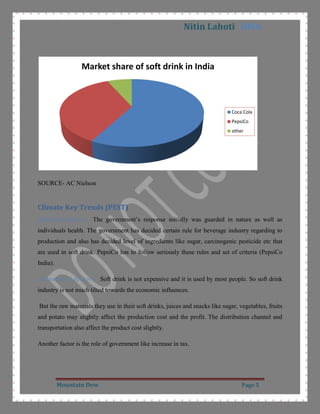
 To understand the concept of market segmentation, market positioning and targeting by using a  The main objective of this report is to understand how and what the strategies are used by PepsiCo to overcome the competitors.<br />Executive Summary<br />This report is the marketing plan analysis of Mountain Dew in India. It is a product of PepsiCo which is a well known food and beverage company worldwide. This report emphasize on how Mountain Dew establish itself in Indian market and also how it has make a good brand image among its target customer. This report is also analysing mountain dew’s 4Ps which are important to understand when we are analysing product. We also included the competitor’s analysis of Mountain Dew and analyse them. For all this process we used credible and reliable sources and based on these sources we recommended plan for next one year. <br />Industry Analysis<br /> Non alcoholic market can be divided into soft drink and fruit juice. Some common soft drinks are flavoured water, sweet tea, iced tea, squash, fruit punch and lemonade. Noncarbonated and carbonated is further part of soft drink. Carbonated drinks are cola, oranges, lemon while non carbonated drink mango drinks CITATION Ind09 \l 1033  (India Agro Industry, 2009). <br />The total size of food industry in India is almost $ 65.6 billion and soft drinks (juices and carbonated beverage) contain $ 1 billion. Indian soft drink market consumption in a year is 284 million crates. Soft drink market is highly seasonal; consumption in during off-season is 15 million crates and in peak season is around 25 million crates per month. In urban area consumption of soft drinks is 75% of whole market. Indian soft drink market is dominated by MNC companies Coca-Cola and PepsiCo CITATION aus09 \l 1033  (Non-alcoholic beverage market in India, 2009).<br />             The consumption of Soft drink in India has a share of 46.8% within the non alcoholic drink industry. In 2004 the total market value of soft drink was 307.2 $ billion and expected to grow 367.1 $ billion in 2009 CITATION Ana09 \l 1033  (Analytics, Press Release for Energy drink, 2009)<br />Company Analysis<br />The business of PepsiCo is based on its vision of making tomorrow better than today CITATION Pep09 \l 1033  (PepsiCo India).<br />In 1989 PepsiCo entered in Indian market and became one of the leading food and beverage companies in India. PepsiCo India and its partners have invested almost 1 billion U.S. dollar to growing their business. Including supplier and distributor it provides more than 1, 50,000 Job for people in India. In India it provide diverse range of brands that includes such- Pepsi, Mirinda, Mountain Dew and 7UP, low calorie product such as Diet Pepsi,  Aquafina drinking water and fruit juice based drinks- Slice, Tropicana. There are some local brands Lehar and Mangola. Frito-Lay is market leader in salty snacks market, which is free of trans-fat. It manufactures traditional snacks under Lehar and Kurkure brands. For supporting operations in India it has 43 bottling plants, of which 15 are owned by company and remaining 28 are owned by franchisee CITATION Our08 \l 1033  (Our History, 2008).<br />Competitor Analysis<br />PepsiCo has a good market share in India but facing tough competition from Coca-Cola Company. Products of Coca Cola Company such as sprite, Coca Cola, Limca and ThumsUp are the competitor of PepsiCo in soft drink market CITATION Coc30 \l 1033  (Bhushan, 2008). The most important drawback of its competitor is their promotion and advertisement. Coca-Cola has less number of brand ambassadors as compare to PepsiCo CITATION 0904 \l 1033  (Baxter, 2009). <br />In India with the market share of 16.4% Thums Up is at number 1, sprite with 15.6% at 2nd position followed by Pepsi at 13% according to AC Nielsen data.   In India Coca-Cola is leader market share of 57.8% followed by Pepsi with 35.6%. In the portfolio of PepsiCo Pepsi is the only one brand with market share of 13.1% but its rival coca cola has four brands that have more than 10% market share in India. Those are ThumsUp 16.45, Sprite 12.2%, Limca 10.9% and Fanta 10%. <br />SOURCE- AC Nielson<br />Climate Key Trends (PEST)<br />Political factor:  The government’s response initially was guarded in nature as well as individuals health. The government has decided certain rule for beverage industry regarding to production and also has decided level of ingredients like sugar, carcinogenic pesticide etc that are used in soft drink. PepsiCo has to follow seriously these rules and set of criteria CITATION Pep09 \l 1033  (PepsiCo India).<br />Economical factor:   Soft drink is not expensive and it is used by most people. So soft drink industry is not much tilted towards the economic influences.<br /> But the raw materials they use in their soft drinks, juices and snacks like sugar, vegetables, fruits and potato may slightly affect the production cost and the profit. The distribution channel and transportation also affect the product cost slightly.<br />Another factor is the role of government like increase in tax.<br />Social factor:  People today are very trendy, sensitive towards the advertisement. It means people drinking Dew are fashionable and are very trendy. Taking this into account PepsiCo targeted new generation people, and they are able to differentiate between them. <br />Some people are conscious about caffeine so they might have negative anticipation about soft drinks. Also some people think that soft drinks companies spread pollution in manufacturing process. For this Pepsi has a column in their website mentioning about their social responsibility.<br />Technological factor:  Technology for manufacturing and packaging of a product, transportation of raw material or delivery of a product is changing time to time, and thus it also affects the production cost, transportation cost and unskilled labour. Technology also plays a big role in packaging and designing of a product. <br />SWOT Analysis<br />In this part we are going to analyses the strength, weakness, threats and opportunity of the PepsiCo. <br />STRENGTH<br />PepsiCo has good brand name, reputation and broader product line in international market.
With the revenue of more than 390 $ million PepsiCo is global leader in convenient snacks  CITATION Bra22 \l 1033 (BrandZ Top 100 Most Valuable, 2009)
International brand, innovative capabilities, strong distribution network.
Pepsi is market leader in making of snacks, sports drink and bottled water.
One of major strength of PepsiCo that it has developed into a large, strong organization because of its good franchise system.
Strong advertising campaign and marketing policy for promoting brands.
Global presence, Sponsorship, Focus on most important customer trend -“satisfaction”.WEAKNESS<br />Pepsi is far away from main competitor Coca-cola in international market.
More than 50 percent of sales come from snacks (Frito-lay), it is a big threat if snacks market comedown CITATION Bos09 \l 1033  (Analytics, Store-Bought Non-Alcoholic Beverages in India, 2009).OPPORTUNITIES<br />Food is must for everyone so it can be expand internationally.
Offer and increase new healthy food and beverage because people are moving towards healthy food.
The fastest growing part of industry is noncarbonated drinks. THREATS<br />Strong competitor in the market like coca-cola, Cadbury Schweppes, Craft food and small bottle firms.
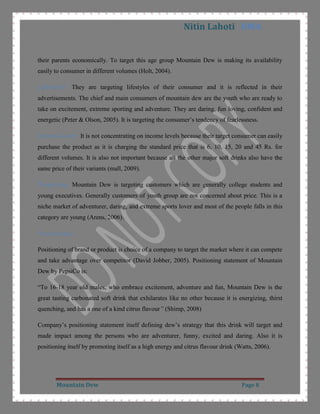
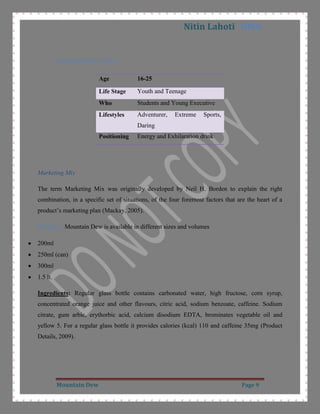
People are moving towards healthy food CITATION 0907 \l 1033  (Babaria & Dharod, 2009). Market Segmentation:<br />Group of individuals who possess similar needs and choices represent a segment of market CITATION Dav05 \l 1033  (David Jobber, 2005). Mountain dew has segmented itself mainly on the basis of demography and lifestyle in a niche market of adventurer and extreme sports. In this niche market most of the consumers are youth  CITATION Pro \l 1033  (Product Differentiation and Mergers in the Carbonated Soft Drink Industry, 2005). The key features of this market-<br />Age: Mountain dew is targeting the consumer of age 12-28 means youth or teenagers. Cold drinks are very popular among this age group and became a part of lifestyle. In the term of life stage this age group falls in youth or teenage who lives with their parents and are depends on their parents economically. To target this age group Mountain Dew is making its availability easily to consumer in different volumes CITATION How \l 1033  (Holt, 2004).<br />Lifestyles: They are targeting lifestyles of their consumer and it is reflected in their advertisements. The chief and main consumers of mountain dew are the youth who are ready to take on excitement, extreme sporting and adventure. They are daring, fun loving, confident and energetic CITATION Pet05 \l 1033  (Peter & Olson, 2005). It is targeting the consumer’s tendency of fearlessness.<br />Income Level: It is not concentrating on income levels because their target consumer can easily purchase the product as it is charging the standard price that is 6, 10, 15, 20 and 45 Rs. for different volumes. It is also not important because all the other major soft drinks also have the same price of their variants CITATION Man09 \l 1033  (mall, 2009).  <br />Targeting: Mountain Dew is targeting customers which are generally college students and young executives. Generally customers of youth group are not concerned about price. This is a niche market of adventurer, daring, and extreme sports lover and most of the people falls in this category are young  CITATION Con \l 1033 (Arens, 2006).<br />Positioning:<br />Positioning of brand or product is choice of a company to target the market where it can compete and take advantage over competitor  CITATION Dav05 \l 1033 (David Jobber, 2005). Positioning statement of Mountain Dew by PepsiCo is:<br />“To 16-18 year old males, who embrace excitement, adventure and fun, Mountain Dew is the great tasting carbonated soft drink that exhilarates like no other because it is energizing, thirst quenching, and has a one of a kind citrus flavour” CITATION Adv \l 1033  (Shimp, 2008)<br />Company’s positioning statement itself defining dew’s strategy that this drink will target and made impact among the persons who are adventurer, funny, excited and daring. Also it is positioning itself by promoting itself as a high energy and citrus flavour drink CITATION Mel \l 1033  (Watts, 2006).  <br />Segmentation Table: <br />Age16-25  Life StageYouth and Teenage WhoStudents and Young ExecutiveLifestylesAdventurer, Extreme Sports, DaringPositioningEnergy and Exhilaration drink<br />    <br />    <br />Marketing Mix <br />The term Marketing Mix was originally developed by Neil H. Borden to explain the right combination, in a specific set of situations, of the four foremost factors that are the heart of a product’s marketing plan CITATION Adr05 \l 1033  (Mackay, 2005). <br />Product: Mountain Dew is available in different sizes and volumes<br />200ml
250ml (can)
300ml
1.5 lt.Ingredients: Regular glass bottle contains carbonated water, high fructose, corn syrup, concentrated orange juice and other flavours, citric acid, sodium benzoate, caffeine. Sodium citrate, gum arbic, erythorbic acid, calcium disodium EDTA, brominates vegetable oil and yellow 5. For a regular glass bottle it provides calories (kcal) 110 and caffeine 35mg CITATION Pro09 \l 1033  (Product Details, 2009).<br />Product Level: There are five type of product level which a marketer need to concentrate on for the success of product CITATION Kot09 \l 1033  (Kotler, Keller, Koshy, & Jha, 2009).<br />Core Benefit:  The basic buying reason of that product by customer. The core benefit for mountain dew is to quench their thirst.
Basic Product: Basic product is the vital features of that product. Basic product for mountain dew is carbonated water with some added flavours.
Expected Product: Expected product for mountain dew is a soft drink which gives more energy and taste to consumer.
Augmented Product: It is the extra features provided by company to their customer. It is giving more energy and taste to their customer by providing them more caffeine in their offering.
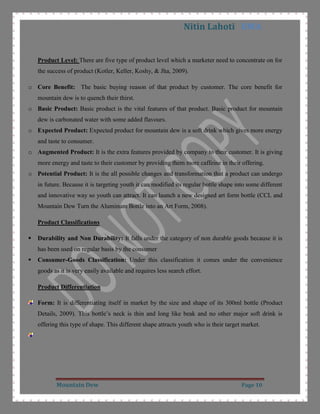
Potential Product: It is the all possible changes and transformation that a product can undergo in future. Because it is targeting youth it can modified its regular bottle shape into some different and innovative way so youth can attract. It can launch a new designed art form bottle CITATION CCL22 \l 1033  (CCL and Mountain Dew Turn the Aluminum Bottle into an Art Form, 2008).   Product Classifications<br />Durability and Non Durability: It falls under the category of non durable goods because it is has been used on regular basis by the consumer
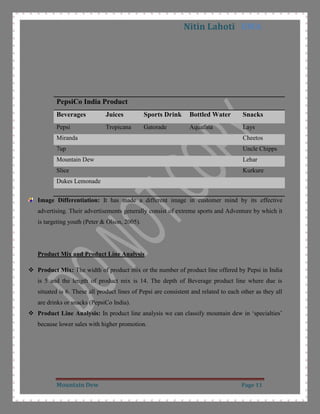
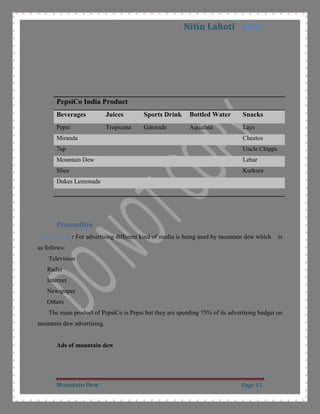
Consumer-Goods Classification: Under this classification it comes under the convenience goods as it is very easily available and requires less search effort.Product Differentiation<br />Form: It is differentiating itself in market by the size and shape of its 300ml bottle CITATION Pro09 \l 1033  (Product Details, 2009). This bottle’s neck is thin and long like beak and no other major soft drink is offering this type of shape. This different shape attracts youth who is their target market.PepsiCo India ProductBeveragesJuicesSports DrinkBottled WaterSnacksPepsiTropicanaGatoradeAquafinaLaysMirandaCheetos7upUncle ChippsMountain DewLeharSliceKurkureDukes Lemonade <br />Image Differentiation: It has made a different image in customer mind by its effective advertising. Their advertisements generally consist of extreme sports and Adventure by which it is targeting youth CITATION Pet05 \l 1033  (Peter & Olson, 2005).Product Mix and Product Line Analysis<br />Product Mix: The width of product mix or the number of product line offered by Pepsi in India is 5 and the length of product mix is 14. The depth of Beverage product line where due is situated is 6. These all product lines of Pepsi are consistent and related to each other as they all are drinks or snacks CITATION Pep09 \l 1033  (PepsiCo India).
Product Line Analysis: In product line analysis we can classify mountain dew in ‘specialties’ because lower sales with higher promotion.
Product Depth: Mountain dew has no other variant available in market. It is available only in one variant but in different volumes i.e. 200ml, 250ml can, 300ml and 1.5lt bottle so its product depth is 4.Product Life Cycle: Company changes its marketing plan and strategy as product’s life stage changes so it is important to know that product is in which life cycle. Soft drinks industry is a very old industry in India. It is now saturating and stepping towards maturation stage of product life cycle. Soft drinks are easily available in urban area and it is now getting popular in rural areas also so it is better it to put it in the stage where it is moving from growth to maturation.<br />Price<br /> Market segmentation, positioning and competitor’s pricing strategy plays a major role in defining a product’s pricing strategy.<br />In shaping price of a product a company should analyze the consumer’s buying behaviour to purchase that product on the basis of price CITATION Kot09 \l 1033  (Kotler, Keller, Koshy, & Jha, 2009). So company has to think 3 important aspects-<br />Reference prices: It means what the other brands are charging for the same. It is available at the same price as the others products of the same category are available in market (our market research).<br />Price-Quality inferences: Many consumers take price as a quality indicator. Dew is a product of PepsiCo which has an image of good quality at low price in consumer’s mind.<br /> Price cues: Perception of consumers plays an important role in price setting. In the beverage industry consumers have a perception to give money in round figure so most of the prices in this industry end with the digit of 5 or 0.  <br />Setting the Price: <br />A company has to take some steps before defining the price-<br />Selecting the Pricing Objectives: The pricing objective for mountain dew is survival because intense competition in sector as well as to increase market share they are using market penetration pricing strategy CITATION StJ03 \l 1033  (Fund, 2003).
Determining the Demand: The customer which mountain dew are targeting are less price sensitive and also it is a low price product so price do not effect so much to demand. It is in a segment where price is inelastic and change in price doesn’t lead to a big change in demand CITATION Fiz08 \l 1033  (Fizz goes flat: Non-colas have slipped, 2008).

25381564 marketing-plan-of-mountain-dew

  • 1.
    Table of ContentsTOC \o \" 1-3\" \h \z \u Introduction PAGEREF _Toc242719082 \h 2Objective PAGEREF _Toc242719083 \h 2Executive Summary PAGEREF _Toc242719084 \h 2Industry Analysis PAGEREF _Toc242719085 \h 3Company Analysis PAGEREF _Toc242719086 \h 3Competitor Analysis PAGEREF _Toc242719087 \h 4Climate Key Trends (PEST) PAGEREF _Toc242719088 \h 4SWOT Analysis PAGEREF _Toc242719089 \h 5Market Segmentation: PAGEREF _Toc242719090 \h 6Marketing Mix PAGEREF _Toc242719091 \h 8Price PAGEREF _Toc242719092 \h 10Distribution: PAGEREF _Toc242719093 \h 12Promotion PAGEREF _Toc242719094 \h 13Plan for the Next 1 year PAGEREF _Toc242719095 \h 14Conclusion PAGEREF _Toc242719096 \h 15Bibliography: PAGEREF _Toc242719097 \h 16<br />Introduction<br />Marketing Plan is a basic concept which is required to make a product successful. It consists of company’s strategy based on industry and targeted customers trends to make that product successful. Marketing plan analysis is done because companies want to distinguish the relevancy of their marketing plan in current scenario. This analysis comprises of industry analysis, company analysis, product analysis, competitor analysis and products 4Ps. As part of our academic work we have to analysis a product’s marketing plan and we choose Mountain Dew because it’s in soft drink industry in which every youth is interested.<br />Objective<br />To understand the concept of marketing and marketing strategy and market planning.
  • 2.
    To understand howkey trend affects the product and industry and how consumer buying behaviour affects the product.
  • 3.
    To understandthe concept of market segmentation, market positioning and targeting by using a The main objective of this report is to understand how and what the strategies are used by PepsiCo to overcome the competitors.<br />Executive Summary<br />This report is the marketing plan analysis of Mountain Dew in India. It is a product of PepsiCo which is a well known food and beverage company worldwide. This report emphasize on how Mountain Dew establish itself in Indian market and also how it has make a good brand image among its target customer. This report is also analysing mountain dew’s 4Ps which are important to understand when we are analysing product. We also included the competitor’s analysis of Mountain Dew and analyse them. For all this process we used credible and reliable sources and based on these sources we recommended plan for next one year. <br />Industry Analysis<br /> Non alcoholic market can be divided into soft drink and fruit juice. Some common soft drinks are flavoured water, sweet tea, iced tea, squash, fruit punch and lemonade. Noncarbonated and carbonated is further part of soft drink. Carbonated drinks are cola, oranges, lemon while non carbonated drink mango drinks CITATION Ind09 \l 1033 (India Agro Industry, 2009). <br />The total size of food industry in India is almost $ 65.6 billion and soft drinks (juices and carbonated beverage) contain $ 1 billion. Indian soft drink market consumption in a year is 284 million crates. Soft drink market is highly seasonal; consumption in during off-season is 15 million crates and in peak season is around 25 million crates per month. In urban area consumption of soft drinks is 75% of whole market. Indian soft drink market is dominated by MNC companies Coca-Cola and PepsiCo CITATION aus09 \l 1033 (Non-alcoholic beverage market in India, 2009).<br /> The consumption of Soft drink in India has a share of 46.8% within the non alcoholic drink industry. In 2004 the total market value of soft drink was 307.2 $ billion and expected to grow 367.1 $ billion in 2009 CITATION Ana09 \l 1033 (Analytics, Press Release for Energy drink, 2009)<br />Company Analysis<br />The business of PepsiCo is based on its vision of making tomorrow better than today CITATION Pep09 \l 1033 (PepsiCo India).<br />In 1989 PepsiCo entered in Indian market and became one of the leading food and beverage companies in India. PepsiCo India and its partners have invested almost 1 billion U.S. dollar to growing their business. Including supplier and distributor it provides more than 1, 50,000 Job for people in India. In India it provide diverse range of brands that includes such- Pepsi, Mirinda, Mountain Dew and 7UP, low calorie product such as Diet Pepsi, Aquafina drinking water and fruit juice based drinks- Slice, Tropicana. There are some local brands Lehar and Mangola. Frito-Lay is market leader in salty snacks market, which is free of trans-fat. It manufactures traditional snacks under Lehar and Kurkure brands. For supporting operations in India it has 43 bottling plants, of which 15 are owned by company and remaining 28 are owned by franchisee CITATION Our08 \l 1033 (Our History, 2008).<br />Competitor Analysis<br />PepsiCo has a good market share in India but facing tough competition from Coca-Cola Company. Products of Coca Cola Company such as sprite, Coca Cola, Limca and ThumsUp are the competitor of PepsiCo in soft drink market CITATION Coc30 \l 1033 (Bhushan, 2008). The most important drawback of its competitor is their promotion and advertisement. Coca-Cola has less number of brand ambassadors as compare to PepsiCo CITATION 0904 \l 1033 (Baxter, 2009). <br />In India with the market share of 16.4% Thums Up is at number 1, sprite with 15.6% at 2nd position followed by Pepsi at 13% according to AC Nielsen data. In India Coca-Cola is leader market share of 57.8% followed by Pepsi with 35.6%. In the portfolio of PepsiCo Pepsi is the only one brand with market share of 13.1% but its rival coca cola has four brands that have more than 10% market share in India. Those are ThumsUp 16.45, Sprite 12.2%, Limca 10.9% and Fanta 10%. <br />SOURCE- AC Nielson<br />Climate Key Trends (PEST)<br />Political factor: The government’s response initially was guarded in nature as well as individuals health. The government has decided certain rule for beverage industry regarding to production and also has decided level of ingredients like sugar, carcinogenic pesticide etc that are used in soft drink. PepsiCo has to follow seriously these rules and set of criteria CITATION Pep09 \l 1033 (PepsiCo India).<br />Economical factor: Soft drink is not expensive and it is used by most people. So soft drink industry is not much tilted towards the economic influences.<br /> But the raw materials they use in their soft drinks, juices and snacks like sugar, vegetables, fruits and potato may slightly affect the production cost and the profit. The distribution channel and transportation also affect the product cost slightly.<br />Another factor is the role of government like increase in tax.<br />Social factor: People today are very trendy, sensitive towards the advertisement. It means people drinking Dew are fashionable and are very trendy. Taking this into account PepsiCo targeted new generation people, and they are able to differentiate between them. <br />Some people are conscious about caffeine so they might have negative anticipation about soft drinks. Also some people think that soft drinks companies spread pollution in manufacturing process. For this Pepsi has a column in their website mentioning about their social responsibility.<br />Technological factor: Technology for manufacturing and packaging of a product, transportation of raw material or delivery of a product is changing time to time, and thus it also affects the production cost, transportation cost and unskilled labour. Technology also plays a big role in packaging and designing of a product. <br />SWOT Analysis<br />In this part we are going to analyses the strength, weakness, threats and opportunity of the PepsiCo. <br />STRENGTH<br />PepsiCo has good brand name, reputation and broader product line in international market.
  • 4.
    With the revenueof more than 390 $ million PepsiCo is global leader in convenient snacks CITATION Bra22 \l 1033 (BrandZ Top 100 Most Valuable, 2009)
  • 5.
    International brand, innovativecapabilities, strong distribution network.
  • 6.
    Pepsi is marketleader in making of snacks, sports drink and bottled water.
  • 7.
    One of majorstrength of PepsiCo that it has developed into a large, strong organization because of its good franchise system.
  • 8.
    Strong advertising campaignand marketing policy for promoting brands.
  • 9.
    Global presence, Sponsorship,Focus on most important customer trend -“satisfaction”.WEAKNESS<br />Pepsi is far away from main competitor Coca-cola in international market.
  • 10.
    More than 50percent of sales come from snacks (Frito-lay), it is a big threat if snacks market comedown CITATION Bos09 \l 1033 (Analytics, Store-Bought Non-Alcoholic Beverages in India, 2009).OPPORTUNITIES<br />Food is must for everyone so it can be expand internationally.
  • 11.
    Offer and increasenew healthy food and beverage because people are moving towards healthy food.
  • 12.
    The fastest growingpart of industry is noncarbonated drinks. THREATS<br />Strong competitor in the market like coca-cola, Cadbury Schweppes, Craft food and small bottle firms.
  • 13.
    People are movingtowards healthy food CITATION 0907 \l 1033 (Babaria & Dharod, 2009). Market Segmentation:<br />Group of individuals who possess similar needs and choices represent a segment of market CITATION Dav05 \l 1033 (David Jobber, 2005). Mountain dew has segmented itself mainly on the basis of demography and lifestyle in a niche market of adventurer and extreme sports. In this niche market most of the consumers are youth CITATION Pro \l 1033 (Product Differentiation and Mergers in the Carbonated Soft Drink Industry, 2005). The key features of this market-<br />Age: Mountain dew is targeting the consumer of age 12-28 means youth or teenagers. Cold drinks are very popular among this age group and became a part of lifestyle. In the term of life stage this age group falls in youth or teenage who lives with their parents and are depends on their parents economically. To target this age group Mountain Dew is making its availability easily to consumer in different volumes CITATION How \l 1033 (Holt, 2004).<br />Lifestyles: They are targeting lifestyles of their consumer and it is reflected in their advertisements. The chief and main consumers of mountain dew are the youth who are ready to take on excitement, extreme sporting and adventure. They are daring, fun loving, confident and energetic CITATION Pet05 \l 1033 (Peter & Olson, 2005). It is targeting the consumer’s tendency of fearlessness.<br />Income Level: It is not concentrating on income levels because their target consumer can easily purchase the product as it is charging the standard price that is 6, 10, 15, 20 and 45 Rs. for different volumes. It is also not important because all the other major soft drinks also have the same price of their variants CITATION Man09 \l 1033 (mall, 2009). <br />Targeting: Mountain Dew is targeting customers which are generally college students and young executives. Generally customers of youth group are not concerned about price. This is a niche market of adventurer, daring, and extreme sports lover and most of the people falls in this category are young CITATION Con \l 1033 (Arens, 2006).<br />Positioning:<br />Positioning of brand or product is choice of a company to target the market where it can compete and take advantage over competitor CITATION Dav05 \l 1033 (David Jobber, 2005). Positioning statement of Mountain Dew by PepsiCo is:<br />“To 16-18 year old males, who embrace excitement, adventure and fun, Mountain Dew is the great tasting carbonated soft drink that exhilarates like no other because it is energizing, thirst quenching, and has a one of a kind citrus flavour” CITATION Adv \l 1033 (Shimp, 2008)<br />Company’s positioning statement itself defining dew’s strategy that this drink will target and made impact among the persons who are adventurer, funny, excited and daring. Also it is positioning itself by promoting itself as a high energy and citrus flavour drink CITATION Mel \l 1033 (Watts, 2006). <br />Segmentation Table: <br />Age16-25  Life StageYouth and Teenage WhoStudents and Young ExecutiveLifestylesAdventurer, Extreme Sports, DaringPositioningEnergy and Exhilaration drink<br /> <br /> <br />Marketing Mix <br />The term Marketing Mix was originally developed by Neil H. Borden to explain the right combination, in a specific set of situations, of the four foremost factors that are the heart of a product’s marketing plan CITATION Adr05 \l 1033 (Mackay, 2005). <br />Product: Mountain Dew is available in different sizes and volumes<br />200ml
  • 14.
  • 15.
  • 16.
    1.5 lt.Ingredients: Regularglass bottle contains carbonated water, high fructose, corn syrup, concentrated orange juice and other flavours, citric acid, sodium benzoate, caffeine. Sodium citrate, gum arbic, erythorbic acid, calcium disodium EDTA, brominates vegetable oil and yellow 5. For a regular glass bottle it provides calories (kcal) 110 and caffeine 35mg CITATION Pro09 \l 1033 (Product Details, 2009).<br />Product Level: There are five type of product level which a marketer need to concentrate on for the success of product CITATION Kot09 \l 1033 (Kotler, Keller, Koshy, & Jha, 2009).<br />Core Benefit: The basic buying reason of that product by customer. The core benefit for mountain dew is to quench their thirst.
  • 17.
    Basic Product: Basicproduct is the vital features of that product. Basic product for mountain dew is carbonated water with some added flavours.
  • 18.
    Expected Product: Expectedproduct for mountain dew is a soft drink which gives more energy and taste to consumer.
  • 19.
    Augmented Product: Itis the extra features provided by company to their customer. It is giving more energy and taste to their customer by providing them more caffeine in their offering.
  • 20.
    Potential Product: Itis the all possible changes and transformation that a product can undergo in future. Because it is targeting youth it can modified its regular bottle shape into some different and innovative way so youth can attract. It can launch a new designed art form bottle CITATION CCL22 \l 1033 (CCL and Mountain Dew Turn the Aluminum Bottle into an Art Form, 2008). Product Classifications<br />Durability and Non Durability: It falls under the category of non durable goods because it is has been used on regular basis by the consumer
  • 21.
    Consumer-Goods Classification: Underthis classification it comes under the convenience goods as it is very easily available and requires less search effort.Product Differentiation<br />Form: It is differentiating itself in market by the size and shape of its 300ml bottle CITATION Pro09 \l 1033 (Product Details, 2009). This bottle’s neck is thin and long like beak and no other major soft drink is offering this type of shape. This different shape attracts youth who is their target market.PepsiCo India ProductBeveragesJuicesSports DrinkBottled WaterSnacksPepsiTropicanaGatoradeAquafinaLaysMirandaCheetos7upUncle ChippsMountain DewLeharSliceKurkureDukes Lemonade <br />Image Differentiation: It has made a different image in customer mind by its effective advertising. Their advertisements generally consist of extreme sports and Adventure by which it is targeting youth CITATION Pet05 \l 1033 (Peter & Olson, 2005).Product Mix and Product Line Analysis<br />Product Mix: The width of product mix or the number of product line offered by Pepsi in India is 5 and the length of product mix is 14. The depth of Beverage product line where due is situated is 6. These all product lines of Pepsi are consistent and related to each other as they all are drinks or snacks CITATION Pep09 \l 1033 (PepsiCo India).
  • 22.
    Product Line Analysis:In product line analysis we can classify mountain dew in ‘specialties’ because lower sales with higher promotion.
  • 23.
    Product Depth: Mountaindew has no other variant available in market. It is available only in one variant but in different volumes i.e. 200ml, 250ml can, 300ml and 1.5lt bottle so its product depth is 4.Product Life Cycle: Company changes its marketing plan and strategy as product’s life stage changes so it is important to know that product is in which life cycle. Soft drinks industry is a very old industry in India. It is now saturating and stepping towards maturation stage of product life cycle. Soft drinks are easily available in urban area and it is now getting popular in rural areas also so it is better it to put it in the stage where it is moving from growth to maturation.<br />Price<br /> Market segmentation, positioning and competitor’s pricing strategy plays a major role in defining a product’s pricing strategy.<br />In shaping price of a product a company should analyze the consumer’s buying behaviour to purchase that product on the basis of price CITATION Kot09 \l 1033 (Kotler, Keller, Koshy, & Jha, 2009). So company has to think 3 important aspects-<br />Reference prices: It means what the other brands are charging for the same. It is available at the same price as the others products of the same category are available in market (our market research).<br />Price-Quality inferences: Many consumers take price as a quality indicator. Dew is a product of PepsiCo which has an image of good quality at low price in consumer’s mind.<br /> Price cues: Perception of consumers plays an important role in price setting. In the beverage industry consumers have a perception to give money in round figure so most of the prices in this industry end with the digit of 5 or 0. <br />Setting the Price: <br />A company has to take some steps before defining the price-<br />Selecting the Pricing Objectives: The pricing objective for mountain dew is survival because intense competition in sector as well as to increase market share they are using market penetration pricing strategy CITATION StJ03 \l 1033 (Fund, 2003).
  • 24.
    Determining the Demand:The customer which mountain dew are targeting are less price sensitive and also it is a low price product so price do not effect so much to demand. It is in a segment where price is inelastic and change in price doesn’t lead to a big change in demand CITATION Fiz08 \l 1033 (Fizz goes flat: Non-colas have slipped, 2008).