A P R I L 2 0 1 6 | V O L U M E 1 3
An analysis of issues shaping Africa’s economic future
This document was produced by
the Office of the Chief Economist
for the Africa region
u
	 Growth will remain lackluster in
Sub-Saharan Africa in 2016, weighed
down by low and volatile commodity
prices.
u
	 Addressing growing economic
vulnerabilities and developing new
sources of sustainable, inclusive
growth are key priorities for the
region.
u
	 Africa’s rapid urbanization offers a
potential springboard for economic
diversification. But building cities
that work will require reforming land
markets and urban regulations, and
coordinating early infrastructure
investments.
AFRICA’S PULSE TEAM:
Punam Chuhan-Pole (Team Lead),
Cesar Calderon, Gerard Kambou,
Sebastien Boreux, Mapi M. Buitano,
Vijdan Korman, Megumi Kubota,
Rafael M. Lopez-Monti
With contributions from
Somik V. Lall, Paul Brenton
A F R I C A’ S P U L S E > 1
Contents
Summary .  .  .  .  .  .  .  .  .  .  .  .  .  .  .  .  .  .  .  .  .  .  .  .  .  .  .  .  .  .  .  .  .  .  .  .  .  .  .  .  .  .  .  .  .  .  .  .  .  .  .  .  .  .  .  .  .  .  .  . 4
Section 1: Recent Developments and Trends .  .  .  .  .  .  .  .  .  .  .  .  .  .  .  .  .  .  .  .  .  .  .  .  .  .  .  .  .  .  .  .  . 5
Global Developments. .  .  .  .  .  .  .  .  .  .  .  .  .  .  .  .  .  .  .  .  .  .  .  .  .  .  .  .  .  .  .  .  .  .  .  .  .  .  .  .  .  .  .  .  .  .  .  .  .  .  . 5
Sub-Saharan Africa. .  .  .  .  .  .  .  .  .  .  .  .  .  .  .  .  .  .  .  .  .  .  .  .  .  .  .  .  .  .  .  .  .  .  .  .  .  .  .  .  .  .  .  .  .  .  .  .  .  .  .  .  . 7
Outlook.  .  .  .  .  .  .  .  .  .  .  .  .  .  .  .  .  .  .  .  .  .  .  .  .  .  .  .  .  .  .  .  .  .  .  .  .  .  .  .  .  .  .  .  .  .  .  .  .  .  .  .  .  .  .  .  .  .  .  . 14
Risks .  .  .  .  .  .  .  .  .  .  .  .  .  .  .  .  .  .  .  .  .  .  .  .  .  .  .  .  .  .  .  .  .  .  .  .  .  .  .  .  .  .  .  .  .  .  .  .  .  .  .  .  .  .  .  .  .  .  .  .  .  . 16
Policy Challenges .  .  .  .  .  .  .  .  .  .  .  .  .  .  .  .  .  .  .  .  .  .  .  .  .  .  .  .  .  .  .  .  .  .  .  .  .  .  .  .  .  .  .  .  .  .  .  .  .  .  .  .  .  . 16
Box 1.1: Twin Deficits in Sub-Saharan Africa.  .  .  .  .  .  .  .  .  .  .  .  .  .  .  .  .  .  .  .  .  .  .  .  .  .  .  .  .  .  .  .  .  .  .  .  .  . 17
Box 1.2: Driving Diversification in Africa through Trade and Competition.  .  .  .  .  .  .  .  .  .  .  .  .  .  .  .  .  .  .  . 21
Section 2: Terms-of-Trade Shock and Impact
on Economic Performance in Sub-Saharan Africa.  .  .  .  .  .  .  .  .  .  .  .  .  .  .  .  .  .  .  .  .  .  .  .  .  .  .  .  . 23
Decline in Oil Prices: Lower and Longer. .  .  .  .  .  .  .  .  .  .  .  .  .  .  .  .  .  .  .  .  .  .  .  .  .  .  .  .  .  .  .  .  .  .  .  .  .  .  . 23
Macroeconomic Impact of the Oil Price Decline. .  .  .  .  .  .  .  .  .  .  .  .  .  .  .  .  .  .  .  .  .  .  .  .  .  .  .  .  .  .  .  .  .  . 24
Box 2.1: Commodity Price Shock for the Macroeconomic Simulations.  .  .  .  .  .  .  .  .  .  .  .  .  .  .  .  .  .  .  .  .  . 30
Section 3: Opening Doors to the World:
Can African Cities Deliver on the Promise of Growth?.  .  .  .  .  .  .  .  .  .  .  .  .  .  .  .  .  .  .  .  .  .  .  .  . 33
Introduction. .  .  .  .  .  .  .  .  .  .  .  .  .  .  .  .  .  .  .  .  .  .  .  .  .  .  .  .  .  .  .  .  .  .  .  .  .  .  .  .  .  .  .  .  .  .  .  .  .  .  .  .  .  .  .  . 34
Crowded, Disconnected, Costly: The Urbanization of People without Capital.  .  .  .  .  .  .  .  .  .  .  .  .  .  .  .  .  . 38
Crowded Cities . .  .  .  .  .  .  .  .  .  .  .  .  .  .  .  .  .  .  .  .  .  .  .  .  .  .  .  .  .  .  .  .  .  .  .  .  .  .  .  .  .  .  .  .  .  .  .  .  .  .  . 38
Disconnected Cities.  .  .  .  .  .  .  .  .  .  .  .  .  .  .  .  .  .  .  .  .  .  .  .  .  .  .  .  .  .  .  .  .  .  .  .  .  .  .  .  .  .  .  .  .  .  .  .  .  . 41
Costly Cities . .  .  .  .  .  .  .  .  .  .  .  .  .  .  .  .  .  .  .  .  .  .  .  .  .  .  .  .  .  .  .  .  .  .  .  .  .  .  .  .  .  .  .  .  .  .  .  .  .  .  .  .  . 45
Out of Service and Closed for Business: Africa’s Urban Low-Development Trap . .  .  .  .  .  .  .  .  .  .  .  .  .  .  . 48
Cities Are “Out of Service”. .  .  .  .  .  .  .  .  .  .  .  .  .  .  .  .  .  .  .  .  .  .  .  .  .  .  .  .  .  .  .  .  .  .  .  .  .  .  .  .  .  .  .  .  . 49
Cities Are “Closed for Business”. .  .  .  .  .  .  .  .  .  .  .  .  .  .  .  .  .  .  .  .  .  .  .  .  .  .  .  .  .  .  .  .  .  .  .  .  .  .  .  .  .  . 50
Investing in Institutional and Physical Structures to Support Scale Economies in Africa’s Cities .  .  .  .  .  .  . 53
Recommendation 1—Reform urban land markets (simplify property rights, strengthen city plans).. 54
Recommendation 2—Coordinate early infrastructure investments (while bringing them to scale).. 58
Strong Institutions Should Provide the Bedrock for Enhancing Africa’s Urban Structures.  .  .  .  .  .  .  .  .  .  . 59
References.  .  .  .  .  .  .  .  .  .  .  .  .  .  .  .  .  .  .  .  .  .  .  .  .  .  .  .  .  .  .  .  .  .  .  .  .  .  .  .  .  .  .  .  .  .  .  .  .  .  .  .  .  .  .  .  .  . 61
Appendix I.  .  .  .  .  .  .  .  .  .  .  .  .  .  .  .  .  .  .  .  .  .  .  .  .  .  .  .  .  .  .  .  .  .  .  .  .  .  .  .  .  .  .  .  .  .  .  .  .  .  .  .  .  .  .  .  .  . 64
A F R I C A’ S P U L S E>2
List of Boxes
Box 1.1: 	 Twin Deficits in Sub-Saharan Africa. .  .  .  .  .  .  .  .  .  .  .  .  .  .  .  .  .  .  .  .  .  .  .  .  .  .  .  .  .  .17
Box 1.2: 	 Driving Diversification in Africa through Trade and Competition. .  .  .  .  .  .  .  .  .  .  .  .21
Box 2.1: 	 Commodity Price Shock for the Macroeconomic Simulations. .  .  .  .  .  .  .  .  .  .  .  .  .  .30
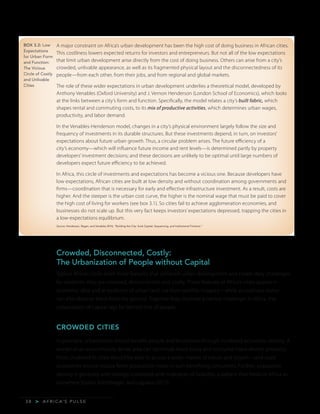
Box 3.1: 	 Low Expected Scale and Returns: Why African Cities
	 Are Locked into Nontradables. .  .  .  .  .  .  .  .  .  .  .  .  .  .  .  .  .  .  .  .  .  .  .  .  .  .  .  .  .  .  .  .  .36
Box 3.2: 	 Low Expectations for Urban Form and Function:
	 The Vicious Circle of Costly and Unlivable Cities . .  .  .  .  .  .  .  .  .  .  .  .  .  .  .  .  .  .  .  .  .  .38
Box 3.3: 	 Low Capital Investment in Sub-Saharan African Cities
	 during a Period of Rapid Urban Growth . .  .  .  .  .  .  .  .  .  .  .  .  .  .  .  .  .  .  .  .  .  .  .  .  .  .  .39
Box 3.4: 	 Leveraging Land Values to Finance Much-Needed Urban
	 Infrastructure in Africa’s Cities.  .  .  .  .  .  .  .  .  .  .  .  .  .  .  .  .  .  .  .  .  .  .  .  .  .  .  .  .  .  .  .  .  . 57
List of Figures
Figure 1.1: 	 Global Growth and Contribution to Growth by Country Groups, 2005–15.  .  .  .  .  .  .  . 5
Figure 1.2: 	 Growth in World Imports of Goods and Services (volume). .  .  .  .  .  .  .  .  .  .  .  .  .  .  .  . 6
Figure 1.3: 	 Cumulative Variation in Commodity Prices since June 2014 . .  .  .  .  .  .  .  .  .  .  .  .  .  .  . 8
Figure 1.4: 	 GDP Growth in SSA, by Country Groups . .  .  .  .  .  .  .  .  .  .  .  .  .  .  .  .  .  .  .  .  .  .  .  .  .  . 8
Figure 1.5: 	 GDP Growth in Nigeria.  .  .  .  .  .  .  .  .  .  .  .  .  .  .  .  .  .  .  .  .  .  .  .  .  .  .  .  .  .  .  .  .  .  .  .  .  .  . 9
Figure 1.6: 	 GDP Growth in South Africa.  .  .  .  .  .  .  .  .  .  .  .  .  .  .  .  .  .  .  .  .  .  .  .  .  .  .  .  .  .  .  .  .  .  .  . 9
Figure 1.7: 	 Capital Flows to SSA. .  .  .  .  .  .  .  .  .  .  .  .  .  .  .  .  .  .  .  .  .  .  .  .  .  .  .  .  .  .  .  .  .  .  .  .  .  .  .10
Figure 1.8: 	 Sovereign Spread (EMBIG), Basis Points. .  .  .  .  .  .  .  .  .  .  .  .  .  .  .  .  .  .  .  .  .  .  .  .  .  .  .  .10
Figure 1.9: 	 Currency Depreciation against the Dollar, Selected SSA Countries. .  .  .  .  .  .  .  .  .  .  .11
Figure 1.10: 	 Consumer Price Inflation and Inflation Targets . .  .  .  .  .  .  .  .  .  .  .  .  .  .  .  .  .  .  .  .  .  .  .12
Figure 1.11: 	 Policy Interest Rates . .  .  .  .  .  .  .  .  .  .  .  .  .  .  .  .  .  .  .  .  .  .  .  .  .  .  .  .  .  .  .  .  .  .  .  .  .  .  .12
Figure 1.12: 	 Policy Frameworks in SSA. .  .  .  .  .  .  .  .  .  .  .  .  .  .  .  .  .  .  .  .  .  .  .  .  .  .  .  .  .  .  .  .  .  .  .  .13
Figure 1.13: 	 Public Debt Stocks . .  .  .  .  .  .  .  .  .  .  .  .  .  .  .  .  .  .  .  .  .  .  .  .  .  .  .  .  .  .  .  .  .  .  .  .  .  .  .  .13
Figure 1.14: 	 Evolution of Risk of Debt Distress: Low-Income Countries in SSA. .  .  .  .  .  .  .  .  .  .  .  .14
Figure 1.15: 	 GDP Growth and Prospects for SSA. .  .  .  .  .  .  .  .  .  .  .  .  .  .  .  .  .  .  .  .  .  .  .  .  .  .  .  .  .  .14
Figure B1.1.1: 	Change in Current Account and Fiscal Balances in SSA, 2007–08 and 2014–15 . .  .  .18
Figure B1.1.2: 	Change in Revenues and Expenditures in SSA, 2007–08 and 2014–15. .  .  .  .  .  .  .  .  .18
Figure B1.1.3: 	Responsiveness of the Current Account Deficit to Movements in the Fiscal Deficit. .  .  .20
Figure B1.2.1: 	Export Concentration Ratio, 2014. .  .  .  .  .  .  .  .  .  .  .  .  .  .  .  .  .  .  .  .  .  .  .  .  .  .  .  .  .  .  .21
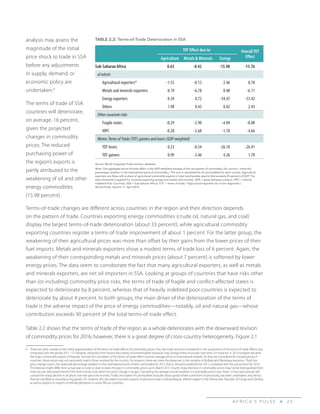
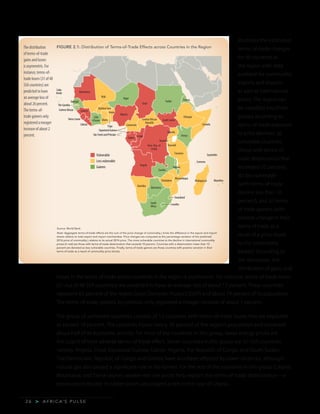
Figure 2.1: 	 Distribution of Terms-of-Trade Effects across Countries in the Region. .  .  .  .  .  .  .  .  .26
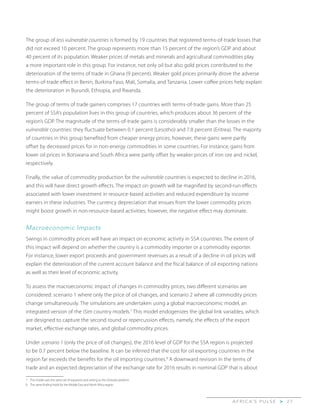
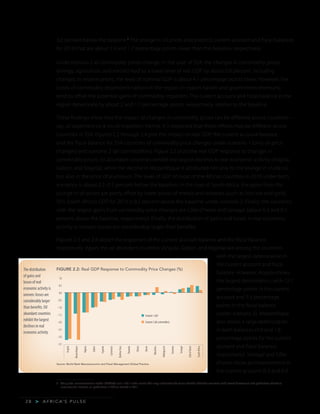
Figure 2.2: 	 Real GDP Response to Commodity Price Changes. .  .  .  .  .  .  .  .  .  .  .  .  .  .  .  .  .  .  .  .  .28
Figure 2.3: 	 Current Account Balance Response to Commodity Price
	 Changes (percentage points).  .  .  .  .  .  .  .  .  .  .  .  .  .  .  .  .  .  .  .  .  .  .  .  .  .  .  .  .  .  .  .  .  . 29
A F R I C A’ S P U L S E > 3
List of Tables
Table B1.1.1: 	 Testing the Twin Deficits Hypothesis in SSA. .  .  .  .  .  .  .  .  .  .  .  .  .  .  .  .  .  .  .  .  .  .  .  .  .19
Table 2.1: 	 Episodes of Plunging Oil Prices.  .  .  .  .  .  .  .  .  .  .  .  .  .  .  .  .  .  .  .  .  .  .  .  .  .  .  .  .  .  .  .  . 24
Table 2.2: 	 Terms-of-Trade Deterioration in SSA.  .  .  .  .  .  .  .  .  .  .  .  .  .  .  .  .  .  .  .  .  .  .  .  .  .  .  .  .  . 25
Table B2.1.1: 	 Change in Crude Oil Price, 2015–16 . .  .  .  .  .  .  .  .  .  .  .  .  .  .  .  .  .  .  .  .  .  .  .  .  .  .  .  .  .30
Table B2.1.2: 	 Episodes of Plunging Oil Prices.  .  .  .  .  .  .  .  .  .  .  .  .  .  .  .  .  .  .  .  .  .  .  .  .  .  .  .  .  .  .  .  . 31
Figure 2.4: 	 Fiscal Balance Response to Commodity Price Changes (percentage points) . .  .  .  .  .29
Figure 3.1: 	 Urbanization and Economic Development . .  .  .  .  .  .  .  .  .  .  .  .  .  .  .  .  .  .  .  .  .  .  .  .  .35
Figure B3.1.1: 	A “Local” City: High Urban Wage Costs and Lack of Tradables Production. .  .  .  .  .  .  .36
Figure B3.3.1: 	Africa’s Urbanization at Lower Income Levels. .  .  .  .  .  .  .  .  .  .  .  .  .  .  .  .  .  .  .  .  .  .  .  .39
Figure 3.2: 	 African Cities: Population Density Gradients, 2012. .  .  .  .  .  .  .  .  .  .  .  .  .  .  .  .  .  .  .  .  .40
Figure 3.3: 	 African Cities: Economic Density, 2014. .  .  .  .  .  .  .  .  .  .  .  .  .  .  .  .  .  .  .  .  .  .  .  .  .  .  .  .40
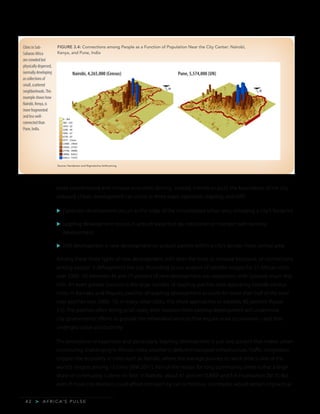
Figure 3.4: 	 Connections among People as a Function of Population Near the City Center:
	 Nairobi, Kenya, and Pune, India.  .  .  .  .  .  .  .  .  .  .  .  .  .  .  .  .  .  .  .  .  .  .  .  .  .  .  .  .  .  .  .  . 42
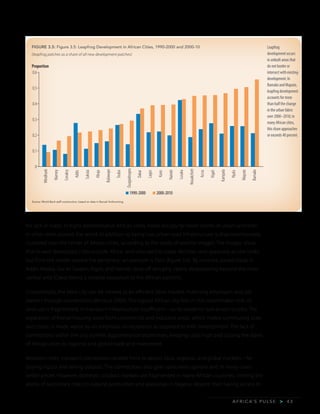
Figure 3.5: 	 Leapfrog Development in African Cities, 1990-2000 and 2000-10 .  .  .  .  .  .  .  .  .  .  .  . 43
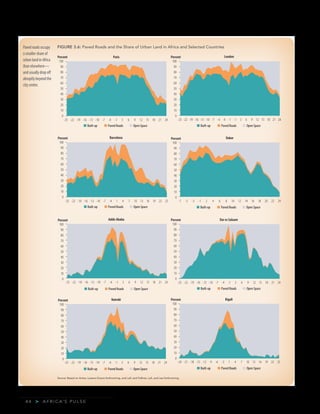
Figure 3.6: 	 Paved Roads and the Share of Urban Land in Africa and Selected Countries . .  .  .  .  .44
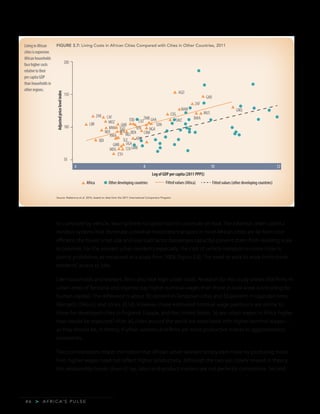
Figure 3.7: 	 Living Costs in African Cities Compared with Cities in Other Countries, 2011. . . . . 46
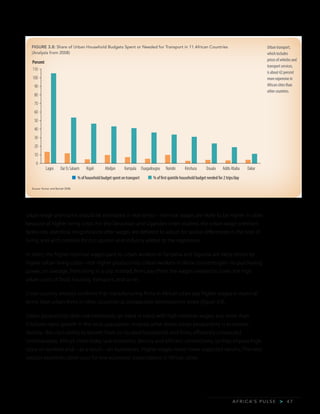
Figure 3.8: 	 Share of Urban Household Budgets Spent or Needed for Transport in
	 11 African Countries (Analysis from 2008). .  .  .  .  .  .  .  .  .  .  .  .  .  .  .  .  .  .  .  .  .  .  .  .  .  .47
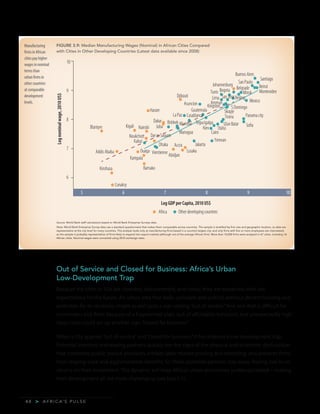
Figure 3.9: 	 Median Manufacturing Wages (Nominal) in African Cities Compared with
	 Cities in Other Developing Countries (Latest data available since 2008). .  .  .  .  .  .  .  .48
Figure 3.10: 	 Size of Urban Firms in Africa and Other Developing Regions.  .  .  .  .  .  .  .  .  .  .  .  .  .  . 51
Figure 3.11: 	 Formal Jobs in Downtown Kampala, Lusaka, and Kigali. .  .  .  .  .  .  .  .  .  .  .  .  .  .  .  .  .  .52
Figure 3.12: 	 Shares of Firms in Internationally Traded and Nontradable Sectors
	 for Selected Cities (Latest Data Available since 2010) . .  .  .  .  .  .  .  .  .  .  .  .  .  .  .  .  .  .  .53
A F R I C A’ S P U L S E>4
Summary
u	Growth in Sub-Saharan Africa decelerated to an estimated 3.0 percent in 2015, from 4.5 percent
in 2014, driven by low commodity prices, weak global growth, rising borrowing costs, and
adverse domestic developments in many countries. The slowdown was especially sharp in the
region’s largest commodity exporters. But there were some bright spots, such as Côte d’Ivoire,
which continued to experience robust, broad-based growth, supported by rising investment, and
Kenya and Rwanda, where growth remained buoyant, helped by infrastructure spending, strong
consumer demand, and a growing services sector.
u	Recent commodity price movements represent a deterioration in the region’s terms of trade in
2016 by an estimated 16 percent (first-order approximation), with commodity exporters, especially
oil exporters, seeing large terms-of-trade losses. For the region as a whole, it is estimated that
the impact of the terms-of-trade shock will lower the level of economic activity in 2016 by 0.5
percent from the baseline, and weaken the current account and fiscal balance by about 4 and 2
percentage points below the baseline, respectively.
u	With commodity prices expected to remain low for longer amid a gradual pickup in global activity
and volatile financial market conditions, average growth in the region is projected to remain
subdued at 3.3 percent in 2016. For 2017–18, growth is projected to average 4.5 percent. The
projected pickup in activity in 2017–18 reflects a gradual improvement in the region’s largest
economies—Angola, Nigeria, and South Africa—as commodity prices stabilize and policies
become more supportive of growth.
u	Nonetheless, risks to the outlook remain tilted to the downside, including a sharper than expected
slowdown in China, further decline in commodity prices, delays in implementing the necessary
adjustment to the export price shock in affected countries, worsening drought conditions, and
political and security uncertainties.
u	As African countries move to rebuild momentum on growth, key policy challenges include
adjusting to a new, lower level of commodity prices; addressing economic vulnerabilities; and
developing new sources of sustainable, inclusive growth.
u	The rapid decline in oil and commodity prices has signaled an urgent need for economic
diversification in Africa. Urbanization and well managed cities provide a major opportunity to offer
a springboard for diversification. But for urbanization to bring the benefits that it should, cities
must become less costly for firms and hence more appealing to investors; in addition, cities must
become kinder to their residents by offering services, amenities, and housing for the poor and the
middle class.
u	To build cities that work—cities that are livable, connected, and affordable, and therefore
economically dense—policy makers will need to direct attention toward the deeper structural
problems that misallocate land, fragment development, and limit productivity. Local and national
governments are called to reform land markets and urban regulations—to enable investment and
development, reward compliance, and ensure enforcement—and coordinate early infrastructure
investments—increasing them is not enough.
A F R I C A’ S P U L S E > 5
Section 1: Recent Developments and Trends
u	The global economic environment facing Sub-Saharan Africa weakened significantly in 2015,
with commodity prices falling sharply and global growth remaining weak, slipping to 2.4
percent, from 2.6 percent in 2014. Global growth is projected to edge up to 2.5 percent in 2016,
as emerging market and developing economy commodity exporters continue to adjust to low
commodity prices.
u	In 2016, growth is expected to remain at a lackluster 3.3 percent in Sub-Saharan Africa. There
is considerable variation in economic performance across countries, with the slowdown
concentrated among the region’s largest commodity exporters. Growing economic
vulnerabilities, amid weakened policy buffers, continue to pose challenges for policy.
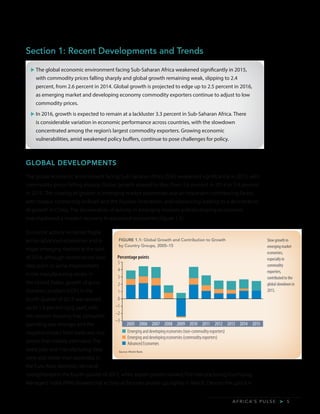
GLOBAL DEVELOPMENTS
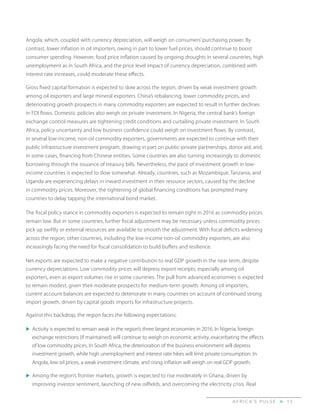
The global economic environment facing Sub-Saharan Africa (SSA) weakened significantly in 2015, with
commodity prices falling sharply. Global growth slowed further, from 2.6 percent in 2014 to 2.4 percent
in 2015. The slowing of growth in emerging market economies was an important contributing factor,
with output contracting in Brazil and the Russian Federation, and rebalancing leading to a deceleration
of growth in China. The deceleration of activity in emerging markets and developing economies
overshadowed a modest recovery in advanced economies (figure 1.1).
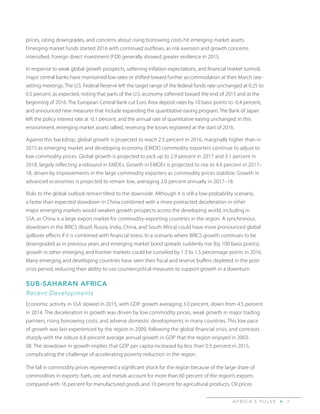
Economic activity remained fragile
across advanced economies and in
major emerging markets at the start
of 2016, although recent sector-level
data point to some improvement
in the manufacturing sector. In
the United States, growth of gross
domestic product (GDP) in the
fourth quarter of 2015 was revised
up to 1.4 percent (q/q, saar), with
the revision showing that consumer
spending was stronger and the
negative impact from trade was less
severe than initially estimated. The
latest jobs and manufacturing data
were also better than expected. In
the Euro Area, domestic demand
strengthened in the fourth quarter of 2015, while export growth slowed. The manufacturing Purchasing
Manager’s Index (PMI) showed that activity at factories picked up slightly in March. Despite the uptick in
Slow growth in
emerging market
economies,
especially in
commodity
exporters,
contributed to the
global slowdown in
2015.
Source: World Bank.
FIGURE 1.1: Global Growth and Contribution to Growth
by Country Groups, 2005–15
2005
5
4
3
2
1
0
–1
–2
–3
2006 2007 2008 2009 2010 2011 2012 2013 2014 2015
Percentage points
Advanced Economies
Emerging and developing economies (commodity exporters)
Emerging and developing economies (non-commodity exporters)
A F R I C A’ S P U L S E>6
activity, factory gate prices fell sharply, highlighting the challenges the European Central Bank faces in its
efforts to lift inflation. In Japan, the economy contracted in the fourth quarter of 2015 and remained weak in
the first quarter of 2016, with activity continuing to slow in the manufacturing and services sectors. In China,
PMI data indicated some improvement in factory activity in March.
The weakness of commodity prices seen in 2015, especially energy, has persisted into early 2016.
Abundant supplies, weaker growth prospects in emerging economies, and a strong U.S. dollar resulted
in a sharp drop in commodity prices in 2015, with energy prices falling by 45 percent and non-
energy prices declining by 15 percent from the previous year. Oil prices rose from less than $30/bbl in
January 2016 to US$37/bbl during the first half of March on improved sentiment. Despite discussion
among producers to freeze output at the January levels, the price rally stalled as the market remained
oversupplied with large stocks, particularly in the United States. Metal prices have also risen from lows
in January, on expectations of firming demand and production cuts. However, the markets remain
oversupplied with large stocks and capacity continues to rise, especially for iron ore and copper.
Agricultural prices continued their downward trend in early 2016 due to ample supplies.
In addition to the fall in commodity prices, global merchandise trade was subdued in 2015, as import
demand fell in commodity-exporting countries, and weakened in China because of slowing activity
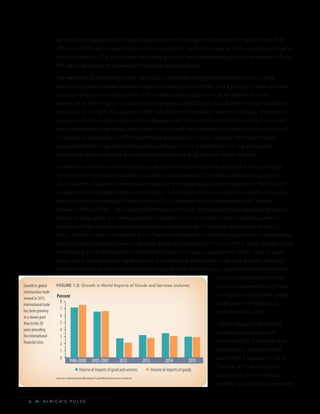
and economic rebalancing. International trade has been growing at a slower pace than in the 20 years
preceding the international financial crisis (figure 1.2). Globally, the annual growth in goods and services
import volumes has averaged 3 percent since 2012, compared with an average pace of 7 percent
between 1986 and 2007. The sluggish performance of trade in recent years can be explained by several
factors: among others, the slowing economic growth in low- and middle-income countries, uneven
recovery of high-income economies, exchange rate volatility with the strong appreciation of the U.S.
dollar, and the slump in commodity prices. The terms of trade of commodity exporters have deteriorated,
affecting their purchasing power to demand goods and services from the rest of the world. Another factor
contributing to the deceleration in international trade is the slower expansion in recent years of global
value chains, which played a significant role in accelerating global trade in the past decades. Although
services trade has shown more resilience than goods trade in recent years, supported by strengthening
consumer spending and rising
purchasing power among major
oil-importing economies, global
trade growth is expected to
remain weak in 2016.
Capital inflows to developing
countries dipped to a post-
crisis low in 2015, slowing to an
estimated 3.1 percent of GDP,
down from 5.3 percent in 2014.
The year 2015 was the third
consecutive year of net fund
outflows, as tumbling commodity
Growth in global
merchandise trade
slowed in 2015.
International trade
has been growing
at a slower pace
than in the 20
years preceding
the international
financial crisis.
Source: International Monetary Fund World Economic Outlook.
FIGURE 1.2: Growth in World Imports of Goods and Services (volume)
1
0
2
3
4
5
6
7
8
1986-2000 2001-2007 2012 2013 2014 2015
Percent
Volume of imports of good and services Volume of imports of goods
A F R I C A’ S P U L S E > 7
prices, rating downgrades, and concerns about rising borrowing costs hit emerging market assets.
Emerging market funds started 2016 with continued outflows, as risk aversion and growth concerns
intensified. Foreign direct investment (FDI) generally showed greater resilience in 2015.
In response to weak global growth prospects, softening inflation expectations, and financial market turmoil,
major central banks have maintained low rates or shifted toward further accommodation at their March rate-
setting meetings. The U.S. Federal Reserve left the target range of the federal funds rate unchanged at 0.25 to
0.5 percent, as expected, noting that parts of the U.S. economy softened toward the end of 2015 and at the
beginning of 2016. The European Central Bank cut Euro Area deposit rates by 10 basis points to -0.4 percent,
and announced new measures that include expanding the quantitative easing program. The Bank of Japan
left the policy interest rate at -0.1 percent, and the annual rate of quantitative easing unchanged. In this
environment, emerging market assets rallied, reversing the losses registered at the start of 2016.
Against this backdrop, global growth is projected to reach 2.5 percent in 2016, marginally higher than in
2015 as emerging market and developing economy (EMDE) commodity exporters continue to adjust to
low commodity prices. Global growth is projected to pick up to 2.9 percent in 2017 and 3.1 percent in
2018, largely reflecting a rebound in EMDEs. Growth in EMDEs is projected to rise to 4.6 percent in 2017–
18, driven by improvements in the large commodity exporters as commodity prices stabilize. Growth in
advanced economies is projected to remain low, averaging 2.0 percent annually in 2017–18.
Risks to the global outlook remain tilted to the downside. Although it is still a low-probability scenario,
a faster than expected slowdown in China combined with a more protracted deceleration in other
major emerging markets would weaken growth prospects across the developing world, including in
SSA, as China is a large export market for commodity-exporting countries in the region. A synchronous
slowdown in the BRICS (Brazil, Russia, India, China, and South Africa) could have more pronounced global
spillover effects if it is combined with financial stress. In a scenario where BRICS growth continues to be
downgraded as in previous years and emerging market bond spreads suddenly rise (by 100 basis points),
growth in other emerging and frontier markets could be curtailed by 1.3 to 1.5 percentage points in 2016.
Many emerging and developing countries have seen their fiscal and reserve buffers depleted in the post-
crisis period, reducing their ability to use countercyclical measures to support growth in a downturn.
SUB-SAHARAN AFRICA
Recent Developments
Economic activity in SSA slowed in 2015, with GDP growth averaging 3.0 percent, down from 4.5 percent
in 2014. The deceleration in growth was driven by low commodity prices, weak growth in major trading
partners, rising borrowing costs, and adverse domestic developments in many countries. This low pace
of growth was last experienced by the region in 2009, following the global financial crisis, and contrasts
sharply with the robust 6.8 percent average annual growth in GDP that the region enjoyed in 2003-
08. The slowdown in growth implies that GDP per capita increased by less than 0.5 percent in 2015,
complicating the challenge of accelerating poverty reduction in the region.
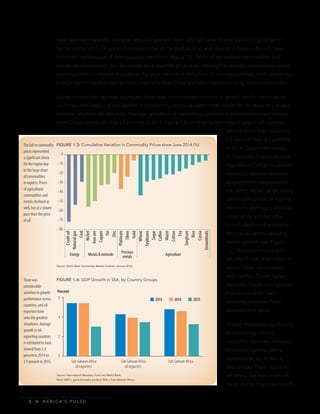
The fall in commodity prices represented a significant shock for the region because of the large share of
commodities in exports: fuels, ore, and metals account for more than 60 percent of the region’s exports
compared with 16 percent for manufactured goods and 10 percent for agricultural products. Oil prices
A F R I C A’ S P U L S E>8
have declined markedly, falling by about 67 percent, from US$108/barrel in June 2014 to US$38/barrel
by December 2015. Oil prices continued to fall at the start of 2016, and, despite a recent rebound, have
remained low because of strong supply conditions (figure 1.3). Prices of agricultural commodities and
metals declined as well, but at a slower pace than the price of oil. Among non-energy commodities, metal
prices sustained a steeper drop, driven by large declines in the prices of iron ore, platinum, and copper, due
in large part to weak global demand, especially from China and other large emerging market economies.
Going beyond the regional aggregate, there was considerable variation in growth performance across
countries. The impact of the decline in commodity prices has been most severe for oil exporters, in part
because oil prices fell the most. Average growth in oil-exporting countries is estimated to have slowed
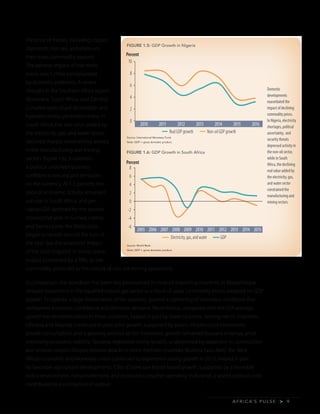
from 5.4 percent in 2014 to 2.9 percent in 2015 (figure 1.4). In Nigeria, the region’s largest oil exporter,
growth more than halved to
2.8 percent from 6.3 percent
in 2014. Growth fell sharply
in Equatorial Guinea and the
Republic of Congo. In several
instances, adverse domestic
developments exacerbated
the direct impact of declining
commodity prices. In Nigeria,
electricity shortages, political
uncertainty, and security
threats depressed activity in
the non-oil sector, keeping
overall growth low (figure
1.5). Political tensions and
security threats intensified in
several other oil exporters,
with conflict (South Sudan)
and Boko Haram insurgencies
(Cameroon and Chad)
diverting resources from
development goals.
Activity weakened significantly
in non-energy mineral
exporting countries, including
Botswana, Guinea, Liberia,
Sierra Leone, South Africa,
and Zambia. These countries
benefited less from lower oil
prices due to sharp declines in
The fall in commodity
prices represented
a significant shock
for the region due
to the large share
of commodities
in exports. Prices
of agricultural
commodities and
metals declined as
well, but at a slower
pace than the price
of oil.
There was
considerable
variation in growth
performance across
countries, and oil
exporters have
seen the greatest
slowdown. Average
growth in oil-
exporting countries
is estimated to have
slowed from 5.4
percent in 2014 to
2.9 percent in 2015.
Source: World Bank Commodity Market Outlook, January 2016.
Source: International Monetary Fund and World Bank.
Note: GDP = gross domestic product; SSA = Sub-Saharan Africa.
FIGURE 1.3: Cumulative Variation in Commodity Prices since June 2014 (%)
FIGURE 1.4: GDP Growth in SSA, by Country Groups
–80
–70
–60
–50
–40
–30
–20
–10
0
Crudeoil
Naturalgas
Coal
Nickel
Ironore
Copper
Tin
Zinc
Gold
Platinum
Silver
Wheat
Soybeans
Sugar
Coffee
Maize
Cotton
Tea
Sorghum
Rice
Cocoa
Groundnuts
Energy Metals & minerals
Precious
metals Agriculture
0
2
4
6
Sub-Saharan Africa
oil exporters
Sub-Saharan Africa
oil importers
Sub-Saharan Africa
2013 2014 2015
Percent
A F R I C A’ S P U L S E > 9
the price of metals, including copper,
diamonds, iron ore, and platinum,
their main commodity exports.
The adverse impact of low metal
prices was further compounded
by domestic problems. A severe
drought in the Southern Africa region
(Botswana, South Africa, and Zambia)
curtailed agricultural production and
hydroelectricity generation there. In
South Africa, the real value added by
the electricity, gas, and water sector
declined sharply, constraining activity
in the manufacturing and mining
sectors (figure 1.6). In addition,
a political crisis kept business
confidence low and put pressures
on the currency. At 1.3 percent, the
pace of economic activity remained
sub-par in South Africa, and per
capita GDP declined for the second
consecutive year. In Guinea, Liberia,
and Sierra Leone, the Ebola crisis
began to recede around the turn of
the year, but the economic impact
of the crisis lingered. In Sierra Leone,
output contracted by a fifth, as low
commodity prices led to the closure of iron ore mining operations.
In comparison, the slowdown has been less pronounced in most oil-importing countries. In Mozambique,
delayed investment in the liquefied natural gas sector as a result of weak commodity prices weighed on GDP
growth. In Uganda, a large depreciation of the currency spurred a tightening of monetary conditions that
dampened economic confidence and domestic demand. Nevertheless, compared with the SSA average,
growth has remained robust in these countries, helped in part by lower oil prices. Among net oil importers,
Ethiopia and Rwanda continued to post solid growth, supported by public infrastructure investment,
private consumption, and a growing services sector. Elsewhere, growth remained buoyant in Kenya, amid
improving economic stability; Tanzania registered strong growth, underpinned by expansion in construction
and services sectors. Despite terrorist attacks in some member countries (Burkina Faso, Mali), the West
African Economic and Monetary Union continued to experience strong growth in 2015, helped in part
by favorable agricultural developments. Côte d’Ivoire saw broad-based growth, supported by a favorable
policy environment, rising investment, and increased consumer spending. In Burundi, a severe political crisis
contributed to a contraction of output.
Domestic
developments
exacerbated the
impact of declining
commodity prices.
In Nigeria, electricity
shortages, political
uncertainty, and
security threats
depressed activity in
the non-oil sector,
while in South
Africa, the declining
real value added by
the electricity, gas,
and water sector
constrained the
manufacturing and
mining sectors.
Source: International Monetary Fund.
Note: GDP = gross domestic product.
Source: World Bank.
Note: GDP = gross domestic product.
FIGURE 1.5: GDP Growth in Nigeria
FIGURE 1.6: GDP Growth in South Africa
0
2
4
6
8
10
2010 2011 2012 2013 2014 2015 2016
RealGDPgrowth Non-oilGDPgrowth
Percent
-6
-4
-2
0
2
4
6
8
2005 2006 2007 2008 2009 2010 2011 2012 2013 2014 2015
Electricity,gas,andwater GDP
Percent
A F R I C A’ S P U L S E>1 0
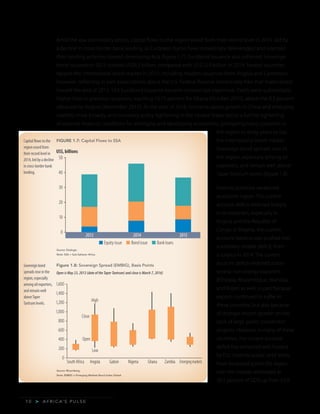
Amid the low commodity prices, capital flows to the region eased from their record level in 2014, led by
a decline in cross-border bank lending, as European banks have increasingly deleveraged and oriented
their lending activities toward developing Asia (figure 1.7). Eurobond issuance also softened. Sovereign
bond issuance in 2015 totaled US$9.2 billion, compared with US$12.9 billion in 2014. Several countries
tapped the international bond market in 2015, including maiden issuances from Angola and Cameroon.
However, reflecting in part expectations about the U.S. Federal Reserve interest rate hike that materialized
toward the end of 2015, SSA Eurobond issuance became increasingly expensive. Yields were substantially
higher than in previous issuances, reaching 10.75 percent for Ghana (October 2015), above the 9.5 percent
obtained by Angola (November 2015). At the start of 2016, concerns about growth in China and emerging
markets more broadly, and monetary policy tightening in the United States led to a further tightening
of external financial conditions for emerging and developing economies, prompting many countries in
the region to delay plans to tap
the international bond market.
Sovereign bond spreads rose in
the region, especially among oil
exporters, and remain well above
Taper Tantrum levels (figure 1.8).
External positions weakened
across the region. The current
account deficit widened sharply
in oil exporters, especially in
Angola and the Republic of
Congo. In Nigeria, the current
account balance was pushed into
a relatively smaller deficit, from
a surplus in 2014. The current
account deficit widened across
several non-energy exporters
(Ethiopia, Mozambique, Namibia,
and Niger) as well, in part because
exports continued to suffer in
these countries, but also because
of stronger import growth on the
back of large public investment
projects. However, in many of these
countries, the current account
deficit has remained well funded
by FDI. External public debt levels
have increased across the region,
with the median estimated at
30.1 percent of GDP, up from 23.9
Capital flows to the
region eased from
their record level in
2014, led by a decline
in cross-border bank
lending.
Sovereign bond
spreads rose in the
region, especially
among oil exporters,
and remain well
aboveTaper
Tantrum levels.
Source: Dealogic.
Note: SSA = Sub-Saharan Africa.
Source: Bloomberg.
Note: EMBIG = Emerging Markets Bond Index Global.
FIGURE 1.7: Capital Flows to SSA
Figure 1.8: Sovereign Spread (EMBIG), Basis Points
Open is May 23, 2013 (date of the Taper Tantrum) and close is March 7, 2016)
0
10
20
30
40
50
2013 2014 2015
US$, billions
Equity issue Bond issue Bank loans
Open is May 23, 2013 (date of the Taper Tantrum) and close is March 7, 2016
0
200
400
600
800
1,000
1,200
1,400
1,600
SouthAfrica Angola Gabon Nigeria Ghana Zambia Emergingmarkets
Low
Close
Open
High
A F R I C A’ S P U L S E > 1 1
Source: Bloomberg.
Note: FX = foreign exchange; LCU = local currency units; SSA = Sub-Saharan Africa.
FIGURE 1.9: Currency Depreciation against the Dollar, Selected SSA Countries
(percent, based on the LCU/US$ rate; an increase means a depreciation)
Nov-15
Nov-15
Mar-16
Jun-15
Jan-16
Jun-15 Sep-15
Feb-15 Sep-15
0
20
40
60
80
100
120
140
160
Zambia Mozambique Angola Ghana South Africa Tanzania Uganda Nigeria Kenya
Largest depreciation
Percent
Change between January 2014 and March 2016
percent of GDP in 2014. On aggregate, external debt levels increased moderately in oil-exporting countries,
contained in part by Nigeria’s low level of public external debt. At the country level, Angola, Gabon, and the
Republic of Congo experienced a large increase in the external debt ratio. Other countries where external
debt levels rose significantly in 2015 include Ghana, Kenya, Mozambique, Tanzania, and Zambia. Several of
these countries (Ghana, Kenya, and Zambia) have tapped the international bond market. The rising external
debt levels leave several countries (Malawi, Mozambique, and the Republic of Congo) vulnerable to the risk
that future currency depreciation could pressure debt servicing costs.
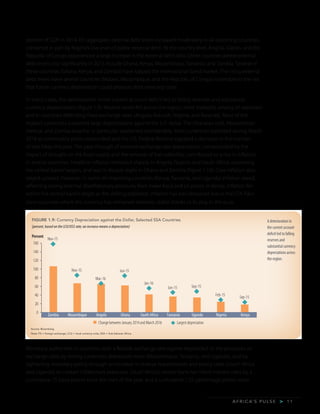
In many cases, the deterioration in the current account deficit led to falling reserves and substantial
currency depreciations (figure 1.9). Reserve levels fell across the region, most markedly among oil exporters
and in countries defending fixed exchange rates (Angola, Burundi, Nigeria, and Rwanda). Most of the
region’s currencies sustained large depreciations against the U.S. dollar. The Ghanaian cedi, Mozambican
metical, and Zambia kwacha, in particular, weakened considerably. Most currencies stabilized during March
2016 as commodity prices rebounded and the U.S. Federal Reserve signaled a decrease in the number
of rate hikes this year. The pass-through of nominal exchange rate depreciation, compounded by the
impact of drought on the food supply and the removal of fuel subsidies, contributed to a rise in inflation
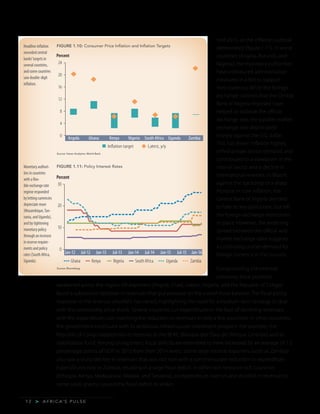
in several countries. Headline inflation increased sharply in Angola, Nigeria, and South Africa, exceeding
the central banks’targets, and was in double digits in Ghana and Zambia (figure 1.10). Core inflation also
edged upward. However, in some oil-importing countries (Kenya, Tanzania, and Uganda) inflation eased,
reflecting strong external disinflationary pressures from lower food and oil prices. In Kenya, inflation fell
within the central bank’s target as the shilling stabilized. Inflation has also remained low in the CFA franc
zone countries where the currency has remained relatively stable thanks to its peg to the euro.
A deterioration in
the current account
deficit led to falling
reserves and
substantial currency
depreciations across
the region.
Monetary authorities in countries with a flexible exchange rate regime responded to the pressures on
exchange rates by letting currencies depreciate more (Mozambique, Tanzania, and Uganda), and by
tightening monetary policy through an increase in reserve requirements and policy rates (South Africa
and Uganda) to contain inflationary pressures. South Africa’s central bank has hiked interest rates by a
cumulative 75 basis points since the start of the year, and a cumulative 1.25 percentage points since
A F R I C A’ S P U L S E>1 2
mid-2015, as the inflation outlook
deteriorated (figure 1.11). In some
countries (Angola, Burundi, and
Nigeria), the monetary authorities
have introduced administrative
measures in a bid to support
their currency. While the foreign
exchange controls that the Central
Bank of Nigeria imposed have
helped to stabilize the official
exchange rate, the parallel market
exchange rate depreciated
sharply against the U.S. dollar.
This has driven inflation higher,
stifled private sector demand, and
contributed to a slowdown in the
non-oil sector and a decline in
international reserves. In March,
against the backdrop of a sharp
increase in core inflation, the
Central Bank of Nigeria decided
to hike its key policy rate, but left
the foreign exchange restrictions
in place. However, the widening
spread between the official and
market exchange rates suggests
a continuing unmet demand for
foreign currency in the country.
Compounding the external
pressures, fiscal positions
weakened across the region. Oil exporters (Angola, Chad, Gabon, Nigeria, and the Republic of Congo)
faced a substantial decrease in revenues that put pressure on the overall fiscal balance. The fiscal policy
response to the revenue shortfalls has varied, highlighting the need for a medium-term strategy to deal
with the commodity price shock. Several countries cut expenditures in the face of declining revenues,
with the expenditure cuts matching the reduction in revenues in only a few countries. In other countries,
the government continued with its ambitious infrastructure investment program. For example, the
Republic of Congo tapped into its reserves at the BEAC (Banque des États de l’Afrique Centrale) and its
stabilization fund. Among oil exporters, fiscal deficits are estimated to have increased by an average of 1.5
percentage points of GDP in 2015 from their 2014 levels. Some large mineral exporters (such as Zambia)
also saw a sharp decline in revenues that was not met with a commensurate reduction in expenditure.
Expenditures rose in Zambia, resulting in a large fiscal deficit. In other non-resource-rich countries
(Ethiopia, Kenya, Madagascar, Malawi, and Tanzania), an expenditure overrun and shortfall in revenue (in
some cases grants) caused the fiscal deficit to widen.
Headline inflation
exceeded central
banks’targets in
several countries,
and some countries
saw double-digit
inflation.
Monetary authori-
ties in countries
with a flex-
ible exchange rate
regime responded
by letting currencies
depreciate more
(Mozambique,Tan-
zania, and Uganda),
and by tightening
monetary policy
through an increase
in reserve require-
ments and policy
rates (South Africa,
Uganda).
Source: Haver Analytics; World Bank.
Source: Bloomberg.
FIGURE 1.10: Consumer Price Inflation and Inflation Targets
FIGURE 1.11: Policy Interest Rates
0
4
8
12
16
20
24
ZambiaKenyaAngola Ghana South Africa UgandaNigeria
Percent
Latest, y/yInflation target
0
10
20
30
Jan-12 Jul-12 Jan-13 Jul-13 Jan-14 Jul-14 Jan-15 Jul-15 Jan-16
Ghana Kenya Nigeria South Africa Uganda Zambia
Percent
A F R I C A’ S P U L S E > 1 3
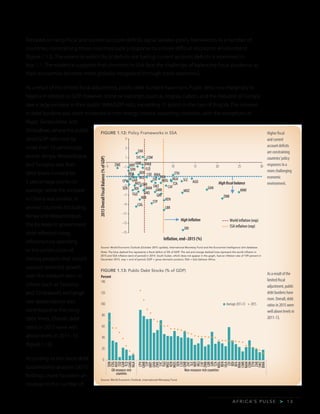
Elevated or rising fiscal and current account deficits signal weaker policy frameworks in a number of
countries, constraining these countries’ policy response to a more difficult economic environment
(figure 1.12). The extent to which fiscal deficits are fueling current account deficits is examined in
box 1.1. The evidence suggests that countries in SSA face the challenge of balancing fiscal prudence as
their economies become more globally integrated (through trade openness).
As a result of the limited fiscal adjustment, public debt burdens have risen. Public debt rose marginally in
Nigeria in relation to GDP. However, some oil exporters (such as Angola, Gabon, and the Republic of Congo)
saw a large increase in their public debt/GDP ratio, exceeding 15 points in the case of Angola. The increase
in debt burdens was more moderate in non-energy mineral exporting countries, with the exceptions of
Niger, Sierra Leone, and
Zimbabwe, where the public
debt/GDP ratio rose by
more than 10 percentage
points. Kenya, Mozambique,
and Tanzania saw their
debt levels increase by
5 percentage points on
average, while the increase
in Ghana was smaller. In
several countries (including
Kenya and Mozambique),
the increase in government
debt reflected rising
infrastructure spending
or the construction of
mining projects that should
support potential growth
over the medium term. In
others (such as Tanzania
and Zimbabwe), exchange
rate depreciations also
contributed to the rising
debt levels. Overall, debt
ratios in 2015 were well
above levels in 2011–13
(figure 1.13).
According to the latest debt
sustainability analysis (2015)
findings, there has been an
increase in the number of
Higher fiscal
and current
account deficits
are constraining
countries’policy
responses to a
more challenging
economic
environment.
Source: World Economic Outlook (October 2015 update), International Monetary Fund and the Economist Intelligence Unit database.
Note: The blue dashed line represents a fiscal deficit of 3% of GDP. The red and orange dashed lines represent the world inflation in
2015 and SSA inflation (end of period) in 2014. South Sudan, which does not appear in the graph, had an inflation rate of 109 percent in
December 2015. eop = end of period; GDP = gross domestic product; SSA = Sub-Saharan Africa.
FIGURE 1.12: Policy Frameworks in SSA
0
20
40
60
80
100
120
140
SDN
COG
AGO
SSD
GAB
TCD
GNQ
NGA
CPV
GMB
STP
MRT
GHA
ZWE
SYC
TGO
MOZ
KEN
MUS
SEN
LSO
GNB
ZAF
SLE
NER
MLI
CAF
ZMB
LBR
GIN
TZA
MDG
BEN
UGA
CIV
BDI
BFA
RWA
CMR
NAM
COM
ETH
ZAR
SWZ
BWA
Oil-resource-rich
countries
Non-resource-rich countries
Average 2011-13 2015
Percent
–1–5 5 10 15 20 25 30
–15
–13
–11
–9
–7
–5
–3
1
3
5
World inflation (eop)
SSA inflation (eop)
AGO
BEN
BWA
BFA
BDI
CPV
CMR
CAF
TCD
COM
ZAR
COG
CIV
GNQ
ERI
ETH
GAB
GMB GHA
GIN
GNB
KEN
LSO
LBR
MDG
MWI
MLI
MRT
MUS
MOZ
NAM
NER
NGA
RWA
SEN
SYC
SLEZAF
SDN
SWZ
TZA
TGO
UGA
ZMB
ZWE
STP
2015OverallFiscalBalance(%ofGDP)
Inflation, end–2015 (%)
Highfiscalbalance
HighInflation
As a result of the
limited fiscal
adjustment, public
debt burdens have
risen. Overall, debt
ratios in 2015 were
well above levels in
2011-13.
Source: World Economic Outlook, International Monetary Fund.
FIGURE 1.13: Public Debt Stocks (% of GDP)
A F R I C A’ S P U L S E>1 4
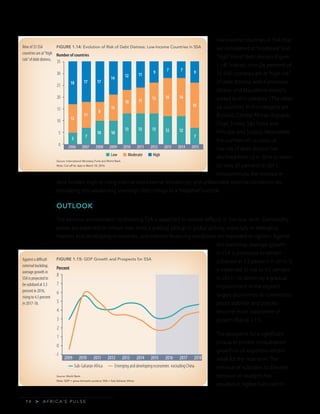
low-income countries in SSA that
are considered at “moderate”and
“high”risk of debt distress (figure
1.14). Indeed, nine (26 percent) of
35 SSA countries are at “high risk”
of debt distress, with Cameroon,
Ghana, and Mauritania recently
added to this category. (The other
six countries in this category are
Burundi, Central African Republic,
Chad, Eritrea, São Tomé and
Príncipe, and Sudan). Meanwhile,
the number of countries at
low risk of debt distress has
declined from 12 in 2014 to seven
(or only 20 percent) in 2015.
Unsurprisingly, the increase in
debt burden, high or rising internal and external imbalances, and unfavorable external conditions are
translating into weakening sovereign debt ratings or a “negative”outlook.
OUTLOOK
The external environment confronting SSA is expected to remain difficult in the near term. Commodity
prices are expected to remain low, amid a gradual pickup in global activity, especially in emerging
markets and developing economies, and external financing conditions are expected to tighten. Against
this backdrop, average growth
in SSA is projected to remain
subdued at 3.3 percent in 2016. It
is expected to rise to 4.5 percent
in 2017–18, driven by a gradual
improvement in the region’s
largest economies as commodity
prices stabilize and policies
become more supportive of
growth (figure 1.15).
The prospects for a significant
pickup in private consumption
growth in oil exporters remain
weak for the near term. The
removal of subsidies to alleviate
pressure on budgets has
resulted in higher fuel costs in
Nine of 35 SSA
countries are at“high
risk”of debt distress.
Against a difficult
external backdrop,
average growth in
SSA is projected to
be subdued at 3.3
percent in 2016,
rising to 4.5 percent
in 2017-18.
Source: World Bank.
Note: GDP = gross domestic product; SSA = Sub-Saharan Africa.
Source: International Monetary Fund and World Bank.
Note: Cut-off for data is March 18, 2016.
FIGURE 1.14: Evolution of Risk of Debt Distress: Low-Income Countries in SSA
FIGURE 1.15: GDP Growth and Prospects for SSA
Number of countries
5 7
10 10
13 13 13 12 12
7
12
11
8
11
10 11 13 16 16
19
18 17 17
14 12 11 9 7 7 9
0
5
10
15
20
25
30
35
2006 2007 2008 2009 2010 2011 2012 2013 2014 2015
Low Moderate High
-1
0
1
2
3
4
5
6
7
8
2009 2010 2011 2012 2013 2014 2015 2016 2017 2018
Sub-Saharan Africa Emerging and developing economies excluding China
Percent
A F R I C A’ S P U L S E > 1 5
Angola, which, coupled with currency depreciation, will weigh on consumers’ purchasing power. By
contrast, lower inflation in oil importers, owing in part to lower fuel prices, should continue to boost
consumer spending. However, food price inflation caused by ongoing droughts in several countries, high
unemployment as in South Africa, and the price level impact of currency depreciation, combined with
interest rate increases, could moderate these effects.
Gross fixed capital formation is expected to slow across the region, driven by weak investment growth
among oil exporters and large mineral exporters. China’s rebalancing, lower commodity prices, and
deteriorating growth prospects in many commodity exporters are expected to result in further declines
in FDI flows. Domestic policies also weigh on private investment. In Nigeria, the central bank’s foreign
exchange control measures are tightening credit conditions and curtailing private investment. In South
Africa, policy uncertainty and low business confidence could weigh on investment flows. By contrast,
in several low-income, non-oil commodity exporters, governments are expected to continue with their
public infrastructure investment program, drawing in part on public-private partnerships, donor aid, and,
in some cases, financing from Chinese entities. Some countries are also turning increasingly to domestic
borrowing through the issuance of treasury bills. Nevertheless, the pace of investment growth in low-
income countries is expected to slow somewhat. Already, countries, such as Mozambique, Tanzania, and
Uganda are experiencing delays in inward investment in their resource sectors, caused by the decline
in commodity prices. Moreover, the tightening of global financing conditions has prompted many
countries to delay tapping the international bond market.
The fiscal policy stance in commodity exporters is expected to remain tight in 2016 as commodity prices
remain low. But in some countries, further fiscal adjustment may be necessary unless commodity prices
pick up swiftly or external resources are available to smooth the adjustment. With fiscal deficits widening
across the region, other countries, including the low-income non-oil commodity exporters, are also
increasingly facing the need for fiscal consolidation to build buffers and resilience.
Net exports are expected to make a negative contribution to real GDP growth in the near term, despite
currency depreciations. Low commodity prices will depress export receipts, especially among oil
exporters, even as export volumes rise in some countries. The pull from advanced economies is expected
to remain modest, given their moderate prospects for medium-term growth. Among oil importers,
current account balances are expected to deteriorate in many countries on account of continued strong
import growth, driven by capital goods imports for infrastructure projects.
Against this backdrop, the region faces the following expectations:
u	Activity is expected to remain weak in the region’s three largest economies in 2016. In Nigeria, foreign
exchange restrictions (if maintained) will continue to weigh on economic activity, exacerbating the effects
of low commodity prices. In South Africa, the deterioration of the business environment will depress
investment growth, while high unemployment and interest rate hikes will limit private consumption. In
Angola, low oil prices, a weak investment climate, and rising inflation will weigh on real GDP growth.
u	Among the region’s frontier markets, growth is expected to rise moderately in Ghana, driven by
improving investor sentiment, launching of new oilfields, and overcoming the electricity crisis. Real
A F R I C A’ S P U L S E>1 6
GDP growth is expected to remain subdued in Zambia, because of low copper prices and power
shortages, and as higher interest rates and food costs stemming from the weakening currency weigh
on private consumption. However, growth is expected to remain robust in Kenya, supported by
private consumption and public investment. In Côte d’Ivoire, improved investment climate and strong
domestic demand will help to keep growth high.
u	The outlook for the region’s low-income countries is expected to include a modest pickup in
growth in oil and mineral exporters in 2016 as they continue to adjust to low commodity prices. In
Mozambique, delayed investment in the liquefied natural gas sector and rising inflation will weigh
on real GDP growth in 2016. Growth is also expected to slow in the Democratic Republic of Congo
as the copper sector continues to struggle and political uncertainty weighs on investor sentiment.
Post-Ebola recovery, aid-driven infrastructure investment and some limited growth in iron ore
exports should help boost activity in Guinea, Liberia, and Sierra Leone. However, political and security
uncertainties are expected to remain a drag on economic growth in Burundi, Burkina Faso, Mali, and
Niger, and drought could adversely impact activity in Ethiopia. For most other countries, growth is
projected to remain robust, supported by domestic investment and lower oil prices.
RISKS
The balance of risks to the outlook remains tilted to the downside.
u	On the external front, a sharper than expected slowdown in China through the rebalancing of
growth toward consumption and services would lead to a further decline in commodity prices and
investments that could lead to a cancelation of planned investment projects in resource sectors, and
further weaken activity in commodity exporters. Weaker than expected growth in the Euro Area could
further weaken the external demand for exports, and reduce investment flows as well as official aid.
Tighter global financing conditions would result in higher borrowing costs that could affect the region
through higher risk premia and reduced sovereign bond access for emerging and frontier countries.
u	On the domestic front, delays in adjustment to external shocks in affected countries would create
policy uncertainties that could weigh on investor sentiment and weaken the recovery. A worsening
of drought conditions would dampen growth in agriculture, reduce hydroelectricity production,
and accentuate inflationary pressures. Boko Haram insurgencies and terrorist attacks remain a
concern in West Africa and Kenya, while the risks of political upheavals are substantial in Burundi
and South Sudan.
POLICY CHALLENGES
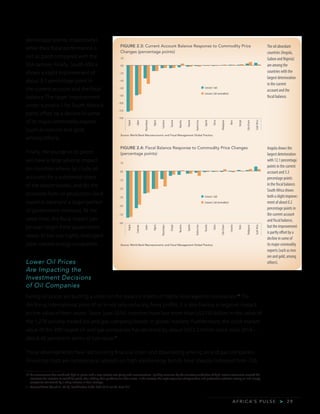
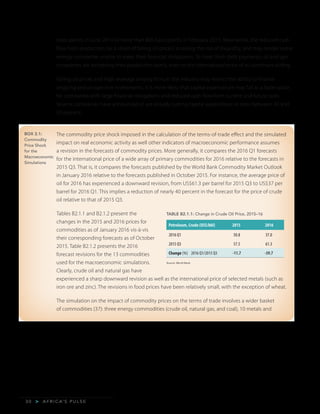
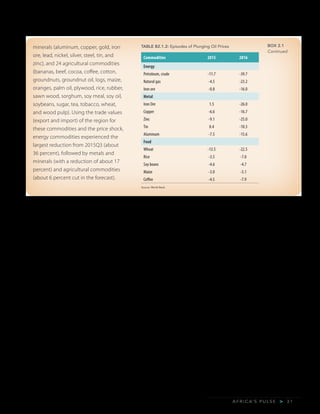
Commodity exporters across the region face a new, lower level of commodity prices to which they need
to adjust. Furthermore, with commodity markets, and external conditions more generally, likely to be
less supportive than in the past, the region will also need to focus on developing new sources of growth.
Meanwhile, widening fiscal and current account deficits have increased economic vulnerabilities, which
are reflected in depreciating currencies and rising inflation. This has prompted central banks in many
cases to raise interest rates, even as the economy was slowing, further undermining growth. Responses
to these challenges will vary, depending on country-specific conditions.
A F R I C A’ S P U L S E > 1 7
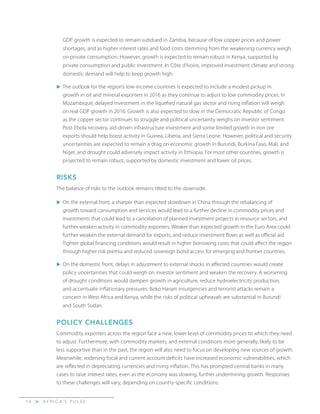
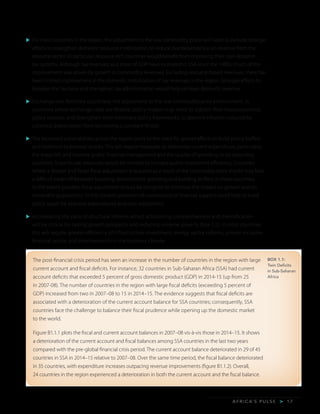
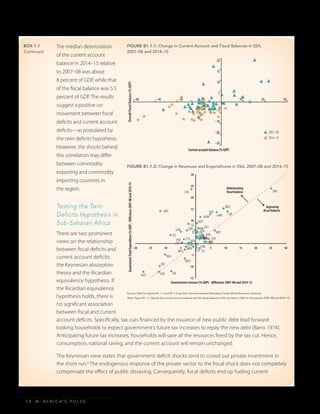
u	For most countries in the region, the adjustment to the low commodity prices will need to include stronger
efforts to strengthen domestic resource mobilization, to reduce overdependence on revenue from the
resource sector. In particular, resource-rich countries would benefit from improving their non-resource
tax systems. Although tax revenues as a share of GDP have increased in SSA since the 1980s, much of the
improvement was driven by growth in commodity revenues. Excluding resource-based revenues, there has
been limited improvement in the domestic mobilization of tax revenues in the region. Stronger efforts to
broaden the tax base and strengthen tax administration would help increase domestic revenue.
u	Exchange rate flexibility could help the adjustment to the low commodity price environment. In
countries where exchange rates are flexible, policy makers may need to tighten their macroeconomic
policy stances, and strengthen their monetary policy frameworks, to prevent inflation induced by
currency depreciation from becoming a constant threat.
u	The increased vulnerabilities across the region point to the need for greater efforts to build policy buffers
and resilience to external shocks. This will require measures to rationalize current expenditure, particularly
the wage bill, and improve public financial management and the quality of spending. In oil-exporting
countries, in particular, measures would be needed to increase public investment efficiency. Countries
where a deeper and faster fiscal adjustment is required as a result of the commodity price shocks may face
a difficult trade-off between boosting development spending and building buffers. In these countries,
to the extent possible, fiscal adjustment should be designed to minimize the impact on growth and on
vulnerable populations. In this context, provision of countercyclical financial support could help to build
policy space for essential expenditures and ease adjustment.
u	Accelerating the pace of structural reforms aimed at boosting competitiveness and diversification
will be critical for raising growth prospects and reducing extreme poverty (box 1.2). In most countries
this will require greater efficiency of infrastructure investment, energy sector reforms, a more inclusive
financial sector, and improvements in the business climate.
BOX 1.1:
Twin Deficits
in Sub-Saharan
Africa
The post-financial crisis period has seen an increase in the number of countries in the region with large
current account and fiscal deficits. For instance, 32 countries in Sub-Saharan Africa (SSA) had current
account deficits that exceeded 5 percent of gross domestic product (GDP) in 2014-15 (up from 25
in 2007-08). The number of countries in the region with large fiscal deficits (exceeding 5 percent of
GDP) increased from two in 2007–08 to 15 in 2014–15. The evidence suggests that fiscal deficits are
associated with a deterioration of the current account balance for SSA countries; consequently, SSA
countries face the challenge to balance their fiscal prudence while opening up the domestic market
to the world.
Figure B1.1.1 plots the fiscal and current account balances in 2007–08 vis-à-vis those in 2014–15. It shows
a deterioration of the current account and fiscal balances among SSA countries in the last two years
compared with the pre-global financial crisis period. The current account balance deteriorated in 29 of 45
countries in SSA in 2014–15 relative to 2007–08. Over the same time period, the fiscal balance deteriorated
in 35 countries, with expenditure increases outpacing revenue improvements (figure B1.1.2). Overall,
24 countries in the region experienced a deterioration in both the current account and the fiscal balance.
A F R I C A’ S P U L S E>1 8
BOX 1.1
Continued
The median deterioration
of the current account
balance in 2014–15 relative
to 2007–08 was about
8 percent of GDP, while that
of the fiscal balance was 5.5
percent of GDP. The results
suggest a positive co-
movement between fiscal
deficits and current account
deficits—as postulated by
the twin deficits hypothesis.
However, the shocks behind
this correlation may differ
between commodity
exporting and commodity
importing countries in
the region.
Testing the Twin
Deficits Hypothesis in
Sub-Saharan Africa
There are two prominent
views on the relationship
between fiscal deficits and
current account deficits:
the Keynesian absorption
theory and the Ricardian
equivalence hypothesis. If
the Ricardian equivalence
hypothesis holds, there is
no significant association
between fiscal and current
account deficits. Specifically, tax cuts financed by the issuance of new public debt lead forward-
looking households to expect government’s future tax increases to repay the new debt (Barro 1974).
Anticipating future tax increases, households will save all the resources freed by the tax cut. Hence,
consumption, national saving, and the current account will remain unchanged.
The Keynesian view states that government deficit shocks tend to crowd out private investment in
the short run.a
The endogenous response of the private sector to the fiscal shock does not completely
compensate the effect of public dissaving. Consequently, fiscal deficits end up fueling current
FIGURE B1.1.1: Change in Current Account and Fiscal Balances in SSA,
2007–08 and 2014–15
Source: Data for figures B1.1.1 and B1.1.2 are from the International Monetary Fund’s World Economic Outlook.
Note: Figure B1.1.1 depicts the current account balance and the fiscal balance of 45 countries in SSA for the periods 2007–08 and 2014–15.
FIGURE B1.1.2: Change in Revenues and Expenditures in SSA, 2007–08 and 2014–15
–40 –30 –20 10 20 30
OverallFiscalBalance(%GDP)
Current account balance (% GDP)
2007–08
2014–15
–10
–5
–10
–20
–15
5
10
15
20
-20 -15 -10 -5 5 10 15 20 25 30
-15
-10
-5
5
10
15
20
25
30
AGO
BEN
BWA
BFA
BDI
CPV
CMR
CAF
TCD
COM
ZAR
COG
CIV
GNQ
ERI
ETH
GAB
GMB
GHA
GIN
GNB
KEN
LSO
LBR
MDG
MWI
MLI
MRT
MUS
MOZ
NAM
NER
NGA
RWA
SEN
SYC
SLE
ZAF
SDN
SWZ
TZA
TGO
UGA
ZMB
ZWE
GovernmentTotalExpenditure(%GDP)-Difference2007-08and2014-15
Government revenue (% GDP) - difference 2007-08 and 2014-15
Deteriorating
fiscalbalance
Improving
fiscalbalance
A F R I C A’ S P U L S E > 1 9
BOX 1.1
Continued
account deficits. For example, a fiscal expansion financed by public debt issuances will increase
private disposable income and private consumption, and lower national saving. This fiscal expansion
will crowd out private investment by lifting domestic interest rates; therefore, a decline in national
saving is matched by an increase in the current account deficit, thus leading to twin fiscal and current
account deficits.
The twin deficits hypothesis is examined for a sample of 47 SSA countries with annual information
from 1980 to 2015. Table B1.1.1 reports the results of regressing the current account balance (as
percentage of GDP) on the fiscal balance and other explanatory variables selected from the literature
(Bartolini and Lahiri 2006), namely, government consumption, public debt, trade openness, GDP
growth, and population growth. Table B1.1.1 (column [1]) reports a simple bivariate regression of
the current account balance on the fiscal balance that yields a positive and significant coefficient.
The regression confirms the hypothesis that fiscal deficits are associated with a deterioration of the
current account balance for SSA countries. The estimated coefficient suggests that if the fiscal balance
declines by 1 percent of GDP, the current account balance deteriorates by 0.16 percent of GDP. When
more control variables are included in the regression (column [2] in table B1.1.1), the estimated
coefficient of fiscal balance not only remains positive and significant, but also becomes larger than
that of the bivariate regression. It shows that a 1 percent of GDP deterioration in the fiscal balance is
associated with a 0.22 percent of GDP widening of the current account deficit.
Although columns [1] and
[2] in table B1.1.1 assume
parameter homogeneity
across countries, the
literature argues that the
transmission process can
be nonlinear because
of the degree of trade
openness or the level of
government indebtedness
(Corsetti and Muller
2006, 2008; Kim and
Roubini 2008; Nickel and
Vansteenkiste 2008; Nickel
and Tudyka 2014).b
Thus,
columns [3] and [4] in
table B1.1.1 introduce the
interaction between fiscal
balance and the level
of public indebtedness
as well as that between
fiscal balance and trade
openness. The findings
TABLE B1.1.1: Testing the Twin Deficits Hypothesis in SSA
Dependent variable: current account balance (% GDP)
Sample of 47 Sub-Saharan African countries, 1980-2015 (annual)
Explanatory variables [1] [2] [3] [4]
Fiscal balance (FB) 0.160* 0.221** 3.195** 0.845
(% GDP) (0.0946) (0.108) (1.193) (1.486)
Government consumption – 0.0270 0.0401 -0.158
(% GDP) (0.164) (0.154) (0.167)
Public Debt (PDbt) – -4.054*** -5.262*** -7.106***
(% GDP, logs) (1.465) (1.456) (1.569)
Trade Openness (TO) – -0.742 -1.925 1.224
(% GDP, logs) (2.450) (2.345) (2.563)
GDP Growth – -0.0281 -0.547 -0.435
(% ) (0.315) (0.361) (0.343)
Population Growth – 0.783 1.283 1.055
(% ) (1.244) (1.183) (1.117)
Interaction: FB x PDbt – – -0.589** -0.972***
(0.236) (0.273)
Interaction: FB x TO – – – 0.835**
(0.346)
Countries 47 45 45 45
Observations 1085 744 744 744
R-squared 0.060 0.275 0.380 0.466
Note. The regression analysis accounts for time effects. Standard errors are in parentheses. *** p<0.01, ** p<0.05, * p<0.1.
A F R I C A’ S P U L S E>2 0
BOX 1.1
Continued
show that fiscal deficits are more likely to be associated with current account deficits in countries with
greater trade integration and lower public debt. The (partial degree of) responsiveness of the current
account deficit to fiscal deficits is about 1.43 for countries with low public debt (around 20 percent of
GDP), and about 0.89 for countries with higher public debt (50 percent of GDP).
Figure B1.1.3 shows the responsiveness of the current account deficit to movements in the fiscal deficit
conditional on the degree of trade openness (panel a) and the level of government indebtedness
(panel b), while keeping constant the other dimension (at its median level). The solid line represents
the strength (or lack thereof) of the twin deficits hypothesis, while the dotted lines capture the 90
percent confidence interval. This response was evaluated at selected percentiles of the distribution
of these two variables for SSA (5th, 10th, …, 90th, 95th). The figure shows that the nature of the
relationship between the current account and the fiscal balance among countries in the region is
consistent with that of the twin deficits hypothesis: (a) the relationship is stronger the greater is the
degree of international trade integration, and (b) the relationship is stronger the lower is the level of
general government gross debt (as a ratio to GDP).
Figure B1.1.3, panel a, shows that for countries with very low levels of trade openness (below the 5th
percentile—that is, exports and imports of about 25 percent of GDP), the relationship between the
current account deficit and the fiscal deficit is negative and nonsignificant. For countries with trade
openness of about 55 percent of GDP (that is, the 40th to 45th percentile), the relationship is positive
and statistically significant, and the coefficient fluctuates between 0.4 and 0.45. For SSA countries with
a high level of openness (say, the top quartile or real exports and imports that represent 90 percent of
GDP), the coefficient is 0.8. This implies that a 1 percent of GDP increase in the fiscal deficit is associated
with a 0.8 percent of GDP increase in the current account deficit for countries with high trade openness.
Figure B1.1.3, panel b, indicates that for countries with very high levels of government indebtedness
(above the 75th percentile—that is, public debt of about 98–100 percent of GDP), the relationship
FIGURE B1.1.3: Responsiveness of the Current Account Deficit to Movements in the Fiscal Deficit
Notes. The conditional responses were computed using the coefficient regressions in column [4] of table B1.1.1. The responses are evaluated at selected percentiles (5th to 95th)
of trade openness (public debt) while holding public debt (trade openness) at its median value.
(a) Conditional on the degree of trade openness (b) Conditional on the level of government indebtedness
Coefficient Coefficient
–1.5
–1.0
–0.5
0.0
0.5
1.0
1.5
2.0
2.5
5 10 15 20 25 30 35 40 45 50 55 60 65 70 75 80 85 90 95
Percentiles of the distribution of exports and imports (% of GDP)
–1.5
–1.0
–0.5
0.0
0.5
1.0
1.5
2.0
2.5
3.0
5 10 15 20 25 30 35 40 45 50 55 60 65 70 75 80 85 90 95
Percentiles of the distributions of public debt (% of GDP)
A F R I C A’ S P U L S E > 2 1
BOX 1.2:
Driving
Diversification
in Africa
through
Trade and
Competition
African countries experienced some of the fastest growth rates in exports in the decade and a
half since the turn of the century. This was mostly driven by rising prices for commodity exports
such as oil and metals, with limited impacts on local economies. As a result, the exports of many
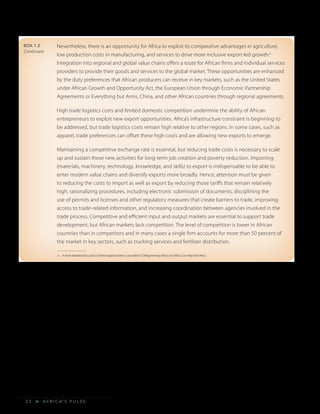
African countries are highly concentrated in a few commodities (figure B1.2.1). There has been some
progress toward diversification in some countries (Ethiopia and Rwanda, for example), but others
have become even more dependent on just a few products (Chad, Sierra Leone).
The global economy is more challenging, but opportunities to drive diversified growth through
exports are important for Africa. Falling demand in key markets, such as China, and the resulting
decline in commodity prices are undermining Africa’s immediate growth prospects. The dominant
commodity exports are sold on global exchanges and cannot be simply diverted to other markets.
FIGURE B1.2.1: Export Concentration Ratio, 2014
Source: World Integrated Solutions database (WITS).
Note: Export concentration is measured by the Herfindahl index; the range of the index is 0 – 100 , with higher values indicating higher extent of concentration.
BOX 1.1
Continued
between the current account deficit and the fiscal deficit is negative and nonsignificant. For
countries with low and middle levels of public indebtedness—such as general government gross
debt of about 30 and 56 percent (the 25th and 50th percentiles, respectively)—there is a significant
and positive relationship between the current account deficit and the fiscal deficit, with coefficients
of 1.1 and 0.5, respectively. For instance, a 1 percent of GDP increase in the fiscal deficit is associated
with a 0.5 percent of GDP increase in the current account deficit for countries with the median level
of government indebtedness.
a.	 An output decline may generate a deeper fall in investment compared with the decline in national savings. This will improve the current account and lead to a phenomenon called
“twin divergence”(Kim and Roubini 2008; Nickel and Vansteenkiste 2008).
b.	 Corsetti and Muller (2006) show that a fiscal deficit that results from a temporary increase in government spending may not be accompanied by a foreign trade deterioration if
the economy is sufficiently closed. Accordingly, twin deficits are more likely to be observed if the economy is highly integrated in world goods markets. Nickel and Tudyka (2014)
show that an increase in the budget deficit (or a decline in public savings) may be accompanied by lower private consumption (and higher savings) if private agents perceive an
unsustainable fiscal stance. Consequently, households may observe higher taxes in the future as more likely to take place if the government’s indebtedness is high. If the public debt-
to-GDP ratio is low, households may not put too much weight on future fiscal adjustments, and fiscal shocks will lead to a deterioration of the current account.
0
10
20
30
40
50
60
70
80
90
100
Angola
Chad
Botswana
Mali
Nigeria
Gabon
GuineaBissau
Burundi
SierraLeone
Congo,Rep.
BurkinaFaso
Niger
SaoTomeandPrincipe
Seychelles
Malawi
Comoros
CentralAfricanRepublic
Zambia
CapeVerde
Guinea
Benin
Cameroon
Mauritania
Somalia
Liberia
Gambia,The
Ghana
Lesotho
Zimbabwe
Congo,Dem.Rep.
Rwanda
Ethiopia(excludesEritrea)
Togo
Côted'Ivoire
Tanzania
Namibia
Uganda
Mozambique
Swaziland
Senegal
Bangladesh
Philippines
Madagascar
SouthAfrica
Mauritius
Kenya
Cambodia
Indonesia
Vietnam
Thailand
Herfindahlindex(1-100)
Countries in which export concentration increased in 2000–2014
A F R I C A’ S P U L S E>2 2
BOX 1.2
Continued
Nevertheless, there is an opportunity for Africa to exploit its comparative advantages in agriculture,
low production costs in manufacturing, and services to drive more inclusive export-led growth.a
Integration into regional and global value chains offers a route for African firms and individual services
providers to provide their goods and services to the global market. These opportunities are enhanced
by the duty preferences that African producers can receive in key markets, such as the United States
under African Growth and Opportunity Act, the European Union through Economic Partnership
Agreements or Everything but Arms, China, and other African countries through regional agreements.
High trade logistics costs and limited domestic competition undermine the ability of African
entrepreneurs to exploit new export opportunities. Africa’s infrastructure constraint is beginning to
be addressed, but trade logistics costs remain high relative to other regions. In some cases, such as
apparel, trade preferences can offset these high costs and are allowing new exports to emerge.
Maintaining a competitive exchange rate is essential, but reducing trade costs is necessary to scale
up and sustain these new activities for long-term job creation and poverty reduction. Importing
(materials, machinery, technology, knowledge, and skills) to export is indispensable to be able to
enter modern value chains and diversify exports more broadly. Hence, attention must be given
to reducing the costs to import as well as export by reducing those tariffs that remain relatively
high, rationalizing procedures, including electronic submission of documents, disciplining the
use of permits and licenses and other regulatory measures that create barriers to trade, improving
access to trade-related information, and increasing coordination between agencies involved in the
trade process. Competitive and efficient input and output markets are essential to support trade
development, but African markets lack competition. The level of competition is lower in African
countries than in competitors and in many cases a single firm accounts for more than 50 percent of
the market in key sectors, such as trucking services and fertilizer distribution.
a	 A more detailed discussion of these opportunities is provided in Defragmenting Africa and Africa Can Help Feed Africa.
A F R I C A’ S P U L S E > 2 3
Section 2: Terms-of-Trade Shock and Impact
on Economic Performance in Sub-Saharan Africa
u	The current oil price decline of about 70 percent since June 2014 is the largest 20-month price drop
over the past half-century. In contrast to other episodes, the price decline has come along with falling
prices of metals and minerals and agricultural commodities—although at a different pace.
u	Recent commodity price changes represent a deterioration in the terms of trade of countries in
Sub-Saharan Africa by an estimated 16 percent (first-order approximation). Terms-of-trade losses of
commodity exporters tend to be larger than the gains by commodity importers. Oil-rich countries are
hit the hardest.
u	For the region as a whole, the level of economic activity is 0.5 percent lower than the baseline under a
scenario of energy and non-energy commodity price changes. At the same time, the current account
and fiscal balance are about 4 and 2 percentage points below the baseline, respectively.
u	Falling oil prices are reducing cash flows from oil production, limiting oil companies’investment in
exploration and production. The falling prices are also reducing the value of the underlying assets
that these companies use to back their rising liabilities. Most oil and gas development in Sub-
Saharan Africa is extremely vulnerable to deferral at the current prices and given the tighter financial
conditions facing oil companies.
DECLINE IN OIL PRICES: LOWER AND LONGER
Commodity prices have experienced sharp swings since the global financial crisis.1
More recently,
the world economy has experienced sharp declines in oil prices. The average international price for a
barrel of crude oil dropped significantly, from US$108 in June 2014 to about US$31 in February 2016.
Moreover, several commodity prices other than oil have also weakened over the past year; however,
the extent of their decline has been far from uniform (figure 1.3). For instance, the cumulative decline
in the prices of iron ore and nickel has been about 50 percent since June 2014, while that of wheat has
exceeded 40 percent.
The sharp drop in crude oil prices since June 2014 is not unprecedented. Four other episodes where the
cumulative price decline exceeded 40 percent can be identified from the data on 20-month variations
in the international price of crude oil, from November 1984 to February 2016 (table 2.1).2
Oil plunge
episodes that are mostly driven by demand shocks (1990–92, 1996–98, and 2008–10) have a cumulative
loss in the price of oil below 50 percent—as opposed to oil supply–driven events (1984–86 and 2014–
16) with a price decline that exceeds 65 percent over a 20-month window.
1	 After the sharp drop in the last quarter of 2008 and first half of 2009, ample policy stimulus in high-income countries and among large and dynamic emerging markets produced a post-
crisis recovery in commodity prices.
2	 Baffes et al. (2015) undertook a similar approach. They identified episodes of sharp decline in oil prices by selecting seven-month periods where the cumulative drop in oil prices exceeded
30 percent.
A F R I C A’ S P U L S E>2 4
Recent evidence supports the
argument that the underlying set
of shocks driving the decline in oil
prices since 2014 is qualitatively
similar to the set of shocks
prevailing during the 1985–86
episode, namely, technological
innovations, rising supply from
non-OPEC countries, and OPEC
policy shifts (Baffes et al. 2015).
MACROECONOMIC IMPACT OF THE OIL PRICE DECLINE
Sub-Saharan Africa (SSA), as a net exporter of commodities, is prone to drastic swings in their
international prices, especially oil, iron ore, copper, gold, coffee, and cocoa, among others. The end
of the commodity super cycle has led to a sharp reduction in export proceeds and volumes, and it is
putting pressure on the currencies of commodity exporting countries in the region. Commodity-related
revenues have also dropped considerably for the governments of countries that export energy and
extractive commodities.
The plunge in commodity prices will be a drag on growth in the region. Macroeconomic simulations
suggest that the plunge in commodity prices would explain a reduction in the level of economic
activity of the region for 2016 of about 0.2 to 0.5 percent below the baseline. However, the end of the
commodity super cycle will hit resource abundant countries in the region harder—notably, oil abundant
countries. Hedging against commodity price risks is at the forefront of the policy agenda, as oil prices
have plunged since June 2014.
Terms-of-Trade Effects3
Table 2.2 presents a first-order approximation of the terms-of-trade effects of recent fluctuations in
commodity prices.4
The price shock used to simulate the terms-of-trade effects among the countries in
SSA is the percentage change in the 2016 average price of each of the commodities under analysis, as
predicted by World Bank in 2015 Q3 and 2016 Q1.5
Box 2.1 reports the assumptions about the changes
in commodity prices. For instance, the average price of crude oil in 2016 was forecasted at US$61.3 per
barrel in 2015 Q3 and US$37 per dollar in 2016 Q1. This implies a downward revision of the international
price of oil of about 40 percent. The approach followed here to compute the terms-of-trade effects may
underestimate the net trade benefits resulting from price changes, as export supply and import demand
may adjust to the new relative prices and exchange rates in a welfare-improving fashion. Hence, the
3	 This section updates the findings in Africa’s Pulse Volume 11 (World Bank 2015).
4	 The calculations in table 2.2 involve a sample of 48 SSA countries and a basket of 37 commodities, including energy commodities (crude oil, natural gas, and coal), metals and minerals
(including precious metals), and agricultural commodities (food, beverages, and raw materials). The choice of commodities reflects their presence in the commodity basket among
countries in the region as well as the existence of liquid markets that allow for the identification of a clear international price.
5	 The commodity basket for a few African countries might be underrepresented because of price data limitations. Among the commodities with missing (or lack of international) prices
are diamonds (with a great participation in the export basket of Botswana, Central African Republic, Namibia, Sierra Leone, and the Democratic Republic of Congo), uranium (Niger and
Namibia), cloves (Comoros and Tanzania), fish (Cabo Verde and Seychelles), and bauxite (Guinea).
TABLE 2.1: Episodes of Plunging Oil Prices
Starting
month
Final
month
Cumulative
Drop (%)
Event
Nov-84 Jul-86 -65.2 Oil market supply glut, OPEC policy shift
Sep-90 May-92 -40.4 U.S. Recession
Oct-96 Jun-98 -47.1 Emerging Market Crisis (Asia, Russian Federation)
Jul-08 Mar-10 -40.3 2008-09 Global Financial Crisis
Jun-14 Feb-16 -71.4 Oil market supply glut, OPEC policy shift
Source: World Bank Commodity Market Outlook.
Note: The table reports the 20-month window episodes with a cumulative drop in oil prices that exceeded 40 percent.
OPEC = Organization of the Petroleum Exporting Countries.
A F R I C A’ S P U L S E > 2 5
analysis may assess the
magnitude of the initial
price shock to trade in SSA
before any adjustments
in supply, demand, or
economic policy are
undertaken.6
The terms of trade of SSA
countries will deteriorate,
on average, 16 percent,
given the projected
changes in commodity
prices. The reduced
purchasing power of
the region’s exports is
partly attributed to the
weakening of oil and other
energy commodities
(15.98 percent).
Terms-of-trade changes are different across countries in the region and their direction depends
on the pattern of trade. Countries exporting energy commodities (crude oil, natural gas, and coal)
display the largest terms-of-trade deterioration (about 33 percent), while agricultural commodity
exporting countries register a terms-of-trade improvement of about 1 percent. For the latter group, the
weakening of their agricultural prices was more than offset by their gains from the lower prices of their
fuel imports. Metals and minerals exporters show a modest terms of trade loss of 6 percent. Again, the
weakening of their corresponding metals and minerals prices (about 7 percent) is softened by lower
energy prices. The data seem to corroborate the fact that many agricultural exporters, as well as metals
and minerals exporters, are net oil importers in SSA. Looking at groups of countries that have risks other
than (or including) commodity price risks, the terms of trade of fragile and conflict-affected states is
expected to deteriorate by 8 percent, whereas that of heavily indebted poor countries is expected to
deteriorate by about 4 percent. In both groups, the main driver of the deterioration of the terms of
trade is the adverse impact of the price of energy commodities—notably, oil and natural gas—whose
contribution exceeds 90 percent of the total terms-of-trade effect.
Table 2.2 shows that the terms of trade of the region as a whole deteriorates with the downward revision
of commodity prices for 2016; however, there is a great degree of cross-country heterogeneity. Figure 2.1
6	 There are other caveats to this initial approximation of the terms-of-trade effects of commodity prices. First, the trade structure considered in the assessment of the terms-of-trade effects was
computed over the period 2011–13. However, extraction from recent discoveries of nonrenewable resources may change these structures over time. For instance, in 2013 tungsten became
the major commodity export of Rwanda. Second, the calculation of the terms-of-trade effect involves average prices in international markets. As they are considered for a broad group of
countries, these prices may not necessarily match those received by the country. For instance, there are some discrepancies in the variation of Kolkata and Mombasa tea prices. Third, the
price change used is the expected percentage variation in the international price of each commodity for 2015, that is, the price predicted for 2015 compared with the actual price for 2014.
This forecast might differ from actual year-on-year or year-to-date changes in commodity prices up to March 2015. Fourth, sharp declines in commodity prices may not be distinguished from
more secular downward trends if the time horizon over which the price change is longer. Calculating the average annual variation in commodity prices over three- or four-year periods will
conceal the sharp decline in oil prices over the past nine months. Finally, the basket of commodities excludes those goods where some form of processing has been undertaken and, hence,
that are classified as manufacturing goods. For instance, the calculation excludes exports of aluminum bars in Mozambique, refined copper in the Democratic Republic of Congo and Zambia,
as well as exports or imports of refined petroleum in some African countries.
TABLE 2.2: Terms-of-Trade Deterioration in SSA
TOT Effect due to: Overall TOT
EffectAgriculture Metals & Minerals Energy
Sub-Saharan Africa 0.65 -0.42 -15.98 -15.76
of which:
Agricultural exporters* -1.55 -0.13 2.46 0.78
Metals and minerals exporters 0.19 -6.78 0.48 -6.11
Energy exporters 0.34 0.72 -34.47 -33.42
Others 1.98 0.43 0.02 2.43
Other covariate risks
Fragile states -0.29 -2.90 -4.89 -8.08
HIPC -0.28 -2.68 -1.70 -4.66
Memo: Terms of Trade (TOT) gainers and losers (GDP-weighted)
TOT losers 0.23 -0.54 -26.10 -26.41
TOT gainers 0.99 -3.46 4.26 1.78
Source: World Integrated Trade Solution database.
Note: The aggregate terms-of-trade effect is the GDP-weighted average of the net exports of commodity j for country c times the
percentage variation in the international price of commodity j. The sum is calculated for all commodities for each country. Agricultural
exporters are those with a share of agricultural commodity exports in total merchandise exports that exceeds 25 percent of GDP. The
same threshold is applied for countries exporting energy and metals and minerals. GDP = gross domestic product; HIPC = Heavily
Indebted Poor Countries; SSA = Sub-Saharan Africa; TOT = terms of trade; * Agricultural exporters list is from Appendix I,
Africa’s Pulse, Volume 11, April 2015.
A F R I C A’ S P U L S E>2 6
illustrates the estimated
terms-of-trade changes
for 48 countries in
the region with data
available for commodity
exports and imports
as well as international
prices. The region can
be classified into three
groups according to
terms-of-trade exposure
to price declines: (a)
vulnerable countries
(those with terms-of-
trade deterioration that
exceeded 10 percent),
(b) less vulnerable
(with terms-of-trade
decline less than 10
percent), and (c) terms
of trade gainers (with
positive change in their
terms of trade as a
result of a price shock
to the commodity
basket). According to
the simulation, the
distribution of gains and
losses in the terms of trade across countries in the region is asymmetric. For instance, terms-of-trade losers
(31 out of 48 SSA countries) are predicted to have an average loss of about 17 percent. These countries
represent 63 percent of the region Gross Domestic Product (GDP) and about 74 percent of its population.
The terms-of-trade gainers, by contrast, only registered a meager increase of about 1 percent.
The group of vulnerable countries consists of 12 countries with terms-of-trade losses that are expected
to exceed 10 percent. The countries house nearly 36 percent of the region’s population and represent
about half of its economic activity. For most of the countries in this group, lower energy prices are
the culprit of their adverse terms-of-trade effect. Seven countries in this group are oil-rich countries,
namely, Angola, Chad, Equatorial Guinea, Gabon, Nigeria, the Republic of Congo, and South Sudan.
The Democratic Republic of Congo and Guinea have also been affected by lower oil prices, although
natural gas also played a significant role in the former. For the rest of the countries in this group (Liberia,
Mauritania, and Sierra Leone), weaker iron ore prices help explain the terms-of-trade deterioration—a
pronounced decline in rubber prices also played a role in the case of Liberia.
The distribution
of terms-of-trade
gains and losses
is asymmetric. For
instance, terms-of-
trade losers (31 of 48
SSA countries) are
predicted to have
an average loss of
about 26 percent.
The terms-of-
trade gainers only
registered a meager
increase of about 2
percent.
Source: World Bank.
Note: Aggregate terms-of-trade effects are the sum of the price change of commodity j times the difference in the export and import
shares relative to total export and import merchandise. Price changes are computed as the percentage variation of the predicted
2016 price of commodity j relative to its actual 2014 price. The more vulnerable countries to the decline in international commodity
prices (in red) are those with terms-of-trade deterioration that exceeds 10 percent. Countries with a deterioration lower than 10
percent are denoted as less vulnerable countries. Finally, terms-of-trade gainers are those countries with positive variation in their
terms of trade as a result of commodity price shocks.
FIGURE 2.1: Distribution of Terms-of-Trade Effects across Countries in the Region
MauritiusMadagascar
Seychelles
Comoros
LesothoSouth
Africa
Swaziland
Botswana
Namibia
Zimbabwe
Mozambique
Malawi
Zambia
Angola
Dem. Rep. of
Congo
Rwanda
Burundi
Tanzania
Kenya
Uganda
Somalia
Ethiopia
Gabon Congo
Central African
Republic
Cameroon
Sudan
South Sudan
Eritrea
Chad
NigerMali
Burkina Faso
Benin
Nigeria
Togo
Equatorial Guinea
São Tomé and Príncipe
Ghana
Côte
d’Ivoire
Liberia
Sierra Leone
GuineaGuinea-Bissau
Senegal
Mauritania
The Gambia
Cabo
Verde
Vulnerable
Less vulnerable
Gainers
A F R I C A’ S P U L S E > 2 7
The group of less vulnerable countries is formed by 19 countries that registered terms-of-trade losses that
did not exceed 10 percent. The group represents more than 15 percent of the region’s GDP and about
40 percent of its population. Weaker prices of metals and minerals and agricultural commodities play
a more important role in this group. For instance, not only oil but also gold prices contributed to the
deterioration of the terms of trade in Ghana (9 percent). Weaker gold prices primarily drove the adverse
terms-of-trade effect in Benin, Burkina Faso, Mali, Somalia, and Tanzania. Lower coffee prices help explain
the deterioration in Burundi, Ethiopia, and Rwanda.
The group of terms of trade gainers comprises 17 countries with terms-of-trade gains. More than 25
percent of SSA’s population lives in this group of countries, which produces about 36 percent of the
region’s GDP. The magnitude of the terms-of-trade gains is considerably smaller than the losses in the
vulnerable countries: they fluctuate between 0.1 percent (Lesotho) and 7.8 percent (Eritrea). The majority
of countries in this group benefited from cheaper energy prices; however, these gains were partly
offset by decreased prices for in non-energy commodities in some countries. For instance, gains from
lower oil prices in Botswana and South Africa were partly offset by weaker prices of iron ore and nickel,
respectively.
Finally, the value of commodity production for the vulnerable countries is expected to decline in 2016,
and this will have direct growth effects. The impact on growth will be magnified by second-run effects
associated with lower investment in resource-based activities and reduced expenditure by income
earners in these industries. The currency depreciation that ensues from the lower commodity prices
might boost growth in non-resource-based activities; however, the negative effect may dominate.
Macroeconomic Impacts
Swings in commodity prices will have an impact on economic activity in SSA countries. The extent of
this impact will depend on whether the country is a commodity importer or a commodity exporter.
For instance, lower export proceeds and government revenues as a result of a decline in oil prices will
explain the deterioration of the current account balance and the fiscal balance of oil exporting nations
as well as their level of economic activity.
To assess the macroeconomic impact of changes in commodity prices, two different scenarios are
considered: scenario 1 where only the price of oil changes, and scenario 2 where all commodity prices
change simultaneously. The simulations are undertaken using a global macroeconomic model, an
integrated version of the iSim country models.7
This model endogenizes the global link variables, which
are designed to capture the second round or repercussion effects, namely, the effects of the export
market, effective exchange rates, and global commodity prices.
Under scenario 1 (only the price of oil changes), the 2016 level of GDP for the SSA region is projected
to be 0.7 percent below the baseline. It can be inferred that the cost for oil exporting countries in the
region far exceeds the benefits for the oil importing countries.8
A downward revision in the terms of
trade and an expected depreciation of the exchange rate for 2016 results in nominal GDP that is about
7	 This model uses the same set of equations and setting as the iSimulate platform.
8	 The same finding holds for the Middle East and North Africa region.
A F R I C A’ S P U L S E>2 8
3.8 percent below the baseline.9
The plunge in oil prices also predicts current account and fiscal balances
for 2016 that are about 1.9 and 1.7 percentage points lower than the baseline, respectively.
Under scenario 2 all commodity prices change. In the case of SSA, the changes in commodity prices
(energy, agriculture, and metals) lead to a lower level of real GDP by about 0.8 percent. Including
changes in relative prices, the level of nominal GDP is about 4.1 percentage points lower. However, the
losses of commodity dependent nations in the region (in export basket and government revenues)
tend to offset the potential gains of commodity importers. The current account and fiscal balance in the
region deteriorate by about 2 and 1.7 percentage points, respectively, relative to the baseline.
These findings show that the impact of changes in commodity prices can be different across countries—
say, oil exporters vis-à-vis oil importers. Hence, it is expected that these effects may be different across
countries in SSA. Figures 2.2 through 2.4 plot the impact on real GDP, the current account balance,
and the fiscal balance for SSA countries of commodity price changes under scenario 1 (only oil price
changes) and scenario 2 (all commodities). Figure 2.2 plots the real GDP response to changes in
commodity prices: oil abundant countries exhibit the largest declines in real economic activity (Angola,
Gabon, and Nigeria), while the decline in Mozambique is attributed not only to the plunge in crude oil,
but also in the price of aluminum. The level of GDP of most of the African countries in 2016 under both
scenarios is about 0.2–0.5 percent below the baseline. In the case of South Africa, the gains from the
plunge in oil prices are partly offset by lower prices of metals and minerals (such as iron ore and gold).
Still, South Africa’s GDP for 2016 is 0.2 percent above the baseline under scenario 2. Finally, the countries
with the largest gains from commodity price changes are Côte d’Ivoire and Senegal (about 0.3 and 0.5
percent above the baseline, respectively). Finally, the distribution of gains and losses in real economic
activity is uneven: losses are considerably larger than benefits.
Figures 2.3 and 2.4 depict the responses of the current account balance and the fiscal balance,
respectively. Again, the oil abundant countries (Angola, Gabon, and Nigeria) are among the countries
with the largest deterioration in
the current account and fiscal
balance. However, Angola shows
the largest deterioration, with 12.1
percentage points in the current
account and 5.3 percentage
points in the fiscal balance
(under scenario 2). Mozambique
also shows a large deterioration
in both balances (4.9 and 1.8
percentage points for the current
account and fiscal balance,
respectively). Senegal and Côte
d’Ivoire show an improvement in
the current account (0.3 and 0.9
9	 The global macroeconomic model (MFMod) uses a 2011 trade matrix. This may understate the terms of trade shock for countries with recent discoveries and production of natural
resources; for instance, oil production in Ghana started in 2011.
The distribution
of gains and
losses of real
economic activity is
uneven: losses are
considerably larger
than benefits. Oil
abundant countries
exhibit the largest
declines in real
economic activity.
Source: World Bank Macroeconomic and Fiscal Management Global Practice.
FIGURE 2.2: Real GDP Response to Commodity Price Changes (%)
–3.5
–3.0
–2.5
–2.0
–1.5
–1.0
–0.5
0.0
0.5
1.0
Angola
Mozambique
Nigeria
Gabon
Uganda
Cameroon
BurkinaFaso
Rwanda
Ghana
Benin
Mauritius
Madagascar
Tanzania
Senegal
Côted'Ivoire
SouthAfrica
Scenario1(oil)
Scenario2(allcommodities)
A F R I C A’ S P U L S E > 2 9
percentage points, respectively),
while their fiscal performance is
not as good compared with the
SSA sample. Finally, South Africa
shows a slight improvement of
about 0.2 percentage point in
the current account and the fiscal
balance. The larger improvement
under scenario 1 for South Africa is
partly offset by a decline in some
of its major commodity exports
(such as iron ore and gold,
among others).
Finally, the plunge in oil prices
will have a large adverse impact
on countries where: (a) crude oil
accounts for a substantial share
of the export basket, and (b) the
proceeds from oil production (and
exports) represent a larger portion
of government revenues. At the
same time, the fiscal impact can
be even larger if the government
needs to bail out highly-leveraged
state-owned energy companies.
Lower Oil Prices
Are Impacting the
Investment Decisions
of Oil Companies
Falling oil prices are putting a strain on the balance sheets of highly-leveraged oil companies.10
The
declining international price of oil is not only reducing firms’ profits, it is also having a negative impact
on the value of their assets. Since June 2014, investors have lost more than US$150 billion in the value of
the 1,278 actively traded (oil and gas company) bonds in global markets. Furthermore, the stock market
value of the 300 largest oil and gas companies has declined by about US$2.3 trillion since June 2014—
about 40 percent in terms of lost value.11
These developments have led to rising financial strain and downsizing among oil and gas companies.
Financing costs are increasing as spreads on high-yield energy bonds have sharply increased from 330
10	An environment that combined high oil prices with a zero interest rate policy and unconventional liquidity measures by the monetary authorities of high-income economies created the
incentives for investors to search for yields, thus shifting their portfolios to riskier assets. In this context, the rapid expansion of exploration and production activities among oil and energy
companies was fueled by a sharp increase in their leverage.
11	Financial Times (March 21, 2016),“Bondholders Suffer US$150 Billion Oil Price Hit.”
The oil abundant
countries (Angola,
Gabon and Nigeria)
are among the
countries with the
largest deterioration
in the current
account and the
fiscal balance.
Angola shows the
largest deterioration
with 12.1 percentage
points in the current
account and 5.3
percentage points
in the fiscal balance.
South Africa shows
bothaslightimprove-
ment of about 0.2
percentage points in
the current account
and fiscal balance,
but the improvement
is partly offset by a
decline in some of
its major commodity
exports (such as iron
ore and gold, among
others).
Source: World Bank Macroeconomic and Fiscal Management Global Practice.
FIGURE 2.3: Current Account Balance Response to Commodity Price
Changes (percentage points)
FIGURE 2.4: Fiscal Balance Response to Commodity Price Changes
(percentage points)
–14.0
–12.0
–10.0
–8.0
–6.0
–4.0
–2.0
0.0
2.0
Angola
Gabon
Mozambique
Nigeria
Cameroon
Tanzania
Mauritius
Rwanda
BurkinaFaso
Uganda
Ghana
Madagascar
Benin
Senegal
Côted'Ivoire
SouthAfrica
Scenario 1 (oil)
Scenario 2 (all commodities)
–6.0
–5.0
–4.0
–3.0
–2.0
–1.0
0.0
1.0
Angola
Cameroon
Gabon
Nigeria
Mozambique
Senegal
Mauritius
Uganda
BurkinaFaso
Rwanda
Ghana
Côted'Ivoire
Tanzania
Benin
Madagascar
SouthAfrica
Scenario 1 (oil)
Scenario 2 (all commodities)
A F R I C A’ S P U L S E>3 0
BOX 2.1:
Commodity
Price Shock
for the
Macroeconomic
Simulations
basis points in June 2014 to more than 800 basis points in February 2015. Meanwhile, the reduced cash
flow from production (as a result of falling oil prices) is raising the risk of illiquidity, and may render some
energy companies unable to meet their financial obligations. To meet their debt payments, oil and gas
companies are increasing their production levels, even as the international price of oil continues sliding.
Falling oil prices and high leverage among firms in the industry may restrict the ability to finance
ongoing and prospective investments. It is more likely that capital expenditure may fall at a faster place
for companies with large financial obligations and reduced cash flow from current and future sales.
Several companies have announced or are already cutting capital expenditure at rates between 30 and
50 percent.
TABLE B2.1.1: Change in Crude Oil Price, 2015–16
Petroleum, Crude (US$/bbl) 2015 2016
2016 Q1 50.8 37.0
2015 Q3 57.5 61.3
Change (%) 2016 Q1/2015 Q3 -11.7 -39.7
Source: World Bank.
The commodity price shock imposed in the calculation of the terms-of-trade effect and the simulated
impact on real economic activity as well other indicators of macroeconomic performance assumes
a revision in the forecasts of commodity prices. More generally, it compares the 2016 Q1 forecasts
for the international price of a wide array of primary commodities for 2016 relative to the forecasts in
2015 Q3. That is, it compares the forecasts published by the World Bank Commodity Market Outlook
in January 2016 relative to the forecasts published in October 2015. For instance, the average price of
oil for 2016 has experienced a downward revision, from US$61.3 per barrel for 2015 Q3 to US$37 per
barrel for 2016 Q1. This implies a reduction of nearly 40 percent in the forecast for the price of crude
oil relative to that of 2015 Q3.
Tables B2.1.1 and B2.1.2 present the
changes in the 2015 and 2016 prices for
commodities as of January 2016 vis-à-vis
their corresponding forecasts as of October
2015. Table B2.1.2 presents the 2016
forecast revisions for the 13 commodities
used for the macroeconomic simulations.
Clearly, crude oil and natural gas have
experienced a sharp downward revision as well as the international price of selected metals (such as
iron ore and zinc). The revisions in food prices have been relatively small, with the exception of wheat.
The simulation on the impact of commodity prices on the terms of trade involves a wider basket
of commodities (37): three energy commodities (crude oil, natural gas, and coal), 10 metals and
A F R I C A’ S P U L S E > 3 1
TABLE B2.1.2: Episodes of Plunging Oil Prices
Commodities 2015 2016
Energy
Petroleum, crude -11.7 -39.7
Natural gas -4.5 -23.2
Iron ore -0.8 -16.0
Metal
Iron Ore 1.5 -26.0
Copper -6.6 -16.7
Zinc -9.1 -25.0
Tin 0.4 -10.3
Aluminum -7.5 -15.6
Food
Wheat -13.5 -22.5
Rice -3.5 -7.0
Soy beans -4.6 -4.7
Maize -3.0 -5.1
Coffee -4.5 -7.9
Source: World Bank.
minerals (aluminum, copper, gold, iron
ore, lead, nickel, silver, steel, tin, and
zinc), and 24 agricultural commodities
(bananas, beef, cocoa, coffee, cotton,
groundnuts, groundnut oil, logs, maize,
oranges, palm oil, plywood, rice, rubber,
sawn wood, sorghum, soy meal, soy oil,
soybeans, sugar, tea, tobacco, wheat,
and wood pulp). Using the trade values
(export and import) of the region for
these commodities and the price shock,
energy commodities experienced the
largest reduction from 2015Q3 (about
36 percent), followed by metals and
minerals (with a reduction of about 17
percent) and agricultural commodities
(about 6 percent cut in the forecast).
BOX 2.1
Continued
A F R I C A’ S P U L S E > 3 3
Section 3: Opening Doors to the World:
Can African Cities Deliver on the Promise of Growth?1
u	As Africa undergoes rapid urban growth, there is a narrow window of opportunity to harness the
potential of cities as engines of economic growth. The rapid decline in oil and commodity prices has
adversely affected resource-rich countries and signaled an urgent need for economic diversification
in Africa. Urbanization and well managed cities provide a major opportunity to offer a springboard
for diversification. Although it is not possible to predict the specific sector opportunities for
diversification, the investments chosen need to be generic, supporting many specific activities. Cities
are just such generic capital: virtually whatever niches prove to be viable, they will take place in cities,
and their success will require that cities work efficiently.
u	The growth of cities, when well managed, can spur economic growth and productivity in two ways.
One, by boosting incentives for investment through higher economic density and proximity—to
support clusters of firms, and to connect workers with firms more efficiently. Two, by making cities
more livable for poor and middle-class residents, through access to services, amenities, and housing.
Through both channels, a successfully developed city offers firms the incentives of agglomeration and
high returns on investment (largely by keeping a rein on workers’living costs).
u	In contrast to these known features of well-developed cities, Africa’s cities today are predominantly
local: they lack a regional or global reach. That is because they have been on a different development
trajectory—one that poses excessive costs to residents and firms. Recent research by the World Bank
on the spatial development of African cities2
shows that cities in Africa today cannot be characterized
as economically dense, connected, and livable. Instead, they are crowded, disconnected, and costly for
households and firms.
u	African cities can easily support only small and local businesses, usually offering nontradable products
and services. The underlying challenge facing these cities is found in constraints on the functioning
of key factor markets. Essential structures for urban economic density and expansion into global
markets are lacking or inadequate. Specifically, the typical African city lacks the structures of human,
institutional, and productive capacity that well-developed cities take for granted. In particular,
economic density cannot rise until authorities take decisive action to strengthen institutions
governing the transfer, valuation, and use of land. In addition, Africa’s cities lacked policy coordination
needed for well-conceived infrastructure based on early, integrated planning and investment. Such
coordination is all the more urgently needed because levels of capital investment have lagged behind
the pace of urban growth, as Africa urbanizes at lower incomes than those of other developing
economies.
1	 This section draws on research being carried out for the World Bank Africa Regional Study on the Spatial Development of African Cities, led by Somik V. Lall with a core team that includes
Paolo Avner, Juliana Aguilar, Olivia D’aoust, Chyi-yun Huang, Rawaa Harati, Nancy Lozano, and Shohei Nakamura. The research has been cosponsored by the UK DFID through the MDTF for
Sustainable Urban Development TF071544.
2	 World Bank (forthcoming). Opening Doors to the World: Building African Cities that Work. World Bank, Washington, DC.
A F R I C A’ S P U L S E>3 4
u	To build cities that work—cities that are livable, connected, and affordable, and therefore
economically dense—policy makers will need to direct attention toward the deeper structural
problems that misallocate land, fragment development, and limit productivity. Local and national
governments are called to reform land markets and urban regulations, and coordinate early
infrastructure investments. At the heart of these efforts is a key principle: common knowledge. Only with
common knowledge can all parties anticipate the results of their actions and the likely returns on their
investment.
u	Successful urbanization will also support Africa’s agricultural and rural transformation by effectively
absorbing the labor being released by these sectors, providing a market for agricultural produce, and
financing further transformation and commercialization. If managed well, urbanization will not be a
sub-plot, but rather the main policy narrative for Africa’s development.
Introduction
Urbanization is a source of dynamism that can enhance productivity and increase economic
integration—a principle evident from the experience of today’s high-income countries and rapidly
emerging economies. Indeed, during the Industrial Age, no country has achieved sustained increases in
national income without urbanization.
If well managed, cities can help countries accelerate growth and “open the doors” to global markets
in two ways:
u	By creating productive environments that attract international investment and increase economic
efficiency
u	By creating livable environments that prevent urban costs from rising excessively with increased
densification.
By generating agglomeration economies, cities can enhance productivity and spur innovation and
national economic diversification. The underlying reason for this is economic density.
The simplest case of agglomeration economies through economic density is the reduction of transport
costs for goods. If a supplier locates near customers, shipping costs decline.3
Many agglomeration
benefits increase with scale. Towns and small cities cannot generate the same productive advantages as
larger cities. International evidence reveals that the elasticity of income with respect to city population is
between 3 and 8 percent (Rosenthal and Strange 2004). Each doubling of city size increases productivity
by 5 percent.
Productivity gains are closely linked to urbanization through their ties to structural transformation and
industrialization. As countries urbanize, workers move from rural to urban areas in search of better paid
3	 In the early 1900s, London and New York were manufacturing powerhouses because factories located there to be close to customers and transport infrastructure. In the late nineteenth
century, four-fifths of Chicago’s jobs were compactly located within four miles of State and Madison Streets, close to where people lived and infrastructure was located (Grover and Lall 2015).
A F R I C A’ S P U L S E > 3 5
and more productive jobs. Similarly, entrepreneurs locate their firms in cities where agglomeration
economies will increase their productivity. Close spatial proximity has many benefits. Certain public
goods—like infrastructure and basic services—are cheaper to provide when populations are large and
densely packed together. Firms located near each other can share suppliers, lowering input costs. Thick
labor markets reduce search costs, as firms have a larger pool of workers to choose from whenever they
need to hire additional labor. And spatial proximity makes it easier for workers to share information and
learn from each other. International evidence shows that knowledge spillovers play a key role in boosting
the productivity of successful cities.
Given these potential economic benefits of cities, it is not surprising that urbanization and economic
development go hand in hand. The evidence from China, the Republic of Korea, and Vietnam in East
Asia clearly highlights the close association between episodes of rapid urbanization and economic
development. Unfortunately, these links appear to be weak in Africa (figure 3.1). African cities are
not delivering agglomeration economies or reaping urban productivity benefits. Instead they suffer
from high food, housing, and transport costs. These high costs arise from coordination failures,
poorly designed policies, weak property rights, and other factors that lower economic density. As a
consequence, African cities lack the scale economies associated with tradable activity. Potential investors
and entrepreneurs are faced with low expectations for the scale of urban production and for the size
of any return on investment. Although low expected scale and returns are not the only ways in which
low expectations harm Africa’s cities (box 3.1), such pessimism points to high urban costs as a central
development challenge. These costs lock firms into producing nontradable goods and services—
keeping the cities out of global markets, and restricting them instead to the provision of products for
local hinterland consumption.
Evidence from China,
the Republic of Korea,
andVietnam shows
the close association
between episodes of
rapid urbanization
and economic
development, but
these links appear
weaker in African
countries.
Source: World Bank staff calculations based on World Development Indicators.
FIGURE 3.1: Urbanization and Economic Development
0
10
20
30
40
50
60
70
80
90
100
Urbanshareofpopulation(%)
GDP per capita (constant 2005 $)
VietnamChina Korea, Rep. Tanzania Côte d’Ivoire Nigeria
A F R I C A’ S P U L S E>3 6
Strengthening the link between urbanization and economic development in Africa is particularly urgent
to manage two regional “megatrends”:
u	Rapid urban growth. Cities in Sub-Saharan Africa (SSA) are quickly gaining in population. Urban areas
in Africa contain 472 million people. That number will double over the next 25 years. The largest cities
grow as fast as 4 percent annually. Productive jobs, affordable housing, and efficient infrastructure will
be urgently needed for residents and newcomers alike.
u	Rapid decline in oil and commodity prices, highlighting the urgency for economic diversification.
Although it is not possible to predict the specific sector opportunities for diversification, the
investments chosen need to be generic, supporting many specific activities. Cities are just such
generic capital: virtually whatever niches prove to be viable will take place in cities, and their success
will require that cities work efficiently. For example, in Nigeria, the triple impact—of a long-term drop
in oil prices, low levels of non-oil-based internally generated revenues,4
and a growing infrastructure
deficit—poses an increasingly urgent investment challenge.
4	 The tax share of revenue in Nigeria averaged 30 percent over 2003–12, far below the 80 percent average for the country’s level of development.
BOX 3.1:
Low Expected
Scale and
Returns: Why
African Cities
Are Locked into
Nontradables
The typical low-expectations trap is
illustrated in figure B3.1.1 by City N, which
produces only nontradable goods and
services in various sectors (government,
retail, construction, nontraded
manufactures, and informal sector services).
Demand comes from income made in the
city, or in the hinterland (resource rents),
or transferred from outside (tax revenues,
foreign aid). There are two urban wage
curves: the nontradable wage curve slopes
downward, reflecting the likely decreasing
returns to nontradable production, and
the tradable wage curve slopes upward,
reflecting the likely increasing returns to
scale in the tradables sector. The urban cost
curve slopes upward, reflecting urban costs
that rise as City N grows larger. Only if the wage in City N were lower than or equal to the international
wage would the urban cost curve be flatter then City N would be able to break into global markets and
compete with international firms.
Source: Venables 2016.
Note: CBD = central business district.
FIGURE B3.1.1: A “Local” City: High Urban Wage Costs
and Lack of Tradables Production
N
$ per worker
CBD Population
(=density x area)
High urban costs
A F R I C A’ S P U L S E > 3 7
There are two key sets of challenges that need to be successfully resolved to strengthen the links
between urbanization and economic transformation in Africa:
u	Enable the functioning of key factor and product markets alongside effectively regulating market distortions.
—	 Institutions governing the transfer, valuation, and use of land are central for building economic
density and enabling Africa’s cities to support dense clusters of firms and be nimble in responding
to changing economic circumstances.
—	 Institutions managing the movement of people and products between rural and urban areas and
between cities can support an integrated network of settlements.
u	Coordinate and scale up investments in urban infrastructure (transport, communications, and basic
services), which are grossly inadequate and insufficiently aligned with plans for housing and
investment in commercial and industrial structures.
Delays in addressing these challenges will lock African cities into development paths where the
agglomeration benefits from economic density, thick labor markets, and livable urban environments will
not be realized. In contrast, African cities will follow their current path of being crowded, disconnected,
and costly:
u	Crowded, not economically dense—lacking structures for residents who live in unplanned downtown
settlements amid a lack of formal, affordable housing.
u	Disconnected, developing as a collection of small, fragmented, and disconnected neighborhoods,
towns, and cities.
u	Costly for households and firms, leading to their avoidance by regional and global investors and
potential trading partners.
The physically unstructured appearance of African cities, seen from the ground, reflects underlying
distortions in the functioning of key factor and product markets, and lack of crucial infrastructure,
housing, and commercial structures. The effects include scattered firms, failure of labor market pooling,
limited specialization across settlements, and a practical restriction to nontradable as opposed to
tradable activity. Further, the cities’ evident disarray keeps them in a second low-expectations trap: that
of underinvestment in their urban form (box 3.2).
The growth of cities will be central to development in Africa as elsewhere. But for urbanization to
bring the benefits that it should, cities will need to offer incentives to investors through agglomeration
and higher productivity. Cities also must become more livable for their residents by offering services,
amenities, and housing for the poor and the middle class. Mayors and ministries will need to resolve
structural problems that misallocate land and labor, fragment development, and limit productivity.
Starting with reforms to land markets and regulations, while increasing and coordinating early
infrastructure investments, African governments can build cities that work. Successful urbanization
will also support Africa’s agricultural and rural transformation by effectively absorbing the labor
being released by these sectors, providing a market for agricultural produce, and financing further
transformation and commercialization.
A F R I C A’ S P U L S E>3 8
BOX 3.2: Low
Expectations
for Urban Form
and Function:
The Vicious
Circle of Costly
and Unlivable
Cities
Crowded, Disconnected, Costly:
The Urbanization of People without Capital
Typical African cities share three features that constrain urban development and create daily challenges
for residents: they are crowded, disconnected, and costly. These features of Africa’s cities appear in
economic data and in evidence of urban land use from satellite imagery—while an ordinary visitor
can also observe them from the ground. Together they illustrate a central challenge: in Africa, the
urbanization of capital lags far behind that of people.
CROWDED CITIES
In principle, urbanization should benefit people and businesses through increased economic density. A
worker in an economically dense area can commute more easily and consume more diverse products.
Firms clustered in cities should be able to access a wider market of inputs and buyers—and scale
economies should reduce firms’ production costs, in turn benefiting consumers. Further, population
density is generally and strongly correlated with indicators of livability: a pattern that holds in Africa as
elsewhere (Gollin, Kirchberger, and Lagakos 2015).
A major constraint on Africa’s urban development has been the high cost of doing business in African cities.
This costliness lowers expected returns for investors and entrepreneurs. But not all of the low expectations
that limit urban development arise directly from the cost of doing business. Others can arise from a city’s
crowded, unlivable appearance, as well as its fragmented physical layout and the disconnectedness of its
people—from each other, from their jobs, and from regional and global markets.
The role of these wider expectations in urban development underlies a theoretical model, developed by
Anthony Venables (Oxford University) and J. Vernon Henderson (London School of Economics), which looks
at the links between a city’s form and function. Specifically, the model relates a city’s built fabric, which
shapes rental and commuting costs, to its mix of productive activities, which determines urban wages,
productivity, and labor demand.
In the Venables-Henderson model, changes in a city’s physical environment largely follow the size and
frequency of investments in its durable structures. But these investments depend, in turn, on investors’
expectations about future urban growth. Thus, a circular problem arises. The future efficiency of a
city’s economy—which will influence future income and rent levels—is determined partly by property
developers’ investment decisions; and these decisions are unlikely to be optimal until large numbers of
developers expect future efficiency to be achieved.
In Africa, this circle of investments and expectations has become a vicious one. Because developers have
low expectations, African cities are built at low density and without coordination among governments and
firms—coordination that is necessary for early and effective infrastructure investment. As a result, costs are
higher. And the steeper is the urban cost curve, the higher is the nominal wage that must be paid to cover
the high cost of living for workers (see box 3.1). So cities fail to achieve agglomeration economies, and
businesses do not scale up. But this very fact keeps investors’ expectations depressed, trapping the cities in
a low-expectations equilibrium.
Source: Henderson, Regan, and Venables 2016, “Building the City: Sunk Capital, Sequencing, and Institutional Frictions.”
A F R I C A’ S P U L S E > 3 9
Yet Africa’s cities are not economically dense or efficient. Instead, they are crowded and unlivable. A
majority of urban residents live in packed, informal settlements with inadequate infrastructure or access
to basic services. Two in three people in Lagos, Nigeria, dwell in slums (World Bank 2015a). Although
households in densely populated areas in Africa are better off than rural households in accessing
services, the mere fact of population density does not guarantee a livable environment.
Why should a majority of people in Africa’s cities live in slums? The immediate explanation is that
the urbanization of people is not accompanied by the urbanization of capital (box 3.3). Housing,
infrastructure, and other capital investments are lacking. Across SSA, housing investment lags
urbanization by nine years (Dasgupta, Lall, and Lozano-Gracia 2014).
BOX 3.3:
Low Capital
Investment in
Sub-Saharan
African Cities
during a Period
of Rapid Urban
Growth
Capital investment in Africa has remained relatively low for the past 40 years, at around 20 percent of gross
domestic product (GDP). In contrast, urbanizing countries in East Asia—China, Japan, and the Republic of
Korea—stepped up capital investment during their periods of rapid urbanization. Between 1980 and 2011,
China’s capital investment (infrastructure, housing, and office buildings) rose from 35 to 48 percent of GDP,
while the urban share of its population rose from 18 to 52 percent between 1978 and 2012. In East Asia as a
whole, capital investment remained above 40 percent of GDP at the end of this period.
Housing investment in Africa has also lagged behind that in other low- and middle-income economies.
Between 2001 and 2011, African low-income countries invested 4.9 percent of GDP in housing,
compared with 5.5 percent elsewhere; and African middle-income countries invested 6.5 percent of
GDP in housing, compared with 9 percent elsewhere (Dasgupta, Lall, and Lozano-Gracia 2014).
These figures underline the fact that Africa is urbanizing while poor—indeed, strikingly poorer than
other developing regions with
similar urbanization levels. In
1968, when countries in the
Middle East and North Africa
region became 40 percent
urban, their per capita GDP was
US$1,800 (2005 constant dollars).
And in 1994, when countries in
the East Asia and Pacific region
surpassed the same threshold,
their per capita GDP was
US$3,600. In Latin America and
the Caribbean, this threshold
was passed in 1950, at a per
capita income of US$1,860. By
contrast, Africa, with 40 percent
urbanization, today has a per
capita GDP of just US$1,000
(figure B3.3.1).
1,860 1,806
3,617
1,018
Latin America
and Caribbean
(1950)
Middle East
and North Africa
(1968)
East Asia
and Pacific
(1994)
Sub-Saharan
Africa
(2013)
GDPpercapita(2005US$)
Urbanization about 40%
FIGURE B3.3.1: Africa’s Urbanization at Lower Income Levels
Source: World Bank staff calculations based on World Development Indicators.
A F R I C A’ S P U L S E>4 0
Because cities lack adequate formal housing within reach of jobs and transport systems to connect
people who live farther away, people forgo services and amenities to live in cramped quarters near
downtown districts. Areas such as Kibera, in Nairobi, and Tandale, in Dar es Salaam, are constantly
growing because—although informal—they are relatively central. They also make for crowded cities.
Throughout Dar es Salaam, 28 percent of residents are living at least three to a room; in Abidjan, it is a full
50 percent (World Bank 2015).
Related to the predominance of informal housing near African city centers is their relative lack of
built-up area. For example, in Harare, Zimbabwe, and Maputo, Mozambique, more than 30 percent of
land within five kilometers of the central business district remains unbuilt. The land near the core in
African cities is not left unbuilt by design, unlike in well-developed downtowns, such as Paris, where
14 percent of downtown land is not built up by design (to reserve green space to make densely
populated districts more livable). Instead, outdated, poorly enforced city plans and dysfunctional
property markets create inefficient land use patterns that no one intended: the downtown lacks
structures, yet it is crowded.
Analysis of imagery from satellites and geographic information systems confirms that in African
cities, capital investment not only appears low near the urban core, but also rapidly declines outside
it. A strong contrast emerges between patterns of downtown population density—in which Africa
resembles other regions (figure 3.2; Johannesburg and Lagos are exceptions)—and economic density,
reflected in indicators of capital investment visible from above (figure 3.3). In figure 3.3, cities with
higher economic density and slower economic density drop-offs—reflecting systematically high urban
capital investment—should cluster in the lower right quadrant. But African cities cluster in the upper
left quadrant: their economic densities are low, with rapid drop-offs outside the city center. Africa’s cities
have low peak economic densities and a small economic reach.
Africa’s generally low levels of urban capital investment also appear in the assessed worth of building
stock. For example, the total economic value of buildings in Dar es Salaam is estimated at around US$12
African cities are
not different in
population density,
but they have
lower economic
density than
comparable cities
elsewhere in the
world.
FIGURE 3.2: African Cities:
Population Density Gradients, 2012
0.0
0.1
0.2
0.3
0.4
0 20000 40000 60000 80000 100000 120000
Rateofdecay
Peak density 5km from city center (people per km2)
High peak, fast decay
Lagos
Jo'burg
Harare
140000 160000 180000
Other SSA
Median peak
Median decay
Source: World Bank staff construction based on Landscan.
700 900 1100
0.0
0.1
0.2
0.3
-100 100 300 500
Rateofdecay
Peak brightness, 5km from city center
Low peak, fast decay
Accra
Jo'burg
Abidjan
Durban
Other SSA
Median decay
Median peak
Source: World Bank staff construction based on Visible Infrared Imaging Radiometer Suite.
Note: Data from high resolution pictures taken from space between 10:00 p.m. and 1:30 a.m.
used as a proxy for local infrastructure.
FIGURE 3.3: African Cities: Economic Density, 2014
A F R I C A’ S P U L S E > 4 1
billion (Ishizawa and Gunasekara 2016). That is just less than three times the city’s share of gross domestic
product (GDP).5
Even lower are the estimated values for Nairobi, Kenya (US$9 billion) and Kigali, Rwanda
(US$2 billion). Compared with cities in Central America, African cities have low replacement values for
their built-up area, built floor area, and population. For instance, Nairobi has the highest replacement
value per square kilometer among the four African cities studied, yet it is just 60 percent of the value of
Tegucigalpa, which has the lowest among six Central American cities. The capital investment shortfall
appears in all building types, but it is most severe in housing: in Nairobi, commercial and industrial
structures explain 55 percent of the total value of building stock, although these structures occupy just 4
percent of the city’s area. Residential development is urgently lacking.
Well-developed cities are productive, and their inhabitants are economically better off. The reason is not
their high population density. Rather, it is their high economic density: labor and capital are geographically
concentrated. The low economic density of Africa’s cities makes them crowded—and less productive than
they should be, as their lack of capital makes them inefficient and keeps their economies local.
DISCONNECTED CITIES
Even as Africa’s cities are crowded—dense with inhabitants, but not capital—they are also physically
dispersed. They develop as collections of small, scattered neighborhoods. Without adequate roads or
transport systems, commuting is slow and costly, so workers lack access to jobs in the larger urban area.
Generally, people and firms are disconnected from each other and from economic opportunity.
The lack of connections among neighborhoods means that African cities, compared with developed
and developing cities in other regions, exhibit lower exposure and higher fragmentation in the intensity of
daytime land use near the city center.
u	Low exposure means that people are disconnected from each other. At a set distance (usually 10
kilometers), they cannot interact with as many people as in a city with higher exposure.
u	High fragmentation means that within a specified area, population varies widely, with scattered
peaks rather than the clustered ones that could enhance scale economies. Fragmentation increases
infrastructure costs, and it lengthens travel times between homes, job sites, and businesses.
According to a new study of 265 cities in 70 countries that controls for total population and per capita
GDP, exposure near the center during daytime hours is about 40 percent lower in African cities than in
Asian and Latin American ones (Henderson and Nigmatulina forthcoming). In addition, African cities are
20 percent more fragmented: an example is the contrast between Nairobi, Kenya, and Pune, India
(figure 3.4).6
One pattern that explains the low exposure and high fragmentation of African cities is their relative lack
of new development near the center. New construction is not located in areas that would make capital
5	 Dar es Salaam’s GDP is estimated at US$2.3 billion. The official exchange rate for 2013 was Sh$1,600 per US$. This gives an estimated GDP of $4.7billion. http://www.thecitizen.co.tz/News/
national/Dar-tops-wealth-list--Arusha-7th-despite-tourist-charm/-/1840392/2016862/-/bmn8u2/-/index.html.
6	 Landscan data was used to estimate the exposure and fragmentation index. Exposure was measured using the Puga index at 10km, and fragmentation was measured using the coefficient
of variation of density among the 8% pixels closer to the city center.
A F R I C A’ S P U L S E>4 2
more concentrated and increase economic density. Instead, it tends to push the boundaries of the city
outward. Urban development can occur in three ways: expansion, leapfrog, and infill:
u	Expansion development occurs at the edge of the consolidated urban area, enlarging a city’s footprint.
u	Leapfrog development occurs in unbuilt areas that do not border or intersect with existing
development.
u	Infill development is new development on unbuilt parcels within a city’s denser, more central area.
Among these three types of new development, infill does the most to increase exposure, or connections
among people: it defragments the city. According to our analysis of satellite images for 21 African cities
over 2000–10, between 46 and 77 percent of new development was expansion, with typically much less
infill. An even greater concern is the large number of leapfrog patches now appearing outside various
cities. In Bamako and Maputo, patches of leapfrog development account for more than half of the total
new patches over 2000–10; in many other cities, this share approaches or exceeds 40 percent (figure
3.5). The patches often being small scale, their isolation from existing development will undermine
city governments’ efforts to provide the networked services that require scale economies—and that
undergird urban productivity.
The prevalence of expansion and particularly leapfrog development is just one pattern that makes urban
commuting challenging in African cities; another is deficient transport infrastructure. Traffic congestion
cripples the economy in cities such as Nairobi, where the average journey-to-work time is one of the
world’s longest among 15 cities (IBM 2011). Part of the reason for long commuting times is that a large
share of commuting is done on foot: in Nairobi, about 41 percent (UNEP and FIA Foundation 2013). But
even if more city dwellers could afford transport by car or minibus, commutes would remain impractical
Cities in Sub-
Saharan Africa
are crowded but
physically dispersed,
normally developing
as collections of
small, scattered
neighborhoods.This
example shows how
Nairobi, Kenya, is
more fragmented
and less well-
connected than
Pune, India.
Source: Henderson and Nigmatulina forthcoming.
FIGURE 3.4: Connections among People as a Function of Population Near the City Center: Nairobi,
Kenya, and Pune, India
Nairobi, 4,265,000 (Census) Pune, 5,574,000 (UN)
A F R I C A’ S P U L S E > 4 3
for lack of roads. In eight representative African cities, roads occupy far lower shares of urban land than
in other cities around the world. In addition to being low, urban road infrastructure is disproportionately
clustered near the center of African cities, according to the study of satellite images. The images show
that in well-developed cities outside Africa, land allocated to roads declines only gradually as one looks
out from the center toward the periphery: an example is Paris (figure 3.6). By contrast, paved roads in
Addis Ababa, Dar es Salaam, Kigali, and Nairobi drop off abruptly, nearly disappearing beyond the most
central area (Dakar being a notable exception to the African pattern).
Economically, the ideal city can be viewed as an efficient labor market, matching employers and job
seekers through connections (Bertaud 2004). The typical African city fails in this matchmaker role. Its
land use is fragmented, its transport infrastructure insufficient—so its residents lack access to jobs. The
separation of formal housing areas from commercial and industrial areas, which makes commuting slow
and costly, is made worse by an emphasis on expansion as opposed to infill development. The lack of
connections within the city stymies agglomeration economies, keeping costs high and closing the doors
of African cities to regional and global trade and investment.
Between cities, transport connections enable firms to access local, regional, and global markets—for
buying inputs and selling outputs. The connections also give consumers options and, in many cases,
better prices. However, domestic product markets are fragmented in many African countries, limiting the
ability of secondary cities to expand production and specialize. In Nigeria, despite their having access to
Leapfrog
development occurs
in unbuilt areas that
do not border or
intersectwithexisting
development. In
Bamako and Maputo,
leapfrogdevelopment
accounts for more
than half the change
in the urban fabric
over 2000–2010; in
many African cities,
this share approaches
or exceeds 40 percent.
Source: World Bank staff construction, based on data in Baruah forthcoming.
FIGURE 3.5: Figure 3.5: Leapfrog Development in African Cities, 1990-2000 and 2000-10
(leapfrog patches as a share of all new development patches)
1990-2000 2000-2010
0
0.1
0.2
0.3
0.4
0.5
0.6
Windhoek
Niamey
Conakry
Addis
Sukuta
Bulawayo
Touba
Dakar
Ouagadougou
Lagos
Kano
Nairobi
Lusaka
Accra
Nouakchott
Kigali
Kampala
Nyala
Maputo
Bamako
Abuja
Proportion
A F R I C A’ S P U L S E>4 4
Paved roads occupy
a smaller share of
urban land in Africa
than elsewhere—
and usually drop off
abruptly beyond the
city center.
Source: Based on Antos, Lozano-Gracia forthcoming, and Lall; and Felkner, Lall, and Lee forthcoming.
FIGURE 3.6: Paved Roads and the Share of Urban Land in Africa and Selected Countries
0
10
20
30
40
50
60
70
80
90
100
-25 -22 -19 -16 -13 -10 -7 -4 -1 3 6 9 12 15 18 21 24
ParisPercent
Built-up Paved Roads Open Space
-25 -22 -19 -16 -13 -10 -7 -4 -1
London
-4 -1 3 6 9 12 15 18 21 24
0
10
20
30
40
50
60
70
80
90
100
Percent
Built-up Paved Roads Open Space
-25 -22 -19 -16 -13 -10 -7 -4 1 4 7 10 13 16 19 22 25
Barcelona
0
10
20
30
40
50
60
70
80
90
100
Percent
Built-up Paved Roads Open Space
-7 -5 -3 -1 2 4 6 8 10 12 14 16 18 20 22 24
Dakar
0
10
20
30
40
50
60
70
80
90
100
Percent
Built-up Paved Roads Open Space
-25 -22 -19 -16 -13 -10 -7 -4
Addis Ababa
-1 3 6 9 12 15 18 21 24
0
10
20
30
40
50
60
70
80
90
100
Percent
Built-up Paved Roads Open Space
-25 -22 -19 -16 -13 -10 -7 -4 -1 3 6 9 12 15 18 21 24
Dar es Salaam
0
10
20
30
40
50
60
70
80
90
100
Percent
Built-up Paved Roads Open Space
-25 -22 -19 -16 -13 -10 -7 -4 -1 3 6 9 12 15 18 21 24
Nairobi
0
10
20
30
40
50
60
70
80
90
100
Percent
Built-up Paved Roads Open Space
-24 -21 -18 -15 -12 -9 -6 -3 1
Kigali
4 7 10 13 16 19 22 25
0
10
20
30
40
50
60
70
80
90
100
Percent
Built-up Paved Roads Open Space
A F R I C A’ S P U L S E > 4 5
a large consumer base throughout the country, most enterprises sell their products only in local markets.
High transport costs pose a disproportionate challenge to the tradables sector, helping account for lack
of development. Highway accessibility shows large regional variations caused by a mix of poor road
conditions, urban congestion, and missing highway and bridge connections. An estimated 40 percent
of federal roads, 65 percent of state roads, and 85 percent of local government roads are in poor or bad
condition and require rehabilitation or reconstruction (World Bank 2015a). In Côte d’Ivoire, transporters
who serve secondary cities face the highest costs. The transport costs are as high as US$0.47 per ton-
kilometer (twice the median cost nationally) and are detrimental to the growth of secondary cities and
reduce connectivity for economically lagging areas with higher poverty incidence (World Bank 2015).
Across Africa, high transport costs and the relatively modest spatial mobility of people likely have
contributed to the limited development of clusters of urban settlements. Evidence from a sample of 21
African countries where census data are available for two time periods shows that urban population is
highly concentrated in the largest city within countries, and that there has hardly been any dispersion of
urban population toward secondary cities.
COSTLY CITIES
Cities in Africa are costly for households, workers, and businesses. The high costs make cities less livable.
They also constrain the region’s economy. Because food and building costs are high, families can hardly
remain healthy or afford decent housing. Because commuting by vehicle is not only slow but expensive,
workers have difficulty finding jobs that match their skills. And workers’ need for higher wages to
compensate for the high cost of living makes firms less productive and competitive.
African households face higher costs relative to their per capita GDP than households in other regions.
This conclusion emerges from a new study of price level indices at the urban level based on data
collected by the International Comparison Program. Comparing price levels in 39 SSA countries with
those for countries at similar income levels, the study finds that households in urban Africa pay 20 to
31 percent more overall (figure 3.7). A similar comparison of urban prices—based on data from 125
cities, including nine in SSA (the Economist Intelligence Unit’s Worldwide Cost of Living Survey)7
—finds
African cities to be about 31 percent more costly for households than cities in low- and middle-income
countries elsewhere (Nakamura et al. 2016).
The price premium for food is also large (about 35 percent), especially given the high share of African
incomes that goes to food. Household surveys conducted over 2003–10 found that the average African
urban household spent between 39 and 59 percent of its budget on food; the poorest urban households
(households in the first income quintile) spent even higher shares, between 44 and 68 percent.
Housing and transport are particularly costly in urban Africa. Housing prices are about 55 percent higher
in urban areas of African countries relative to their income levels. Urban transport, which includes prices
of vehicles and transport services, is about 42 percent more expensive in African cities than cities in
other countries. Urban workers in SSA also incur high commuting costs, or they simply cannot afford
7	 The nine African cities are Abidjan, Dakar, Douala, Harare, Johannesburg, Lagos, Lusaka, Nairobi, and Pretoria.
A F R I C A’ S P U L S E>4 6
to commute by vehicle, leaving them no option but to commute on foot. The informal, often colorful
minibus systems that dominate collective motorized transport in most African cities are far from cost-
efficient: the buses’ small size and low load factor (passenger capacity) prevent them from realizing scale
economies. For the poorest urban residents especially, the cost of vehicle transport in some cities is
plainly prohibitive, as measured in a study from 2008 (figure 3.8). The need to walk to work limits these
residents’ access to jobs.
Like households and workers, firms also face high urban costs. Research for this study shows that firms in
urban areas of Tanzania and Uganda pay higher nominal wages than those in rural areas (controlling for
human capital). The difference is about 30 percent in Tanzanian cities and 50 percent in Ugandan ones
(Bernard, D’Aoust, and Jones 2016). However, these estimated nominal wage premiums are similar to
those for developed cities in England, Europe, and the United States. So are urban wages in Africa higher
than would be expected? After all, cities around the world are associated with higher nominal wages—
as they should be, in theory, if urban workers and firms are more productive thanks to agglomeration
economies.
Two considerations dispel the notion that African urban workers simply earn more by producing more.
First, higher wages need not reflect higher productivity. Although the two are closely related in theory,
this relationship breaks down if, say, labor and product markets are not perfectly competitive. Second,
Living in African
cities is expensive.
African households
face higher costs
relative to their
per capita GDP
than households in
other regions.
FIGURE 3.7: Living Costs in African Cities Compared with Cities in Other Countries, 2011
Source: Nakamura et al. 2016, based on data from the 2011 International Comparison Program.
6
50
100
150
200
8 10 12
AGO
GAB
ZAF
GNQ
MUS
BWA
COG
SWZ
LBR
BDI
RWA
BFA
GMB
SLE
ETH
Log of GDP per capita (2011 PPP$)
Adjustedpricelevelindex
MOZ
GMB
MDG TZA
UGA
NER
MWI
GNB
NGA
ZMB
LSO
SEN
TOD GHA
SDN
CRMMLI
KEN
TGO
BEN
NAM
ZAR CAF
Africa Fitted values (Africa) Fitted values (other developing countries)Other developing countries
A F R I C A’ S P U L S E > 4 7
urban wage premiums should be estimated in real terms—nominal wages are likely to be higher in cities
because of higher living costs. For the Tanzanian and Ugandan cities studied, the urban wage premium
fades into statistical insignificance after wages are deflated to adjust for spatial differences in the cost of
living, and with controls for occupation and industry added to the regression.
In short, the higher nominal wages paid to urban workers in Tanzania and Uganda are likely driven by
higher urban living costs—not higher productivity. Urban workers in these countries gain no purchasing
power, on average, from living in a city. Instead, firms pay them the wages needed to cover the high
urban costs of food, housing, transport, and so on.
Cross-country analysis confirms that manufacturing firms in African cities pay higher wages in nominal
terms than urban firms in other countries at comparable development levels (figure 3.9).
Urban productivity does not necessarily go hand in hand with high nominal wages, any more than
it follows rapid growth in the local population. Instead, what drives urban productivity is economic
density: the city’s ability to benefit from co-located households and firms, efficiently connected.
Unfortunately, Africa’s cities today lack economic density and efficient connections, so they impose high
costs on workers and—as a result—on businesses. Higher wages mean lower expected returns. The next
section examines other cues for low economic expectations in African cities.
Urban transport,
which includes
prices of vehicles and
transport services,
is about 42 percent
more expensive in
African cities than
other countries.
Source: Kumar and Barrett 2008.
FIGURE 3.8: Share of Urban Household Budgets Spent or Needed for Transport in 11 African Countries
(Analysis from 2008)
0
10
20
30
40
50
60
70
80
90
100
110
Lagos Dar Es Salaam Kigali Abidjan Kampala Ouagadougou Nairobi Kinshasa Douala DakarAddis Ababa
% of household budget spent on transport % of first quintile household budget needed for 2 trips/day
Percent
A F R I C A’ S P U L S E>4 8
Manufacturing
firms in African
cities pay higher
wages in nominal
terms than
urban firms in
other countries
at comparable
development
levels.
FIGURE 3.9: Median Manufacturing Wages (Nominal) in African Cities Compared
with Cities in Other Developing Countries (Latest data available since 2008)
Source: World Bank staff calculations based on World Bank Enterprise Surveys data.
Note: World Bank Enterprise Survey data use a standard questionnaire that makes them comparable across countries. The sample is stratified by firm size and geographic location, so data are
representative at the city level for many countries. This analysis looks only at manufacturing firms based in a country’s largest city; and only firms with five or more employees are interviewed,
so the sample is probably representative of firms likely to expand into export markets (although not of the average African firm). More than 10,000 firms were analyzed in 67 cities, including 16
African cities. Nominal wages were converted using 2010 exchange rates.
Abidjan
Kinshasa
AddisAbaba
Accra
Conakry
Nairobi
Bamako
Noukchott
Blantyre Kigali
Dakar
Juba
DaresSalaam
Kampala
Lusaka
Harare
Ouaga
Djibouti
Johannesburg
Casablanca
Tegucigalpa
Amman
SanJose
Kabul
BuenosAires
Yerevan
Dhaka
Sofia
LaPaz
SaoPaulo
Santiago
Bogota
SDomingo
Cairo
Tbilisi
Guatemala
Jakarta
Mumbai
Kingston
Bishkek
Vientienne
Beirut
Mexico
Skopje
UlanBatar
Managua
Panamacity
Lima
Asuncion
Belgrade
Tunis
Kiev
Montevideo
Tirana
Minsk
Beijing
Lognominalwage,2010US$
5
6
7
8
9
10
6 7 8 9 10
Africa Otherdevelopingcountries
Log GDP per Capita, 2010 US$
Out of Service and Closed for Business: Africa’s Urban
Low-Development Trap
Because the cities in SSA are crowded, disconnected, and costly, they are burdened with low
expectations for the future. An urban area that looks unlivable and unkind, without decent housing and
amenities for its residents, might as well post a sign stating: “out of service.” And one that is difficult for
commuters and firms because of a fragmented plan, lack of affordable transport, and unexpectedly high
labor costs could set up another sign: “closed for business.”
When a city appears “out of service” and “closed for business,” it has entered a low-development trap.
Potential investors and trading partners quickly see the signs of the physical and economic dysfunction
that constrains public service provision, inhibits labor market pooling and matching, and prevents firms
from reaping scale and agglomeration benefits. So these potential partners stay away, fearing low to no
returns on their investment. This dynamic will keep Africa’s urban economies undercapitalized—making
their development all the more challenging (see box 3.1).
A F R I C A’ S P U L S E > 4 9
How to escape the trap? Before seeking a way out, city and national governments should recognize the
problem for what it is: not simply one of underinvestment leading to low infrastructure, but one of low
expectations arising from inadequately planned growth and an ill-considered development path. This
section looks more closely at the form and function of African cities to spotlight key inefficiencies and
their immediate effects—the signs that warn business away, limiting Africa’s appeal to the business world.
CITIES ARE “OUT OF SERVICE”
From an urban planner’s perspective, three features of African cities directly explain their unlivability and
lack of appeal for property developers and investors:
u	Inappropriate or unrealistic regulations and opaque guidelines—especially concerning land
ownership—impede access to land and discourage the formal development of housing and
workplaces, especially in city centers.
u	Poor connective infrastructure and the lack of affordable public transit constrain residents’ housing
choices, leading to informal squatting near city centers and long commutes from peripheral
neighborhoods.
u	Ineffective delivery of basic services leaves many residents—in downtown slums and away from the
center—lacking the amenities found in more economically successful cities.
Why have urban plans been ineffective? Partly because they are divorced from reality. For example,
they do not consider finances, market dynamics and interests, social diversity, or differences among
income groups. Moreover, such regulations that are enacted lack built-in implementation mechanisms—
while human capacity constraints and financial resource constraints have further weakened their
implementation and enforcement. Finally, the plans’ intentions and outcomes are distorted by
institutional failure and fragmentation (across sectors and levels), political interference, and insufficient
consideration of a city’s political economy.
Systems of land ownership in Africa are often the first and most cumbersome regulatory burden that
weighs on urban development. For example, a majority of the land in Kampala, Uganda, operates under
a complex land tenure regime that recognizes independent rights over land and structures, giving
rise to legal disputes and blocking investment (Muinde 2013). The problem takes a different form in
Nigeria, where urban land transactions incur high costs, and inefficient regulations further stymie formal
development. In Lagos and Port Harcourt, titling expenses alone can reach 30 percent of construction
costs, while total transaction costs range from 12 to 36 percent of a property’s value (World Bank 2015a).
As a result, land is developed informally. In Ibadan in 2000, researchers found that 83 percent of homes
violated city zoning rules (Arimah and Adeagbo 2000).
Another challenge is the lack of connective infrastructure. Given faster and more affordable transport,
more African city dwellers might forgo a downtown location for a large house with better amenities, a
few kilometers from the center. However, long commutes are an insuperable obstacle for most residents.
Some live on the outskirts of the city, while many others settle for more centrally located informal
A F R I C A’ S P U L S E>5 0
housing, the only affordable kind. In Dar es Salaam, for example, people live in Tandale—the informal
district—not for its services and amenities, but despite its lack of them. Its central location puts people
close to where most jobs and economic opportunities are found. In 2010, Dar es Salaam’s informal
housing areas were on average much closer than formal ones to commercial and industrial areas (Antos,
Lozano-Gracia, and Lall 2015). In all, more than 60 percent of Africa’s urban population lives in areas with
some combination of overcrowding, low-quality housing, and inadequate access to clean water and
sanitation (United Nations 2015a). The result is a picture of urban dysfunction that, across the region,
keeps expectations low and deters investment.
CITIES ARE “CLOSED FOR BUSINESS”
From an economist’s perspective, the spatial form of African cities has developed in three ways that hurt
their productive function—keeping markets inefficient and firms uncompetitive:
u	Fragmented land development prevents firms from reaping scale and agglomeration benefits.
u	Low investment in infrastructure, housing, and commercial structures further limits cities’ economic
size, confining business downtown.
u	High urban costs generate economic inefficiencies and necessitate urban workers to be compensated
with high wages, making firms less productive.
Fragmented Land Development
The spatially fragmented growth of African cities distances firms and workers from one another. In doing
so, it prevents firms from reaping scale and agglomeration benefits. Spatial separation reduces workers’
access to jobs and thus limits firm size; it prevents job market pooling and matching; and it hinders the
transfer of skills and knowledge. Although the underlying causes of spatial fragmentation are regulatory
and institutional, its effects are material, limiting urban economies.
Scale matters for business—especially in tradable activities, where larger firms can lower unit production
costs by investing in efficient technologies. Africa’s anemic tradables sector is related to the small median
firm size for cities in the region, compared with cities in other low- and medium-income countries (figure
3.10). Overall, Africa’s urban firms employ 20 percent fewer workers than comparable firms elsewhere
(Lacovone, Ramachandran, and Schmidt 2014). Why?
One reason is that in African cities, most workers cannot access employment far from where they live.
Walking, cycling, and informal shared transport are the main commuting modes in African cities. But
walking is slow, while vehicle commutes are delayed by poor road infrastructure and traffic congestion.
A resident of Nairobi, on average, can reach no more than 8 percent of all jobs within 45 minutes. By
contrast, in greater London in 2013, this figure was 21.6 percent (nearly one million jobs).
Fragmented development and unfeasible commutes imply that the most accessible urban jobs are those
pursued at home—and by oneself. For example, in Kigali, Rwanda, the home is the usual headquarters
A F R I C A’ S P U L S E > 5 1
for the 72 percent of firms that are
run by a single individual. To be
sure, formal jobs are concentrated
in central Kigali, just as they are
in most cities. Other examples
include Kampala, Uganda, and
Lusaka, Zambia (figure 3.11). But
formal jobs tell only part of the
story in Kigali, where 97 percent
of all firms are informal. Of those
informal sector firms, 90 percent
engage in nontradable activities
dominated by retail; and such
nontradable activities are not
concentrated in the center. Instead,
many spread out from it and are
scattered throughout Kigali’s more
densely populated areas.
Low Investment in Structures
Considered as a whole, the average urban area in Africa is not strikingly less built-up than its
counterparts in other regions (except in Asia, where cities are more densely built; Angel et al. 2011). What
is lacking is the concentration of capital and infrastructure investment that enables households to live
decently and affordably near jobs.
A downtown dense with structures should in principle create dense demand, enabling specialization—
especially in locally traded goods and services—and driving productivity gains. But Africa’s large city
centers are dominated by a retail industry that does not benefit from economies of specialization. In
Kigali and Kampala, many urban workers purvey food and beverages. Low investment in structures limits
a city’s economic density, exacerbating spatial fragmentation and precluding agglomeration economies.
High Urban Costs
Spatially fragmented development and the high cost of living in Africa’s cities necessitate high urban
labor costs that make firms less competitive. Firms pay higher nominal wages in African cities than
elsewhere—wages that reflect high urban costs, not higher productivity. The need for high wages may
result partly from spatially fragmented development and inadequate transport, which together generate
economic inefficiencies. In addition, urban workers may need to be compensated for poorer living
conditions in slums with scarce amenities. When the urban wage exceeds the international wage, a city
can end up specializing entirely in the production of nontradable goods.
Urban firms are
smaller in Sub-
Saharan Africa than
in other developing
regions.
Source: World Bank staff calculations based on the World Bank Enterprise Surveys undertaken since
2010 of more than 15,000 firms in capital cities, or cities with more than one million inhabitants, and
with at least 50 firms sampled.
FIGURE 3.10: Size of Urban Firms in Africa and Other Developing Regions
0
10
20
30
40
50
60
14
33
22
20
40
52
Africa Latin America
and Carribean
East Asia Pacific
& South Asia
Medianfirmsize
full-timeequivalent
Non-tradable
Tradable
A F R I C A’ S P U L S E>5 2
High urban labor costs are all the more a
concern given the low human capital levels in
African cities. Urban agglomeration economies
thrive on knowledge spillovers, which in turn
presuppose a mix of specialized cognitive
skills in the labor market.8
Such skills are not
captured in a narrow measure of educational
achievement, as they include tacit knowledge,
which is difficult to codify and best imparted in
person and in practice. Tacit knowledge is often
highly specialized, varying by place, culture,
or circumstance: examples include how to
remove a brain tumor, how to land a lucrative
client, and how to keep an outdated generator
running in an outage (Smith 2001). Although
measuring tacit knowledge transmission is
difficult, new research from Spain suggests
that workers gain more valuable skills through
on-the-job experience in larger cities than
elsewhere (De la Rocha and Puga 2015).
Workers in African cities are relatively poor
in cognitive skills, according to results from
the first initiative to measure skills in low- and
middle-income countries (the World Bank STEP
Skills Measurement Program). Cities in Ghana
and Kenya, compared with other developing
countries, show a distribution of cognitive
skills that is denser at the low end of the
index and far less dense at the high end. This
contrast suggests that African urban workers
are not sorting by ability, as they should to
generate agglomeration economies. To raise
expectations for the future, Africa’s cities will
need to restructure their labor market by
attracting and growing more specialized talent.
Spatially fragmented development, low capital
investment, and high labor costs trap urban
economies into producing only locally traded
8	 They also presuppose the“soft”social skills discussed, for example,
in Fujita and Thisse (2002).
Formal jobs are
mostly downtown
in Kampala,
Uganda; Lusaka,
Zambia; and Kigali,
Rwanda.
FIGURE 3.11: Formal Jobs in Downtown Kampala,
Lusaka, and Kigali
Source: World Bank staff calculations based on Uganda, Zambia, and Rwanda economic
censuses, all conducted in 2011.
Kampala, Uganda
Kigali, Rwanda
Lusaka, Zambia
A F R I C A’ S P U L S E > 5 3
goods and services, curtailing their opportunities for growth. Cities such as Dar es Salaam and Kigali,
compared with cities outside Africa, have a much lower share of firms in internationally traded sectors
(figure 3.12). Regarded from the outside, even more than from within, African cities indeed appear
“closed for business.”
African cities have
a much lower
share of firms in
internationally
traded sectors.
Spatially fragmented
development, low
capital investment,
and high labor costs
trap urban economies
into producing only
locally traded goods
and services.
Sources: World Bank staff calculations based on the World Bank Enterprise Surveys undertaken since 2010 of more than 15,000 firms in capital
cities, or cities with more than one million inhabitants, and with at least 50 firms sampled.
FIGURE 3.12: Shares of Firms in Internationally Traded and Nontradable Sectors for Selected Cities
(Latest Data Available since 2010)
0% 10% 20% 30% 40% 50% 60% 70% 80% 90% 100%
Lima
Chittagong
Buenos Aires
Bogota
Shenzhen City
Delhi
Dhaka
Cairo
Guatemala City
Harare
Addis Ababa
Tunis
Lagos
Lusaka
Nairobi
Sanaa
Accra
Kano
Dakar
Kampala
Kigali
Dar Es Salaam
Gaborone
Non-tradable Tradable
Investing in Institutional and Physical Structures to Support Scale
Economies in Africa’s Cities
To create an internationally competitive tradables sector, African cities must cease to be crowded,
disconnected, and costly, and instead become livable, connected, and productive. How?
The answer lies in swift action by mayors and ministers to enhance the functioning of land markets
(the factor market most urgently in need of reform), and to strengthen urban planning, regulation, and
enforcement—followed by actions to coordinate and scale up investment in cities’ physical structures
and infrastructure. In short, city leaders must make decisive and concerted efforts to:
A F R I C A’ S P U L S E>5 4
1.	 Reform urban land markets and regulations. Leaders can act immediately to improve the institutional
and capacitive structures that govern land markets and land use—structures that depend on
human capital, and that will ultimately determine a city’s ability to mobilize investment capital.
Leaders should do this by:
u	Simplifying and clarifying transfers of property rights among land market participants (freeing these
procedures from today’s unclear, overlapping property rights regimes).
u	Supporting the effective management of urban development through foresighted planning, realistic
regulation, and predictable enforcement.
2.	 Coordinate and increase early infrastructure investments. After taking firm and decisive steps to
improve institutional structures, authorities can build on those efforts to adapt physical structures
and infrastructure—including housing, transport infrastructure (including roads), and basic
services—to a future of urban productivity. Leaders should do this by:
u	Making infrastructure investments early, and coordinating them with land market intention reforms and
the plans and regulations that guide physical structures (ensuring that infrastructure investments will
be integrated with the growth of neighborhoods and structures in predictable ways).
u	Intensifying these early, coordinated infrastructure investments to take full advantage of scale economies
in housing, transport, and services (avoiding inefficient and fragmented investments that diverge
from market demand).
Both efforts should aim at structural improvements in the allocation of a city’s land, capital, and
structures. Their aim should be to achieve urban development at scale and for scale, while fostering
economic specialization.
RECOMMENDATION 1—Reform urban land markets (simplify
property rights, strengthen city plans).
Over the next 20 years, the growth of Africa’s urban populations will propel new demand for
infrastructure, housing, and other physical structures, and for amenities. To meet this new demand, city
leaders and planners must use adaptable strategies. Plans and regulations should allow the best use
of land—but they should also permit uses, and users, to change over time, as demand evolves further.
Three key considerations will be how to handle land and property rights, how to value land and manage
land prices, and land use and urban planning.
Africa’s cities do not develop in a well-planned fashion, but grow informally—and develop informally—
because public planning is ineffective, while private development is hobbled or repelled by opaque
or inappropriate regulations. Informal dwellings house not only the poor, but also middle-income
households, because of constraints on formal land markets. The same constraints have much to do with
the typical African city’s spatial fragmentation and the relatively low capital investment near its core.
The crowded streets of African cities also attest to a lack of formative, integrated urban plans. Traffic
congestion stems not just from limited road infrastructure, but also from limited parking and lack of
A F R I C A’ S P U L S E > 5 5
formal addresses. And the informality and small scale of public and collective transport in African cities
indicate that these networks are mostly reactive—they emerge in response to the city’s growth. They do
not structure it, as did the introduction of rail infrastructure or street cars in well-developed cities, such
as Paris and London (Brooks and Lutz 2013).
Households in African cities find it difficult to locate outside the central business district because the lack
of paved roads makes commuting from the periphery impractical (Felkner, Lall, and Lee forthcoming).
Increased investments in roads could increase productivity, while affecting commuting costs and times
differently across the city—but only if such investments are well thought through in advance. Similarly,
African cities have an urgent need for well-planned and forward-thinking transport systems. All transport
development plans are not equal.9
The lack of physical and technological structures in Africa’s cities—housing, services, and transport—
points back to the need for planning capacity. Without proper local planning guidance, it is impossible
to coordinate and implement infrastructure and public amenities and other investments. No planning, or
poor planning, is one of the fundamental reasons why African cities are too crowded, too disconnected,
and too costly to attract regional and global investors and trading partners.
Reforming land markets is the sine qua non for policy efforts to get Africa’s urbanization right. Not only
will there be a major payoff in economic efficiency, these reforms will help African cities tap the potential
of rising land values to finance infrastructure and other public goods.10
Clarification of Land and Property Rights
Clear rights to urban land are a precondition for the emergence of a formal land market. Informal,
non-legal markets can function in almost any conditions, but informality in land markets is distinctively
limiting because—unlike the business of most informal markets—land is an asset. Asset transactions are
viable only if the purchaser can rely on some enduring, extra-legal means whereby new ownership is
recognized, such as sanction by the local community. In contrast, a formal market does not merely offer
purchasers the protection of the state; rather, because transactions are readily observable and recorded,
it generates the public good of accurate valuation.
African cities struggle with overlapping and sometimes contradictory property rights systems—formal,
customary, and informal. Under the customary rules for land tenure that control much peri-urban and
urban land in Africa, property rights depend on the consent of local chiefs or family elders. Examples
include cities in Ghana, Lesotho, Mozambique, South Africa, and Zambia.
When barriers to urban land access arise from an overly complex property rights regime, they impede
the consolidation of plots and the transfer of land among users—and among uses. Firms cannot readily
9	 Two contrasting paths for the development of urban mobility appear in the experiences of China and Japan (World Bank 2015c).
10	International experience suggests that strong institutions appear as a precondition for successful implementation of all instruments for tapping land value increases to finance
infrastructure. These include institutions that assign and protect property rights, institutions that enable independent valuation and public dissemination of land values across uses, and a
strong legal framework supported by a healthy judicial system to handle disputes and oversee the process. Finally, as land-based instruments are considered for financing infrastructure, it
is important to recognize the risks associated with them. Real estate markets are highly cyclical and if land financing is used to finance infrastructure broadly (as opposed to focusing only
on new development), cyclicality can bring instability to local authorities. Further, large revenues associated with land transactions and urban infrastructure investment create incentives for
corruption. Finally, there is the risk that high potential profits from land transactions will transform local authorities into real estate developers, with profit rather than welfare maximization
as their main objective.
A F R I C A’ S P U L S E>5 6
buy downtown land to convert it from low-density residential use into higher-density apartments, or to
build clusters of new commercial structures. Land transactions are long, costly, and complicated. Such
market constraints reduce the collateral value of structures, giving developers little incentive to invest in
residential height—while tempting all parties to enter informal arrangements (World Bank 2015b).
Unclear land rights are severely constraining urban land redevelopment throughout Africa, imposing
high costs. Even where formal titles or clear land rights exist, basic mapping, geographic, or ownership
information is often inaccurate or land records are maintained poorly, causing disputes. Applying for
formal recognition can also be a tedious process. In Mozambique, one can apply for concession to a
land plot from the relevant municipal directorate or municipal cadaster services. But the application can
involve as many as 103 administrative steps and may be protracted over several years (UN-Habitat 2008).
The lack of a proper registration system prevents urban land markets from functioning well, and creates
obstacles to raising capital for development and investment—and to the local authority raising revenue.
Across Africa, land databases and other systems to record information are inadequate and opaque.
An African city is likely to struggle with overlapping systems of land tenure—formal, customary, and
informal—in a single urban space, where they often conflict with each other and constrain land
markets by creating confusion and disputes over land rights. These dysfunctions distort the price
and availability of land for efficient urban development. Finally, land administration systems (such
as registries and cadaster records) are incomplete and underused for enforcing legal claims and
landholders’ fiscal obligations, so lenders cannot always use land as collateral. In SSA, only 10 percent of
total land is registered (UN-Habitat forthcoming). In West Africa, only 2 to 3 percent of land is held with a
government registered title (Toulmin 2005).
Low land registration may result partly from cumbersome, expensive registration and transfer systems
loaded with survey expenses and fees, which make registration challenging and unaffordable for many
(Toulmin 2005). The main challenges to effective land governance in Africa include land grabs, insecurity
in land tenure, inefficient land administration and management, political interference and corruption,
and insufficient capacity and resources (Byamugisha 2013).
The good news is that African countries are taking steps to clarify land rights. Botswana took the
bold step of regularizing customary land in 2008, partly because the Land Boards faced challenges to
administering tribal land (Malope and Phirinyane 2016). Zambia passed a new planning bill in 2015,
extending planning controls across state and customary land and designating all local authorities as
planning authorities (Wesseling 2016). Namibia recognizes traditional leaders as part of the formal land
system; they are designated by the president and details about them are published in the government’s
gazette (United Nations 2015b).
Some countries and cities are developing hybrid regimes to make formal and customary administration
more compatible. For example, in Nigerian states with largely Muslim populations, the emir’s
representatives subdivide and allocate land with the help of volunteer professionals from the
government. An example is the city of Rigasa, in the extreme west of Kaduna (Igabi Local Government
Area). Future urban redevelopers in Africa may learn from the past successes of two approaches—land
sharing and land readjustment—in several Asian cities.
A F R I C A’ S P U L S E > 5 7
Land Valuation and Prices
The pricing of land on the market partly depends on policies, which must be designed with great care.
Taxes, charges, and subsidies can be used to complement regulatory controls on land use, creating
financial incentives and disincentives. Revenues—such as those from land-based financing—can also
be used to finance administrative costs and infrastructure. And implementation tools, such as capital
investment, budget, and phasing plans, can help with upstream planning.
Most cities in SSA lack the capacity to raise revenues from land: laws prohibit, or severely limit, land
fees and taxes (World Bank 2015b). Even with different laws in place, cities would have little power to
leverage land for revenue, as fiscal cadaster records and capacities are weak. And cities’ reliance on
central government transfers means that they have few incentives to make such efforts. Given the
inadequacy of revenues from intergovernmental transfers, Africa’s cities should consider land and
property taxes to finance urban infrastructure and public services (box 3.4).
BOX 3.4:
Leveraging
Land Values to
Finance Much-
Needed Urban
Infrastructure in
Africa’s Cities
To be economically dense and well connected, Africa’s cities will need huge investment in infrastructure.
Although revenues from the intergovernmental transfer system have been the mainstay of urban public
finance, there is a need to explore how cities can leverage the value of their assets—mainly land—to
finance infrastructure and provide public goods and services. Land-based infrastructure financing has
the greatest payoff where there is rapid urban growth. Rapid growth causes land prices to rise rapidly,
creating an opportunity to generate significant revenue. Yet rapid growth also magnifies infrastructure
investment needs, requiring significant sources of development finance. France, Japan, and the United
States used land-based financing techniques most heavily during periods of rapid urban growth when
there were large leaps in the scale of urban investment. Taxes on land can also potentially improve the
efficiency of land use, as property owners have an incentive to develop the land to its most profitable
use commensurate with the market value of the property. Valuable downtown locations with higher land
prices will experience densification and investment in residential and commercial structures. Not only can
such a taxes incentivize dense urban development, they are also nondistortionary, as appreciation in land
values is merely an economic rent for a scarce resource, rather than a return on the economic activity of
the owner. So, unlike in production, there is no behavior by the owner to be distorted.
Higher revenues from land and real estate can come from (a) improved valuation of land and properties
closer to their market value, thus deepening the tax base; (b) improved compliance, so that more
property owners pay land and property taxes, thus broadening the tax base; and (c) monetization of
underused public land. However, setting in place land and real estate tax systems that support economic
density is not straightforward. Strong institutions are essential to define property rights clearly; ensure
standardized and objective methods of land valuation; and support and oversee the process of land
management, land sales, and tax collection. For purely real estate taxes, it is important to realize that
property values generally respond more slowly to annual changes in economic activity and “property
areas” respond even more slowly
A F R I C A’ S P U L S E>5 8
Urban Planning and Land Use Regulation
Land and property rights affect the transfer of land between users; land prices determine the intensity
of investments in structures. However, land transfers and land prices are affected by urban planning
and land use regulations—the policies that determine how and where land is used. Among land use
regulations are zoning ordinances, building codes, and other associated bylaws, most of them legally
binding (Birch 2008, 142).
Across Africa, today’s urban plans appear ineffective: They are not successfully coordinating investment
in structures or managing the spatial form of cities. One source of difficulty is the inappropriate adoption
of regulatory codes and planning models inherited from colonial regimes or imported from high-
income countries (Balbo 1993; Gandy 2006; Kanyeihamba 1980; Myers 2003). Another problem is that
plans do not give credible accounts of finance, market dynamics, or distributional impacts. Furthermore,
guidelines are not articulated enough, granular enough, or transparent enough to set consistent
and enforceable parameters for development. Finally, capacity and resource constraints weaken
implementation and enforcement.
City and national authorities will have to make tough political decisions informed by technical evidence
and assessments. For this, they will need to increase urban planning capacity and resources. Lack of
staff capacity proves a serious constraint on effective urban management. It is even more crippling
to enforcement, which is often the greatest challenge, even where all the necessary structures and
regulations are in place.
Because African cities lack the institutional structures needed for functional land markets, farsighted
planning, and effective regulation, their physical structures and infrastructure lag far behind the growth
of the urban population. Not only housing, but other basic infrastructure and services are in a constant
struggle to catch up.
RECOMMENDATION 2—Coordinate early infrastructure
investments (while bringing them to scale).
Two sets of structures—institutional, and physical and infrastructural—must be improved, making them
more livable and affordable for people and more attractive to business. However, physical structures and
infrastructure pose special challenges.
One challenge is path dependence: the costs of developing housing, infrastructure, and industrial
premises will depend on sequencing. Making infrastructure investments first, followed by investments
in housing and industrial premises, can reduce the cost of all three. That is because sewerage, drainage,
electricity, clean water, and connectivity are cheaper to provide at scale than if they are added to houses
and factories individually and as an afterthought (Collier 2015). Further, urban structures share a “putty-
clay”quality: once constructed, they are difficult to modify and can stay in place for more than 150 years
(Hallegatte 2009).
A city’s ability to make infrastructure investments that are early, coordinated, and intensive will directly
determine its later appeal to firms considering their own investments in the urban economy. Only
A F R I C A’ S P U L S E > 5 9
efficient infrastructure and service provision will enable economic density combined with livability, for
job market matching and productivity. In contrast, inefficient structures can set back urban development
for decades, even centuries. The challenge is that although density in structures is a public good—the
benefit of high economic density and interaction is an externality—the concomitant investment in
housing and commercial structures must be borne privately by households and firms.
A second challenge is interdependence among various investments in physical structures and
infrastructure. For households, the utility of housing depends on firms’ investments in premises that
provide accessible jobs. And for firms, the productivity of premises depends on the proximity of
infrastructure, workers, and customers. Any social return on public infrastructure depends on the
proximity of housing and premises. For example, a rapid transit system is more viable at higher densities.
Policies need to leverage complementarities and avoid coordination failures resulting in single-sector
interventions that prevent economic density.
Unregulated markets are unlikely to solve the problems of path dependence and interdependence. Public
policy and urban planning are needed to get urban structures“right.”This imperative is especially challenging
in Africa, where the fragmented nature of urban development is locking cities into high cost paths.
Despite the challenges, coordination will be crucial to Africa’s success in managing path dependence and
interdependence. Much of a structure’s value is determined by complementarities with other structures
in the neighborhood or city. The first structures built will dictate the options for further investments in
the vicinity: path dependence implies that investors need to anticipate what other structures will be built
nearby. Further, these expectations are self-fulfilling—investments affect expectations, which in turn
affect investments (see box 3.2). The problems of path dependence and interdependence are all the more
pressing because of this circular problem of expectations, as it affects investments in durable capital.
The Need for Common Knowledge
Effective coordination requires common knowledge (Thomas et al. 2014). Common knowledge is distinct
from and more demanding than shared knowledge, which is simply something that everyone knows.
Shared knowledge becomes common knowledge only when everyone knows that everyone knows the
same thing. Ideally, investment intentions need to be sufficiently publicly observable for each investor to
be confident that other investors observe the same information.
Strong Institutions Should Provide the Bedrock
for Enhancing Africa’s Urban Structures
Today, a race is on between new infrastructure investment projects and the institutional structures—the
capacities of African city governments for urban planning, regulation, and enforcement—that should
shape and coordinate them. The infrastructure projects are winning the race. The institutional structures
are falling behind.
That is a problem. The choices that leaders make now will commit a city to a specific trajectory for
decades to come (Lecocq and Shalizi 2014). If new transport systems and industrial zones, for example,
A F R I C A’ S P U L S E>6 0
are not coordinated with one another—and with urban land markets and land use regulations—such
projects can set a city on a counterproductive development path.
Large infrastructure projects such as roads, bus rapid transit, and railways come with high sunk costs.
Like large structures, these projects depreciate very slowly over decades or even centuries (Philibert
2007). Cities display high inertia: although they are in a permanent process of reconstruction, their
transformation is largely uncoordinated and targets only individual buildings or infrastructure segments at
any one time. So urban forms are extremely difficult to change, even when large social gains are possible
(Fay et al. 2015).
Decisions about a city’s growth pattern, based on underlying transport investment choices, will also
strongly influence future greenhouse gas emissions and environmental sustainability. Scholars have
proven the impact of urban form on driving behaviors, modal choices, transport-related energy
consumption, and carbon dioxide emissions (Newman and Kenworthy 1989). African cities now enjoy a
unique opportunity to avoid carbon-intensive urban transportation trajectories. Getting these choices
right the first time around—while urbanization is still in its early stages—is critical. Given the inertia of
urban settlements, polluting now and cleaning up later is not an option.
If infrastructure continues to outrun the institutional structures that should be planning and regulating
development, Africa’s cities will lose. Because urban plans and development regulations are highly
political, planning must be accompanied by effective and inclusive political systems and institutions—
elements often lacking in Africa.
In sum, if cities in SSA remain crowded, disconnected, and costly, they can be neither kind to their
residents nor productive. Yet these cities are still being built. What they can do today—before it is too
late—is to ensure that they are not locked into inefficient and unsustainable patterns of urbanization.
Given the high sunk costs and enduring nature of infrastructure, any approach to urban development that
lacks early planning and coordination will only require future generations to clean up the mess: a terribly
inefficient strategy.
To inspire better economic and social outcomes, cities in Africa need better institutions. It is up to
local and national authorities to undertake the institutional reforms needed for effective planning and
coordination—raising urban economic density and productivity, and spurring Africa’s belated structural
transformation. Institutional structures must lead, not lag, urban infrastructure. As a result, the region’s
cities will become not only better connected and more efficient, but also kinder to their working
inhabitants, whose increasing skills will be critical to economic growth and development. The doors of
African cities will then, and only then, stand open to the world.
A F R I C A’ S P U L S E > 6 1
References
Antos, S, N Lozano-Gracia, and S. V. Lall. Forthcoming.“Morphology of African Cities.”World Bank,
Washington, DC.
Arimah, C. B., and D. Adeagbo. 2000.“Compliance with Urban Development and Planning Regulations in
Ibadan, Nigeria.”Habitat International 24 (3): 279–94.
Baffes, John, M. Ayhan Kose, Franziska Ohnsorge, and Stocker. 2015.“The Great Plunge in Oil Prices: Causes,
Consequences, and Policy Responses.”Policy Research Note PRN/15/01, World Bank, Washington, DC.
Balbo, M. 1993.“Urban Planning and the Fragmented City of Developing Countries.”Third World Planning
Review 15 (1): 23–35.
Barro, Robert J. 1974.“Are Government Bonds Net Wealth?”Journal of Political Economy 82 (6): 1095–1117.
Bartolini, Leonardo, and Amartya Lahiri. 2006“Twin Deficits, Twenty Years Later.”Federal Reserve Bank of New
York, Current Issues in Economics and Finance 12 (7): 1–7.
Baruah, N. Forthcoming. Splintered and Segmented? Fragmentation of African Cities Footprints. London
School of Economics, London]
Bernard, L., O. D’Aoust, and P. Jones. 2016. The Urban Wage Premium in Africa: Myth or Reality. World Bank,
Washington DC
Bertaud, A. 2004.“The Spatial Organization of Cities: Deliberate Outcome or Unforeseen Consequence?”
Working Paper 2004-01, University of California, Berkeley, CA.
Birch, E. L. 2008. The Urban and Regional Planning Reader. London and New York: Routledge.
Brennan, J. R., A. Burton, and Y. Lawi. 2007. Dar es Salaam: Histories from an Emerging African Metropolis. Dar es
Salaam/Nairobi: Mkuki na Nyota/BIEA.
Brooks, L., and B. Lutz. 2013.“Vestiges of Transit: Urban Persistence at a Micro Scale.”Trachtenberg School of
Public Policy and Public Administration, George Washington University, Washington, DC.
Byamugisha F. 2013. Securing Africa’s Land for Shared Prosperity. World Bank, Washington, DC.
Collier, P. 2015. African Urbanization: an Analytic Policy Guide. World Bank, Washington, DC.
Collier, P., and P. Jones. 2016.“Transforming Dar es Salaam into a City that Work.”Oxford University , Oxford UK.
Corsetti, Giancarlo, and Gernot J. Muller. 2006.“Twin Deficits: Squaring Theory, Evidence and Common Sense.”
Economic Policy 21 (48): 599–638.
———. 2008.“Twin Deficits, Openness, and the Business Cycle.”Journal of the European Economic Association 6
(2-3): 404–13.
Dasgupta, B., S. V. Lall, and N. Lozano-Gracia. 2014.“Urbanization and Housing Investment.”Policy Research
Working Paper 7110, World Bank, Washington, DC.
De la Rocha, J., and D. Puga. 2016.“Learning by Working in Big Cities.”Review of Economic Studies. Forthcoming.
Fay, M., S. Hallegatte, A. Vogt-Schilb, J. Rozenberg, U. Narloch, and T. Kerr. 2015. Decarbonizing Development.
World Bank, Washington, DC.
A F R I C A’ S P U L S E>6 2
Felkner, J., S. Lall, and H. Lee. Forthcoming.“Road Investment, Urban Development and Local Growth: Evidence
from Four African Cities.”World bank, Washington DC
Gandy, M. 2006.“Planning, Anti-planning and the Infrastructure Crisis Facing Metropolitan Lagos.”Urban Studies
43 (2): 371–96.
Gollin, D., M. Kirchberger, and D. Lagakos. 2015.“Living Standards across Space: Evidence from Sub-Saharan
Africa.”Columbia University
Hallegatte, S. 2009.“Strategies to Adapt to an Uncertain Climate Change.”Global Environmental Change 19 (2):
240–47.
Henderson, V., and J. Nigmatulina. Forthcoming.“The Fabric of African Cities: How to Think about Density and
Land Use. London School of Economics, London
Iacovone, L., V. Ramachandran, and M. Schmidt. 2014.“Stunted Growth: Why Don’t African Firms Create More
Jobs?”Working Paper 353, Center for Global Development, Washington, DC.
IBM (International Business Machines Corporation). 2011. IBM Global Commuter Pain Survey: Traffic Congestion
Down, Pain Way Up. IBM, Armonk, NY. http://www-03.ibm.com/press/us/en/pressrelease/35359.wss.
Ishizawa, O., and R. Gunasekara. 2016. Economic Values of Buildings in Four African Cities. World Bank,
Washington DC
Kanyeihamba, G. W. 1980.“The Impact of the Received Law on Planning and Development in Anglophonic
Africa.”International Journal of Urban and Regional Research 4 (2): 239–66.
Kim, Soyoung, and Nouriel Roubini. 2008.“Twin Deficit or Twin Divergence? Fiscal Policy, Current Account, and
Real Exchange Rate in the U.S.”Journal of International Economics 74: 362–83.
Kumar, A., and F. Barrett. 2008.“Stuck in Traffic: Urban Transport in Africa.”AICD Background Paper, African
Infrastructure Country Diagnostic, World Bank, Washington, DC.
Lecocq, F., and Z. Shalizi. 2014.“The Economics of Targeted Mitigation in Infrastructure.”Climate Policy 14 (2):
187–208.
Lozano Gracia, N., S. E. Antos, and S. V. Lall. 2015.“Morphology of African Cities.”World Bank, Washington, DC.
Malope P., and M. Phirinyane. 2016.“Enhancing Property Rights through Land Tenure Regularisation in
Botswana.”Paper prepared for presentation at the 2016 World Bank Conference on Land and Poverty. World
Bank, Washington, DC.
Myers, G. A. 2003. Verandahs of Power: Colonialism and Space in Urban Africa. New York: Syracuse University
Press.
Nakamura et al. to: Nakamura, S., R. Harati, S. Lall, Y. Dikhanov, N. Hamadeh, W.V. Oliver, M.O. Rissanen,
and M. Yamanaka. 2016.“Is Living in African Cities Expensive? Policy Research Working Paper, World Bank,
Washington, DC.
Newman, P. W., and J. R. Kenworthy. 1989.“Gasoline Consumption and Cities.”Journal of the American Planning
Association 55 (1): 24–37. doi:10.1080/01944368908975398.
Nickel, Christiane, and Andreas Tudyka. 2014.“Fiscal Stimulus in Times of High Debt: Reconsidering Multipliers
and Twin Deficits.”Journal of Money, Credit and Banking 46 (7): 1313–44.
A F R I C A’ S P U L S E > 6 3
Nickel, Christiane and Isabel Vansteenkiste (2008)“Fiscal policies, the current account and Ricardian
equivalence.”ECB Working Paper No. 935, European Central Bank September.
Philibert, C. 2007. Technology Penetration and Capital Stock Turnover: Lessons from IEA Scenario Analysis. Paris:
International Energy Agency.
Smith, E. A. (2001). The role of tacit and explicit knowledge in the workplace.Journal of knowledge
Management, 5(4), 311-321.
Thomas, K., P. DeScioli, O. Sultan Haque, and S. Pinker. 2014.“The Psychology of Coordination and Common
Knowledge.”Journal of Personality and Social Psychology 107 (4): 657–76.
Toulmin, C. 2005. Securing Land and Property Rights in Sub-Saharan Africa: The Role of Local Institutions. Geneva,
Switzerland: World Economic Forum.
UNEP (United Nations Environment Programme) and FIA Foundation. 2013. Share the Road: Design Guidelines
for Non Motorised Transport in Africa. Nairobi, Kenya: UNEP.
UN-Habitat (United Nations Human Settlements Programme). 2008. Mozambique Urban Sector Profile. Nairobi,
Kenya: UN-Habitat.
United Nations. 2015a.“Millennium Development Goals Indicators. Indicator 7.10 Proportion of Urban
Population Living in Slums.”United Nations, New York. http://mdgs.un.org/unsd/mdg/seriesdetail.
aspx?srid=710.
———. 2015b.“Thirteenth to fifteenth International Convention on the Elimination of All Forms of Racial
Discrimination (ICERD) periodic report by Namibia. United Nations International Convention on the
Elimination of All Forms of Racial Discrimination. United Nations, New York.
Venables, A. 2016. Breaking into Tradables: Urban Form and Urban Function in a Developing City.
University of Oxford.
Wesseling T. 2016. New Approaches to Physical Planning in Zambia. Royal HaskoningDHV. http://www.
royalhaskoningdhv.com/en-gb/innovation/world-cities-day/new-approaches-to-physical-planning-in-
zambia. Accessed March 18, 2016.
World Bank. 2015. Africa’s Pulse, Volume 11. World Bank, Washington, DC.
World Bank. 2015. Côte d’Ivoire Urbanization Review: Diversified Urbanization. Washington, DC: World Bank.
———. 2015a. From Oil to Cities: Nigeria’s Next Transformation. Nigeria Urbanization Review. Washington DC:
World Bank.
———. 2015b.“Stocktaking of the Housing Sector in Sub-Saharan Africa. Challenges and Opportunities.”
World Bank, Washington, DC.
———. 2015c.“Vietnam 2035 Report.”Washington DC: World Bank.
World Bank. Forthcoming.“Opening Doors to the World: Building African Cities that Work”. World Bank,
Washington, DC.
A F R I C A’ S P U L S E>6 4
Appendix I
Country Classification for Analysis
Advanced
Economies
Resource-Rich Countries Non-Resource-Rich
Countries
Fragile and Conflict
Affected Countries
Oil Metals & Minerals
Australia
Austria
Belgium
Canada
Cyprus
Czech Republic
Denmark
Estonia
Finland
France
Germany
Greece
Hong Kong SAR
Iceland
Ireland
Israel
Italy
Japan
Korea
Latvia
Lithuania
Luxembourg
Malta
Netherlands
New Zealand
Norway
Portugal
San Marino
Singapore
Slovak Republic
Slovenia
Spain
Sweden
Switzerland
Taiwan Province
of China
United Kingdom
United States
Angola
Chad
Congo, Republic
Equatorial Guinea
Gabon
Nigeria
South Sudan
Botswana
Congo, Democratic
Republic
Guinea
Liberia
Mauritania
Namibia
Niger
Sierra Leone
Zambia
Benin
Burkina Faso
Burundi
Cabo Verde
Cameroon
Central African
Republic
Comoros
Côte d’Ivoire
Eritrea
Ethiopia
Gambia, The
Ghana
Guinea-Bissau
Kenya
Lesotho
Madagascar
Malawi
Mali
Mauritius
Mozambique
Rwanda
São Tomé and
Príncipe
Senegal
Seychelles
Somalia
South Africa
Sudan
Swaziland
Tanzania
Togo
Uganda
Zimbabwe
Burundi
Central African
Republic
Chad
Comoros
Congo, Dem. Rep.
Congo, Rep.
Côte d’Ivoire
Eritrea
Guinea-Bissau
Liberia
Madagascar
Malawi
Mali
Sierra Leone
Somalia
South Sudan
Sudan
Togo
Zimbabwe
1	 Resource-rich countries are those with rents from natural resources (excluding forests) that exceed 10 percent of GDP.
2	 Fragile countries should meet the following criteria: (a) a harmonized average CPIA country rating of 3.2 or less, or b) the presence of a
UN and/or regional peace-keeping or peace-building mission during the past three years.
3. 	Advanced economies list is from World Bank’s Global Economics Prospects Report.
W W W . W O R L D B A N K . O R G / A F R I C A S P U L S E

Africas-Pulse-brochure_Vol13

  • 1.
    A P RI L 2 0 1 6 | V O L U M E 1 3 An analysis of issues shaping Africa’s economic future This document was produced by the Office of the Chief Economist for the Africa region u Growth will remain lackluster in Sub-Saharan Africa in 2016, weighed down by low and volatile commodity prices. u Addressing growing economic vulnerabilities and developing new sources of sustainable, inclusive growth are key priorities for the region. u Africa’s rapid urbanization offers a potential springboard for economic diversification. But building cities that work will require reforming land markets and urban regulations, and coordinating early infrastructure investments. AFRICA’S PULSE TEAM: Punam Chuhan-Pole (Team Lead), Cesar Calderon, Gerard Kambou, Sebastien Boreux, Mapi M. Buitano, Vijdan Korman, Megumi Kubota, Rafael M. Lopez-Monti With contributions from Somik V. Lall, Paul Brenton
  • 3.
    A F RI C A’ S P U L S E > 1 Contents Summary . . . . . . . . . . . . . . . . . . . . . . . . . . . . . . . . . . . . . . . . . . . . . . . . . . . . . . . . . . . . 4 Section 1: Recent Developments and Trends . . . . . . . . . . . . . . . . . . . . . . . . . . . . . . . . . 5 Global Developments. . . . . . . . . . . . . . . . . . . . . . . . . . . . . . . . . . . . . . . . . . . . . . . . . . . . 5 Sub-Saharan Africa. . . . . . . . . . . . . . . . . . . . . . . . . . . . . . . . . . . . . . . . . . . . . . . . . . . . . . 7 Outlook. . . . . . . . . . . . . . . . . . . . . . . . . . . . . . . . . . . . . . . . . . . . . . . . . . . . . . . . . . . . 14 Risks . . . . . . . . . . . . . . . . . . . . . . . . . . . . . . . . . . . . . . . . . . . . . . . . . . . . . . . . . . . . . . 16 Policy Challenges . . . . . . . . . . . . . . . . . . . . . . . . . . . . . . . . . . . . . . . . . . . . . . . . . . . . . . 16 Box 1.1: Twin Deficits in Sub-Saharan Africa. . . . . . . . . . . . . . . . . . . . . . . . . . . . . . . . . . . . . . 17 Box 1.2: Driving Diversification in Africa through Trade and Competition. . . . . . . . . . . . . . . . . . . . 21 Section 2: Terms-of-Trade Shock and Impact on Economic Performance in Sub-Saharan Africa. . . . . . . . . . . . . . . . . . . . . . . . . . . . . 23 Decline in Oil Prices: Lower and Longer. . . . . . . . . . . . . . . . . . . . . . . . . . . . . . . . . . . . . . . . 23 Macroeconomic Impact of the Oil Price Decline. . . . . . . . . . . . . . . . . . . . . . . . . . . . . . . . . . . 24 Box 2.1: Commodity Price Shock for the Macroeconomic Simulations. . . . . . . . . . . . . . . . . . . . . . 30 Section 3: Opening Doors to the World: Can African Cities Deliver on the Promise of Growth?. . . . . . . . . . . . . . . . . . . . . . . . . 33 Introduction. . . . . . . . . . . . . . . . . . . . . . . . . . . . . . . . . . . . . . . . . . . . . . . . . . . . . . . . . 34 Crowded, Disconnected, Costly: The Urbanization of People without Capital. . . . . . . . . . . . . . . . . . 38 Crowded Cities . . . . . . . . . . . . . . . . . . . . . . . . . . . . . . . . . . . . . . . . . . . . . . . . . . . . 38 Disconnected Cities. . . . . . . . . . . . . . . . . . . . . . . . . . . . . . . . . . . . . . . . . . . . . . . . . . 41 Costly Cities . . . . . . . . . . . . . . . . . . . . . . . . . . . . . . . . . . . . . . . . . . . . . . . . . . . . . . 45 Out of Service and Closed for Business: Africa’s Urban Low-Development Trap . . . . . . . . . . . . . . . . 48 Cities Are “Out of Service”. . . . . . . . . . . . . . . . . . . . . . . . . . . . . . . . . . . . . . . . . . . . . . 49 Cities Are “Closed for Business”. . . . . . . . . . . . . . . . . . . . . . . . . . . . . . . . . . . . . . . . . . . 50 Investing in Institutional and Physical Structures to Support Scale Economies in Africa’s Cities . . . . . . . 53 Recommendation 1—Reform urban land markets (simplify property rights, strengthen city plans).. 54 Recommendation 2—Coordinate early infrastructure investments (while bringing them to scale).. 58 Strong Institutions Should Provide the Bedrock for Enhancing Africa’s Urban Structures. . . . . . . . . . . 59 References. . . . . . . . . . . . . . . . . . . . . . . . . . . . . . . . . . . . . . . . . . . . . . . . . . . . . . . . . . 61 Appendix I. . . . . . . . . . . . . . . . . . . . . . . . . . . . . . . . . . . . . . . . . . . . . . . . . . . . . . . . . . 64
  • 4.
    A F RI C A’ S P U L S E>2 List of Boxes Box 1.1: Twin Deficits in Sub-Saharan Africa. . . . . . . . . . . . . . . . . . . . . . . . . . . . . . .17 Box 1.2: Driving Diversification in Africa through Trade and Competition. . . . . . . . . . . . .21 Box 2.1: Commodity Price Shock for the Macroeconomic Simulations. . . . . . . . . . . . . . .30 Box 3.1: Low Expected Scale and Returns: Why African Cities Are Locked into Nontradables. . . . . . . . . . . . . . . . . . . . . . . . . . . . . . . . . .36 Box 3.2: Low Expectations for Urban Form and Function: The Vicious Circle of Costly and Unlivable Cities . . . . . . . . . . . . . . . . . . . . . . .38 Box 3.3: Low Capital Investment in Sub-Saharan African Cities during a Period of Rapid Urban Growth . . . . . . . . . . . . . . . . . . . . . . . . . . . .39 Box 3.4: Leveraging Land Values to Finance Much-Needed Urban Infrastructure in Africa’s Cities. . . . . . . . . . . . . . . . . . . . . . . . . . . . . . . . . . 57 List of Figures Figure 1.1: Global Growth and Contribution to Growth by Country Groups, 2005–15. . . . . . . . 5 Figure 1.2: Growth in World Imports of Goods and Services (volume). . . . . . . . . . . . . . . . . 6 Figure 1.3: Cumulative Variation in Commodity Prices since June 2014 . . . . . . . . . . . . . . . . 8 Figure 1.4: GDP Growth in SSA, by Country Groups . . . . . . . . . . . . . . . . . . . . . . . . . . . 8 Figure 1.5: GDP Growth in Nigeria. . . . . . . . . . . . . . . . . . . . . . . . . . . . . . . . . . . . . . . 9 Figure 1.6: GDP Growth in South Africa. . . . . . . . . . . . . . . . . . . . . . . . . . . . . . . . . . . . 9 Figure 1.7: Capital Flows to SSA. . . . . . . . . . . . . . . . . . . . . . . . . . . . . . . . . . . . . . . .10 Figure 1.8: Sovereign Spread (EMBIG), Basis Points. . . . . . . . . . . . . . . . . . . . . . . . . . . . .10 Figure 1.9: Currency Depreciation against the Dollar, Selected SSA Countries. . . . . . . . . . . .11 Figure 1.10: Consumer Price Inflation and Inflation Targets . . . . . . . . . . . . . . . . . . . . . . . .12 Figure 1.11: Policy Interest Rates . . . . . . . . . . . . . . . . . . . . . . . . . . . . . . . . . . . . . . . .12 Figure 1.12: Policy Frameworks in SSA. . . . . . . . . . . . . . . . . . . . . . . . . . . . . . . . . . . . .13 Figure 1.13: Public Debt Stocks . . . . . . . . . . . . . . . . . . . . . . . . . . . . . . . . . . . . . . . . .13 Figure 1.14: Evolution of Risk of Debt Distress: Low-Income Countries in SSA. . . . . . . . . . . . .14 Figure 1.15: GDP Growth and Prospects for SSA. . . . . . . . . . . . . . . . . . . . . . . . . . . . . . .14 Figure B1.1.1: Change in Current Account and Fiscal Balances in SSA, 2007–08 and 2014–15 . . . .18 Figure B1.1.2: Change in Revenues and Expenditures in SSA, 2007–08 and 2014–15. . . . . . . . . .18 Figure B1.1.3: Responsiveness of the Current Account Deficit to Movements in the Fiscal Deficit. . . .20 Figure B1.2.1: Export Concentration Ratio, 2014. . . . . . . . . . . . . . . . . . . . . . . . . . . . . . . .21 Figure 2.1: Distribution of Terms-of-Trade Effects across Countries in the Region. . . . . . . . . .26 Figure 2.2: Real GDP Response to Commodity Price Changes. . . . . . . . . . . . . . . . . . . . . .28 Figure 2.3: Current Account Balance Response to Commodity Price Changes (percentage points). . . . . . . . . . . . . . . . . . . . . . . . . . . . . . . . . . 29
  • 5.
    A F RI C A’ S P U L S E > 3 List of Tables Table B1.1.1: Testing the Twin Deficits Hypothesis in SSA. . . . . . . . . . . . . . . . . . . . . . . . . .19 Table 2.1: Episodes of Plunging Oil Prices. . . . . . . . . . . . . . . . . . . . . . . . . . . . . . . . . 24 Table 2.2: Terms-of-Trade Deterioration in SSA. . . . . . . . . . . . . . . . . . . . . . . . . . . . . . 25 Table B2.1.1: Change in Crude Oil Price, 2015–16 . . . . . . . . . . . . . . . . . . . . . . . . . . . . . .30 Table B2.1.2: Episodes of Plunging Oil Prices. . . . . . . . . . . . . . . . . . . . . . . . . . . . . . . . . 31 Figure 2.4: Fiscal Balance Response to Commodity Price Changes (percentage points) . . . . . .29 Figure 3.1: Urbanization and Economic Development . . . . . . . . . . . . . . . . . . . . . . . . . .35 Figure B3.1.1: A “Local” City: High Urban Wage Costs and Lack of Tradables Production. . . . . . . .36 Figure B3.3.1: Africa’s Urbanization at Lower Income Levels. . . . . . . . . . . . . . . . . . . . . . . . .39 Figure 3.2: African Cities: Population Density Gradients, 2012. . . . . . . . . . . . . . . . . . . . . .40 Figure 3.3: African Cities: Economic Density, 2014. . . . . . . . . . . . . . . . . . . . . . . . . . . . .40 Figure 3.4: Connections among People as a Function of Population Near the City Center: Nairobi, Kenya, and Pune, India. . . . . . . . . . . . . . . . . . . . . . . . . . . . . . . . . 42 Figure 3.5: Leapfrog Development in African Cities, 1990-2000 and 2000-10 . . . . . . . . . . . . 43 Figure 3.6: Paved Roads and the Share of Urban Land in Africa and Selected Countries . . . . . .44 Figure 3.7: Living Costs in African Cities Compared with Cities in Other Countries, 2011. . . . . 46 Figure 3.8: Share of Urban Household Budgets Spent or Needed for Transport in 11 African Countries (Analysis from 2008). . . . . . . . . . . . . . . . . . . . . . . . . . .47 Figure 3.9: Median Manufacturing Wages (Nominal) in African Cities Compared with Cities in Other Developing Countries (Latest data available since 2008). . . . . . . . .48 Figure 3.10: Size of Urban Firms in Africa and Other Developing Regions. . . . . . . . . . . . . . . 51 Figure 3.11: Formal Jobs in Downtown Kampala, Lusaka, and Kigali. . . . . . . . . . . . . . . . . . .52 Figure 3.12: Shares of Firms in Internationally Traded and Nontradable Sectors for Selected Cities (Latest Data Available since 2010) . . . . . . . . . . . . . . . . . . . .53
  • 6.
    A F RI C A’ S P U L S E>4 Summary u Growth in Sub-Saharan Africa decelerated to an estimated 3.0 percent in 2015, from 4.5 percent in 2014, driven by low commodity prices, weak global growth, rising borrowing costs, and adverse domestic developments in many countries. The slowdown was especially sharp in the region’s largest commodity exporters. But there were some bright spots, such as Côte d’Ivoire, which continued to experience robust, broad-based growth, supported by rising investment, and Kenya and Rwanda, where growth remained buoyant, helped by infrastructure spending, strong consumer demand, and a growing services sector. u Recent commodity price movements represent a deterioration in the region’s terms of trade in 2016 by an estimated 16 percent (first-order approximation), with commodity exporters, especially oil exporters, seeing large terms-of-trade losses. For the region as a whole, it is estimated that the impact of the terms-of-trade shock will lower the level of economic activity in 2016 by 0.5 percent from the baseline, and weaken the current account and fiscal balance by about 4 and 2 percentage points below the baseline, respectively. u With commodity prices expected to remain low for longer amid a gradual pickup in global activity and volatile financial market conditions, average growth in the region is projected to remain subdued at 3.3 percent in 2016. For 2017–18, growth is projected to average 4.5 percent. The projected pickup in activity in 2017–18 reflects a gradual improvement in the region’s largest economies—Angola, Nigeria, and South Africa—as commodity prices stabilize and policies become more supportive of growth. u Nonetheless, risks to the outlook remain tilted to the downside, including a sharper than expected slowdown in China, further decline in commodity prices, delays in implementing the necessary adjustment to the export price shock in affected countries, worsening drought conditions, and political and security uncertainties. u As African countries move to rebuild momentum on growth, key policy challenges include adjusting to a new, lower level of commodity prices; addressing economic vulnerabilities; and developing new sources of sustainable, inclusive growth. u The rapid decline in oil and commodity prices has signaled an urgent need for economic diversification in Africa. Urbanization and well managed cities provide a major opportunity to offer a springboard for diversification. But for urbanization to bring the benefits that it should, cities must become less costly for firms and hence more appealing to investors; in addition, cities must become kinder to their residents by offering services, amenities, and housing for the poor and the middle class. u To build cities that work—cities that are livable, connected, and affordable, and therefore economically dense—policy makers will need to direct attention toward the deeper structural problems that misallocate land, fragment development, and limit productivity. Local and national governments are called to reform land markets and urban regulations—to enable investment and development, reward compliance, and ensure enforcement—and coordinate early infrastructure investments—increasing them is not enough.
  • 7.
    A F RI C A’ S P U L S E > 5 Section 1: Recent Developments and Trends u The global economic environment facing Sub-Saharan Africa weakened significantly in 2015, with commodity prices falling sharply and global growth remaining weak, slipping to 2.4 percent, from 2.6 percent in 2014. Global growth is projected to edge up to 2.5 percent in 2016, as emerging market and developing economy commodity exporters continue to adjust to low commodity prices. u In 2016, growth is expected to remain at a lackluster 3.3 percent in Sub-Saharan Africa. There is considerable variation in economic performance across countries, with the slowdown concentrated among the region’s largest commodity exporters. Growing economic vulnerabilities, amid weakened policy buffers, continue to pose challenges for policy. GLOBAL DEVELOPMENTS The global economic environment facing Sub-Saharan Africa (SSA) weakened significantly in 2015, with commodity prices falling sharply. Global growth slowed further, from 2.6 percent in 2014 to 2.4 percent in 2015. The slowing of growth in emerging market economies was an important contributing factor, with output contracting in Brazil and the Russian Federation, and rebalancing leading to a deceleration of growth in China. The deceleration of activity in emerging markets and developing economies overshadowed a modest recovery in advanced economies (figure 1.1). Economic activity remained fragile across advanced economies and in major emerging markets at the start of 2016, although recent sector-level data point to some improvement in the manufacturing sector. In the United States, growth of gross domestic product (GDP) in the fourth quarter of 2015 was revised up to 1.4 percent (q/q, saar), with the revision showing that consumer spending was stronger and the negative impact from trade was less severe than initially estimated. The latest jobs and manufacturing data were also better than expected. In the Euro Area, domestic demand strengthened in the fourth quarter of 2015, while export growth slowed. The manufacturing Purchasing Manager’s Index (PMI) showed that activity at factories picked up slightly in March. Despite the uptick in Slow growth in emerging market economies, especially in commodity exporters, contributed to the global slowdown in 2015. Source: World Bank. FIGURE 1.1: Global Growth and Contribution to Growth by Country Groups, 2005–15 2005 5 4 3 2 1 0 –1 –2 –3 2006 2007 2008 2009 2010 2011 2012 2013 2014 2015 Percentage points Advanced Economies Emerging and developing economies (commodity exporters) Emerging and developing economies (non-commodity exporters)
  • 8.
    A F RI C A’ S P U L S E>6 activity, factory gate prices fell sharply, highlighting the challenges the European Central Bank faces in its efforts to lift inflation. In Japan, the economy contracted in the fourth quarter of 2015 and remained weak in the first quarter of 2016, with activity continuing to slow in the manufacturing and services sectors. In China, PMI data indicated some improvement in factory activity in March. The weakness of commodity prices seen in 2015, especially energy, has persisted into early 2016. Abundant supplies, weaker growth prospects in emerging economies, and a strong U.S. dollar resulted in a sharp drop in commodity prices in 2015, with energy prices falling by 45 percent and non- energy prices declining by 15 percent from the previous year. Oil prices rose from less than $30/bbl in January 2016 to US$37/bbl during the first half of March on improved sentiment. Despite discussion among producers to freeze output at the January levels, the price rally stalled as the market remained oversupplied with large stocks, particularly in the United States. Metal prices have also risen from lows in January, on expectations of firming demand and production cuts. However, the markets remain oversupplied with large stocks and capacity continues to rise, especially for iron ore and copper. Agricultural prices continued their downward trend in early 2016 due to ample supplies. In addition to the fall in commodity prices, global merchandise trade was subdued in 2015, as import demand fell in commodity-exporting countries, and weakened in China because of slowing activity and economic rebalancing. International trade has been growing at a slower pace than in the 20 years preceding the international financial crisis (figure 1.2). Globally, the annual growth in goods and services import volumes has averaged 3 percent since 2012, compared with an average pace of 7 percent between 1986 and 2007. The sluggish performance of trade in recent years can be explained by several factors: among others, the slowing economic growth in low- and middle-income countries, uneven recovery of high-income economies, exchange rate volatility with the strong appreciation of the U.S. dollar, and the slump in commodity prices. The terms of trade of commodity exporters have deteriorated, affecting their purchasing power to demand goods and services from the rest of the world. Another factor contributing to the deceleration in international trade is the slower expansion in recent years of global value chains, which played a significant role in accelerating global trade in the past decades. Although services trade has shown more resilience than goods trade in recent years, supported by strengthening consumer spending and rising purchasing power among major oil-importing economies, global trade growth is expected to remain weak in 2016. Capital inflows to developing countries dipped to a post- crisis low in 2015, slowing to an estimated 3.1 percent of GDP, down from 5.3 percent in 2014. The year 2015 was the third consecutive year of net fund outflows, as tumbling commodity Growth in global merchandise trade slowed in 2015. International trade has been growing at a slower pace than in the 20 years preceding the international financial crisis. Source: International Monetary Fund World Economic Outlook. FIGURE 1.2: Growth in World Imports of Goods and Services (volume) 1 0 2 3 4 5 6 7 8 1986-2000 2001-2007 2012 2013 2014 2015 Percent Volume of imports of good and services Volume of imports of goods
  • 9.
    A F RI C A’ S P U L S E > 7 prices, rating downgrades, and concerns about rising borrowing costs hit emerging market assets. Emerging market funds started 2016 with continued outflows, as risk aversion and growth concerns intensified. Foreign direct investment (FDI) generally showed greater resilience in 2015. In response to weak global growth prospects, softening inflation expectations, and financial market turmoil, major central banks have maintained low rates or shifted toward further accommodation at their March rate- setting meetings. The U.S. Federal Reserve left the target range of the federal funds rate unchanged at 0.25 to 0.5 percent, as expected, noting that parts of the U.S. economy softened toward the end of 2015 and at the beginning of 2016. The European Central Bank cut Euro Area deposit rates by 10 basis points to -0.4 percent, and announced new measures that include expanding the quantitative easing program. The Bank of Japan left the policy interest rate at -0.1 percent, and the annual rate of quantitative easing unchanged. In this environment, emerging market assets rallied, reversing the losses registered at the start of 2016. Against this backdrop, global growth is projected to reach 2.5 percent in 2016, marginally higher than in 2015 as emerging market and developing economy (EMDE) commodity exporters continue to adjust to low commodity prices. Global growth is projected to pick up to 2.9 percent in 2017 and 3.1 percent in 2018, largely reflecting a rebound in EMDEs. Growth in EMDEs is projected to rise to 4.6 percent in 2017– 18, driven by improvements in the large commodity exporters as commodity prices stabilize. Growth in advanced economies is projected to remain low, averaging 2.0 percent annually in 2017–18. Risks to the global outlook remain tilted to the downside. Although it is still a low-probability scenario, a faster than expected slowdown in China combined with a more protracted deceleration in other major emerging markets would weaken growth prospects across the developing world, including in SSA, as China is a large export market for commodity-exporting countries in the region. A synchronous slowdown in the BRICS (Brazil, Russia, India, China, and South Africa) could have more pronounced global spillover effects if it is combined with financial stress. In a scenario where BRICS growth continues to be downgraded as in previous years and emerging market bond spreads suddenly rise (by 100 basis points), growth in other emerging and frontier markets could be curtailed by 1.3 to 1.5 percentage points in 2016. Many emerging and developing countries have seen their fiscal and reserve buffers depleted in the post- crisis period, reducing their ability to use countercyclical measures to support growth in a downturn. SUB-SAHARAN AFRICA Recent Developments Economic activity in SSA slowed in 2015, with GDP growth averaging 3.0 percent, down from 4.5 percent in 2014. The deceleration in growth was driven by low commodity prices, weak growth in major trading partners, rising borrowing costs, and adverse domestic developments in many countries. This low pace of growth was last experienced by the region in 2009, following the global financial crisis, and contrasts sharply with the robust 6.8 percent average annual growth in GDP that the region enjoyed in 2003- 08. The slowdown in growth implies that GDP per capita increased by less than 0.5 percent in 2015, complicating the challenge of accelerating poverty reduction in the region. The fall in commodity prices represented a significant shock for the region because of the large share of commodities in exports: fuels, ore, and metals account for more than 60 percent of the region’s exports compared with 16 percent for manufactured goods and 10 percent for agricultural products. Oil prices
  • 10.
    A F RI C A’ S P U L S E>8 have declined markedly, falling by about 67 percent, from US$108/barrel in June 2014 to US$38/barrel by December 2015. Oil prices continued to fall at the start of 2016, and, despite a recent rebound, have remained low because of strong supply conditions (figure 1.3). Prices of agricultural commodities and metals declined as well, but at a slower pace than the price of oil. Among non-energy commodities, metal prices sustained a steeper drop, driven by large declines in the prices of iron ore, platinum, and copper, due in large part to weak global demand, especially from China and other large emerging market economies. Going beyond the regional aggregate, there was considerable variation in growth performance across countries. The impact of the decline in commodity prices has been most severe for oil exporters, in part because oil prices fell the most. Average growth in oil-exporting countries is estimated to have slowed from 5.4 percent in 2014 to 2.9 percent in 2015 (figure 1.4). In Nigeria, the region’s largest oil exporter, growth more than halved to 2.8 percent from 6.3 percent in 2014. Growth fell sharply in Equatorial Guinea and the Republic of Congo. In several instances, adverse domestic developments exacerbated the direct impact of declining commodity prices. In Nigeria, electricity shortages, political uncertainty, and security threats depressed activity in the non-oil sector, keeping overall growth low (figure 1.5). Political tensions and security threats intensified in several other oil exporters, with conflict (South Sudan) and Boko Haram insurgencies (Cameroon and Chad) diverting resources from development goals. Activity weakened significantly in non-energy mineral exporting countries, including Botswana, Guinea, Liberia, Sierra Leone, South Africa, and Zambia. These countries benefited less from lower oil prices due to sharp declines in The fall in commodity prices represented a significant shock for the region due to the large share of commodities in exports. Prices of agricultural commodities and metals declined as well, but at a slower pace than the price of oil. There was considerable variation in growth performance across countries, and oil exporters have seen the greatest slowdown. Average growth in oil- exporting countries is estimated to have slowed from 5.4 percent in 2014 to 2.9 percent in 2015. Source: World Bank Commodity Market Outlook, January 2016. Source: International Monetary Fund and World Bank. Note: GDP = gross domestic product; SSA = Sub-Saharan Africa. FIGURE 1.3: Cumulative Variation in Commodity Prices since June 2014 (%) FIGURE 1.4: GDP Growth in SSA, by Country Groups –80 –70 –60 –50 –40 –30 –20 –10 0 Crudeoil Naturalgas Coal Nickel Ironore Copper Tin Zinc Gold Platinum Silver Wheat Soybeans Sugar Coffee Maize Cotton Tea Sorghum Rice Cocoa Groundnuts Energy Metals & minerals Precious metals Agriculture 0 2 4 6 Sub-Saharan Africa oil exporters Sub-Saharan Africa oil importers Sub-Saharan Africa 2013 2014 2015 Percent
  • 11.
    A F RI C A’ S P U L S E > 9 the price of metals, including copper, diamonds, iron ore, and platinum, their main commodity exports. The adverse impact of low metal prices was further compounded by domestic problems. A severe drought in the Southern Africa region (Botswana, South Africa, and Zambia) curtailed agricultural production and hydroelectricity generation there. In South Africa, the real value added by the electricity, gas, and water sector declined sharply, constraining activity in the manufacturing and mining sectors (figure 1.6). In addition, a political crisis kept business confidence low and put pressures on the currency. At 1.3 percent, the pace of economic activity remained sub-par in South Africa, and per capita GDP declined for the second consecutive year. In Guinea, Liberia, and Sierra Leone, the Ebola crisis began to recede around the turn of the year, but the economic impact of the crisis lingered. In Sierra Leone, output contracted by a fifth, as low commodity prices led to the closure of iron ore mining operations. In comparison, the slowdown has been less pronounced in most oil-importing countries. In Mozambique, delayed investment in the liquefied natural gas sector as a result of weak commodity prices weighed on GDP growth. In Uganda, a large depreciation of the currency spurred a tightening of monetary conditions that dampened economic confidence and domestic demand. Nevertheless, compared with the SSA average, growth has remained robust in these countries, helped in part by lower oil prices. Among net oil importers, Ethiopia and Rwanda continued to post solid growth, supported by public infrastructure investment, private consumption, and a growing services sector. Elsewhere, growth remained buoyant in Kenya, amid improving economic stability; Tanzania registered strong growth, underpinned by expansion in construction and services sectors. Despite terrorist attacks in some member countries (Burkina Faso, Mali), the West African Economic and Monetary Union continued to experience strong growth in 2015, helped in part by favorable agricultural developments. Côte d’Ivoire saw broad-based growth, supported by a favorable policy environment, rising investment, and increased consumer spending. In Burundi, a severe political crisis contributed to a contraction of output. Domestic developments exacerbated the impact of declining commodity prices. In Nigeria, electricity shortages, political uncertainty, and security threats depressed activity in the non-oil sector, while in South Africa, the declining real value added by the electricity, gas, and water sector constrained the manufacturing and mining sectors. Source: International Monetary Fund. Note: GDP = gross domestic product. Source: World Bank. Note: GDP = gross domestic product. FIGURE 1.5: GDP Growth in Nigeria FIGURE 1.6: GDP Growth in South Africa 0 2 4 6 8 10 2010 2011 2012 2013 2014 2015 2016 RealGDPgrowth Non-oilGDPgrowth Percent -6 -4 -2 0 2 4 6 8 2005 2006 2007 2008 2009 2010 2011 2012 2013 2014 2015 Electricity,gas,andwater GDP Percent
  • 12.
    A F RI C A’ S P U L S E>1 0 Amid the low commodity prices, capital flows to the region eased from their record level in 2014, led by a decline in cross-border bank lending, as European banks have increasingly deleveraged and oriented their lending activities toward developing Asia (figure 1.7). Eurobond issuance also softened. Sovereign bond issuance in 2015 totaled US$9.2 billion, compared with US$12.9 billion in 2014. Several countries tapped the international bond market in 2015, including maiden issuances from Angola and Cameroon. However, reflecting in part expectations about the U.S. Federal Reserve interest rate hike that materialized toward the end of 2015, SSA Eurobond issuance became increasingly expensive. Yields were substantially higher than in previous issuances, reaching 10.75 percent for Ghana (October 2015), above the 9.5 percent obtained by Angola (November 2015). At the start of 2016, concerns about growth in China and emerging markets more broadly, and monetary policy tightening in the United States led to a further tightening of external financial conditions for emerging and developing economies, prompting many countries in the region to delay plans to tap the international bond market. Sovereign bond spreads rose in the region, especially among oil exporters, and remain well above Taper Tantrum levels (figure 1.8). External positions weakened across the region. The current account deficit widened sharply in oil exporters, especially in Angola and the Republic of Congo. In Nigeria, the current account balance was pushed into a relatively smaller deficit, from a surplus in 2014. The current account deficit widened across several non-energy exporters (Ethiopia, Mozambique, Namibia, and Niger) as well, in part because exports continued to suffer in these countries, but also because of stronger import growth on the back of large public investment projects. However, in many of these countries, the current account deficit has remained well funded by FDI. External public debt levels have increased across the region, with the median estimated at 30.1 percent of GDP, up from 23.9 Capital flows to the region eased from their record level in 2014, led by a decline in cross-border bank lending. Sovereign bond spreads rose in the region, especially among oil exporters, and remain well aboveTaper Tantrum levels. Source: Dealogic. Note: SSA = Sub-Saharan Africa. Source: Bloomberg. Note: EMBIG = Emerging Markets Bond Index Global. FIGURE 1.7: Capital Flows to SSA Figure 1.8: Sovereign Spread (EMBIG), Basis Points Open is May 23, 2013 (date of the Taper Tantrum) and close is March 7, 2016) 0 10 20 30 40 50 2013 2014 2015 US$, billions Equity issue Bond issue Bank loans Open is May 23, 2013 (date of the Taper Tantrum) and close is March 7, 2016 0 200 400 600 800 1,000 1,200 1,400 1,600 SouthAfrica Angola Gabon Nigeria Ghana Zambia Emergingmarkets Low Close Open High
  • 13.
    A F RI C A’ S P U L S E > 1 1 Source: Bloomberg. Note: FX = foreign exchange; LCU = local currency units; SSA = Sub-Saharan Africa. FIGURE 1.9: Currency Depreciation against the Dollar, Selected SSA Countries (percent, based on the LCU/US$ rate; an increase means a depreciation) Nov-15 Nov-15 Mar-16 Jun-15 Jan-16 Jun-15 Sep-15 Feb-15 Sep-15 0 20 40 60 80 100 120 140 160 Zambia Mozambique Angola Ghana South Africa Tanzania Uganda Nigeria Kenya Largest depreciation Percent Change between January 2014 and March 2016 percent of GDP in 2014. On aggregate, external debt levels increased moderately in oil-exporting countries, contained in part by Nigeria’s low level of public external debt. At the country level, Angola, Gabon, and the Republic of Congo experienced a large increase in the external debt ratio. Other countries where external debt levels rose significantly in 2015 include Ghana, Kenya, Mozambique, Tanzania, and Zambia. Several of these countries (Ghana, Kenya, and Zambia) have tapped the international bond market. The rising external debt levels leave several countries (Malawi, Mozambique, and the Republic of Congo) vulnerable to the risk that future currency depreciation could pressure debt servicing costs. In many cases, the deterioration in the current account deficit led to falling reserves and substantial currency depreciations (figure 1.9). Reserve levels fell across the region, most markedly among oil exporters and in countries defending fixed exchange rates (Angola, Burundi, Nigeria, and Rwanda). Most of the region’s currencies sustained large depreciations against the U.S. dollar. The Ghanaian cedi, Mozambican metical, and Zambia kwacha, in particular, weakened considerably. Most currencies stabilized during March 2016 as commodity prices rebounded and the U.S. Federal Reserve signaled a decrease in the number of rate hikes this year. The pass-through of nominal exchange rate depreciation, compounded by the impact of drought on the food supply and the removal of fuel subsidies, contributed to a rise in inflation in several countries. Headline inflation increased sharply in Angola, Nigeria, and South Africa, exceeding the central banks’targets, and was in double digits in Ghana and Zambia (figure 1.10). Core inflation also edged upward. However, in some oil-importing countries (Kenya, Tanzania, and Uganda) inflation eased, reflecting strong external disinflationary pressures from lower food and oil prices. In Kenya, inflation fell within the central bank’s target as the shilling stabilized. Inflation has also remained low in the CFA franc zone countries where the currency has remained relatively stable thanks to its peg to the euro. A deterioration in the current account deficit led to falling reserves and substantial currency depreciations across the region. Monetary authorities in countries with a flexible exchange rate regime responded to the pressures on exchange rates by letting currencies depreciate more (Mozambique, Tanzania, and Uganda), and by tightening monetary policy through an increase in reserve requirements and policy rates (South Africa and Uganda) to contain inflationary pressures. South Africa’s central bank has hiked interest rates by a cumulative 75 basis points since the start of the year, and a cumulative 1.25 percentage points since
  • 14.
    A F RI C A’ S P U L S E>1 2 mid-2015, as the inflation outlook deteriorated (figure 1.11). In some countries (Angola, Burundi, and Nigeria), the monetary authorities have introduced administrative measures in a bid to support their currency. While the foreign exchange controls that the Central Bank of Nigeria imposed have helped to stabilize the official exchange rate, the parallel market exchange rate depreciated sharply against the U.S. dollar. This has driven inflation higher, stifled private sector demand, and contributed to a slowdown in the non-oil sector and a decline in international reserves. In March, against the backdrop of a sharp increase in core inflation, the Central Bank of Nigeria decided to hike its key policy rate, but left the foreign exchange restrictions in place. However, the widening spread between the official and market exchange rates suggests a continuing unmet demand for foreign currency in the country. Compounding the external pressures, fiscal positions weakened across the region. Oil exporters (Angola, Chad, Gabon, Nigeria, and the Republic of Congo) faced a substantial decrease in revenues that put pressure on the overall fiscal balance. The fiscal policy response to the revenue shortfalls has varied, highlighting the need for a medium-term strategy to deal with the commodity price shock. Several countries cut expenditures in the face of declining revenues, with the expenditure cuts matching the reduction in revenues in only a few countries. In other countries, the government continued with its ambitious infrastructure investment program. For example, the Republic of Congo tapped into its reserves at the BEAC (Banque des États de l’Afrique Centrale) and its stabilization fund. Among oil exporters, fiscal deficits are estimated to have increased by an average of 1.5 percentage points of GDP in 2015 from their 2014 levels. Some large mineral exporters (such as Zambia) also saw a sharp decline in revenues that was not met with a commensurate reduction in expenditure. Expenditures rose in Zambia, resulting in a large fiscal deficit. In other non-resource-rich countries (Ethiopia, Kenya, Madagascar, Malawi, and Tanzania), an expenditure overrun and shortfall in revenue (in some cases grants) caused the fiscal deficit to widen. Headline inflation exceeded central banks’targets in several countries, and some countries saw double-digit inflation. Monetary authori- ties in countries with a flex- ible exchange rate regime responded by letting currencies depreciate more (Mozambique,Tan- zania, and Uganda), and by tightening monetary policy through an increase in reserve require- ments and policy rates (South Africa, Uganda). Source: Haver Analytics; World Bank. Source: Bloomberg. FIGURE 1.10: Consumer Price Inflation and Inflation Targets FIGURE 1.11: Policy Interest Rates 0 4 8 12 16 20 24 ZambiaKenyaAngola Ghana South Africa UgandaNigeria Percent Latest, y/yInflation target 0 10 20 30 Jan-12 Jul-12 Jan-13 Jul-13 Jan-14 Jul-14 Jan-15 Jul-15 Jan-16 Ghana Kenya Nigeria South Africa Uganda Zambia Percent
  • 15.
    A F RI C A’ S P U L S E > 1 3 Elevated or rising fiscal and current account deficits signal weaker policy frameworks in a number of countries, constraining these countries’ policy response to a more difficult economic environment (figure 1.12). The extent to which fiscal deficits are fueling current account deficits is examined in box 1.1. The evidence suggests that countries in SSA face the challenge of balancing fiscal prudence as their economies become more globally integrated (through trade openness). As a result of the limited fiscal adjustment, public debt burdens have risen. Public debt rose marginally in Nigeria in relation to GDP. However, some oil exporters (such as Angola, Gabon, and the Republic of Congo) saw a large increase in their public debt/GDP ratio, exceeding 15 points in the case of Angola. The increase in debt burdens was more moderate in non-energy mineral exporting countries, with the exceptions of Niger, Sierra Leone, and Zimbabwe, where the public debt/GDP ratio rose by more than 10 percentage points. Kenya, Mozambique, and Tanzania saw their debt levels increase by 5 percentage points on average, while the increase in Ghana was smaller. In several countries (including Kenya and Mozambique), the increase in government debt reflected rising infrastructure spending or the construction of mining projects that should support potential growth over the medium term. In others (such as Tanzania and Zimbabwe), exchange rate depreciations also contributed to the rising debt levels. Overall, debt ratios in 2015 were well above levels in 2011–13 (figure 1.13). According to the latest debt sustainability analysis (2015) findings, there has been an increase in the number of Higher fiscal and current account deficits are constraining countries’policy responses to a more challenging economic environment. Source: World Economic Outlook (October 2015 update), International Monetary Fund and the Economist Intelligence Unit database. Note: The blue dashed line represents a fiscal deficit of 3% of GDP. The red and orange dashed lines represent the world inflation in 2015 and SSA inflation (end of period) in 2014. South Sudan, which does not appear in the graph, had an inflation rate of 109 percent in December 2015. eop = end of period; GDP = gross domestic product; SSA = Sub-Saharan Africa. FIGURE 1.12: Policy Frameworks in SSA 0 20 40 60 80 100 120 140 SDN COG AGO SSD GAB TCD GNQ NGA CPV GMB STP MRT GHA ZWE SYC TGO MOZ KEN MUS SEN LSO GNB ZAF SLE NER MLI CAF ZMB LBR GIN TZA MDG BEN UGA CIV BDI BFA RWA CMR NAM COM ETH ZAR SWZ BWA Oil-resource-rich countries Non-resource-rich countries Average 2011-13 2015 Percent –1–5 5 10 15 20 25 30 –15 –13 –11 –9 –7 –5 –3 1 3 5 World inflation (eop) SSA inflation (eop) AGO BEN BWA BFA BDI CPV CMR CAF TCD COM ZAR COG CIV GNQ ERI ETH GAB GMB GHA GIN GNB KEN LSO LBR MDG MWI MLI MRT MUS MOZ NAM NER NGA RWA SEN SYC SLEZAF SDN SWZ TZA TGO UGA ZMB ZWE STP 2015OverallFiscalBalance(%ofGDP) Inflation, end–2015 (%) Highfiscalbalance HighInflation As a result of the limited fiscal adjustment, public debt burdens have risen. Overall, debt ratios in 2015 were well above levels in 2011-13. Source: World Economic Outlook, International Monetary Fund. FIGURE 1.13: Public Debt Stocks (% of GDP)
  • 16.
    A F RI C A’ S P U L S E>1 4 low-income countries in SSA that are considered at “moderate”and “high”risk of debt distress (figure 1.14). Indeed, nine (26 percent) of 35 SSA countries are at “high risk” of debt distress, with Cameroon, Ghana, and Mauritania recently added to this category. (The other six countries in this category are Burundi, Central African Republic, Chad, Eritrea, São Tomé and Príncipe, and Sudan). Meanwhile, the number of countries at low risk of debt distress has declined from 12 in 2014 to seven (or only 20 percent) in 2015. Unsurprisingly, the increase in debt burden, high or rising internal and external imbalances, and unfavorable external conditions are translating into weakening sovereign debt ratings or a “negative”outlook. OUTLOOK The external environment confronting SSA is expected to remain difficult in the near term. Commodity prices are expected to remain low, amid a gradual pickup in global activity, especially in emerging markets and developing economies, and external financing conditions are expected to tighten. Against this backdrop, average growth in SSA is projected to remain subdued at 3.3 percent in 2016. It is expected to rise to 4.5 percent in 2017–18, driven by a gradual improvement in the region’s largest economies as commodity prices stabilize and policies become more supportive of growth (figure 1.15). The prospects for a significant pickup in private consumption growth in oil exporters remain weak for the near term. The removal of subsidies to alleviate pressure on budgets has resulted in higher fuel costs in Nine of 35 SSA countries are at“high risk”of debt distress. Against a difficult external backdrop, average growth in SSA is projected to be subdued at 3.3 percent in 2016, rising to 4.5 percent in 2017-18. Source: World Bank. Note: GDP = gross domestic product; SSA = Sub-Saharan Africa. Source: International Monetary Fund and World Bank. Note: Cut-off for data is March 18, 2016. FIGURE 1.14: Evolution of Risk of Debt Distress: Low-Income Countries in SSA FIGURE 1.15: GDP Growth and Prospects for SSA Number of countries 5 7 10 10 13 13 13 12 12 7 12 11 8 11 10 11 13 16 16 19 18 17 17 14 12 11 9 7 7 9 0 5 10 15 20 25 30 35 2006 2007 2008 2009 2010 2011 2012 2013 2014 2015 Low Moderate High -1 0 1 2 3 4 5 6 7 8 2009 2010 2011 2012 2013 2014 2015 2016 2017 2018 Sub-Saharan Africa Emerging and developing economies excluding China Percent
  • 17.
    A F RI C A’ S P U L S E > 1 5 Angola, which, coupled with currency depreciation, will weigh on consumers’ purchasing power. By contrast, lower inflation in oil importers, owing in part to lower fuel prices, should continue to boost consumer spending. However, food price inflation caused by ongoing droughts in several countries, high unemployment as in South Africa, and the price level impact of currency depreciation, combined with interest rate increases, could moderate these effects. Gross fixed capital formation is expected to slow across the region, driven by weak investment growth among oil exporters and large mineral exporters. China’s rebalancing, lower commodity prices, and deteriorating growth prospects in many commodity exporters are expected to result in further declines in FDI flows. Domestic policies also weigh on private investment. In Nigeria, the central bank’s foreign exchange control measures are tightening credit conditions and curtailing private investment. In South Africa, policy uncertainty and low business confidence could weigh on investment flows. By contrast, in several low-income, non-oil commodity exporters, governments are expected to continue with their public infrastructure investment program, drawing in part on public-private partnerships, donor aid, and, in some cases, financing from Chinese entities. Some countries are also turning increasingly to domestic borrowing through the issuance of treasury bills. Nevertheless, the pace of investment growth in low- income countries is expected to slow somewhat. Already, countries, such as Mozambique, Tanzania, and Uganda are experiencing delays in inward investment in their resource sectors, caused by the decline in commodity prices. Moreover, the tightening of global financing conditions has prompted many countries to delay tapping the international bond market. The fiscal policy stance in commodity exporters is expected to remain tight in 2016 as commodity prices remain low. But in some countries, further fiscal adjustment may be necessary unless commodity prices pick up swiftly or external resources are available to smooth the adjustment. With fiscal deficits widening across the region, other countries, including the low-income non-oil commodity exporters, are also increasingly facing the need for fiscal consolidation to build buffers and resilience. Net exports are expected to make a negative contribution to real GDP growth in the near term, despite currency depreciations. Low commodity prices will depress export receipts, especially among oil exporters, even as export volumes rise in some countries. The pull from advanced economies is expected to remain modest, given their moderate prospects for medium-term growth. Among oil importers, current account balances are expected to deteriorate in many countries on account of continued strong import growth, driven by capital goods imports for infrastructure projects. Against this backdrop, the region faces the following expectations: u Activity is expected to remain weak in the region’s three largest economies in 2016. In Nigeria, foreign exchange restrictions (if maintained) will continue to weigh on economic activity, exacerbating the effects of low commodity prices. In South Africa, the deterioration of the business environment will depress investment growth, while high unemployment and interest rate hikes will limit private consumption. In Angola, low oil prices, a weak investment climate, and rising inflation will weigh on real GDP growth. u Among the region’s frontier markets, growth is expected to rise moderately in Ghana, driven by improving investor sentiment, launching of new oilfields, and overcoming the electricity crisis. Real
  • 18.
    A F RI C A’ S P U L S E>1 6 GDP growth is expected to remain subdued in Zambia, because of low copper prices and power shortages, and as higher interest rates and food costs stemming from the weakening currency weigh on private consumption. However, growth is expected to remain robust in Kenya, supported by private consumption and public investment. In Côte d’Ivoire, improved investment climate and strong domestic demand will help to keep growth high. u The outlook for the region’s low-income countries is expected to include a modest pickup in growth in oil and mineral exporters in 2016 as they continue to adjust to low commodity prices. In Mozambique, delayed investment in the liquefied natural gas sector and rising inflation will weigh on real GDP growth in 2016. Growth is also expected to slow in the Democratic Republic of Congo as the copper sector continues to struggle and political uncertainty weighs on investor sentiment. Post-Ebola recovery, aid-driven infrastructure investment and some limited growth in iron ore exports should help boost activity in Guinea, Liberia, and Sierra Leone. However, political and security uncertainties are expected to remain a drag on economic growth in Burundi, Burkina Faso, Mali, and Niger, and drought could adversely impact activity in Ethiopia. For most other countries, growth is projected to remain robust, supported by domestic investment and lower oil prices. RISKS The balance of risks to the outlook remains tilted to the downside. u On the external front, a sharper than expected slowdown in China through the rebalancing of growth toward consumption and services would lead to a further decline in commodity prices and investments that could lead to a cancelation of planned investment projects in resource sectors, and further weaken activity in commodity exporters. Weaker than expected growth in the Euro Area could further weaken the external demand for exports, and reduce investment flows as well as official aid. Tighter global financing conditions would result in higher borrowing costs that could affect the region through higher risk premia and reduced sovereign bond access for emerging and frontier countries. u On the domestic front, delays in adjustment to external shocks in affected countries would create policy uncertainties that could weigh on investor sentiment and weaken the recovery. A worsening of drought conditions would dampen growth in agriculture, reduce hydroelectricity production, and accentuate inflationary pressures. Boko Haram insurgencies and terrorist attacks remain a concern in West Africa and Kenya, while the risks of political upheavals are substantial in Burundi and South Sudan. POLICY CHALLENGES Commodity exporters across the region face a new, lower level of commodity prices to which they need to adjust. Furthermore, with commodity markets, and external conditions more generally, likely to be less supportive than in the past, the region will also need to focus on developing new sources of growth. Meanwhile, widening fiscal and current account deficits have increased economic vulnerabilities, which are reflected in depreciating currencies and rising inflation. This has prompted central banks in many cases to raise interest rates, even as the economy was slowing, further undermining growth. Responses to these challenges will vary, depending on country-specific conditions.
  • 19.
    A F RI C A’ S P U L S E > 1 7 u For most countries in the region, the adjustment to the low commodity prices will need to include stronger efforts to strengthen domestic resource mobilization, to reduce overdependence on revenue from the resource sector. In particular, resource-rich countries would benefit from improving their non-resource tax systems. Although tax revenues as a share of GDP have increased in SSA since the 1980s, much of the improvement was driven by growth in commodity revenues. Excluding resource-based revenues, there has been limited improvement in the domestic mobilization of tax revenues in the region. Stronger efforts to broaden the tax base and strengthen tax administration would help increase domestic revenue. u Exchange rate flexibility could help the adjustment to the low commodity price environment. In countries where exchange rates are flexible, policy makers may need to tighten their macroeconomic policy stances, and strengthen their monetary policy frameworks, to prevent inflation induced by currency depreciation from becoming a constant threat. u The increased vulnerabilities across the region point to the need for greater efforts to build policy buffers and resilience to external shocks. This will require measures to rationalize current expenditure, particularly the wage bill, and improve public financial management and the quality of spending. In oil-exporting countries, in particular, measures would be needed to increase public investment efficiency. Countries where a deeper and faster fiscal adjustment is required as a result of the commodity price shocks may face a difficult trade-off between boosting development spending and building buffers. In these countries, to the extent possible, fiscal adjustment should be designed to minimize the impact on growth and on vulnerable populations. In this context, provision of countercyclical financial support could help to build policy space for essential expenditures and ease adjustment. u Accelerating the pace of structural reforms aimed at boosting competitiveness and diversification will be critical for raising growth prospects and reducing extreme poverty (box 1.2). In most countries this will require greater efficiency of infrastructure investment, energy sector reforms, a more inclusive financial sector, and improvements in the business climate. BOX 1.1: Twin Deficits in Sub-Saharan Africa The post-financial crisis period has seen an increase in the number of countries in the region with large current account and fiscal deficits. For instance, 32 countries in Sub-Saharan Africa (SSA) had current account deficits that exceeded 5 percent of gross domestic product (GDP) in 2014-15 (up from 25 in 2007-08). The number of countries in the region with large fiscal deficits (exceeding 5 percent of GDP) increased from two in 2007–08 to 15 in 2014–15. The evidence suggests that fiscal deficits are associated with a deterioration of the current account balance for SSA countries; consequently, SSA countries face the challenge to balance their fiscal prudence while opening up the domestic market to the world. Figure B1.1.1 plots the fiscal and current account balances in 2007–08 vis-à-vis those in 2014–15. It shows a deterioration of the current account and fiscal balances among SSA countries in the last two years compared with the pre-global financial crisis period. The current account balance deteriorated in 29 of 45 countries in SSA in 2014–15 relative to 2007–08. Over the same time period, the fiscal balance deteriorated in 35 countries, with expenditure increases outpacing revenue improvements (figure B1.1.2). Overall, 24 countries in the region experienced a deterioration in both the current account and the fiscal balance.
  • 20.
    A F RI C A’ S P U L S E>1 8 BOX 1.1 Continued The median deterioration of the current account balance in 2014–15 relative to 2007–08 was about 8 percent of GDP, while that of the fiscal balance was 5.5 percent of GDP. The results suggest a positive co- movement between fiscal deficits and current account deficits—as postulated by the twin deficits hypothesis. However, the shocks behind this correlation may differ between commodity exporting and commodity importing countries in the region. Testing the Twin Deficits Hypothesis in Sub-Saharan Africa There are two prominent views on the relationship between fiscal deficits and current account deficits: the Keynesian absorption theory and the Ricardian equivalence hypothesis. If the Ricardian equivalence hypothesis holds, there is no significant association between fiscal and current account deficits. Specifically, tax cuts financed by the issuance of new public debt lead forward- looking households to expect government’s future tax increases to repay the new debt (Barro 1974). Anticipating future tax increases, households will save all the resources freed by the tax cut. Hence, consumption, national saving, and the current account will remain unchanged. The Keynesian view states that government deficit shocks tend to crowd out private investment in the short run.a The endogenous response of the private sector to the fiscal shock does not completely compensate the effect of public dissaving. Consequently, fiscal deficits end up fueling current FIGURE B1.1.1: Change in Current Account and Fiscal Balances in SSA, 2007–08 and 2014–15 Source: Data for figures B1.1.1 and B1.1.2 are from the International Monetary Fund’s World Economic Outlook. Note: Figure B1.1.1 depicts the current account balance and the fiscal balance of 45 countries in SSA for the periods 2007–08 and 2014–15. FIGURE B1.1.2: Change in Revenues and Expenditures in SSA, 2007–08 and 2014–15 –40 –30 –20 10 20 30 OverallFiscalBalance(%GDP) Current account balance (% GDP) 2007–08 2014–15 –10 –5 –10 –20 –15 5 10 15 20 -20 -15 -10 -5 5 10 15 20 25 30 -15 -10 -5 5 10 15 20 25 30 AGO BEN BWA BFA BDI CPV CMR CAF TCD COM ZAR COG CIV GNQ ERI ETH GAB GMB GHA GIN GNB KEN LSO LBR MDG MWI MLI MRT MUS MOZ NAM NER NGA RWA SEN SYC SLE ZAF SDN SWZ TZA TGO UGA ZMB ZWE GovernmentTotalExpenditure(%GDP)-Difference2007-08and2014-15 Government revenue (% GDP) - difference 2007-08 and 2014-15 Deteriorating fiscalbalance Improving fiscalbalance
  • 21.
    A F RI C A’ S P U L S E > 1 9 BOX 1.1 Continued account deficits. For example, a fiscal expansion financed by public debt issuances will increase private disposable income and private consumption, and lower national saving. This fiscal expansion will crowd out private investment by lifting domestic interest rates; therefore, a decline in national saving is matched by an increase in the current account deficit, thus leading to twin fiscal and current account deficits. The twin deficits hypothesis is examined for a sample of 47 SSA countries with annual information from 1980 to 2015. Table B1.1.1 reports the results of regressing the current account balance (as percentage of GDP) on the fiscal balance and other explanatory variables selected from the literature (Bartolini and Lahiri 2006), namely, government consumption, public debt, trade openness, GDP growth, and population growth. Table B1.1.1 (column [1]) reports a simple bivariate regression of the current account balance on the fiscal balance that yields a positive and significant coefficient. The regression confirms the hypothesis that fiscal deficits are associated with a deterioration of the current account balance for SSA countries. The estimated coefficient suggests that if the fiscal balance declines by 1 percent of GDP, the current account balance deteriorates by 0.16 percent of GDP. When more control variables are included in the regression (column [2] in table B1.1.1), the estimated coefficient of fiscal balance not only remains positive and significant, but also becomes larger than that of the bivariate regression. It shows that a 1 percent of GDP deterioration in the fiscal balance is associated with a 0.22 percent of GDP widening of the current account deficit. Although columns [1] and [2] in table B1.1.1 assume parameter homogeneity across countries, the literature argues that the transmission process can be nonlinear because of the degree of trade openness or the level of government indebtedness (Corsetti and Muller 2006, 2008; Kim and Roubini 2008; Nickel and Vansteenkiste 2008; Nickel and Tudyka 2014).b Thus, columns [3] and [4] in table B1.1.1 introduce the interaction between fiscal balance and the level of public indebtedness as well as that between fiscal balance and trade openness. The findings TABLE B1.1.1: Testing the Twin Deficits Hypothesis in SSA Dependent variable: current account balance (% GDP) Sample of 47 Sub-Saharan African countries, 1980-2015 (annual) Explanatory variables [1] [2] [3] [4] Fiscal balance (FB) 0.160* 0.221** 3.195** 0.845 (% GDP) (0.0946) (0.108) (1.193) (1.486) Government consumption – 0.0270 0.0401 -0.158 (% GDP) (0.164) (0.154) (0.167) Public Debt (PDbt) – -4.054*** -5.262*** -7.106*** (% GDP, logs) (1.465) (1.456) (1.569) Trade Openness (TO) – -0.742 -1.925 1.224 (% GDP, logs) (2.450) (2.345) (2.563) GDP Growth – -0.0281 -0.547 -0.435 (% ) (0.315) (0.361) (0.343) Population Growth – 0.783 1.283 1.055 (% ) (1.244) (1.183) (1.117) Interaction: FB x PDbt – – -0.589** -0.972*** (0.236) (0.273) Interaction: FB x TO – – – 0.835** (0.346) Countries 47 45 45 45 Observations 1085 744 744 744 R-squared 0.060 0.275 0.380 0.466 Note. The regression analysis accounts for time effects. Standard errors are in parentheses. *** p<0.01, ** p<0.05, * p<0.1.
  • 22.
    A F RI C A’ S P U L S E>2 0 BOX 1.1 Continued show that fiscal deficits are more likely to be associated with current account deficits in countries with greater trade integration and lower public debt. The (partial degree of) responsiveness of the current account deficit to fiscal deficits is about 1.43 for countries with low public debt (around 20 percent of GDP), and about 0.89 for countries with higher public debt (50 percent of GDP). Figure B1.1.3 shows the responsiveness of the current account deficit to movements in the fiscal deficit conditional on the degree of trade openness (panel a) and the level of government indebtedness (panel b), while keeping constant the other dimension (at its median level). The solid line represents the strength (or lack thereof) of the twin deficits hypothesis, while the dotted lines capture the 90 percent confidence interval. This response was evaluated at selected percentiles of the distribution of these two variables for SSA (5th, 10th, …, 90th, 95th). The figure shows that the nature of the relationship between the current account and the fiscal balance among countries in the region is consistent with that of the twin deficits hypothesis: (a) the relationship is stronger the greater is the degree of international trade integration, and (b) the relationship is stronger the lower is the level of general government gross debt (as a ratio to GDP). Figure B1.1.3, panel a, shows that for countries with very low levels of trade openness (below the 5th percentile—that is, exports and imports of about 25 percent of GDP), the relationship between the current account deficit and the fiscal deficit is negative and nonsignificant. For countries with trade openness of about 55 percent of GDP (that is, the 40th to 45th percentile), the relationship is positive and statistically significant, and the coefficient fluctuates between 0.4 and 0.45. For SSA countries with a high level of openness (say, the top quartile or real exports and imports that represent 90 percent of GDP), the coefficient is 0.8. This implies that a 1 percent of GDP increase in the fiscal deficit is associated with a 0.8 percent of GDP increase in the current account deficit for countries with high trade openness. Figure B1.1.3, panel b, indicates that for countries with very high levels of government indebtedness (above the 75th percentile—that is, public debt of about 98–100 percent of GDP), the relationship FIGURE B1.1.3: Responsiveness of the Current Account Deficit to Movements in the Fiscal Deficit Notes. The conditional responses were computed using the coefficient regressions in column [4] of table B1.1.1. The responses are evaluated at selected percentiles (5th to 95th) of trade openness (public debt) while holding public debt (trade openness) at its median value. (a) Conditional on the degree of trade openness (b) Conditional on the level of government indebtedness Coefficient Coefficient –1.5 –1.0 –0.5 0.0 0.5 1.0 1.5 2.0 2.5 5 10 15 20 25 30 35 40 45 50 55 60 65 70 75 80 85 90 95 Percentiles of the distribution of exports and imports (% of GDP) –1.5 –1.0 –0.5 0.0 0.5 1.0 1.5 2.0 2.5 3.0 5 10 15 20 25 30 35 40 45 50 55 60 65 70 75 80 85 90 95 Percentiles of the distributions of public debt (% of GDP)
  • 23.
    A F RI C A’ S P U L S E > 2 1 BOX 1.2: Driving Diversification in Africa through Trade and Competition African countries experienced some of the fastest growth rates in exports in the decade and a half since the turn of the century. This was mostly driven by rising prices for commodity exports such as oil and metals, with limited impacts on local economies. As a result, the exports of many African countries are highly concentrated in a few commodities (figure B1.2.1). There has been some progress toward diversification in some countries (Ethiopia and Rwanda, for example), but others have become even more dependent on just a few products (Chad, Sierra Leone). The global economy is more challenging, but opportunities to drive diversified growth through exports are important for Africa. Falling demand in key markets, such as China, and the resulting decline in commodity prices are undermining Africa’s immediate growth prospects. The dominant commodity exports are sold on global exchanges and cannot be simply diverted to other markets. FIGURE B1.2.1: Export Concentration Ratio, 2014 Source: World Integrated Solutions database (WITS). Note: Export concentration is measured by the Herfindahl index; the range of the index is 0 – 100 , with higher values indicating higher extent of concentration. BOX 1.1 Continued between the current account deficit and the fiscal deficit is negative and nonsignificant. For countries with low and middle levels of public indebtedness—such as general government gross debt of about 30 and 56 percent (the 25th and 50th percentiles, respectively)—there is a significant and positive relationship between the current account deficit and the fiscal deficit, with coefficients of 1.1 and 0.5, respectively. For instance, a 1 percent of GDP increase in the fiscal deficit is associated with a 0.5 percent of GDP increase in the current account deficit for countries with the median level of government indebtedness. a. An output decline may generate a deeper fall in investment compared with the decline in national savings. This will improve the current account and lead to a phenomenon called “twin divergence”(Kim and Roubini 2008; Nickel and Vansteenkiste 2008). b. Corsetti and Muller (2006) show that a fiscal deficit that results from a temporary increase in government spending may not be accompanied by a foreign trade deterioration if the economy is sufficiently closed. Accordingly, twin deficits are more likely to be observed if the economy is highly integrated in world goods markets. Nickel and Tudyka (2014) show that an increase in the budget deficit (or a decline in public savings) may be accompanied by lower private consumption (and higher savings) if private agents perceive an unsustainable fiscal stance. Consequently, households may observe higher taxes in the future as more likely to take place if the government’s indebtedness is high. If the public debt- to-GDP ratio is low, households may not put too much weight on future fiscal adjustments, and fiscal shocks will lead to a deterioration of the current account. 0 10 20 30 40 50 60 70 80 90 100 Angola Chad Botswana Mali Nigeria Gabon GuineaBissau Burundi SierraLeone Congo,Rep. BurkinaFaso Niger SaoTomeandPrincipe Seychelles Malawi Comoros CentralAfricanRepublic Zambia CapeVerde Guinea Benin Cameroon Mauritania Somalia Liberia Gambia,The Ghana Lesotho Zimbabwe Congo,Dem.Rep. Rwanda Ethiopia(excludesEritrea) Togo Côted'Ivoire Tanzania Namibia Uganda Mozambique Swaziland Senegal Bangladesh Philippines Madagascar SouthAfrica Mauritius Kenya Cambodia Indonesia Vietnam Thailand Herfindahlindex(1-100) Countries in which export concentration increased in 2000–2014
  • 24.
    A F RI C A’ S P U L S E>2 2 BOX 1.2 Continued Nevertheless, there is an opportunity for Africa to exploit its comparative advantages in agriculture, low production costs in manufacturing, and services to drive more inclusive export-led growth.a Integration into regional and global value chains offers a route for African firms and individual services providers to provide their goods and services to the global market. These opportunities are enhanced by the duty preferences that African producers can receive in key markets, such as the United States under African Growth and Opportunity Act, the European Union through Economic Partnership Agreements or Everything but Arms, China, and other African countries through regional agreements. High trade logistics costs and limited domestic competition undermine the ability of African entrepreneurs to exploit new export opportunities. Africa’s infrastructure constraint is beginning to be addressed, but trade logistics costs remain high relative to other regions. In some cases, such as apparel, trade preferences can offset these high costs and are allowing new exports to emerge. Maintaining a competitive exchange rate is essential, but reducing trade costs is necessary to scale up and sustain these new activities for long-term job creation and poverty reduction. Importing (materials, machinery, technology, knowledge, and skills) to export is indispensable to be able to enter modern value chains and diversify exports more broadly. Hence, attention must be given to reducing the costs to import as well as export by reducing those tariffs that remain relatively high, rationalizing procedures, including electronic submission of documents, disciplining the use of permits and licenses and other regulatory measures that create barriers to trade, improving access to trade-related information, and increasing coordination between agencies involved in the trade process. Competitive and efficient input and output markets are essential to support trade development, but African markets lack competition. The level of competition is lower in African countries than in competitors and in many cases a single firm accounts for more than 50 percent of the market in key sectors, such as trucking services and fertilizer distribution. a A more detailed discussion of these opportunities is provided in Defragmenting Africa and Africa Can Help Feed Africa.
  • 25.
    A F RI C A’ S P U L S E > 2 3 Section 2: Terms-of-Trade Shock and Impact on Economic Performance in Sub-Saharan Africa u The current oil price decline of about 70 percent since June 2014 is the largest 20-month price drop over the past half-century. In contrast to other episodes, the price decline has come along with falling prices of metals and minerals and agricultural commodities—although at a different pace. u Recent commodity price changes represent a deterioration in the terms of trade of countries in Sub-Saharan Africa by an estimated 16 percent (first-order approximation). Terms-of-trade losses of commodity exporters tend to be larger than the gains by commodity importers. Oil-rich countries are hit the hardest. u For the region as a whole, the level of economic activity is 0.5 percent lower than the baseline under a scenario of energy and non-energy commodity price changes. At the same time, the current account and fiscal balance are about 4 and 2 percentage points below the baseline, respectively. u Falling oil prices are reducing cash flows from oil production, limiting oil companies’investment in exploration and production. The falling prices are also reducing the value of the underlying assets that these companies use to back their rising liabilities. Most oil and gas development in Sub- Saharan Africa is extremely vulnerable to deferral at the current prices and given the tighter financial conditions facing oil companies. DECLINE IN OIL PRICES: LOWER AND LONGER Commodity prices have experienced sharp swings since the global financial crisis.1 More recently, the world economy has experienced sharp declines in oil prices. The average international price for a barrel of crude oil dropped significantly, from US$108 in June 2014 to about US$31 in February 2016. Moreover, several commodity prices other than oil have also weakened over the past year; however, the extent of their decline has been far from uniform (figure 1.3). For instance, the cumulative decline in the prices of iron ore and nickel has been about 50 percent since June 2014, while that of wheat has exceeded 40 percent. The sharp drop in crude oil prices since June 2014 is not unprecedented. Four other episodes where the cumulative price decline exceeded 40 percent can be identified from the data on 20-month variations in the international price of crude oil, from November 1984 to February 2016 (table 2.1).2 Oil plunge episodes that are mostly driven by demand shocks (1990–92, 1996–98, and 2008–10) have a cumulative loss in the price of oil below 50 percent—as opposed to oil supply–driven events (1984–86 and 2014– 16) with a price decline that exceeds 65 percent over a 20-month window. 1 After the sharp drop in the last quarter of 2008 and first half of 2009, ample policy stimulus in high-income countries and among large and dynamic emerging markets produced a post- crisis recovery in commodity prices. 2 Baffes et al. (2015) undertook a similar approach. They identified episodes of sharp decline in oil prices by selecting seven-month periods where the cumulative drop in oil prices exceeded 30 percent.
  • 26.
    A F RI C A’ S P U L S E>2 4 Recent evidence supports the argument that the underlying set of shocks driving the decline in oil prices since 2014 is qualitatively similar to the set of shocks prevailing during the 1985–86 episode, namely, technological innovations, rising supply from non-OPEC countries, and OPEC policy shifts (Baffes et al. 2015). MACROECONOMIC IMPACT OF THE OIL PRICE DECLINE Sub-Saharan Africa (SSA), as a net exporter of commodities, is prone to drastic swings in their international prices, especially oil, iron ore, copper, gold, coffee, and cocoa, among others. The end of the commodity super cycle has led to a sharp reduction in export proceeds and volumes, and it is putting pressure on the currencies of commodity exporting countries in the region. Commodity-related revenues have also dropped considerably for the governments of countries that export energy and extractive commodities. The plunge in commodity prices will be a drag on growth in the region. Macroeconomic simulations suggest that the plunge in commodity prices would explain a reduction in the level of economic activity of the region for 2016 of about 0.2 to 0.5 percent below the baseline. However, the end of the commodity super cycle will hit resource abundant countries in the region harder—notably, oil abundant countries. Hedging against commodity price risks is at the forefront of the policy agenda, as oil prices have plunged since June 2014. Terms-of-Trade Effects3 Table 2.2 presents a first-order approximation of the terms-of-trade effects of recent fluctuations in commodity prices.4 The price shock used to simulate the terms-of-trade effects among the countries in SSA is the percentage change in the 2016 average price of each of the commodities under analysis, as predicted by World Bank in 2015 Q3 and 2016 Q1.5 Box 2.1 reports the assumptions about the changes in commodity prices. For instance, the average price of crude oil in 2016 was forecasted at US$61.3 per barrel in 2015 Q3 and US$37 per dollar in 2016 Q1. This implies a downward revision of the international price of oil of about 40 percent. The approach followed here to compute the terms-of-trade effects may underestimate the net trade benefits resulting from price changes, as export supply and import demand may adjust to the new relative prices and exchange rates in a welfare-improving fashion. Hence, the 3 This section updates the findings in Africa’s Pulse Volume 11 (World Bank 2015). 4 The calculations in table 2.2 involve a sample of 48 SSA countries and a basket of 37 commodities, including energy commodities (crude oil, natural gas, and coal), metals and minerals (including precious metals), and agricultural commodities (food, beverages, and raw materials). The choice of commodities reflects their presence in the commodity basket among countries in the region as well as the existence of liquid markets that allow for the identification of a clear international price. 5 The commodity basket for a few African countries might be underrepresented because of price data limitations. Among the commodities with missing (or lack of international) prices are diamonds (with a great participation in the export basket of Botswana, Central African Republic, Namibia, Sierra Leone, and the Democratic Republic of Congo), uranium (Niger and Namibia), cloves (Comoros and Tanzania), fish (Cabo Verde and Seychelles), and bauxite (Guinea). TABLE 2.1: Episodes of Plunging Oil Prices Starting month Final month Cumulative Drop (%) Event Nov-84 Jul-86 -65.2 Oil market supply glut, OPEC policy shift Sep-90 May-92 -40.4 U.S. Recession Oct-96 Jun-98 -47.1 Emerging Market Crisis (Asia, Russian Federation) Jul-08 Mar-10 -40.3 2008-09 Global Financial Crisis Jun-14 Feb-16 -71.4 Oil market supply glut, OPEC policy shift Source: World Bank Commodity Market Outlook. Note: The table reports the 20-month window episodes with a cumulative drop in oil prices that exceeded 40 percent. OPEC = Organization of the Petroleum Exporting Countries.
  • 27.
    A F RI C A’ S P U L S E > 2 5 analysis may assess the magnitude of the initial price shock to trade in SSA before any adjustments in supply, demand, or economic policy are undertaken.6 The terms of trade of SSA countries will deteriorate, on average, 16 percent, given the projected changes in commodity prices. The reduced purchasing power of the region’s exports is partly attributed to the weakening of oil and other energy commodities (15.98 percent). Terms-of-trade changes are different across countries in the region and their direction depends on the pattern of trade. Countries exporting energy commodities (crude oil, natural gas, and coal) display the largest terms-of-trade deterioration (about 33 percent), while agricultural commodity exporting countries register a terms-of-trade improvement of about 1 percent. For the latter group, the weakening of their agricultural prices was more than offset by their gains from the lower prices of their fuel imports. Metals and minerals exporters show a modest terms of trade loss of 6 percent. Again, the weakening of their corresponding metals and minerals prices (about 7 percent) is softened by lower energy prices. The data seem to corroborate the fact that many agricultural exporters, as well as metals and minerals exporters, are net oil importers in SSA. Looking at groups of countries that have risks other than (or including) commodity price risks, the terms of trade of fragile and conflict-affected states is expected to deteriorate by 8 percent, whereas that of heavily indebted poor countries is expected to deteriorate by about 4 percent. In both groups, the main driver of the deterioration of the terms of trade is the adverse impact of the price of energy commodities—notably, oil and natural gas—whose contribution exceeds 90 percent of the total terms-of-trade effect. Table 2.2 shows that the terms of trade of the region as a whole deteriorates with the downward revision of commodity prices for 2016; however, there is a great degree of cross-country heterogeneity. Figure 2.1 6 There are other caveats to this initial approximation of the terms-of-trade effects of commodity prices. First, the trade structure considered in the assessment of the terms-of-trade effects was computed over the period 2011–13. However, extraction from recent discoveries of nonrenewable resources may change these structures over time. For instance, in 2013 tungsten became the major commodity export of Rwanda. Second, the calculation of the terms-of-trade effect involves average prices in international markets. As they are considered for a broad group of countries, these prices may not necessarily match those received by the country. For instance, there are some discrepancies in the variation of Kolkata and Mombasa tea prices. Third, the price change used is the expected percentage variation in the international price of each commodity for 2015, that is, the price predicted for 2015 compared with the actual price for 2014. This forecast might differ from actual year-on-year or year-to-date changes in commodity prices up to March 2015. Fourth, sharp declines in commodity prices may not be distinguished from more secular downward trends if the time horizon over which the price change is longer. Calculating the average annual variation in commodity prices over three- or four-year periods will conceal the sharp decline in oil prices over the past nine months. Finally, the basket of commodities excludes those goods where some form of processing has been undertaken and, hence, that are classified as manufacturing goods. For instance, the calculation excludes exports of aluminum bars in Mozambique, refined copper in the Democratic Republic of Congo and Zambia, as well as exports or imports of refined petroleum in some African countries. TABLE 2.2: Terms-of-Trade Deterioration in SSA TOT Effect due to: Overall TOT EffectAgriculture Metals & Minerals Energy Sub-Saharan Africa 0.65 -0.42 -15.98 -15.76 of which: Agricultural exporters* -1.55 -0.13 2.46 0.78 Metals and minerals exporters 0.19 -6.78 0.48 -6.11 Energy exporters 0.34 0.72 -34.47 -33.42 Others 1.98 0.43 0.02 2.43 Other covariate risks Fragile states -0.29 -2.90 -4.89 -8.08 HIPC -0.28 -2.68 -1.70 -4.66 Memo: Terms of Trade (TOT) gainers and losers (GDP-weighted) TOT losers 0.23 -0.54 -26.10 -26.41 TOT gainers 0.99 -3.46 4.26 1.78 Source: World Integrated Trade Solution database. Note: The aggregate terms-of-trade effect is the GDP-weighted average of the net exports of commodity j for country c times the percentage variation in the international price of commodity j. The sum is calculated for all commodities for each country. Agricultural exporters are those with a share of agricultural commodity exports in total merchandise exports that exceeds 25 percent of GDP. The same threshold is applied for countries exporting energy and metals and minerals. GDP = gross domestic product; HIPC = Heavily Indebted Poor Countries; SSA = Sub-Saharan Africa; TOT = terms of trade; * Agricultural exporters list is from Appendix I, Africa’s Pulse, Volume 11, April 2015.
  • 28.
    A F RI C A’ S P U L S E>2 6 illustrates the estimated terms-of-trade changes for 48 countries in the region with data available for commodity exports and imports as well as international prices. The region can be classified into three groups according to terms-of-trade exposure to price declines: (a) vulnerable countries (those with terms-of- trade deterioration that exceeded 10 percent), (b) less vulnerable (with terms-of-trade decline less than 10 percent), and (c) terms of trade gainers (with positive change in their terms of trade as a result of a price shock to the commodity basket). According to the simulation, the distribution of gains and losses in the terms of trade across countries in the region is asymmetric. For instance, terms-of-trade losers (31 out of 48 SSA countries) are predicted to have an average loss of about 17 percent. These countries represent 63 percent of the region Gross Domestic Product (GDP) and about 74 percent of its population. The terms-of-trade gainers, by contrast, only registered a meager increase of about 1 percent. The group of vulnerable countries consists of 12 countries with terms-of-trade losses that are expected to exceed 10 percent. The countries house nearly 36 percent of the region’s population and represent about half of its economic activity. For most of the countries in this group, lower energy prices are the culprit of their adverse terms-of-trade effect. Seven countries in this group are oil-rich countries, namely, Angola, Chad, Equatorial Guinea, Gabon, Nigeria, the Republic of Congo, and South Sudan. The Democratic Republic of Congo and Guinea have also been affected by lower oil prices, although natural gas also played a significant role in the former. For the rest of the countries in this group (Liberia, Mauritania, and Sierra Leone), weaker iron ore prices help explain the terms-of-trade deterioration—a pronounced decline in rubber prices also played a role in the case of Liberia. The distribution of terms-of-trade gains and losses is asymmetric. For instance, terms-of- trade losers (31 of 48 SSA countries) are predicted to have an average loss of about 26 percent. The terms-of- trade gainers only registered a meager increase of about 2 percent. Source: World Bank. Note: Aggregate terms-of-trade effects are the sum of the price change of commodity j times the difference in the export and import shares relative to total export and import merchandise. Price changes are computed as the percentage variation of the predicted 2016 price of commodity j relative to its actual 2014 price. The more vulnerable countries to the decline in international commodity prices (in red) are those with terms-of-trade deterioration that exceeds 10 percent. Countries with a deterioration lower than 10 percent are denoted as less vulnerable countries. Finally, terms-of-trade gainers are those countries with positive variation in their terms of trade as a result of commodity price shocks. FIGURE 2.1: Distribution of Terms-of-Trade Effects across Countries in the Region MauritiusMadagascar Seychelles Comoros LesothoSouth Africa Swaziland Botswana Namibia Zimbabwe Mozambique Malawi Zambia Angola Dem. Rep. of Congo Rwanda Burundi Tanzania Kenya Uganda Somalia Ethiopia Gabon Congo Central African Republic Cameroon Sudan South Sudan Eritrea Chad NigerMali Burkina Faso Benin Nigeria Togo Equatorial Guinea São Tomé and Príncipe Ghana Côte d’Ivoire Liberia Sierra Leone GuineaGuinea-Bissau Senegal Mauritania The Gambia Cabo Verde Vulnerable Less vulnerable Gainers
  • 29.
    A F RI C A’ S P U L S E > 2 7 The group of less vulnerable countries is formed by 19 countries that registered terms-of-trade losses that did not exceed 10 percent. The group represents more than 15 percent of the region’s GDP and about 40 percent of its population. Weaker prices of metals and minerals and agricultural commodities play a more important role in this group. For instance, not only oil but also gold prices contributed to the deterioration of the terms of trade in Ghana (9 percent). Weaker gold prices primarily drove the adverse terms-of-trade effect in Benin, Burkina Faso, Mali, Somalia, and Tanzania. Lower coffee prices help explain the deterioration in Burundi, Ethiopia, and Rwanda. The group of terms of trade gainers comprises 17 countries with terms-of-trade gains. More than 25 percent of SSA’s population lives in this group of countries, which produces about 36 percent of the region’s GDP. The magnitude of the terms-of-trade gains is considerably smaller than the losses in the vulnerable countries: they fluctuate between 0.1 percent (Lesotho) and 7.8 percent (Eritrea). The majority of countries in this group benefited from cheaper energy prices; however, these gains were partly offset by decreased prices for in non-energy commodities in some countries. For instance, gains from lower oil prices in Botswana and South Africa were partly offset by weaker prices of iron ore and nickel, respectively. Finally, the value of commodity production for the vulnerable countries is expected to decline in 2016, and this will have direct growth effects. The impact on growth will be magnified by second-run effects associated with lower investment in resource-based activities and reduced expenditure by income earners in these industries. The currency depreciation that ensues from the lower commodity prices might boost growth in non-resource-based activities; however, the negative effect may dominate. Macroeconomic Impacts Swings in commodity prices will have an impact on economic activity in SSA countries. The extent of this impact will depend on whether the country is a commodity importer or a commodity exporter. For instance, lower export proceeds and government revenues as a result of a decline in oil prices will explain the deterioration of the current account balance and the fiscal balance of oil exporting nations as well as their level of economic activity. To assess the macroeconomic impact of changes in commodity prices, two different scenarios are considered: scenario 1 where only the price of oil changes, and scenario 2 where all commodity prices change simultaneously. The simulations are undertaken using a global macroeconomic model, an integrated version of the iSim country models.7 This model endogenizes the global link variables, which are designed to capture the second round or repercussion effects, namely, the effects of the export market, effective exchange rates, and global commodity prices. Under scenario 1 (only the price of oil changes), the 2016 level of GDP for the SSA region is projected to be 0.7 percent below the baseline. It can be inferred that the cost for oil exporting countries in the region far exceeds the benefits for the oil importing countries.8 A downward revision in the terms of trade and an expected depreciation of the exchange rate for 2016 results in nominal GDP that is about 7 This model uses the same set of equations and setting as the iSimulate platform. 8 The same finding holds for the Middle East and North Africa region.
  • 30.
    A F RI C A’ S P U L S E>2 8 3.8 percent below the baseline.9 The plunge in oil prices also predicts current account and fiscal balances for 2016 that are about 1.9 and 1.7 percentage points lower than the baseline, respectively. Under scenario 2 all commodity prices change. In the case of SSA, the changes in commodity prices (energy, agriculture, and metals) lead to a lower level of real GDP by about 0.8 percent. Including changes in relative prices, the level of nominal GDP is about 4.1 percentage points lower. However, the losses of commodity dependent nations in the region (in export basket and government revenues) tend to offset the potential gains of commodity importers. The current account and fiscal balance in the region deteriorate by about 2 and 1.7 percentage points, respectively, relative to the baseline. These findings show that the impact of changes in commodity prices can be different across countries— say, oil exporters vis-à-vis oil importers. Hence, it is expected that these effects may be different across countries in SSA. Figures 2.2 through 2.4 plot the impact on real GDP, the current account balance, and the fiscal balance for SSA countries of commodity price changes under scenario 1 (only oil price changes) and scenario 2 (all commodities). Figure 2.2 plots the real GDP response to changes in commodity prices: oil abundant countries exhibit the largest declines in real economic activity (Angola, Gabon, and Nigeria), while the decline in Mozambique is attributed not only to the plunge in crude oil, but also in the price of aluminum. The level of GDP of most of the African countries in 2016 under both scenarios is about 0.2–0.5 percent below the baseline. In the case of South Africa, the gains from the plunge in oil prices are partly offset by lower prices of metals and minerals (such as iron ore and gold). Still, South Africa’s GDP for 2016 is 0.2 percent above the baseline under scenario 2. Finally, the countries with the largest gains from commodity price changes are Côte d’Ivoire and Senegal (about 0.3 and 0.5 percent above the baseline, respectively). Finally, the distribution of gains and losses in real economic activity is uneven: losses are considerably larger than benefits. Figures 2.3 and 2.4 depict the responses of the current account balance and the fiscal balance, respectively. Again, the oil abundant countries (Angola, Gabon, and Nigeria) are among the countries with the largest deterioration in the current account and fiscal balance. However, Angola shows the largest deterioration, with 12.1 percentage points in the current account and 5.3 percentage points in the fiscal balance (under scenario 2). Mozambique also shows a large deterioration in both balances (4.9 and 1.8 percentage points for the current account and fiscal balance, respectively). Senegal and Côte d’Ivoire show an improvement in the current account (0.3 and 0.9 9 The global macroeconomic model (MFMod) uses a 2011 trade matrix. This may understate the terms of trade shock for countries with recent discoveries and production of natural resources; for instance, oil production in Ghana started in 2011. The distribution of gains and losses of real economic activity is uneven: losses are considerably larger than benefits. Oil abundant countries exhibit the largest declines in real economic activity. Source: World Bank Macroeconomic and Fiscal Management Global Practice. FIGURE 2.2: Real GDP Response to Commodity Price Changes (%) –3.5 –3.0 –2.5 –2.0 –1.5 –1.0 –0.5 0.0 0.5 1.0 Angola Mozambique Nigeria Gabon Uganda Cameroon BurkinaFaso Rwanda Ghana Benin Mauritius Madagascar Tanzania Senegal Côted'Ivoire SouthAfrica Scenario1(oil) Scenario2(allcommodities)
  • 31.
    A F RI C A’ S P U L S E > 2 9 percentage points, respectively), while their fiscal performance is not as good compared with the SSA sample. Finally, South Africa shows a slight improvement of about 0.2 percentage point in the current account and the fiscal balance. The larger improvement under scenario 1 for South Africa is partly offset by a decline in some of its major commodity exports (such as iron ore and gold, among others). Finally, the plunge in oil prices will have a large adverse impact on countries where: (a) crude oil accounts for a substantial share of the export basket, and (b) the proceeds from oil production (and exports) represent a larger portion of government revenues. At the same time, the fiscal impact can be even larger if the government needs to bail out highly-leveraged state-owned energy companies. Lower Oil Prices Are Impacting the Investment Decisions of Oil Companies Falling oil prices are putting a strain on the balance sheets of highly-leveraged oil companies.10 The declining international price of oil is not only reducing firms’ profits, it is also having a negative impact on the value of their assets. Since June 2014, investors have lost more than US$150 billion in the value of the 1,278 actively traded (oil and gas company) bonds in global markets. Furthermore, the stock market value of the 300 largest oil and gas companies has declined by about US$2.3 trillion since June 2014— about 40 percent in terms of lost value.11 These developments have led to rising financial strain and downsizing among oil and gas companies. Financing costs are increasing as spreads on high-yield energy bonds have sharply increased from 330 10 An environment that combined high oil prices with a zero interest rate policy and unconventional liquidity measures by the monetary authorities of high-income economies created the incentives for investors to search for yields, thus shifting their portfolios to riskier assets. In this context, the rapid expansion of exploration and production activities among oil and energy companies was fueled by a sharp increase in their leverage. 11 Financial Times (March 21, 2016),“Bondholders Suffer US$150 Billion Oil Price Hit.” The oil abundant countries (Angola, Gabon and Nigeria) are among the countries with the largest deterioration in the current account and the fiscal balance. Angola shows the largest deterioration with 12.1 percentage points in the current account and 5.3 percentage points in the fiscal balance. South Africa shows bothaslightimprove- ment of about 0.2 percentage points in the current account and fiscal balance, but the improvement is partly offset by a decline in some of its major commodity exports (such as iron ore and gold, among others). Source: World Bank Macroeconomic and Fiscal Management Global Practice. Source: World Bank Macroeconomic and Fiscal Management Global Practice. FIGURE 2.3: Current Account Balance Response to Commodity Price Changes (percentage points) FIGURE 2.4: Fiscal Balance Response to Commodity Price Changes (percentage points) –14.0 –12.0 –10.0 –8.0 –6.0 –4.0 –2.0 0.0 2.0 Angola Gabon Mozambique Nigeria Cameroon Tanzania Mauritius Rwanda BurkinaFaso Uganda Ghana Madagascar Benin Senegal Côted'Ivoire SouthAfrica Scenario 1 (oil) Scenario 2 (all commodities) –6.0 –5.0 –4.0 –3.0 –2.0 –1.0 0.0 1.0 Angola Cameroon Gabon Nigeria Mozambique Senegal Mauritius Uganda BurkinaFaso Rwanda Ghana Côted'Ivoire Tanzania Benin Madagascar SouthAfrica Scenario 1 (oil) Scenario 2 (all commodities)
  • 32.
    A F RI C A’ S P U L S E>3 0 BOX 2.1: Commodity Price Shock for the Macroeconomic Simulations basis points in June 2014 to more than 800 basis points in February 2015. Meanwhile, the reduced cash flow from production (as a result of falling oil prices) is raising the risk of illiquidity, and may render some energy companies unable to meet their financial obligations. To meet their debt payments, oil and gas companies are increasing their production levels, even as the international price of oil continues sliding. Falling oil prices and high leverage among firms in the industry may restrict the ability to finance ongoing and prospective investments. It is more likely that capital expenditure may fall at a faster place for companies with large financial obligations and reduced cash flow from current and future sales. Several companies have announced or are already cutting capital expenditure at rates between 30 and 50 percent. TABLE B2.1.1: Change in Crude Oil Price, 2015–16 Petroleum, Crude (US$/bbl) 2015 2016 2016 Q1 50.8 37.0 2015 Q3 57.5 61.3 Change (%) 2016 Q1/2015 Q3 -11.7 -39.7 Source: World Bank. The commodity price shock imposed in the calculation of the terms-of-trade effect and the simulated impact on real economic activity as well other indicators of macroeconomic performance assumes a revision in the forecasts of commodity prices. More generally, it compares the 2016 Q1 forecasts for the international price of a wide array of primary commodities for 2016 relative to the forecasts in 2015 Q3. That is, it compares the forecasts published by the World Bank Commodity Market Outlook in January 2016 relative to the forecasts published in October 2015. For instance, the average price of oil for 2016 has experienced a downward revision, from US$61.3 per barrel for 2015 Q3 to US$37 per barrel for 2016 Q1. This implies a reduction of nearly 40 percent in the forecast for the price of crude oil relative to that of 2015 Q3. Tables B2.1.1 and B2.1.2 present the changes in the 2015 and 2016 prices for commodities as of January 2016 vis-à-vis their corresponding forecasts as of October 2015. Table B2.1.2 presents the 2016 forecast revisions for the 13 commodities used for the macroeconomic simulations. Clearly, crude oil and natural gas have experienced a sharp downward revision as well as the international price of selected metals (such as iron ore and zinc). The revisions in food prices have been relatively small, with the exception of wheat. The simulation on the impact of commodity prices on the terms of trade involves a wider basket of commodities (37): three energy commodities (crude oil, natural gas, and coal), 10 metals and
  • 33.
    A F RI C A’ S P U L S E > 3 1 TABLE B2.1.2: Episodes of Plunging Oil Prices Commodities 2015 2016 Energy Petroleum, crude -11.7 -39.7 Natural gas -4.5 -23.2 Iron ore -0.8 -16.0 Metal Iron Ore 1.5 -26.0 Copper -6.6 -16.7 Zinc -9.1 -25.0 Tin 0.4 -10.3 Aluminum -7.5 -15.6 Food Wheat -13.5 -22.5 Rice -3.5 -7.0 Soy beans -4.6 -4.7 Maize -3.0 -5.1 Coffee -4.5 -7.9 Source: World Bank. minerals (aluminum, copper, gold, iron ore, lead, nickel, silver, steel, tin, and zinc), and 24 agricultural commodities (bananas, beef, cocoa, coffee, cotton, groundnuts, groundnut oil, logs, maize, oranges, palm oil, plywood, rice, rubber, sawn wood, sorghum, soy meal, soy oil, soybeans, sugar, tea, tobacco, wheat, and wood pulp). Using the trade values (export and import) of the region for these commodities and the price shock, energy commodities experienced the largest reduction from 2015Q3 (about 36 percent), followed by metals and minerals (with a reduction of about 17 percent) and agricultural commodities (about 6 percent cut in the forecast). BOX 2.1 Continued
  • 35.
    A F RI C A’ S P U L S E > 3 3 Section 3: Opening Doors to the World: Can African Cities Deliver on the Promise of Growth?1 u As Africa undergoes rapid urban growth, there is a narrow window of opportunity to harness the potential of cities as engines of economic growth. The rapid decline in oil and commodity prices has adversely affected resource-rich countries and signaled an urgent need for economic diversification in Africa. Urbanization and well managed cities provide a major opportunity to offer a springboard for diversification. Although it is not possible to predict the specific sector opportunities for diversification, the investments chosen need to be generic, supporting many specific activities. Cities are just such generic capital: virtually whatever niches prove to be viable, they will take place in cities, and their success will require that cities work efficiently. u The growth of cities, when well managed, can spur economic growth and productivity in two ways. One, by boosting incentives for investment through higher economic density and proximity—to support clusters of firms, and to connect workers with firms more efficiently. Two, by making cities more livable for poor and middle-class residents, through access to services, amenities, and housing. Through both channels, a successfully developed city offers firms the incentives of agglomeration and high returns on investment (largely by keeping a rein on workers’living costs). u In contrast to these known features of well-developed cities, Africa’s cities today are predominantly local: they lack a regional or global reach. That is because they have been on a different development trajectory—one that poses excessive costs to residents and firms. Recent research by the World Bank on the spatial development of African cities2 shows that cities in Africa today cannot be characterized as economically dense, connected, and livable. Instead, they are crowded, disconnected, and costly for households and firms. u African cities can easily support only small and local businesses, usually offering nontradable products and services. The underlying challenge facing these cities is found in constraints on the functioning of key factor markets. Essential structures for urban economic density and expansion into global markets are lacking or inadequate. Specifically, the typical African city lacks the structures of human, institutional, and productive capacity that well-developed cities take for granted. In particular, economic density cannot rise until authorities take decisive action to strengthen institutions governing the transfer, valuation, and use of land. In addition, Africa’s cities lacked policy coordination needed for well-conceived infrastructure based on early, integrated planning and investment. Such coordination is all the more urgently needed because levels of capital investment have lagged behind the pace of urban growth, as Africa urbanizes at lower incomes than those of other developing economies. 1 This section draws on research being carried out for the World Bank Africa Regional Study on the Spatial Development of African Cities, led by Somik V. Lall with a core team that includes Paolo Avner, Juliana Aguilar, Olivia D’aoust, Chyi-yun Huang, Rawaa Harati, Nancy Lozano, and Shohei Nakamura. The research has been cosponsored by the UK DFID through the MDTF for Sustainable Urban Development TF071544. 2 World Bank (forthcoming). Opening Doors to the World: Building African Cities that Work. World Bank, Washington, DC.
  • 36.
    A F RI C A’ S P U L S E>3 4 u To build cities that work—cities that are livable, connected, and affordable, and therefore economically dense—policy makers will need to direct attention toward the deeper structural problems that misallocate land, fragment development, and limit productivity. Local and national governments are called to reform land markets and urban regulations, and coordinate early infrastructure investments. At the heart of these efforts is a key principle: common knowledge. Only with common knowledge can all parties anticipate the results of their actions and the likely returns on their investment. u Successful urbanization will also support Africa’s agricultural and rural transformation by effectively absorbing the labor being released by these sectors, providing a market for agricultural produce, and financing further transformation and commercialization. If managed well, urbanization will not be a sub-plot, but rather the main policy narrative for Africa’s development. Introduction Urbanization is a source of dynamism that can enhance productivity and increase economic integration—a principle evident from the experience of today’s high-income countries and rapidly emerging economies. Indeed, during the Industrial Age, no country has achieved sustained increases in national income without urbanization. If well managed, cities can help countries accelerate growth and “open the doors” to global markets in two ways: u By creating productive environments that attract international investment and increase economic efficiency u By creating livable environments that prevent urban costs from rising excessively with increased densification. By generating agglomeration economies, cities can enhance productivity and spur innovation and national economic diversification. The underlying reason for this is economic density. The simplest case of agglomeration economies through economic density is the reduction of transport costs for goods. If a supplier locates near customers, shipping costs decline.3 Many agglomeration benefits increase with scale. Towns and small cities cannot generate the same productive advantages as larger cities. International evidence reveals that the elasticity of income with respect to city population is between 3 and 8 percent (Rosenthal and Strange 2004). Each doubling of city size increases productivity by 5 percent. Productivity gains are closely linked to urbanization through their ties to structural transformation and industrialization. As countries urbanize, workers move from rural to urban areas in search of better paid 3 In the early 1900s, London and New York were manufacturing powerhouses because factories located there to be close to customers and transport infrastructure. In the late nineteenth century, four-fifths of Chicago’s jobs were compactly located within four miles of State and Madison Streets, close to where people lived and infrastructure was located (Grover and Lall 2015).
  • 37.
    A F RI C A’ S P U L S E > 3 5 and more productive jobs. Similarly, entrepreneurs locate their firms in cities where agglomeration economies will increase their productivity. Close spatial proximity has many benefits. Certain public goods—like infrastructure and basic services—are cheaper to provide when populations are large and densely packed together. Firms located near each other can share suppliers, lowering input costs. Thick labor markets reduce search costs, as firms have a larger pool of workers to choose from whenever they need to hire additional labor. And spatial proximity makes it easier for workers to share information and learn from each other. International evidence shows that knowledge spillovers play a key role in boosting the productivity of successful cities. Given these potential economic benefits of cities, it is not surprising that urbanization and economic development go hand in hand. The evidence from China, the Republic of Korea, and Vietnam in East Asia clearly highlights the close association between episodes of rapid urbanization and economic development. Unfortunately, these links appear to be weak in Africa (figure 3.1). African cities are not delivering agglomeration economies or reaping urban productivity benefits. Instead they suffer from high food, housing, and transport costs. These high costs arise from coordination failures, poorly designed policies, weak property rights, and other factors that lower economic density. As a consequence, African cities lack the scale economies associated with tradable activity. Potential investors and entrepreneurs are faced with low expectations for the scale of urban production and for the size of any return on investment. Although low expected scale and returns are not the only ways in which low expectations harm Africa’s cities (box 3.1), such pessimism points to high urban costs as a central development challenge. These costs lock firms into producing nontradable goods and services— keeping the cities out of global markets, and restricting them instead to the provision of products for local hinterland consumption. Evidence from China, the Republic of Korea, andVietnam shows the close association between episodes of rapid urbanization and economic development, but these links appear weaker in African countries. Source: World Bank staff calculations based on World Development Indicators. FIGURE 3.1: Urbanization and Economic Development 0 10 20 30 40 50 60 70 80 90 100 Urbanshareofpopulation(%) GDP per capita (constant 2005 $) VietnamChina Korea, Rep. Tanzania Côte d’Ivoire Nigeria
  • 38.
    A F RI C A’ S P U L S E>3 6 Strengthening the link between urbanization and economic development in Africa is particularly urgent to manage two regional “megatrends”: u Rapid urban growth. Cities in Sub-Saharan Africa (SSA) are quickly gaining in population. Urban areas in Africa contain 472 million people. That number will double over the next 25 years. The largest cities grow as fast as 4 percent annually. Productive jobs, affordable housing, and efficient infrastructure will be urgently needed for residents and newcomers alike. u Rapid decline in oil and commodity prices, highlighting the urgency for economic diversification. Although it is not possible to predict the specific sector opportunities for diversification, the investments chosen need to be generic, supporting many specific activities. Cities are just such generic capital: virtually whatever niches prove to be viable will take place in cities, and their success will require that cities work efficiently. For example, in Nigeria, the triple impact—of a long-term drop in oil prices, low levels of non-oil-based internally generated revenues,4 and a growing infrastructure deficit—poses an increasingly urgent investment challenge. 4 The tax share of revenue in Nigeria averaged 30 percent over 2003–12, far below the 80 percent average for the country’s level of development. BOX 3.1: Low Expected Scale and Returns: Why African Cities Are Locked into Nontradables The typical low-expectations trap is illustrated in figure B3.1.1 by City N, which produces only nontradable goods and services in various sectors (government, retail, construction, nontraded manufactures, and informal sector services). Demand comes from income made in the city, or in the hinterland (resource rents), or transferred from outside (tax revenues, foreign aid). There are two urban wage curves: the nontradable wage curve slopes downward, reflecting the likely decreasing returns to nontradable production, and the tradable wage curve slopes upward, reflecting the likely increasing returns to scale in the tradables sector. The urban cost curve slopes upward, reflecting urban costs that rise as City N grows larger. Only if the wage in City N were lower than or equal to the international wage would the urban cost curve be flatter then City N would be able to break into global markets and compete with international firms. Source: Venables 2016. Note: CBD = central business district. FIGURE B3.1.1: A “Local” City: High Urban Wage Costs and Lack of Tradables Production N $ per worker CBD Population (=density x area) High urban costs
  • 39.
    A F RI C A’ S P U L S E > 3 7 There are two key sets of challenges that need to be successfully resolved to strengthen the links between urbanization and economic transformation in Africa: u Enable the functioning of key factor and product markets alongside effectively regulating market distortions. — Institutions governing the transfer, valuation, and use of land are central for building economic density and enabling Africa’s cities to support dense clusters of firms and be nimble in responding to changing economic circumstances. — Institutions managing the movement of people and products between rural and urban areas and between cities can support an integrated network of settlements. u Coordinate and scale up investments in urban infrastructure (transport, communications, and basic services), which are grossly inadequate and insufficiently aligned with plans for housing and investment in commercial and industrial structures. Delays in addressing these challenges will lock African cities into development paths where the agglomeration benefits from economic density, thick labor markets, and livable urban environments will not be realized. In contrast, African cities will follow their current path of being crowded, disconnected, and costly: u Crowded, not economically dense—lacking structures for residents who live in unplanned downtown settlements amid a lack of formal, affordable housing. u Disconnected, developing as a collection of small, fragmented, and disconnected neighborhoods, towns, and cities. u Costly for households and firms, leading to their avoidance by regional and global investors and potential trading partners. The physically unstructured appearance of African cities, seen from the ground, reflects underlying distortions in the functioning of key factor and product markets, and lack of crucial infrastructure, housing, and commercial structures. The effects include scattered firms, failure of labor market pooling, limited specialization across settlements, and a practical restriction to nontradable as opposed to tradable activity. Further, the cities’ evident disarray keeps them in a second low-expectations trap: that of underinvestment in their urban form (box 3.2). The growth of cities will be central to development in Africa as elsewhere. But for urbanization to bring the benefits that it should, cities will need to offer incentives to investors through agglomeration and higher productivity. Cities also must become more livable for their residents by offering services, amenities, and housing for the poor and the middle class. Mayors and ministries will need to resolve structural problems that misallocate land and labor, fragment development, and limit productivity. Starting with reforms to land markets and regulations, while increasing and coordinating early infrastructure investments, African governments can build cities that work. Successful urbanization will also support Africa’s agricultural and rural transformation by effectively absorbing the labor being released by these sectors, providing a market for agricultural produce, and financing further transformation and commercialization.
  • 40.
    A F RI C A’ S P U L S E>3 8 BOX 3.2: Low Expectations for Urban Form and Function: The Vicious Circle of Costly and Unlivable Cities Crowded, Disconnected, Costly: The Urbanization of People without Capital Typical African cities share three features that constrain urban development and create daily challenges for residents: they are crowded, disconnected, and costly. These features of Africa’s cities appear in economic data and in evidence of urban land use from satellite imagery—while an ordinary visitor can also observe them from the ground. Together they illustrate a central challenge: in Africa, the urbanization of capital lags far behind that of people. CROWDED CITIES In principle, urbanization should benefit people and businesses through increased economic density. A worker in an economically dense area can commute more easily and consume more diverse products. Firms clustered in cities should be able to access a wider market of inputs and buyers—and scale economies should reduce firms’ production costs, in turn benefiting consumers. Further, population density is generally and strongly correlated with indicators of livability: a pattern that holds in Africa as elsewhere (Gollin, Kirchberger, and Lagakos 2015). A major constraint on Africa’s urban development has been the high cost of doing business in African cities. This costliness lowers expected returns for investors and entrepreneurs. But not all of the low expectations that limit urban development arise directly from the cost of doing business. Others can arise from a city’s crowded, unlivable appearance, as well as its fragmented physical layout and the disconnectedness of its people—from each other, from their jobs, and from regional and global markets. The role of these wider expectations in urban development underlies a theoretical model, developed by Anthony Venables (Oxford University) and J. Vernon Henderson (London School of Economics), which looks at the links between a city’s form and function. Specifically, the model relates a city’s built fabric, which shapes rental and commuting costs, to its mix of productive activities, which determines urban wages, productivity, and labor demand. In the Venables-Henderson model, changes in a city’s physical environment largely follow the size and frequency of investments in its durable structures. But these investments depend, in turn, on investors’ expectations about future urban growth. Thus, a circular problem arises. The future efficiency of a city’s economy—which will influence future income and rent levels—is determined partly by property developers’ investment decisions; and these decisions are unlikely to be optimal until large numbers of developers expect future efficiency to be achieved. In Africa, this circle of investments and expectations has become a vicious one. Because developers have low expectations, African cities are built at low density and without coordination among governments and firms—coordination that is necessary for early and effective infrastructure investment. As a result, costs are higher. And the steeper is the urban cost curve, the higher is the nominal wage that must be paid to cover the high cost of living for workers (see box 3.1). So cities fail to achieve agglomeration economies, and businesses do not scale up. But this very fact keeps investors’ expectations depressed, trapping the cities in a low-expectations equilibrium. Source: Henderson, Regan, and Venables 2016, “Building the City: Sunk Capital, Sequencing, and Institutional Frictions.”
  • 41.
    A F RI C A’ S P U L S E > 3 9 Yet Africa’s cities are not economically dense or efficient. Instead, they are crowded and unlivable. A majority of urban residents live in packed, informal settlements with inadequate infrastructure or access to basic services. Two in three people in Lagos, Nigeria, dwell in slums (World Bank 2015a). Although households in densely populated areas in Africa are better off than rural households in accessing services, the mere fact of population density does not guarantee a livable environment. Why should a majority of people in Africa’s cities live in slums? The immediate explanation is that the urbanization of people is not accompanied by the urbanization of capital (box 3.3). Housing, infrastructure, and other capital investments are lacking. Across SSA, housing investment lags urbanization by nine years (Dasgupta, Lall, and Lozano-Gracia 2014). BOX 3.3: Low Capital Investment in Sub-Saharan African Cities during a Period of Rapid Urban Growth Capital investment in Africa has remained relatively low for the past 40 years, at around 20 percent of gross domestic product (GDP). In contrast, urbanizing countries in East Asia—China, Japan, and the Republic of Korea—stepped up capital investment during their periods of rapid urbanization. Between 1980 and 2011, China’s capital investment (infrastructure, housing, and office buildings) rose from 35 to 48 percent of GDP, while the urban share of its population rose from 18 to 52 percent between 1978 and 2012. In East Asia as a whole, capital investment remained above 40 percent of GDP at the end of this period. Housing investment in Africa has also lagged behind that in other low- and middle-income economies. Between 2001 and 2011, African low-income countries invested 4.9 percent of GDP in housing, compared with 5.5 percent elsewhere; and African middle-income countries invested 6.5 percent of GDP in housing, compared with 9 percent elsewhere (Dasgupta, Lall, and Lozano-Gracia 2014). These figures underline the fact that Africa is urbanizing while poor—indeed, strikingly poorer than other developing regions with similar urbanization levels. In 1968, when countries in the Middle East and North Africa region became 40 percent urban, their per capita GDP was US$1,800 (2005 constant dollars). And in 1994, when countries in the East Asia and Pacific region surpassed the same threshold, their per capita GDP was US$3,600. In Latin America and the Caribbean, this threshold was passed in 1950, at a per capita income of US$1,860. By contrast, Africa, with 40 percent urbanization, today has a per capita GDP of just US$1,000 (figure B3.3.1). 1,860 1,806 3,617 1,018 Latin America and Caribbean (1950) Middle East and North Africa (1968) East Asia and Pacific (1994) Sub-Saharan Africa (2013) GDPpercapita(2005US$) Urbanization about 40% FIGURE B3.3.1: Africa’s Urbanization at Lower Income Levels Source: World Bank staff calculations based on World Development Indicators.
  • 42.
    A F RI C A’ S P U L S E>4 0 Because cities lack adequate formal housing within reach of jobs and transport systems to connect people who live farther away, people forgo services and amenities to live in cramped quarters near downtown districts. Areas such as Kibera, in Nairobi, and Tandale, in Dar es Salaam, are constantly growing because—although informal—they are relatively central. They also make for crowded cities. Throughout Dar es Salaam, 28 percent of residents are living at least three to a room; in Abidjan, it is a full 50 percent (World Bank 2015). Related to the predominance of informal housing near African city centers is their relative lack of built-up area. For example, in Harare, Zimbabwe, and Maputo, Mozambique, more than 30 percent of land within five kilometers of the central business district remains unbuilt. The land near the core in African cities is not left unbuilt by design, unlike in well-developed downtowns, such as Paris, where 14 percent of downtown land is not built up by design (to reserve green space to make densely populated districts more livable). Instead, outdated, poorly enforced city plans and dysfunctional property markets create inefficient land use patterns that no one intended: the downtown lacks structures, yet it is crowded. Analysis of imagery from satellites and geographic information systems confirms that in African cities, capital investment not only appears low near the urban core, but also rapidly declines outside it. A strong contrast emerges between patterns of downtown population density—in which Africa resembles other regions (figure 3.2; Johannesburg and Lagos are exceptions)—and economic density, reflected in indicators of capital investment visible from above (figure 3.3). In figure 3.3, cities with higher economic density and slower economic density drop-offs—reflecting systematically high urban capital investment—should cluster in the lower right quadrant. But African cities cluster in the upper left quadrant: their economic densities are low, with rapid drop-offs outside the city center. Africa’s cities have low peak economic densities and a small economic reach. Africa’s generally low levels of urban capital investment also appear in the assessed worth of building stock. For example, the total economic value of buildings in Dar es Salaam is estimated at around US$12 African cities are not different in population density, but they have lower economic density than comparable cities elsewhere in the world. FIGURE 3.2: African Cities: Population Density Gradients, 2012 0.0 0.1 0.2 0.3 0.4 0 20000 40000 60000 80000 100000 120000 Rateofdecay Peak density 5km from city center (people per km2) High peak, fast decay Lagos Jo'burg Harare 140000 160000 180000 Other SSA Median peak Median decay Source: World Bank staff construction based on Landscan. 700 900 1100 0.0 0.1 0.2 0.3 -100 100 300 500 Rateofdecay Peak brightness, 5km from city center Low peak, fast decay Accra Jo'burg Abidjan Durban Other SSA Median decay Median peak Source: World Bank staff construction based on Visible Infrared Imaging Radiometer Suite. Note: Data from high resolution pictures taken from space between 10:00 p.m. and 1:30 a.m. used as a proxy for local infrastructure. FIGURE 3.3: African Cities: Economic Density, 2014
  • 43.
    A F RI C A’ S P U L S E > 4 1 billion (Ishizawa and Gunasekara 2016). That is just less than three times the city’s share of gross domestic product (GDP).5 Even lower are the estimated values for Nairobi, Kenya (US$9 billion) and Kigali, Rwanda (US$2 billion). Compared with cities in Central America, African cities have low replacement values for their built-up area, built floor area, and population. For instance, Nairobi has the highest replacement value per square kilometer among the four African cities studied, yet it is just 60 percent of the value of Tegucigalpa, which has the lowest among six Central American cities. The capital investment shortfall appears in all building types, but it is most severe in housing: in Nairobi, commercial and industrial structures explain 55 percent of the total value of building stock, although these structures occupy just 4 percent of the city’s area. Residential development is urgently lacking. Well-developed cities are productive, and their inhabitants are economically better off. The reason is not their high population density. Rather, it is their high economic density: labor and capital are geographically concentrated. The low economic density of Africa’s cities makes them crowded—and less productive than they should be, as their lack of capital makes them inefficient and keeps their economies local. DISCONNECTED CITIES Even as Africa’s cities are crowded—dense with inhabitants, but not capital—they are also physically dispersed. They develop as collections of small, scattered neighborhoods. Without adequate roads or transport systems, commuting is slow and costly, so workers lack access to jobs in the larger urban area. Generally, people and firms are disconnected from each other and from economic opportunity. The lack of connections among neighborhoods means that African cities, compared with developed and developing cities in other regions, exhibit lower exposure and higher fragmentation in the intensity of daytime land use near the city center. u Low exposure means that people are disconnected from each other. At a set distance (usually 10 kilometers), they cannot interact with as many people as in a city with higher exposure. u High fragmentation means that within a specified area, population varies widely, with scattered peaks rather than the clustered ones that could enhance scale economies. Fragmentation increases infrastructure costs, and it lengthens travel times between homes, job sites, and businesses. According to a new study of 265 cities in 70 countries that controls for total population and per capita GDP, exposure near the center during daytime hours is about 40 percent lower in African cities than in Asian and Latin American ones (Henderson and Nigmatulina forthcoming). In addition, African cities are 20 percent more fragmented: an example is the contrast between Nairobi, Kenya, and Pune, India (figure 3.4).6 One pattern that explains the low exposure and high fragmentation of African cities is their relative lack of new development near the center. New construction is not located in areas that would make capital 5 Dar es Salaam’s GDP is estimated at US$2.3 billion. The official exchange rate for 2013 was Sh$1,600 per US$. This gives an estimated GDP of $4.7billion. http://www.thecitizen.co.tz/News/ national/Dar-tops-wealth-list--Arusha-7th-despite-tourist-charm/-/1840392/2016862/-/bmn8u2/-/index.html. 6 Landscan data was used to estimate the exposure and fragmentation index. Exposure was measured using the Puga index at 10km, and fragmentation was measured using the coefficient of variation of density among the 8% pixels closer to the city center.
  • 44.
    A F RI C A’ S P U L S E>4 2 more concentrated and increase economic density. Instead, it tends to push the boundaries of the city outward. Urban development can occur in three ways: expansion, leapfrog, and infill: u Expansion development occurs at the edge of the consolidated urban area, enlarging a city’s footprint. u Leapfrog development occurs in unbuilt areas that do not border or intersect with existing development. u Infill development is new development on unbuilt parcels within a city’s denser, more central area. Among these three types of new development, infill does the most to increase exposure, or connections among people: it defragments the city. According to our analysis of satellite images for 21 African cities over 2000–10, between 46 and 77 percent of new development was expansion, with typically much less infill. An even greater concern is the large number of leapfrog patches now appearing outside various cities. In Bamako and Maputo, patches of leapfrog development account for more than half of the total new patches over 2000–10; in many other cities, this share approaches or exceeds 40 percent (figure 3.5). The patches often being small scale, their isolation from existing development will undermine city governments’ efforts to provide the networked services that require scale economies—and that undergird urban productivity. The prevalence of expansion and particularly leapfrog development is just one pattern that makes urban commuting challenging in African cities; another is deficient transport infrastructure. Traffic congestion cripples the economy in cities such as Nairobi, where the average journey-to-work time is one of the world’s longest among 15 cities (IBM 2011). Part of the reason for long commuting times is that a large share of commuting is done on foot: in Nairobi, about 41 percent (UNEP and FIA Foundation 2013). But even if more city dwellers could afford transport by car or minibus, commutes would remain impractical Cities in Sub- Saharan Africa are crowded but physically dispersed, normally developing as collections of small, scattered neighborhoods.This example shows how Nairobi, Kenya, is more fragmented and less well- connected than Pune, India. Source: Henderson and Nigmatulina forthcoming. FIGURE 3.4: Connections among People as a Function of Population Near the City Center: Nairobi, Kenya, and Pune, India Nairobi, 4,265,000 (Census) Pune, 5,574,000 (UN)
  • 45.
    A F RI C A’ S P U L S E > 4 3 for lack of roads. In eight representative African cities, roads occupy far lower shares of urban land than in other cities around the world. In addition to being low, urban road infrastructure is disproportionately clustered near the center of African cities, according to the study of satellite images. The images show that in well-developed cities outside Africa, land allocated to roads declines only gradually as one looks out from the center toward the periphery: an example is Paris (figure 3.6). By contrast, paved roads in Addis Ababa, Dar es Salaam, Kigali, and Nairobi drop off abruptly, nearly disappearing beyond the most central area (Dakar being a notable exception to the African pattern). Economically, the ideal city can be viewed as an efficient labor market, matching employers and job seekers through connections (Bertaud 2004). The typical African city fails in this matchmaker role. Its land use is fragmented, its transport infrastructure insufficient—so its residents lack access to jobs. The separation of formal housing areas from commercial and industrial areas, which makes commuting slow and costly, is made worse by an emphasis on expansion as opposed to infill development. The lack of connections within the city stymies agglomeration economies, keeping costs high and closing the doors of African cities to regional and global trade and investment. Between cities, transport connections enable firms to access local, regional, and global markets—for buying inputs and selling outputs. The connections also give consumers options and, in many cases, better prices. However, domestic product markets are fragmented in many African countries, limiting the ability of secondary cities to expand production and specialize. In Nigeria, despite their having access to Leapfrog development occurs in unbuilt areas that do not border or intersectwithexisting development. In Bamako and Maputo, leapfrogdevelopment accounts for more than half the change in the urban fabric over 2000–2010; in many African cities, this share approaches or exceeds 40 percent. Source: World Bank staff construction, based on data in Baruah forthcoming. FIGURE 3.5: Figure 3.5: Leapfrog Development in African Cities, 1990-2000 and 2000-10 (leapfrog patches as a share of all new development patches) 1990-2000 2000-2010 0 0.1 0.2 0.3 0.4 0.5 0.6 Windhoek Niamey Conakry Addis Sukuta Bulawayo Touba Dakar Ouagadougou Lagos Kano Nairobi Lusaka Accra Nouakchott Kigali Kampala Nyala Maputo Bamako Abuja Proportion
  • 46.
    A F RI C A’ S P U L S E>4 4 Paved roads occupy a smaller share of urban land in Africa than elsewhere— and usually drop off abruptly beyond the city center. Source: Based on Antos, Lozano-Gracia forthcoming, and Lall; and Felkner, Lall, and Lee forthcoming. FIGURE 3.6: Paved Roads and the Share of Urban Land in Africa and Selected Countries 0 10 20 30 40 50 60 70 80 90 100 -25 -22 -19 -16 -13 -10 -7 -4 -1 3 6 9 12 15 18 21 24 ParisPercent Built-up Paved Roads Open Space -25 -22 -19 -16 -13 -10 -7 -4 -1 London -4 -1 3 6 9 12 15 18 21 24 0 10 20 30 40 50 60 70 80 90 100 Percent Built-up Paved Roads Open Space -25 -22 -19 -16 -13 -10 -7 -4 1 4 7 10 13 16 19 22 25 Barcelona 0 10 20 30 40 50 60 70 80 90 100 Percent Built-up Paved Roads Open Space -7 -5 -3 -1 2 4 6 8 10 12 14 16 18 20 22 24 Dakar 0 10 20 30 40 50 60 70 80 90 100 Percent Built-up Paved Roads Open Space -25 -22 -19 -16 -13 -10 -7 -4 Addis Ababa -1 3 6 9 12 15 18 21 24 0 10 20 30 40 50 60 70 80 90 100 Percent Built-up Paved Roads Open Space -25 -22 -19 -16 -13 -10 -7 -4 -1 3 6 9 12 15 18 21 24 Dar es Salaam 0 10 20 30 40 50 60 70 80 90 100 Percent Built-up Paved Roads Open Space -25 -22 -19 -16 -13 -10 -7 -4 -1 3 6 9 12 15 18 21 24 Nairobi 0 10 20 30 40 50 60 70 80 90 100 Percent Built-up Paved Roads Open Space -24 -21 -18 -15 -12 -9 -6 -3 1 Kigali 4 7 10 13 16 19 22 25 0 10 20 30 40 50 60 70 80 90 100 Percent Built-up Paved Roads Open Space
  • 47.
    A F RI C A’ S P U L S E > 4 5 a large consumer base throughout the country, most enterprises sell their products only in local markets. High transport costs pose a disproportionate challenge to the tradables sector, helping account for lack of development. Highway accessibility shows large regional variations caused by a mix of poor road conditions, urban congestion, and missing highway and bridge connections. An estimated 40 percent of federal roads, 65 percent of state roads, and 85 percent of local government roads are in poor or bad condition and require rehabilitation or reconstruction (World Bank 2015a). In Côte d’Ivoire, transporters who serve secondary cities face the highest costs. The transport costs are as high as US$0.47 per ton- kilometer (twice the median cost nationally) and are detrimental to the growth of secondary cities and reduce connectivity for economically lagging areas with higher poverty incidence (World Bank 2015). Across Africa, high transport costs and the relatively modest spatial mobility of people likely have contributed to the limited development of clusters of urban settlements. Evidence from a sample of 21 African countries where census data are available for two time periods shows that urban population is highly concentrated in the largest city within countries, and that there has hardly been any dispersion of urban population toward secondary cities. COSTLY CITIES Cities in Africa are costly for households, workers, and businesses. The high costs make cities less livable. They also constrain the region’s economy. Because food and building costs are high, families can hardly remain healthy or afford decent housing. Because commuting by vehicle is not only slow but expensive, workers have difficulty finding jobs that match their skills. And workers’ need for higher wages to compensate for the high cost of living makes firms less productive and competitive. African households face higher costs relative to their per capita GDP than households in other regions. This conclusion emerges from a new study of price level indices at the urban level based on data collected by the International Comparison Program. Comparing price levels in 39 SSA countries with those for countries at similar income levels, the study finds that households in urban Africa pay 20 to 31 percent more overall (figure 3.7). A similar comparison of urban prices—based on data from 125 cities, including nine in SSA (the Economist Intelligence Unit’s Worldwide Cost of Living Survey)7 —finds African cities to be about 31 percent more costly for households than cities in low- and middle-income countries elsewhere (Nakamura et al. 2016). The price premium for food is also large (about 35 percent), especially given the high share of African incomes that goes to food. Household surveys conducted over 2003–10 found that the average African urban household spent between 39 and 59 percent of its budget on food; the poorest urban households (households in the first income quintile) spent even higher shares, between 44 and 68 percent. Housing and transport are particularly costly in urban Africa. Housing prices are about 55 percent higher in urban areas of African countries relative to their income levels. Urban transport, which includes prices of vehicles and transport services, is about 42 percent more expensive in African cities than cities in other countries. Urban workers in SSA also incur high commuting costs, or they simply cannot afford 7 The nine African cities are Abidjan, Dakar, Douala, Harare, Johannesburg, Lagos, Lusaka, Nairobi, and Pretoria.
  • 48.
    A F RI C A’ S P U L S E>4 6 to commute by vehicle, leaving them no option but to commute on foot. The informal, often colorful minibus systems that dominate collective motorized transport in most African cities are far from cost- efficient: the buses’ small size and low load factor (passenger capacity) prevent them from realizing scale economies. For the poorest urban residents especially, the cost of vehicle transport in some cities is plainly prohibitive, as measured in a study from 2008 (figure 3.8). The need to walk to work limits these residents’ access to jobs. Like households and workers, firms also face high urban costs. Research for this study shows that firms in urban areas of Tanzania and Uganda pay higher nominal wages than those in rural areas (controlling for human capital). The difference is about 30 percent in Tanzanian cities and 50 percent in Ugandan ones (Bernard, D’Aoust, and Jones 2016). However, these estimated nominal wage premiums are similar to those for developed cities in England, Europe, and the United States. So are urban wages in Africa higher than would be expected? After all, cities around the world are associated with higher nominal wages— as they should be, in theory, if urban workers and firms are more productive thanks to agglomeration economies. Two considerations dispel the notion that African urban workers simply earn more by producing more. First, higher wages need not reflect higher productivity. Although the two are closely related in theory, this relationship breaks down if, say, labor and product markets are not perfectly competitive. Second, Living in African cities is expensive. African households face higher costs relative to their per capita GDP than households in other regions. FIGURE 3.7: Living Costs in African Cities Compared with Cities in Other Countries, 2011 Source: Nakamura et al. 2016, based on data from the 2011 International Comparison Program. 6 50 100 150 200 8 10 12 AGO GAB ZAF GNQ MUS BWA COG SWZ LBR BDI RWA BFA GMB SLE ETH Log of GDP per capita (2011 PPP$) Adjustedpricelevelindex MOZ GMB MDG TZA UGA NER MWI GNB NGA ZMB LSO SEN TOD GHA SDN CRMMLI KEN TGO BEN NAM ZAR CAF Africa Fitted values (Africa) Fitted values (other developing countries)Other developing countries
  • 49.
    A F RI C A’ S P U L S E > 4 7 urban wage premiums should be estimated in real terms—nominal wages are likely to be higher in cities because of higher living costs. For the Tanzanian and Ugandan cities studied, the urban wage premium fades into statistical insignificance after wages are deflated to adjust for spatial differences in the cost of living, and with controls for occupation and industry added to the regression. In short, the higher nominal wages paid to urban workers in Tanzania and Uganda are likely driven by higher urban living costs—not higher productivity. Urban workers in these countries gain no purchasing power, on average, from living in a city. Instead, firms pay them the wages needed to cover the high urban costs of food, housing, transport, and so on. Cross-country analysis confirms that manufacturing firms in African cities pay higher wages in nominal terms than urban firms in other countries at comparable development levels (figure 3.9). Urban productivity does not necessarily go hand in hand with high nominal wages, any more than it follows rapid growth in the local population. Instead, what drives urban productivity is economic density: the city’s ability to benefit from co-located households and firms, efficiently connected. Unfortunately, Africa’s cities today lack economic density and efficient connections, so they impose high costs on workers and—as a result—on businesses. Higher wages mean lower expected returns. The next section examines other cues for low economic expectations in African cities. Urban transport, which includes prices of vehicles and transport services, is about 42 percent more expensive in African cities than other countries. Source: Kumar and Barrett 2008. FIGURE 3.8: Share of Urban Household Budgets Spent or Needed for Transport in 11 African Countries (Analysis from 2008) 0 10 20 30 40 50 60 70 80 90 100 110 Lagos Dar Es Salaam Kigali Abidjan Kampala Ouagadougou Nairobi Kinshasa Douala DakarAddis Ababa % of household budget spent on transport % of first quintile household budget needed for 2 trips/day Percent
  • 50.
    A F RI C A’ S P U L S E>4 8 Manufacturing firms in African cities pay higher wages in nominal terms than urban firms in other countries at comparable development levels. FIGURE 3.9: Median Manufacturing Wages (Nominal) in African Cities Compared with Cities in Other Developing Countries (Latest data available since 2008) Source: World Bank staff calculations based on World Bank Enterprise Surveys data. Note: World Bank Enterprise Survey data use a standard questionnaire that makes them comparable across countries. The sample is stratified by firm size and geographic location, so data are representative at the city level for many countries. This analysis looks only at manufacturing firms based in a country’s largest city; and only firms with five or more employees are interviewed, so the sample is probably representative of firms likely to expand into export markets (although not of the average African firm). More than 10,000 firms were analyzed in 67 cities, including 16 African cities. Nominal wages were converted using 2010 exchange rates. Abidjan Kinshasa AddisAbaba Accra Conakry Nairobi Bamako Noukchott Blantyre Kigali Dakar Juba DaresSalaam Kampala Lusaka Harare Ouaga Djibouti Johannesburg Casablanca Tegucigalpa Amman SanJose Kabul BuenosAires Yerevan Dhaka Sofia LaPaz SaoPaulo Santiago Bogota SDomingo Cairo Tbilisi Guatemala Jakarta Mumbai Kingston Bishkek Vientienne Beirut Mexico Skopje UlanBatar Managua Panamacity Lima Asuncion Belgrade Tunis Kiev Montevideo Tirana Minsk Beijing Lognominalwage,2010US$ 5 6 7 8 9 10 6 7 8 9 10 Africa Otherdevelopingcountries Log GDP per Capita, 2010 US$ Out of Service and Closed for Business: Africa’s Urban Low-Development Trap Because the cities in SSA are crowded, disconnected, and costly, they are burdened with low expectations for the future. An urban area that looks unlivable and unkind, without decent housing and amenities for its residents, might as well post a sign stating: “out of service.” And one that is difficult for commuters and firms because of a fragmented plan, lack of affordable transport, and unexpectedly high labor costs could set up another sign: “closed for business.” When a city appears “out of service” and “closed for business,” it has entered a low-development trap. Potential investors and trading partners quickly see the signs of the physical and economic dysfunction that constrains public service provision, inhibits labor market pooling and matching, and prevents firms from reaping scale and agglomeration benefits. So these potential partners stay away, fearing low to no returns on their investment. This dynamic will keep Africa’s urban economies undercapitalized—making their development all the more challenging (see box 3.1).
  • 51.
    A F RI C A’ S P U L S E > 4 9 How to escape the trap? Before seeking a way out, city and national governments should recognize the problem for what it is: not simply one of underinvestment leading to low infrastructure, but one of low expectations arising from inadequately planned growth and an ill-considered development path. This section looks more closely at the form and function of African cities to spotlight key inefficiencies and their immediate effects—the signs that warn business away, limiting Africa’s appeal to the business world. CITIES ARE “OUT OF SERVICE” From an urban planner’s perspective, three features of African cities directly explain their unlivability and lack of appeal for property developers and investors: u Inappropriate or unrealistic regulations and opaque guidelines—especially concerning land ownership—impede access to land and discourage the formal development of housing and workplaces, especially in city centers. u Poor connective infrastructure and the lack of affordable public transit constrain residents’ housing choices, leading to informal squatting near city centers and long commutes from peripheral neighborhoods. u Ineffective delivery of basic services leaves many residents—in downtown slums and away from the center—lacking the amenities found in more economically successful cities. Why have urban plans been ineffective? Partly because they are divorced from reality. For example, they do not consider finances, market dynamics and interests, social diversity, or differences among income groups. Moreover, such regulations that are enacted lack built-in implementation mechanisms— while human capacity constraints and financial resource constraints have further weakened their implementation and enforcement. Finally, the plans’ intentions and outcomes are distorted by institutional failure and fragmentation (across sectors and levels), political interference, and insufficient consideration of a city’s political economy. Systems of land ownership in Africa are often the first and most cumbersome regulatory burden that weighs on urban development. For example, a majority of the land in Kampala, Uganda, operates under a complex land tenure regime that recognizes independent rights over land and structures, giving rise to legal disputes and blocking investment (Muinde 2013). The problem takes a different form in Nigeria, where urban land transactions incur high costs, and inefficient regulations further stymie formal development. In Lagos and Port Harcourt, titling expenses alone can reach 30 percent of construction costs, while total transaction costs range from 12 to 36 percent of a property’s value (World Bank 2015a). As a result, land is developed informally. In Ibadan in 2000, researchers found that 83 percent of homes violated city zoning rules (Arimah and Adeagbo 2000). Another challenge is the lack of connective infrastructure. Given faster and more affordable transport, more African city dwellers might forgo a downtown location for a large house with better amenities, a few kilometers from the center. However, long commutes are an insuperable obstacle for most residents. Some live on the outskirts of the city, while many others settle for more centrally located informal
  • 52.
    A F RI C A’ S P U L S E>5 0 housing, the only affordable kind. In Dar es Salaam, for example, people live in Tandale—the informal district—not for its services and amenities, but despite its lack of them. Its central location puts people close to where most jobs and economic opportunities are found. In 2010, Dar es Salaam’s informal housing areas were on average much closer than formal ones to commercial and industrial areas (Antos, Lozano-Gracia, and Lall 2015). In all, more than 60 percent of Africa’s urban population lives in areas with some combination of overcrowding, low-quality housing, and inadequate access to clean water and sanitation (United Nations 2015a). The result is a picture of urban dysfunction that, across the region, keeps expectations low and deters investment. CITIES ARE “CLOSED FOR BUSINESS” From an economist’s perspective, the spatial form of African cities has developed in three ways that hurt their productive function—keeping markets inefficient and firms uncompetitive: u Fragmented land development prevents firms from reaping scale and agglomeration benefits. u Low investment in infrastructure, housing, and commercial structures further limits cities’ economic size, confining business downtown. u High urban costs generate economic inefficiencies and necessitate urban workers to be compensated with high wages, making firms less productive. Fragmented Land Development The spatially fragmented growth of African cities distances firms and workers from one another. In doing so, it prevents firms from reaping scale and agglomeration benefits. Spatial separation reduces workers’ access to jobs and thus limits firm size; it prevents job market pooling and matching; and it hinders the transfer of skills and knowledge. Although the underlying causes of spatial fragmentation are regulatory and institutional, its effects are material, limiting urban economies. Scale matters for business—especially in tradable activities, where larger firms can lower unit production costs by investing in efficient technologies. Africa’s anemic tradables sector is related to the small median firm size for cities in the region, compared with cities in other low- and medium-income countries (figure 3.10). Overall, Africa’s urban firms employ 20 percent fewer workers than comparable firms elsewhere (Lacovone, Ramachandran, and Schmidt 2014). Why? One reason is that in African cities, most workers cannot access employment far from where they live. Walking, cycling, and informal shared transport are the main commuting modes in African cities. But walking is slow, while vehicle commutes are delayed by poor road infrastructure and traffic congestion. A resident of Nairobi, on average, can reach no more than 8 percent of all jobs within 45 minutes. By contrast, in greater London in 2013, this figure was 21.6 percent (nearly one million jobs). Fragmented development and unfeasible commutes imply that the most accessible urban jobs are those pursued at home—and by oneself. For example, in Kigali, Rwanda, the home is the usual headquarters
  • 53.
    A F RI C A’ S P U L S E > 5 1 for the 72 percent of firms that are run by a single individual. To be sure, formal jobs are concentrated in central Kigali, just as they are in most cities. Other examples include Kampala, Uganda, and Lusaka, Zambia (figure 3.11). But formal jobs tell only part of the story in Kigali, where 97 percent of all firms are informal. Of those informal sector firms, 90 percent engage in nontradable activities dominated by retail; and such nontradable activities are not concentrated in the center. Instead, many spread out from it and are scattered throughout Kigali’s more densely populated areas. Low Investment in Structures Considered as a whole, the average urban area in Africa is not strikingly less built-up than its counterparts in other regions (except in Asia, where cities are more densely built; Angel et al. 2011). What is lacking is the concentration of capital and infrastructure investment that enables households to live decently and affordably near jobs. A downtown dense with structures should in principle create dense demand, enabling specialization— especially in locally traded goods and services—and driving productivity gains. But Africa’s large city centers are dominated by a retail industry that does not benefit from economies of specialization. In Kigali and Kampala, many urban workers purvey food and beverages. Low investment in structures limits a city’s economic density, exacerbating spatial fragmentation and precluding agglomeration economies. High Urban Costs Spatially fragmented development and the high cost of living in Africa’s cities necessitate high urban labor costs that make firms less competitive. Firms pay higher nominal wages in African cities than elsewhere—wages that reflect high urban costs, not higher productivity. The need for high wages may result partly from spatially fragmented development and inadequate transport, which together generate economic inefficiencies. In addition, urban workers may need to be compensated for poorer living conditions in slums with scarce amenities. When the urban wage exceeds the international wage, a city can end up specializing entirely in the production of nontradable goods. Urban firms are smaller in Sub- Saharan Africa than in other developing regions. Source: World Bank staff calculations based on the World Bank Enterprise Surveys undertaken since 2010 of more than 15,000 firms in capital cities, or cities with more than one million inhabitants, and with at least 50 firms sampled. FIGURE 3.10: Size of Urban Firms in Africa and Other Developing Regions 0 10 20 30 40 50 60 14 33 22 20 40 52 Africa Latin America and Carribean East Asia Pacific & South Asia Medianfirmsize full-timeequivalent Non-tradable Tradable
  • 54.
    A F RI C A’ S P U L S E>5 2 High urban labor costs are all the more a concern given the low human capital levels in African cities. Urban agglomeration economies thrive on knowledge spillovers, which in turn presuppose a mix of specialized cognitive skills in the labor market.8 Such skills are not captured in a narrow measure of educational achievement, as they include tacit knowledge, which is difficult to codify and best imparted in person and in practice. Tacit knowledge is often highly specialized, varying by place, culture, or circumstance: examples include how to remove a brain tumor, how to land a lucrative client, and how to keep an outdated generator running in an outage (Smith 2001). Although measuring tacit knowledge transmission is difficult, new research from Spain suggests that workers gain more valuable skills through on-the-job experience in larger cities than elsewhere (De la Rocha and Puga 2015). Workers in African cities are relatively poor in cognitive skills, according to results from the first initiative to measure skills in low- and middle-income countries (the World Bank STEP Skills Measurement Program). Cities in Ghana and Kenya, compared with other developing countries, show a distribution of cognitive skills that is denser at the low end of the index and far less dense at the high end. This contrast suggests that African urban workers are not sorting by ability, as they should to generate agglomeration economies. To raise expectations for the future, Africa’s cities will need to restructure their labor market by attracting and growing more specialized talent. Spatially fragmented development, low capital investment, and high labor costs trap urban economies into producing only locally traded 8 They also presuppose the“soft”social skills discussed, for example, in Fujita and Thisse (2002). Formal jobs are mostly downtown in Kampala, Uganda; Lusaka, Zambia; and Kigali, Rwanda. FIGURE 3.11: Formal Jobs in Downtown Kampala, Lusaka, and Kigali Source: World Bank staff calculations based on Uganda, Zambia, and Rwanda economic censuses, all conducted in 2011. Kampala, Uganda Kigali, Rwanda Lusaka, Zambia
  • 55.
    A F RI C A’ S P U L S E > 5 3 goods and services, curtailing their opportunities for growth. Cities such as Dar es Salaam and Kigali, compared with cities outside Africa, have a much lower share of firms in internationally traded sectors (figure 3.12). Regarded from the outside, even more than from within, African cities indeed appear “closed for business.” African cities have a much lower share of firms in internationally traded sectors. Spatially fragmented development, low capital investment, and high labor costs trap urban economies into producing only locally traded goods and services. Sources: World Bank staff calculations based on the World Bank Enterprise Surveys undertaken since 2010 of more than 15,000 firms in capital cities, or cities with more than one million inhabitants, and with at least 50 firms sampled. FIGURE 3.12: Shares of Firms in Internationally Traded and Nontradable Sectors for Selected Cities (Latest Data Available since 2010) 0% 10% 20% 30% 40% 50% 60% 70% 80% 90% 100% Lima Chittagong Buenos Aires Bogota Shenzhen City Delhi Dhaka Cairo Guatemala City Harare Addis Ababa Tunis Lagos Lusaka Nairobi Sanaa Accra Kano Dakar Kampala Kigali Dar Es Salaam Gaborone Non-tradable Tradable Investing in Institutional and Physical Structures to Support Scale Economies in Africa’s Cities To create an internationally competitive tradables sector, African cities must cease to be crowded, disconnected, and costly, and instead become livable, connected, and productive. How? The answer lies in swift action by mayors and ministers to enhance the functioning of land markets (the factor market most urgently in need of reform), and to strengthen urban planning, regulation, and enforcement—followed by actions to coordinate and scale up investment in cities’ physical structures and infrastructure. In short, city leaders must make decisive and concerted efforts to:
  • 56.
    A F RI C A’ S P U L S E>5 4 1. Reform urban land markets and regulations. Leaders can act immediately to improve the institutional and capacitive structures that govern land markets and land use—structures that depend on human capital, and that will ultimately determine a city’s ability to mobilize investment capital. Leaders should do this by: u Simplifying and clarifying transfers of property rights among land market participants (freeing these procedures from today’s unclear, overlapping property rights regimes). u Supporting the effective management of urban development through foresighted planning, realistic regulation, and predictable enforcement. 2. Coordinate and increase early infrastructure investments. After taking firm and decisive steps to improve institutional structures, authorities can build on those efforts to adapt physical structures and infrastructure—including housing, transport infrastructure (including roads), and basic services—to a future of urban productivity. Leaders should do this by: u Making infrastructure investments early, and coordinating them with land market intention reforms and the plans and regulations that guide physical structures (ensuring that infrastructure investments will be integrated with the growth of neighborhoods and structures in predictable ways). u Intensifying these early, coordinated infrastructure investments to take full advantage of scale economies in housing, transport, and services (avoiding inefficient and fragmented investments that diverge from market demand). Both efforts should aim at structural improvements in the allocation of a city’s land, capital, and structures. Their aim should be to achieve urban development at scale and for scale, while fostering economic specialization. RECOMMENDATION 1—Reform urban land markets (simplify property rights, strengthen city plans). Over the next 20 years, the growth of Africa’s urban populations will propel new demand for infrastructure, housing, and other physical structures, and for amenities. To meet this new demand, city leaders and planners must use adaptable strategies. Plans and regulations should allow the best use of land—but they should also permit uses, and users, to change over time, as demand evolves further. Three key considerations will be how to handle land and property rights, how to value land and manage land prices, and land use and urban planning. Africa’s cities do not develop in a well-planned fashion, but grow informally—and develop informally— because public planning is ineffective, while private development is hobbled or repelled by opaque or inappropriate regulations. Informal dwellings house not only the poor, but also middle-income households, because of constraints on formal land markets. The same constraints have much to do with the typical African city’s spatial fragmentation and the relatively low capital investment near its core. The crowded streets of African cities also attest to a lack of formative, integrated urban plans. Traffic congestion stems not just from limited road infrastructure, but also from limited parking and lack of
  • 57.
    A F RI C A’ S P U L S E > 5 5 formal addresses. And the informality and small scale of public and collective transport in African cities indicate that these networks are mostly reactive—they emerge in response to the city’s growth. They do not structure it, as did the introduction of rail infrastructure or street cars in well-developed cities, such as Paris and London (Brooks and Lutz 2013). Households in African cities find it difficult to locate outside the central business district because the lack of paved roads makes commuting from the periphery impractical (Felkner, Lall, and Lee forthcoming). Increased investments in roads could increase productivity, while affecting commuting costs and times differently across the city—but only if such investments are well thought through in advance. Similarly, African cities have an urgent need for well-planned and forward-thinking transport systems. All transport development plans are not equal.9 The lack of physical and technological structures in Africa’s cities—housing, services, and transport— points back to the need for planning capacity. Without proper local planning guidance, it is impossible to coordinate and implement infrastructure and public amenities and other investments. No planning, or poor planning, is one of the fundamental reasons why African cities are too crowded, too disconnected, and too costly to attract regional and global investors and trading partners. Reforming land markets is the sine qua non for policy efforts to get Africa’s urbanization right. Not only will there be a major payoff in economic efficiency, these reforms will help African cities tap the potential of rising land values to finance infrastructure and other public goods.10 Clarification of Land and Property Rights Clear rights to urban land are a precondition for the emergence of a formal land market. Informal, non-legal markets can function in almost any conditions, but informality in land markets is distinctively limiting because—unlike the business of most informal markets—land is an asset. Asset transactions are viable only if the purchaser can rely on some enduring, extra-legal means whereby new ownership is recognized, such as sanction by the local community. In contrast, a formal market does not merely offer purchasers the protection of the state; rather, because transactions are readily observable and recorded, it generates the public good of accurate valuation. African cities struggle with overlapping and sometimes contradictory property rights systems—formal, customary, and informal. Under the customary rules for land tenure that control much peri-urban and urban land in Africa, property rights depend on the consent of local chiefs or family elders. Examples include cities in Ghana, Lesotho, Mozambique, South Africa, and Zambia. When barriers to urban land access arise from an overly complex property rights regime, they impede the consolidation of plots and the transfer of land among users—and among uses. Firms cannot readily 9 Two contrasting paths for the development of urban mobility appear in the experiences of China and Japan (World Bank 2015c). 10 International experience suggests that strong institutions appear as a precondition for successful implementation of all instruments for tapping land value increases to finance infrastructure. These include institutions that assign and protect property rights, institutions that enable independent valuation and public dissemination of land values across uses, and a strong legal framework supported by a healthy judicial system to handle disputes and oversee the process. Finally, as land-based instruments are considered for financing infrastructure, it is important to recognize the risks associated with them. Real estate markets are highly cyclical and if land financing is used to finance infrastructure broadly (as opposed to focusing only on new development), cyclicality can bring instability to local authorities. Further, large revenues associated with land transactions and urban infrastructure investment create incentives for corruption. Finally, there is the risk that high potential profits from land transactions will transform local authorities into real estate developers, with profit rather than welfare maximization as their main objective.
  • 58.
    A F RI C A’ S P U L S E>5 6 buy downtown land to convert it from low-density residential use into higher-density apartments, or to build clusters of new commercial structures. Land transactions are long, costly, and complicated. Such market constraints reduce the collateral value of structures, giving developers little incentive to invest in residential height—while tempting all parties to enter informal arrangements (World Bank 2015b). Unclear land rights are severely constraining urban land redevelopment throughout Africa, imposing high costs. Even where formal titles or clear land rights exist, basic mapping, geographic, or ownership information is often inaccurate or land records are maintained poorly, causing disputes. Applying for formal recognition can also be a tedious process. In Mozambique, one can apply for concession to a land plot from the relevant municipal directorate or municipal cadaster services. But the application can involve as many as 103 administrative steps and may be protracted over several years (UN-Habitat 2008). The lack of a proper registration system prevents urban land markets from functioning well, and creates obstacles to raising capital for development and investment—and to the local authority raising revenue. Across Africa, land databases and other systems to record information are inadequate and opaque. An African city is likely to struggle with overlapping systems of land tenure—formal, customary, and informal—in a single urban space, where they often conflict with each other and constrain land markets by creating confusion and disputes over land rights. These dysfunctions distort the price and availability of land for efficient urban development. Finally, land administration systems (such as registries and cadaster records) are incomplete and underused for enforcing legal claims and landholders’ fiscal obligations, so lenders cannot always use land as collateral. In SSA, only 10 percent of total land is registered (UN-Habitat forthcoming). In West Africa, only 2 to 3 percent of land is held with a government registered title (Toulmin 2005). Low land registration may result partly from cumbersome, expensive registration and transfer systems loaded with survey expenses and fees, which make registration challenging and unaffordable for many (Toulmin 2005). The main challenges to effective land governance in Africa include land grabs, insecurity in land tenure, inefficient land administration and management, political interference and corruption, and insufficient capacity and resources (Byamugisha 2013). The good news is that African countries are taking steps to clarify land rights. Botswana took the bold step of regularizing customary land in 2008, partly because the Land Boards faced challenges to administering tribal land (Malope and Phirinyane 2016). Zambia passed a new planning bill in 2015, extending planning controls across state and customary land and designating all local authorities as planning authorities (Wesseling 2016). Namibia recognizes traditional leaders as part of the formal land system; they are designated by the president and details about them are published in the government’s gazette (United Nations 2015b). Some countries and cities are developing hybrid regimes to make formal and customary administration more compatible. For example, in Nigerian states with largely Muslim populations, the emir’s representatives subdivide and allocate land with the help of volunteer professionals from the government. An example is the city of Rigasa, in the extreme west of Kaduna (Igabi Local Government Area). Future urban redevelopers in Africa may learn from the past successes of two approaches—land sharing and land readjustment—in several Asian cities.
  • 59.
    A F RI C A’ S P U L S E > 5 7 Land Valuation and Prices The pricing of land on the market partly depends on policies, which must be designed with great care. Taxes, charges, and subsidies can be used to complement regulatory controls on land use, creating financial incentives and disincentives. Revenues—such as those from land-based financing—can also be used to finance administrative costs and infrastructure. And implementation tools, such as capital investment, budget, and phasing plans, can help with upstream planning. Most cities in SSA lack the capacity to raise revenues from land: laws prohibit, or severely limit, land fees and taxes (World Bank 2015b). Even with different laws in place, cities would have little power to leverage land for revenue, as fiscal cadaster records and capacities are weak. And cities’ reliance on central government transfers means that they have few incentives to make such efforts. Given the inadequacy of revenues from intergovernmental transfers, Africa’s cities should consider land and property taxes to finance urban infrastructure and public services (box 3.4). BOX 3.4: Leveraging Land Values to Finance Much- Needed Urban Infrastructure in Africa’s Cities To be economically dense and well connected, Africa’s cities will need huge investment in infrastructure. Although revenues from the intergovernmental transfer system have been the mainstay of urban public finance, there is a need to explore how cities can leverage the value of their assets—mainly land—to finance infrastructure and provide public goods and services. Land-based infrastructure financing has the greatest payoff where there is rapid urban growth. Rapid growth causes land prices to rise rapidly, creating an opportunity to generate significant revenue. Yet rapid growth also magnifies infrastructure investment needs, requiring significant sources of development finance. France, Japan, and the United States used land-based financing techniques most heavily during periods of rapid urban growth when there were large leaps in the scale of urban investment. Taxes on land can also potentially improve the efficiency of land use, as property owners have an incentive to develop the land to its most profitable use commensurate with the market value of the property. Valuable downtown locations with higher land prices will experience densification and investment in residential and commercial structures. Not only can such a taxes incentivize dense urban development, they are also nondistortionary, as appreciation in land values is merely an economic rent for a scarce resource, rather than a return on the economic activity of the owner. So, unlike in production, there is no behavior by the owner to be distorted. Higher revenues from land and real estate can come from (a) improved valuation of land and properties closer to their market value, thus deepening the tax base; (b) improved compliance, so that more property owners pay land and property taxes, thus broadening the tax base; and (c) monetization of underused public land. However, setting in place land and real estate tax systems that support economic density is not straightforward. Strong institutions are essential to define property rights clearly; ensure standardized and objective methods of land valuation; and support and oversee the process of land management, land sales, and tax collection. For purely real estate taxes, it is important to realize that property values generally respond more slowly to annual changes in economic activity and “property areas” respond even more slowly
  • 60.
    A F RI C A’ S P U L S E>5 8 Urban Planning and Land Use Regulation Land and property rights affect the transfer of land between users; land prices determine the intensity of investments in structures. However, land transfers and land prices are affected by urban planning and land use regulations—the policies that determine how and where land is used. Among land use regulations are zoning ordinances, building codes, and other associated bylaws, most of them legally binding (Birch 2008, 142). Across Africa, today’s urban plans appear ineffective: They are not successfully coordinating investment in structures or managing the spatial form of cities. One source of difficulty is the inappropriate adoption of regulatory codes and planning models inherited from colonial regimes or imported from high- income countries (Balbo 1993; Gandy 2006; Kanyeihamba 1980; Myers 2003). Another problem is that plans do not give credible accounts of finance, market dynamics, or distributional impacts. Furthermore, guidelines are not articulated enough, granular enough, or transparent enough to set consistent and enforceable parameters for development. Finally, capacity and resource constraints weaken implementation and enforcement. City and national authorities will have to make tough political decisions informed by technical evidence and assessments. For this, they will need to increase urban planning capacity and resources. Lack of staff capacity proves a serious constraint on effective urban management. It is even more crippling to enforcement, which is often the greatest challenge, even where all the necessary structures and regulations are in place. Because African cities lack the institutional structures needed for functional land markets, farsighted planning, and effective regulation, their physical structures and infrastructure lag far behind the growth of the urban population. Not only housing, but other basic infrastructure and services are in a constant struggle to catch up. RECOMMENDATION 2—Coordinate early infrastructure investments (while bringing them to scale). Two sets of structures—institutional, and physical and infrastructural—must be improved, making them more livable and affordable for people and more attractive to business. However, physical structures and infrastructure pose special challenges. One challenge is path dependence: the costs of developing housing, infrastructure, and industrial premises will depend on sequencing. Making infrastructure investments first, followed by investments in housing and industrial premises, can reduce the cost of all three. That is because sewerage, drainage, electricity, clean water, and connectivity are cheaper to provide at scale than if they are added to houses and factories individually and as an afterthought (Collier 2015). Further, urban structures share a “putty- clay”quality: once constructed, they are difficult to modify and can stay in place for more than 150 years (Hallegatte 2009). A city’s ability to make infrastructure investments that are early, coordinated, and intensive will directly determine its later appeal to firms considering their own investments in the urban economy. Only
  • 61.
    A F RI C A’ S P U L S E > 5 9 efficient infrastructure and service provision will enable economic density combined with livability, for job market matching and productivity. In contrast, inefficient structures can set back urban development for decades, even centuries. The challenge is that although density in structures is a public good—the benefit of high economic density and interaction is an externality—the concomitant investment in housing and commercial structures must be borne privately by households and firms. A second challenge is interdependence among various investments in physical structures and infrastructure. For households, the utility of housing depends on firms’ investments in premises that provide accessible jobs. And for firms, the productivity of premises depends on the proximity of infrastructure, workers, and customers. Any social return on public infrastructure depends on the proximity of housing and premises. For example, a rapid transit system is more viable at higher densities. Policies need to leverage complementarities and avoid coordination failures resulting in single-sector interventions that prevent economic density. Unregulated markets are unlikely to solve the problems of path dependence and interdependence. Public policy and urban planning are needed to get urban structures“right.”This imperative is especially challenging in Africa, where the fragmented nature of urban development is locking cities into high cost paths. Despite the challenges, coordination will be crucial to Africa’s success in managing path dependence and interdependence. Much of a structure’s value is determined by complementarities with other structures in the neighborhood or city. The first structures built will dictate the options for further investments in the vicinity: path dependence implies that investors need to anticipate what other structures will be built nearby. Further, these expectations are self-fulfilling—investments affect expectations, which in turn affect investments (see box 3.2). The problems of path dependence and interdependence are all the more pressing because of this circular problem of expectations, as it affects investments in durable capital. The Need for Common Knowledge Effective coordination requires common knowledge (Thomas et al. 2014). Common knowledge is distinct from and more demanding than shared knowledge, which is simply something that everyone knows. Shared knowledge becomes common knowledge only when everyone knows that everyone knows the same thing. Ideally, investment intentions need to be sufficiently publicly observable for each investor to be confident that other investors observe the same information. Strong Institutions Should Provide the Bedrock for Enhancing Africa’s Urban Structures Today, a race is on between new infrastructure investment projects and the institutional structures—the capacities of African city governments for urban planning, regulation, and enforcement—that should shape and coordinate them. The infrastructure projects are winning the race. The institutional structures are falling behind. That is a problem. The choices that leaders make now will commit a city to a specific trajectory for decades to come (Lecocq and Shalizi 2014). If new transport systems and industrial zones, for example,
  • 62.
    A F RI C A’ S P U L S E>6 0 are not coordinated with one another—and with urban land markets and land use regulations—such projects can set a city on a counterproductive development path. Large infrastructure projects such as roads, bus rapid transit, and railways come with high sunk costs. Like large structures, these projects depreciate very slowly over decades or even centuries (Philibert 2007). Cities display high inertia: although they are in a permanent process of reconstruction, their transformation is largely uncoordinated and targets only individual buildings or infrastructure segments at any one time. So urban forms are extremely difficult to change, even when large social gains are possible (Fay et al. 2015). Decisions about a city’s growth pattern, based on underlying transport investment choices, will also strongly influence future greenhouse gas emissions and environmental sustainability. Scholars have proven the impact of urban form on driving behaviors, modal choices, transport-related energy consumption, and carbon dioxide emissions (Newman and Kenworthy 1989). African cities now enjoy a unique opportunity to avoid carbon-intensive urban transportation trajectories. Getting these choices right the first time around—while urbanization is still in its early stages—is critical. Given the inertia of urban settlements, polluting now and cleaning up later is not an option. If infrastructure continues to outrun the institutional structures that should be planning and regulating development, Africa’s cities will lose. Because urban plans and development regulations are highly political, planning must be accompanied by effective and inclusive political systems and institutions— elements often lacking in Africa. In sum, if cities in SSA remain crowded, disconnected, and costly, they can be neither kind to their residents nor productive. Yet these cities are still being built. What they can do today—before it is too late—is to ensure that they are not locked into inefficient and unsustainable patterns of urbanization. Given the high sunk costs and enduring nature of infrastructure, any approach to urban development that lacks early planning and coordination will only require future generations to clean up the mess: a terribly inefficient strategy. To inspire better economic and social outcomes, cities in Africa need better institutions. It is up to local and national authorities to undertake the institutional reforms needed for effective planning and coordination—raising urban economic density and productivity, and spurring Africa’s belated structural transformation. Institutional structures must lead, not lag, urban infrastructure. As a result, the region’s cities will become not only better connected and more efficient, but also kinder to their working inhabitants, whose increasing skills will be critical to economic growth and development. The doors of African cities will then, and only then, stand open to the world.
  • 63.
    A F RI C A’ S P U L S E > 6 1 References Antos, S, N Lozano-Gracia, and S. V. Lall. Forthcoming.“Morphology of African Cities.”World Bank, Washington, DC. Arimah, C. B., and D. Adeagbo. 2000.“Compliance with Urban Development and Planning Regulations in Ibadan, Nigeria.”Habitat International 24 (3): 279–94. Baffes, John, M. Ayhan Kose, Franziska Ohnsorge, and Stocker. 2015.“The Great Plunge in Oil Prices: Causes, Consequences, and Policy Responses.”Policy Research Note PRN/15/01, World Bank, Washington, DC. Balbo, M. 1993.“Urban Planning and the Fragmented City of Developing Countries.”Third World Planning Review 15 (1): 23–35. Barro, Robert J. 1974.“Are Government Bonds Net Wealth?”Journal of Political Economy 82 (6): 1095–1117. Bartolini, Leonardo, and Amartya Lahiri. 2006“Twin Deficits, Twenty Years Later.”Federal Reserve Bank of New York, Current Issues in Economics and Finance 12 (7): 1–7. Baruah, N. Forthcoming. Splintered and Segmented? Fragmentation of African Cities Footprints. London School of Economics, London] Bernard, L., O. D’Aoust, and P. Jones. 2016. The Urban Wage Premium in Africa: Myth or Reality. World Bank, Washington DC Bertaud, A. 2004.“The Spatial Organization of Cities: Deliberate Outcome or Unforeseen Consequence?” Working Paper 2004-01, University of California, Berkeley, CA. Birch, E. L. 2008. The Urban and Regional Planning Reader. London and New York: Routledge. Brennan, J. R., A. Burton, and Y. Lawi. 2007. Dar es Salaam: Histories from an Emerging African Metropolis. Dar es Salaam/Nairobi: Mkuki na Nyota/BIEA. Brooks, L., and B. Lutz. 2013.“Vestiges of Transit: Urban Persistence at a Micro Scale.”Trachtenberg School of Public Policy and Public Administration, George Washington University, Washington, DC. Byamugisha F. 2013. Securing Africa’s Land for Shared Prosperity. World Bank, Washington, DC. Collier, P. 2015. African Urbanization: an Analytic Policy Guide. World Bank, Washington, DC. Collier, P., and P. Jones. 2016.“Transforming Dar es Salaam into a City that Work.”Oxford University , Oxford UK. Corsetti, Giancarlo, and Gernot J. Muller. 2006.“Twin Deficits: Squaring Theory, Evidence and Common Sense.” Economic Policy 21 (48): 599–638. ———. 2008.“Twin Deficits, Openness, and the Business Cycle.”Journal of the European Economic Association 6 (2-3): 404–13. Dasgupta, B., S. V. Lall, and N. Lozano-Gracia. 2014.“Urbanization and Housing Investment.”Policy Research Working Paper 7110, World Bank, Washington, DC. De la Rocha, J., and D. Puga. 2016.“Learning by Working in Big Cities.”Review of Economic Studies. Forthcoming. Fay, M., S. Hallegatte, A. Vogt-Schilb, J. Rozenberg, U. Narloch, and T. Kerr. 2015. Decarbonizing Development. World Bank, Washington, DC.
  • 64.
    A F RI C A’ S P U L S E>6 2 Felkner, J., S. Lall, and H. Lee. Forthcoming.“Road Investment, Urban Development and Local Growth: Evidence from Four African Cities.”World bank, Washington DC Gandy, M. 2006.“Planning, Anti-planning and the Infrastructure Crisis Facing Metropolitan Lagos.”Urban Studies 43 (2): 371–96. Gollin, D., M. Kirchberger, and D. Lagakos. 2015.“Living Standards across Space: Evidence from Sub-Saharan Africa.”Columbia University Hallegatte, S. 2009.“Strategies to Adapt to an Uncertain Climate Change.”Global Environmental Change 19 (2): 240–47. Henderson, V., and J. Nigmatulina. Forthcoming.“The Fabric of African Cities: How to Think about Density and Land Use. London School of Economics, London Iacovone, L., V. Ramachandran, and M. Schmidt. 2014.“Stunted Growth: Why Don’t African Firms Create More Jobs?”Working Paper 353, Center for Global Development, Washington, DC. IBM (International Business Machines Corporation). 2011. IBM Global Commuter Pain Survey: Traffic Congestion Down, Pain Way Up. IBM, Armonk, NY. http://www-03.ibm.com/press/us/en/pressrelease/35359.wss. Ishizawa, O., and R. Gunasekara. 2016. Economic Values of Buildings in Four African Cities. World Bank, Washington DC Kanyeihamba, G. W. 1980.“The Impact of the Received Law on Planning and Development in Anglophonic Africa.”International Journal of Urban and Regional Research 4 (2): 239–66. Kim, Soyoung, and Nouriel Roubini. 2008.“Twin Deficit or Twin Divergence? Fiscal Policy, Current Account, and Real Exchange Rate in the U.S.”Journal of International Economics 74: 362–83. Kumar, A., and F. Barrett. 2008.“Stuck in Traffic: Urban Transport in Africa.”AICD Background Paper, African Infrastructure Country Diagnostic, World Bank, Washington, DC. Lecocq, F., and Z. Shalizi. 2014.“The Economics of Targeted Mitigation in Infrastructure.”Climate Policy 14 (2): 187–208. Lozano Gracia, N., S. E. Antos, and S. V. Lall. 2015.“Morphology of African Cities.”World Bank, Washington, DC. Malope P., and M. Phirinyane. 2016.“Enhancing Property Rights through Land Tenure Regularisation in Botswana.”Paper prepared for presentation at the 2016 World Bank Conference on Land and Poverty. World Bank, Washington, DC. Myers, G. A. 2003. Verandahs of Power: Colonialism and Space in Urban Africa. New York: Syracuse University Press. Nakamura et al. to: Nakamura, S., R. Harati, S. Lall, Y. Dikhanov, N. Hamadeh, W.V. Oliver, M.O. Rissanen, and M. Yamanaka. 2016.“Is Living in African Cities Expensive? Policy Research Working Paper, World Bank, Washington, DC. Newman, P. W., and J. R. Kenworthy. 1989.“Gasoline Consumption and Cities.”Journal of the American Planning Association 55 (1): 24–37. doi:10.1080/01944368908975398. Nickel, Christiane, and Andreas Tudyka. 2014.“Fiscal Stimulus in Times of High Debt: Reconsidering Multipliers and Twin Deficits.”Journal of Money, Credit and Banking 46 (7): 1313–44.
  • 65.
    A F RI C A’ S P U L S E > 6 3 Nickel, Christiane and Isabel Vansteenkiste (2008)“Fiscal policies, the current account and Ricardian equivalence.”ECB Working Paper No. 935, European Central Bank September. Philibert, C. 2007. Technology Penetration and Capital Stock Turnover: Lessons from IEA Scenario Analysis. Paris: International Energy Agency. Smith, E. A. (2001). The role of tacit and explicit knowledge in the workplace.Journal of knowledge Management, 5(4), 311-321. Thomas, K., P. DeScioli, O. Sultan Haque, and S. Pinker. 2014.“The Psychology of Coordination and Common Knowledge.”Journal of Personality and Social Psychology 107 (4): 657–76. Toulmin, C. 2005. Securing Land and Property Rights in Sub-Saharan Africa: The Role of Local Institutions. Geneva, Switzerland: World Economic Forum. UNEP (United Nations Environment Programme) and FIA Foundation. 2013. Share the Road: Design Guidelines for Non Motorised Transport in Africa. Nairobi, Kenya: UNEP. UN-Habitat (United Nations Human Settlements Programme). 2008. Mozambique Urban Sector Profile. Nairobi, Kenya: UN-Habitat. United Nations. 2015a.“Millennium Development Goals Indicators. Indicator 7.10 Proportion of Urban Population Living in Slums.”United Nations, New York. http://mdgs.un.org/unsd/mdg/seriesdetail. aspx?srid=710. ———. 2015b.“Thirteenth to fifteenth International Convention on the Elimination of All Forms of Racial Discrimination (ICERD) periodic report by Namibia. United Nations International Convention on the Elimination of All Forms of Racial Discrimination. United Nations, New York. Venables, A. 2016. Breaking into Tradables: Urban Form and Urban Function in a Developing City. University of Oxford. Wesseling T. 2016. New Approaches to Physical Planning in Zambia. Royal HaskoningDHV. http://www. royalhaskoningdhv.com/en-gb/innovation/world-cities-day/new-approaches-to-physical-planning-in- zambia. Accessed March 18, 2016. World Bank. 2015. Africa’s Pulse, Volume 11. World Bank, Washington, DC. World Bank. 2015. Côte d’Ivoire Urbanization Review: Diversified Urbanization. Washington, DC: World Bank. ———. 2015a. From Oil to Cities: Nigeria’s Next Transformation. Nigeria Urbanization Review. Washington DC: World Bank. ———. 2015b.“Stocktaking of the Housing Sector in Sub-Saharan Africa. Challenges and Opportunities.” World Bank, Washington, DC. ———. 2015c.“Vietnam 2035 Report.”Washington DC: World Bank. World Bank. Forthcoming.“Opening Doors to the World: Building African Cities that Work”. World Bank, Washington, DC.
  • 66.
    A F RI C A’ S P U L S E>6 4 Appendix I Country Classification for Analysis Advanced Economies Resource-Rich Countries Non-Resource-Rich Countries Fragile and Conflict Affected Countries Oil Metals & Minerals Australia Austria Belgium Canada Cyprus Czech Republic Denmark Estonia Finland France Germany Greece Hong Kong SAR Iceland Ireland Israel Italy Japan Korea Latvia Lithuania Luxembourg Malta Netherlands New Zealand Norway Portugal San Marino Singapore Slovak Republic Slovenia Spain Sweden Switzerland Taiwan Province of China United Kingdom United States Angola Chad Congo, Republic Equatorial Guinea Gabon Nigeria South Sudan Botswana Congo, Democratic Republic Guinea Liberia Mauritania Namibia Niger Sierra Leone Zambia Benin Burkina Faso Burundi Cabo Verde Cameroon Central African Republic Comoros Côte d’Ivoire Eritrea Ethiopia Gambia, The Ghana Guinea-Bissau Kenya Lesotho Madagascar Malawi Mali Mauritius Mozambique Rwanda São Tomé and Príncipe Senegal Seychelles Somalia South Africa Sudan Swaziland Tanzania Togo Uganda Zimbabwe Burundi Central African Republic Chad Comoros Congo, Dem. Rep. Congo, Rep. Côte d’Ivoire Eritrea Guinea-Bissau Liberia Madagascar Malawi Mali Sierra Leone Somalia South Sudan Sudan Togo Zimbabwe 1 Resource-rich countries are those with rents from natural resources (excluding forests) that exceed 10 percent of GDP. 2 Fragile countries should meet the following criteria: (a) a harmonized average CPIA country rating of 3.2 or less, or b) the presence of a UN and/or regional peace-keeping or peace-building mission during the past three years. 3. Advanced economies list is from World Bank’s Global Economics Prospects Report.
  • 68.
    W W W. W O R L D B A N K . O R G / A F R I C A S P U L S E