International Journal of Trend in Scientific Research and Development (IJTSRD)
Volume 4 Issue 3, April 2020 Available Online: www.ijtsrd.com e-ISSN: 2456 – 6470
@ IJTSRD | Unique Paper ID – IJTSRD30303 | Volume – 4 | Issue – 3 | March-April 2020 Page 207
Care – Max for Drowsiness Detection and Notification
R N Susheel, B M Mathumitha, Mr. C Raju
Department of Electronics and Communication,
Bannari Amman Institute of Technology, Sathyamangalam, Tamil Nadu, India
ABSTRACT
This project proposes drowsiness detection and notification system for
vehicles and a mobile application for car maintenance. The major objective of
the system is to prevent the road accidents caused by driver falling asleep
during the travel. The system for drowsiness detection has a camera that
monitors the driver’s eye continuously. It calculates the eye aspect ratio to
detect if the driver is drowsy. If found drowsy, alarm rings. In this project, a
Raspberry Pi board is used for drowsiness detection and alerting the driver.
The IoT based mobile application built using android studio proposed here
has certain settings like next service date, interval for wheel air checking,
interval for wheel alignment. The app is connected to the system using IoT.
The information is sent to the system. These settings are notified to the driver
through a voice module.
KEYWORDS: Raspberry Pi, Open CV, Android Studio
How to cite this paper: R N Susheel | B M
Mathumitha | Mr. C Raju "Care – Max for
Drowsiness Detection and Notification"
Published in
International Journal
of Trend in Scientific
Research and
Development
(ijtsrd), ISSN: 2456-
6470, Volume-4 |
Issue-3, April 2020,
pp.207-211, URL:
www.ijtsrd.com/papers/ijtsrd30303.pdf
Copyright © 2020 by author(s) and
International Journal ofTrendinScientific
Research and Development Journal. This
is an Open Access article distributed
under the terms of
the Creative
CommonsAttribution
License (CC BY 4.0)
(http://creativecommons.org/licenses/by
/4.0)
INTRODUCTION
Every year the amount of deaths and injuries are increasing
drastically by road accidents. Mostly they are due to human
errors like drinking & driving,overspeeding,drowsiness etc.
People can avoid the accidents caused by drinking alcohol.
Unfortunately, not the accidents caused by drowsiness, as it
is uncertain. People who drive long distance tend to fall
asleep during less traffichoursorwhentravellingonstraight
roads. Drowsy Driving Prevention Week is Nov. 1-8,
2020. Though government is spreading awareness it is
difficult to avoid this. Hence a system like this is needed to
monitor the driver's state continuously. Care-max for
drowsiness detection and notification to address this issue.
The proposed system involves a camera which continuously
monitors the eyes of the driver. There are already existing
solutions for this challenge. But they result in more
computational complexity and are costly too. The algorithm
they use is also not very efficient and is not accurate. Butour
proposed system uses two vertical eye landmarkstofindthe
aspect ratio. This is done using computer vision. The level of
drowsiness is determined and alerts the driver by the alarm
sound. This promises accuracy and cost efficiency. This will
be very helpful in reducing the amount of accidents caused
by driver falling asleep.
In addition to drowsiness detection and alerting,thissystem
comes as a package that includes a mobile application. This
mobile app has some settings that user enters for the first
time only. The settings includeinterval ofwheel airchecking,
wheel alignment, radiator check and service date of the car.
This app sends the configured information to the system.
The system uses a voice assistance module that remind user
when to check air or when to put car undernextservice.This
app communicates to the system using IOT. Hence, our
system “CARE-MAX for drowsiness detection and
notification” promises to give better results.
All the objectives are shown below:
A. To design and develop a system that detectsdrowsiness
and alerts the driver, controlled by Raspberry pi.
B. To design a mobile application for vehicle maintenance
using android studio.
C. To implement the drowsiness detection algorithm and
successfully calculate the eye aspect ratio.
D. To develop the prototype of this system.
I. LITERATURE REVIEW
In this paper[1], Driver Drowsiness Detection requires a
video sensor to detect the faces of drivers. If the face doesn’t
match the template the concerned authority will get a
notification and inform the particular driver about the
intrusion taking place. The GPS/GPRS module is connected
to the controller and the location of the driver is send to the
medical assistance. Accelerometer sensors are used in the
system to record the speed of the person driving the car. All
these are notified through the application. The camera can
detect the face of the driver, we calculate the drowsiness
level of the driver based on eye blink rate. If drivers blink
their eyes more frequently, the authors assume that the
drivers are drowsy.
IJTSRD30303
International Journal of Trend in Scientific Research and Development (IJTSRD) @ www.ijtsrd.com eISSN: 2456-6470
@ IJTSRD | Unique Paper ID – IJTSRD30303 | Volume – 4 | Issue – 3 | March-April 2020 Page 208
In this paper [2], In order to find the drowsiness the eye
blink sensor is used. A spectacle with eye blink sensor is
used to detect the driver drowsiness and alerts the driver
with buzzer, if driver is affected by drowsiness. They used
the sensor like tilt sensor, eye blink sensor to detect and
process.
In this paper [3], They illustrated that there are several
methods to detect the drowsiness of the person driving the
car. Drowsiness detection can be categories based on the
vehicle, behaviour of the driver and sometimes the
physiological factors. Detection technique based on the
vehicle deviation from the lane or pressure on acceleration
portal and also through pulse rate, heartbeat etc. The
drowsiness detection is focusesonthe behaviouralfactorsof
the driver. It includes the head tilting, eye blinking, eye
closure, yawning. Author uses image processingto providea
solution to detect the drowsiness at the earliest and gettime
to avoid the danger.
II. MATERIALS
The drowsiness detection system reduces the count of
accidents by the driver due to sleepy state. The group of
hardware components is used for the detection of drowsy
and android application is used for the notification which
involves interval of wheel air checking, wheel alignment,
radiator check and service date of the car. The various
components are listed below:
1. Raspberry pi 3b+
2. Logitech Web camera
3. Speaker/buzzer
4. 5V Adapter
A. Hardware components:
Raspberry Pi 3 b+:
The Raspberry Pi 3 b+ is used to control the functionality.
The program for drowsiness detection and notification is
dumped into it. The Raspberry Pi 3 b+ is connected to the
app through IoT.
Figure1. Raspberry pi 3 b+
Web Camera:
The Web Camera is used to monitor the eyes of the driver
during travel. This is given as input to the raspberry pi for
processing as a live video.
Figure2. Web Camera
Speaker:
The Speaker is connected to the raspberry pi in one of its
output port. It is used to alert the driver if he is drowsy. And
also notifies the user of car maintenance intervals using a
voice module.
Figure3. Speaker B. Overview:
In our proposed method, we have decided to use logi tech
web camera along with raspberry pi 3b+ since it supports
the library file well and has good speed rate. This method
eliminates the use of sensors. The block diagram of the
proposed is shown in figure 4
Power supply:
In this system, power supply of 5V with 2.5A is used for
raspberry pi 3b+ by micro USB port.Thepowerrequirement
is increased when it has the maximum interfaces. In our
proposed system, Camera module requires only 50mA.
Figure4. Block diagram
Controller section:
Here raspberry pi 3b+ section is the control unitofthe entire
system. It is a single board system and has many ports
including the USB port. Raspberry pi 3b+ has 1GB RAM with
64 bit processor. It is the fastest and most powerful device
with quad-core ARM cortex.
Logitech web camera is connected to raspberry pi 3b+ and
placed so that it has a clear vision of the face of driver
without causing any interference. If the sleepiness of the
driver is detected through camera it causesanalarm/buzzer
sound.
International Journal of Trend in Scientific Research and Development (IJTSRD) @ www.ijtsrd.com eISSN: 2456-6470
@ IJTSRD | Unique Paper ID – IJTSRD30303 | Volume – 4 | Issue – 3 | March-April 2020 Page 209
Application:
Android app is created using android studio. It will have a
login of the person having the vehicle. This mobile app has
some settings that user sets for the first time only. The
settings include interval of wheel air checking, wheel
alignment, radiator check and service date of the car. The
system uses the voice assistance module that reminds the
user. Raspberry pi 3b+ connects with application using IoT.
III. ARCHITECTURE OF THE SYSTEM
A. Face detection:
To detect the face of the driver, a livevideocapturedthrough
web camera is given as an input to the raspberry pi 3b+. The
stream of face in video is monitored and processed by the
raspberry pi 3b+. The facial landmark detection with Dlib
and Open CV is used. Dlib 5-points facial landmark detector
is a technique that reduces the 68-point detector localizes
regions which includes eyes, eyebrows, nose, mouth and
jawline to 2 points for the left eye, 2 points for the right eye
and 1 points for the nose. It also increases the speed of
detection up to 8-10 % than the original version.Butto build
face detection for the drowsiness detection we use 68-point
detector to get more points on eyes where only two points
per eye in 5-point detector. It increases the accuracy of the
detection.
The face detection model:
1. Haar cascades: It is fast but have less accuracy.
2. HOG + Linear SVM detector: It is more accurate than
Haar cascades with less false positives and also requires
less parameters.
The Facial landmark detector is loaded and live stream is
initialized. The each frame from the live video stream is
processed and converted to grayscale image. We use haar
cascades model to detect the faces in grayscale image. Each
face is detected and visualized.
Figure5. Facial landmarks
B. Eye Extraction:
The face of the driver is detected. Thedrowsinesslevel ofthe
driver is predicted by the eye blink rate. The eye landmarks
should be extracted to calculate blink rate. The landmark
points of the left eye and right eye is extractedbyusingfacial
landmarks indexes. The extraction points of the left eye and
right eye is achieved easily.
C. EAR processing:
The face is detected and the eyes are extracted from the
image. To find the eye blink rate and to predict the
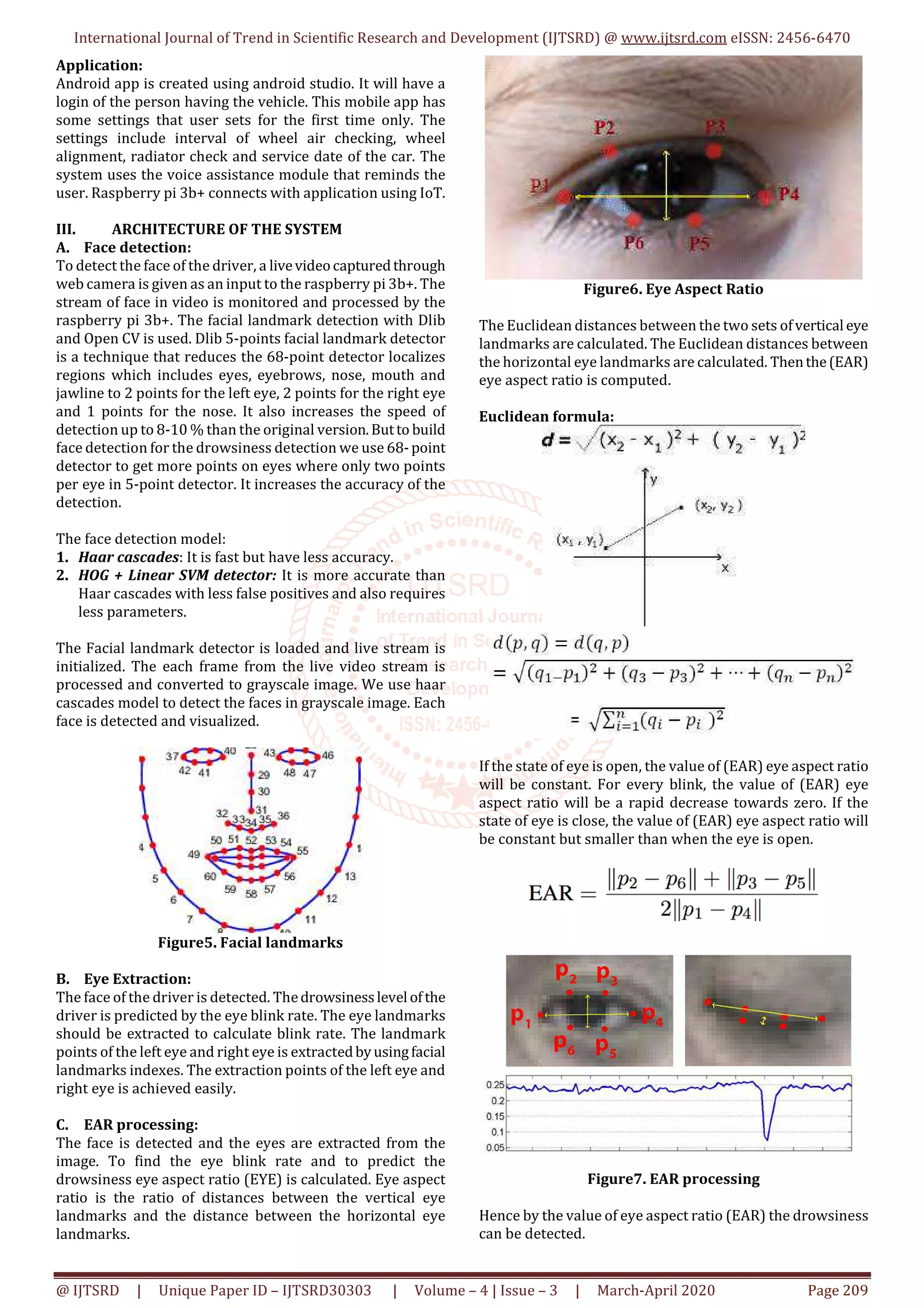
drowsiness eye aspect ratio (EYE) is calculated. Eye aspect
ratio is the ratio of distances between the vertical eye
landmarks and the distance between the horizontal eye
landmarks.
Figure6. Eye Aspect Ratio
The Euclidean distances between the two sets ofvertical eye
landmarks are calculated. The Euclidean distances between
the horizontal eye landmarks are calculated. Thenthe(EAR)
eye aspect ratio is computed.
Euclidean formula:
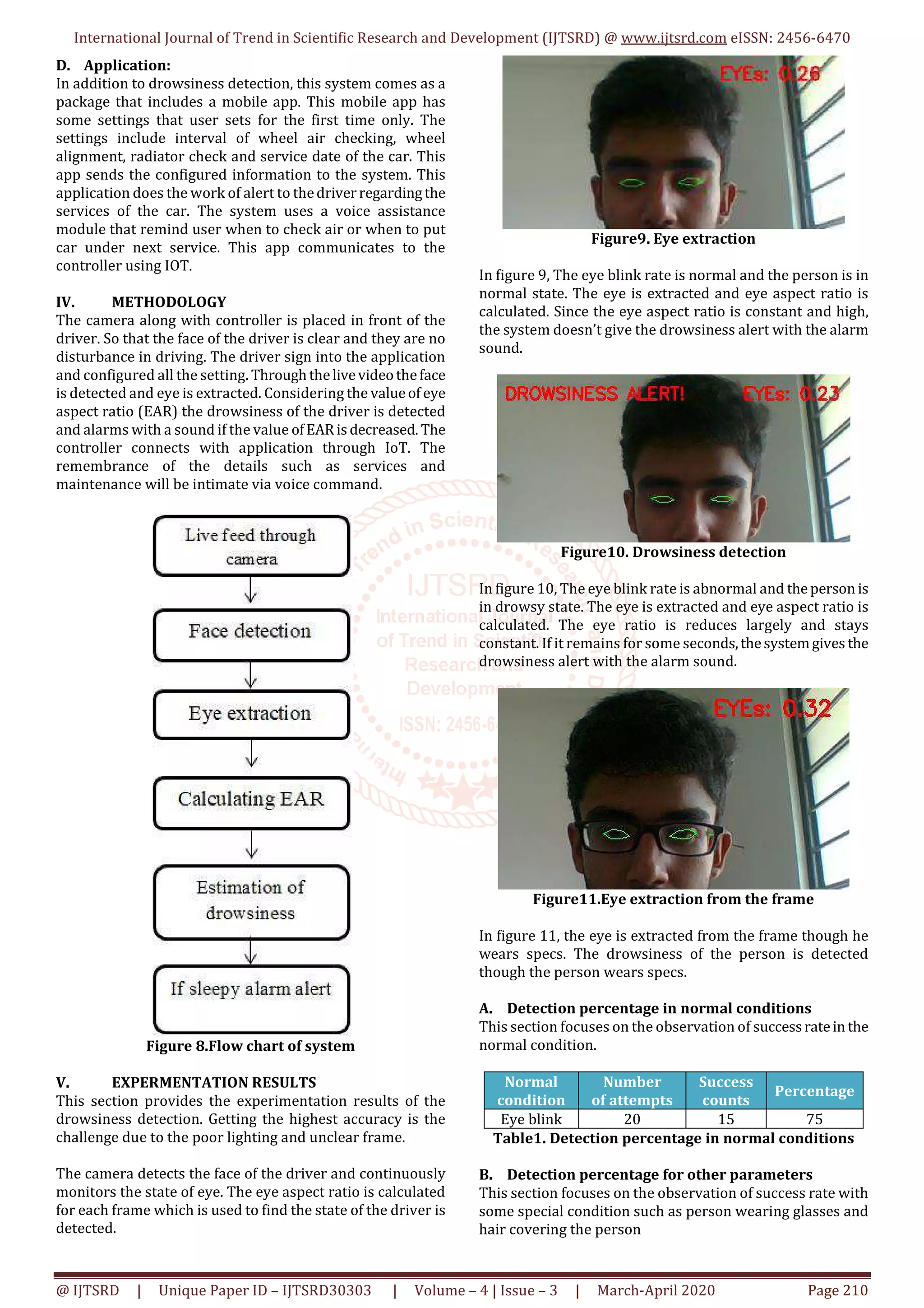
If the state of eye is open, the value of (EAR) eye aspect ratio
will be constant. For every blink, the value of (EAR) eye
aspect ratio will be a rapid decrease towards zero. If the
state of eye is close, the value of (EAR) eye aspect ratio will
be constant but smaller than when the eye is open.
Figure7. EAR processing
Hence by the value of eye aspect ratio (EAR) the drowsiness
can be detected.
International Journal of Trend in Scientific Research and Development (IJTSRD) @ www.ijtsrd.com eISSN: 2456-6470
@ IJTSRD | Unique Paper ID – IJTSRD30303 | Volume – 4 | Issue – 3 | March-April 2020 Page 210
D. Application:
In addition to drowsiness detection, this system comes as a
package that includes a mobile app. This mobile app has
some settings that user sets for the first time only. The
settings include interval of wheel air checking, wheel
alignment, radiator check and service date of the car. This
app sends the configured information to the system. This
application does the work of alert to thedriverregardingthe
services of the car. The system uses a voice assistance
module that remind user when to check air or when to put
car under next service. This app communicates to the
controller using IOT.
IV. METHODOLOGY
The camera along with controller is placed in front of the
driver. So that the face of the driver is clear and they are no
disturbance in driving. The driver sign into the application
and configured all the setting. Throughthelivevideotheface
is detected and eye is extracted. Considering the valueof eye
aspect ratio (EAR) the drowsiness of the driver is detected
and alarms with a sound if the value ofEAR isdecreased. The
controller connects with application through IoT. The
remembrance of the details such as services and
maintenance will be intimate via voice command.
Figure 8.Flow chart of system
V. EXPERMENTATION RESULTS
This section provides the experimentation results of the
drowsiness detection. Getting the highest accuracy is the
challenge due to the poor lighting and unclear frame.
The camera detects the face of the driver and continuously
monitors the state of eye. The eye aspect ratio is calculated
for each frame which is used to find the state of the driver is
detected.
Figure9. Eye extraction
In figure 9, The eye blink rate is normal and the person is in
normal state. The eye is extracted and eye aspect ratio is
calculated. Since the eye aspect ratio is constant and high,
the system doesn’t give the drowsiness alert with the alarm
sound.
Figure10. Drowsiness detection
In figure 10, The eye blink rate is abnormal and theperson is
in drowsy state. The eye is extracted and eye aspect ratio is
calculated. The eye ratio is reduces largely and stays
constant. If it remains for some seconds,thesystemgives the
drowsiness alert with the alarm sound.
Figure11.Eye extraction from the frame
In figure 11, the eye is extracted from the frame though he
wears specs. The drowsiness of the person is detected
though the person wears specs.
A. Detection percentage in normal conditions
This section focuses on the observation of successratein the
normal condition.
Normal
condition
Number
of attempts
Success
counts
Percentage
Eye blink 20 15 75
Table1. Detection percentage in normal conditions
B. Detection percentage for other parameters
This section focuses on the observation of success rate with
some special condition such as person wearing glasses and
hair covering the person
International Journal of Trend in Scientific Research and Development (IJTSRD) @ www.ijtsrd.com eISSN: 2456-6470
@ IJTSRD | Unique Paper ID – IJTSRD30303 | Volume – 4 | Issue – 3 | March-April 2020 Page 211
Parameter
Number
of attempts
Success
counts
Percentage
Person wearing
glasses
20 7 35
Hair covering
the person’s face
20 5 25
Table2. Detection percentage for other parameters
VI. CONCLUSION
This project focuses on the drowsiness detection and
notification regarding the wheel air checking, wheel
alignment, radiator check and service date of the car. The
system gets the live video as the input and detects the facial
landmarks in the each frame. The eye is extracted and
monitored. Depends on the eye aspect ratio state of the
person is detected. If the person is in drowsy state system
alerts by the alarm sound. According to the experimental
results, the size of the model used to detect the face and eye
is small. Hence, it can be integrated into car for theadvanced
automation. The future work will be focusing on the
estimation of human behaviour such as yawning and
distraction of the driver. Also the system can be integrated
with the braking system to slower the speed of the vehicle
when the drowsiness is detected.
REFERENCES:
[1] Human Drowsiness Detection system,
International Journal of Engineering and Advanced
Technology (IJEAT), ISSN: 2249 – 8958, Volume-8
Issue-4, April, 2019
[2] Driver Drowsiness Detection System for VehicleSafety
International Journal of Innovative Technology and
Exploring Engineering, ISSN: 2278-3075, Volume-8,
Issue- 6S4, April 2019
[3] Real Time Driver Drowsiness Detection Based on
Driver's Face Image BehaviorUsinga SystemofHuman
Computer Interaction Implemented in a Smartphone,
January 2018
[4] Driver Drowsiness Detection using Eye-Closeness
Detection, Oraan Khunpisuth, TaweechaiChotchinasri,
Varakorn Koschakosai and Narit Hnoohom. 2016 12th
International Conference on Signal-Image Technology
& Internet-Based Systems.
[5] Association for Safe International RoadTravel (ASIRT),
Road Crash Statistics, 2016.
[6] Don’t sleep and drive – VW’s fatigue detection
technology, Jan, T, Karnahl, Seifert, K., Hilgenstock,J.,&
Zobel, R, 2016.
[7] Drowsy Driving, Facts and Stats: DrowsyDriving– Stay
Alert, Arrive Alive, 2016.
[8] An improved real time eye state identification system
in driver drowsiness detection," in Proc. IEEEInt.Conf.
on Control and Automation, IEEE, ]. Hong, Tianyi,
Huabiao Qin, and Qianshu Sun, 2007
[9] Real-time eye, gaze, and face pose tracking for
monitoring driver vigilance, International Journal of
Real-Time Imaging,]. J. Qiang and X. Yang vol. 8, 2002,
pp. 357– 377.
[10] Driver drowsiness detection with eyelid related
parameters by Support Vector Machine, S. Hu and G.
Zheng, International Journal of Expert Systems with
Applications, vol. 36, 2009, pp. 7651–7658.

Care – Max for Drowsiness Detection and Notification

  • 1.
    International Journal ofTrend in Scientific Research and Development (IJTSRD) Volume 4 Issue 3, April 2020 Available Online: www.ijtsrd.com e-ISSN: 2456 – 6470 @ IJTSRD | Unique Paper ID – IJTSRD30303 | Volume – 4 | Issue – 3 | March-April 2020 Page 207 Care – Max for Drowsiness Detection and Notification R N Susheel, B M Mathumitha, Mr. C Raju Department of Electronics and Communication, Bannari Amman Institute of Technology, Sathyamangalam, Tamil Nadu, India ABSTRACT This project proposes drowsiness detection and notification system for vehicles and a mobile application for car maintenance. The major objective of the system is to prevent the road accidents caused by driver falling asleep during the travel. The system for drowsiness detection has a camera that monitors the driver’s eye continuously. It calculates the eye aspect ratio to detect if the driver is drowsy. If found drowsy, alarm rings. In this project, a Raspberry Pi board is used for drowsiness detection and alerting the driver. The IoT based mobile application built using android studio proposed here has certain settings like next service date, interval for wheel air checking, interval for wheel alignment. The app is connected to the system using IoT. The information is sent to the system. These settings are notified to the driver through a voice module. KEYWORDS: Raspberry Pi, Open CV, Android Studio How to cite this paper: R N Susheel | B M Mathumitha | Mr. C Raju "Care – Max for Drowsiness Detection and Notification" Published in International Journal of Trend in Scientific Research and Development (ijtsrd), ISSN: 2456- 6470, Volume-4 | Issue-3, April 2020, pp.207-211, URL: www.ijtsrd.com/papers/ijtsrd30303.pdf Copyright © 2020 by author(s) and International Journal ofTrendinScientific Research and Development Journal. This is an Open Access article distributed under the terms of the Creative CommonsAttribution License (CC BY 4.0) (http://creativecommons.org/licenses/by /4.0) INTRODUCTION Every year the amount of deaths and injuries are increasing drastically by road accidents. Mostly they are due to human errors like drinking & driving,overspeeding,drowsiness etc. People can avoid the accidents caused by drinking alcohol. Unfortunately, not the accidents caused by drowsiness, as it is uncertain. People who drive long distance tend to fall asleep during less traffichoursorwhentravellingonstraight roads. Drowsy Driving Prevention Week is Nov. 1-8, 2020. Though government is spreading awareness it is difficult to avoid this. Hence a system like this is needed to monitor the driver's state continuously. Care-max for drowsiness detection and notification to address this issue. The proposed system involves a camera which continuously monitors the eyes of the driver. There are already existing solutions for this challenge. But they result in more computational complexity and are costly too. The algorithm they use is also not very efficient and is not accurate. Butour proposed system uses two vertical eye landmarkstofindthe aspect ratio. This is done using computer vision. The level of drowsiness is determined and alerts the driver by the alarm sound. This promises accuracy and cost efficiency. This will be very helpful in reducing the amount of accidents caused by driver falling asleep. In addition to drowsiness detection and alerting,thissystem comes as a package that includes a mobile application. This mobile app has some settings that user enters for the first time only. The settings includeinterval ofwheel airchecking, wheel alignment, radiator check and service date of the car. This app sends the configured information to the system. The system uses a voice assistance module that remind user when to check air or when to put car undernextservice.This app communicates to the system using IOT. Hence, our system “CARE-MAX for drowsiness detection and notification” promises to give better results. All the objectives are shown below: A. To design and develop a system that detectsdrowsiness and alerts the driver, controlled by Raspberry pi. B. To design a mobile application for vehicle maintenance using android studio. C. To implement the drowsiness detection algorithm and successfully calculate the eye aspect ratio. D. To develop the prototype of this system. I. LITERATURE REVIEW In this paper[1], Driver Drowsiness Detection requires a video sensor to detect the faces of drivers. If the face doesn’t match the template the concerned authority will get a notification and inform the particular driver about the intrusion taking place. The GPS/GPRS module is connected to the controller and the location of the driver is send to the medical assistance. Accelerometer sensors are used in the system to record the speed of the person driving the car. All these are notified through the application. The camera can detect the face of the driver, we calculate the drowsiness level of the driver based on eye blink rate. If drivers blink their eyes more frequently, the authors assume that the drivers are drowsy. IJTSRD30303
  • 2.
    International Journal ofTrend in Scientific Research and Development (IJTSRD) @ www.ijtsrd.com eISSN: 2456-6470 @ IJTSRD | Unique Paper ID – IJTSRD30303 | Volume – 4 | Issue – 3 | March-April 2020 Page 208 In this paper [2], In order to find the drowsiness the eye blink sensor is used. A spectacle with eye blink sensor is used to detect the driver drowsiness and alerts the driver with buzzer, if driver is affected by drowsiness. They used the sensor like tilt sensor, eye blink sensor to detect and process. In this paper [3], They illustrated that there are several methods to detect the drowsiness of the person driving the car. Drowsiness detection can be categories based on the vehicle, behaviour of the driver and sometimes the physiological factors. Detection technique based on the vehicle deviation from the lane or pressure on acceleration portal and also through pulse rate, heartbeat etc. The drowsiness detection is focusesonthe behaviouralfactorsof the driver. It includes the head tilting, eye blinking, eye closure, yawning. Author uses image processingto providea solution to detect the drowsiness at the earliest and gettime to avoid the danger. II. MATERIALS The drowsiness detection system reduces the count of accidents by the driver due to sleepy state. The group of hardware components is used for the detection of drowsy and android application is used for the notification which involves interval of wheel air checking, wheel alignment, radiator check and service date of the car. The various components are listed below: 1. Raspberry pi 3b+ 2. Logitech Web camera 3. Speaker/buzzer 4. 5V Adapter A. Hardware components: Raspberry Pi 3 b+: The Raspberry Pi 3 b+ is used to control the functionality. The program for drowsiness detection and notification is dumped into it. The Raspberry Pi 3 b+ is connected to the app through IoT. Figure1. Raspberry pi 3 b+ Web Camera: The Web Camera is used to monitor the eyes of the driver during travel. This is given as input to the raspberry pi for processing as a live video. Figure2. Web Camera Speaker: The Speaker is connected to the raspberry pi in one of its output port. It is used to alert the driver if he is drowsy. And also notifies the user of car maintenance intervals using a voice module. Figure3. Speaker B. Overview: In our proposed method, we have decided to use logi tech web camera along with raspberry pi 3b+ since it supports the library file well and has good speed rate. This method eliminates the use of sensors. The block diagram of the proposed is shown in figure 4 Power supply: In this system, power supply of 5V with 2.5A is used for raspberry pi 3b+ by micro USB port.Thepowerrequirement is increased when it has the maximum interfaces. In our proposed system, Camera module requires only 50mA. Figure4. Block diagram Controller section: Here raspberry pi 3b+ section is the control unitofthe entire system. It is a single board system and has many ports including the USB port. Raspberry pi 3b+ has 1GB RAM with 64 bit processor. It is the fastest and most powerful device with quad-core ARM cortex. Logitech web camera is connected to raspberry pi 3b+ and placed so that it has a clear vision of the face of driver without causing any interference. If the sleepiness of the driver is detected through camera it causesanalarm/buzzer sound.
  • 3.
    International Journal ofTrend in Scientific Research and Development (IJTSRD) @ www.ijtsrd.com eISSN: 2456-6470 @ IJTSRD | Unique Paper ID – IJTSRD30303 | Volume – 4 | Issue – 3 | March-April 2020 Page 209 Application: Android app is created using android studio. It will have a login of the person having the vehicle. This mobile app has some settings that user sets for the first time only. The settings include interval of wheel air checking, wheel alignment, radiator check and service date of the car. The system uses the voice assistance module that reminds the user. Raspberry pi 3b+ connects with application using IoT. III. ARCHITECTURE OF THE SYSTEM A. Face detection: To detect the face of the driver, a livevideocapturedthrough web camera is given as an input to the raspberry pi 3b+. The stream of face in video is monitored and processed by the raspberry pi 3b+. The facial landmark detection with Dlib and Open CV is used. Dlib 5-points facial landmark detector is a technique that reduces the 68-point detector localizes regions which includes eyes, eyebrows, nose, mouth and jawline to 2 points for the left eye, 2 points for the right eye and 1 points for the nose. It also increases the speed of detection up to 8-10 % than the original version.Butto build face detection for the drowsiness detection we use 68-point detector to get more points on eyes where only two points per eye in 5-point detector. It increases the accuracy of the detection. The face detection model: 1. Haar cascades: It is fast but have less accuracy. 2. HOG + Linear SVM detector: It is more accurate than Haar cascades with less false positives and also requires less parameters. The Facial landmark detector is loaded and live stream is initialized. The each frame from the live video stream is processed and converted to grayscale image. We use haar cascades model to detect the faces in grayscale image. Each face is detected and visualized. Figure5. Facial landmarks B. Eye Extraction: The face of the driver is detected. Thedrowsinesslevel ofthe driver is predicted by the eye blink rate. The eye landmarks should be extracted to calculate blink rate. The landmark points of the left eye and right eye is extractedbyusingfacial landmarks indexes. The extraction points of the left eye and right eye is achieved easily. C. EAR processing: The face is detected and the eyes are extracted from the image. To find the eye blink rate and to predict the drowsiness eye aspect ratio (EYE) is calculated. Eye aspect ratio is the ratio of distances between the vertical eye landmarks and the distance between the horizontal eye landmarks. Figure6. Eye Aspect Ratio The Euclidean distances between the two sets ofvertical eye landmarks are calculated. The Euclidean distances between the horizontal eye landmarks are calculated. Thenthe(EAR) eye aspect ratio is computed. Euclidean formula: If the state of eye is open, the value of (EAR) eye aspect ratio will be constant. For every blink, the value of (EAR) eye aspect ratio will be a rapid decrease towards zero. If the state of eye is close, the value of (EAR) eye aspect ratio will be constant but smaller than when the eye is open. Figure7. EAR processing Hence by the value of eye aspect ratio (EAR) the drowsiness can be detected.
  • 4.
    International Journal ofTrend in Scientific Research and Development (IJTSRD) @ www.ijtsrd.com eISSN: 2456-6470 @ IJTSRD | Unique Paper ID – IJTSRD30303 | Volume – 4 | Issue – 3 | March-April 2020 Page 210 D. Application: In addition to drowsiness detection, this system comes as a package that includes a mobile app. This mobile app has some settings that user sets for the first time only. The settings include interval of wheel air checking, wheel alignment, radiator check and service date of the car. This app sends the configured information to the system. This application does the work of alert to thedriverregardingthe services of the car. The system uses a voice assistance module that remind user when to check air or when to put car under next service. This app communicates to the controller using IOT. IV. METHODOLOGY The camera along with controller is placed in front of the driver. So that the face of the driver is clear and they are no disturbance in driving. The driver sign into the application and configured all the setting. Throughthelivevideotheface is detected and eye is extracted. Considering the valueof eye aspect ratio (EAR) the drowsiness of the driver is detected and alarms with a sound if the value ofEAR isdecreased. The controller connects with application through IoT. The remembrance of the details such as services and maintenance will be intimate via voice command. Figure 8.Flow chart of system V. EXPERMENTATION RESULTS This section provides the experimentation results of the drowsiness detection. Getting the highest accuracy is the challenge due to the poor lighting and unclear frame. The camera detects the face of the driver and continuously monitors the state of eye. The eye aspect ratio is calculated for each frame which is used to find the state of the driver is detected. Figure9. Eye extraction In figure 9, The eye blink rate is normal and the person is in normal state. The eye is extracted and eye aspect ratio is calculated. Since the eye aspect ratio is constant and high, the system doesn’t give the drowsiness alert with the alarm sound. Figure10. Drowsiness detection In figure 10, The eye blink rate is abnormal and theperson is in drowsy state. The eye is extracted and eye aspect ratio is calculated. The eye ratio is reduces largely and stays constant. If it remains for some seconds,thesystemgives the drowsiness alert with the alarm sound. Figure11.Eye extraction from the frame In figure 11, the eye is extracted from the frame though he wears specs. The drowsiness of the person is detected though the person wears specs. A. Detection percentage in normal conditions This section focuses on the observation of successratein the normal condition. Normal condition Number of attempts Success counts Percentage Eye blink 20 15 75 Table1. Detection percentage in normal conditions B. Detection percentage for other parameters This section focuses on the observation of success rate with some special condition such as person wearing glasses and hair covering the person
  • 5.
    International Journal ofTrend in Scientific Research and Development (IJTSRD) @ www.ijtsrd.com eISSN: 2456-6470 @ IJTSRD | Unique Paper ID – IJTSRD30303 | Volume – 4 | Issue – 3 | March-April 2020 Page 211 Parameter Number of attempts Success counts Percentage Person wearing glasses 20 7 35 Hair covering the person’s face 20 5 25 Table2. Detection percentage for other parameters VI. CONCLUSION This project focuses on the drowsiness detection and notification regarding the wheel air checking, wheel alignment, radiator check and service date of the car. The system gets the live video as the input and detects the facial landmarks in the each frame. The eye is extracted and monitored. Depends on the eye aspect ratio state of the person is detected. If the person is in drowsy state system alerts by the alarm sound. According to the experimental results, the size of the model used to detect the face and eye is small. Hence, it can be integrated into car for theadvanced automation. The future work will be focusing on the estimation of human behaviour such as yawning and distraction of the driver. Also the system can be integrated with the braking system to slower the speed of the vehicle when the drowsiness is detected. REFERENCES: [1] Human Drowsiness Detection system, International Journal of Engineering and Advanced Technology (IJEAT), ISSN: 2249 – 8958, Volume-8 Issue-4, April, 2019 [2] Driver Drowsiness Detection System for VehicleSafety International Journal of Innovative Technology and Exploring Engineering, ISSN: 2278-3075, Volume-8, Issue- 6S4, April 2019 [3] Real Time Driver Drowsiness Detection Based on Driver's Face Image BehaviorUsinga SystemofHuman Computer Interaction Implemented in a Smartphone, January 2018 [4] Driver Drowsiness Detection using Eye-Closeness Detection, Oraan Khunpisuth, TaweechaiChotchinasri, Varakorn Koschakosai and Narit Hnoohom. 2016 12th International Conference on Signal-Image Technology & Internet-Based Systems. [5] Association for Safe International RoadTravel (ASIRT), Road Crash Statistics, 2016. [6] Don’t sleep and drive – VW’s fatigue detection technology, Jan, T, Karnahl, Seifert, K., Hilgenstock,J.,& Zobel, R, 2016. [7] Drowsy Driving, Facts and Stats: DrowsyDriving– Stay Alert, Arrive Alive, 2016. [8] An improved real time eye state identification system in driver drowsiness detection," in Proc. IEEEInt.Conf. on Control and Automation, IEEE, ]. Hong, Tianyi, Huabiao Qin, and Qianshu Sun, 2007 [9] Real-time eye, gaze, and face pose tracking for monitoring driver vigilance, International Journal of Real-Time Imaging,]. J. Qiang and X. Yang vol. 8, 2002, pp. 357– 377. [10] Driver drowsiness detection with eyelid related parameters by Support Vector Machine, S. Hu and G. Zheng, International Journal of Expert Systems with Applications, vol. 36, 2009, pp. 7651–7658.