0
Voluntary carbon market
governance post-2020
Brad Schallert
Director, Carbon Market Governance and Aviation
WWF-US
1
Underlying
questions on
voluntary carbon
markets
•When to buy
carbon credits?
•How to account
for and report
carbon credits?
What to say
about carbon
credit purchases?
•What to buy?
2
What makes a high-quality carbon
credit?
Carbon Credit Guidance for Buyers project
3
Carbon credit markets are experiencing explosive growth in quantity
Issuance from independent crediting programs
has increased more than 4-fold since 2016…
…and experts expect breakneck growth to
continue into the medium- and long-term
29 28
53
67
2015 2017
2016 2019E1
2018
c.125
4.5x
1. 2019 data is based on 11 months of actuals and an indicative estimate for December 2019
Source: Forest Trends Ecosystem Marketplace carbon credit reports; Verra; Gold Standard; S&P Global Platts; Financial Times; BCG analysis
$44b
Carbon credit
market
(2050)
Carbon
allowances
market (2018)
For comparison
Carbon credit
market
(2019)
$200b
$0.6b
CAGR:
+21%
Carbon credit issuances under the 2 largest voluntary
standards (VCS and Gold Standard), MtCO2e
4
However, lack of a clear benchmark for "high-quality" carbon credits
No market certainty on
where to direct most
impactful carbon
financing, low quality
units remain in-demand
Responsible buyers lack
understanding of the
market making them
susceptible to
reputational risks
Buyers have no simple
means to disclose carbon
credit purchases and
demonstrate impact
Public transparency is
lacking despite increasing
expectations (e.g. around
non-financial disclosures)
No clear path
for navigating
a complex
carbon credit
landscape
No independent
source assessing
credit quality
(see next slide)
No transparency
about carbon
credit buying
practices
No clarity over
what a "good"
carbon credit
buying strategy is
Uncertainty about
"double claiming"
linked to Paris
Agreement
negotiations
Irrespective of buyers'
intent, industry accused
of greenwashing as
difficult to differentiate
between credits' integrity
5
Many carbon credits on the market are questionable, with no real, measurable,
and additional emissions reductions
Backup
Clean Development
Mechanism (CDM) is one
major source of carbon
credits
According to a 2016 study conducted by Oeko-Institut…
7%
Potential CER
supply highly likely
to be additional and
not over-estimated
73%
CERs (CDM credits)
highly unlikely to be
additional and likely
over-estimated
Our analysis suggests that the CDM still has fundamental
flaws in terms of overall environmental integrity
Source: "How additional is the Clean Development Mechanism?", Oeko-Institut, 2016
6
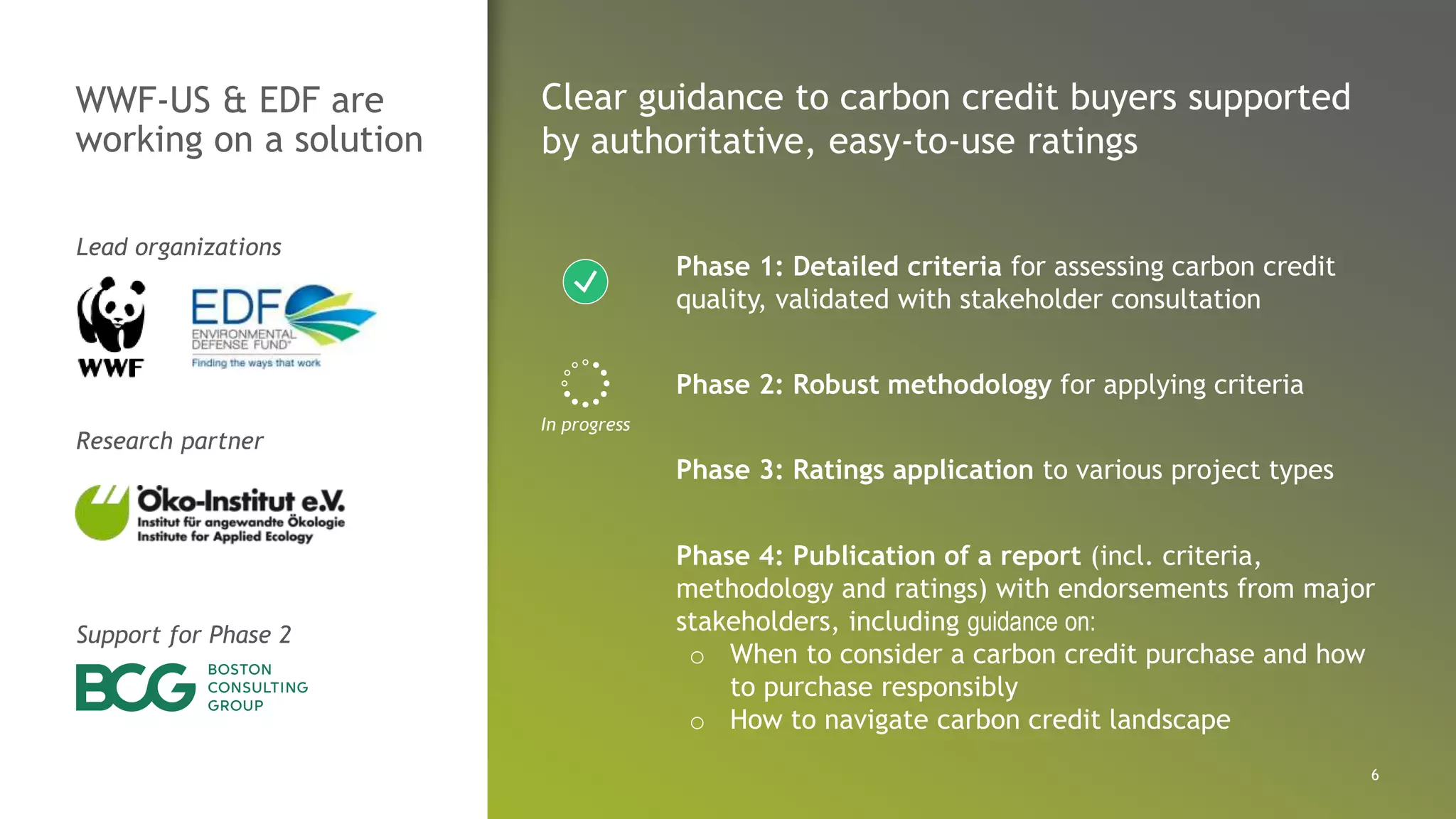
WWF-US & EDF are
working on a solution
Clear guidance to carbon credit buyers supported
by authoritative, easy-to-use ratings
Phase 1: Detailed criteria for assessing carbon credit
quality, validated with stakeholder consultation
Phase 2: Robust methodology for applying criteria
Phase 3: Ratings application to various project types
Phase 4: Publication of a report (incl. criteria,
methodology and ratings) with endorsements from major
stakeholders, including guidance on:
o When to consider a carbon credit purchase and how
to purchase responsibly
o How to navigate carbon credit landscape
Lead organizations
Research partner
Support for Phase 2
In progress
7
Phase 1: What makes
a high-quality carbon
credit?
Available now at:
https://www.worldwildlife.org/
publications/what-makes-a-
high-quality-carbon-credit
8
Help buyers identify quality carbon credit projects
to protect their reputation and leverage brand
benefits
Signal to carbon crediting entities and project
developers how their activities/procedures might
need to change to adjust to a new level of
environmental integrity
Help civil society, NGOs, and other interested
entities assess offsetting claims of buyers
Provide guidance to policy makers (e.g.
governments on the ICAO Council) on determining
project quality and how to future-proof projects
Exhaustive and easy-to-use report… …to provide crucial guidance to many audiences
Carbon Credit Guidance for Buyers (CCG4B) will provide comprehensive, clear,
and independent guidance relevant to stakeholders across all sectors
1. An introduction to carbon credits
2. The role of carbon credits in a responsible mitigation
strategy
3. A discussion of the possible types of claims that may
be made after purchasing carbon credits
4. An explanation of the criteria/methodology
5. Guidance on how to interpret the results
6. A visual presentation of the findings
7. Additional due diligence steps that may be applied to
assess the quality of specific carbon credits
8. The full methodology and set of assumptions in an
appendix
9
Thank you!
Please contact Brad Schallert with
further questions
Brad.Schallert@wwfus.org

presentation on voluntary carbon market.pptx

  • 1.
    0 Voluntary carbon market governancepost-2020 Brad Schallert Director, Carbon Market Governance and Aviation WWF-US
  • 2.
    1 Underlying questions on voluntary carbon markets •Whento buy carbon credits? •How to account for and report carbon credits? What to say about carbon credit purchases? •What to buy?
  • 3.
    2 What makes ahigh-quality carbon credit? Carbon Credit Guidance for Buyers project
  • 4.
    3 Carbon credit marketsare experiencing explosive growth in quantity Issuance from independent crediting programs has increased more than 4-fold since 2016… …and experts expect breakneck growth to continue into the medium- and long-term 29 28 53 67 2015 2017 2016 2019E1 2018 c.125 4.5x 1. 2019 data is based on 11 months of actuals and an indicative estimate for December 2019 Source: Forest Trends Ecosystem Marketplace carbon credit reports; Verra; Gold Standard; S&P Global Platts; Financial Times; BCG analysis $44b Carbon credit market (2050) Carbon allowances market (2018) For comparison Carbon credit market (2019) $200b $0.6b CAGR: +21% Carbon credit issuances under the 2 largest voluntary standards (VCS and Gold Standard), MtCO2e
  • 5.
    4 However, lack ofa clear benchmark for "high-quality" carbon credits No market certainty on where to direct most impactful carbon financing, low quality units remain in-demand Responsible buyers lack understanding of the market making them susceptible to reputational risks Buyers have no simple means to disclose carbon credit purchases and demonstrate impact Public transparency is lacking despite increasing expectations (e.g. around non-financial disclosures) No clear path for navigating a complex carbon credit landscape No independent source assessing credit quality (see next slide) No transparency about carbon credit buying practices No clarity over what a "good" carbon credit buying strategy is Uncertainty about "double claiming" linked to Paris Agreement negotiations Irrespective of buyers' intent, industry accused of greenwashing as difficult to differentiate between credits' integrity
  • 6.
    5 Many carbon creditson the market are questionable, with no real, measurable, and additional emissions reductions Backup Clean Development Mechanism (CDM) is one major source of carbon credits According to a 2016 study conducted by Oeko-Institut… 7% Potential CER supply highly likely to be additional and not over-estimated 73% CERs (CDM credits) highly unlikely to be additional and likely over-estimated Our analysis suggests that the CDM still has fundamental flaws in terms of overall environmental integrity Source: "How additional is the Clean Development Mechanism?", Oeko-Institut, 2016
  • 7.
    6 WWF-US & EDFare working on a solution Clear guidance to carbon credit buyers supported by authoritative, easy-to-use ratings Phase 1: Detailed criteria for assessing carbon credit quality, validated with stakeholder consultation Phase 2: Robust methodology for applying criteria Phase 3: Ratings application to various project types Phase 4: Publication of a report (incl. criteria, methodology and ratings) with endorsements from major stakeholders, including guidance on: o When to consider a carbon credit purchase and how to purchase responsibly o How to navigate carbon credit landscape Lead organizations Research partner Support for Phase 2 In progress
  • 8.
    7 Phase 1: Whatmakes a high-quality carbon credit? Available now at: https://www.worldwildlife.org/ publications/what-makes-a- high-quality-carbon-credit
  • 9.
    8 Help buyers identifyquality carbon credit projects to protect their reputation and leverage brand benefits Signal to carbon crediting entities and project developers how their activities/procedures might need to change to adjust to a new level of environmental integrity Help civil society, NGOs, and other interested entities assess offsetting claims of buyers Provide guidance to policy makers (e.g. governments on the ICAO Council) on determining project quality and how to future-proof projects Exhaustive and easy-to-use report… …to provide crucial guidance to many audiences Carbon Credit Guidance for Buyers (CCG4B) will provide comprehensive, clear, and independent guidance relevant to stakeholders across all sectors 1. An introduction to carbon credits 2. The role of carbon credits in a responsible mitigation strategy 3. A discussion of the possible types of claims that may be made after purchasing carbon credits 4. An explanation of the criteria/methodology 5. Guidance on how to interpret the results 6. A visual presentation of the findings 7. Additional due diligence steps that may be applied to assess the quality of specific carbon credits 8. The full methodology and set of assumptions in an appendix
  • 10.
    9 Thank you! Please contactBrad Schallert with further questions Brad.Schallert@wwfus.org