International Journal of Scientific Research and Engineering Development-– Volume 2 Issue 6, Nov-Dec 2019
Available at www.ijsred.com
ISSN : 2581-7175 ©IJSRED:All Rights are Reserved Page 509
Carbon Level Detection of Vehicle for Preventing Air
Pollution Using IOT Sensors
Prathamesh Lolge,Ashutosh Amrutkar,Kunal Pakhale,Chinmay Joshi
Department of Computer Engineering,Late G.N. Sapkal College of Engineering, University of Pune,Nashik,India.
----------------------------------------************************----------------------------------
Abstract:
As we know the number of vehicles are increases day by day. Due to the vehicles, level of carbon
monoxide, carbon dioxide, methane and sulphur, etc. gases are increasing in atmosphere. It causes the
global warming effect that has bad effects on the earth. High enough concentrations in the air can result in
suffocation of air breathing creatures. It directly affects to nature and it also harmful to the humans. The
present situation at some places any vehicle can get the PUC certificate without actual checking then there
is no use of the PUC certificate only. The system is for Carbon level detection of vehicle for preventing
Air Pollution using IOT to control the level of gases released by the vehicles.
Keywords —Client Server Architecture,Android,IOT,MYSQLArduino.
----------------------------------------************************----------------------------------
I. INTRODUCTION
This is the project Carbon level detection of
vehicle for preventing Air Pollution using IOT
Sensors.
The smoke which released from the vehicles
is sense by the sensors. Reading of sensor is
compared with the reference reading in application
and if the level of the carbon is increased of the car
or corresponding vehicle is locked at that insane.
The vehicle is unlocked only when the level of
carbon is in under control. As the pollution is
increases global warming that means temperature
and humidity is also increase. With the help of the
proposed system we can control the air pollution in
some percentage. This will be helpful to the nature
also for the human beings.
Before locking the vehicle user gets the
notification for the servicing of vehicle. If user did
not service the vehicle then vehicle get locked and
only the authorised PUC officer can unlocked the
vehicle.
II. RELATED WORK
Problem Statement:
As we know the number of vehicles are
increases day by day. Due to the vehicles, level of
carbon monoxide, carbon dioxide, methane and
sulphur, etc. gases are increasing in atmosphere. It
causes the global warming effect that has bad
effects on the earth.
Literature Survey:
RESEARCH ARTICLE OPEN ACCESS
International Journal of Scientific Research and Engineering Development-– Volume 2 Issue 6, Nov-Dec 2019
Available at www.ijsred.com
ISSN : 2581-7175 ©IJSRED: All Rights are Reserved Page 510
III. AIMS AND OBJECTIVES:
1. Provide interactive interface through
which users can interact with application
easily.
The system is Carbon level detection of
vehicle for preventing Air Pollution using
IOT to control the level of gases released by
thevehicles. This system is one of the
important featurewithout an effective
authorization mechanism.
Our application also maintain the information of
temperature and humidity of surrounding.
V:FEASIBILITY STUDY
• Technical Feasibility:
Whether it is possible to develop the project
with available
equipment as well as available software/Hardware
with available
manpower.
If there will be any kind of need in order to
develop the S/W in this phase the cost of H/W, S/W
as well as technical equipment are considered and
found that whether requested system is technically
feasible for the organization or not.
• Economical Feasibility:
The presence of hardware, software and
various technical equipment reduced our cost as
compared to the total work for the
System. Hence the system being economically
feasible.
The procedure is to determine the benefits
and savings that are expected from a proposed
system and compare them with input costs.
• Operational Feasibility:
Operational Feasibility study address
questions whether we can run the proposed system
with minimum hardware software setups and the
demands of processing are realistic? Can user
operate it? The new system is very much user
friendly and operational cost is of the new system
needs less human efforts. The system is directly
used by the users and needs no other operators to
coordinate the system. So the system can be judged
operationally feasible.
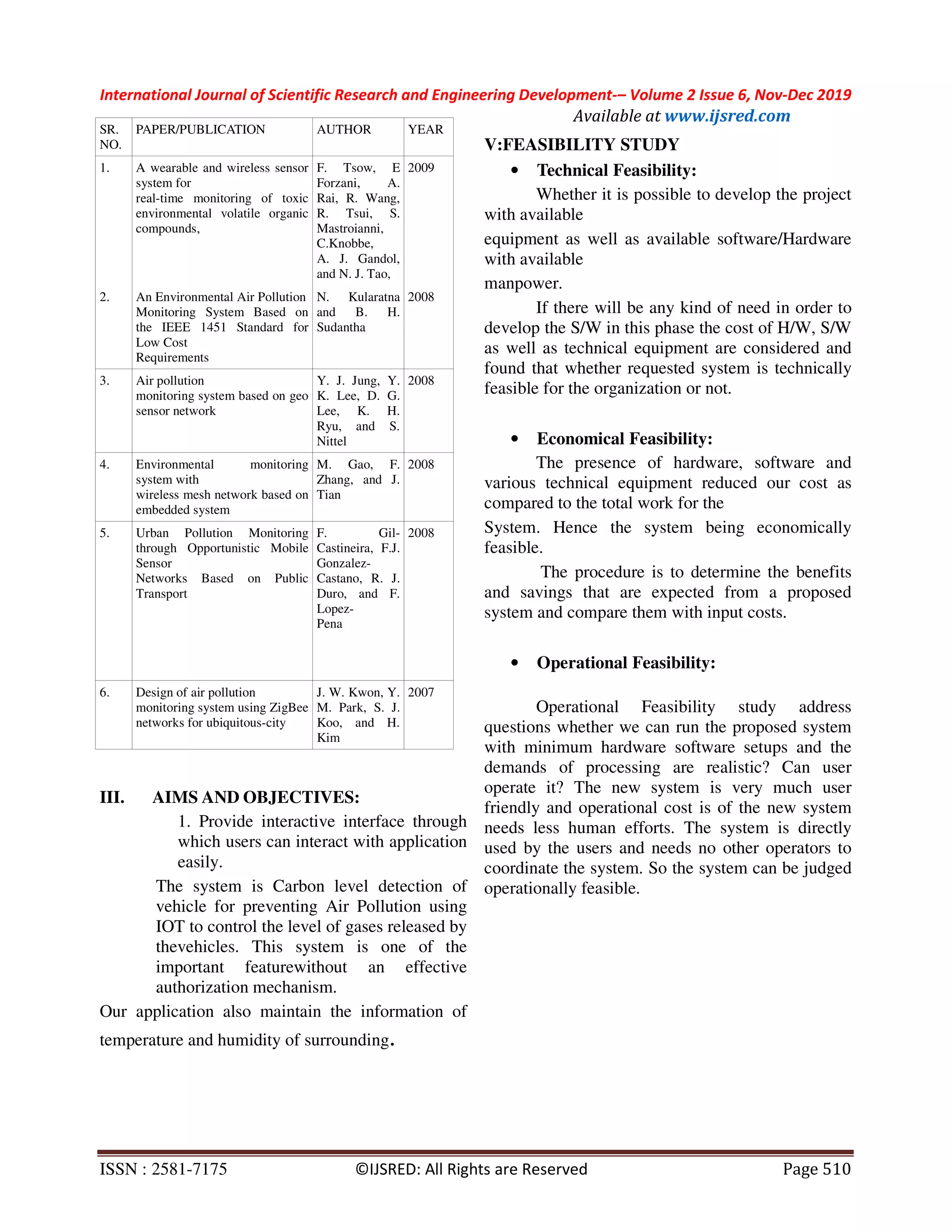
SR.
NO.
PAPER/PUBLICATION AUTHOR YEAR
1. A wearable and wireless sensor
system for
real-time monitoring of toxic
environmental volatile organic
compounds,
F. Tsow, E
Forzani, A.
Rai, R. Wang,
R. Tsui, S.
Mastroianni,
C.Knobbe,
A. J. Gandol,
and N. J. Tao,
2009
2. An Environmental Air Pollution
Monitoring System Based on
the IEEE 1451 Standard for
Low Cost
Requirements
N. Kularatna
and B. H.
Sudantha
2008
3. Air pollution
monitoring system based on geo
sensor network
Y. J. Jung, Y.
K. Lee, D. G.
Lee, K. H.
Ryu, and S.
Nittel
2008
4. Environmental monitoring
system with
wireless mesh network based on
embedded system
M. Gao, F.
Zhang, and J.
Tian
2008
5. Urban Pollution Monitoring
through Opportunistic Mobile
Sensor
Networks Based on Public
Transport
F. Gil-
Castineira, F.J.
Gonzalez-
Castano, R. J.
Duro, and F.
Lopez-
Pena
2008
6. Design of air pollution
monitoring system using ZigBee
networks for ubiquitous-city
J. W. Kwon, Y.
M. Park, S. J.
Koo, and H.
Kim
2007
International Journal of Scientific Research and Engineering Development-– Volume 2 Issue 6, Nov-Dec 2019
Available at www.ijsred.com
ISSN : 2581-7175 ©IJSRED: All Rights are Reserved Page 511
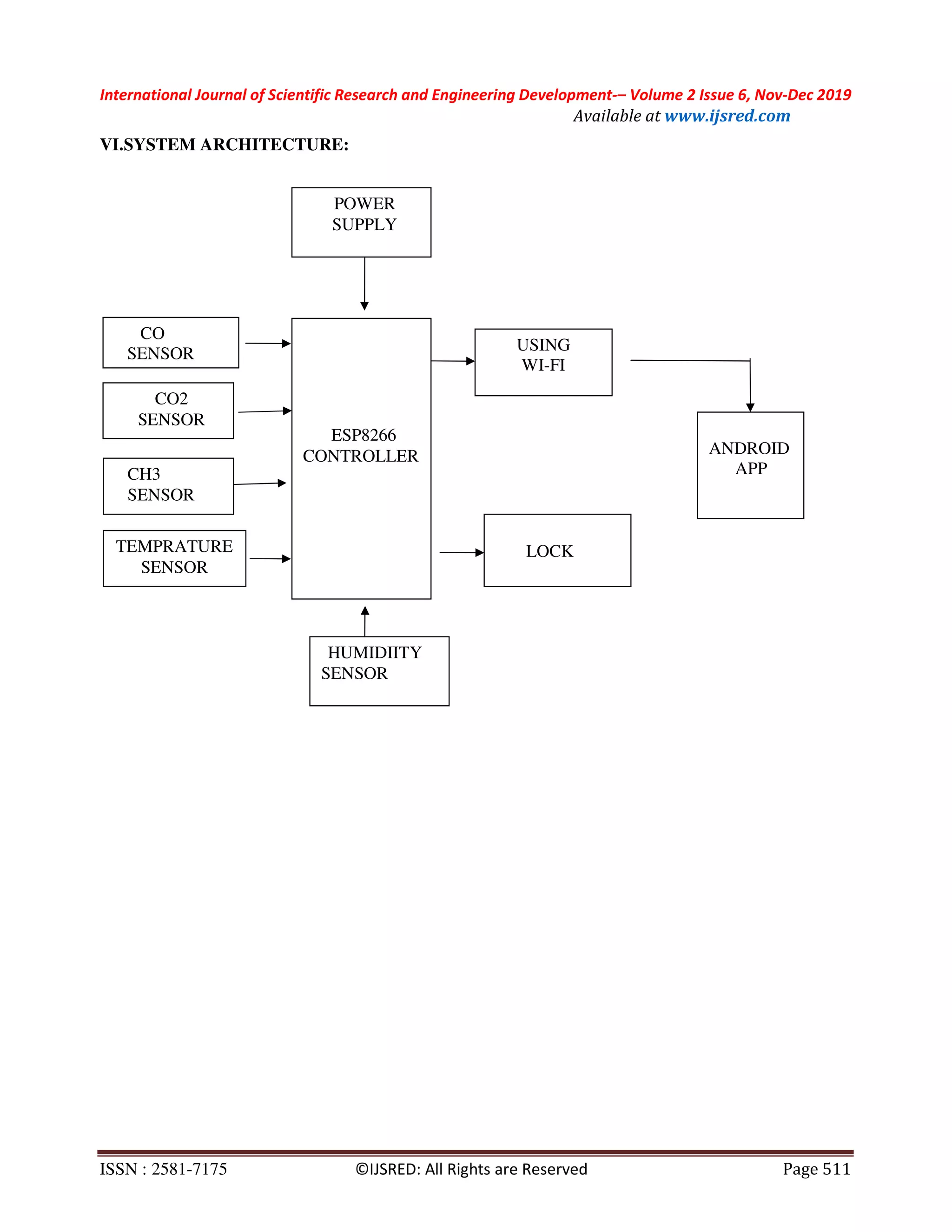
VI.SYSTEM ARCHITECTURE:
ESP8266
CONTROLLER
CO
SENSOR
CO2
SENSOR
CH3
SENSOR
TEMPRATURE
SENSOR
HUMIDIITY
SENSOR
USING
WI-FI
LOCK
ANDROID
APP
POWER
SUPPLY
International Journal of Scientific Research and Engineering Development-– Volume 2 Issue 6, Nov-Dec 2019
Available at www.ijsred.com
ISSN : 2581-7175 ©IJSRED: All Rights are Reserved Page 512
VII: CONCLUSION
Level of released gases can easily detect by
the sensor. Existing vehicles can also implement the
system. Easy implementation of the system.
As the pollution is increases global warming
that means temperature and humidity is also
increase. So, the proposed system will detect and
help to control carbon level.
ACKNOWLEDGMENT
We are very thankful to our guide
Prof.M.G.Bhandare, project co-ordinator
Prof.Prashant Kale & H.O.D Dr(Prof) Nilesh
Wankhade,Computer Engineering, Late G.N Sapkal
College of Engineering for guidance and advice
which help to improve the present and for reading
the paper and giving the valuable suggestions to
improve the paper.
REFERENCES.
[1] J. W. Kwon, Y. M. Park, S. J. Koo, and H. Kim, “Design of air
pollution monitoring system using ZigBee networks for ubiquitous-city
in Proc. Int. Conf. Convergence Information Technology, 2007, pp.
10241031S. Zhang, C. Zhu, J. K. O. Sin, and P. K. T. Mok, “A novel
ultrathin elevated channel low-temperature poly-Si TFT,” IEEE
Electron Device Lett., vol. 20, pp. 569–571, Nov. 1999.
[2] M. Gao, F. Zhang, and J. Tian, “Environmental monitoring system
withwireless mesh network based on embedded system,” in Proc. 5th
IEEEInt. Symp. Embedded Comput., 2008, pp. 174-179.
[3] Y. J. Jung, Y. K. Lee, D. G. Lee, K. H. Ryu, and S. Nittel, “Air
pollution monitoring system based on geosensor network,” in Proc.
IEEE Int. Geoscience Remote Sensing Symp., 2008, vol. 3, pp. 1370-
1373.

Carbon level detection of vehicle for preventing Air Pollution using IOT Sensors

  • 1.
    International Journal ofScientific Research and Engineering Development-– Volume 2 Issue 6, Nov-Dec 2019 Available at www.ijsred.com ISSN : 2581-7175 ©IJSRED:All Rights are Reserved Page 509 Carbon Level Detection of Vehicle for Preventing Air Pollution Using IOT Sensors Prathamesh Lolge,Ashutosh Amrutkar,Kunal Pakhale,Chinmay Joshi Department of Computer Engineering,Late G.N. Sapkal College of Engineering, University of Pune,Nashik,India. ----------------------------------------************************---------------------------------- Abstract: As we know the number of vehicles are increases day by day. Due to the vehicles, level of carbon monoxide, carbon dioxide, methane and sulphur, etc. gases are increasing in atmosphere. It causes the global warming effect that has bad effects on the earth. High enough concentrations in the air can result in suffocation of air breathing creatures. It directly affects to nature and it also harmful to the humans. The present situation at some places any vehicle can get the PUC certificate without actual checking then there is no use of the PUC certificate only. The system is for Carbon level detection of vehicle for preventing Air Pollution using IOT to control the level of gases released by the vehicles. Keywords —Client Server Architecture,Android,IOT,MYSQLArduino. ----------------------------------------************************---------------------------------- I. INTRODUCTION This is the project Carbon level detection of vehicle for preventing Air Pollution using IOT Sensors. The smoke which released from the vehicles is sense by the sensors. Reading of sensor is compared with the reference reading in application and if the level of the carbon is increased of the car or corresponding vehicle is locked at that insane. The vehicle is unlocked only when the level of carbon is in under control. As the pollution is increases global warming that means temperature and humidity is also increase. With the help of the proposed system we can control the air pollution in some percentage. This will be helpful to the nature also for the human beings. Before locking the vehicle user gets the notification for the servicing of vehicle. If user did not service the vehicle then vehicle get locked and only the authorised PUC officer can unlocked the vehicle. II. RELATED WORK Problem Statement: As we know the number of vehicles are increases day by day. Due to the vehicles, level of carbon monoxide, carbon dioxide, methane and sulphur, etc. gases are increasing in atmosphere. It causes the global warming effect that has bad effects on the earth. Literature Survey: RESEARCH ARTICLE OPEN ACCESS
  • 2.
    International Journal ofScientific Research and Engineering Development-– Volume 2 Issue 6, Nov-Dec 2019 Available at www.ijsred.com ISSN : 2581-7175 ©IJSRED: All Rights are Reserved Page 510 III. AIMS AND OBJECTIVES: 1. Provide interactive interface through which users can interact with application easily. The system is Carbon level detection of vehicle for preventing Air Pollution using IOT to control the level of gases released by thevehicles. This system is one of the important featurewithout an effective authorization mechanism. Our application also maintain the information of temperature and humidity of surrounding. V:FEASIBILITY STUDY • Technical Feasibility: Whether it is possible to develop the project with available equipment as well as available software/Hardware with available manpower. If there will be any kind of need in order to develop the S/W in this phase the cost of H/W, S/W as well as technical equipment are considered and found that whether requested system is technically feasible for the organization or not. • Economical Feasibility: The presence of hardware, software and various technical equipment reduced our cost as compared to the total work for the System. Hence the system being economically feasible. The procedure is to determine the benefits and savings that are expected from a proposed system and compare them with input costs. • Operational Feasibility: Operational Feasibility study address questions whether we can run the proposed system with minimum hardware software setups and the demands of processing are realistic? Can user operate it? The new system is very much user friendly and operational cost is of the new system needs less human efforts. The system is directly used by the users and needs no other operators to coordinate the system. So the system can be judged operationally feasible. SR. NO. PAPER/PUBLICATION AUTHOR YEAR 1. A wearable and wireless sensor system for real-time monitoring of toxic environmental volatile organic compounds, F. Tsow, E Forzani, A. Rai, R. Wang, R. Tsui, S. Mastroianni, C.Knobbe, A. J. Gandol, and N. J. Tao, 2009 2. An Environmental Air Pollution Monitoring System Based on the IEEE 1451 Standard for Low Cost Requirements N. Kularatna and B. H. Sudantha 2008 3. Air pollution monitoring system based on geo sensor network Y. J. Jung, Y. K. Lee, D. G. Lee, K. H. Ryu, and S. Nittel 2008 4. Environmental monitoring system with wireless mesh network based on embedded system M. Gao, F. Zhang, and J. Tian 2008 5. Urban Pollution Monitoring through Opportunistic Mobile Sensor Networks Based on Public Transport F. Gil- Castineira, F.J. Gonzalez- Castano, R. J. Duro, and F. Lopez- Pena 2008 6. Design of air pollution monitoring system using ZigBee networks for ubiquitous-city J. W. Kwon, Y. M. Park, S. J. Koo, and H. Kim 2007
  • 3.
    International Journal ofScientific Research and Engineering Development-– Volume 2 Issue 6, Nov-Dec 2019 Available at www.ijsred.com ISSN : 2581-7175 ©IJSRED: All Rights are Reserved Page 511 VI.SYSTEM ARCHITECTURE: ESP8266 CONTROLLER CO SENSOR CO2 SENSOR CH3 SENSOR TEMPRATURE SENSOR HUMIDIITY SENSOR USING WI-FI LOCK ANDROID APP POWER SUPPLY
  • 4.
    International Journal ofScientific Research and Engineering Development-– Volume 2 Issue 6, Nov-Dec 2019 Available at www.ijsred.com ISSN : 2581-7175 ©IJSRED: All Rights are Reserved Page 512 VII: CONCLUSION Level of released gases can easily detect by the sensor. Existing vehicles can also implement the system. Easy implementation of the system. As the pollution is increases global warming that means temperature and humidity is also increase. So, the proposed system will detect and help to control carbon level. ACKNOWLEDGMENT We are very thankful to our guide Prof.M.G.Bhandare, project co-ordinator Prof.Prashant Kale & H.O.D Dr(Prof) Nilesh Wankhade,Computer Engineering, Late G.N Sapkal College of Engineering for guidance and advice which help to improve the present and for reading the paper and giving the valuable suggestions to improve the paper. REFERENCES. [1] J. W. Kwon, Y. M. Park, S. J. Koo, and H. Kim, “Design of air pollution monitoring system using ZigBee networks for ubiquitous-city in Proc. Int. Conf. Convergence Information Technology, 2007, pp. 10241031S. Zhang, C. Zhu, J. K. O. Sin, and P. K. T. Mok, “A novel ultrathin elevated channel low-temperature poly-Si TFT,” IEEE Electron Device Lett., vol. 20, pp. 569–571, Nov. 1999. [2] M. Gao, F. Zhang, and J. Tian, “Environmental monitoring system withwireless mesh network based on embedded system,” in Proc. 5th IEEEInt. Symp. Embedded Comput., 2008, pp. 174-179. [3] Y. J. Jung, Y. K. Lee, D. G. Lee, K. H. Ryu, and S. Nittel, “Air pollution monitoring system based on geosensor network,” in Proc. IEEE Int. Geoscience Remote Sensing Symp., 2008, vol. 3, pp. 1370- 1373.