46
PAPER PUBLICATION:
AIR QUALITYMONITORING SYSTEM BASED ON IOT
LOVELY PROFESSIONAL UNIVERSITY (PUNJAB)
Department of Computer Science and Engineering
ABSTRACT: Today technology has become an integral part of our day to day life. It is important
for us to exploit the technological advancements as much as possible in order to gain more benefits.
We all are aware of the fact that in places like Delhi and other metropolitan cities, the air quality
index is changing from bad to worse. People living in such places should necessarily carry an air
pollution monitoring system consisting of all facilities to keep track of airquality index and take
necessary steps to improve quality of air in immediate surroundings. There is a wide range of
scope for this product to be used in many situations. This system can be upgraded into a more
advanced system with added features in the future.
Introduction:
A healthy environment is the first and
foremost thing for our happiness. We need a
pollution free surrounding for living a safe
and secure life. The recent increase in
pollution levels in metropolitan cities,
especially in Delhi, is a worrying sign. In the
world that is advancing rapidly with
technology where cars could drive on their
own and drones could capture your food, air
pollution should not be of much concern but
the above statistics just proves it wrong. Our
application is one such thing which can
provide the surrounding air quality index to
the user. This is a basic level system which
notifies the user of the various pollutants and
their levels present in air.
Related work:
1. We have taken a cue from works done
by Parveen Sulthana, PramodSharma
and Vijayakumar Sajjan. We have
taken those works as a reference and
have done it using different
methodologies apart from doing as
much as possible to eliminate the cons
in the related work. There were other
interesting works focusing on air
pollution detection.
2. Aravindhar, D. J. (2019, November).
Iot Based Air Pollution Monitoring
System Using Esp8266-12.
3. Kim, S. H., Jeong, J. M., Hwang, M.
T., & Kang, C. S. (2017, October).
Development of an IoT-based
atmospheric environment monitoring
system.
2.
47
1. Nasution, T.H., Muchtar, M. A., &
Simon, A. (2019, October).
Designing an IoT-based air quality
monitoring system.
2. One such work is an IoT-based real
time air pollution monitoring system
proposed to monitor the pollution
levels of various pollutants in
Coimbatore city. The geographical
area is classified as industrial,
residential and traffic zones. It
proposes an IoT system that could be
deployed at any location and store the
measured value in a cloud database,
perform pollution analysis, and
display the pollution level at any
given location.
3. Since the existing work involves too
much cost apart from complex
implementation and high
maintenance, we have eliminated all
such factors. Also, our work is done
in such a way that it can accommodate
further enhancementsto it. Ours is a
work which focuses on providing a
low cost air pollution monitoring
system for regular and daily usage for
people living in metropolitan and
highly polluted cities to be aware of
their surroundings.
Proposed work:
1. We are here with an innovation
which emphasizes on providing an
IoT-Enabled Air Pollution Meter
With Digital Dashboard On
Smartphone.
2. To display real-time air quality
readings for the immediate
surroundings.
3. This is done to have a better
understanding of our surroundings
and ensure the quality of air is not
compromised by constantly
monitoring air quality on our smart
phone.
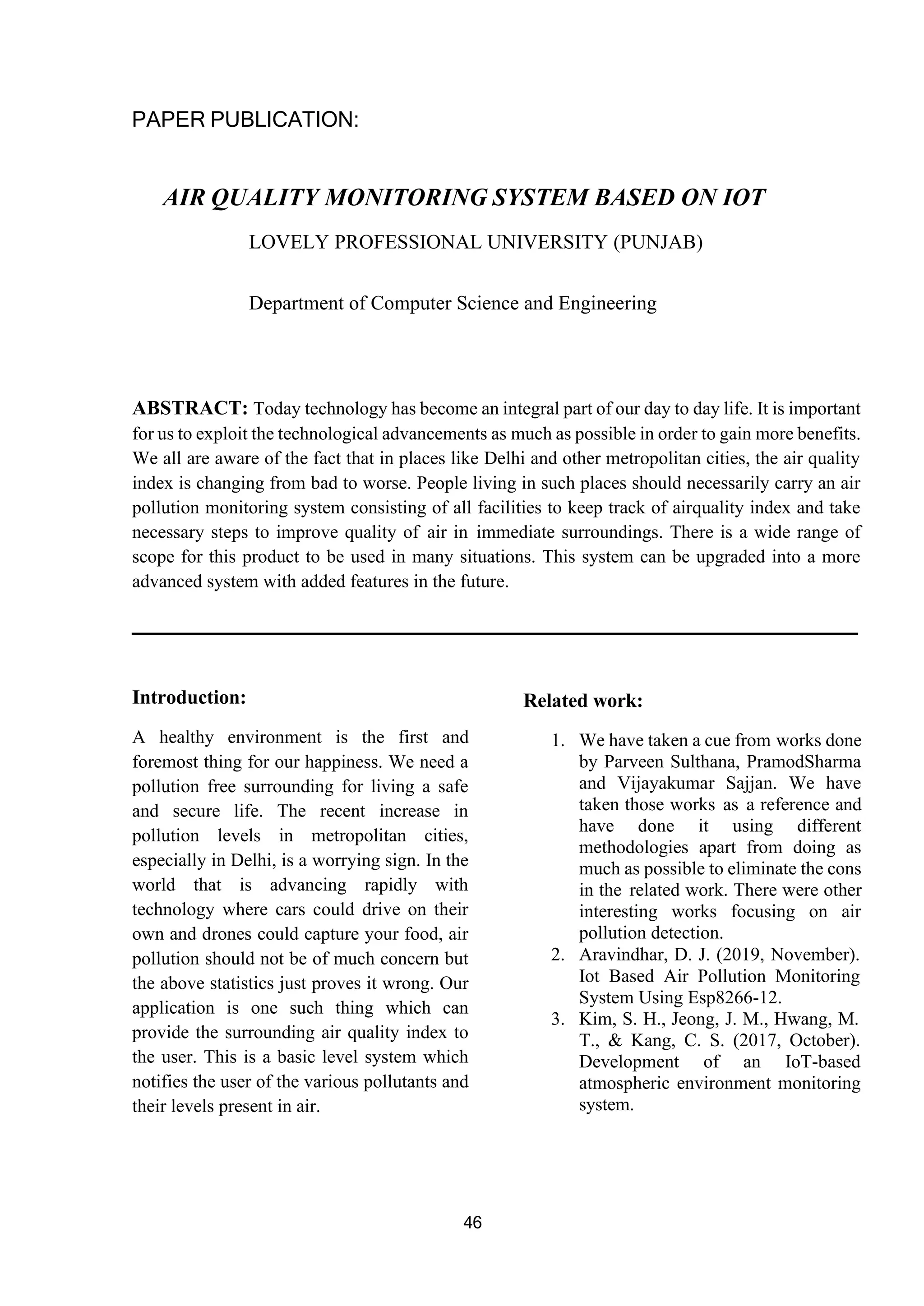
System Architecture Diagram:
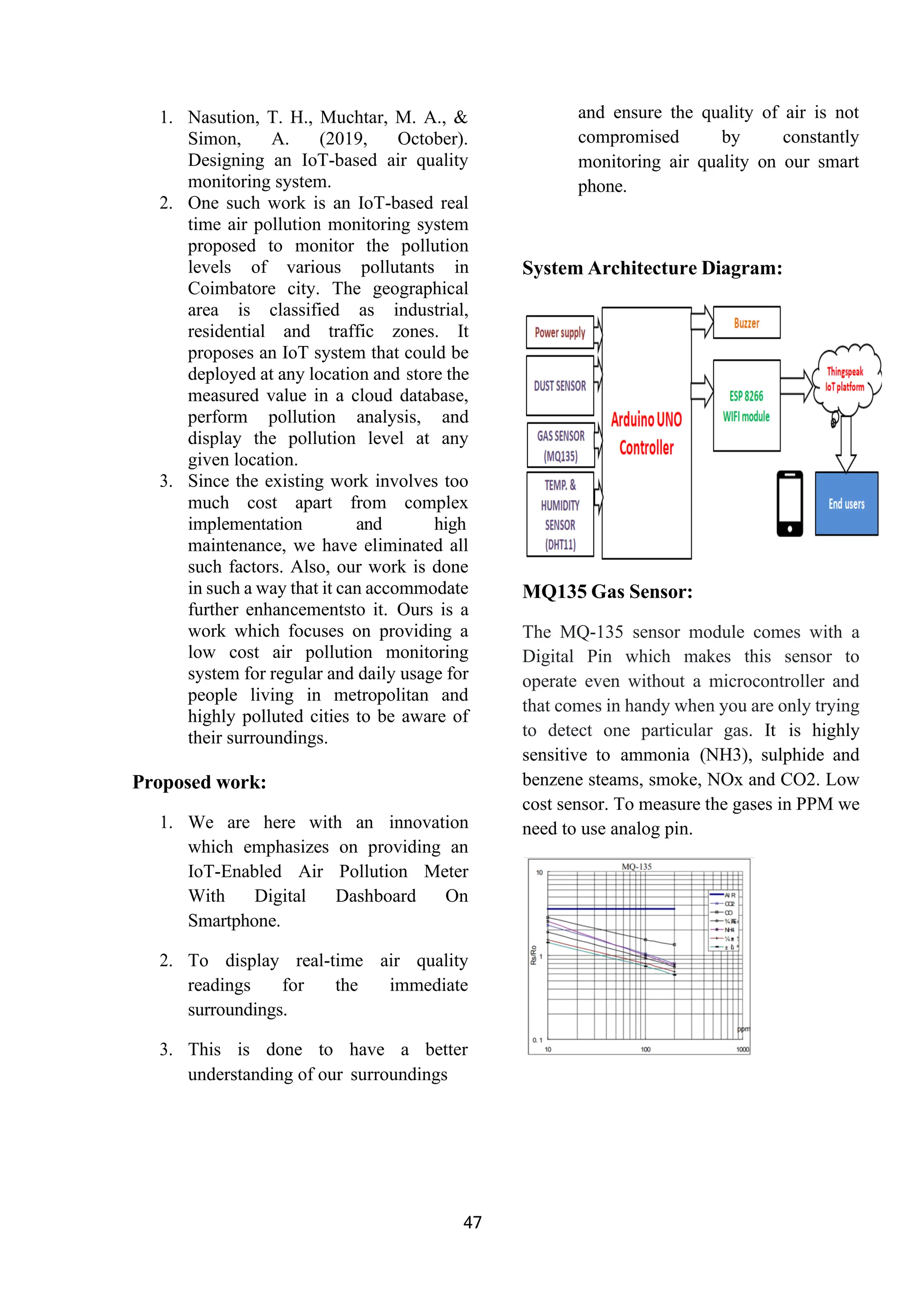
MQ135 Gas Sensor:
The MQ-135 sensor module comes with a
Digital Pin which makes this sensor to
operate even without a microcontroller and
that comes in handy when you are only trying
to detect one particular gas. It is highly
sensitive to ammonia (NH3), sulphide and
benzene steams, smoke, NOx and CO2. Low
cost sensor. To measure the gases in PPM we
need to use analog pin.
3.
48
DHT11 Temperature andHumidity
Sensor:
DHT11 sensor consists of capacitive
humidity sensor and thermistor for sensing
temperature. This composite sensor contains
calibrated digital signal outputs of
temperature and humidity. The DHT11 only
returns integers (e.g. 20). The temperature
range of DHT11 is from 0 to 50 degree
Celsius with a 2-degree accuracy. Humidity
range of this sensor is from 20 to 80% with
5% accuracy. DHT11 is small in size with
operating voltage from 3 to 5 volts. The
maximum current used while measuring is
2.5mA.
Dust Sensor:
It works on the principle of laser scattering.
The air enters through the air inlet where a
light source illuminates the particles and the
scattered light is transformed into a signal by
a phototransistor. These signals are amplified
by the amplifier circuit and then processed to
get the particle concentration. The intensity
of the scattered light depends on the dust
particles. More the dustparticles in the air,
the greater will be the intensity of light.
Output voltage at the VOUT pin of the sensor
changes according to the intensity of
scattered light.
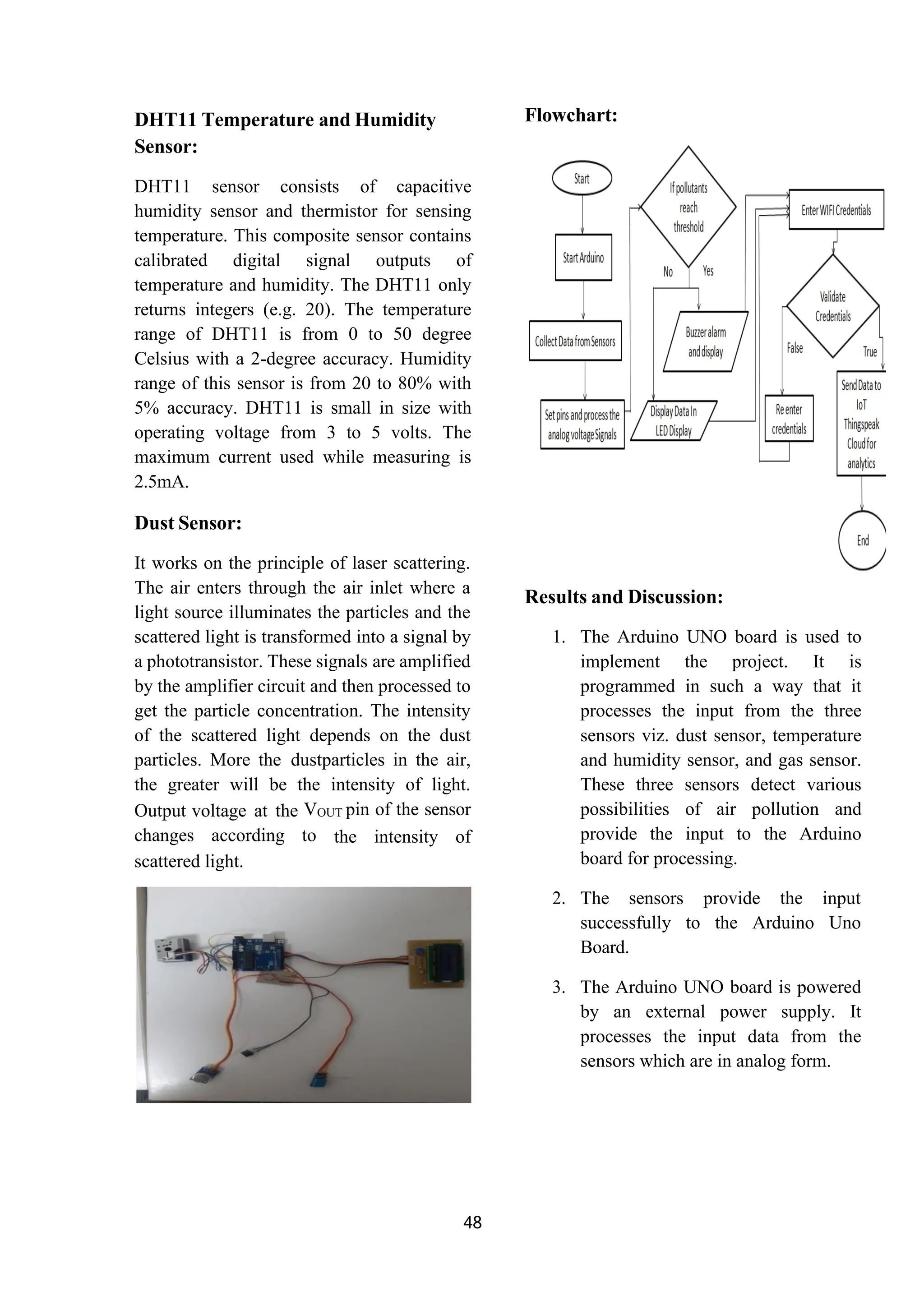
Flowchart:
Results and Discussion:
1. The Arduino UNO board is used to
implement the project. It is
programmed in such a way that it
processes the input from the three
sensors viz. dust sensor, temperature
and humidity sensor, and gas sensor.
These three sensors detect various
possibilities of air pollution and
provide the input to the Arduino
board for processing.
2. The sensors provide the input
successfully to the Arduino Uno
Board.
3. The Arduino UNO board is powered
by an external power supply. It
processes the input data from the
sensors which are in analog form.
4.
49
4. The datais processed and sent to the
IoT cloud Platform “Thingspeak”
through ESP8266 WiFi Module. The
Thingspeak platform can be used to
design our application interface, store
and visualize it using various widgets.
It acts as a communication medium
between the hardware and the
smartphone.
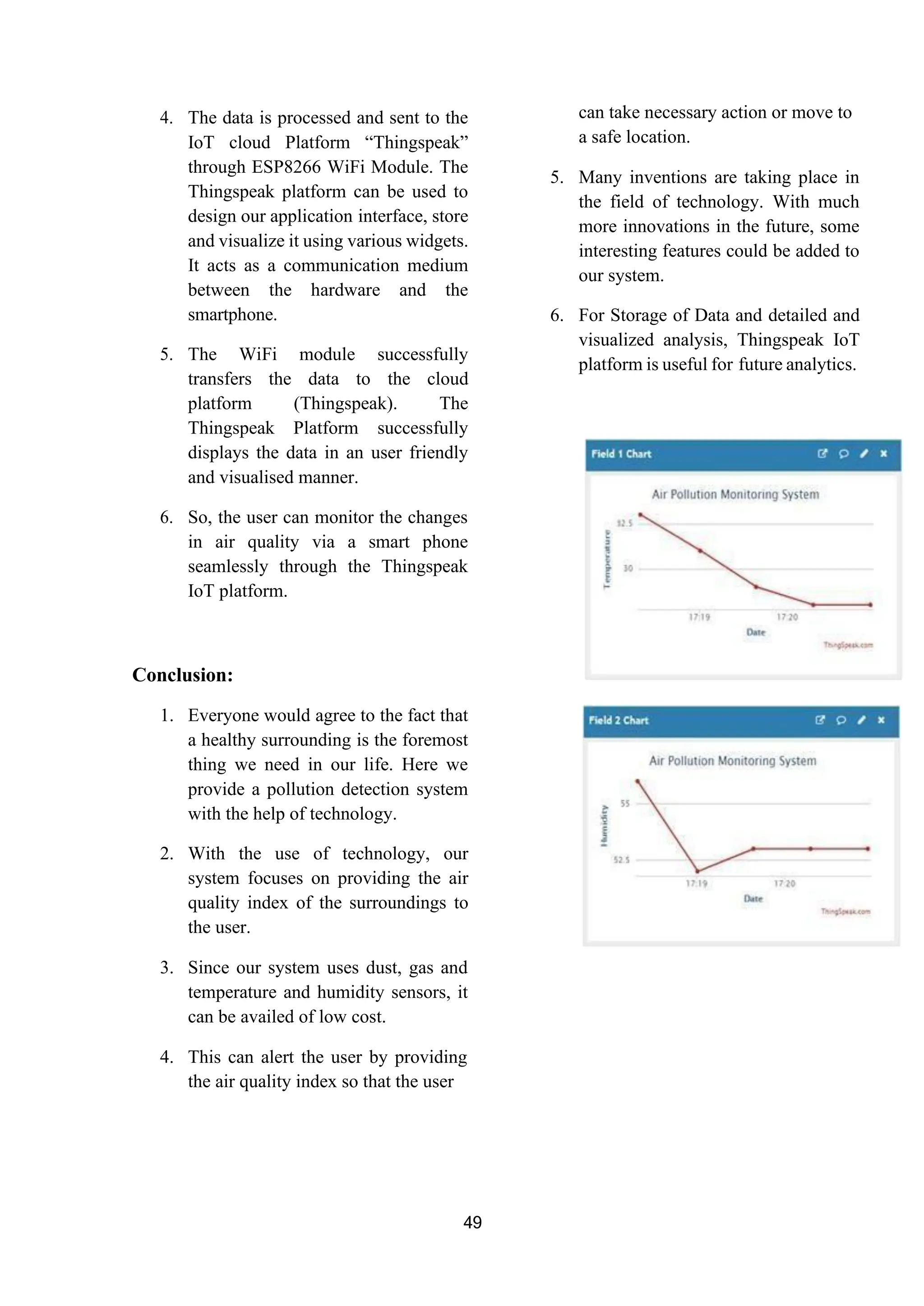
5. The WiFi module successfully
transfers the data to the cloud
platform (Thingspeak). The
Thingspeak Platform successfully
displays the data in an user friendly
and visualised manner.
6. So, the user can monitor the changes
in air quality via a smart phone
seamlessly through the Thingspeak
IoT platform.
Conclusion:
1. Everyone would agree to the fact that
a healthy surrounding is the foremost
thing we need in our life. Here we
provide a pollution detection system
with the help of technology.
2. With the use of technology, our
system focuses on providing the air
quality index of the surroundings to
the user.
3. Since our system uses dust, gas and
temperature and humidity sensors, it
can be availed of low cost.
4. This can alert the user by providing
the air quality index so that the user
can take necessary action or move to
a safe location.
5. Many inventions are taking place in
the field of technology. With much
more innovations in the future, some
interesting features could be added to
our system.
6. For Storage of Data and detailed and
visualized analysis, Thingspeak IoT
platform is useful for future analytics.
5.
50
1. Our systemis developed in such a
way that it can accommodate new
features for upgradation. Our system
is implemented successfully and
could be enhanced with further
developments and extended use of
technology.
References:
[1] Xiaojun, C., Xianpeng, L., & Peng,
X. (2015, January). IOT-based air
pollution monitoring and forecasting
system. In 2015 international
conference on computer and
computational sciences (ICCCS) (pp.
257-260). IEEE.
[2] Pal, P., Gupta, R., Tiwari, S., &
Sharma, A. (2017). IoT based air
pollution monitoring system using
Arduino. International Research
Journal of Engineering and
Technology (IRJET), 4(10), 1137-
1140.
[3] Parmar, G., Lakhani, S., &
Chattopadhyay, M. K. (2017,
October). An IoT based low cost air
pollution monitoring system. In 2017
International Conference on Recent
Innovations in Signal processing and
Embedded Systems (RISE) (pp. 524-
528). IEEE.
[4] Desai, N. S., & Alex, J. S. R. (2017,
March). IoT based air pollution
monitoring and predictor system on
Beagle bone black. In 2017
International Conference on Nextgen
Electronic Technologies: Silicon to
Software (ICNETS2) (pp. 367-370).
IEEE.
[5] Rushikesh, R., & Sivappagari, C. M.
R. (2015, October). Development of
IoT based vehicular pollution
monitoring system. In 2015
international conference on green
6.
51
computing and internetof things
(ICGCIoT) (pp. 779-783). IEEE.
[6] Shah, H. N., Khan, Z., Merchant, A.
A., Moghal, M., Shaikh, A., & Rane,
P. (2018). IOT based air pollution
monitoring system. International
Journal of Scientific & Engineering
Research, 9(2), 62-
[7] Singh, A., Pathak, D., Pandit, P.,
Patil, S., & Golar, P. C. (2017). IOT
based air and sound pollution
monitoring system. International
Journal of Advanced Research in
Electrical, Electronics and
Instrumentation Engineering, 6(3).
[8] Okokpujie, K. O., Noma-Osaghae,E.,
Odusami, M., John, S. N., & Oluga,
O. (2018). A smart air pollution
monitoring
system. International Journal of
Civil Engineering and Technology
(IJCIET), 9(9), 799-809.
[9] Gupta, H., Bhardwaj, D., Agrawal,H.,
Tikkiwal, V. A., & Kumar, A. (2019).
An IoT Based Air Pollution
Monitoring System for Smart Cities.
In 2019 IEEE International
Conference on Sustainable Energy
Technologies and Systems
(ICSETS) (pp. 173-177). IEEE.
[10] Saha, A. K., Sircar, S., Chatterjee, P.,
Dutta, S., Mitra, A., Chatterjee, A.,
... & Saha, H. N. (2018, January). A
raspberry Pi controlled cloud based
air and sound pollution monitoring
system with temperature and
humidity sensing. In 2018 IEEE 8th
Annual Computing and
Communication Workshop and
Conference (CCWC) (pp. 607-611).
IEEE.
[11] Muthukumar, S., Mary, W. S.,
Jayanthi, S., Kiruthiga, R., &
Mahalakshmi, M. (2018, July). IoT
based air pollution monitoring and
control system. In 2018 International
Conference on inventive research in
computing applications
(ICIRCA) (pp. 1286-1288). IEEE.
[12] Ayele, T. W., & Mehta, R. (2018,
April). Air pollution monitoring and
prediction using IoT. In 2018 second
international conference on inventive
communication and computational
technologies (ICICCT) (pp. 1741-
1745). IEEE.
[13] Saikumar, C. V., Reji, M., &
Kishoreraja, P. C. (2017). IOT based
air quality monitoring
system. International Journal of Pure
and Applied
Mathematics, 117(9), 53-57.
[14] BC, K., & Jose, D. (2018). IoT Based
Pollution Monitoring System using
Raspberry-PI. International Journal
of Pure and Applied Mathematics,
118(24).
[15] Zakaria, N. A., Abidin, Z. Z., Harum,
N., Hau, L. C., Ali, N. S., & Jafar, F.
A. (2018). Wireless internet of
things-based air quality device for
smart pollution monitoring. Int. J.
Adv. Comput. Sci. Appl, 9(11), 65-69.
7.
52
[16] Grace, R.K., & Manju, S. (2019). A
comprehensive review of wireless
sensor networks based air pollution
monitoring systems. Wireless
Personal Communications, 108(4),
2499-2515.
[17] Senthilkumar, R., Venkatakrishnan,
P., & Balaji, N. (2020). Intelligent
based novel embedded system based
IoT enabled air pollution monitoring
system. Microprocessors and
Microsystems, 77, 103172.
[18] Dhingra, S., Madda, R. B., Gandomi,
A. H., Patan, R., & Daneshmand, M.
(2019). Internet of Things mobile–air
pollution monitoring system (IoT-
Mobair). IEEE Internet of Things
Journal, 6(3), 5577-5584.
[19] Kumar, H., Karthikeyan, S.,
Manjunath, G. M., & Rakshith, M. S.
(2018). Solar power environmental
air pollution & water quality
monitoring system based onIoT.
Perspectives in Communication,
Embedded-systems and Signal-
processing-PiCES, 2(8), 197-199.
[20] Chowdhury, S., Islam, M. S.,
Raihan, M. K., & Arefin, M. S. (2019,
September). Design and
Implementation of an IoT Based Air
Pollution Detection and Monitoring
System. In 2019 5th International
Conference on Advances inElectrical
Engineering (ICAEE) (pp. 296-300).
IEEE.
[21] Alam, S. S., Islam, A. J., Hasan, M.
M., Rafid, M. N. M., Chakma, N., &
Imtiaz, M. N. (2018, September).
Design and development of a low-
cost IoT based environmental
pollution monitoring system. In 2018
4th international conference on
electrical engineering and
information & communication
technology (iCEEiCT) (pp. 652-656).
IEEE.
[22] Sai, K. B. K., Subbareddy, S. R., &
Luhach, A. K. (2019). IOT based air
quality monitoring system using
MQ135 and MQ7 with machine
learning analysis. Scalable
Computing: Practice and
Experience, 20(4), 599-606.
[23] Yamunathangam, D., Pritheka, K., &
Varuna, P. (2019). IoT enabled air
pollution monitoring and awareness
creation system. Int. Jrnl. of Recent
Techn. and Eng, 7(4), 398-400.
[24] Srivastava, C., Singh, S., & Singh,
A. P. (2020). IoT-enabled air
monitoring system. In Intelligent
Systems, Technologies and
Applications (pp. 173-180). Springer,
Singapore.
![50
1. Our system is developed in such a
way that it can accommodate new
features for upgradation. Our system
is implemented successfully and
could be enhanced with further
developments and extended use of
technology.
References:
[1] Xiaojun, C., Xianpeng, L., & Peng,
X. (2015, January). IOT-based air
pollution monitoring and forecasting
system. In 2015 international
conference on computer and
computational sciences (ICCCS) (pp.
257-260). IEEE.
[2] Pal, P., Gupta, R., Tiwari, S., &
Sharma, A. (2017). IoT based air
pollution monitoring system using
Arduino. International Research
Journal of Engineering and
Technology (IRJET), 4(10), 1137-
1140.
[3] Parmar, G., Lakhani, S., &
Chattopadhyay, M. K. (2017,
October). An IoT based low cost air
pollution monitoring system. In 2017
International Conference on Recent
Innovations in Signal processing and
Embedded Systems (RISE) (pp. 524-
528). IEEE.
[4] Desai, N. S., & Alex, J. S. R. (2017,
March). IoT based air pollution
monitoring and predictor system on
Beagle bone black. In 2017
International Conference on Nextgen
Electronic Technologies: Silicon to
Software (ICNETS2) (pp. 367-370).
IEEE.
[5] Rushikesh, R., & Sivappagari, C. M.
R. (2015, October). Development of
IoT based vehicular pollution
monitoring system. In 2015
international conference on green](https://image.slidesharecdn.com/researchpaperpdf-250529140955-2cda5729/75/air-monitoring-system-research-paper-for-b-tech-5-2048.jpg)
![51
computing and internet of things
(ICGCIoT) (pp. 779-783). IEEE.
[6] Shah, H. N., Khan, Z., Merchant, A.
A., Moghal, M., Shaikh, A., & Rane,
P. (2018). IOT based air pollution
monitoring system. International
Journal of Scientific & Engineering
Research, 9(2), 62-
[7] Singh, A., Pathak, D., Pandit, P.,
Patil, S., & Golar, P. C. (2017). IOT
based air and sound pollution
monitoring system. International
Journal of Advanced Research in
Electrical, Electronics and
Instrumentation Engineering, 6(3).
[8] Okokpujie, K. O., Noma-Osaghae,E.,
Odusami, M., John, S. N., & Oluga,
O. (2018). A smart air pollution
monitoring
system. International Journal of
Civil Engineering and Technology
(IJCIET), 9(9), 799-809.
[9] Gupta, H., Bhardwaj, D., Agrawal,H.,
Tikkiwal, V. A., & Kumar, A. (2019).
An IoT Based Air Pollution
Monitoring System for Smart Cities.
In 2019 IEEE International
Conference on Sustainable Energy
Technologies and Systems
(ICSETS) (pp. 173-177). IEEE.
[10] Saha, A. K., Sircar, S., Chatterjee, P.,
Dutta, S., Mitra, A., Chatterjee, A.,
... & Saha, H. N. (2018, January). A
raspberry Pi controlled cloud based
air and sound pollution monitoring
system with temperature and
humidity sensing. In 2018 IEEE 8th
Annual Computing and
Communication Workshop and
Conference (CCWC) (pp. 607-611).
IEEE.
[11] Muthukumar, S., Mary, W. S.,
Jayanthi, S., Kiruthiga, R., &
Mahalakshmi, M. (2018, July). IoT
based air pollution monitoring and
control system. In 2018 International
Conference on inventive research in
computing applications
(ICIRCA) (pp. 1286-1288). IEEE.
[12] Ayele, T. W., & Mehta, R. (2018,
April). Air pollution monitoring and
prediction using IoT. In 2018 second
international conference on inventive
communication and computational
technologies (ICICCT) (pp. 1741-
1745). IEEE.
[13] Saikumar, C. V., Reji, M., &
Kishoreraja, P. C. (2017). IOT based
air quality monitoring
system. International Journal of Pure
and Applied
Mathematics, 117(9), 53-57.
[14] BC, K., & Jose, D. (2018). IoT Based
Pollution Monitoring System using
Raspberry-PI. International Journal
of Pure and Applied Mathematics,
118(24).
[15] Zakaria, N. A., Abidin, Z. Z., Harum,
N., Hau, L. C., Ali, N. S., & Jafar, F.
A. (2018). Wireless internet of
things-based air quality device for
smart pollution monitoring. Int. J.
Adv. Comput. Sci. Appl, 9(11), 65-69.](https://image.slidesharecdn.com/researchpaperpdf-250529140955-2cda5729/75/air-monitoring-system-research-paper-for-b-tech-6-2048.jpg)
![52
[16] Grace, R. K., & Manju, S. (2019). A
comprehensive review of wireless
sensor networks based air pollution
monitoring systems. Wireless
Personal Communications, 108(4),
2499-2515.
[17] Senthilkumar, R., Venkatakrishnan,
P., & Balaji, N. (2020). Intelligent
based novel embedded system based
IoT enabled air pollution monitoring
system. Microprocessors and
Microsystems, 77, 103172.
[18] Dhingra, S., Madda, R. B., Gandomi,
A. H., Patan, R., & Daneshmand, M.
(2019). Internet of Things mobile–air
pollution monitoring system (IoT-
Mobair). IEEE Internet of Things
Journal, 6(3), 5577-5584.
[19] Kumar, H., Karthikeyan, S.,
Manjunath, G. M., & Rakshith, M. S.
(2018). Solar power environmental
air pollution & water quality
monitoring system based onIoT.
Perspectives in Communication,
Embedded-systems and Signal-
processing-PiCES, 2(8), 197-199.
[20] Chowdhury, S., Islam, M. S.,
Raihan, M. K., & Arefin, M. S. (2019,
September). Design and
Implementation of an IoT Based Air
Pollution Detection and Monitoring
System. In 2019 5th International
Conference on Advances inElectrical
Engineering (ICAEE) (pp. 296-300).
IEEE.
[21] Alam, S. S., Islam, A. J., Hasan, M.
M., Rafid, M. N. M., Chakma, N., &
Imtiaz, M. N. (2018, September).
Design and development of a low-
cost IoT based environmental
pollution monitoring system. In 2018
4th international conference on
electrical engineering and
information & communication
technology (iCEEiCT) (pp. 652-656).
IEEE.
[22] Sai, K. B. K., Subbareddy, S. R., &
Luhach, A. K. (2019). IOT based air
quality monitoring system using
MQ135 and MQ7 with machine
learning analysis. Scalable
Computing: Practice and
Experience, 20(4), 599-606.
[23] Yamunathangam, D., Pritheka, K., &
Varuna, P. (2019). IoT enabled air
pollution monitoring and awareness
creation system. Int. Jrnl. of Recent
Techn. and Eng, 7(4), 398-400.
[24] Srivastava, C., Singh, S., & Singh,
A. P. (2020). IoT-enabled air
monitoring system. In Intelligent
Systems, Technologies and
Applications (pp. 173-180). Springer,
Singapore.](https://image.slidesharecdn.com/researchpaperpdf-250529140955-2cda5729/75/air-monitoring-system-research-paper-for-b-tech-7-2048.jpg)


