Capturing CO2

Reversing Climate Change: The Global Resolutique


                            Kelly Kokaisel | Design for Community | Fall 2010
What is the problem with CO2?
Climate Change
   The Earth's climate has changed
    many times during the planet's
    history, with everything from ice
    ages to heat waves.

   Natural factors such as volcanic
    eruptions, changes in the Earth's
    orbit and precession, and the
    amount of energy released from the
    Sun have affect Earth's climate.

   Beginning late in the 18th century,
    human activities associated with the
    Industrial Revolution have
    changed the composition of the
    atmosphere and are very likely are
    influencing the Earth's climate. [6]
Climate Forcings
   Some factors that can shape
    climate are variations in solar
    radiation, changes in the Earth's
    orbit, plate techtonics, and
    changes in greenhouse gas
    concentrations. CO2 is one
    of these greenhouse gases.

   Feedback loops can amplify or
    diminish these effects. Some
    parts of the climate, such as
    oceans and ice caps, respond
    slowly in reaction to these
    effects because of their large
    mass. Therefore, the climate
    system can take centuries or
    longer to fully respond to new
    external forcings. [5]
CO2 | Carbon Dioxide
                Carbon dioxide (CO2) is a gas that
                naturally comprises 0.039% of the
                atmosphere. As of October 2010, carbon
                dioxide in the Earth's atmosphere is at a
                concentration of 388 ppm by volume. [5]
                Climate impacts have led scientists to
                conclude that we are already   above the
                safe zone, and that unless we are able
                to quickly return to below 350 ppm this
                century, we
                          risk reaching the
                tipping point of irreversible
                impacts such as the melting of the
                Greenland ice sheet and major methane
                releases from increased permafrost melt.
                [7]
CCS | Carbon Capture Storage
                     Carbon capture and storage (CCS) is one part of
                      a general strategy for reducing CO2 emissions to
                      combat climate change.

                     "If humanity wishes to preserve a planet similar
                      to that on which civilization developed and to
                      which life on Earth is adapted, CO2 will need to
                      be reduced from its current 385 ppm to at most
                      350 ppm."

                     It is a hard task, but not impossible. We need to
                      stop taking carbon out of the ground and putting
                      it into the air. We need to start using using more
                      of our most abundant energy sources, solar and
                      wind energy and other such sources of
                      renewable energy. If we do, then the earth will
                      slowly and naturally cycle some of the extra
                      carbon out of the atmosphere, and eventually
                      CO2 concentrations will return to a safe level.
                     “By decreasing use of other fossil fuels, and
                      improving agricultural and forestry practices
                      around the world, scientists believe we could get
                      back below 350 by mid-century. But the longer
                      we remain in the danger zone—above 350—the
                      more likely that we will see disastrous and
                      irreversible climate impacts”. [7]
What are some of the ways to
  reduce atmospheric CO2?
Turning Carbon
Dioxide into Useful
Products
Massachusetts-based
Novomer has received
$18.4 million from the US
Department of Energy to
develop a process for
converting carbon dioxide
into polycarbonate
polymers that could be
used to make plastic
bottles. Since its
formation 4 years ago,
Novomer has been
developing a way to form
plastics that contain
between 40 and 50 per
cent carbon dioxide by
weight. [1]
Capturing carbon
                                                                                                with copper
                                                                                                Researchers at
                                                                                                Leiden University, have
                                                                                                developed a selective
                                                                                                copper complex
                                                                                                predisposed to capture
                                                                                                CO2 and ignore other
                                                                                                atmospheric gasses. The
                                                                                                trapped CO2 can be
The dinuclear copper(I) complex is oxidised in air by carbon dioxide rather than oxygen.        removed through
                                                                                                electrochemistry,
                                                                                                requiring a relatively low
                                                                                                electrical potential to
                                                                                                replace lost electrons. [2]


                                             Carbon dioxide is bound between two molecules of
                                             the copper complex and converted to oxalate.
Underground
Storage
The IEA's Carbon Capture
and Storage Technology
Roadmap calls for
governments to invest US
$54 billion by 2020 to
fund 100 Carbon Capture
Storgae projects
worldwide, which would
capture carbon dioxide
and pipe it underground
for long-term storage. [3]
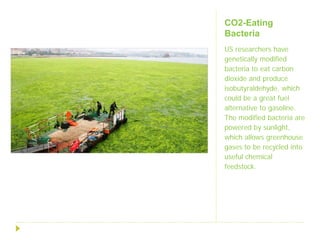
CO2-Eating
Bacteria
US researchers have
genetically modified
bacteria to eat carbon
dioxide and produce
isobutyraldehyde, which
could be a great fuel
alternative to gasoline.
The modified bacteria are
powered by sunlight,
which allows greenhouse
gases to be recycled into
useful chemical
feedstock.
Support Those Who Care

   Support government policies which promote
    greenhouse gas emission reduction & capture.

   Support companies that operate with Triple Bottom
    Line business practices.

   Reduce your own consumption of fossil fuels.
Thank You
Sources
   [1] Recycling CO2 to make plastic 28 July 2010
    http://www.rsc.org/chemistryworld/News/2010/July/28071001.asp

   [2] Capturing carbon with copper 15 January 2010
    http://www.rsc.org/chemistryworld/News/2010/January/15011001.asp

   [3] Trillions for CCS to fight climate change 21 October 2009
    http://www.rsc.org/chemistryworld/News/2009/October/21100901.asp

   [4] Bacteria turn carbon dioxide into fuel 15 November 2009
    http://www.rsc.org/chemistryworld/News/2009/November/15110901.asp

   [5] Carbon dioxide http://en.wikipedia.org/wiki/Carbon_dioxide#cite_note-0

   [6] U.S. Environmental Protection Agency
    http://www.epa.gov/climatechange/basicinfo.html

   [7] 350.org http://www.350.org/en/about/science

Capturing Co2 - The Global Resolutique

  • 1.
    Capturing CO2 Reversing ClimateChange: The Global Resolutique Kelly Kokaisel | Design for Community | Fall 2010
  • 2.
    What is theproblem with CO2?
  • 3.
    Climate Change  The Earth's climate has changed many times during the planet's history, with everything from ice ages to heat waves.  Natural factors such as volcanic eruptions, changes in the Earth's orbit and precession, and the amount of energy released from the Sun have affect Earth's climate.  Beginning late in the 18th century, human activities associated with the Industrial Revolution have changed the composition of the atmosphere and are very likely are influencing the Earth's climate. [6]
  • 4.
    Climate Forcings  Some factors that can shape climate are variations in solar radiation, changes in the Earth's orbit, plate techtonics, and changes in greenhouse gas concentrations. CO2 is one of these greenhouse gases.  Feedback loops can amplify or diminish these effects. Some parts of the climate, such as oceans and ice caps, respond slowly in reaction to these effects because of their large mass. Therefore, the climate system can take centuries or longer to fully respond to new external forcings. [5]
  • 5.
    CO2 | CarbonDioxide Carbon dioxide (CO2) is a gas that naturally comprises 0.039% of the atmosphere. As of October 2010, carbon dioxide in the Earth's atmosphere is at a concentration of 388 ppm by volume. [5] Climate impacts have led scientists to conclude that we are already above the safe zone, and that unless we are able to quickly return to below 350 ppm this century, we risk reaching the tipping point of irreversible impacts such as the melting of the Greenland ice sheet and major methane releases from increased permafrost melt. [7]
  • 6.
    CCS | CarbonCapture Storage  Carbon capture and storage (CCS) is one part of a general strategy for reducing CO2 emissions to combat climate change.  "If humanity wishes to preserve a planet similar to that on which civilization developed and to which life on Earth is adapted, CO2 will need to be reduced from its current 385 ppm to at most 350 ppm."  It is a hard task, but not impossible. We need to stop taking carbon out of the ground and putting it into the air. We need to start using using more of our most abundant energy sources, solar and wind energy and other such sources of renewable energy. If we do, then the earth will slowly and naturally cycle some of the extra carbon out of the atmosphere, and eventually CO2 concentrations will return to a safe level.  “By decreasing use of other fossil fuels, and improving agricultural and forestry practices around the world, scientists believe we could get back below 350 by mid-century. But the longer we remain in the danger zone—above 350—the more likely that we will see disastrous and irreversible climate impacts”. [7]
  • 7.
    What are someof the ways to reduce atmospheric CO2?
  • 8.
    Turning Carbon Dioxide intoUseful Products Massachusetts-based Novomer has received $18.4 million from the US Department of Energy to develop a process for converting carbon dioxide into polycarbonate polymers that could be used to make plastic bottles. Since its formation 4 years ago, Novomer has been developing a way to form plastics that contain between 40 and 50 per cent carbon dioxide by weight. [1]
  • 9.
    Capturing carbon with copper Researchers at Leiden University, have developed a selective copper complex predisposed to capture CO2 and ignore other atmospheric gasses. The trapped CO2 can be The dinuclear copper(I) complex is oxidised in air by carbon dioxide rather than oxygen. removed through electrochemistry, requiring a relatively low electrical potential to replace lost electrons. [2] Carbon dioxide is bound between two molecules of the copper complex and converted to oxalate.
  • 10.
    Underground Storage The IEA's CarbonCapture and Storage Technology Roadmap calls for governments to invest US $54 billion by 2020 to fund 100 Carbon Capture Storgae projects worldwide, which would capture carbon dioxide and pipe it underground for long-term storage. [3]
  • 11.
    CO2-Eating Bacteria US researchers have geneticallymodified bacteria to eat carbon dioxide and produce isobutyraldehyde, which could be a great fuel alternative to gasoline. The modified bacteria are powered by sunlight, which allows greenhouse gases to be recycled into useful chemical feedstock.
  • 12.
    Support Those WhoCare  Support government policies which promote greenhouse gas emission reduction & capture.  Support companies that operate with Triple Bottom Line business practices.  Reduce your own consumption of fossil fuels.
  • 13.
  • 14.
    Sources  [1] Recycling CO2 to make plastic 28 July 2010 http://www.rsc.org/chemistryworld/News/2010/July/28071001.asp  [2] Capturing carbon with copper 15 January 2010 http://www.rsc.org/chemistryworld/News/2010/January/15011001.asp  [3] Trillions for CCS to fight climate change 21 October 2009 http://www.rsc.org/chemistryworld/News/2009/October/21100901.asp  [4] Bacteria turn carbon dioxide into fuel 15 November 2009 http://www.rsc.org/chemistryworld/News/2009/November/15110901.asp  [5] Carbon dioxide http://en.wikipedia.org/wiki/Carbon_dioxide#cite_note-0  [6] U.S. Environmental Protection Agency http://www.epa.gov/climatechange/basicinfo.html  [7] 350.org http://www.350.org/en/about/science