Henry Johansen
Tacit Knowledge Management in High Reliability
Organizations (HRO): An Action Research Approach
17th of December 2014
Master’s Thesis - Master of Science in Information Security
2
• Information Security
• Protect information assets from loss of confidentiality,
integrity and availability
• Knowledge and skills of each individual - can be both an
asset and protection mechanism
• Tacit Knowledge
• Belongs to the individual
• Expressed by action
• Captured by observation
• Created by experience
• Most important asset to protect
• Most difficult asset to protect
INTRODUCTION - BACKGROUND
• Explicit Knowledge
• Easily to articulate and
communicate
• Both human, physical and
computer based
• Recorded or captured in a
medium  Information
“How-To-Do” “What-To-Do”
Complementary
3
INTRODUCTION - BACKGROUND
• Knowledge Society
• High Reliability Organizations (HRO)
• High grade of special expertise
• Socio-Critical Systems dependent on expert knowledge
4
INTRODUCTION - PROBLEM
• Retired Knowledge
• The aging workforce has much knowledge and especially tacit knowledge
that is important to capture and transfer to new younger forces before
retiring
• Tacit Knowledge transferring are time consuming
• Lack of knowledge increase the vulnerability of affected systems
Business/System/Situation/Value Chain
Timeline
Source: Karin Bleken, 2014
http://www.gd.no/lilleha
mmer/article7718503.ece
5
INTRODUCTION - RESEARCH QUESTIONS
• Research Question 1:
• How is tacit knowledge transferred in an HRO today?
• Research Question 2:
• What is the State-of-the-Art in tacit knowledge management today?
• Research Question 3:
• Can a Interactive Media platform improve that capturing and
transferring in the HRO?
6
RELATED - THEORY
• Knowledge development is to achieve a conversion between tacit and explicit
knowledge through various social processes (Nonaka and Takeuchi, 1995)
• Nonaka’s four mode of knowledge conversion
Source: Nonaka, I. February 1994. A dynamic theory of organizational knowledge creation. Organiztion Science, 5(1).
Nonaka’s Spiral of Organizational Knowledge Creation
Nonaka’s SECI model of Knowledge Conversion
State-of-the-art
7
METHOD/EXPERIMENT - ACTION RESEARCH (CYCLE ONE)
The cyclical process of action research according to Susman and Evered
Source: Susman, G. I. & Evered, R. D. 1978. An Assessment of the Scientific Merits of Action Research.
Administrative Science Quarterly, 23(4), 582–603. [Online] http://www.jstor. org/stable/2392581
8
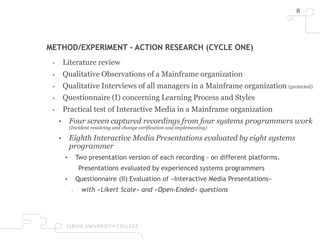
METHOD/EXPERIMENT - ACTION RESEARCH (CYCLE ONE)
• Literature review
• Qualitative Observations of a Mainframe organization
• Qualitative Interviews of all managers in a Mainframe organization (protected)
• Questionnaire (I) concerning Learning Process and Styles
• Practical test of Interactive Media in a Mainframe organization
• Four screen captured recordings from four systems programmers work
(Incident resolving and change verification and implementing)
• Eighth Interactive Media Presentations evaluated by eight systems
programmer
• Two presentation version of each recording – on different platforms.
Presentations evaluated by experienced systems programmers
• Questionnaire (II) Evaluation of «Interactive Media Presentations»
• with «Likert Scale» and «Open-Ended» questions
9
THE ACTION RESEARCH OBJECT
• Mainframe organization with 111 employee
• Mainly Systems Programmer (Technical Experts)
• 88% Male and 12 % Female
• Average age 57 years
• More than 3000 years of experience in summary
• T-shaped
10
THE ACTION RESEARCH OBJECT
• Mainframe organization with 111 employee
• Mainly Systems Programmer (Technical Experts)
• 88% Male and 12 % Female
• Average age 57 years
• More than 3000 years of experience in summary
• T-shaped
11
RESULT (RQ1) - THE ACTION RESEARCH OBJECT
• Mainframe organization with 111 employee
• Operates according to ITIL® , LEAN and KAIZEN®
• Three most used ITIL process where tacit knowledge are used
and exchanged:
• Incident Management (IM)
• Problem Management (PM)
• Change Management (CM)
• Tacit Knowledge Exchange Arena: (ba Nonaka&Konno/Contex Erden, von Krog & Nonaka)
• Team work / projects
• Regular meeting in professional groups (teams)
• Between two individuals
• Both physically side-by-side and virtually by using
collaboration tools – MS Lync
• In self-organizing network
13
RESULT
Source: Nonaka, I. & Konno, N. 1998. The Concept of ’Ba’: Building a Foundation for knowledge
Creation. California Management Review, 40(3), 40–54. [Online] http://dx.doi.org/10.1225/CMR107
• Orginating ba - Sharing knowledge in real-
time
• Interactive ba – Sharing knowledge
Interactive Media/e-learning presentation
• Cyber ba – Acuire new explicit knowledge
from Interactive Media/e-learning presentation
• Excersising ba - Create new tacit knowledge
by exercising simultaneously as watching a
Interactive Media/e-learning presentation
14
RESULT
Source: Nonaka, I. & Konno, N. 1998. The Concept of ’Ba’: Building a Foundation for knowledge
Creation. California Management Review, 40(3), 40–54. [Online] http://dx.doi.org/10.1225/CMR107
• Orginating ba - Sharing knowledge in real-
time
• Interactive ba – Sharing knowledge on a
Interactive Media/e-learning presentation
• Cyber ba – Acuire new explicit knowledge
from a Interactive Media/e-learning presentation
• Excersising ba – Create new tacit knowledge
by exercising simultaneously as watching a
Interactive Media/e-learning presentation
15
RESULT
• Orginating ba - Sharing knowledge in real-
time
• Interactive ba – Sharing knowledge on a
Interactive Media/e-learning presentation
• Cyber ba – Acuire new explicit knowledge
from a Interactive Media/e-learning presentation
• Excersising ba - Create new tacit knowledge
by exercising simultaneously as watching a
Interactive Media/e-learning presentation
Source: Nonaka, I. & Konno, N. 1998. The Concept of ’Ba’: Building a Foundation for knowledge
Creation. California Management Review, 40(3), 40–54. [Online] http://dx.doi.org/10.1225/CMR107
16
RESULT
Source: Nonaka, I. & Konno, N. 1998. The Concept of ’Ba’: Building a Foundation for knowledge
Creation. California Management Review, 40(3), 40–54. [Online] http://dx.doi.org/10.1225/CMR107
• Orginating ba - Sharing knowledge in real-
time
• Interactive ba – Sharing knowledge on a
Interactive Media/e-learning presentation
• Cyber ba – Acuire new explicit knowledge
from a Interactive Media/e-learning presentation
• Excersising ba - Create new tacit knowledge
by exercising simultaneously as watching a
Interactive Media/e-learning presentation
17
RESULT
Source: Nonaka, I. & Konno, N. 1998. The Concept of ’Ba’: Building a Foundation for knowledge
Creation. California Management Review, 40(3), 40–54. [Online] http://dx.doi.org/10.1225/CMR107
• Orginating ba - Sharing knowledge in real-
time
• Interactive ba – Sharing knowledge on a
Interactive Media/e-learning presentation
• Cyber ba – Acuire new explicit knowledge
from a Interactive Media/e-learning presentation
• Excersising ba – Create new tacit knowledge
by exercising simultaneously as watching a
Interactive Media/e-learning presentation
18
RESULT
Source: Nonaka, I. & Konno, N. 1998. The Concept of ’Ba’: Building a Foundation for knowledge
Creation. California Management Review, 40(3), 40–54. [Online] http://dx.doi.org/10.1225/CMR107
• Orginating ba - Sharing knowledge in real-
time
• Interactive ba – Sharing knowledge on a
Interactive Media/e-learning presentation
• Cyber ba – Acuire new explicit knowledge
from a Interactive Media/e-learning presentation
• Excersising ba - Create new tacit knowledge
by exercising simultaneously as watching a
Interactive Media/e-learning presentation
19
RESULT - RETIRED KNOWLEDGE SURVIVES
Business/System/Situation/Value Chain
Timeline
20
RESULT SUMMARY
• Research Question 1:
• How is tacit knowledge transferred in the HRO today?
• Observation and Interviews: Project/Team/Individual two-and-two
• Research Question 2:
• What is the State-of-the-Art in tacit knowledge management today?
• Literature review: Nonaka’s SECI model
• Research Question 3:
• Can a Interactive Media platform improve that capturing and transferring in the HRO?
• Test of Interactive Media Presentation in a real situation: Yes
• Asynchronous learning “I can use it whenever it suits me ” – Retired knowledge survives
• In addition to identified improvements of ITIL process CM, PM, IM, KM, ISM, CI
• A framework and methodology for future research
21
DISCUSSION AND CONCLUSION
• Combining work and research in the same organization
• Evaluation group with long experience in the mainframe discipline. No newbie
in the evaluation group.
• Nonaka’s SECI model widely used and accepted in knowledge theory
• Feedback from Evaluation Group
• Presentation with spoken instruction (audio) preferred
• Presentation length - 80 minutes too long?
• Interactive Media Presentation with "How-To-Do" instructions from Screen
Capture Recording of individuals work, makes other individuals able to
perform tasks they otherwise would not have been able to.
• Tacit “How-To-Do” knowledge has been documented and the organization has
secured the ownership of the “How-To-Do” knowledge as Explicit Knowledge
• The current method of capture and transferring tacit knowledge improved
22
FUTURES WORKS (ACTION RESEARCH CYCLE TWO)
• Measuring learning outcome
from Interactive Media
presentation
• Cost/Benefit research of
Interactive Media/e-learning
• Interactive Media/e-learning
Performance Analysis by using
Kesti’s Tacit Signal Approach
• The observerd HRO organization
has decided to continue with the
method of tacit knowledge
capturing, tested in this thesis.
Source: Susman, G. I. & Evered, R. D. 1978. An Assessment of the Scientific Merits
of Action Research. Administrative Science Quarterly, 23(4), 582–603. [Online]
http://www.jstor. org/stable/2392581
Question?
Thank you for your attention!

HJohansenMasterPresentation

  • 1.
    Henry Johansen Tacit KnowledgeManagement in High Reliability Organizations (HRO): An Action Research Approach 17th of December 2014 Master’s Thesis - Master of Science in Information Security
  • 2.
    2 • Information Security •Protect information assets from loss of confidentiality, integrity and availability • Knowledge and skills of each individual - can be both an asset and protection mechanism • Tacit Knowledge • Belongs to the individual • Expressed by action • Captured by observation • Created by experience • Most important asset to protect • Most difficult asset to protect INTRODUCTION - BACKGROUND • Explicit Knowledge • Easily to articulate and communicate • Both human, physical and computer based • Recorded or captured in a medium  Information “How-To-Do” “What-To-Do” Complementary
  • 3.
    3 INTRODUCTION - BACKGROUND •Knowledge Society • High Reliability Organizations (HRO) • High grade of special expertise • Socio-Critical Systems dependent on expert knowledge
  • 4.
    4 INTRODUCTION - PROBLEM •Retired Knowledge • The aging workforce has much knowledge and especially tacit knowledge that is important to capture and transfer to new younger forces before retiring • Tacit Knowledge transferring are time consuming • Lack of knowledge increase the vulnerability of affected systems Business/System/Situation/Value Chain Timeline Source: Karin Bleken, 2014 http://www.gd.no/lilleha mmer/article7718503.ece
  • 5.
    5 INTRODUCTION - RESEARCHQUESTIONS • Research Question 1: • How is tacit knowledge transferred in an HRO today? • Research Question 2: • What is the State-of-the-Art in tacit knowledge management today? • Research Question 3: • Can a Interactive Media platform improve that capturing and transferring in the HRO?
  • 6.
    6 RELATED - THEORY •Knowledge development is to achieve a conversion between tacit and explicit knowledge through various social processes (Nonaka and Takeuchi, 1995) • Nonaka’s four mode of knowledge conversion Source: Nonaka, I. February 1994. A dynamic theory of organizational knowledge creation. Organiztion Science, 5(1). Nonaka’s Spiral of Organizational Knowledge Creation Nonaka’s SECI model of Knowledge Conversion State-of-the-art
  • 7.
    7 METHOD/EXPERIMENT - ACTIONRESEARCH (CYCLE ONE) The cyclical process of action research according to Susman and Evered Source: Susman, G. I. & Evered, R. D. 1978. An Assessment of the Scientific Merits of Action Research. Administrative Science Quarterly, 23(4), 582–603. [Online] http://www.jstor. org/stable/2392581
  • 8.
    8 METHOD/EXPERIMENT - ACTIONRESEARCH (CYCLE ONE) • Literature review • Qualitative Observations of a Mainframe organization • Qualitative Interviews of all managers in a Mainframe organization (protected) • Questionnaire (I) concerning Learning Process and Styles • Practical test of Interactive Media in a Mainframe organization • Four screen captured recordings from four systems programmers work (Incident resolving and change verification and implementing) • Eighth Interactive Media Presentations evaluated by eight systems programmer • Two presentation version of each recording – on different platforms. Presentations evaluated by experienced systems programmers • Questionnaire (II) Evaluation of «Interactive Media Presentations» • with «Likert Scale» and «Open-Ended» questions
  • 9.
    9 THE ACTION RESEARCHOBJECT • Mainframe organization with 111 employee • Mainly Systems Programmer (Technical Experts) • 88% Male and 12 % Female • Average age 57 years • More than 3000 years of experience in summary • T-shaped
  • 10.
    10 THE ACTION RESEARCHOBJECT • Mainframe organization with 111 employee • Mainly Systems Programmer (Technical Experts) • 88% Male and 12 % Female • Average age 57 years • More than 3000 years of experience in summary • T-shaped
  • 11.
    11 RESULT (RQ1) -THE ACTION RESEARCH OBJECT • Mainframe organization with 111 employee • Operates according to ITIL® , LEAN and KAIZEN® • Three most used ITIL process where tacit knowledge are used and exchanged: • Incident Management (IM) • Problem Management (PM) • Change Management (CM) • Tacit Knowledge Exchange Arena: (ba Nonaka&Konno/Contex Erden, von Krog & Nonaka) • Team work / projects • Regular meeting in professional groups (teams) • Between two individuals • Both physically side-by-side and virtually by using collaboration tools – MS Lync • In self-organizing network
  • 12.
    13 RESULT Source: Nonaka, I.& Konno, N. 1998. The Concept of ’Ba’: Building a Foundation for knowledge Creation. California Management Review, 40(3), 40–54. [Online] http://dx.doi.org/10.1225/CMR107 • Orginating ba - Sharing knowledge in real- time • Interactive ba – Sharing knowledge Interactive Media/e-learning presentation • Cyber ba – Acuire new explicit knowledge from Interactive Media/e-learning presentation • Excersising ba - Create new tacit knowledge by exercising simultaneously as watching a Interactive Media/e-learning presentation
  • 13.
    14 RESULT Source: Nonaka, I.& Konno, N. 1998. The Concept of ’Ba’: Building a Foundation for knowledge Creation. California Management Review, 40(3), 40–54. [Online] http://dx.doi.org/10.1225/CMR107 • Orginating ba - Sharing knowledge in real- time • Interactive ba – Sharing knowledge on a Interactive Media/e-learning presentation • Cyber ba – Acuire new explicit knowledge from a Interactive Media/e-learning presentation • Excersising ba – Create new tacit knowledge by exercising simultaneously as watching a Interactive Media/e-learning presentation
  • 14.
    15 RESULT • Orginating ba- Sharing knowledge in real- time • Interactive ba – Sharing knowledge on a Interactive Media/e-learning presentation • Cyber ba – Acuire new explicit knowledge from a Interactive Media/e-learning presentation • Excersising ba - Create new tacit knowledge by exercising simultaneously as watching a Interactive Media/e-learning presentation Source: Nonaka, I. & Konno, N. 1998. The Concept of ’Ba’: Building a Foundation for knowledge Creation. California Management Review, 40(3), 40–54. [Online] http://dx.doi.org/10.1225/CMR107
  • 15.
    16 RESULT Source: Nonaka, I.& Konno, N. 1998. The Concept of ’Ba’: Building a Foundation for knowledge Creation. California Management Review, 40(3), 40–54. [Online] http://dx.doi.org/10.1225/CMR107 • Orginating ba - Sharing knowledge in real- time • Interactive ba – Sharing knowledge on a Interactive Media/e-learning presentation • Cyber ba – Acuire new explicit knowledge from a Interactive Media/e-learning presentation • Excersising ba - Create new tacit knowledge by exercising simultaneously as watching a Interactive Media/e-learning presentation
  • 16.
    17 RESULT Source: Nonaka, I.& Konno, N. 1998. The Concept of ’Ba’: Building a Foundation for knowledge Creation. California Management Review, 40(3), 40–54. [Online] http://dx.doi.org/10.1225/CMR107 • Orginating ba - Sharing knowledge in real- time • Interactive ba – Sharing knowledge on a Interactive Media/e-learning presentation • Cyber ba – Acuire new explicit knowledge from a Interactive Media/e-learning presentation • Excersising ba – Create new tacit knowledge by exercising simultaneously as watching a Interactive Media/e-learning presentation
  • 17.
    18 RESULT Source: Nonaka, I.& Konno, N. 1998. The Concept of ’Ba’: Building a Foundation for knowledge Creation. California Management Review, 40(3), 40–54. [Online] http://dx.doi.org/10.1225/CMR107 • Orginating ba - Sharing knowledge in real- time • Interactive ba – Sharing knowledge on a Interactive Media/e-learning presentation • Cyber ba – Acuire new explicit knowledge from a Interactive Media/e-learning presentation • Excersising ba - Create new tacit knowledge by exercising simultaneously as watching a Interactive Media/e-learning presentation
  • 18.
    19 RESULT - RETIREDKNOWLEDGE SURVIVES Business/System/Situation/Value Chain Timeline
  • 19.
    20 RESULT SUMMARY • ResearchQuestion 1: • How is tacit knowledge transferred in the HRO today? • Observation and Interviews: Project/Team/Individual two-and-two • Research Question 2: • What is the State-of-the-Art in tacit knowledge management today? • Literature review: Nonaka’s SECI model • Research Question 3: • Can a Interactive Media platform improve that capturing and transferring in the HRO? • Test of Interactive Media Presentation in a real situation: Yes • Asynchronous learning “I can use it whenever it suits me ” – Retired knowledge survives • In addition to identified improvements of ITIL process CM, PM, IM, KM, ISM, CI • A framework and methodology for future research
  • 20.
    21 DISCUSSION AND CONCLUSION •Combining work and research in the same organization • Evaluation group with long experience in the mainframe discipline. No newbie in the evaluation group. • Nonaka’s SECI model widely used and accepted in knowledge theory • Feedback from Evaluation Group • Presentation with spoken instruction (audio) preferred • Presentation length - 80 minutes too long? • Interactive Media Presentation with "How-To-Do" instructions from Screen Capture Recording of individuals work, makes other individuals able to perform tasks they otherwise would not have been able to. • Tacit “How-To-Do” knowledge has been documented and the organization has secured the ownership of the “How-To-Do” knowledge as Explicit Knowledge • The current method of capture and transferring tacit knowledge improved
  • 21.
    22 FUTURES WORKS (ACTIONRESEARCH CYCLE TWO) • Measuring learning outcome from Interactive Media presentation • Cost/Benefit research of Interactive Media/e-learning • Interactive Media/e-learning Performance Analysis by using Kesti’s Tacit Signal Approach • The observerd HRO organization has decided to continue with the method of tacit knowledge capturing, tested in this thesis. Source: Susman, G. I. & Evered, R. D. 1978. An Assessment of the Scientific Merits of Action Research. Administrative Science Quarterly, 23(4), 582–603. [Online] http://www.jstor. org/stable/2392581
  • 22.
  • 23.
    Thank you foryour attention!