Capital Structure Theories
Muhammad shahbaz khan
+92303-9409486
The Islamia University of Bahawalpur
Department of Management Sciences
The Islamia University of Bahawalpur
Department of Management Sciences
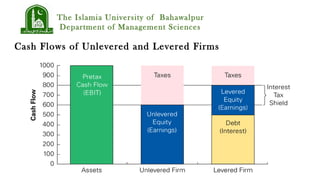
Cash Flows of Unlevered and Levered Firms
The Islamia University of Bahawalpur
Department of Management Sciences
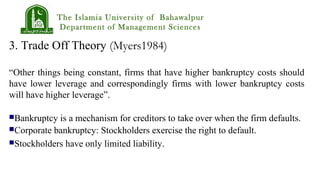
3. Trade Off Theory (Myers1984)
“Other things being constant, firms that have higher bankruptcy costs should
have lower leverage and correspondingly firms with lower bankruptcy costs
will have higher leverage”.
Bankruptcy is a mechanism for creditors to take over when the firm defaults.
Corporate bankruptcy: Stockholders exercise the right to default.
Stockholders have only limited liability.
The Islamia University of Bahawalpur
Department of Management Sciences
The Islamia University of Bahawalpur
Department of Management Sciences
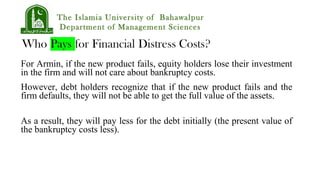
For Armin, if the new product fails, equity holders lose their investment
in the firm and will not care about bankruptcy costs.
However, debt holders recognize that if the new product fails and the
firm defaults, they will not be able to get the full value of the assets.
As a result, they will pay less for the debt initially (the present value of
the bankruptcy costs less).
The Islamia University of Bahawalpur
Department of Management Sciences
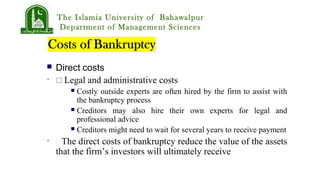
 Direct costs
•  Legal and administrative costs
 Costly outside experts are often hired by the firm to assist with
the bankruptcy process
 Creditors may also hire their own experts for legal and
professional advice
 Creditors might need to wait for several years to receive payment
• The direct costs of bankruptcy reduce the value of the assets
that the firm’s investors will ultimately receive
The Islamia University of Bahawalpur
Department of Management Sciences
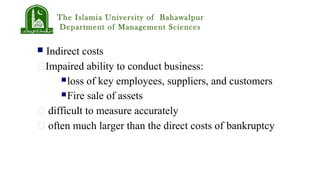
 Indirect costs
Impaired ability to conduct business:
loss of key employees, suppliers, and customers
Fire sale of assets
 difficult to measure accurately
 often much larger than the direct costs of bankruptcy
The Islamia University of Bahawalpur
Department of Management Sciences
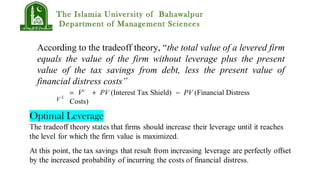
According to the tradeoff theory, “the total value of a levered firm
equals the value of the firm without leverage plus the present
value of the tax savings from debt, less the present value of
financial distress costs”
= VU
+ PV (Interest Tax Shield) − PV (Financial Distress
Costs)V L
The Islamia University of Bahawalpur
Department of Management Sciences
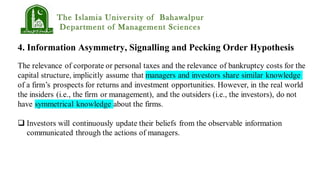
4. Information Asymmetry, Signalling and Pecking Order Hypothesis
The Islamia University of Bahawalpur
Department of Management Sciences
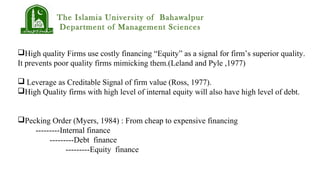
High quality Firms use costly financing “Equity” as a signal for firm’s superior quality.
It prevents poor quality firms mimicking them.(Leland and Pyle ,1977)
 Leverage as Creditable Signal of firm value (Ross, 1977).
High Quality firms with high level of internal equity will also have high level of debt.
Pecking Order (Myers, 1984) : From cheap to expensive financing
---------Internal finance
---------Debt finance
---------Equity finance
The Islamia University of Bahawalpur
Department of Management Sciences
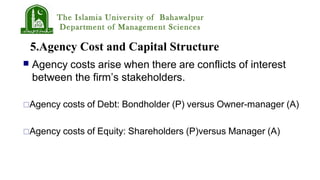
5.Agency Cost and Capital Structure
 Agency costs arise when there are conflicts of interest
between the firm’s stakeholders.
Agency costs of Debt: Bondholder (P) versus Owner-manager (A)
Agency costs of Equity: Shareholders (P)versus Manager (A)
The Islamia University of Bahawalpur
Department of Management Sciences
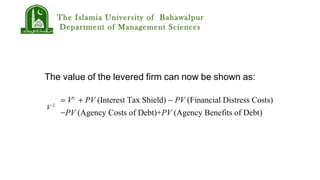
The value of the levered firm can now be shown as:
= VU
+ PV (Interest Tax Shield) − PV (Financial Distress Costs)
−PV (Agency Costs of Debt)+PV (Agency Benefits of Debt)
V L
The Islamia University of Bahawalpur
Department of Management Sciences
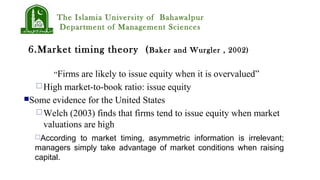
6.Market timing theory (Baker and Wurgler , 2002)
“Firms are likely to issue equity when it is overvalued”
High market-to-book ratio: issue equity
Some evidence for the United States
Welch (2003) finds that firms tend to issue equity when market
valuations are high
According to market timing, asymmetric information is irrelevant;
managers simply take advantage of market conditions when raising
capital.
The Islamia University of Bahawalpur
Department of Management Sciences
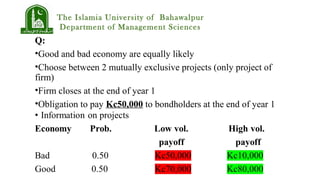
Q:
•Good and bad economy are equally likely
•Choose between 2 mutually exclusive projects (only project of
firm)
•Firm closes at the end of year 1
•Obligation to pay Kc50,000 to bondholders at the end of year 1
The Islamia University of Bahawalpur
Department of Management Sciences
The Islamia University of Bahawalpur
Department of Management Sciences
The Islamia University of Bahawalpur
Department of Management Sciences
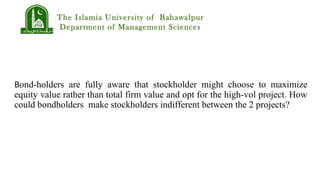
Bond-holders are fully aware that stockholder might choose to maximize
equity value rather than total firm value and opt for the high-vol project. How
could bondholders make stockholders indifferent between the 2 projects?

Capital structure theories ii

  • 1.
    Capital Structure Theories Muhammadshahbaz khan +92303-9409486 The Islamia University of Bahawalpur Department of Management Sciences
  • 2.
    The Islamia Universityof Bahawalpur Department of Management Sciences Cash Flows of Unlevered and Levered Firms
  • 3.
    The Islamia Universityof Bahawalpur Department of Management Sciences 3. Trade Off Theory (Myers1984) “Other things being constant, firms that have higher bankruptcy costs should have lower leverage and correspondingly firms with lower bankruptcy costs will have higher leverage”. Bankruptcy is a mechanism for creditors to take over when the firm defaults. Corporate bankruptcy: Stockholders exercise the right to default. Stockholders have only limited liability.
  • 4.
    The Islamia Universityof Bahawalpur Department of Management Sciences
  • 5.
    The Islamia Universityof Bahawalpur Department of Management Sciences For Armin, if the new product fails, equity holders lose their investment in the firm and will not care about bankruptcy costs. However, debt holders recognize that if the new product fails and the firm defaults, they will not be able to get the full value of the assets. As a result, they will pay less for the debt initially (the present value of the bankruptcy costs less).
  • 6.
    The Islamia Universityof Bahawalpur Department of Management Sciences  Direct costs •  Legal and administrative costs  Costly outside experts are often hired by the firm to assist with the bankruptcy process  Creditors may also hire their own experts for legal and professional advice  Creditors might need to wait for several years to receive payment • The direct costs of bankruptcy reduce the value of the assets that the firm’s investors will ultimately receive
  • 7.
    The Islamia Universityof Bahawalpur Department of Management Sciences  Indirect costs Impaired ability to conduct business: loss of key employees, suppliers, and customers Fire sale of assets  difficult to measure accurately  often much larger than the direct costs of bankruptcy
  • 8.
    The Islamia Universityof Bahawalpur Department of Management Sciences According to the tradeoff theory, “the total value of a levered firm equals the value of the firm without leverage plus the present value of the tax savings from debt, less the present value of financial distress costs” = VU + PV (Interest Tax Shield) − PV (Financial Distress Costs)V L
  • 9.
    The Islamia Universityof Bahawalpur Department of Management Sciences 4. Information Asymmetry, Signalling and Pecking Order Hypothesis
  • 10.
    The Islamia Universityof Bahawalpur Department of Management Sciences High quality Firms use costly financing “Equity” as a signal for firm’s superior quality. It prevents poor quality firms mimicking them.(Leland and Pyle ,1977)  Leverage as Creditable Signal of firm value (Ross, 1977). High Quality firms with high level of internal equity will also have high level of debt. Pecking Order (Myers, 1984) : From cheap to expensive financing ---------Internal finance ---------Debt finance ---------Equity finance
  • 11.
    The Islamia Universityof Bahawalpur Department of Management Sciences 5.Agency Cost and Capital Structure  Agency costs arise when there are conflicts of interest between the firm’s stakeholders. Agency costs of Debt: Bondholder (P) versus Owner-manager (A) Agency costs of Equity: Shareholders (P)versus Manager (A)
  • 12.
    The Islamia Universityof Bahawalpur Department of Management Sciences The value of the levered firm can now be shown as: = VU + PV (Interest Tax Shield) − PV (Financial Distress Costs) −PV (Agency Costs of Debt)+PV (Agency Benefits of Debt) V L
  • 13.
    The Islamia Universityof Bahawalpur Department of Management Sciences 6.Market timing theory (Baker and Wurgler , 2002) “Firms are likely to issue equity when it is overvalued” High market-to-book ratio: issue equity Some evidence for the United States Welch (2003) finds that firms tend to issue equity when market valuations are high According to market timing, asymmetric information is irrelevant; managers simply take advantage of market conditions when raising capital.
  • 14.
    The Islamia Universityof Bahawalpur Department of Management Sciences Q: •Good and bad economy are equally likely •Choose between 2 mutually exclusive projects (only project of firm) •Firm closes at the end of year 1 •Obligation to pay Kc50,000 to bondholders at the end of year 1
  • 15.
    The Islamia Universityof Bahawalpur Department of Management Sciences
  • 16.
    The Islamia Universityof Bahawalpur Department of Management Sciences
  • 17.
    The Islamia Universityof Bahawalpur Department of Management Sciences Bond-holders are fully aware that stockholder might choose to maximize equity value rather than total firm value and opt for the high-vol project. How could bondholders make stockholders indifferent between the 2 projects?